Smart Home & PropTech Guide for Singapore Homeowners 2026: Digital Locks, Costs and Does It Boost Resale Value

Smart Home & PropTech Guide for Singapore Homeowners 2026: Digital Locks, Costs and Does It Boost Resale Value

Quick Answer: Smart Home and PropTech in Singapore

  • Singapore has one of the highest smart home adoption rates in Asia, supported by a tech-comfortable population, high household income, and the Government’s own Smart Nation initiative.
  • Singapore’s smart home appliances market was valued at roughly US$160 million in 2024 and is projected to reach around US$440 million by 2033, a compound annual growth rate of about 11.9%.
  • Digital door locks have moved from an early-adopter novelty to a near-standard feature, appearing across new BTO flats in estates like Tengah and Bidadari as well as resale flats in established towns such as Tampines and Jurong.
  • Digital locks and smart gates must still comply with the Singapore Civil Defence Force (SCDF) Fire Code, which requires that main gates and locking mechanisms do not impede rapid evacuation or firefighter access during an emergency.
  • Installation costs range widely: a budget or DIY setup can cost a few hundred dollars, while a professionally installed mid-tier system for a 3 or 4-room flat typically runs S$3,000 to S$6,000.
  • The impact on resale value is real but modest: a “smart-ready” home is a genuine selling point that can widen buyer interest, particularly among younger, tech-comfortable buyers, but it rarely commands a measurable price premium on its own.
  • PropTech more broadly, covering digital property search, transaction and management tools, has made the buying, selling and renting process faster, though the fundamentals of due diligence and legal process remain unchanged.

What “Smart Home” and “PropTech” Actually Mean in Singapore

PropTech, short for property technology, is a broad umbrella covering any digital tool that changes how people search for, transact, finance or manage property, from listing portals and virtual tours through to e-conveyancing platforms and digital mortgage applications. Smart home technology is a narrower subset focused specifically on the physical home itself: internet-connected devices such as digital locks, smart lighting, air-conditioning controllers, security cameras and voice assistants that residents can monitor and control remotely, usually through a smartphone app or a central hub.

Singapore is unusually well positioned for both. High smartphone penetration, near-universal home broadband, and a Government that has actively promoted smart living through BTO flat infrastructure and the wider Smart Nation programme have combined to push smart home technology well beyond early-adopter territory. By 2026, choosing whether to add smart features has become a mainstream part of renovation planning for many homeowners, alongside more traditional choices like flooring and kitchen layout.
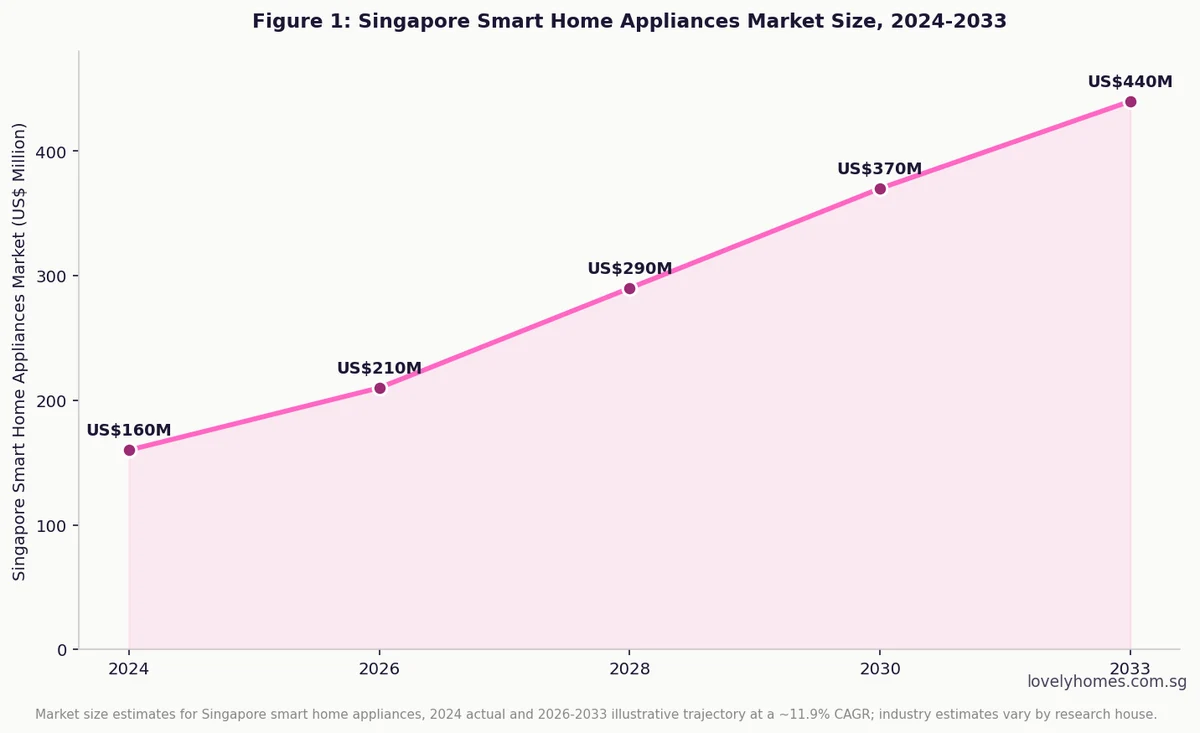
Singapore smart home appliances market size 2024 to 2033
Figure 1: Singapore’s smart home appliances market size, 2024 to 2033.

Digital Locks: The Most Common Starting Point, and the SCDF Rules That Apply

For most homeowners, a digital door lock is the entry point into smart home technology, and by 2026 it has become close to a default choice rather than a novelty upgrade. Modern digital locks typically offer a combination of fingerprint biometrics, facial recognition, PIN codes, RFID key cards and mobile app unlocking, along with features such as temporary guest access codes and break-in alarms. They appear as a standard fitting across many new BTO flats and are one of the most common single upgrades made by owners of older resale flats.

Homeowners should be aware that digital locks, and especially any accompanying smart gate or grille, remain subject to the Singapore Civil Defence Force (SCDF) Fire Code, which sets clear requirements to ensure a home’s main entrance does not impede rapid evacuation in a fire or block firefighter access to the unit. In practice, this means any digital gate or grille installed alongside a digital lock needs a mechanism that allows quick manual release from inside the home, even if the electronic system fails or loses power. Homeowners should check that any product and installer they use is compliant with current SCDF guidelines before installation, particularly for HDB flats where the main gate is part of the shared building’s fire safety plan.

Beyond the Lock: Building Out a Smart Home System

Once a digital lock is in place, the next most common additions are smart lighting and air-conditioning control, typically coordinated through a central hub using a wireless protocol such as Zigbee, which allows multiple devices from different brands to be controlled from a single app or voice assistant. Security cameras, video doorbells and leak or smoke sensors round out a typical mid-tier installation, giving homeowners remote visibility into their flat while away, whether checking that the stove was switched off or keeping an eye on an elderly parent or a pet.

At the premium end, full home automation extends this further to motorised curtains, integrated whole-home audio, and centralised control panels that manage every connected device from a single interface, often installed as part of a broader renovation rather than as a standalone project. The right tier for any given household depends on budget, how much of the work is done during an existing renovation versus retrofitted afterwards, and how much day-to-day convenience the household genuinely wants from automation versus simple manual control.
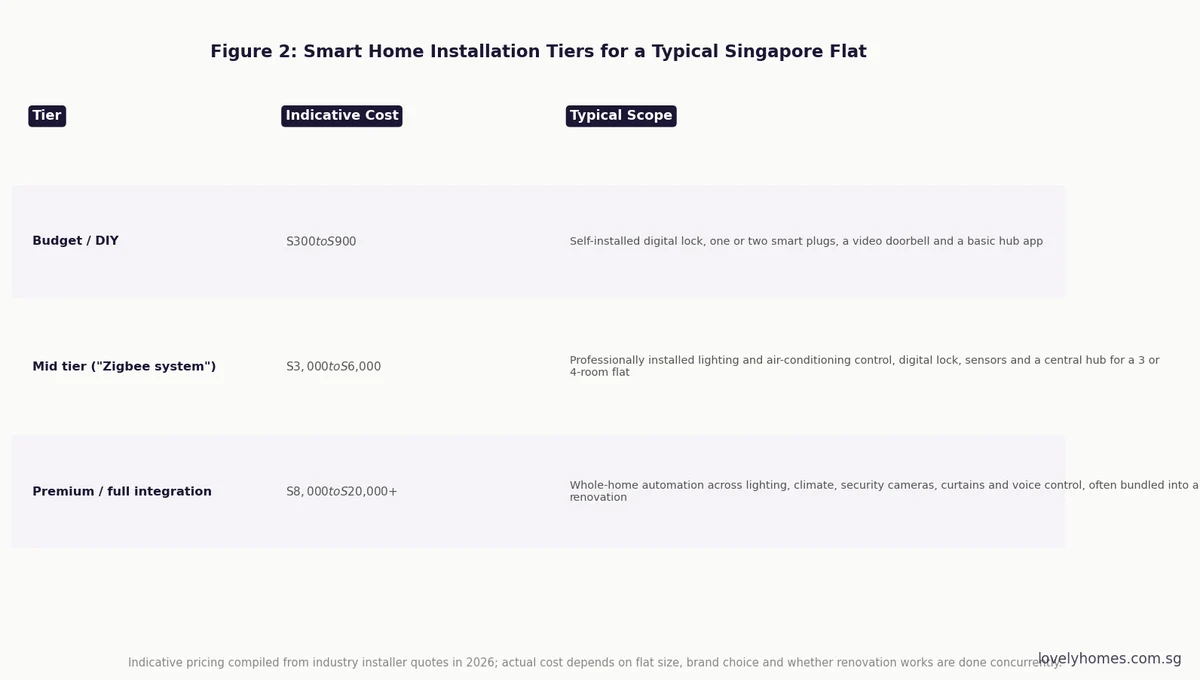
Smart home installation cost tiers Singapore 2026
Figure 2: Smart home installation cost tiers for a typical Singapore flat.

Does a Smart Home Actually Boost Resale Value?

This is the question most homeowners considering an investment in smart technology actually want answered, and the honest response is nuanced. A “smart-ready” home is a genuine selling point in 2026, and can help a listing stand out and draw stronger interest, particularly from younger, tech-comfortable buyers who increasingly expect at least a digital lock as standard. However, the direct impact on the final transacted price is modest: the cost of installing smart devices is generally small relative to the overall value of the property, and buyers who appreciate the technology are not necessarily willing to pay a specific dollar premium for it, especially since most smart devices can be added relatively cheaply and quickly by a new owner after purchase if they are not already present.

Where smart home technology does deliver clearer, quantifiable value is in ongoing running costs and convenience rather than resale price: smart lighting and air-conditioning control can meaningfully reduce electricity usage over time through scheduling and automatic shut-off, and security features provide genuine peace of mind that has value to the occupant even if it does not show up as a specific line item in a valuation report.

Summary: Smart Home and PropTech Facts at a Glance

Question Short Answer
How big is Singapore’s smart home market? Around US$160 million in 2024, projected to reach roughly US$440 million by 2033.
What is the most common first smart home upgrade? A digital door lock, now close to standard across new BTO flats and a common resale flat retrofit.
Do digital locks have to meet fire safety rules? Yes, SCDF Fire Code rules require quick manual release for rapid evacuation and firefighter access.
How much does a mid-tier smart home system cost? Roughly S$3,000 to S$6,000 for a professionally installed system in a 3 or 4-room flat.
Does smart home tech raise resale price? It widens buyer appeal but rarely commands a specific measurable price premium on its own.
What is PropTech, more broadly? Digital tools covering property search, transactions, financing and management, distinct from in-home smart devices.

Worked Example: Retrofitting a 4-Room HDB Flat

The household: Ms Wong owns a 4-room resale flat in an established estate and wants a mid-tier smart home retrofit alongside a planned renovation, without going as far as full whole-home automation.

The build-out: she installs a digital lock at approximately S$450, smart lighting across the living room and bedrooms at approximately S$900, smart air-conditioning control at approximately S$700, and a central hub tying the system together at approximately S$350, with professional installation labour adding a further S$600. The total comes to approximately S$3,000, sitting at the lower end of the mid-tier cost range.

What she gets in return: immediate convenience and security from the digital lock and lighting control, an estimated modest reduction in her air-conditioning electricity usage from scheduling and automatic shut-off, and a flat that, should she sell it later, presents as modern and well-equipped to prospective buyers, even though this alone is unlikely to add a specific measurable premium to her eventual asking price.

These figures are illustrative only; actual costs depend on the brands chosen, the flat’s existing wiring, and whether the work is bundled into a larger renovation project.
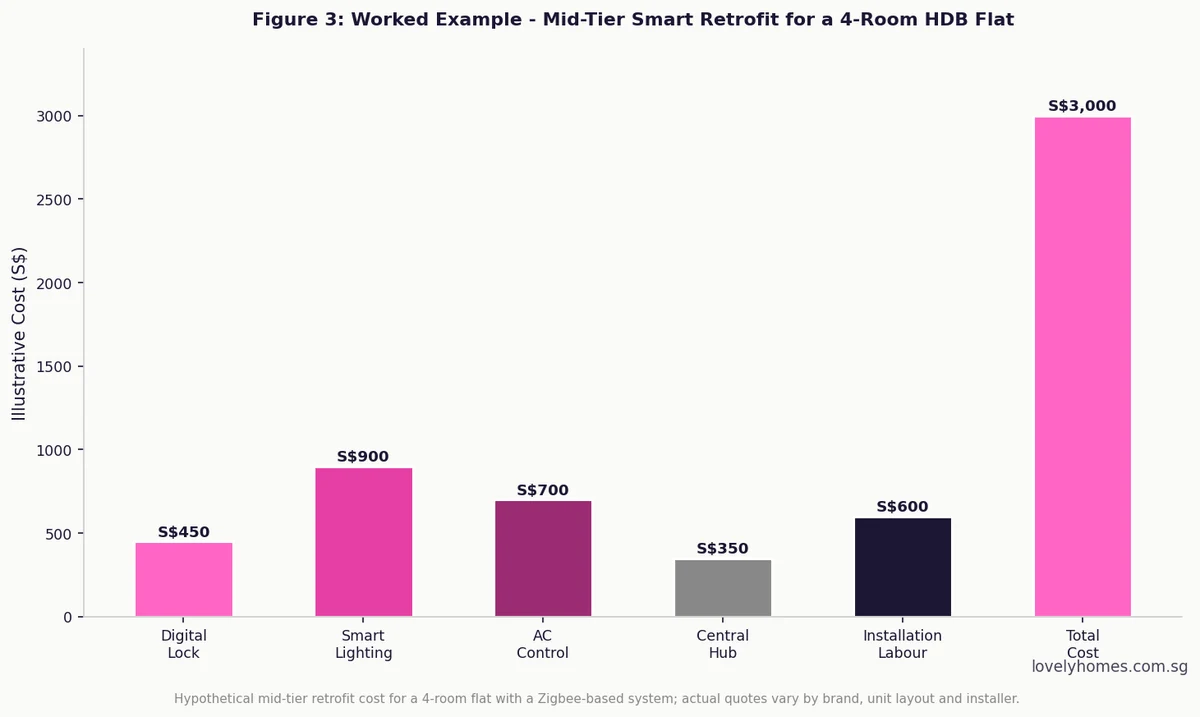
Worked example smart home retrofit cost 4-room HDB flat Singapore
Figure 3: Worked example, mid-tier smart retrofit cost for a 4-room HDB flat.

Why This Matters for Homeowners, Buyers and Landlords

For owner-occupiers, smart home technology is best thought of as a genuine quality-of-life investment rather than a resale strategy in itself: the convenience, security and running-cost benefits accrue to whoever lives in the home day to day, and any resale appeal is a secondary bonus rather than the primary reason to install it. For landlords, offering a unit with at least a digital lock and basic smart features can help a listing stand out in a crowded rental market, since it signals a well-maintained, modern property without requiring a large capital outlay. For buyers evaluating two otherwise comparable homes, existing smart home features are a pleasant convenience worth factoring into a decision, but should not be weighted too heavily relative to more fundamental considerations such as location, remaining lease and layout, since most smart devices can always be added later at relatively modest cost.

What Might Come Next

The following is informed speculation, not confirmed policy. As Singapore’s Smart Nation initiatives continue to mature, it is plausible that future BTO developments come pre-wired for smart home integration at a more comprehensive level than today, reducing retrofit costs for new owners from the outset. Continued growth in AI-assisted home security, including smarter anomaly detection from connected cameras and sensors, is also a plausible direction for the market given the pace of investment already seen in Singapore’s broader smart home sector, though the specific products and timelines are not yet confirmed.

Frequently Asked Questions

Is a digital lock allowed on an HDB main door and gate?

Yes, digital locks are widely used on HDB doors and gates, but any accompanying digital gate or grille must still comply with SCDF Fire Code requirements for rapid manual release during an emergency.

What is the cheapest way to start with smart home technology?

A budget or DIY approach, typically a self-installed digital lock, a smart plug or two and a video doorbell, can cost a few hundred dollars and still deliver meaningful convenience and security.

Will installing smart home devices increase my flat’s valuation?

Not in a formal valuation sense; bank and HDB valuations are based primarily on comparable transactions, not individual fittings, though smart features can support buyer interest and a faster sale.

Can I mix smart home brands, or do I need to stick to one ecosystem?

Many homeowners mix brands successfully using a shared wireless protocol such as Zigbee and a central hub or voice assistant that supports cross-brand control, though checking compatibility before purchase avoids frustration later.

Is PropTech the same as smart home technology?

No. PropTech is the broader category covering digital property search, transaction and management tools, while smart home technology refers specifically to connected devices inside the physical home.

Do smart home devices actually reduce electricity bills?

Smart lighting and air-conditioning scheduling can meaningfully reduce usage over time through automatic shut-off and optimised settings, though actual savings depend on household habits and existing appliance efficiency.

Should I install smart home features before selling my flat?

A basic digital lock can help a listing feel modern and well maintained, but a large smart home investment purely to boost sale price is unlikely to be recovered dollar-for-dollar, so it is better justified by your own convenience while living there.

Disclaimer: This article is for general informational purposes only and does not constitute engineering, safety or investment advice. Market size figures, cost ranges and adoption trends are illustrative and drawn from industry estimates that vary by research house. Always check current Singapore Civil Defence Force (SCDF) fire safety requirements before installing any digital lock or gate, and engage a licensed installer for any electrical work.
×

Click anywhere outside to close
Singapore Home Staging Guide 2026: How to Stage Your Property to Sell Faster and for More

Singapore Home Staging Guide 2026: How to Stage Your Property to Sell Faster and for More

Home staging — the art of presenting a property at its most attractive to prospective buyers — is one of the highest-return, lowest-risk investments a seller in Singapore can make before listing. In a market where buyers have more choice in 2026 than at any point since 2016, first impressions are not merely useful; they are often the deciding factor between a swift sale at or above valuation and a listing that sits on the market for months, accumulating perception of stigma.

This guide covers the full spectrum: from the quick, low-cost interventions that deliver outsized returns, to the staging philosophy that matches presentation to the buyer profile most likely to be viewing your property. Whether you are selling a 3-room HDB flat in Toa Payoh or a S$3 million penthouse in the Core Central Region, the principles are the same — buyers do not buy properties, they buy how they feel when they walk through the door.

Quick Answer — Singapore Home Staging at a Glance

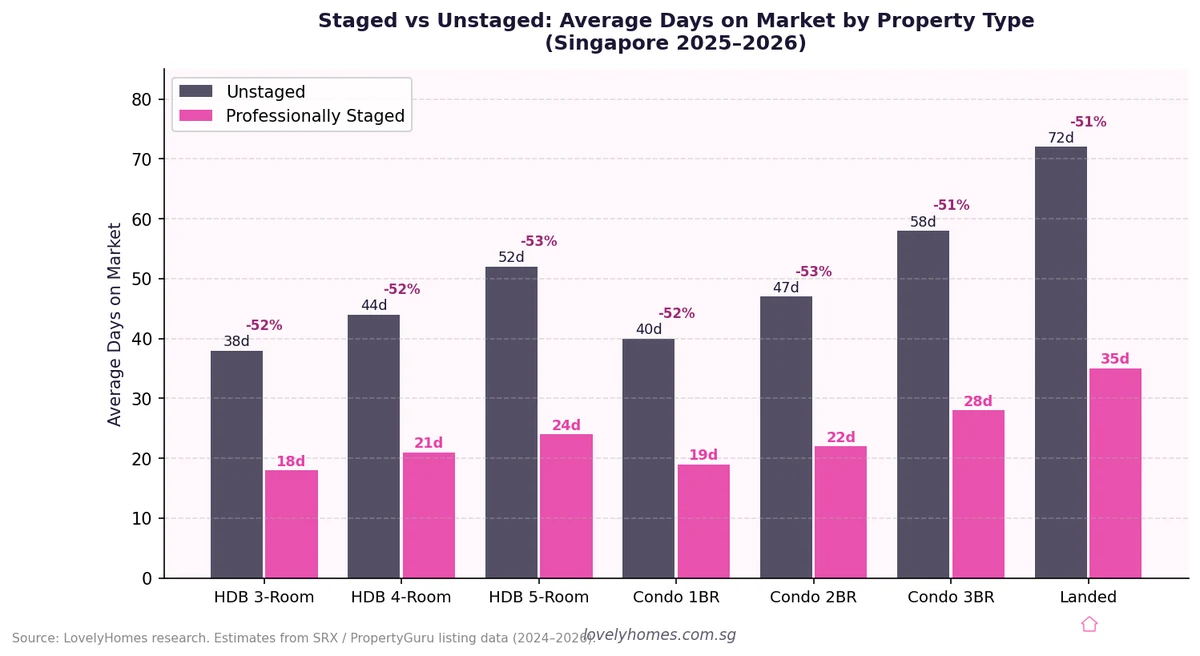
  • Staged homes in Singapore sell on average 40–55% faster than unstaged equivalents across all property types
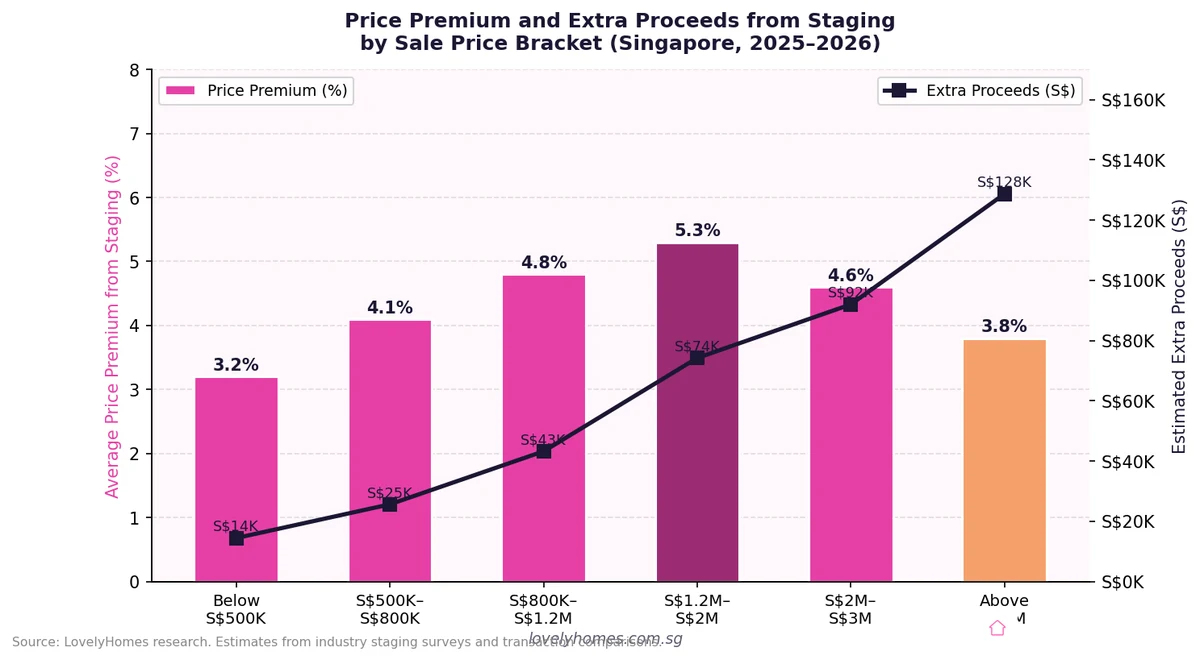
  • Professional staging can achieve a 3–5% price premium, equivalent to S$30,000–S$74,000 on a S$1–S$1.5M sale
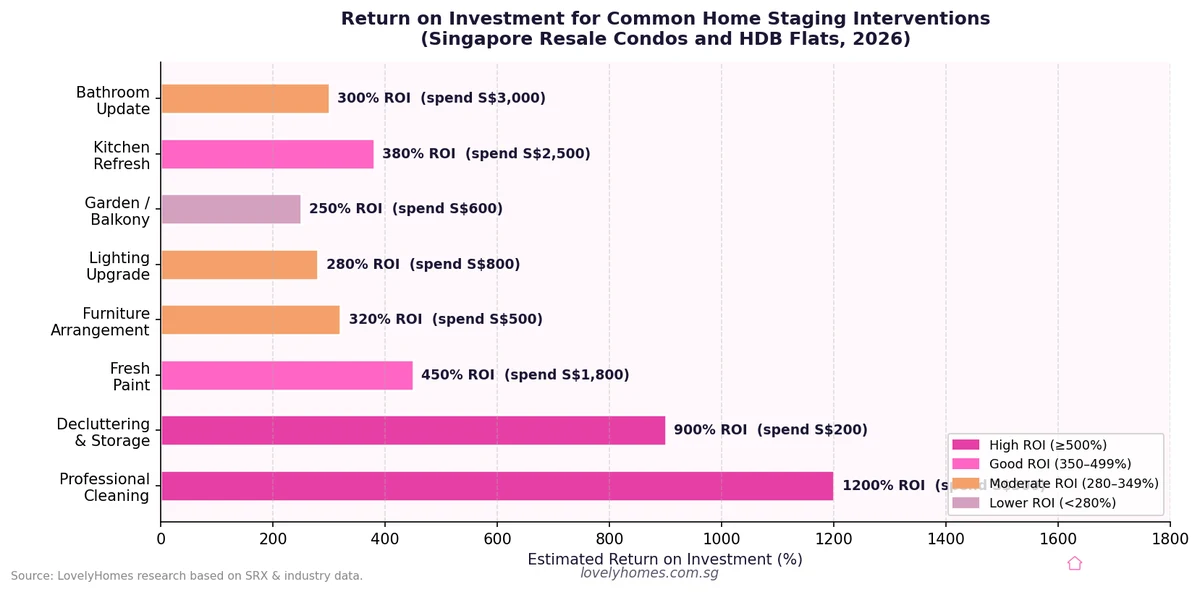
  • The highest-ROI interventions: professional cleaning (1,200% ROI), decluttering and storage (900%), fresh neutral paint (450%)
  • Common mistakes: over-personalising, ignoring the entrance, leaving obvious defects unaddressed, and staging for the wrong buyer profile
  • Cost range: S$800 (DIY clean/declutter) to S$8,000 (full professional staging); budget S$2,500–S$4,500 for a typical 3-room HDB or small condo
  • HDB sellers: ensure you have satisfied the MOP before listing; staging does not trigger any HDB restriction

What Is Home Staging and Why Does It Work?

Home staging is the deliberate preparation of a residential property for sale, with the goal of appealing to the widest possible pool of buyers and maximising perceived value. It is distinct from renovation: renovation improves the physical property; staging manages how the existing property is experienced.

It works because residential property purchases are driven far more by emotion than buyers typically acknowledge. Research consistently shows that buyers form their primary impression of a home within 8 seconds of walking through the door, and that impression disproportionately anchors their valuation and negotiating behaviour. A cluttered, poorly lit, or personalised home suppresses a buyer’s ability to imagine themselves living there, which in turn suppresses their willingness to pay the asking price or move quickly.

In Singapore’s 2026 market — where resale condo and HDB listings have increased as completions add supply — buyers have the luxury of viewing multiple properties before deciding. A well-staged home stands out not because it hides defects (buyers will see those at the survey), but because it creates an emotional connection that unstaged competitors cannot replicate.

Home staging ROI by intervention type Singapore 2026 horizontal bar chart
Figure 1: Return on investment for common home staging interventions. Professional cleaning and decluttering deliver the highest ROI for the lowest outlay; kitchen and bathroom updates cost more but still return multiples of their spend.

The 8 Staging Interventions That Deliver the Best Returns

Not all staging effort is equal. The chart above illustrates the return on investment of the most common staging interventions for Singapore resale condos and HDB flats. Here is what each intervention involves and what drives its return.

1. Professional Deep Cleaning (ROI: approx. 1,200%)

Cost: S$200–S$400 for a typical condo or HDB. A professionally cleaned home signals to buyers that it has been well maintained. Clean kitchens, spotless bathrooms, and streak-free windows remove the psychological barrier of “I would have to clean this before I could live here.” Grout cleaning, aircon coil servicing, and exhaust hood degreasing are the highest-impact specifics. This is the single highest-return staging investment available to any Singapore seller.

2. Decluttering and Storage (ROI: approx. 900%)

Cost: S$150–S$250 (skip hire or self-storage for 1–2 months). Clutter reduces the perceived size of a room and tells buyers the property has insufficient storage. Remove at least one-third of existing furniture and personal items; pack family photographs, trophies, certificates, and religious items into temporary storage. Buyers need to see themselves in the space, not you. In Singapore, where square footage is expensive, the “space” a buyer perceives is as important as the actual floor area.

3. Fresh Neutral Paint (ROI: approx. 450%)

Cost: S$1,500–S$2,500 for a full HDB 4-room repaint by a professional. Fresh paint in a neutral palette — warm whites, soft greiges, pale sage — makes every room appear cleaner, brighter, and more recently refurbished. It also allows buyers to project their own colour preferences onto the space. Bold or highly personalised colour choices — however attractive to the current owner — narrow the buyer pool and can trigger price negotiations.

4. Furniture Arrangement (ROI: approx. 320%)

Cost: S$500 (staging consultant fee, 2–3 hour visit). Most people arrange their furniture for personal convenience rather than photogenic impact. A staging consultant will reposition sofas, coffee tables, and dining sets to maximise sightlines, create clear traffic flow, and make the main living area photograph well for online listings. In a market where over 80% of buyer search journeys begin online, how a room looks in a photograph drives viewing rates as much as price.

5. Lighting Upgrade (ROI: approx. 280%)

Cost: S$600–S$1,000. Singapore’s common-spec ceiling lights are functional but rarely flattering. Replacing recessed lights with warm-white LEDs (2,700–3,000K colour temperature), adding table lamps in the living and master bedroom, and ensuring all blown bulbs are replaced creates an ambiance that makes the home feel warm and inviting rather than institutional. During viewings and photography sessions, turn on every light in the property.

Staged vs unstaged average days on market Singapore property types 2026
Figure 2: Staged properties sell significantly faster across all property types. The reduction in days on market ranges from 40% for HDB 3-rooms to 51% for landed homes.

Room-by-Room Staging Priorities

Not every room carries equal weight in a buyer’s decision. Research from Singapore property transactions identifies the following hierarchy:

Room / Area Buyer Impact Key Actions Budget
Front door and entrance Very High Fresh paint on door, clean letterbox, shoe rack out of sight, fresh mat S$50–S$200
Living room Very High Declutter, rearrange furniture, neutral throw cushions, single potted plant S$150–S$500
Kitchen High Clear all countertops, deep clean, replace cabinet handles if dated S$200–S$800
Master bedroom High Fresh white bedlinen, clear bedside tables, remove all personal photos S$100–S$400
Bathrooms High Re-grout tiles, replace shower curtain, fresh white towels, clear counter S$200–S$600
Balcony / yard Medium Clear clutter, wash floor, one or two potted plants, small seating set S$100–S$400
Second bedrooms Medium Remove excess furniture, clear wardrobes to 50%, fresh bed linen S$50–S$150

Photography: The Often-Ignored Staging Multiplier

In Singapore’s property market, where listings on platforms such as PropertyGuru and 99.co compete for buyer attention through thumbnail images, professional photography is not optional — it is the staging element with the highest reach. A staged home photographed on a smartphone in natural light is still a competitively disadvantaged listing. Professional real estate photography typically costs S$200–S$400 and produces images that increase listing click-through rates by an estimated 30–40% relative to amateur photography.

Key photography staging rules: shoot during the golden hour (late afternoon for most Singapore orientations), turn on all lights, open all curtains, remove all visible rubbish bins and toilet rolls, and shoot from corners to maximise the perceived room depth. A virtual tour or 360-degree Matterport scan — available from specialist Singapore property photographers for S$300–S$600 — further increases qualified viewing rates by filtering in buyers who are genuinely interested in the layout before they visit in person.

Home staging price premium and extra proceeds by sale price bracket Singapore 2026
Figure 3: The price premium from staging peaks at 5.3% for properties in the S$1.2M–S$2M bracket, translating to an average S$74,200 in additional proceeds on a S$1.5M sale.

Worked Example: Staging a S$1.4M OCR Condo for Sale

Mr and Mrs Tan own a 2BR condo in Jurong East that they purchased in 2019 for S$980,000. Current market value is approximately S$1.4 million. They are planning to sell in September 2026 to fund an upgrade. Their staging budget: S$4,500.

Staging Item Cost Action
Professional deep clean S$380 Full unit including aircon coils and grout
Declutter and self-storage (2 months) S$280 Remove 40% of furniture; pack personal items
Repaint (full unit, neutral warm white) S$2,100 Replace dated beige walls and feature navy wall
New bedlinen, cushions, neutral towels S$450 Fresh, hotel-style presentation
Lighting refresh (warm-white LEDs) S$620 Replace 18 ceiling lights and add 2 table lamps
Professional photography + Matterport S$580 24 HDR images plus 360-degree virtual tour
Total staging investment S$4,410 Well within budget

At a 4.8% price premium (the estimated staging premium for S$1.2M–S$2M properties), the additional sale proceeds would be approximately S$67,200 on a S$1.4 million sale. For an outlay of S$4,410, that represents a return of over 15 times the investment. Even at half that premium (2.4%), the extra proceeds of S$33,600 still deliver a 7.6x return on staging spend. In a market where the gap between listed price and achieved price can easily exceed the cost of staging, not staging is the more expensive choice.

What Might Come Next: Staging in a Buyer’s Market

With Singapore’s private residential vacancy rate at approximately 9.2% in mid-2026 and more supply completing through 2027, the property market is shifting towards buyers having greater choice. In a buyer’s market, presentation differentiates properties that sell quickly at asking price from those that either receive low-ball offers or sit unsold. The imperative to stage well is higher in 2026 than it was in 2021 or 2022, when most properties sold with minimal preparation because demand exceeded supply. Sellers who present their properties to the standard described in this guide will command a meaningful advantage in the next 12 to 18 months.

Frequently Asked Questions

Do I need to use a professional staging company in Singapore?

Not necessarily. For HDB flats and smaller condos in the OCR, a thorough DIY staging — deep cleaning, decluttering, repainting in a neutral colour, fresh bedlinen, and good photography — can achieve most of the available gain at a fraction of the cost of a professional staging service. Professional staging companies (which typically charge S$2,000–S$6,000 for a full service including furniture hire) add the most value for larger, higher-priced properties (above S$1.5 million) where the cost is proportionally small relative to the potential price premium, and where the buyer pool includes discerning high-net-worth individuals who compare multiple premium listings simultaneously.

Should I disclose defects before staging?

Staging is not concealment. Under Singapore law, sellers of property have a duty to disclose latent defects — material defects that are not apparent upon reasonable inspection — and failure to do so can expose the seller to claims for misrepresentation or breach of contract even after completion. Staging should enhance the presentation of a well-maintained property, not mask defects that a buyer would find material. Addressing defects before listing (where cost-effective) is both ethically correct and commercially rational: buyers who discover problems during the survey period frequently use them as leverage for renegotiation, eroding the price premium that staging was designed to create.

Can I stage an occupied property in Singapore?

Yes, and in fact most Singapore resale transactions involve staging occupied properties. The key is disciplined decluttering: remove everything that is not serving a presentation purpose and store it off-site. Living with a staged property during the marketing period requires compromise — maintaining the cleaning standard, keeping surfaces clear, and making the bed every morning before any viewing. For families with children or pets, this is manageable for a marketing period of 4–8 weeks. If you are renting the property out while marketing it, coordinate with your tenant well in advance: under Singapore law, tenants have a right to quiet enjoyment, and viewings must be agreed in the tenancy agreement or by separate arrangement.

What is the biggest staging mistake Singapore sellers make?

Over-personalisation is the most common and most costly mistake. Sellers who present their property as a reflection of their own life — displaying family photographs, personal collections, religious iconography, and idiosyncratic colour choices — are effectively telling buyers “this is my home, not yours.” The goal of staging is to present a lifestyle aspiration that the target buyer can project themselves into. The second most common mistake is neglecting the entrance: the front door, letterbox, and short corridor leading to the main living area are the first thing every buyer sees, and a disproportionate amount of their subconscious evaluation happens in those first three to five seconds. A cracked letter box, a scratched door, or a cluttered shoe rack at the entrance quietly signals poor maintenance of the entire property.

How long does staging take before listing in Singapore?

A realistic timeline for a thorough staging programme for a typical 3–4-room HDB or 2BR condo in Singapore is three to four weeks: one week for decluttering and organising storage, one to two weeks for repainting (if required), two to three days for deep cleaning and final furniture arrangement, and one day for photography. Rushing the process — listing before the paint has dried or before the decluttering is complete — produces inferior photographs and diminishes the impact of the staging investment. Budget for a four-week preparation window before your target listing date.

Does staging work for HDB flats in Singapore, or mainly for condos?

Staging is as effective for HDB resale flats as for condos, and arguably delivers a higher proportional impact at the lower price point. The competitive set for an HDB 4-room in a mature estate like Toa Payoh or Queenstown in 2026 is significant: buyers have dozens of comparable listings to choose from. A well-cleaned, decluttered, and freshly painted HDB flat in a move-in-ready condition will transact faster and above valuation relative to an equivalent flat that presents as tired or dated. The same principles apply: neutral colours, maximum light, decluttered rooms, and professional photography. At an average HDB 4-room price of S$550K–S$700K in mature estates in 2026, a 3–4% premium translates to S$16,500–S$28,000 in additional proceeds from a total staging spend that need not exceed S$2,500.

Related Articles

Disclaimer: This article is for general information and educational purposes only. Staging cost and return estimates are based on Singapore industry research and comparable property data as at 14 August 2026 and will vary by property type, condition, location, and market conditions. This article does not constitute legal, financial, or property valuation advice. Always verify current market conditions through the URA and consult a licensed property professional before making any decision to sell.

Singapore HDB Renovation Guide 2026: Costs, Rules, Timeline and Grants

Singapore HDB Renovation Guide 2026: Costs, Rules, Timeline and Grants

Quick Answer — HDB Renovation 2026 at a glance

  • HDB flat owners may renovate only after receiving keys and HDB’s written consent for regulated works.
  • Total renovation budgets for a 4-room HDB flat typically range from S$30,000 to S$80,000 in 2026.
  • Works requiring HDB approval include wall hacking, toilet alterations, and carpentry; most require the contractor to be registered with HDB.
  • BTO flat owners face a Goodwill Repair Allowance from HDB (up to S$3,000 for defects) separate from renovation.
  • Enhanced Housing Grant (EHG), CPF Housing Grant (CHG), and the Step-Up CPF Housing Grant apply to the purchase price only — not renovation costs.
  • Interest-free Renovation Loans are available from banks (up to 6× monthly income, max S$30,000), repayable over 1–5 years.
  • Noise-producing work (drilling, hacking) is restricted to Mondays–Saturdays, 09:00–17:00 and prohibited on Sundays and public holidays.
  • The HDB renovation timeline typically runs 8–13 weeks from design to handover.

What Is an HDB Renovation?

An HDB renovation is any construction or alteration work carried out within a Housing and Development Board (HDB) flat after the owner takes possession of the keys. Unlike private condominiums, HDB flats are public housing units sold under a 99-year leasehold tenure by the Singapore government, and they come with a set of rules administered by HDB under the Housing and Development Act. These rules exist to preserve the structural integrity of public housing blocks, protect neighbouring residents, and ensure that any alterations meet safety standards.

Renovations range from purely cosmetic works — painting a wall or replacing light fittings — to comprehensive gut-renovations involving new flooring throughout, a full kitchen overhaul, bathroom retiling, and custom carpentry. The extent of the works, the type of contractor engaged, and the specific flat type (BTO, Resale, Executive, or DBSS) all affect what approvals you need, what restrictions apply, and how much you can expect to spend.

Who Governs HDB Renovation Rules?

Two agencies govern renovation rules in Singapore:

  • HDB (Housing and Development Board) — sets rules for HDB flats specifically: which works require its approval, which contractors must be registered under the Renovation Contractor Registration Scheme (RCRS), and restrictions on timing, materials, and structural alterations.
  • BCA (Building and Construction Authority) — issues Building Plan (BP) approvals for more significant structural changes, such as adding a new floor or significantly altering waterproofing layers.

For the majority of HDB renovations, HDB’s in-house approval suffices. You or your contractor can submit the application via HDB’s e-Services portal at hdb.gov.sg. Turnaround is typically 3–10 working days, though complex structural requests may take longer.

HDB renovation costs by work category 2026 Singapore
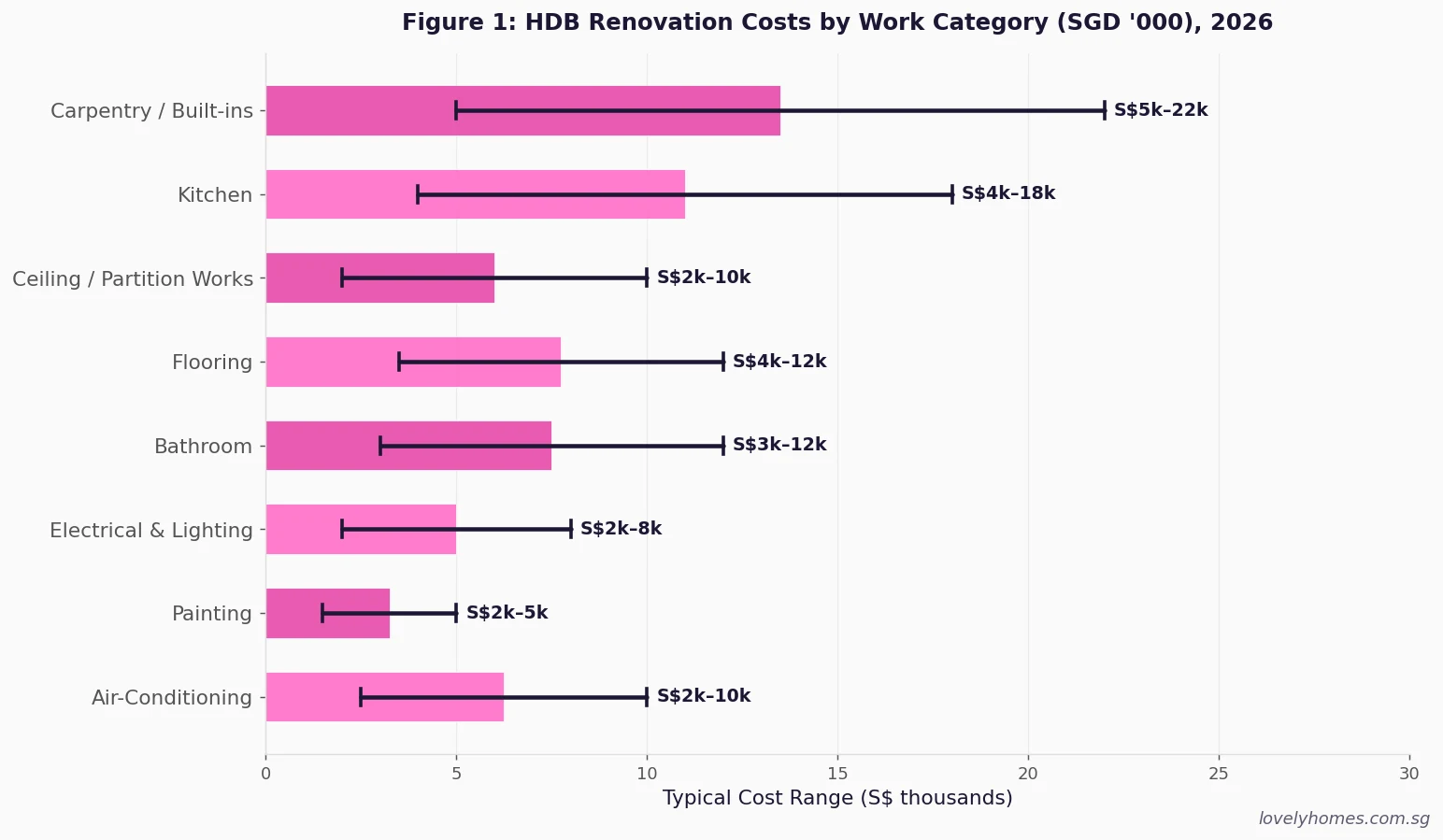
Figure 1: Typical HDB renovation cost ranges by work category, Singapore 2026. Costs vary by flat size, materials, and contractor.

HDB Renovation Cost Breakdown (2026)

Based on industry data compiled from HDB-registered renovation contractors and consumer surveys, the following cost ranges apply to a standard 4-room HDB flat (approximately 90 sq m) in 2026. These are starting estimates; final costs depend heavily on materials chosen (e.g., homogeneous tile vs. marble vs. engineered wood), the contractor’s labour rates, and the extent of defect rectification required.

Renovation Category Typical Range (4-room HDB) Key Cost Drivers
Flooring (all rooms) S$3,500–S$12,000 Material: vinyl vs. homogeneous tile vs. timber; area size
Carpentry & Built-ins S$5,000–S$22,000 Number of cabinets; solid wood vs. laminate; wardrobe sliding doors
Kitchen S$4,000–S$18,000 Cabinet type, countertop material (quartz vs. laminate), appliances
Bathroom(s) S$3,000–S$12,000 Number of bathrooms, fixture quality, waterproofing works
Electrical & Lighting S$2,000–S$8,000 Number of new points; LED downlights; smart switches
Painting (full flat) S$1,500–S$5,000 Paint grade; primer coat; feature wall treatment
Ceiling & Partitions S$2,000–S$10,000 False ceiling area; partition walls; skim-coat plastering
Air-Conditioning S$2,500–S$10,000 Number of fan coil units; brand (Daikin/Mitsubishi/Panasonic); inverter vs standard
Total (all-in, typical 4-room) S$30,000–S$80,000 Comprehensive renovation; excludes furniture and appliances

Source: Industry estimates, 2026. Costs are inclusive of GST (9%). HDB renovation loan covers up to S$30,000; amounts above require personal savings or a personal loan.

Works That Require HDB Approval

HDB draws a clear line between works that are freely permitted and those that require formal approval. Broadly speaking, anything that affects the structural integrity of the building, alters plumbing or electrical systems beyond routine replacement, or changes the internal layout requires HDB’s written consent before work begins. Proceeding without approval can result in a reinstatement order (HDB can require you to undo the changes at your own cost) and, in serious cases, a fine under the Housing and Development Act.

HDB renovation permit categories and approval requirements Singapore 2026
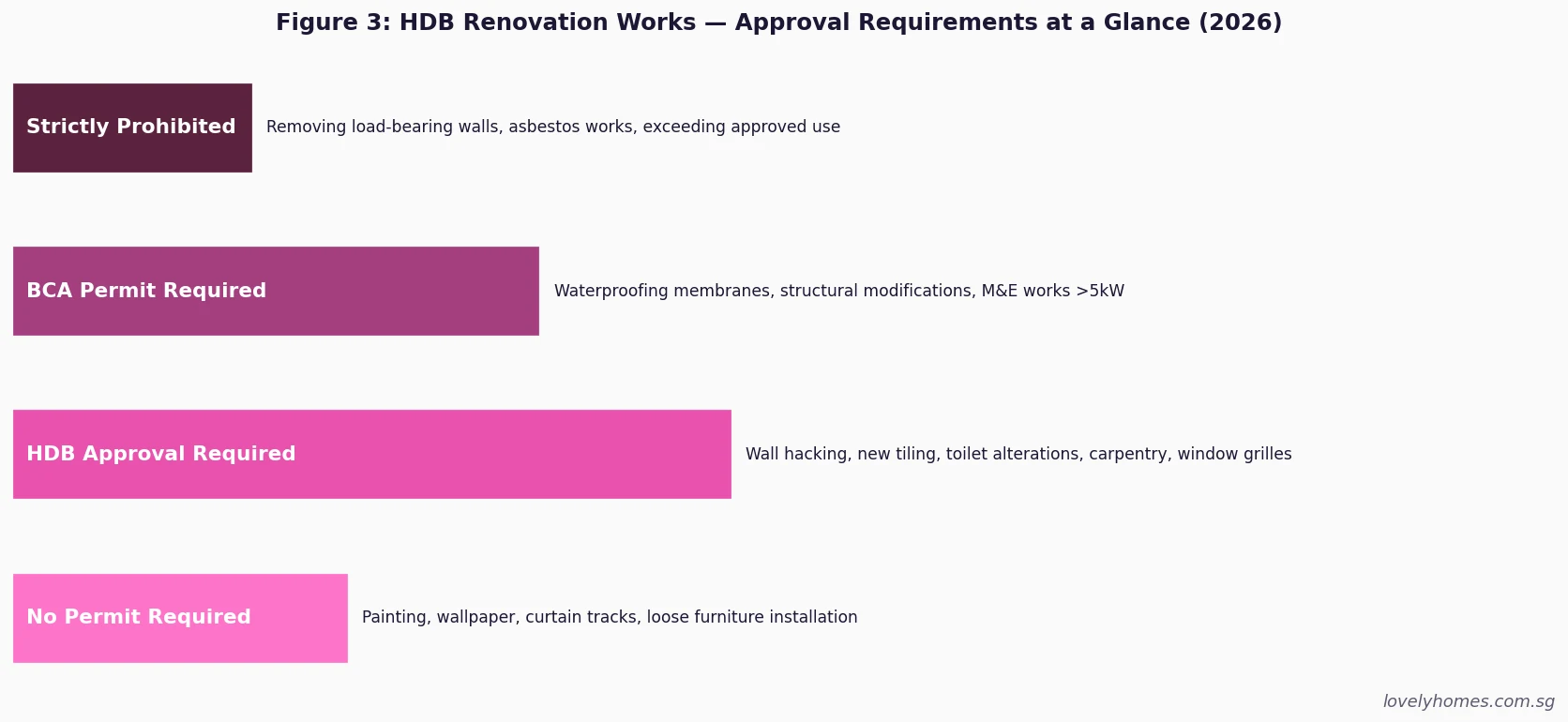
Figure 2: HDB renovation works categorised by approval requirements, 2026. Always verify with HDB e-Services before commencing.

The table below summarises the key categories:

Category Common Works Included What You Need
No Approval Needed Painting, wallpaper, curtain tracks, floating shelves, loose furniture, light fittings (like-for-like replacement) Nothing — proceed freely
HDB Approval Required Hacking walls (non-structural), re-tiling, toilet and bathroom alterations, new built-in carpentry, window grilles, wet kitchen works HDB-registered contractor + e-Services approval (3–10 working days)
BCA Permit Required Waterproofing membrane layer, structural modifications, electrical works >5kW, changes to common areas BCA Building Plan approval + qualified person (QP)
Strictly Prohibited Removing load-bearing or party walls, adding rooms above approved height, asbestos removal (old pre-1990 flats), changing flat to non-residential use Cannot be approved — do not proceed

Hiring a Renovation Contractor: The HDB RCRS Explained

For any work requiring HDB approval, you must engage a contractor registered under the Renovation Contractor Registration Scheme (RCRS), administered by HDB. The RCRS ensures that contractors meet minimum competency standards, carry adequate insurance, and are aware of HDB’s renovation rules. You can verify a contractor’s RCRS registration status via HDB’s website before signing any contract.

The RCRS has two tiers: Tier 1 contractors can handle more extensive works (including structural and waterproofing), while Tier 2 contractors handle standard renovation works. Most homeowners hiring a general renovation contractor for a full-flat renovation will be dealing with a Tier 1 RCRS firm.

Practical tip: Always obtain at least three quotations from different RCRS-registered contractors, and ensure each quotation itemises the scope of work clearly. Ambiguous quotations that list “renovation works” as a lump sum make it difficult to compare pricing or resolve disputes later.

The HDB Renovation Process: Step by Step

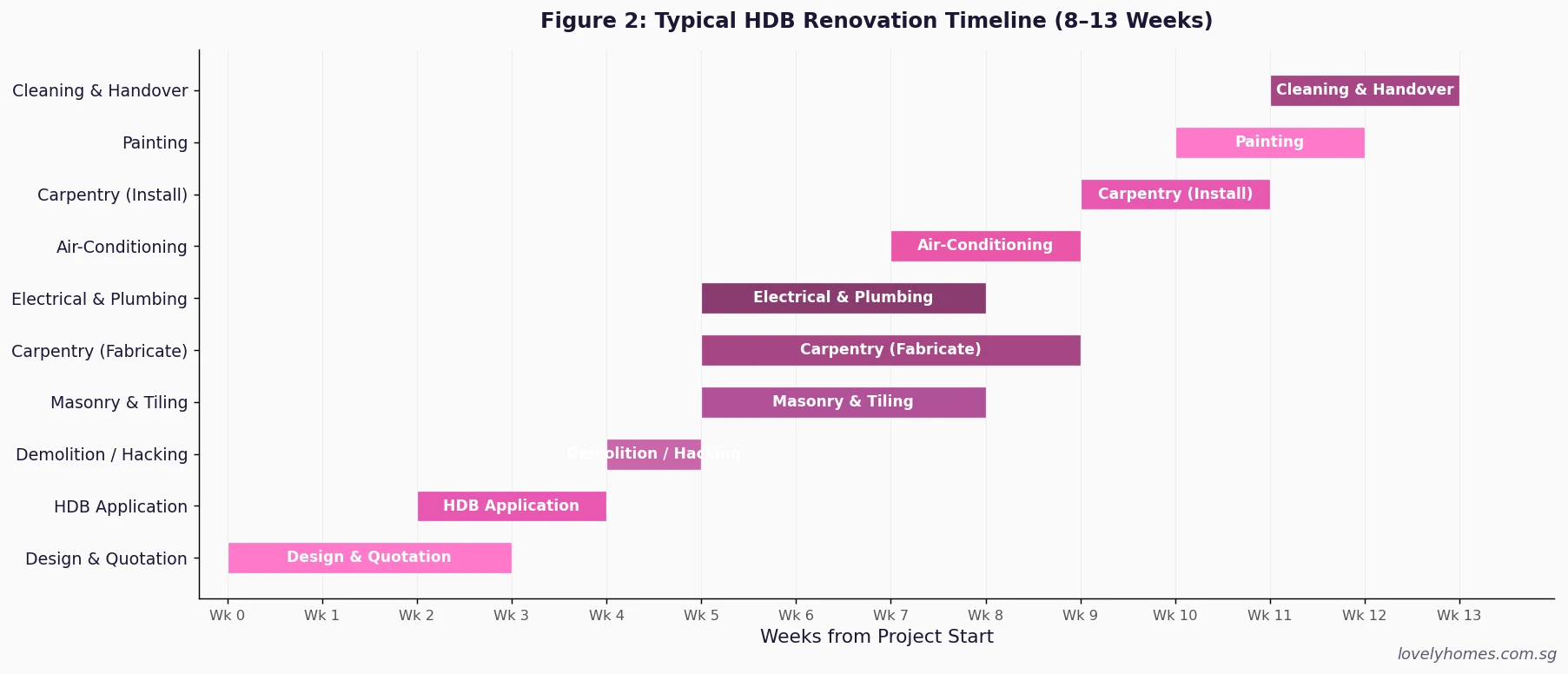
  1. Design and Consultation (Weeks 1–3): Engage an interior designer (ID) or renovation contractor. Present your wishlist, obtain a proposed floor plan, select materials, and receive a quotation. This phase often involves 2–4 rounds of revision.
  2. HDB Approval Application (Weeks 2–4): Your contractor submits the renovation application via HDB’s e-Services portal on your behalf. HDB typically responds within 3–10 working days. Commence work ONLY after receiving written approval.
  3. Demolition and Hacking (Week 4–5): Removal of existing tiles, walls (subject to approval), fixtures, and fittings. This is the noisiest phase — restricted to weekdays and Saturdays, 09:00–17:00 per NEA rules.
  4. Masonry, Tiling and Waterproofing (Weeks 5–8): Laying new tiles in wet areas (kitchen, bathrooms) and all rooms. Waterproofing of wet areas is critical — poor waterproofing is one of the most common sources of leakage disputes between neighbours.
  5. Carpentry Fabrication (Weeks 5–9): Custom carpentry is typically fabricated off-site (at the contractor’s workshop) while other works proceed. Allow 3–5 weeks for fabrication of a full set of kitchen and bedroom cabinetry.
  6. Electrical and Plumbing (Weeks 5–8): New electrical points, DB board upgrades, plumbing rerouting, and air-conditioning trunking. Electrical works must be carried out by a licensed electrical worker (LEW).
  7. Air-Conditioning Installation (Weeks 7–9): Installation of indoor fan coil units and outdoor compressor; trunking and drainage; tested and commissioned.
  8. Carpentry Installation (Weeks 9–11): Built-in cabinets, wardrobes, kitchen cabinets, and TV console are fitted on-site once masonry and tiling are complete.
  9. Painting (Weeks 10–12): Walls and ceilings painted after carpentry and major works; typically 2 coats primer + 2 finish coats.
  10. Cleaning and Handover (Weeks 12–13): Post-renovation cleaning, defect walk-through, and handover of keys. Ensure all defects noted during walk-through are rectified before full payment is released.
HDB renovation timeline 2026 Singapore Gantt chart week by week
Figure 3: Typical HDB renovation timeline, 2026. Phases overlap substantially; total duration depends on contractor capacity and approval speed.

HDB Renovation Rules You Must Know

Beyond the approval requirements, HDB imposes a set of specific rules that apply during the renovation process:

  • Work Hours: Renovation work that generates noise (hacking, drilling, hammering) is restricted to Mondays–Saturdays, 09:00–17:00. Work is prohibited on Sundays and gazetted public holidays. Non-noisy works (painting, carpentry installation) may be carried out outside these hours if neighbours are not disturbed.
  • Duration Limits: HDB sets a maximum renovation period: 3 months for new flats and 1 month for resale flats (for HDB-approved works specifically). Extensions can be requested if needed.
  • Toilets: In HDB flats, the toilet floor must not be hacked more than 50mm below the structural floor slab. This is a common cause of disputes — contractors who hack too deep can inadvertently damage the slab, causing leaks to the flat below.
  • Wet Areas — Waterproofing: All wet area works (bathrooms, kitchen) must include proper waterproofing. HDB recommends using contractors who have completed HDB’s waterproofing module training.
  • Balcony Enclosure: Enclosing a balcony or service yard with windows or glass panels requires HDB’s approval and must comply with approved glass specifications for safety.
  • Flooring: You cannot lay flooring directly on the structural floor slab without the required screed base. Using self-levelling compound is acceptable; significant changes to floor thickness may affect door thresholds and must be planned for.

Financing Your HDB Renovation

Renovation costs for a typical 4-room HDB flat can range from S$30,000 to S$80,000, which is a significant outlay for most households. Singapore offers several financing options:

1. Bank Renovation Loan: Most major Singapore banks — DBS, OCBC, UOB, Standard Chartered, and others — offer unsecured renovation loans specifically for HDB and private properties. Key parameters in 2026: loan amount up to 6× your monthly income or S$30,000, whichever is lower; interest rates range from 3.8% to 5.0% p.a. (effective rate); repayment periods of 1–5 years. These are unsecured personal loans — no collateral required and no impact on your HDB loan or CPF balance.

2. Personal Savings: The cheapest option (no interest). For a S$50,000 renovation financed entirely from savings, a couple putting aside S$2,000/month could accumulate the funds in 25 months. Renovation is best planned well before key collection.

3. CPF Ordinary Account (OA): CPF OA funds cannot be used for renovation costs. They may only be applied to the flat purchase price, BSD/ABSD stamp duties, and legal fees. This is a common misconception — your renovation costs must be paid in cash or financed via a bank renovation loan.

4. Government Grants: There are no direct renovation subsidies for standard HDB flats. However, the Home Improvement Programme (HIP) — managed by HDB for blocks aged 27 years or more — funds essential upgrading of common areas and select internal works (bathroom fittings, spalling concrete repairs) at HDB’s cost. Check hdb.gov.sg to see if your block is on the HIP schedule.

Worked Example: Full 4-Room HDB Renovation in Bishan, 2026

Mr and Mrs Tan, both Singapore Citizens in their early 30s, purchased a resale 4-room HDB flat in Bishan for S$720,000 in June 2026. They budget S$65,000 for a full renovation. Here is how their renovation finances play out:

Item Cost (SGD) Notes
Flooring (full flat, homogeneous tile) S$9,500 90 sq m × S$105/sq m installed
Kitchen (new cabinets + quartz top + hob/hood) S$14,000 Retile + new cabinets + integrated hood
Bathrooms ×2 (full retile + new fittings) S$12,000 S$6,000 per bathroom, waterproofed
Carpentry (master BD wardrobe + kids BD + TV console + study shelving) S$16,000 Custom built-ins, 4 pieces
Electrical (new points + DB board + smart switches) S$4,800 LEW-certified; 6 new power points + 12 lights
Air-Conditioning (3 units, Daikin inverter) S$4,200 Living + 2 bedrooms; installed with trunking
Painting (full flat, 2+2 coats) S$2,800 Including feature wall treatment in living room
False Ceiling (living + dining) S$3,500 Cornice and L-box cove lighting
Total Renovation Cost S$66,800 Inclusive of 9% GST
Bank Renovation Loan (S$30,000 at 4.2% EIR, 3yr) S$887/month Remaining S$36,800 from savings

Total monthly loan repayment of S$887 represents approximately 10.4% of their combined monthly household income of S$8,500 — well within a comfortable range. Their mortgage (HDB loan at 2.6% for S$560,000 over 25 years) is S$2,527/month (MSR 29.7%). Combined monthly obligations are S$3,414, or 40.2% of income — still manageable.

Common Renovation Pitfalls and How to Avoid Them

Renovation disputes are unfortunately common in Singapore. The most frequent problems involve contractors who disappear after collecting an initial deposit (contractor run-off), poor waterproofing leading to leaks into neighbouring flats, and work that does not match what was quoted. To protect yourself: always use an RCRS-registered contractor; pay deposits in stages (typically 10% on signing, 40% on commencement, 40% on completion, 10% retention); check the contractor’s track record on HDB’s list and consumer review platforms; and retain a small amount until all defects are rectified.

For disputes, you may escalate to the Consumers Association of Singapore (CASE) or file a Small Claims Tribunal application for amounts up to S$20,000. HDB can also be contacted if the contractor has violated RCRS rules, which may result in the contractor’s deregistration.

What Might Come Next: HDB Renovation Policy in 2026 and Beyond

Singapore’s HDB renovation framework has been relatively stable but there are several areas to watch. First, the Green Mark push from BCA: there are ongoing discussions about making energy-efficient appliances (inverter air-conditioning, LED lighting) a prerequisite for renovation approval in new BTO flats — akin to the mandatory energy labels already in force for appliances. Second, waterproofing standards: following a number of high-profile leakage disputes in 2024–2025, HDB is reviewing whether waterproofing work should require an independent inspection certificate before sign-off. Third, the Universal Design standard, already mandatory for new BTO layouts, may eventually extend to resale renovation guidelines, requiring wider doorways and grip-friendly bathroom fixtures for ageing-in-place.

Frequently Asked Questions

Can I renovate my HDB flat before I receive the keys?

No. Renovation work may only commence after you have collected the keys to your flat and received HDB’s written approval for the specific works you plan to carry out. This applies to both BTO and resale flats. Attempting to carry out works before key collection — even with a contractor who has access — is a breach of HDB’s terms and can result in penalties.

How long does HDB take to approve a renovation application?

HDB typically approves straightforward renovation applications within 3–10 working days via the e-Services portal. Applications involving structural changes, balcony enclosures, or works that require BCA input may take longer — sometimes 2–4 weeks. It is advisable to submit the application as early as possible so approval arrives before your preferred commencement date.

Is there a noise curfew for HDB renovation works?

Yes. Renovation works that generate noise — including hacking, drilling, sawing, and hammering — must be carried out between 09:00 and 17:00, Mondays to Saturdays only. Work is strictly prohibited on Sundays and gazetted public holidays. Non-noisy works such as painting and installation of pre-fabricated carpentry pieces may be carried out during other hours, provided they do not disturb neighbouring residents. Violations can be reported to HDB and may attract a fine.

Can I use my CPF OA to pay for renovation?

No. CPF Ordinary Account (OA) savings cannot be used to pay for renovation costs. CPF OA may only be applied to the purchase price of the flat, Buyer’s Stamp Duty (BSD), Additional Buyer’s Stamp Duty (ABSD), and legal conveyancing fees. All renovation costs must be paid in cash, or financed through a bank renovation loan (unsecured personal loan). This is one of the most commonly misunderstood rules among first-time HDB buyers.

What happens if I renovate without HDB approval?

Carrying out regulated works without HDB’s approval is a serious breach of HDB’s policies. HDB can issue a Reinstatement Order requiring you to undo all unauthorised works at your own cost and within a specified timeframe. Failure to comply with a reinstatement order can result in HDB engaging contractors to carry out the reinstatement work and billing you for it. In addition, your RCRS-registered contractor may lose their registration, and you may face a fine under the Housing and Development Act. There have also been cases where banks have added conditions to mortgage approvals pending resolution of HDB reinstatement orders.

How do I find a reputable HDB renovation contractor?

Start with HDB’s official list of RCRS-registered contractors at hdb.gov.sg. This confirms the contractor is licensed for HDB work. Beyond that, seek recommendations from friends, family, or neighbours who have recently renovated; read reviews on consumer platforms (being aware that reviews can be gamed); and obtain at least three itemised quotations. Visit the contractor’s showroom or completed projects if possible. Always pay in structured progressive stages, and ensure the signed contract specifies completion dates, penalties for delay, and a defect liability period (typically 12 months).

What is the HDB Goodwill Repair Allowance for BTO flats?

The Goodwill Repair Allowance (GRA) is an HDB-administered fund available to BTO flat buyers to address minor defects found during the Defects Inspection Period (typically the first year after key collection). HDB provides up to S$3,000 to cover rectification costs for qualifying defects (spalling concrete, faulty tiles, plumbing issues). This is separate from your renovation budget. Report defects via the HDB Mobile App and HDB will arrange for the main contractor to rectify them — or, if the main contractor is unavailable, you may use the GRA to hire your own contractor. The GRA is NOT a renovation grant; it only covers genuine construction defects.

Related Articles

Disclaimer

This article is for general informational purposes only and does not constitute professional advice. Renovation costs, HDB approval requirements, and grant details are subject to change. Always verify current rules and approval requirements directly with HDB (hdb.gov.sg) and consult a licensed renovation contractor, financial adviser, or legal professional before proceeding with any renovation or financing commitment. LovelyHomes is an independent editorial publication and is not affiliated with HDB, BCA, or any government body.

Singapore Home Renovation Guide 2026: HDB Permits, APEX System, Condo Rules and Step-by-Step Process

Singapore Home Renovation Guide 2026: HDB Permits, APEX System, Condo Rules and Step-by-Step Process

Quick Answer: Singapore Home Renovation 2026 — Key Takeaways

  • HDB renovation permits are mandatory for hacking, flooring, plumbing, electrical and partition works — submitted via the APEX system by your HDB-registered contractor.
  • APEX is fully electronic — your contractor applies on your behalf; no HDB office visit required. Standard processing: 7–14 working days.
  • Condo owners need MCST written approval in addition to BCA compliance — budget a refundable S$500–S$1,000 security deposit.
  • Noisy works (hacking, drilling) are restricted to weekday 9am–5pm; quiet period 1–2pm in HDB estates; no renovation on Sundays or public holidays.
  • BTO renovation window: 3 months from permit issue; resale HDB: 1 month — works must complete within the permit period.
  • CaseTrust-RCMA accreditation is the gold standard for contractor selection — look for the logo for independent dispute mediation.
  • Typical renovation costs 2026: 4-room HDB S$40,000–S$60,000; 3-bedroom condo S$60,000–S$100,000. See the Singapore Renovation Cost Guide 2026.

What Is a Home Renovation and Why Does It Need Approval in Singapore?

A home renovation in Singapore covers any structural, mechanical or cosmetic change to a residential unit — from hacking walls and laying new tiles to rewiring circuits and relocating plumbing. Two separate regulatory regimes govern this depending on property type. For HDB flats, the Housing & Development Board (HDB) administers renovation rules under the Housing and Development Act; approvals flow through the APEX system via a licensed renovation contractor. For private condominiums and apartments, the Building and Construction Authority (BCA) sets structural safety requirements under the Building Control Act, while each development’s Management Corporation Strata Title (MCST) enforces its own by-laws registered under the Building Maintenance and Strata Management Act (BMSMA).

The permit framework exists because Singapore’s high-density housing means that an unpermitted structural alteration in one flat can compromise the structural integrity of an entire residential block. HDB detects thousands of permit violations annually through inspection and neighbour complaints. Penalties include fines of up to S$5,000, a mandatory stop-work order, and an Order to Reinstate — requiring the owner to demolish all unpermitted works and restore the flat to its original approved state at their own cost.

Singapore HDB renovation permit required vs no permit required works list 2026
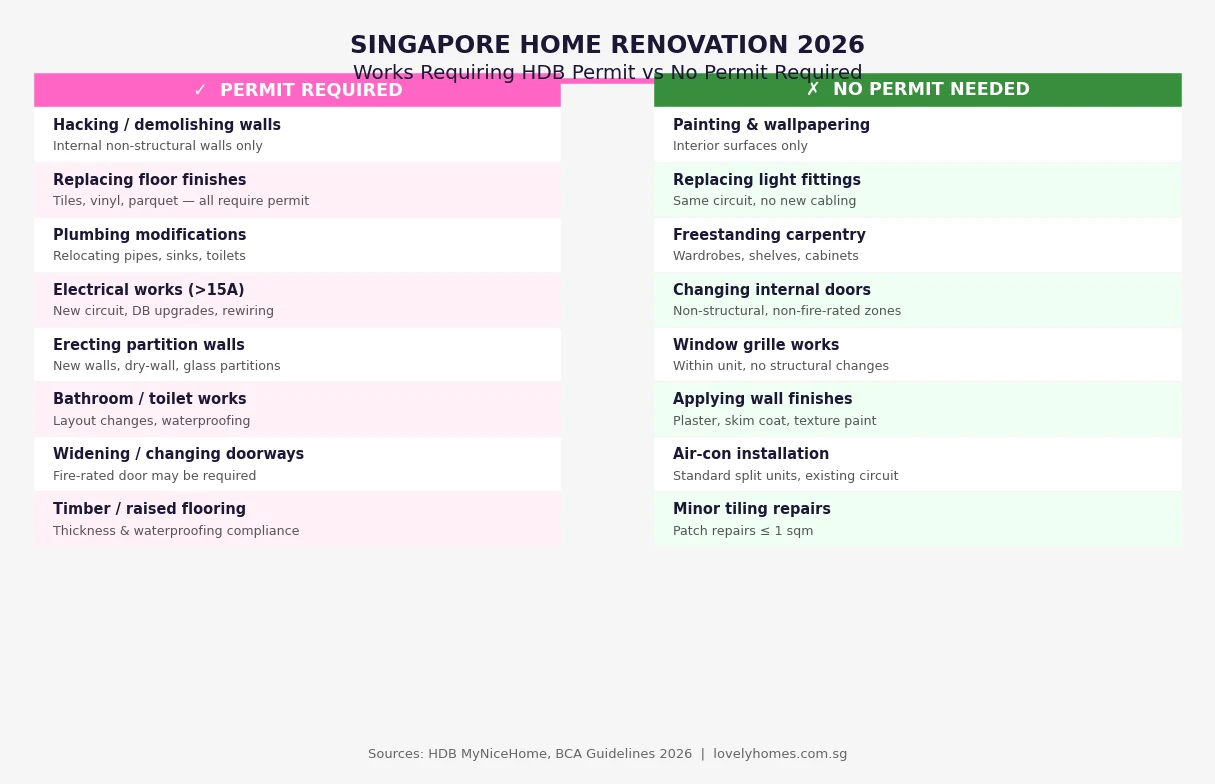
Figure 1: Works requiring HDB permit versus works that require no permit — Singapore home renovation 2026. Source: HDB MyNiceHome, BCA Guidelines.
Click image to zoom

The APEX System: How HDB Renovation Permits Work in 2026

APEX (Application for Renovation Permit via Electronic Transaction) is HDB’s mandatory online portal for all permit applications. Since mid-2024, paper forms at HDB branches are no longer accepted. You do not apply yourself: your HDB-registered renovation contractor submits the application on your behalf via the APEX portal, attaching technical drawings confirming that the proposed works comply with HDB’s guidelines.

Works That Require an HDB Permit

Eight primary categories of works require a permit before commencement: hacking or demolishing internal (non-structural) walls; replacing floor finishes (tiles, vinyl, parquet); modifications to sanitary plumbing or water piping; electrical works exceeding 15A or involving new circuiting or distribution board (DB) upgrades; erecting new partition walls; all bathroom and toilet layout changes including waterproofing; widening or changing doorways (fire-rated doors may be required where the entrance faces an escape route); and installation of timber or raised flooring. A Professional Engineer (PE) endorsement is additionally required where works come within 300mm of load-bearing structural elements.

Application Timeline and Permit Validity

Standard APEX applications are processed within 7–14 working days. Complex cases involving PE endorsement or structural elements can take up to 21 working days. For BTO flats, all approved works must be completed within three months of permit issuance. For resale flats, the window is one month. Extensions must be applied for before the permit expires — not retrospectively.

Renovation Work Permit Required? Key Requirement (HDB 2026)
Wall hacking / demolishing Yes Non-structural only; PE endorsement if near structural wall
Replacing floor finishes Yes Thickness limits; waterproofing compliance
Plumbing relocation Yes Licensed plumber; HDB-approved contractor
Electrical works (>15A / new circuit) Yes Licensed electrical worker required
Erecting partition walls Yes Dry-wall, glass, masonry — all need permit
Bathroom / toilet layout changes Yes Waterproofing membrane mandatory
Widening / changing doorways Yes Fire-rated door if facing escape route
Timber / raised flooring Yes Thickness limit; waterproofing compliance
Painting / wallpapering No Internal surfaces only
Freestanding carpentry No Wardrobes, shelves, built-ins without hacking
Air-conditioner installation No (usually) Standard split units on existing circuit
Replacing light fittings No Same circuit; no new cabling

How to Renovate a Private Condominium: MCST Rules and BCA Requirements

Condominium renovation operates under a separate legal framework. The BCA Building Control Act governs structural safety — prohibiting works that touch load-bearing elements without BCA approval and a qualified person (architect or structural engineer) submission. Day-to-day renovation rules are set by your MCST under its registered by-laws, which vary significantly between developments.

What Always Requires MCST Written Approval

Works affecting common property or the building structure — wall hacking, bathroom waterproofing, plumbing relocation, electrical upgrades beyond 15A, and flooring changes from tiles to timber — require written MCST approval before your contractor begins. A typical MCST application requires: a completed renovation form; your contractor’s BCA licence details; proposed floor plans; an indemnity letter; and a refundable security deposit of S$500 to S$1,000. MCST committees typically respond within 5–10 working days.

Noise Restrictions and Working Hours

Under the National Environment Agency’s regulations and most MCST by-laws, noisy renovation works (drilling, hacking) are restricted to weekdays between 9am and 5pm. Sundays and public holidays are universally prohibited. Most MCSTes follow HDB’s model of a quiet period from 12pm to 2pm. Verify your development’s specific by-laws — registered with the Singapore Land Authority — before scheduling noisy trades.

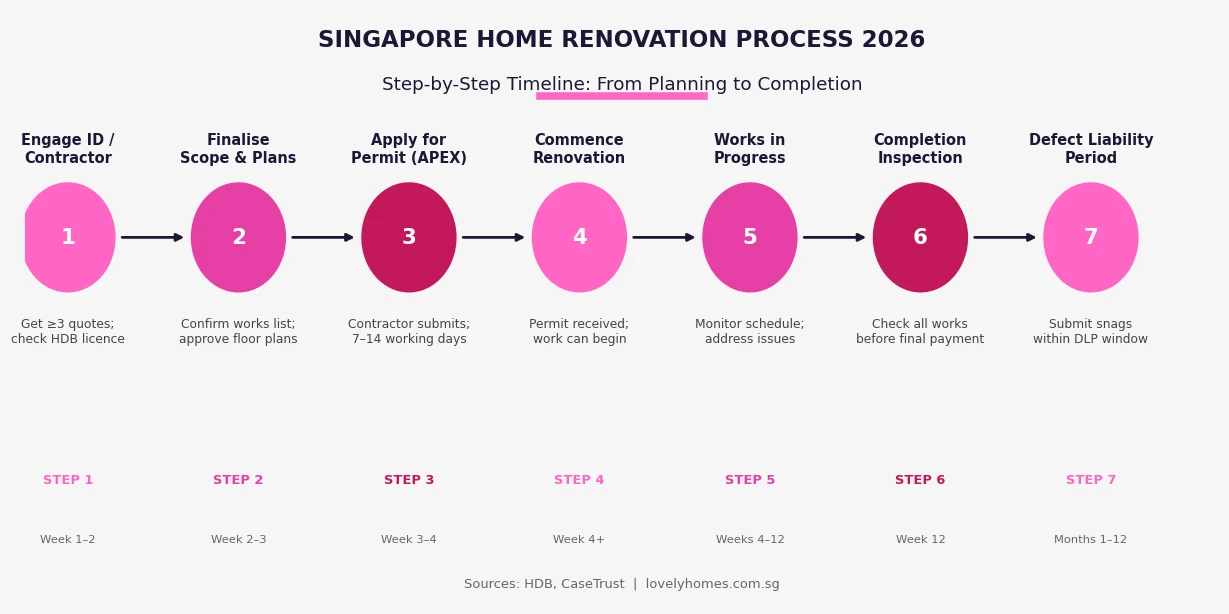
Singapore home renovation step-by-step process timeline 2026
Figure 2: The seven-step Singapore home renovation process from contractor engagement to defect liability period. Source: HDB, CaseTrust.
Click image to zoom

Choosing a Renovation Contractor in Singapore

For HDB flats, you must engage a contractor on HDB’s registered list — only registered contractors can submit APEX applications. For private condominiums, BCA licencing is the minimum requirement, though your MCST may maintain its own approved contractor list.

Above and beyond minimum licencing, look for CaseTrust-RCMA (Renovation and Decoration) accreditation — a joint scheme operated by the Consumers Association of Singapore (CASE) and the Renovation and Decoration Advisory Centre (RADAC). Accredited contractors participate in independent dispute mediation and maintain financial accountability. If works are abandoned, defective or materially incomplete, CaseTrust accreditation gives you a formal escalation route without resorting to civil litigation.

What Your Renovation Contract Must Include

A properly drafted renovation contract should specify: the full scope of works by trade (carpentry, tiling, M&E, painting); detailed material specifications (tile brand and grade, cabinet material, paint finish); a payment schedule tied to milestones; project start and completion dates; a defect liability clause for post-completion rectification; and the APEX permit number once issued. Never pay more than 10% upfront before the permit is approved and work has commenced on site.

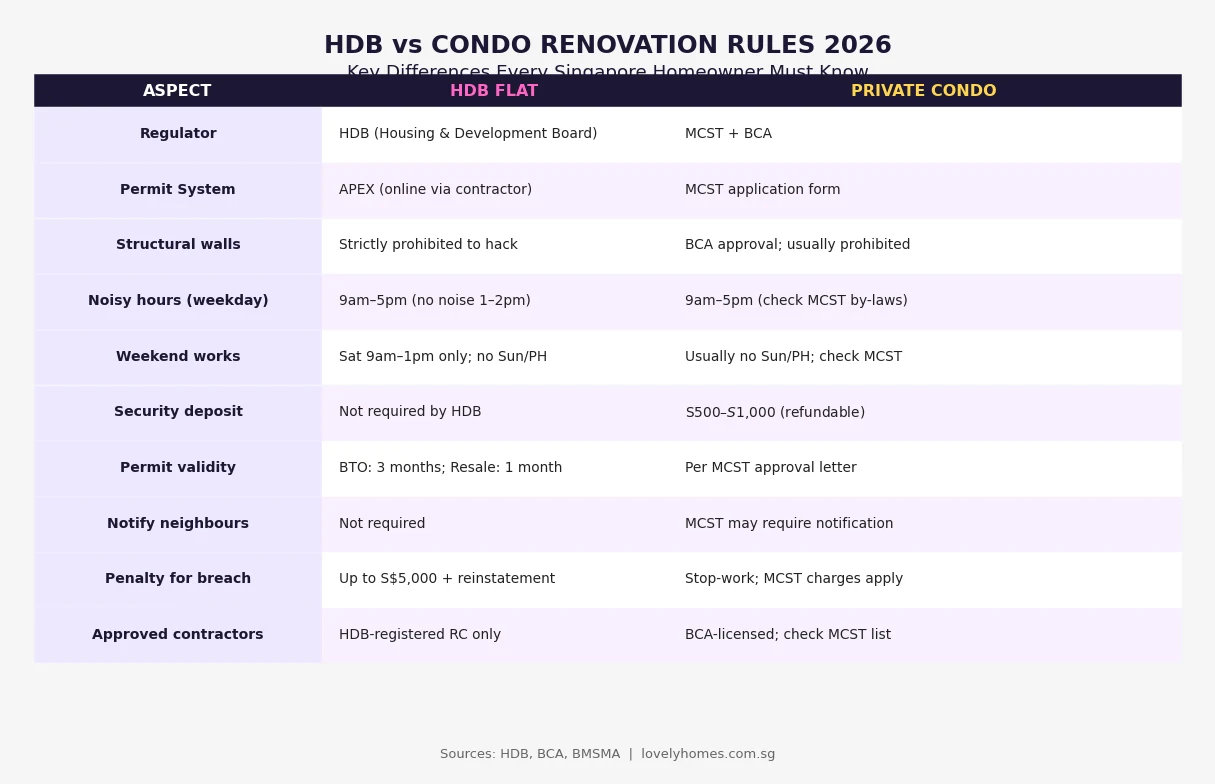
HDB vs condo renovation rules comparison Singapore 2026
Figure 3: HDB versus private condominium renovation rules — ten key differences. Source: HDB, BCA, BMSMA 2026.
Click image to zoom

HDB vs Condo Renovation Rules: Summary Table

Aspect HDB Flat Private Condo / Apartment
Regulator HDB MCST + BCA
Permit system APEX (contractor-submitted online) MCST application form
Structural walls Strictly prohibited to hack BCA approval required; usually prohibited
Noisy works hours (weekday) 9am–5pm; quiet period 1–2pm 9am–5pm; varies by MCST by-law
Weekend renovation Sat 9am–1pm only; no Sun/PH Usually no Sun/PH; check MCST
Security deposit Not required by HDB S$500–S$1,000 (refundable)
Permit validity BTO: 3 months; Resale: 1 month Per MCST approval letter
Neighbour notification Not legally required MCST may require written notification
Penalty for breach Up to S$5,000 fine + reinstatement order Stop-work; MCST may charge; Strata Titles Board enforcement
Contractor requirement HDB-registered RC only BCA-licensed; check MCST approved list

Worked Example: Full Renovation of a 4-Room BTO Flat, Tampines North 2026

Case Study: Mr & Mrs Lim — 4-Room BTO, Tampines North, TOP January 2026

Scope: Full renovation — hacking two non-structural partition walls; full tile overlay in living room and all bedrooms; kitchen and two bathrooms retiled; electrical DB upgrade; four built-in wardrobes; kitchen carpentry; and full-unit painting.

Permit process: Contractor engaged 1 February 2026. APEX application submitted 5 February 2026. Permit issued 17 February 2026 (8 working days). Renovation commenced 18 February 2026.

Timeline: BTO 3-month permit window expires 17 May 2026. Practical completion achieved 28 April 2026 (10 weeks). ✓ Within permit window.

Cost breakdown (2026 market rates):

  • Hacking and masonry: S$3,200
  • Tiling — living, bedrooms, bathrooms: S$14,500
  • Carpentry — wardrobes, kitchen, feature wall: S$22,000
  • Electrical works — DB upgrade, additional points: S$4,800
  • Painting — full unit including ceiling: S$3,500
  • Plumbing and sanitary fixtures: S$5,200
  • Total renovation cost: S$53,200

Compliance: No structural walls hacked. PE endorsement not required. Tiling thickness within HDB’s 75mm screed limit. Permit completed on time. No stop-work orders issued.

Why Singapore’s Renovation Rules Matter More Than You Might Think

Singapore’s renovation regulations are among the most prescriptive in the Asia-Pacific region, and they exist because the physical consequences of unpermitted renovation in high-density housing are real and irreversible. HDB estimates that several thousand permit violations are detected annually. The most serious cases involve hacking of structural elements — columns, shear walls, transfer beams — that directly compromise the load-bearing integrity of the entire residential block. In multi-storey buildings, the consequences of structural compromise cascade upward through every unit above.

For private condominiums, the BMSMA framework ensures that a renovation undertaken inside one unit does not depreciate the shared asset for hundreds of other subsidiary proprietors. MCST enforcement is backed by the Strata Titles Board, which can order reinstatement at the offending owner’s cost regardless of whether the contractor has since disappeared.

The practical takeaway for homeowners is straightforward: the permit process costs little in either time or money compared to the downside risk of enforcement. A S$5,000 fine and a reinstatement order on a S$50,000 renovation is a financially and emotionally costly outcome that is entirely avoidable.

What Might Come Next: Renovation Regulation Trends in Singapore

The BCA’s Built Environment Industry Transformation Map signals a push towards greater digitalisation of the permit and inspection process. Pilot programmes testing AI-assisted permit review — where computer vision analyses submitted drawings against HDB’s permitted and prohibited works matrix — could reduce APEX processing to 2–3 working days for straightforward applications by 2027. HDB has also signalled an upcoming review of renovation guidelines to accommodate sustainability upgrades: EV charging infrastructure, enhanced thermal insulation, and solar-ready flat designs are areas where current rules are expected to evolve before 2028. Homeowners planning longer-horizon renovation projects should watch the HDB MyNiceHome portal for rule updates.

Frequently Asked Questions: Singapore Home Renovation 2026

Can I do my own HDB renovation without a licensed contractor?

For works that do not require an HDB permit — painting, wallpapering, assembling freestanding furniture — you may carry out the works yourself. However, for all permit-required works (hacking, electrical, plumbing, tiling, partition walls), the APEX permit can only be submitted by an HDB-registered renovation contractor. DIY permit-required works constitute a breach of the Housing and Development Act and can result in fines and reinstatement orders. Electrical and plumbing works also carry personal safety risks and may void your home insurance. Use a licensed contractor for all structural and mechanical trades.

How do I verify that a contractor is HDB-registered?

The full, regularly updated list of HDB-registered renovation contractors is available on the HDB website at www.hdb.gov.sg under “Managing My Home → Renovation → Find a Registered Renovation Contractor”. You can search by contractor name, registration number or trade specialisation. For additional consumer protection, check whether the contractor also holds CaseTrust-RCMA accreditation via the CASE website at www.case.org.sg.

What happens if I renovate without an HDB permit?

HDB conducts routine inspections and investigates neighbour complaints about noise, dust or unusual works. If inspectors discover permit-required works carried out without approval, they will issue an immediate stop-work order. The homeowner — not the contractor — is legally liable and may be fined up to S$5,000. HDB will then issue an Order to Reinstate, requiring the works to be demolished and the flat restored to its original state at the homeowner’s expense. Your home insurance policy is unlikely to cover losses arising from unpermitted works.

Do I need to inform my neighbours before renovation starts?

For HDB flats, there is no legal obligation to notify neighbouring units, though it is courteous to do so for extended projects involving significant noise. For private condominiums, many MCSTes require written notification to immediately adjacent units before commencement, particularly for hacking or plumbing works. Failure to comply with MCST notification requirements can result in withdrawal of approval and a stop-work order. Check your specific development’s by-laws, which are registered with the Singapore Land Authority and available from your MCST management office.

What is the difference between an HDB renovation permit and a BCA building permit?

An HDB renovation permit is required for internal alterations to an HDB flat under HDB’s renovation guidelines. A BCA building permit (Building Plan Approval) is required for structural works affecting the building envelope, load-bearing elements, or gross floor area — such as an extension to a landed property, a new roof, or external wall modifications. For most HDB flat renovations, only the HDB permit is required. Landed property owners undertaking major structural works additionally need BCA approval, submitted by a qualified person (architect or structural engineer).

Can I renovate a resale HDB flat before the transfer is completed?

No. The HDB renovation permit can only be issued to the registered owner of the flat. Renovation cannot legally commence before the resale completion appointment has been concluded, keys collected, and ownership confirmed by HDB. Any renovation begun before this point is unpermitted, and the incoming owner inherits any enforcement consequences. Plan and select your contractor during the resale transaction period so that works can begin as soon as keys are in hand.

How long does a typical full HDB flat renovation take?

A full renovation of a 3-room HDB flat typically takes 6–9 weeks from permit approval to practical completion. A 4-room or 5-room flat generally takes 8–14 weeks depending on scope and contractor workload. The most time-intensive phases are hacking and masonry (week 1), tiling (weeks 1–3), and carpentry (weeks 3–6). Painting, final fixtures and clean-up complete the final two weeks. BTO flat owners must ensure the full scope is completed within the 3-month permit window, so engage your contractor immediately upon key collection.

Related Articles

Disclaimer: This article is for general informational purposes only and does not constitute legal, financial or renovation advice. Renovation rules, permit requirements and approved contractor lists are subject to change by HDB, BCA and individual MCSTes. Always verify current requirements directly with HDB (www.hdb.gov.sg), BCA (www.bca.gov.sg), and your development’s MCST management office before commencing any renovation works. For complex structural works, engage a qualified architect or structural engineer.

Translate »