Singapore HDB Renovation Guide 2026: Costs, Rules, Timeline and Grants

Singapore HDB Renovation Guide 2026: Costs, Rules, Timeline and Grants

Quick Answer — HDB Renovation 2026 at a glance

  • HDB flat owners may renovate only after receiving keys and HDB’s written consent for regulated works.
  • Total renovation budgets for a 4-room HDB flat typically range from S$30,000 to S$80,000 in 2026.
  • Works requiring HDB approval include wall hacking, toilet alterations, and carpentry; most require the contractor to be registered with HDB.
  • BTO flat owners face a Goodwill Repair Allowance from HDB (up to S$3,000 for defects) separate from renovation.
  • Enhanced Housing Grant (EHG), CPF Housing Grant (CHG), and the Step-Up CPF Housing Grant apply to the purchase price only — not renovation costs.
  • Interest-free Renovation Loans are available from banks (up to 6× monthly income, max S$30,000), repayable over 1–5 years.
  • Noise-producing work (drilling, hacking) is restricted to Mondays–Saturdays, 09:00–17:00 and prohibited on Sundays and public holidays.
  • The HDB renovation timeline typically runs 8–13 weeks from design to handover.

What Is an HDB Renovation?

An HDB renovation is any construction or alteration work carried out within a Housing and Development Board (HDB) flat after the owner takes possession of the keys. Unlike private condominiums, HDB flats are public housing units sold under a 99-year leasehold tenure by the Singapore government, and they come with a set of rules administered by HDB under the Housing and Development Act. These rules exist to preserve the structural integrity of public housing blocks, protect neighbouring residents, and ensure that any alterations meet safety standards.

Renovations range from purely cosmetic works — painting a wall or replacing light fittings — to comprehensive gut-renovations involving new flooring throughout, a full kitchen overhaul, bathroom retiling, and custom carpentry. The extent of the works, the type of contractor engaged, and the specific flat type (BTO, Resale, Executive, or DBSS) all affect what approvals you need, what restrictions apply, and how much you can expect to spend.

Who Governs HDB Renovation Rules?

Two agencies govern renovation rules in Singapore:

  • HDB (Housing and Development Board) — sets rules for HDB flats specifically: which works require its approval, which contractors must be registered under the Renovation Contractor Registration Scheme (RCRS), and restrictions on timing, materials, and structural alterations.
  • BCA (Building and Construction Authority) — issues Building Plan (BP) approvals for more significant structural changes, such as adding a new floor or significantly altering waterproofing layers.

For the majority of HDB renovations, HDB’s in-house approval suffices. You or your contractor can submit the application via HDB’s e-Services portal at hdb.gov.sg. Turnaround is typically 3–10 working days, though complex structural requests may take longer.
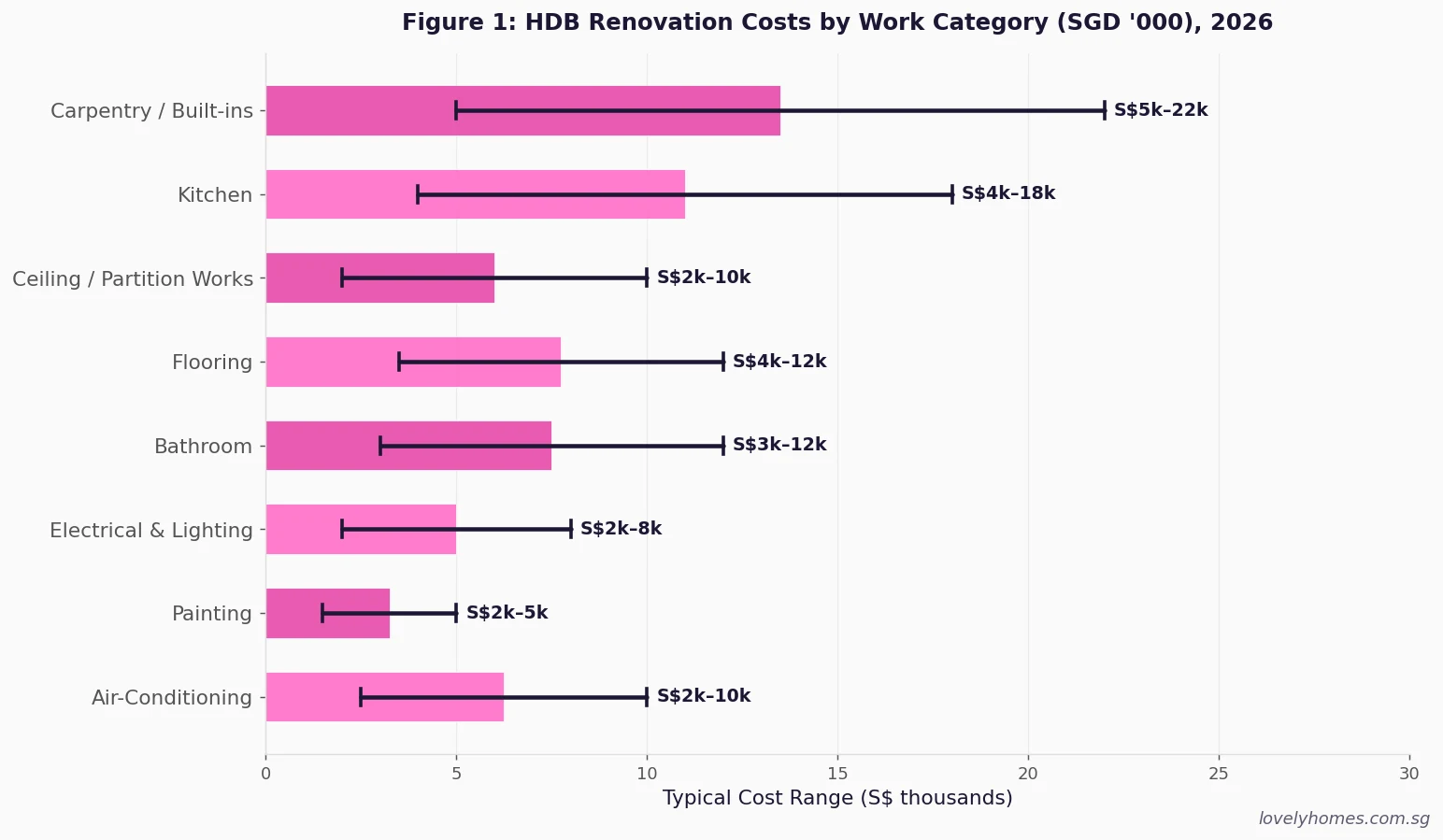
HDB renovation costs by work category 2026 Singapore
Figure 1: Typical HDB renovation cost ranges by work category, Singapore 2026. Costs vary by flat size, materials, and contractor.

HDB Renovation Cost Breakdown (2026)

Based on industry data compiled from HDB-registered renovation contractors and consumer surveys, the following cost ranges apply to a standard 4-room HDB flat (approximately 90 sq m) in 2026. These are starting estimates; final costs depend heavily on materials chosen (e.g., homogeneous tile vs. marble vs. engineered wood), the contractor’s labour rates, and the extent of defect rectification required.

Renovation Category Typical Range (4-room HDB) Key Cost Drivers
Flooring (all rooms) S$3,500–S$12,000 Material: vinyl vs. homogeneous tile vs. timber; area size
Carpentry & Built-ins S$5,000–S$22,000 Number of cabinets; solid wood vs. laminate; wardrobe sliding doors
Kitchen S$4,000–S$18,000 Cabinet type, countertop material (quartz vs. laminate), appliances
Bathroom(s) S$3,000–S$12,000 Number of bathrooms, fixture quality, waterproofing works
Electrical & Lighting S$2,000–S$8,000 Number of new points; LED downlights; smart switches
Painting (full flat) S$1,500–S$5,000 Paint grade; primer coat; feature wall treatment
Ceiling & Partitions S$2,000–S$10,000 False ceiling area; partition walls; skim-coat plastering
Air-Conditioning S$2,500–S$10,000 Number of fan coil units; brand (Daikin/Mitsubishi/Panasonic); inverter vs standard
Total (all-in, typical 4-room) S$30,000–S$80,000 Comprehensive renovation; excludes furniture and appliances

Source: Industry estimates, 2026. Costs are inclusive of GST (9%). HDB renovation loan covers up to S$30,000; amounts above require personal savings or a personal loan.

Works That Require HDB Approval

HDB draws a clear line between works that are freely permitted and those that require formal approval. Broadly speaking, anything that affects the structural integrity of the building, alters plumbing or electrical systems beyond routine replacement, or changes the internal layout requires HDB’s written consent before work begins. Proceeding without approval can result in a reinstatement order (HDB can require you to undo the changes at your own cost) and, in serious cases, a fine under the Housing and Development Act.
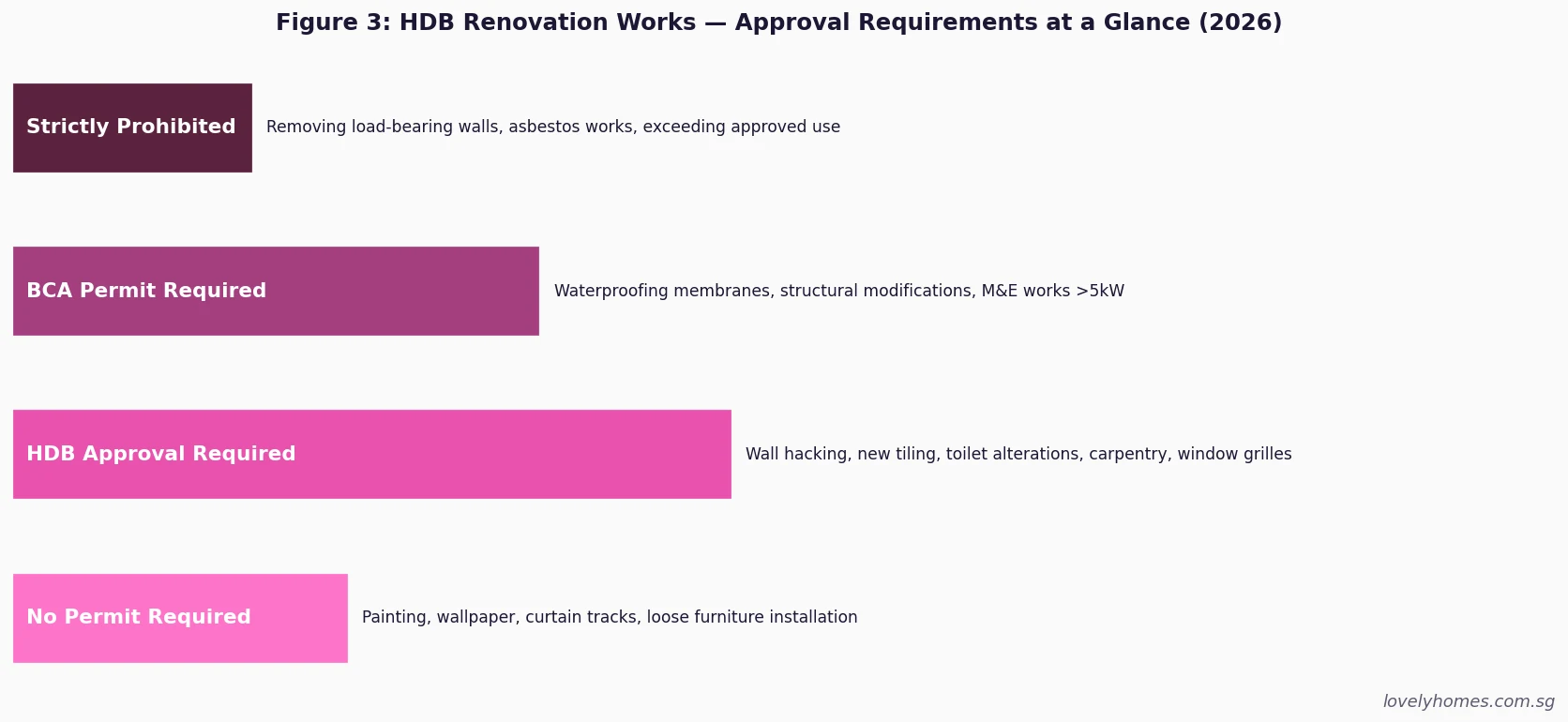
HDB renovation permit categories and approval requirements Singapore 2026
Figure 2: HDB renovation works categorised by approval requirements, 2026. Always verify with HDB e-Services before commencing.

The table below summarises the key categories:

Category Common Works Included What You Need
No Approval Needed Painting, wallpaper, curtain tracks, floating shelves, loose furniture, light fittings (like-for-like replacement) Nothing — proceed freely
HDB Approval Required Hacking walls (non-structural), re-tiling, toilet and bathroom alterations, new built-in carpentry, window grilles, wet kitchen works HDB-registered contractor + e-Services approval (3–10 working days)
BCA Permit Required Waterproofing membrane layer, structural modifications, electrical works >5kW, changes to common areas BCA Building Plan approval + qualified person (QP)
Strictly Prohibited Removing load-bearing or party walls, adding rooms above approved height, asbestos removal (old pre-1990 flats), changing flat to non-residential use Cannot be approved — do not proceed

Hiring a Renovation Contractor: The HDB RCRS Explained

For any work requiring HDB approval, you must engage a contractor registered under the Renovation Contractor Registration Scheme (RCRS), administered by HDB. The RCRS ensures that contractors meet minimum competency standards, carry adequate insurance, and are aware of HDB’s renovation rules. You can verify a contractor’s RCRS registration status via HDB’s website before signing any contract.

The RCRS has two tiers: Tier 1 contractors can handle more extensive works (including structural and waterproofing), while Tier 2 contractors handle standard renovation works. Most homeowners hiring a general renovation contractor for a full-flat renovation will be dealing with a Tier 1 RCRS firm.

Practical tip: Always obtain at least three quotations from different RCRS-registered contractors, and ensure each quotation itemises the scope of work clearly. Ambiguous quotations that list “renovation works” as a lump sum make it difficult to compare pricing or resolve disputes later.

The HDB Renovation Process: Step by Step

  1. Design and Consultation (Weeks 1–3): Engage an interior designer (ID) or renovation contractor. Present your wishlist, obtain a proposed floor plan, select materials, and receive a quotation. This phase often involves 2–4 rounds of revision.
  2. HDB Approval Application (Weeks 2–4): Your contractor submits the renovation application via HDB’s e-Services portal on your behalf. HDB typically responds within 3–10 working days. Commence work ONLY after receiving written approval.
  3. Demolition and Hacking (Week 4–5): Removal of existing tiles, walls (subject to approval), fixtures, and fittings. This is the noisiest phase — restricted to weekdays and Saturdays, 09:00–17:00 per NEA rules.
  4. Masonry, Tiling and Waterproofing (Weeks 5–8): Laying new tiles in wet areas (kitchen, bathrooms) and all rooms. Waterproofing of wet areas is critical — poor waterproofing is one of the most common sources of leakage disputes between neighbours.
  5. Carpentry Fabrication (Weeks 5–9): Custom carpentry is typically fabricated off-site (at the contractor’s workshop) while other works proceed. Allow 3–5 weeks for fabrication of a full set of kitchen and bedroom cabinetry.
  6. Electrical and Plumbing (Weeks 5–8): New electrical points, DB board upgrades, plumbing rerouting, and air-conditioning trunking. Electrical works must be carried out by a licensed electrical worker (LEW).
  7. Air-Conditioning Installation (Weeks 7–9): Installation of indoor fan coil units and outdoor compressor; trunking and drainage; tested and commissioned.
  8. Carpentry Installation (Weeks 9–11): Built-in cabinets, wardrobes, kitchen cabinets, and TV console are fitted on-site once masonry and tiling are complete.
  9. Painting (Weeks 10–12): Walls and ceilings painted after carpentry and major works; typically 2 coats primer + 2 finish coats.
  10. Cleaning and Handover (Weeks 12–13): Post-renovation cleaning, defect walk-through, and handover of keys. Ensure all defects noted during walk-through are rectified before full payment is released.
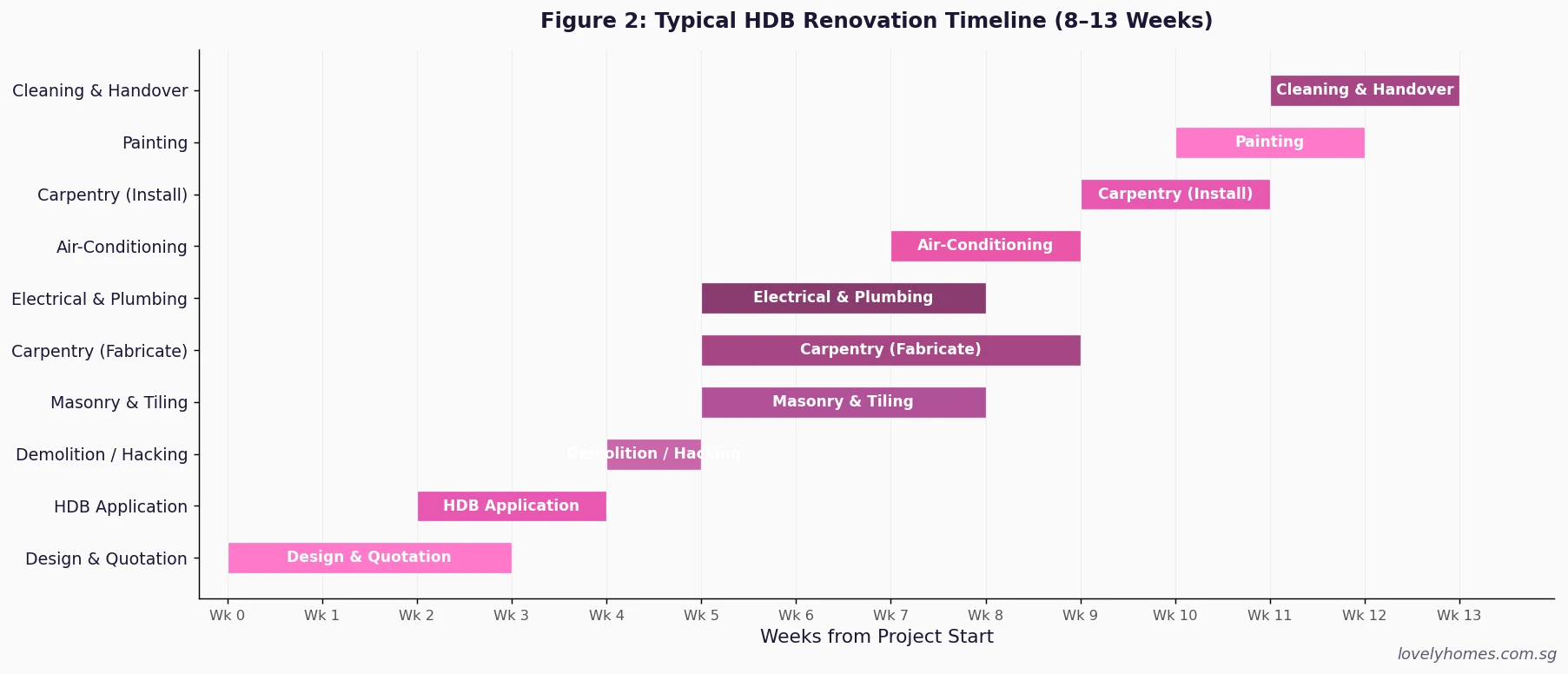
HDB renovation timeline 2026 Singapore Gantt chart week by week
Figure 3: Typical HDB renovation timeline, 2026. Phases overlap substantially; total duration depends on contractor capacity and approval speed.

HDB Renovation Rules You Must Know

Beyond the approval requirements, HDB imposes a set of specific rules that apply during the renovation process:

  • Work Hours: Renovation work that generates noise (hacking, drilling, hammering) is restricted to Mondays–Saturdays, 09:00–17:00. Work is prohibited on Sundays and gazetted public holidays. Non-noisy works (painting, carpentry installation) may be carried out outside these hours if neighbours are not disturbed.
  • Duration Limits: HDB sets a maximum renovation period: 3 months for new flats and 1 month for resale flats (for HDB-approved works specifically). Extensions can be requested if needed.
  • Toilets: In HDB flats, the toilet floor must not be hacked more than 50mm below the structural floor slab. This is a common cause of disputes — contractors who hack too deep can inadvertently damage the slab, causing leaks to the flat below.
  • Wet Areas — Waterproofing: All wet area works (bathrooms, kitchen) must include proper waterproofing. HDB recommends using contractors who have completed HDB’s waterproofing module training.
  • Balcony Enclosure: Enclosing a balcony or service yard with windows or glass panels requires HDB’s approval and must comply with approved glass specifications for safety.
  • Flooring: You cannot lay flooring directly on the structural floor slab without the required screed base. Using self-levelling compound is acceptable; significant changes to floor thickness may affect door thresholds and must be planned for.

Financing Your HDB Renovation

Renovation costs for a typical 4-room HDB flat can range from S$30,000 to S$80,000, which is a significant outlay for most households. Singapore offers several financing options:

1. Bank Renovation Loan: Most major Singapore banks — DBS, OCBC, UOB, Standard Chartered, and others — offer unsecured renovation loans specifically for HDB and private properties. Key parameters in 2026: loan amount up to 6× your monthly income or S$30,000, whichever is lower; interest rates range from 3.8% to 5.0% p.a. (effective rate); repayment periods of 1–5 years. These are unsecured personal loans — no collateral required and no impact on your HDB loan or CPF balance.

2. Personal Savings: The cheapest option (no interest). For a S$50,000 renovation financed entirely from savings, a couple putting aside S$2,000/month could accumulate the funds in 25 months. Renovation is best planned well before key collection.

3. CPF Ordinary Account (OA): CPF OA funds cannot be used for renovation costs. They may only be applied to the flat purchase price, BSD/ABSD stamp duties, and legal fees. This is a common misconception — your renovation costs must be paid in cash or financed via a bank renovation loan.

4. Government Grants: There are no direct renovation subsidies for standard HDB flats. However, the Home Improvement Programme (HIP) — managed by HDB for blocks aged 27 years or more — funds essential upgrading of common areas and select internal works (bathroom fittings, spalling concrete repairs) at HDB’s cost. Check hdb.gov.sg to see if your block is on the HIP schedule.

Worked Example: Full 4-Room HDB Renovation in Bishan, 2026

Mr and Mrs Tan, both Singapore Citizens in their early 30s, purchased a resale 4-room HDB flat in Bishan for S$720,000 in June 2026. They budget S$65,000 for a full renovation. Here is how their renovation finances play out:

Item Cost (SGD) Notes
Flooring (full flat, homogeneous tile) S$9,500 90 sq m × S$105/sq m installed
Kitchen (new cabinets + quartz top + hob/hood) S$14,000 Retile + new cabinets + integrated hood
Bathrooms ×2 (full retile + new fittings) S$12,000 S$6,000 per bathroom, waterproofed
Carpentry (master BD wardrobe + kids BD + TV console + study shelving) S$16,000 Custom built-ins, 4 pieces
Electrical (new points + DB board + smart switches) S$4,800 LEW-certified; 6 new power points + 12 lights
Air-Conditioning (3 units, Daikin inverter) S$4,200 Living + 2 bedrooms; installed with trunking
Painting (full flat, 2+2 coats) S$2,800 Including feature wall treatment in living room
False Ceiling (living + dining) S$3,500 Cornice and L-box cove lighting
Total Renovation Cost S$66,800 Inclusive of 9% GST
Bank Renovation Loan (S$30,000 at 4.2% EIR, 3yr) S$887/month Remaining S$36,800 from savings

Total monthly loan repayment of S$887 represents approximately 10.4% of their combined monthly household income of S$8,500 — well within a comfortable range. Their mortgage (HDB loan at 2.6% for S$560,000 over 25 years) is S$2,527/month (MSR 29.7%). Combined monthly obligations are S$3,414, or 40.2% of income — still manageable.

Common Renovation Pitfalls and How to Avoid Them

Renovation disputes are unfortunately common in Singapore. The most frequent problems involve contractors who disappear after collecting an initial deposit (contractor run-off), poor waterproofing leading to leaks into neighbouring flats, and work that does not match what was quoted. To protect yourself: always use an RCRS-registered contractor; pay deposits in stages (typically 10% on signing, 40% on commencement, 40% on completion, 10% retention); check the contractor’s track record on HDB’s list and consumer review platforms; and retain a small amount until all defects are rectified.

For disputes, you may escalate to the Consumers Association of Singapore (CASE) or file a Small Claims Tribunal application for amounts up to S$20,000. HDB can also be contacted if the contractor has violated RCRS rules, which may result in the contractor’s deregistration.

What Might Come Next: HDB Renovation Policy in 2026 and Beyond

Singapore’s HDB renovation framework has been relatively stable but there are several areas to watch. First, the Green Mark push from BCA: there are ongoing discussions about making energy-efficient appliances (inverter air-conditioning, LED lighting) a prerequisite for renovation approval in new BTO flats — akin to the mandatory energy labels already in force for appliances. Second, waterproofing standards: following a number of high-profile leakage disputes in 2024–2025, HDB is reviewing whether waterproofing work should require an independent inspection certificate before sign-off. Third, the Universal Design standard, already mandatory for new BTO layouts, may eventually extend to resale renovation guidelines, requiring wider doorways and grip-friendly bathroom fixtures for ageing-in-place.

Frequently Asked Questions

Can I renovate my HDB flat before I receive the keys?

No. Renovation work may only commence after you have collected the keys to your flat and received HDB’s written approval for the specific works you plan to carry out. This applies to both BTO and resale flats. Attempting to carry out works before key collection — even with a contractor who has access — is a breach of HDB’s terms and can result in penalties.

How long does HDB take to approve a renovation application?

HDB typically approves straightforward renovation applications within 3–10 working days via the e-Services portal. Applications involving structural changes, balcony enclosures, or works that require BCA input may take longer — sometimes 2–4 weeks. It is advisable to submit the application as early as possible so approval arrives before your preferred commencement date.

Is there a noise curfew for HDB renovation works?

Yes. Renovation works that generate noise — including hacking, drilling, sawing, and hammering — must be carried out between 09:00 and 17:00, Mondays to Saturdays only. Work is strictly prohibited on Sundays and gazetted public holidays. Non-noisy works such as painting and installation of pre-fabricated carpentry pieces may be carried out during other hours, provided they do not disturb neighbouring residents. Violations can be reported to HDB and may attract a fine.

Can I use my CPF OA to pay for renovation?

No. CPF Ordinary Account (OA) savings cannot be used to pay for renovation costs. CPF OA may only be applied to the purchase price of the flat, Buyer’s Stamp Duty (BSD), Additional Buyer’s Stamp Duty (ABSD), and legal conveyancing fees. All renovation costs must be paid in cash, or financed through a bank renovation loan (unsecured personal loan). This is one of the most commonly misunderstood rules among first-time HDB buyers.

What happens if I renovate without HDB approval?

Carrying out regulated works without HDB’s approval is a serious breach of HDB’s policies. HDB can issue a Reinstatement Order requiring you to undo all unauthorised works at your own cost and within a specified timeframe. Failure to comply with a reinstatement order can result in HDB engaging contractors to carry out the reinstatement work and billing you for it. In addition, your RCRS-registered contractor may lose their registration, and you may face a fine under the Housing and Development Act. There have also been cases where banks have added conditions to mortgage approvals pending resolution of HDB reinstatement orders.

How do I find a reputable HDB renovation contractor?

Start with HDB’s official list of RCRS-registered contractors at hdb.gov.sg. This confirms the contractor is licensed for HDB work. Beyond that, seek recommendations from friends, family, or neighbours who have recently renovated; read reviews on consumer platforms (being aware that reviews can be gamed); and obtain at least three itemised quotations. Visit the contractor’s showroom or completed projects if possible. Always pay in structured progressive stages, and ensure the signed contract specifies completion dates, penalties for delay, and a defect liability period (typically 12 months).

What is the HDB Goodwill Repair Allowance for BTO flats?

The Goodwill Repair Allowance (GRA) is an HDB-administered fund available to BTO flat buyers to address minor defects found during the Defects Inspection Period (typically the first year after key collection). HDB provides up to S$3,000 to cover rectification costs for qualifying defects (spalling concrete, faulty tiles, plumbing issues). This is separate from your renovation budget. Report defects via the HDB Mobile App and HDB will arrange for the main contractor to rectify them — or, if the main contractor is unavailable, you may use the GRA to hire your own contractor. The GRA is NOT a renovation grant; it only covers genuine construction defects.

Related Articles

Disclaimer

This article is for general informational purposes only and does not constitute professional advice. Renovation costs, HDB approval requirements, and grant details are subject to change. Always verify current rules and approval requirements directly with HDB (hdb.gov.sg) and consult a licensed renovation contractor, financial adviser, or legal professional before proceeding with any renovation or financing commitment. LovelyHomes is an independent editorial publication and is not affiliated with HDB, BCA, or any government body.
Renting in Singapore 2026: Complete Guide for Tenants — HDB, Condo, Costs and Rights

Renting in Singapore 2026: Complete Guide for Tenants — HDB, Condo, Costs and Rights

🏠 Quick Answer — Renting in Singapore 2026

  • Singapore’s rental market is administered through a combination of HDB rules (for HDB flats), Urban Redevelopment Authority (URA) guidelines (for private property), and IRAS regulations (stamp duty on tenancy agreements).
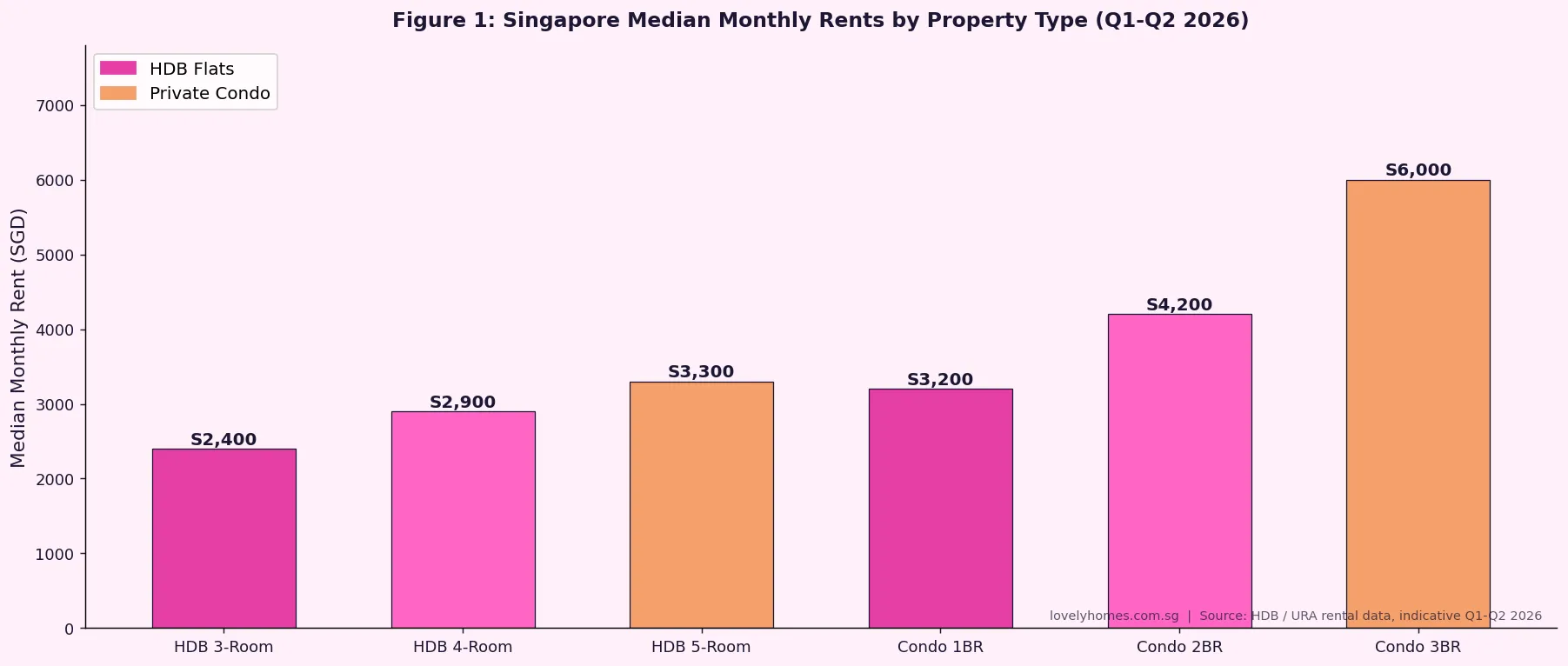
  • Median monthly rents range from S$2,400 for a 3-room HDB flat to S$6,000+ for a 2-bedroom condo in prime districts — with significant variation by estate, floor, and condition.
  • Foreigners may rent any HDB flat (whole unit, with HDB approval to the landlord) or any private residential property without restriction, subject to immigration pass validity.
  • Upfront cash required typically equals 3–4 months’ rent: two months’ security deposit, one month’s advance rent, one month’s agent commission (for leases > 12 months, customarily borne by tenant), plus stamp duty and utilities deposit.
  • Stamp duty on tenancy agreements is paid to IRAS at 0.4% of annual rent multiplied by the number of years — due within 14 days of signing.
  • HDB subletting rules: the entire HDB flat can only be sublet by an owner who has completed MOP. The subletting quota for Malay flats and non-Malay flats applies. Each sublet must be registered with HDB.
  • Tenancy disputes are handled by the Community Disputes Resolution Tribunal (CDRT) or the Small Claims Tribunal (SCT) depending on the nature and quantum of the claim.
  • Do not pay cash deposits without a signed LOI or TA — any holding deposit (typically S$500–S$1,000) should be accompanied by a written Letter of Intent.

Renting a home in Singapore — whether you are a fresh graduate settling into your first flat, an expatriate on an Employment Pass, or a family upsizing while waiting for your BTO — involves navigating a distinct set of rules, costs, and rights that differ substantially from what many Western markets call “standard.” Singapore’s rental market is compact, transparent, and well-regulated; understanding how it works will help you negotiate confidently and protect your deposit.

This guide covers the full rental journey: finding a property, understanding what foreigners can rent, negotiating and signing the tenancy agreement, paying the correct stamp duty, knowing your rights as a tenant, and understanding what happens when disputes arise. All figures reflect Q1–Q2 2026 market conditions as reported by HDB and URA data.

Singapore Rental Market Overview: Prices by Property Type

Singapore’s rental market operates across two broad segments: HDB flats sublet by owner-occupiers (who must have completed the five-year Minimum Occupation Period), and private residential properties — condominiums, apartments, landed houses, and serviced apartments — managed by the Urban Redevelopment Authority. Rent levels vary substantially by district, age of property, floor level, and lease term.

Singapore median monthly rents by property type Q1-Q2 2026 HDB 3-room 4-room 5-room condo 1BR 2BR 3BR
Figure 1: Singapore median monthly rents by property type (Q1–Q2 2026). HDB figures are for whole-unit sublets in the open market. Private condo figures are island-wide indicative medians. Source: HDB / URA rental data.

Demand for HDB sublets is driven primarily by migrant workers on S-Passes and Work Permits who do not qualify for private housing subsidies, as well as by local couples waiting for BTO completion. Demand for private condominiums is dominated by Employment Pass holders, company-sponsored expats, and Singaporeans who have sold their HDB flat and are in a transitional rental period. The Orchard Road and Marina Bay precincts (Districts 9, 10, 11) command the highest rents for private property, while Jurong West, Woodlands, and Punggol offer the most affordable alternatives in the HDB resale sublet market.

Who Can Rent What in Singapore?

Singapore imposes no general restriction on foreigners renting private residential property — any valid immigration pass holder (Employment Pass, S Pass, Student Pass, Dependant Pass, Long-Term Visit Pass) may rent a private condo or apartment.

HDB flat subletting is more restricted. An HDB owner who has completed the MOP may sublet either individual rooms or the entire flat, subject to HDB approval. Foreigners holding Employment Passes, S Passes, or Work Permits may rent HDB sublets, but Malaysia citizens (MC) are not subject to the HDB subletting quota, while other foreigners fall under a 35% per-block non-citizen quota. Short-term rental of HDB flats (fewer than six consecutive months) is strictly prohibited.

Private residential properties must not be used for short-term accommodation of fewer than three consecutive months under URA guidelines — this prohibition covers platforms such as Airbnb. Violation can result in fines of up to S$200,000 and prosecution. URA actively enforces this rule through complaint channels and data-driven monitoring.

Finding a Rental Property in Singapore

Most rental listings are found through three main channels: property portals (PropertyGuru, 99.co, SRX Property), licensed property agents registered with the Council for Estate Agencies (CEA), and direct landlord arrangements through community boards or social networks. In tight market conditions, popular listings on 99.co are typically under offer within 48–72 hours of posting.

Property agents in Singapore must be licensed by CEA and are subject to the Code of Ethics and Professional Client Care. For residential rentals longer than 12 months, the customary commission structure is: tenant pays one month’s rent to their agent, landlord pays one month’s rent to their agent. For leases of six to twelve months, commission is typically half a month per party. For leases under six months, commission is negotiated case by case.

The Tenancy Agreement: LOI, Terms, and What to Negotiate

The rental process in Singapore follows a standard sequence: (1) viewing, (2) Letter of Intent (LOI), (3) Tenancy Agreement (TA), (4) stamp duty, (5) key handover. Each step carries legal weight, and tenants who pay money before a written document is signed have limited recourse if the deal falls through.

The Letter of Intent is a short document (one to two pages) confirming your offer to rent at an agreed price. It is signed by the tenant and accompanies a “good faith deposit” — typically one month’s rent. The LOI is not a binding tenancy but establishes the framework for the TA. If the landlord rejects your LOI after accepting the deposit, they must return it in full. If you withdraw after the landlord has accepted and countersigned, the deposit may be forfeited.

The Tenancy Agreement is the binding lease. It should specify: the monthly rent; the term (start and end dates); the security deposit quantum (typically two months for a two-year lease, one month for a one-year lease); what utilities and services are included; diplomatic clause terms (most EPs allow break at six months if the tenant’s employment is terminated involuntarily); and a schedule of furniture/fittings. Singapore does not have a standard government-prescribed TA form, but the Law Society and the Singapore Accredited Estate Agencies (SAEA) publish model templates.

Key clauses to negotiate:

  • Diplomatic clause: allows early termination with two months’ notice if you lose your EP through redundancy or repatriation. Standard in most expat leases; absent in many local landlord agreements — insist on it.
  • Minor repairs cap: typically the first S$150 – S$200 per repair is the tenant’s responsibility; above that is the landlord’s. Negotiate this threshold based on the age of the property.
  • Air-conditioning servicing: clarify whether quarterly servicing is the tenant’s or landlord’s responsibility, and what happens when a unit fails.
  • Reinstatement: what must be “put back” at end of lease — walls repainted, fixtures restored — and who bears the cost.

Stamp Duty on Tenancy Agreements

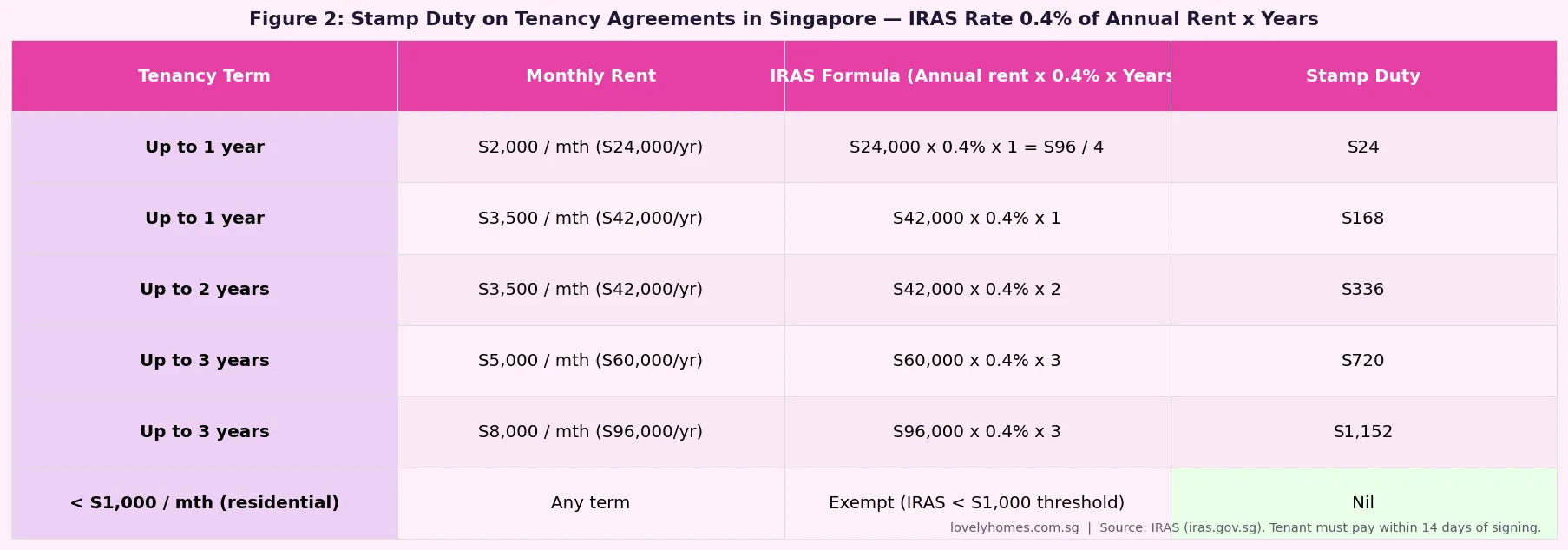
Under the Stamp Duties Act administered by IRAS, a stamp duty is payable on every tenancy agreement for residential property in Singapore. The rate is 0.4% of the total rent for the lease term — calculated as annual rent multiplied by 0.4% multiplied by the number of years. Tenancy agreements for monthly rent under S$1,000 are exempt.

Stamp duty on Singapore tenancy agreements IRAS rate 0.4% annual rent examples 2026
Figure 2: Stamp duty payable on Singapore tenancy agreements at the IRAS rate of 0.4% of annual rent multiplied by the number of years. Source: IRAS (iras.gov.sg). Tenants must pay within 14 days of signing.

The responsibility for paying stamp duty falls on the tenant. Payment must be made within 14 days of signing the TA (or 30 days if the document is signed overseas). Failure to stamp within the deadline incurs penalties of up to four times the duty payable. Payment is made electronically through the IRAS myTax Portal (mytax.iras.gov.sg). Agents typically remind tenants to stamp promptly; the process takes under 10 minutes online and the certificate of stamping should be kept for the duration of the lease.

Deposits and Upfront Costs

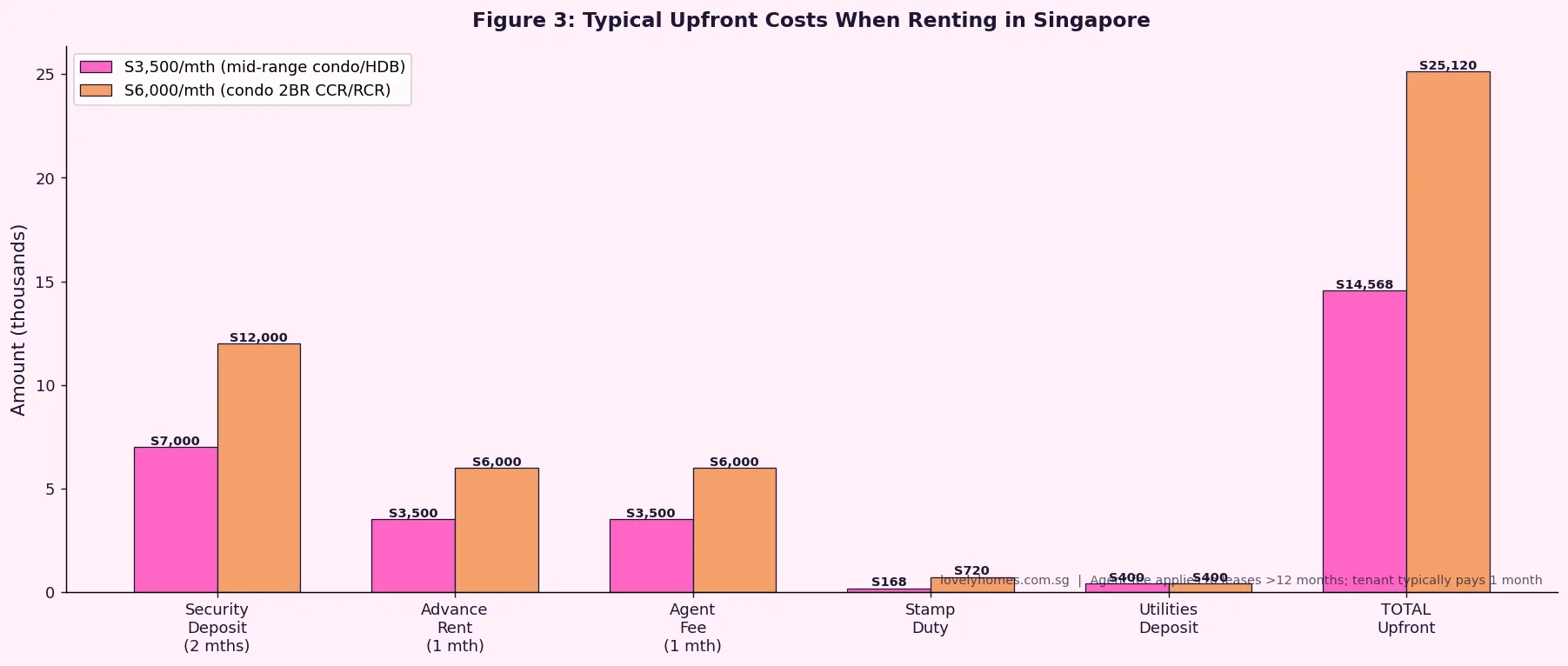
First-time renters in Singapore consistently underestimate total upfront cash required. Beyond the monthly rent itself, you will typically need to pay: a security deposit (two months for a two-year lease, one month for a one-year lease), one month’s advance rent at signing, agent commission (one month’s rent for leases over 12 months), stamp duty (IRAS, 0.4% formula), and a utilities deposit with SP Group (typically S$300 – S$500 for an HDB flat, up to S$800 for a large condo unit).

Typical upfront renting costs in Singapore security deposit advance rent agent fee stamp duty 2026
Figure 3: Total upfront cash required when renting in Singapore, for two typical rent levels. Agent fee shown assumes tenant pays one month commission for a two-year lease. Stamp duty calculated at 0.4% for a two-year lease.

For a S$3,500/month two-year condo lease, total upfront cost is approximately S$14,568. For a S$6,000/month two-year CCR/RCR condo, upfront cost rises to approximately S$25,120 — nearly the equivalent of over four months’ rent in cash before you even move in. Budget carefully, and keep all receipts and bank transfer records.

HDB Subletting Rules for Landlords

If you are renting from an HDB flat owner, your landlord is required to comply with a specific set of HDB subletting rules — and so, as an informed tenant, it is worth knowing what these entail so you can spot a landlord who is operating outside the rules (an arrangement that could leave you in a legally precarious position).

To legally sublet an HDB flat (whole unit), the owner must: have completed the MOP (five years from key collection for BTO, five years from completion of resale purchase); obtain written approval from HDB before the subletting commences; register each occupant with HDB within seven days of commencement; and cap the total number of occupants at six for 4-room and larger flats, or four for 3-room flats. Subletting periods must be a minimum of six consecutive months; daily, weekly, or short-term rentals are prohibited. Approval must be renewed every three years.

Non-citizen subtenants fall under an occupancy quota: HDB flats in any block cannot have more than 35% non-citizen occupancy. If a block is at quota, HDB will not approve further non-citizen subtenants. Tenants should verify with the landlord that HDB approval has been obtained and ask for a copy of the approval letter before paying any deposit.

Summary: HDB Flat vs Private Condo Rental Rules

Rule / Feature HDB Flat (Sublet) Private Condo / Apartment
Minimum rental term 6 consecutive months 3 consecutive months (URA rule)
Landlord eligibility Owner-occupier who completed MOP Any owner / licensed agent
Foreigner restriction Subject to 35% non-citizen quota (block) No restriction on foreigners
Max occupants 6 (4-room+) or 4 (3-room) 6 per MCST/URA guidelines
HDB approval required Yes — before subletting commences No (private property)
Registration of occupants Yes — with HDB within 7 days No formal requirement
Stamp duty on TA Yes — IRAS 0.4% rule applies Yes — same IRAS 0.4% rule
Short-term rental (Airbnb) Strictly prohibited Strictly prohibited (< 3 months)
Pet rules HDB pet restrictions apply (dog breeds) MCST by-laws — varies by development

Worked Example: Amy Rents a 2-Bedroom Condo in East Coast

Scenario: Amy, British national on an Employment Pass, renting a 2-bedroom condo in District 15 (East Coast), 2-year lease

Monthly rent agreed: S$4,000

Lease term: 2 years (24 months) commencing 1 August 2026

Security deposit: 2 months × S$4,000 = S$8,000 (held by landlord, refunded at end of lease less deductions)

Advance rent: 1 month = S$4,000

Agent commission (Amy’s agent): 1 month = S$4,000 (2-year lease, tenant pays 1 month)

Stamp duty (IRAS): S$4,000 × 12 months × 0.4% × 2 years = S$48,000 × 0.4% × 2 = S$384 (due to IRAS within 14 days of signing)

SP Group utilities deposit: approximately S$500

Total upfront cash: S$8,000 + S$4,000 + S$4,000 + S$384 + S$500 = S$16,884

Monthly expenses: S$4,000 rent + estimated S$180 utilities + approximately S$30 internet = approximately S$4,210/month

Diplomatic clause: Amy insists on a diplomatic clause allowing 2 months’ notice termination if her EP is cancelled due to retrenchment. The landlord agrees, reducing Amy’s lease risk substantially.

Key takeaway: Amy’s upfront cost is effectively 4.2 months’ rent. The security deposit is not a cost — she should recover it at lease end — but it is a cash outflow she must plan for at move-in.

Tenant Rights and Dispute Resolution

Singapore has a relatively lean set of statutory tenant protections compared to, say, the United Kingdom or Germany. There is no rent control; landlords may set rent at market rates and increase rents on renewal. However, tenants do have meaningful protections against illegal eviction, deposit confiscation, and harassment.

Security deposit disputes — the most common category — can be filed with the Small Claims Tribunal (SCT) for amounts up to S$20,000, or the Community Disputes Resolution Tribunal (CDRT) for neighbour-related matters. The SCT process is relatively fast (typically six to eight weeks) and affordable (filing fee from S$10). For amounts above S$20,000, the matter goes to the Magistrate’s Court.

Illegal lockouts — landlords changing locks or removing belongings without a court order — are actionable under the Distress Act. If this happens, contact the Police (999) and a lawyer immediately. Landlords have no right to enter the premises without reasonable notice (typically 24–48 hours) except in genuine emergencies.

The CEA Professional Centre at HDB Hub can assist with complaints against licensed property agents who have acted unethically in a rental transaction.

What Might Come Next: Rental Market Outlook for 2H 2026

Singapore’s rental market has moderated since its 2022–2023 peak, when supply constraints and post-pandemic demand combined to push rents up 30–40% over 18 months. By Q2 2026, the pipeline of private completions — some 8,500 private residential units expected to TOP in 2026 — is providing meaningful supply relief, particularly for condo rentals in the RCR and OCR. HDB sublet rents remain firm in mature estates where demand from PMETs and S Pass holders is structural.

Two forces may tighten the rental market again in 2H 2026: first, a continued flow of new EP holders as Singapore’s technology and financial services sectors maintain hiring momentum; second, the sizeable cohort of BTO buyers who collected keys in 2021–2022 and are now entering MOP-related transitional periods, reducing HDB sublet supply as owners move back in. Watch the quarterly SRX and 99.co rental indices — released monthly — for signals of where rents are heading in your target neighbourhood.

Frequently Asked Questions about Renting in Singapore

Can a foreigner on a Tourist Pass (short-term visit) rent an HDB flat?

No. Short-term visit pass holders cannot legally rent an HDB flat. HDB requires all subtenants to hold a valid Work Pass (Employment Pass, S Pass, Work Permit), Student Pass, Dependant Pass, or Long-Term Visit Pass with at least three months’ validity, or be a Singapore Citizen or Permanent Resident. Tourist pass holders are not eligible. Renting from a landlord who accommodates tourist pass holders is illegal and can expose both the landlord and the tenant to penalties.

What happens to my security deposit if the landlord sells the property during my tenancy?

Your tenancy agreement runs with the property, not the person. If the landlord sells during your lease, the new owner takes over the obligations under the tenancy agreement — including the obligation to return your security deposit at the end of the lease. You should receive written confirmation from both the outgoing and incoming owners that the deposit has been transferred. If it has not, the outgoing landlord remains liable for its return. Get this in writing before the sale completes.

Is agent commission negotiable, and do I always have to pay it as the tenant?

In a tenant’s market (more supply than demand), agent commissions are negotiable. In a landlord’s market, the customary structure — tenant pays one month for leases over 12 months — is more likely to be non-negotiable. Some landlords co-broke commissions (both landlord’s and tenant’s agent share a single commission pot), reducing the tenant’s out-of-pocket cost. Always clarify commission terms in the LOI before signing — ambiguous commission arrangements are a common source of disputes. CEA’s rules prohibit double commissions without disclosure.

What is a diplomatic clause and how does it work?

A diplomatic clause (also called a “D-clause” or “relocation clause”) allows a tenant to terminate a tenancy before the lease end date if they are transferred, retrenched, or required to leave Singapore due to factors outside their control. Typically it requires two months’ written notice and takes effect only after the first year of a two-year lease. It is not a statutory right — it must be negotiated and included in the TA. If not included, early termination normally forfeits the security deposit and may trigger a claim for the remaining rent. For expats on company-sponsored packages, the diplomatic clause is essential.

Can my landlord increase my rent mid-lease?

No — once a tenancy agreement is signed at a fixed rent, the landlord cannot unilaterally increase it during the lease term. Rent increases can only occur at the point of renewal. Many landlords include an option to renew clause in the TA at a fixed rent or at “market rate to be mutually agreed.” If your renewal clause specifies market rate, obtain comparable evidence (SRX, PropertyGuru listings) before the renewal negotiation to anchor your position. Singapore has no rent control legislation, so there is no statutory cap on renewal increases.

Do I have to pay stamp duty if my tenancy is month-to-month?

A month-to-month tenancy (also called a periodic tenancy) is technically a tenancy agreement for an uncertain period. IRAS treats it as a tenancy for one year (the minimum stamp duty computation period) if the monthly rent exceeds S$1,000. You should stamp the agreement within 14 days of signing. If your rent is below S$1,000 per month, no stamp duty is payable regardless of term. The safer practice is to stamp every residential TA where rent exceeds S$1,000/month.

Disclaimer: This article is for general information only and does not constitute legal or financial advice. HDB subletting rules, URA short-term rental rules, IRAS stamp duty rates, and CEA licensing requirements are subject to change. Always verify current rules directly with HDB (hdb.gov.sg), URA (ura.gov.sg), IRAS (iras.gov.sg), and CEA (cea.gov.sg) before entering into any tenancy agreement. Rental figures are indicative Q1–Q2 2026 market data and may vary by estate, property condition, and lease terms. Seek independent legal advice for complex tenancy disputes.

Singapore Home Renovation Guide 2026: HDB Permits, APEX System, Condo Rules and Step-by-Step Process

Singapore Home Renovation Guide 2026: HDB Permits, APEX System, Condo Rules and Step-by-Step Process

Quick Answer: Singapore Home Renovation 2026 — Key Takeaways

  • HDB renovation permits are mandatory for hacking, flooring, plumbing, electrical and partition works — submitted via the APEX system by your HDB-registered contractor.
  • APEX is fully electronic — your contractor applies on your behalf; no HDB office visit required. Standard processing: 7–14 working days.
  • Condo owners need MCST written approval in addition to BCA compliance — budget a refundable S$500–S$1,000 security deposit.
  • Noisy works (hacking, drilling) are restricted to weekday 9am–5pm; quiet period 1–2pm in HDB estates; no renovation on Sundays or public holidays.
  • BTO renovation window: 3 months from permit issue; resale HDB: 1 month — works must complete within the permit period.
  • CaseTrust-RCMA accreditation is the gold standard for contractor selection — look for the logo for independent dispute mediation.
  • Typical renovation costs 2026: 4-room HDB S$40,000–S$60,000; 3-bedroom condo S$60,000–S$100,000. See the Singapore Renovation Cost Guide 2026.

What Is a Home Renovation and Why Does It Need Approval in Singapore?

A home renovation in Singapore covers any structural, mechanical or cosmetic change to a residential unit — from hacking walls and laying new tiles to rewiring circuits and relocating plumbing. Two separate regulatory regimes govern this depending on property type. For HDB flats, the Housing & Development Board (HDB) administers renovation rules under the Housing and Development Act; approvals flow through the APEX system via a licensed renovation contractor. For private condominiums and apartments, the Building and Construction Authority (BCA) sets structural safety requirements under the Building Control Act, while each development’s Management Corporation Strata Title (MCST) enforces its own by-laws registered under the Building Maintenance and Strata Management Act (BMSMA).

The permit framework exists because Singapore’s high-density housing means that an unpermitted structural alteration in one flat can compromise the structural integrity of an entire residential block. HDB detects thousands of permit violations annually through inspection and neighbour complaints. Penalties include fines of up to S$5,000, a mandatory stop-work order, and an Order to Reinstate — requiring the owner to demolish all unpermitted works and restore the flat to its original approved state at their own cost.

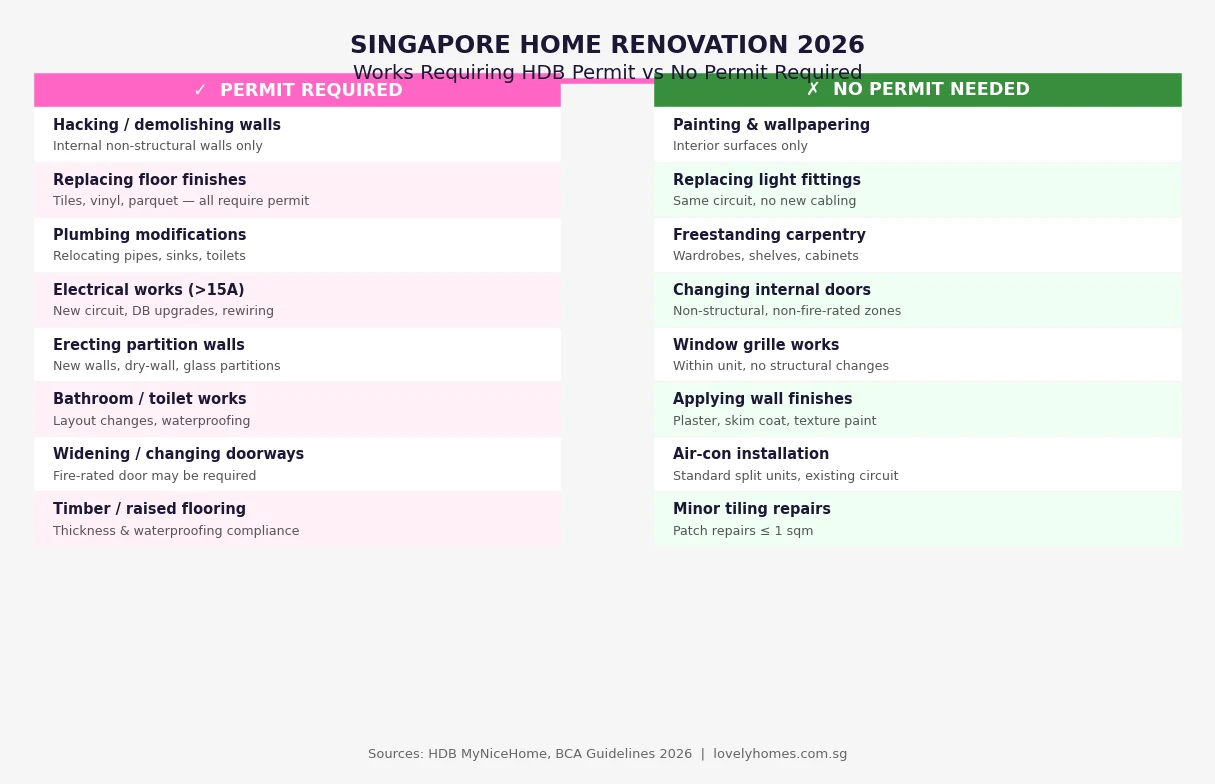
Singapore HDB renovation permit required vs no permit required works list 2026
Figure 1: Works requiring HDB permit versus works that require no permit — Singapore home renovation 2026. Source: HDB MyNiceHome, BCA Guidelines.
Click image to zoom

The APEX System: How HDB Renovation Permits Work in 2026

APEX (Application for Renovation Permit via Electronic Transaction) is HDB’s mandatory online portal for all permit applications. Since mid-2024, paper forms at HDB branches are no longer accepted. You do not apply yourself: your HDB-registered renovation contractor submits the application on your behalf via the APEX portal, attaching technical drawings confirming that the proposed works comply with HDB’s guidelines.

Works That Require an HDB Permit

Eight primary categories of works require a permit before commencement: hacking or demolishing internal (non-structural) walls; replacing floor finishes (tiles, vinyl, parquet); modifications to sanitary plumbing or water piping; electrical works exceeding 15A or involving new circuiting or distribution board (DB) upgrades; erecting new partition walls; all bathroom and toilet layout changes including waterproofing; widening or changing doorways (fire-rated doors may be required where the entrance faces an escape route); and installation of timber or raised flooring. A Professional Engineer (PE) endorsement is additionally required where works come within 300mm of load-bearing structural elements.

Application Timeline and Permit Validity

Standard APEX applications are processed within 7–14 working days. Complex cases involving PE endorsement or structural elements can take up to 21 working days. For BTO flats, all approved works must be completed within three months of permit issuance. For resale flats, the window is one month. Extensions must be applied for before the permit expires — not retrospectively.

Renovation Work Permit Required? Key Requirement (HDB 2026)
Wall hacking / demolishing Yes Non-structural only; PE endorsement if near structural wall
Replacing floor finishes Yes Thickness limits; waterproofing compliance
Plumbing relocation Yes Licensed plumber; HDB-approved contractor
Electrical works (>15A / new circuit) Yes Licensed electrical worker required
Erecting partition walls Yes Dry-wall, glass, masonry — all need permit
Bathroom / toilet layout changes Yes Waterproofing membrane mandatory
Widening / changing doorways Yes Fire-rated door if facing escape route
Timber / raised flooring Yes Thickness limit; waterproofing compliance
Painting / wallpapering No Internal surfaces only
Freestanding carpentry No Wardrobes, shelves, built-ins without hacking
Air-conditioner installation No (usually) Standard split units on existing circuit
Replacing light fittings No Same circuit; no new cabling

How to Renovate a Private Condominium: MCST Rules and BCA Requirements

Condominium renovation operates under a separate legal framework. The BCA Building Control Act governs structural safety — prohibiting works that touch load-bearing elements without BCA approval and a qualified person (architect or structural engineer) submission. Day-to-day renovation rules are set by your MCST under its registered by-laws, which vary significantly between developments.

What Always Requires MCST Written Approval

Works affecting common property or the building structure — wall hacking, bathroom waterproofing, plumbing relocation, electrical upgrades beyond 15A, and flooring changes from tiles to timber — require written MCST approval before your contractor begins. A typical MCST application requires: a completed renovation form; your contractor’s BCA licence details; proposed floor plans; an indemnity letter; and a refundable security deposit of S$500 to S$1,000. MCST committees typically respond within 5–10 working days.

Noise Restrictions and Working Hours

Under the National Environment Agency’s regulations and most MCST by-laws, noisy renovation works (drilling, hacking) are restricted to weekdays between 9am and 5pm. Sundays and public holidays are universally prohibited. Most MCSTes follow HDB’s model of a quiet period from 12pm to 2pm. Verify your development’s specific by-laws — registered with the Singapore Land Authority — before scheduling noisy trades.

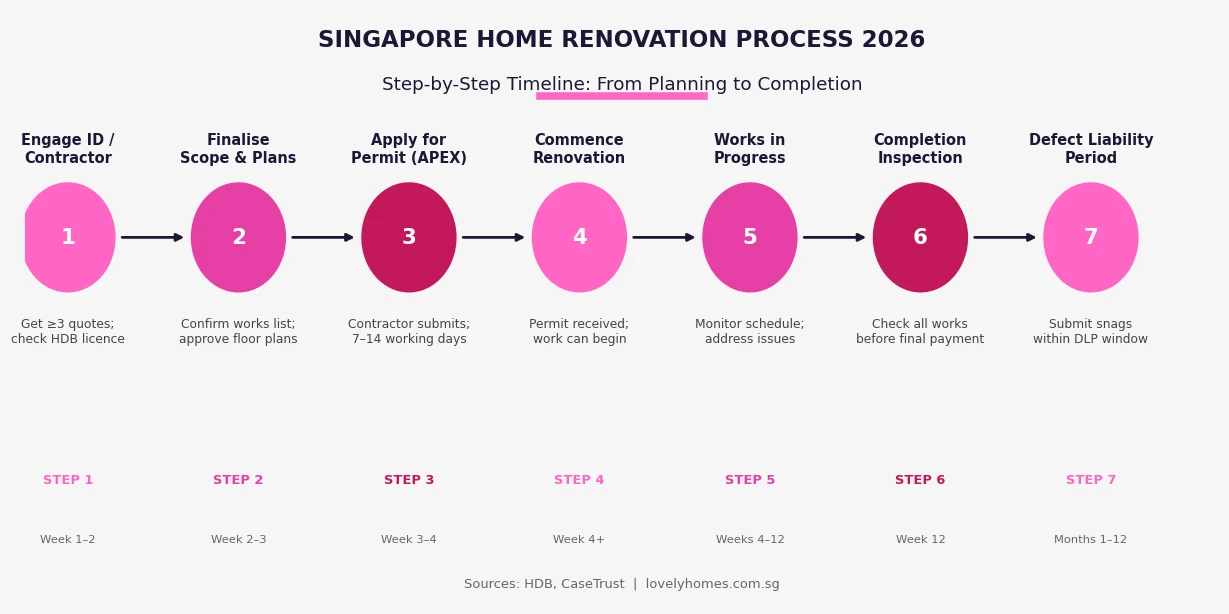
Singapore home renovation step-by-step process timeline 2026
Figure 2: The seven-step Singapore home renovation process from contractor engagement to defect liability period. Source: HDB, CaseTrust.
Click image to zoom

Choosing a Renovation Contractor in Singapore

For HDB flats, you must engage a contractor on HDB’s registered list — only registered contractors can submit APEX applications. For private condominiums, BCA licencing is the minimum requirement, though your MCST may maintain its own approved contractor list.

Above and beyond minimum licencing, look for CaseTrust-RCMA (Renovation and Decoration) accreditation — a joint scheme operated by the Consumers Association of Singapore (CASE) and the Renovation and Decoration Advisory Centre (RADAC). Accredited contractors participate in independent dispute mediation and maintain financial accountability. If works are abandoned, defective or materially incomplete, CaseTrust accreditation gives you a formal escalation route without resorting to civil litigation.

What Your Renovation Contract Must Include

A properly drafted renovation contract should specify: the full scope of works by trade (carpentry, tiling, M&E, painting); detailed material specifications (tile brand and grade, cabinet material, paint finish); a payment schedule tied to milestones; project start and completion dates; a defect liability clause for post-completion rectification; and the APEX permit number once issued. Never pay more than 10% upfront before the permit is approved and work has commenced on site.

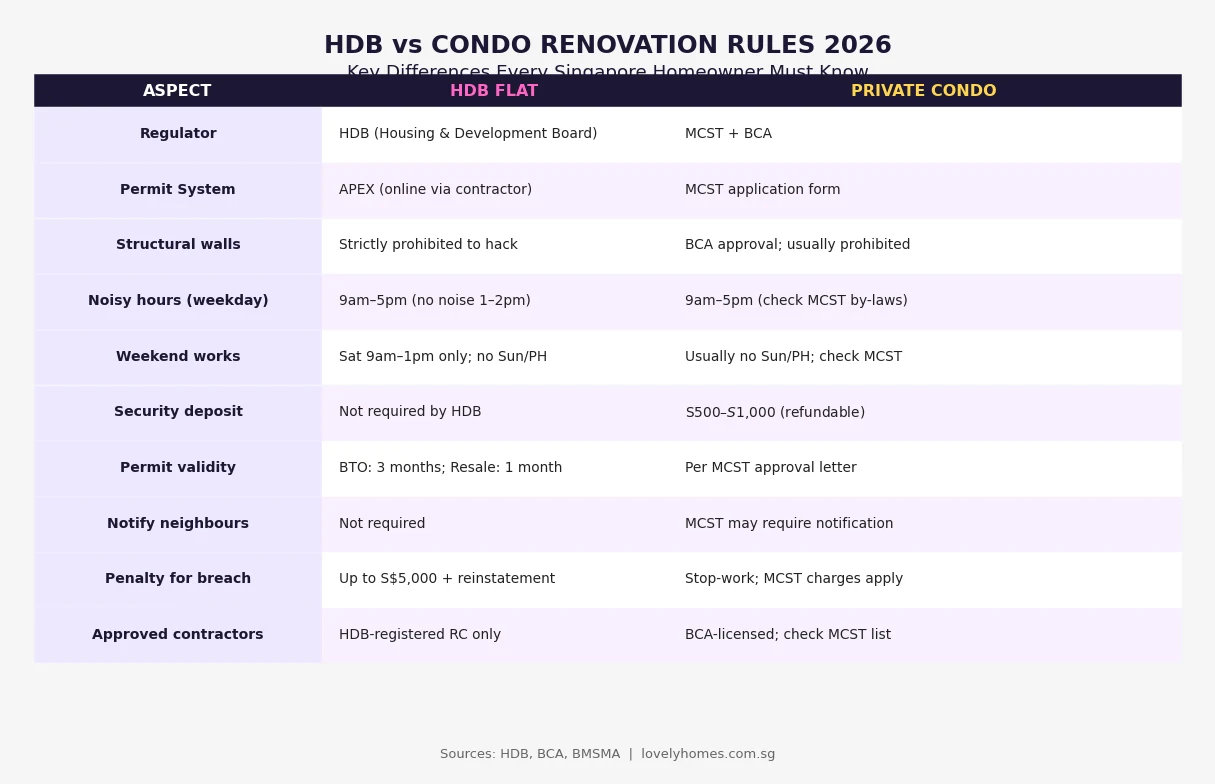
HDB vs condo renovation rules comparison Singapore 2026
Figure 3: HDB versus private condominium renovation rules — ten key differences. Source: HDB, BCA, BMSMA 2026.
Click image to zoom

HDB vs Condo Renovation Rules: Summary Table

Aspect HDB Flat Private Condo / Apartment
Regulator HDB MCST + BCA
Permit system APEX (contractor-submitted online) MCST application form
Structural walls Strictly prohibited to hack BCA approval required; usually prohibited
Noisy works hours (weekday) 9am–5pm; quiet period 1–2pm 9am–5pm; varies by MCST by-law
Weekend renovation Sat 9am–1pm only; no Sun/PH Usually no Sun/PH; check MCST
Security deposit Not required by HDB S$500–S$1,000 (refundable)
Permit validity BTO: 3 months; Resale: 1 month Per MCST approval letter
Neighbour notification Not legally required MCST may require written notification
Penalty for breach Up to S$5,000 fine + reinstatement order Stop-work; MCST may charge; Strata Titles Board enforcement
Contractor requirement HDB-registered RC only BCA-licensed; check MCST approved list

Worked Example: Full Renovation of a 4-Room BTO Flat, Tampines North 2026

Case Study: Mr & Mrs Lim — 4-Room BTO, Tampines North, TOP January 2026

Scope: Full renovation — hacking two non-structural partition walls; full tile overlay in living room and all bedrooms; kitchen and two bathrooms retiled; electrical DB upgrade; four built-in wardrobes; kitchen carpentry; and full-unit painting.

Permit process: Contractor engaged 1 February 2026. APEX application submitted 5 February 2026. Permit issued 17 February 2026 (8 working days). Renovation commenced 18 February 2026.

Timeline: BTO 3-month permit window expires 17 May 2026. Practical completion achieved 28 April 2026 (10 weeks). ✓ Within permit window.

Cost breakdown (2026 market rates):

  • Hacking and masonry: S$3,200
  • Tiling — living, bedrooms, bathrooms: S$14,500
  • Carpentry — wardrobes, kitchen, feature wall: S$22,000
  • Electrical works — DB upgrade, additional points: S$4,800
  • Painting — full unit including ceiling: S$3,500
  • Plumbing and sanitary fixtures: S$5,200
  • Total renovation cost: S$53,200

Compliance: No structural walls hacked. PE endorsement not required. Tiling thickness within HDB’s 75mm screed limit. Permit completed on time. No stop-work orders issued.

Why Singapore’s Renovation Rules Matter More Than You Might Think

Singapore’s renovation regulations are among the most prescriptive in the Asia-Pacific region, and they exist because the physical consequences of unpermitted renovation in high-density housing are real and irreversible. HDB estimates that several thousand permit violations are detected annually. The most serious cases involve hacking of structural elements — columns, shear walls, transfer beams — that directly compromise the load-bearing integrity of the entire residential block. In multi-storey buildings, the consequences of structural compromise cascade upward through every unit above.

For private condominiums, the BMSMA framework ensures that a renovation undertaken inside one unit does not depreciate the shared asset for hundreds of other subsidiary proprietors. MCST enforcement is backed by the Strata Titles Board, which can order reinstatement at the offending owner’s cost regardless of whether the contractor has since disappeared.

The practical takeaway for homeowners is straightforward: the permit process costs little in either time or money compared to the downside risk of enforcement. A S$5,000 fine and a reinstatement order on a S$50,000 renovation is a financially and emotionally costly outcome that is entirely avoidable.

What Might Come Next: Renovation Regulation Trends in Singapore

The BCA’s Built Environment Industry Transformation Map signals a push towards greater digitalisation of the permit and inspection process. Pilot programmes testing AI-assisted permit review — where computer vision analyses submitted drawings against HDB’s permitted and prohibited works matrix — could reduce APEX processing to 2–3 working days for straightforward applications by 2027. HDB has also signalled an upcoming review of renovation guidelines to accommodate sustainability upgrades: EV charging infrastructure, enhanced thermal insulation, and solar-ready flat designs are areas where current rules are expected to evolve before 2028. Homeowners planning longer-horizon renovation projects should watch the HDB MyNiceHome portal for rule updates.

Frequently Asked Questions: Singapore Home Renovation 2026

Can I do my own HDB renovation without a licensed contractor?

For works that do not require an HDB permit — painting, wallpapering, assembling freestanding furniture — you may carry out the works yourself. However, for all permit-required works (hacking, electrical, plumbing, tiling, partition walls), the APEX permit can only be submitted by an HDB-registered renovation contractor. DIY permit-required works constitute a breach of the Housing and Development Act and can result in fines and reinstatement orders. Electrical and plumbing works also carry personal safety risks and may void your home insurance. Use a licensed contractor for all structural and mechanical trades.

How do I verify that a contractor is HDB-registered?

The full, regularly updated list of HDB-registered renovation contractors is available on the HDB website at www.hdb.gov.sg under “Managing My Home → Renovation → Find a Registered Renovation Contractor”. You can search by contractor name, registration number or trade specialisation. For additional consumer protection, check whether the contractor also holds CaseTrust-RCMA accreditation via the CASE website at www.case.org.sg.

What happens if I renovate without an HDB permit?

HDB conducts routine inspections and investigates neighbour complaints about noise, dust or unusual works. If inspectors discover permit-required works carried out without approval, they will issue an immediate stop-work order. The homeowner — not the contractor — is legally liable and may be fined up to S$5,000. HDB will then issue an Order to Reinstate, requiring the works to be demolished and the flat restored to its original state at the homeowner’s expense. Your home insurance policy is unlikely to cover losses arising from unpermitted works.

Do I need to inform my neighbours before renovation starts?

For HDB flats, there is no legal obligation to notify neighbouring units, though it is courteous to do so for extended projects involving significant noise. For private condominiums, many MCSTes require written notification to immediately adjacent units before commencement, particularly for hacking or plumbing works. Failure to comply with MCST notification requirements can result in withdrawal of approval and a stop-work order. Check your specific development’s by-laws, which are registered with the Singapore Land Authority and available from your MCST management office.

What is the difference between an HDB renovation permit and a BCA building permit?

An HDB renovation permit is required for internal alterations to an HDB flat under HDB’s renovation guidelines. A BCA building permit (Building Plan Approval) is required for structural works affecting the building envelope, load-bearing elements, or gross floor area — such as an extension to a landed property, a new roof, or external wall modifications. For most HDB flat renovations, only the HDB permit is required. Landed property owners undertaking major structural works additionally need BCA approval, submitted by a qualified person (architect or structural engineer).

Can I renovate a resale HDB flat before the transfer is completed?

No. The HDB renovation permit can only be issued to the registered owner of the flat. Renovation cannot legally commence before the resale completion appointment has been concluded, keys collected, and ownership confirmed by HDB. Any renovation begun before this point is unpermitted, and the incoming owner inherits any enforcement consequences. Plan and select your contractor during the resale transaction period so that works can begin as soon as keys are in hand.

How long does a typical full HDB flat renovation take?

A full renovation of a 3-room HDB flat typically takes 6–9 weeks from permit approval to practical completion. A 4-room or 5-room flat generally takes 8–14 weeks depending on scope and contractor workload. The most time-intensive phases are hacking and masonry (week 1), tiling (weeks 1–3), and carpentry (weeks 3–6). Painting, final fixtures and clean-up complete the final two weeks. BTO flat owners must ensure the full scope is completed within the 3-month permit window, so engage your contractor immediately upon key collection.

Related Articles

Disclaimer: This article is for general informational purposes only and does not constitute legal, financial or renovation advice. Renovation rules, permit requirements and approved contractor lists are subject to change by HDB, BCA and individual MCSTes. Always verify current requirements directly with HDB (www.hdb.gov.sg), BCA (www.bca.gov.sg), and your development’s MCST management office before commencing any renovation works. For complex structural works, engage a qualified architect or structural engineer.

Singapore Renovation Cost Guide 2026: HDB, Condo & Landed Budgets Explained

Singapore Renovation Cost Guide 2026: HDB, Condo & Landed Budgets Explained

📌 Quick Answer: Singapore Renovation Costs at a Glance (2026)

  • HDB 3-room reno: S$18,000–S$40,000 (basic to premium)
  • HDB 4-room reno: S$25,000–S$55,000 — the most common renovation bracket
  • HDB 5-room / EA: S$32,000–S$90,000 depending on scope and finishes
  • Condo 2-bedroom: S$30,000–S$65,000; 3-bedroom S$45,000–S$100,000
  • Landed (inter-terrace): S$80,000–S$180,000 for a mid-range full reno
  • Cost driver: Carpentry (built-ins) typically accounts for 25–30% of total budget
  • HDB rules: All renovation works in HDB flats require an HDB-approved renovation contractor and specific permits for hacking, plumbing, and electrical works
  • Cost inflation: The BCA Building Cost Index rose ~53% between 2019 and 2026, driven by labour shortages, import costs, and COVID disruptions

Introduction: Understanding Renovation Costs in Singapore

Renovating a home in Singapore is one of the largest discretionary expenditures most households will make after purchasing property. Whether you have just collected the keys to a new HDB Build-To-Order (BTO) flat, bought a resale unit requiring a full makeover, or acquired a condo for rental fit-out, understanding the realistic cost envelope — and what drives it — is essential before signing any contractor agreement.

This guide draws on Building and Construction Authority (BCA) cost data, HDB renovation guidelines, and industry contractor surveys to give you a transparent, up-to-date picture of what renovations cost in Singapore in 2026. We cover all property types, break down costs by trade, flag the HDB-specific rules you must follow, and provide a worked example of a realistic S$60,000 HDB 4-room renovation.

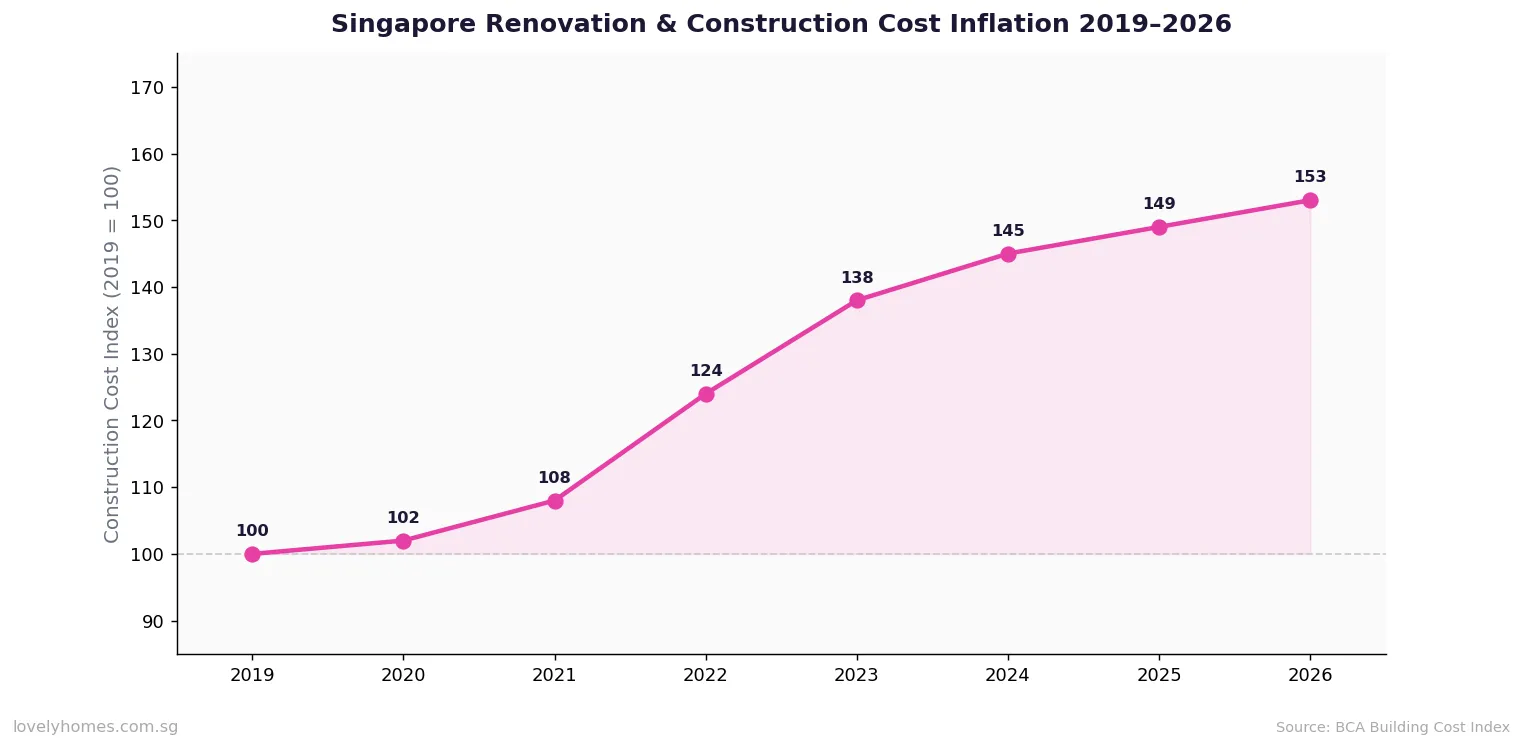
Renovation costs in Singapore have risen sharply since 2019 — the BCA Building Cost Index climbed approximately 53% between 2019 and 2026, driven by a combination of labour shortages (post-COVID, especially for skilled trades), higher import costs for materials (tiles, sanitary ware, timber), and supply chain disruptions. Buyers who last renovated in 2018–2020 will find that comparable works cost materially more today.

Renovation Cost Ranges by Property Type

The first step in any renovation budget exercise is benchmarking your total envelope against the market range for your property type. These figures represent the realistic range for Singapore renovation contractors in 2026 — the lower end assumes basic joinery, standard fittings, and minimal hacking; the upper end assumes premium materials, extensive carpentry, and full kitchen/bathroom overhauls.

Singapore renovation cost ranges HDB condo landed 2026
Figure 1: Singapore renovation cost ranges by property type (2026). Source: BCA / HDB / contractor industry surveys.

A few caveats: these figures assume a straightforward renovation with no major structural changes. Knocking down walls (even non-structural ones in HDB flats) requires permits and increases costs. Additions and Alterations (A&A) works on landed properties are governed by URA and BCA regulations and can add significantly to the base scope. Condo renovations also require approval from the Management Corporation Strata Title (MCST) for any works affecting common property or structural elements.

HDB-Specific Renovation Rules

Renovating an HDB flat is more tightly regulated than renovating private property. The HDB Renovation Guidelines, administered under the Housing & Development Board Act, mandate that all homeowners:

  • Engage only HDB-registered renovation contractors — a list is maintained on the HDB portal. Using an unregistered contractor voids your renovation permit and may result in enforcement action.
  • Apply for a Renovation Permit (RP) through the HDB portal before works commence. Most structural, plumbing, electrical, and hacking works require a prior permit.
  • Adhere to permitted renovation hours: weekdays 9 am–5 pm, Saturdays 9 am–1 pm; no renovation noise on Sundays and Public Holidays.
  • Complete all works within the one-month renovation period (extendable by application for complex projects).

Common HDB-prohibited works include: removal of structural walls or floor beams, installation of structural roof modifications, and certain types of wet area extensions beyond the bathroom footprint. Always confirm with HDB before including any such works in your renovation scope.

HDB Renovation Costs by Room

Room / Area Typical Cost Range (S$) Key Work Items
Living/Dining S$8,000–S$20,000 Feature wall, flooring, false ceiling, lighting, TV console
Master Bedroom S$5,000–S$12,000 Wardrobe, bedhead, flooring, lighting
Common Bedrooms (×2) S$3,000–S$7,000 each Wardrobe, flooring, study desk
Kitchen (HDB) S$5,000–S$15,000 Cabinet replacement, countertop, backsplash, appliances excl.
Bathrooms (×2) S$4,000–S$10,000 each Tiles, sanitary ware, shower screen, waterproofing
Electrical & Lighting S$3,000–S$8,000 Rewiring, additional DB points, smart switches
Painting (whole flat) S$2,000–S$5,000 Full repaint, feature wall

Renovation Cost Breakdown by Trade

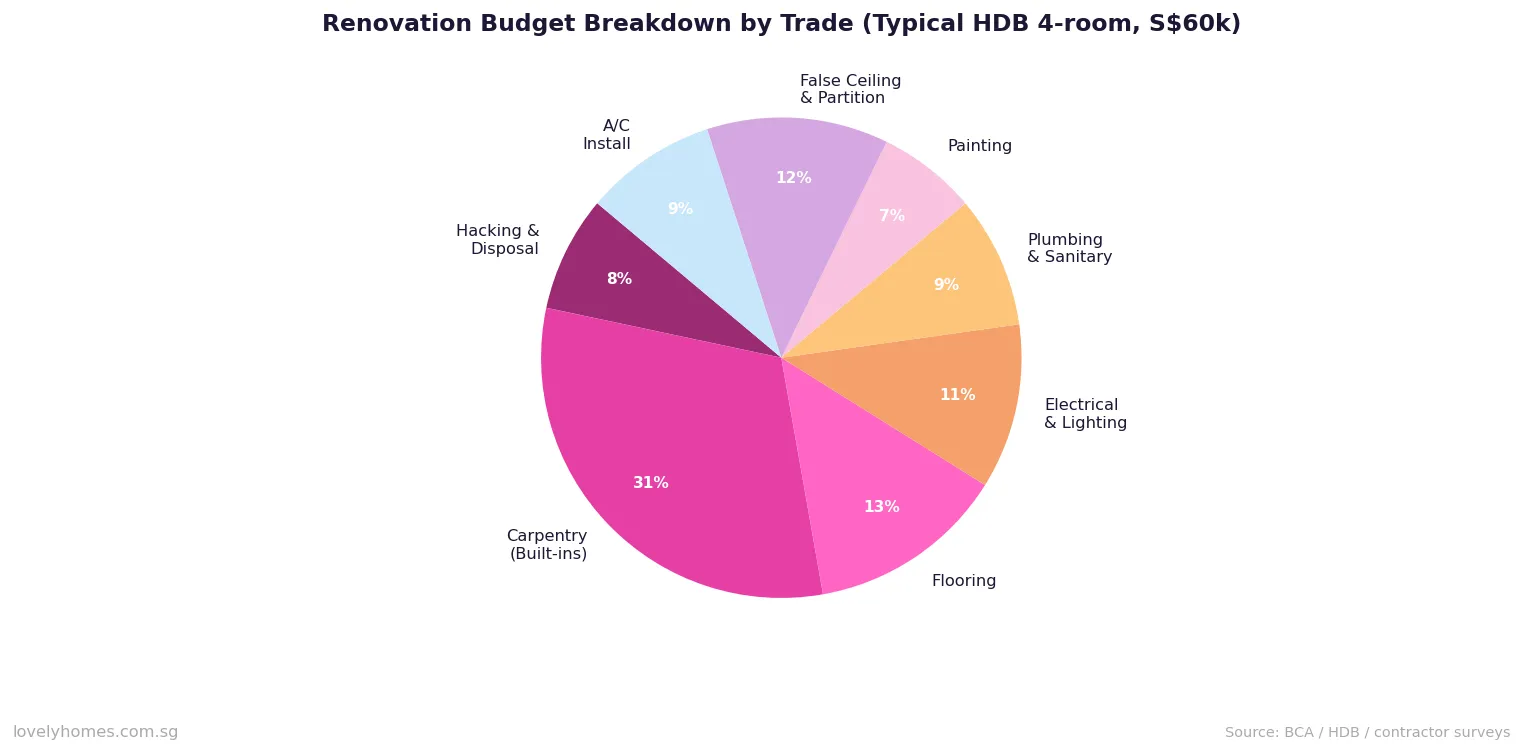
Understanding how renovation budgets are distributed across trades helps you identify where to focus your cost-saving efforts and where to protect quality. The single largest cost centre in most Singapore renovations is carpentry and built-in joinery, which typically represents 25–30% of the total budget. This covers wardrobes, kitchen cabinets, TV consoles, book shelves, and any custom millwork. Premium solid-wood or veneer finishes can push carpentry costs materially higher than the base rate.

Singapore renovation budget breakdown by trade HDB 4-room 2026
Figure 2: Typical renovation budget allocation by trade — HDB 4-room, S$60,000 total (2026). Source: BCA / contractor industry surveys.

The second-largest bucket is typically flooring (ceramic/porcelain tiles or vinyl plank), which accounts for around 12% of the budget. Electrical and plumbing works together form another ~18%, and are subject to HDB permit requirements for all HDB flat owners. Painting — often perceived as expensive — is actually among the most cost-efficient trades: a full repaint of an HDB 4-room flat typically costs S$2,000–S$5,000 and has a disproportionate visual impact relative to its cost.

Renovation Cost Inflation: The 2019–2026 Story

Singapore’s renovation industry has absorbed significant cost pressures since 2019. Labour costs for skilled tradespeople — carpenters, tilers, plumbers, and electricians — rose sharply as COVID-19 border restrictions in 2020–2021 reduced the availability of foreign construction workers. Material costs (particularly timber, tiles, and sanitary fittings) rose with global shipping costs and supply chain disruptions in 2021–2022. Although freight costs normalised from 2023 onward, labour costs have remained elevated as the construction sector competes for workers with major public infrastructure projects (MRT, public housing, Changi Airport Terminal 5).

Singapore renovation construction cost inflation index 2019 to 2026
Figure 3: Singapore renovation and construction cost inflation index, 2019–2026 (base 2019 = 100). Source: BCA Building Cost Index.

Condo and Landed Renovation: Key Differences

Private condo renovations follow BCA regulations under the Building Control Act, but are also subject to each development’s MCST by-laws. Common restrictions include no wet works above the 2nd storey without waterproofing certification, no penetration of ceiling slabs, and defined renovation hours (which may be stricter than the HDB schedule). Always obtain a copy of the MCST by-laws before finalising your renovation scope.

Landed property renovations involving Additions and Alterations (A&A) of more than a specified GFA threshold require a Qualified Person (QP) — an architect or engineer — to submit plans to BCA and URA. For conservation shophouses or bungalows in gazetted conservation areas, URA’s Conservation Guidelines impose additional requirements on façade changes, window types, and internal modifications. Budget an additional S$15,000–S$40,000 for QP fees and regulatory compliance on complex landed A&A projects.

How to Choose a Renovation Contractor

Singapore has no single licensing body for interior designers or renovation contractors (other than the HDB registration requirement for HDB flat works and the BCA licensing system for general construction contractors above certain project values). Homeowners should:

  • Obtain at least three quotations from different contractors, specifying the same scope in writing.
  • Verify the contractor’s HDB registration (if applicable) and any relevant BCA licensing at hdb.gov.sg and bca.gov.sg.
  • Request a detailed Bill of Quantities (BQ) — a line-item breakdown by trade and material. Reject any contractor who provides only a lump-sum quote without itemisation.
  • Include a defects liability period of at least 12 months in the contract, with a retention sum of 5–10% held until defects are rectified.
  • Pay progressively: typically 10% on signing, 30% on commencement, 30% on milestone completion, and the balance (including retention) on final handover.

Summary: Singapore Renovation Costs at a Glance (2026)

Property Type Basic Reno (S$) Mid-Range (S$) Premium (S$)
HDB 3-room 18,000–25,000 25,000–32,000 32,000–40,000+
HDB 4-room 25,000–35,000 35,000–45,000 45,000–55,000+
HDB 5-room / EA 32,000–45,000 45,000–60,000 60,000–90,000+
Condo 1-bed 22,000–30,000 30,000–38,000 38,000–45,000+
Condo 2-bed 30,000–45,000 45,000–55,000 55,000–65,000+
Condo 3-bed 45,000–65,000 65,000–85,000 85,000–100,000+
Landed (Inter) 80,000–110,000 110,000–140,000 140,000–180,000+

Worked Example: A Realistic S$60,000 HDB 4-Room Renovation

📊 Case Study: The Lim Family — New BTO 4-room at Kallang Horizon (98 sqm)

Budget: S$60,000
Timeline: 6 weeks from commencement
Property: New BTO 4-room HDB flat — bare unit, no flooring, no built-ins

Trade / Work Item Scope Cost (S$)
Hacking & disposal Bathroom walls, kitchen walls (existing tiles), debris removal 4,200
Carpentry (built-ins) Master wardrobe (2.4m, 4-door), 2× common room wardrobes, TV console, kitchen cabinets (upper & lower), shoe cabinet 16,800
Flooring 600×600 porcelain tiles throughout (except bathrooms), L&D and installation 7,200
Electrical & lighting Rewiring, 8 fan/light points, track lighting, 4 additional DB points 6,000
Plumbing & sanitary 2× bathroom refit (WC, basin, mixer, accessories), kitchen sink & mixer 4,800
Painting Full flat repaint, 1× feature wall 3,600
False ceiling & partition Living/dining plaster false ceiling with cove lighting, bedroom partition 6,600
Air-conditioning 4-trunking system (Daikin multi-split, 5 FCUs) — supply & installation 7,200
Miscellaneous & contingency Grouting, sealants, touch-ups, 5% contingency 3,600
Total 60,000

HDB Renovation Permit required for: hacking, electrical works, plumbing. Permit application submitted online via HDB portal before commencement. Contractor is HDB-registered. Renovation hours: Mon–Fri 9am–5pm, Sat 9am–1pm.

What This Means for Homeowners in 2026

The renovation cost picture in 2026 is one of structurally higher but stable prices. The dramatic 2021–2022 spike in material and labour costs has plateaued, but there is no expectation of a meaningful reversal — labour costs are sticky, and major public infrastructure projects (T5, Cross Island Line Phase 2, Jurong Lake District) will continue to compete for skilled workers with the residential renovation sector.

The practical implication is that homeowners should budget conservatively, obtain multiple quotations, and resist the temptation to compress scope at the expense of structural works (waterproofing, electrical distribution boards, plumbing) — these are the items where deferred spending creates expensive future problems. A well-specified renovation with clear defects liability terms and a staged payment schedule remains the best risk-management approach available to homeowners.

What Might Come Next: Renovation Costs in 2027 and Beyond

Several policy and structural trends will shape renovation costs over the next 1–2 years. The Singapore government’s push to increase the use of Integrated Digital Delivery (IDD) and Design for Manufacture and Assembly (DfMA) in the construction sector — led by BCA — may eventually improve productivity and moderate labour cost growth in renovation. However, the near-term impact on residential renovation (which relies on small-scale, bespoke trades) is likely to be minimal. More consequential in the near term will be the wind-down of the Temporary Housing Unit levy rebate scheme, and any changes to foreign worker levy rates for the construction sector.

❓ Frequently Asked Questions: Singapore Renovation Costs 2026

Do I need a permit to renovate my HDB flat?

Yes. All renovation works in HDB flats — including hacking, plumbing, electrical changes, and structural modifications — require a Renovation Permit (RP) from HDB before works commence. Your HDB-registered contractor is responsible for applying for the RP on your behalf through the HDB portal. Works carried out without a valid RP are an offence under the Housing & Development Act and may result in a restoration order requiring you to reinstate the unit at your own cost.

Can I renovate a condo unit without MCST approval?

Minor works (painting, replacing fixtures, installing non-structural furniture) generally do not require MCST approval. However, any works affecting the common property — drilling into structural walls, modifying utility risers, replacing windows, or any wet works above ground-floor units — typically require prior written approval from the MCST. Review your development’s by-laws carefully before commencing work, and obtain written MCST approval for any ambiguous scope items. Your contractor should also observe the development’s stipulated renovation hours, which may be stricter than the HDB schedule.

What is the cheapest way to renovate an HDB flat in Singapore?

The three most effective cost-saving strategies are: (1) Minimise hacking — hacking and disposal is disruptive, expensive, and can trigger unforeseen defects in adjacent surfaces; retiling over existing tiles (if structurally sound) can save S$3,000–S$6,000. (2) Rationalise carpentry — limit built-ins to rooms that genuinely need them; freestanding furniture is more cost-effective than custom carpentry for secondary bedrooms. (3) Obtain at least three detailed BQ quotations and negotiate on the basis of comparable line items — price competition between contractors is substantial in Singapore’s current renovation market.

How long does a typical HDB renovation take?

A standard HDB 4-room renovation takes 4–8 weeks from commencement, depending on scope and contractor scheduling. The HDB-permitted renovation period is one month, extendable by application. Complex scopes (full wet works, extensive electrical rewiring, major carpentry) typically require 6–8 weeks and should be confirmed with your contractor before signing. Factor in a buffer: contractor delays, material lead times (especially for imported tiles or custom joinery), and defect rectification commonly add 1–2 weeks to the projected timeline.

Is renovation loan interest deductible for tax purposes?

For owner-occupied residential properties in Singapore, renovation costs and renovation loan interest are not deductible against personal income tax. However, if you are renovating a property that you rent out, renovation costs that constitute deductible repairs and maintenance (restoring existing fixtures to working condition, not upgrading or adding new fixtures) may be deductible against rental income under Section 14 of the Income Tax Act, administered by IRAS. Capital expenditure — adding new fixtures or improving the property beyond its original condition — is not deductible. Consult a tax professional or refer to the IRAS website for the current guidance on rental property deductions.

Does CPF Ordinary Account funds cover renovation costs?

No. CPF Ordinary Account (OA) savings cannot be used for renovation expenses. CPF OA funds may only be used for approved property purchases, HDB home loans, mortgage instalment payments, property-related insurance premiums, and stamp duty. Renovation must be funded from cash savings or a renovation loan. Most major Singapore banks offer unsecured renovation loans at rates between 3.88% and 6.0% effective p.a. for tenures of 1–5 years — these are typically lower-cost than personal loans but must not exceed 6× the borrower’s monthly income or S$30,000, whichever is lower, under MAS guidelines for licensed financial institutions.

Disclaimer: This article is for general information purposes only and does not constitute financial, legal, or construction advice. Renovation costs vary significantly based on scope, contractor, materials, and site conditions. Regulatory requirements for HDB, condo, and landed renovations are subject to change. Always verify current guidelines with HDB, BCA, and URA, and engage qualified professionals for your renovation project.
×

Click anywhere outside to close

Translate »