Singapore Seller’s Stamp Duty (SSD) Guide 2026: Rates, Rules and Worked Examples
Seller’s Stamp Duty (SSD) is a tax levied by the Inland Revenue Authority of Singapore (IRAS) on the sale of residential and industrial properties that are disposed of within a specified holding period. Introduced in 2010 and subsequently revised, SSD is one of Singapore’s core property market stabilisation tools — designed to discourage short-term speculative “flipping” of property. Sell too early, and you pay. Hold long enough, and you pay nothing.
For most property owners, SSD is straightforward in concept but easy to miscalculate in practice. The rate, the holding period clock, the definition of the “date of acquisition”, and the rare exemptions all matter. This guide covers every dimension of Singapore SSD in 2026, with rates, worked examples, and Singapore-dollar figures drawn from IRAS’s official stamp duty guidance.
Quick Answer — Singapore SSD at a Glance
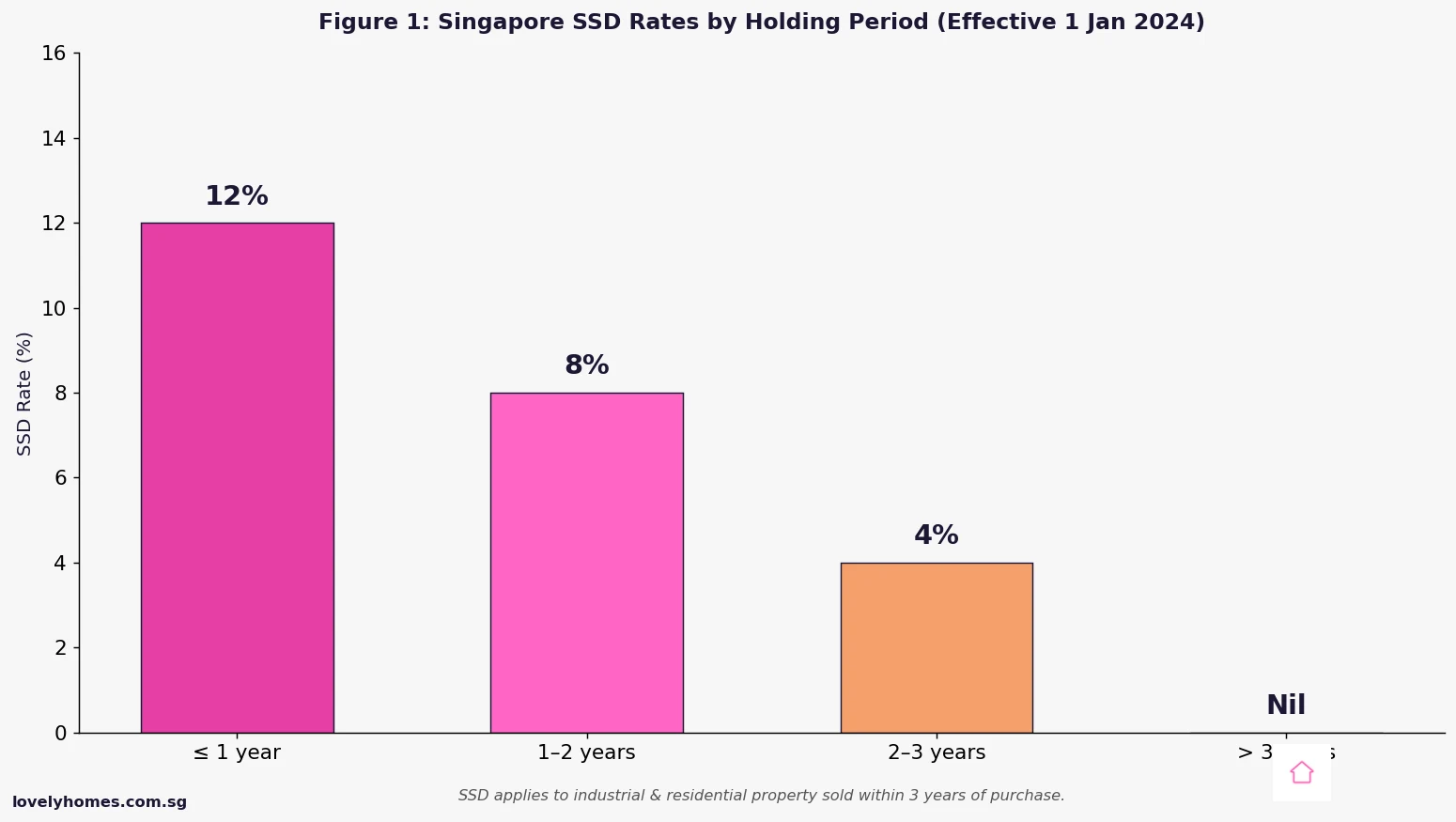
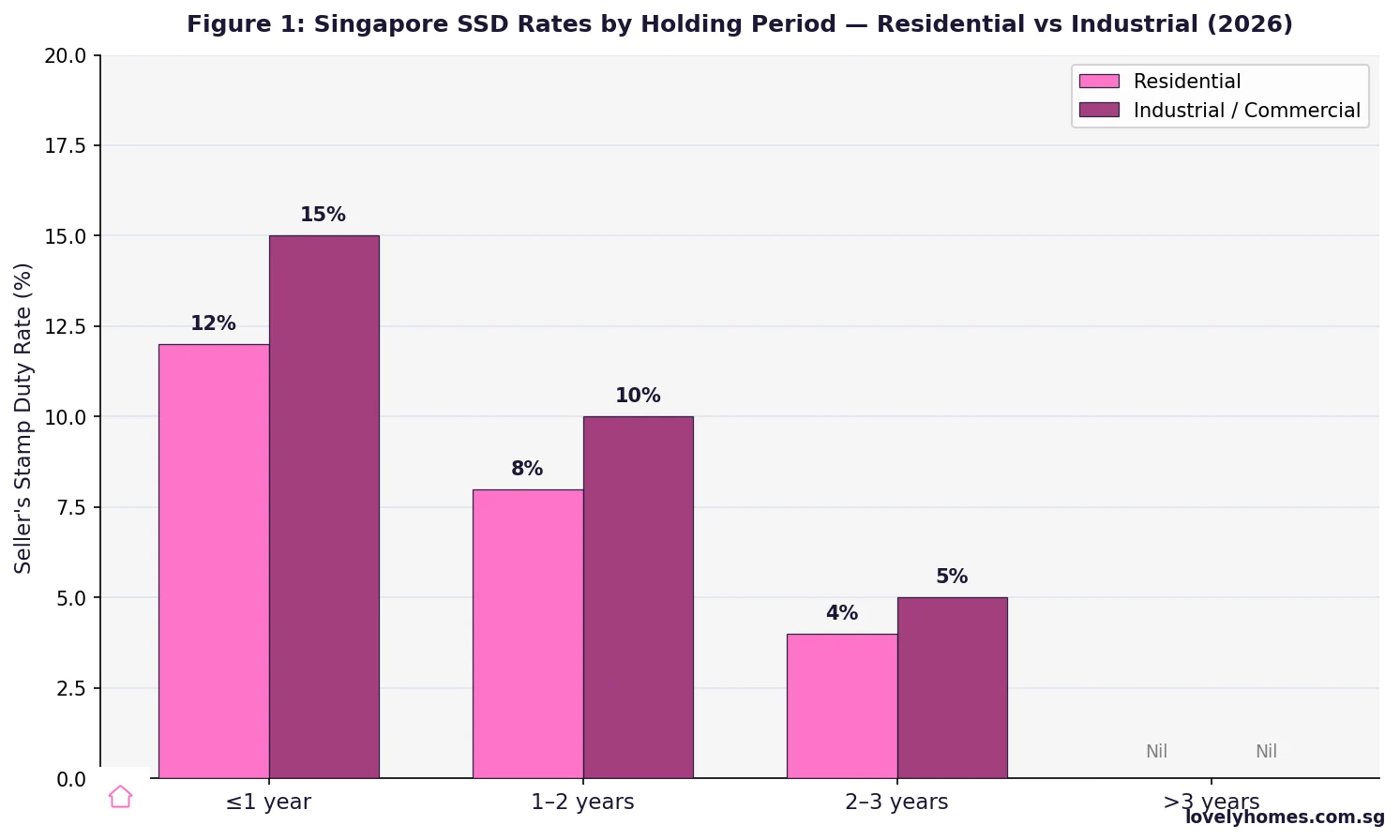
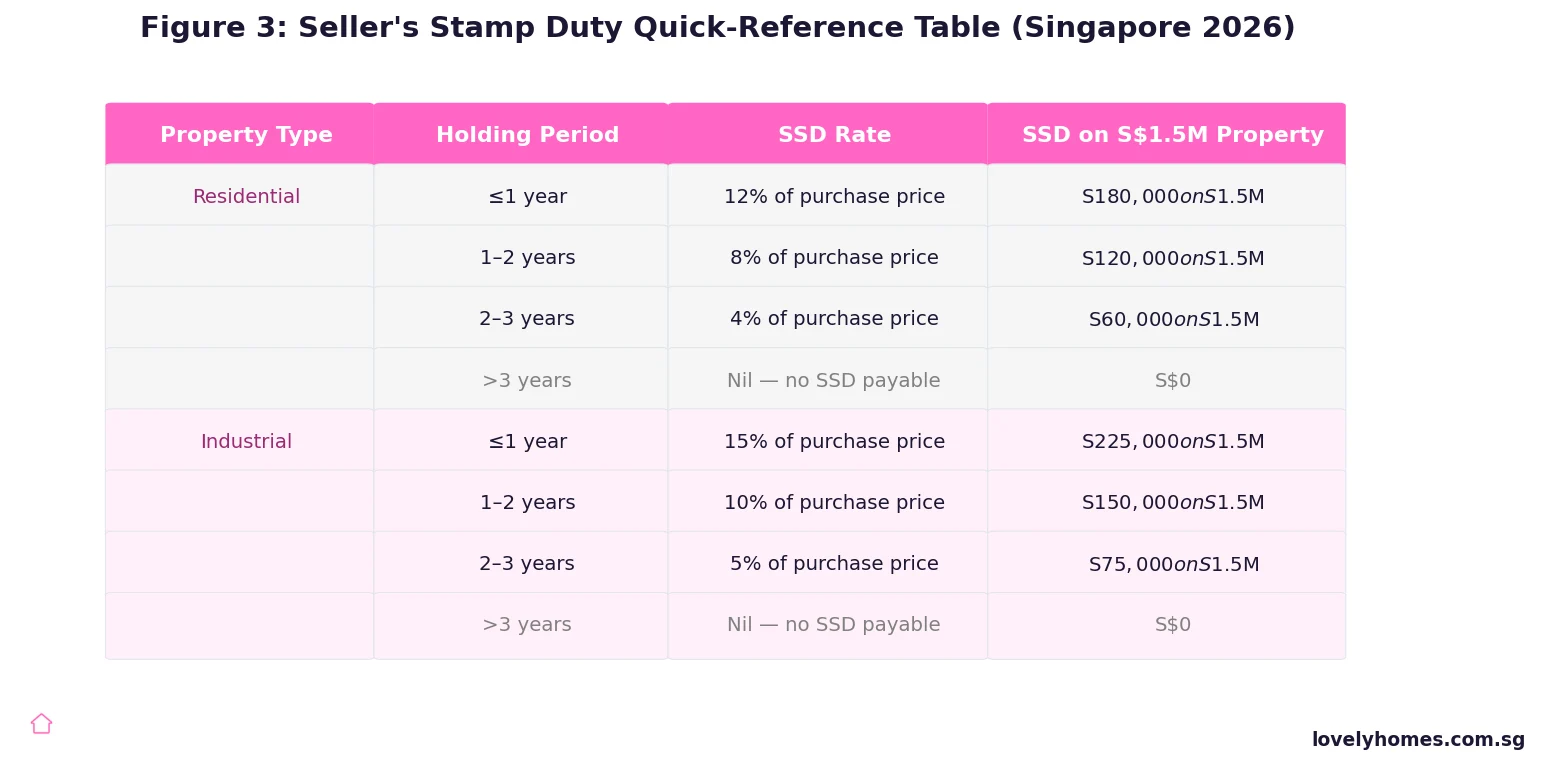
- Residential SSD rates (2026): 12% if sold within 1 year; 8% within 1–2 years; 4% within 2–3 years; Nil thereafter. Administered by IRAS.
- Industrial SSD rates (2026): 15% within 1 year; 10% within 1–2 years; 5% within 2–3 years; Nil thereafter.
- SSD is calculated on the higher of purchase price or market value at the time of sale.
- The holding period clock starts from the date of purchase (Option to Purchase exercise date, or date of sale and purchase agreement, whichever applies).
- SSD is payable by the seller, not the buyer, within 14 days of execution of the instrument of transfer.
- HDB flats are generally exempt from residential SSD (the Minimum Occupation Period rules serve the same function).
- SSD is not refundable if the sale subsequently falls through after the transfer instrument has been stamped.
What Is Seller’s Stamp Duty (SSD)?
Seller’s Stamp Duty is a stamp duty applied under the Stamp Duties Act (Chapter 312) to the conveyance or transfer of residential and industrial properties that are sold within the SSD holding period. It was first introduced for residential properties on 20 February 2010, following concerns about speculative activity in Singapore’s property market, and the rates have been adjusted several times since — most recently on 11 March 2017, when the residential SSD rates were simplified and the holding period was reduced from four years to three years.
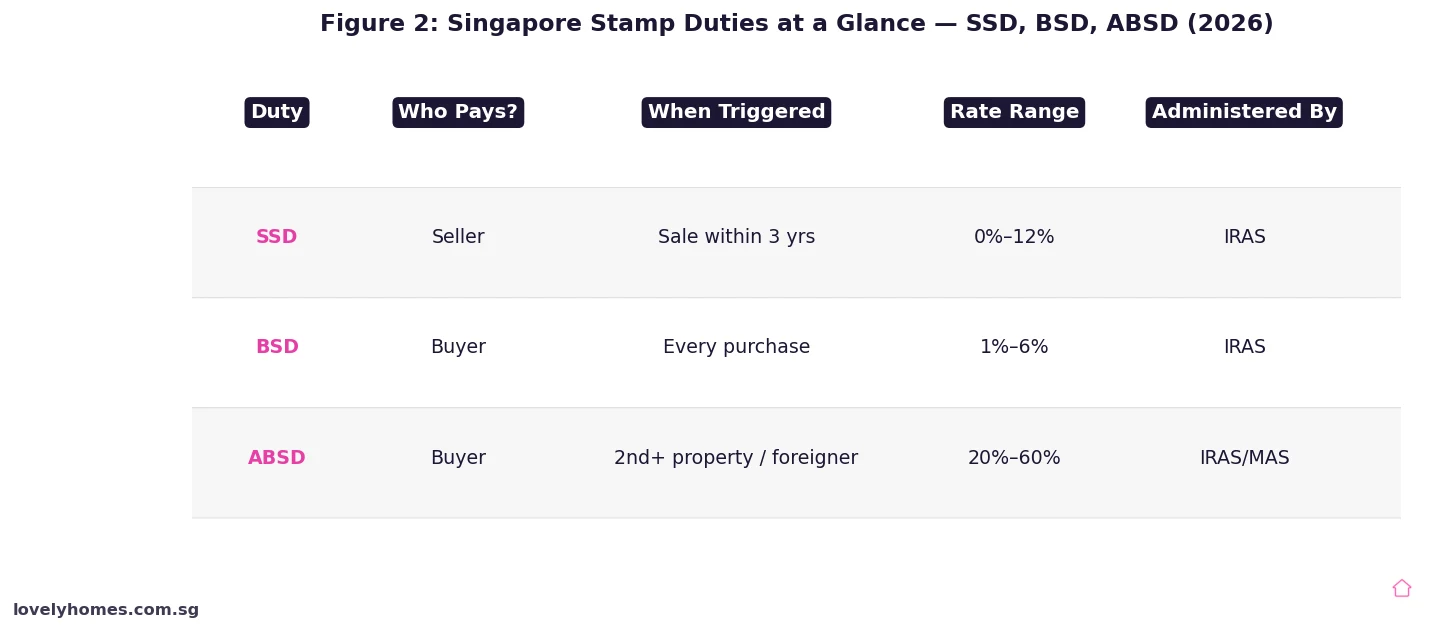
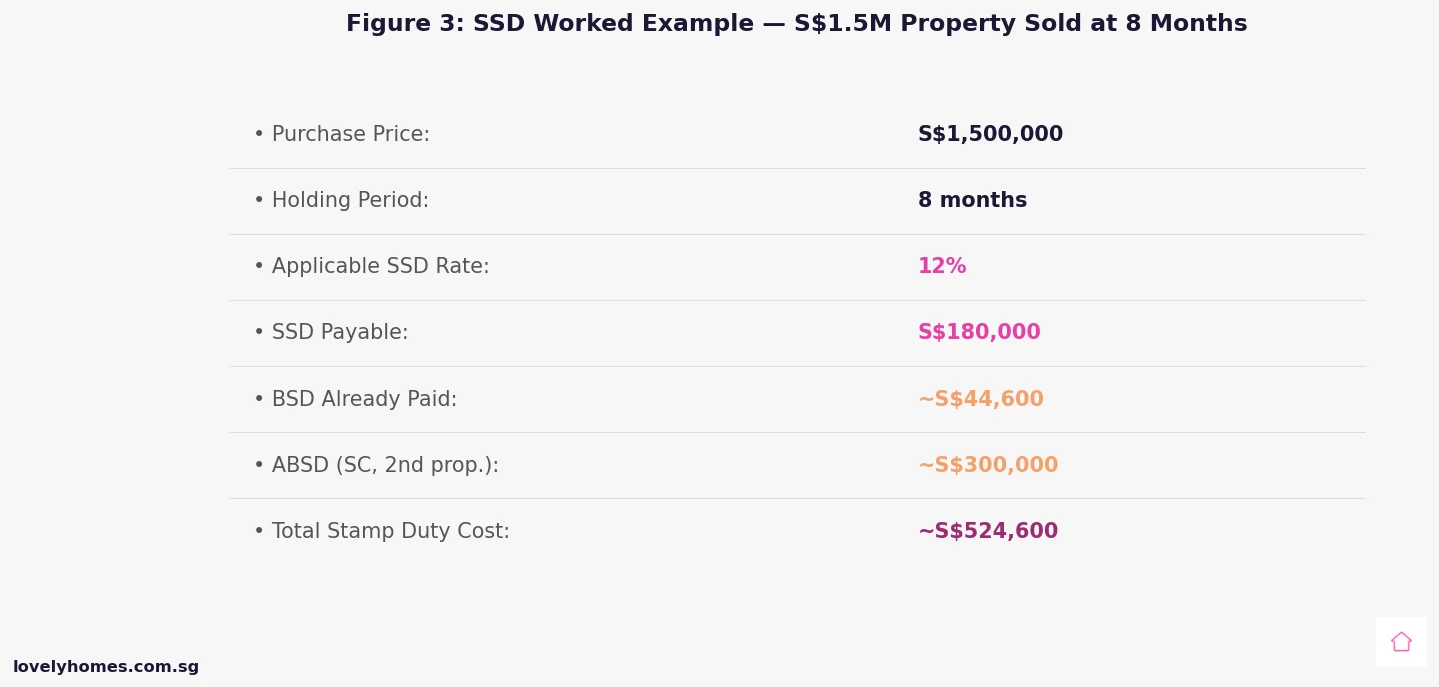
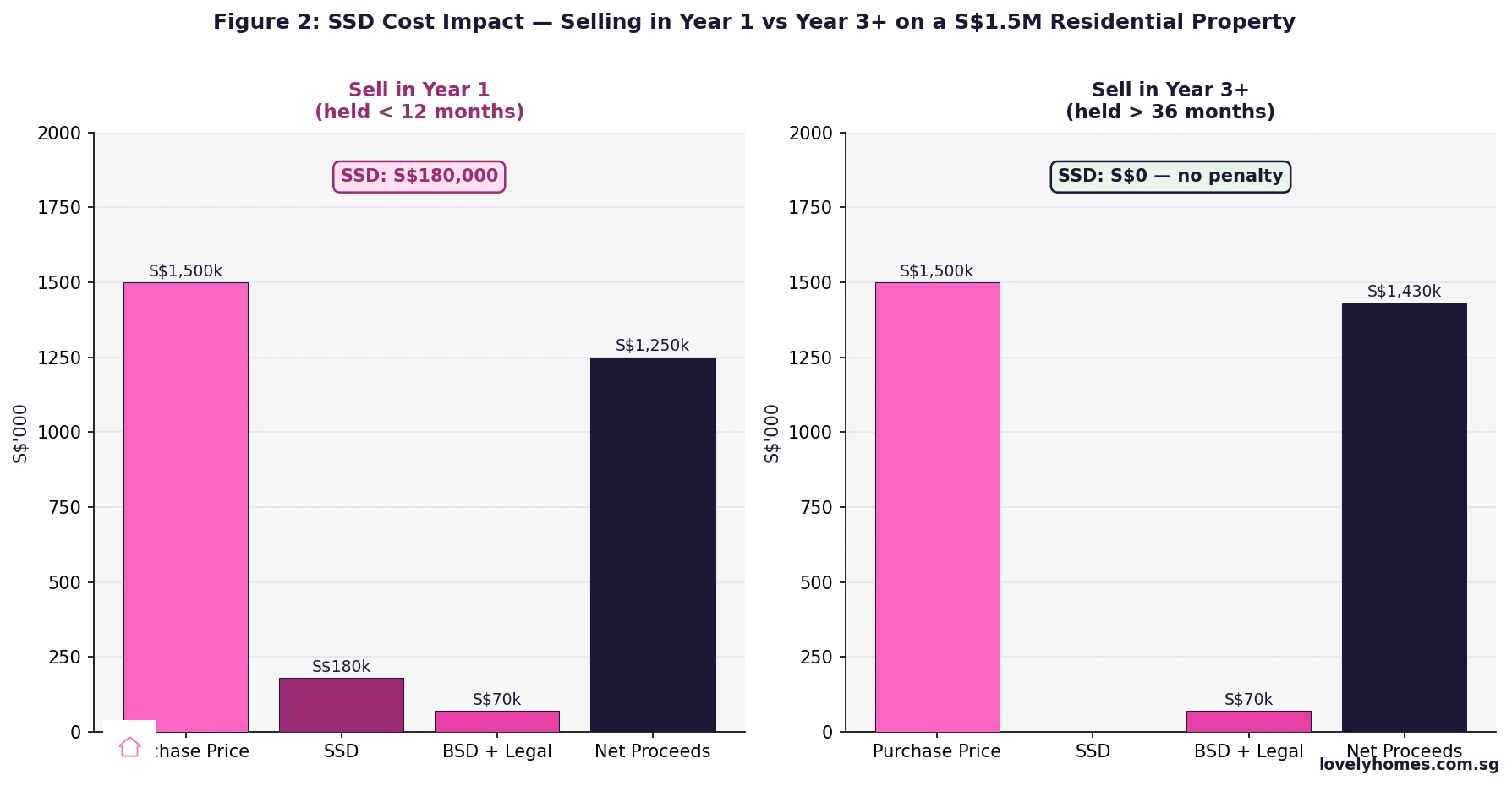
The SSD is administered by IRAS and collected alongside Buyer’s Stamp Duty (BSD) and Additional Buyer’s Stamp Duty (ABSD) as part of Singapore’s stamp duty framework. Unlike BSD and ABSD (which are paid by the buyer), SSD falls squarely on the seller. It is a significant cost: on a S$1,500,000 residential property sold within the first year, SSD alone amounts to S$180,000.
Residential SSD Rates 2026
The residential SSD rates that apply in 2026 — effective from 11 March 2017 — are tiered by the number of years the property was held, measured from the date of acquisition to the date of sale. IRAS defines “years” in complete calendar years, so a property held for 364 days is treated as “held within 1 year” and incurs the 12% rate.
| Holding Period | Residential SSD Rate | Industrial SSD Rate |
|---|---|---|
| Up to and including 1 year | 12% | 15% |
| More than 1 year and up to 2 years | 8% | 10% |
| More than 2 years and up to 3 years | 4% | 5% |
| More than 3 years | Nil | Nil |
SSD is levied on the higher of the sale price or the market value of the property at the time of sale, as determined by IRAS. For most arm’s-length transactions, the sale price is the applicable figure. If IRAS determines that the sale price is below market value (for example, in a related-party transaction), the market value will be used instead.
Industrial Property SSD
Industrial SSD was introduced later than residential SSD — on 12 January 2013 — following a rapid run-up in industrial property prices in 2011–2012. The rates are slightly higher than residential (15% > 12% in year one; 10% > 8% in year two; 5% > 4% in year three), and the definition of “industrial property” covers properties that are zoned as Business 1 (B1), Business 2 (B2), or Business Park in URA’s Master Plan — including warehouses, factories, and workshop units. Commercial properties (retail shophouses, office units) are not subject to industrial SSD.
HDB Flats and SSD Exemption
HDB flats are generally exempt from residential SSD. The rationale is that the HDB Minimum Occupation Period (MOP) — typically five years for BTO flats and three years for DBSS flats — already prevents early disposal of HDB flats, serving the same policy function as SSD. Any attempt to sell an HDB flat before the MOP expires without HDB’s approval is a breach of HDB’s conditions of purchase, not merely a stamp duty matter. After the MOP, HDB resale flats can be sold freely with no SSD payable.
How SSD Is Calculated
The SSD amount is simply: SSD Rate × Higher of (Sale Price or Market Value). There are no deductions for renovation costs, CPF refunds, or outstanding loan balances. It is applied on the gross disposal price. Because SSD is a cost to the seller, it is typically considered in net proceeds calculations when deciding whether an early sale makes financial sense.
Worked Example: The Tan Family’s Early Sale Decision
Scenario: Mr Tan (Singapore Citizen) purchased a condominium unit in the Outside Central Region (OCR) for S$1,200,000 on 15 June 2025 using Option to Purchase. His employer has offered him a posting overseas and he is considering whether to sell in August 2026 (approximately 14 months after purchase) or to hold until after the 3-year SSD window expires (after 15 June 2028).
If he sells in August 2026 (held approximately 14 months — within 1–2 years):
- Assumed sale price: S$1,280,000 (6.7% gain over purchase price)
- SSD rate: 8% (held more than 1 year, up to 2 years)
- SSD payable: S$1,280,000 × 8% = S$102,400
- BSD paid at purchase: S$42,600 (already sunk cost)
- Legal & agent fees on sale: approximately S$16,000
- Net proceeds from sale: S$1,280,000 − S$102,400 (SSD) − S$16,000 (fees) = S$1,161,600
- vs purchase price of S$1,200,000: net loss of S$38,400 (excluding financing costs)
If he waits and sells after June 2028 (held over 3 years):
- Assumed sale price: S$1,350,000 (modest appreciation over 3 years)
- SSD: S$0
- Legal & agent fees: approximately S$17,000
- Net proceeds: S$1,350,000 − S$17,000 = S$1,333,000
- vs purchase price: net gain of S$133,000 (excluding financing costs)
Conclusion: The 3-year wait delivers a S$171,400 improvement in net proceeds (after SSD and fees). Unless the posting income or an immediate property need makes the sale unavoidable, holding past the SSD window is typically the better financial decision.
What “Date of Acquisition” Means for SSD
For residential properties purchased under an Option to Purchase (OTP), IRAS measures the holding period from the date the OTP was exercised (typically 14 days after the option is granted). For Sale and Purchase agreements where no OTP is involved (common in new launches), the holding period runs from the date of the Sale and Purchase agreement. For inherited property, the acquisition date is the date of the deceased’s death (or, for gifts, the date the gift is accepted). This last point is critical: if you inherit a property and sell it within three years of the deceased’s death, SSD may apply even if you personally held the property for a short period.
SSD Remissions and Exemptions
IRAS provides remissions from SSD in a narrow set of circumstances:
- Deceased estate: SSD is remitted if the property is sold by the executor or administrator of the estate and the sale is necessary to pay estate duties or administration expenses, subject to IRAS approval.
- Compulsory acquisition: If the property is compulsorily acquired by the government under the Land Acquisition Act, no SSD is payable — the government acquisition is not a “sale” for SSD purposes.
- HDB flats: As noted above, HDB flats are exempt (subject to MOP rules).
- Restructuring / corporate reorganisation: Intra-group transfers that qualify for IRAS’s reconstruction relief may be exempt, but these apply only to corporate entities and require an advance ruling.
There is no general hardship remission for personal circumstances (divorce, job loss, medical emergency). If you sell within the SSD window for personal reasons, the duty applies regardless of why you are selling.
Why SSD Matters for Property Investors in 2026
Singapore’s property market in 2026 continues to attract investor interest despite the full suite of cooling measures in place since April 2023. Understanding SSD is essential for any property investor modelling returns: a 12% first-year SSD on a S$2 million property is S$240,000 — more than the ABSD payable by a Singapore Citizen buying a second property (20% = S$400,000, but note SSD is a seller cost while ABSD is a buyer cost). The interaction of ABSD on purchase and SSD on early sale creates a powerful “lock-in” effect that effectively discourages all but long-term investors.
Compared to jurisdictions such as Hong Kong (which abolished its Buyer’s Stamp Duty for non-residents in February 2024), Singapore has maintained its full cooling measure suite. Industry data from URA’s Q2 2026 statistics show that short-hold transaction activity (sub-3-year disposals) in private residential remains well below pre-2010 levels, indicating that SSD continues to be effective as a speculative brake.
What Might Change for SSD
As at 1 August 2026, the Singapore government has not announced any changes to residential or industrial SSD rates. Property analysts note that any relaxation would likely signal a shift in the government’s assessment of market stability. Given that private residential prices rose by approximately 1.8% in Q2 2026 (URA data, pr26-57), there is little immediate pressure to relax SSD. LovelyHomes will monitor MAS and IRAS announcements and update this guide accordingly. For the most current rates and guidance, consult the IRAS SSD page.
SSD Quick-Reference Summary
| Parameter | Detail |
|---|---|
| Administered by | IRAS (Inland Revenue Authority of Singapore) |
| Residential rates | 12% (≤1 yr) / 8% (1–2 yr) / 4% (2–3 yr) / 0% (>3 yr) |
| Industrial rates | 15% (≤1 yr) / 10% (1–2 yr) / 5% (2–3 yr) / 0% (>3 yr) |
| Calculated on | Higher of sale price or IRAS-assessed market value |
| Paid by | Seller (within 14 days of execution of transfer instrument) |
| HDB flats | Generally exempt (subject to MOP rules) |
| Date of acquisition | Date OTP exercised (or S&P date if no OTP) |
| Remissions | Estate disposal, compulsory acquisition, HDB exemption, qualifying restructuring |
| Introduced | 20 February 2010 (residential); 12 January 2013 (industrial) |
| Current rates effective | 11 March 2017 |
FAQ — Seller’s Stamp Duty Singapore 2026
Do I have to pay SSD on an HDB resale flat?
In virtually all circumstances, no. HDB resale flats are exempt from the residential Seller’s Stamp Duty framework. The HDB Minimum Occupation Period (MOP) — five years for most BTO flats, three years for DBSS flats — fulfils the same anti-speculation function. If you attempt to sell your HDB flat before completing the MOP, you will be in breach of HDB’s conditions of sale, and HDB may take enforcement action (including compulsory acquisition of the flat). The SSD framework simply does not apply to HDB disposals in the way it applies to private residential properties.
If I transfer the property to my spouse, does SSD apply?
Yes, in most cases. A transfer of property — even between spouses — is treated as a disposal for SSD purposes if it occurs within the SSD holding period, unless the transfer qualifies for a specific IRAS remission. Transfers between spouses that are required by a court order in divorce proceedings may qualify for SSD remission, but voluntary transfers between spouses (for example, to restructure ownership) are generally dutiable. You should seek legal and tax advice before proceeding with any intra-family transfer within the SSD window. IRAS must be consulted in advance for any remission application.
When exactly does the 3-year SSD clock start and stop?
The clock starts on the date the Option to Purchase is exercised by the buyer (i.e., when you, as the original purchaser, accepted the signed OTP and exercised your right to purchase). For properties purchased under a Sale and Purchase agreement without a prior OTP (common for new launch developer sales where the OTP was not formally used), the clock starts from the date of the Sale and Purchase agreement. The clock stops on the date you sign the sale and purchase agreement as seller (or exercise the OTP for the sale if an OTP is used). If the gap between start and end is three complete calendar years or less, SSD may apply. IRAS’s practice is to count by the exact number of years elapsed — a disposal on the third anniversary date is SSD-free; a disposal the day before is not.
Can I negotiate with the buyer to share the SSD cost?
As a matter of commercial negotiation, nothing prevents you from agreeing with the buyer that they will contribute to the SSD cost as part of the sale price. However, IRAS remains indifferent to whatever agreement you reach: SSD is legally the seller’s liability and must be paid by the seller (through the conveyancing lawyer) from the sale proceeds. In practice, most buyers simply factor in a discounted sale price rather than paying a separate SSD contribution. If you increase the declared sale price to offset the SSD cost, you should be aware that the buyer’s BSD, ABSD, and any stamp duty will also be computed on that higher declared price.
What if I buy a property, fail to complete the purchase, and the seller forfeits my deposit — do I face SSD?
No. SSD is payable only on the completion of a sale and purchase — specifically, on the execution of the instrument of transfer that changes legal title. If a transaction is aborted before completion (for example, the buyer defaults and forfeits the deposit, or the seller exercises a right to terminate), no title transfer occurs, so no SSD is triggered. The SSD framework applies to completed disposals, not to failed transactions. However, the forfeited deposit, legal fees, and OTP costs are non-recoverable, and any BSD or ABSD that has already been paid by the buyer is generally not refundable (though IRAS allows refund applications in some circumstances).
Does SSD apply to commercial shophouses or office units?
No. The residential SSD applies only to residential properties, and the industrial SSD applies only to properties zoned as B1, B2, or Business Park under the URA Master Plan. Commercial properties — including retail shophouses, office units, and F&B premises zoned Commercial or Commercial & Residential — are not subject to either residential or industrial SSD. This means commercial shophouses and office units can be bought and sold in any timeframe without SSD. Note, however, that conservation shophouses in mixed-use zones may have specific heritage restrictions administered by URA that govern their use and alteration, independent of stamp duty rules.
Related Articles
- ABSD Singapore 2026: Complete Guide to Additional Buyer’s Stamp Duty
- Singapore Buyer’s Stamp Duty (BSD) Guide 2026
- Singapore Rental Stamp Duty Guide 2026
- ABSD Remission Singapore 2026: Complete Guide to Remissions & Concessions
- Singapore LTV Limit Guide 2026
- Singapore Conveyancing Fees Guide 2026
- Singapore Property Agent Commission Fees Guide 2026
Disclaimer
This article is published for general informational and educational purposes only. It does not constitute legal, financial, or tax advice. Seller’s Stamp Duty rates and rules in Singapore may change. Always refer to the IRAS website for the most current stamp duty rates, and consult a qualified Singapore solicitor or tax adviser before making any property transaction decisions. IRAS has sole authority to determine whether any remission from SSD is available in a specific case.