On 22 May 2026, the Ministry of National Development (MND), the Urban Redevelopment Authority (URA), and the Building and Construction Authority (BCA) jointly published two new regulatory frameworks that fundamentally change the accountability landscape for Singapore’s private property developers. Under the new rules, a developer responsible for serious construction defects or safety breaches can be banned from acquiring Government Land Sales (GLS) sites for up to five years , and have sales on its future unlaunched projects suspended. The penalties can extend beyond the developer entity itself to its directors and related companies.
For homebuyers, this matters in two ways. First, it provides a new layer of quality assurance on future new-launch projects , developers who cut corners on construction quality now face consequences that go beyond financial penalties to their core business model. Second, buyers of new launches from developers who come under investigation need to understand how their contracts and existing purchases are affected. This article explains both frameworks in full.
- MND, URA and BCA jointly issued two new developer penalty frameworks on 22 May 2026, effective immediately.
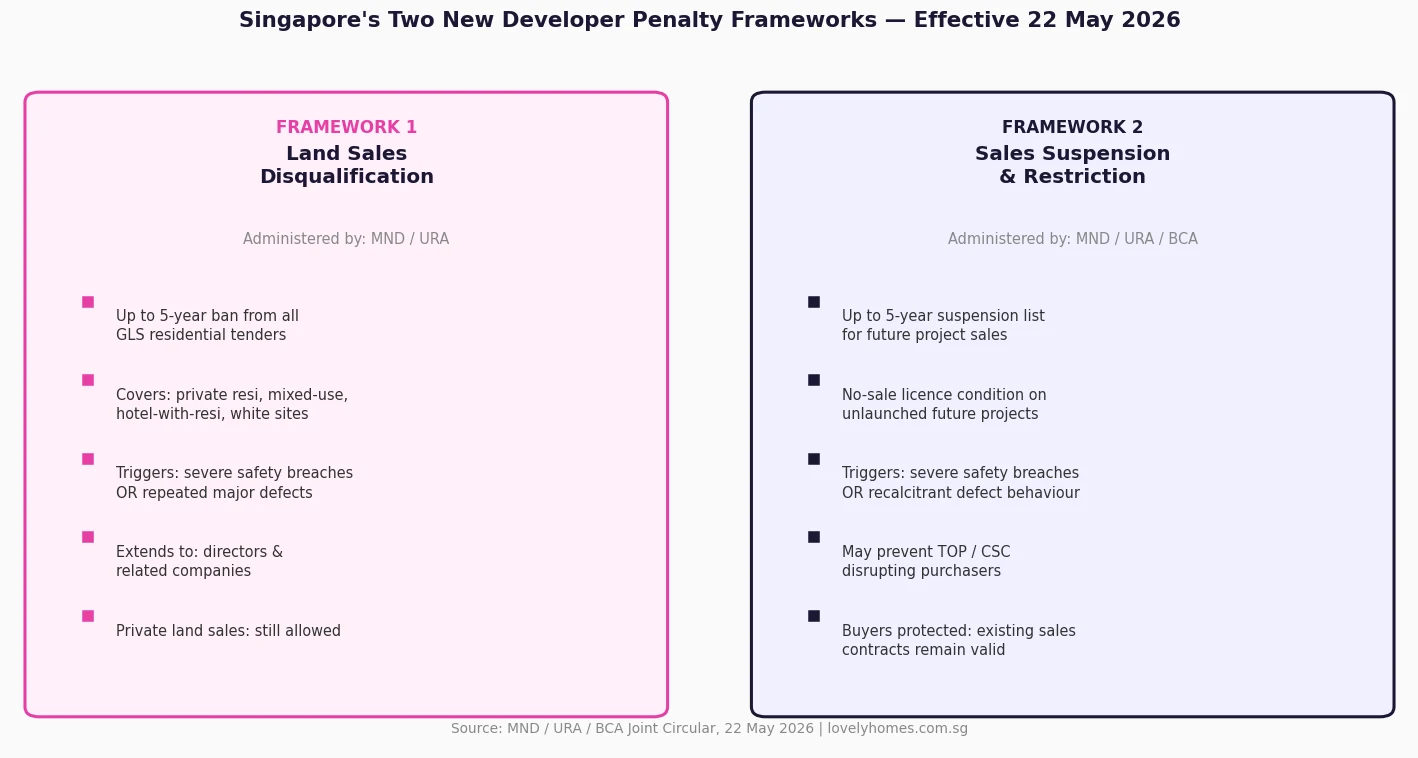
- Framework 1 , Land Sales Disqualification: developers can be banned from GLS residential tenders for up to 5 years for severe safety breaches or repeatedly delivering defective projects with recalcitrant behaviour.
- Framework 2 , Sales Suspension: developers can be placed on a suspension list for up to 5 years and have no-sale licence conditions imposed on future unlaunched projects.
- Penalties can extend to the developer’s directors and other individuals who exert influence over the company’s decision-making.
- The frameworks apply to all GLS sites with a residential component: private residential, mixed-use, hotel-with-residences, white sites, and Executive Condominium sites.
- Existing sales contracts on previously launched units are protected , buyers who have already signed Sale and Purchase Agreements are not affected by a sales suspension on future phases or projects.
- The new rules build on the May 2023 developer banding system, adding teeth to the existing quality monitoring framework.
- No developer has been formally disqualified or suspended under the new frameworks yet , they take effect prospectively.
Background: Why Singapore Is Tightening Developer Accountability
Singapore’s construction quality landscape has come under increased scrutiny over the past three years. Several high-profile new-launch condominium projects delivered after the COVID-19 construction slowdown exhibited significant defects at Temporary Occupation Permit (TOP) , ranging from water seepage and cracked tiles to more serious structural and fire-safety issues. While most defects were ultimately rectified under the mandatory one-year Defects Liability Period (DLP), the scale and frequency of complaints prompted MND and BCA to review whether existing frameworks were sufficient to deter poor construction practices.
In May 2023, BCA introduced a developer banding system that rated developers and contractors on their defect track record and quality management practices, creating a reputational incentive for higher standards. The 22 May 2026 circulars go significantly further: instead of reputational consequences alone, developers now face direct commercial penalties , loss of access to government land and loss of the right to sell units in their own projects.
Framework 1 , Land Sales Disqualification: How It Works
Under the Land Sales Disqualification Framework administered by MND and URA, a developer may be disqualified from participating in GLS tender exercises for sites with any residential component. The disqualification period can extend to five years. The framework covers all residential-component GLS site types: private residential, mixed-use developments, hotel developments incorporating residential units, white sites zoned for residential, and Executive Condominium sites.
The triggers for disqualification are: (a) severe regulatory non-compliance affecting safety , construction defects or practices that pose an active safety risk to occupants or the public, or (b) repeated delivery of projects with major defects combined with recalcitrant behaviour , defined as a persistent failure to remedy defects within the Defects Liability Period despite enforcement action. Developers who demonstrate prompt remediation and cooperation with BCA will receive more favourable treatment than those who contest or delay.
Critically, the disqualification applies to the developer entity and can extend to individual directors and persons with substantial control over the company. This provision prevents developers from creating new subsidiary entities to circumvent bans , a common concern in regulatory frameworks that focus solely on the corporate vehicle. Disqualified developers may still participate in private land sales (non-GLS) subject to normal market conditions.
Framework 2 , Sales Suspension: How It Works
The Sales Suspension Framework, also jointly administered by MND, URA and BCA, allows authorities to place a developer on a sales suspension list for up to five years and to impose no-sale licence conditions on the developer’s future unlaunched projects. A developer on the suspension list cannot launch new project phases for sale, cannot issue Option to Purchase documents for unlaunched units, and faces additional scrutiny on any pending licence applications.
The triggers for sales suspension are broadly similar to Framework 1 but the sales suspension can be applied as a standalone measure , a developer does not need to be GLS-disqualified to face sales restrictions on its private developments. This gives regulators flexibility to calibrate the penalty to the severity of the conduct and the specific business impact.
Existing purchasers are protected: the no-sale condition applies only to unlaunched future units. Buyers who have already signed a Sale and Purchase Agreement (SPA) for units in a project under investigation retain all their contractual rights and are not affected by the suspension. This protection is consistent with Singapore’s Housing Developers (Control and Licensing) Act framework, which prioritises buyer protection in licensed residential developments.
Summary: The Two Frameworks at a Glance
| Dimension | Framework 1: GLS Disqualification | Framework 2: Sales Suspension |
|---|---|---|
| Administered by | MND / URA | MND / URA / BCA |
| Maximum penalty duration | 5 years | 5 years |
| What is restricted | GLS tender participation (residential) | Sales of unlaunched future project units |
| Sites covered | Private resi, mixed-use, hotel-resi, white, EC | Any future unlaunched residential project |
| Triggers | Severe safety breach; repeated major defects + recalcitrance | Same triggers; can be standalone |
| Extends to directors? | Yes , individuals with substantial control | Yes , individuals with substantial control |
| Private land sales allowed? | Yes | Depends on licence conditions |
| Existing buyers protected? | N/A | Yes , signed SPAs unaffected |
What This Means for Homebuyers in Singapore
For buyers of new-launch condominiums, the frameworks provide a structural deterrent that should , over time , raise the baseline quality of private residential construction. The most significant change is the director-level accountability provision: by making key individuals personally at risk of exclusion from the GLS market, the regulation targets the decision-makers who ultimately control construction budgets, contractor selection, and quality supervision. This is a more effective deterrent than corporate-level penalties alone, which can be absorbed by large developers as a cost of business.
Practical implications for buyers considering new launches in 2026 and beyond: when purchasing off-plan, check the developer’s BCA banding rating (publicly available on BCA’s website) and their track record on previous projects. Developers with a strong track record of TOP quality and prompt DLP rectification are now formally differentiated from those with persistent defect issues , not only in reputation but in their ability to compete for land and launch future projects.
Buyers who have already signed SPAs for ongoing projects need not panic. The new frameworks operate prospectively and do not retroactively affect existing contracts. However, if your project’s developer comes under investigation or is placed on the suspension list after you have signed, it is advisable to consult a conveyancing solicitor about your contractual rights under the SPA , including the phased payment schedule, the TOP timeline, and any force majeure or developer default provisions.
What Might Come Next
The following is forward-looking analysis and should be treated as informed commentary rather than certainty. Industry observers expect MND and BCA to publish detailed implementation guidelines within the next three to six months, clarifying the specific thresholds for “severe safety breach”, the appeals mechanism for developers who dispute a finding, and the process for removal from the suspension or disqualification list following remediation. The frameworks are principle-based rather than prescriptive, which gives authorities flexibility but also creates some uncertainty for developers about exactly where the threshold lies.
There is also speculation in the industry about whether the frameworks will prompt consolidation among smaller developers who lack the capital reserves to weather a multi-year GLS exclusion or sales suspension. Larger listed developers with diversified pipelines are better positioned to absorb such a penalty; smaller single-project developers could face existential commercial consequences. This may paradoxically concentrate GLS land-buying further among established players , a secondary market effect worth monitoring in GLS tender results through 2026 and 2027.
Frequently Asked Questions
Has any developer been banned under these new frameworks yet?
Does a sales suspension affect the project I already bought a unit in?
What is the BCA developer banding system and how do I check a developer’s rating?
Can a disqualified developer appeal the decision?
Do these penalties apply to HDB and EC developers as well as private condo developers?
Related Articles
- Singapore EC Buying Guide 2026: Complete Guide to Executive Condominiums
- Private Condo Buying Process Singapore 2026: Complete Step-by-Step Guide
- URA 1H 2026 GLS Programme: All 9 Confirmed List Sites Analysed
- ABSD Singapore 2026: Complete Guide to Additional Buyer’s Stamp Duty
- Conveyancing Fees Singapore 2026: Legal Costs for Buying and Selling Property
Disclaimer
This article is based on the MND/URA/BCA joint circular issued on 22 May 2026 and is for informational purposes only. It does not constitute legal advice. The frameworks are subject to further implementation guidelines and may be amended. Buyers with questions about how these frameworks affect a specific purchase or existing contract should consult a licensed conveyancing solicitor. Official information is available from MND, URA, and BCA.
Supporting graphics
Original article illustrations are available below.
- Figure 1: The two new developer penalty frameworks introduced jointly by MND, URA and BCA on 22 May 2026. Framework 1 governs GLS tender eligibility; Framework 2 governs sales rights on future unlaunched projects. Source: MND/URA/BCA Joint Circular, 22 May 2026.
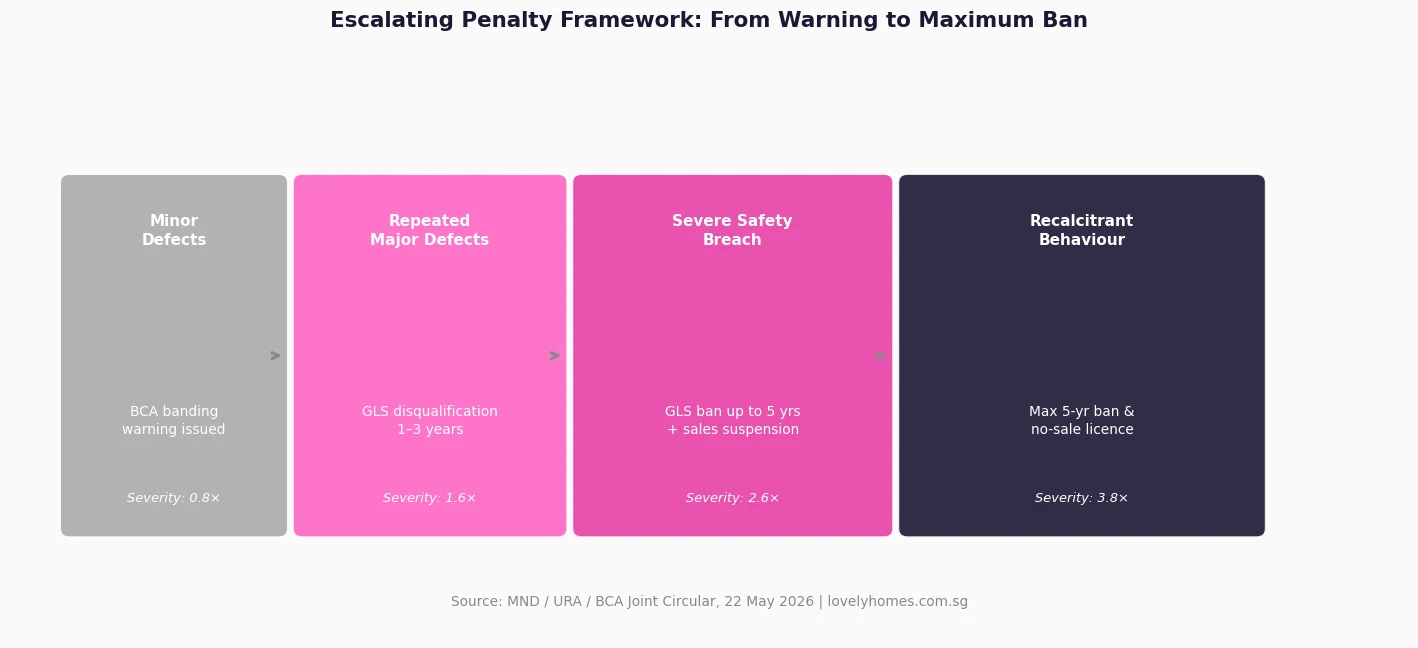
- Figure 2: Escalating penalty framework from BCA banding warning through to maximum 5-year GLS ban and no-sale licence. Severity and duration scale with the degree of non-compliance and recalcitrance. Source: MND/URA/BCA Joint Circular, 22 May 2026.