Singapore HDB BTO Application Guide 2026: Eligibility, HFE Letter, Balloting and Key Collection Explained

Singapore HDB BTO Application Guide 2026: Eligibility, HFE Letter, Balloting and Key Collection Explained

📌 Quick Answer: HDB BTO Application 2026

  • BTO (Build-To-Order) flats are HDB flats built after a sales application — you apply first, HDB builds to the number of units needed, so there is no speculative inventory.
  • Eligibility essentials: at least one Singapore Citizen applicant, combined household income at or below the flat-type ceiling (S$7,000–S$14,000), and no private property ownership in the 30 months before application.
  • The HDB Flat Eligibility (HFE) Letter is now mandatory before you can submit a BTO application — obtain it through the MyHDBPage portal with Singpass; it takes about 2–3 weeks.
  • BTO exercises are held roughly 4–5 times per year; each exercise lists flats in multiple towns, with application windows typically 5–7 days.
  • A successful ballot means you are invited to select a flat during a flat selection appointment; unsuccessful applicants join the queue for subsequent exercises.
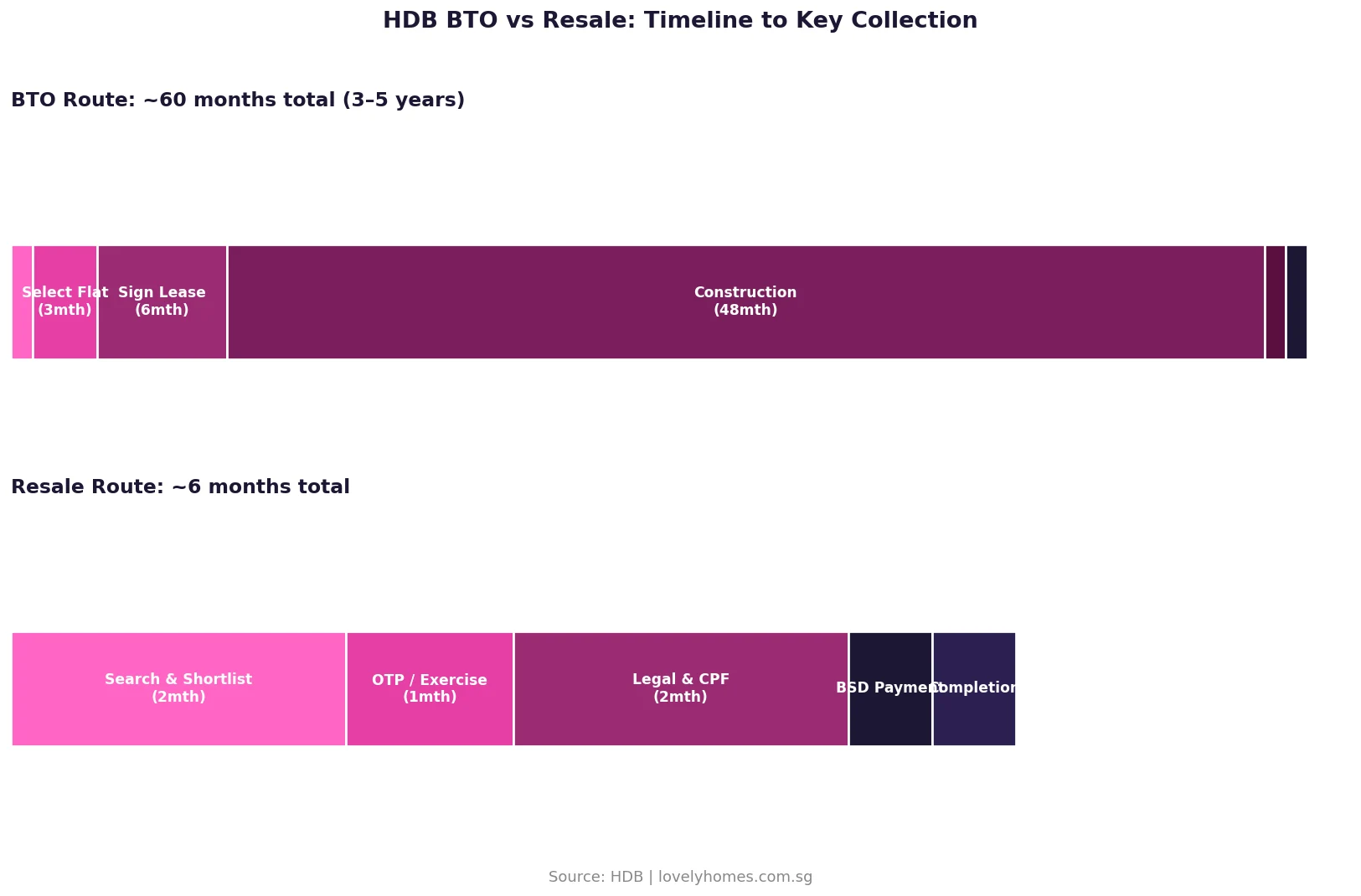
  • Completion times range from 3 to 4.5 years after booking, depending on the project and site conditions.
  • Standard Minimum Occupation Period (MOP) is 5 years from the date of key collection. Plus and Prime model flats carry a 10-year MOP and resale restrictions.
  • Grants available: Enhanced CPF Housing Grant (EHG) up to S$120,000 for families, S$60,000 for singles; Proximity Housing Grant (PHG) up to S$30,000 for buying near parents.

What Is an HDB BTO Flat and How Does It Work?

The Build-To-Order (BTO) scheme is the Housing & Development Board’s primary mechanism for supplying new public housing to eligible Singapore households. Unlike resale flats — which are purchased from existing owners on the open market — BTO flats are sold directly by HDB at subsidised prices before construction begins. HDB only proceeds with a project once sufficient applications have been received, hence the “build to order” terminology. This demand-led model keeps supply aligned with actual household formation needs and limits speculative overbuilding.

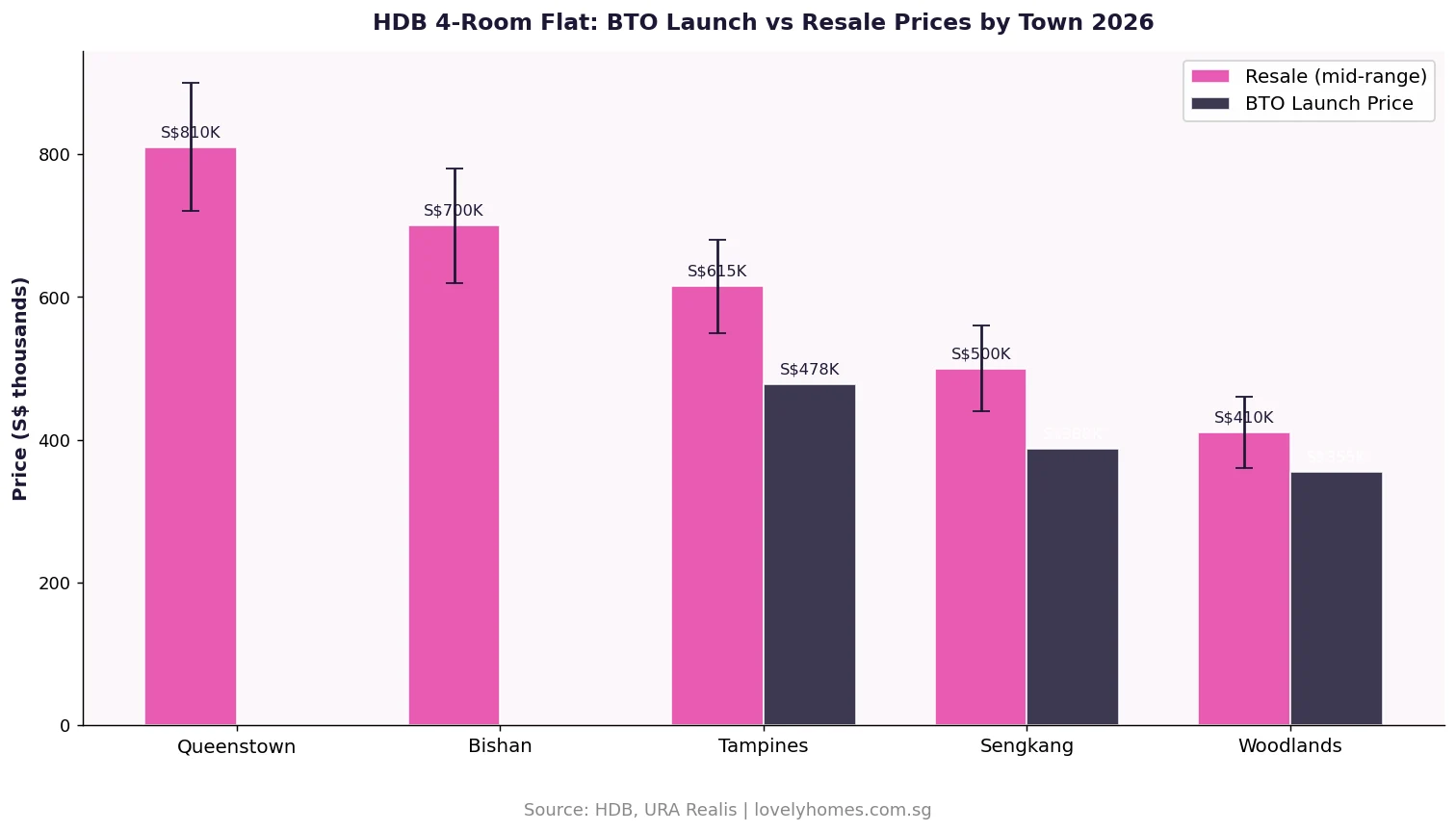
BTO flats come in a range of types from 2-Room Flexi (35–47 sqm) through to 5-Room (110–113 sqm) and the 3-Generation (3Gen) layout designed for multi-generational households. Prices are subsidised relative to private market equivalents; a 4-room BTO flat in a non-mature estate typically prices at S$350,000–S$520,000, compared to resale equivalents at S$490,000–S$720,000 in the same area. The subsidy is funded by HDB and supported through a system of CPF Housing Grants that further reduce the effective purchase price for eligible households.

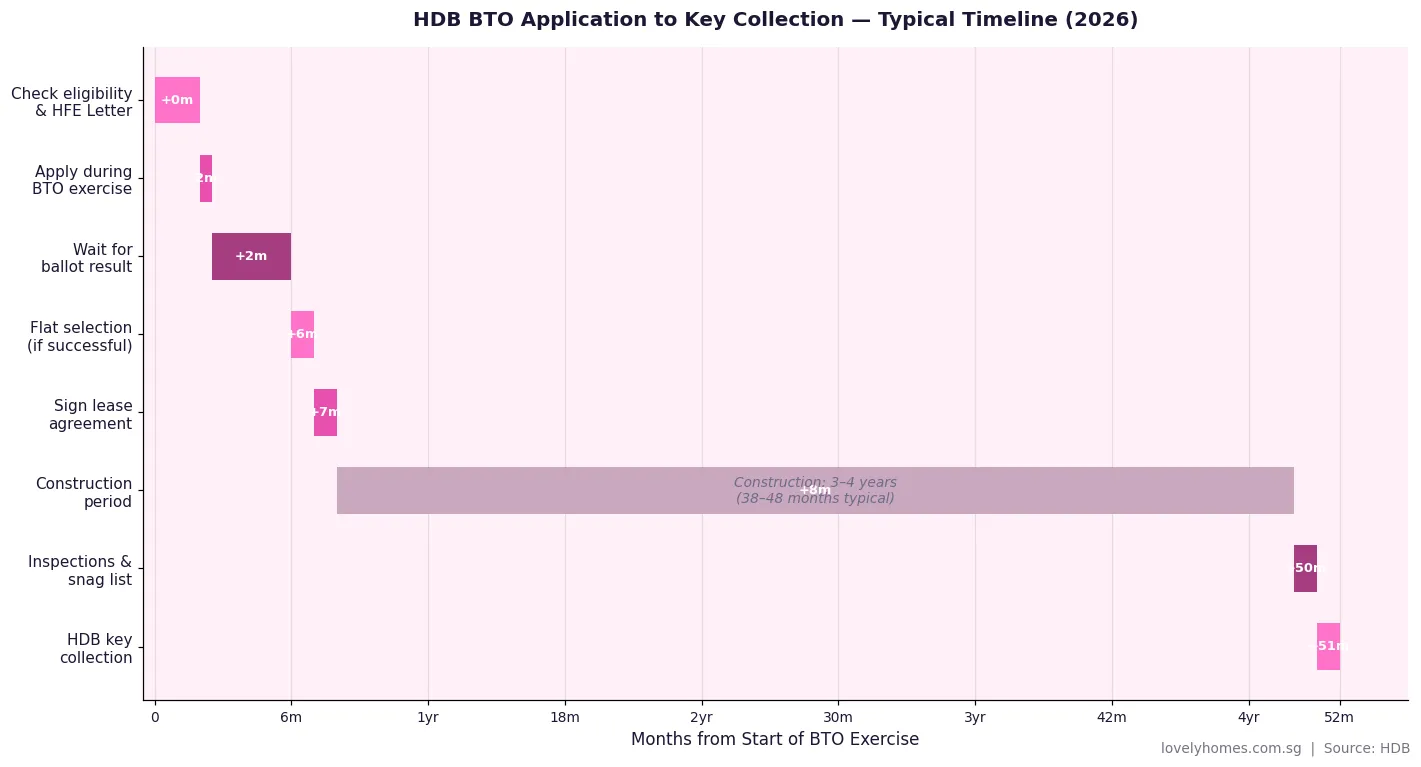
The BTO process involves several distinct stages — eligibility checking, HFE letter application, ballot application, flat selection, signing of the lease, a construction wait of three to four-and-a-half years, and finally key collection and move-in. This guide walks through each stage in detail with the 2026-current rules, timelines, and the specific grant amounts that apply this year.

HDB BTO application to key collection timeline Singapore 2026
Figure 1: Typical HDB BTO Journey — From Eligibility Check to Key Collection (2026). Construction phase is 38–48 months for most projects. Source: HDB.

BTO Eligibility: Who Can Apply?

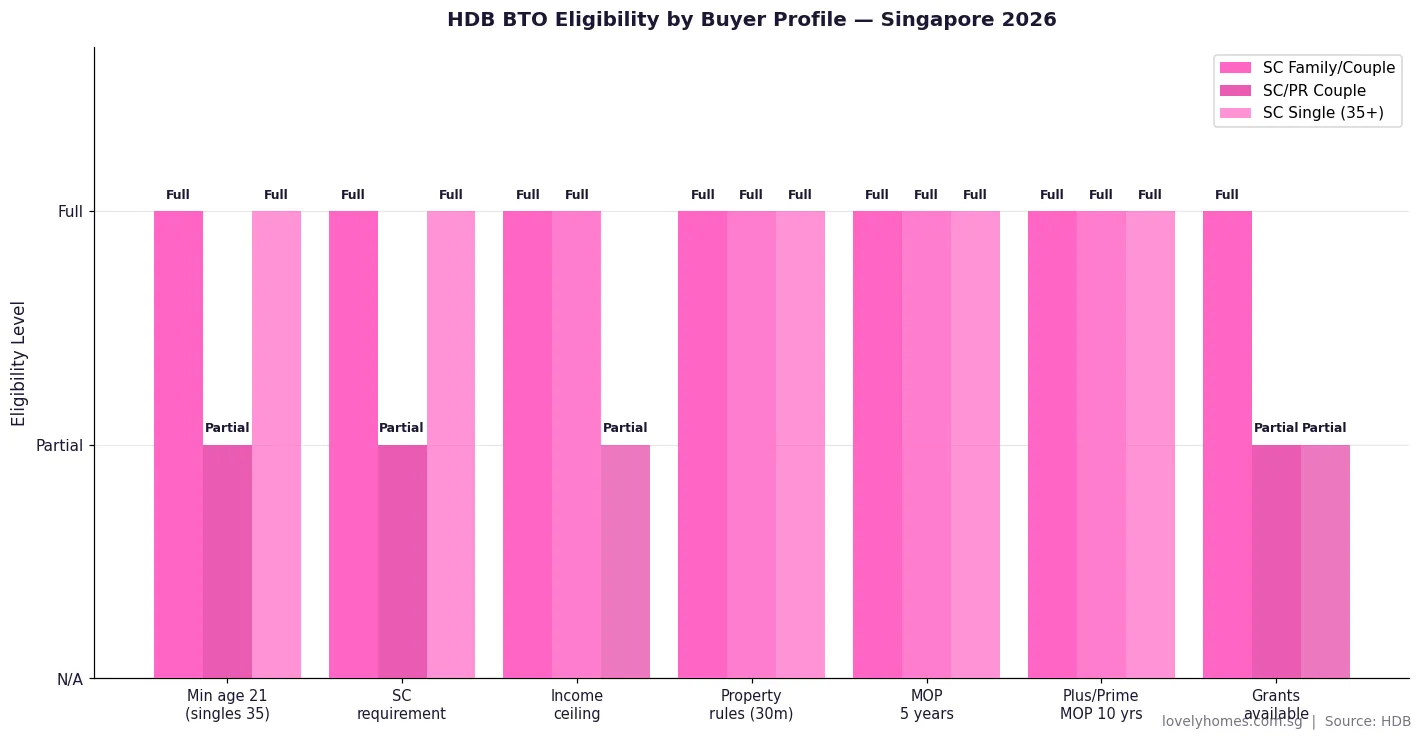
HDB BTO flats are available only to Singapore Citizens and, under certain schemes, Singapore Permanent Residents (PRs). The eligibility framework as at June 2026 is set out below.

Eligibility Criterion SC Family / Couple SC/PR Couple SC Single (35+)
Minimum age 21 years (main applicant) 21 years (SC applicant) 35 years
SC requirement At least 1 SC applicant SC + PR (PR must be spouse) Must be SC
Income ceiling (4-Room) S$10,000/mth combined S$10,000/mth combined S$7,000/mth
Income ceiling (5-Room / 3Gen) S$14,000/mth combined S$14,000/mth combined Not eligible for 5-Room
Private property rule No private property 30 mths before & at application Same Same
Flat types eligible All types All types 2-Room Flexi only
EHG grant available Up to S$120,000 Up to S$120,000 (if SC component) Up to S$60,000

Foreigners who are neither SC nor PR cannot apply for BTO flats under any scheme. PRs who are single also cannot apply. Under the SC/PR scheme, the PR must be the applicant’s spouse and must obtain SC status within a specified period after key collection or face resale restrictions. Additionally, applicants must not own or have disposed of any flat in a manner that disqualifies them under HDB’s ownership rules — for example, those who have previously received a HDB housing subsidy are not eligible for a second subsidised flat unless they meet specific criteria such as the Married Child Priority Scheme (MCPS) rules.

The HDB Flat Eligibility (HFE) Letter: Step One

Since May 2023, prospective BTO buyers must obtain a HDB Flat Eligibility (HFE) Letter before applying for a BTO flat. The HFE Letter replaced the old Housing Loan Eligibility (HLE) letter and the flat eligibility check — it combines both into a single document that confirms: (a) which flat types you are eligible to purchase; (b) the maximum HDB concessionary loan amount; and (c) the CPF Housing Grants you qualify for.

To apply for an HFE Letter, log in at hdb.gov.sg using Singpass. You will need to provide income documents (CPF contribution history is auto-retrieved), particulars of all household members, and details of any existing properties. HDB typically issues the HFE Letter within 21 business days. The letter is valid for 6 months; apply for it approximately one month before the BTO exercise opens to ensure it is ready in time.

HDB BTO June 2026 supply by town and flat type
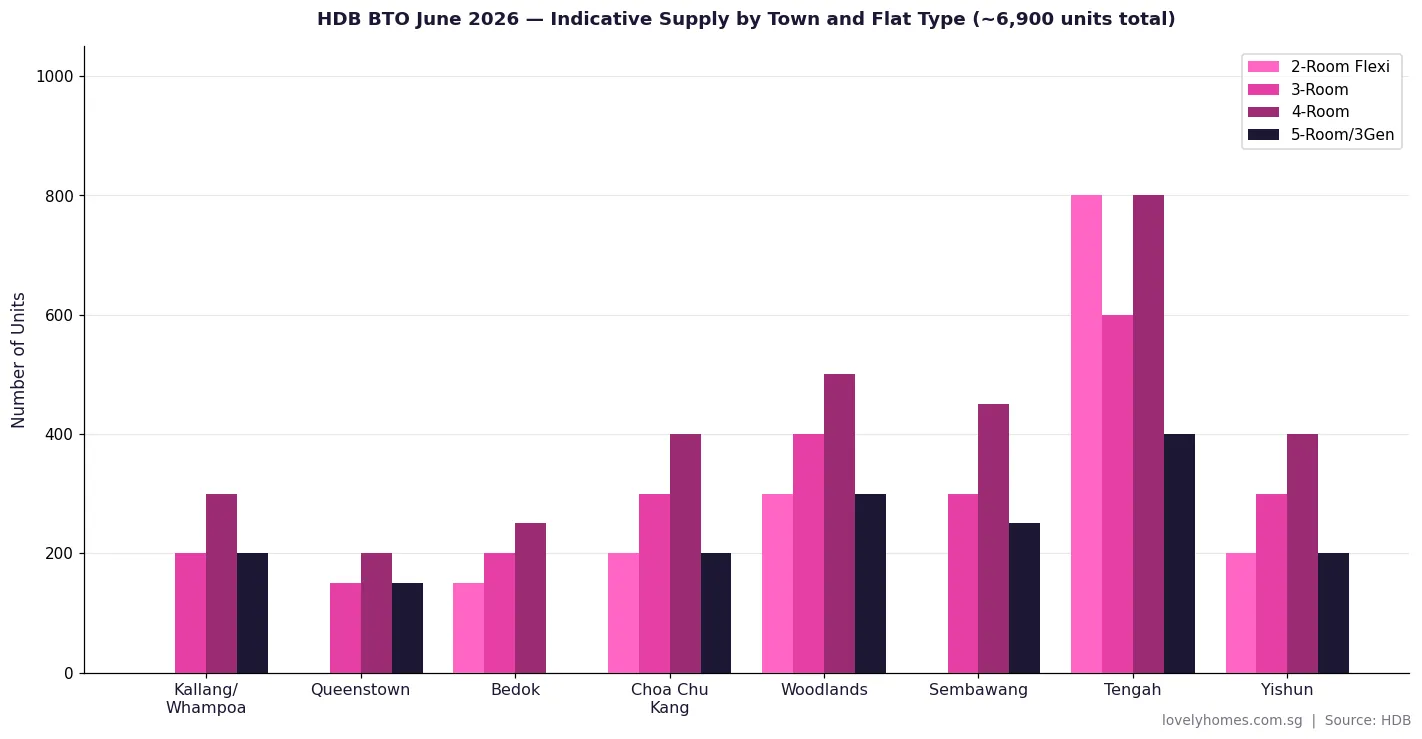
Figure 2: HDB BTO June 2026 — Indicative Unit Supply by Town and Flat Type (approximately 6,900 units across 8 towns). Source: HDB (figures indicative based on announced supply).

Applying for a BTO Flat: The Exercise and Ballot

HDB launches BTO exercises approximately 4–5 times per year, typically in February, May, August, and November (with occasional additional exercises). Each exercise lists projects in multiple towns. The application window is usually 5–7 days, during which eligible applicants may submit one application per exercise via the HDB website or at an HDB Branch.

Key rules during application: applicants may apply for only one flat type in one town per exercise. An application requires a non-refundable application fee of S$10. Successful applicants in the 2-Room Flexi Ballot who do not eventually select a flat will have the S$10 refunded. Households with more children receive priority queue positions under the Parenthood Priority Scheme (PPS), and first-timers receive ballot priority over second-timers.

After the application window closes, HDB computer-ballots all applicants. Results are released approximately 3 weeks later. Successful applicants receive a ballot queue number and a flat selection appointment within approximately 3–6 months. If the ballot number is not reached (all flats selected before your turn), the applicant is treated as unsuccessful and is given an additional ballot chance (2nd timer status not triggered — first-timer status preserved for a stated number of unsuccessful attempts).

First-Timer Priority and Queue Balloting

HDB’s priority allocation system is designed to give first-time buyers and families with young children a better chance of success. In a standard BTO exercise, approximately 85–90% of flat supply is set aside for first-timers (those who have never owned or received a housing subsidy before). The remaining 10–15% is allocated to second-timers. Within the first-timer pool, the Parenthood Priority Scheme (PPS) reserves a further 30% of supply for families with Singaporean children aged 18 or below.

After three or more unsuccessful ballots, first-timer applicants (with children) may apply under the Additional Ballots Scheme, which gives them a higher chance. HDB has progressively expanded priority rules — from 2024, those who have collected a BTO flat and are applying again (e.g., for a larger flat after having more children) are classified as second-timers and face a smaller allocation pool.

HDB BTO eligibility by buyer profile Singapore 2026
Figure 3: HDB BTO Eligibility Assessment by Buyer Profile (2026). “Full” = fully eligible; “Partial” = eligible with conditions or restrictions. Source: HDB.

Flat Selection, Booking and Signing the Lease

Upon receiving a flat selection appointment, applicants visit an HDB Branch (or select online via the portal in more recent exercises) and choose their preferred unit from the remaining available options. At selection, a booking fee is payable: S$2,000 for 2-Room Flexi, S$4,000 for 3-Room, S$8,000 for 4-Room and 5-Room/3Gen (as at 2026; fees are reviewed periodically). The booking fee is non-refundable if you subsequently withdraw from the purchase.

After booking, HDB typically schedules the signing of the Agreement for Lease (Lease Agreement) within 4–6 months. At this appointment, applicants pay the down payment and stamp fees. For those taking an HDB concessionary loan, the down payment is 10% of the flat price (payable via CPF OA or cash); for those using a bank loan, the down payment is 25% (with 5% minimum in cash). Buyer’s Stamp Duty (BSD) is also payable at this stage. After signing, construction proceeds and buyers await key collection.

CPF Housing Grants for BTO Buyers (2026)

BTO buyers may be eligible for significant grant support that directly reduces the effective purchase price. As at June 2026, the key grants are:

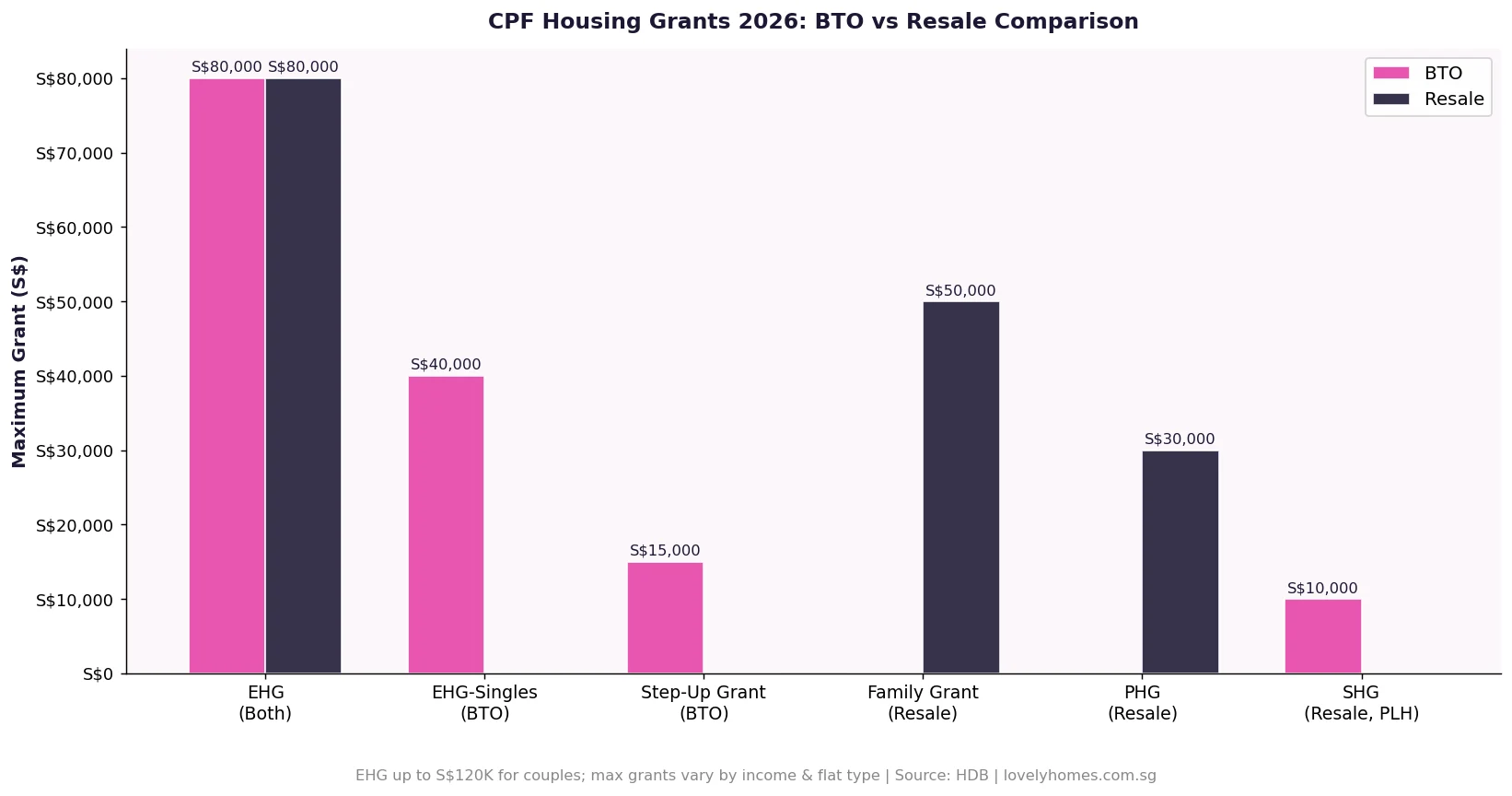
  • Enhanced CPF Housing Grant (EHG): Up to S$120,000 for families (income ≤ S$9,000/mth average over 12 months before application) and up to S$60,000 for singles. The EHG is income-tiered — a family earning S$2,000/mth receives the full S$120,000; at S$9,000/mth, the grant is S$5,000. Effective from 20 August 2024.
  • CPF Housing Grant — Families (Family Grant): An additional S$10,000–S$30,000 for eligible first-timer families purchasing 4-Room or smaller BTO flats, depending on flat type and town classification.
  • Step-Up CPF Housing Grant: S$15,000 for second-timer SC families moving from a 2-Room to a 3-Room BTO flat.
  • Proximity Housing Grant (PHG): S$30,000 for buying within 4 km of parents’ or child’s home; S$20,000 for buying in the same town. Available for resale HDB purchases — not BTO directly, but may apply on the eventual resale.

Grants are disbursed as CPF credits into the recipient’s OA account, reducing the cash required at booking and lease signing. They do not reduce the outstanding loan; rather, they offset the cash/CPF down payment needed.

📌 Worked Example: Mr & Mrs Goh — First-Timer BTO Application, Tampines 4-Room

Mr Goh (SC, age 29) and Mrs Goh (SC, age 27) are first-timer applicants. Combined household income: S$7,200/mth (based on 12-month CPF contribution average). One child aged 2. They apply for a 4-room BTO flat in Tampines during the June 2026 BTO exercise, priced at S$478,000.

  • HFE Letter: Applied 30 days before exercise opens; issued in 16 business days. Confirms eligibility for 4-Room, HDB loan S$382,400 (80% LTV), EHG S$50,000 (income S$7,200 tier).
  • Ballot result: Successful; queue number 38 out of 220 applicants for 240 available units. Flat selection appointment in Month 4.
  • Flat price: S$478,000. Grants: EHG S$50,000 → effective price S$428,000.
  • Booking fee: S$8,000 (cash or NETS).
  • BSD: (1% × S$180,000) + (2% × S$180,000) + (3% × S$118,000) = S$1,800 + S$3,600 + S$3,540 = S$8,940 on S$478,000.
  • HDB Loan: S$382,400 at 2.6% p.a. over 25 years → monthly instalment S$1,731. MSR: S$1,731 ÷ S$7,200 = 24.0% ✓ (below 30% MSR limit).
  • Total upfront cash outlay at lease signing: Booking fee S$8,000 + down payment (10% S$47,800 less EHG S$50,000 already in CPF OA) → effectively S$5,800 cash + S$8,940 BSD (payable by CPF OA) = approximately S$14,740 in cash/CPF.
  • Key collection: Estimated 3 years 8 months from booking, approximately Q2 2030. MOP: 5 years from key collection date (standard flat).

Plus and Prime BTO Flats: Stricter Rules for Better Locations

From 2024, HDB restructured the BTO flat classification. “Standard” flats (in non-mature, non-central estates) carry the familiar 5-year MOP and standard resale/rental rules. “Plus” flats — in choicer locations such as Kallang/Whampoa, Queenstown fringe, and new towns with strong transport links — carry a 10-year MOP and cannot be rented out for the first 10 years. “Prime” flats — in the most central, highest-demand locations near the CBD and in mature estates — carry a 10-year MOP, are subject to a subsidy clawback on first resale (buyers must return a portion of their capital gain to HDB), and have additional resale restrictions to ensure the flats remain affordable for future first-timers. If you are considering a Plus or Prime flat, factor the longer holding period and clawback into your financial planning.

Why the BTO Route Matters for Most Singapore Families

For first-timer Singapore Citizens, the BTO route remains the most financially sound path to home ownership. The built-in subsidy can be S$100,000 or more relative to resale market prices in the same estate, and when layered with the EHG and other grants, the effective discount for a median-income family can approach S$200,000 over the life of ownership. The trade-off is the waiting period — typically three to four-and-a-half years from booking to key collection — which requires careful planning if you are currently renting or living with parents.

The Plus and Prime restructuring reflects HDB’s continuing effort to balance locational desirability with long-term affordability. By imposing longer MOPs and clawbacks on high-demand locations, HDB aims to prevent BTO flats from functioning as pure financial instruments for short-term gain, keeping them as genuine homes for resident families. For buyers who prize flexibility and liquidity, the standard resale market or an Executive Condominium (EC) may be more appropriate despite the higher entry cost.

📊 Upcoming BTO Exercises and Policy Signals (2026–2027)

This section reflects publicly available information and should not be treated as investment advice.

HDB has announced approximately 6,900 BTO units for the June 2026 exercise across Kallang/Whampoa, Queenstown, Bedok, Choa Chu Kang, Woodlands, Sembawang, Tengah, and Yishun. The next exercise is expected in August or September 2026, with further supply planned for Tengah (which is receiving the largest allocation as the new town builds up) and potentially a new site in the Jurong Lake District area. HDB’s annual BTO supply target for 2024–2025 was 19,000–20,000 units; this pipeline is expected to continue through 2027 to address the demand backlog from the COVID-era construction delays. Buyers who are unsuccessful in the June 2026 exercise should track MyNiceHome and the HDB press releases portal for the August–September launch announcement.

Frequently Asked Questions: HDB BTO Application 2026

How long does it take to get a BTO flat from application to key collection?

The total journey from submitting a BTO application to receiving your keys typically spans four to five years. Allow 2–3 weeks to obtain the HFE Letter, then 5–7 days for the application window. Ballot results are released in approximately 3 weeks; flat selection appointments are scheduled 3–6 months after that. Construction takes 38–48 months (roughly 3–4 years) from project launch. So the full door-to-door period is approximately 44–54 months, or about 4 years from application date. Some projects in non-mature estates have been delivered in under 40 months; complex urban-infill sites have taken longer. HDB publishes an estimated completion date for each project at the time of launch, which is the most reliable reference for your specific project.

Can Singapore Permanent Residents (PRs) apply for a BTO flat?

PRs can apply for a BTO flat only under the SC/PR scheme — that is, when they are applying jointly with a Singapore Citizen spouse. A PR cannot apply for a BTO flat on their own, nor can two PRs apply together. Under the SC/PR scheme, the PR must subsequently obtain Singapore Citizenship within a specified period after key collection (HDB’s latest requirement is that the PR spouse applies for citizenship if they have not done so within a reasonable time). PR singles and unmarried PR couples are not eligible for BTO. PRs who are single or not applying with an SC spouse should consider the HDB resale market under the HDB resale rules for PRs, which permit PR family/couple applications for resale flats.

What is the income ceiling for BTO flats in 2026?

The income ceiling depends on the flat type. For 2-Room Flexi and 3-Room BTO flats, the ceiling is S$7,000 per month gross household income. For 4-Room flats, the ceiling is S$10,000 per month. For 5-Room and 3-Generation (3Gen) flats, the ceiling is S$14,000 per month. Income is assessed based on the average gross monthly income over the 12 months preceding the application. Bonuses, commission, and variable pay are included in the calculation. For self-employed or commission-based applicants, IRAS Notice of Assessment income averaged over 12 months is used. If your income fluctuates, it is advisable to time your application to a 12-month window when your average income falls below the ceiling.

What happens if I am unsuccessful in the BTO ballot?

If you apply but do not receive a ballot queue number, or if your queue number is not reached (all flats are selected before your turn), you are treated as an unsuccessful first-timer applicant. Your first-timer priority status is retained, and HDB gives you one additional ballot chance: in the next BTO exercise, you will be issued two ballot chances instead of one for the same flat type and town category (non-mature or mature). After two or more consecutive unsuccessful attempts, first-timer families with children may apply under the Married Child Priority Scheme (MCPS) or the Additional Ballots Scheme for enhanced priority. There is no penalty for multiple unsuccessful applications. You may also wish to consider the HDB Sales of Balance Flats (SBF) exercises, which release unsold BTO units from previous exercises at (typically) lower prices and with shorter remaining construction wait times.

Can I rent out my BTO flat before the MOP?

No. You cannot rent out the entire BTO flat before completing the Minimum Occupation Period (MOP), which is 5 years from the date of key collection for standard flats (10 years for Plus and Prime flats). During the MOP, you and at least one listed occupier must be physically residing in the flat. You may rent out individual rooms (but not the entire flat) to eligible tenants, subject to HDB approval and the Non-Citizen Quota (NCQ) rules. Full subletting of the entire flat is only permitted after the MOP is complete and upon receiving HDB’s written approval. Violation of the MOP subletting restriction is a serious offence under the Housing and Development Act and can result in the compulsory acquisition of the flat by HDB with no compensation to the owner.

How much CPF can I use to buy a BTO flat?

For HDB flats (including BTO), CPF Ordinary Account (OA) savings may be used to pay the down payment, monthly mortgage instalments, BSD, and legal/conveyancing fees, subject to the Valuation Limit (VL) and Withdrawal Limit (WL). The Valuation Limit is the lower of the purchase price and the HDB assessed value at purchase; you may withdraw up to 100% of the VL from CPF. The Withdrawal Limit is 120% of the VL — beyond this, no further CPF can be used for housing and all mortgage repayments must be in cash. Since BTO flats are new and HDB sets the price equal to the assessed value, the VL and purchase price are the same and the 120% WL is typically reached only after many years of repayment. Any CPF withdrawn for housing is subject to accrued interest at the OA rate of 2.5% per annum, which must be refunded to your CPF account upon the eventual sale of the flat.

What is the difference between BTO, SBF, and ROF flat types?

HDB offers three main channels for buying new or near-new subsidised flats: BTO (Build-To-Order) — new flats that have not yet been built; buyers commit before construction and wait 3–4.5 years for key collection. SBF (Sales of Balance Flats) — unsold units from previous BTO exercises, typically with shorter wait times (1–3 years) as construction is already underway or complete; these are released approximately twice per year. ROF (Re-Offer of Balance Flats) — flats returned or unselected from prior exercises, offered in smaller batches more frequently. BTO offers the widest choice and (for popular estates) the lowest price relative to eventual resale value, but requires the longest wait. SBF and ROF can be good options for buyers who need to move sooner or who prefer a known, near-complete building. Eligibility rules are broadly similar across all three channels.

Related Articles on HDB and Property Buying in Singapore

Disclaimer

This article is for general informational purposes only and does not constitute financial, legal, or housing advice. HDB BTO eligibility criteria, grant amounts, income ceilings, and MOP rules are set by the Housing & Development Board (HDB) and may be updated at any time. Always verify current eligibility at hdb.gov.sg and consult a licensed HDB solicitor or financial adviser before making any application or commitment. CPF rules are governed by the CPF Board; verify current withdrawal limits at cpf.gov.sg. LovelyHomes is not an HDB-authorised agent and this article does not constitute an application, booking, or commitment to any HDB flat.

Singapore HDB Resale Guide 2026: Complete Guide to Buying and Selling HDB Resale Flats

Singapore HDB Resale Guide 2026: Complete Guide to Buying and Selling HDB Resale Flats

Quick Answer — HDB Resale Singapore 2026: Key Takeaways

  • Who can buy: Singapore Citizens (SC) and Permanent Residents (PR) forming an eligible family nucleus or joining an SC under the Joint Singles Scheme.
  • No income ceiling for eligibility — but grants (EHG up to S$80,000 for families) require household income ≤ S$14,000/mth.
  • Market price, no HDB price control: HDB resale flats are sold at negotiated market prices; Cash Over Valuation (COV) is common in mature estates.
  • HFE letter mandatory since May 2023: All buyers must obtain a valid HDB Flat Eligibility (HFE) letter before submitting any Option to Purchase (OTP).
  • HDB Loan: 2.6% p.a., up to 80% LTV (capped at assessed monthly instalment ≤ 30% MSR); Bank Loan: up to 75% LTV, market rate ~3–4% p.a.
  • Resale prices: The HDB Resale Price Index (RPI) hit 216.3 in Q1 2026 — up 41% since Q1 2021, with growth moderating to +0.9% QoQ in Q1 2026.
  • Process: HFE letter → flat search → OTP (21-day validity) → resale flat application → HDB appointment → completion (typically 8–12 weeks total).
  • MOP: 5 years from key collection before you can sell, rent out entire flat, or buy a private property (10 years for Plus/Prime classification flats bought from HDB directly — not applicable to resale).

HDB resale flats form the backbone of Singapore’s housing market. With over 1.1 million flats across 24 towns and estates, the HDB resale market gives buyers immediate access to established neighbourhoods — complete with MRT stations, schools, hawker centres, and community infrastructure — without the multi-year wait of a Build-To-Order (BTO) exercise.

In 2025, approximately 29,000 HDB resale transactions were completed, a volume broadly consistent with the five-year average. Prices have risen sharply since 2021 — the Resale Price Index surged 41% between Q1 2021 and Q1 2026 — but the pace of growth has eased considerably. Understanding how to navigate the resale market in 2026 requires clarity on eligibility rules, grant quantum, financing limits, and the sequencing of each step in the purchase process.

This guide covers every dimension of Singapore HDB resale — whether you are a first-time buyer seeking a mature estate flat, an upgrader buying a five-room in a choice location, or a seller assessing the right time to exit.

HDB resale price ranges by flat type Singapore 2026 — horizontal bar chart
Figure 1: Singapore HDB Resale Price Ranges by Flat Type, Q1 2026 (indicative OCR prices; CCR/mature estate premiums apply). Source: HDB, URA REALIS.

Who Can Buy an HDB Resale Flat in Singapore?

HDB resale eligibility is governed by the Housing and Development Act (Cap 129) and administered by the Housing and Development Board. The core requirement is that at least one buyer must be a Singapore Citizen, and the buyers must form a qualifying family nucleus. The main eligibility schemes are:

Public Scheme: The most common scheme, open to SCs or SPRs who are married, engaged, or are parent-and-child pairs, siblings, or orphans. At least one SC or SPR is required; if all applicants are SCs, an unrestricted range of unit types and sizes is available. SPR-only families may purchase 3-room or larger resale flats in non-mature towns and estates.

Single Singapore Citizen (SSC) Scheme: SCs aged 35 and above who are single, divorced, or widowed may purchase a 2-room Flexi to 5-room resale flat anywhere in Singapore. This scheme was introduced to support housing access for non-family-nucleus applicants.

Joint Singles Scheme (JSS): Two or more SCs aged 35 and above who are not related may co-purchase an HDB resale flat (3-room or smaller) together.

Non-Citizen Spouse Scheme: A lone SC married to a non-citizen (non-SPR) may purchase a resale flat if the couple does not already own private property.

Fiancé/Fiancée Scheme: Engaged couples may purchase a resale flat before marriage, provided they marry within three months of key collection and register their marriage with HDB.

Importantly, there is no income ceiling to purchase an HDB resale flat — the income limits only affect grant eligibility. This contrasts with BTO where the household income ceiling of S$14,000/mth (or S$21,000/mth for larger flat types) applies to eligibility itself.

Buyers who currently own private property — locally or overseas — generally cannot purchase an HDB resale flat while retaining that private property. SCs and SPRs who own private property may buy an HDB resale flat only after disposing of the private property, with a six-month window to complete the disposal.

HDB Resale Valuation and Cash Over Valuation (COV)

Unlike BTO flats whose prices are set by HDB, resale flat prices are negotiated freely between buyer and seller. HDB appoints an approved valuer to assess the flat’s market value at the point of the resale application; the valuation is typically commissioned two to three weeks after the OTP is exercised.

If the agreed price exceeds the assessed valuation, the difference — the Cash Over Valuation (COV) — must be paid entirely in cash. CPF Ordinary Account funds and housing loans can only cover up to the assessed valuation. COV has ranged from zero to over S$100,000 depending on location, flat type, floor level, facing, and the overall market temperature. In the current market (Q1 2026), median COV in mature estates such as Toa Payoh, Bishan, and Queenstown typically ranges between S$20,000 and S$60,000.

As a practical matter, buyers should budget for potential COV as part of upfront cash requirements, especially when competing for flats in highly sought-after precincts. Sellers should price with awareness that excessive COV requests can deter buyers, who must source that cash component from personal savings, not CPF.

Housing Grants for HDB Resale Flats 2026

The Singapore government offers a generous portfolio of grants to subsidise HDB resale purchases. These are administered by HDB and credited either to the buyer’s CPF Ordinary Account or disbursed as cash at completion.

Enhanced CPF Housing Grant (EHG): The flagship resale grant, available to both first-time families and first-time singles. For first-time families, the EHG ranges from S$25,000 (household income S$10,501–S$12,000/mth) to S$80,000 (household income not exceeding S$3,000/mth). For first-time singles, the quantum is half the family rate at the same income band. The EHG is credited to the buyer’s CPF OA and applied against the purchase price. Critically, the EHG is available regardless of which town, flat type, or remaining lease the resale flat has, provided the flat’s remaining lease covers the youngest buyer to at least age 95.

Proximity Housing Grant (PHG): Introduced in 2015, the PHG rewards buyers who purchase close to their parents or children. Families receive S$30,000 if they purchase within the same town or within 4 km of their parents/children; S$20,000 if within 4 km only. Singles receive S$15,000 (same town or 4 km) or S$10,000 (4 km only). The PHG is credited as cash and disbursed at completion.

Step-Up CPF Housing Grant: Available to second-time buyers who previously lived in a 2-room BTO flat (Standard or Plus in non-mature estates) and are upgrading to a 4-room or smaller resale flat in a non-mature town. The quantum is S$15,000, credited to CPF OA.

CPF Housing Grant for Resale Flats: Applicable under certain conditions for buyers who already received grants under the old AHG/SHG framework before it was superseded by the EHG in 2019. New buyers from 2019 onwards are assessed under the EHG regime instead.

HDB resale housing grants 2026 — EHG and PHG by household income bar chart
Figure 2: HDB Resale Grants 2026 — EHG and PHG quantum by household income tier. EHG up to S$80,000 for families; PHG up to S$30,000. Source: HDB.

Financing Your HDB Resale Purchase

Two financing options are available: the HDB Concessionary Loan and a bank housing loan. The choice has permanent consequences — once you take a bank loan for the current or a prior flat, you cannot subsequently revert to the HDB loan for a future purchase.

The HDB Concessionary Loan carries a rate of 2.6% per annum (0.1 percentage point above the CPF OA rate of 2.5%), fixed by HDB and reviewed quarterly. Its key advantages are stability, a higher LTV limit of 80% (versus 75% for bank loans), and the absence of a mandatory cash down-payment — the full 20% downpayment can be paid from CPF OA. The Mortgage Servicing Ratio (MSR) cap of 30% of gross monthly income applies to both HDB and bank loans on HDB flats.

A bank loan is subject to market rates, which in Q1 2026 range from approximately 3.0–3.8% p.a. depending on loan package type (fixed or floating). The LTV is capped at 75%, and a minimum 5% cash downpayment is mandatory (the remaining 20% of the purchase price can be met with CPF). If you have an outstanding housing loan on any property, the LTV ceiling drops further and TDSR (Total Debt Servicing Ratio, 55% of gross income) applies in addition to MSR.

The HDB Flat Eligibility (HFE) Letter — mandatory since May 2023 — consolidates in a single document the buyer’s eligibility to purchase a resale flat, the CPF housing grants they are entitled to, and the HDB Concessionary Loan quantum they may borrow. The HFE letter is valid for six months and must be obtained before the seller issues any OTP.

HDB Resale vs HDB BTO vs EC — Quick Comparison

Parameter HDB Resale HDB BTO Executive Condo (EC)
Price control Market-driven; COV possible Subsidised by HDB; below market Market-driven; no subsidy
Wait time Immediate (8–12 wks completion) 3–5 years wait 3–4 years (new) or immediate (resale)
Income ceiling None (grants require ≤S$14,000) S$14,000/mth (most types) S$16,000/mth (new EC)
Grants available EHG (up to S$80k) + PHG (up to S$30k) EHG (up to S$80k) AHG/FHG (EC-specific; limited)
MOP 5 years from key collection 5 years (Standard); 10 years (Plus/Prime) 5 years (after TOP) for sale; 10 years for privatisation
Foreigners SC/SPR only SC only (as at least one applicant) SC/SPR only (new EC); anyone after 10 years
CPF usage OA up to VL (Valuation Limit) OA up to VL OA up to VL

The HDB Resale Process Step by Step

The HDB resale process follows a defined sequence governed by HDB’s administrative procedures. From first search to key collection typically spans eight to twelve weeks.

Step 1 — Apply for HFE Letter: Before any flat viewing or negotiation, both buyers must apply jointly for the HDB Flat Eligibility (HFE) letter via the HDB Flat Portal. HDB reviews CPF balances, existing property ownership, and loan history; processing takes five to ten business days. The HFE letter confirms grant entitlements and maximum loan quantum.

Step 2 — Flat Search and Negotiation: Use HDB’s ResaleFlatListings portal or engage a CEA-registered salesperson. Review transaction data on HDB’s website to calibrate a fair offer. Agree price, preferred completion date, and any fixtures to be included. Sellers and buyers can transact without agents under HDB’s direct registration option.

Step 3 — Option to Purchase (OTP): The seller issues an OTP valid for 21 calendar days. The buyer pays the Option fee (≤ S$1,000 for flats priced ≤ S$500,000; ≤ S$2,000 for flats > S$500,000). Within the 21-day window, the buyer decides to exercise by paying the Exercise fee (deducted from the purchase price) and submitting the resale flat application.

Step 4 — Resale Flat Application: Both buyer and seller submit separate portions of the application on HDB’s portal. HDB processes the application, appoints a valuer, and reviews grant eligibility — typically two to three weeks. An Approval-in-Principle (AIP) or Approval letter follows.

Step 5 — HDB Resale Appointment: Both parties attend a scheduled appointment at HDB Hub or via online portal. Documents are signed, CPF withdrawals authorised, and completion legalities confirmed. Stamp duty (BSD) is payable within 14 days of the OTP exercise date.

Step 6 — Completion and Key Collection: On the agreed completion date, HDB transfers the title and the buyer collects the keys. The five-year MOP clock starts from this date.

Worked Example: Mr & Mrs Chan — Tampines 4-Room Resale

Scenario: Mr & Mrs Chan, both Singapore Citizens, joint gross monthly income S$9,200. First-time buyers. Purchasing a 4-room resale flat in Tampines (mature estate), agreed price S$720,000. Mrs Chan’s parents live in Tampines — PHG proximity within 4 km applies. Couple plans to take HDB Concessionary Loan.

Grant entitlement (HFE letter):
EHG (income S$9,001–S$10,500 band): S$35,000 (credited to CPF OA)
PHG (parents within 4 km): S$20,000 (cash disbursed at completion)
Total grants: S$55,000

Stamp duty:
BSD on S$720,000: first S$180k × 1% = S$1,800 + next S$180k × 2% = S$3,600 + remaining S$360k × 3% = S$10,800 = S$16,200 BSD
ABSD: nil (SC purchasing first residential property)

Financing:
HDB Concessionary Loan (LTV 80%): S$720,000 × 80% = S$576,000 loan
Monthly instalment @ 2.6% p.a., 25-year tenure: ≈ S$2,607/mth
MSR: S$2,607 ÷ S$9,200 = 28.3% — PASS (≤30%)

Downpayment (20% = S$144,000):
EHG S$35,000 credited to CPF OA; assume existing CPF OA S$85,000 each (combined S$170,000 + S$35,000 = S$205,000 available in CPF)
S$144,000 covered entirely from CPF OA — no cash downpayment required

Cash upfront (items payable in cash):
BSD S$16,200 (can pay from CPF or cash) + Legal fees ~S$2,500 + Survey fee S$290 + Option Exercise fee ~S$2,000 = ~S$21,000 (most payable from CPF)
PHG cash grant of S$20,000 received at completion partially offsets out-of-pocket costs

HDB Resale Price Index RPI trend Q1 2021 to Q1 2026 Singapore chart
Figure 3: Singapore HDB Resale Price Index (RPI) Q1 2021 to Q1 2026 — 41% cumulative growth; pace moderating to +0.9% QoQ by Q1 2026. Source: HDB Resale Statistics.

Why HDB Resale Prices Matter for Buyers and Sellers in 2026

The HDB Resale Price Index at 216.3 as of Q1 2026 reflects a market that has absorbed significant price appreciation over five years but is now settling into a slower growth phase. The pace of quarterly increase has decelerated from over 3% QoQ at the 2021–2022 peak to under 1% by Q1 2026. This matters for buyers in two ways: the fear of missing out that drove frantic bidding and record COV payments in 2022 has eased, but asking prices remain structurally elevated.

The emergence of million-dollar HDB flats — a rare phenomenon before 2021, now recorded in the hundreds annually — reflects both genuine scarcity of prime-location resale stock and the wider anchor effects of elevated private market pricing. Buyers in mature estates such as Queenstown, Bishan, Bukit Merah, Toa Payoh, and Clementi should model their budget around prices that remain 35–50% above 2019 levels.

For sellers, the moderation in price growth means that extraordinary COV premiums of S$100,000 or more are harder to sustain outside genuinely irreplaceable locations. A well-priced flat at or near valuation with a clean transaction history and a remaining lease comfortably above 65 years will still attract competitive offers.

What Might Come Next — HDB Resale Outlook for H2 2026

The following is analytical perspective, not financial advice. Readers should form their own view and seek professional guidance where appropriate.

Several structural factors point to continued price resilience in the HDB resale market through 2026. BTO supply — while improving, with HDB targeting 19,600 new flats for the year — cannot satisfy immediate demand from buyers with pressing housing timelines. The June 2026 BTO exercise covers 6,900 flats across Ang Mo Kio, Bishan, Bukit Merah, Sembawang, and Woodlands, with application windows opening around 11 June 2026 — but successful applicants will wait three to five years for keys, sustaining demand for resale units throughout that period.

Interest rate policy adds a counterweight. HDB’s concessionary loan rate of 2.6% has remained stable, but bank loan rates at 3–4% represent a meaningful servicing cost for buyers who do not qualify for or prefer not to use the HDB loan. Any prolonged period of elevated rates compresses affordability and exerts a modest downward pressure on resale prices, particularly in less sought-after non-mature estates. The MAS Financial Stability Review 2025 noted the property market as resilient but flagged household debt-servicing burdens as a risk to monitor.

The government’s supply-side response — including the BTO Plus and Prime frameworks and the 2H2026 GLS programme releasing approximately 9,200 new private units — will take several years to materialise as completed stock. In the near term, the HDB resale market is likely to remain a seller’s market in mature estates and a more balanced market in non-mature towns.

Frequently Asked Questions — HDB Resale Singapore 2026

Can I buy an HDB resale flat if I already own a private property?

Generally, no — SCs and SPRs who own a private residential property (local or overseas) are not permitted to purchase an HDB flat without first disposing of the private property. However, there is a six-month disposal window: you may purchase the HDB resale flat first and dispose of the private property within six months of the HDB flat’s completion date. Failure to comply results in HDB taking action under the Housing and Development Act. Note that even if disposal is completed within the window, the Additional Buyer’s Stamp Duty (ABSD) for the HDB purchase is not subject to the standard married-couple remission scheme that applies to private property purchases — the HDB flat is treated as a separate stamp duty regime.

What is the MOP for HDB resale flats, and does it apply to Plus/Prime resale flats too?

The standard Minimum Occupation Period (MOP) for all HDB resale flats is five years from the date of key collection (or the date HDB records as the start of the owner’s occupation). The extended ten-year MOP for Plus and Prime classification flats applies only to flats purchased directly from HDB under a BTO exercise — it does not attach to resale transactions of those flat types. This means a buyer purchasing a Plus or Prime flat on the resale market is subject only to the standard five-year MOP, not the extended ten-year restriction. The PLH resale conditions (sub-sale restrictions and clawback) also do not carry forward to resale purchasers of Plus/Prime flats.

What happens if the agreed resale price is below HDB’s valuation?

If the agreed purchase price is below the HDB-assessed valuation, the buyer benefits — the housing loan amount can still be based on up to 80% of the assessed valuation, giving the buyer access to the same maximum loan quantum as if they had paid valuation. CPF usage is also capped at the assessed valuation (or the Withdrawal Limit, whichever applies), so a below-valuation purchase stretches the buyer’s CPF further. There is no penalty or restriction on transacting below valuation, and sellers sometimes accept below-valuation prices in a slower market or when they need to transact quickly.

How is the Enhanced CPF Housing Grant (EHG) calculated for joint buyers with different nationalities?

For mixed-nationality couples (one SC, one SPR), the grant computation uses the average gross monthly income of both applicants. The same grant table applies. However, SPR-only households are not eligible for the EHG — at least one applicant must be a Singapore Citizen for the EHG to apply. Where one buyer earns significantly more than the other, the blended average income can push the couple into a lower grant tier than the lower-earning partner’s income alone would suggest, so the computational basis of the HFE letter should be reviewed carefully before finalising the purchase decision.

Can I use CPF to pay the Cash Over Valuation (COV) on an HDB resale flat?

No. COV — the amount by which an agreed resale price exceeds HDB’s assessed valuation — must be paid entirely in cash. CPF Ordinary Account funds and housing loan proceeds can only be applied up to the assessed valuation of the flat. This is a hard rule under the CPF Act and the Housing and Development Act. Buyers in competitive markets must therefore budget for COV as a pure cash outlay, separate from the CPF-funded downpayment and the loan amount. Sellers often know this constraint and price accordingly, using COV as a market-clearing mechanism in high-demand areas.

What are the stamp duties payable when buying an HDB resale flat?

Buyer’s Stamp Duty (BSD) applies to all HDB resale purchases. The BSD rate schedule (effective 15 February 2023) is: first S$180,000 at 1%; next S$180,000 at 2%; next S$640,000 at 3%; next S$500,000 at 4%; next S$1,500,000 at 5%; amounts above S$3,000,000 at 6%. For a flat purchased at S$600,000, the BSD works out to S$13,200 (S$1,800 + S$3,600 + S$7,800). Additional Buyer’s Stamp Duty (ABSD) is nil for Singapore Citizens purchasing their first residential property. SPRs purchasing their first property pay 5% ABSD; SPRs purchasing a second property pay 30% ABSD. BSD must be paid within 14 days of exercising the OTP. It can be paid from CPF OA funds if sufficient balance is available.

Related Articles on LovelyHomes

Disclaimer

This article is for general informational purposes only and does not constitute financial, legal, or property advice. HDB policies, grant eligibility criteria, loan limits, stamp duty rates, and market statistics are subject to change by the Housing and Development Board, the Inland Revenue Authority of Singapore (IRAS), the Monetary Authority of Singapore (MAS), and the CPF Board. Readers should verify all figures directly with HDB at www.hdb.gov.sg, IRAS at www.iras.gov.sg, and consult a licensed property salesperson registered with the Council for Estate Agencies (CEA) and/or a licensed financial adviser before making any property transaction decision. Property investment carries risk; past price performance does not guarantee future returns.

×

Translate »