Jurong Singapore Neighbourhood Guide 2026: Prices, MRT & Living

Jurong Singapore Neighbourhood Guide 2026: Prices, MRT & Living


⚡ Quick Answer: Jurong Neighbourhood Guide 2026

  • District: D22 — covers Jurong West, Jurong East, Boon Lay, Lakeside and Pioneer
  • HDB 4-room resale: Jurong West median ~S$458K; Jurong East median ~S$530K (Q1 2026)
  • Private condo PSF: Jurong West ~S$1,180 psf; Jurong East ~S$1,350 psf (URA REALIS 2025–Q1 2026)
  • MRT: East-West Line + North-South Line (Jurong East interchange); Jurong Region Line opening in phases 2026–2028
  • Transformation: Jurong Lake District (JLD) — Singapore’s second CBD; 1,070 ha of mixed-use development planned to 2040
  • Top schools: Rulang Primary, River Valley High (IP), NUS High School, Jurong Pioneer JC, NTU
  • Best for: Budget-conscious HDB buyers seeking good connectivity; investors eyeing JLD appreciation
  • Watch out for: Older leasehold private stock; long commute times to the city centre from Jurong West

What Makes Jurong Worth Your Attention in 2026?

Jurong often surprises first-time buyers. The district — historically associated with industrial land and sprawling HDB estates — is quietly becoming one of Singapore’s most watched property markets. Two forces are driving this shift: the Jurong Lake District (JLD) transformation, arguably the boldest urban-planning move since the Marina Bay reclamation, and the opening of the Jurong Region Line (JRL), which will for the first time give the western reaches of Singapore a dedicated metro network of their own.

Jurong covers a significant portion of District 22, bounded broadly by the Kranji Expressway to the north, Jurong Island to the south, and the Pan Island Expressway to the east. Its two main nodes — Jurong West and Jurong East — have quite different characters. Jurong West is Singapore’s largest HDB town by flat count, offering some of the most affordable resale prices in the Outside Central Region (OCR). Jurong East functions as a regional commercial hub anchored by JEM, Westgate and the International Business Park, with transaction prices noticeably higher than its western neighbour.

This guide draws on HDB Resale Statistics, URA REALIS, the URA Master Plan 2025, and LTA transport data to give you a data-led picture of property prices, connectivity, schools, and investment outlook for Jurong in 2026.

HDB resale median prices Jurong West Jurong East Singapore 2026 flat type bar chart
Figure 1: HDB Resale Median Prices by Flat Type — Jurong West vs Jurong East vs Singapore Average (2025–Q1 2026). Source: HDB Resale Statistics, URA.

HDB Resale Prices in Jurong (2025–Q1 2026)

Jurong West remains one of the most affordably priced HDB resale markets in Singapore. Its scale — over 140,000 flats across multiple precincts — keeps supply plentiful and prices grounded. The table below summarises median resale prices for both Jurong West and Jurong East across common flat types, benchmarked against the Singapore national average.

Flat Type Jurong West (S$) Jurong East (S$) Singapore Average (S$)
3-Room 310,000 350,000 370,000
4-Room 458,000 530,000 545,000
5-Room 575,000 650,000 660,000
Executive 680,000 745,000 750,000

Source: HDB Resale Price Statistics 2025–Q1 2026. Figures are medians; individual transactions vary based on floor, facing and precinct.

Jurong West’s 4-room median of S$458,000 represents approximately 16% below the national median of S$545,000. High-floor units in sought-after precincts near Lakeside MRT regularly transact above S$550,000, with premium units touching S$600,000-plus, but these remain exceptions. Jurong East commands a premium reflecting its commercial-node status, dual-line MRT interchange, and proximity to JLD.

Private Residential Market: Condos in Jurong

Private residential supply in Jurong is more limited than in city-fringe or CCR districts, reflecting the area’s historically public-housing character. Key projects include Westwood Residences (Jurong West), The Lakegarden Residences (Lakeside), and older leasehold mid-rises around Jurong East. The private condo market here is characterised almost exclusively by 99-year leasehold tenure, which matters for CPF usage and refinancing options as the lease shortens.

Private condo PSF Jurong West Jurong East vs Singapore districts comparison 2026 bar chart
Figure 2: Private Condo Median PSF — Jurong Districts vs Selected Singapore Benchmarks (2025–Q1 2026). Source: URA REALIS.

Jurong West private condos transact at a median of approximately S$1,180 psf, while Jurong East achieves roughly S$1,350 psf — both representing meaningful discounts to Queenstown (S$2,100 psf) and the CCR (S$2,600+ psf). This PSF gap is the investment thesis for buyers who believe JLD transformation will narrow the discount over a 10–15-year horizon. That thesis carries significant execution risk and a long time horizon, however, and should not be the sole basis for a purchase decision.

Jurong district snapshot 2026 key facts MRT schools malls prices infographic overview
Figure 3: Jurong District Snapshot 2026 — Key facts on HDB prices, MRT, schools and future plans. Source: URA, HDB, LTA.

Jurong Lake District: Singapore’s Second CBD

The Jurong Lake District is the single most consequential factor in Jurong’s medium-term property outlook. Covering approximately 1,070 hectares around Jurong Lake and its environs, JLD is designated as Singapore’s second Central Business District under the URA Master Plan 2025. The district is intended to deliver up to 100,000 new jobs, 20,000 new homes, and a mixed-use environment integrating offices, retail, hospitality, and lakeside recreational spaces by approximately 2040.

The anchor development at present is the International Business Park, already home to Bosch, Rolls-Royce and various life-sciences firms. The URA has signalled plans for a World Expo-scale mixed-use precinct on the JLD waterfront. Infrastructure supporting JLD includes the Jurong Region Line, road-network upgrades along Jurong Town Hall Road and Boon Lay Way, and a future Cross Island Line (CRL) extension expected post-2032. The JLD white site GLS tender (launched 3 July 2026, pr26-53) closes 17 November 2026 — bid levels will serve as the clearest market-implied valuation signal for JLD to date.

MRT and Transport Connectivity

Jurong East station is one of Singapore’s busiest MRT interchanges, serving both the East-West Line (EWL) and the North-South Line (NSL). This dual-line access gives residents one-transfer connections to Raffles Place, Orchard, Bishan, Novena, and Changi — all reachable within approximately 40 minutes. Jurong West is primarily served by EWL stations: Boon Lay, Pioneer, Joo Koon, and Gul Circle.

The Jurong Region Line (JRL) will serve areas currently reliant on feeder buses, including Jurong West precincts near Tengah (the new “forest town”) and parts of Choa Chu Kang. The JRL also serves NTU, dramatically improving campus connectivity. Phase 1 opened in late 2026; subsequent phases targeting completion by 2028 will complete the western loop. The Cross Island Line (CRL), expected post-2032, will add a further east-west axis through the Jurong corridor.

Schools and Education in Jurong

Jurong has a well-established school catchment at all levels. For Primary 1 Registration, proximity within 1 km of a sought-after school can confer ballot priority — a consideration that materially influences some buying decisions in the Jurong East precinct surrounding Rulang Primary School.

School Level Type Location
Rulang Primary School Primary Government Jurong East
Jurong West Primary School Primary Government Jurong West
Fuhua Primary School Primary Government Jurong West
River Valley High School Secondary/IP Autonomous Jurong East
Hua Yi Secondary School Secondary Government Jurong West
NUS High School of Math & Science Secondary/JC Independent Clementi (nearby)
Jurong Pioneer Junior College Junior College Government Jurong West
Nanyang Technological University (NTU) University Autonomous Jurong West

Families with secondary-school-age children who value Integrated Programme (IP) pathways may find River Valley High School’s location in Jurong East a meaningful draw. Parents are advised to verify current school boundaries via the MOE School Finder at moe.gov.sg before making proximity-based purchase decisions, as catchment boundaries are subject to revision.

📊 Worked Example: Buying a 4-Room HDB Resale in Jurong West (2026)

Scenario: A Singapore Citizen couple (first-time buyers) purchases a 4-room HDB resale flat in Jurong West Street 74 at S$480,000 (above median, reflecting a mid-floor unit in reasonable condition).

Item Amount (S$)
Purchase price 480,000
Buyer’s Stamp Duty (BSD) — 1% on first S$180K + 2% on next S$180K + 3% on balance 9,000
ABSD — Singapore Citizens, first residential property Nil
HDB conveyancing & legal fees (estimate) 1,500
Valuation fee (estimate) 300
Minimum down payment at 5% (HDB loan) or 25% (bank loan) 24,000 or 120,000
CPF Proximity Housing Grant (PHG) if living near parents Up to (30,000)
Estimated monthly HDB loan repayment at 2.6% p.a. over 25 years on S$456,000 loan approx. 2,068/month

BSD computed per IRAS formula. CPF grants subject to eligibility — visit homes.hdb.gov.sg for your actual entitlement. Figures are illustrative only and do not constitute financial advice.

Why Jurong Matters for Singapore Property Buyers

Jurong’s significance in the Singapore property market is structural rather than cyclical. The government’s commitment to JLD — backed by GLS activity, MRT capital expenditure and the URA Master Plan — provides a rare instance of explicit public-sector signalling about where long-term urban value is intended to flow. For buyers who take a 10-to-20-year view, Jurong offers the possibility of purchasing ahead of infrastructure completion at still-moderate prices.

For genuine owner-occupiers, Jurong West offers one of the most practical value propositions in Singapore: affordable HDB resale flats, a credible school catchment, improving MRT connectivity, and a full suite of town-level retail amenities including JEM, Westgate, IMM, Jurong Point, and Big Box. The commute penalty relative to the city is real — Jurong East to Raffles Place via EWL takes approximately 38 minutes — but for families prioritising space and price, the trade-off is frequently compelling. Peer markets in Malaysia’s Iskandar region and Bangkok’s Bang Na corridor demonstrate that infrastructure-led western urban extensions can close significant price gaps over a decade.

What Might Come Next for Jurong Property (Speculative Outlook)

The following represents editorial analysis, not investment advice. Several catalysts could influence Jurong property prices in the 2026–2030 period:

  • JLD White Site tender award (late 2026 or 2027): The tender closes 17 November 2026. A strong bid above S$1.8 billion would set a market-implied valuation for JLD land and likely reprice nearby private residential assets upward.
  • Jurong Region Line full opening (2028): Once all JRL phases are operational, an estimated 200,000 residents will gain direct rail access, removing the accessibility discount currently embedded in Jurong West prices.
  • HDB BTO launches in Tengah (2026–2028): Tengah’s car-lite, green-corridor design concept is attracting buyer attention. Successful BTO launches and high resale COV figures in Tengah could lift perceptions of the broader western corridor.
  • Cross Island Line Phase 2 (post-2032): CRL stations near Jurong would dramatically shorten cross-island travel times and potentially add a meaningful long-term MRT premium to surrounding properties.

Frequently Asked Questions: Jurong Property 2026

Is Jurong West a good place to buy property in 2026?

Jurong West is one of Singapore’s most affordable HDB resale markets, making it well-suited for first-timer Singapore Citizens or Permanent Residents who need space at reasonable prices. The Jurong Lake District transformation provides a long-term price narrative, though buyers should note that JLD’s direct impact is most visible in Jurong East rather than Jurong West. For genuine owner-occupiers with a 5–10 year horizon, Jurong West remains among the most practical options in the OCR.

How is Jurong East different from Jurong West as a property market?

Jurong East is the commercial heart of the western region, home to JEM, Westgate, the International Business Park, and the planned JLD core. It commands an HDB resale premium of roughly S$60,000–S$80,000 over Jurong West for equivalent flat types, and private condo PSF is approximately S$170 psf higher. Jurong East also benefits from dual MRT connectivity (EWL + NSL), making it significantly more accessible than Jurong West, which is primarily served by the EWL.

When will the Jurong Region Line open?

The Jurong Region Line (JRL) is opening in phases. Phase 1, connecting Choa Chu Kang to Tengah and Brickland, opened in late 2026. Subsequent phases linking NTU, Nanyang, Peng Kang Hill, and the Jurong East interchange are targeted for completion by 2028. Residents in Jurong West precincts currently served only by feeder buses will gain direct rail access once the western phases are complete.

Are there good schools in Jurong for primary school registration?

Yes — Rulang Primary School in Jurong East is among the most sought-after primary schools in the west, and proximity within 1 km confers ballot priority that can influence buying decisions. River Valley High (Integrated Programme) and Jurong Pioneer JC serve secondary and JC levels. NTU and nearby NUS High School provide tertiary and specialised secondary options. Verify current school boundaries via the MOE School Finder at moe.gov.sg before making proximity-based purchase decisions, as catchments can change.

What is the Jurong Lake District (JLD) and how does it affect property prices?

The Jurong Lake District is Singapore’s planned second CBD — a 1,070-hectare mixed-use precinct centred on Jurong Lake that URA expects to host 100,000 jobs and 20,000 new homes by 2040. JLD’s direct property price impact is most visible in Jurong East, where developer land bids and new residential launches have already priced in some JLD premium. Jurong West properties benefit more indirectly through improved infrastructure sentiment and MRT access rather than direct JLD job proximity.

What are the ABSD rates for buying a second property in Jurong in 2026?

ABSD rates apply uniformly across all residential properties island-wide and do not vary by location. Singapore Citizens buying a second residential property pay 20% ABSD. Permanent Residents buying a first property pay 5%; a second property, 30%. Foreigners buying any residential property pay 60%. Rates were last revised in April 2023. For full ABSD tables, refer to IRAS at iras.gov.sg or the LovelyHomes ABSD Complete Guide.

Is it better to buy a new launch or HDB resale in Jurong?

This depends on your timeline and budget. BTO HDB launches involve a 3–5 year wait but come with modern finishes and a full 99-year lease. HDB resale flats offer immediate occupation and CPF Housing Grant eligibility (subject to flat age and income criteria), but the remaining lease will be shorter — a factor that matters for CPF usage and bank loan tenures under MAS Notice 645. Private new launches in Jurong (primarily GLS sites) typically offer 1–3 years to completion. Buyers should model their specific scenario against current CPF, HDB, and MAS lending parameters.

Disclaimer: This article is for general informational purposes only and does not constitute financial, legal or property investment advice. All property prices, resale data and market statistics cited are based on publicly available sources including HDB Resale Price Statistics, URA REALIS and URA press releases as at Q1–Q2 2026. Market conditions change frequently; readers are encouraged to verify all figures with official sources at hdb.gov.sg, ura.gov.sg, iras.gov.sg and cpf.gov.sg before making any property decision. Consult a licensed property agent, mortgage broker and/or qualified financial adviser for advice specific to your circumstances.
Jurong West Neighbourhood Guide Singapore 2026: Property Prices, Schools, JRL MRT and Investment Outlook

Jurong West Neighbourhood Guide Singapore 2026: Property Prices, Schools, JRL MRT and Investment Outlook

Jurong West is Singapore’s largest public housing new town by residential population — a sprawling western estate in District 22 (D22) that has evolved from its early industrial-adjacent origins into a well-equipped, MRT-connected community. Long viewed as a budget-friendly OCR option for first-time buyers and HDB upgraders, Jurong West is now attracting a broader investor audience, driven by the transformative Jurong Lake District (JLD) masterplan and the incoming Jurong Region Line (JRL).

This guide covers everything buyers, investors, and tenants need to know about Jurong West property in 2026: HDB and condo prices, MRT network, schools, lifestyle amenities, rental yields, capital growth prospects, and a full buyer worked example.

Quick Answer: Key Facts About Jurong West

  • District: D22 (Jurong West, Boon Lay, Pioneer, Taman Jurong)
  • MRT access: EWL — Lakeside, Chinese Garden, Boon Lay, Pioneer, Joo Koon; JRL opening from 2027; CRL Phase 2 JLD interchange ~2030
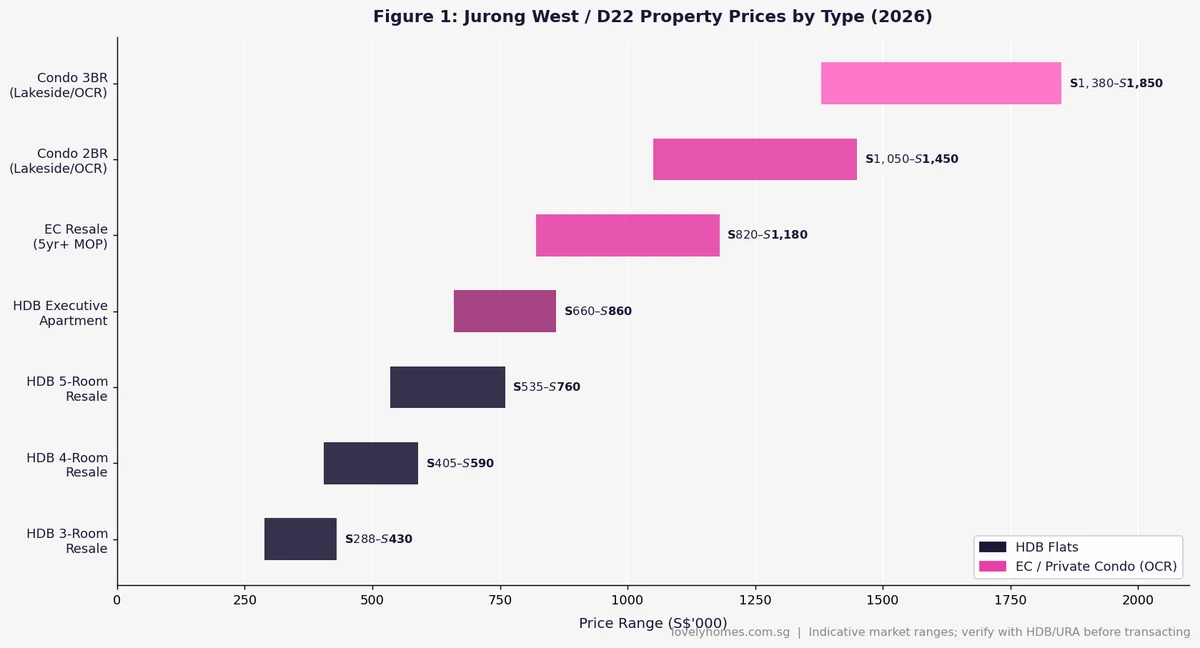
  • HDB resale prices: 3-room S$288,000–S$430,000; 4-room S$405,000–S$590,000; 5-room S$535,000–S$760,000
  • Private/EC prices: EC resale S$820,000–S$1,180,000; condo 2BR S$1,050,000–S$1,450,000; condo 3BR S$1,380,000–S$1,850,000
  • Gross rental yield: HDB 4.1–4.8%; condo/EC 3.4–4.2%
  • 3-year capital growth: private condos +10.5–11.8%; HDB flats +7.2–8.8%
  • JLD uplift catalyst: 100,000 jobs target, S$100B+ investment pipeline; Cross Island Line (CRL) Jurong Lake District interchange ~2030
  • Notable projects: Lake Grande (99yr, D22 flagship); Parc Riviera (99yr); Lakeville (99yr); J’den (JLD adjacent, fully sold)
  • Buyer profile: First-time HDB buyers; NTU/NIE faculty and student tenants; industrial-worker tenants; JLD long-term investors

What Is Jurong West and Where Is It?

Jurong West is a planning area in Singapore’s Western Region, administered by URA. It encompasses the subzones of Boon Lay, Chin Bee, Kian Teck, Taman Jurong, Wenya, Yunnan, and the residential precincts stretching west from Chinese Garden to Joo Koon. The planning area is classified as Outside Central Region (OCR) throughout, making it Singapore’s quintessential value-segment residential market.

The estate was developed from the 1970s onward as Singapore’s answer to housing the industrial workforce of the Jurong Industrial Estate — then the backbone of the nation’s manufacturing economy. Today, Jurong West has matured into a self-sufficient community with comprehensive amenities, though it retains its character as Singapore’s most affordable major HDB town.

Jurong West D22 property prices by type 2026 — HDB, EC and condo price ranges
Figure 1: Jurong West / D22 property prices by type, 2026. Source: HDB resale portal, URA REALIS, indicative market data.

MRT Connectivity: EWL, JRL and the CRL Catalyst

Jurong West is served by five East West Line (EWL) stations — Lakeside (EW26), Chinese Garden (EW25), Boon Lay (EW27), Pioneer (EW28), and Joo Koon (EW29) — giving residents direct westbound access to Jurong East interchange and eastbound access to the CBD (City Hall, Raffles Place) within 35–45 minutes.

The transformative addition is the Jurong Region Line (JRL), a new MRT line opening in phases from 2027. The JRL will provide cross-island connectivity independent of the EWL trunk, serving the Tengah, Jurong Industrial Estate, and Nanyang Technological University (NTU) corridors. Key stations serving Jurong West precincts include Boon Lay JRL (interchange with EWL), and the Taman Jurong and Enterprise nodes. LTA has confirmed JRL Stage 1 (Choa Chu Kang to Boon Lay) targeting completion in mid-2027, with Stage 2 and Stage 3 by 2028.

Looking further ahead, the Cross Island Line (CRL) Phase 2 is planned to include a Jurong Lake District station, creating a future CRL–EWL–JRL interchange at Jurong East — one of the most powerful multimodal nodes outside the CBD. This interchange, expected around 2030, is the single largest infrastructure catalyst underpinning the JLD property investment thesis.

Property Prices in Jurong West 2026

Jurong West offers the most affordable HDB resale flats among Singapore’s mature towns, making it a popular choice for first-time buyers and families on tighter budgets. A 4-room resale flat in Boon Lay or Taman Jurong typically commands S$405,000 to S$590,000 in 2026, with premium blocks in Lakeside precinct (near waterfront and MRT) occasionally reaching S$600,000–S$630,000. Five-room flats trade at S$535,000 to S$760,000, reflecting their larger floor area and suitability for multigenerational families.

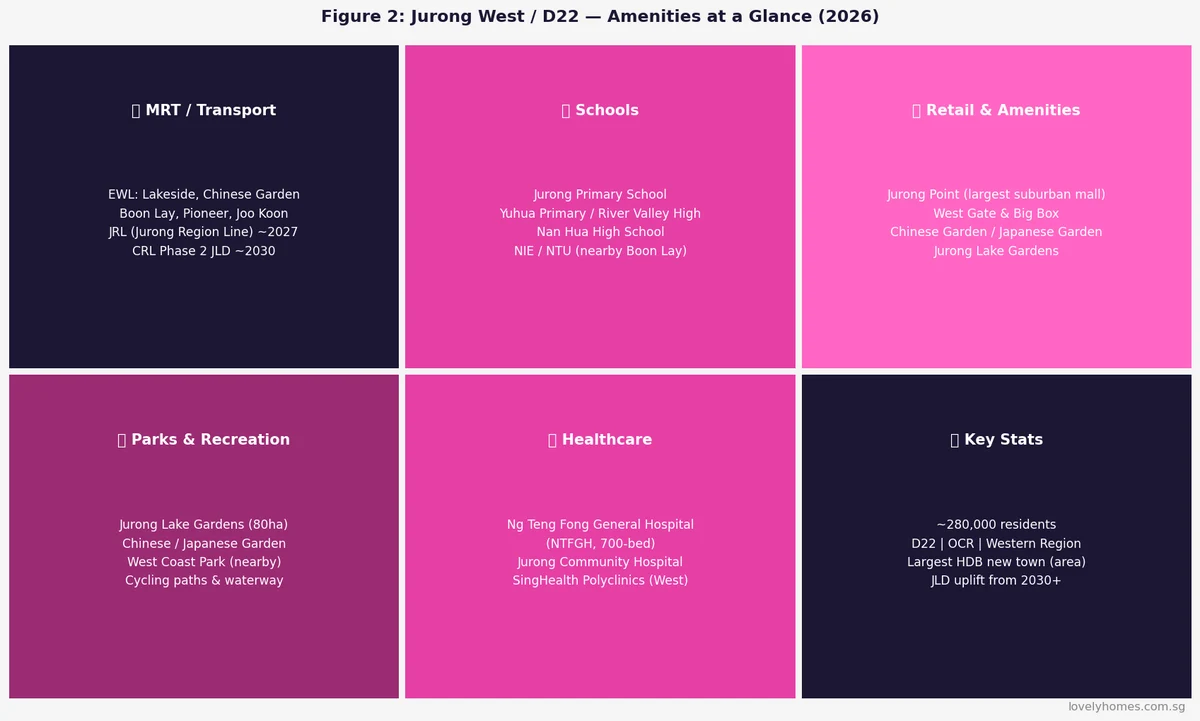
The private residential market in D22 is more limited than in eastern or central districts. The flagship developments are the three Jurong lakeside condos — Lake Grande (710 units, 99yr, launched 2016 at ~S$1,350 PSF, now trading at approximately S$1,500–S$1,700 PSF resale), Parc Riviera (752 units, 99yr), and Lakeville (696 units, 99yr). These projects form the benchmark private condo tier for D22 OCR. EC resale — particularly Westwood Residences and The Topiary (both past 5-year MOP) — provides an intermediate option between HDB and private, with transacted prices of S$820,000 to S$1,180,000 for units that have fully privatised.

Jurong West D22 amenities grid — EWL MRT, schools, retail, parks, hospital, key stats
Figure 2: Jurong West / D22 amenities at a glance — transport, schools, retail, parks and healthcare.

Schools in Jurong West

Jurong West is well-stocked with primary schools spread across its precincts, providing good within-1km options for families with young children. Key schools include Jurong West Primary School, Yuhua Primary School, Lakeside Primary School (in the waterfront precinct), and the SAP school Nan Hua Primary School on Clementi Avenue 1 (within reach of the western Clementi–Jurong border).

At secondary level, Nan Hua High School, River Valley High School (a centralised independent school, accessible via EWL), Yuan Ching Secondary, and Jurong Secondary all fall within the D22 ecosystem. For tertiary education, Nanyang Technological University (NTU) and the National Institute of Education (NIE) — both in the adjacent Jurong/Boon Lay area — generate a steady pool of academic-sector tenants, making the estate attractive for buy-to-let investors targeting the education cluster.

Lifestyle, Amenities and the JLD Masterplan

Jurong West’s retail anchor is Jurong Point — Singapore’s largest suburban shopping mall with over 500 tenants — located adjacent to Boon Lay MRT. The nearby WestGate and JEM malls at Jurong East further expand the retail catchment for western residents. For recreation, the Jurong Lake Gardens (an 80-hectare lakeside park opened in 2019) and the iconic Chinese Garden and Japanese Garden heritage parks provide significant green space at the estate’s eastern fringe.

The most consequential transformation for Jurong West buyers, however, is the Jurong Lake District (JLD) masterplan. URA has designated JLD as Singapore’s second Central Business District — a 360-hectare precinct centred on Jurong East, targeting 100,000 jobs and attracting major institutional anchors including the Singapore Tourism Board’s planned Tourism 2.0 hub. The URA masterplan envisions JLD as a mixed-use lakeside precinct with commercial towers, hotels, recreational facilities, and residential developments, all served by the future EWL–JRL–CRL mega-interchange. Healthcare in Jurong West is served by Ng Teng Fong General Hospital (NTFGH) — a 700-bed acute-care hospital opened in 2015 and designated as the western regional hospital — and Jurong Community Hospital on the same campus.

Rental Yields and Investment Case

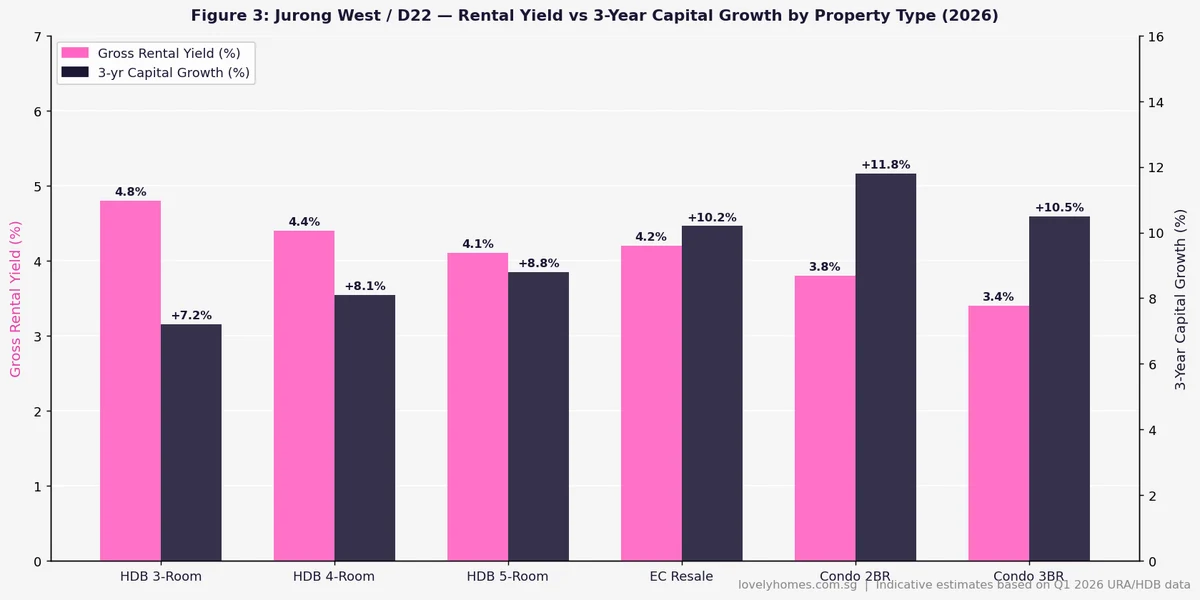
Jurong West’s primary investment draw is its high gross rental yield relative to the rest of Singapore. HDB 3-room flats in the estate yield approximately 4.8% gross, the highest among Singapore’s major HDB towns, driven by affordable entry prices and consistent demand from blue-collar workers, NTU/NIE staff, and junior industrial-sector tenants. Four-room flats yield around 4.4% gross, and 5-room flats approximately 4.1%.

Jurong West D22 rental yield vs 3-year capital growth by property type 2026
Figure 3: Jurong West / D22 — gross rental yield vs 3-year capital growth by property type (2026). Source: indicative estimates based on URA/HDB Q1 2026 data.

Private condo yields in D22 are lower due to higher entry PSF, but the JLD re-rating thesis has driven stronger capital appreciation. Lake Grande 2BR units have appreciated approximately +11.8% on a 3-year basis through Q1 2026, in line with the broader lakeside corridor outperformance. EC resale units — benefiting from their mixed private/HDB character and fully privatised status after MOP — have delivered the strongest combined return profile: yield around 4.2% with 3-year capital growth of approximately +10.2%.

Summary: Jurong West Property Types at a Glance

Property Type Typical Price Range Gross Yield 3yr Capital Growth Tenure
HDB 3-Room Resale S$288,000–S$430,000 ~4.8% +7.2% 99-yr (HDB)
HDB 4-Room Resale S$405,000–S$590,000 ~4.4% +8.1% 99-yr (HDB)
HDB 5-Room Resale S$535,000–S$760,000 ~4.1% +8.8% 99-yr (HDB)
EC Resale (5yr+ MOP) S$820,000–S$1,180,000 ~4.2% +10.2% 99-yr (privatised)
Condo 2BR (Lakeside OCR) S$1,050,000–S$1,450,000 ~3.8% +11.8% 99-yr
Condo 3BR (Lakeside OCR) S$1,380,000–S$1,850,000 ~3.4% +10.5% 99-yr

Worked Example: First-Time Buyer Purchasing an HDB Resale Flat in Jurong West

Profile: Mr and Mrs Rajan, both Singapore Citizens, joint monthly income S$7,200. First-time buyers seeking an HDB resale flat in Jurong West close to Boon Lay MRT for Mr Rajan’s commute to the Jurong Industrial Estate.

Target unit: 4-room resale flat, Boon Lay Drive, asking price S$498,000.

  • CPF Housing Grants available: Enhanced CPF Housing Grant (EHG) — joint income S$7,200, within EHG ceiling of S$9,000; EHG for family = S$30,000. Proximity Housing Grant (PHG) — not applicable (not buying near parents). Total grants: S$30,000.
  • Effective purchase price after grants: S$498,000 − S$30,000 = S$468,000
  • Buyer’s Stamp Duty (BSD): S$1–S$180,000 @ 1% = S$1,800 + S$180,001–S$360,000 @ 2% = S$3,600 + S$360,001–S$468,000 @ 3% = S$3,240 = BSD S$8,640
  • ABSD: Nil — SC first residential property
  • Loan option — HDB Loan: 80% LTV on purchase price = S$398,400 (before EHG offset); effective loan after EHG S$368,400 at 2.6% p.a. over 25 years = approximately S$1,669/month
  • Mortgage Servicing Ratio (MSR): S$1,669 ÷ S$7,200 = 23.2% — well within the 30% MSR cap
  • CPF/cash upfront: 20% downpayment from CPF OA = S$99,600; BSD S$8,640 from CPF; legal fees ~S$2,500 cash; total CPF draw ~S$108,240; cash ~S$2,500

The Rajans are comfortably within MSR at 23.2% and their CPF OA savings (assuming S$120,000 combined) are sufficient for the downpayment. The HDB loan — while carrying a higher interest rate than a bank loan — provides the security of no lock-in penalty and the ability to overpay without fee. Monthly repayments of S$1,669 represent a very sustainable 23.2% of joint income, leaving ample capacity for savings and family expenditure.

Why Jurong West Matters: The JLD Long-Term Thesis

Jurong West’s investment case rests substantially on the Jurong Lake District masterplan, which URA has been developing since 2008 and accelerated post-2020. JLD is Singapore’s most significant decentralisation initiative: the government is deliberately shifting high-value economic activity, including financial services, technology, and medical tourism, from the traditional CBD to the western lakeside precinct. The S$100 billion development pipeline, anchor commitments from major corporations, and the planned CRL–JRL–EWL interchange at Jurong East by 2030 collectively underpin a structural case for western property appreciation that stretches well into the 2030s.

Comparable precedents exist elsewhere in Singapore: the build-out of Marina Bay from the 2000s transformed adjacent Districts 1 and 2 values; the development of Punggol Digital District has re-rated Punggol condos. JLD is a substantially larger initiative by both scale and investment quantum, with government backing and legislative commitment.

What Might Come Next for Jurong West

This section contains forward-looking analysis and should not be construed as a prediction of future prices.

The most significant near-term catalyst is JRL Stage 1 opening in mid-2027. Historically, property values within a 500m radius of new MRT stations have appreciated 3–8% in the 12–24 months around station opening, based on LTA and academic studies of prior line openings. Jurong West precincts near planned JRL stations — particularly Taman Jurong — could see notable uplift. The CRL Phase 2 confirmation (expected from MND/LTA around 2026–2027) will also provide a milestone catalyst for JLD-adjacent properties. Conversely, the large public housing pipeline for Tengah (a new HDB town adjacent to Jurong West, expected to deliver 42,000 homes through the late 2020s) could exert moderate supply-side pressure on Jurong West HDB resale prices in the medium term.

Frequently Asked Questions

Is Jurong West a good area to buy property in 2026?

For value-seeking buyers and yield-focused investors, Jurong West offers the most affordable entry point among Singapore’s MRT-served estates, with the JLD masterplan providing a credible long-term capital appreciation case. The trade-off is a less vibrant lifestyle compared with central or eastern estates, longer commute times to the CBD for non-western employment nodes, and proximity to industrial zones in the southern precincts. For families on moderate incomes buying their first HDB home, or investors seeking the highest gross rental yield, Jurong West is one of Singapore’s more compelling value propositions in 2026.

Which MRT stations serve Jurong West?

Five EWL stations serve Jurong West: Lakeside (EW26), Chinese Garden (EW25), Boon Lay (EW27), Pioneer (EW28), and Joo Koon (EW29). The upcoming JRL (Jurong Region Line), opening from mid-2027, will add further stations in the Boon Lay, Taman Jurong, and Enterprise corridors, providing east–west connectivity independent of the EWL trunk. The CRL Phase 2 Jurong Lake District interchange (~2030) will link the Cross Island Line to both EWL and JRL at Jurong East, making the western node one of Singapore’s best-connected transport hubs outside the city.

What is the Minimum Occupation Period (MOP) for Jurong West HDB flats?

Standard (Open Market) HDB BTO flats in Jurong West carry a 5-year MOP from the date of key collection. During MOP, the flat cannot be sold on the open market, rented out in full (subletting individual rooms is permitted with HDB approval), or used to fulfil CPF accrued interest clawback. Jurong West is classified as a Standard location under HDB’s classification framework — not Plus or Prime — so no extended MOP applies. After MOP, HDB resale flats in Jurong West can be sold freely, and owners can purchase a private property concurrently (though they would pay 20% ABSD if retaining the HDB).

How does Jurong West compare with Tampines or Woodlands?

Jurong West offers the lowest HDB resale prices of the three, reflecting its OCR western location and industrial-adjacent character. Tampines (D18) commands a premium of approximately S$100,000–S$180,000 for equivalent HDB flat types, driven by its mature town status, stronger amenity base, and Tampines Regional Centre employment cluster. Woodlands (D25) is similarly priced to Jurong West but has a different JLD-equivalent catalyst in the Woodlands Regional Centre and the RTS Link to Johor Bahru. For JLD uplift exposure, Jurong West is unique. For established amenity and eastern-facing employment, Tampines is stronger.

Can a Singapore PR buy an HDB resale flat in Jurong West?

Yes. Permanent Residents who meet HDB eligibility — forming a family nucleus with another SPR or SC family member, and having held PR status for at least 3 years — can purchase HDB resale flats in Jurong West. However, SPRs pay a 5% ABSD on their first residential purchase and 15% ABSD on their second. SPRs are also subject to the Ethnic Integration Policy (EIP) quotas and SPR quota (8% per block, 5% per neighbourhood) when purchasing HDB flats.

What is the best precinct in Jurong West to buy?

For capital appreciation potential, the Lakeside precinct (near Lakeside MRT and Jurong Lake Gardens) offers the strongest JLD adjacency and lifestyle amenity. Lake Grande, Parc Riviera, and Lakeville are the benchmark developments here. For rental yield and affordability, the Boon Lay and Taman Jurong precincts offer higher yields from a lower entry base and benefit from Jurong Point’s retail anchor and Boon Lay MRT access. Families prioritising school catchments should focus on precincts within 1km of Nan Hua or Lakeside Primary schools.

How will the Tengah new town affect Jurong West property prices?

HDB’s Tengah new town — Singapore’s newest HDB estate, adjacent to Jurong West’s northern boundary — is expected to add approximately 42,000 public housing units through the late 2020s. In the short to medium term, this supply injection could exert modest downward pressure on Jurong West HDB resale prices, particularly for units competing with similarly priced Tengah BTO flats. However, Tengah BTO flats carry a 5-year MOP and are new-build (typically priced at a discount to resale), limiting direct substitution. The JRL will also serve Tengah, potentially enhancing connectivity of both estates and mitigating resale price pressure.

Related Articles

Disclaimer

This article is for general informational purposes only and does not constitute financial, legal, or property advice. All property prices, rental yields, and capital growth figures are indicative estimates drawn from URA REALIS data, HDB resale portal transactions, and market analysis as at Q1 2026. Actual transaction prices vary by unit, floor, condition, and prevailing market conditions. ABSD, BSD, CPF rules, HDB eligibility, MSR, and TDSR policies are set by the Singapore Government (IRAS, HDB, MAS, CPF Board) and are subject to change. Readers should conduct their own due diligence and consult a licensed property agent, lawyer, and financial adviser before making any property transaction. For authoritative data, refer to URA (ura.gov.sg), HDB (hdb.gov.sg), IRAS (iras.gov.sg), MAS (mas.gov.sg), and CPF Board (cpf.gov.sg).

Translate »