Singapore Home Loan Rates April 2026: Fixed vs Floating in the Current SORA Cycle
Singapore home loan pricing has moved materially since the peaks of 2023 and 2024, and April 2026 is shaping up to be one of the more borrower-friendly moments in the current cycle. The 3-month Compounded SORA has settled into a range well below its late-2023 highs, and the gap between fixed-rate and floating-rate packages has narrowed to the point where the “obvious” choice is no longer obvious at all.
This piece takes stock of where rates are, how the major banks are pricing, and what the trade-offs look like for new buyers, HDB upgraders, and the large cohort of owners whose 2023 fixed-rate lock-ins are rolling off this year.
Where the benchmark sits
The 3-month Compounded SORA — the reference rate that replaced SIBOR and SOR for new housing loans — has eased through Q1 2026 as the US Federal Reserve’s cutting cycle has filtered through to Singapore dollar funding markets. Where 3M SORA was printing above 3.7% through much of 2023, the indicator has been hovering in the 2.3%–2.6% band for most of April 2026, with banks pricing new floating packages off that level plus a spread of roughly 0.70%–0.90%.
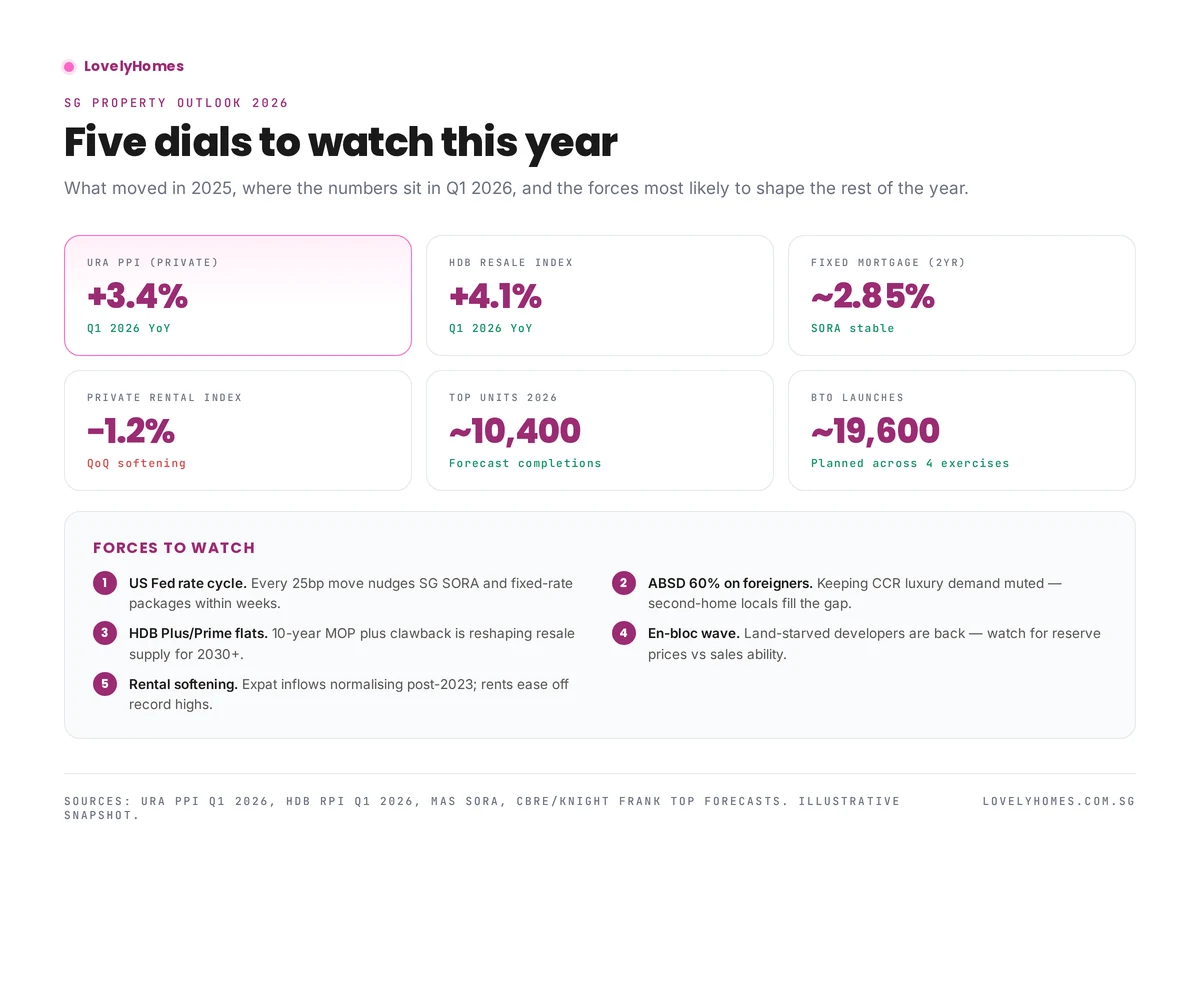
That puts an average SORA-linked package today at an all-in rate of approximately 3.0%–3.5%, depending on the bank, the loan quantum, and the lock-in terms. Fixed-rate packages, which lagged the downward move, are now quoting in a similar neighbourhood — typically 2.8%–3.3% for 2-year fixes, and a touch higher for 3-year tenors.
Fixed vs floating: the trade-off has narrowed
Through 2023 and much of 2024, the gap between fixed and floating was wide enough that borrowers who chose wrong paid for it in real money. Fixed packages at the peak were being priced defensively, while floating rates climbed sharply as SORA averaged above 3.7%. By April 2026, the two curves have converged.
For a borrower drawing down today, the working assumption is that fixed and SORA-linked packages are within roughly 20–40 basis points of each other at origination. That means the decision is driven less by absolute pricing and more by risk appetite:
- Fixed: Certainty of monthly instalments through the lock-in period. Useful for borrowers whose cash flow is tight, or who prefer not to track a benchmark. The cost of certainty has fallen to a level many borrowers now find worth paying.
- Floating (SORA-linked): Full transmission of any further SORA easing, but also full exposure to any reversal if inflation or SGD funding conditions surprise to the upside.
Industry desks are generally characterising the market consensus as “one or two more cuts, then pause” — but that consensus has been wrong often enough in the last three years that it should not be treated as a plan.
Refinancing pressure: the 2023 cohort is rolling off
The more immediate market story is the wave of 2-year and 3-year fixed-rate loans taken out in 2023 and early 2024 that are now resetting. Many of these packages were locked in at 3.8%–4.5%, and are rolling to revert rates (typically a bank board rate plus spread) that today would be higher still if left unaddressed.
For this cohort, refinancing is not a theoretical optimisation — it is often a 50–150 basis point saving per year on the outstanding balance. On a S$1.5 million loan, that is roughly S$7,500–S$22,500 in annual interest saved. Unsurprisingly, loan-redemption teams across the major local banks have reported elevated refinancing volumes through the first quarter.
The usual frictions apply: lock-in clawbacks on the outgoing package, legal subsidy recovery if the original loan is less than three years old, and a full TDSR/MSR recomputation at the new bank. Borrowers whose income has moved or whose other credit obligations have grown since the original drawdown should run the TDSR numbers before committing to a switch.
What new buyers should be modelling
For buyers entering the market in April 2026 — whether for a new launch, a resale private, or an HDB resale — the practical planning rate remains higher than today’s quoted rate. MAS’s medium-term interest rate floor for TDSR and MSR stress-testing is 4% for residential property loans, so any serviceability calculation should be done at 4% regardless of how attractive the current quote looks.
In practice, that means:
- Take the current quoted rate for the lock-in period (say 3.0%) and model monthly cash flow at that number.
- Separately stress the same loan at 4% to check TDSR headroom and personal comfort.
- Assume the loan will at some point float against SORA at reversion — plan for that eventuality rather than hope the current quote holds for the full 25–30 year tenor.
The gap between those two numbers is the buffer the framework asks borrowers to keep. In an easing cycle it is tempting to view 4% as overly conservative; in a tightening cycle it is what keeps households solvent.
Looking ahead
The near-term path for Singapore home loan rates is tied to the same macro questions global markets are wrestling with: the terminal level of US policy rates, the pace at which Asian central banks mirror or diverge, and whether core inflation in Singapore continues to drift back towards MAS’s comfort zone. A further 25–50 basis points of easing through the remainder of 2026 is priced in by most desks, but the base case could shift quickly if the inflation data surprises.
For borrowers, the practical stance is unchanged regardless of the macro view: understand whether your exposure is to the fixed curve or to SORA, refinance when the arithmetic clearly favours it, and model every purchase at the 4% stress rate rather than the headline quote. The packages on offer in April 2026 are the most competitive they have been in roughly two years — but that is a reason to shop carefully, not a reason to stop reading the fine print.
This article is a market overview and does not constitute financial advice. Borrowers should speak with their preferred bank or a licensed mortgage broker for package-specific terms and obtain personalised serviceability calculations before committing to a home loan.