Singapore Buyer’s Stamp Duty (BSD) Guide 2026: Rates, Calculation and Worked Examples

Singapore Buyer’s Stamp Duty (BSD) Guide 2026: Rates, Calculation and Worked Examples
Singapore buyer's stamp duty BSD 2026 complete guide — rates, calculation and exemptions lovelyhomes.com.sg
Singapore Buyer’s Stamp Duty (BSD) 2026 — Complete Guide to Rates, Calculation and Exemptions

💰 Quick Answer: BSD at a Glance

  • Buyer’s Stamp Duty (BSD) is a tax on the purchase of any property in Singapore — residential, commercial or industrial — payable by the buyer.
  • BSD is calculated on the higher of the purchase price or market value at the date of the contract.
  • Rates are progressive from 1% to 6% across six price bands, effective 20 February 2023.
  • BSD is separate from ABSD (Additional Buyer’s Stamp Duty) — ABSD is an additional tax layered on top of BSD for certain buyer profiles and applies only to residential property.
  • BSD must be paid within 14 days of signing the OTP acceptance letter or Sale and Purchase Agreement, via the IRAS e-Stamping Portal.
  • There are no BSD exemptions for first-time buyers — every buyer of every property type pays BSD (though CPF OA funds can be used to pay it).
  • For a S$1.5M property, BSD works out to S$44,600 (2.97% effective rate).

What Is Buyer’s Stamp Duty? The Basics

Buyer’s Stamp Duty (BSD) is a documentary stamp tax levied by the Inland Revenue Authority of Singapore (IRAS) on instruments relating to the purchase or transfer of property in Singapore. Unlike the Additional Buyer’s Stamp Duty (ABSD) — which is a policy tool designed to moderate residential demand and targets specific buyer profiles — BSD is a baseline transactional tax that applies universally to all property types and all buyer profiles without exception. Whether you are a Singapore Citizen buying your first HDB resale flat, a permanent resident purchasing a condominium or a foreign company acquiring industrial land, BSD applies.

BSD is governed by the Stamp Duties Act (Cap. 312) and has been part of Singapore’s property transaction framework for decades. The current progressive rate structure — reaching a top rate of 6% on the portion of the property value above S$3 million — was introduced on 20 February 2023 as part of a broader package of property market cooling measures, replacing the previous top rate of 4% that had been in effect since March 2017.

BSD Rates — The Full Rate Schedule

BSD is calculated band by band on the cumulative purchase price (or market value, whichever is higher). The six bands and their rates are as follows:
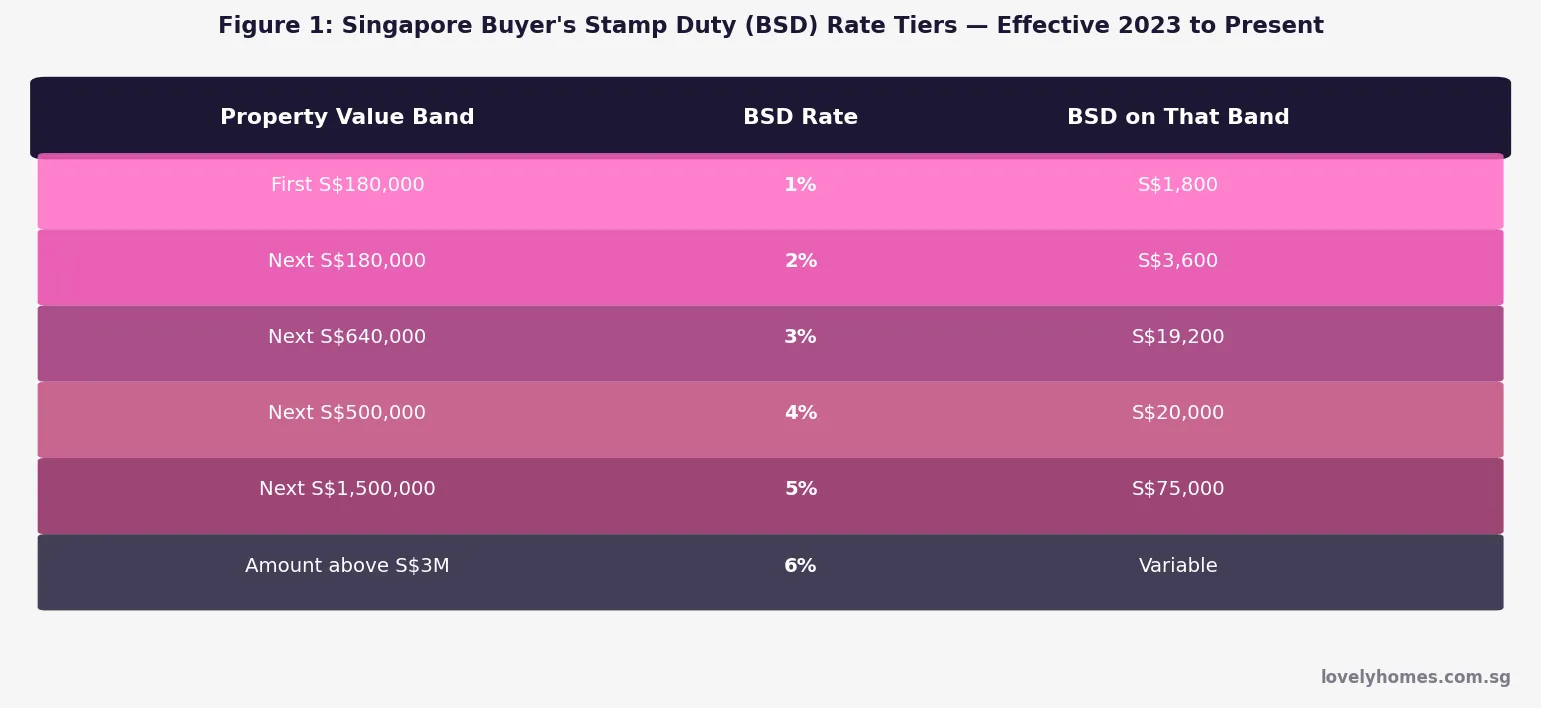
Singapore buyer's stamp duty BSD rate tiers table 2026 — 1% to 6% progressive rates by property value band
Figure 1: Singapore BSD Rate Tiers — Progressive Bands from 1% to 6% (Effective 20 February 2023)
Property Value Band BSD Rate Maximum BSD on Band Cumulative Max BSD
First S$180,000 1% S$1,800 S$1,800
Next S$180,000 (S$180,001–S$360,000) 2% S$3,600 S$5,400
Next S$640,000 (S$360,001–S$1,000,000) 3% S$19,200 S$24,600
Next S$500,000 (S$1,000,001–S$1,500,000) 4% S$20,000 S$44,600
Next S$1,500,000 (S$1,500,001–S$3,000,000) 5% S$75,000 S$119,600
Amount above S$3,000,000 6% Variable S$119,600 + 6% of excess

A useful shortcut: for any property priced at exactly S$1,000,000, BSD is S$24,600. For S$1,500,000, BSD is S$44,600. For S$2,000,000, BSD is S$69,600. These are the cumulative amounts where each band maxes out cleanly.

BSD by Purchase Price — Key Reference Points

The chart below shows BSD payable at common price points, alongside the effective BSD rate (BSD ÷ purchase price), illustrating how the progressive structure causes the effective rate to rise steadily from approximately 1.9% at S$500,000 to close to 4% at S$3,000,000.
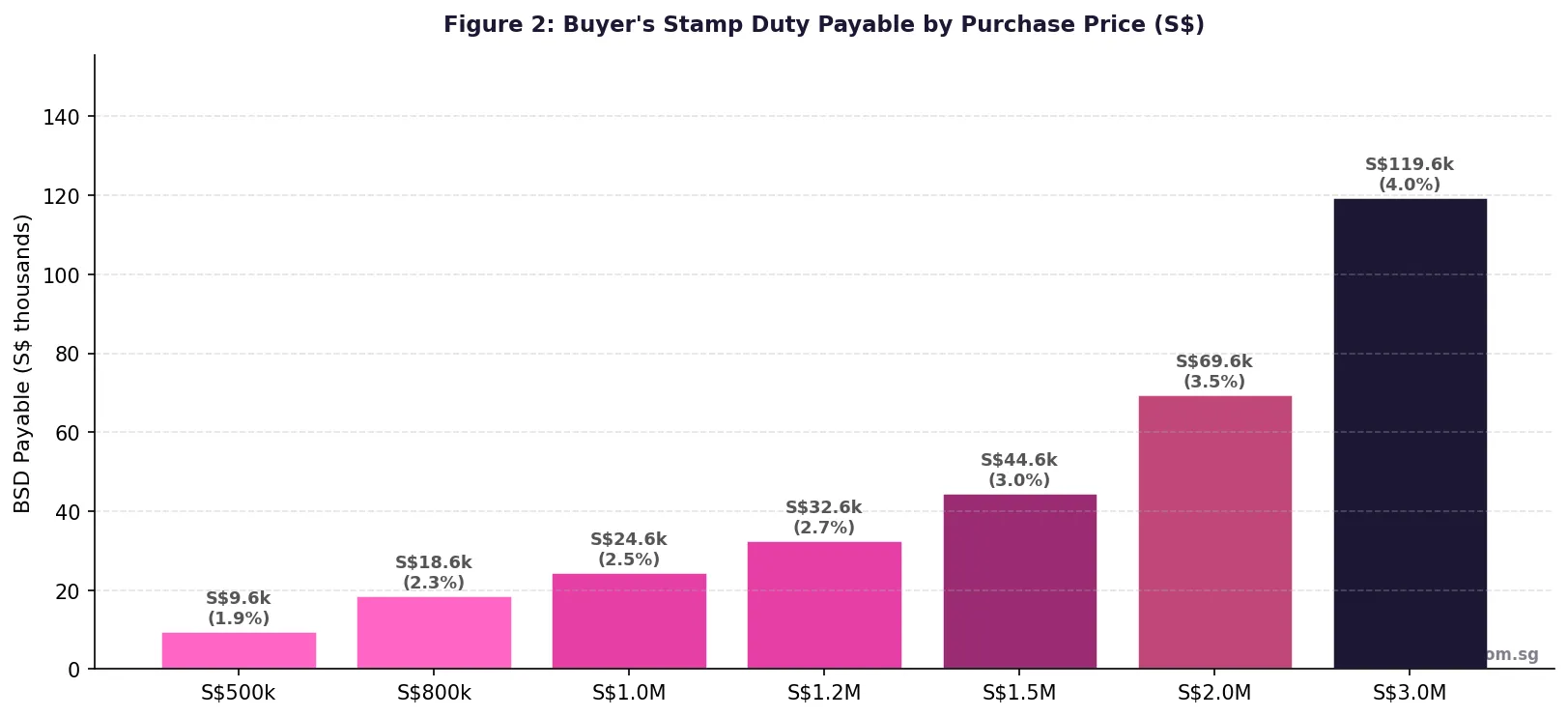
Singapore BSD payable by purchase price 2026 — stamp duty amounts for S$500k to S$3M properties
Figure 2: BSD Payable by Purchase Price — S$500K to S$3M Properties (Singapore 2026)
Purchase Price BSD Payable Effective Rate Typical Property Type
S$500,000 S$9,600 1.92% HDB 3–4 room resale (non-mature estate)
S$800,000 S$18,600 2.33% HDB 4–5 room resale (mature estate)
S$1,000,000 S$24,600 2.46% HDB 5-room / million-dollar flat; entry condo OCR
S$1,200,000 S$32,600 2.72% Mass-market condominium OCR
S$1,500,000 S$44,600 2.97% Mid-market condo RCR/OCR
S$2,000,000 S$69,600 3.48% City-fringe RCR condo / entry CCR unit
S$3,000,000 S$119,600 3.99% CCR condo; semi-detached house OCR
S$5,000,000 S$239,600 4.79% Landed property; Good Class Bungalow land

BSD vs ABSD — Understanding the Difference

BSD and ABSD are two separate stamp duties that apply to residential property transactions, but they operate differently and for different purposes.

BSD is a fixed transactional tax — it applies to all property types (residential, commercial, industrial, land) and all buyer profiles. It raises general revenue and has been part of Singapore’s tax framework since the colonial era. The buyer pays BSD regardless of their nationality, residency status, or how many properties they own.

ABSD, by contrast, is a targeted demand-management tool introduced in December 2011 and revised multiple times since. It applies only to residential property and its rate varies by buyer profile: Singapore Citizens pay 0% on their first residential property, 20% on their second and 30% on their third and beyond. Permanent Residents pay 5% on their first and 30% on their second and beyond. Foreigners pay a flat 60% on any residential property purchase.
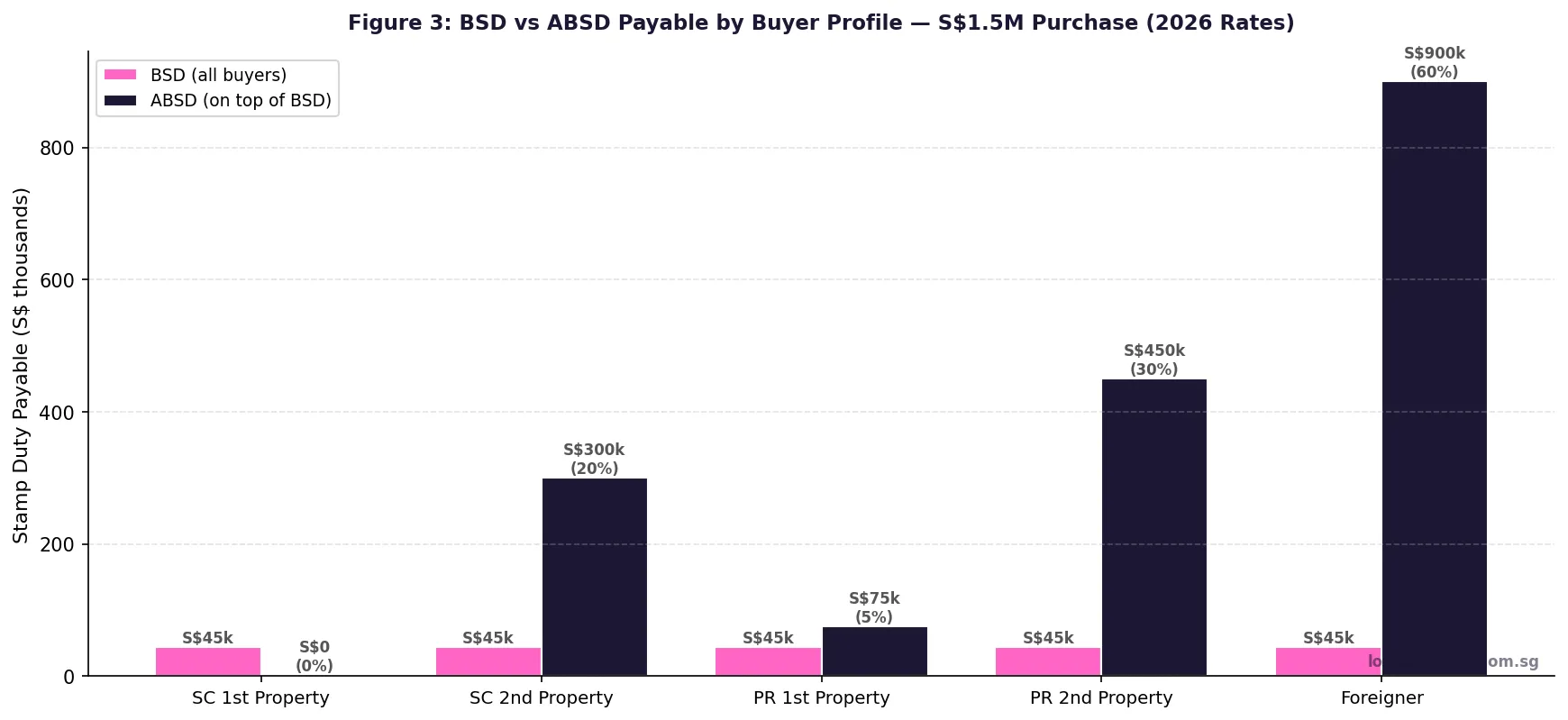
Singapore BSD vs ABSD comparison by buyer profile 2026 — stamp duty payable on S$1.5M property
Figure 3: BSD vs ABSD Payable by Buyer Profile — S$1.5M Residential Property (2026 Rates)

The practical implication: for a Singapore Citizen buying their first residential property, BSD is the only stamp duty payable. For a foreigner, both BSD (S$44,600 at S$1.5M) and ABSD (S$900,000 at 60% of S$1.5M) apply, making the total stamp duty burden S$944,600 — more than 60% of the purchase price.

How to Calculate BSD Step by Step

BSD is calculated on the basis of the higher of (a) the agreed purchase price and (b) the market value at the date of the contract (for residential property, this is typically the Option to Purchase date). If you negotiate a price below market value — for example, in a family transfer or a motivated seller situation — IRAS will still compute BSD on the market value, not the transacted price.

The formula, applied band by band, is:

  1. Identify the taxable value (higher of price vs. market value).
  2. Apply 1% to the first S$180,000 → produces up to S$1,800.
  3. Apply 2% to the next S$180,000 → produces up to S$3,600.
  4. Apply 3% to the next S$640,000 → produces up to S$19,200.
  5. Apply 4% to the next S$500,000 → produces up to S$20,000.
  6. Apply 5% to the next S$1,500,000 → produces up to S$75,000.
  7. Apply 6% to any remaining amount above S$3,000,000.
  8. Sum all bands.

For a property value of S$V, where S$360,000 < V ≤ S$1,000,000, a quick formula applies: BSD = 3% × V − S$5,400. For S$1,000,000 < V ≤ S$1,500,000: BSD = 4% × V − S$15,400. These shortcuts are convenient for mental estimates.

Worked Example: BSD on an RCR Condominium Purchase

Ms Priya is a Singapore Citizen purchasing her first property — a 2-bedroom condominium unit in the Rest of Central Region (RCR) at a negotiated price of S$1,780,000. IRAS values the unit at S$1,720,000 (below the purchase price). BSD is computed on the higher figure of S$1,780,000.

First S$180,000 × 1%S$1,800
Next S$180,000 × 2%S$3,600
Next S$640,000 × 3%S$19,200
Next S$500,000 × 4%S$20,000
Remaining S$280,000 × 5% (S$1,780,000 − S$1,500,000)S$14,000
Total BSD payableS$58,600
Effective BSD rate3.29%

Because Ms Priya is an SC first-time buyer, her ABSD is S$0. Her BSD of S$58,600 must be paid within 14 days of exercising the Option to Purchase (i.e. within 14 days of the date she signs the OTP acceptance letter). She may pay BSD from her CPF Ordinary Account, from cash, or a combination of both. BSD is a one-time payment and is not refundable if the transaction falls through after the OTP is exercised (though the OTP deposit itself is a separate matter governed by the OTP terms).

When Is BSD Due? Payment Timing and Process

BSD must be paid within 14 days of the date of the instrument (OTP acceptance, Sale and Purchase Agreement, or Instrument of Transfer) giving rise to the liability. The IRAS e-Stamping Portal (estamping.iras.gov.sg) is the online gateway for BSD payment. For residential property transactions handled by lawyers, the conveyancing firm typically manages BSD payment on behalf of the buyer as part of the standard legal process — the amount is included in the lawyers’ completion account.

Failure to stamp within 14 days attracts a late stamping penalty of S$10 or the unpaid duty amount, whichever is higher, plus an interest charge. IRAS may also disallow the property instrument in legal proceedings if it has not been duly stamped.

BSD for Non-Residential Property

BSD applies to all property types, not just residential. For commercial and industrial property, the same BSD rate schedule applies (1%–6% progressive). However, ABSD does not apply to non-residential property acquisitions — meaning a company or individual purchasing an office unit or warehouse pays only BSD, with no ABSD overlay.

For land transactions, BSD is computed on the land price (or market value of the land). Conversion of leasehold to freehold tenure also triggers stamp duty in certain circumstances. Foreign ownership restrictions on residential property do not apply to commercial or industrial property, making those asset classes particularly attractive to foreign investors who wish to avoid the 60% ABSD on residential purchases.

BSD Exemptions and Remissions

BSD exemptions are narrow. The main categories are:

  • Transfers pursuant to a will or intestate succession: Property inherited through a deceased estate is exempt from BSD, though the transfer must be completed through a grant of probate or letters of administration process.
  • Transfers between spouses: A spousal transfer of residential property that was purchased before marriage is eligible for BSD remission under Section 22A of the Stamp Duties Act, provided both parties remain married and the property will be the matrimonial home.
  • GST-registered entities acquiring commercial or industrial property may claim input tax credits on the GST component, though BSD itself remains payable.

There is no BSD exemption for first-time buyers. Unlike the ABSD, which has a 0% rate for SC first-property purchases, BSD applies at the standard progressive rates to every buyer regardless of property count or citizenship. This distinguishes Singapore’s BSD from stamp duty regimes in some other jurisdictions (such as the UK, which provides first-time buyer relief up to certain thresholds).

What BSD Means for Property Buyers in 2026

The 2023 BSD increase — introducing the 5% and 6% top bands — meaningfully raised the transaction cost for high-value residential purchases. For a S$3M property, BSD rose from S$89,600 (under the pre-2023 schedule) to S$119,600, an increase of S$30,000 or approximately 33%. For a S$5M property, BSD is now S$239,600 versus S$179,600 previously — an additional S$60,000.

For buyers in the mass-market segment — properties below S$1,000,000 — the BSD structure is unchanged from 2017; only the top two bands were revised in 2023. The change therefore disproportionately affects luxury segment buyers, collective sale (en bloc) participants and industrial/commercial property investors acquiring high-value assets.

For HDB resale buyers, BSD at common price points (S$500,000–S$800,000) works out to S$9,600–S$18,600 — typically payable from CPF OA as part of the conveyancing process, with no cash top-up required for most buyers.

What Might Come Next

The 2023 BSD enhancement was explicitly designed to improve tax progressivity — ensuring that the wealthy pay proportionally more on high-value property purchases. The government has indicated that the BSD rate structure will be reviewed periodically alongside other property market measures. A further revision to the top band (6%) is unlikely in the near term given that property transaction volumes have moderated since the 2022–2023 peak. More likely is continued adjustment of the ABSD rate schedule as a more targeted demand-management lever, while BSD remains stable as a baseline revenue measure. For buyers acquiring property in 2026, the current BSD schedule should be treated as the effective framework for the foreseeable future.

Frequently Asked Questions

Does BSD apply if I buy property through a company?

Yes. BSD applies to all acquisitions of Singapore property, whether by an individual or a legal entity such as a company, trust or other vehicle. For residential property acquired through a company or trust, ABSD also applies at elevated rates (entities pay 65% ABSD on any residential property acquisition). BSD rates for corporate buyers follow the same progressive schedule as for individuals. Note that a company purchasing property as a GST-registered trader may be able to claim input tax credits on the GST element of the transaction, but BSD itself is not recoverable as input tax and is always a cost to the buyer.

Can I pay BSD from my CPF Ordinary Account?

Yes. BSD on the purchase of both HDB and private residential property may be paid using CPF OA funds. In practice, your conveyancing lawyer will request a CPF withdrawal authorisation as part of the legal completion process, and the CPF Board will disburse the BSD amount (along with the purchase price component funded by CPF) directly to the relevant parties. BSD for commercial or industrial property, however, cannot be paid from CPF — the CPF Act restricts CPF withdrawals for property purchases to residential property only. If your CPF OA balance is insufficient to cover BSD, the shortfall must be paid in cash.

How is BSD calculated for an HDB resale flat?

For an HDB resale flat, BSD is computed on the higher of the resale price or the HDB valuation. If you agree to pay above-valuation (a Cash-Over-Valuation, or COV), BSD is computed on the resale price. If the resale price is below valuation — which is uncommon but occurs in distressed situations — BSD is computed on the (higher) valuation. HDB instructs buyers on the applicable stamp duty amount as part of the resale application process. BSD for HDB resale flats priced at S$500,000 to S$800,000 (the most common range) runs from approximately S$9,600 to S$18,600 and is typically paid from CPF OA at the point of legal completion.

Is BSD refundable if my property purchase falls through?

Generally, no. BSD is levied on the instrument (the signed OTP acceptance letter or S&P agreement) and is payable even if the transaction subsequently falls through — for example, if the buyer fails to obtain a loan, cannot exercise the OTP within the validity period, or the sale is cancelled by mutual consent. IRAS does provide for ad hoc remissions in specific circumstances (such as a developer’s project being abandoned, or a court-ordered rescission), but these are exceptions that require a formal application to IRAS. The standard position is that BSD paid on a lapsed or cancelled transaction is not refundable. This underscores the importance of confirming financing (HFE Letter for HDB, AIP for private property) before exercising any OTP.

What is the difference between BSD and stamp duty on tenancy?

BSD is the stamp duty payable on the purchase of property. Tenancy stamp duty (also called lease stamp duty) is a separate levy payable on a tenancy agreement or lease contract. For a residential tenancy, the stamp duty rate is 0.4% of the total rent for leases of up to 4 years, or 0.4% of four times the average annual rent for longer leases. Tenancy stamp duty must be paid within 14 days if the lease is signed in Singapore, or within 30 days if signed abroad. It is typically paid by the tenant, though the tenancy agreement can specify otherwise. The two duties are entirely independent — a property owner may incur tenancy stamp duty on a lease entered into during ownership, and BSD is payable by the buyer at the time of acquisition.

Do foreign buyers pay BSD at a higher rate?

No. The BSD rate schedule is identical for all buyer profiles — Singapore Citizens, Permanent Residents, foreigners and entities. What differs is the ABSD overlay, which is substantially higher for foreigners (60%) than for citizens and PRs. The BSD table in this guide applies to all buyers without adjustment. A foreigner purchasing a S$2,000,000 residential unit pays BSD of S$69,600 (same as any other buyer) and additionally pays ABSD of S$1,200,000 (60%), for a combined stamp duty of S$1,269,600.

When was the BSD schedule last changed?

The current BSD schedule — featuring 5% on the band from S$1,500,001 to S$3,000,000 and 6% above S$3,000,000 — took effect on 20 February 2023. Prior to that, the top rate was 4% on all amounts above S$1,000,000, a schedule that had been in force since 22 February 2018 (when the rate on the S$180,001–S$1,000,000 band was raised from 2% to 3%). Properties transacted under an OTP granted before 20 February 2023 but exercised on or after that date were subject to the new schedule unless the OTP was exercised within the original validity period before 20 February 2023. Buyers who purchased before that date enjoy the lower effective rates of the prior schedule for all outstanding BSD amounts computed at that time.

Related Articles

Disclaimer

This guide is published by LovelyHomes for general informational purposes only and reflects the BSD rates and rules as at 11 August 2026. Stamp duty rates and legislation are administered by the Inland Revenue Authority of Singapore (IRAS) and are subject to change by the Singapore Government without notice. BSD computations in this guide are illustrative and may not account for all individual circumstances, interim changes in legislation, or IRAS administrative concessions. Nothing in this guide constitutes tax, financial, legal or property advice. Readers are strongly encouraged to verify current BSD rates and payment procedures at iras.gov.sg/taxes/stamp-duty, consult the IRAS Stamp Duty calculator, and seek professional advice from a licensed conveyancing lawyer or tax adviser before completing any property transaction. Additional Buyer’s Stamp Duty (ABSD), Seller’s Stamp Duty (SSD) and other property taxes are governed by separate provisions of the Stamp Duties Act and are not comprehensively covered in this guide.
Inheriting Property in Singapore 2026: Probate, Stamp Duty & Estate Planning Essentials

Inheriting Property in Singapore 2026: Probate, Stamp Duty & Estate Planning Essentials

Inheriting property in Singapore is one of those events most families confront only once or twice in a lifetime. The legal mechanics are forgiving compared with the United Kingdom or the United States — Singapore has no estate duty, no inheritance tax, and no capital-gains tax on residential property — but the process is still demanding. The deceased’s estate must clear probate, the heir must understand how the property fits into their existing ABSD count, and several stamp-duty deadlines run from the date of death rather than the date of transfer. Get any of these wrong and you can either lose months of clear title or unwittingly trigger ABSD on a future purchase.

This 2026 guide walks the entire journey end to end — what happens whether or not the deceased left a Will, the statutory shares set by the Intestate Succession Act, the typical costs of probate, the stamp-duty position on transfer to the heir, and the all-important interaction with ABSD on the heir’s next property purchase. All figures and rules below reflect Singapore’s position as of 29 April 2026. For the live position, always check Family Justice Courts, the Intestate Succession Act, and IRAS Stamp Duty.

Quick Answer — inheriting property in Singapore

  • Singapore abolished estate duty for deaths from 15 February 2008. There is no longer an inheritance tax.
  • The deceased’s estate goes through probate (with a Will) or Letters of Administration (without one).
  • Without a Will, the Intestate Succession Act (ISA) sets statutory shares between spouse, children and parents.
  • Transfer of property to the heir is a transmission, not a sale — no BSD or ABSD on that transfer.
  • BUT — the inherited property counts toward the heir’s property tally for ABSD on their next purchase.
  • Joint-tenancy property passes automatically by survivorship — outside the Will or ISA.
  • HDB flats follow extra rules — only Singapore Citizen/PR family members who meet eligibility can inherit and remain in occupation.

The Two Pathways: With a Will and Without

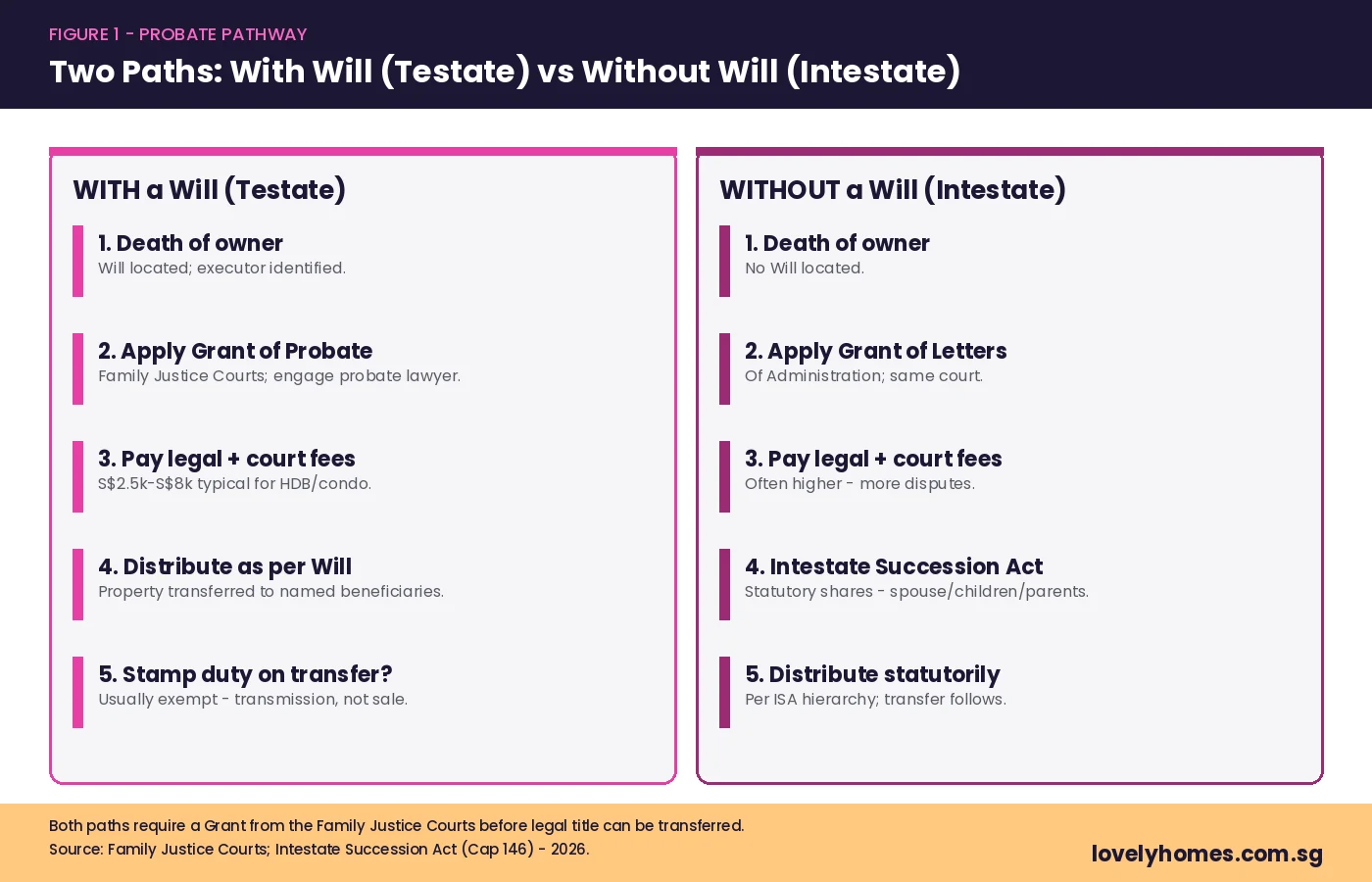
The first question after a death is the same one solicitors ask: was there a Will? The answer determines which application the executors or family must make to the Family Justice Courts, who has standing to administer the estate, and how the property is ultimately divided.

Probate pathway diagram - testate vs intestate inheritance Singapore 2026
Figure 1: The two pathways for inheriting property in Singapore. Both end with the property being transmitted into the heir’s name once the Court issues the Grant.

With a Will (Testate Succession)

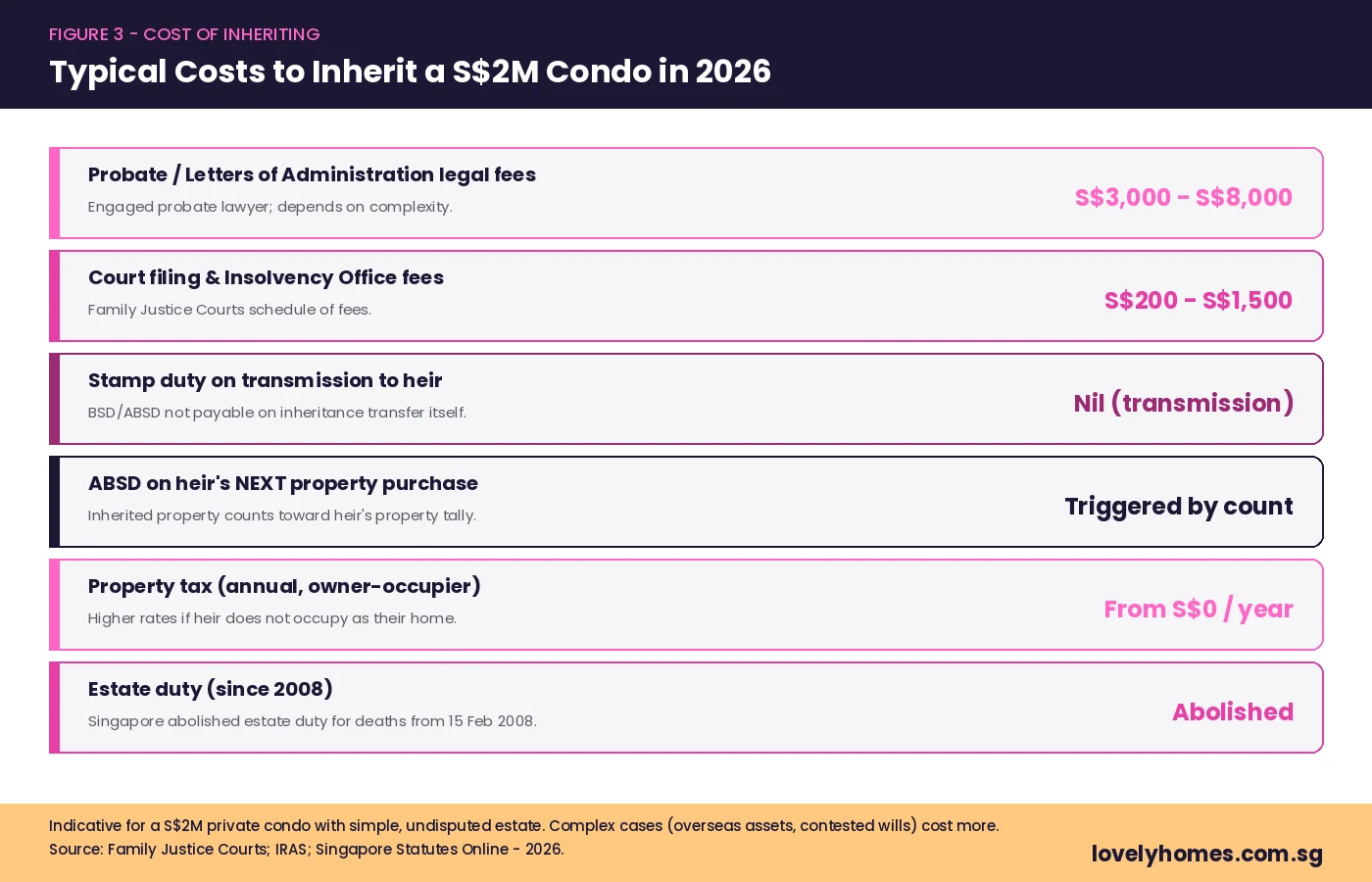
If the deceased left a valid Will, the named executor applies to the Family Justice Courts for a Grant of Probate. The Will dictates who inherits the property — the executor’s job is to carry out those instructions after settling the estate’s debts. For a clean estate (no caveats, no contests, full documentation), a Grant of Probate is typically issued within 4–8 weeks. Probate fees range roughly S$3,000 to S$8,000 in legal costs for a single residential property, plus court filing fees of a few hundred dollars.

Without a Will (Intestate Succession)

Where there is no Will, the next-of-kin applies for a Grant of Letters of Administration. The applicant administers the estate and distributes it according to the statutory shares set out in the Intestate Succession Act (ISA). Letters of Administration take longer than probate — typically 8–16 weeks — because the Court must satisfy itself who is entitled to apply, what the estate consists of, and that no contest exists. Where the estate is over S$5 million or contains foreign assets, the timeline extends materially.

Joint-Tenancy — The Quiet Third Path

For property held by spouses as joint tenants, the surviving spouse takes the deceased’s share automatically by survivorship — outside the Will, outside the ISA, and outside probate altogether. The surviving spouse simply lodges a Notice of Death with the Singapore Land Authority (SLA) along with the death certificate, and the title is updated. This is the cleanest of the three pathways. By contrast, tenancy-in-common property passes through the Will or the ISA like any other estate asset. For the difference, see our Joint Tenancy vs Tenancy in Common Singapore 2026 guide.

The Intestate Succession Act — How an Estate Without a Will Is Split

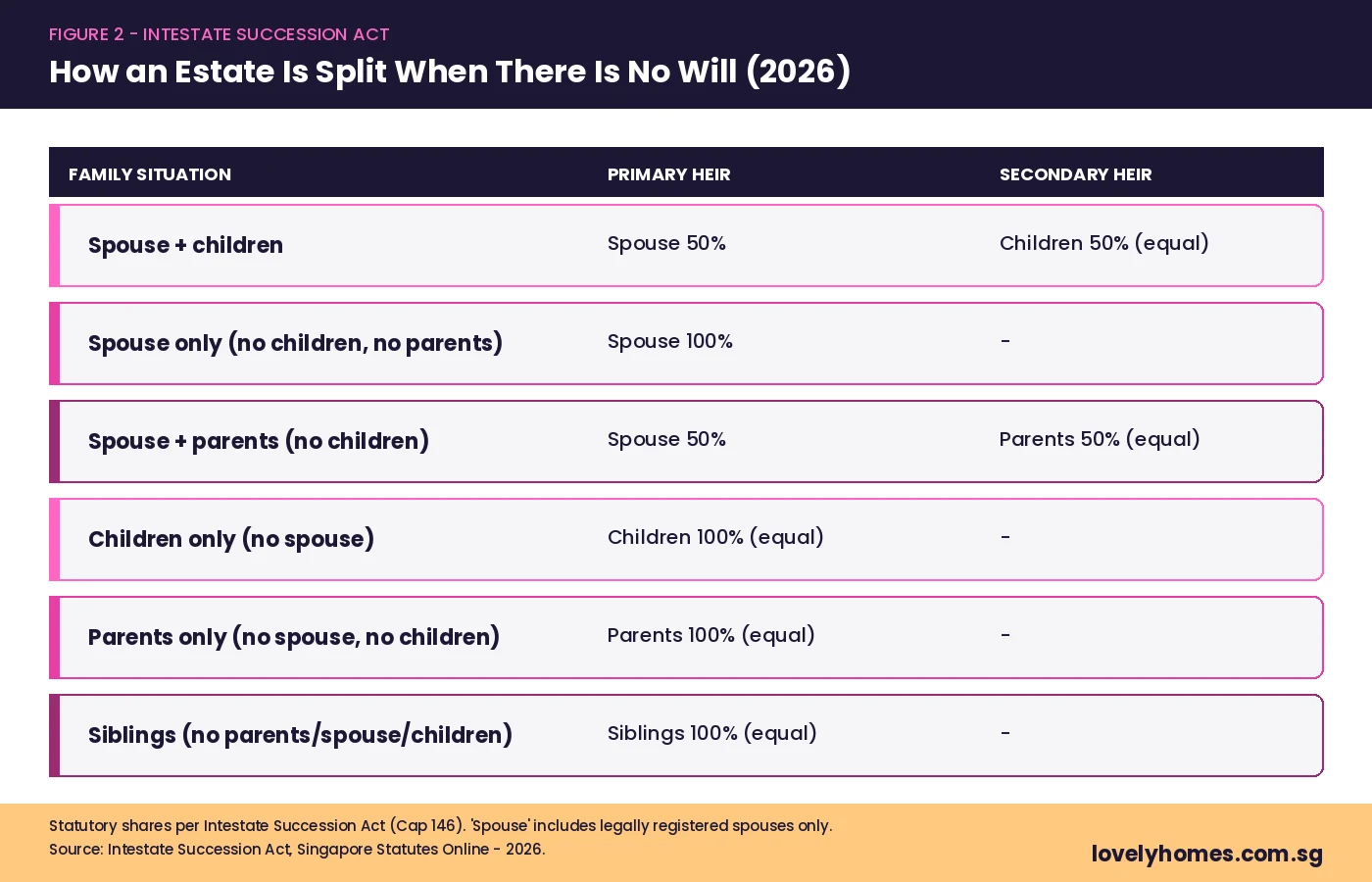
If you die intestate (without a Will) and you are domiciled in Singapore, the Intestate Succession Act (Cap 146) determines exactly who gets what. The Act is gender-neutral but assumes a fairly traditional family structure — spouse, children, parents, siblings — in that order of priority.

Intestate Succession Act statutory shares chart for 2026
Figure 2: Intestate Succession Act statutory shares, 2026. Where there is no Will, distribution follows the Act’s strict order.
Family Situation Statutory Distribution
Spouse + children Spouse 50%; children 50% (split equally between children)
Spouse only (no children, no parents) Spouse takes 100%
Spouse + parents (no children) Spouse 50%; parents 50% (equally)
Children only (no spouse) Children 100% (equal shares per stirpes)
Parents only (no spouse, no children) Parents 100% (equally)
Siblings (no parents, no spouse, no children) Siblings 100% (equally)
No surviving immediate or extended family Estate goes to the Singapore Government (bona vacantia)

Two practical points worth highlighting. First, “spouse” in the Act means a legally registered spouse only — long-term partners, fiancés, and ex-spouses are excluded, no matter how long the relationship. Second, step-children are not statutory heirs unless legally adopted. If you have a blended family, you almost certainly need a Will — the ISA will not deliver the outcome most blended families assume.

HDB Inheritance — Special Rules That Override the General Position

HDB flats are not just real estate — they are part of Singapore’s public housing system, with eligibility rules that override the general law of succession. When a HDB owner dies, the flat does not simply transfer to the heir named in the Will or the ISA share — HDB still has to approve who can inherit and remain in the flat. The rules are roughly:

  • The heir must be Singapore Citizen or PR. Foreigner heirs cannot inherit and remain on title for an HDB flat.
  • The heir must satisfy HDB’s family-nucleus or single-buyer eligibility. A 28-year-old single child cannot inherit the flat outright until age 35 under the Single Singapore Citizen Scheme — the flat is held in trust until then or sold on the open market.
  • Existing property by the heir matters. If the heir already owns a private residential property, HDB’s ownership rules require the heir to dispose of the private property within 6 months of the inheritance to retain the HDB flat, or vice versa.
  • The flat’s remaining MOP and SC quota apply. Inheritance does not reset the Minimum Occupation Period or trigger any quota issues, but the heir must continue to comply with rental, sublet, and EIP/SPR quota rules.

For a HDB-specific deep-dive, our How to Sell an HDB Flat 2026 guide covers the complications when an inherited HDB flat must be sold to fund the estate or to free the heir to remain on private property. The HDB section of the official HDB site sets out the live position.

Stamp Duty on the Inheritance — What You Actually Pay

Singapore’s tax position on inheritance is unusually generous compared with major Western jurisdictions:

Cost breakdown of inheriting a S$2 million property in Singapore 2026
Figure 3: Indicative cost of inheriting a S$2M private condo in 2026. Singapore charges no estate duty and no BSD/ABSD on the transmission itself.

1. No estate duty since 15 February 2008

Singapore abolished estate duty for deaths occurring on or after 15 February 2008. There is no “death tax”, no “inheritance tax”, and no “estate tax” on the value of the property at the date of death. This is a major reason why Singapore is favoured by family-office structures over the UK (40% inheritance tax) or the US federal estate tax.

2. No BSD or ABSD on transmission

The transfer of the property from the deceased’s estate to the heir is a transmission — not a sale — and therefore not subject to Buyer’s Stamp Duty (BSD) or Additional Buyer’s Stamp Duty (ABSD). This is consistent with IRAS’s position that ABSD only applies on a purchase. Inheriting your parent’s flat does not, in itself, trigger any stamp-duty bill.

3. BUT — ABSD count is affected for the heir’s next purchase

Here is the trap. While the inheritance itself attracts no ABSD, the inherited property counts toward the heir’s property tally for any future purchase. A Singapore Citizen who inherits their parent’s HDB flat now owns one residential property — their next purchase will be an SC-2nd at 20% ABSD, not the SC-1st at 0%.

Heirs who are mid-purchase when the inheritance arrives need to plan carefully. A common workaround is to renounce the inherited interest in favour of another beneficiary — legally permissible under the Probate & Administration Act, provided the renunciation is done before the heir takes any benefit from the property. We strongly recommend speaking to a probate lawyer before renouncing because the implications are irreversible. For broader context on ABSD, see our ABSD Singapore Complete Guide 2026.

4. Property tax continues, billed to the new owner

The annual property tax obligation passes to the heir on transmission. If the heir occupies the property as their home, owner-occupier rates (lowest band) apply. If the heir already has another home and rents the inherited property out, IRAS will apply the higher non-owner-occupier rates. See our Singapore Property Tax 2026 guide for current rates and bands.

CPF Refund — The Easily-Missed Step

If the deceased used CPF to fund the property, the principal sum used plus accrued interest must be refunded to their CPF account on transfer. The CPF refund is paid to the deceased’s estate (effectively to the named CPF nominees, if any, or otherwise distributed by the executor). This is not a tax — it is the final clearing of the deceased’s CPF position. The figure can be substantial: a 4-room HDB flat that was funded with S$200,000 of CPF in 2000 might owe over S$400,000 of principal-plus-accrued-interest in 2026.

Heirs sometimes mistake this CPF refund for a charge that they have to pay personally. They do not — the refund comes out of the estate’s share of any sale proceeds, or, if the property is being retained, the estate must arrange for the refund from cash assets. The refund is a precondition for clear title and cannot be deferred.

How Long Does the Whole Process Take?

For a simple estate — one residential property, undisputed Will or clean intestacy, one or two heirs, no overseas assets — the typical journey looks like this:

Stage Typical Timeline Who Drives It
Locate Will & gather documents 1–2 weeks Family
Engage probate lawyer 1 week Family
File Grant application (probate or LA) 2–4 weeks Lawyer
Court issues Grant 2–6 weeks for probate; 8–16 for LA Court
Lodge Grant + Notice of Death with SLA 1–2 weeks Lawyer
CPF refund & outstanding loan settlement 2–4 weeks Lawyer / family
Title transmitted to heir 2–3 weeks after CPF/loan clearance SLA
Total simple estate ~3–4 months testate; ~5–7 months intestate

Contested estates, estates over S$5 million, estates with overseas immovable property, or estates where the deceased’s domicile is uncertain all add months to the timeline. Engaging an experienced probate solicitor early is the single most important action a family can take to keep the timeline on track.

A Worked Example — What Mr Tan’s Family Actually Pays

Mr Tan, a Singapore Citizen aged 78, dies in March 2026. He leaves behind:

  • A 4-room HDB flat in Bedok (held in his sole name), valued at S$650,000.
  • A S$2 million private condominium in District 15 (held jointly with his wife as joint tenants).
  • A simple Will leaving the HDB flat equally to his two adult children, both Singapore Citizens.

The flow:

  1. Condo — immediate transfer. The District 15 condominium passes automatically to Mrs Tan by survivorship. No probate, no Will, no ISA. Mrs Tan lodges the death certificate with SLA. Cost: roughly S$300 in lodgement fees.
  2. HDB flat — through probate. The executor (eldest son) applies for a Grant of Probate. Court issues the Grant in five weeks. Probate legal fees: ~S$4,500. The HDB flat is then transmitted equally to the two children. Both children are Singapore Citizens, but each already owns a private condo — under HDB rules, they cannot retain the inherited HDB flat and must dispose of either the HDB or the private property within six months. Family decides to sell the flat on the open market.
  3. CPF refund. Mr Tan had used S$280,000 of CPF (principal + accrued interest) on the HDB flat. The refund flows from sale proceeds to his CPF account, then to nominees.
  4. Sale proceeds distributed. Net of the CPF refund and S$8,000 selling costs, the remaining S$362,000 is divided equally between the two children (S$181,000 each).
  5. ABSD impact for the children. Because each child took beneficial ownership of the HDB flat before selling it, each had two residential properties on title for that brief window. Their next condo purchase will be an SC-3rd-property at 30% ABSD — not 0%. The family should have spoken to a probate lawyer about renouncing in favour of the surviving spouse, or selling the flat directly out of the estate without taking transmission.

This is the textbook example of why estate planning matters. With one Will revision — leaving the HDB flat to Mrs Tan instead — the entire ABSD complication for the children would have been avoided.

How Estate Planning Works in Singapore (Briefly)

Three estate-planning instruments do most of the heavy lifting:

  1. A valid Will. Drafted, signed, and witnessed per the Wills Act. Costs from S$300 (simple Will at a high-street firm) up to several thousand for a complex estate. The single highest-leverage action any property-owning Singaporean can take.
  2. CPF nominations. CPF moneys do not pass through the Will or the ISA — they go to nominees. Without a CPF nomination, balances go to the Public Trustee for distribution per ISA. Update CPF nominations whenever there is a major life event.
  3. Manner of co-ownership. Married couples buying property together should consciously choose between joint tenancy (survivorship transfers automatically) and tenancy in common (each owner’s share passes through their estate). The choice has profound implications for inheritance, divorce, and ABSD planning.

For an even more direct approach, large families with significant property holdings sometimes use private trusts — though Singapore’s ABSD-on-trustees position (65% on the trustee’s entity rate) means trust structures need careful structuring to avoid triggering punitive ABSD. This is well outside the scope of a general guide and demands specialist trust counsel.

What Might Come Next

Two areas to watch. First, Singapore’s policy stance on intergenerational transfer is generally favourable, but the ABSD position on inherited property has been quietly tightening since 2018. Expect IRAS to continue scrutinising arrangements where inheritance is structured to avoid ABSD — in particular “in-life gifts” and trust structures that benefit a Singapore property owner’s children. Second, the Family Justice Courts have signalled that they may digitise more of the probate process by 2027, which should compress the testate timeline below 4 weeks for simple estates. None of this is policy yet, and these paragraphs are editorial speculation only.

Frequently Asked Questions

Do I have to pay any tax when I inherit property in Singapore?

No tax is payable on the transmission itself — Singapore abolished estate duty for deaths from 15 February 2008, and no BSD or ABSD applies on a transfer that is not a sale. You will, however, pick up the annual property-tax obligation from the date of transmission, and any future purchase you make will count the inherited property toward your ABSD tally.

My parent died without a Will. Can I just sign over my share to my sibling?

Yes — this is called a Deed of Family Arrangement, signed after the Grant of Letters of Administration is issued. All ISA-statutory heirs must agree, and the deed is filed with the Court. It allows the family to redirect the estate without having to go to a full reapplication. Engage a probate solicitor to draft the deed and ensure stamp duty implications are covered.

Can I refuse the inheritance?

Yes. A beneficiary can renounce their interest under the Probate & Administration Act before taking any benefit from the property. The renunciation must be in writing and is irrevocable. Heirs sometimes do this to avoid the ABSD-count consequence of inheriting, channelling the property to a sibling who would not be affected.

What happens to the deceased’s outstanding mortgage on the property?

Most Singaporean homeowners carry Mortgage Reducing Term Assurance (MRTA) or the Home Protection Scheme (HPS) for HDB. Either policy pays off the outstanding loan on death — the heir takes the property unencumbered. If no MRTA/HPS exists, the mortgage continues and the heir must either continue servicing it (if eligible to take over the loan) or sell the property to discharge it.

If I am a Singapore Citizen and inherit a Malaysian property, do I need to declare it in Singapore?

Yes. Even though no Singapore tax is due on the inheritance itself, you must declare any overseas residential property you own when applying for ABSD remission, HDB schemes, or LBS — the Singapore Government counts overseas residential property toward eligibility tests. You will also have Malaysian filing obligations, including the Real Property Gains Tax position on any future disposal.

Can a foreigner inherit a Singapore property?

Yes for private property — foreigners can inherit and own non-restricted private residential property in Singapore, subject to the Residential Property Act for landed homes. For HDB flats, foreigners cannot inherit the flat directly — the HDB flat must be sold and the proceeds distributed instead. Engage a Singapore lawyer who deals with cross-border probate.

How much do probate lawyers cost in 2026?

For a simple estate with one residential property and no contests, expect around S$3,000–S$8,000 in legal fees (with a Will) or S$4,000–S$10,000 (without a Will, since Letters of Administration take longer and require a personal-representative bond). Court filing fees are typically a few hundred dollars more.

Related Articles

Disclaimer: This guide is for general information only and does not constitute legal, tax, or financial advice. Probate, succession, stamp duty, and HDB inheritance rules change over time and depend on individual circumstances. Always verify the live position with the Family Justice Courts, the Intestate Succession Act, the HDB website, and IRAS, and consult a Singapore-qualified probate solicitor before acting on any estate matter.

Translate »