Tenant Rights & Landlord Obligations Singapore 2026: Complete Guide
Quick Answer: Tenant Rights Key Facts
- Singapore’s Residential Tenancies Act 2023 (RTA) — in force from 1 July 2023 — provides statutory rights for tenants of private residential properties for the first time.
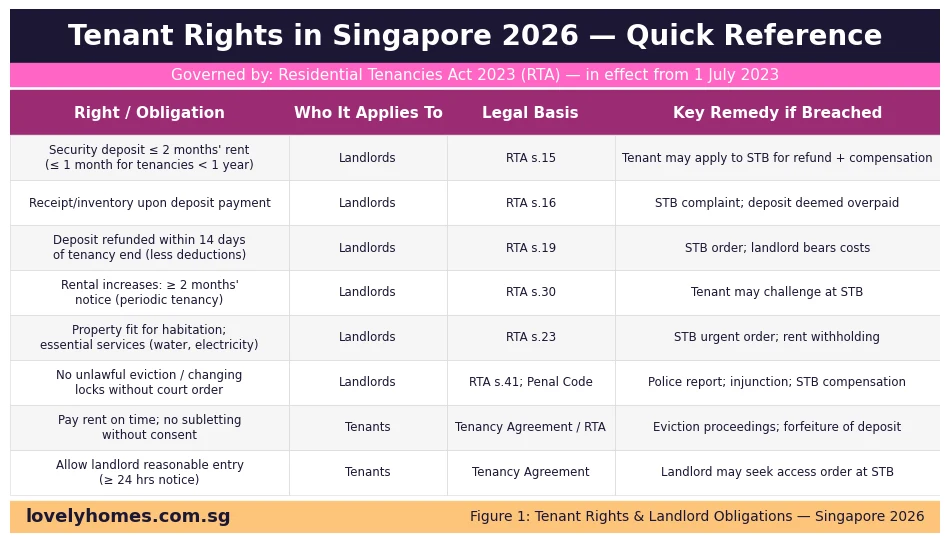
- Security deposits are capped at 2 months’ rent for tenancies of 1 year or more; 1 month for shorter tenancies.
- Landlords must refund the deposit (less valid deductions) within 14 days of the tenancy ending.
- Unlawful eviction — including changing locks or cutting utilities — is a criminal offence under both the RTA and the Penal Code.
- Disputes go to the Small Claims Tribunals (STB), which now have expanded jurisdiction to hear residential tenancy disputes up to $20,000 (or $30,000 by consent).
- HDB flats let on the open market are subject to HDB subletting rules (minimum 6-month tenancy; HDB approval required; income / nationality restrictions on tenants).
- Landlords must provide properties that are fit for habitation and maintain essential services (water, electricity, structural integrity).
Introduction: A New Era for Singapore Renters
For most of Singapore’s modern property history, private residential tenants had no statutory framework protecting their rights. Disputes were settled through the courts under general contract law — expensive, slow, and inaccessible for most tenants. The Residential Tenancies Act 2023 (RTA), passed by Parliament and gazetted in July 2023, changed this fundamentally. For the first time, Singapore tenants of private residential property have an accessible, low-cost tribunal — the Small Claims Tribunals — and a statutory baseline of rights that no tenancy agreement can contract out of.
This guide explains what those rights are, what landlords are legally obliged to do (and not do), how HDB subletting rules layer on top of the RTA, and what to do if things go wrong. Whether you are a tenant in a $3,000-a-month condominium in Orchard or a landlord renting out your second property in Jurong, understanding the RTA framework is essential reading in 2026.
What Does the RTA Cover?
The RTA applies to tenancy agreements for private residential properties in Singapore — condominiums, apartments, terrace houses, semi-detached and detached private homes, and private strata units let to individuals. It does not apply to:
- HDB flats (which remain under the Housing and Development Act and HDB’s own subletting rules).
- Commercial or industrial properties.
- Residential premises let for fewer than 3 months (short-term accommodation; separate rules apply under the Planning Act).
- Properties where the landlord and tenant share living space (i.e., the landlord lives in the property too).
This last exclusion is significant — the sizeable market of landlords who let out individual rooms whilst living in the same unit falls outside the RTA. The Consumers Association of Singapore (CASE) and housing advocates have called for this gap to be addressed in future legislative amendments.
Security Deposit Rules Under the RTA
One of the most practically important provisions in the RTA concerns the security deposit — the sum (usually equivalent to 1–2 months’ rent) that tenants pay upfront as protection for landlords against damage or unpaid rent.
Deposit Cap
Under the RTA, landlords may not require a security deposit exceeding:
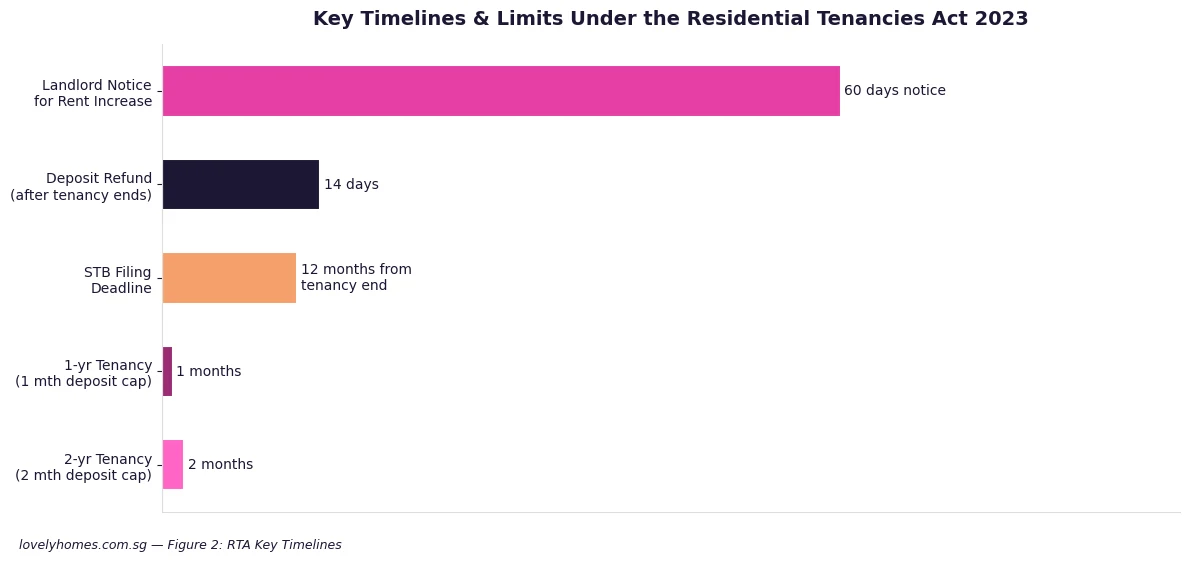
- 2 months’ rent for tenancies of 1 year or more.
- 1 month’s rent for tenancies lasting less than 1 year.
Prior to the RTA, there was no statutory cap, and some landlords — particularly in the high-demand rental market of 2022–2023 — were demanding 3-month deposits for 2-year leases. The cap addresses this.
Deposit Receipt and Inventory
On receiving the deposit, the landlord must issue a written receipt and, if an inventory of the property’s contents is taken, a copy of that inventory. This is the baseline against which deductions will be assessed at the end of the tenancy.
Deposit Refund Timeline
The deposit (less any valid deductions for damage beyond fair wear and tear, or unpaid rent) must be refunded within 14 days of the tenancy ending. If the landlord makes deductions, they must provide a written itemised statement of deductions with supporting documentation (e.g., contractor quotes or invoices). Failing to refund within 14 days is a breach of the RTA and grounds for an STB application.
Security Deposit at a Glance
| Feature | Rule | Source |
|---|---|---|
| Cap (tenancy ≥ 1 yr) | Maximum 2 months’ rent | RTA s.15 |
| Cap (tenancy < 1 yr) | Maximum 1 month’s rent | RTA s.15 |
| Receipt requirement | Written receipt must be issued on payment | RTA s.16 |
| Inventory | Inventory copy must be provided if one is taken | RTA s.16 |
| Refund timeline | Within 14 days of tenancy end | RTA s.19 |
| Deductions | Permitted for damage beyond fair wear and tear; unpaid rent | RTA s.18 |
| Deduction statement | Written itemised statement with supporting evidence required | RTA s.18 |
| Dispute forum | STB (claims up to $20,000; $30,000 by consent) | Small Claims Tribunals Act |
Landlord Obligations: What the RTA Requires
Fitness for Habitation
Landlords must ensure the property is fit for habitation at the start of the tenancy and throughout its duration. This includes maintaining structural integrity, ensuring water and electricity supply, and keeping common fixtures (plumbing, electrical installations) in working order. If a landlord fails to carry out repairs that affect habitability — for example, a persistent roof leak or a non-functional water heater — the tenant may apply to the STB for a repair order or a reduction in rent.
Prohibition on Unlawful Eviction
Perhaps the most consequential provision in the RTA is the prohibition on unlawful eviction. A landlord may not:
- Change the locks or remove the tenant’s belongings without a court order.
- Cut off utilities (water, electricity, gas) to force a tenant out.
- Harass, threaten or intimidate the tenant in connection with occupancy.
Breach of these provisions is a criminal offence under the RTA, with penalties of up to $5,000 for a first offence. Before the RTA, landlords in rent disputes sometimes resorted to these measures — the legislation now makes them clearly illegal, and tenants can call the police and file an STB application simultaneously.
Rent Increase Notice
For periodic tenancies (month-to-month tenancies with no fixed end date), landlords must give at least 2 months’ written notice before increasing the rent. This provision prevents sudden rent hikes that leave tenants unable to plan their finances or find alternative accommodation.
Tenant Obligations: What You Are Required to Do
Rights come with responsibilities. Under the RTA and standard tenancy agreement terms, tenants in Singapore are obliged to:
Pay Rent Punctually
Rent is due on the date specified in the agreement. Most agreements allow a 7-day grace period, but this is a matter of contract, not statute. Persistent late payment is grounds for landlord termination of the tenancy — and, in Singapore, the courts have historically upheld landlord rights to forfeit a lease on persistent non-payment even when the total arrears are modest.
No Subletting Without Consent
Subletting the whole or any part of the property without the landlord’s written consent is a breach of most tenancy agreements. For HDB flat tenants, subletting carries additional regulatory consequences — HDB’s approval is required, and the flat owner (the HDB landlord) must comply with HDB’s rules on permissible tenants, minimum tenancy periods (6 months) and total occupancy caps.
Allow Landlord Entry on Reasonable Notice
Tenants must permit the landlord (or their authorised agents) to enter the property for inspection, repair or valuation purposes — but only on reasonable notice. Most agreements specify 24–48 hours’ written notice. Entering without notice (except in genuine emergencies) is a breach of the tenancy agreement and potentially of the tenant’s right to quiet enjoyment.
HDB Subletting Rules: A Separate Framework
For HDB flat owners who sublet their flat to tenants, the RTA does not apply. Instead, HDB’s subletting framework — administered under the Housing and Development Act — governs the landlord-tenant relationship. The key rules as of June 2026:
| HDB Subletting Rule | Detail |
|---|---|
| Approval required | HDB approval must be obtained before subletting; application via MyHDBPage |
| Minimum tenancy period | 6 months per rental |
| Maximum occupancy | 6 persons for 4-room flat and larger; 4 persons for 3-room and smaller |
| Non-citizen occupancy | Foreigners from Malaysia, PRs and citizens of designated countries only; Malaysian non-PR nationals may rent only selected flat types |
| MOP compliance | HDB flat must have fulfilled its Minimum Occupation Period (5 years) before subletting the entire flat |
| Rent registration | Landlord must register the tenancy with HDB via MyHDBPage within 7 days of commencement |
| Subletting period cap | Maximum 3-year approval; renewable. Total subletting period capped at 20 years for non-elderly owners; no cap for elderly-priority flat owners in some schemes |
Non-compliance with HDB subletting rules — for example, subletting before the MOP or to ineligible tenants — can result in HDB compelling the flat owner to sell the flat within 6 months and retain the sale proceeds. These are serious consequences; both landlords and tenants should verify HDB approval status before executing any HDB flat tenancy agreement.
Worked Example: Deposit Dispute in a $4,200/month Condominium
Priya rents a 2-bedroom condominium unit in Toa Payoh for $4,200/month on a 2-year lease starting 1 July 2024. She pays a 2-month security deposit of $8,400 and signs an inventory list at the start.
At the end of the tenancy on 30 June 2026, the landlord claims $2,800 in deductions: $1,200 for repainting a bedroom wall, $800 for replacing a cracked bathroom tile, and $800 for general cleaning. Priya disputes the cleaning charge (the unit was professionally cleaned) and the repainting (she says the paint peeling was pre-existing — not in the inventory). The landlord does not refund the deposit by 14 July 2026.
| Item | Landlord Claim | Priya’s Position | Likely STB Outcome |
|---|---|---|---|
| Bedroom repainting ($1,200) | Damage by tenant | Pre-existing; not in inventory | Likely disallowed — inventory gap favours tenant |
| Bathroom tile ($800) | Cracked by tenant | Disputed; no proof of cause | May be split; depends on evidence |
| Cleaning ($800) | Unit dirty at handover | Professional cleaning done; receipt provided | Likely disallowed if receipt produced |
| Late refund (breach) | — | Deposit not refunded by Day 14 | STB may award compensation in addition to refund |
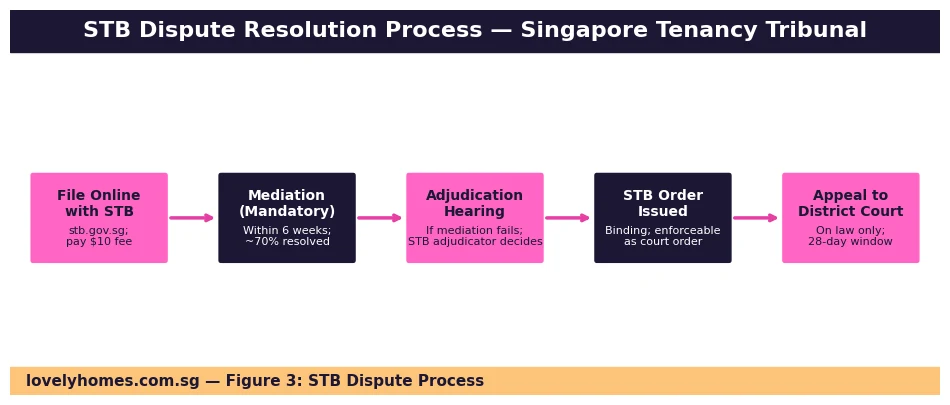
Priya files at the STB online (filing fee: $10). Mediation is scheduled within 3 weeks. The mediator helps both parties reach a settlement: landlord refunds $7,600 (retaining only the tile repair cost of $800) within 7 days. Total time from filing to settlement: 4 weeks.
Why This Matters: Singapore’s Rental Market in 2026
Singapore’s private rental market peaked in late 2022–early 2023 with median rents for non-landed properties hitting record highs. Although rental growth has moderated through 2024–2025 as additional housing supply came on stream — notably from the wave of new private completions — the market remains tight in central and near-city districts. With over 80,000 private residential units under long-term leases as of Q1 2026 (URA data), the RTA’s tenant protection framework is more relevant than ever.
The RTA has had a measurable impact on STB filings. The tribunal reported a significant increase in tenancy-related cases in its first year of operating under the expanded framework — consistent with tenants being newly empowered to assert rights they previously could not cost-effectively enforce. Industry figures suggest that deposit-related disputes account for the majority of STB residential tenancy filings.
What Might Change
The Ministry of Law has signalled that it will review the RTA’s coverage and effectiveness after its first full operating cycle. Areas flagged for possible amendment include extending the Act to cover room-only tenancies (where landlord and tenant share the property), clarifying the “fit for habitation” standard with more prescriptive criteria, and potentially increasing the STB’s monetary jurisdiction beyond $20,000 to reflect Singapore’s elevated rental levels. These remain proposals as of June 2026 and are not yet law.
Separately, the Urban Redevelopment Authority’s (URA) review of short-term rental regulations — covering platforms such as Airbnb — continues. Properties let for fewer than 3 months currently require URA approval; the regulatory framework is expected to be clarified before the end of 2026, with implications for both landlords considering short-stay models and tenants who may be displaced by landlords switching from long-term to short-term rental models.
Frequently Asked Questions
Can my landlord deduct the cost of repainting from my deposit?
It depends on the condition of the walls. Landlords may deduct for damage beyond normal fair wear and tear — for example, large holes in walls, graffiti, or staining that requires specialist treatment. They may not deduct for normal repainting required after a long tenancy, as gradual paint deterioration is considered fair wear and tear. If the property had freshly painted walls at the start (documented in the inventory) and the walls are now visibly damaged (beyond normal fading), a deduction may be justified. The STB applies an objective standard: what would a reasonable person consider normal wear given the length and nature of the tenancy?
My landlord changed the locks while I was away. What should I do?
This is unlawful eviction under the RTA (s.41). Call the police immediately — the landlord’s conduct is a criminal offence. Simultaneously, file an urgent application at the STB or seek an injunction at the Magistrates’ Court to compel the landlord to restore access. Document everything: photograph the changed locks, keep copies of your tenancy agreement and rent payment records, and note the date and time. An unlawfully evicted tenant may also be entitled to damages from the STB for loss of use of the property and reasonable moving costs.
Can a landlord increase rent in the middle of a fixed-term tenancy?
No. During a fixed-term tenancy (for example, a 12-month or 24-month lease at a fixed rent), the landlord cannot unilaterally increase the rent — the agreed rent is contractually binding for the entire fixed term. For periodic (month-to-month) tenancies, the RTA requires at least 2 months’ written notice before a rent increase takes effect. Any attempt to increase rent without proper notice during a periodic tenancy is a breach of the RTA and may be challenged at the STB.
How do I file a complaint at the STB?
You file online through the Community Justice and Tribunals System (CJTS) at statecourts.gov.sg. The filing fee is $10 for claims up to $10,000 and $20 for claims up to $20,000. You will need to submit your tenancy agreement, deposit payment receipt, inventory (if any), correspondence with the landlord, and any evidence supporting your claim. The STB will schedule a mandatory mediation session; if mediation fails, the matter proceeds to adjudication. The entire process typically concludes within 6–10 weeks.
Does the RTA apply to HDB flat rentals?
No. HDB flat rentals remain governed by the Housing and Development Act and HDB’s administrative rules, not the RTA. However, certain general principles of contract law still apply — for example, a tenant of an HDB flat may sue the landlord in court for breach of contract if the landlord wrongfully retains a deposit. HDB tenants who face deposit disputes may also approach HDB’s officer resolution services or seek help from CASE. The Ministry of Law has acknowledged the coverage gap and may extend RTA-style protections to HDB flat tenancies in a future legislative update.
What notice period must a landlord give to end a tenancy?
For fixed-term tenancies, neither party can terminate early without the other’s consent (unless specific break clauses have been included). At the end of the fixed term, the tenancy ends automatically unless renewed. For periodic tenancies, the RTA and industry practice require a minimum of 1 month’s written notice (from either party) to end a month-to-month tenancy. Many tenancy agreements specify 2 months’ notice — this is enforceable as a contractual term even if it exceeds the statutory minimum. Always check your specific tenancy agreement for the notice clause.
Can a tenant sublet a room to a friend or family member?
Only with the landlord’s written consent. Most Singapore tenancy agreements prohibit subletting (of the whole unit or any part of it) without prior written landlord approval. Subletting without consent is a breach of the agreement and may entitle the landlord to terminate the tenancy. For HDB flat tenancies, the occupant rules are even stricter — HDB prescribes who may occupy the flat, and the total occupant count is capped at 6 for larger flats. Tenants must comply with both their tenancy agreement and any applicable HDB rules.
Related Articles
- Renting a Condo in Singapore 2026: Complete Guide
- Renting an HDB Flat Singapore 2026: What Landlords and Tenants Must Know
- Singapore Rental Market Guide 2026
- Singapore Property Rental Guide 2026
- HDB Minimum Occupation Period (MOP) Singapore 2026
- ABSD Singapore 2026: Complete Guide to Additional Buyer’s Stamp Duty
- Singapore Home Loan Complete Guide 2026
Disclaimer: This article is for general information only and does not constitute legal advice. The Residential Tenancies Act 2023 is a relatively new statute and its application continues to be clarified through STB adjudication decisions. Landlords and tenants should seek independent legal advice for specific disputes or tenancy arrangements. Official resources: Ministry of Law, State Courts / STB, HDB (for HDB flat subletting rules). Information is accurate as of 10 June 2026.
Click anywhere to close | lovelyhomes.com.sg