The typical private property selling process takes 12–16 weeks from listing to completion. For HDB flats, the HDB-managed resale process adds administrative steps and typically takes 16–24 weeks from Option to Purchase to key handover.
Seller’s Stamp Duty (SSD) applies to private residential properties sold within four years of purchase (for properties bought on or after 4 July 2025): 16% in Year 1, 12% in Year 2, 8% in Year 3 and 4% in Year 4. HDB flats are not subject to SSD but must satisfy the Minimum Occupation Period (MOP) before resale.
Agent commission for sellers is typically 1% to 2% of the sale price, negotiable. It is not fixed by law but is governed by the Council for Estate Agencies (CEA) Code of Ethics. No commission is payable until a valid transaction is completed.
When you sell a property in which CPF Ordinary Account funds were used for the purchase, you must refund the CPF principal used plus accrued interest (at 2.5% p.a. compounded) before any cash proceeds are available to you.
Legal fees for a private property sale are typically S$2,500–S$5,000; for HDB resale, S$1,500–S$2,800. Conveyancing lawyers handle the title transfer, mortgage discharge and CPF charge release.
There is no capital gains tax in Singapore on property disposals. However, if IRAS determines that a seller is a property trader (buying and selling frequently for profit), gains may be assessed as income and taxed at the applicable income tax rate.
Upon completion, your proceeds flow in this order: mortgage redemption → CPF refund with accrued interest → agent commission → legal fees → net cash to seller.
Should You Sell? The Pre-Sale Decision
Deciding to sell a Singapore property involves more than agreeing on an asking price. Before you appoint an agent or list a property, three questions must be answered: Have you satisfied the applicable holding-period rules? What will the net proceeds look like after repaying CPF, the mortgage and transaction costs? And — if you own an HDB flat and plan to purchase a private property after selling — what are the ABSD implications of your next move?
For HDB flat owners, the key holding-period rule is the Minimum Occupation Period (MOP): five years for Standard flats, ten years for Plus and Prime flats introduced under the 2024 classification. You may not list your HDB flat for resale until the MOP is satisfied. Violating the MOP by selling prematurely (including sub-letting the entire flat during the MOP without HDB approval) can result in compulsory acquisition of the flat at the purchase price — a severe financial penalty.
For private residential property owners, the governing holding-period rule is the Seller’s Stamp Duty (SSD). Selling within the prescribed period triggers an SSD bill payable by the seller within 14 days of the disposal. For properties bought before 4 July 2025, the SSD holding period is three years; for those bought on or after 4 July 2025, it is four years. At SSD rates of up to 16%, selling too early can eliminate any capital gain and more.
Figure 1: Indicative selling costs by property type — excluding SSD and CPF refund. Source: LovelyHomes estimates based on CEA standard commissions and typical legal fees (2026).
Stage 1: Pre-Sale Preparation
Before listing, you should complete four tasks. First, confirm your MOP or SSD position. For HDB sellers, log in to the HDB Flat Portal to verify the exact MOP end date. For private property owners, calculate the four-year SSD holding period from the date of the Option to Purchase or Sale and Purchase Agreement — not the date of legal completion.
Second, obtain a formal valuation. HDB sellers must submit a Request for Value through the HDB portal — this valuation determines the benchmark for Cash Over Valuation (COV) discussions. Private property sellers typically rely on comparative market analyses from agents and, for bank refinancing purposes, formal valuations commissioned by lenders.
Third, appoint a CEA-registered agent. The Council for Estate Agencies (CEA) maintains the Public Register of property agents (cea.gov.sg/public-register). You should verify your agent’s registration before signing an Exclusive Listing Agreement. The agreement specifies commission rate, exclusivity period, and the agent’s obligations — read it carefully before signing.
Fourth, consider decluttering, repainting and minor repairs. Data from industry surveys consistently shows that well-presented properties sell 10–15% faster and closer to the asking price than properties in poor condition. For HDB flats especially, fresh paint and clean common areas make a material difference in a competitive resale market.
Stage 2: Listing, Marketing and Negotiation
Once listed, your agent will market the property on portals (PropertyGuru, 99.co, SRX) and conduct viewings. A professionally photographed listing — including a virtual tour for private properties — is no longer optional in the current market; buyers routinely shortlist on the basis of photographs before agreeing to a physical viewing.
Negotiations typically proceed through the agent. Buyers will make verbal offers, and you may counter. Key negotiation levers include the asking price, the option fee quantum (typically 1% for private, S$1–S$10,000 for HDB), the option exercise period, the completion timeline, and what fixtures and fittings are included. For private property, it is common for sellers to grant a 14-day Option to Purchase after agreeing on the price and basic terms.
An important discipline: do not accept more than one option fee from different buyers for the same property at the same time. Granting multiple options simultaneously is unlawful. Once you accept an option fee and issue an Option to Purchase, the buyer has the exclusive right to exercise it within the validity period.
Figure 2: The Singapore property selling process — five stages from pre-sale preparation to key handover. Source: LovelyHomes, based on CEA procedures and HDB/URA guidelines (2026).
Stage 3: Granting the Option to Purchase (OTP)
For private property, the Option to Purchase is a bilateral agreement that grants the buyer an exclusive right to purchase at the agreed price within a specified period (typically 14 days). Upon receiving the option fee (usually 1% of the purchase price), you sign and date the OTP. You cannot sell the property to anyone else during the option period. If the buyer does not exercise the option by the deadline, the option lapses and you retain the option fee as compensation.
For HDB resale flats, HDB prescribes a standard OTP format. The seller grants the option after the HDB Flat Eligibility (HFE) letter has been issued to the buyer and the Request for Value submitted. The option fee for HDB is between S$1 and S$1,000 (negotiable), and the option exercise fee is between S$1 and S$5,000 (for 4-room and smaller) or S$1 and S$10,000 (for 5-room and larger). The total of option fee plus exercise fee must not exceed S$5,000 or S$10,000 respectively. The HDB OTP has a 21-day validity: the buyer has 14 days to decide and 7 days after exercise to register the resale application with HDB.
Stage 4: Exercise, S&P Agreement and BSD/ABSD
When the buyer exercises the Option to Purchase, they pay the balance of the agreed deposit (typically 4–9% for private property; the exercise fee for HDB). For private property, the parties then execute a formal Sale and Purchase (S&P) Agreement drafted by the buyer’s conveyancing lawyers. The seller’s lawyers review and negotiate the S&P terms.
The buyer must pay Buyer’s Stamp Duty (BSD) and Additional Buyer’s Stamp Duty (ABSD, if applicable) within 14 days of exercising the Option. This is the buyer’s obligation, not the seller’s — but understanding it matters to sellers because it can affect how quickly a buyer is willing or able to complete the transaction.
For HDB resale, after the buyer exercises the option, both parties submit the resale application through the HDB Resale Portal. HDB verifies eligibility, processes the CPF withdrawals and housing grant (if any), and sets the completion date — typically 8–10 weeks after the resale application is accepted.
Stage 5: Completion and Net Proceeds
Completion day (or key collection day for HDB) is when legal ownership transfers. On completion, the proceeds flow in a prescribed order:
Mortgage redemption — the outstanding loan balance is repaid to the bank (or HDB). The bank simultaneously releases the mortgage charge on the title.
CPF refund — the CPF Board is repaid the principal withdrawn for the property plus accrued interest at 2.5% per annum (compounded annually). This refund goes back into your CPF Ordinary Account, not to you in cash.
Legal fees and disbursements — conveyancing and title search fees paid to your solicitors.
Agent commission — typically deducted from proceeds or paid on completion date.
Net cash to seller — the residual after all the above deductions.
Sellers are sometimes surprised to discover that their CPF refund obligation (including decades of compounded accrued interest) absorbs a substantial portion of the sale proceeds. For a property held for 15 years with CPF heavily used, the CPF refund may exceed the original CPF principal withdrawn by 30–40%.
Figure 3: Net proceeds waterfall — selling a S$1.8M private condominium with no SSD and a S$600,000 outstanding loan. Source: LovelyHomes worked example (2026).
Selling Costs at a Glance
Cost Item
HDB Resale
Private Condo
Landed Property
Payable By
Agent Commission
~1% (negotiable)
~1–2% (negotiable)
~1–2% (negotiable)
Seller
Legal / Conveyancing
S$1,500–S$2,800
S$2,500–S$4,500
S$3,500–S$6,000
Seller
HDB Admin Fee
S$40 (resale levy admin)
—
—
Seller
SSD (if within hold period)
Nil (HDB exempt)
Up to 16%
Up to 16%
Seller
CPF Refund (principal + interest)
Yes — full refund required
Yes — full refund required
Yes — full refund required
Seller (to CPF Board)
Mortgage Early Redemption
Nil (no prepayment penalty on HDB loans)
Check loan documents; typically nil after lock-in period
Check loan documents
Seller
Property Agent Registration
Both agent and seller must use CEA-registered agents
—
—
—
Worked Example: Selling a Bishan 5-Room HDB Flat
Scenario: Mr and Mrs Lim, both Singapore Citizens, purchased their 5-room HDB flat in Bishan in June 2019 for S$450,000 using an HDB concessionary loan of S$360,000 (fully repaid by 2026) and CPF Ordinary Account withdrawals totalling S$200,000 over the seven-year holding period. In August 2026, they receive an offer of S$780,000. Their MOP was satisfied in June 2024.
CPF refund obligation: CPF principal used = S$200,000. Accrued CPF interest at 2.5% p.a. compounded over 7 years = approximately S$37,500. Total CPF refund to CPF Board: S$237,500. This amount re-enters their CPF Ordinary Account — it is not lost, but it is not available as liquid cash.
Agent commission (1%): 1% × S$780,000 = S$7,800.
Legal fees: approximately S$2,500.
HDB admin fee: S$40.
SSD: Nil — HDB flats are not subject to SSD.
Mortgage outstanding: Nil — fully repaid.
Net cash proceeds calculation:
Item
Amount
Sale Price
+S$780,000
CPF Refund (principal + interest)
−S$237,500
Agent Commission (1%)
−S$7,800
Legal Fees
−S$2,500
HDB Admin Fee
−S$40
Net Cash Proceeds
S$532,160
The Lims walk away with S$532,160 in cash, plus S$237,500 back in their CPF OA. Their next move determines ABSD exposure: if they buy a private condo as their sole property (having sold the HDB), they pay 0% ABSD as SC buying a first residential property. If they retain the HDB and buy a private condo as a second property, they pay 20% ABSD — approximately S$300,000 on a S$1.5M condo. Selling first and buying second, with the 6-month overlap remission if needed, is therefore the financially dominant sequence for most upgraders.
Why This Matters: The Upgrade vs. Retain Calculation
The ABSD framework has fundamentally altered the upgrade decision for HDB owners. Before April 2023, a Singapore Citizen buying a second property paid 12% ABSD. At S$1.5 million, that was S$180,000 — significant but potentially manageable for a dual-income household with substantial HDB equity. After April 2023, the same transaction costs S$300,000 in ABSD — roughly equivalent to two years of median household income.
This has driven a structural shift in upgrader behaviour. Increasingly, HDB sellers opt to complete their HDB sale before purchasing their next home, accepting a period of rental tenancy (or temporary stay with family) to avoid the ABSD surcharge. This “sell first, buy later” approach has the incidental effect of increasing HDB resale supply and, by removing one source of demand from the private market, moderating private property prices — which is, of course, precisely the policy intention.
The SSD tightening of July 2025 (extending the holding period from three to four years) similarly reinforces long-term ownership. A private property investor who purchased in 2024 and wishes to exit in 2027 now faces 8% SSD rather than nil — adding a S$100,000–S$200,000 friction cost on a typical mid-market transaction.
What Might Change: Outlook for Sellers in 2026–2027
As at August 2026, no relaxation of SSD or ABSD has been announced. Private residential prices have been rising at a modest pace — 0.9% in Q1 2026 and approximately 0.8% in Q2 2026 — suggesting the government sees no imminent need to stimulate market activity through measure relaxation.
Sellers considering whether to hold or exit in 2026–2027 should note two supply-side dynamics. First, the GLS pipeline remains active: the 2H 2026 Confirmed List contains nine sites, and completions from 2023–2025 launches are adding supply through 2026–2028. Second, the June 2025 revision to the HDB Minimum Occupation Period for Plus and Prime flat types (extended to ten years) will continue to lock in HDB supply for years to come, keeping resale volumes for newer flats subdued.
For sellers who are approaching the end of their SSD holding period on private properties bought in 2022–2023, the fourth year of holding (now relevant for post-July-2025 purchases) may become a timing consideration. Sellers of properties bought in 2021 or earlier who have fully cleared the (then) three-year SSD window are in the most liquid position.
Frequently Asked Questions
Can I sell my HDB flat if I still have an outstanding HDB loan?
Yes. The outstanding HDB loan is repaid on completion using the sale proceeds. The sequence on key handover day is: sale proceeds arrive at the conveyancing account → HDB loan is redeemed in full → CPF principal and accrued interest are refunded to the CPF Board → legal fees and agent commission are deducted → the remaining cash is released to the seller. You do not need to clear the HDB loan before listing the flat for sale. However, you must have satisfied the Minimum Occupation Period (five years for Standard; ten years for Plus/Prime) before you can list. If you have a negative equity situation (unlikely on HDB flats given their price trajectory), you would need to top up the shortfall in cash to complete the sale.
Does selling my HDB flat and buying a private condo trigger ABSD?
No — provided you sell your HDB flat before you purchase the private condominium. A Singapore Citizen with no other property ownership pays 0% ABSD on the purchase of a first private residential property. The sequence matters: if you purchase the condo first and then sell the HDB, you own two properties simultaneously, and you will be assessed 20% ABSD on the condo purchase price. You may subsequently apply for an ABSD remission from IRAS after the HDB sale completes, provided the HDB is sold within six months of the private property’s Temporary Occupation Permit (TOP) or the date of purchase (for completed units). The remission is not automatic — you must file a claim with IRAS.
What happens to my CPF savings when I sell my property?
When a CPF-charged property is sold, the CPF Board must be refunded the full CPF principal withdrawn for that property plus accrued interest at 2.5% per annum (compounded annually from the date each withdrawal was made). This refund is deposited back into your CPF Ordinary Account — it is not a loss, but it is not cash-in-hand. On a property held for many years with large CPF withdrawals, the accrued interest component can be substantial. For example, S$200,000 of CPF used over ten years at 2.5% compounded produces approximately S$55,750 in accrued interest — total refund S$255,750, all back into CPF. You can subsequently use this CPF OA balance for your next property purchase, subject to CPF withdrawal limits.
Is there capital gains tax on property sales in Singapore?
Singapore does not have a capital gains tax. Gains on the sale of residential property are generally not taxable. However, IRAS monitors property transactions and may assess gains as income if it concludes that the seller is engaged in property trading (i.e., buying and selling properties with the primary intention of making a profit, rather than for personal use or long-term investment). Indicators that IRAS considers include frequency of purchases and sales, holding period, financing method, reasons for purchase, and whether the property was self-occupied. If IRAS categorises your gains as trading income, they are taxable at your marginal income tax rate. Most owner-occupiers and genuine long-term investors do not face this risk.
Can I sell a HDB flat before the MOP if I move overseas?
Generally no. The HDB Minimum Occupation Period applies regardless of where you live. You may not sell your flat, rent out the entire flat, or transfer ownership during the MOP without HDB’s approval, and such approval is rarely granted except in exceptional hardship circumstances. If you are posted overseas by your employer, the permitted approach is to sublet your flat (with HDB approval) subject to HDB subletting rules — not to sell it. Selling during MOP results in compulsory acquisition of the flat at the original purchase price, with you forfeiting any grant subsidies received and potentially being barred from applying for another HDB flat for a period.
What is the correct procedure for terminating an Exclusive Listing Agreement with an agent?
An Exclusive Listing Agreement binds the seller to one agent for the exclusivity period stated in the agreement, typically one to three months. To terminate early, you should give written notice to the agent. If the agent has performed their duties (conducting viewings, marketing the property) and you terminate without cause before the exclusivity period ends, you may be liable for a partial commission or reasonable marketing expenses. If the agent has breached the agreement (e.g., failing to conduct viewings, misrepresenting the property) you have grounds to terminate without liability. Disputes between sellers and agents may be referred to the CEA (Council for Estate Agencies) for mediation or adjudication.
Disclaimer: This article is for general informational purposes only and does not constitute legal, tax or financial advice. All figures, timelines, fees and regulatory requirements cited are based on information available as at August 2026 and are subject to change. SSD, ABSD and BSD computations should be verified with IRAS (iras.gov.sg). HDB transaction procedures should be confirmed via the HDB Resale Portal and HDB InfoWEB (hdb.gov.sg). Readers should engage a licensed conveyancing lawyer and a CEA-registered property agent for all property transactions. Official sources: IRAS (iras.gov.sg), HDB (hdb.gov.sg), CEA (cea.gov.sg), CPF Board (cpf.gov.sg), URA (ura.gov.sg).
Singapore has deployed five categories of cooling measures since 2009: Additional Buyer’s Stamp Duty (ABSD), Seller’s Stamp Duty (SSD), Loan-to-Value (LTV) limits, Total Debt Servicing Ratio (TDSR) and Mortgage Servicing Ratio (MSR).
ABSD rates effective 27 April 2023 remain in force: 0% for Singapore Citizens buying their first home, 20% on the second property, 30% on the third and subsequent; 5%/30%/35% for Permanent Residents; 60% for foreigners; 65% for entities.
The Seller’s Stamp Duty (SSD) was tightened on 4 July 2025: private residential properties bought from that date and sold within four years face rates of 16%, 12%, 8% and 4% respectively. Prior SSD covered only three years at 12/8/4%.
HDB LTV was cut from 80% to 75% in August 2024, aligned with private-property bank loan limits. The Enhanced CPF Housing Grant (EHG) was raised simultaneously to partially offset the larger downpayment for first-timers.
TDSR (Total Debt Servicing Ratio) is capped at 55%, stress-tested at a 4% p.a. floor rate. MSR (for HDB and Executive Condominiums) is capped at 30%.
No cooling measure has been relaxed since April 2023. The government has signalled it will keep measures in place until it is confident that market conditions are stable.
A Singapore Citizen couple buying a S$1.5 million private condo as their second property pays ABSD of S$300,000 — cash only, non-CPF.
What Are Property Cooling Measures?
Singapore’s property cooling measures are a suite of demand-management policies administered jointly by the Ministry of National Development (MND), the Monetary Authority of Singapore (MAS) and the Inland Revenue Authority of Singapore (IRAS). Their stated purpose is to ensure that residential property prices remain stable and affordable, prevent speculative activity from building up, and align demand with long-term economic fundamentals.
Unlike direct price controls, cooling measures work through the tax and lending system. They raise the cost of speculative purchases, restrict borrowing headroom, and impose holding-period penalties on quick resales. Singapore has been willing to deploy these tools aggressively: between 2009 and 2026, policymakers tightened measures at least 15 times, pausing only briefly in 2017 when they partially eased some rules after a period of price moderation.
The result is a market that has risen in nominal terms — prices roughly doubled between 2009 and 2025 — but has done so far more slowly than peer cities such as Hong Kong or Vancouver, which applied fewer demand constraints. Understanding what each measure does, who it targets, and when it was introduced is essential for any property buyer or investor in Singapore today.
Figure 1: ABSD Rates by Buyer Profile — effective 27 April 2023. Source: IRAS / Ministry of Finance.
ABSD — Additional Buyer’s Stamp Duty
ABSD is the most consequential cooling measure for most buyers. It is a stamp duty surcharge levied on the purchase price (or market value, whichever is higher) at the time of acquisition. Unlike the basic Buyer’s Stamp Duty (BSD), which applies to all purchases, ABSD is structured by the buyer’s citizenship and property ownership count. It cannot be paid from CPF Ordinary Account balances — it must be settled in cash.
ABSD was first introduced in December 2011 to address a surge in foreign purchases. It has been raised in December 2013, July 2018, December 2021, September 2022 and — most dramatically — in April 2023. The April 2023 round doubled the rate for foreigners from 30% to 60% and raised the SC second-property rate from 12% to 20%.
Buyer Profile
1st Residential Property
2nd Residential Property
3rd & Subsequent
Singapore Citizen (SC)
0%
20%
30%
Singapore PR (SPR)
5%
30%
35%
Foreigner
60%
60%
60%
Entity (company / trust)
65%
65%
65%
SC + SPR couple (co-purchase)
5% (PR rate applies)
—
—
ABSD remissions are available in specific circumstances: married SC-and-SC couples buying their first jointly-owned property may claim a remission if they sell their existing HDB flat within six months of the private property’s completion. Developer ABSD (applicable at 35% for unsold units) is remitted if the development is sold out within five years (extended to six or seven years for large sites under the April 2023 framework).
Free Trade Agreement (FTA) provisions grant national treatment to citizens of the United States, Iceland, Liechtenstein, Norway and Switzerland under their respective FTAs with Singapore — those buyers pay SC rates for ABSD.
SSD — Seller’s Stamp Duty
Seller’s Stamp Duty is an exit tax on private residential properties sold within a holding period of the purchase date. It targets short-term flipping and speculative resales. Unlike ABSD, SSD is payable by the seller, not the buyer, and is triggered only when the property is sold (or a deemed sale occurs) within the prescribed holding period. HDB flats are not subject to SSD; SSD applies only to private residential properties.
SSD was first reintroduced in February 2010 (covering one-year holdings) and progressively extended. The most recent tightening on 4 July 2025 extended the holding period from three to four years and raised the rates:
Year of Sale After Purchase
SSD Rate — Bought Before 4 Jul 2025
SSD Rate — Bought On or After 4 Jul 2025
Year 1 (within 1 year)
12%
16%
Year 2 (1–2 years)
8%
12%
Year 3 (2–3 years)
4%
8%
Year 4 (3–4 years)
Nil
4%
After Year 4
Nil
Nil
Figure 3: SSD rates before and after 4 July 2025. Source: IRAS.
SSD is computed on the higher of the transacted price or market value. For a property sold for S$2 million in Year 2 (bought after 4 July 2025), the SSD bill would be 12% × S$2,000,000 = S$240,000 — a material holding cost that effectively rules out short-term speculation.
LTV — Loan-to-Value Limits
LTV limits cap the maximum amount a buyer may borrow relative to the property’s value (or purchase price, whichever is lower). MAS administers LTV limits for bank loans; HDB administers its own concessionary loan LTV. Reducing LTV forces buyers to bring more cash and CPF funds upfront, cooling demand among highly-leveraged purchasers.
Loan Type
1st Housing Loan
2nd Housing Loan
3rd & Subsequent
Bank loan (private property / EC)
75% LTV, min 5% cash
45% LTV, min 25% cash
35% LTV, min 25% cash
HDB concessionary loan
75% LTV (from Aug 2024; was 80%)
Not available
Not available
The August 2024 HDB LTV reduction from 80% to 75% was the first change to the HDB loan limit since 2014. On a S$500,000 HDB flat, this means the maximum HDB loan falls from S$400,000 to S$375,000 — buyers must find an extra S$25,000 in cash or CPF. The Enhanced CPF Housing Grant (EHG), raised to S$120,000 for families at the same time, was designed to offset this for first-timers.
TDSR and MSR — Income-Based Limits
The Total Debt Servicing Ratio (TDSR) was introduced in June 2013 by MAS to prevent over-leveraged purchases. It caps the share of a borrower’s gross monthly income that can be committed to all debt repayments (mortgages, car loans, credit card instalments, etc.) at 55%. Lenders must stress-test the mortgage at a floor rate of 4% per annum, regardless of the actual prevailing rate. This means a S$1.5 million loan at 3.5% is assessed as though the repayment were at 4% when computing TDSR headroom.
The Mortgage Servicing Ratio (MSR) applies only to HDB flat purchases and Executive Condominiums (during the first five years before MOP). MSR caps the share of gross monthly income going to mortgage repayments alone at 30%. For a household earning S$9,000 per month, the maximum monthly mortgage is S$2,700 — and MSR generally binds before TDSR for HDB buyers.
The measures have followed Singapore’s property cycle closely. The first SSD reintroduction in 2010 came as prices rebounded sharply from the 2008–2009 global financial crisis. The introduction of ABSD in December 2011 was a direct response to rising foreign purchases of private property and HDB resale flats. The June 2013 TDSR framework was a structural reform — rather than raising rates again, the government imposed a systemic borrowing limit that continues to govern all property financing to this day.
The 2017 partial relaxation was notable because it was the first time the government unwound any cooling measure — reducing SSD from four years to three, and lowering ABSD for PRs buying their first property and for entities buying residential property. It signalled that measures were calibrated to conditions, not permanent.
The post-COVID acceleration in 2021–2023 produced the sharpest tightening cycle since 2011. By April 2023, the government had raised ABSD three times in 18 months. The July 2025 SSD extension — from three to four years with higher rates — added a further layer of friction for short-term investors in private property.
Worked Example: The Real Cost for a SC Second-Property Buyer
Scenario: Mr and Mrs Chen, both Singapore Citizens, own an HDB flat (MOP cleared). They wish to purchase a S$1.5 million OCR private condominium as a second property for investment and rental income.
BSD (Buyer’s Stamp Duty): First S$180,000 at 1% = S$1,800; next S$180,000 at 2% = S$3,600; next S$640,000 at 3% = S$19,200; next S$500,000 at 4% = S$20,000 (where the BSD schedule tops out at S$1m threshold for SC). Wait — revised BSD rates: S$180k at 1% = S$1,800; S$180k at 2% = S$3,600; S$640k at 3% = S$19,200; remaining S$500k at 4% = S$20,000. Total BSD: S$44,600.
ABSD (Second Property — SC rate 20%): 20% × S$1,500,000 = S$300,000. This must be paid in cash within 14 days of exercising the Option to Purchase. It cannot be funded from CPF or the bank loan.
Bank loan (75% LTV): Maximum loan S$1,125,000. At 3.5% over 25 years, the monthly repayment is approximately S$5,626. TDSR at this income floor (for the loan to clear 55% TDSR) requires gross monthly household income of at least S$10,229.
Total upfront outlay: Down payment 25% = S$375,000 (min 5% cash = S$75,000; remainder CPF or cash) + BSD S$44,600 + ABSD S$300,000 = S$719,600, of which at least S$375,000 must be cash/CPF and S$300,000 must be pure cash.
This worked example illustrates why the April 2023 ABSD hike (which doubled the foreigners’ rate and raised the SC second-property rate from 12% to 20%) materially changed the investment calculus for most local property investors. At the old 12% rate, the Chens would have paid S$180,000 in ABSD — S$120,000 less than the current S$300,000.
Why Singapore Uses Cooling Measures: The Policy Rationale
Singapore’s government has consistently articulated three reasons for maintaining cooling measures: first, housing affordability — ensuring that owner-occupier demand, rather than speculative investment, drives prices; second, financial stability — preventing households from taking on unsustainable mortgage debt; and third, social equity — public housing (HDB) should remain accessible to the broad middle class.
The April 2023 ABSD hike was explicitly framed around the last point. With foreign buyers — particularly from mainland China and the United States — accounting for a disproportionate share of luxury-market transactions, the government raised the foreigners’ ABSD from 30% to 60% to “cool the market and ensure that Singapore’s housing remains primarily for Singaporeans”, as Minister of Finance Lawrence Wong stated in Parliament.
Critics sometimes argue that ABSD is a blunt instrument — it raises the bar for Singaporeans buying a second property as much as it does for foreign speculators. The counter-argument from policymakers is that the market distortion of not intervening is worse: unchecked price rises would erode HDB upgrader pathways and price out first-time buyers entirely.
What Might Come Next for Singapore Cooling Measures
As of August 2026, no relaxation of the April 2023 ABSD rates has been signalled. Government statements have consistently emphasised that the measures will remain until policymakers are confident that the risk of a price spiral has abated. Private residential prices rose 0.9% in Q1 2026 and showed a modest 0.8% increase in Q2 2026 — a pace of appreciation consistent with long-term fundamentals, which may reduce pressure for further tightening.
Potential triggers for partial relaxation include: a sustained period of subdued price growth; a significant cooling in transaction volumes; or a supply glut from completions in the GLS pipeline. Conversely, any resurgence in foreign capital flows — particularly if the Singapore dollar appreciates materially or global equity markets enter a risk-off phase — could prompt the government to tighten further.
The July 2025 SSD extension to four years, applied only to properties purchased from that date, suggests the government is comfortable with the current ABSD regime and is using SSD as an additional supply-side tool. Whether the ABSD foreigners’ rate of 60% proves permanent or is partially wound back as part of broader geopolitical calibration remains the key open question for 2027 and beyond.
Quick-Reference Summary: All Active Measures
Measure
Current Rate / Limit
Administered By
Effective From
ABSD — SC 1st property
0%
IRAS
27 Apr 2023
ABSD — SC 2nd property
20%
IRAS
27 Apr 2023
ABSD — SC 3rd+ property
30%
IRAS
27 Apr 2023
ABSD — PR 1st property
5%
IRAS
27 Apr 2023
ABSD — PR 2nd property
30%
IRAS
27 Apr 2023
ABSD — Foreigner
60%
IRAS
27 Apr 2023
ABSD — Entity
65%
IRAS
27 Apr 2023
SSD (bought on/after 4 Jul 2025)
16/12/8/4% (yrs 1–4)
IRAS
4 Jul 2025
SSD (bought before 4 Jul 2025)
12/8/4% (yrs 1–3)
IRAS
Ongoing
LTV — bank loan, 1st loan
75%
MAS
Ongoing
LTV — bank loan, 2nd loan
45%
MAS
Ongoing
LTV — HDB concessionary loan
75%
HDB / MAS
Aug 2024
TDSR
55% of gross income
MAS
Ongoing
MSR (HDB / EC)
30% of gross income
MAS / HDB
Ongoing
Frequently Asked Questions
Can I avoid ABSD if I sell my first property before buying the second?
Yes — with conditions. Singapore Citizens who already own a property and wish to buy a replacement first property may purchase the new property first and then sell the existing one. If the existing property is disposed of within six months of the new property’s completion (or purchase, for resale), they may claim an ABSD remission. The remission is not automatic — it must be applied for through IRAS after the sale. This provision does not apply to upgraders buying a permanent second property; it applies only where the first property will be sold and the buyer genuinely intends to own just one residential property.
Does ABSD apply to HDB flats?
ABSD applies to all residential property purchases, including HDB flats. However, Singapore Citizens buying their first HDB flat pay 0% ABSD. The practical impact of ABSD on HDB buyers is mainly felt by PRs (who pay 5% on their first HDB flat) and by SC upgraders buying a second property (who pay 20% ABSD on the private condo or EC even if they retain the HDB flat). Note that HDB regulations separately restrict HDB flat ownership to eligible households — a SC cannot own both an HDB flat and a private property during the HDB Minimum Occupation Period (MOP).
Who pays Seller’s Stamp Duty — the buyer or the seller?
SSD is paid by the seller. It arises on a disposal (sale, transfer, or assignment) of a private residential property within the prescribed holding period. The SSD obligation sits with the vendor, not the purchaser, and is computed on the higher of the sale price or the market value determined by IRAS. It is payable within 14 days of the disposal date. SSD does not apply to HDB flats, which have their own resale restrictions (the five-year Minimum Occupation Period). For private properties bought before 4 July 2025, the SSD holding period is three years (12/8/4%). For those bought on or after 4 July 2025, it is four years (16/12/8/4%).
How does TDSR affect how much I can borrow?
TDSR limits total monthly debt obligations to 55% of gross monthly income. Lenders apply a 4% per annum stress-test rate, regardless of the actual prevailing SORA rate. For a single borrower earning S$10,000 per month, maximum total debt service is S$5,500 per month. If the borrower already has a car loan of S$700 per month, the maximum available for a mortgage is S$4,800 per month. At 3.5% over 25 years, that translates to a maximum loan of approximately S$910,000. The stress test at 4% would further reduce the effective loan capacity, since the lender models repayments at 4% when checking TDSR — not the borrower’s actual rate. This is why borrowers who pass the quoted rate often find their approved loan is smaller than expected.
Are Singapore Citizens who are first-time buyers completely exempt from all cooling measures?
Not entirely. SC first-time buyers pay 0% ABSD on their first residential property — so ABSD is effectively nil. However, LTV limits (75% for bank loans, 75% for HDB loans), TDSR (55%) and MSR (30%, for HDB and EC purchases) all apply regardless of buyer profile or ownership count. The HDB’s five-year Minimum Occupation Period is also a demand management measure in its own right — it prevents first-timer buyers from selling immediately after acquiring a subsidised flat. First-time buyers who use HDB loans and grants benefit from a more generous package, but the income-based borrowing limits still bind.
What is the 15-month wait-out period, and does it still apply?
The 15-month private-property wait-out period was introduced in September 2022. It required private residential property owners (or former private property owners) to wait 15 months after disposing of their private property before they could purchase an HDB resale flat. This was designed to prevent downsizing “arbitrage” — extracting value from a private property sale and using it to compete in the HDB resale market with cash over valuation. The wait-out period was subsequently removed as part of the August 2024 policy package, when HDB LTV was cut from 80% to 75%. As of August 2026, there is no wait-out period for former private property owners buying an HDB resale flat, provided they meet HDB’s standard eligibility criteria.
Does the 60% ABSD for foreigners apply to Singapore Permanent Residents from FTA countries?
No. Citizens (not PRs) of the United States, Iceland, Liechtenstein, Norway and Switzerland are treated as Singapore Citizens for ABSD purposes under Singapore’s Free Trade Agreements with those nations. They pay SC ABSD rates — meaning 0% on a first property, 20% on a second. This FTA exception applies only to citizens of those five countries, not to PRs, and not to passport holders of other nations even if they are resident in Singapore under an Employment Pass or other visa.
Disclaimer: This article is for general informational purposes only and does not constitute legal, tax or financial advice. Stamp duty rates, LTV limits, TDSR/MSR caps and all other figures cited are based on information available as at August 2026 and are subject to change without notice. ABSD, SSD and BSD computations should be verified with IRAS (iras.gov.sg) directly. For purchase or investment decisions, readers should consult a licensed property agent registered with the Council for Estate Agencies (CEA), a qualified lawyer and, where applicable, a licensed financial adviser. Official sources: IRAS (iras.gov.sg), MAS (mas.gov.sg), HDB (hdb.gov.sg), MND (mnd.gov.sg), URA (ura.gov.sg).
Seller’s Stamp Duty (SSD) is a tax payable by the seller when disposing of certain residential and industrial properties in Singapore within a specified holding period. Unlike Additional Buyer’s Stamp Duty (ABSD), which the buyer pays, SSD is borne entirely by the property seller.
Introduced in February 2010, SSD was designed as a cooling measure to deter short-term property speculation and encourage longer-term property ownership. Over the past 16 years, the rates and holding periods have changed multiple times in response to market conditions and Government policy objectives.
For sellers, understanding SSD is critical: it can significantly erode capital gains or even create a loss when selling within the holding period. Many property investors overlook SSD in their calculations and are shocked by the tax bill at completion.
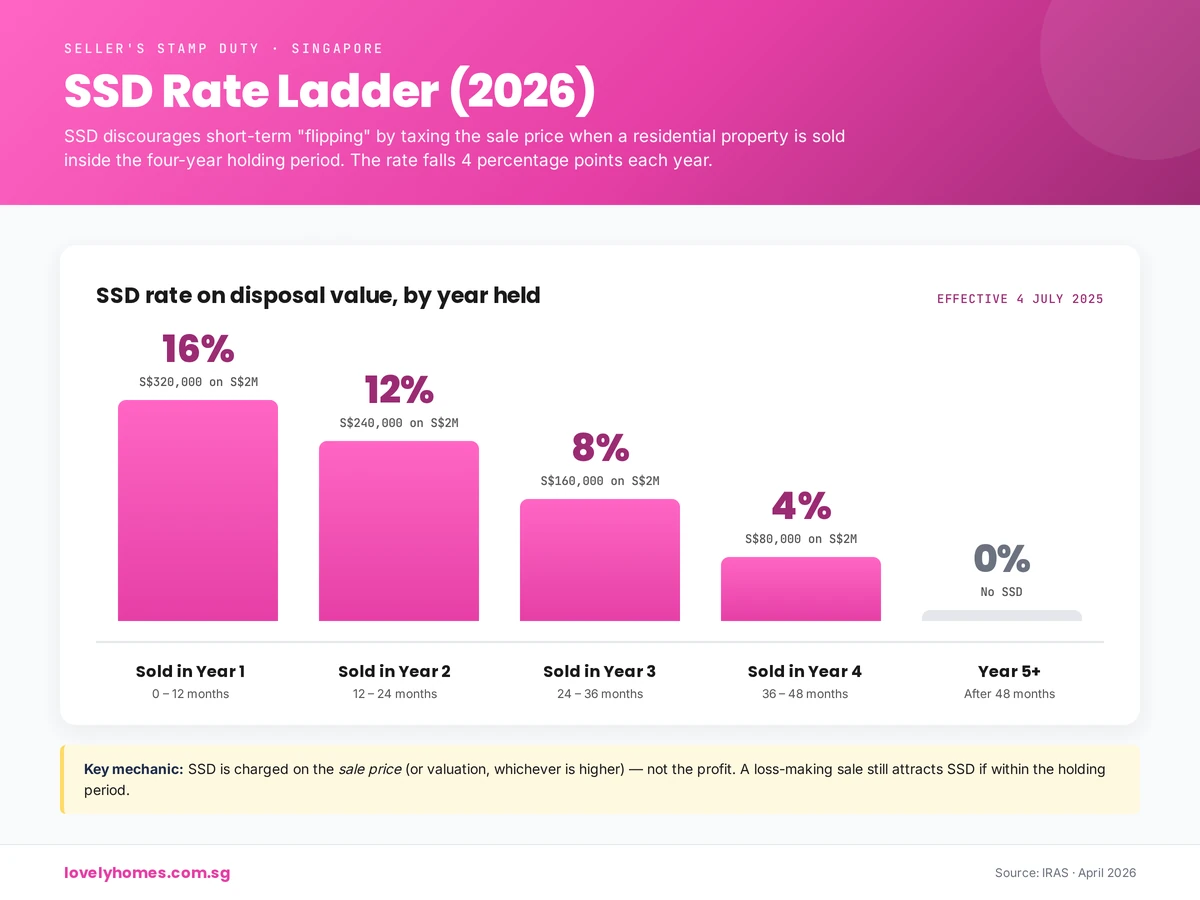
Figure 1: The current four-year SSD ladder — 16%/12%/8%/4% on disposal value (IRAS, 2026).
Current SSD Rates in 2026 (Critical Update)
Quick Answer: What Are Today’s SSD Rates?
Residential properties: Depends on purchase date.
Purchased 11 March 2017 to 3 July 2025: 12% (Year 1) / 8% (Year 2) / 4% (Year 3) / 0% thereafter
Purchased on or after 4 July 2025: 16% (Year 1) / 12% (Year 2) / 8% (Year 3) / 4% (Year 4) / 0% thereafter
Industrial properties: 15% (Year 1) / 10% (Year 2) / 5% (Year 3) / 0% thereafter (unchanged since January 2013)
Commercial properties: 0% (retail shops, offices, no SSD applies)
Important: On 4 July 2025, the Government announced a significant restructure of residential SSD, effective for all properties purchased on or after that date. The holding period extended from 3 years to 4 years, and rates increased by 4 percentage points across all tiers.
Year of Disposal
Residential (Old: purchased ≤ 3 July 2025)
Residential (New: purchased ≥ 4 July 2025)
Industrial
Year 1
12%
16%
15%
Year 2
8%
12%
10%
Year 3
4%
8%
5%
Year 4
N/A
4%
N/A
Year 5+
0%
0%
0%
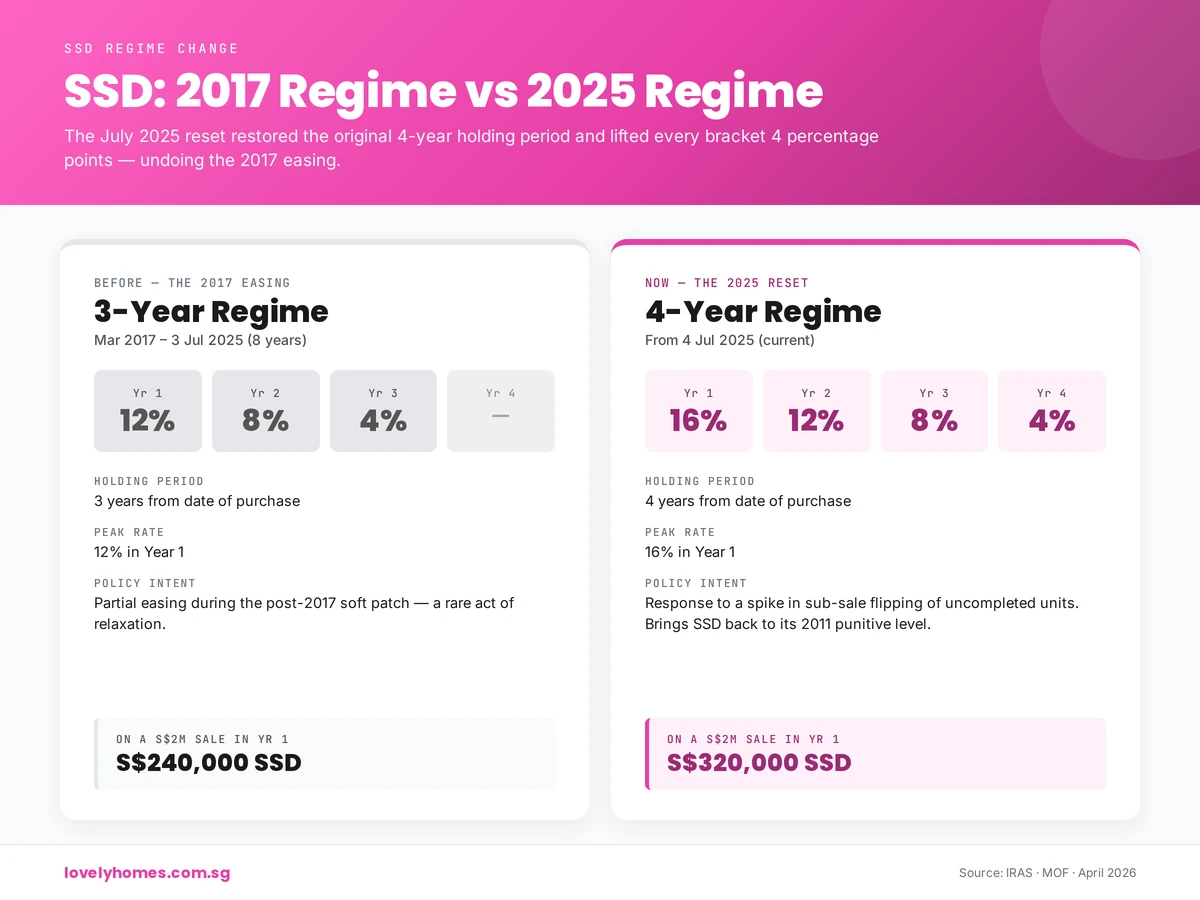
Figure 2: The July 2025 reset undid the 2017 easing — back to four years, up 4 percentage points per bracket.
A Brief History of SSD in Singapore
SSD rates have evolved significantly over the past 16 years, reflecting the Government’s shifting approach to cooling the property market:
February 2010: SSD introduced at 1% (Year 1) / 2% (Year 2) / 3% (Year 3) for sales within 1 year of purchase.
August 2010: SSD extended to cover sales within 3 years of purchase, maintaining the 1%/2%/3% rates.
January 2011: Rates escalated dramatically to 16% (Year 1) / 12% (Year 2) / 8% (Year 3) / 4% (Year 4) over 4 years, coinciding with the Global Financial Crisis aftermath and rising property prices.
January 2013: Industrial SSD introduced at 15%/10%/5% over 3 years, with no holding period extension thereafter.
11 March 2017: Residential SSD rates eased back to 12% (Year 1) / 8% (Year 2) / 4% (Year 3), and the holding period shortened from 4 years to 3 years. This marked a significant market cooling.
4 July 2025:Latest restructure: SSD rates for residential properties increased to 16% (Year 1) / 12% (Year 2) / 8% (Year 3) / 4% (Year 4), and the holding period extended back to 4 years. This applies to all properties purchased on or after 4 July 2025. Properties purchased before this date remain under the 12%/8%/4% regime (3-year holding period).
When Does SSD Apply? Key Conditions
SSD applies when all of the following conditions are met:
Property type: The property must be residential (private condo, terrace house, landed property) or industrial (factory, warehouse, B1/B2 zoned land). Commercial properties (retail shops, office units) are not subject to SSD.
Holding period: The property must be sold or disposed of within the holding period (3 years for pre-July 2025 purchases, 4 years for post-July 2025 purchases).
Disposal triggering event: The relevant date is when the Option to Purchase (OTP) is granted to the buyer or the Sale and Purchase Agreement (SPA) is signed, whichever is earlier. This date marks Day 1 of the holding period.
Acquisition date: The holding period starts from the date the OTP was exercised or the SPA was signed when you purchased the property (the date you acquired it).
SSD applies to most property disposals: sales to third parties, transfers to family members (unless specifically remitted), gifts, and even transfers in lieu of insolvency. The key trigger is the disposal date relative to the acquisition date.
HDB and SSD
Whilst SSD technically applies to HDB flats purchased after the legislative date (February 2010), in practice, SSD rarely applies to HDB owners because HDB imposes a Minimum Occupation Period (MOP). Most HDB flats have a 5-year MOP, meaning you cannot sell before 5 years have passed. By the time you can sell, the SSD holding period (3 or 4 years) has expired, and you owe no SSD.
However, if you own an HDB flat purchased before the SSD regime and sell early (during a defined period when some flats had shorter MOPs), SSD could theoretically apply. Consult your legal conveyancer for your specific flat’s MOP rules.
Executive Condominiums (ECs) and SSD
Executive Condominiums are subject to SSD if disposed of within the holding period after the MOP expires (typically 5 years). Once the MOP is completed and the property is decoupled from HDB rules, it is treated as a private residential property for SSD purposes.
Worked Examples: How SSD Is Calculated
Example 1: Private Condo Purchased January 2025, Sold June 2026
Scenario: You purchased a private condo on 15 January 2025 for S$1,800,000. You sold it on 20 June 2026 for S$2,000,000. At the time of sale, the property’s market value was assessed at S$1,950,000.
Analysis:
Purchase date: 15 January 2025 (before 4 July 2025 → old regime applies)
Sale date: 20 June 2026
Holding period: Approximately 17 months = Year 2
SSD rate: 8% (Year 2 rate under old regime)
Disposal value for SSD: Higher of sale price (S$2,000,000) or market value (S$1,950,000) = S$2,000,000
SSD payable: 8% × S$2,000,000 = S$160,000
Outcome: Despite a S$200,000 paper gain, you owe S$160,000 in SSD. Your actual net gain after SSD (and ignoring agent fees, legal costs, and ABSD if applicable to the buyer) would be only S$40,000—or entirely erased if other transaction costs are factored in.
Example 2: Private Condo Purchased March 2023, Sold April 2026
Scenario: You purchased a private condo on 10 March 2023 for S$1,600,000. You sold it on 5 April 2026 for S$1,750,000.
Analysis:
Purchase date: 10 March 2023 (before 4 July 2025 → old regime applies)
Sale date: 5 April 2026
Holding period: Approximately 3 years 3 months = beyond Year 3
SSD rate: 0% (holding period exceeded 3 years)
SSD payable: S$0
Outcome: You have held the property beyond the 3-year holding period, so no SSD is due. Your entire S$150,000 gain (less transaction costs and ABSD if applicable) is yours to keep.
Example 3: Industrial Property Purchased January 2025, Sold March 2026
Scenario: You purchased an industrial property (warehouse) on 20 January 2025 for S$2,000,000. You sold it on 15 March 2026 for S$2,100,000.
Analysis:
Property type: Industrial
Purchase date: 20 January 2025
Sale date: 15 March 2026
Holding period: Approximately 14 months = Year 2
SSD rate: 10% (Year 2 rate for industrial properties)
Disposal value for SSD: Higher of sale price or market value = S$2,100,000
SSD payable: 10% × S$2,100,000 = S$210,000
Outcome: Your S$100,000 paper gain is entirely wiped out by the S$210,000 SSD bill. You would need to pay S$110,000 from your own pocket to complete the sale. This illustrates why industrial property flippers face substantial tax penalties.
Example 4: New Regime – Residential Purchased July 2025, Sold November 2026
Scenario: You purchased a private condo on 10 July 2025 for S$1,500,000. You sold it on 15 November 2026 for S$1,650,000.
Analysis:
Purchase date: 10 July 2025 (on or after 4 July 2025 → new regime applies)
Sale date: 15 November 2026
Holding period: Approximately 16 months = Year 2
SSD rate: 12% (Year 2 rate under new regime)
Disposal value for SSD: S$1,650,000
SSD payable: 12% × S$1,650,000 = S$198,000
Outcome: Under the new, stricter regime, even a modest 10% appreciation is swallowed by a 12% SSD rate. The sale results in a net loss of approximately S$48,000 (before other transaction costs).
How SSD Is Calculated: Disposal Value
A critical point: SSD is calculated on the higher of the selling price or the market value of the property as at the date of sale.
If you sell below market value (e.g., to a family member at a discount, or in a distressed sale), the property’s assessed market value may still be used by IRAS to compute SSD. You cannot reduce your SSD bill by negotiating a lower sale price.
Market value is typically determined by a professional valuation, comparable sales data, or IRAS’s own assessment. If you believe IRAS’s valuation is incorrect, you can request a review, but the onus is on you to provide supporting evidence.
How to Legally Avoid or Minimise SSD
SSD is a significant liability for property sellers. Fortunately, several legitimate strategies exist:
1. Hold for the Full Period (3 or 4 Years)
The most straightforward approach: Hold your residential property for at least 3 years (if purchased before 4 July 2025) or 4 years (if purchased after) before selling. Once the holding period expires, SSD drops to 0%, and you keep your entire gain.
For industrial properties, hold for 3 years to eliminate SSD.
This strategy is ideal if you can afford to hold the property long-term. Many professional investors plan around these holding periods when structuring their portfolios.
2. Timing the OTP Carefully (Within Limits)
The key holding-period dates are:
Start date: The date you exercised the OTP or signed the SPA when you purchased the property.
End date: The date you granted the OTP to the buyer or signed the SPA when you sold the property.
If you purchased on 10 January 2025, the 3-year threshold is reached on 10 January 2028. If you can delay granting your buyer’s OTP until 10 January 2028 or later, SSD drops to 0%.
However, there are strict limits: You cannot artificially delay the OTP grant date if you have already agreed to sell. Doing so could constitute a breach of contract or fraud. The dates must reflect genuine transaction timings.
3. Properties Exempt or Remitted from SSD
Certain disposals qualify for full SSD remission or exemption:
Compulsory Acquisition (CA) by the Government: If your property is acquired under the Land Acquisition Act (e.g., for public housing, roads, or infrastructure), SSD is fully remitted.
Developer Repurchase: If a property developer repurchases a unit within a stipulated period (e.g., within 5 years of the original sale for some EC schemes), SSD may be remitted under the scheme’s terms.
Matrimonial Property Transfer: Transfers of residential property between spouses or ex-spouses as part of matrimonial or ancillary relief proceedings may qualify for remission if executed pursuant to a Court Order. However, this is a narrow exemption—consult a legal advisor.
HDB Repurchase by HDB: If HDB repurchases a flat from you (e.g., under right of first refusal schemes), SSD is typically remitted.
Bankruptcy or Insolvency: In certain insolvency situations, SSD may be remitted if the property is disposed of by a trustee or official receiver under court order.
These exemptions are narrow and require specific conditions. If you believe you qualify, consult a licensed conveyancing lawyer or contact IRAS directly for a ruling.
4. Decoupling Strategy (With Caution)
If you are married and own property as joint tenants, decoupling (transferring one spouse’s share to the other spouse) creates a new acquisition date for the transferred share. This means the holding period for that share restarts.
Example: You and your spouse bought a property jointly on 1 January 2025. On 1 July 2026, you transfer your spouse’s share to yourself. Your spouse’s share now has a new acquisition date (1 July 2026), so its holding period restarts. If you then sell the entire property on 1 January 2027, your share is subject to Year 2 SSD, but your spouse’s share (which was only held from July 2026 to January 2027 = 6 months = Year 1) would trigger Year 1 SSD on that portion.
This strategy is complex, has significant stamp duty and ABSD implications, and may not be worthwhile. Do not attempt without guidance from a tax professional and conveyancer.
5. Beware: Legitimate Avoidance vs. Tax Evasion
There is a clear legal line between legitimate tax planning and tax evasion:
Legitimate: Holding the property longer, timing transactions around the 3-year mark, claiming available exemptions.
Illegal: Falsifying transaction dates, under-declaring the sale price, splitting the sale into multiple transactions to circumvent SSD, or using straw buyers.
IRAS actively audits property transactions and has recovered substantial SSD arrears from taxpayers who attempted to evade the tax. The penalties (including interest and potential prosecution) far exceed any tax saved.
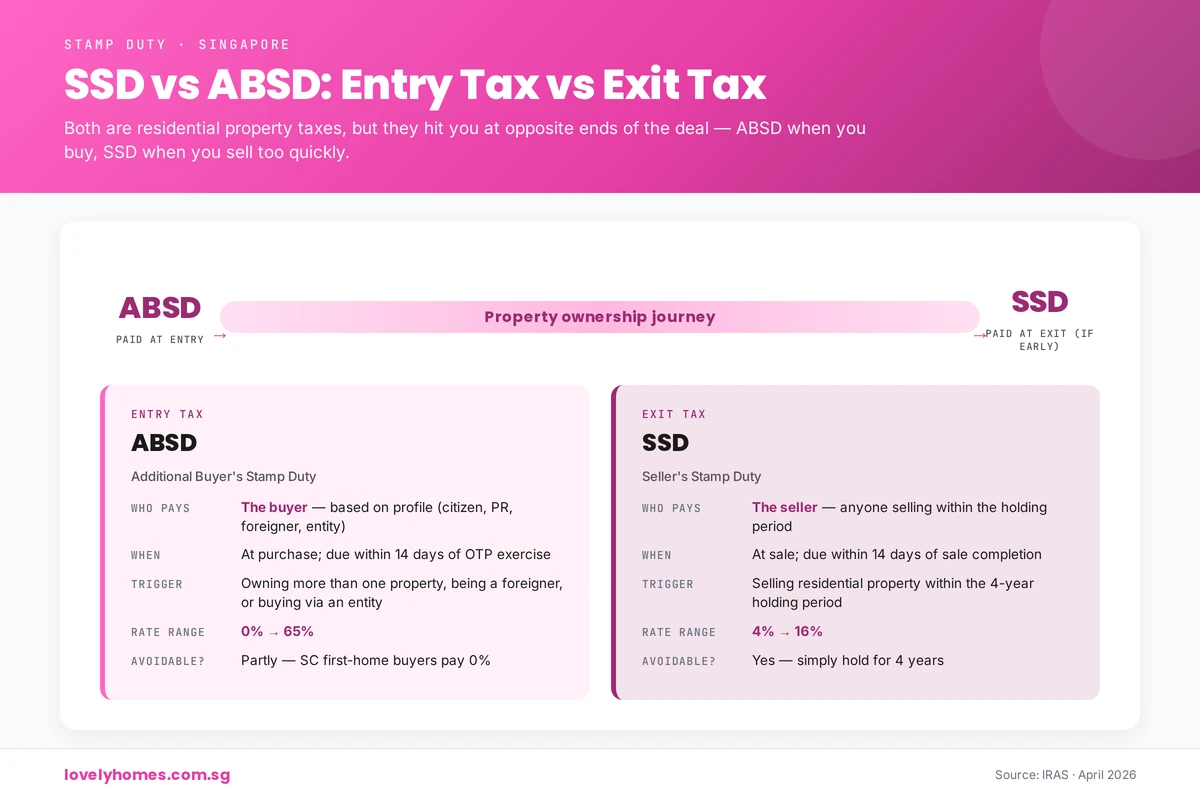
Figure 3: ABSD is charged when you buy; SSD is charged only if you sell within the holding period.
SSD vs. ABSD: What’s the Difference?
Many property sellers confuse SSD (Seller’s Stamp Duty) with ABSD (Additional Buyer’s Stamp Duty). They are separate taxes and can both apply to a single transaction:
Aspect
SSD (Seller’s Stamp Duty)
ABSD (Additional Buyer’s Stamp Duty)
Payable By
Seller
Buyer
When
At sale, if property sold within holding period (3 or 4 years)
At purchase, if buyer is foreigner, company, trust, or owns other properties
Applies To
Residential & industrial properties only
Residential properties only (no ABSD on industrial)
Purpose
Deter short-term speculation by sellers
Deter foreign ownership & multiple property purchases by buyers
Example Rate
12% (Year 1, old regime) or 16% (Year 1, new regime)
Key Point: Both SSD and ABSD can apply to a single transaction. If a Singaporean citizen (owner) sells a residential property within 3 years to a foreign buyer (or to another Singaporean who already owns 1+ properties), the seller pays SSD and the buyer pays ABSD. Each is computed on the transaction price and borne by the respective party.
Frequently Asked Questions (FAQ)
Q1: Who decides what the “disposal value” is for SSD calculation?
A: The disposal value is the higher of the actual selling price or the property’s market value as at the date of sale. If you sell at S$2M but IRAS assesses the market value at S$2.2M, SSD is computed on S$2.2M. You can appeal IRAS’s valuation, but the burden is on you to prove the value with evidence (comparables, professional appraisals). In most cases, the selling price is the disposal value, unless it is significantly below market (a rare event).
Q2: Can I use my CPF to pay SSD?
A: No. SSD is a seller’s cost and must be paid from the sale proceeds or your own funds. CPF can only be used to purchase residential property and to pay the conveyance duty (stamp duty) on the purchase itself, not on the sale or SSD. SSD is withheld from your sale proceeds at completion.
Q3: Does SSD apply if I gift my property to a family member?
A: Yes, in principle, SSD applies to gifts unless a specific remission is granted. The “disposal value” for a gift is the property’s market value (since there is no actual sale price), and SSD is computed on that value. However, if the gift is part of a matrimonial order or compulsory acquisition, remission may apply. For most family gifts without legal exemption, SSD is payable by the donor (gift-giver). Consult a lawyer before gifting property if within the holding period.
Q4: Does SSD apply if I inherited the property?
A: No, SSD does not apply to inherited properties. Inheritance is not a “disposal” triggering SSD; it is a transmission of title by operation of law upon death. Your holding period for SSD purposes starts from the date the original buyer (the deceased) purchased the property. If the deceased held it for more than 3 years before dying, there is no SSD when you (the heir) subsequently sell. If the deceased had held it less than 3 years and you sell shortly after, you may owe SSD, but the holding period is measured from the original purchase date, not your inheritance date.
Q5: Does SSD apply to HDB flats?
A: Technically, yes—SSD applies to HDB flats purchased after February 2010. However, in practice, SSD rarely triggers for HDB owners because HDB imposes a Minimum Occupation Period (typically 5 years). Once you can sell (after MOP), the SSD holding period has usually expired. If you own an older HDB flat or one with a shorter MOP and sell within the holding period, SSD would apply. Check your flat’s MOP with HDB before selling early.
Q6: Can I get SSD back if the buyer backs out?
A: SSD is paid at completion of the sale (when the sale is finalised and transferred to the buyer). If the buyer backs out before completion, the sale does not complete, and SSD is not triggered or payable. If the sale completes and you have paid SSD, but the buyer later defaults or the sale is reversed (rare), you would need to seek legal remedy or negotiate a refund directly with the buyer. IRAS does not refund SSD unless the underlying transaction is formally set aside by Court order.
Q7: How is SSD calculated on an incomplete property (Build-to-Completion, BUC)?
A: For a property sold before completion of construction (i.e., before the Completion Certificate is issued), SSD is calculated on the contract price (as stated in the SPA or OTP), not the actual completion value. The holding period is measured from the date the OTP was exercised on the original purchase. If you resale a BUC unit within the holding period, SSD is due on the resale price. This is an area where many investors get caught—ensure you understand the SSD implications before flipping an off-plan property.
Q8: What happens if I sell a property that is jointly owned with my spouse?
A: If you and your spouse own a property as joint tenants or tenants-in-common, the sale price is shared (usually 50/50 unless another ratio is agreed). SSD is calculated on the full sale price, but it is paid from the joint sale proceeds. The holding period is the same for both owners (it starts from the date the property was first acquired). No special relief applies merely because of joint ownership; both spouses are treated as single sellers of a single property. If you decouple (transfer one spouse’s share to the other), the transferred share gets a new acquisition date, which can complicate SSD calculations.
Q9: Can I defer or spread SSD payments over time?
A: No, SSD must be paid in full at the point of completion (when the sale is finalised). There is no option to spread the payment or defer it. Your conveyancer will calculate the SSD owed and ensure it is deducted from the sale proceeds before you receive your net amount. If you cannot afford the SSD, the sale cannot complete, and you remain the owner.
Q10: Are there any SSD changes coming in 2026/2027?
A: As of April 2026, no further changes to SSD have been announced. The most recent restructure took effect on 4 July 2025 (16%/12%/8%/4% over 4 years for properties purchased on or after that date). Keep monitoring IRAS’s official website and Government budget announcements for any future changes. However, do not assume changes; rely only on official announcements from IRAS and the Ministry of Finance (MOF).
This guide is provided for general informational purposes only and does not constitute legal, tax, financial, or investment advice. SSD rates, holding periods, and exemptions are subject to change at the discretion of the Government of Singapore and the Inland Revenue Authority of Singapore (IRAS).
Consult a licensed conveyancing lawyer to understand your specific SSD liability based on your property’s purchase and sale dates.
Obtain a professional valuation if you believe the market value of your property may differ significantly from the sale price.
Contact IRAS directly for clarification on any specific scenarios or exemptions that may apply to your situation.
Property laws change, and individual circumstances vary widely. LovelyHomes.com.sg and its authors assume no liability for actions taken based on this guide. Always seek independent professional advice before committing to a property transaction.