Published 28 April 2026. Reflects developer launch-weekend announcements and Singapore property press coverage of 25–26 April 2026.
Quick Answer — what happened
Two major Singapore new condo launches went live on the weekend of 25–26 April 2026: Tengah Garden Residences (863 units, 99-yr leasehold, GuocoLand × CSC Land) and Vela Bay (515 units, 99-yr leasehold, SingHaiyi × Haiyi Holdings).
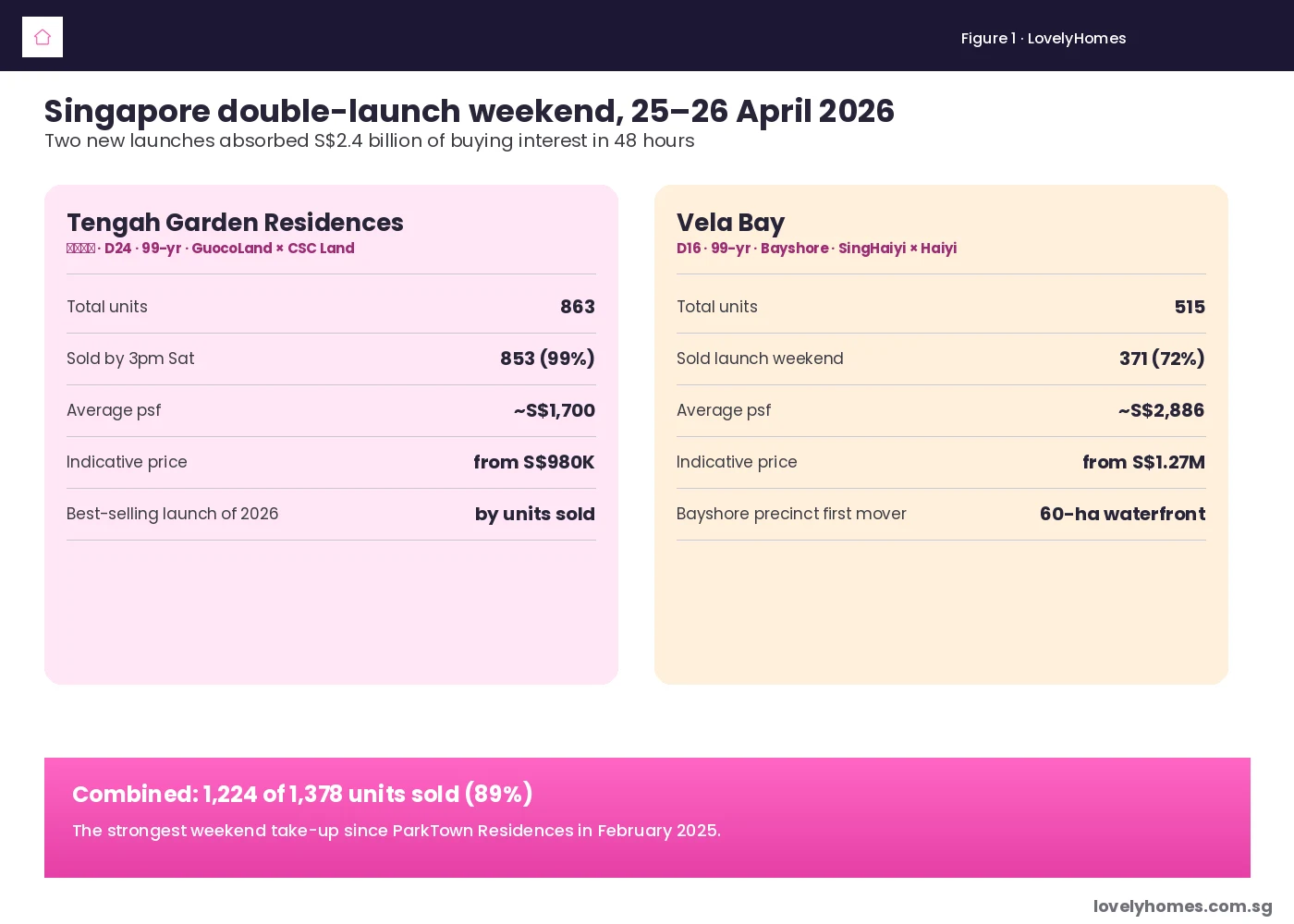
Combined, the two projects sold 1,224 of 1,378 units (89%) over the launch weekend.
Tengah Garden Residences cleared 853 of 863 units (~99%) by Saturday afternoon, the strongest launch-day take-up since ParkTown Residences in February 2025.
Vela Bay sold 371 of 515 units (~72%), becoming the first private launch in the 60-hectare Bayshore waterfront precinct.
Average prices: Tengah Garden Residences ≈ S$1,700 psf, with units from S$980,000. Vela Bay ≈ S$2,886 psf, with units from S$1.27 million.
The weekend’s combined gross sales value is approximately S$2.4 billion, the largest dual-launch weekend on record for Singapore residential property.
The headline numbers
Singapore’s primary condo market has been described as “thin but priced firm” through Q1 2026. The weekend of 25–26 April 2026 ended that narrative with a single set of launch figures. By close of business Sunday, two new projects in different parts of the island had between them moved more units than the entire month of February 2026.
Tengah Garden Residences, the first private condominium launched inside the Tengah HDB-led new town, registered 853 sales out of 863 units — a 99% sell-through rate. Vela Bay, the first private residential launch in the Bayshore precinct in the East, sold 371 of 515 units. The two projects together absorbed buyer demand worth roughly S$2.4 billion in 48 hours.
Figure 1: 1,224 of 1,378 units sold across the two projects — roughly 89% of available stock cleared in two days.
Tengah Garden Residences — the suburb story
Developed jointly by GuocoLand and CSC Land Group on a 99-year leasehold parcel along Tengah Garden Avenue (District 24), Tengah Garden Residences was launched at indicative prices from S$980,000 for one-bedroom units. Average pricing landed at roughly S$1,700 per square foot, slotting in between recent Outside-Central-Region (OCR) launches and the older Bukit Batok mass-market resale stack.
Key drivers of the near-sellout:
Pent-up Tengah demand. Tengah’s residential identity has been HDB-led since 2018, with no private launches inside the estate. The opening of the first private project tested an aspirational segment that had been waiting four years.
Pricing that read as “below ParkTown”. ParkTown Residences in Tampines launched at a higher OCR psf in February 2025; the Tengah price point felt restrained by comparison.
Singapore-Citizen-heavy buyer mix. Over 90% of buyers are reported to be Singapore Citizens, consistent with the post-2023 ABSD regime where foreign demand at OCR price points has thinned.
Connectivity story. Future Tengah MRT (Jurong Region Line, opening 2027–2028) and the proximity of the new Tengah town centre supported the long-hold buyer thesis.
Vela Bay — the Bayshore opener
Vela Bay, by SingHaiyi Group and Haiyi Holdings, launched at average prices of around S$2,886 psf, with one-bedroom units from S$1.27 million. The 515-unit project sits inside the Bayshore precinct, an emerging 60-hectare master-planned waterfront on the East Coast.
The Vela Bay take-up of 72% is more modest than Tengah Garden Residences’ 99%, but no less interesting:
Higher absolute price point. A typical 2-bedroom Vela Bay unit lands above S$2 million; that is a different buyer profile from Tengah.
First-mover premium. As the only private launch in a precinct still under construction, Vela Bay’s price had to absorb the discount buyers usually demand for “go-first” risk on infrastructure delivery.
Nine new sites in 1H 2026 GLS. URA’s 1H 2026 Government Land Sales programme released nine confirmed-list sites with capacity for ~9,185 units. The sequencing of those sites — including the Bayshore Drive mixed-use plot whose tender closes 15 July 2026 — is shaping how buyers price first-mover Bayshore stock.
SingHaiyi balance-sheet narrative. SingHaiyi has been a heavy participant in en-bloc and GLS bids in 2026 (it was also part of the consortium that won Loyang Valley en-bloc at S$880 million); its Bayshore launch is a clear conviction trade by the developer.
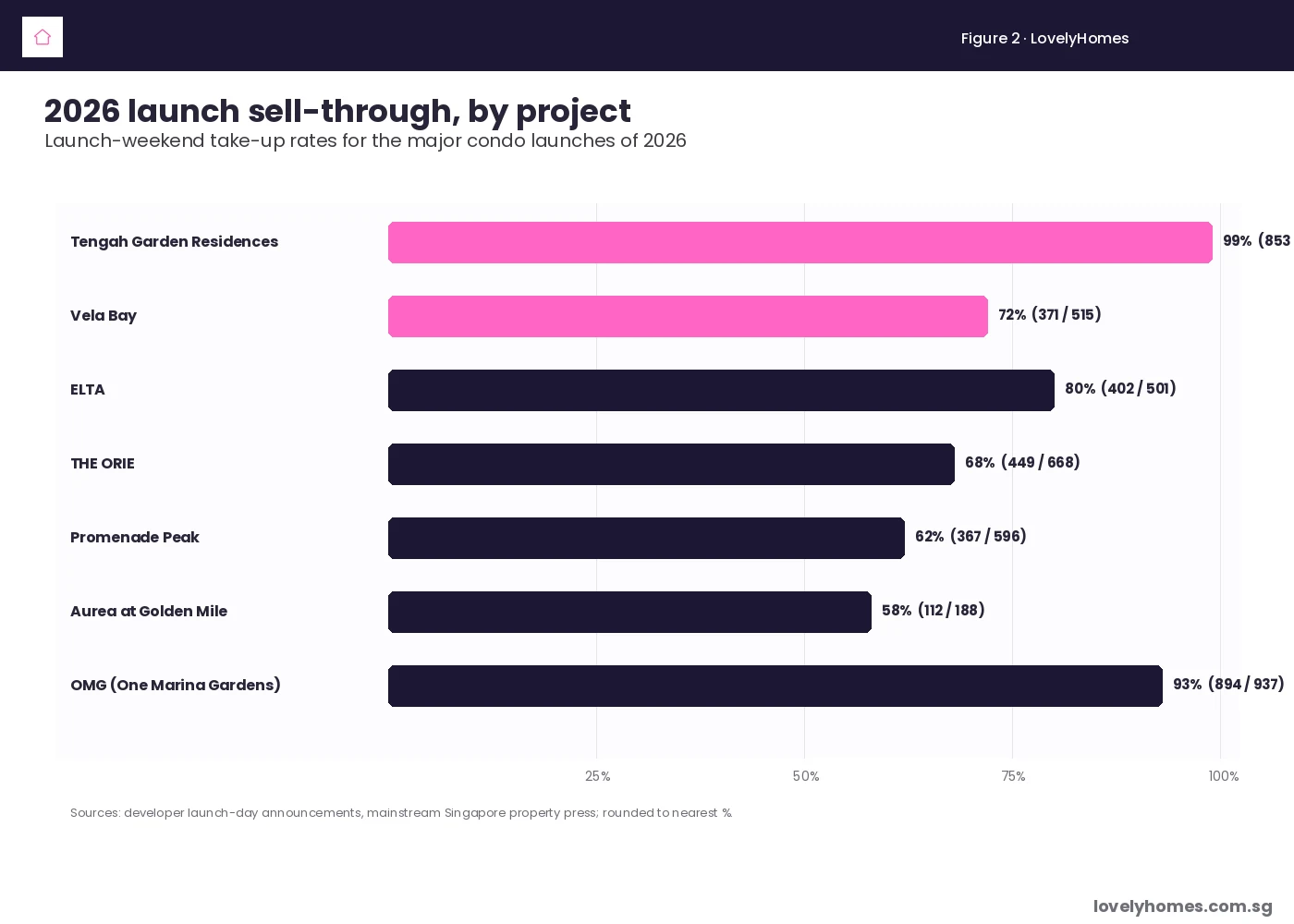
Figure 2: Tengah Garden Residences sits at the top of the 2026 launch sell-through table. Vela Bay’s 72% is also above the 2026 OCR/RCR average.
What the weekend tells us about 2026 demand
Metric
Reading
Implication
Combined launch-weekend take-up
1,224 / 1,378 units (89%)
Latent demand absorbing strongly when supply opens at the right price
OCR launch psf — Tengah
~S$1,700
Below recent comparable OCR launches; a “value” anchor for 2026 OCR pricing
RCR/East launch psf — Vela Bay
~S$2,886
Setting the benchmark for the Bayshore precinct ahead of the Bayshore Drive GLS tender
Buyer mix
Predominantly Singapore Citizen
Foreign demand still suppressed by the 60% ABSD; the market is local-driven
2026 launch pipeline
~17 projects, ~8,100 units
30% lower than 2025 — supply scarcity supports launch-day pricing power
What this means for buyers
For prospective Tengah buyers who missed the launch ballot, the resale option will likely sit at a 3–7% premium once units start changing hands — typical for a near-sellout launch. Tengah Garden Residences will not have additional release tranches for some months given the sell-through.
For Vela Bay, with 144 units (28%) still available, the post-launch phase remains accessible at launch pricing. Buyers should monitor whether units in Towers 1 and 2 are released before infrastructure milestones in the Bayshore precinct — first-mover units historically appreciate as the precinct fills out, but only if pricing on later launches doesn’t undercut them.
For the broader market, the weekend confirms that well-priced, well-located new launches in Singapore can still clear at speed in 2026, against the narrative of cooling-measure overhang. The discipline is on launch-day pricing: Tengah’s near-sellout came at a psf below what some industry watchers had projected for an OCR launch this cycle. Vela Bay’s slower (but still strong) take-up suggests that buyers in the higher-price RCR segment remain willing to pay up only for clearly differentiated locations.
What might come next
Two near-term watchpoints:
Bayshore Drive mixed-use GLS tender (closes 15 July 2026). The land bid will be read against Vela Bay’s launch psf as a price discovery point for the precinct.
BTO June 2026 ballot (~6,900 flats). If HDB pricing continues to compress against private OCR pricing, the substitution effect supports a second wave of OCR private demand later in 2026.
The next major private launches in the calendar — Bayshore Drive (if the tender awards in 1H 2026), Sembawang Drive EC, and a likely 2H 2026 District 5 OCR launch — will tell us whether the 25–26 April weekend was a one-off catch-up after a thin Q1, or the start of a measurably stronger primary market.
Frequently asked questions
Why did Tengah Garden Residences sell so much faster than Vela Bay?
Three reasons. First, price: at ~S$1,700 psf, Tengah’s entry price of S$980,000 sits below the typical OCR launch and is reachable for HDB upgrader couples. Vela Bay at ~S$2,886 psf and S$1.27 million entry sits in a different affordability cohort. Second, Tengah is a four-year-old new town with a built-out HDB community already in occupation; Vela Bay is the first launch in a precinct still under construction. Third, Tengah was the first private launch in the new town — a one-off scarcity premium that Vela Bay does not enjoy because more Bayshore launches will follow.
Is this evidence that cooling measures aren’t working?
Not necessarily. Cooling measures (the April 2023 ABSD hike, the September 2022 LTV / TDSR tightening) have visibly suppressed foreign demand and kept investor flows thin. The April 2026 launches were powered overwhelmingly by Singapore Citizen owner-occupier and upgrader demand, which is exactly the segment policy-makers wanted to remain active. The strong take-up reflects pent-up local demand meeting limited new supply, not a re-acceleration of speculative buying.
Should buyers chase a near-sellout launch like Tengah?
Generally no. Once a launch clears 90%+, the remaining stock is typically the less attractive layouts or units, and the resale market opens at a premium. The discipline for buyers is to be at the front of the queue at launch — or wait for the resale market to settle 6–9 months later when the urgency premium has softened.
What does this mean for the Bayshore Drive GLS tender?
Vela Bay’s 72% sell-through at ~S$2,886 psf gives bidders a reference point for what a Bayshore launch can absorb at price. If the Bayshore Drive GLS tender bids land at above S$1,400 psf ppr, the implied launch psf for the next Bayshore project would be approximately S$3,000+, which is testable against Vela Bay’s revealed demand curve.
How does this compare to historical strong launches?
The 99% Tengah figure is the highest launch-weekend take-up since ParkTown Residences in February 2025, which moved 87% on launch day. Going further back, Lentor Mansion (2024), Amo Residence (2022), and Treasure at Tampines (2019) all booked similar 90%+ launch-day percentages. Each of those projects shared the same ingredients as Tengah: a clear price-point anchor, an underserved sub-market, and a strong upgrader cohort.
Will more units be released?
For Tengah Garden Residences, the developer has not announced a second tranche; with only 10 units unsold, there is little to release. For Vela Bay, the remaining 144 units (28%) will be released in batches over the coming weeks at the same indicative price band; movements above launch pricing typically follow demonstrated take-up of 80%+.
Disclaimer. All sales figures, prices and dates are based on developer launch-day announcements and public reporting in the Singapore property press. Final transaction figures will be reflected in URA Realis caveats over the coming weeks. This article is general market commentary and does not constitute investment, legal or financial advice. Buyers should always verify current pricing and availability with the developer’s appointed sales gallery and consult a licensed Singapore conveyancing lawyer before exercising any Option to Purchase. Cooling-measure thresholds and ABSD rates are administered by the Inland Revenue Authority of Singapore and the Monetary Authority of Singapore.
New Launch Tengah Garden Residences Vela Bay Singapore Property Market Property News OCR Bayshore Tengah SingHaiyi GuocoLand
HDB’s May 2026 Build-To-Order launch is expected to open for application in the first week of May, the second launch of the year after the February 2026 exercise. Based on the sites gazetted through URA Government Land Sales in late 2024 and 2025, and on pre-launch developer briefings released by HDB, we preview the likely site mix, expected application rates, and the first-timer vs second-timer allocation picture.
At a glance
May 2026 BTO is expected to launch approximately 6,800 flats across Standard, Plus and Prime categories.
Confirmed launch sites include Bukit Merah (Henderson), Tampines (Tampines North), Tengah (Garden District) and Woodlands (Woodlands North Coast).
Bukit Merah Henderson is the category headliner — Prime location classification; expect application rates above 10x for 4-room.
Family grant framework (Enhanced CPF Housing Grant, Family Grant, Proximity Housing Grant) applies; first-timer ballot weights unchanged.
Applications typically close 7 days after opening; ballot results announced 4–6 weeks later.
What a Plus / Prime BTO classification means for May buyers
The Plus and Prime classifications — introduced under the revised 2024 HDB framework — replace the legacy Mature / Non-Mature framework for new BTO launches. Standard flats follow the traditional BTO rules. Plus flats, typically in choice non-mature locations, carry a 10-year Minimum Occupation Period (up from 5) and subsidy clawback on resale. Prime flats, in the most central and amenity-rich locations, carry the same 10-year MOP plus a resale income ceiling that applies when the flat is eventually sold.
Buyers should model the full hold cycle before ballot. A Prime classification delivers an under-market purchase price and exceptional location, but the 10-year MOP plus resale-income-ceiling combination narrows the eventual buyer pool at exit. For households expecting to stay in the flat 15–20 years, the Prime route is straightforward. For households planning a shorter trade-up, the Standard category is typically the better fit.
Site-by-site expectations
Bukit Merah (Henderson) — Prime classification
Estimated launch: approximately 1,200 flats, 4-room and 5-room mix. The site sits on Henderson Road, about a 5-minute walk from Redhill MRT (East-West Line) and within walking distance of Dawson Estate and Bukit Merah Central. The Prime designation is expected to deliver a substantial price discount vs the adjacent resale market, where four-room flats are transacting in the S$850–S$1,050k band. Expect application rates for 4-room flats above 10x on the first-timer pool.
Tampines (Tampines North) — Plus classification
Estimated launch: approximately 1,600 flats, full mix from 2-room Flexi to 5-room. The site is adjacent to the Tampines North MRT (Cross Island Line Stage 1, opened late 2024) and sits in a growing mixed-use district bracketed by Tampines Regional Centre and Tampines North Park. The Plus classification carries a 10-year MOP but no resale-income ceiling. Expect application rates of 4–6x on 4-room flats.
Tengah (Garden District) — Standard classification
Estimated launch: approximately 2,400 flats, the largest single-site batch of the May 2026 launch. The Tengah Garden District is the western master-planned town pioneered as Singapore’s first car-free town centre. The Jurong Region Line MRT is under construction with stations expected to open progressively from 2027 through 2029. Expect application rates of 2–3x on 4-room flats given the larger supply and the longer MRT wait.
Woodlands (Woodlands North Coast) — Standard classification
Estimated launch: approximately 1,600 flats. The Woodlands North Coast site benefits from the recently opened Thomson-East Coast Line terminus at Woodlands North, cross-border connectivity via the under-construction Johor Bahru-Singapore Rapid Transit System, and the still-developing Woodlands Regional Centre. Expect application rates of 2–3x on 4-room flats.
First-timer, second-timer and quota mechanics
HDB ring-fences a majority of every launch for first-time applicant families — specifically, at least 85% of four-room and larger Standard flats are reserved for first-timer families. Two-timer applicants (families who already own or have previously owned an HDB flat, EC or private property) compete for the remaining quota and typically face ballot odds 2–4x longer than first-timers. Singles and first-timer families under the joint application framework are balloted separately under the 2-Room Flexi scheme.
Prime and Plus flats have the same general first-timer preference but with a further stratification: households with household income under the relevant bracket receive the CPF Housing Grant stack, which can add up to S$80,000 in grants depending on income-group position.
Application tactics for a strong ballot position
Three behavioural points the HDB system rewards. First, ballot entry across multiple launches does not compound — each launch is a fresh lottery. But second-timers who roll over their application to a next launch do receive a small priority-weighting uplift, capped at two rollovers. Second, the Proximity Housing Grant (S$30,000 for applying to live with or near parents) is a strong signal to the ballot system and materially improves odds at Bukit Merah Henderson and Tampines North. Third, the Enhanced CPF Housing Grant is income-tiered — the lowest income tier receives the largest grant, which influences eligibility for Standard categories.
Expected timeline
What May 2026 means for the resale market
A May launch of approximately 6,800 flats is a moderate supply pulse into the BTO pipeline, but the immediate effect on resale is indirect. In the short term, first-timer applicants who commit to a BTO ballot typically withdraw from active resale viewings while waiting for the result, which softens resale transaction volume for 4–6 weeks. If ballot rates are high (as expected for Bukit Merah Henderson), disappointed applicants often re-enter the resale market in late June, which typically produces a small transaction bounce in July. This pattern has been consistent across the last six BTO launch cycles.
Frequently asked questions
When exactly does the May 2026 BTO open for application?
HDB typically announces the exact launch window approximately two weeks before applications open. Based on past May launches, the window usually falls in the first 10 days of May, with applications closing roughly 7 days after opening.
Can I apply for both a BTO and a resale flat at the same time?
You can apply for a BTO while viewing resale flats, but you cannot hold a BTO booking and simultaneously enter a resale HDB agreement. Most applicants use the BTO ballot window to continue resale research; successful balloters decline at booking if they have already committed to a resale.
How much is the ABSD and BSD on a BTO flat?
BTO flats are sold directly by HDB under the Housing & Development Act. Buyers’ Stamp Duty applies on the purchase price at the standard schedule. Additional Buyer’s Stamp Duty does not apply to first-timer BTO applicants buying their first residential property.
What is the difference between Plus and Prime?
Both carry a 10-year MOP and subsidy clawback on sale. Prime adds a resale-income-ceiling constraint at exit — the eventual resale buyer must meet an income ceiling. Plus has no such eventual-buyer constraint.
Can PRs apply for BTO flats?
PR-only households cannot apply for a BTO. A Singapore Citizen applying with a PR spouse or family nucleus can apply under the HDB Fiancé/Fiancée, Family or Joint Singles scheme.
What happens if I decline the allocated BTO flat?
Declining a BTO selection appointment has consequences for future applications: after two non-selections in a 12-month period, HDB may debar the applicant from applying for BTO for a period of up to 12 months. Plan your ballot portfolio carefully.
Source
Source: HDB public information on the BTO launch framework and 2024 revised category system, URA GLS announcements, and public site-gazetting records. Full documentation: HDB BTO flat selection and URA GLS current sites.
Editorial note. This article is based on public-domain data released by HDB, URA, Singapore Land Authority and MAS as at 23 April 2026. All analysis is our own. No marketing-agency research is cited. Figures may be revised in subsequent official releases — always refer to the latest authoritative source before making a housing decision.
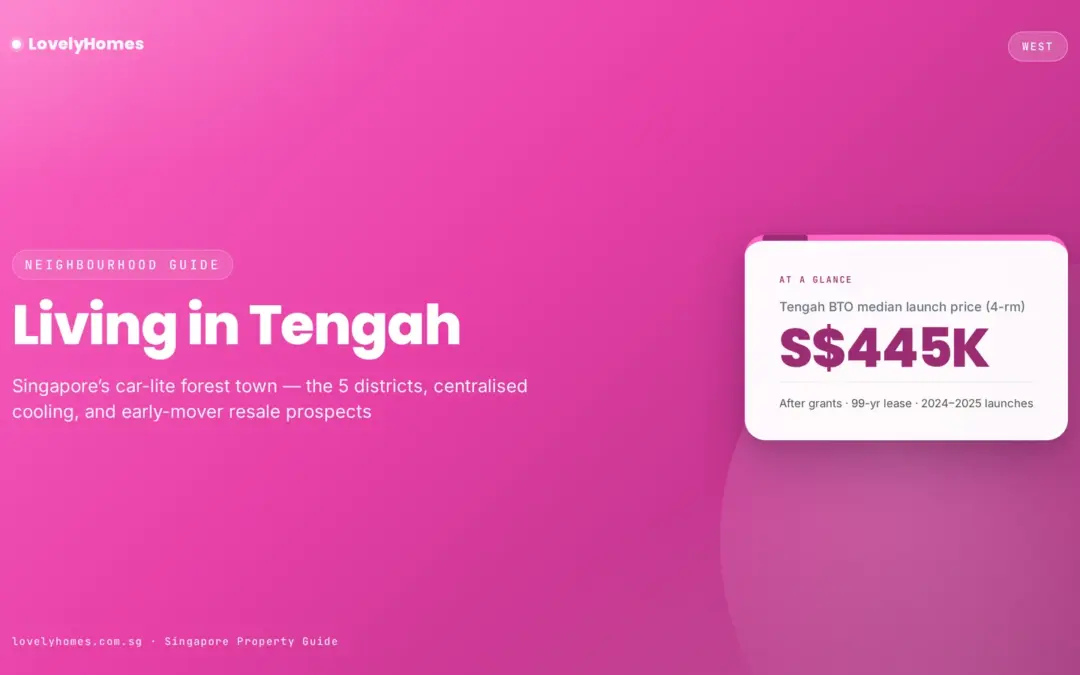
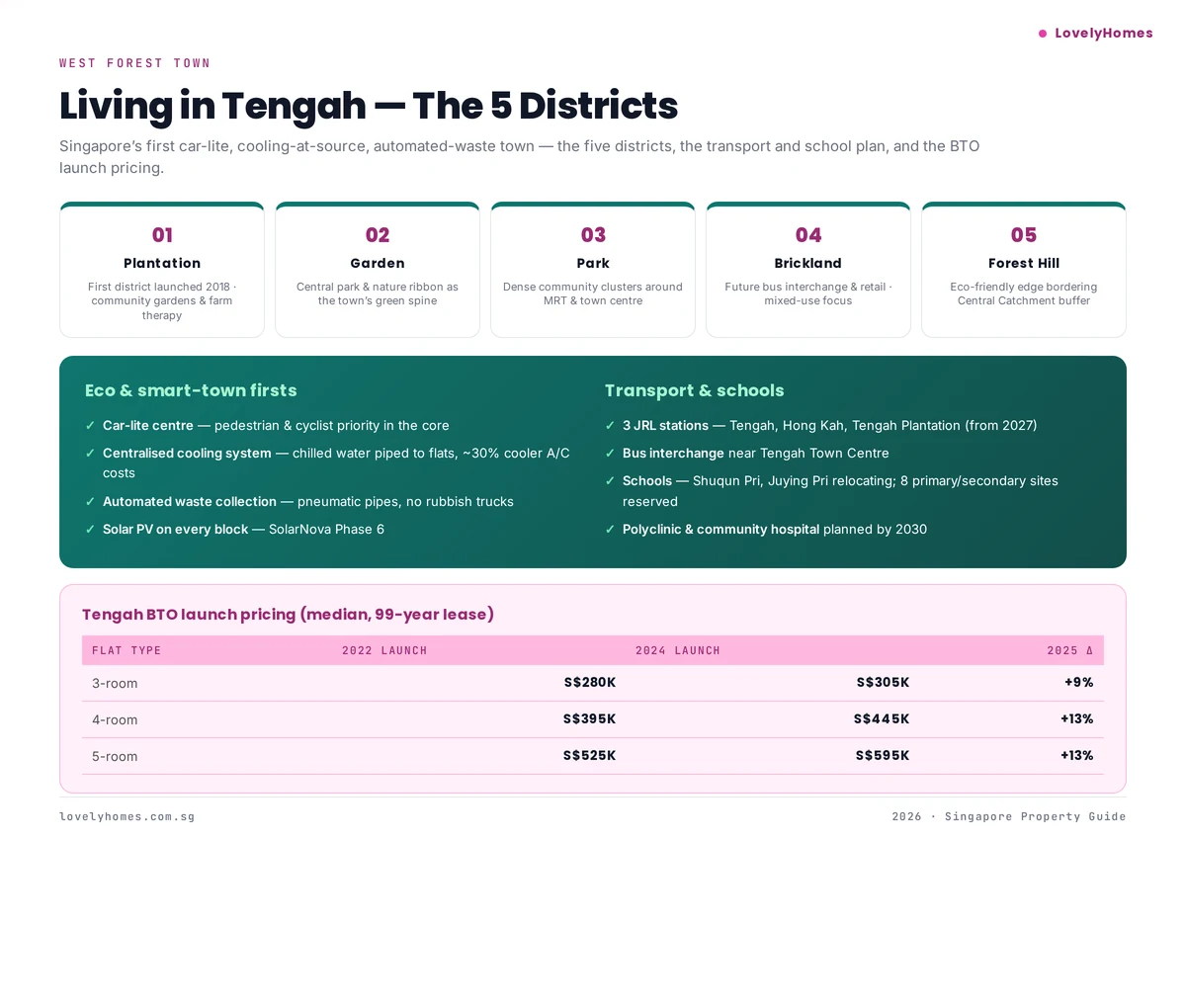
Tengah is Singapore’s first car-lite, forest-town of 42,000 new homes across five districts (Plantation, Garden, Park, Brickland, Forest Hill). Launch BTO pricing rose from ~S$395K (4-rm) in 2022 to ~S$445K in 2024–2025. The Jurong Region Line opens 3 Tengah stations from 2027, and centralised cooling promises lower aircon bills. First BTO flats MOP in 2027.
Tengah was unveiled in 2016 and launched its first BTOs in 2018. It sits on ~700 ha of mostly ex-military land in the west, next to Jurong East and Bukit Batok. What makes Tengah unusual isn’t just its size — it’s the design principles: car-lite centre, centralised district cooling, automated waste collection, solar panels as standard, and a forest ribbon running through the town.
This guide walks through the five districts, the transport plan, schools, and what early BTO pricing tells you about future resale prospects. If you’re deciding between estates, read our best HDB estates for young families.
Tengah’s 5 districts, car-lite centre, JRL stations, and BTO launch pricing
The five districts of Tengah
Plantation District — the first launched, now MOPing from 2027. Known for its community gardens and farm-therapy programmes.
Garden District — central park and nature-ribbon spine, with mid-rise clusters around green loops.
Park District — densest residential core, adjacent to town centre and bus interchange.
Brickland District — future mixed-use focus with a planned bus interchange and retail hub.
Forest Hill District — the eco-edge district bordering the Central Catchment buffer.
The car-lite, eco-town design
Car-lite centre — vehicles run underground through a ring road; pedestrian and cyclist paths on the surface.
Centralised cooling — chilled water piped into every flat, cutting A/C costs by ~30% vs conventional splits.
Automated waste collection — pneumatic pipes beneath blocks transport rubbish directly to a central point.
Smart home ready — BTO flats pre-wired for smart home devices and IoT integration.
Forest ribbon — a 5 km nature corridor linking Central Catchment to the Western Water Catchment.
Transport — the JRL changes everything
Tengah has three Jurong Region Line stations opening in phases from 2027:
Tengah — town centre interchange, linking to existing Choa Chu Kang (NSL)
Hong Kah — between Plantation and Garden districts
Tengah Plantation — serving the western districts
Before 2027, residents rely on feeder buses to Choa Chu Kang or Bukit Batok MRT (20–30 minutes). The Kranji Expressway and Pan-Island Expressway provide car access.
Schools and services
Shuqun Primary and Juying Primary are relocating to Tengah. Eight school sites in total are reserved. A polyclinic is planned within the town centre. A community hospital is planned around 2030.
How BTO launch pricing has moved
Flat type
2022 launch median
2024–2025 launch median
Δ
3-room
~S$280K
~S$305K
+9%
4-room
~S$395K
~S$445K
+13%
5-room
~S$525K
~S$595K
+13%
Pricing reflects improving amenities and proximity to the forthcoming JRL. Under HDB’s October 2024 classification, Tengah flats are “Plus” — meaning a 10-year MOP and resale clawback rules on certain grants.
Who Tengah suits
Tengah appeals to eco-minded families, work-from-home professionals valuing space over commute, and first-time buyers who can accept 2–3 years of transitional inconvenience before JRL opens. The centralised cooling + solar panels combination matters more if you plan to live there 15+ years.
Frequently asked questions
Should I wait for JRL before buying in Tengah?
Resale prices will reflect JRL opening in 2027. If you’re buying to live, the wait question depends on your commute — current residents use Choa Chu Kang (NSL) as the gateway. If you’re buying to invest, the 10-year MOP for Plus flats means flipping post-JRL isn’t an option anyway.
What is centralised cooling?
Chilled water is produced in a centralised plant and piped through the town into each flat’s fan coil units. You pay for cooling (per kWh of thermal energy) rather than electricity for a split A/C. Typical savings are 15–30% vs standalone A/C depending on usage.
Is Tengah too remote?
Without JRL, yes — the current bus-feeder commute to CCK MRT adds 15–20 minutes per trip. From 2027, Tengah will have direct JRL to Boon Lay, Pandan Reservoir, and the Jurong East hub.
What happens to grants under the Plus classification?
Plus BTOs have a subsidy clawback on resale within the first 10 years beyond MOP — you repay a portion of the grants and proportional market gains. For families genuinely buying to live, the clawback rarely bites. See our EHG grant guide for the mechanics.
Disclaimer
This guide is for general information only. Estate pricing, upcoming launches, MRT opening dates, and masterplan details change over time. Always verify the latest HDB, URA, LTA and MND announcements before making property decisions. LovelyHomes is not a licensed property agent. For personalised advice, please engage a registered CEA agent.