Singapore HDB Eligibility Guide 2026: Who Can Buy an HDB Flat?

Singapore HDB Eligibility Guide 2026: Who Can Buy an HDB Flat?

Quick Answer: Who Can Buy an HDB Flat in Singapore?

  • Singapore Citizens (SC) with an eligible family nucleus or as a single aged 35+ can buy most HDB flat types.
  • Singapore Permanent Residents (PR) can purchase HDB resale flats (not BTO) together with an SC or another PR, subject to the Ethnic Integration Policy (EIP) quota.
  • Foreigners are not eligible to own HDB flats under any scheme.
  • Income ceiling: S$14,000/month for most BTO flat types and family purchase schemes; S$7,000 for singles buying BTO.
  • Ethnic Integration Policy: resale purchases are subject to ethnic group quotas per block and neighbourhood.
  • Minimum Occupation Period (MOP): 5 years for Standard flats; 10 years for Plus and Prime classification flats.
  • HDB Flat Eligibility (HFE) letter: required before making any BTO application or resale OTP exercise.
  • Ownership restriction: you generally cannot own both an HDB flat and private residential property at the same time.

What Is HDB Eligibility?

In Singapore, public housing flats developed by the Housing & Development Board (HDB) account for approximately 80% of the resident population’s homes. Access to these flats is not universal — HDB administers a detailed eligibility framework that controls who may purchase, what type of flat they may buy, how much they may pay, and when they may sell or upgrade. This framework exists to ensure that subsidised public housing is directed towards Singapore residents who genuinely need it, and to prevent speculative activity in a housing market that is central to social stability.

Eligibility is assessed across five main dimensions: citizenship, family nucleus, income ceiling, ownership history, and property ownership. Prospective buyers must satisfy all applicable criteria simultaneously. The check begins with obtaining a HDB Flat Eligibility (HFE) letter — a mandatory pre-application assessment that HDB issues after reviewing the applicant’s MyInfo data, CPF records, and existing property ownership.

HDB purchase schemes Singapore 2026 — who qualifies comparison table for all schemes
Figure 1: HDB Purchase Schemes: Eligibility at a Glance, Singapore 2026. Schemes vary by citizenship, income ceiling, flat type, and resale access. Source: HDB (hdb.gov.sg).

HDB Purchase Schemes: A Complete Overview

HDB administers several distinct purchase schemes, each designed for a different household configuration. Each scheme has its own eligibility criteria; an applicant must qualify under exactly one scheme at the time of application.

Public Scheme

The most common scheme. Eligibility requires a family nucleus comprising at least one Singapore Citizen and at least one other SC or PR listed as an essential occupant or co-owner. The household’s gross monthly income must not exceed S$14,000 (S$21,000 for extended families occupying larger flat types). Eligible for all BTO flat types (2-room Flexi through 5-room) and resale flats.

Fiancé/Fiancée Scheme

Allows a couple who are engaged but not yet married to apply for an HDB flat together, provided they are both SCs or one is SC and one is PR. They must solemnise their marriage before collecting keys. If the marriage does not proceed, they may be required to return or sell the flat under HDB’s terms. The income ceiling and flat type eligibility mirrors the Public Scheme.

Orphans Scheme

For SC applicants who are orphans and whose parents were SCs or PRs. The applicant must include at least one sibling who is an SC or PR as a co-owner or essential occupant. Income ceiling is S$14,000. Applicable to both BTO and resale flats.

Single Singapore Citizen Scheme

Unmarried or divorced SC aged 35 and above may purchase a 2-Room Flexi flat in any BTO estate under this scheme, or a resale flat of any size (subject to EIP). The income ceiling is S$7,000 per month for BTO applications. For resale flats, there is no income ceiling. A single SC cannot purchase a 3-room or larger BTO flat under this scheme, though they may purchase resale flats of any type without an income ceiling.

Non-Citizen Family Scheme

For a Singapore Citizen who wishes to include a non-SC/non-PR spouse (i.e., a foreigner) as an occupant — not a co-owner — in an HDB flat application. The foreigner spouse must have resided in Singapore for at least one year before the application. Only resale flats are eligible under this scheme; BTO flats are not available. The SC applicant must be the sole owner.

Joint Singles Scheme

Two or more SC singles, each aged 35 or above, may jointly purchase an HDB resale flat together. This scheme does not require a family nucleus or marital relationship. An income ceiling of S$7,000 per person applies for BTO applications; resale has no income ceiling. The co-owners may later separate their arrangement if one marries or moves out, subject to HDB’s prevailing policies.

PR (Permanent Resident) Resale

PRs who form a family nucleus with an SC or another PR may purchase HDB resale flats (not BTO), subject to the Ethnic Integration Policy (EIP) quota. PRs must have held PR status for at least 3 years before applying to purchase a resale flat. There is no income ceiling for PR resale purchases. PRs are generally not eligible for CPF Housing Grants on resale purchases, though specific grants such as the Proximity Housing Grant may apply in some cases.

HDB income ceiling by scheme and property type Singapore 2026 — bar chart comparison
Figure 2: HDB Monthly Household Income Ceilings, Singapore 2026. ECs have a higher ceiling at S$16,000. Singles face a lower S$7,000 BTO ceiling. Source: HDB.

Income Ceiling: The Most Commonly Misunderstood Rule

The income ceiling is assessed on the gross monthly household income of all owners and essential occupants. It includes base salary, commissions, bonuses (annualised and divided by 12), and other regular income. CPF contributions from both employer and employee are included in the gross figure. If any family member’s income is variable (e.g., a self-employed person), HDB uses the average gross monthly income over the past 12 months.

The S$14,000 ceiling applies to most BTO applications under the Public Scheme and is assessed at the point of application. For Executive Condominiums (ECs), which are co-developed by private developers and HDB, the income ceiling is higher at S$16,000. Singles applying for BTO flats are assessed at a ceiling of S$7,000. For resale flat purchases, there is no income ceiling — though income affects CPF Housing Grant quantum eligibility.

The Ethnic Integration Policy (EIP): Resale Quotas

The Ethnic Integration Policy, introduced in 1989, ensures that no single ethnic group dominates any HDB block or neighbourhood. It does this by setting upper limits on the proportion of units in each block and in each neighbourhood that may be owned by a particular ethnic group. When a seller lists a resale flat, HDB checks whether the proposed buyer’s ethnic group would exceed the block- or neighbourhood-level quota. If the quota is breached, the sale cannot proceed to that buyer.

HDB ethnic integration policy EIP resale quota limits by ethnic group neighbourhood and block 2026
Figure 3: HDB EIP Quota Limits by Ethnic Group and Level, Singapore 2026. Block-level quotas are slightly higher than neighbourhood limits. Source: HDB (hdb.gov.sg).

As at 2026, the approximate EIP quotas are: Chinese — 84% at neighbourhood level, 87% at block level; Malay — 22% neighbourhood, 25% block; Indian and Others — 12% neighbourhood, 15% block. These figures reflect the general population composition and are reviewed by HDB periodically. A practical consequence for buyers is that in some sought-after estates, popular 4- or 5-room resale flats may not be eligible for purchase by certain ethnic groups if the quota is full. Buyers should check the EIP status of specific units with HDB before making an offer.

Property Ownership Restrictions

HDB flat owners — and their essential occupants — are generally not permitted to own private residential property concurrently. The rule operates as follows:

For BTO purchases: at the point of application, none of the owners or essential occupants may own any private residential property in Singapore or overseas. Any such property must be disposed of before the HDB flat application is submitted.

For resale purchases: owners and essential occupants must dispose of any private residential property within 6 months of the HDB resale completion.

After the Minimum Occupation Period (MOP) is fulfilled, owners may purchase a private residential property while retaining the HDB flat — provided the HDB flat is not being rented out in its entirety (whole-flat subletting is only permitted under specific HDB approval and post-MOP conditions).

MOP: The Minimum Occupation Period

The MOP is the mandatory period an HDB owner must live in the flat as their primary residence before they may sell it on the open market, rent it out in full, or purchase private residential property. Under the Standard classification (applicable to most existing HDB flats), the MOP is 5 years. For flats classified as Plus (launched from 2H 2024 — desirable locations close to MRT, town centres) the MOP is 10 years. For flats classified as Prime (launched from 2H 2024 — most central, heavily subsidised locations), the MOP is also 10 years with additional restrictions including a compulsory subsidy clawback on resale.

Worked Example: The Lim Family’s BTO Application Journey

Case: Mr and Mrs Lim — SC couple, first-time buyers, Tengah BTO application

Combined Gross Monthly IncomeS$9,200/month
Income Ceiling CheckS$9,200 < S$14,000 — ELIGIBLE
Chosen Flat4-room BTO, Tengah Standard classification
Estimated Selling PriceS$420,000
Enhanced Housing Grant (EHG) at S$9,200/mth incomeS$25,000
Effective Price After GrantS$395,000
HDB Loan (90% LTV, 2.6% p.a., 25 yr)S$355,500 | ~S$1,607/mth
MSR Check (30% cap on S$9,200)S$2,760 max | S$1,607 actual — PASS
MOP Requirement5 years (Standard flat)
Cash Outlay at Application (option fee)S$1,000 (4-room flat)

EHG is subject to meeting HDB’s eligibility criteria at the time of flat application. Grant amounts are indicative; verify at hdb.gov.sg.

Why This Matters: HDB as Social Infrastructure

HDB eligibility rules exist because the Singapore government views public housing as a critical social leveller. The system channels significant fiscal subsidies — through land pricing, CPF Housing Grants, concessionary HDB loan rates, and construction costs — to residents who genuinely need affordable housing. Without eligibility controls, speculative demand could overwhelm the system and prevent genuine first-time buyers from accessing the subsidies.

The 2024 introduction of the Standard/Plus/Prime classification system reflects an evolution in this philosophy: recognising that different HDB locations carry very different inherent locational value (and thus subsidy), the government has imposed differentiated restrictions (higher MOP, income ceilings, and clawback) on the most desirable estates to maintain a level of fairness and prevent HDB flats from becoming purely investment vehicles.

What Might Come Next

The HDB eligibility framework has been remarkably stable in its core structure since the 1980s, but individual parameters shift over time. Income ceilings were last raised in 2019 (from S$12,000 to S$14,000 for families). The Plus/Prime classification is being rolled out gradually as new BTO exercises launch; observers expect it to cover a significant proportion of new supply in the coming years. The government may revisit single-buyer eligibility — currently restricted to 2-Room Flexi BTO — particularly as the proportion of single-person households in Singapore continues to rise.

Frequently Asked Questions

Can a Singapore PR buy a BTO flat directly?

No. PRs cannot apply for BTO flats directly. PRs may only purchase HDB flats on the resale market, and only after holding PR status for at least 3 years. They must form an eligible family nucleus (e.g., PR + SC, or PR + PR with at least one child who is an SC or PR), and the purchase is subject to the Ethnic Integration Policy quota. There is no income ceiling for resale purchases, but EHG and most CPF Housing Grants are generally not available to PRs buying resale flats (certain grants like the Proximity Housing Grant may apply).

What is the HDB Flat Eligibility (HFE) letter and why do I need it?

The HFE letter is a mandatory eligibility assessment issued by HDB through the MyHDBPage portal. It consolidates in one document: whether you are eligible to purchase an HDB flat, the maximum HDB loan you qualify for, and the CPF Housing Grants you are entitled to. You must have a valid HFE letter before you can submit a BTO application or exercise an OTP for a resale flat. The HFE letter is valid for 9 months from the date of issue. It replaced the old system of separate eligibility and loan letters in 2023, simplifying the process for applicants.

Can I own an HDB flat and a private property at the same time?

Generally, no — during the MOP. While you are serving the Minimum Occupation Period (5 or 10 years depending on classification), you and all listed owners and essential occupants may not own any private residential property in Singapore or overseas. After the MOP is fulfilled, you may purchase a private residential property and retain your HDB flat simultaneously. However, whole-flat HDB subletting (renting out the entire flat) is only permitted under HDB’s specific subletting approval scheme and is restricted to SC owners. Subletting individual rooms is permitted post-MOP with HDB approval.

How is the income ceiling calculated for variable-income earners?

HDB uses the gross monthly income for applicants on fixed salaries. For variable-income earners — including commission-based employees, business owners, and freelancers — HDB typically uses the average of the past 12 months of income as declared in NOA (Notice of Assessment from IRAS) and other supporting documents. Gross income includes employer CPF contributions. If you have recently changed jobs or your income has dropped significantly, you should apply with the most recent 12-month average; HDB may exercise discretion in borderline cases. Seek HDB’s advice directly via the HFE letter application process.

What happens if I exceed the income ceiling after I buy the flat?

The income ceiling is assessed only at the point of application — it is not an ongoing condition. Once you have been granted eligibility and purchased the flat, there is no mechanism for HDB to claw back your eligibility or grants simply because your income subsequently rises above the ceiling. The ceiling is a gate for access to the subsidised market, not a permanent constraint on your income trajectory. However, if you are applying for a new grant or a second HDB flat in future, your income at that time will again be assessed against the prevailing income ceiling.

Can singles in Singapore buy a 3-room or larger HDB flat?

Under the Single SC Scheme (for those aged 35 and above), singles may only apply for 2-Room Flexi BTO flats. However, singles may purchase resale flats of any flat type on the open market, subject to the EIP quota and standard resale eligibility criteria — there is no flat-size restriction for resale. Joint Singles (two or more SCs each aged 35+) purchasing resale flats together may also buy any flat size. The government has resisted expanding BTO access beyond 2-Room Flexi for singles, though this is a recurring topic in public debate.

What is the EIP and how do I check if I can buy a specific flat?

The Ethnic Integration Policy (EIP) sets upper limits on the proportion of units in each HDB block and neighbourhood that may be owned by buyers of a particular ethnic group. Before making an offer on a resale flat, you can check whether your ethnic group has headroom to purchase the specific unit by using HDB’s EIP and SPR Quota Check tool on the HDB website (hdb.gov.sg). If the quota is full at either the block or neighbourhood level for your ethnic group, the sale cannot proceed to you — the seller must find a buyer from an eligible ethnic group. This check is free and immediate.
Disclaimer: This article is for general informational purposes only and does not constitute legal, financial, or housing advice. HDB eligibility rules, income ceilings, grant amounts, and scheme details may change. Always verify current eligibility conditions at HDB (hdb.gov.sg) via the HFE letter application, CPF Board (cpf.gov.sg) for CPF usage rules, and MAS (mas.gov.sg) for financing regulations. Consult a licensed HDB salesperson or financial adviser before making any housing decision.

HDB 15-Month Wait-Out Period Removed: What Private Property Owners Need to Know (2026)

HDB 15-Month Wait-Out Period Removed: What Private Property Owners Need to Know (2026)

Published 4 August 2026  | 
Policy Update

Quick Answer

The 15-month wait-out period for private residential property owners buying HDB resale flats was removed on 28 July 2026 with immediate effect. Private property owners can now sell their home and buy an HDB resale flat without waiting — provided they purchase a non-subsidised flat and do not take an HDB housing loan. Seniors aged 55 and above were already exempted from day one of this rule.

HDB 15-month wait-out period removed 28 July 2026 Singapore
Effective 28 July 2026, private property owners can buy HDB resale flats immediately — no more 15-month wait. (LovelyHomes.com.sg)

What Changed on 28 July 2026

On 28 July 2026, HDB announced the immediate removal of the 15-month wait-out period
for private residential property owners buying non-subsidised HDB resale flats. The
change took effect from the same day.

Prior to this, if you owned a private property in Singapore and wished to purchase an
HDB resale flat, you had to dispose of your private property first and then wait out a
15-month period before you could complete the HDB purchase. This cooling measure was
introduced in September 2022 alongside a cut to the HDB loan-to-value (LTV) limit.

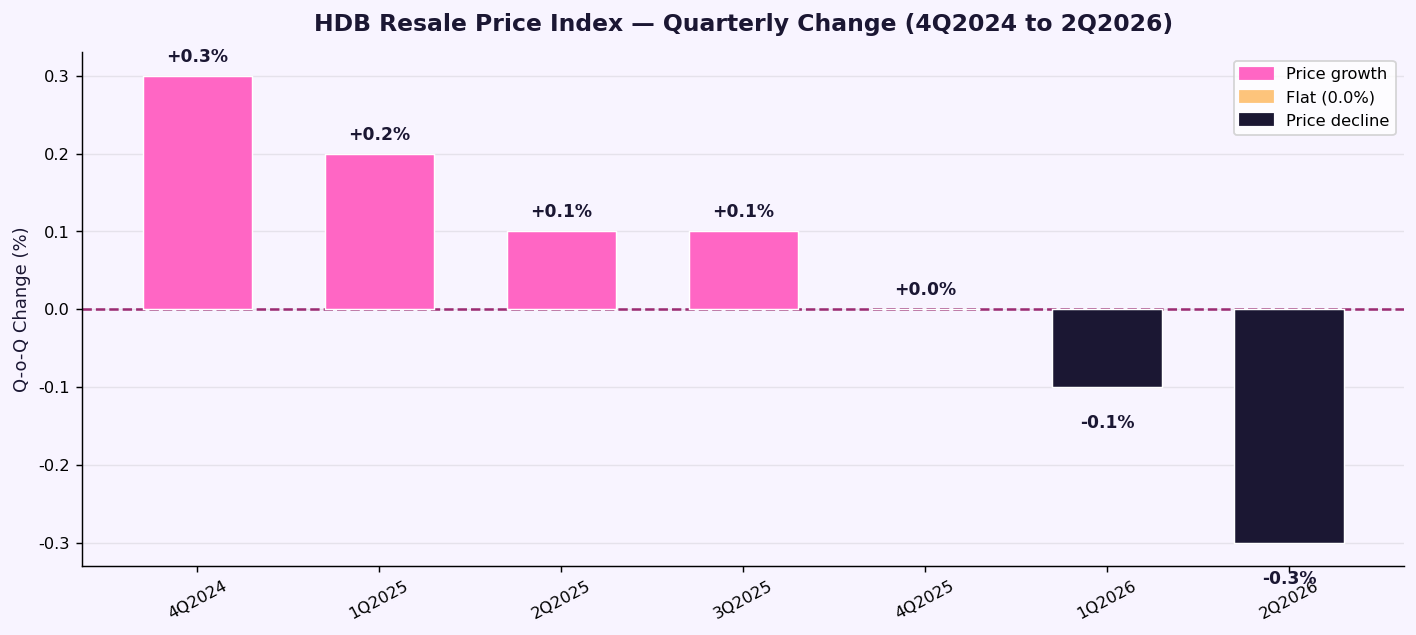
The removal was attributed to sustained moderation in HDB resale prices. The HDB
Resale Price Index (RPI) has now recorded two consecutive quarters of decline — down
0.1% quarter-on-quarter in 1Q2026 and a further 0.3% in 2Q2026 — following five
consecutive quarters of slower or zero growth from 4Q2024 to 4Q2025.

Timeline of HDB cooling and de-cooling measures Singapore 2022 to 2026
Key HDB cooling and de-cooling measures from September 2022 to July 2026. (Source: HDB / LovelyHomes.com.sg)

Who Does This Apply To?

The removal of the wait-out period applies to private residential property
owners
who meet two conditions simultaneously:

  1. They purchase a non-subsidised HDB resale flat (i.e., they are not
    taking a new BTO or subsidised flat); and
  2. They do not take an HDB housing loan — they must
    finance the purchase with cash, CPF savings, or a bank loan.

If you plan to use an HDB concessionary loan, the rules may differ — check directly
with HDB at the point of application as eligibility conditions for HDB loans are
separately assessed.

Seniors exemption: Singaporeans aged 55 and above downsizing to a
four-room or smaller non-subsidised resale flat were already exempted from the wait-out
period when it was introduced in 2022. This exemption continues to apply.

Why Was It Removed? The Market Context

HDB cited sustained price moderation as the basis for removing the measure. The
following chart shows the quarter-on-quarter change in the HDB Resale Price Index from
4Q2024 to 2Q2026:

HDB Resale Price Index quarterly change 2024 to 2026 bar chart
HDB Resale Price Index quarter-on-quarter change. Two consecutive declines in 1Q2026 and 2Q2026 prompted the policy reversal. (Source: HDB / LovelyHomes.com.sg)

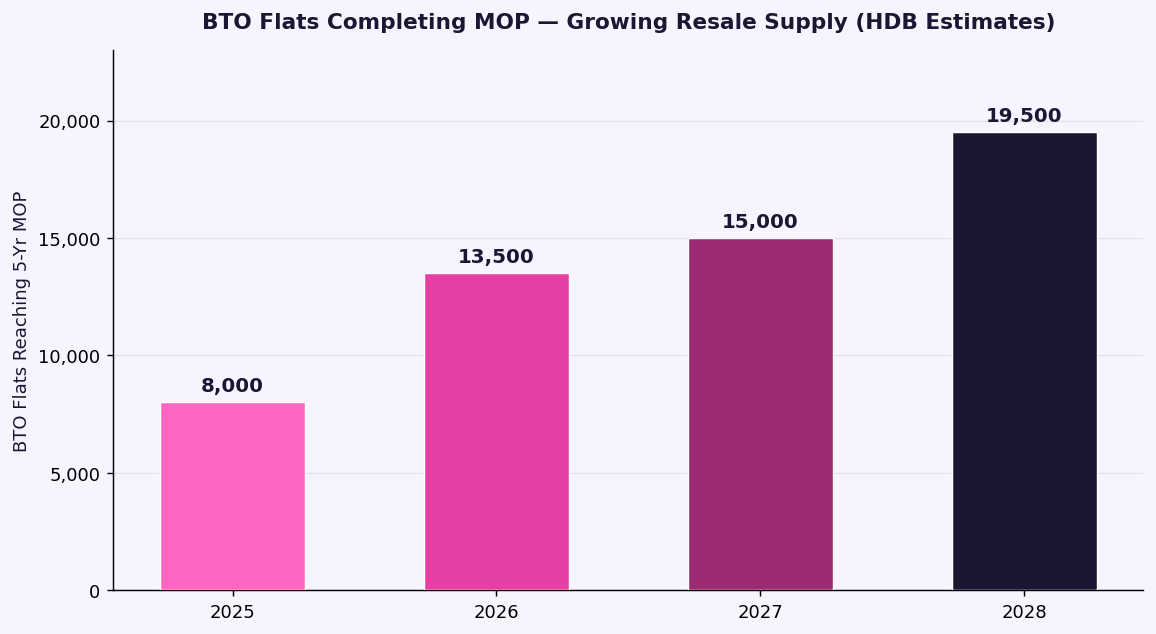
HDB also noted that a rising pipeline of BTO flats completing their 5-year Minimum
Occupation Period (MOP) will add further supply to the resale market in coming years —
providing an additional structural buffer against price escalation.

BTO flats completing MOP 2025 to 2028 supply pipeline Singapore HDB
BTO flats reaching MOP will surge from 8,000 in 2025 to an estimated 19,500 by 2028, adding significant resale supply. (Source: HDB / LovelyHomes.com.sg)

Practical Implications for Private Property Owners

Before 28 July 2026, the decision to downsize from private property to an HDB resale
flat required careful planning around the 15-month gap — including renting or staying
with family while the wait-out period elapsed. That constraint is now gone.

Here is a summary of the key conditions that remain:

Condition Before 28 Jul 2026 After 28 Jul 2026
Wait-out period 15 months after disposing private property No wait-out period
Flat type Non-subsidised HDB resale only Non-subsidised HDB resale only (unchanged)
Loan type Must not use HDB concessionary loan Must not use HDB concessionary loan (unchanged)
Seniors 55+ (≤4-room) Exempted from day one (Sept 2022) Still exempted (rule no longer relevant)
HDB LTV limit (bank loan) 75% (since Aug 2024) 75% (unchanged)

Worked Example

Scenario: Couple downsizing from condo to HDB resale

Profile: A Singaporean couple, both aged 52, who own a private
condominium. They wish to sell and move into a 5-room HDB resale flat at S$750,000 in
Bishan. They will finance with cash and a bank loan (no HDB loan).

Before 28 July 2026:
They sell their condo → wait 15 months → complete HDB resale purchase.
Minimum total process: ~18–22 months end-to-end.

After 28 July 2026:
They sell their condo and can exercise the Option to Purchase (OTP) on the HDB resale
flat on the same day, if desired. The transaction can complete within the standard
8-week OTP completion window.

ABSD position: Because they are disposing of their private property,
and the HDB resale flat will be their only property at completion, they are treated as
purchasing their first residential property for ABSD purposes — ABSD rate is 0% for
Singapore Citizens on the first property.

Note: Consult HDB and a conveyancing solicitor on the precise timing of the sale and
purchase to ensure the private property is disposed of before — or simultaneously with
— the completion of the HDB purchase, so as not to incur ABSD on the HDB flat.

Related Articles

Frequently Asked Questions

Does the removal apply to all HDB purchases?

No. The wait-out period removal applies only to purchases of non-subsidised HDB resale flats without an HDB concessionary loan. It does not apply to new BTO flats, DBSS flats, or subsidised resale flat purchases with HDB loans.

What if I still have an outstanding private property mortgage — can I buy an HDB resale flat now?

You must have fully disposed of (i.e., sold and completed) your private residential property before — or on the same day as — completing your HDB resale purchase. The wait-out period is removed, but the requirement to own only the HDB flat at completion remains.

Do I pay ABSD on an HDB resale flat if I previously owned private property?

If you sell your private property and the HDB resale flat is your only property at the point of completion, you are treated as a first-property buyer for ABSD. Singapore Citizens pay 0% ABSD on their first residential property. ABSD cannot be paid using CPF — it must be paid in cash.

Can foreigners benefit from this policy change?

Foreigners are generally not eligible to purchase HDB resale flats except under specific circumstances (e.g., a foreigner married to a Singapore Citizen or PR, subject to HDB eligibility). The policy change itself is not targeted at foreigners.

Was the HDB loan-to-value (LTV) limit also changed on 28 July 2026?

No. The HDB LTV limit remains at 75% (as set in August 2024) for those taking an HDB concessionary loan. Bank loan LTV limits for HDB resale flats are set by MAS and remain unchanged. Only the 15-month wait-out period was removed on 28 July 2026.

What happened to the other September 2022 cooling measures?

The September 2022 package included three measures: (1) the 15-month wait-out period (now removed); (2) the HDB LTV cut from 85% to 80% (subsequently tightened further to 75% in August 2024); and (3) an interest rate floor of 3% for HDB loan assessment. As of 4 August 2026, only the wait-out period has been removed — the LTV limit and stress-test rate remain in place.

I am a senior aged 55. Does anything change for me?

Seniors aged 55 and above were already exempted from the wait-out period when it was introduced in 2022, specifically when downsizing to a four-room or smaller non-subsidised resale flat. With the wait-out period fully removed, the senior exemption is effectively subsumed — the rule no longer applies to any eligible private property owner.


Disclaimer: This article is for general informational purposes only and
does not constitute legal, financial, or property advice. Rules and figures cited are
based on HDB and government announcements current as at 4 August 2026 and may change
without notice. Always verify with HDB or a qualified professional before making any
property decision. LovelyHomes is not affiliated with any property agency.

Singapore MOP Guide 2026: Minimum Occupation Period Rules Explained

Singapore MOP Guide 2026: Minimum Occupation Period Rules Explained

Quick Answer — Singapore MOP at a Glance

  • MOP stands for Minimum Occupation Period — the mandatory period during which you must physically occupy your flat as your primary residence before you can sell it on the open market.
  • Standard HDB flats (BTO, SBF, resale): 5 years from key collection date.
  • HDB Plus and Prime flats (under the 2024 classification): 10 years from key collection date.
  • Executive Condominiums (EC): 5 years from TOP, after which the EC is partially privatised (SC/PR buyers only); after 10 years, fully privatised and open to all buyers including foreigners.
  • During MOP, you cannot sell or sublet the entire flat, and you cannot own another private residential property in Singapore.
  • You can sublet individual rooms (with HDB approval) and continue to enjoy the flat normally during MOP.
  • Breaching MOP conditions is a serious offence: HDB may compulsorily acquire the flat, and the owner forfeits any subsidies received.
  • After MOP, you may sell on the resale market, rent out the entire flat, and buy private property (subject to ABSD on the second property).

What Is the MOP and Why Does It Exist?

The Minimum Occupation Period (MOP) is a policy condition applied by the Housing & Development Board (HDB) to all subsidised public housing flats. At its core, MOP is a residency requirement: you must live in the flat as your primary home for the stipulated period before you are permitted to dispose of it on the open resale market or own another private residential property in Singapore.

The MOP exists for two interconnected policy reasons. First, it deters speculative “flipping” of HDB flats — short-term buying and selling that would inflate resale prices and undermine the Government’s objective of keeping public housing affordable and accessible for genuine owner-occupiers. Second, it reinforces the “owner-occupier” nature of HDB subsidies: the grants, concessionary loans, and ballot priorities extended to buyers are predicated on the flat being a home, not an investment vehicle.

MOP is not a new concept — it has been part of Singapore’s public housing policy for decades. What has changed is the duration: the 2024 classification of flats into Standard, Plus, and Prime tiers introduced a new 10-year MOP for Plus and Prime flats, reflecting the stronger subsidies and more desirable locations these flats carry.

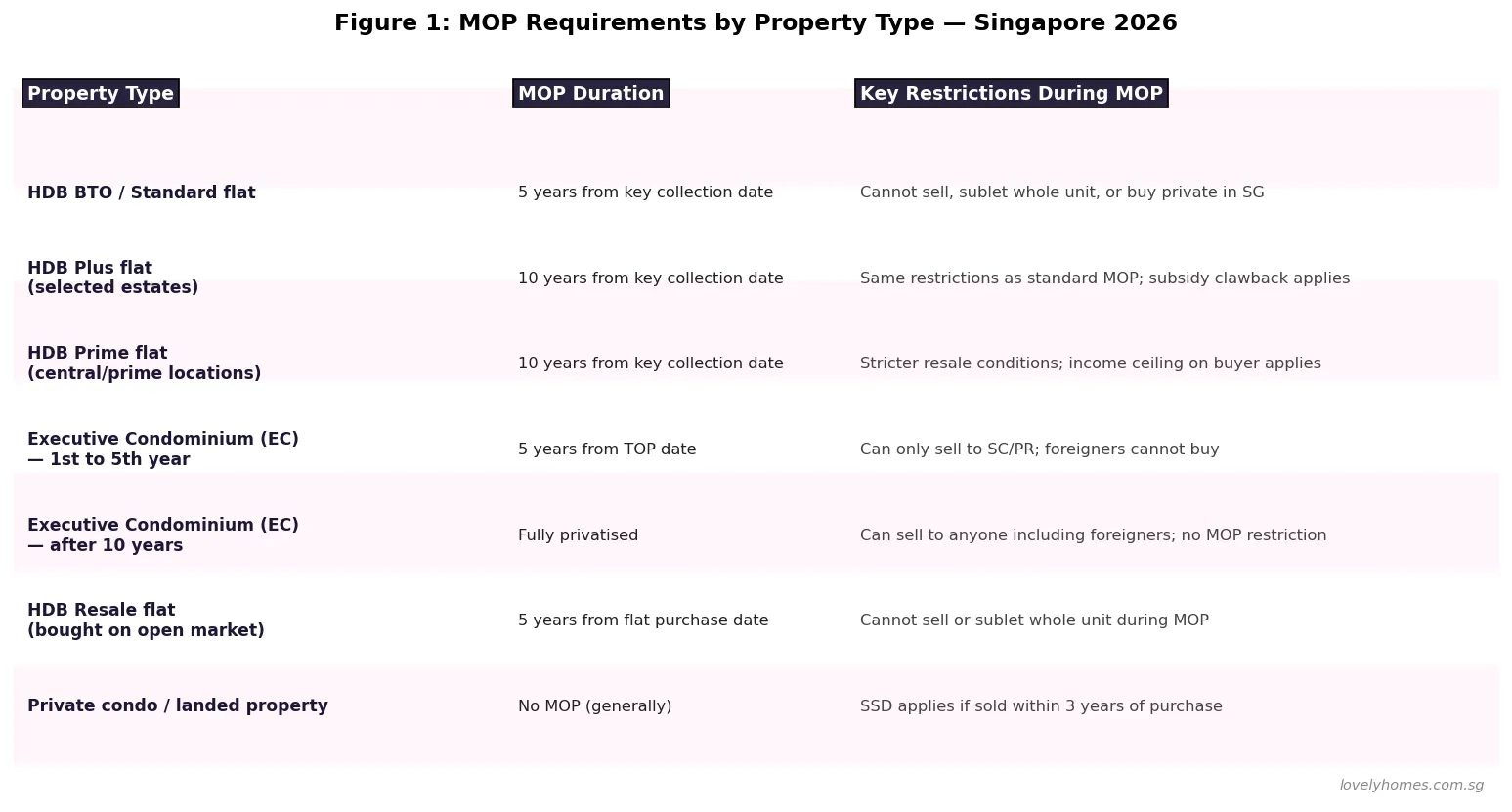
MOP requirements by property type HDB EC private Singapore 2026 table
Figure 1: MOP Requirements by Property Type — Singapore 2026. The 10-year MOP for HDB Plus and Prime flats applies to flats offered from the August 2024 BTO exercise onwards.

HDB Standard Flats: The 5-Year MOP

The majority of HDB flats — whether obtained via Build-to-Order (BTO), Sale of Balance Flats (SBF), or bought on the open resale market — are subject to a 5-year MOP running from the date of key collection (for BTO and SBF) or the date of resale completion (for resale flat purchases).

Note that the clock starts from the date you physically take possession of the keys, not from the date you applied for the flat, paid the booking fee, or signed the Agreement for Lease. For BTO flats, this distinction matters because construction timelines mean the gap between application and key collection can be 3 to 5 years or more. Buyers who applied in 2019 and collected keys in 2023 started their 5-year MOP in 2023, not in 2019.

During the 5-year MOP, the flat must remain your registered residential address. Extended absences from Singapore do not automatically suspend or extend the MOP clock, but HDB monitors occupancy through its routine checks and may take action if a flat is found to be unoccupied or rented out in its entirety.

Owners of HDB resale flats who have already served an MOP in their previous HDB flat do not carry over any “MOP credit”: each flat purchase starts a fresh 5-year MOP from key collection or resale completion date.

HDB Plus and Prime Flats: The 10-Year MOP

From the August 2024 BTO exercise onwards, HDB introduced the Standard-Plus-Prime classification to differentiate flats by location desirability and the level of subsidy received. Plus flats are in choicer suburban or well-connected locations; Prime flats are in central or prime areas that would command premium private property prices if not for the public housing subsidy.

Both Plus and Prime flats carry a 10-year MOP and additional post-MOP resale conditions:

  • Income ceiling on resale buyer: When you eventually sell a Plus or Prime flat after MOP, the buyer must satisfy an income ceiling (currently S$14,000 per month for families, S$7,000 for singles). This condition persists for the life of the flat.
  • Subsidy clawback: On resale after MOP, a portion of the subsidy received at purchase is clawed back through a reduced resale levy or an explicit recovery mechanism specified in the flat purchase conditions.
  • No private property ownership concurrently: Same as Standard MOP — you cannot own any private residential property in Singapore during the 10-year period.

These additional conditions reflect the Government’s intent that the deep subsidies in Plus and Prime flats benefit genuine long-term residents, not those who “subsidise-in, flip-out” as soon as the MOP expires.

Executive Condominiums: A Two-Stage MOP

Executive Condominiums (ECs) are a hybrid housing type — initially sold by private developers under HDB rules, then progressively privatised over time. Their MOP structure is unique:

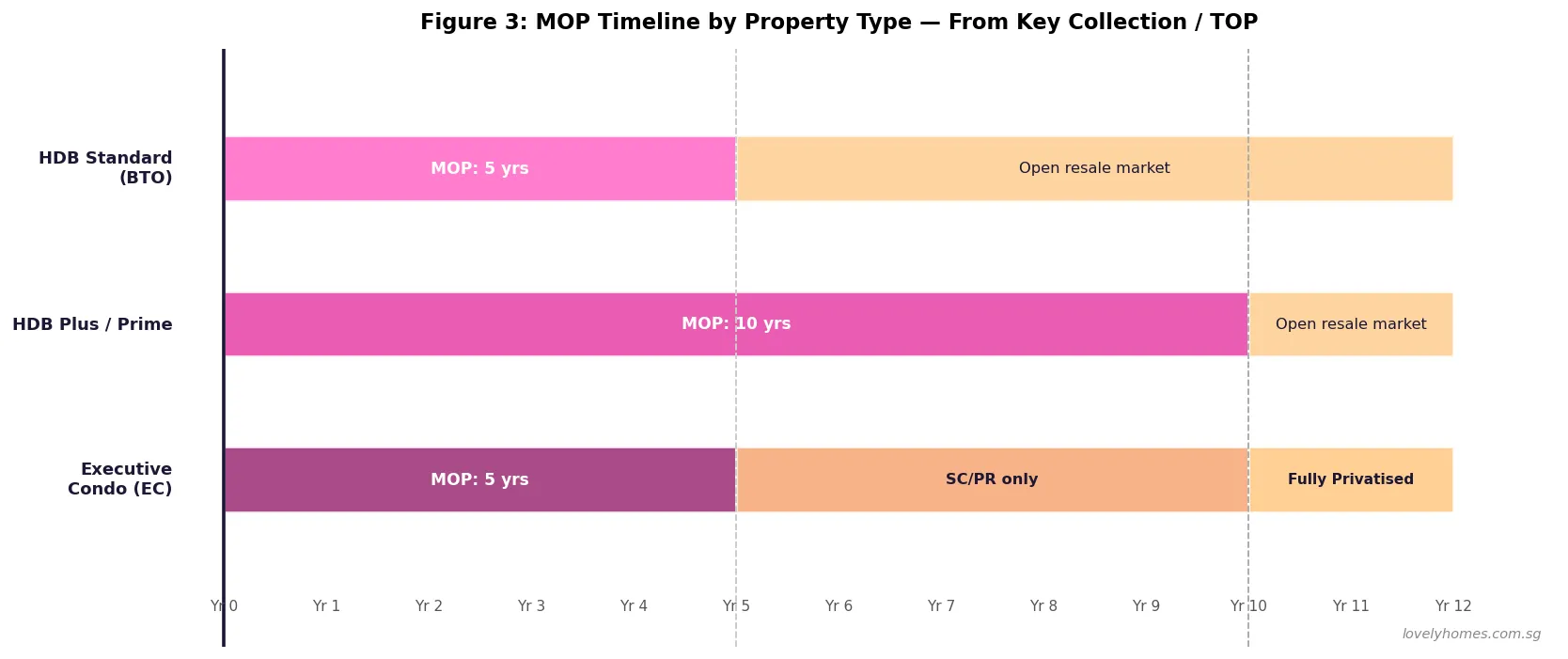
  • Years 0–5 (first 5 years from TOP): MOP period. You must occupy the EC as your primary residence. You cannot sell or sublet the entire unit. You cannot own other private residential property in Singapore. Sale is restricted to Singapore Citizens and Permanent Residents only.
  • Years 5–10 (partial privatisation): The EC is partially privatised. You may sell your unit on the open market, but only to Singapore Citizens or Permanent Residents. Foreigners are still excluded.
  • After Year 10 (full privatisation): The EC is fully privatised. All restrictions are lifted. You may sell to anyone — including foreigners and corporate entities — at market price. The EC is now essentially indistinguishable from a private condominium in the resale market.

The EC MOP clock starts from the Temporary Occupation Permit (TOP) date of the development — not the individual unit’s handover date. This is different from HDB BTO, where the MOP runs from the individual key collection date. For ECs, all units in the same development share the same TOP date and therefore the same privatisation milestones.

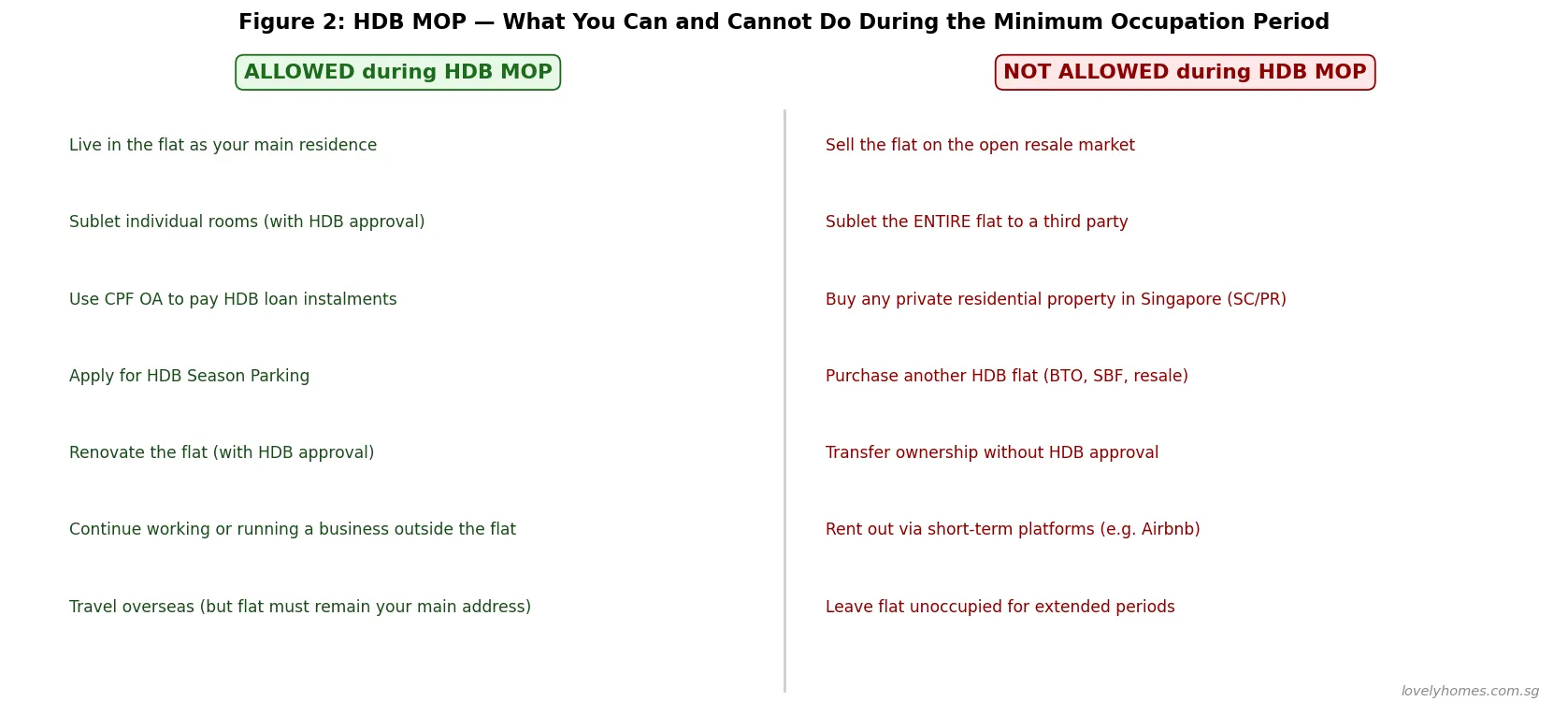
HDB MOP what you can and cannot do during minimum occupation period Singapore
Figure 2: HDB MOP — What You Can and Cannot Do During the Minimum Occupation Period. Room subletting requires HDB approval and is subject to nationality and quota rules.

Private Property Ownership During MOP

One of the most practically significant MOP restrictions concerns private property ownership. During the MOP of any HDB flat (Standard, Plus, or Prime) or EC (during the 5-year MOP), neither you nor any occupier listed on the flat’s registration can own any private residential property in Singapore.

This restriction extends to:

  • Private condominiums (including those still under construction)
  • Landed residential properties (terrace, semi-detached, bungalow)
  • Private ECs in their own MOP period
  • Residential properties held through a company or trust (in certain circumstances)

Overseas private properties are generally not caught by this rule, as HDB’s jurisdiction covers Singapore residential properties. However, owners should note that if they sell their HDB flat post-MOP and purchase a private property, they will need to manage their CPF usage carefully and ensure the ABSD position on their new purchase is correctly assessed.

The restriction does not prevent you from retaining commercial property, industrial property, or non-residential assets. It also does not prevent you from inheriting property during MOP — though you would need to dispose of the inherited private residential property promptly (within 6 months for local; varies for overseas). HDB must be informed of any inheritance of residential property during MOP.

Worked Example: The Tan Family MOP Journey

Mr and Mrs Tan, both Singapore Citizens, applied for a 4-room BTO in Tampines in April 2019. After a 3½-year construction timeline, they collected their keys on 15 October 2022. Their 5-year MOP ends on 15 October 2027.

During MOP (Oct 2022 – Oct 2027):

  • The Tans live in the flat as their primary residence. They sublet one bedroom to a foreign worker (HDB approval granted; within the 6-person occupancy cap).
  • In 2024, Mr Tan inherits a share in his late father’s HDB flat in Ang Mo Kio. Since it is another HDB flat (not private property), this does not breach MOP. However, HDB requires the Tans to dispose of the inherited HDB flat within 6 months, as households are generally not permitted to own two HDB flats simultaneously.
  • The Tans do not purchase any private property during this period.

After MOP (from 15 October 2027):

  • The Tans’ flat has appreciated from its purchase price of S$380,000 to an estimated resale value of S$620,000 based on comparable transactions in Tampines.
  • They decide to upgrade to a S$1.5M OCR private condo. They sell their HDB flat first (netting approximately S$588,000 after CPF refund and outstanding loan).
  • As SC buying their first private property (no other property after HDB sale): ABSD = S$0. BSD = S$44,600 on S$1.5M.
  • HDB concessionary loan (2.6%) was discharged; bank loan for private condo at ~3.5% SORA-pegged.
  • They could alternatively choose to retain the HDB flat (now permitted to rent out the entire flat post-MOP) and buy a private property — but ABSD of 20% (S$300,000 on a S$1.5M purchase) would apply as this would be their second residential property.
Singapore MOP timeline HDB standard HDB Plus EC minimum occupation period chart
Figure 3: MOP Timeline by Property Type — From Key Collection / TOP. EC units become freely tradeable on the open market (including to foreigners) only after 10 years from the development’s TOP date.

What Happens if You Breach MOP?

Breaching MOP conditions is treated seriously by HDB. The consequences are severe and non-negotiable:

  • Compulsory acquisition: HDB may compulsorily acquire the flat and pay the owner the lower of the purchase price or the current valuation, effectively wiping out any appreciation in value. The owner also forfeits housing grants received at purchase.
  • Financial penalties: In addition to or in lieu of compulsory acquisition, HDB may impose financial penalties. The quantum varies by severity and whether it is a first or repeat offence.
  • Repayment of grants and concessions: All grants (EHG, Family Grant, PHG) and any concessionary loan interest rate benefits must be repaid with accrued interest.
  • Legal proceedings: Persistent or egregious breaches (e.g., subletting the entire flat without approval, using the flat for illegal commercial purposes) can result in court action and criminal liability.

Common MOP breaches include: subletting the entire flat without approval; leaving the flat vacant for an extended period while residing elsewhere; and purchasing a private property or EC during the MOP period. HDB conducts periodic checks, and it also relies on tip-offs from neighbours and members of the public.

What Opens Up After MOP?

The end of MOP unlocks a range of options that were unavailable during the mandatory period:

  • Sell on the resale market: You may list your flat for sale to eligible buyers on the HDB resale portal.
  • Sublet the entire flat: With HDB approval, you may rent out your entire flat (not just individual rooms). Subletting rules include nationality requirements for tenants, minimum occupancy periods, and an overall cap on the number of occupants.
  • Purchase private residential property: You (and co-applicants) may buy a private condo or landed property in Singapore, subject to ABSD at the prevailing rate for your buyer profile. If you retain the HDB flat, the private purchase is treated as a second property (ABSD at 20% for SC).
  • Buy another HDB flat: You may apply for another BTO, SBF, or resale flat — though you must dispose of your current flat within 6 months of taking possession of the new one (for BTO/SBF) or before the new resale flat’s completion.

What Might Come Next: MOP Policy Trends

The introduction of the 10-year MOP for Plus and Prime flats in 2024 was a significant policy shift, and it would be unusual for HDB to further extend or tighten MOP conditions in the near term. However, several policy conversations are ongoing:

The Government has signalled that it will monitor the impact of the new classification carefully, particularly on resale prices in Plus and Prime estates. If Plus/Prime flats are seen to appreciate rapidly despite the longer MOP and tighter resale conditions, further administrative measures are not out of the question. Conversely, if the classification dampens demand for these flats at launch, HDB may recalibrate pricing or grant levels rather than adjusting MOP.

For standard 5-year MOP flats, no change is expected in the near term. The 5-year MOP has been a cornerstone of HDB policy stability and changing it would have significant knock-on effects on resale market liquidity and upgrader demand.

Summary: MOP Quick-Reference

Property Type MOP Duration MOP Clock Starts From Key Post-MOP Change
HDB Standard BTO / SBF 5 years Key collection date Can sell, sublet entire flat, buy private
HDB Standard Resale 5 years Resale completion date Same as above
HDB Plus flat 10 years Key collection date Resale with income ceiling & subsidy clawback
HDB Prime flat 10 years Key collection date Resale with income ceiling & subsidy clawback
Executive Condo (EC) 5 years (TOP) Development’s TOP date Can sell to SC/PR; after 10 yrs, fully open
Private condo / landed No MOP N/A SSD applies if sold within 3 yrs of purchase

Frequently Asked Questions

Does the MOP clock pause if I go overseas for work?

No — the MOP clock runs continuously from the key collection date (or resale completion date) regardless of overseas travel. Extended absences from Singapore do not pause or reset the MOP. However, HDB requires that the flat remain your registered primary residence during MOP, and very prolonged absences (e.g., relocating overseas for 2 or more years) may draw scrutiny. If you are required to relocate for work, you should inform HDB, as there are limited administrative accommodations for exceptional circumstances, though these are assessed on a case-by-case basis and are not guaranteed.

Can I own a private property overseas during my HDB MOP?

Yes, generally. HDB’s MOP restriction applies to private residential properties in Singapore. Owning residential property overseas (e.g., a property in Malaysia, Australia, or the UK) does not breach HDB MOP conditions. However, you should note that some overseas properties may be relevant for ABSD purposes when you eventually sell your HDB flat and purchase private property in Singapore, and you should take professional advice on your specific cross-border situation.

What is the MOP for an HDB flat I bought on the resale market?

When you purchase an HDB flat on the resale market, a fresh 5-year MOP begins from the date your resale flat’s transaction is completed (i.e., your new flat’s resale completion date). It does not matter how long the previous owner owned the flat or whether they had already served MOP. Each sale resets the MOP obligation for the new buyer. This applies even if the selling owner had served 20 years of MOP — you start from zero again upon purchase.

Can I add or remove a co-owner during MOP?

Adding or removing an owner from an HDB flat’s title during MOP is generally not permitted without HDB’s approval. Approved exceptions include changes resulting from marriage, divorce, or the death of a co-owner. Attempting to transfer ownership (in whole or in part) to a third party during MOP, without satisfying one of these approved grounds, is treated as a breach of MOP conditions and may result in compulsory acquisition. If you need to make changes to the ownership structure, always seek HDB’s written approval first.

After MOP, do I need to inform HDB before buying private property?

You do not need HDB’s prior approval to purchase private property after your MOP has been fully served. However, if you choose to retain your HDB flat and buy a private property simultaneously, HDB imposes conditions: you must have fully paid off the HDB loan (or have a bank loan), and you must continue to reside in the HDB flat (you cannot sublet the entire HDB flat and simultaneously own private property without prior HDB authorisation). If you sell your HDB flat before or at the same time as buying private, there are no HDB-level restrictions (though ABSD and BSD will apply on the private purchase as normal).

What happens to my MOP if the HDB flat is repossessed or compulsorily acquired?

If HDB repossesses or compulsorily acquires your flat (e.g., due to a MOP breach or loan default), the compensation paid is the lower of the purchase price or the current market valuation. You do not receive the open-market resale value. Any housing grants received are deducted from the compensation. The experience is financially damaging and also affects your future HDB eligibility — individuals whose flats have been compulsorily acquired may face restrictions on purchasing another subsidised HDB flat. In cases involving serious breaches, HDB may refer the matter to the authorities for further action.

Related Articles

Disclaimer

This article is for general information only and does not constitute legal, financial, or housing advice. HDB policies, MOP rules, and resale conditions are updated periodically; always verify the current position with the Housing & Development Board (HDB) directly or through the HDB InfoWEB. Stamp duty rates and CPF rules are administered by IRAS and the CPF Board respectively. LovelyHomes is not a licensed property agent or housing advisory service.

HDB Resale Market Q2 2026: Prices Ease but Million-Dollar Flats Hit Record 491

HDB Resale Market Q2 2026: Prices Ease but Million-Dollar Flats Hit Record 491


⚡ Quick Answer: HDB Resale Market Q2 2026

  • Price trend: HDB Resale Price Index (RPI) declined in Q2 2026 — the second consecutive quarter of softening after a multi-year bull run
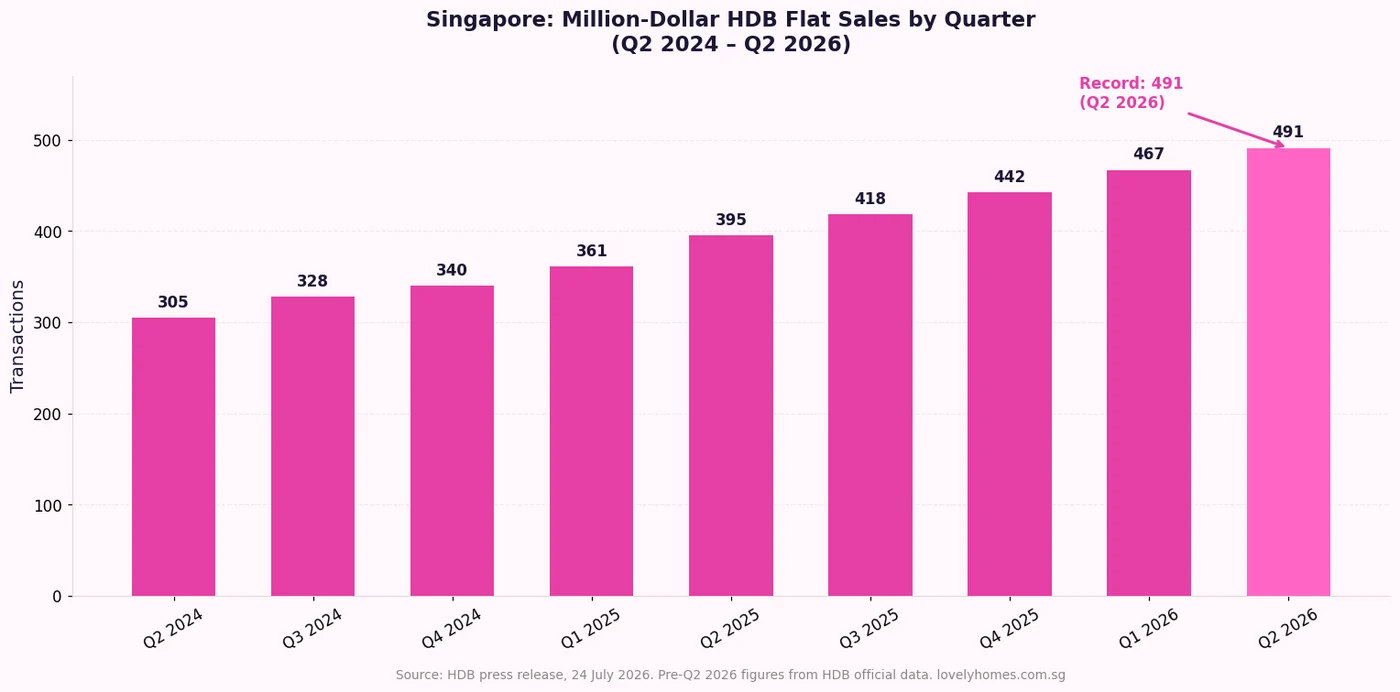
  • Record million-dollar flats: 491 million-dollar HDB resale transactions in Q2 2026 — an all-time quarterly high, up from 467 in Q1 2026
  • The paradox: Overall prices easing, yet the premium end of the market is more active than ever — a tale of two HDB markets
  • Private vs HDB divergence: URA data shows private residential prices rose +0.5% in Q2 2026, while HDB resale drifted lower — the widest divergence in recent years
  • Context: The price softening is modest — HDB resale remains significantly above pre-pandemic levels. This is a correction, not a collapse
  • What buyers should know: Affordability is improving for mass-market HDB buyers; premium location and high-floor units continue to command strong premiums
  • Source: HDB press release dated 24 July 2026; URA Q2 2026 flash estimates

HDB Resale Prices Ease Again — But the Premium Segment Tells a Different Story

Singapore’s Housing & Development Board released its Q2 2026 resale statistics on 24 July 2026, delivering a nuanced picture that will require careful reading. On the surface, the headline is straightforward: the HDB Resale Price Index (RPI) fell for the second consecutive quarter, extending a mild correction that began in Q1 2026. For most buyers who have been watching resale prices run continuously higher since 2020, this represents the clearest signal yet that the pandemic-era HDB bull run has entered a consolidation phase.

But the data contains a striking counterpoint. Within the same quarter that saw overall resale prices ease, 491 million-dollar HDB flats changed hands — the highest quarterly figure ever recorded by HDB. Singapore’s premium HDB segment, far from cooling, is operating at peak intensity. Understanding this apparent contradiction is the key to reading the Q2 2026 data correctly.

This report draws on HDB’s 24 July 2026 press release, URA’s Q2 2026 private residential flash estimates, and town-level resale data to give buyers and sellers a clear-eyed picture of where the HDB resale market stands at the midpoint of 2026.

Singapore million-dollar HDB flat sales quarterly trend Q2 2024 to Q2 2026 record 491 units bar chart
Figure 1: Singapore Million-Dollar HDB Flat Sales by Quarter (Q2 2024 – Q2 2026). Q2 2026 hit a record 491 transactions. Source: HDB, 24 July 2026.

The Overall Price Picture: A Modest and Orderly Correction

The HDB Resale Price Index has now posted two consecutive quarterly declines. This is the first such back-to-back softening since the 2018–2019 period, when a combination of ABSD hikes (in July 2018) and rising interest rates cooled both private and public housing markets simultaneously. The current correction has different drivers: mortgage rates have stabilised (the 3-month compounded SORA rate has eased from its 2024 peak of approximately 3.7% to around 2.9% as at June 2026), and HDB has steadily increased BTO supply, reducing urgency among first-time buyers who previously faced years-long queues.

The price softening is characterised as modest by historical standards. Resale flats across the board remain significantly above their pre-pandemic (Q4 2019) levels — the pandemic-era run-up added an estimated 30–40% to HDB resale prices between 2020 and 2023, and a two-quarter decline has unwound only a fraction of those gains. Buyers who purchased resale flats in 2020–2021 are still sitting on substantial paper gains in most towns.

HDB Resale Trend Q1 2026 Q2 2026 Direction
HDB Resale Price Index (RPI) Declined Declined ↓ 2nd consecutive quarter
Million-Dollar Flat Transactions 467 491 (record) ↑ All-time quarterly high
Private Residential PPI (URA) +0.3% +0.5% ↑ Outperforming HDB
Market character Selective softening Mass-market easing + premium surge Diverging

Source: HDB press release 24 July 2026; URA Q2 2026 flash estimates. RPI directional change only — specific index values at hdb.gov.sg.

The Million-Dollar Flat Phenomenon: 491 in a Single Quarter

The 491 million-dollar resale transactions in Q2 2026 represent a market segment that is effectively decoupled from the overall HDB resale trend. To put this in context: in the entirety of 2019 (before the pandemic acceleration), fewer than 500 million-dollar HDB flats transacted across the whole year. By Q2 2026, that is now a single-quarter figure.

The million-dollar flat segment is concentrated in a handful of locations: mature estates close to the city or with distinctive cachet. Bishan, Queenstown, Buona Vista, Toa Payoh, Clementi, and Ang Mo Kio consistently produce the bulk of these transactions. The common factors are remaining lease (typically 60+ years, some freehold-equivalent 99-year blocks built in the late 1990s now hitting 25–30 years remaining), floor level (high-floor units with city or greenery views), and proximity to primary schools with strong alumni ballot priority.

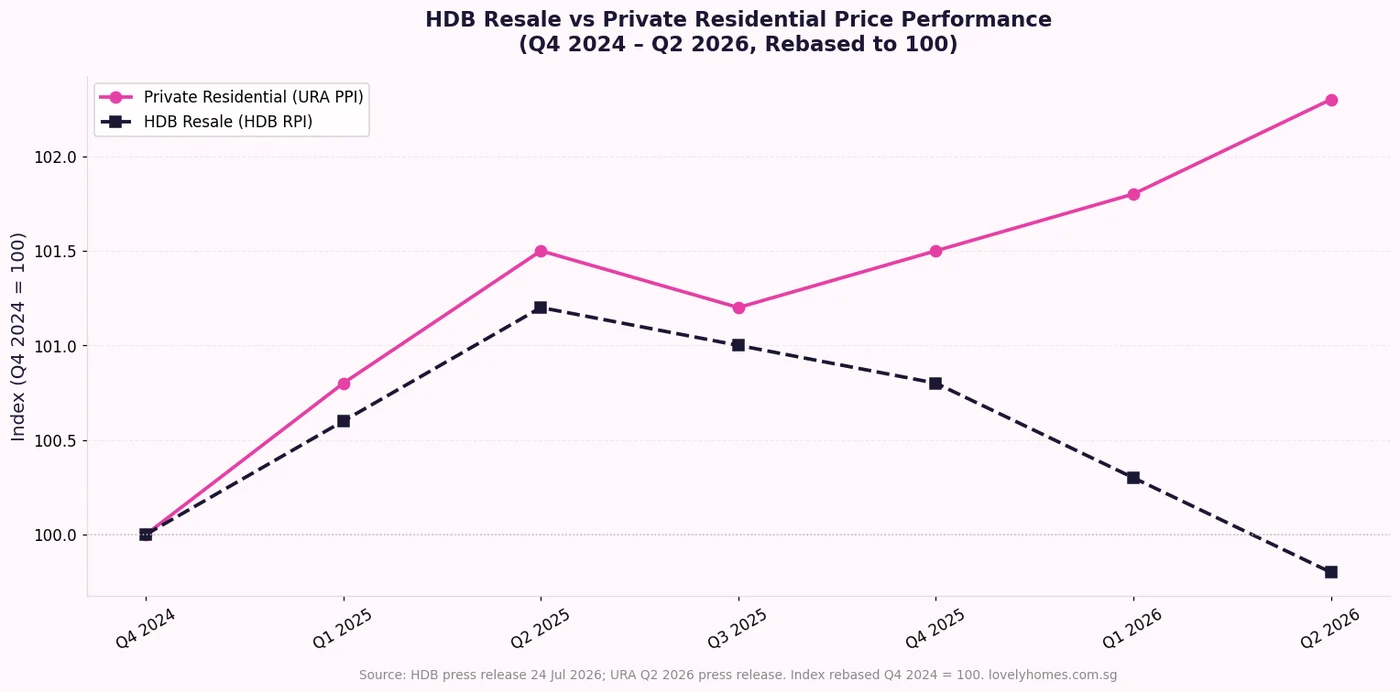
HDB resale price index vs URA private residential price index Q2 2024 to Q2 2026 divergence line chart
Figure 2: HDB Resale vs Private Residential Price Performance (Q4 2024 – Q2 2026, Rebased). The two markets are diverging for the first time since 2019. Source: HDB, URA. Note: Index values are illustrative trend indicators; refer to official HDB/URA releases for precise figures.

The HDB–Private Divergence: What It Signals

For the first time since 2019, Singapore’s HDB resale market and the private residential market are moving in opposite directions. URA’s Q2 2026 flash estimate showed private residential prices up +0.5% for the quarter (led by a +1.8% rise in the Core Central Region and +2.5% in the Landed segment), while HDB resale drifted lower. This divergence has meaningful implications for housing upgraders and property investors alike.

For HDB-to-private upgraders, the divergence is a double-edged sword: their HDB resale proceeds may be slightly lower than at the market’s Q3 2023 peak, while the private property they are purchasing has held its value or risen. The net affordability of the upgrade journey has therefore widened in favour of staying in HDB rather than upgrading — at least in the short term. This dynamic may itself be depressing resale volume as potential upgraders postpone the move.

For HDB resale buyers, the correction is an incremental improvement in affordability. A 4-room flat in Jurong West that might have commanded S$480,000 at the 2023 market peak may now transact at S$455,000–S$465,000 in comparable precincts, subject to block, floor, and condition. For buyers who were priced out during the 2020–2023 run-up, this is the most accommodating entry point in three years.

📊 Worked Example: Buying a 4-Room Resale HDB in 2026

Scenario: Singapore Citizen couple (first-time buyers) purchasing a 4-room HDB resale in Sengkang at S$540,000 (consistent with Q2 2026 median pricing for the area).

Item Amount (S$)
Purchase price 540,000
Buyer’s Stamp Duty (BSD) — 1% on first S$180K + 2% on next S$180K + 3% on balance 10,800
ABSD — Singapore Citizens, first residential property Nil
HDB conveyancing & legal fees (estimate) 1,600
Minimum down payment at 5% (HDB loan) or 25% (bank loan) 27,000 or 135,000
Enhanced Housing Grant (EHG) — if household income ≤ S$9,000/month Up to (80,000)
CPF Family Grant — first-timer couple buying 4-room or larger resale Up to (50,000)
Estimated monthly HDB loan repayment at 2.6% p.a. over 25 years on S$513,000 loan approx. 2,326/month

BSD: 1% × S$180K = S$1,800 + 2% × S$180K = S$3,600 + 3% × S$180K = S$5,400; total S$10,800. Grant amounts are illustrative — verify eligibility at homes.hdb.gov.sg. Figures do not constitute financial advice.

Why This Matters: Reading the Signal Correctly

Two-quarter HDB price declines are historically brief episodes in Singapore. Policy guardrails — including the BTO supply pipeline (which increases supply but also validates long-term demand by requiring buyers to commit years in advance), the loan-to-value framework under MAS Notice 645, and the Total Debt Servicing Ratio cap — tend to prevent both runaway inflation and disorderly corrections in the public housing segment.

The million-dollar flat figure of 491 is important precisely because it shows that premium demand is structurally intact even as the mass market softens. Singapore’s affluent households continue to see mature-estate HDB flats — particularly those in education-premium catchment zones — as a combination of lifestyle asset and inflation hedge. Until either school registration rules change materially or a large volume of new premium-location HDB supply enters the market (neither of which is imminent), the premium segment is unlikely to correct sharply.

For the mass market, the correction is a healthy unwinding of excesses built during a period of constrained supply and ultra-low rates. Buyers who waited now have a modestly more favourable entry point; sellers who need to transact should price competitively and be prepared for longer marketing periods than in 2021–2023.

What Might Come Next (Speculative Outlook)

The following is editorial analysis and not investment advice. Several factors will shape the HDB resale market through the second half of 2026:

  • BTO MOP completions: A cohort of flats from 2021 launches (when BTO applications surged) will complete their 5-year Minimum Occupation Period from 2026. This adds fresh resale supply, particularly in newer towns like Tengah, Punggol, and Bidadari — which could modestly increase inventory and extend the softening in those submarkets.
  • Interest rate trajectory: SORA has eased in 2025–2026, reducing the cost of HDB loans (capped at 0.1% above CPF Ordinary Account rate, currently 2.6% p.a.) and bank variable-rate mortgages. Further easing would improve affordability and could reverse the price trend in H2 2026.
  • Cooling measure review: The government has signalled willingness to adjust property market measures when warranted. If HDB resale prices continue declining, a targeted reduction in ABSD or HDB loan restrictions is not outside the realm of policy possibility, though the government typically moves slowly and cautiously.

Frequently Asked Questions: HDB Resale Market Q2 2026

Are HDB resale prices expected to keep falling in 2026?

Two consecutive quarterly declines do not constitute a trend on their own, and most market observers expect the Q2 2026 softening to be modest and temporary rather than the start of a sustained downturn. Singapore’s HDB resale market is supported by structural demand (permanent population growth, household formation, upgrader activity) and policy guardrails. The more likely scenario for H2 2026 is price stabilisation rather than further decline, though this depends heavily on interest rate movements and supply dynamics. Buyers and sellers should plan based on their own financial circumstances rather than trying to time the market.

What is driving record million-dollar HDB sales if overall prices are falling?

The million-dollar HDB segment is effectively a separate micro-market defined by location, lease, floor level, and school catchment rather than by general HDB supply-demand dynamics. These flats transact at prices that reflect their proximity to elite primary schools, remaining lease above 70 years, and their status as high-floor, city-view units in mature estates — attributes that are structurally scarce and for which affluent buyers pay a structural premium. The mass-market softening does not materially affect buyers who specifically want a CHIJ-, Ai Tong-, or Nanyang-catchment HDB flat with 80+ years remaining — there are simply very few of them, and multiple buyers typically compete for each one.

Should I buy or wait if HDB resale prices are falling?

This is a personal financial decision that depends on your household income, CPF savings, grant eligibility, and housing timeline. If you plan to live in the flat for 5–10 years, short-term price movements matter less than whether you can comfortably service the loan. If you are trying to time the market, note that two quarters of softening does not necessarily mean prices will fall further — previous HDB correction episodes (2014–2018) lasted longer but also offered only modest discount opportunities before prices rebounded. Consult a licensed financial adviser before committing.

Where do million-dollar HDB flat transactions typically occur?

The majority of million-dollar HDB resale transactions are concentrated in mature estates with central locations and strong school catchments. Consistently high-volume estates include Queenstown (near Henry Park Primary, Queensway Secondary), Bishan (near Ai Tong School), Toa Payoh (near CHIJ Primary), Ang Mo Kio (near Ai Tong and Anderson Primary), Clementi (near Nan Hua Primary), and Buona Vista. High-floor units in blocks with long remaining leases, unobstructed views, and MRT proximity within these estates typically clear S$1 million. Serangoon, Tampines, and Bedok have also seen increasing million-dollar transactions as buyers move slightly further from the city for comparable space.

How does the HDB Resale Price Index (RPI) differ from individual flat prices?

The HDB Resale Price Index is a composite index computed by HDB that tracks the overall price level of HDB resale transactions across all flat types and towns. It is analogous to URA’s Property Price Index for the private sector. A decline in the RPI means the weighted average transaction price across all HDB resale flats has fallen — but individual flat prices can and do diverge significantly from the index. A mature-estate 5-room flat with an exceptional view may transact well above its Q4 2025 level even as the national RPI falls. Buyers should use town-level transaction data from HDB’s resale flat prices portal at hdb.gov.sg for relevant pricing guidance rather than relying on the headline index alone.

What CPF housing grants are available for HDB resale buyers in 2026?

First-timer Singapore Citizens buying an HDB resale flat in 2026 may be eligible for the Enhanced Housing Grant (EHG, up to S$80,000 based on income), the CPF Family Grant (up to S$50,000 for 4-room or larger flats), and the Proximity Housing Grant (up to S$30,000 if buying near parents or married child). Single Singapore Citizens buying a 2-room or larger resale flat may qualify for the Single Person EHG (up to S$40,000) and the Singles Grant (up to S$25,000 for 4-room and larger). All grants are subject to income ceilings, property value caps, and other eligibility criteria — check your specific entitlement via the HDB Flat Portal at homes.hdb.gov.sg before house-hunting.

Disclaimer: This article is for general informational purposes only and does not constitute financial, legal or property investment advice. Price trend data is sourced from HDB’s press release of 24 July 2026 and URA’s Q2 2026 flash estimates. The illustrative price index chart (Figure 2) is a directional representation for editorial purposes; exact HDB Resale Price Index values are available at hdb.gov.sg. Million-dollar transaction figures (491 units in Q2 2026) are sourced from HDB’s official data. All other figures, estimates and projections are illustrative. Readers should verify all data at hdb.gov.sg, ura.gov.sg, iras.gov.sg, and cpf.gov.sg before making any property decision. Consult a licensed property agent, mortgage broker and/or qualified financial adviser for advice specific to your circumstances.

Executive Condominium Singapore 2026: EC Buying Guide

Executive Condominium Singapore 2026: EC Buying Guide

The Executive Condominium (EC) occupies a unique position in Singapore’s housing landscape: priced and governed closer to HDB than to the private market on launch day, yet destined to become fully privatised a decade later. For buyers who earn too much to qualify for a standard BTO flat but find private condo prices out of reach, an EC can offer remarkable long-term value — provided you understand the rules.

This guide explains how ECs work, who can buy them, what the income ceiling and MOP rules look like in 2026, and how to evaluate whether an EC fits your circumstances. All figures reflect current HDB and MAS rules as at 26 July 2026.

⚡ Quick Answer: Executive Condominium Key Facts (2026)

  • What it is: A hybrid housing type built and sold by private developers but subsidised at launch by HDB rules, with income ceilings and an MOP. Fully privatised 10 years after Temporary Occupation Permit (TOP).
  • Income ceiling: Combined gross monthly household income must not exceed S$16,000. At least one applicant must be a Singapore Citizen (SC); co-applicant can be SC or Singapore Permanent Resident (SPR).
  • Minimum Occupation Period (MOP): 5 years from TOP before you can sell on the open market. During MOP, you may not sublet the whole unit. After MOP, you may sell to SC/SPR.
  • Full privatisation: 10 years from TOP, after which the EC is treated as a private property — foreigners may buy, HDB rules no longer apply, and en bloc proceedings become possible.
  • Typical launch prices: S$1,100–S$1,450 psf as at mid-2026 — a significant discount to comparable private condos in the same area, which typically trade at S$1,500–S$2,500 psf.
  • CPF grants available: Eligible first-timer SC families may apply for CPF Housing Grants of up to S$30,000 for an EC purchase from a developer (HDB Proximity Housing Grant does not apply at launch).
  • Key risk: EC projects typically have a 3–4 year construction period. Buyers commit at BTO-style sales before the project is built and must manage a prolonged TOP wait combined with the 5-year MOP before any liquidity.

What Is an Executive Condominium? Origins and Purpose

The EC scheme was introduced by the Singapore government in 1995 to address a gap in the public housing ladder: professionals and dual-income couples earning above the HDB income ceiling but unable to afford private condo prices were left without a suitable housing option. The solution was a public-private hybrid — developed, built, and marketed by private developers, but subject to HDB eligibility rules and subsidy recovery mechanisms at the point of sale, for the first ten years of the unit’s life.

HDB selects EC sites on the Government Land Sales (GLS) programme, invites developers to tender, and sets the eligibility rules. The developer then markets and sells units to qualifying buyers at launch — typically at prices meaningfully below comparable private condos in the same precinct, reflecting the income ceiling constraint that limits demand.

Over the past decade, ECs have proven to be one of Singapore’s best-performing asset classes by capital appreciation for long-term owners. Units purchased at launch in 2012–2015 at S$700–$850 psf have in many cases transacted post-privatisation at S$1,200–$1,600 psf, generating substantial gains for owners who held through the 10-year window.

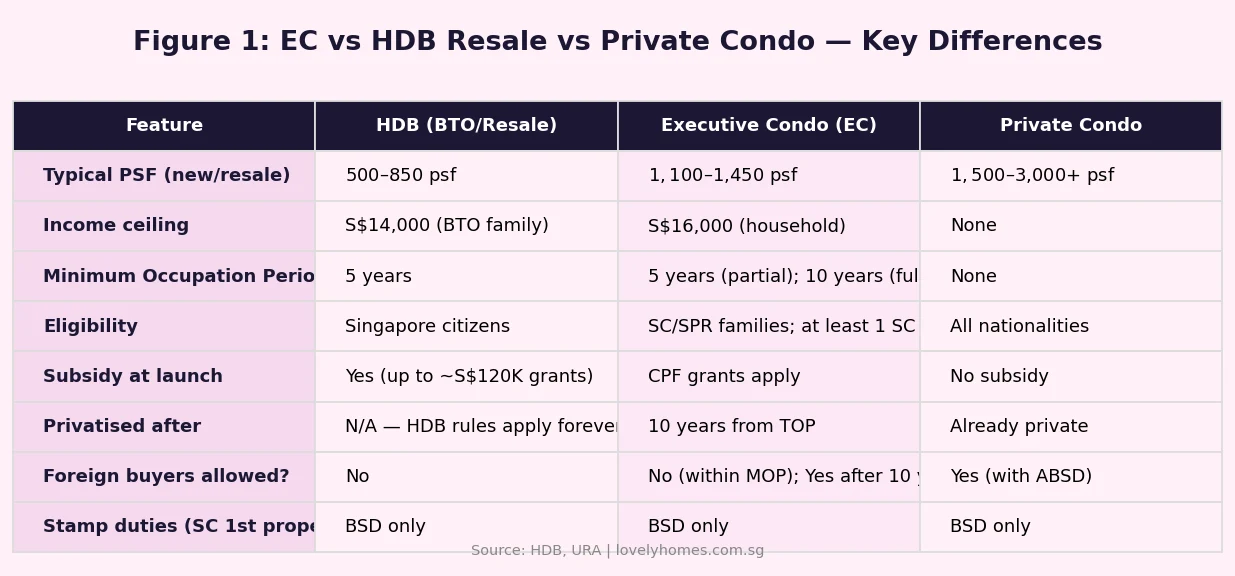
Executive condominium versus HDB resale versus private condo comparison table Singapore 2026
Figure 1: How ECs compare to HDB resale and private condos across price, eligibility, MOP, and ownership rules. Source: HDB, URA Realis.

Who Can Buy an EC? Eligibility Criteria (2026)

EC eligibility is governed by HDB and must be verified at the point of booking with the developer. The primary eligibility conditions for a new EC launch in 2026 are as follows.

Citizenship and family nucleus

At least one applicant must be a Singapore Citizen. The co-applicant may be a Singapore Citizen or a Singapore Permanent Resident. Common eligible family nuclei include married or engaged couples, SC/SPR families with children, and SC parents applying with SC children. Singles and SPR-only households cannot apply for a new EC launch.

Income ceiling

The combined gross monthly household income of all persons listed in the application must not exceed S$16,000. This ceiling was raised from S$12,000 to S$14,000 in August 2019 and further raised to S$16,000 in August 2024, reflecting income growth and housing affordability pressures. Income is assessed at the point of application on the basis of the most recent 12 months of payslips or, for self-employed persons, the most recent Notice of Assessment from IRAS.

Property ownership history

Applicants must not own any private residential property (in Singapore or overseas) or have disposed of one within the 30 months preceding the application date. If any applicant owns or has recently sold a private property, they are ineligible to purchase a new EC. For resale EC transactions (secondary market, post-MOP), the private property restriction does not apply — foreigners may buy after full privatisation at the 10-year mark.

Previous HDB / EC subsidy history

An applicant who has previously received an HDB housing subsidy (purchased a BTO flat, received a resale grant, or purchased an EC from a developer) is considered a second-timer and is eligible but does not qualify for the first-timer CPF grants. Both HDB flat owners and EC flat owners must ensure they have not benefited from two prior housing subsidies — HDB limits each household to two subsidised purchases over a lifetime in most circumstances.

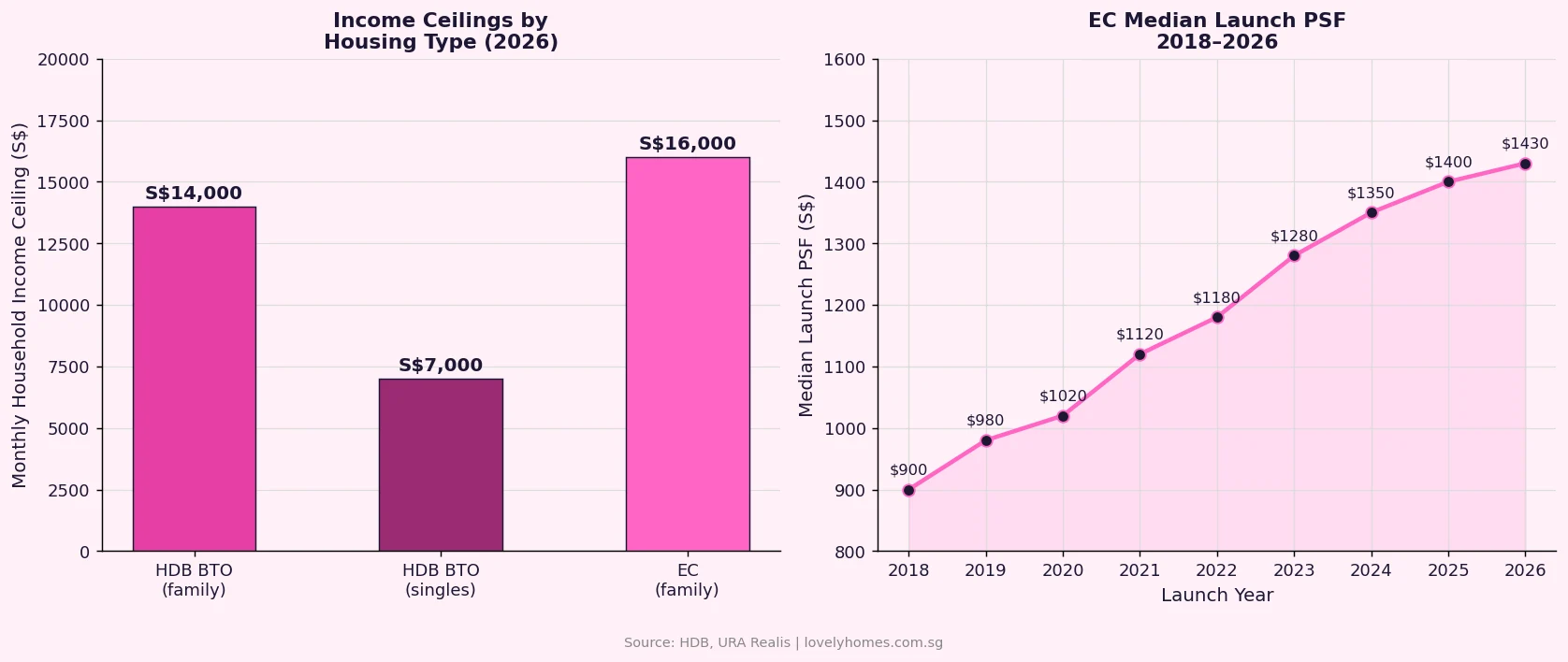
EC income ceiling versus HDB BTO income ceiling Singapore 2026 and EC median launch PSF trend 2018 to 2026
Figure 2 (left): Income ceilings by housing type in 2026 — HDB BTO (S$14,000 family), HDB BTO singles (S$7,000), EC (S$16,000). (right): EC median launch PSF trend 2018–2026. Source: HDB, URA Realis.

The MOP Rules: What You Can and Cannot Do During the First 10 Years

The EC’s MOP framework is more nuanced than that of a standard HDB flat and operates in two phases.

Phase 1 — First 5 years from TOP: Full MOP lockup

From the date of TOP, the EC owner enters a strict 5-year MOP. During this period: the unit cannot be sold on the open market; the entire unit cannot be sublet (renting out individual rooms is permitted, but the owner must continue to occupy the unit); and the EC remains subject to all HDB rules on ownership, nationality, and family nucleus.

Phase 2 — Years 5 to 10: Partial opening

Once the 5-year MOP has been served, the EC may be sold on the open market — but only to Singapore Citizens and Permanent Residents. Foreigners remain ineligible as buyers. The selling price is negotiated freely on the open market with no government reference pricing; by this stage, post-MOP EC resale prices typically reflect a significant uplift over the original launch price. Whole-unit subletting is also permitted from the end of MOP.

Phase 3 — 10 years from TOP: Full privatisation

At the 10-year anniversary from TOP, the EC is fully privatised. From this date, all HDB rules cease to apply. Foreigners may purchase units (subject to ABSD at the applicable foreign-buyer rate). En bloc sales become legally possible. The EC is indistinguishable from a freehold or leasehold private condominium for all practical purposes, except that all ECs are sold on 99-year leasehold land from the date of purchase.

Summary of EC Rules at a Glance (2026)

Rule Detail (2026)
Developer Private developer (HDB selects GLS site; developer builds and sells)
Income ceiling (launch) S$16,000 gross combined household income / month
Citizenship requirement At least 1 SC; co-applicant can be SC or SPR
Minimum Occupation Period 5 years from TOP (partial opening); 10 years (full privatisation)
Subletting (whole unit) Prohibited during first 5 years; permitted after MOP
Eligible buyers (5–10 yr) SC and SPR only
Eligible buyers (after 10 yr) All nationalities (foreigners pay ABSD)
Tenure 99-year leasehold
CPF grant (first-timer SC family) Up to S$30,000 (CPF Housing Grant for EC)
ABSD (SC first property) Nil (BSD only applies at purchase)
Resale levy applicable Yes, if applicant previously received HDB subsidy on a flat sold within last 30 months
Typical launch PSF (2026) S$1,100–S$1,450 psf (varies by location)

Worked Example: Buying an EC in 2026 — Full Cost Breakdown

📈 The Scenario

Daniel and Priya are a married couple. Daniel is a Singapore Citizen; Priya is a Singapore Permanent Resident. Combined gross monthly income: S$14,500 (below the S$16,000 ceiling). They are first-timers with no prior HDB or EC purchase. They are interested in a new EC launch at S$1,250 psf for a 1,076 sq ft (100 sqm) 3-bedroom unit.

Step 1 — Purchase price:
1,076 sq ft × S$1,250 psf = S$1,345,000

Step 2 — Buyer’s Stamp Duty (BSD):
On S$1,345,000: 1% on first S$180K = S$1,800 + 2% on next S$180K = S$3,600 + 3% on next S$640K = S$19,200 + 4% on next S$500K (capped at S$345K remaining) = S$13,800
Total BSD ≈ S$38,400

Step 3 — Additional Buyer’s Stamp Duty (ABSD):
Daniel is SC, Priya is SPR; both first-time. For a joint purchase, IRAS levies ABSD based on the buyer attracting the highest rate. SPR first property = 5%; SC first property = 0%. Highest rate governs the entire transaction. ABSD = 5% × S$1,345,000 = S$67,250. (Note: holding the property in the SC’s sole name avoids ABSD entirely — a common approach for mixed SC/SPR couples. Seek legal advice before structuring.)

Step 4 — CPF Housing Grant:
Daniel (SC first-timer) qualifies for the CPF Housing Grant for EC. With combined income of S$14,500, the grant is S$10,000 (grant tapers above S$12,000; check CPF Board’s grant schedule for the exact tier). This is credited to CPF-OA and used toward the purchase.

Step 5 — Down payment and loan:
EC purchases must be funded with a bank loan (HDB concessionary loans are not available for ECs). Maximum LTV is 75% of purchase price for first-time borrowers with no outstanding housing loans.
Loan: 75% × S$1,345,000 = S$1,008,750
Down payment: 25% = S$336,250 (minimum 5% in cash; remainder from CPF-OA)
Cash minimum: 5% × S$1,345,000 = S$67,250

Step 6 — TDSR/MSR check:
At 4.00% stress rate, 30-year tenure, monthly repayment on S$1,008,750 ≈ S$1,008,750 × (4.77/1,000) ≈ S$4,812/month
MSR check: S$14,500 × 30% = S$4,350/month. Monthly repayment S$4,812 > S$4,350 → MSR breach.
Solution: Reduce loan quantum or increase tenure (if age permits) or consider a smaller unit. Alternatively, if Daniel’s name alone is used, income drops — likely worse. At a lower unit price of S$1.2M, loan = S$900K, monthly repayment ≈ S$4,293 < S$4,350 → MSR passes.

Executive condominium MOP timeline from purchase to full privatisation Singapore
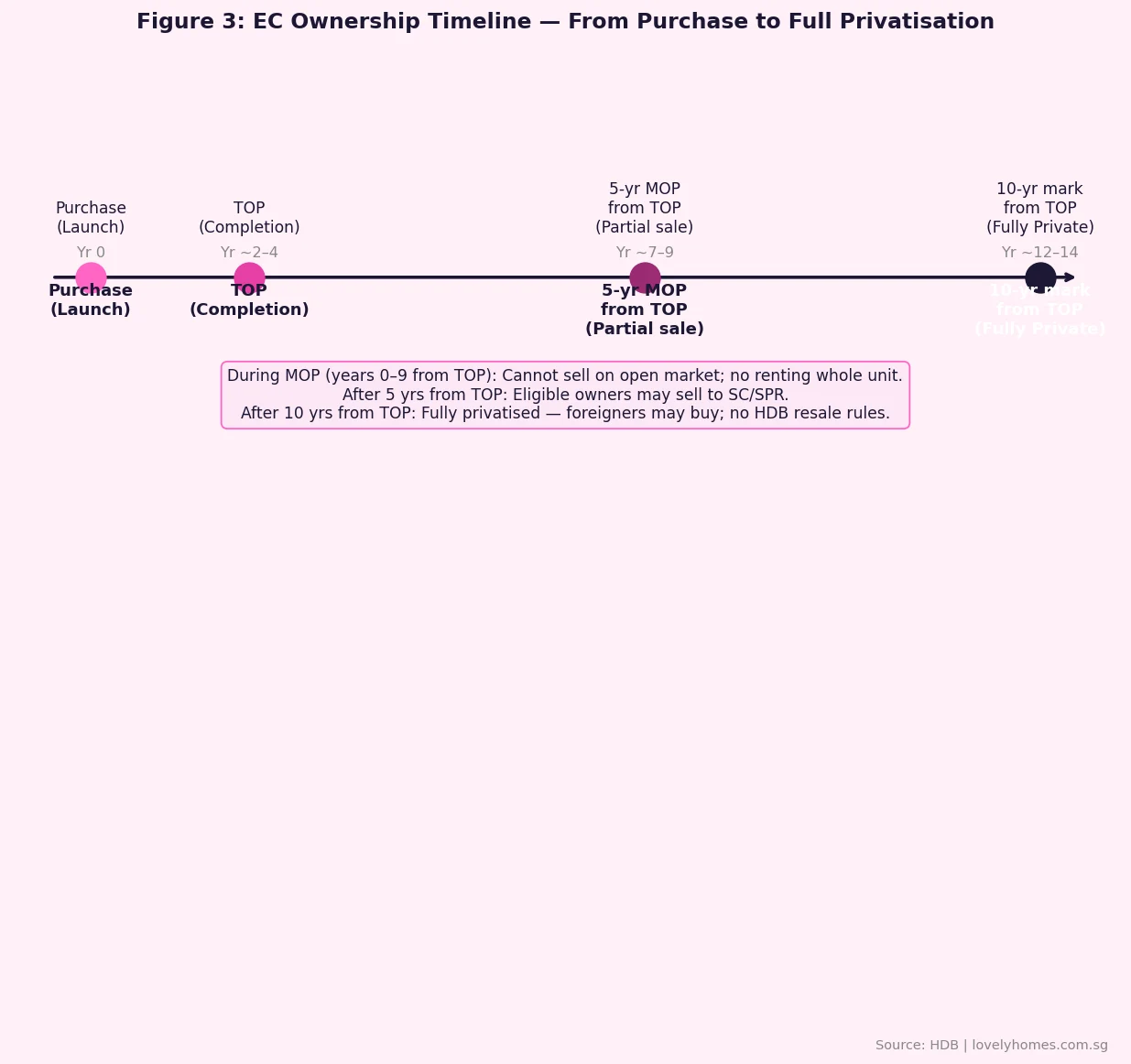
Figure 3: EC ownership timeline — from launch purchase through 5-year MOP to full privatisation at 10 years from TOP. Source: HDB.

Why ECs Often Outperform: The Long-Term Value Proposition

The EC’s structural advantage is its launch discount. Because the income ceiling constrains the buyer pool at launch, developers price ECs below the prevailing private market — typically a 15–25% discount to comparable private condos in the same estate at the time of launch. Yet once the 10-year privatisation window opens, the EC trades freely against all private properties in the same precinct, including those that have always been fully private. The discount disappears, but the unit remains the same.

Historical data from URA Realis confirms this pattern. EC projects launched in Districts 19, 23, and 27 between 2011 and 2015 at S$700–$850 psf have, post-privatisation, transacted at S$1,100–$1,600 psf — a compound annual appreciation of 5–8% for long-term holders. This significantly outpaces the HDB resale index over the same period and is broadly comparable to private condo appreciation in those estates.

The key risk is illiquidity. During the 10-year window, your capital is locked into the property. Unlike a private condo, you cannot quickly exit if your circumstances change — a job loss, a divorce, or a sudden need to upgrade or downsize requires either selling within the post-MOP SC/SPR pool or waiting for full privatisation. Buyers who are not confident they can remain in the unit for at least 5–7 years should think carefully before committing.

What Might Come Next for ECs

The EC pipeline as at mid-2026 remains active. Several GLS sites awarded in 2024 and 2025 are expected to yield new EC launches between Q4 2026 and 2028 in areas including Tengah, Bukit Timah Link, and Plantation Loop. Supply is expected to run at approximately 2,000–2,500 new EC units per year — comparable to recent averages.

Whether the S$16,000 income ceiling will be raised again is a matter for periodic HDB review. Prior adjustments (2015, 2019, 2024) have tracked income growth with a lag; with the next HDB review cycle typically every 3–5 years, the ceiling is unlikely to change before 2027 at the earliest. Buyers currently at or near the S$16,000 ceiling should apply before their income exceeds the limit — income is assessed at the point of application, not at TOP.

There is no indication from HDB that the 10-year privatisation rule will change. This has been a structural feature of the EC scheme since its inception and underpins the long-term investment thesis for EC buyers.

Frequently Asked Questions: Executive Condominium Singapore 2026

Can a single Singapore Citizen buy an EC?

No — singles cannot apply for a new EC launch from a developer. HDB requires EC applicants to form one of the eligible family nuclei: a married or engaged couple, a family with children, or in certain cases a joint application between SC parents and their SC child. Singles wishing to own an EC must wait until the post-MOP secondary market opens (5 years from TOP) and purchase from a resale EC seller. Note that after full privatisation at 10 years from TOP, foreigners — and therefore also SPR singles — may also purchase ECs on the open market. There are no restrictions on singles once full privatisation has occurred.

My spouse owns a private condo. Can we still apply for an EC?

No. If your spouse owns any private residential property in Singapore or overseas, or has disposed of one within the 30 months preceding the EC application date, you are ineligible to apply for a new EC launch. This restriction applies to all persons listed on the application. If your spouse’s private property was sold more than 30 months before the application date, you would generally be eligible — but you should verify this against HDB’s official eligibility checker, as rules can be nuanced depending on the timing of sale and grant history.

Do I have to take a bank loan for an EC, or can I use an HDB concessionary loan?

ECs must be financed entirely through a bank loan or your own funds — HDB concessionary loans (which offer below-market interest rates and are available for HDB flat purchases) are not available for EC purchases. This means EC buyers must pass the TDSR and MSR requirements applicable to bank loans, including the 4.00% stress-test rate. The maximum Loan-to-Value (LTV) for a first housing loan from a bank is 75% of the purchase price; buyers must fund the remaining 25% from CPF-OA savings and cash. At least 5% must come from cash.

What happens to my EC if I get divorced during the MOP?

A divorce during the MOP creates complications because neither party can sell the EC on the open market. HDB has a formal process for this situation: either one spouse can take over the full ownership (subject to eligibility checks), or HDB may grant an early release from the MOP in exceptional circumstances involving a court order. The resolution typically requires the couple to obtain a court order on the division of matrimonial assets, after which HDB will assess whether a transfer of ownership is permitted. Given the complexity, buyers contemplating separation during MOP should consult a family law practitioner and approach HDB directly.

Can I rent out my EC during the MOP?

You may rent out individual rooms during the MOP, provided you (and the other registered occupiers listed on the application) continue to occupy the flat. Renting out the entire unit is prohibited during the MOP. Violations can result in HDB taking action, including compulsory acquisition of the flat. Once the 5-year MOP is served, you may rent out the entire unit without restriction — at this point the EC opens to the SC/SPR resale market and standard market rents apply. This flexibility makes post-MOP ECs popular with investors who previously lived in the unit and wish to rent it out while residing elsewhere.

Is the EC income ceiling assessed on the date I book the unit or the date I sign the Sale and Purchase Agreement?

Income eligibility for an EC is assessed at the point of application to HDB for eligibility check — which typically occurs at or before the booking date. HDB issues an Eligibility Letter (or a similar approval) confirming the income ceiling assessment. If your income changes between the assessment date and the date of signing the Sales and Purchase Agreement, HDB’s rules require you to report any material change; if income has risen above the ceiling, eligibility may be withdrawn. Buyers close to the S$16,000 ceiling should time their application carefully and avoid taking on additional income sources (such as substantial freelance work) in the months preceding application.

Disclaimer: This article is for general informational and educational purposes only. It does not constitute financial, legal, or property purchase advice. EC eligibility rules, income ceilings, MOP requirements, CPF grant amounts, and stamp duty rates are set by HDB and the Monetary Authority of Singapore and may change at any time. All worked examples use figures that are illustrative only; actual costs depend on your individual circumstances, property selection, and prevailing rates. ABSD rates for mixed-citizenship couples depend on the share ownership structure and applicable remission rules — consult a licensed conveyancing lawyer before committing to a purchase. Always refer to HDB (hdb.gov.sg), CPF Board (cpf.gov.sg), and IRAS (iras.gov.sg) for the most current and authoritative information.

HDB PLH Model Singapore 2026: Rules, MOP & Clawback Guide

HDB PLH Model Singapore 2026: Rules, MOP & Clawback Guide

Quick Answer — HDB PLH Model Singapore 2026

  • What it is: The Prime Location Public Housing (PLH) model applies to HDB flats built in prime central areas. It imposes stricter resale rules to prevent windfall gains from heavily subsidised public housing.
  • 10-year MOP: PLH flats have a minimum occupation period of 10 years, double the standard 5 years for regular HDB flats.
  • Subsidy clawback: When you sell your PLH flat for the first time, you must return 6% of the resale price or current market value (whichever is higher) to HDB.
  • Buyer restrictions: PLH flats on first resale can only be sold to Singapore Citizens (not Permanent Residents). The buyer’s household income must not exceed S$14,000/month.
  • Launched: The PLH model was introduced by HDB in November 2021. Nine PLH projects have been launched through July 2026.
  • Rationale: The model ensures that HDB can continue to provide affordable housing in prime areas without enabling excessive speculative gains by early buyers.
  • Does not apply to standard BTO: Regular HDB BTO flats in non-prime areas follow the standard 5-year MOP and have no clawback.

What Is the HDB PLH Model? An Introduction

The Prime Location Public Housing (PLH) model is a set of enhanced rules applied by the Housing and Development Board (HDB) to new flats launched in prime central locations — areas where land costs, amenity access, and MRT connectivity make property significantly more valuable than in suburban HDB towns.

HDB first announced the PLH model on 26 October 2021 and applied it to two BTO projects launched in November 2021: King George’s Heights in Kallang/Whampoa and Rochor in the Rochor planning area. Since then, every BTO launch in prime central Singapore has been designated as a PLH project.

The model was created in response to a policy tension that HDB had long grappled with: how to keep public housing affordable for Singaporeans who need it in prime locations, while preventing taxpayer-subsidised flats from becoming speculative assets for buyers who resell at a significant profit years later. The PLH model does not cap resale prices, but it does impose a clawback mechanism and elongated MOP to reduce the speculative appeal of prime-location BTO flats.

PLH model versus standard BTO key differences table — HDB Singapore 2026
Figure 1: PLH Model vs Standard BTO — Key Policy Differences (2026). Source: HDB PLH Guidelines.

The Four Key PLH Model Rules Explained

1. Ten-Year Minimum Occupation Period (MOP)

Under the standard HDB framework, flat owners must live in their flat for a minimum occupation period of five years before they may sell on the open market, rent out the entire flat, or invest in private property. The PLH model doubles this to ten years. This means a household that purchases a PLH BTO flat in 2022 and collects keys in 2026 cannot sell until 2036 at the earliest.

The extended MOP has two effects. First, it limits the liquidity of PLH flats, which reduces their appeal to buyers who are not committed long-term occupiers. Second, it ensures the public housing stock in prime areas is occupied by genuine owner-occupiers for a meaningful period before it enters the resale market. The standard MOP rules apply in all other respects: PLH owners can still rent out individual rooms (not the whole flat) and may not own private residential property during the MOP.

2. Subsidy Clawback on First Resale

The single most financially material rule of the PLH model is the subsidy clawback. When a PLH flat owner sells their flat for the very first time after completing the MOP, they must pay HDB a sum equal to 6% of the resale price or 6% of the current market value — whichever is higher. This clawback represents a partial return of the enhanced subsidy that HDB provides for prime-location flats, which are priced below the true cost of building and the prevailing market value of the location.

The clawback applies only once — on the first resale. Subsequent buyers of a PLH flat (i.e., buyers who purchase on the open resale market after the first resale) are not subject to any clawback when they eventually sell. However, the standard 5-year MOP and normal HDB resale rules apply to subsequent buyers.

HDB PLH clawback worked example S$1.1 million resale 2026
Figure 2: PLH Clawback Worked Example — S$1.1M First Resale. The clawback is 6% of the higher of resale price or market value. Source: HDB.

3. Resale Buyer Restrictions

When a PLH flat owner completes the MOP and lists their flat for sale, the pool of eligible buyers is restricted compared to standard HDB resale. Specifically:

  • The first resale of a PLH flat can only be sold to Singapore Citizens. Permanent Residents (PRs) are not eligible to purchase a PLH flat on its first resale.
  • The purchasing household’s monthly income must not exceed S$14,000. This is the same income ceiling applied at the point of BTO purchase, and it is intended to ensure that prime-location public housing remains accessible to Singaporeans of moderate means, not only high earners.

These restrictions dissolve after the first resale. From the second resale onwards, PLH flats are treated similarly to standard HDB resale flats — PRs may purchase them, and there is no income ceiling for buyers.

4. No Concurrent Private Property Ownership During MOP

Like all HDB flat owners, PLH flat owners are prohibited from owning private residential property in Singapore or overseas during the MOP. Given the 10-year MOP, this is a longer constraint. Owners who receive private property by way of inheritance during the MOP must dispose of it within 6 months.

PLH Projects Launched to Date (as at July 2026)

Complete list of HDB PLH projects launched in Singapore as at July 2026
Figure 3: All PLH Projects Launched in Singapore Through July 2026. Source: HDB BTO Launch Records.

Nine PLH projects have been launched since the model’s introduction in November 2021. All are located in prime central areas that would otherwise have been too expensive for the majority of Singaporean households. Projects are distributed across several planning areas including Kallang/Whampoa, Rochor, Queenstown, Toa Payoh, and Ang Mo Kio Central — areas that were historically served only by ageing HDB estates and expensive private housing. The PLH model has enabled HDB to continue selling new flats in these desirable locations without surrendering the affordability mandate of public housing.

Summary Table — PLH Model at a Glance

Feature Standard BTO PLH Model BTO
Minimum Occupation Period 5 years 10 years
Subsidy Clawback (1st Resale) None 6% of resale price or current market value (higher)
1st Resale — Eligible Buyers SC and PRs Singapore Citizens only
1st Resale — Income Ceiling None S$14,000/month household income
Subsequent Resales Standard HDB resale rules Standard HDB resale rules (clawback does not apply again)
Location Any HDB town Prime central areas designated by HDB
Private Property During MOP Not allowed (5 yrs) Not allowed (10 yrs)

Worked Example — Buying and Selling a PLH Flat

Scenario: PLH Flat in Toa Payoh Crest — Purchase, MOP, and First Resale

BTO purchase (2023): A Singapore Citizen couple buys a 4-room PLH flat at Toa Payoh Crest for S$498,000 (after HDB grant). They collect keys in 2027 (typical BTO lead time of 4 years).

MOP expiry: 10-year MOP from key collection = MOP fulfilled in 2037.

First resale (2037 — illustrative): Market value assessed at S$980,000. Resale price agreed at S$1,020,000.

Item Amount
Agreed Resale Price S$1,020,000
Current Market Value (assessed by HDB) S$980,000
PLH Clawback Base (higher of the two) S$1,020,000
PLH Clawback Amount (6%) S$61,200
Proceeds After Clawback (before agent fees, legal, CPF refund) S$958,800
CPF Ordinary Account Refund (principal + accrued interest) Deducted separately per CPF rules

This is an illustrative scenario. Actual clawback is calculated at the time of resale. Market values in 2037 are entirely speculative. Consult HDB and a licensed financial adviser before relying on any projection.

Why the PLH Model Matters for Singapore Homebuyers

The PLH model represents a significant policy shift in how Singapore manages the tension between public housing accessibility and market efficiency in prime locations. Prior to its introduction, BTO launches in prime areas (like Pinnacle@Duxton in Tanjong Pagar, completed 2009) produced cases where buyers who paid subsidised BTO prices resold after 5 years at more than double what they paid, capturing gains that critics argued were underwritten by taxpayers via HDB’s development subsidies.

For prospective buyers weighing a PLH flat against other housing options, the key trade-offs are:

  • Pros: Genuine location premium — you get a flat in a central area at below-market pricing; well-designed, modern HDB blocks typically with excellent MRT access; strong community facilities.
  • Cons: Longer MOP reduces flexibility for 10 years; clawback reduces your eventual net sale proceeds; buyer pool restriction on first resale could limit your exit options; opportunity cost of not owning private property for 10 years.

For buyers who intend to live in their flat as a genuine long-term home, the PLH model’s constraints are relatively minor. For buyers who view the BTO as primarily an investment with an intention to upgrade quickly, the PLH model is a material deterrent — which is precisely its design intent.

What Might Come Next for the PLH Model

HDB has indicated it will continue launching PLH projects wherever prime central sites become available through redevelopment or land release. In 2026, the government is exploring further amendments to the HDB resale framework, including whether the PLH clawback rate should be adjusted over time to reflect changing market dynamics. HDB has also hinted at a potential review of the income ceiling for resale PLH flat buyers, given rising household incomes across Singapore. These are official statements subject to policy evolution — buyers should track HDB announcements at hdb.gov.sg for the most current guidance.

More broadly, the PLH model reflects a broader policy philosophy: Singapore’s land is finite, and the government’s role is to allocate housing resources equitably, not to maximise speculative gains for early buyers. As long as this philosophy guides housing policy, PLH-style constraints on prime-area BTO flats are likely to remain — and potentially expand.

FAQ — HDB PLH Model 2026

Can I rent out my PLH flat during the MOP?
You may rent out individual bedrooms in your PLH flat during the MOP (with HDB approval) but you cannot rent out the entire flat. Renting out the whole flat is only permitted after the MOP is satisfied. This is the same rule that applies to standard HDB flats — the PLH model does not change the subletting rules, only the MOP duration and first-resale conditions.
Does the 6% clawback apply every time I sell my PLH flat?
No. The clawback applies only on the first resale — when the original BTO buyer sells the flat after completing the MOP. From the second sale onwards (i.e., when the first resale buyer subsequently sells), no clawback applies. However, from the second sale onwards, PLH flats are treated as ordinary HDB resale flats subject to standard rules: 5-year MOP for the new buyer, no income ceiling, and PRs are eligible to purchase.
What happens if the market value is higher than my asking price at resale?
The PLH clawback is based on 6% of the higher of the resale price or the current market value as assessed by HDB. If a flat owner tries to reduce the stated transaction price to minimise the clawback, HDB’s valuation will be used instead. For example, if you sell at S$900,000 but HDB’s valuation is S$950,000, the clawback is 6% × S$950,000 = S$57,000 — not S$54,000. This provision prevents gaming of the clawback through under-declared transaction values.
Are there any PLH projects in the pipeline for future BTO launches?
HDB has not published a confirmed list of future PLH sites beyond those already announced. Historically, PLH projects have been launched in Kallang/Whampoa, Rochor, Queenstown, Toa Payoh, and Ang Mo Kio Central. It is widely anticipated that future BTO launches in areas such as Mount Pleasant (to be redeveloped), Tanglin, or any future central area sites will also be designated as PLH. HDB’s announcement for each BTO sales exercise will confirm PLH designation. Monitor HDB’s official website and press releases for updates.
Can I buy a PLH flat if my combined household income is S$14,500 per month?
At the point of BTO application (new PLH flat purchase), the income ceiling is S$14,000/month for a household. If your combined income exceeds S$14,000/month, you are not eligible to apply for a new PLH BTO flat. The same S$14,000/month income ceiling applies to buyers of PLH flats on first resale. However, if you are buying a PLH flat on its second or subsequent resale (i.e., not the first resale from the original owner), no income ceiling applies — you may purchase regardless of income, subject only to normal HDB eligibility conditions (citizenship status, family nucleus, etc.).
How does the PLH model compare to the HDB Plus flat classification introduced in 2024?
In 2024, HDB introduced a revised BTO flat classification: Standard, Plus, and Prime (PLH). Under this framework, the existing PLH designation was re-labelled as “Prime” flats. “Plus” flats occupy a middle tier — they are located in choice areas but not the most central prime zones. Plus flats have an 8-year MOP (compared to PLH’s 10 years) and a subsidy clawback that is somewhat lower than the 6% PLH rate. Standard flats retain the 5-year MOP and no clawback. For flats launched before the 2024 reclassification, the original PLH terms continue to apply. Always verify the specific classification and conditions for any flat you are purchasing with HDB directly.

Disclaimer: This article provides general information about the HDB Prime Location Public Housing (PLH) model and does not constitute financial, legal, or property advice. HDB policies, MOP rules, clawback rates, income ceilings, and eligibility conditions are subject to change by the government. All figures and policy details reflect information available as at July 2026. Verify all PLH-specific rules directly with HDB at hdb.gov.sg before making any housing decision. For matters involving CPF withdrawal, stamp duty, or legal documentation, consult the CPF Board (cpf.gov.sg), IRAS (iras.gov.sg), and a qualified lawyer respectively.

Translate »