HDB Resale Levy Singapore 2026: Complete Guide for Second-Timer Flat Buyers

HDB Resale Levy Singapore 2026: Complete Guide for Second-Timer Flat Buyers

Quick Answer — HDB Resale Levy at a Glance

  • The HDB Resale Levy applies when a second-timer household buys a new BTO flat or a new Executive Condominium (EC) from a developer after previously enjoying a housing subsidy.
  • Levy amounts range from S$15,000 (2-Room Flexi) to S$55,000 (Multi-Generation flat), based on the flat type you are selling.
  • The levy does not apply if you buy a resale HDB flat on the open market, or if you buy private property.
  • Payment comes from your sale proceeds (CPF refund + cash). If proceeds fall short, you must top up in cash.
  • The policy ensures those who already benefited from a large housing subsidy pay back a portion before receiving a second round of public housing support.
  • If your previous subsidised home was an Executive Condo (EC), the levy is calculated differently: 15% of your net EC resale proceeds, subject to a minimum of S$15,000.
  • Singles under the Single Singapore Citizen (SSC) scheme or Joint Singles Scheme may also be subject to the levy if buying a second subsidised flat.

What Is the HDB Resale Levy?

The HDB Resale Levy is a financial charge levied by the Housing and Development Board (HDB) on households who apply to purchase a second new subsidised flat — either a Build-to-Order (BTO) flat or a new Executive Condominium (EC) sold directly by a developer — after having previously benefited from a public housing subsidy.

The policy exists to uphold the principle of equity in Singapore’s public housing system. New BTO flats and ECs are sold at prices significantly below open-market value, a subsidy funded by taxpayers. HDB’s view is that once a household has enjoyed this advantage, they should not receive the same full quantum of subsidy a second time without contributing back to the system. The resale levy is that contribution.

Introduced in its current fixed-amount form for households that sold their first subsidised flat on or after 3 March 2006, the levy has remained a cornerstone of Singapore’s housing mobility framework. HDB administers the levy directly, collecting it at the point when the second subsidised flat purchase is completed.

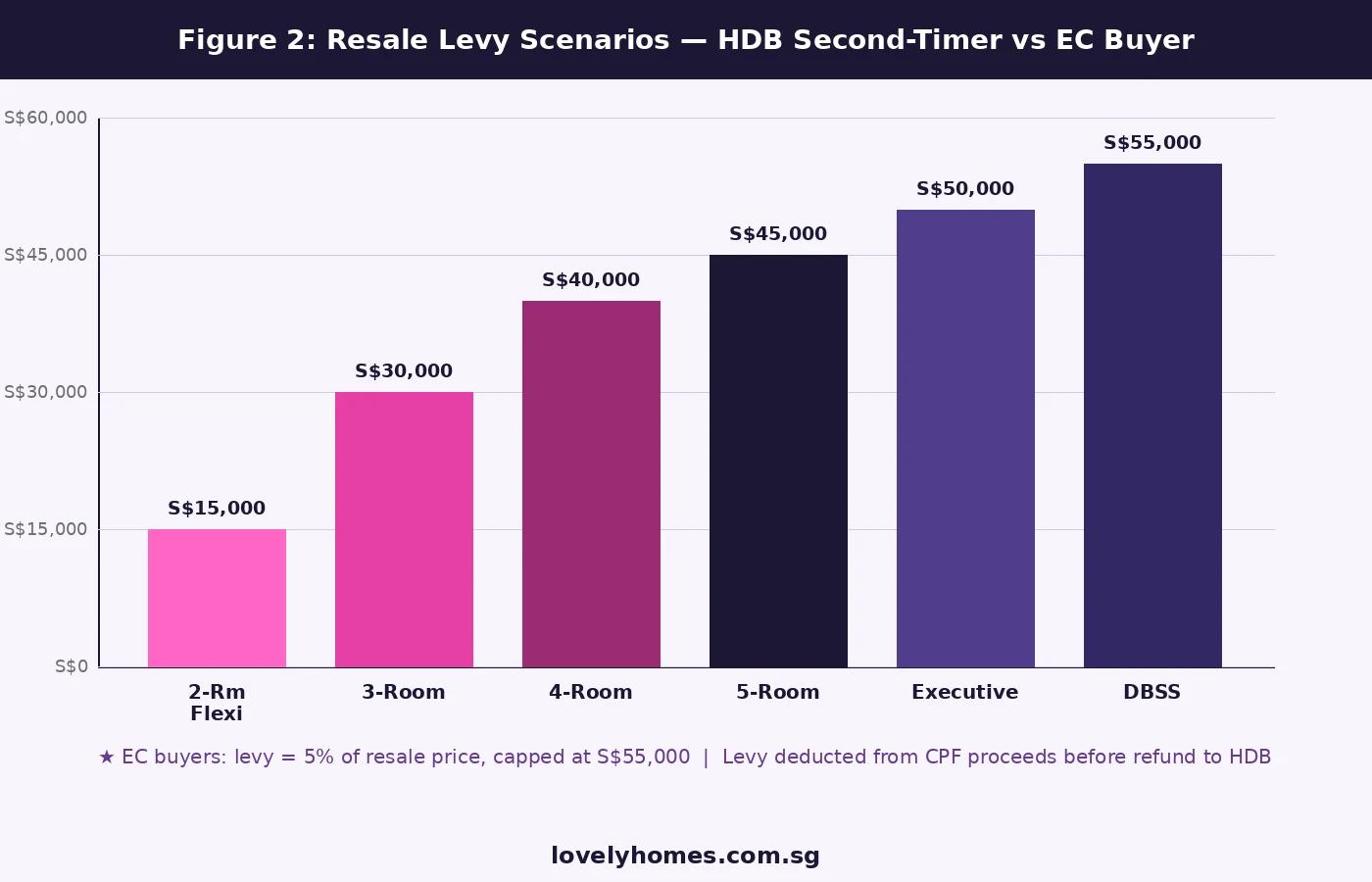
HDB Resale Levy amounts by flat type Singapore 2026 bar chart
Figure 1: HDB Resale Levy amounts by flat type — from S$15,000 (2-Room Flexi) to S$55,000 (Multi-Generation). Source: HDB, 2026.

Who Has to Pay the HDB Resale Levy?

The levy applies specifically to second-timer households. HDB classifies a household as a second-timer when at least one applicant has previously:

  • Received a housing subsidy from HDB — including the Enhanced CPF Housing Grant (EHG), the Central Provident Fund Housing Grant (CPF-HG), the Special CPF Housing Grant (SHG), or any earlier-generation grant — when buying a resale flat; or
  • Bought a new BTO, Build-to-Order Sales of Balance Flats (SBF), or EC flat directly from a developer.

If you are a first-timer — meaning you have never previously bought an HDB flat or EC, and have not received a CPF housing grant for a resale purchase — you do not pay the resale levy on your first BTO or EC purchase, regardless of price or flat type.

The levy also applies to Singles buying under the Single Singapore Citizen (SSC) scheme who have previously owned a subsidised flat, and to non-citizen spouses in joint applications where the Singapore Citizen applicant is a second-timer.

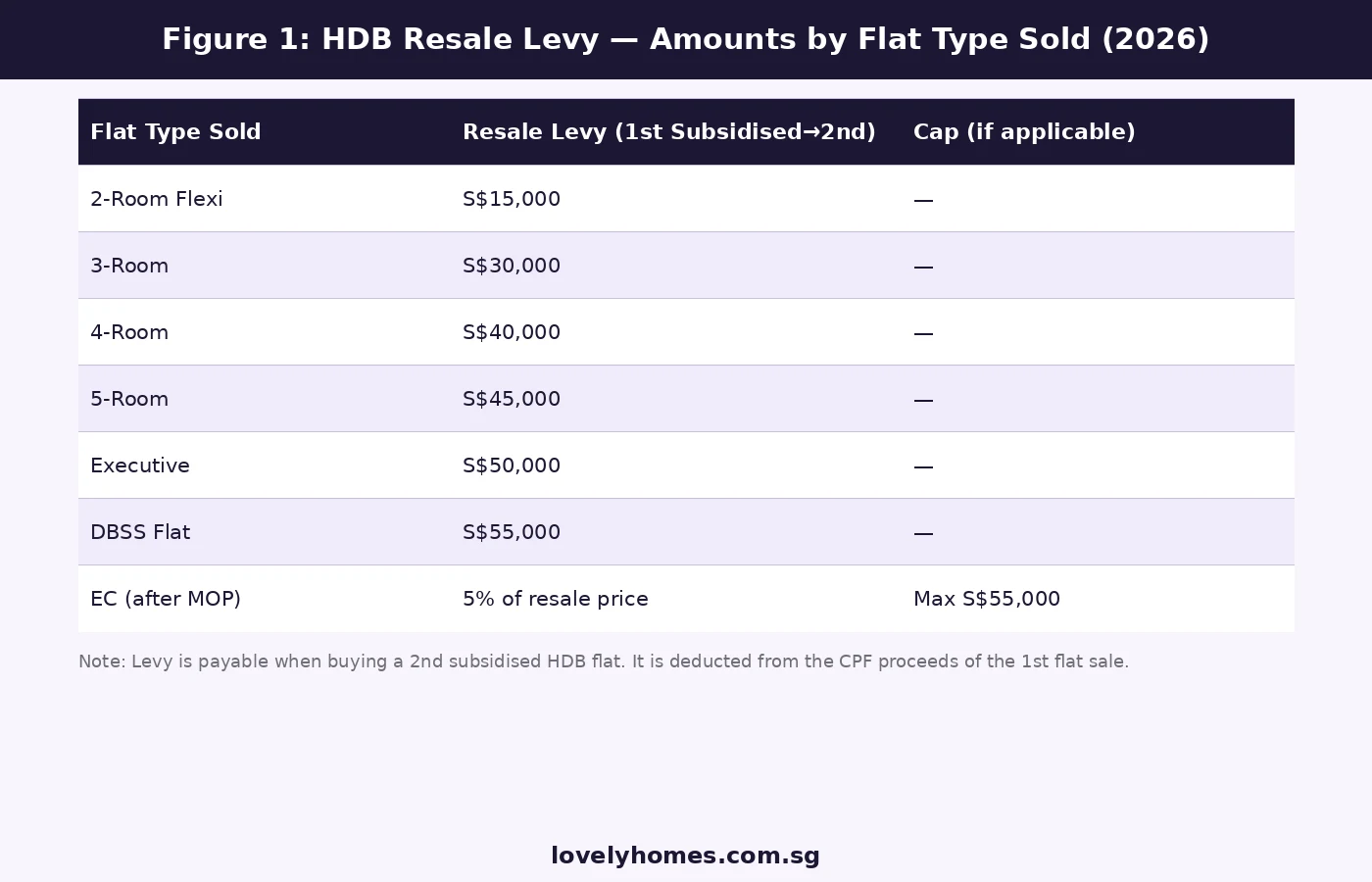
Resale Levy Amounts by Flat Type (2026)

The levy is fixed and based on the type of HDB flat you are selling, not on the purchase price of your next flat. This table shows the 2026 schedule:

Flat Type Sold Resale Levy (Fixed) Notes
2-Room Flexi S$15,000 Lowest levy; applies to Type 1 and Type 2 2-room flats
3-Room S$30,000 Applies to 3-room BTO and resale-with-grant flats sold
4-Room S$40,000 Most common flat type; levy payable on proceeds
5-Room S$45,000 Includes 5-room improved and 5-room model A flats
Executive Flat S$50,000 Applies to executive maisonettes and executive apartments
Multi-Generation (Multi-Gen) Flat S$55,000 Highest fixed levy; Multi-Gen flats are rare and targeted at three-generation families
DBSS Flat By flat type equivalent A DBSS 4-room incurs S$40,000; 5-room incurs S$45,000
Executive Condominium (EC) 15% of net resale proceeds (min. S$15,000) Only applies if you previously bought an EC directly from a developer and are now buying a new BTO/EC

Key point on DBSS flats: Design, Build and Sell Scheme (DBSS) flats are treated equivalently to standard HDB flats of the same flat type for levy purposes. The levy on a 4-room DBSS flat sold is S$40,000 — the same as a standard 4-room HDB.

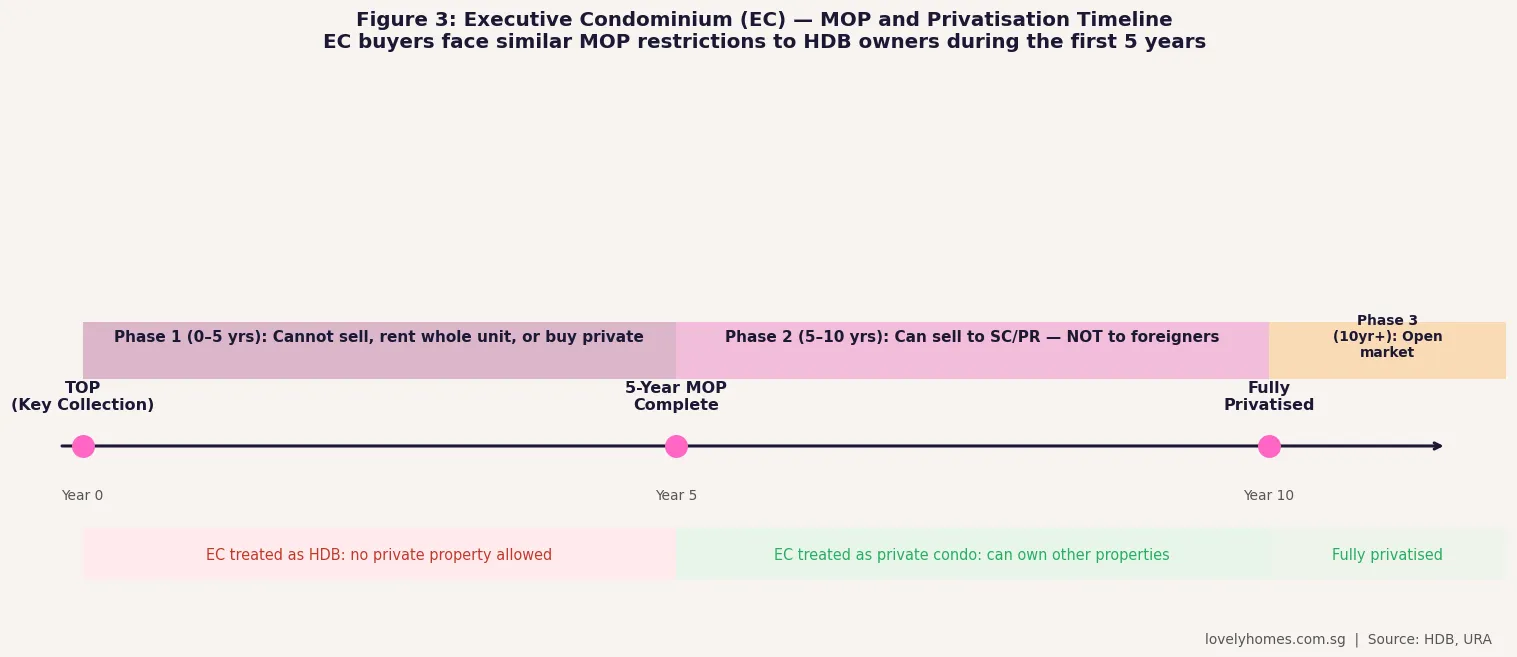
Key point on ECs: Executive Condominiums sold before their 5-year Minimum Occupation Period (MOP) are treated differently. If you sold your EC at the 5-year MOP mark (when it is still classified as an HDB property for resale purposes) and wish to buy another subsidised flat, your levy is calculated at 15% of the net resale price of the EC, not a fixed sum. The minimum levy is S$15,000.

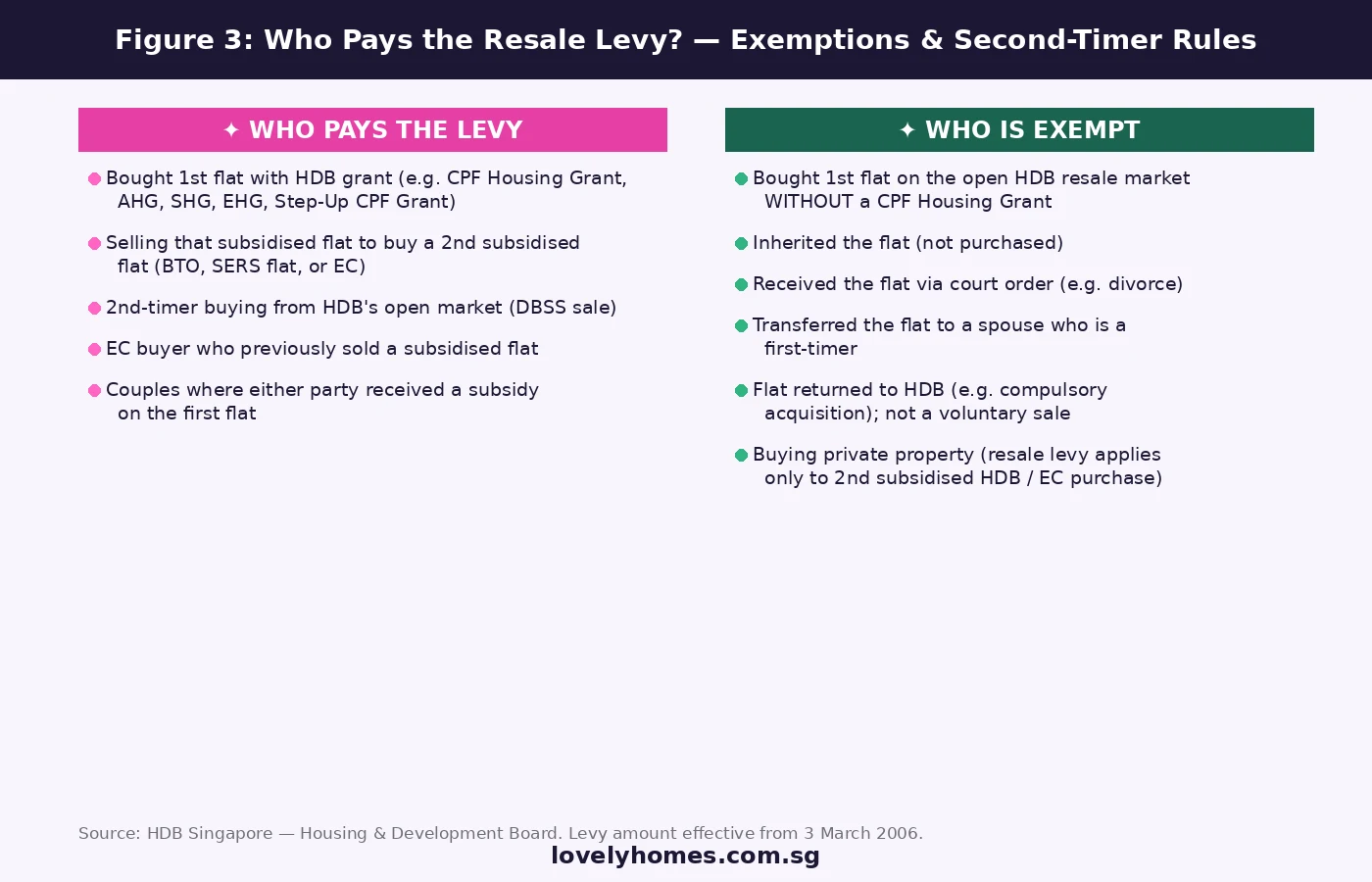
When HDB Resale Levy applies decision matrix Singapore 2026
Figure 2: HDB Resale Levy decision matrix — when the levy applies and when it does not. Source: HDB, 2026.

When Does the Resale Levy Apply?

The trigger for the levy is narrow and precise: it applies only when a second-timer household purchases a new subsidised flat from HDB directly (BTO or SBF exercise) or a new EC from a developer. It does not apply in any of the following scenarios:

  • Buying a resale HDB flat on the open market — even if you are a second-timer, no levy is charged when you buy a resale flat (though you will also receive no EHG or CPF housing grants).
  • Buying private property — the levy is exclusively a feature of the subsidised public housing system.
  • Transferring ownership within the family — an intra-family transfer is not a new subsidised purchase and does not trigger the levy.
  • First-timers — by definition, if you have not previously received a housing subsidy, the levy does not apply.

One nuance worth noting: if you buy a resale HDB flat with a CPF housing grant (making you a subsidised buyer of a resale flat), you become a second-timer for future subsidised flat purchases. Should you later apply for a BTO or new EC, the resale levy will apply at that stage, calculated on the flat you had originally bought with the grant.

How Is the Resale Levy Paid?

The levy is deducted from the proceeds of your flat sale. In practice, HDB coordinates the payment as part of the resale transaction. The sequence is:

  1. You agree to sell your existing flat and apply for a new BTO flat or EC concurrently.
  2. At the point of your existing flat’s resale completion, HDB retains the levy amount from the sale proceeds.
  3. The retained amount is credited to HDB’s account — it is not returned to your CPF Ordinary Account.
  4. If your sale proceeds (after CPF refund) are insufficient to cover the levy, you must make up the shortfall in cash.

Unlike CPF principal and accrued interest (which are refunded to your CPF OA and can be redeployed for the next flat), the resale levy is gone once deducted. It is a one-time levy and cannot be offset against BSD, legal fees, or any other cost of the new purchase.

There is no option to defer the levy or to split it across multiple payment dates. It must be settled in full at the point of sale completion of the existing flat. HDB does not currently offer any hardship waiver or instalment arrangement for the levy.

Net Proceeds After the Levy

Understanding your effective net proceeds after the levy is deducted helps with financial planning for your next purchase. The chart below illustrates how the S$40,000 levy on a 4-room flat affects gross sale proceeds at five common price points:

HDB resale proceeds after levy deduction 4-room flat Singapore 2026
Figure 3: Gross resale proceeds vs after-levy amount for a 4-room flat at five price points. Levy of S$40,000 deducted at source. Source: HDB; LovelyHomes calculations, 2026.

Critically, the levy reduces the pool of funds available for your CPF Ordinary Account refund and cash portion. If you are relying on the proceeds to fund the downpayment on a new BTO flat, factor the levy deduction in from the outset. A 4-room flat sold at S$550,000 effectively becomes S$510,000 in terms of what flows back to you and HDB.

Resale Levy vs HDB Grants: The Netting Question

A common question from second-timers is whether HDB grants can offset the resale levy. The short answer is no. Grants and the levy operate entirely separately:

  • Second-timers who buy a new BTO flat receive reduced grants compared to first-timers. For example, a second-timer buying a new BTO flat under the Step-Up CPF Housing Grant may receive S$15,000 — far less than the S$80,000–S$120,000 available to first-timer families under the EHG.
  • The resale levy is charged in addition to the reduced grant quantum. It is not deducted from any grant or factored into the BTO price.
  • The combined effect is that second-timers face a higher effective cost of a new BTO purchase: less grant assistance AND an upfront levy payment.

This is the intended design. HDB’s rationale is that second-timers have already benefited significantly from the subsidised housing system and have had the opportunity to accumulate equity in their first flat. The reduced grants and levy together calibrate the subsidy quantum to reflect that prior benefit.

Worked Example: The Yip Family’s Resale Levy Calculation

Scenario: 4-Room Flat Sold, New 4-Room BTO Purchased

Mr and Mrs Yip, both Singapore Citizens, bought a 4-room BTO flat in Punggol in 2014 for S$390,000. They are now selling the flat (estimated market value S$610,000) and applying for a new 4-room BTO flat in Tengah under the Married Child Priority Scheme.

Item Amount
Gross resale price of Punggol 4-room flat S$610,000
CPF principal drawn + accrued interest (estimated) S$320,000 (refunded to CPF OA)
Outstanding HDB mortgage balance S$48,000 (repaid from proceeds)
HDB Resale Levy (4-room sold) S$40,000
Agent commission (1% + 9% GST) S$6,649
Legal fees (seller) S$2,500
Net cash proceeds to Mrs & Mr Yip S$192,851

New Tengah BTO (4-room, estimated S$480,000 — Plus model):

Item Amount
BTO price S$480,000
Step-Up CPF Housing Grant (2nd-timer) -S$15,000
Net payable S$465,000
HDB loan (80% LTV, 2nd-timer eligible) S$372,000 @2.60% 25yr = S$1,682/mth (MSR 18.7% of S$9,000/mth joint income)
Downpayment (20% — CPF OA) S$93,000 from CPF OA refund
BSD (S$480,000) S$8,700
Legal fees (buyer) S$2,500
Remaining CPF OA balance after DP S$227,000 (reserve for mortgage servicing)

MSR check: S$1,682 / S$9,000 = 18.7% — within 30% MSR limit. TDSR not applicable (HDB loan). The S$40,000 resale levy is a sunk cost; Mr and Mrs Yip’s CPF OA reserve of S$227,000 provides strong mortgage cover for the Tengah BTO.

What This Means for Second-Timers Planning to Upgrade

The resale levy is best understood as a built-in “subsidy recapture” mechanism. For households who bought a 3-room or 4-room BTO flat in the 2010s and have watched flat values rise substantially — Tampines 4-rooms regularly changing hands above S$600,000 in 2025–2026 — the S$30,000–S$40,000 levy is relatively modest relative to the capital gain they have made. In such cases, the levy is unlikely to derail the upgrade path.

The levy becomes more financially significant in two scenarios: (a) where the flat was held for a shorter period and appreciation is limited, or (b) where the household plans to buy a new EC priced at the upper end of the income ceiling — here, the reduced grant quantum combined with the levy can meaningfully increase the cash component required at completion.

From a policy perspective, Singapore’s resale levy is notably lighter than comparable mechanisms in other high-density housing markets. Hong Kong’s Home Ownership Scheme imposes resale restrictions rather than monetary levies; Taiwan’s affordable housing schemes cap resale gains outright. Singapore’s fixed-levy approach offers transparency and predictability — households know their exact levy exposure from the moment they decide to sell.

What Might Come Next

The following is editorial speculation based on observed policy trends and should not be relied upon for financial decisions.

HDB has not adjusted the fixed resale levy amounts since the current schedule took effect in 2006. Given that resale flat prices have increased substantially over the past two decades — the HDB Resale Price Index rose from a base of 100 in 1998 to approximately 183 in early 2026 — there is a reasonable argument that the S$15,000–S$55,000 range represents a declining proportion of the subsidy value enjoyed by second-timers.

Industry observers have periodically suggested that HDB may consider indexing levy amounts to flat values or the RPI. A levy pegged at, say, 7%–8% of the median resale price of the flat type sold would automatically adjust over time. Whether HDB will move in this direction is unknown; any change would likely be accompanied by an extended transition period given the direct impact on household finances.

Frequently Asked Questions

I’m selling a 4-room flat but buying a 3-room BTO. Does the levy depend on what I buy or what I sell?

The levy is calculated based on the flat type you are selling, not the flat type you are buying. If you sell a 4-room flat, you pay S$40,000 regardless of whether you buy a 2-room, 3-room, or 5-room BTO next. The type of your next flat does not affect the levy amount.

My spouse is a first-timer but I am a second-timer. Do we pay the resale levy?

Yes. In a joint application, if any one applicant is classified as a second-timer, the household is treated as a second-timer application and the resale levy applies. The levy is calculated on the flat type sold by the second-timer applicant. This is a common scenario for couples where one partner previously owned a subsidised flat before the marriage.

Can I use CPF Ordinary Account funds to pay the resale levy?

No. The resale levy is not a property purchase cost that HDB allows to be paid from CPF. It is deducted from the proceeds of the sale of your existing flat — which includes CPF funds refunded from that sale — but the levy itself flows out of those proceeds before they are returned to your CPF OA. The practical effect is that the levy reduces the CPF amount credited back to your OA, and any shortfall must be topped up in cash. You cannot make a direct CPF OA withdrawal specifically for the levy.

Does the resale levy apply if I sell my HDB flat to buy a private condo?

No. The resale levy only applies when you are purchasing a new subsidised flat (BTO, SBF, or new EC from a developer). If you sell your HDB flat and purchase a private condominium, no resale levy is charged. You may, however, incur ABSD if you own or co-own any other residential property at the time of the private property purchase. The levy and ABSD are separate instruments with separate triggers.

What happens if my resale proceeds are not enough to cover the levy?

If the net proceeds from your flat sale (after repaying the HDB mortgage and refunding CPF principal + accrued interest to your CPF OA) are insufficient to cover the levy, you must pay the shortfall in cash before the resale transaction can be completed. HDB will not approve the new flat application until the levy is settled in full. There is no waiver, reduction, or instalment scheme for the levy, even in cases of genuine financial hardship.

I sold my 4-room flat in 2004. Does the current levy schedule apply to me?

No. The fixed-levy schedule described in this guide applies only to households who sold their first subsidised flat on or after 3 March 2006. If you sold your first subsidised flat before that date, the earlier levy framework applies, which was based on a percentage of the resale price (15% for 3-room and above). If you are uncertain which regime applies to you, contact HDB directly with your transaction details.

My previous flat was a DBSS flat I bought from a developer. Do I pay the levy?

Yes, if the DBSS flat was purchased directly from a developer under HDB’s Design, Build and Sell Scheme, you are considered to have purchased a subsidised flat. When you sell the DBSS flat and apply for a new BTO or EC, the resale levy applies based on the flat type of the DBSS flat sold. A 4-room DBSS attracts S$40,000; a 5-room DBSS attracts S$45,000. The levy is the same as for a standard HDB flat of the equivalent type.

Disclaimer: This article is for general informational purposes only and does not constitute financial, legal, or property advice. HDB policies, levy amounts, and grant quantum are subject to change. Readers should verify current rules directly with HDB at hdb.gov.sg, and with IRAS at iras.gov.sg for stamp duty matters and cpf.gov.sg for CPF withdrawal rules. Worked examples use estimated figures for illustration; actual financial outcomes will vary. Consult a licensed property professional and a qualified financial adviser before making any housing decision.

×

Click anywhere to close

HDB Resale Flat Prices Singapore 2026: Complete Guide to Trends, COV and Valuations

HDB Resale Flat Prices Singapore 2026: Complete Guide to Trends, COV and Valuations

Quick Answer: HDB Resale Flat Prices in Singapore 2026

  • 4-room flats transact at a national median of S$498,000 in Q1 2026, up from S$448,000 in 2024.
  • 5-room flats reached a median of S$610,000 in Q1 2026; Executive Maisonettes hit S$710,000.
  • Mature estates like Bukit Timah and Queenstown command 4-room premiums above S$700,000.
  • The HDB Resale Price Index (RPI) stood at 183.1 in Q1 2026, up 8.7 points from Q1 2020.
  • Cash Over Valuation (COV) is the amount paid above HDB’s assessed value — it must be paid in cash, not CPF.
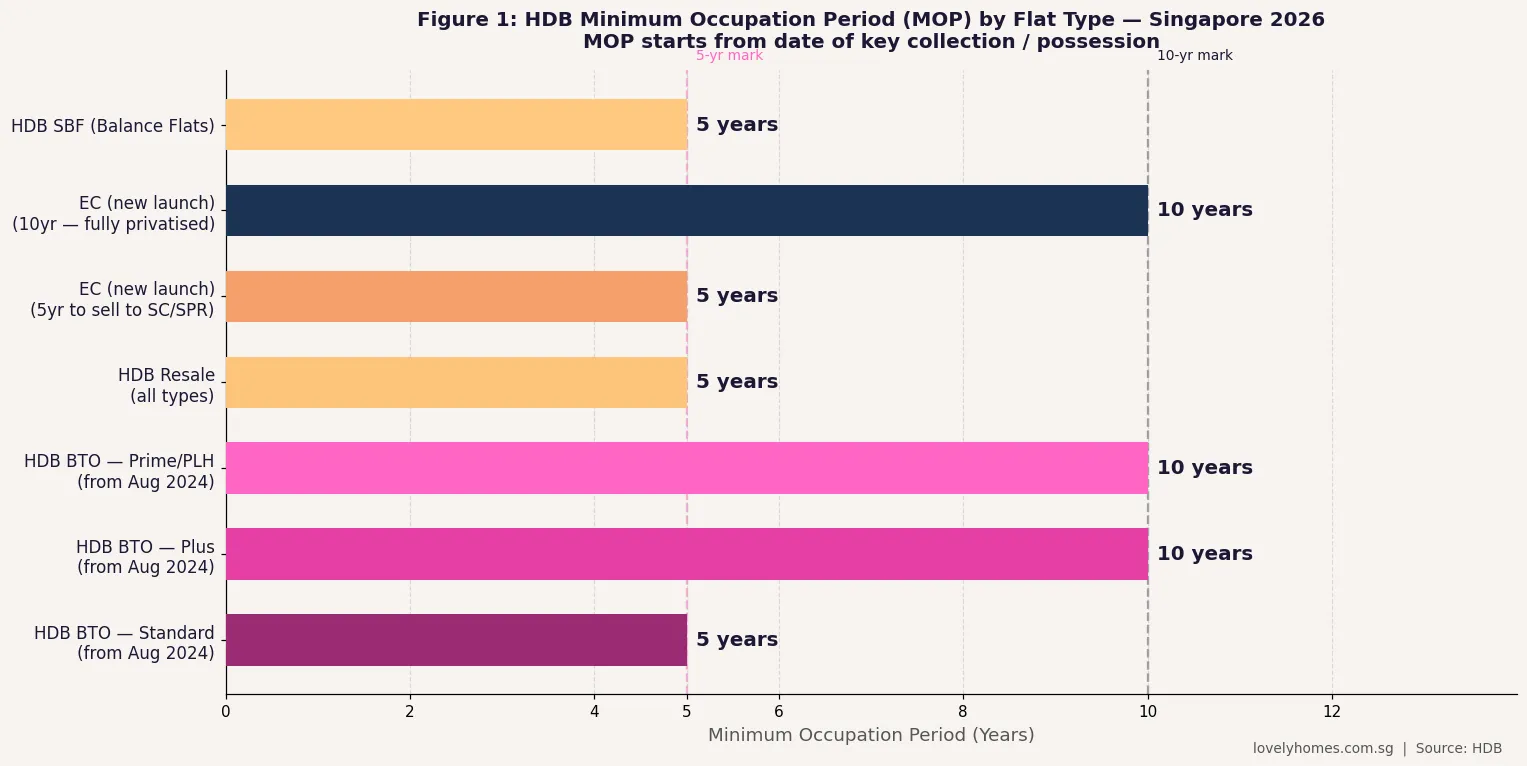
  • HDB resale prices are moderated by the Minimum Occupation Period (MOP), lease decay, and proximity grants.
  • Prices are expected to grow modestly (1–3% annually) through 2026, supported by tight BTO supply and strong household formation.

What Are HDB Resale Flat Prices and How Are They Set?

When you purchase a Housing and Development Board (HDB) resale flat, you are buying from a private seller in the open market — not directly from HDB. The price is negotiated between buyer and seller, but must reflect market conditions and is informed by HDB’s Comparable Transaction data and the official valuation commissioned by the buyer’s bank or HDB loan officer.

Unlike BTO (Build-To-Order) flats, where HDB sets the selling price with subsidies applied, resale flat prices are driven by supply and demand. Factors include the flat’s lease remaining, floor level, renovation condition, proximity to MRT stations and top primary schools, estate amenities, and recent comparable transactions in the same block or vicinity.

HDB monitors and reports resale transaction data every quarter via the HDB Resale Price Index (RPI) and releases median transaction prices by flat type and town. This transparency helps buyers and sellers negotiate from an informed position.

HDB Resale Prices by Flat Type: 2024 vs Q1 2026

Resale prices have risen consistently across all flat types since 2020. The table below and Figure 1 compare median transacted prices in 2024 versus Q1 2026.

HDB resale median prices by flat type 2024 vs Q1 2026 Singapore bar chart
Figure 1: Median HDB resale prices by flat type — 2024 vs Q1 2026. Source: HDB Resale Statistics.
Flat Type 2024 Median Q1 2026 Median Change
2-Room Flexi S$285,000 S$295,000 +3.5%
3-Room S$315,000 S$348,000 +10.5%
4-Room S$448,000 S$498,000 +11.2%
5-Room S$570,000 S$610,000 +7.0%
Executive / Maisonette S$658,000 S$710,000 +7.9%

Source: HDB Resale Statistics. Figures are national medians; individual transactions vary by town, floor, and condition.

Understanding the HDB Resale Price Index (RPI)

The HDB Resale Price Index (RPI) is published by HDB every quarter. It tracks the overall movement of resale flat prices relative to a base period (Q1 2009 = 100). It is the closest equivalent to a benchmark price index for the HDB resale market — similar in concept to the URA Private Residential Property Index for the private market.

In Q1 2026, the RPI stood at 183.1, meaning resale prices are 83.1% higher in nominal terms than they were in Q1 2009. The rate of increase has slowed significantly since the sharp pandemic-era run-up of 2021–2022, when prices rose almost 25 points in two years. The market has since entered a plateau phase with modest quarterly gains of 0.2–0.4%.

HDB Resale Price Index trend Q1 2020 to Q1 2026 Singapore
Figure 2: HDB Resale Price Index (RPI), Q1 2020 – Q1 2026. Base: Q1 2009 = 100. Source: HDB Resale Statistics.

The RPI is a useful trend indicator but does not tell you what any specific flat will transact at. The HDB Resale Portal’s Check Past Resale Transactions tool gives block-level data, which is far more actionable for buyers negotiating a specific unit.

HDB Resale Prices by Town: Where Are Prices Highest?

Resale prices vary enormously by location. The same flat type can fetch more than double in a mature, well-connected estate versus a young non-mature town. Figure 3 shows indicative Q1 2026 median 4-room prices for the ten most actively transacted towns.

HDB resale 4-room flat median prices by town Q1 2026 Singapore
Figure 3: Indicative median 4-room HDB resale prices by town, Q1 2026. Source: HDB Resale Statistics and LovelyHomes analysis.

Bukit Timah (S$810,000), Queenstown (S$720,000), and Bishan (S$660,000) lead the premium tier, driven by central location, proximity to top primary schools (Nanyang, Henry Park, Raffles Girls’), and strong upgrader demand. At the other end, Sengkang (S$495,000) and Hougang (S$510,000) remain among the most affordable mature-ish estates with good MRT coverage.

What Drives HDB Resale Prices?

Understanding the key price drivers helps buyers estimate fair value and sellers price competitively. The main factors are:

1. Location and connectivity. Proximity to MRT stations (within 500 metres) adds a meaningful premium. Flats within 1 km of top primary schools command a further uplift due to the MOE P1 registration priority system — see our guide to buying near top schools.

2. Remaining lease. HDB flats are sold on 99-year leases from the date of construction. A flat with 70 years remaining is worth more than one with 50 years, because CPF usage is restricted for flats with shorter leases — specifically, if the flat’s remaining lease cannot cover the youngest buyer to age 95, CPF usage is prorated. Banks also apply stricter LTV ratios on short-lease flats. The HDB Lease Buyback Scheme and Lease Top-Up programme can extend some leases, but this remains a minority option.

3. Flat condition and renovation. Buyers frequently pay a S$20,000–S$80,000 premium for freshly renovated units with quality kitchen and bathroom fittings, versus an unrennovated unit in the same block. However, overbuilt or highly customised renovations do not recover their full cost at resale.

4. Floor level and orientation. High-floor units with unobstructed views or favourable orientations (e.g., north-south facing to minimise afternoon sun) attract 5–15% premiums over low-floor equivalents in the same block.

5. Flat size (actual square footage). HDB flat-type naming covers a range of actual sizes. A “4-room” flat can be anywhere from 80 to 110 square metres depending on the development era. Buyers should always divide the asking price by the actual size in square metres to compare on a per-square-metre basis.

6. HDB upgrading works. Flats that have completed the Home Improvement Programme (HIP) or Neighbourhood Renewal Programme (NRP) typically command a S$20,000–S$40,000 premium over pre-HIP equivalents, as buyers factor in avoided costs and improved common-area aesthetics.

Cash Over Valuation (COV) Explained

One of the most misunderstood concepts in HDB resale is Cash Over Valuation (COV). When a buyer agrees to pay a price higher than the official valuation of the flat (determined by an accredited valuer appointed by HDB, the buyer’s bank, or HDB’s own valuation office), the excess is the COV — and it must be paid entirely in cash. CPF Ordinary Account funds can only be used up to the officially assessed market value.

For example, if a flat is valued at S$550,000 but the negotiated transacted price is S$575,000, the COV is S$25,000. This S$25,000 must come from cash savings, not CPF. It is paid on top of the standard cash and CPF downpayments for the loan.

COV is common in popular estates and for well-renovated flats. Buyers should check the HDB Resale Portal at resale.hdb.gov.sg for recent transactions in the target block to gauge whether COV is likely and at what level before making an offer.

Worked Example: The Chew Family

Scenario: SC Couple Buying a 5-Room Flat in Tampines

Mr and Mrs Chew are Singapore Citizens. Mr Chew (34) earns S$6,200/month; Mrs Chew (33) earns S$5,100/month. Joint monthly income: S$11,300. They have S$120,000 in CPF Ordinary Account (combined) and S$60,000 in cash savings. They are first-time buyers and have never owned any property.

  • Target flat: 5-room HDB in Tampines, 92 sqm, lease commenced 2001 (remaining ~74 years), renovated 2022.
  • Negotiated price: S$640,000
  • Official valuation: S$618,000
  • COV: S$640,000 − S$618,000 = S$22,000 (cash, not CPF)
  • HDB loan (2.6% p.a., 25 years, LTV 80%): S$494,400 → monthly instalment S$2,240/month
  • MSR check: S$2,240 ÷ S$11,300 = 19.8% (below 30% MSR cap — PASS)
  • CPF downpayment: 20% × S$618,000 (valuation) = S$123,600 → covered by combined CPF OA of S$120,000 + S$3,600 top-up in cash
  • Cash required at exercise: COV S$22,000 + BSD S$12,950 + Legal S$2,800 + HDB admin fee S$80 + CPF shortfall S$3,600 = S$41,430
  • CPF Housing Grants applied: EHG S$50,000 (income S$11,300/mth, eligible) + Family Grant S$50,000 (resale 5-room) = S$100,000 total grants applied against purchase price via CPF OA

Result: The Chews’ effective net price after grants is S$540,000. Monthly instalment of S$2,240 is comfortably within the MSR. Their cash outlay of S$41,430 is manageable given their S$60,000 in savings. They retain approximately S$18,570 in liquid cash after the purchase.

Why HDB Resale Values Hold Up — and When They Don’t

Singapore’s public housing market has historically been resilient because HDB flats serve a fundamental shelter function for the majority of the population. Several structural factors support resale values:

Eligibility restrictions keep demand concentrated. Only Singapore Citizens and Permanent Residents may purchase HDB flats. This excludes the largest category of buyers (foreigners) who are entirely channelled into the private market. Within the eligible pool, demand is strong: household formation rates remain high, BTO supply takes 3–5 years to deliver, and the resale market is the only avenue for those needing a home now.

CPF integration creates a floor price. For most HDB buyers, CPF Ordinary Account savings constitute a large part of the downpayment. This effectively creates a price floor, as buyers are willing to commit CPF savings they might otherwise lose access to if they do not purchase a property. The CPF accrued interest mechanism means sellers must refund CPF usage plus accrued interest on sale, which effectively anchors the minimum sale price needed to recover the seller’s CPF commitment.

When values can soften. Short-lease flats (below 60 years remaining) face structural headwinds: CPF usage restrictions, tighter bank LTV, and lower pool of eligible buyers. Estates where residents have grown older without sufficient HIP investment, or where population resettlement has reduced catchment size, may also see below-average growth. A flat approaching 40–50 years of lease expiry may see steep valuation discounts.

What Might Come Next for HDB Resale Prices?

This section represents editorial analysis and forward-looking opinion, not a guarantee of future price performance.

The HDB resale market is likely to grow at a modest 1–3% annualised rate through 2026 and into 2027, based on the following dynamics. BTO supply delivered in 2023–2024 (from launches in 2020–2021) will start reaching MOP from 2025 onwards, gradually increasing resale supply. However, the June 2026 BTO exercise offering 6,900 flats in popular towns (Bishan, Bukit Merah, Ang Mo Kio) will only arrive on the resale market in 2031–2033 at the earliest.

Interest rate trends matter too. If the Singapore Overnight Rate Average (SORA) continues declining through 2026, bank loan attractiveness relative to the HDB loan (fixed at 2.6% p.a.) shifts. A sustained decline in SORA could bring more buyers back to the market, supporting demand for resale flats, particularly among those who prefer immediate occupation over the 3–5 year BTO wait.

Prime Location Public Housing (PLH) flats with 10-year MOPs, and any further cooling measures, could dampen speculative demand at the top end. However, the entry-level and mid-tier resale segments (3-room and 4-room in non-mature estates) appear structurally well-supported.

Summary Table: HDB Resale Prices at a Glance (Q1 2026)

Flat Type National Median Premium Town Range Affordable Town Range
2-Room Flexi S$295,000 S$380,000–S$450,000 S$220,000–S$270,000
3-Room S$348,000 S$480,000–S$650,000 S$280,000–S$330,000
4-Room S$498,000 S$650,000–S$900,000+ S$400,000–S$480,000
5-Room S$610,000 S$750,000–S$1,000,000+ S$490,000–S$570,000
Executive / Maisonette S$710,000 S$850,000–S$1,100,000+ S$580,000–S$660,000

Frequently Asked Questions: HDB Resale Flat Prices

How do I find out the recent transacted prices for a specific HDB block?

Use the HDB Resale Flat Prices tool on the official HDB website at resale.hdb.gov.sg. You can filter by town, flat type, street name, and period. The tool shows every registered resale transaction, including the transacted price, floor area, storey range, and flat model. This is the most reliable data source for gauging fair value for a specific unit. The URA Real Estate Information System (REALIS) also contains HDB transaction data for subscribers.

Are HDB million-dollar flats common, and what drives them?

HDB resale flats transacting above S$1,000,000 (colloquially called “million-dollar flats”) have become more frequent since 2022. They are overwhelmingly concentrated in mature central estates (Queenstown, Bishan, Toa Payoh, Ang Mo Kio) for large flat types (5-room, Executive Maisonette) on high floors with long remaining leases. In Q1 2026, approximately 80–120 units per quarter transact above S$1,000,000 — this represents less than 2% of total quarterly transactions and is not representative of the broader market. Most resale flats transact between S$300,000 and S$700,000.

Can I use CPF to pay COV?

No. Cash Over Valuation must be paid entirely in cash. CPF Ordinary Account funds can only be applied towards the purchase price up to the officially assessed valuation. If you agree to pay S$560,000 for a flat valued at S$540,000, the S$20,000 COV must come from your cash savings. This is an important planning point — buyers who have substantial CPF balances but limited cash savings may be unable to purchase a flat with a high COV without additional cash top-ups.

How does the Ethnic Integration Policy (EIP) affect resale prices?

The Ethnic Integration Policy (EIP) sets racial proportion limits for each HDB block and neighbourhood. If a block has already reached its Chinese, Malay, or Indian/Other quota for a given ethnic group, buyers of that ethnicity cannot purchase in that block — effectively reducing the pool of eligible buyers. When a block is at or near quota for a popular ethnic group, this can exert downward pressure on transacted prices because fewer buyers qualify. Conversely, a block with open quota availability across all ethnic groups attracts the widest buyer pool and tends to transact at or above comparable blocks with restricted quotas.

Does a shorter lease always mean a lower price?

Generally yes, but the discount is non-linear and depends on specific thresholds. Flats with more than 60 years remaining trade relatively normally. Once a flat’s remaining lease falls below 60 years, CPF restrictions begin to phase in — the amount of CPF that can be used is prorated based on how long the flat’s lease can cover the youngest buyer to age 95. Below 30 years remaining, the flat becomes effectively cash-only, dramatically reducing the buyer pool. Short-lease flats in desirable locations (e.g., Queenstown or Toa Payoh) may still trade at substantial absolute prices due to location premium, but will not appreciate at the same rate as longer-lease counterparts.

What happens to a flat’s price after HDB’s Selective En Bloc Redevelopment Scheme (SERS)?

When HDB announces a SERS for a block, the announcement itself typically causes an immediate uplift in nearby comparable flat prices as the market anticipates compensation plus new-flat allocation. However, SERS is administered selectively by HDB and cannot be applied for by residents — it is announced by HDB when redevelopment is deemed appropriate for planning reasons. Fewer than 5% of HDB estates have ever been selected for SERS, so it is not a reliable investment thesis for most buyers.

How do HDB resale prices compare internationally?

HDB resale flats remain remarkably affordable relative to comparable housing in global cities despite recent price growth. A national median 4-room flat at S$498,000 represents approximately 4–5 years of median household income for a dual-income SC couple — a price-to-income ratio that is far more favourable than Hong Kong, Sydney, or London. The key enabler is Singapore’s CPF-linked savings system, which channels mandatory pension contributions directly into housing affordability, and the Ethnic Integration Policy, which distributes demand across the island rather than concentrating it in a few prime postcodes.

Related Articles


Disclaimer: The information in this article is for general educational purposes only and does not constitute financial, investment, or legal advice. HDB resale flat prices, Resale Price Index figures, grant amounts, and loan parameters are subject to change. Always verify current data directly with the Housing and Development Board (hdb.gov.sg), CPF Board (cpf.gov.sg), IRAS (iras.gov.sg), and the Monetary Authority of Singapore (mas.gov.sg). Property transactions involve significant sums — engage a licensed housing agent accredited by the Council for Estate Agencies (CEA) and a solicitor for conveyancing before committing to any purchase.

HDB Resale Process Singapore 2026: Step-by-Step Guide from OTP to Key Collection

HDB Resale Process Singapore 2026: Step-by-Step Guide from OTP to Key Collection

Quick Answer: HDB Resale Process 2026

  • The HDB resale process typically takes 8–12 weeks from granting the Option to Purchase (OTP) to key collection.
  • Buyers must obtain an HDB Flat Eligibility (HFE) letter before granting or exercising an OTP — skipping this step is one of the most common costly mistakes.
  • Both buyer and seller register their intent on the HDB Resale Portal before any private negotiation. The portal manages all submissions, checklists, and appointment scheduling.
  • The OTP option fee is capped at S$1,000; the total option fee plus exercise fee cannot exceed S$5,000 (HDB administrative rule).
  • As of Q1 2026, the median HDB resale prices are: 3-room S$348K, 4-room S$498K, 5-room S$610K, Executive S$710K.
  • Resale flats are eligible for CPF Housing Grants including the Enhanced Housing Grant (up to S$120,000), the Family Grant (S$50,000), and the Proximity Housing Grant (S$30,000).
  • A buyer must meet the HDB eligibility conditions: at least one Singapore Citizen applicant, family nucleus, income ceiling (S$14,000 for resale with no income ceiling waiver), and the 30-month private property disposal requirement (if applicable).

The HDB Resale Market in 2026

Buying a resale HDB flat remains the most direct path to home ownership for many Singapore families. Unlike Build-To-Order (BTO) flats, resale units are available immediately — there is no construction wait of four to five years. You can inspect the actual flat, assess the neighbourhood, and negotiate directly with the existing owner. The tradeoff is price: resale flats generally command premiums over BTO prices, particularly for mature estates and well-located units.

In Q1 2026, HDB resale transaction volume remained robust at approximately 6,300 units, driven by the large cohort of flats completing their Minimum Occupation Period (MOP) — nearly 13,480 flats reached MOP in 2026 alone, roughly 70% more than in 2025. Resale prices have moderated from the 2022–2023 peak but remain elevated. The Housing & Development Board (HDB) continues to administer all resale transactions through its digital Resale Portal, which was significantly upgraded in 2022 to consolidate all buyer and seller steps in a single system.

Step 1: Check Eligibility and Obtain Your HFE Letter

The first practical step for any resale buyer is to apply for an HDB Flat Eligibility (HFE) letter via the HDB Resale Portal (accessible via Singpass at resale.hdb.gov.sg). The HFE letter replaces the former Eligibility Letter and is now mandatory — you cannot grant or exercise an OTP for an HDB resale flat without a valid HFE letter.

The HFE letter confirms your eligibility to purchase (flat type, location restrictions, income ceiling), the CPF Housing Grants you qualify for, and the maximum HDB loan you can obtain. It is valid for nine months from the date of issue. The application processing time is typically three to five working days.

Eligibility conditions for Singapore Citizens purchasing a resale HDB flat in 2026 include: at least one SC in the family nucleus, a minimum of one other member in the family nucleus (spouse, fiancé/e, parent, child, or sibling), no private property ownership by any applicant within the past 30 months, income not exceeding S$14,000/month for families (S$7,000 for singles), and compliance with the Ethnic Integration Policy (EIP) and Singapore Permanent Resident (SPR) Quota for the block.

Step 2: Register Intent to Buy (and Intent to Sell)

Once your HFE letter is in hand, register your Intent to Buy on the HDB Resale Portal. This is a formal declaration that you are actively seeking a resale flat and locks in your eligibility status for the transaction. Simultaneously, the seller must register their Intent to Sell before granting the OTP — a seller who issues an OTP without having registered their Intent to Sell is in breach of HDB procedures. Both registrations are free and can be done online. The Intent to Sell also auto-runs an eligibility check for the seller, confirming their right to sell and any Resale Levy payable.

At this stage, buyers typically engage a property agent (optional but strongly recommended for first-timers), shortlist units on HDB’s MyHDBPage or property portals, and begin flat viewings. When viewing a flat, confirm: the Ethnic Integration Policy (EIP) quota for your ethnicity at that block, the remaining lease (and its CPF implications), the Annual Value for property tax estimation, and any outstanding town council arrears the seller is responsible for clearing before completion.

Step 3: Negotiate and Grant the Option to Purchase (OTP)

The Option to Purchase (OTP) is a legally binding contract granting the buyer the exclusive right to purchase the flat at the agreed price within 21 calendar days. The seller issues the OTP after agreeing on the price and terms. Key parameters:

  • Option Fee: Paid upon signing the OTP, up to S$1,000 (negotiated between parties). This is non-refundable if the buyer does not exercise the OTP.
  • Option Period: 21 calendar days from the OTP date.
  • Exercise Fee: Paid when exercising the OTP. Total option fee + exercise fee cannot exceed S$5,000.
  • Cash Over Valuation (COV): If the agreed price exceeds HDB’s assessed market value, the excess must be paid fully in cash — CPF cannot be used for COV. COV can range from S$0 to over S$50,000 depending on demand for the specific unit.

Before exercising the OTP, buyers should commission a professional valuation (if not already done by HDB), confirm their bank or HDB loan quantum, and ensure sufficient CPF OA funds for the downpayment and instalment servicing.

HDB resale process timeline Singapore 2026 step by step OTP to key collection
Figure 1: Complete HDB resale transaction timeline showing parallel buyer and seller steps. The typical transaction completes in 8–12 weeks from OTP granting, subject to HDB appointment availability.

Step 4: Exercise the OTP and Submit the Resale Application

To exercise the OTP, the buyer signs the “Acceptance to Purchase” section and pays the exercise fee before the 21-day option period expires. Within 7 calendar days of exercising the OTP, both buyer and seller must submit their respective halves of the Resale Application on the HDB Resale Portal. The submission is a critical legal step — failure to submit within 7 days of the other party’s submission voids the application and may lead to the OTP being treated as lapsed.

Each party submits their part independently: the buyer uploads financial documentation (HFE letter, CPF statements, mortgage approval letter) while the seller uploads proof of ownership, HDB flat particulars, and any relevant declarations. HDB issues a confirmation of receipt and a Resale Checklist for each party to sign and acknowledge before the transaction can proceed.

Step 5: HDB Valuation, Checklist Endorsement, and Mortgage Approval

After submission, HDB arranges a valuation of the flat by one of its approved valuers (the cost, approximately S$120–S$180, is borne by the buyer). The valuation determines the market value for CPF and grant purposes. Buyers should note: if the purchase price exceeds the valuation, the excess (COV) must be paid in cash at completion.

The HDB Resale Checklist — a legal document — must be endorsed by both parties via the portal. It confirms that both sides have understood key policies: MOP rules (the buyer’s new five-year MOP clock begins from key collection), flat eligibility conditions, CPF usage rules, and grant terms. For buyers using a bank loan, the formal Loan Offer Letter from the bank must also be submitted at this stage.

For buyers using a HDB Concessionary Loan (available to eligible Singapore Citizen households with income below S$7,000/month), the HFE letter already contains the loan quantum. For bank loans, buyers must have received a formal Loan Offer Letter (typically secured after the HFE letter stage) with the interest rate, tenure, and monthly repayment confirmed.

Step 6: HDB Completion Appointment and Key Collection

HDB schedules the completion appointment typically within 6–8 weeks of accepting the Resale Application. At the completion appointment (held at HDB Hub, Toa Payoh), the title of the property is formally transferred from seller to buyer. Both parties, or their solicitors, must attend. The following payments are settled at or before completion:

  • Buyer’s Stamp Duty (BSD) — must be paid within 14 days of OTP exercise or 14 days of completion, whichever is earlier. Payable via IRAS e-Stamping.
  • Outstanding purchase price balance — funded by the bank loan disbursement, CPF OA, and any cash balance (including COV).
  • Seller’s outstanding CPF refund — the seller’s CPF principal plus accrued interest is deducted from the sale proceeds and returned to the seller’s CPF OA.
  • HDB resale administrative fee — S$80 for each party.

After the completion appointment, keys are handed over, and the buyer’s five-year MOP period begins. The Singapore Land Authority (SLA) registers the transfer, and the buyer becomes the registered owner in the land register within a few working days.

HDB resale median prices by flat type 2024 vs Q1 2026 Singapore property market
Figure 2: HDB resale median prices by flat type — 2024 versus Q1 2026. All flat types recorded positive growth, with 5-room flats (+5.2%) and Executive flats (+4.4%) leading the uptick.

Financing Your HDB Resale Purchase

Buyers have two primary financing options for a resale HDB flat: an HDB Concessionary Loan or a bank loan. The HDB loan is available only to Singapore Citizen-led households with no existing private property and income below S$7,000/month (or S$3,500 for single applicants). It offers 75% LTV (down from 80% in August 2024), no cash downpayment requirement, and a fixed rate tied to CPF OA rate + 0.1% (currently 2.6% p.a.). The full comparison is covered in our HDB Loan vs Bank Loan Guide 2026.

Bank loans offer lower interest rates (typically 1.5%–2.2% fixed for the first 2–3 years in mid-2026) but require a minimum 5% cash downpayment and are subject to the Monetary Authority of Singapore’s Total Debt Servicing Ratio (TDSR, 55%) and Mortgage Servicing Ratio (MSR, 30% of gross income for HDB property). The MSR cap of 30% is the binding constraint for most HDB buyers. A couple earning S$9,000/month combined is capped at S$2,700/month mortgage, which at 2.0% over 25 years supports a loan of approximately S$514,000.

CPF Housing Grants (EHG, Family Grant, PHG, Step-Up Grant) are applied against the purchase price and reduce the loan quantum needed. For eligible families buying a resale flat, total grants can reach S$200,000. See our CPF Housing Grant Guide 2026 for the full breakdown.

All-in Buyer Costs

HDB resale buyer transaction costs BSD agent legal fees Singapore 2026
Figure 3: All-in buyer transaction costs for HDB resale purchases at five price points — S$400,000 to S$800,000. BSD is the largest transaction cost; agent commission at 1% and legal fees of approximately S$2,500 are the primary additional items.
Cost Item Who Pays Typical Amount Notes
Buyer’s Stamp Duty (BSD) Buyer S$5,400–S$20,600 (for S$400K–S$800K) Progressive rates 1%–6%; payable via IRAS e-Stamping
ABSD Buyer Nil (SC 1st property); 20% SC 2nd Most first-time buyers pay zero ABSD; HDB purchase counts as 1st property
Agent Commission Buyer (for buyer’s agent) ~1% of purchase price Seller pays 2% for seller’s agent
Legal Fees Buyer ~S$2,500–S$3,000 Conveyancing by HDB or appointed solicitor
Valuation Fee Buyer S$120–S$180 Arranged by HDB; determines CPF-eligible amount
HDB Admin Fee Buyer & Seller S$80 each Per party; paid at HDB completion appointment
Cash Over Valuation (COV) Buyer S$0–S$50,000+ (negotiated) Payable in cash only; CPF cannot be used

Worked Example: The Yeo Family

Mr and Mrs Yeo are Singapore Citizens (joint applicants, combined income S$8,500/month) purchasing a four-room resale flat in Tampines. They have an eligible HFE letter confirming: EHG S$45,000 (income S$8,500/month falls within the S$9,000 band for families), Family Grant S$50,000 (buying resale, both SC, first time applying for subsidy), and access to HDB loan at 75% LTV. The flat is offered at S$560,000 (valuated at S$558,000 — COV of S$2,000).

Item Amount
Purchase Price S$560,000
Less: EHG + Family Grant − S$95,000
Net price after grants S$465,000
HDB Loan (75% of S$558K valuation) S$418,500
CPF OA contribution (downpayment + ongoing) S$44,500
Cash for COV S$2,000
BSD (on S$560,000) S$11,400
ABSD Nil (SC 1st property)
Agent + Legal + Valuation + HDB Admin S$9,280
Total Cash Outlay ~S$22,680
Monthly HDB loan repayment (@2.6%, 25yr) S$1,894/month
MSR check: S$1,894 / S$8,500 22.3% — PASS (below 30%)

The Yeos’ total cash outlay of S$22,680 is very manageable, and their monthly repayment of S$1,894 comfortably clears the 30% MSR cap. Without the grants, their cash outlay would have been over S$117,000 — the grants are doing significant heavy lifting. Their new five-year MOP period starts from the day of key collection.

Common Mistakes to Avoid

The HDB resale process is well-documented, but buyers regularly stumble at several predictable points. Exercising an OTP before receiving the HFE letter is the single most consequential error — buyers have been forced to forfeit the option fee and restart the process after discovering ineligibility. Failing to check the Ethnic Integration Policy (EIP) quota before viewing is another: if your ethnicity’s quota for a block is already full, you cannot purchase in that block regardless of price or seller willingness.

On the financing side, many buyers secure informal bank “approval-in-principle” letters rather than formal Loan Offer Letters — these are not the same thing, and only the formal letter satisfies HDB’s submission requirements. Buyers should also verify their CPF OA balance accounts for the downpayment, ongoing instalments, BSD, and a buffer for unexpected costs before committing to an OTP price. Our guide on Singapore property downpayment requirements 2026 explains the full cash and CPF calculation.

What Might Come Next

This section reflects editorial analysis and is not official HDB policy.

HDB has signalled an intent to keep resale flat supply elevated through 2026 and 2027, with the large cohort of MOP-completing flats adding to available stock. The policy priority of affordable home ownership, reaffirmed in Budget 2026, supports the continued availability of EHG grants. There is ongoing academic and policy debate about whether COV — which is not tracked publicly — is re-emerging as a significant affordability barrier in mature estates.

The HDB Resale Portal is scheduled for a further update in late 2026 to integrate more seamlessly with SLA’s e-conveyancing platform, potentially reducing the completion timeline to below eight weeks for straightforward transactions. Buyers should track announcements at hdb.gov.sg.

FAQ: HDB Resale Process 2026

Do I need a property agent to buy a resale HDB flat?

No — HDB’s Resale Portal is designed for direct buyer-seller transactions without agents. However, most buyers and sellers engage agents for negotiation support, paperwork management, and expertise in checking EIP quotas, valuation, and neighbourhood comparables. Buyers do not pay agent commission for new launch properties, but for resale HDB they typically pay 1% commission to their own agent (the seller pays 2% to theirs). Using an agent registered with the Council for Estate Agencies (CEA) is strongly recommended; you can verify any agent’s registration at the CEA Public Register at cea.gov.sg.

What happens if the HDB valuation comes in below the agreed purchase price?

If HDB’s appointed valuer assesses the flat below the negotiated price, the difference (Cash Over Valuation, or COV) must be paid in cash — you cannot use CPF for COV. For example, if you agreed to pay S$580,000 but HDB values the flat at S$560,000, you owe S$20,000 COV in cash. Many buyers include a valuation clause in the OTP negotiations to give them the right to renegotiate or withdraw if the COV exceeds a specified amount, though sellers in a hot market may resist such clauses.

Can a Singapore Permanent Resident buy an HDB resale flat?

Yes, a Singapore PR may purchase an HDB resale flat as a joint purchaser with a Singapore Citizen (the essential occupier rule still requires at least one SC in the household). An SPR household (both applicants are PR and neither is SC) cannot buy an HDB flat. Additionally, SPR buyers are subject to a 5% ABSD on their first residential property purchase. An SPR couple buying a resale HDB where both are PR would pay 5% ABSD on top of BSD and other costs. The relevant ABSD rates are explained in our ABSD Singapore 2026 complete guide.

What is the difference between the Resale Checklist and the Option to Purchase?

The Option to Purchase (OTP) is a private contract between buyer and seller, granting the buyer an exclusive right to purchase at the agreed price within 21 days. The HDB Resale Checklist is a separate HDB administrative document — submitted via the Resale Portal — that both parties must acknowledge before HDB will process the resale application. The checklist confirms that both parties understand their legal obligations regarding MOP, CPF refunds, grant terms, and HDB regulations. Failing to submit the checklist endorsement within the required window delays the transaction and may require resubmission of the entire application.

Does buying an HDB resale flat affect my ability to buy a private property later?

Yes — once you buy any HDB flat (BTO or resale), you own an HDB property. If you subsequently wish to purchase a private residential property, you must either sell the HDB flat first (and observe HDB’s rules on timing and MOP) or hold both simultaneously and pay 20% ABSD as a Singapore Citizen buying a second property. For upgraders, the standard strategy is to sell the HDB flat within 6 months of purchasing the private property (for ABSD remission purposes) or to complete the HDB MOP before purchasing the private property. See our Stamp Duty Remission Guide 2026 for upgrader remission timing rules.

What happens to the seller’s outstanding CPF at completion?

When an HDB flat is sold, the seller’s CPF principal drawn plus accrued interest (at 2.5% p.a.) is deducted from the sale proceeds and returned to the seller’s CPF OA. This is not optional — it is a statutory obligation under the Central Provident Fund Act. The seller’s conveyancing solicitor or HDB will calculate the exact refund amount, which is paid directly by the buyer’s bank (or HDB loan disbursement) to the seller’s CPF account before the net cash balance is released to the seller. Long-term owners are sometimes surprised to find the CPF refund consumes much of the apparent price gain — our guide on CPF accrued interest for property 2026 explains this in detail.

Can I buy an HDB resale flat if I currently own a private property overseas?

Yes, with conditions. If you own private residential property overseas, you are not automatically disqualified from buying an HDB resale flat. However, from 9 May 2023 onwards, Singapore Citizen buyers of HDB flats (new or resale) who own private residential property — whether in Singapore or overseas — must dispose of that private property within six months of key collection. You also pay 20% ABSD on the HDB resale purchase if you already own one or more properties (including overseas ones) at the time of purchase, though you may apply for ABSD remission on disposal if you meet HDB’s approved buyer criteria.

Related Articles

Disclaimer

This article is for general informational purposes only and does not constitute financial, legal, or property advice. HDB eligibility conditions, grant amounts, loan rules, and stamp duty rates are subject to change. Always verify current HDB resale requirements at hdb.gov.sg and current CPF rules at cpf.gov.sg. Stamp duty rates are administered by IRAS at iras.gov.sg. For personalised guidance, engage a property agent registered with the Council for Estate Agencies (CEA) and, for financial planning, a licensed adviser regulated by MAS. LovelyHomes.com.sg accepts no liability for reliance on the information contained herein.


Click anywhere to close
HDB Ethnic Integration Policy (EIP) Singapore 2026: Quotas, Eligibility and What Buyers Must Know

HDB Ethnic Integration Policy (EIP) Singapore 2026: Quotas, Eligibility and What Buyers Must Know

⚡ HDB EIP at a Glance — Quick Answer

  • What it is: The HDB Ethnic Integration Policy (EIP) is a quota system introduced in 1989 to maintain racial integration in HDB estates by capping the proportion of each ethnic group in any given block and neighbourhood.
  • Who administers it: HDB (Housing & Development Board), under the Ministry of National Development.
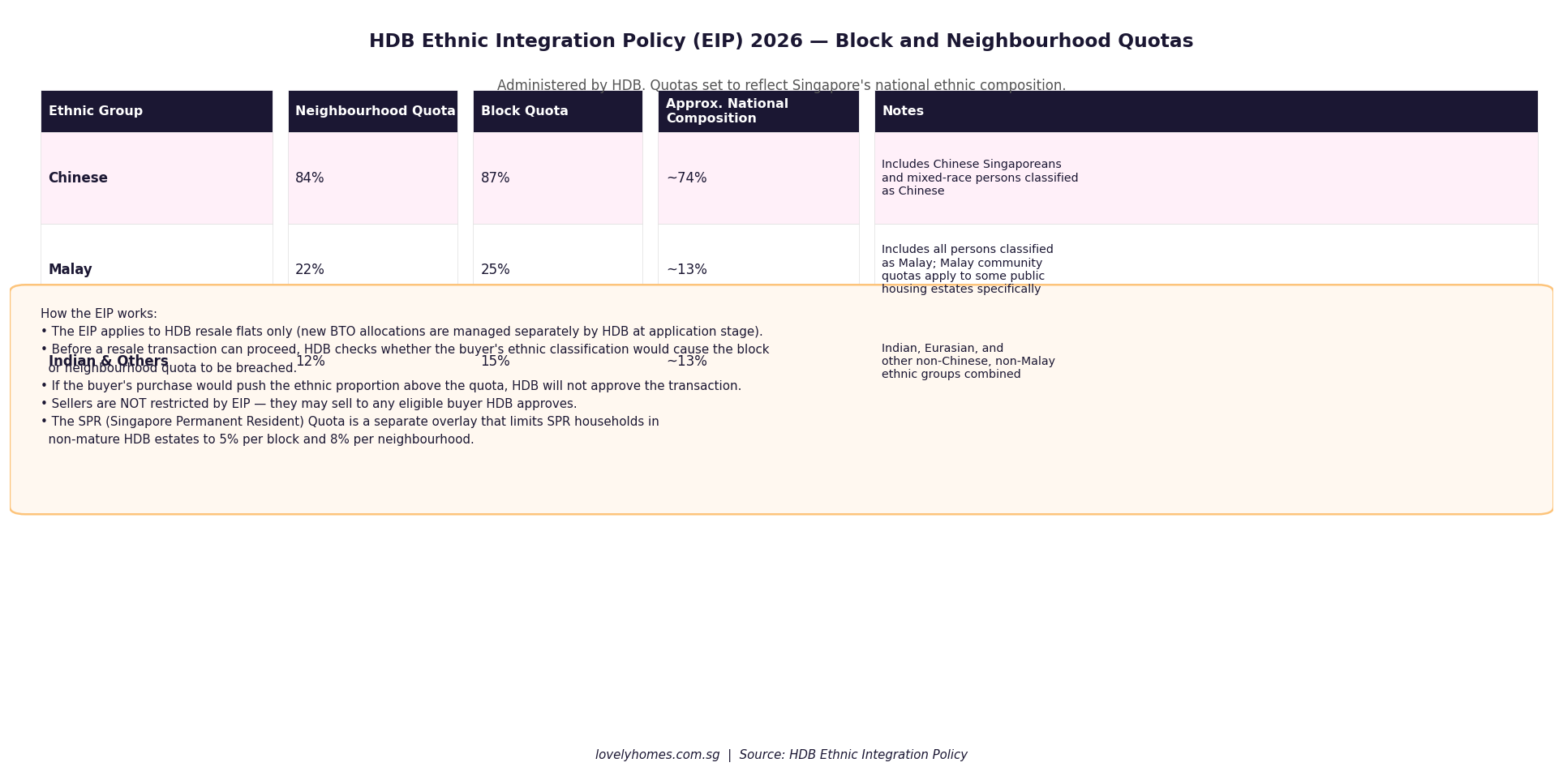
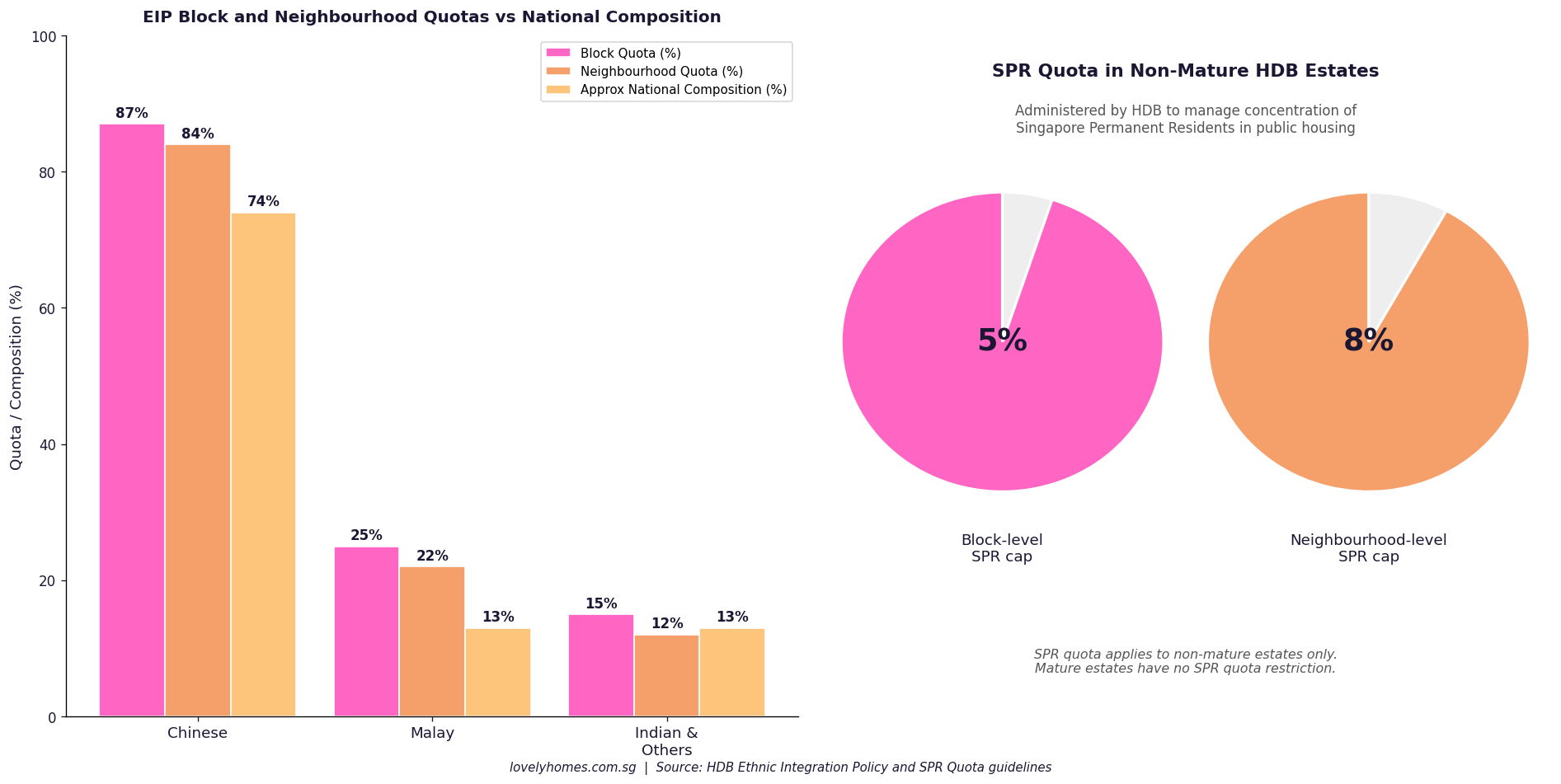
  • Quota limits: Chinese — 87% (block) / 84% (neighbourhood); Malay — 25% / 22%; Indian/Others — 13% / 10%.
  • Who is affected: Anyone buying or renting an HDB resale flat in Singapore — Singapore Citizens (SCs), Singapore Permanent Residents (SPRs), and HDB flat owners renting out.
  • Key risk: If a block or neighbourhood has reached the quota for your ethnic group, you cannot complete the resale purchase for that flat, even after exercising the OTP.
  • How to check: Via the HDB Resale Portal or by calling HDB directly — always check before signing any Option to Purchase (OTP).
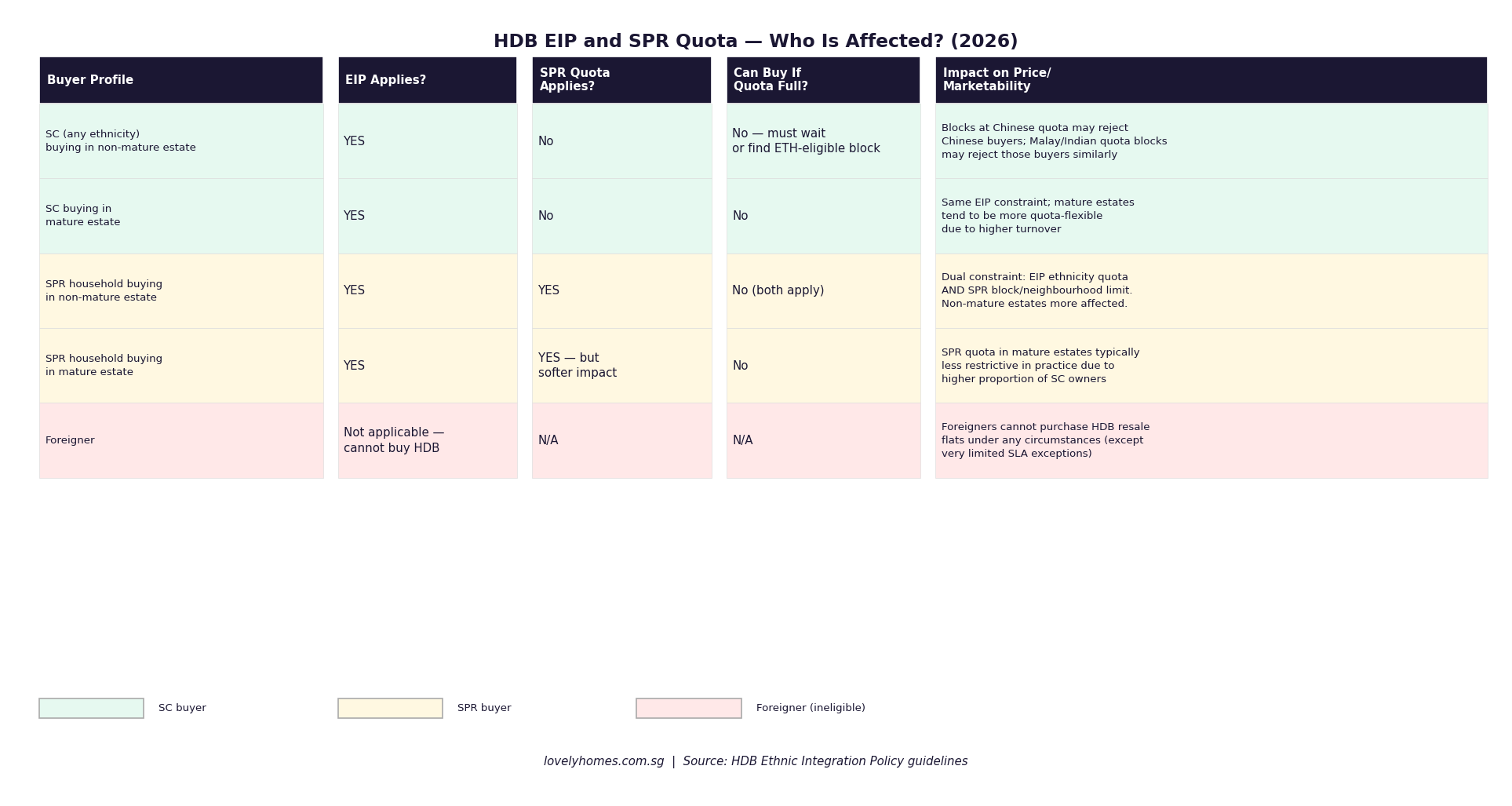
  • SPR angle: SPRs face an additional SPR Quota (SPR households cannot exceed 5% of flats per block and 8% per neighbourhood) on top of the EIP.
  • Rental applies too: HDB flat owners must also comply with EIP quotas when renting out their flat or bedrooms.

When Singaporeans buy an HDB resale flat, most focus on price, lease, and proximity to amenities. Far fewer remember to check the Ethnic Integration Policy (EIP) — until they discover, after exercising the Option to Purchase, that the block has already met the quota for their ethnic group.

The EIP is one of Singapore’s most consequential yet least-explained housing policies. Introduced in 1 March 1989 by the HDB under the Ministry of National Development, it was designed to prevent the racial self-segregation that had been emerging in certain estates — a pattern the government concluded was contrary to Singapore’s long-term social cohesion. The policy works by capping the proportion of each ethnic community in any given HDB block and neighbourhood, effectively requiring that no single group dominates any residential area.

For property buyers and sellers, the EIP creates a real constraint: it can limit the pool of eligible buyers for your flat and, conversely, rule out flats you want to purchase. Understanding how it works — and how to check before you sign — is essential for anyone navigating the HDB resale market in 2026.

Figure 1: HDB Ethnic Integration Policy EIP quota table neighbourhood and block limits 2026
Figure 1: HDB Ethnic Integration Policy quota limits by ethnic group — neighbourhood and block levels (2026). Source: HDB.

Origins and Policy Background

By the late 1980s, HDB estates had begun to show ethnic clustering — not through any discriminatory housing allocation, but through the natural tendency of communities to live near one another. Surveys showed that certain blocks in Queenstown and Toa Payoh were becoming more than 90% Chinese or more than 80% Malay. The government, mindful of the 1964 and 1969 racial riots in Singapore’s early independence years, concluded that residential segregation — even voluntary — risked weakening inter-ethnic relationships over time.

The EIP was the policy response. From 1 March 1989, every HDB resale transaction required HDB’s approval, contingent on the buyer’s ethnicity not exceeding the established quota for that block and neighbourhood. The quota limits were set to approximate the national ethnic composition at the time: Chinese ~77%, Malay ~22%, Indian and others ~10% — with built-in flexibility at the block level to allow minor deviations.

The policy has remained largely unchanged in structure since 1989, though HDB reviews the specific quota percentages periodically. The last substantive adjustment was in 2010, when HDB reviewed the neighbourhood-level caps. In 2026, the figures remain: Chinese 84% / 87%, Malay 22% / 25%, Indian/Others 10% / 13% (neighbourhood / block).

How the EIP Works in Practice

The EIP operates at two levels simultaneously: the neighbourhood level and the block level. A buyer’s ethnicity must be within quota at both levels for a transaction to proceed.

Neighbourhood vs Block

A neighbourhood is a planning cluster of approximately 1,000–2,000 HDB households — roughly what most Singaporeans think of as a “precinct” or estate zone. A block is the individual HDB building. The block limit is slightly higher than the neighbourhood limit to give HDB flexibility in managing transitions.

If a Malay buyer wishes to purchase a flat in a block where Malay households already constitute 24% of the block’s flats, the block limit of 25% is not yet breached. However, if the neighbourhood (the surrounding cluster) already has 22% Malay households, the neighbourhood limit is met and the transaction cannot proceed — even though the block itself has room.

Who is Classified as What Ethnicity?

The classification follows the buyer’s (and co-buyers’) NRIC race declaration. For mixed-race individuals or couples, HDB uses the race of the primary buyer — generally the person listed first in the application. For joint purchases by couples of different ethnicities, HDB determines the applicable ethnicity based on its established criteria (generally the husband’s declared race in traditional family arrangements, though this has evolved to reflect modern applicant structures — buyers should check with HDB directly for their specific combination).

Figure 2: Step-by-step process to check HDB EIP status before buying a resale flat
Figure 2: How to check your HDB EIP status before buying a resale flat — a four-step process.

The SPR Quota: An Additional Layer for Permanent Residents

Beyond the ethnic-group quota, Singapore Permanent Residents (SPRs) face a separate SPR Quota. This quota caps the number of SPR households in any HDB block at 5% and in any neighbourhood at 8%. The rationale: HDB flats are subsidised public housing primarily for citizens, and excessive SPR concentration in any area is seen as inconsistent with that purpose.

Practically, this means SPR buyers face two quota checks before any resale purchase: (1) the ethnic-group EIP check, and (2) the SPR Quota check. Either can block a transaction. In more popular estates — Queenstown, Bishan, Toa Payoh, Tampines — SPR quotas can be reached at certain blocks, limiting options for SPR buyers even when the EIP quota is not an issue.

SPRs also cannot buy new BTO flats or Executive Condominiums during the initial launch period. Their housing options are largely confined to HDB resale flats (subject to both quotas) and private residential properties.

EIP Impact on HDB Resale Sellers

For sellers, the EIP can materially affect saleability. If a Chinese seller owns a flat in a block where the Chinese quota has already been met, the pool of eligible buyers is restricted to non-Chinese buyers only — significantly narrowing demand and potentially suppressing the resale price.

This dynamic is known informally as an “EIP-affected” flat. Industry data (from URA and HDB transaction records) suggests that EIP-affected blocks can see resale prices 5–12% below comparable non-affected blocks in the same estate, as the effective buyer pool is reduced. The discount reflects the liquidity premium buyers demand for taking on an asset with constrained future resalability.

Seller tip: Before listing your HDB flat for sale, check the current EIP status of your block and neighbourhood on the HDB Resale Portal. If your block’s dominant ethnic group quota is near its cap, consider whether a price adjustment is needed to attract buyers from the eligible pool, or whether to time your sale to coincide with demographic shifts in the block.

EIP and HDB Rentals

The EIP applies not only to resale transactions but also to approved whole-unit and bedroom rentals of HDB flats. When an HDB flat owner applies to rent out the entire flat or individual bedrooms, HDB checks whether the rental would cause the block or neighbourhood quota for the tenant’s ethnicity to be exceeded. If so, HDB will not approve the rental application for that particular tenant.

This has practical implications for landlords in popular rental estates. A Malay landlord renting to a Malay tenant in a block near its Malay quota limit may have the application declined, requiring them to seek tenants of other ethnicities. The rental EIP check is done through the HDB Resale Portal and typically takes 7–14 business days for approval.

EIP Compliance Summary for Buyers and Sellers (2026)

Scenario EIP Check Required? SPR Quota Check? How to Check Consequence of Breach
SC buying HDB resale Yes No HDB Resale Portal / call HDB Transaction cannot proceed
SPR buying HDB resale Yes Yes (both) HDB Resale Portal / call HDB Transaction cannot proceed
Foreigner buying HDB N/A N/A N/A Foreigners cannot buy HDB
SC/SPR renting out flat Yes (for tenant) Yes if tenant is SPR HDB Resale Portal (rental) Rental application declined
Flat owner listing for sale No — buyer’s responsibility No Inform buyers to check before OTP Buyer may back out post-OTP
New BTO purchase Not applicable Not applicable N/A HDB allocates based on ballot; no EIP for BTO

Worked Example: EIP Blocking a Resale Purchase

👥 The Rajan Family — Indian SC Couple, Tampines

Situation: Mr and Mrs Rajan (both SC, Indian, classified as “Indian/Others” under HDB’s ethnic categories) have identified a 5-room HDB resale flat at Tampines Street 81 for S$748,000. They have obtained an In-Principle Approval (IPA) from OCBC and are ready to exercise the OTP.

EIP check result: Before signing, Mr Rajan checks the HDB Resale Portal. He finds that Block 837, Tampines Street 81 has Indian/Others households at 12.8% of total flats — just below the 13% block limit. However, the neighbourhood ethnic composition shows Indian/Others at 10.2% — exceeding the 10% neighbourhood limit.

Outcome: Even though the block itself has not reached the 13% block cap, the neighbourhood cap of 10% has been breached. HDB would not approve the resale transaction if the Rajans proceed. They must look elsewhere.

Alternative strategy: Mr Rajan checks two neighbouring blocks in the same estate. Block 821 has Indian/Others at 8.9% (block) and the neighbourhood is at 9.6% — both within limits. The Rajans find a comparable 5-room flat there for S$742,000 and proceed with that transaction instead.

Key lesson: Always run the EIP check on the specific block and neighbourhood before exercising the OTP. HDB’s Resale Portal provides this check in real time. If in doubt, ask HDB to confirm in writing before you commit.

Why the EIP Matters for Property Buyers and Investors in 2026

The EIP is one of a small number of housing policies with no private-sector equivalent anywhere in the world — an active government intervention in the resale market to shape residential demographics. Its continued existence in 2026 reflects Singapore’s view that racial integration in housing is a public good that market forces alone will not maintain.

For buyers, this has three practical implications:

1. Pre-OTP due diligence is mandatory. Unlike stamp duty (which is always payable) or CPF usage (which always applies up to the withdrawal limit), the EIP can create an absolute bar to a transaction. There is no waiver, no appeal, and no workaround. The check is free and takes minutes on the HDB Resale Portal — there is no excuse for not doing it before any OTP is signed.

2. Resale value may be constrained. A flat in a block where one ethnic group’s quota is near saturation has a structurally smaller buyer pool. Over time, as Singapore’s ethnic composition shifts slightly (the 2020 and 2030 Censuses have shown gradual changes in distribution), these constraints may ease or tighten. Buyers should assess whether the block they are purchasing in is near any quota caps — not just for their own purchase, but for future resalability.

3. Rental yield could be affected. Landlords whose target tenant demographic is near the block quota may find their rental application declined and be forced to seek tenants from a different group — potentially limiting rental demand and yields in certain micro-locations.

What Might Change: Possible EIP Developments (Speculative)

The EIP has been in place for 37 years as at 2026 and has rarely been publicly debated in Singapore’s political discourse. However, several developments could prompt a policy review in the years ahead:

  • Shifting ethnic composition: Singapore’s 2020 Census showed modest shifts in ethnic composition — the Chinese share declined slightly from 76.8% (2010) to 75.9%; the Malay share remained at ~15%; Indian/Others grew slightly. If these trends continue, HDB may adjust quota caps to reflect the updated demographic baseline.
  • New citizen intake: Singapore’s naturalisation programme brings in citizens from a variety of ethnic backgrounds not represented in the original EIP framework. If new citizen categories grow significantly, HDB may need to refine how “Indian/Others” is classified.
  • Digital OTP reforms: HDB has been digitising the resale process. It is plausible that future HDB Resale Portal upgrades will integrate real-time EIP checks directly into the OTP workflow, reducing the risk of buyers unknowingly exercising an ineligible OTP.

Figure 3: Singapore ethnic composition vs EIP neighbourhood and block quota caps by ethnicity 2026
Figure 3: Singapore ethnic composition (2024 Census) vs HDB EIP quota caps (neighbourhood and block levels). Sources: Department of Statistics Singapore; HDB.

Frequently Asked Questions

Can I buy any HDB resale flat I want, regardless of the EIP?

No. The EIP creates a hard quota that HDB enforces at the point of resale approval. If your ethnic group’s quota has been reached at either the block or neighbourhood level, HDB will not approve the transaction. The OTP is a private agreement between buyer and seller, but HDB’s approval is required for the actual transfer of the flat — so exercising an OTP on an EIP-blocked flat effectively voids the transaction, and the buyer may lose the OTP option fee (typically 1% of the purchase price, capped at S$1,000). Always check before you sign.

Does the EIP apply to new BTO flats?

No. The EIP does not apply to HDB BTO (Build-to-Order) flat purchases. BTO allocation is managed through HDB’s ballot system, and HDB itself manages the ethnic balance during the initial allocation process. The EIP only becomes relevant when BTO flat owners subsequently sell in the open resale market during or after the Minimum Occupation Period (MOP). At that point, the resale flat enters the open market and EIP rules apply to the buyer’s purchase.

What happens if I am of mixed ethnicity?

HDB uses the race as declared on your NRIC for EIP purposes. For mixed-race individuals, the NRIC declaration (made at birth or at the point of citizenship registration) governs which quota is checked. If you have changed your race declaration on your NRIC (permissible under certain circumstances), the updated declaration applies. For couples where both buyers are of different ethnicities, HDB determines the applicable ethnic classification based on its guidelines — typically the primary applicant’s declared race. If this creates ambiguity for your situation, call HDB directly to confirm before exercising any OTP.

Can EIP quotas be waived or appealed?

Generally, no. The EIP is a statutory policy administered by HDB, and there is no formal waiver or appeal process for buyers who cannot meet the quota for a particular block or neighbourhood. The solution is to identify an alternative block or neighbourhood where the quota has not been reached. HDB occasionally adjusts the boundaries of planning neighbourhoods when redevelopment occurs, which can change quota calculations for affected blocks — but this is an administrative restructuring, not an individual waiver.

Does the EIP affect Executive Condominiums (ECs)?

ECs are a hybrid housing type — publicly developed by HDB but privately managed after completion. The EIP does apply to ECs during their public-housing phase (the first 5 to 10 years, prior to full privatisation). Once an EC has been privatised (after the 10-year mark), it is treated as private residential property and the EIP no longer applies to resale transactions. Given the EC MOP change in May 2026 (MOP extended from 5 to 10 years, privatisation extended from 10 to 15 years), the EIP-applicable period for new ECs has in effect been extended alongside these changes.

How do I check the EIP status before buying an HDB resale flat?

The fastest method is to log in to the HDB Resale Portal (resale.hdb.gov.sg) using your SingPass, navigate to the “Check Resale Conditions” section, and enter the block and street address of the flat you are interested in. The portal will return the current ethnic composition percentages and confirm whether your ethnic group is within the quota. Alternatively, you can call HDB at 1800-225-5432 (toll-free) and request an EIP check for the specific address. Always get confirmation in writing (via email or the portal’s printable report) before exercising your OTP.

Does the EIP affect the resale value of HDB flats?

It can. A flat in a block where the dominant ethnic group’s quota has been met effectively has a smaller eligible buyer pool — only buyers of the non-dominant ethnic groups can purchase. This structural limitation on demand can depress the flat’s market price relative to comparable flats in non-quota-affected blocks. The discount is hard to quantify precisely (it varies by estate, ethnic mix, and local demand), but it is a real consideration for buyers making a long-term investment decision. Before purchasing, assess not just your own EIP eligibility, but whether the block’s current composition suggests that future resalability may be constrained.

Disclaimer: This article is for general informational purposes only and does not constitute legal, financial, or property advice. The Ethnic Integration Policy (EIP) is administered by the Housing & Development Board (HDB) under the Ministry of National Development. EIP quotas and eligibility criteria are subject to change by HDB at any time. Readers must verify the current EIP status of any specific block and neighbourhood directly with HDB via the HDB Resale Portal (www.hdb.gov.sg) or by calling HDB at 1800-225-5432 before exercising any Option to Purchase. Ethnic classification rules may vary for individuals in specific circumstances — consult HDB directly for your situation. LovelyHomes recommends consulting a CEA-registered property agent and a qualified legal adviser before entering into any property transaction.

×

Click anywhere to close
HDB Resale Levy Singapore 2026: Complete Guide for Second-Timer Buyers and Upgraders

HDB Resale Levy Singapore 2026: Complete Guide for Second-Timer Buyers and Upgraders

The HDB Resale Levy is one of Singapore’s least understood property costs — and one of the most consequential for households planning to upgrade from a first subsidised flat to a second. Administered by the Housing and Development Board (HDB), the resale levy exists to ensure that the substantial housing subsidy granted to first-time buyers is partially recovered when those buyers choose to purchase a second subsidised flat from HDB. Understanding exactly who pays it, how much it is, and when it is collected can save upgrading households tens of thousands of dollars in planning errors.

✅ Quick Answer — HDB Resale Levy at a Glance

  • What it is: A levy payable to HDB by second-timer applicants who received a housing subsidy on their first flat and are now buying a new subsidised flat.
  • Who pays: Second-timers buying a new Build-To-Order (BTO), Sale of Balance Flat (SBF), or new Executive Condominium (EC before privatisation).
  • Who does NOT pay: First-timers; buyers of resale HDB flats (the levy applies only to new-flat purchases); buyers who have not previously received a housing subsidy.
  • Amounts (2026): S$15,000 (2-room) | S$30,000 (3-room) | S$40,000 (4-room) | S$45,000 (5-room) | S$50,000 (Executive) | S$55,000 (EC).
  • When paid: Deducted from the sale proceeds of the first flat, or paid in cash if proceeds are insufficient.
  • Official source: HDB’s Resale Levy Policy (www.hdb.gov.sg).

What Is the HDB Resale Levy and Why Does It Exist?

Singapore’s public housing system is built on the principle of one major housing subsidy per household in a lifetime. When a household buys its first BTO flat, it benefits from a significant subsidy — typically 20–40% below the market value of equivalent resale flats — funded by the Government through HDB’s development programme. This subsidy is the bedrock of Singapore’s high home-ownership rate (approximately 89% as at 2026).

When a subsidised household later sells its flat and applies to buy a second new subsidised flat (another BTO or a new EC), it would effectively be receiving a second government subsidy. The resale levy is designed to partially recoup the first subsidy, ensuring fair allocation of public resources across generations of Singaporeans. It applies regardless of the sale price achieved for the first flat — the levy is fixed by flat type, not by capital gain.

The levy was first introduced in 1995 and has been revised several times. The current levy schedule (below) has been in place since 2006 with minor adjustments, and no changes were announced in 2025 or early 2026.

Resale Levy Amounts — 2026 Schedule

HDB resale levy amounts by flat type Singapore 2026
Figure 1: HDB Resale Levy Amounts by First-Flat Type — 2026. Levy is fixed regardless of sale price achieved. Source: Housing and Development Board.
Type of First Subsidised Flat Resale Levy (S$) Payable To
2-Room Flexi BTO 15,000 HDB
3-Room BTO / DBSS / SBF 30,000 HDB
4-Room BTO / DBSS / SBF 40,000 HDB
5-Room BTO / DBSS / SBF 45,000 HDB
Executive Flat / Maisonette BTO 50,000 HDB
Executive Condominium (new, pre-privatisation) 55,000 HDB

The levy is determined by the type of the first subsidised flat, not the second. If a household sold a 4-room BTO and is now buying a 5-room BTO, it pays the 4-room levy of S$40,000 — not the 5-room levy of S$45,000. This distinction often surprises upgraders who assume the levy scales with their new purchase.

Who Pays — and Who Is Exempt

Who pays HDB resale levy Singapore 2026 eligibility guide
Figure 2: HDB Resale Levy — Who Pays vs Who Does Not Pay (2026). Green column: exempt. Pink column: liable. Source: HDB.

The two conditions that must simultaneously be met for the levy to apply are: (1) you or your co-applicant previously received a housing subsidy on a flat you own or have owned, and (2) you are now applying for a new subsidised flat (BTO, SBF, or new EC). If either condition is absent, no levy applies.

Common situations where the levy does NOT apply: buying a resale HDB flat on the open market (regardless of whether you owned a BTO before); buying a private condominium or landed property; buying an HDB flat from HDB as a first-timer with no prior subsidy; and any purchase after the levy has already been paid once (HDB does not charge it twice for the same household).

When Is the Resale Levy Collected?

HDB upgrading journey resale levy timeline Singapore 2026
Figure 3: The HDB Upgrading Journey — where the Resale Levy is collected in the transaction sequence. Source: HDB.

The levy is collected at the point of completion of the sale of the first flat, not at the point of booking the new flat. In practice, HDB deducts the levy directly from the sale proceeds — meaning it never passes through the seller’s hands. If the net sale proceeds (after repaying the outstanding HDB loan and refunding CPF with accrued interest) are insufficient to cover the levy, the shortfall must be paid in cash.

This sequencing has an important implication for households planning their upgrade: you must complete the sale of your first flat before or concurrently with the booking of the new flat. HDB will not proceed with the new flat application until it can confirm the levy payment from the sale proceeds. In practice, HDB typically requires a signed Option to Purchase (OTP) on the sale of the first flat before confirming the new flat booking.

Can the Resale Levy Be Paid in CPF?

No. The HDB Resale Levy must be paid in cash or deducted from the net cash proceeds of the first flat’s sale. It cannot be paid using CPF Ordinary Account (OA) savings. This is a common misconception and a frequent source of financial surprise for upgraders who assumed their CPF could cover all transaction costs.

The practical consequence: if you are selling a 4-room BTO and your net cash proceeds after HDB loan repayment and CPF refund (with accrued interest) are less than S$40,000, you will need to top up the shortfall in cash from your personal savings. This situation is more common than buyers realise, particularly for flats sold in the early years after MOP, when capital appreciation has been modest and CPF accrued interest has significantly eroded the net cash component.

Resale Levy vs ABSD: Key Differences

Feature Resale Levy ABSD
Administered by HDB Inland Revenue Authority of Singapore (IRAS)
Applies to New subsidised HDB/EC purchases by second-timers All residential property purchases (rates vary by profile)
SC first property No levy (unless second-time buyer) 0% ABSD
SC second property No levy (resale market); levy if new HDB 20% ABSD
Payable via CPF? No — cash only No — cash only
Fixed or variable? Fixed by flat type, not price Percentage of purchase price
Can be remitted? No Yes, under specific conditions (e.g., SC couples who sell first property within timeline)

The ABSD remission scheme (where a SC married couple buying their second property simultaneously can sell their first within 6 months after completion and apply for ABSD remission) does not affect the resale levy — the two are entirely separate instruments with separate rules and separate authorities.

What This Means for Upgraders: Planning the Upgrade Correctly

The practical implications of the resale levy are most acute for households with a low outstanding HDB loan balance and moderate CPF accrued interest — a situation common among households who purchased their first BTO 8–12 years ago at subsidised prices and have mostly paid down their loan. Such households may find that their net cash proceeds after selling are barely above or even below the levy amount, making the cash flow management of the upgrade critical.

The recommended approach is to work backwards from the levy amount before booking a second flat. Calculate your estimated net cash proceeds: (1) estimated sale price of current flat, minus (2) outstanding HDB or bank loan balance, minus (3) CPF refund with accrued interest (mandatory), equals (4) net cash. If (4) is less than the applicable levy, plan for the shortfall before the upgrade timeline begins.

Does the Resale Levy Apply to Divorcees or Single Applicants?

Yes, with nuance. A divorced Singapore Citizen who previously owned a subsidised flat with an ex-spouse may be subject to the resale levy if they are applying for a new BTO as a second-timer. However, HDB applies a concession for divorcees applying under certain schemes (such as the Joint Singles Scheme or the Single Person Scheme under specific conditions) — eligibility for this concession depends on income, flat type applied for, and the specific circumstances of the divorce. Divorcees are strongly advised to consult HDB directly before making any booking.

📊 Worked Example: Family Selling 4-Room BTO and Buying a New EC

Profile: Lim family — SC/SC couple, age 38 and 36; bought a 4-room BTO in Punggol in 2015 for S$320,000 (HDB loan S$256,000, fully repaid by 2023); MOP completed 2020; now selling at S$620,000 and booking a new EC.

Step 1 — Gross sale proceeds: S$620,000

Step 2 — CPF refund with accrued interest:
Total CPF OA used (down payment + monthly instalments over 8 years): ~S$220,000
Accrued interest at 2.5% p.a. for average holding period (~6 years): ~S$34,000
Total CPF refund required: S$220,000 + S$34,000 = S$254,000

Step 3 — Outstanding loan balance: S$0 (fully repaid in 2023)

Step 4 — Net cash proceeds: S$620,000 – S$254,000 – S$0 = S$366,000 cash

Step 5 — Resale Levy (4-room BTO seller buying new EC): S$40,000 (levy is based on first flat type = 4-room, regardless of what they are buying)

Step 6 — Net after levy: S$366,000 – S$40,000 = S$326,000 net cash available for EC downpayment

New EC purchase: S$1,350,000; minimum 5% cash downpayment = S$67,500; next 15% via CPF OA = S$202,500; balance via bank loan S$1,080,000 @ 3.2% p.a. 25yr ≈ S$5,230/mth. TDSR = S$5,230 / combined income S$16,000 = 32.7% — PASS (TDSR cap 55%).

Key insight: The S$40,000 levy significantly reduces the Lim family’s available cash — from S$366k to S$326k — but is comfortably manageable given their sale price and income. Families with smaller sale proceeds or higher CPF accrual would face tighter cash positions.

Frequently Asked Questions — HDB Resale Levy

Do I pay the resale levy if I am buying a resale HDB flat (not BTO)?

No. The resale levy applies only when you are purchasing a new subsidised flat directly from HDB — that is, a BTO, Sale of Balance Flat (SBF), or a new Executive Condominium (EC, before it achieves privatisation at the 5-year mark). If you are buying a resale HDB flat on the open market from a private seller, no resale levy is charged, regardless of whether you previously owned a BTO or received a housing grant. This is a critical distinction — many upgraders choose the resale market specifically to avoid the levy, sacrificing subsidised pricing in exchange for levy-free transacting.

Can I avoid the resale levy by adding a new flat co-applicant who is a first-timer?

No. If any co-applicant on the new flat application is a second-timer (previously received a housing subsidy), the resale levy applies to the entire application. You cannot dilute the levy obligation by adding a first-timer co-applicant. HDB treats the household as a whole — if any member has received a prior subsidy, the levy is charged.

What if I am selling my first flat at a loss — do I still pay the levy?

Yes. The resale levy is a fixed amount determined by your first flat’s type, not by whether you made a profit or loss on its sale. Even if you sell your 4-room BTO below your purchase price (or break even after CPF and loan repayment), the S$40,000 levy still applies. In such cases — where net cash proceeds are insufficient — you must pay the levy shortfall in cash. This is one of the primary reasons that HDB advises households to plan their upgrade timeline carefully, ideally waiting until the flat’s market value has appreciated sufficiently to generate meaningful net cash proceeds.

Does the resale levy apply if I sold my first flat more than 10 years ago?

Yes, there is no time limitation on the resale levy obligation. Once you have received a housing subsidy on a flat, your status as a second-timer is permanent for HDB eligibility purposes. Even if you sold your first BTO 15 or 20 years ago, applying for a new BTO today would trigger the applicable levy. This surprises some buyers who assumed the passage of time or a change in marital status would reset their subsidy status — it does not, unless specific HDB concession conditions apply.

Do Singapore Permanent Residents (SPRs) pay the resale levy?

SPRs are generally not eligible to purchase new BTO flats, so the resale levy rarely applies to them directly. However, if an SPR purchased a resale flat as a first-timer (which SPRs are permitted to do) and later achieves Singapore Citizenship, they may apply for a BTO as a couple where one is SC and one was a former SPR — in which case HDB would assess whether any prior housing subsidy was received and apply the levy accordingly. The specific eligibility rules for mixed-status (SC/SPR become SC/SC) applicants are complex; consult HDB directly.

Can the resale levy be waived or reduced in hardship situations?

HDB does not have a published framework for waiving or reducing the resale levy on hardship grounds. The levy is a fixed statutory amount with no discretionary exemption for financial difficulty. Households who are unable to pay the levy from sale proceeds must arrange cash payment before HDB will proceed with the new flat transaction. If cash reserves are insufficient, households may need to consider alternative options such as purchasing a resale flat (no levy applies), deferring the upgrade, or liquidating other assets to meet the levy obligation. This is a situation where independent financial advice is strongly recommended before committing to a booking.

What happens to the resale levy if my new BTO booking is cancelled?

If you cancel your new BTO or SBF booking before completion, HDB will typically refund the resale levy — but the exact refund treatment depends on the stage of cancellation and whether the first flat has already been sold. If the first flat has been sold and proceeds used to pay the levy, the refund would be processed back to you in cash. If the cancellation is post-completion of the new flat, no refund applies. HDB’s cancellation and refund terms for BTO bookings are detailed on the HDB website and in your sales letter — review these carefully before booking.

Disclaimer: This article is for general informational and educational purposes only and does not constitute legal, financial, or property advice. The HDB Resale Levy amounts, eligibility criteria, and collection procedures described are based on HDB’s published policy as of June 2026 and are subject to change at any time. Readers must verify all information directly with the Housing and Development Board (www.hdb.gov.sg) before making any property transaction decision. CPF accrued interest calculations, loan amounts, and cash flow estimates in worked examples are illustrative only. Consult a licensed financial adviser and HDB directly before proceeding with any flat sale or purchase.

Singapore HDB Upgrading Programmes Guide 2026: HIP, NRP, Remaking Our Heartland and What Flat Owners Pay

Singapore HDB Upgrading Programmes Guide 2026: HIP, NRP, Remaking Our Heartland and What Flat Owners Pay

If you own an older HDB flat, chances are your block has either already gone through a government upgrading programme, is currently going through one, or will eventually be selected for one. The Home Improvement Programme (HIP), the Neighbourhood Renewal Programme (NRP), and the broader Remaking Our Heartland initiative are HDB’s toolkit for keeping ageing public housing estates liveable, safe, and marketable for resale. But many flat owners are unclear about what each programme actually does, how much they will be asked to pay, and what the impact on their flat’s value might be. This guide explains all three, step by step.

Quick Answer — Key Takeaways

  • HIP (Home Improvement Programme) targets individual flats and blocks aged 30+ years — fixing spalling concrete, replacing toilets, upgrading electrical wiring. Compulsory essential works are fully paid by HDB; internal improvements involve a subsidised flat-owner contribution.
  • NRP (Neighbourhood Renewal Programme) upgrades common spaces at precinct level — covered walkways, pavilions, fitness areas, playgrounds. There is no direct cost to flat owners; the government pays.
  • Remaking Our Heartland (ROH) is a broader, estate-wide masterplan that can include new commercial facilities, transport improvements, parks, and community hubs over a 5–10 year horizon.
  • HIP requires a 75% flat-owner vote in favour before the programme proceeds for the entire block.
  • Typical HIP cost to a flat owner (after subsidy) ranges from approximately S$800 to S$4,200 for compulsory internal works, depending on flat type and household income.
  • Pioneer Generation and Merdeka Generation flat owners receive an additional subsidy that can reduce or eliminate their cost-sharing amount.
  • Upgrading programmes generally have a positive effect on resale values — industry data suggests a 3%–8% price uplift in the 12–24 months following HIP completion, though this varies by location and market conditions.
  • Each block and precinct goes through HIP and NRP only once in their lifecycle; there is no second round.

What Is the Home Improvement Programme (HIP)?

The Home Improvement Programme is HDB’s flagship in-flat upgrading initiative. It was introduced in 2007 to address the structural and facilities deterioration that inevitably affects blocks built in the 1970s, 1980s, and 1990s. HDB selects eligible blocks — typically those aged 30 years or older that have not yet undergone HIP — and offers flat owners the opportunity to vote for the upgrade.

The programme operates in two tiers. The first is essential repairs — works such as spalling concrete ceiling repairs, roof waterproofing, pipe replacement, and common-corridor structural fixes that HDB carries out for the entire block at no direct cost to flat owners. These are non-negotiable repairs that maintain the building’s structural integrity. The second tier is internal improvements to individual flats — replacement of one toilet, replacement of the entrance door, and electrical wiring upgrades where required. For these internal works, flat owners pay a subsidised cost-sharing amount; the remainder is funded by HDB.

There is also a third tier: optional add-on works that flat owners can choose to include at the time of HIP, such as a second toilet upgrade, kitchen upgrade, heavy-duty gate, window replacement, or additional power points. Flat owners pay the full (subsidised) cost of these optional items.

HDB Home Improvement Programme HIP works coverage compulsory optional 2026
Figure 1: HDB Home Improvement Programme (HIP) — What Works Are Covered, Who Is Responsible, and Who Pays. Source: HDB Singapore.

How Much Does HIP Cost Flat Owners?

The cost-sharing amount for compulsory internal works depends on three factors: the flat type, the value of the flat, and the household income. HDB applies a subsidy of 95%–99% for lower-income households (those qualifying for means-tested assistance), meaning some flat owners pay as little as a few hundred dollars. For higher-value flats in mature estates, the cost-sharing component is higher.

HDB HIP cost sharing flat type Singapore 2026 how much flat owners pay
Figure 2: HIP Cost-Sharing by Flat Type — Typical Range of Owner Contributions After HDB Subsidy (2026). Source: HDB Singapore / LovelyHomes analysis.

As a practical guide, a 4-room flat owner in a mature estate can expect to pay approximately S$2,200–S$3,200 for the compulsory internal works. A 5-room flat owner may pay S$2,700–S$3,800. These amounts can be paid in cash or via CPF Ordinary Account. Flat owners who face genuine financial hardship may apply to HDB for instalment payment arrangements. The optional add-on works are priced separately and are entirely at the flat owner’s discretion.

Pioneer Generation (born 1949 or earlier) and Merdeka Generation (born 1950–1959) flat owners qualify for an enhanced subsidy under HDB’s generational appreciation policy. Many in these cohorts pay little to nothing for the compulsory internal works; HDB absorbs the bulk of the cost as an expression of gratitude to the founding generation of Singapore homeowners.

Flat Type Compulsory Internal (Typical Range) Optional Add-Ons (If All Selected) Payment Method
1-Room / 2-Room S$800 – S$1,800 S$0 – S$1,200 Cash or CPF OA
3-Room S$1,800 – S$2,600 S$800 – S$2,000 Cash or CPF OA
4-Room S$2,200 – S$3,200 S$1,200 – S$3,000 Cash or CPF OA
5-Room S$2,700 – S$3,800 S$1,800 – S$4,000 Cash or CPF OA
Executive S$3,000 – S$4,200 S$2,200 – S$5,000 Cash or CPF OA

The HIP Voting Process: How Does It Work?

HDB does not simply impose HIP on a block. A community ballot is held: at least 75% of flat owners in the block must vote in favour of the programme before it proceeds. This threshold applies to the block as a whole — even if you personally voted against HIP or abstained, you will be required to participate (and pay) if 75% or more of your neighbours voted yes.

The vote is typically preceded by a block-level briefing session where HDB officers explain the programme, the proposed works, and the cost-sharing amounts. Flat owners are given a ballot form and a set period to respond. A second round of consultation is held if the first round does not reach the 75% threshold, though HDB reserves the right to proceed without a vote for purely structural and safety-related essential repairs.

Upgrading Programmes at a Glance

Programme Focus Who Pays Requires Flat-Owner Vote One-Time or Repeatable
HIP (Home Improvement Programme) Individual flat interiors + block structure HDB pays essential works; owner pays subsidised cost-sharing for internal works Yes — 75% majority required One-time per block
NRP (Neighbourhood Renewal Programme) Precinct common spaces and facilities Government pays entirely; no cost to flat owners Residents consulted, no formal ballot One-time per precinct
Remaking Our Heartland (ROH) Whole-estate infrastructure, commercial nodes, parks, transport Government capital expenditure No — HDB-directed masterplan Long-term programme (5–10 years)
Lift Upgrading Programme (LUP) Lift provision to every floor in older blocks Government pays majority; owner contribution S$2,000–S$6,000 depending on floor Yes — 75% majority required One-time per block

What Is the Neighbourhood Renewal Programme (NRP)?

While HIP addresses individual flats and blocks, the Neighbourhood Renewal Programme operates at the precinct level — typically a cluster of several blocks that share common facilities. The NRP funds improvements to common areas: covered linkways connecting blocks to MRT stations and bus interchanges, pavilions, community gardens, fitness corners, upgraded void decks, new playgrounds, and improved lighting.

There is no direct cost to flat owners for NRP. The programme is entirely funded by the government. Flat owners are consulted on design preferences — for example, whether they prefer a traditional pavilion or a modern exercise station — but the funding decision and timeline are set by HDB and the People’s Association. NRP works typically take three to five years from announcement to completion, given the scope of precinct-level construction.

HIP vs NRP comparison Singapore HDB upgrading programmes differences 2026
Figure 3: HIP vs NRP — Key Differences in Scope, Cost, and Coverage. Source: HDB Singapore / LovelyHomes.

Remaking Our Heartland: The Estate Masterplan

Above both HIP and NRP sits Remaking Our Heartland (ROH) — HDB’s long-term masterplan initiative for the most mature and high-priority estates. ROH designates selected towns for a comprehensive, decade-long transformation: new commercial and retail nodes, improved connectivity to public transport, parks and green corridors, upgraded community centres, and new public housing to replace old blocks removed under selective en-bloc redevelopment (SERS). ROH towns announced to date include Ang Mo Kio, Bedok, Toa Payoh, Bukit Merah, Clementi, and Queenstown, among others.

For flat owners in an ROH zone, the long-term implication is broadly positive: sustained investment in infrastructure and amenities tends to underpin demand and support resale prices relative to estates that have not received similar attention. However, construction disruption over several years is a legitimate trade-off, particularly for elderly residents who may be more sensitive to noise and dust.

Worked Example: The Chan Family, Toa Payoh 4-Room

Background. Mr and Mrs Chan own a 4-room HDB flat in Toa Payoh, built in 1985. In early 2025, they received notice from HDB that their block has been selected for HIP. A block ballot is held in April 2025; 82% of flat owners vote yes. HIP is confirmed.

Compulsory works (no choice). HDB schedules spalling concrete repairs on the exterior facade and ceiling boards, roof waterproofing works, and replacement of the shared pipe stack. These are fully paid by HDB. Disruption: contractors work on external areas; the Chans’ daily routine is minimally affected.

Compulsory internal works. HDB notifies the Chans they must replace one toilet (the master bathroom) and their main entrance door. Cost-sharing amount for their 4-room flat: S$2,850 (after HDB subsidy). As retirees, Mr and Mrs Chan are Merdeka Generation seniors, and HDB applies the enhanced subsidy. Their final payment: S$580. They pay by CPF OA.

Optional add-ons. The Chans opt to upgrade their second toilet (S$1,800) and replace their kitchen cabinet top with a stone-top worktop (outside HIP scope — they will renovate separately after HIP is complete). Total optional payment: S$1,800 by CPF OA.

Total cost to Chans: S$2,380 (S$580 compulsory + S$1,800 optional).

Resale impact. HIP works are completed in November 2026. The Chans’ block now shows fresh facades, a new main door, and an upgraded toilet. Industry comparison: similar Toa Payoh 4-room flats without HIP transact at S$490,000–S$530,000; the Chans’ block post-HIP attracts offers of S$520,000–S$560,000 — a premium of approximately S$28,000–S$35,000 (approximately 6%). Net: HIP investment of S$2,380 correlates with a S$28,000+ value uplift, a return of more than 11x on the out-of-pocket cost.

Effect on HDB Resale Value: What the Data Shows

The resale premium from HIP completion is real but not guaranteed in isolation. Research on HDB transaction data consistently finds that blocks that have completed HIP command higher prices — on average 3%–8% above comparable non-HIP blocks in the same town, adjusting for flat type, floor, and remaining lease. The premium is most pronounced in the 12–18 months immediately following HIP completion, as buyers actively seek out recently upgraded stock.

NRP completion tends to produce a more diffuse benefit across the entire precinct rather than a sharp per-block premium. The improvement in common facilities lifts the perceived liveability of the neighbourhood, supporting prices across multiple blocks simultaneously.

For buyers considering a purchase of a pre-HIP block, the key question is not whether HIP will happen, but when. HDB selects blocks based on age and condition; a 35-year-old block without HIP in a well-maintained mature estate is effectively in the queue. Buying a pre-HIP block at a slight discount and receiving the uplift post-HIP can be a sound value strategy — provided the timing aligns with your holding horizon.

What Might Come Next for HDB Upgrading Programmes

HDB has indicated it will continue to progressively roll out HIP to all eligible blocks over the coming decade. As of 2026, the vast majority of blocks built before 1990 have either completed HIP or are in active programming. Blocks built in the 1990s are now entering the 30-year threshold and are beginning to be scheduled.

Looking forward, there is policy interest in a possible HIP II for the earliest cohort of flats — those built in the early 1970s that have already undergone a first round of upgrading. The concept of a second lifecycle upgrade, addressing deterioration accumulated since the original HIP, has been discussed in Parliament. No formal HIP II programme has been announced as at June 2026, but flat owners in the oldest blocks should monitor HDB announcements closely.

On the NRP front, HDB has been refining the community consultation process, with more structured engagement through the People’s Association and grassroots advisers to ensure precinct design reflects actual resident needs rather than a standardised template. This is likely to improve the long-term quality and relevance of NRP improvements.

Frequently Asked Questions

Can I refuse to participate in HIP if my block votes yes?

No. If 75% or more of flat owners in your block vote for HIP, all flat owners — including those who voted against or abstained — are required to participate and pay the applicable cost-sharing amount. The 75% threshold is a block-level decision, not a per-unit opt-in. You may however choose whether to include any optional add-on works, which are entirely voluntary. If you have a genuine financial hardship, you can approach HDB to discuss instalment payment arrangements for your cost-sharing amount.

What happens if my block fails to reach the 75% vote threshold?

If the ballot falls below 75%, the HIP internal improvements component does not proceed for the block in that round. HDB may hold a second consultation at a later date. However, any purely structural or safety-related essential repairs — such as spalling concrete ceiling repairs or roof waterproofing — may still proceed regardless of the vote outcome, as these are considered necessary maintenance rather than optional improvements.

Can I use my CPF Ordinary Account to pay for HIP works?

Yes. Both the compulsory cost-sharing amount and the optional add-on works can be paid using your CPF Ordinary Account balance. You can also pay in cash if you prefer to preserve your CPF OA for mortgage repayments. HDB will inform you of the payment options and deadline when they send you the official HIP notice and cost-sharing letter.

Does HIP affect the HDB Minimum Occupation Period (MOP) for my flat?

No. HIP does not restart or extend your flat’s MOP. The five-year (or 10-year for PLH) MOP runs from the date your keys were collected and is not affected by any upgrading programme. You can sell your flat on the open market once your MOP is complete, irrespective of whether HIP has been completed, is in progress, or has not yet been scheduled.

I am renting out my HDB flat. Do I still have to pay for HIP?

Yes. The HIP cost-sharing obligation applies to the flat owner, not the tenant. As the owner, you remain responsible for paying the cost-sharing amount regardless of whether the flat is owner-occupied or rented out. If the HIP works require access to your flat (for internal toilet and door replacement), HDB will co-ordinate with you and your tenant on access times. If there are practical difficulties, you should notify HDB in advance.

How do I find out if my block has been selected for HIP or NRP?

HDB will write directly to all flat owners in a selected block with an official notice, at least several months before works commence. You can also check the HDB website (hdb.gov.sg) under “Home Improvement Programme” for the latest list of blocks selected for HIP. Alternatively, enquire with your Member of Parliament’s Meet-the-People sessions or your Town Council, who are typically briefed on upgrading schedules ahead of public announcements. Your block’s election district can affect the timing — upgrading programmes are sometimes co-ordinated with constituency development plans.

What is the difference between HIP and the Estate Upgrading Programme (EUP)?

The Estate Upgrading Programme was an earlier initiative, largely completed by the mid-2000s, that focused on precinct-level common area improvements — lift upgrading, covered walkways, void deck enhancement. The NRP effectively superseded and extended the EUP concept. HIP is a more recent and more targeted programme focusing specifically on in-flat and structural improvements. Most older blocks have undergone EUP or NRP for common areas, but may still be awaiting HIP for internal flat improvements.

Disclaimer: This article is for general informational purposes only and does not constitute professional advice. HDB upgrading programme schedules, cost-sharing amounts, and eligibility criteria are subject to change at HDB’s discretion. All figures cited are based on publicly available HDB information as at June 2026 and are indicative; actual amounts may differ depending on your flat’s condition, estate, and household circumstances. Always verify current details directly with HDB at hdb.gov.sg or by calling the HDB Branch. For property-related financial planning, consult a licensed financial adviser or mortgage specialist. Resale price data referenced is based on URA transaction data available at ura.gov.sg. CPF payment eligibility should be verified at cpf.gov.sg.
×

Click anywhere or press Esc to close

Translate »