Singapore ‘Long Island’ Preparatory Works to Begin End-2026: East Coast Property Outlook

Singapore ‘Long Island’ Preparatory Works to Begin End-2026: East Coast Property Outlook

Singapore’s most ambitious infrastructure undertaking in a generation took a concrete step forward on 30 June 2026, when the Urban Redevelopment Authority (URA) and the Housing & Development Board (HDB) announced that preparatory works for ‘Long Island’ — the Government’s large-scale coastal protection strategy for the East Coast — will commence from end-2026. For property owners, investors, and anyone watching the long arc of Singapore’s planning, this announcement sets a firm starting gun on a project that will reshape the East Coast’s future land supply, flood resilience, and lifestyle amenities over the next several decades.

‘Long Island’ is not simply a reclamation project — it is Singapore’s primary response to the threat of rising sea levels to its low-lying East Coast. The Government has long signalled that without proactive intervention, the East Coast’s beaches, parks, and existing development would become increasingly vulnerable as global sea levels rise. Long Island will ultimately create a new landmass off the East Coast, incorporating a reservoir, an expanded coastal park, and mixed-use development land — but that is decades away. What changes now is that the ground work begins.

Quick Answer — Long Island: What You Need to Know

  • Preparatory works (seabed clearing, sand bunds, sand infilling) begin end-2026, in the waters west of Bedok Jetty.
  • Phase 1 covers approximately 570 hectares — roughly 1.5 times the size of Marina Bay — spanning about 7km east-to-west and up to 1km wide.
  • Phase 2 (east of Bedok Jetty, ~155 ha) begins only after the 2029 SEA Games.
  • Beaches and parks along East Coast Park remain fully open throughout the preparatory works; near-shore swimming and jogging/cycling paths are unaffected.
  • Main reclamation works will only begin after further technical studies and public engagement — likely the early 2030s at the earliest.
  • The completed Long Island will include a new reservoir, a larger coastal park, and new urban land — potentially adding thousands of residential and commercial units in the long term.
  • An Environmental Study published alongside the announcement found no significant water quality impact and only localised, short-term biodiversity effects from the preparatory works.
  • The public has until 28 July 2026 to submit feedback on the Environmental Study report at go.gov.sg/long-island.

What Are the Preparatory Works — and Why Now?

The preparatory works announced on 30 June 2026 are a precursor to the main reclamation. They involve three primary activities: removal of seabed obstructions (existing cables, pipelines, and debris), construction of temporary sand bunds (underwater embankments to contain the work area), and sand infilling to begin building up the seabed. These are engineering prerequisites — the seabed must be cleared and stabilised before full-scale reclamation can proceed.

The timing reflects two pressures. First, the Government has identified that sea level rise poses an increasingly urgent risk to the East Coast, and delaying the preparatory works extends the timeline for protection. Second, the 2029 SEA Games — to be hosted partly at East Coast Park — limits when Phase 2 can begin. By starting Phase 1 now and phasing Phase 2 to avoid disrupting the Games, the Government has threaded the needle between urgency and community impact.

The preparatory works will take place at least 130 metres from the shoreline and will be demarcated by silt screens and floating barriers. HDB, as the appointed reclamation agent, will monitor water quality, sediment levels, noise, and dust throughout.
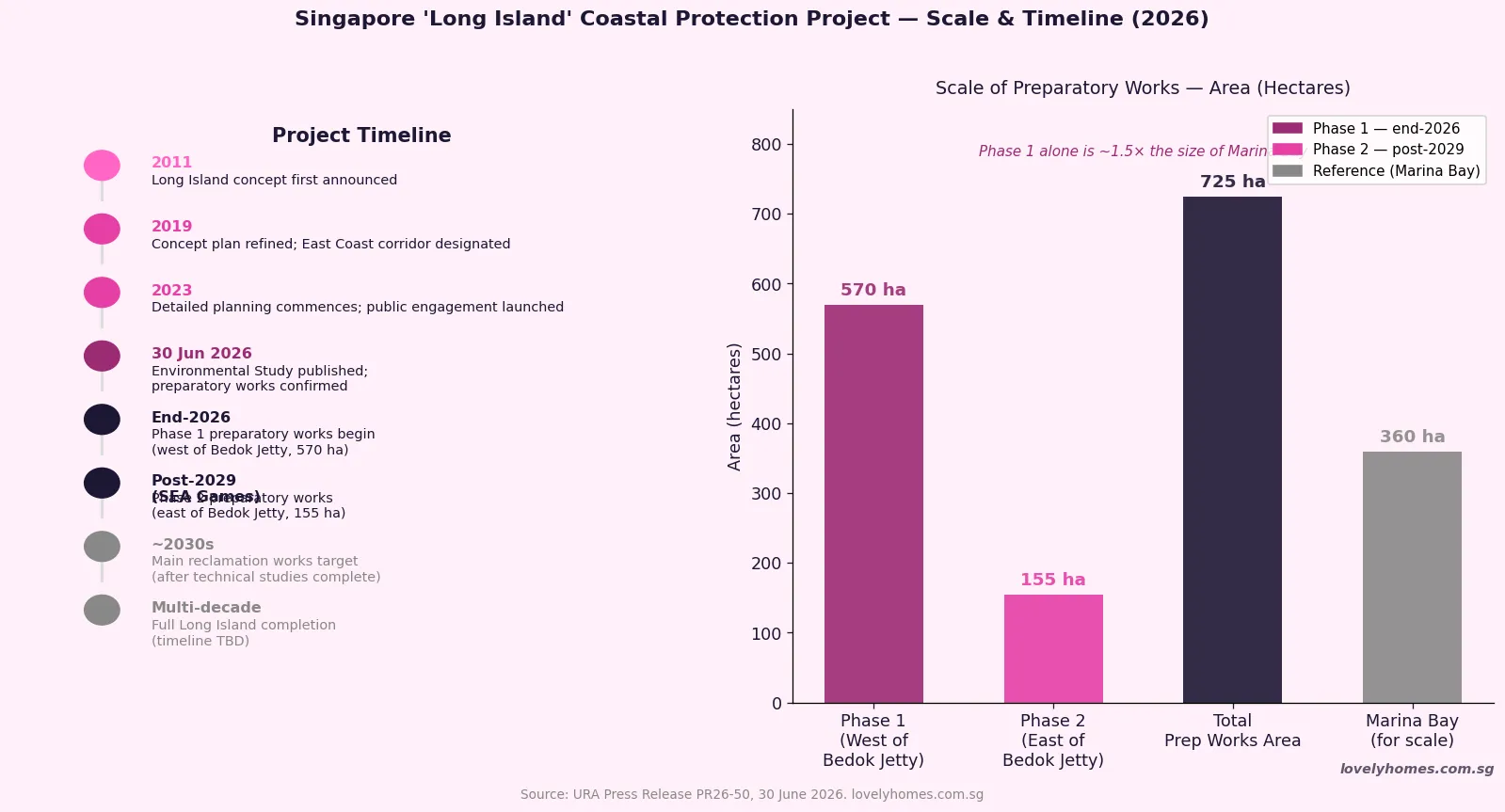
Singapore Long Island project timeline and preparatory works scale 570 hectares 2026
Figure 1: Long Island project timeline from concept to preparatory works commencement, and scale of the Phase 1 and Phase 2 preparatory works areas relative to Marina Bay. Source: URA Press Release PR26-50, 30 June 2026.

Environmental Impact — What the Study Found

HDB commissioned an Environmental Study specifically for the preparatory works phase. The study’s key findings provide important context for how the works will affect the surrounding environment:

On water quality: no significant changes are expected. Water quality will continue to meet prevailing marine water quality criteria throughout the works. Silt screens will contain sediment plumes.

On marine biodiversity: there is up to minor impact on some coral and seagrass beds near the works site, with potential short-term and localised effects from sediment plumes. The majority of coral and seagrass in the vicinity — including Sisters’ Islands Marine Park — are assessed to be largely unaffected. This will reassure the nature community, which had concerns about the proximity of Phase 1 to some of the East Coast’s more ecologically sensitive zones.

On sea sports: kiteboarding will be the most affected activity, with moderate displacement from the reduced sea space. Other sea sport users face minor to moderate impact. Agencies have committed to working with affected sea sport users to find alternative sites for the interim period.

The Environmental Study report is open for public feedback for four weeks from 30 June 2026. An Environmental Monitoring and Management Plan (EMMP) will be put in place to manage environmental conditions throughout the works.

What This Means for East Coast Property

Long Island will be one of the most significant drivers of East Coast property values over the coming decade — but it is a slow-burn catalyst rather than an immediate price mover. Here is the framework LovelyHomes uses to think about the property implications:

Short term (2026–2030): Neutral to slightly negative. The preparatory works bring marine vessels, sand infilling activity, and restricted sea space off the East Coast. Buyers considering East Coast properties — particularly those with sea-facing units or sea-sports lifestyle utility — should factor in construction-adjacent disruption. This is unlikely to cause price falls (East Coast fundamentals remain strong), but it may dampen the marginal premium that sea-view units command during this period.

Medium term (2030s): Watch for planning signals. When the detailed reclamation plans are released — expected after the technical studies are completed in the early 2030s — the market will get clarity on the eventual land profile, the new waterfront layout, the reservoir location, and potential residential zones. This is when the property market will begin to price in the Long Island uplift meaningfully. Marine Parade, Bedok, and Siglap properties in particular may benefit from the signal that the East Coast will gain a significant new green and waterfront amenity.

Long term (2040s and beyond): Transformative. If Long Island proceeds as currently envisaged — a new coastal park, a freshwater reservoir, and new urban land — it represents the creation of entirely new prime East Coast real estate. The precedent is Bishan, which was built on former agricultural land and is now one of Singapore’s most sought-after mature estates. Long Island’s eventual waterfront development could command premium valuations similar to the Marina Bay waterfront, which today represents some of Singapore’s highest residential and commercial values.

Long Island in Context — Singapore’s Coastal Planning History

This is not the first time Singapore has reclaimed land to address long-term needs. Marina Bay itself was reclaimed over several decades — the land that now hosts Marina Bay Sands, the financial district, and Gardens by the Bay was once open sea. Jurong Island was created by amalgamating seven smaller islands for petrochemical use. Changi Airport’s runways sit on reclaimed land. What is different about Long Island is its explicit dual purpose: it is simultaneously a climate adaptation measure (coastal protection) and a land creation exercise — and it is being planned with unusually extensive public engagement, reflecting a more consultative planning era.

The Government’s message is clear: Long Island is going ahead, and it will be built in a way that is sensitive to the environment, the existing East Coast community, and the interests of future residents. For property investors, that certainty has real value — it means the East Coast’s long-term trajectory is upward.

Summary — Long Island Key Facts

Item Detail
Lead agencies URA (planning), HDB (reclamation agent)
Purpose Coastal protection from sea level rise; new land supply
Phase 1 start End-2026, west of Bedok Jetty
Phase 1 area ~570 ha (7km long × up to 1km wide)
Phase 2 start After 2029 SEA Games, east of Bedok Jetty
Phase 2 area ~155 ha
Main reclamation start TBD — after technical studies (early 2030s est.)
Beach/park access Fully maintained throughout works
Feedback period 4 weeks from 30 June 2026 (closes ~28 July 2026)

Frequently Asked Questions

Will Long Island be built for housing? When will new homes be available?

The Government has said Long Island will include new urban land — but has not yet confirmed the mix of residential, commercial, industrial, or recreational uses. Given the project timeline, any new housing on Long Island is at least 20–30 years away. The more immediate property implication is the uplift to existing East Coast properties as the project progresses and its final scope becomes clear. The Government’s track record — Marina Bay, Bidadari — suggests Long Island’s eventual homes will be well-planned and high-quality, but buyers looking for a near-term supply injection from this project will be disappointed.

Does the Long Island announcement affect East Coast Park access?

No. URA and HDB have explicitly confirmed that beaches, jogging and cycling paths, and near-shore swimming areas along East Coast Park will remain open and accessible throughout the preparatory works. Works are at least 130 metres from the shoreline. The main restriction is on certain sea sports users — particularly kiteboarding — who will need to use alternative sea space during the Phase 1 period. East Coast Park itself, as a recreational asset, is unaffected.

Will the preparatory works affect sea views from East Coast condominiums?

In the near term, marine vessels, sand bunds, and floating barriers will be visible from East Coast properties with sea views — particularly during active infilling operations. However, these are temporary structures for the preparatory phase. The visual impact during preparatory works is expected to be significant from units with direct sea views but modest from properties further back. The more important long-term consideration is that once Long Island is reclaimed, those “sea view” units may have their sightlines altered permanently — a factor that discerning buyers of high-floor sea-facing East Coast units should factor into their purchase decision today.

How does this compare to Singapore’s previous reclamation projects?

Long Island is comparable in scale to the Tuas reclamation (which expanded Singapore’s western coast for industrial use) and the Changi East reclamation (which expanded Changi Airport). In terms of residential property impact, the closest precedent is Marina Bay — which transformed from open sea to the city’s premier commercial and residential address. Long Island’s combination of climate resilience purpose and mixed-use development potential makes it perhaps the most strategically significant reclamation in Singapore since Marina Bay, with a potentially larger impact on the East Coast residential market than any single policy change in recent memory.

Where can I read the full Environmental Study and submit feedback?

The Environmental Study report for the preparatory works is available at go.gov.sg/long-island. The public feedback period runs for four weeks from 30 June 2026, closing approximately 28 July 2026. Feedback can be submitted via the portal at that link. URA and HDB have committed to evaluating feedback thoroughly and incorporating suitable suggestions before finalising the mitigation measures for the preparatory works.

Related Articles

Disclaimer

This article is an editorial analysis produced by LovelyHomes based on URA Press Release PR26-50 (30 June 2026) and publicly available government planning documents. All timelines, area figures, and project details are drawn from official URA and HDB sources. Property market analysis represents LovelyHomes’ editorial view and does not constitute investment advice. Readers should conduct their own due diligence and consult a licensed property professional before making any purchase decision. For official information about the Long Island project, visit go.gov.sg/long-island.

Singapore EC Cooling Measures May 2026: 10-Year MOP, 90% First-Timer Quota and End of the Deferred Payment Scheme

Singapore EC Cooling Measures May 2026: 10-Year MOP, 90% First-Timer Quota and End of the Deferred Payment Scheme

SINGAPORE PROPERTY NEWS — 8 MAY 2026

Singapore EC Cooling Measures May 2026: 10-Year MOP, 90% First-Timer Quota and End of the Deferred Payment Scheme

⚡ Quick Answer

  • On 8 May 2026, Minister for National Development Chee Hong Tat announced the most significant overhaul of Singapore’s Executive Condominium (EC) scheme since 2013.
  • The Minimum Occupation Period (MOP) for new ECs is extended from 5 years to 10 years. During the MOP, owners cannot sell on the open market, rent out the entire unit, or purchase another residential property.
  • Privatisation — when foreigners and companies can buy — is pushed from 10 years to 15 years after the date of issue of the Temporary Occupation Permit (TOP).
  • The first-timer priority quota rises from 70% to 90% of units per project, with the priority window extended from one month to two years.
  • The Deferred Payment Scheme (DPS) — which allowed buyers to defer most of their payment until TOP — is abolished for all new EC GLS sites with tender closing dates from 8 May 2026 onwards.
  • The measures apply to new EC Government Land Sales (GLS) tender sites only. The five EC projects already in the pipeline (Senja Close, Woodlands Drive 17, Sembawang Road, Miltonia Close, and one other) are exempt from all three changes.
  • The stated policy objective is to ensure ECs fulfil their original purpose as affordable, owner-occupied housing for Singapore’s sandwich class — households earning too much for HDB but unable to readily afford private condominiums.

What Was Announced on 8 May 2026?

Speaking on 8 May 2026, Minister for National Development Chee Hong Tat confirmed a three-pronged policy tightening of Singapore’s Executive Condominium scheme — the hybrid public-private housing type introduced in 1995 to serve households in the S$8,000 to S$16,000 monthly income bracket. The announcement, described by the Ministry of National Development (MND) as the most significant revision to EC rules since 2013, addresses growing concern that ECs had increasingly been purchased as investment vehicles rather than owner-occupied homes.

Industry data had shown that EC en-bloc and resale activity accelerated sharply after the five-year MOP, with developers and investors competing alongside genuine owner-occupiers. The DPS, available only on ECs and not on private new launches, had allowed buyers to purchase EC units with minimal initial outlay — attracting buyers who might otherwise not have been able to afford even the initial downpayment — and the 70% first-timer quota had left meaningful room for second-timers (typically HDB upgraders) to acquire units at launch.

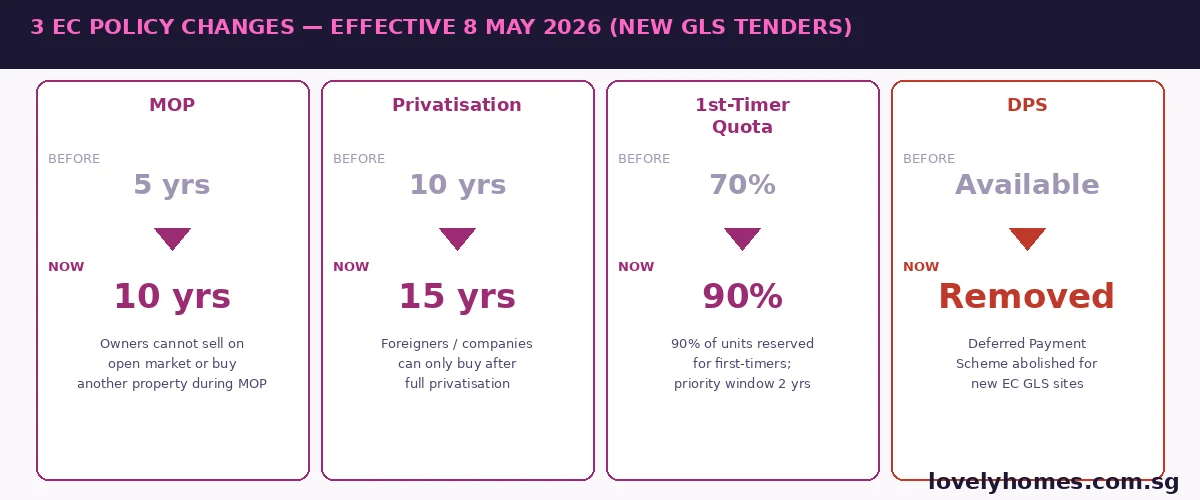
Singapore EC policy changes May 2026 — MOP 5 to 10 years, privatisation 10 to 15 years, first-timer quota 70% to 90%, DPS abolished
Figure 1: The three EC policy changes announced 8 May 2026 — before vs after comparison. Applies to EC GLS sites with tender closing from 8 May 2026. Source: Ministry of National Development; LovelyHomes research.

Change 1: MOP Extended from 5 to 10 Years

The most consequential change is the doubling of the Minimum Occupation Period from five to ten years. During the MOP, EC owners:

  • Cannot sell their unit on the open resale market.
  • Cannot rent out the entire unit (subletting individual bedrooms while continuing to reside remains subject to HDB rules).
  • Cannot purchase another residential property in Singapore.

Previously, the five-year MOP — combined with progressive privatisation at 10 years — meant that an EC buyer who received their keys in 2021 could theoretically sell on the open market in 2026 and acquire a second residential property simultaneously, often realising substantial capital gains. The 10-year MOP eliminates this arbitrage window and forces a longer owner-occupation commitment more in keeping with the EC scheme’s original mandate.

The extension aligns EC MOP rules more closely with the 10-year MOP applicable to Prime Location Public Housing (PLH) and Plus-category BTO flats — a deliberate signal from MND that ECs, despite their private-development DNA, are intended as long-term homes first and investment assets second.

Change 2: Privatisation at 15 Years (up from 10)

Alongside the longer MOP, the privatisation timeline is extended from 10 to 15 years from TOP. Privatisation is the milestone at which an EC becomes a fully private condominium — when foreigners, companies, and buyers without citizenship or PR status can purchase units on the open market.

In practice, privatisation typically triggers a price re-rating: EC resale values converge toward equivalent private condominium prices once the property is fully privatised, because the pool of potential buyers expands significantly. The extension from 10 to 15 years delays this re-rating, reducing the near-term speculative premium embedded in EC purchases and moderating investment-driven demand during the launch period.

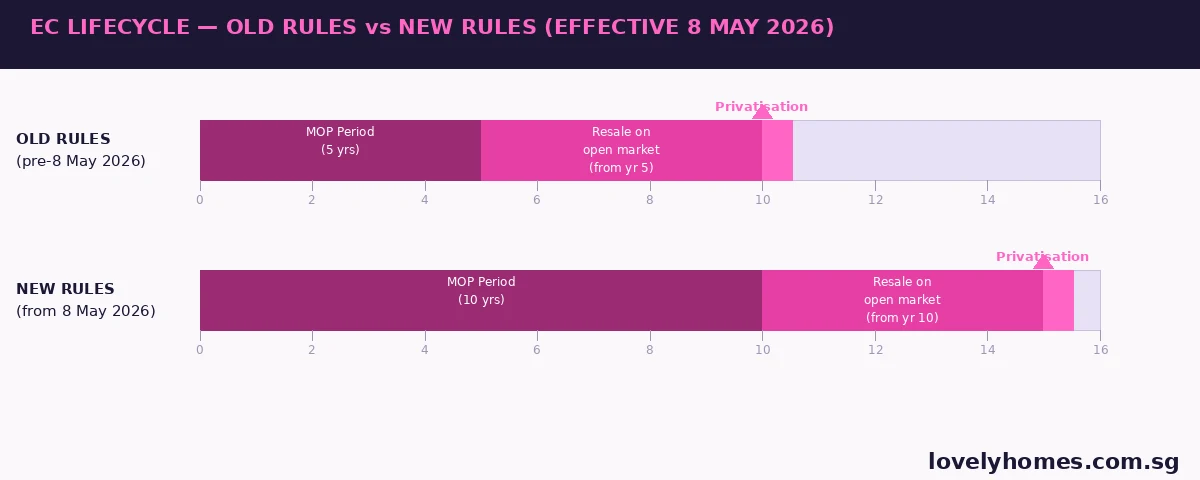
EC lifecycle timeline Singapore 2026 — old rules (5-year MOP, 10-year privatisation) vs new rules (10-year MOP, 15-year privatisation)
Figure 2: EC lifecycle comparison — old vs new rules. The new timeline significantly extends the owner-occupation mandate and delays the privatisation re-rating event. Source: LovelyHomes research; MND.

Change 3: First-Timer Quota Raised to 90%; Priority Window Extended to Two Years

Under the previous framework, developers were required to reserve 70% of EC units for first-time homebuyers during the initial one-month priority booking period. From the second month onwards, the remaining 30% — and any unsold first-timer units — could be sold to second-timers (HDB upgraders who have sold their flat).

Under the new rules:

  • 90% of units must be set aside for first-time homebuyers.
  • This priority window lasts for two years — not one month — meaning only 10% of units are freely available to second-timers at launch, and the remaining 90% stay ring-fenced for two full years.

The practical effect is dramatic. Second-timer demand — which has historically underpinned strong launch-day sell-through rates for ECs — is effectively squeezed out of the market for the first two years. Projects that launch under the new rules will see their second-timer allocation shrink from 30% to 10%, concentrating demand among genuine first-time buyers earning below S$16,000 per month.

Change 4: Deferred Payment Scheme Abolished

The Deferred Payment Scheme (DPS), available exclusively on EC new launches (it was prohibited for private residential new launches since 2007), allowed buyers to pay a 20% downpayment upfront and defer the remaining 80% — including the bank loan — until the project received its Temporary Occupation Permit (TOP), typically three to four years after launch.

DPS was popular among two buyer groups: HDB upgraders who still had an outstanding HDB mortgage and did not wish to service two loans concurrently during the construction period, and investors who wanted to maximise the leverage impact of an EC purchase. With DPS removed, EC buyers under the new rules will need to:

  • Progress Pay — paying in tranches as construction milestones are hit, via a bank loan drawn down progressively.
  • Service the EC construction loan and their existing HDB mortgage simultaneously if they have not yet sold their HDB flat (since the MOP prevents immediate HDB disposal in many cases).

The MAS’s TDSR framework (55% income cap on all debt obligations) will constrain how many HDB upgraders can absorb dual loan servicing — effectively raising the income bar for EC buyers and prioritising financially stronger applicants.

Which EC Projects Are Affected?

The new measures apply to EC Government Land Sales sites with tender closing dates on or after 8 May 2026. Five EC projects already in the tender pipeline — with tenders either closed or closing before that date — are explicitly exempt and will proceed under the existing (pre-8 May) rules:

  • Senja Close EC
  • Woodlands Drive 17 EC
  • Sembawang Road EC
  • Miltonia Close EC
  • One further pipeline project (details to be confirmed by HDB/URA)

These five projects — likely to launch in 2026–2027 — are expected to see a surge of interest from second-timers and buyers who wish to purchase under the more flexible old rules. Industry observers note that buyers steering toward these exempt projects will need to act quickly, as remaining allocation for second-timers and DPS-eligible units will be finite.

Worked Example: How the New Rules Change the Numbers for a Typical EC Buyer

Scenario: Mr and Mrs Wong, both 32, Singapore Citizens, combined gross income S$12,500/month. They currently own a 5-room HDB flat in Sengkang (purchased in 2020, MOP met in 2025). They are considering purchasing a 3-bedroom EC unit priced at S$1,350,000 under the new rules.

Factor Old EC Rules New EC Rules (from 8 May 2026)
Purchase Price S$1,350,000 S$1,350,000
Payment Scheme DPS: 20% now, 80% at TOP Progress Pay only (loan drawn progressively)
Concurrent HDB Loan During Construction Not required (DPS defers EC loan to TOP) Must service both HDB + EC construction loan simultaneously
TDSR impact (HDB loan S$900/mth remaining) Minimal — DPS means no EC loan repayment yet EC drawdown ~S$3,200/mth + HDB S$900 = S$4,100 total debt; 32.8% TDSR (within 55% cap)
MOP before open-market sale 5 years from TOP 10 years from TOP
Foreigners can buy From year 10 From year 15
Investment horizon implication Potential exit at yr 5 at ~private-condo prices Committed owner-occupier for at least 10 years; no speculative flip

In this scenario, the Wongs’ TDSR is manageable at 32.8% even with dual loan servicing, provided the HDB loan is nearly paid down. However, if their HDB loan outstanding were S$400,000 (monthly instalment ~S$2,100), the combined debt-service ratio would rise to approximately 42.4% — still within the 55% TDSR cap but more constrained. Buyers in this position should model their TDSR carefully before committing to a new EC under progress payment terms.

What This Means for the EC Market

The measures represent a structural reset of what an EC purchase means. In the near term, the five pipeline-exempt projects are likely to see accelerated interest and potentially strong launch sell-through from buyers who want to enter under the old rules. Beyond that cohort, the EC market will become a genuinely longer-duration, owner-occupation-focused product.

For developers, the longer MOP and privatisation horizon reduces the EC product’s differentiation from standard BTO-adjacent housing, potentially affecting pricing discipline and land bid appetite for future EC GLS sites. The removal of DPS increases the effective income threshold for EC buyers — those who cannot manage dual loan servicing during the construction period may need to sell their HDB flat first before committing, introducing additional friction. Land prices for new EC sites may moderate somewhat, as the speculative premium embedded in EC bids dissipates.

For genuine first-timer buyers — the target beneficiary of all three measures — the new rules improve access meaningfully. A 90% first-timer quota with a two-year priority window essentially makes ECs a first-timer product for the first two years of sales, which is exactly the intent.

Frequently Asked Questions

Do the new EC rules affect ECs I already own?

No. The new rules apply only to EC units in GLS sites with tender closing dates on or after 8 May 2026. If you already own an EC unit — or are purchasing one of the five pipeline-exempt projects — your MOP, privatisation timeline, and DPS eligibility are governed by the rules in place at the time of your purchase. Existing EC owners are not retrospectively affected. This is consistent with how all prior EC and property cooling-measure changes have been implemented in Singapore — on a prospective (not retrospective) basis.

Can I still buy an EC as a second-timer after 8 May 2026?

Yes, but your access is significantly restricted. Under the new rules, only 10% of EC units per project are available to second-timers at launch, and this 10% allocation applies throughout the first two years of sales. After the two-year first-timer priority window, any unsold units — and the developer’s remaining inventory — can be opened to second-timers and the general market. Second-timers who are willing to wait may have access to a larger selection later, but popular projects may sell out during the priority window. Second-timers who still wish to buy an EC should act quickly on the five pipeline-exempt projects, where the existing 30% second-timer allocation applies.

Can I rent out my EC under the new rules?

During the new 10-year MOP, you cannot rent out the entire EC unit — the same restriction that applied during the previous 5-year MOP. Subletting individual bedrooms while you continue to reside in the unit may be permitted subject to HDB’s prevailing subletting guidelines, but you must check HDB’s approval requirements as they apply to EC units specifically. After the 10-year MOP is satisfied, you can rent out the entire unit on the open market. Given the longer MOP, buyers who anticipated rental income during years 5–10 under the old rules will need to revise their investment models.

How does the removal of DPS affect my monthly cash flow?

Under the old DPS, a buyer committed only 20% of the purchase price upfront and deferred the bank loan drawdown to TOP. This meant no monthly mortgage payments during the 3–4 year construction period. Under progress payment — now the only available scheme — the bank disburses the loan in tranches as the developer hits construction milestones (foundation, framework, roof, walls, etc.), and you begin servicing the loan from the point each tranche is drawn. Buyers who still have an outstanding HDB mortgage will need to budget for dual loan instalments during construction. MAS’s TDSR cap of 55% applies to all debt obligations combined, so buyers should model this carefully. Those who cannot manage dual servicing may consider selling their HDB flat before committing to the EC — though this creates a transitional housing gap.

Will EC prices fall as a result of these changes?

The near-term impact on EC prices is mixed. The five pipeline-exempt projects may see elevated prices as demand concentrates on the last cohort available under old rules. For future EC sites subject to the new rules, the removal of the DPS reduces the buyer pool (those who relied on deferred payment to manage cash flow will no longer be able to participate), while the 10% second-timer cap reduces overall demand at launch. Land prices for future EC GLS sites could moderate as the investment premium dissipates. However, ECs will retain their structural price advantage over private condominiums — the income ceiling cap (S$16,000/mth), first-timer focus, and government land sale pricing mechanism all support a meaningful discount to private market prices. LovelyHomes does not expect a dramatic price correction; rather, a moderation of the premium above private condo prices that new-rule ECs commanded in 2022–2024.

Which upcoming EC projects are exempt from the new rules?

Five EC projects in the GLS pipeline with tender closing dates before 8 May 2026 are exempt from all three new measures. As confirmed by MND, these include Senja Close EC, Woodlands Drive 17 EC, Sembawang Road EC, and Miltonia Close EC, plus one additional pipeline site. These projects will proceed under the old MOP (5 years), old privatisation timeline (10 years), existing first-timer quota (70%), and retain DPS eligibility. Expected to launch in 2026 and 2027, these projects are likely to attract strong early-stage interest from buyers who wish to secure EC units under the pre-8 May framework. Buyers should monitor HDB’s new EC launch announcements closely.

Related Articles

Disclaimer: This article is a news and analysis piece based on information available as at 9 May 2026. EC policy details, effective dates, and eligibility rules are subject to change and clarification by the Ministry of National Development (MND) and HDB. Always verify the latest requirements directly with HDB (hdb.gov.sg), MND (mnd.gov.sg), and IRAS before making any property purchase decision. This article does not constitute financial, legal, or investment advice. Consult a licensed financial adviser and Singapore conveyancing lawyer before committing to any EC purchase.

Published: 9 May 2026. Sources: Ministry of National Development press statement, 8 May 2026; HDB; URA; IRAS; industry commentary. Cross-referenced against LovelyHomes EC guide (post 105772) and TDSR guide (post 105935).

Translate »