Singapore Executive Condo (EC) Buying Guide 2026: Eligibility, Prices, MOP and the New 10-Year Rules Explained

Singapore Executive Condo (EC) Buying Guide 2026: Eligibility, Prices, MOP and the New 10-Year Rules Explained

Quick Answer — Singapore Executive Condo (EC) at a glance

  • EC household income ceiling: S$16,000/month (unchanged in 2026)
  • EC prices in 2026: roughly S$1.3M–S$2.2M for new launches, depending on unit size
  • At least one Singapore Citizen applicant required; co-applicant can be SC or PR
  • New EC sites from 8 May 2026: 10-year MOP and 15-year wait to full privatisation
  • Existing launched ECs retain the older 5-year MOP and 10-year privatisation timeline
  • ECs occupy the unique “sandwich class” position — priced above HDB BTO but below private condos
  • CPF Housing Grant of up to S$30,000 (Proximity Housing Grant) available for eligible EC buyers
  • Foreigners and companies cannot buy ECs during the initial launch period from developers

An Executive Condominium — universally abbreviated to EC in Singapore — is a hybrid housing type administered by the Housing & Development Board (HDB) but developed and sold by private property developers. ECs were introduced in 1995 to serve the “sandwich class” of Singaporeans who earn above the HDB BTO income ceiling of S$14,000/month but find private condominiums financially out of reach. In 2026, ECs remain one of Singapore’s most compelling property purchases for eligible buyers: they offer condominium-standard facilities (swimming pool, gym, function room, landscaped grounds, 24-hour security) at prices roughly 15–25% below comparable private condominiums, with the bonus of becoming fully private after a defined holding period. This guide covers every aspect of buying an EC in Singapore in 2026 — eligibility, pricing, the new 10-year MOP and 15-year privatisation rules, CPF usage, financing, and a worked financial example.

What Makes an EC Different from an HDB BTO and a Private Condo?

Understanding where an EC sits in Singapore’s housing ecosystem is the starting point for any prospective buyer. HDB Build-To-Order (BTO) flats are owned by the government, subject to significant resale restrictions, carry an income ceiling of S$14,000/month, and cannot be sold on the open market for five years from the date of key collection. At the other extreme, fully private condominiums have no income ceiling, no nationality restriction (subject to ABSD rates), and no minimum occupation period — but typically cost S$1.4M–S$3M+ for a new launch in 2026.

ECs sit between these two. During the initial restricted period, ECs operate under HDB rules — they must be sold by the developer at launch to eligible SC/PR applicants, buyers must meet the income ceiling, and a Minimum Occupation Period applies. Once privatised, an EC becomes indistinguishable from any other private condo in the eyes of the law. This trajectory — from subsidised hybrid to fully private asset — is what makes ECs uniquely attractive as a long-term investment vehicle, particularly for first-time buyers who can benefit from CPF grants while locking in capital appreciation over 10–15 years.

EC vs HDB BTO vs private condo price comparison Singapore 2026
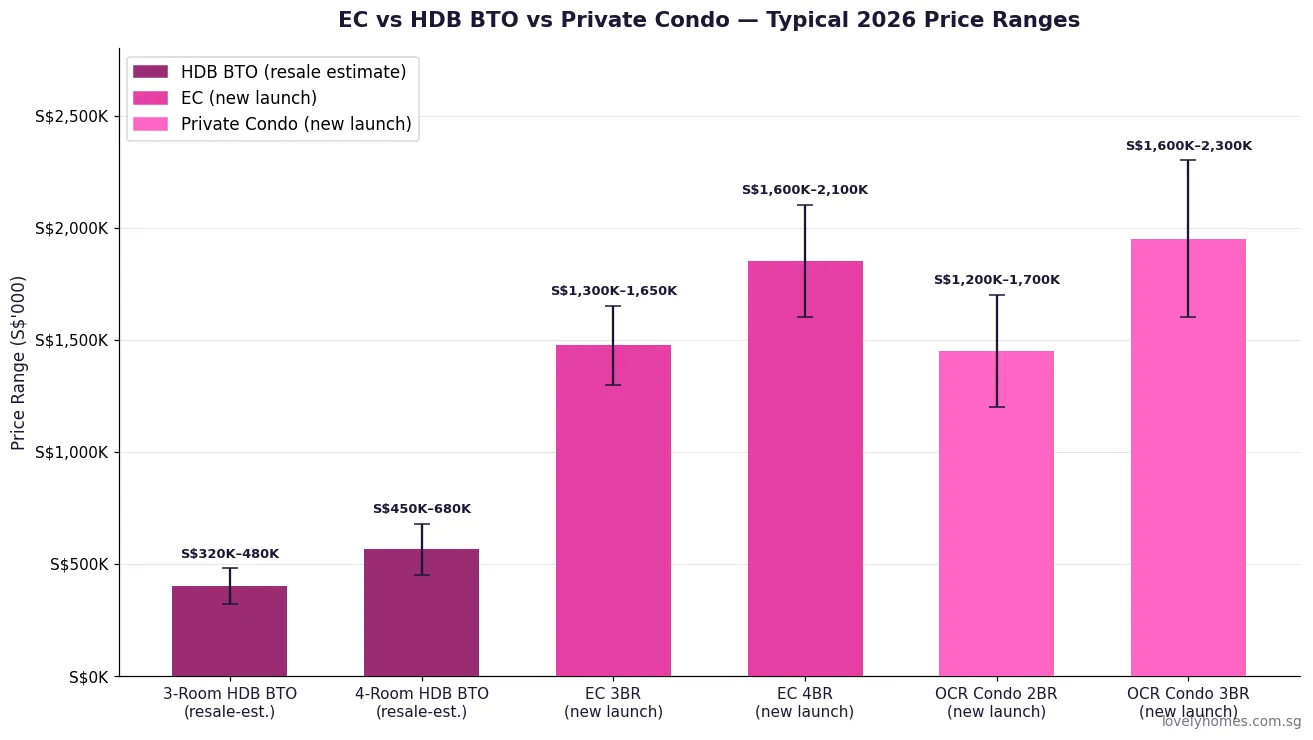
Figure 1: Typical 2026 price ranges for 3-room/4-room HDB BTO flats (resale value estimates), EC new launches (3BR/4BR), and private OCR condo new launches. EC pricing typically falls 15–25% below equivalent private condos. Source: URA, HDB, developer sales data.

EC Eligibility — Who Can Buy?

EC eligibility is more restrictive than private condo eligibility and must be carefully assessed before any application. All of the following conditions must be met simultaneously.

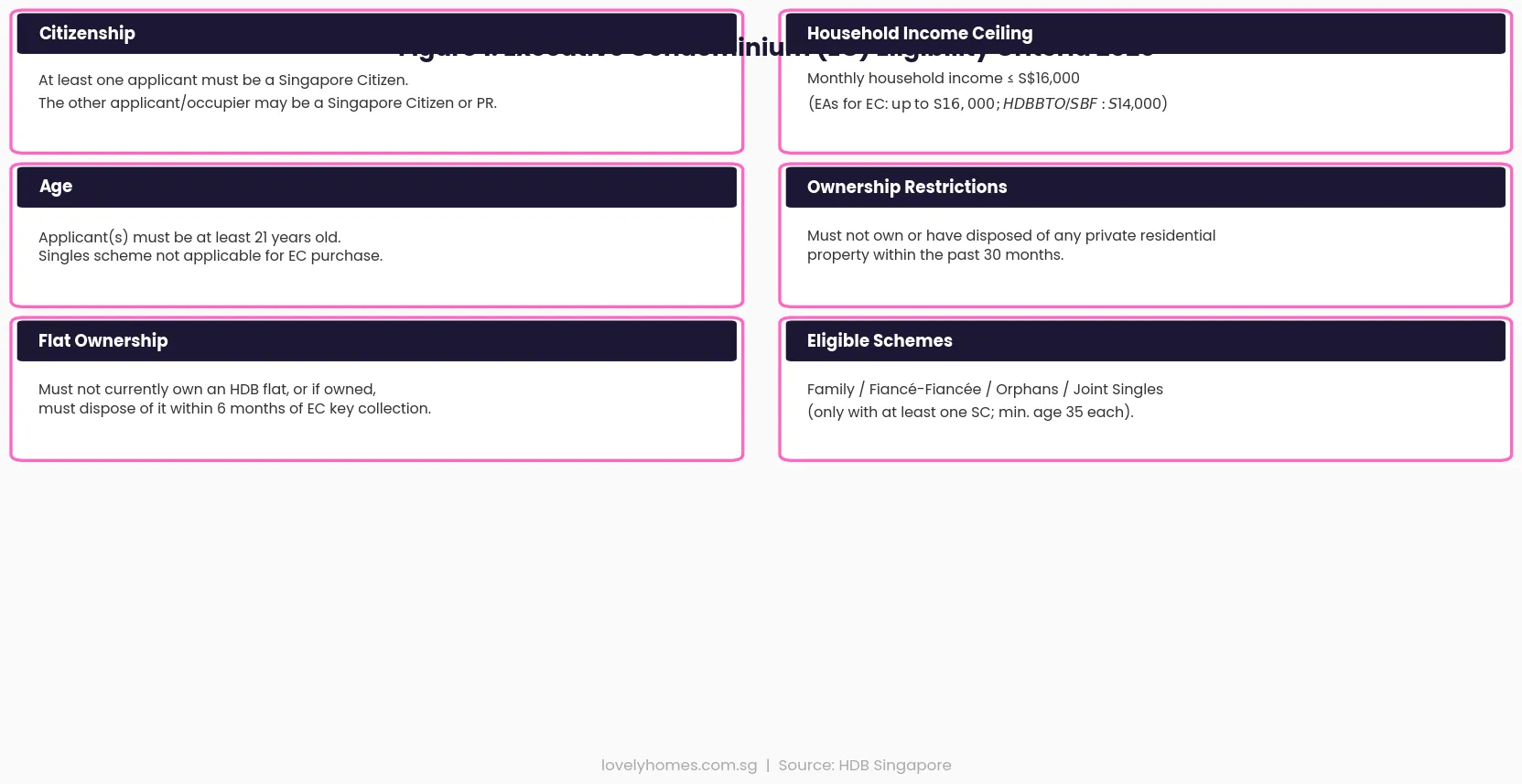
Citizenship: At least one applicant in the application must be a Singapore Citizen. Co-applicants can be Singapore Citizens or Singapore Permanent Residents. Foreigners are categorically ineligible to purchase ECs during the initial launch period from the developer. Only after 10 years from the date the EC obtained its Temporary Occupation Permit (TOP) may foreigners purchase ECs on the open market.

Household income ceiling: The combined gross monthly household income of all applicants and any occupants listed in the application must not exceed S$16,000. This ceiling has not changed in Budget 2026. Gross income includes all sources — base salary, allowances, bonuses averaged over 12 months, self-employment income, rental income, and foreign income if the applicant is assessed for Singapore tax. Exceeding the ceiling by even S$1 at the time of application results in automatic disqualification, and HDB verifies income through IRAS tax assessments and CPF contribution records.

Age: All applicants must be at least 21 years old. Under the Joint Singles Scheme (JSS), two or more unmarried Singapore Citizens may jointly apply for an EC, but each must be at least 35 years old.

Private property cooling-off period: Applicants must not have disposed of any private residential property (locally or overseas) within 30 months before the EC application date. If you sold a private property on 1 January 2024, you cannot apply for an EC until 1 July 2026.

HDB ownership history: If you or any applicant has previously owned an HDB flat, the Minimum Occupation Period of that flat must be fully served before you may apply for an EC. Additionally, if you currently own or are listed as an occupant of an HDB flat, you must dispose of that HDB flat within six months of taking possession of the EC.

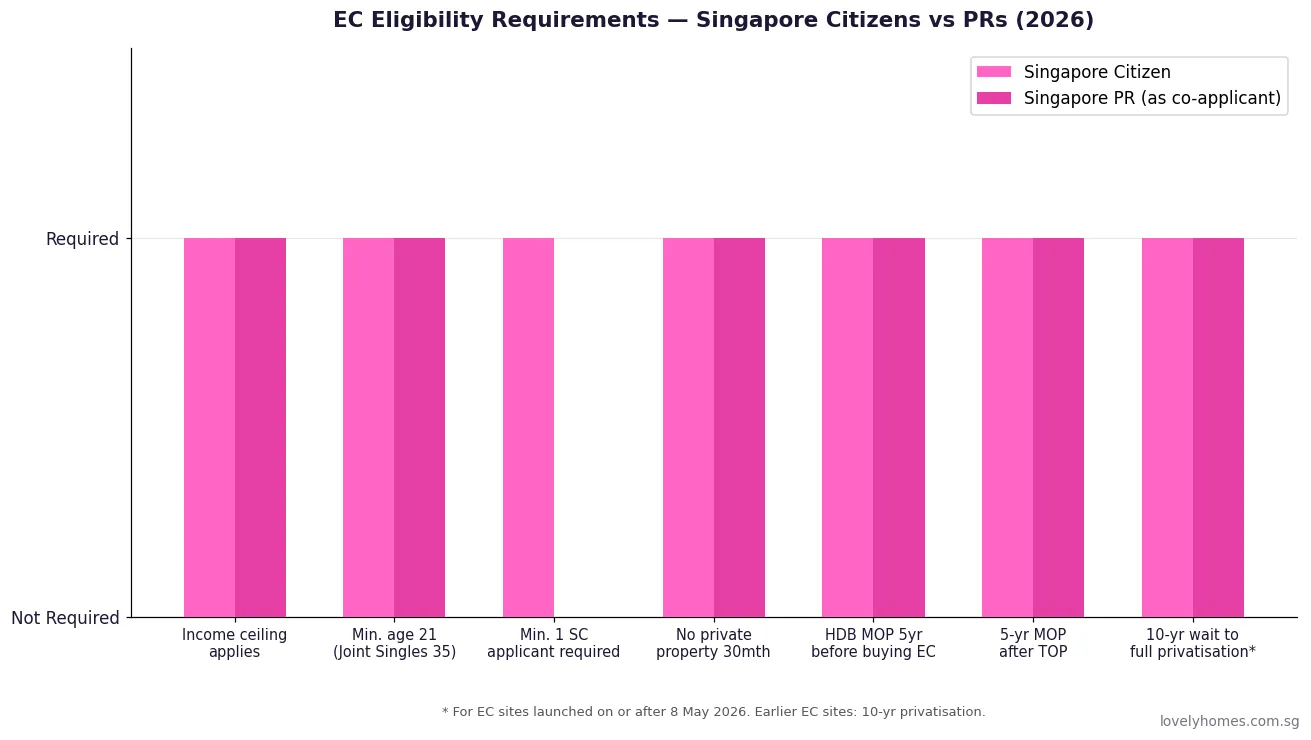
Singapore executive condo EC eligibility requirements 2026
Figure 2: EC eligibility requirements for Singapore Citizens and PRs as co-applicants, 2026. All criteria (income ceiling, citizenship, age, cooling-off period, MOP) must be satisfied simultaneously. Source: HDB.

EC Pricing in 2026 — What to Expect

New EC launches in 2026 are priced in the S$1,300–S$2,200 per square foot (psf) range, reflecting rising land costs. Upcoming EC sites at Jalan Loyang Besar (Pasir Ris) and Tampines Street 95 are expected to launch at around S$1,700 psf when they come to market, which translates to absolute prices of approximately S$1.4M for a 3-bedroom unit and S$1.8–S$2.0M for a 4-bedroom unit.

Currently available ECs illustrate the pricing landscape. Novo Place — a 504-unit development by Hoi Hup Realty and Sunway Developments — was released at indicative prices starting from S$1.298M for a 2-bedroom unit up to S$1.779M for a 4-bedroom-plus-study. Aurelle of Tampines is another active launch in 2026, reflecting the continued concentration of EC supply in the north-east corridor near good MRT connectivity.

EC Development Location Year of TOP (est.) Price Range (new launch) Units
Aurelle of Tampines Tampines Ave 11 ~2029 S$1.35M–S$2.0M 760
Novo Place Tengah Garden Walk ~2029 S$1.30M–S$1.78M 504
Lumina Grand Bukit Batok West Ave 5 ~2028 S$1.31M–S$1.65M (est.) 495
Altura Bukit Batok West Ave 8 ~2028 S$1.30M–S$1.65M (est.) 360
Jalan Loyang Besar (upcoming) Pasir Ris ~2030 ~S$1.40M–S$2.0M (projected) TBC

The New 10-Year MOP and 15-Year Privatisation Rules (From 8 May 2026)

On 8 May 2026, the Singapore Government announced a significant tightening of EC holding period rules for EC sites awarded on or after that date. Understanding the distinction between old-regime ECs (already launched) and new-regime ECs (future GLS site awards) is essential for any EC buyer in 2026.

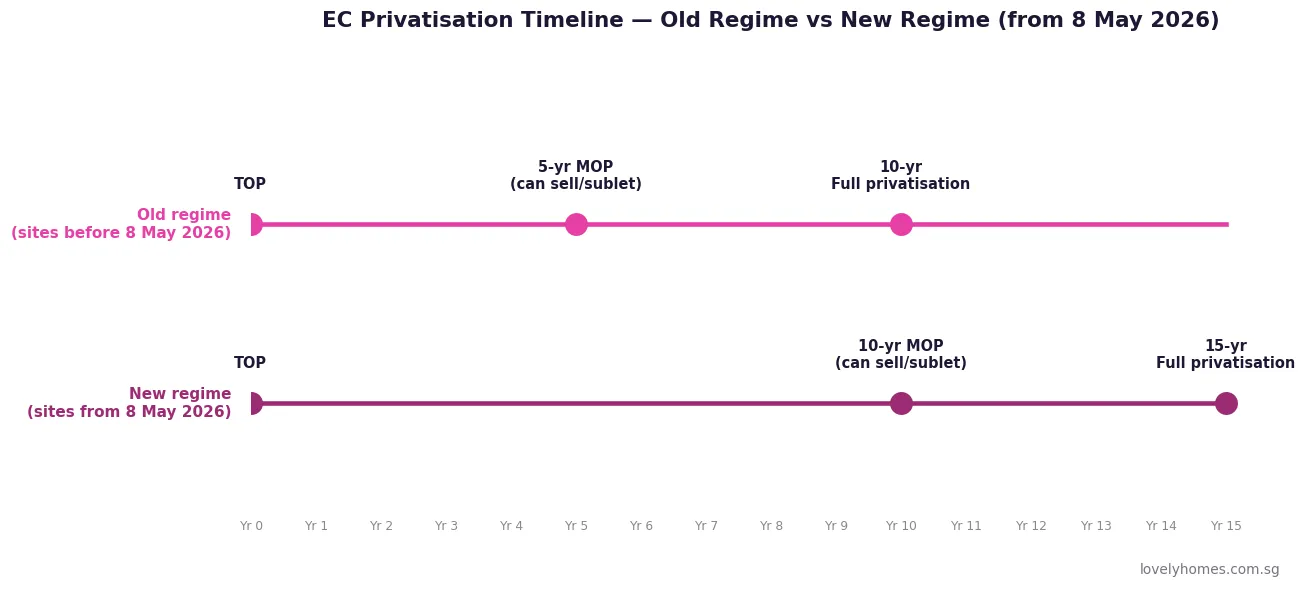
Singapore EC executive condo privatisation timeline old vs new regime 2026
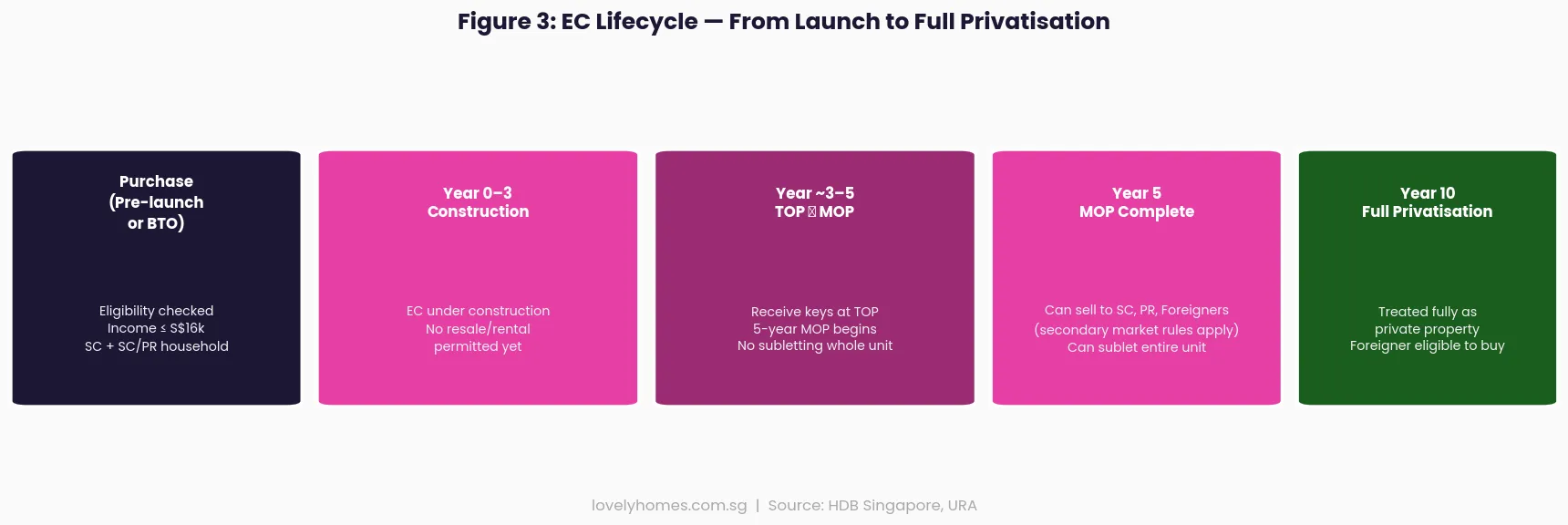
Figure 3: EC privatisation timeline — old regime (EC sites awarded before 8 May 2026) vs new regime (EC sites awarded from 8 May 2026). Source: HDB announcement, 8 May 2026.

Old regime (Aurelle of Tampines, Novo Place, Lumina Grand, Altura, and all ECs launched before 8 May 2026): The familiar 5-year MOP applies from TOP. After the MOP, the EC may be sold on the open market to Singapore Citizens or PRs. After 10 years from TOP, the EC is fully privatised and may be sold to foreigners and entities — subject to ABSD.

New regime (EC sites awarded from 8 May 2026 onwards): The MOP extends to 10 years from TOP. Full privatisation — when the unit may be transacted with foreigners and entities — does not occur until 15 years from TOP. This significantly extends the illiquidity period and reduces the short-to-medium-term capital gain that characterized earlier EC purchases. The Government’s stated rationale is to ensure ECs genuinely serve the long-term housing needs of eligible Singaporeans rather than shorter-cycle investment objectives.

The practical implication for buyers in 2026: the four currently launched ECs (Aurelle, Novo Place, Lumina Grand, Altura) are old-regime projects and retain the more liquid 5-year MOP and 10-year privatisation timeline. New EC sites awarded after 8 May 2026 will carry the extended restrictions. Buyers who prioritise resale flexibility should prioritise current launches over future GLS-derived ECs.

Financing an EC — CPF, Bank Loans and TDSR

ECs are financed through bank loans (HDB concessionary loans are not available for ECs). The bank will assess the application under the Total Debt Servicing Ratio (TDSR) framework administered by the Monetary Authority of Singapore (MAS), capping total monthly debt repayments at 55% of gross monthly income. The maximum loan-to-value (LTV) ratio for an EC bank loan is 75% of the purchase price or valuation (whichever is lower), so buyers must have at least 25% in cash and/or CPF.

CPF Ordinary Account (OA) savings may be used for the downpayment (subject to the Valuation Limit and Withdrawal Limit), monthly mortgage instalments, and stamp duties on the EC purchase. However, CPF usage for ECs is governed by the same accrued interest rules as HDB loans — when you sell the EC, you must return to your CPF account the principal withdrawn plus 2.5% per annum accrued interest. This is not a penalty but a refund to your own retirement account, and it reduces the net cash proceeds from any eventual sale.

Buyers who currently own an HDB flat and are eligible to purchase an EC simultaneously (e.g., within the six-month disposal window) must be careful about ABSD exposure: if they have not yet sold their HDB when they execute the EC Sales and Purchase Agreement, they will technically hold two residential properties and may attract ABSD at 20% (SC second property) on the EC purchase price. Planning the HDB sale to precede the EC SPA execution by at least one day is the standard approach.

Worked Example: Mr and Mrs Lim — Buying Aurelle of Tampines EC

Mr Lim (SC) and Mrs Lim (SC) are a married couple in their mid-30s. Mr Lim earns S$9,500/month and Mrs Lim earns S$5,800/month — combined S$15,300/month, comfortably below the S$16,000 income ceiling. They currently live in Mrs Lim’s parents’ HDB flat and have no prior private property ownership. They are applying for a 4-bedroom unit at Aurelle of Tampines at S$1,780,000.

Eligibility checks:

  • Income: S$15,300/month — below S$16,000 ceiling ✓
  • Citizenship: both SC ✓
  • Age: both 34 and 36 — above 21 ✓
  • Private property cooling-off: neither has owned private property ✓
  • HDB ownership: neither owns an HDB flat in their own names ✓

Purchase costs:

  • Purchase price: S$1,780,000
  • Buyer’s Stamp Duty (BSD): S$1,780,000 × BSD schedule = S$4,600 (first S$180,000 × 1%) + S$27,600 (next S$360,000 × 2%) + S$36,000 (next S$360,000 × 3%) + S$39,200 (next S$880,000 × 4%) = S$56,600 (standard BSD calculation: (180,000×1%)+(360,000×2%)+(360,000×3%)+(880,000×4%) = 1,800+7,200+10,800+35,200 = S$55,000)
  • Additional Buyer’s Stamp Duty (ABSD): S$0 — SC buying first residential property ✓
  • Legal fees (EC S&P): approximately S$3,500
  • Total acquisition cost: approximately S$1,783,500 + S$55,000 BSD + S$3,500 legal = S$1,841,500

Financing:

  • Downpayment (25%): S$445,000 — funded from CPF OA + cash savings
  • Bank loan (75%): S$1,335,000 at 3.2% fixed over 25 years = approx S$6,420/month
  • TDSR check: S$6,420 ÷ S$15,300 = 42.0% — well within 55% TDSR ✓
  • MSR note: MSR (Mortgage Servicing Ratio) of 30% applies only to HDB loans, not to EC bank loans

Grant eligibility: The Lims do not qualify for the CPF Housing Grant (available only for HDB BTO buyers) or the Enhanced Housing Grant (EHG). However, if one set of parents lives within 4km of Aurelle of Tampines, the Proximity Housing Grant (PHG) of S$10,000 (living near parents) or S$20,000 (living with parents) may apply — reducing the effective purchase price.

Projected holding value: Assuming Aurelle of Tampines follows a typical EC appreciation trajectory, comparable ECs that TOPed around 2019–2020 and privatised around 2029–2030 have demonstrated 35–50% resale premium over launch price during the privatisation window. This is speculative — past EC performance does not guarantee future returns — but the long-term track record of ECs converting to fully private assets in strong MRT-connected locations has been broadly positive.

Why ECs Matter: The Sandwich Class Opportunity

ECs were specifically designed by the Ministry of National Development (MND) to address Singapore’s “sandwich class” dilemma — households too affluent for subsidised HDB housing but not wealthy enough to comfortably absorb private condo prices without significant financial strain. In 2026, this remains the precise demographic challenge: private condo prices have risen substantially since 2020, the income ceiling for HDB BTO remains S$14,000/month, and the S$14,001–S$16,000 income band represents hundreds of thousands of eligible Singaporean households.

For buyers who qualify, an EC in a well-located development is arguably the most efficient use of S$1.3–S$2.0M in Singapore’s property market — providing private facilities and capital appreciation without the full ABSD burden on a second purchase or the income-test barriers of HDB. The caveat is the holding period: buyers must be prepared for the unit to remain illiquid (under old-regime rules) for 5 years and (under new-regime rules) for 10 years before they can sell. EC buying is fundamentally a medium-to-long-term commitment, not a short-cycle trade.

What Might Come Next — EC Policy Outlook

The 8 May 2026 announcement extending the MOP to 10 years and privatisation to 15 years for new EC sites signals that the Government intends to reinforce EC’s owner-occupation objective and reduce speculative pressure. It is plausible that income ceilings may be reviewed upward if private condo prices continue to rise faster than household income growth — a precedent exists from the 2021 rise in the HDB BTO income ceiling from S$12,000 to S$14,000 and the parallel EC ceiling rise from S$14,000 to S$16,000. Future EC GLS allocations will likely continue to be concentrated in MRT-connected OCR towns such as Tengah, Tampines, Pasir Ris, and the north corridor, aligning with long-term infrastructure investment in these areas.

Summary: EC vs HDB BTO vs Private Condo

Feature HDB BTO Executive Condo (EC) Private Condo
Income ceiling S$14,000/mth S$16,000/mth None
Eligibility SC/PR (various schemes) Min. 1 SC; SC/PR only Open (with ABSD for foreigners)
MOP (new launch) 5 years 5 yrs (old) / 10 yrs (new*) None
Full privatisation N/A 10 yrs (old) / 15 yrs (new*) Already private
CPF Housing Grant Up to S$120,000 (EHG) PHG up to S$30,000 None
HDB loan available? Yes (2.6%) No — bank only No — bank only
Typical 2026 price S$300K–S$700K (resale) S$1.3M–S$2.2M S$1.4M–S$3.5M+
Foreign buyer eligible? No After 10 yrs TOP (old) / 15 yrs (new*) Yes (60% ABSD for foreigners)

* For EC GLS sites awarded from 8 May 2026 onwards.

Frequently Asked Questions

Can a Singapore Permanent Resident buy a new EC?

A PR cannot buy a new EC as the sole or principal applicant. At least one Singapore Citizen must be part of the application. A PR may be a co-applicant alongside a SC spouse under the Public Scheme, or an EC may be purchased under a family nucleus that includes at least one SC. After the EC is fully privatised (10 years under old-regime rules, 15 years under new-regime rules), PRs and foreigners may purchase ECs on the open market. On the open market, a PR purchasing a fully privatised EC is subject to PR ABSD rates (5% for first residential property, 30% for second+).

What is the difference between the 5-year MOP and the 10-year MOP?

The Minimum Occupation Period (MOP) is the period during which the EC cannot be sold on the open market. Under the old regime (ECs launched before 8 May 2026), the MOP is 5 years from the date the EC obtained its TOP. After 5 years, the EC may be sold to Singapore Citizens or PRs on the open market. After 10 years from TOP, it becomes fully private (saleable to foreigners). Under the new regime (EC GLS sites awarded from 8 May 2026), the MOP extends to 10 years from TOP, and full privatisation occurs only at 15 years. During the MOP period, the EC cannot be sublet in its entirety (individual rooms may be sublet with HDB approval), and the owner must occupy the unit as their primary residence.

Can I use my CPF to pay for an EC?

Yes. CPF Ordinary Account (OA) savings may be used for the downpayment (subject to the Valuation Limit — VL — which is the lower of purchase price or valuation), monthly mortgage instalments, legal fees, and stamp duties. When CPF OA is used, the CPF Act requires you to refund the principal amount withdrawn plus 2.5% per annum accrued interest when you sell the EC. This refund goes back into your CPF OA (and, where applicable, Special or Retirement Account up to the prevailing Full Retirement Sum). The accrued interest is not a penalty — it is your own retirement savings with its minimum guaranteed return. Buyers should model this refund when calculating net sale proceeds from a future EC sale.

Does ABSD apply when buying an EC?

Yes, the same ABSD schedule that applies to private condominiums applies to ECs. Singapore Citizens buying their first residential property pay 0% ABSD — this is the most favourable scenario and why many EC buyers time their HDB disposal to precede the EC purchase. Singapore Citizens buying a second residential property pay 20% ABSD on the EC’s purchase price. If a buyer still holds their HDB flat when they execute the EC Sales and Purchase Agreement, the HDB flat counts as a first property, making the EC the second — triggering 20% ABSD. HDB provides a conditional ABSD remission for married SC couples who sell their HDB flat within six months of purchasing the private property (including EC). Always consult an IRAS-registered solicitor to verify your ABSD status before signing.

What happens to my HDB flat if I buy an EC?

If you currently own an HDB flat and wish to purchase an EC, you must dispose of your HDB flat within six months of taking possession of the EC (i.e., within six months of key collection). Selling before key collection is the cleanest approach to avoid ABSD exposure. If you sell your HDB after executing the EC Sales and Purchase Agreement, you may be subject to ABSD at 20% on the EC, but may apply for ABSD remission from IRAS provided the HDB is disposed of within six months of the EC SPA date. The remission is available to married SC couples and requires a formal application — it is not automatic. Failure to meet the six-month timeline results in forfeiture of any ABSD remission.

Are there any resale restrictions during the MOP?

During the Minimum Occupation Period, the EC may not be sold, transferred, or sublet as a whole unit without HDB approval. Individual bedrooms may be rented to lodgers with HDB approval — the same rules that apply to HDB flat owners. The owner must continue to occupy the unit as their principal residence throughout the MOP. Breaching MOP restrictions is treated as an offence under the Housing and Development Act and the Planning Act, and may result in compulsory acquisition of the unit by HDB at the original purchase price — a severe financial consequence. After the MOP expires, the EC may be transacted freely on the open market.

Are ECs a good investment in 2026?

ECs have historically been strong investments for eligible buyers due to the price discount at launch relative to comparable private condos, CPF grant support for eligible applicants, and the capital appreciation that typically accompanies privatisation. Past ECs that TOPed around 2017–2020 and privatised around 2027–2030 are, in many cases, transacting at premiums of 40–60% over their original launch prices in 2014–2018. However, the extension of the holding period to 10 years (MOP) and 15 years (privatisation) for new-regime ECs significantly changes the investment calculus — it reduces the short-cycle gain that previous buyers enjoyed and increases the commitment required. ECs remain a sound medium-to-long-term investment for buyers who genuinely intend to live in the property, but are less suitable as shorter-horizon plays. As with any property purchase, future value is not guaranteed — economic conditions, interest rates, supply, and government policy all influence outcomes.

Related Articles

Disclaimer: This article is intended as general information only and does not constitute legal or financial advice. EC eligibility, income ceilings, ABSD rates, MOP rules, and privatisation timelines are set by government policy and may be revised without notice. All figures are based on information available as at June 2026. Always verify current conditions with the Housing & Development Board (HDB), the Inland Revenue Authority of Singapore (IRAS), and a qualified property solicitor before making any purchase decision. Past capital appreciation of ECs does not guarantee future returns. LovelyHomes does not act as a property agent and does not endorse any developer or property service provider.

Singapore EC Buying Guide 2026: Complete Guide to Executive Condominiums

Singapore EC Buying Guide 2026: Complete Guide to Executive Condominiums

For Singapore’s “sandwich class” — households who earn too much to qualify for subsidised HDB flats but find new private condominiums financially out of reach — the Executive Condominium (EC) remains the most important rung on the property ladder. Priced typically S$400–S$700 per square foot lower than comparable private condominiums at launch, ECs are purpose-built by private developers on government land, sold to eligible buyers with CPF grants, and eventually privatised ten years after their Temporary Occupation Permit (TOP) date. At that point, they trade freely on the open market like any private condominium.

This guide covers everything you need to know about buying an EC in Singapore in 2026 — who is eligible, how much you can borrow, which CPF grants apply, the full cost breakdown, and how the new cooling measures announced on 8 May 2026 change the landscape. Where relevant, we cross-reference the EC rule changes in our separate article Singapore EC Rule Changes May 2026: 10-Year MOP, No DPS and 90% First-Timer Quota Explained.

Quick Answer — EC Buying Guide at a Glance

  • ECs are built by private developers but sold under HDB rules — eligibility, income ceiling (S$16,000/month for families), and a 5-year MOP apply.
  • New ECs in 2026 are launching at an estimated S$1,400–S$1,550 psf — roughly S$400–S$600 psf lower than comparable OCR private condominiums.
  • Eligible buyers can access the CPF Additional Housing Grant (AHG) of up to S$30,000 and the Family Housing Grant (FHG) of up to S$10,000.
  • As of 8 May 2026, new EC rules include: 10-year MOP before an EC unit can be rented out in its entirety, 15-year privatisation period (up from 10), 90% first-timer priority ballot, and abolition of the Deferred Payment Scheme (DPS).
  • ABSD is not payable on a first EC purchase from the developer; standard ABSD rates apply if buying a fully privatised EC on the open market.
  • You cannot own any private property for 30 months before applying, and must not own another HDB flat at the time of EC application.
  • The Minimum Occupation Period is 5 years for selling; the unit cannot be rented out in its entirety during this 5-year period (and now 10 years for full-unit rental under the new rules).
  • At privatisation (15 years from TOP under the new rules), the EC may be purchased by foreigners at standard ABSD rates.

What Is an Executive Condominium?

An Executive Condominium is a hybrid residential property type unique to Singapore, introduced by the Housing and Development Board (HDB) in 1995. It is developed by private developers on land sold by HDB under the Government Land Sales (GLS) programme, and comes with private condominium facilities — swimming pool, gymnasium, clubhouse, security, and landscaped grounds — at a price point made accessible through an eligibility framework similar to HDB flats.

Unlike a standard HDB flat, an EC is sold under a hybrid legal framework: it is a private strata-title property governed by the Building Maintenance and Strata Management Act (BMSMA), but for the first ten to fifteen years (depending on the vintage), it is subject to HDB ownership rules including the Minimum Occupation Period (MOP) and eligibility requirements. After the privatisation date, these HDB rules fall away entirely and the property trades as a full private condominium.

HDB administers the EC scheme. The Singapore Land Authority (SLA) maintains the land register. The Urban Redevelopment Authority (URA) tracks EC transaction data under the same REALIS system that covers private condominiums. Applications for new EC launches are made through the HDB portal at hdb.gov.sg.

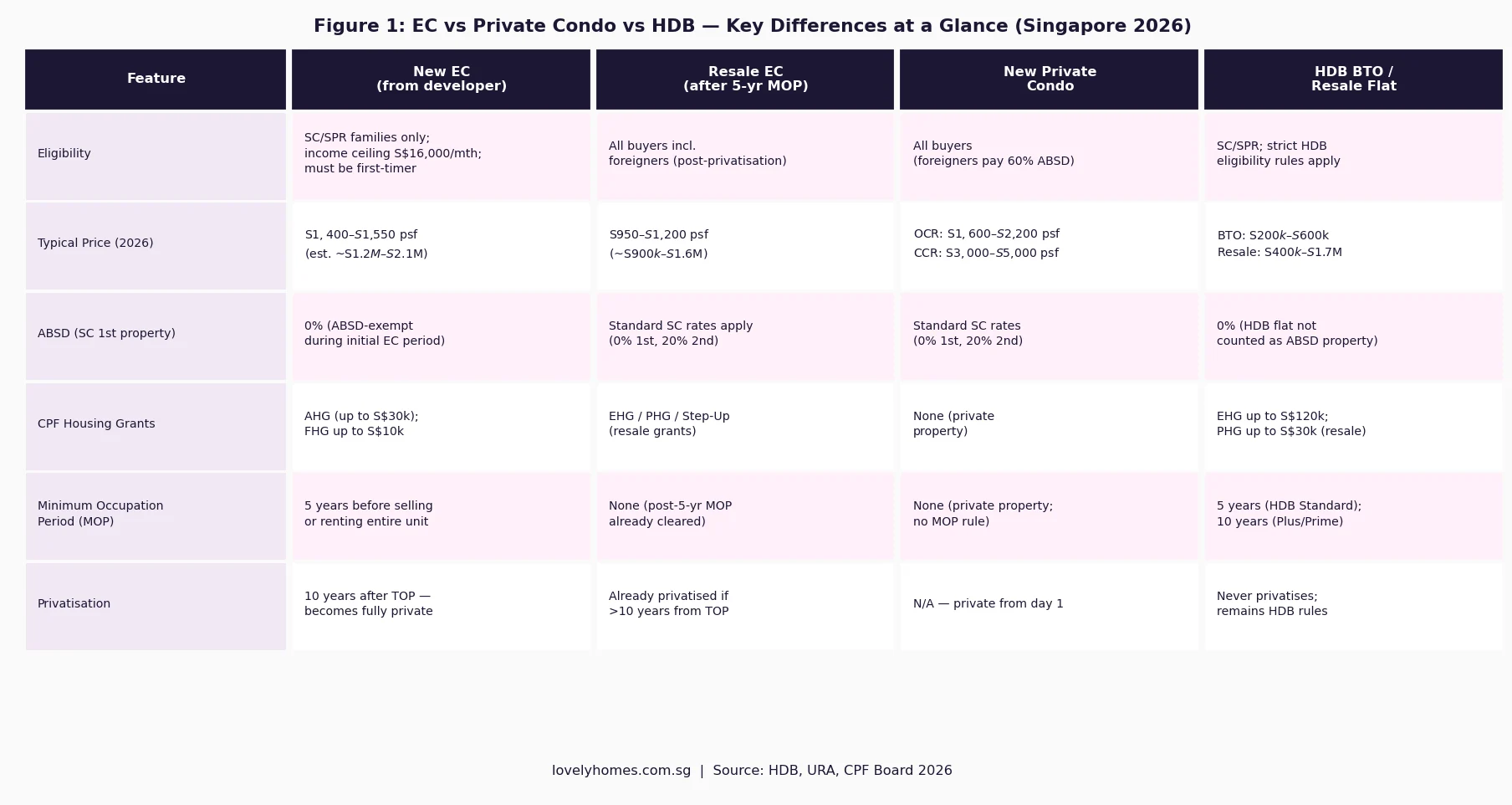
EC vs private condo vs HDB comparison Singapore 2026 — eligibility, price, MOP, grants
Figure 1: Executive Condominium vs Private Condo vs HDB — key differences at a glance (Singapore 2026). Source: HDB, URA, CPF Board.

EC Eligibility in 2026 — Who Can Buy?

Eligibility for purchasing a new EC from the developer is strictly governed by HDB. The primary eligibility schemes are the Public Scheme (family nucleus), Fiance/Fiancee Scheme, Orphans Scheme, and Joint Singles Scheme. The overwhelming majority of EC buyers purchase under the Public Scheme: a Singapore Citizen applicant forms a family nucleus with a spouse, children, or parents.

Eligibility Criterion Requirement
Citizenship At least one applicant must be a Singapore Citizen. The other occupier may be a Singapore Citizen or Permanent Resident.
Age At least 21 years old (18 years old for orphans scheme)
Income ceiling Monthly household gross income ≤ S$16,000 (families); ≤ S$8,000 (singles — Joint Singles Scheme only, age 35+)
First-timer status Must not have previously owned a private residential property in the 30 months before the EC application. Both applicant and occupier must not currently own an HDB flat (unless selling within 6 months of EC key collection).
Previous subsidies If previously purchased an HDB flat with CPF grants or sold an HDB flat with HDB loan, there are waiting periods or resale levy implications. Check HDB’s eligibility calculator.
30-month private property rule Neither the applicant nor any listed occupier may have disposed of a private residential property within 30 months before the EC application date.
Ownership of HDB flat Must not own an HDB flat unless you commit to sell within 6 months of EC TOP (for existing HDB owners upgrading).

Under the new rules effective 8 May 2026, 90% of units in each EC launch are balloted exclusively to first-timer families in the initial launch phase. This is a significant increase from the previous 70% first-timer priority, and is designed to ensure that ECs continue to serve their target demographic — upgraders who have not previously benefited from a subsidised property. Second-timer families (who have previously owned an HDB flat) are permitted to ballot only for the remaining 10% allocation during the first month of launch, and gain unrestricted access from the second month.

EC Pricing, CPF Grants, and Affordability in 2026

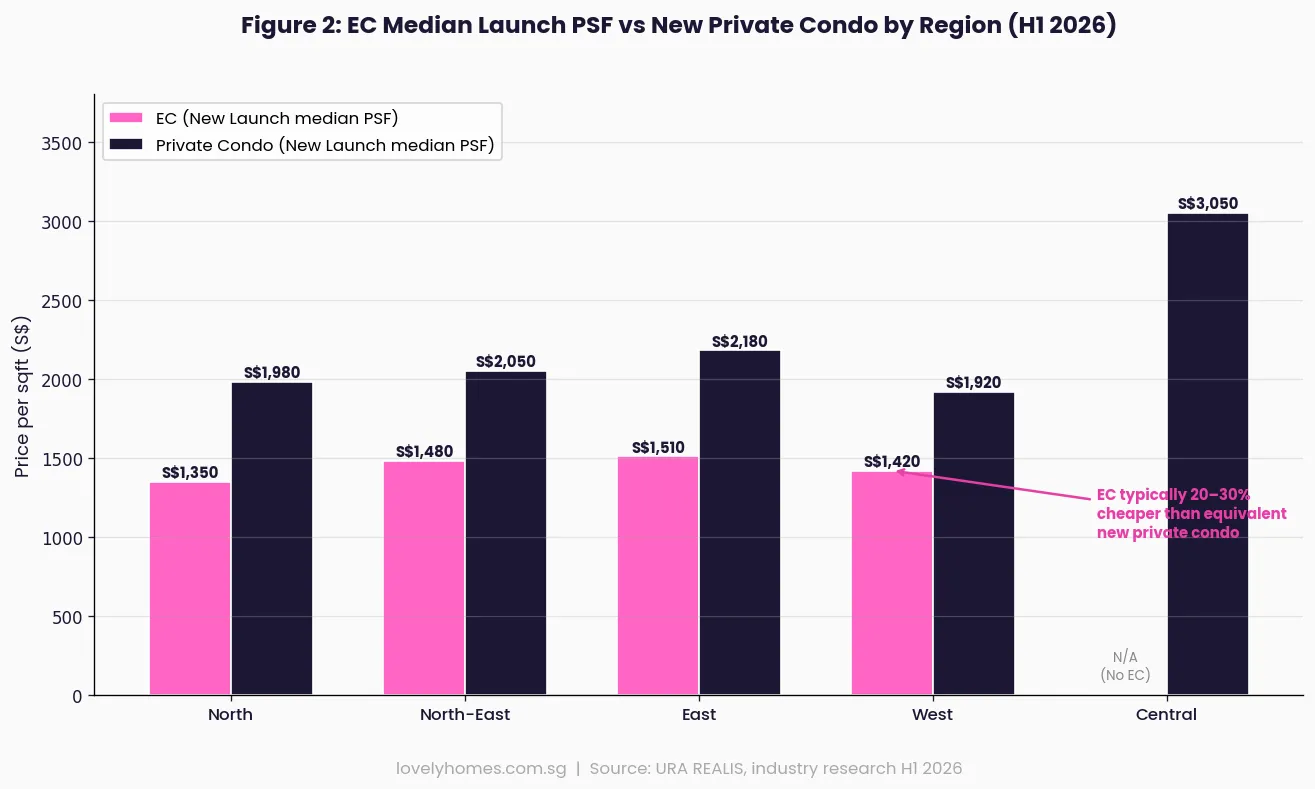
The pricing advantage of an EC over a comparable OCR private condominium has been the scheme’s defining attraction since its introduction. In the 2026 launch pipeline, new ECs are expected to price at S$1,400–S$1,550 per square foot, against OCR private condominiums averaging S$1,900–S$2,200 psf. For a 1,000 sq ft three-bedroom unit, that translates to a launch price of approximately S$1.4M–S$1.55M for the EC versus S$1.9M–S$2.2M for a comparable private condo — a saving of S$450,000–S$700,000 before grants.

On top of the pricing discount, eligible EC buyers may apply for CPF housing grants. The two principal grants for new EC purchases are the CPF Additional Housing Grant (AHG) and the Family Housing Grant (FHG), both administered by the CPF Board and HDB:

EC income ceiling and CPF grant amounts Singapore 2026 — AHG FHG and EC eligibility income
Figure 2: EC income ceiling and CPF grant amounts for EC buyers (Singapore 2026). AHG = Additional Housing Grant; FHG = Family Housing Grant. Source: HDB, CPF Board.
Grant Maximum Amount Income Ceiling to Qualify Notes
CPF Additional Housing Grant (AHG) S$30,000 ≤ S$10,000/month (family) Tiered based on income; only first-timers eligible; credited to CPF OA
Family Housing Grant (FHG) S$10,000 ≤ S$16,000/month (family) Available to all eligible EC first-timer families; credited to CPF OA
Step-Up CPF Housing Grant S$15,000 ≤ S$7,000/month (2nd-timer) For 2nd-timer families who previously lived in a 2-room or smaller HDB flat; not stacked with AHG

CPF grants for ECs are credited to your CPF Ordinary Account (OA) and may be used to offset the purchase price or reduce the mortgage. Unlike HDB resale grants, EC grants do not require you to hold the property for the MOP before they are “used up” — but CPF OA funds used are subject to the standard CPF accrued interest rules on eventual sale.

Financing an EC: Bank Loans, CPF, and the TDSR/MSR Framework

ECs may only be financed via bank loans — HDB concessionary loans are not available for EC purchases. The loan is subject to the standard Monetary Authority of Singapore (MAS) framework: Total Debt Servicing Ratio (TDSR) of 55% and, for EC purchases, the Mortgage Servicing Ratio (MSR) of 30% of gross monthly income. The MSR applies because ECs are treated as HDB-type properties for the purposes of borrowing limits during the initial eligibility period.

Under the prevailing LTV rules, a buyer with no outstanding property loans may borrow up to 75% of the purchase price (or market valuation, whichever is lower) from a financial institution. With the new 2026 rules abolishing the Deferred Payment Scheme (DPS), buyers are required to service the loan from the point of purchase or from when construction milestones are reached under the Normal Progressive Payment scheme.

Financing Parameter Applicable Rule
Loan type Bank loan only (no HDB concessionary loan for ECs)
Maximum LTV 75% of purchase price / valuation (whichever is lower), assuming no existing property loans
Minimum cash payment 5% in cash; remaining 20% downpayment may come from CPF OA
TDSR (total debt) All monthly debt obligations ≤ 55% of gross monthly income
MSR (mortgage only) EC mortgage repayment ≤ 30% of gross monthly income
Maximum loan tenure 30 years (capped such that loan maturity does not exceed age 65 of youngest borrower)
DPS (Deferred Payment Scheme) Abolished effective 8 May 2026 — all purchases use Normal Progressive Payment

EC Cooling Measures 2026: What Changed on 8 May 2026?

The Government announced a package of EC-specific cooling measures on 8 May 2026 — the most significant changes to the EC framework in over a decade. The changes are designed to reinforce the EC’s role as a subsidised housing product for genuine owner-occupiers and to curtail speculative demand. The four key changes are:

  • 10-year full-unit rental restriction: EC owners may not rent out their entire unit for 10 years from the unit’s TOP date (up from the previous 5-year restriction). During this period, individual rooms may still be rented to authorised occupants. This effectively extends the owner-occupier commitment period significantly.
  • 15-year privatisation period: An EC is now privatised 15 years from its TOP date (up from 10 years previously). Until privatisation, the HDB ownership rules continue to apply. From the privatisation date, the EC becomes a full private condominium and may be sold to foreigners and entities without restriction.
  • 90% first-timer priority ballot: In the first month of each EC launch, 90% of units are reserved for first-timer families — up from 70%. This ensures that the primary beneficiaries of the EC subsidy are those who have not previously owned a subsidised property.
  • Abolition of the Deferred Payment Scheme (DPS): Buyers can no longer defer mortgage repayments until TOP. All EC purchases from 8 May 2026 onwards use the Normal Progressive Payment scheme, which ties payments to construction milestones. This is consistent with the progressive payment rules that already apply to most new launches.

For a detailed analysis of these changes and their implications, read our companion article: Singapore EC Rule Changes May 2026: 10-Year MOP, No DPS and 90% First-Timer Quota Explained.

EC Minimum Occupation Period (MOP) — What You Can and Cannot Do

The EC Minimum Occupation Period is 5 years, measured from the date of key collection (i.e., from the date the unit is physically occupied, not from TOP or purchase date). During the 5-year MOP, the EC owner must live in the unit and cannot sell or sublet the entire unit to a third party. Individual rooms may be rented to authorised occupants, subject to HDB’s prevailing subletting rules.

After completing the 5-year MOP, the EC may be sold on the open market to Singapore Citizens and PRs (but not yet foreigners or entities, as the privatisation has not yet occurred). After the 15-year privatisation milestone (under the new rules), the EC may be sold to any buyer worldwide including foreigners and companies — at which point standard ABSD rates apply to the buyer based on their profile and property count.

EC vs Private Condo: Price Gap and Value Proposition (2016–2026)

The persistent price gap between EC new launches and comparable OCR private condominiums has historically closed over time as the EC approaches and then passes privatisation. Buyers who purchased ECs at launch in 2014–2017 have typically seen capital appreciation of 25–45% by the time of privatisation around 2024–2027, in many cases outperforming comparable OCR condominiums on a per-unit basis given the lower entry price.

EC versus OCR private condo launch PSF price trend Singapore 2016 to 2026
Figure 3: EC new launch PSF vs OCR private condo average — Singapore 2016 to 2026. The shaded area represents the price gap available to EC buyers. Source: URA REALIS, HDB, LovelyHomes research.

The 2026 EC launch pipeline includes several projects across the OCR and RCR, including Altura EC (Bukit Batok West Avenue 8) and Novo Place (Tengah Garden Avenue), which are near-completion or recently TOP’d, as well as upcoming launches in Tampines, Tengah, and Bedok areas. Under the new 15-year privatisation rule, buyers of 2026 ECs should note that the privatisation milestone does not arrive until approximately 2040–2041, extending the HDB-rule period compared with earlier vintages.

Worked Example: The Lim Family Buying a 2026 EC Launch

Mr and Mrs Lim are a Singapore Citizen couple, both aged 34. Their combined gross monthly income is S$12,000. They are first-time buyers who have never owned any private property or subsidised HDB flat. They are applying for a new EC launch at Tengah, priced at S$1.45M for a 1,000 sq ft three-bedroom unit.

Item Amount Notes
Purchase price S$1,450,000 1,000 sq ft, 3-bedroom EC at ~S$1,450 psf
CPF AHG (income S$12,000 — no AHG; AHG requires ≤S$10,000) S$0 Income S$12,000 exceeds AHG S$10,000 ceiling
CPF Family Housing Grant (FHG) S$10,000 First-timer family; income ≤ S$16,000 — fully eligible
Effective purchase price after grant S$1,440,000 Grant applied against CPF OA balance
ABSD S$0 First EC purchase from developer — ABSD-exempt
BSD S$43,400 On S$1.45M: 1%×180k + 2%×180k + 3%×640k + 4%×450k
Bank loan (75% LTV) S$1,087,500 Based on purchase price S$1.45M × 75%
Minimum cash downpayment (5%) S$72,500 Must be paid in cash
CPF OA (remaining 20% downpayment) S$290,000 From CPF OA (including FHG S$10,000)
Monthly mortgage (25 years @ 3.5%) ~S$5,440/month MSR = 45.3% — EXCEEDS 30% MSR; must increase downpayment or reduce loan
Adjusted: loan S$800,000 (55.2% LTV), 30 yrs @ 3.5% ~S$3,593/month MSR = 29.9% — within 30% MSR limit. Requires additional S$287,500 in CPF/cash.

This worked example illustrates a critical affordability tension: the MSR of 30% cap on the EC mortgage can force buyers with a combined income of S$12,000 to make a larger downpayment than the minimum 25% required by LTV rules. At S$1.45M and a 3.5% bank rate, a 75% LTV loan of S$1.0875M requires monthly repayments of approximately S$5,440 — an MSR of 45.3%, far above the 30% limit. The Lim family would need to either reduce the loan amount (by increasing their downpayment to approximately 44.8%), buy a smaller or lower-priced unit, or wait until their income increases. This is a common challenge for buyers in the S$11,000–S$16,000 income band looking at 3-bedroom ECs in 2026.

EC Buying Summary — Key Rules at a Glance (2026)

Rule / Parameter Current Position (Post–8 May 2026)
Income ceiling (family) S$16,000/month
Income ceiling (singles, age 35+) S$8,000/month (Joint Singles Scheme)
First-timer priority at launch 90% of units — raised from 70% on 8 May 2026
ABSD on new EC purchase Nil (ABSD-exempt for eligible buyers under EC scheme)
Minimum Occupation Period 5 years (from key collection date)
Full-unit rental restriction 10 years from TOP (new rule from 8 May 2026)
Privatisation period 15 years from TOP (new rule; previously 10 years)
Deferred Payment Scheme Abolished — Normal Progressive Payment only (8 May 2026)
CPF AHG (max) S$30,000 (income ≤ S$10,000/month)
CPF FHG (max) S$10,000 (income ≤ S$16,000/month)
Loan type Bank loan only (no HDB concessionary loan)
MSR cap 30% of gross monthly income
TDSR cap 55% of gross monthly income
Maximum LTV 75% (no existing property loans)

What Might Come Next for the EC Scheme?

The 8 May 2026 cooling measures signal a clear policy intent: the Government views the EC as a genuine first-home product for middle-income Singaporeans, not a short-to-medium-term investment vehicle. The extension of the rental restriction to 10 years and the privatisation period to 15 years both reduce the speculative premium that early-privatisation buyers have historically captured.

Going forward, it is possible that: the income ceiling is revised upward to keep pace with nominal wage growth; additional GLS sites are released to increase EC supply given strong demand from HDB upgraders; or that the 30-month private property wait-out period for EC applicants is extended further. These are speculative scenarios — any changes would be announced by HDB and take effect from the announcement date.

For buyers evaluating ECs in the 2026 pipeline, the longer privatisation horizon means a re-pricing of the “privatisation premium” into the expected hold period. Buyers who are genuinely owner-occupiers over a 15-year horizon are largely unaffected — but those who were banking on a 10-year exit into the private market will need to revise their investment thesis.

Related Articles

Frequently Asked Questions

Can a Singapore PR buy a new EC directly from the developer?

No. At least one applicant in the household must be a Singapore Citizen to buy a new EC from the developer. A Singapore PR may be listed as an occupier or co-applicant only if the primary applicant is a Singapore Citizen. After the EC completes its 5-year MOP, it may be sold to SC or SPR buyers. After privatisation (15 years from TOP under the new rules), it may be sold to foreigners and entities as well.

Do I pay ABSD when buying an EC from the developer?

No, ABSD is not payable on a first EC purchase from the developer under the EC eligibility scheme, provided you qualify under one of HDB’s approved eligibility schemes and the purchase is your first-ever subsidised property. However, if you already own a private residential property (and have not disposed of it within 30 months before applying), you are ineligible for the EC scheme entirely. ABSD applies normally if you purchase a fully privatised EC on the resale market after the 15-year privatisation milestone, as that is treated as a standard private property purchase.

What is the difference between an EC’s MOP and the rental restriction?

These are two distinct rules. The MOP (5 years from key collection) governs when you can sell the EC unit — you must hold and occupy it for 5 years before selling on the open market. The full-unit rental restriction (now 10 years from TOP under the 8 May 2026 rules) governs when you can rent out the entire unit to a third-party tenant. You can rent individual rooms at any time to authorised occupants, but cannot vacate the unit entirely and sublet it as a whole during the 10-year period. Both rules apply concurrently — you may therefore sell after 5 years, but the buyer cannot rent it out until the 10-year rental restriction expires.

Can I use CPF to buy an EC?

Yes. CPF Ordinary Account (OA) savings may be used to pay the downpayment (except the mandatory 5% cash portion), stamp duties, and monthly mortgage instalments for an EC, subject to the Valuation Limit and Withdrawal Limit rules. CPF housing grants (AHG and FHG) are credited to your CPF OA and can be applied against the purchase price. The standard CPF accrued interest rules apply — any CPF OA used must be returned with accrued interest (currently 2.5% per annum) when the property is eventually sold.

Is an EC a good investment in 2026?

The investment case for ECs has historically been strong for genuine owner-occupiers. The entry price discount (versus comparable private condominiums) combined with appreciation to private-market values at and after privatisation has generated solid capital gains for many EC buyers over 10–15-year hold periods. However, the new 15-year privatisation rule extends the investment horizon and reduces the liquid exit window. ECs are best regarded as a long-term owner-occupier decision with an embedded investment component, not a short-cycle flip. Gross rental yields for EC units approaching privatisation (around 3.5–4.5%) are competitive with OCR private condominiums. Buyers should factor in the MSR borrowing constraint, which can require a higher-than-minimum downpayment at today’s price levels, reducing their effective leverage and upfront capital efficiency compared with a similarly-sized HDB flat purchase.

What upcoming EC projects are launching in 2026?

The 2026 EC launch pipeline includes several projects across the OCR. Watch the LovelyHomes EC Launches page for the latest project information as details are confirmed. Key sites in the URA 1H2026 GLS Confirmed List include Tengah Garden Avenue (multiple phases), Tampines North, and a Bedok South site. Pricing at new launches has been in the S$1,400–S$1,550 psf range based on recent comparable awards; final prices depend on developer cost structures and market conditions at the time of launch.


Disclaimer: This article is for general information and educational purposes only. It does not constitute legal, financial, or investment advice. EC eligibility rules, income ceilings, CPF grant amounts, and cooling-measure parameters are set by HDB and the Singapore Government and may change at any time. Always verify the current position on the HDB website and consult a licensed property agent (CEA-registered), conveyancing lawyer, and/or licensed financial adviser before making any property decision. LovelyHomes is not a licensed property agent and does not represent any developer, agent, or financial institution.

Singapore EC Cooling Measures May 2026: 10-Year MOP, 90% First-Timer Quota and End of the Deferred Payment Scheme

Singapore EC Cooling Measures May 2026: 10-Year MOP, 90% First-Timer Quota and End of the Deferred Payment Scheme

SINGAPORE PROPERTY NEWS — 8 MAY 2026

Singapore EC Cooling Measures May 2026: 10-Year MOP, 90% First-Timer Quota and End of the Deferred Payment Scheme

⚡ Quick Answer

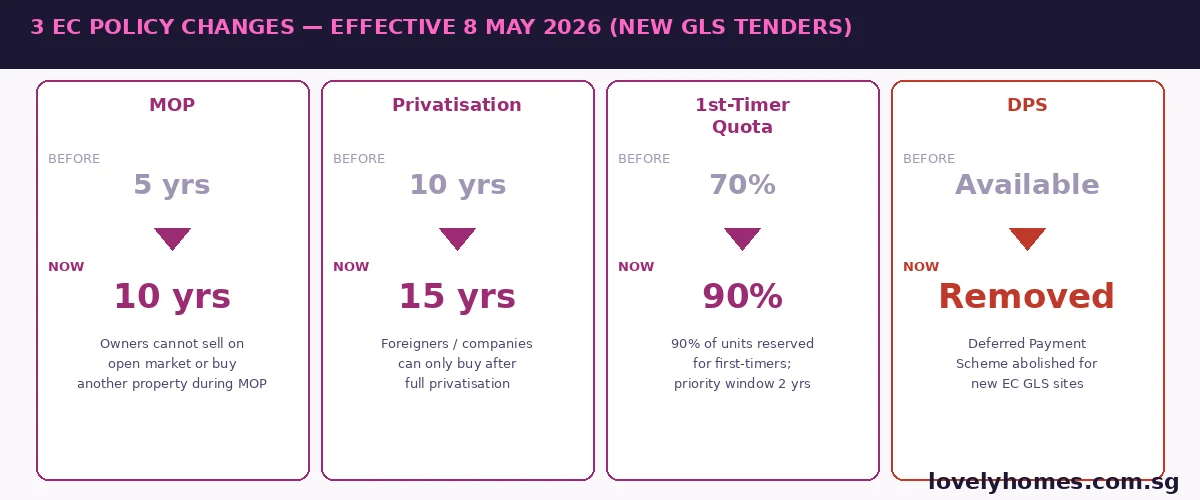
  • On 8 May 2026, Minister for National Development Chee Hong Tat announced the most significant overhaul of Singapore’s Executive Condominium (EC) scheme since 2013.
  • The Minimum Occupation Period (MOP) for new ECs is extended from 5 years to 10 years. During the MOP, owners cannot sell on the open market, rent out the entire unit, or purchase another residential property.
  • Privatisation — when foreigners and companies can buy — is pushed from 10 years to 15 years after the date of issue of the Temporary Occupation Permit (TOP).
  • The first-timer priority quota rises from 70% to 90% of units per project, with the priority window extended from one month to two years.
  • The Deferred Payment Scheme (DPS) — which allowed buyers to defer most of their payment until TOP — is abolished for all new EC GLS sites with tender closing dates from 8 May 2026 onwards.
  • The measures apply to new EC Government Land Sales (GLS) tender sites only. The five EC projects already in the pipeline (Senja Close, Woodlands Drive 17, Sembawang Road, Miltonia Close, and one other) are exempt from all three changes.
  • The stated policy objective is to ensure ECs fulfil their original purpose as affordable, owner-occupied housing for Singapore’s sandwich class — households earning too much for HDB but unable to readily afford private condominiums.

What Was Announced on 8 May 2026?

Speaking on 8 May 2026, Minister for National Development Chee Hong Tat confirmed a three-pronged policy tightening of Singapore’s Executive Condominium scheme — the hybrid public-private housing type introduced in 1995 to serve households in the S$8,000 to S$16,000 monthly income bracket. The announcement, described by the Ministry of National Development (MND) as the most significant revision to EC rules since 2013, addresses growing concern that ECs had increasingly been purchased as investment vehicles rather than owner-occupied homes.

Industry data had shown that EC en-bloc and resale activity accelerated sharply after the five-year MOP, with developers and investors competing alongside genuine owner-occupiers. The DPS, available only on ECs and not on private new launches, had allowed buyers to purchase EC units with minimal initial outlay — attracting buyers who might otherwise not have been able to afford even the initial downpayment — and the 70% first-timer quota had left meaningful room for second-timers (typically HDB upgraders) to acquire units at launch.

Singapore EC policy changes May 2026 — MOP 5 to 10 years, privatisation 10 to 15 years, first-timer quota 70% to 90%, DPS abolished
Figure 1: The three EC policy changes announced 8 May 2026 — before vs after comparison. Applies to EC GLS sites with tender closing from 8 May 2026. Source: Ministry of National Development; LovelyHomes research.

Change 1: MOP Extended from 5 to 10 Years

The most consequential change is the doubling of the Minimum Occupation Period from five to ten years. During the MOP, EC owners:

  • Cannot sell their unit on the open resale market.
  • Cannot rent out the entire unit (subletting individual bedrooms while continuing to reside remains subject to HDB rules).
  • Cannot purchase another residential property in Singapore.

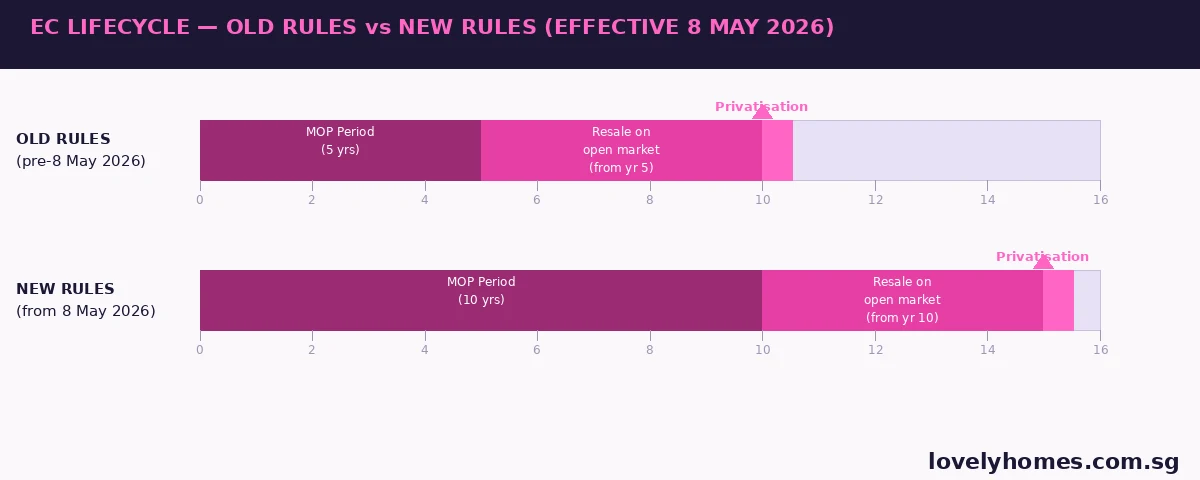
Previously, the five-year MOP — combined with progressive privatisation at 10 years — meant that an EC buyer who received their keys in 2021 could theoretically sell on the open market in 2026 and acquire a second residential property simultaneously, often realising substantial capital gains. The 10-year MOP eliminates this arbitrage window and forces a longer owner-occupation commitment more in keeping with the EC scheme’s original mandate.

The extension aligns EC MOP rules more closely with the 10-year MOP applicable to Prime Location Public Housing (PLH) and Plus-category BTO flats — a deliberate signal from MND that ECs, despite their private-development DNA, are intended as long-term homes first and investment assets second.

Change 2: Privatisation at 15 Years (up from 10)

Alongside the longer MOP, the privatisation timeline is extended from 10 to 15 years from TOP. Privatisation is the milestone at which an EC becomes a fully private condominium — when foreigners, companies, and buyers without citizenship or PR status can purchase units on the open market.

In practice, privatisation typically triggers a price re-rating: EC resale values converge toward equivalent private condominium prices once the property is fully privatised, because the pool of potential buyers expands significantly. The extension from 10 to 15 years delays this re-rating, reducing the near-term speculative premium embedded in EC purchases and moderating investment-driven demand during the launch period.

EC lifecycle timeline Singapore 2026 — old rules (5-year MOP, 10-year privatisation) vs new rules (10-year MOP, 15-year privatisation)
Figure 2: EC lifecycle comparison — old vs new rules. The new timeline significantly extends the owner-occupation mandate and delays the privatisation re-rating event. Source: LovelyHomes research; MND.

Change 3: First-Timer Quota Raised to 90%; Priority Window Extended to Two Years

Under the previous framework, developers were required to reserve 70% of EC units for first-time homebuyers during the initial one-month priority booking period. From the second month onwards, the remaining 30% — and any unsold first-timer units — could be sold to second-timers (HDB upgraders who have sold their flat).

Under the new rules:

  • 90% of units must be set aside for first-time homebuyers.
  • This priority window lasts for two years — not one month — meaning only 10% of units are freely available to second-timers at launch, and the remaining 90% stay ring-fenced for two full years.

The practical effect is dramatic. Second-timer demand — which has historically underpinned strong launch-day sell-through rates for ECs — is effectively squeezed out of the market for the first two years. Projects that launch under the new rules will see their second-timer allocation shrink from 30% to 10%, concentrating demand among genuine first-time buyers earning below S$16,000 per month.

Change 4: Deferred Payment Scheme Abolished

The Deferred Payment Scheme (DPS), available exclusively on EC new launches (it was prohibited for private residential new launches since 2007), allowed buyers to pay a 20% downpayment upfront and defer the remaining 80% — including the bank loan — until the project received its Temporary Occupation Permit (TOP), typically three to four years after launch.

DPS was popular among two buyer groups: HDB upgraders who still had an outstanding HDB mortgage and did not wish to service two loans concurrently during the construction period, and investors who wanted to maximise the leverage impact of an EC purchase. With DPS removed, EC buyers under the new rules will need to:

  • Progress Pay — paying in tranches as construction milestones are hit, via a bank loan drawn down progressively.
  • Service the EC construction loan and their existing HDB mortgage simultaneously if they have not yet sold their HDB flat (since the MOP prevents immediate HDB disposal in many cases).

The MAS’s TDSR framework (55% income cap on all debt obligations) will constrain how many HDB upgraders can absorb dual loan servicing — effectively raising the income bar for EC buyers and prioritising financially stronger applicants.

Which EC Projects Are Affected?

The new measures apply to EC Government Land Sales sites with tender closing dates on or after 8 May 2026. Five EC projects already in the tender pipeline — with tenders either closed or closing before that date — are explicitly exempt and will proceed under the existing (pre-8 May) rules:

  • Senja Close EC
  • Woodlands Drive 17 EC
  • Sembawang Road EC
  • Miltonia Close EC
  • One further pipeline project (details to be confirmed by HDB/URA)

These five projects — likely to launch in 2026–2027 — are expected to see a surge of interest from second-timers and buyers who wish to purchase under the more flexible old rules. Industry observers note that buyers steering toward these exempt projects will need to act quickly, as remaining allocation for second-timers and DPS-eligible units will be finite.

Worked Example: How the New Rules Change the Numbers for a Typical EC Buyer

Scenario: Mr and Mrs Wong, both 32, Singapore Citizens, combined gross income S$12,500/month. They currently own a 5-room HDB flat in Sengkang (purchased in 2020, MOP met in 2025). They are considering purchasing a 3-bedroom EC unit priced at S$1,350,000 under the new rules.

Factor Old EC Rules New EC Rules (from 8 May 2026)
Purchase Price S$1,350,000 S$1,350,000
Payment Scheme DPS: 20% now, 80% at TOP Progress Pay only (loan drawn progressively)
Concurrent HDB Loan During Construction Not required (DPS defers EC loan to TOP) Must service both HDB + EC construction loan simultaneously
TDSR impact (HDB loan S$900/mth remaining) Minimal — DPS means no EC loan repayment yet EC drawdown ~S$3,200/mth + HDB S$900 = S$4,100 total debt; 32.8% TDSR (within 55% cap)
MOP before open-market sale 5 years from TOP 10 years from TOP
Foreigners can buy From year 10 From year 15
Investment horizon implication Potential exit at yr 5 at ~private-condo prices Committed owner-occupier for at least 10 years; no speculative flip

In this scenario, the Wongs’ TDSR is manageable at 32.8% even with dual loan servicing, provided the HDB loan is nearly paid down. However, if their HDB loan outstanding were S$400,000 (monthly instalment ~S$2,100), the combined debt-service ratio would rise to approximately 42.4% — still within the 55% TDSR cap but more constrained. Buyers in this position should model their TDSR carefully before committing to a new EC under progress payment terms.

What This Means for the EC Market

The measures represent a structural reset of what an EC purchase means. In the near term, the five pipeline-exempt projects are likely to see accelerated interest and potentially strong launch sell-through from buyers who want to enter under the old rules. Beyond that cohort, the EC market will become a genuinely longer-duration, owner-occupation-focused product.

For developers, the longer MOP and privatisation horizon reduces the EC product’s differentiation from standard BTO-adjacent housing, potentially affecting pricing discipline and land bid appetite for future EC GLS sites. The removal of DPS increases the effective income threshold for EC buyers — those who cannot manage dual loan servicing during the construction period may need to sell their HDB flat first before committing, introducing additional friction. Land prices for new EC sites may moderate somewhat, as the speculative premium embedded in EC bids dissipates.

For genuine first-timer buyers — the target beneficiary of all three measures — the new rules improve access meaningfully. A 90% first-timer quota with a two-year priority window essentially makes ECs a first-timer product for the first two years of sales, which is exactly the intent.

Frequently Asked Questions

Do the new EC rules affect ECs I already own?

No. The new rules apply only to EC units in GLS sites with tender closing dates on or after 8 May 2026. If you already own an EC unit — or are purchasing one of the five pipeline-exempt projects — your MOP, privatisation timeline, and DPS eligibility are governed by the rules in place at the time of your purchase. Existing EC owners are not retrospectively affected. This is consistent with how all prior EC and property cooling-measure changes have been implemented in Singapore — on a prospective (not retrospective) basis.

Can I still buy an EC as a second-timer after 8 May 2026?

Yes, but your access is significantly restricted. Under the new rules, only 10% of EC units per project are available to second-timers at launch, and this 10% allocation applies throughout the first two years of sales. After the two-year first-timer priority window, any unsold units — and the developer’s remaining inventory — can be opened to second-timers and the general market. Second-timers who are willing to wait may have access to a larger selection later, but popular projects may sell out during the priority window. Second-timers who still wish to buy an EC should act quickly on the five pipeline-exempt projects, where the existing 30% second-timer allocation applies.

Can I rent out my EC under the new rules?

During the new 10-year MOP, you cannot rent out the entire EC unit — the same restriction that applied during the previous 5-year MOP. Subletting individual bedrooms while you continue to reside in the unit may be permitted subject to HDB’s prevailing subletting guidelines, but you must check HDB’s approval requirements as they apply to EC units specifically. After the 10-year MOP is satisfied, you can rent out the entire unit on the open market. Given the longer MOP, buyers who anticipated rental income during years 5–10 under the old rules will need to revise their investment models.

How does the removal of DPS affect my monthly cash flow?

Under the old DPS, a buyer committed only 20% of the purchase price upfront and deferred the bank loan drawdown to TOP. This meant no monthly mortgage payments during the 3–4 year construction period. Under progress payment — now the only available scheme — the bank disburses the loan in tranches as the developer hits construction milestones (foundation, framework, roof, walls, etc.), and you begin servicing the loan from the point each tranche is drawn. Buyers who still have an outstanding HDB mortgage will need to budget for dual loan instalments during construction. MAS’s TDSR cap of 55% applies to all debt obligations combined, so buyers should model this carefully. Those who cannot manage dual servicing may consider selling their HDB flat before committing to the EC — though this creates a transitional housing gap.

Will EC prices fall as a result of these changes?

The near-term impact on EC prices is mixed. The five pipeline-exempt projects may see elevated prices as demand concentrates on the last cohort available under old rules. For future EC sites subject to the new rules, the removal of the DPS reduces the buyer pool (those who relied on deferred payment to manage cash flow will no longer be able to participate), while the 10% second-timer cap reduces overall demand at launch. Land prices for future EC GLS sites could moderate as the investment premium dissipates. However, ECs will retain their structural price advantage over private condominiums — the income ceiling cap (S$16,000/mth), first-timer focus, and government land sale pricing mechanism all support a meaningful discount to private market prices. LovelyHomes does not expect a dramatic price correction; rather, a moderation of the premium above private condo prices that new-rule ECs commanded in 2022–2024.

Which upcoming EC projects are exempt from the new rules?

Five EC projects in the GLS pipeline with tender closing dates before 8 May 2026 are exempt from all three new measures. As confirmed by MND, these include Senja Close EC, Woodlands Drive 17 EC, Sembawang Road EC, and Miltonia Close EC, plus one additional pipeline site. These projects will proceed under the old MOP (5 years), old privatisation timeline (10 years), existing first-timer quota (70%), and retain DPS eligibility. Expected to launch in 2026 and 2027, these projects are likely to attract strong early-stage interest from buyers who wish to secure EC units under the pre-8 May framework. Buyers should monitor HDB’s new EC launch announcements closely.

Related Articles

Disclaimer: This article is a news and analysis piece based on information available as at 9 May 2026. EC policy details, effective dates, and eligibility rules are subject to change and clarification by the Ministry of National Development (MND) and HDB. Always verify the latest requirements directly with HDB (hdb.gov.sg), MND (mnd.gov.sg), and IRAS before making any property purchase decision. This article does not constitute financial, legal, or investment advice. Consult a licensed financial adviser and Singapore conveyancing lawyer before committing to any EC purchase.

Published: 9 May 2026. Sources: Ministry of National Development press statement, 8 May 2026; HDB; URA; IRAS; industry commentary. Cross-referenced against LovelyHomes EC guide (post 105772) and TDSR guide (post 105935).

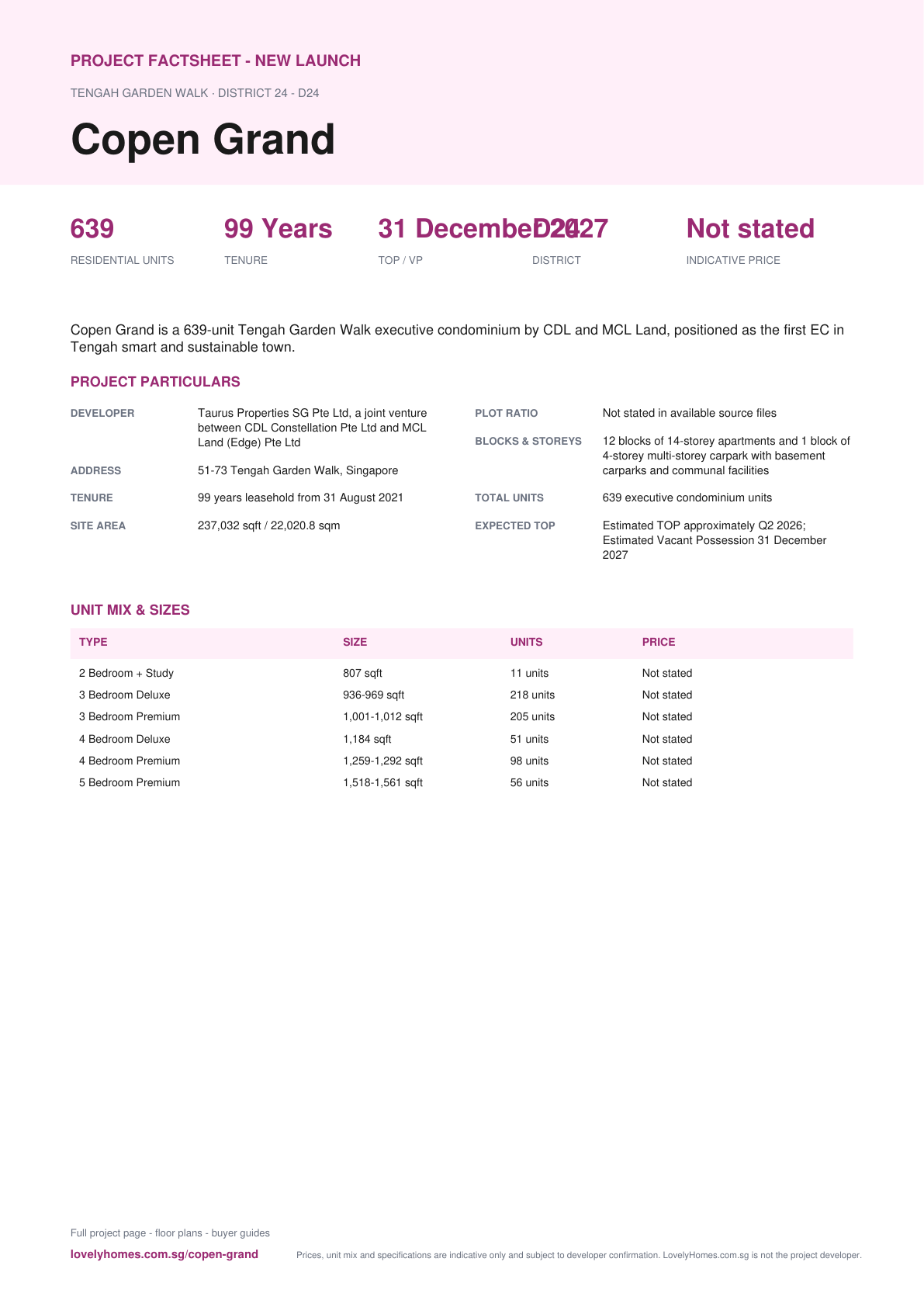
Copen Grand

Copen Grand


TENGAH GARDEN WALK · DISTRICT 24

Copen Grand

Executive condominium
639
Residential Units
99 Years
Tenure
31 December 2027
Expected TOP
D24
District
Not stated
Indicative Price

639
Residential Units
99 Years
Tenure
31 December 2027
Expected TOP
D24
District
Not stated
Indicative Price

Why Copen Grand

Copen Grand is a 639-unit Tengah Garden Walk executive condominium by CDL and MCL Land, positioned as the first EC in Tengah smart and sustainable town.

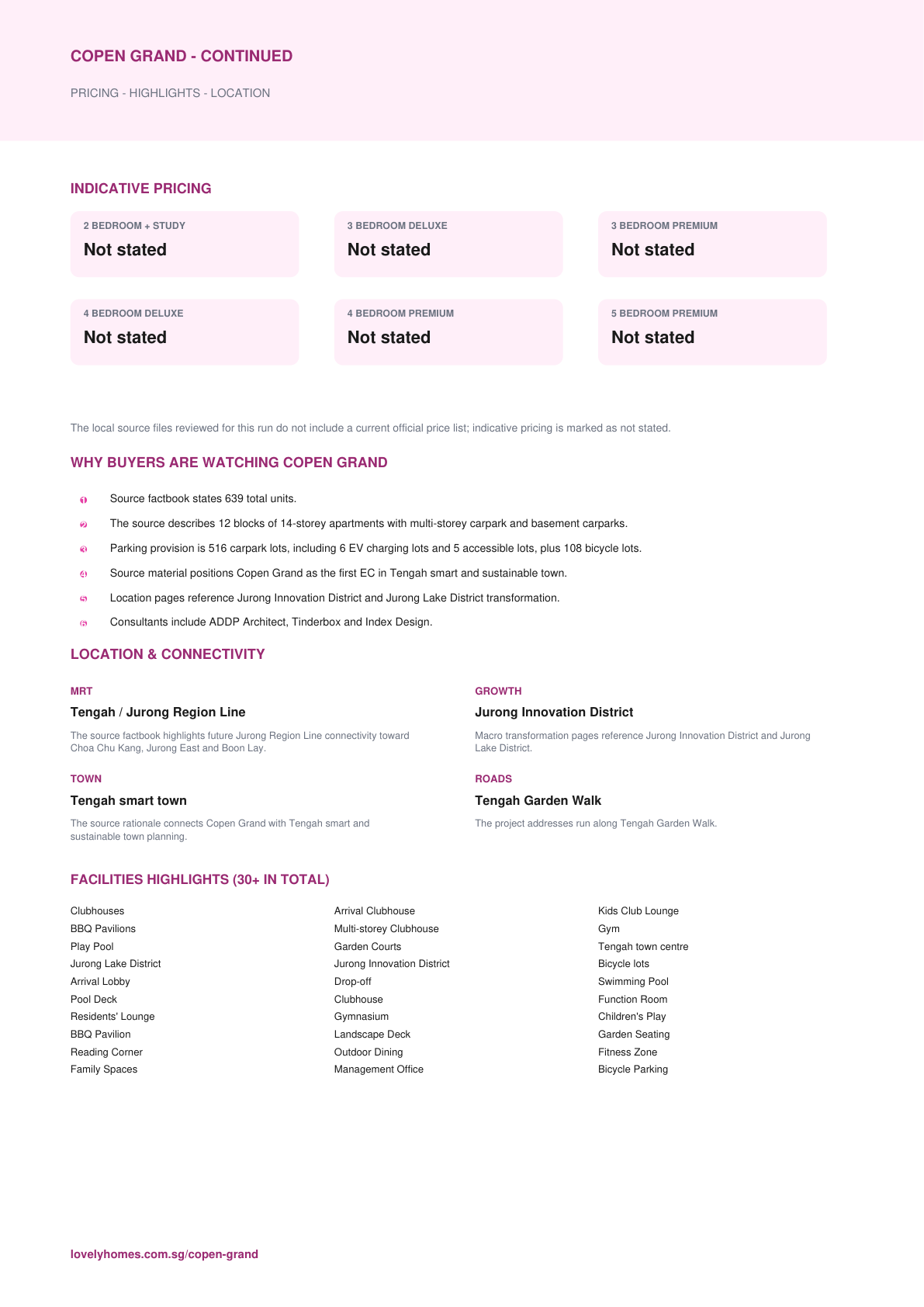
The local source files reviewed for this run do not include a current official price list; indicative pricing is marked as not stated.

Unknown items are marked conservatively from the available source files, rather than filled with assumptions.

Pillar 01

Tengah / Jurong Region Line

The source factbook highlights future Jurong Region Line connectivity toward Choa Chu Kang, Jurong East and Boon Lay.

Pillar 02

639 executive condominium units

12 blocks of 14-storey apartments and 1 block of 4-storey multi-storey carpark with basement carparks and communal facilities

Pillar 03

Source-derived shortlist

Site plan, selected floor plans, sales pack and factsheet are generated from the local project source folder.

Project At-a-Glance

Developer Taurus Properties SG Pte Ltd, a joint venture between CDL Constellation Pte Ltd and MCL Land (Edge) Pte Ltd
Address 51-73 Tengah Garden Walk, Singapore
District D24
Tenure 99 years leasehold from 31 August 2021
Site Area 237,032 sqft / 22,020.8 sqm
Plot Ratio Not stated in available source files
Blocks and Storeys 12 blocks of 14-storey apartments and 1 block of 4-storey multi-storey carpark with basement carparks and communal facilities
Total Units 639 executive condominium units
Carpark Refer to source sales pack
Expected TOP Estimated TOP approximately Q2 2026; Estimated Vacant Possession 31 December 2027
Launch date Not stated in available source files
Developer Taurus Properties SG Pte Ltd
Main Contractor Woh Hup (Private) Limited
Architect ADDP Architect LLP
C&S TW-Asia Consultants Pte Ltd
M&E Consultant BELMACS Pte Ltd
Quantity Surveyor Rider Levett Bucknall LLP
Landscape Consultant Tinderbox Pte Ltd

Unit Mix and Sizes

Type Size Units % of Total
2 Bedroom + Study 807 sqft 11 units 1.7%
3 Bedroom Deluxe 936-969 sqft 218 units 34.1%
3 Bedroom Premium 1,001-1,012 sqft 205 units 32.1%
4 Bedroom Deluxe 1,184 sqft 51 units 8.0%
4 Bedroom Premium 1,259-1,292 sqft 98 units 15.3%
5 Bedroom Premium 1,518-1,561 sqft 56 units 8.8%
Total 807 sqft+ 639 executive condominium units 100%
Source note: Unit mix and sizes are taken from local source project files. Confirm final availability and strata areas against the developer sales pack.

Indicative Pricing

2 Bedroom + Study from
Not stated
3 Bedroom Deluxe from
Not stated
3 Bedroom Premium from
Not stated
4 Bedroom Deluxe from
Not stated
4 Bedroom Premium from
Not stated
5 Bedroom Premium from
Not stated
Pricing note: The local source files reviewed for this run do not include a current official price list; indicative pricing is marked as not stated.

Why Buyers Are Watching

  1. 1Source factbook states 639 total units.
  2. 2The source describes 12 blocks of 14-storey apartments with multi-storey carpark and basement carparks.
  3. 3Parking provision is 516 carpark lots, including 6 EV charging lots and 5 accessible lots, plus 108 bicycle lots.
  4. 4Source material positions Copen Grand as the first EC in Tengah smart and sustainable town.
  5. 5Location pages reference Jurong Innovation District and Jurong Lake District transformation.
  6. 6Consultants include ADDP Architect, Tinderbox and Index Design.

Location and Connectivity

MRT
Tengah / Jurong Region Line
The source factbook highlights future Jurong Region Line connectivity toward Choa Chu Kang, Jurong East and Boon Lay.
Growth
Jurong Innovation District
Macro transformation pages reference Jurong Innovation District and Jurong Lake District.
Town
Tengah smart town
The source rationale connects Copen Grand with Tengah smart and sustainable town planning.
Roads
Tengah Garden Walk
The project addresses run along Tengah Garden Walk.
Copen Grand source site and location context plan

Schools Nearby

Primary / Nearby Princess Elizabeth Primary School, Jurong Primary School, Dazhong Primary School
Secondary / Tertiary Millennia Institute
Distance note School distance and priority admission should be re-checked against OneMap and current MOE rules before purchase.

Lifestyle and Amenities

Daily Convenience

Clubhouses, Arrival Clubhouse

Outdoors

Kids Club Lounge, BBQ Pavilions

Dining

Multi-storey Clubhouse, Gym

Retail

Play Pool, Garden Courts

Community

Tengah town centre, Jurong Lake District

Wellness

Jurong Innovation District, Bicycle lots

Site Plan

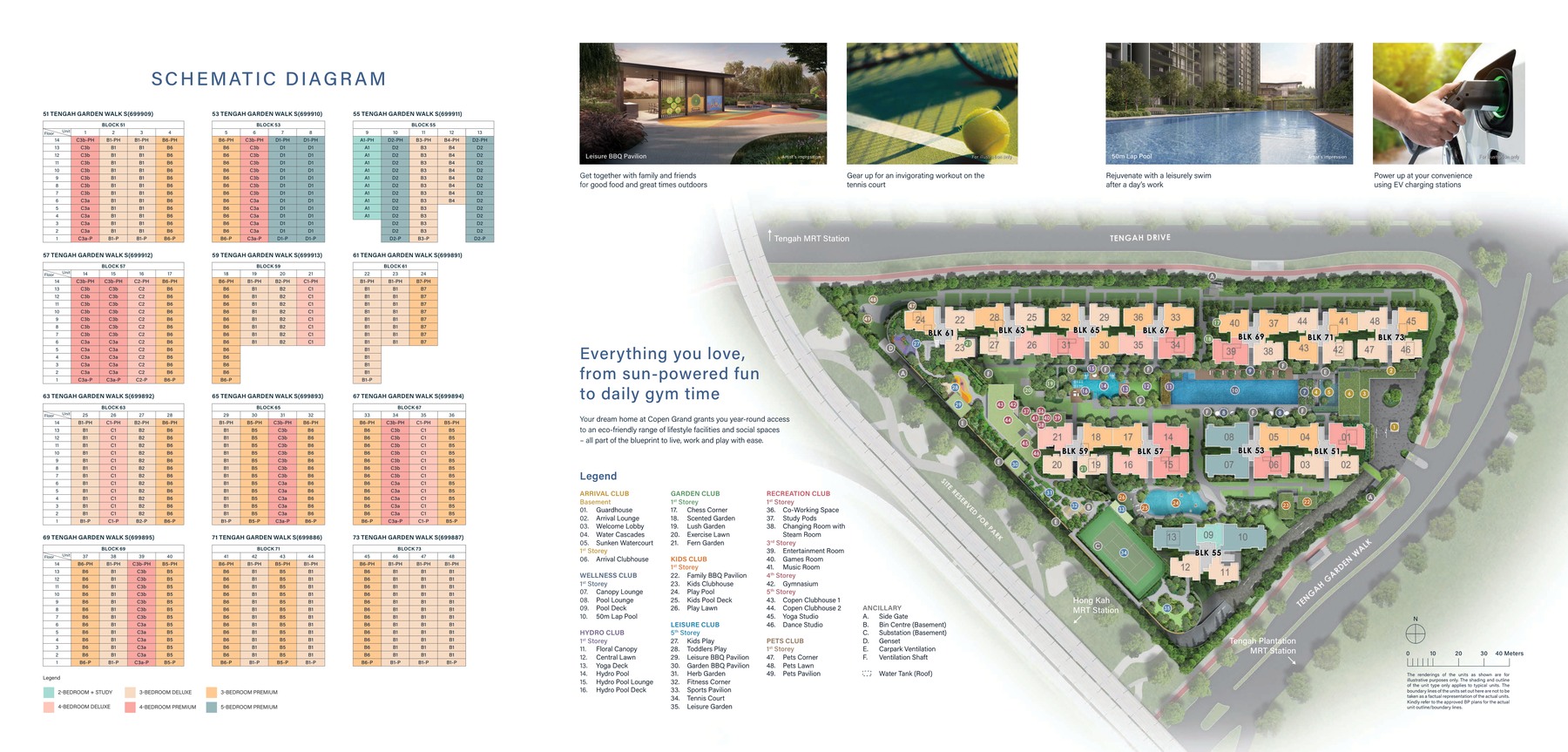
Copen Grand actual site plan

Actual source site plan · subject to developer confirmation

Floor Plans (Selected)

Representative plans by unit type. Download the full PDF below for the complete source-derived floor plan pack.

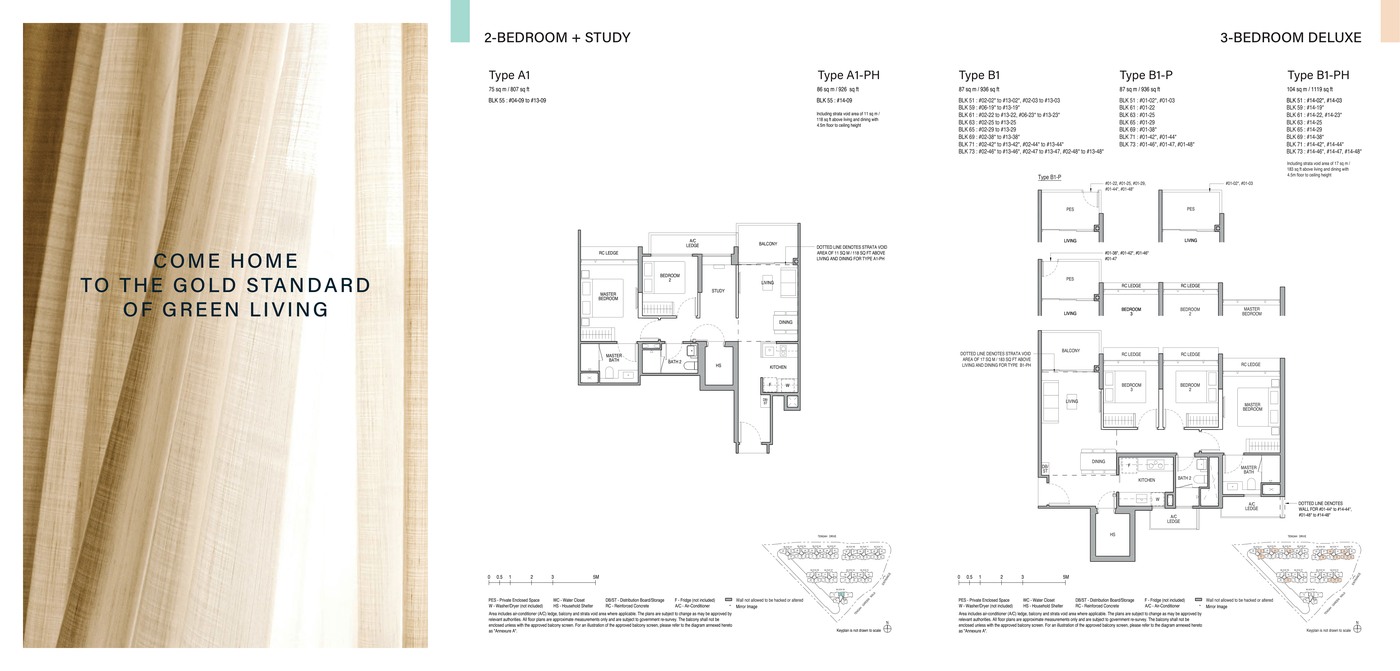
Copen Grand 2 Bedroom + Study floor plan

2 Bedroom + Study
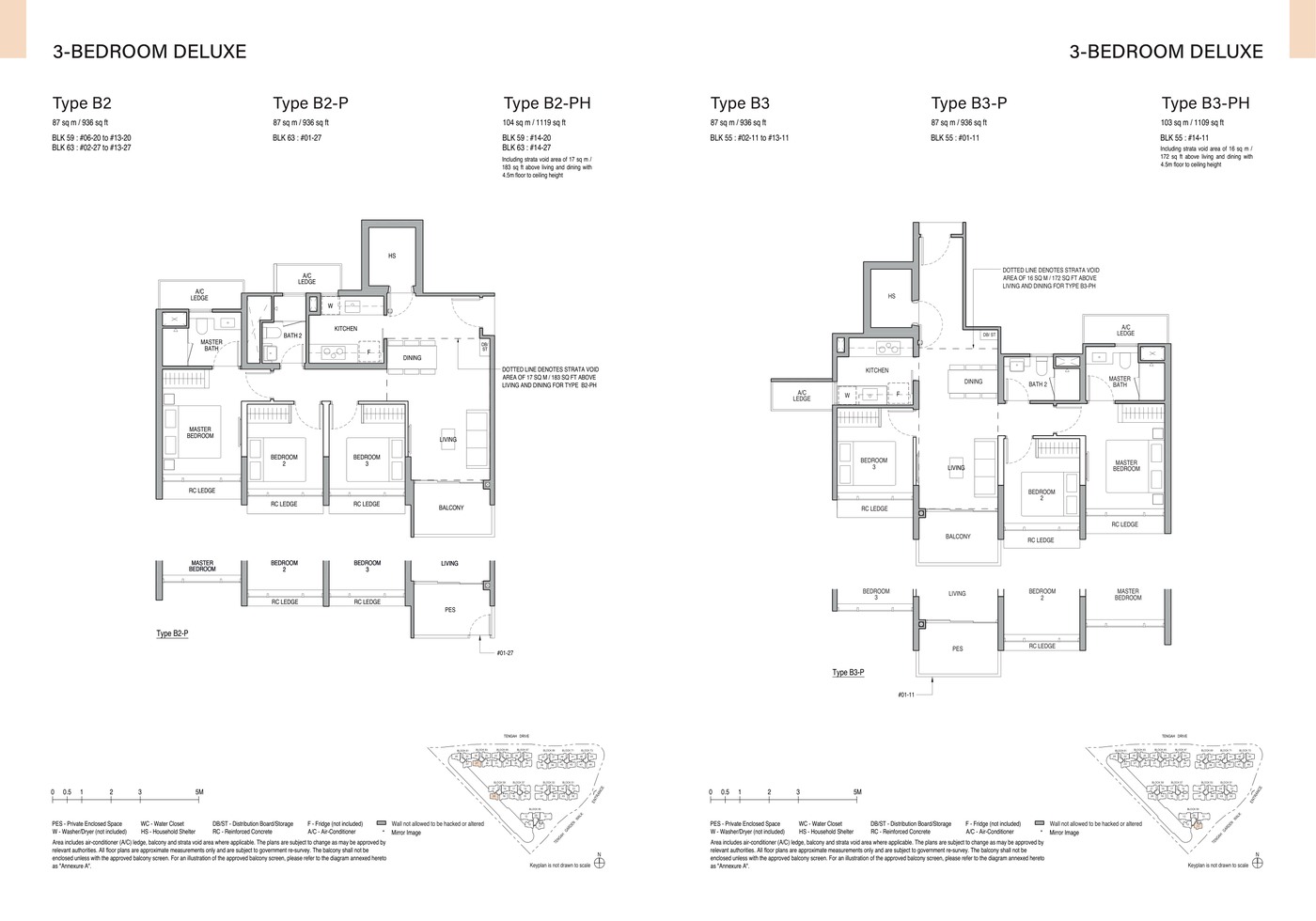
Copen Grand 3 Bedroom Deluxe floor plan

3 Bedroom Deluxe
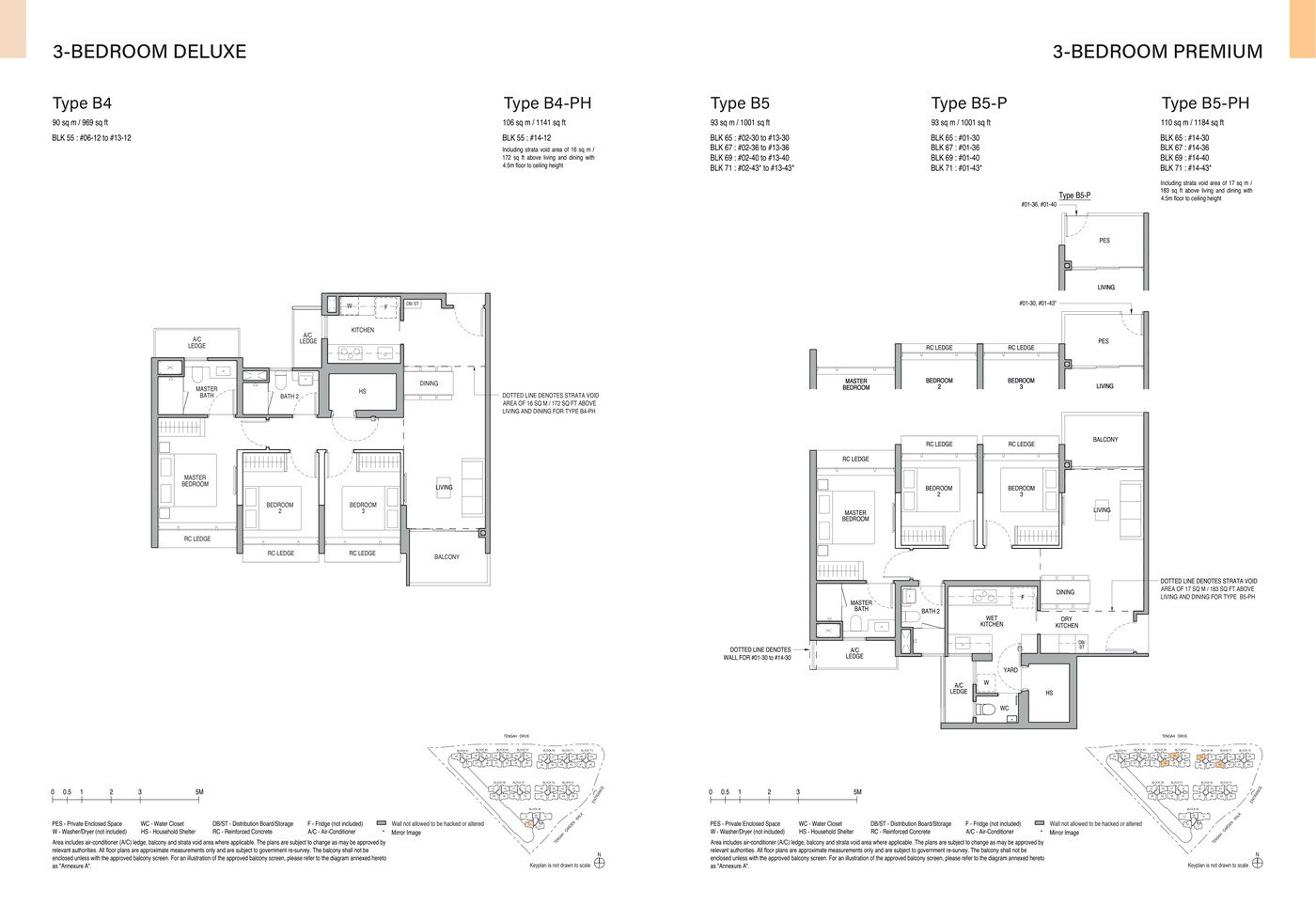
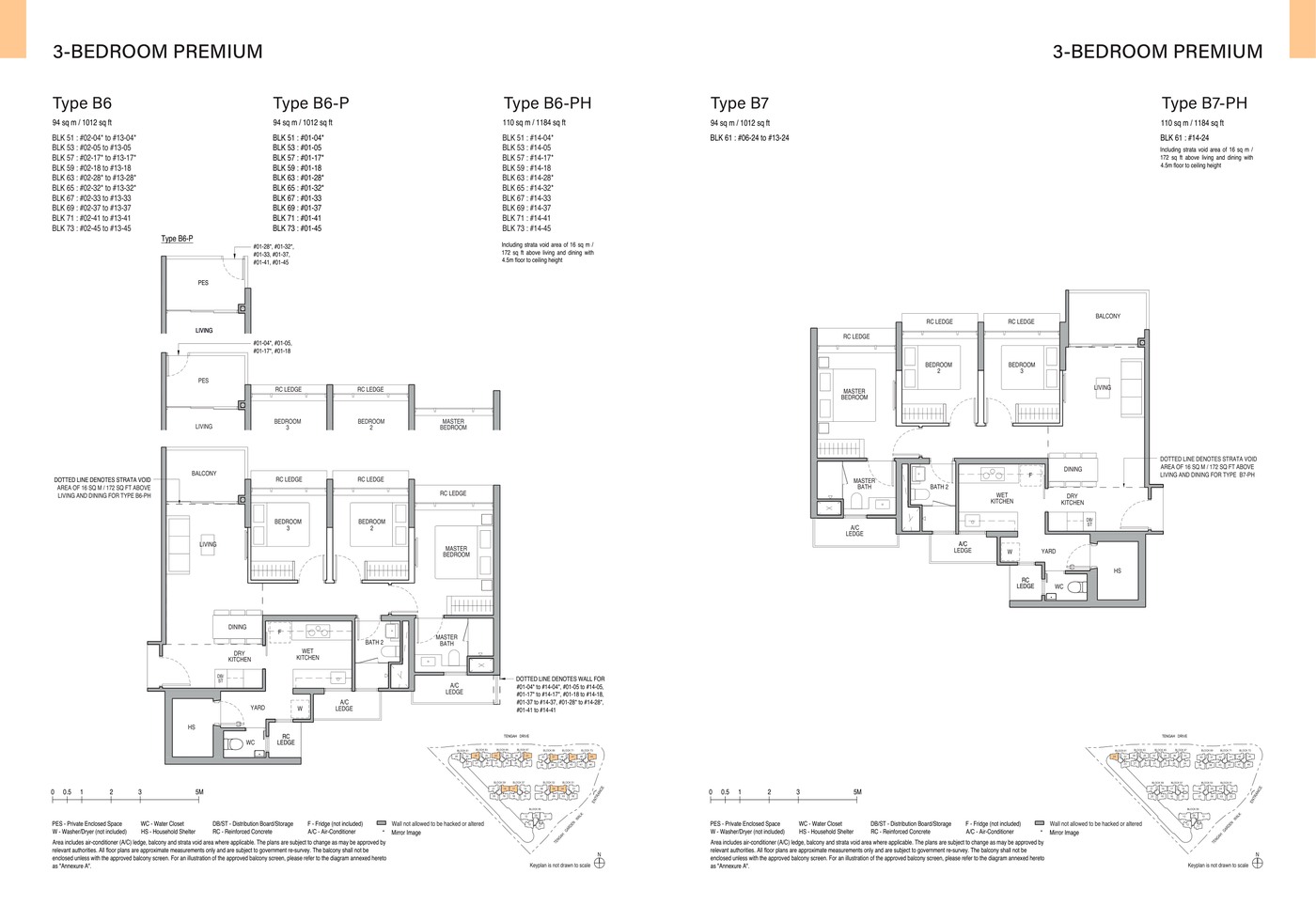
Copen Grand 3 Bedroom Premium floor plan

3 Bedroom Premium
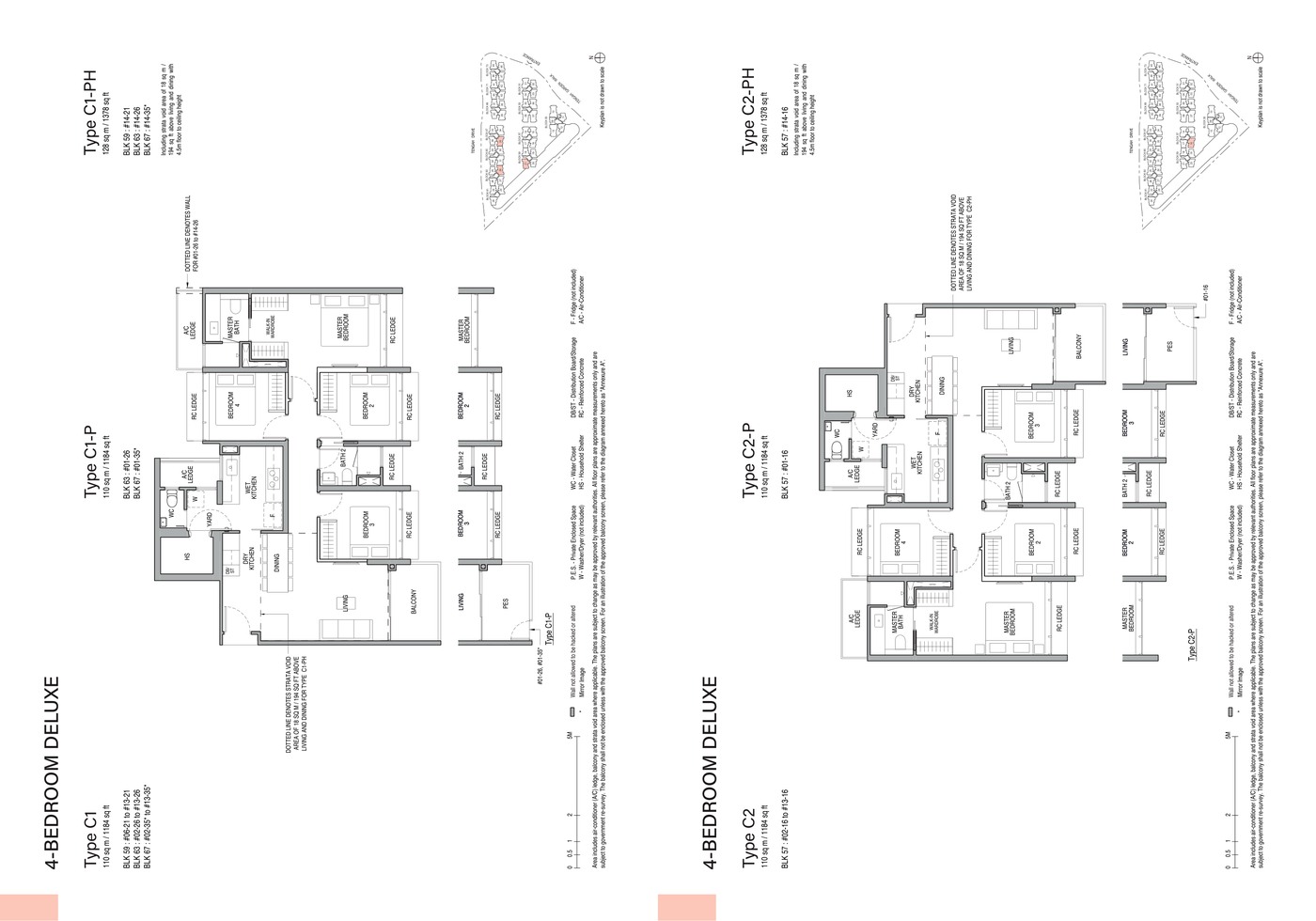
Copen Grand 4 Bedroom Deluxe floor plan

4 Bedroom Deluxe
Copen Grand 4 Bedroom Premium floor plan

4 Bedroom Premium
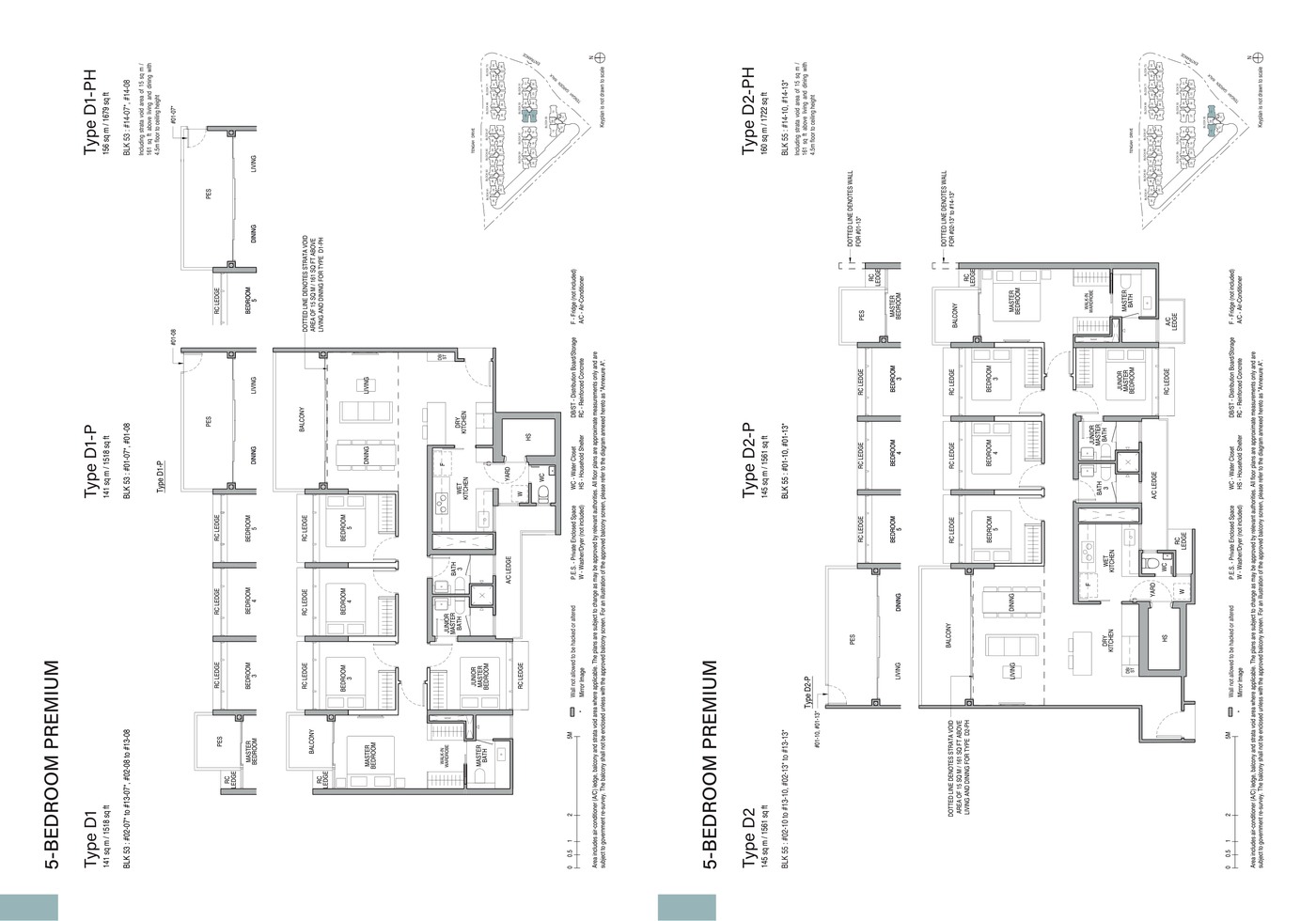
Copen Grand 5 Bedroom Premium floor plan

5 Bedroom Premium
Full Floor Plans PDF
All available source floor plans for detailed stack shortlisting.

Download PDF

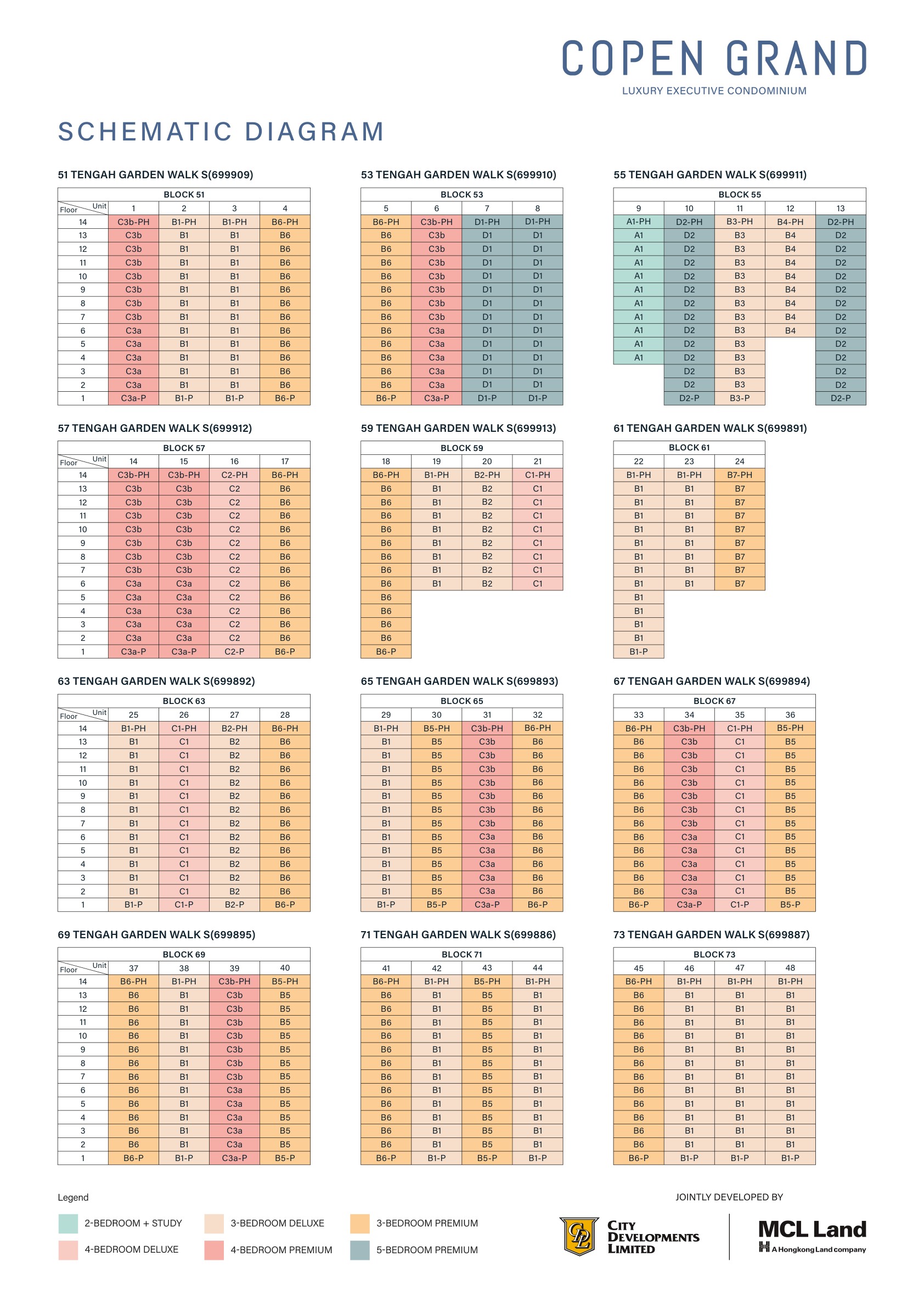
Elevation and Stack Chart

Copen Grand elevation and stack chart

Elevation and stack chart · source-derived · subject to developer confirmation

Facilities (30+)

ClubhousesArrival ClubhouseKids Club LoungeBBQ PavilionsMulti-storey ClubhouseGymPlay PoolGarden CourtsTengah town centreJurong Lake DistrictJurong Innovation DistrictBicycle lotsArrival LobbyDrop-offSwimming PoolPool DeckClubhouseFunction RoomResidents' LoungeGymnasiumChildren's PlayBBQ PavilionLandscape DeckGarden SeatingReading CornerOutdoor DiningFitness ZoneFamily SpacesManagement OfficeBicycle ParkingAccessible FacilitiesCarparkEV LotsSecurityMail RoomSide Gate

Gallery

Developer and Consultant Team

Taurus Properties SG Pte Ltd, a joint venture between CDL Constellation Pte Ltd and MCL Land (Edge) Pte Ltd

Copen Grand source materials identify the developer and consultant team below. Buyers should confirm final contractual parties in the official sales documents.

Developer Taurus Properties SG Pte Ltd
Main Contractor Woh Hup (Private) Limited
Architect ADDP Architect LLP
C&S TW-Asia Consultants Pte Ltd
M&E Consultant BELMACS Pte Ltd
Quantity Surveyor Rider Levett Bucknall LLP
Landscape Consultant Tinderbox Pte Ltd
Interior Design Index Design Pte Ltd

Sustainability and Specifications

The source rationale describes Copen Grand as linked to Copenhagen and positioned as a green sustainable project in Tengah smart and sustainable town.

  • Source discipline – only available source details are shown.
  • Specifications – confirm final appliances, finishes and provisions in the developer sales pack.
  • Mobility – MRT, road and neighbourhood access should be checked against current site conditions before purchase.

Project Timeline

Lease starts
31 August 2021
Factbook source
28 September 2022
Estimated TOP
Approx. Q2 2026
Estimated VP
31 December 2027
TBA
Developer update

Project Factsheet

A shareable 2-page PDF snapshot of everything on this page – bring it to viewings, forward it to family.

Download the Full Sales Pack

PDF · 2 pages

Copen Grand Factsheet

2-page LovelyHomes project factsheet – share with family, bring to viewings.

Download Factsheet

PDF · floor plans

Full Floor Plans

Representative and full source-derived floor plans for shortlisting stacks.

Download Floor Plans

Source · site plan

Site Plan

Actual source site plan image used on this project page.

Download Site Plan

Frequently Asked Questions

Where is Copen Grand located?
51-73 Tengah Garden Walk, Singapore
Who is the developer?
Taurus Properties SG Pte Ltd, a joint venture between CDL Constellation Pte Ltd and MCL Land (Edge) Pte Ltd
When is Copen Grand expected to be completed?
Estimated TOP approximately Q2 2026; Estimated Vacant Possession 31 December 2027
What unit types are available?
2 Bedroom + Study (807 sqft); 3 Bedroom Deluxe (936-969 sqft); 3 Bedroom Premium (1,001-1,012 sqft); 4 Bedroom Deluxe (1,184 sqft); 4 Bedroom Premium (1,259-1,292 sqft); 5 Bedroom Premium (1,518-1,561 sqft)
What are indicative prices at Copen Grand?
The local source files reviewed for this run do not include a current official price list; indicative pricing is marked as not stated.
How is the connectivity?
The source factbook highlights future Jurong Region Line connectivity toward Choa Chu Kang, Jurong East and Boon Lay.
What facilities are included?
Clubhouses, Arrival Clubhouse, Kids Club Lounge, BBQ Pavilions, Multi-storey Clubhouse, Gym, Play Pool, Garden Courts, Tengah town centre, Jurong Lake District, Jurong Innovation District, Bicycle lots
Is it freehold or leasehold?
99 years leasehold from 31 August 2021
Which schools are nearby?
Princess Elizabeth Primary School, Jurong Primary School, Dazhong Primary School, Millennia Institute
What makes Copen Grand different?
Source factbook states 639 total units. The source describes 12 blocks of 14-storey apartments with multi-storey carpark and basement carparks. Parking provision is 516 carpark lots, including 6 EV charging lots and 5 accessible lots, plus 108 bicycle lots.

Ready to see Copen Grand in person?

Speak to our LovelyHomes concierge on WhatsApp for the latest unit availability, e-brochures and showflat bookings.

Message on WhatsApp

Related Buying Guides

Stamp Duty

ABSD Singapore 2026: The Complete Guide

Rates, surcharges and remissions for citizens, PRs and foreigners buying a second or first home.

Stamp Duty

Buyer’s Stamp Duty (BSD) Singapore 2026

Current BSD rates, worked examples and a calculator for residential purchases.

Financing

Home Loan Singapore 2026: HDB vs Bank

LTV, SORA, fixed vs floating and how to structure your financing package.

Step-by-Step

First-Time Home Buyer Walkthrough

From option fee to collection of keys – every step in the Singapore buying process.

Location

CCR vs RCR vs OCR Explained

How Singapore regions affect pricing, demand and capital appreciation.

Policy

Cooling Measures Timeline 2009-2026

Every major round of Singapore property cooling measures and what they did to prices.

Disclaimer. Prices, unit mix, specifications, site plans, floor plans and facility lists on this page are indicative only and subject to change by the developer without notice. All information has been compiled from available local source project material and verified for this run on 5 May 2026. LovelyHomes.com.sg is not the project developer. Prospective buyers should consult an accredited salesperson and the developer’s official sales kit before committing to any purchase. Artist impressions are for illustrative purposes only and may differ from the final built product.

Coastal Cabana

Coastal Cabana


JALAN LOYANG BESAR · DISTRICT 18

Coastal Cabana

Executive condominium
748
Residential Units
99 Years
Tenure
31 March 2029
Expected TOP
D18
District
Not stated
Indicative Price

748
Residential Units
99 Years
Tenure
31 March 2029
Expected TOP
D18
District
Not stated
Indicative Price

Why Coastal Cabana

Coastal Cabana is a Pasir Ris executive condominium beside the coastal lifestyle belt, planned with 748 homes and extensive clubhouse, pool and landscape facilities.

The local source files reviewed for this run do not include a current official price list; indicative pricing is marked as not stated.

Unknown items are marked conservatively from the available source files, rather than filled with assumptions.

Pillar 01

Pasir Ris Park / beach

The local brochure positions the project beside the Pasir Ris coastal lifestyle belt.

Pillar 02

748 residential units

4 blocks of 11 storeys and 12 blocks of 12 storeys with roof terrace, basement carpark, pool, tennis court and communal facilities

Pillar 03

Source-derived shortlist

Site plan, selected floor plans, sales pack and factsheet are generated from the local project source folder.

Project At-a-Glance

Developer Pasir Ris Development Pte Ltd
Address Blocks 2-32 Jalan Loyang Besar, Pasir Ris, Singapore
District D18
Tenure 99 years leasehold
Site Area 28,405.50 sqm
Plot Ratio 2.5
Blocks and Storeys 4 blocks of 11 storeys and 12 blocks of 12 storeys with roof terrace, basement carpark, pool, tennis court and communal facilities
Total Units 748 residential units
Carpark Refer to source sales pack
Expected TOP Expected Vacant Possession 31 March 2029
Launch date Not stated in available source files
Developer Pasir Ris Development Pte Ltd
Architect P&T Consultants Pte Ltd
Landscape Consultant Ecoplan Asia Pte Ltd
Project Interior Designer Index Design Pte Ltd
M&E Engineer United Project Consultants Pte Ltd
C&S Engineer Engineers Alliance Pte Ltd

Unit Mix and Sizes

Type Size Units % of Total
3 Bedroom Deluxe 872 sqft 46 units 6.1%
3 Bedroom Premium 915 sqft 139 units 18.6%
3 Bedroom Premium + Study 915 sqft 165 units 22.1%
4 Bedroom Classic 990 sqft 59 units 7.9%
4 Bedroom Deluxe 1,012 sqft 142 units 19.0%
4 Bedroom Premium 1,055 sqft 59 units 7.9%
4 Bedroom Premium + Study 1,163-1,216 sqft 68 units 9.1%
4 Bedroom Premium + Flexi 1,206 sqft 48 units 6.4%
5 Bedroom Premium 1,367-1,421 sqft 22 units 2.9%
Total 872 sqft+ 748 residential units 100%
Source note: Unit mix and sizes are taken from local source project files. Confirm final availability and strata areas against the developer sales pack.

Indicative Pricing

3 Bedroom Deluxe from
Not stated
3 Bedroom Premium from
Not stated
3 Bedroom Premium + Study from
Not stated
4 Bedroom Classic from
Not stated
4 Bedroom Deluxe from
Not stated
4 Bedroom Premium from
Not stated
Pricing note: The local source files reviewed for this run do not include a current official price list; indicative pricing is marked as not stated.

Why Buyers Are Watching

  1. 1Source architect briefing states 748 total residential units.
  2. 2The source site information states 99-year leasehold tenure and 28,405.50 sqm site area.
  3. 3Parking provision is stated as 748 residential carpark lots, including 5 EV lots and 6 accessible lots.
  4. 4The development includes swimming pool, tennis court, clubhouse and communal facilities.
  5. 5Source unit mix spans 3-bedroom deluxe to 5-bedroom premium layouts.
  6. 6Pasir Ris Park, Downtown East and future Cross Island Line connectivity are highlighted in the source briefing.

Location and Connectivity

Coast
Pasir Ris Park / beach
The local brochure positions the project beside the Pasir Ris coastal lifestyle belt.
Retail
Downtown East
The architect briefing highlights living right next to Downtown East.
MRT
Pasir Ris / future CRL
Source connectivity pages reference Pasir Ris and Cross Island Line expansion context.
Roads
Jalan Loyang Besar
The site is located at Jalan Loyang Besar in the Pasir Ris planning area.
Coastal Cabana source site and location context plan

Schools Nearby

Primary / Nearby Casuarina Primary School, Pasir Ris Primary School, White Sands Primary School
Secondary / Tertiary Hai Sing Catholic School
Distance note School distance and priority admission should be re-checked against OneMap and current MOE rules before purchase.

Lifestyle and Amenities

Daily Convenience

Clubhouse, Swimming Pool

Outdoors

Tennis Court, Communal Facilities

Dining

Roof Terrace, Landscape Deck

Retail

Basement Carpark, Pasir Ris Park

Community

Beach lifestyle, Downtown East

Wellness

Park connector network, Coastal amenities

Site Plan

Coastal Cabana actual site plan

Actual source site plan · subject to developer confirmation

Floor Plans (Selected)

Representative plans by unit type. Download the full PDF below for the complete source-derived floor plan pack.

Coastal Cabana 3 Bedroom Deluxe floor plan

3 Bedroom Deluxe
Coastal Cabana 3 Bedroom Premium floor plan

3 Bedroom Premium
Coastal Cabana 4 Bedroom Classic / Deluxe floor plan

4 Bedroom Classic / Deluxe
Coastal Cabana 4 Bedroom Premium floor plan

4 Bedroom Premium
Coastal Cabana 4 Bedroom Premium + Study floor plan

4 Bedroom Premium + Study
Coastal Cabana 5 Bedroom Premium floor plan

5 Bedroom Premium
Full Floor Plans PDF
All available source floor plans for detailed stack shortlisting.

Download PDF

Elevation and Stack Chart

Coastal Cabana elevation and stack chart

Elevation and stack chart · source-derived · subject to developer confirmation

Facilities (30+)

ClubhouseSwimming PoolTennis CourtCommunal FacilitiesRoof TerraceLandscape DeckBasement CarparkPasir Ris ParkBeach lifestyleDowntown EastPark connector networkCoastal amenitiesArrival LobbyDrop-offPool DeckFunction RoomResidents' LoungeGymnasiumChildren's PlayBBQ PavilionGarden SeatingReading CornerOutdoor DiningFitness ZoneFamily SpacesManagement OfficeBicycle ParkingAccessible FacilitiesCarparkEV LotsSecurityMail RoomSide GateQuiet GardenSocial DeckWater Feature

Gallery

Developer and Consultant Team

Pasir Ris Development Pte Ltd

Coastal Cabana source materials identify the developer and consultant team below. Buyers should confirm final contractual parties in the official sales documents.

Developer Pasir Ris Development Pte Ltd
Architect P&T Consultants Pte Ltd
Landscape Consultant Ecoplan Asia Pte Ltd
Project Interior Designer Index Design Pte Ltd
M&E Engineer United Project Consultants Pte Ltd
C&S Engineer Engineers Alliance Pte Ltd

Sustainability and Specifications

The source briefing references coastal living, park connectors, landscape planning and EV parking lots; formal green certification was not found in the reviewed files.

  • Source discipline – only available source details are shown.
  • Specifications – confirm final appliances, finishes and provisions in the developer sales pack.
  • Mobility – MRT, road and neighbourhood access should be checked against current site conditions before purchase.

Project Timeline

Architect briefing
18 November 2025
Expected VP
31 March 2029
Status
Confirm current launch timing and availability with developer sales team
TBA
Developer update
TBA
Developer update

Project Factsheet

A shareable 2-page PDF snapshot of everything on this page – bring it to viewings, forward it to family.

Download the Full Sales Pack

PDF · 2 pages

Coastal Cabana Factsheet

2-page LovelyHomes project factsheet – share with family, bring to viewings.

Download Factsheet

PDF · floor plans

Full Floor Plans

Representative and full source-derived floor plans for shortlisting stacks.

Download Floor Plans

Source · site plan

Site Plan

Actual source site plan image used on this project page.

Download Site Plan

Frequently Asked Questions

Where is Coastal Cabana located?
Blocks 2-32 Jalan Loyang Besar, Pasir Ris, Singapore
Who is the developer?
Pasir Ris Development Pte Ltd
When is Coastal Cabana expected to be completed?
Expected Vacant Possession 31 March 2029
What unit types are available?
3 Bedroom Deluxe (872 sqft); 3 Bedroom Premium (915 sqft); 3 Bedroom Premium + Study (915 sqft); 4 Bedroom Classic (990 sqft); 4 Bedroom Deluxe (1,012 sqft); 4 Bedroom Premium (1,055 sqft)
What are indicative prices at Coastal Cabana?
The local source files reviewed for this run do not include a current official price list; indicative pricing is marked as not stated.
How is the connectivity?
The local brochure positions the project beside the Pasir Ris coastal lifestyle belt.
What facilities are included?
Clubhouse, Swimming Pool, Tennis Court, Communal Facilities, Roof Terrace, Landscape Deck, Basement Carpark, Pasir Ris Park, Beach lifestyle, Downtown East, Park connector network, Coastal amenities
Is it freehold or leasehold?
99 years leasehold
Which schools are nearby?
Casuarina Primary School, Pasir Ris Primary School, White Sands Primary School, Hai Sing Catholic School
What makes Coastal Cabana different?
Source architect briefing states 748 total residential units. The source site information states 99-year leasehold tenure and 28,405.50 sqm site area. Parking provision is stated as 748 residential carpark lots, including 5 EV lots and 6 accessible lots.

Ready to see Coastal Cabana in person?

Speak to our LovelyHomes concierge on WhatsApp for the latest unit availability, e-brochures and showflat bookings.

Message on WhatsApp

Related Buying Guides

Stamp Duty

ABSD Singapore 2026: The Complete Guide

Rates, surcharges and remissions for citizens, PRs and foreigners buying a second or first home.

Stamp Duty

Buyer’s Stamp Duty (BSD) Singapore 2026

Current BSD rates, worked examples and a calculator for residential purchases.

Financing

Home Loan Singapore 2026: HDB vs Bank

LTV, SORA, fixed vs floating and how to structure your financing package.

Step-by-Step

First-Time Home Buyer Walkthrough

From option fee to collection of keys – every step in the Singapore buying process.

Location

CCR vs RCR vs OCR Explained

How Singapore regions affect pricing, demand and capital appreciation.

Policy

Cooling Measures Timeline 2009-2026

Every major round of Singapore property cooling measures and what they did to prices.

Disclaimer. Prices, unit mix, specifications, site plans, floor plans and facility lists on this page are indicative only and subject to change by the developer without notice. All information has been compiled from available local source project material and verified for this run on 5 May 2026. LovelyHomes.com.sg is not the project developer. Prospective buyers should consult an accredited salesperson and the developer’s official sales kit before committing to any purchase. Artist impressions are for illustrative purposes only and may differ from the final built product.

Rivelle Tampines

Rivelle Tampines


New Launch · Tampines Street 95, District 18

Rivelle Tampines

572-unit Tampines EC with 3- to 5-bedroom homes near Tampines West MRT and Bedok Reservoir.

572
Units
D18
District
EC
Type
30 Jun 2030
VP
Tampines West
MRT
572
Units
D18
District
EC
Type
30 Jun 2030
VP
Tampines West
MRT

Why Rivelle Tampines

572-unit Tampines EC with 3- to 5-bedroom homes near Tampines West MRT and Bedok Reservoir.

01

Executive Condominium supply in the mature Tampines estate

Executive Condominium supply in the mature Tampines estate.

02

5-minute walk stated to Tampines West MRT and the future Pinery Mall

5-minute walk stated to Tampines West MRT and the future Pinery Mall.

03

All homes are family-sized 3- to 5-bedroom layouts

All homes are family-sized 3- to 5-bedroom layouts.

Project At-a-Glance

Project Name Rivelle Tampines
Property Type Executive Condominium
Address 51-71 Tampines Street 95, Singapore
District 18
Tenure 99 years from 5 February 2025
Developer Sim Lian JV (Tampines 7) Pte. Ltd.
Total Units 572 units
Site Area 22,488.9 sqm / 242,068 sqft
Plot Ratio 2.5
TOP / VP Expected vacant possession 30 June 2030

Rivelle Tampines in brief

Executive Condominium supply in the mature Tampines estate.

5-minute walk stated to Tampines West MRT and the future Pinery Mall.

Unit Mix and Sizes

Unit Type Size Range Units
3 Bedroom 883-926 sqft 241
4 Bedroom 1,044-1,184 sqft 291
5 Bedroom 1,378 sqft 40
Source note: Unit mix and sizes are compiled from local project factsheet/floor-plan materials. Buyers should verify latest units and strata details before booking.

Indicative Pricing

Price Guide
Latest official price matrix
Availability
Available on request
Status
Subject to EC eligibility and developer release
The local source materials do not provide a publishable current unit-by-unit price list for this post. Request the latest developer price matrix before making a purchase decision.

Why Buyers Are Watching

  • 1Executive Condominium supply in the mature Tampines estate.
  • 25-minute walk stated to Tampines West MRT and the future Pinery Mall.
  • 3All homes are family-sized 3- to 5-bedroom layouts.
  • 4Sim Lian development and construction track record.

Location and Connectivity

Link 1
5 mins walk to Tampines West MRT
Connectivity detail from local project materials; travel times should be independently verified.
Link 2
5 mins walk to future Pinery Mall
Connectivity detail from local project materials; travel times should be independently verified.
Link 3
6 mins cycle to Tampines Round Market and Our Tampines Hub
Connectivity detail from local project materials; travel times should be independently verified.
Link 4
5 MRT stops to Jewel Changi Airport
Connectivity detail from local project materials; travel times should be independently verified.
Rivelle Tampines location map
Location details are source-derived and should be verified against current transport maps.

Schools Nearby

Nearby schools St Hilda's Primary within 1km, Tampines Primary, Jun Yuan Primary, St Anthony's Canossian Primary, Temasek Polytechnic, SUTD
Note School proximity and eligibility should be checked against the latest MOE OneMap school-query data.

Lifestyle and Amenities

Bedok Reservoir

Neighbourhood amenity highlighted in the local source pack and surrounding-area notes.

SAFRA Tampines

Neighbourhood amenity highlighted in the local source pack and surrounding-area notes.

Tampines Mall

Neighbourhood amenity highlighted in the local source pack and surrounding-area notes.

Century Square

Neighbourhood amenity highlighted in the local source pack and surrounding-area notes.

Tampines One

Neighbourhood amenity highlighted in the local source pack and surrounding-area notes.

IKEA Tampines / Courts / Giant

Neighbourhood amenity highlighted in the local source pack and surrounding-area notes.

Site Plan

Rivelle Tampines actual site plan

Rivelle Tampines actual site plan from source material

Floor Plans (Selected)

Representative actual floor plans by unit type. Download the full floor-plan PDF below for every available source layout.

Rivelle Tampines 3 Bedroom Premium C1P / C2S representative floor plan

3 Bedroom Premium C1P / C2S
Rivelle Tampines 3 Bedroom Premium Patio representative floor plan

3 Bedroom Premium Patio
Rivelle Tampines 4 Bedroom D1 / D1a representative floor plan

4 Bedroom D1 / D1a
Rivelle Tampines 4 Bedroom + Study representative floor plan

4 Bedroom + Study
Rivelle Tampines 5 Bedroom E1 representative floor plan

5 Bedroom E1
Need every stack and layout?
Download the full floor-plan PDF from the source pack.

Download PDF

Elevation and Stack Chart

Rivelle Tampines elevation and stack chart

Elevation / stack chart from source material

Facilities (30+)

Arrival BayClubhouseGrand Function RoomRippling waterscapesPool deckFamily poolChildren's poolWellness poolGymBBQ pavilionDining pavilionKids' playFitness cornerLandscaped deckThematic gardensReading loungeFunction lawnSocial loungeOutdoor diningJogging pathBasement carparkEV lotsAccessible lotsBicycle parkingDrop-off courtSheltered walkwaysWater featuresGarden seatingClubhouse deckQuiet corners

Gallery

Developer and Consultant Team

Sim Lian JV (Tampines 7) Pte. Ltd.

Developer and consultant details are compiled from the local project factsheet.

Developer Sim Lian JV (Tampines 7) Pte. Ltd.
Architect ADDP Architects LLP
Landscape Architect Ecoplan Asia Pte Ltd
Structural Engineer BCK & Partners Pte Ltd
M&E Engineer United Project Consultants Pte Ltd
Main Contractor Sim Lian Construction Co. (Pte.) Ltd.

Sustainability and Specifications

  • EC family-sized planning supports owner-occupation
  • 5 EV charging lots and accessible parking provided
  • Landscape deck and waterscape concept
  • Proximity to MRT, cycling routes and mature-town amenities

Project Timeline

Feb 2025
Lease commencement
Nov 2025
BP approval
Feb 2026
Factsheet date
Jun 2030
Expected VP
Jun 2033
Expected legal completion

Project Factsheet

Download the Full Sales Pack

PDF · 2 pages · 2 MB

Rivelle Tampines Factsheet

Clean LovelyHomes project factsheet for quick review.

Download Factsheet

PDF · floor plans · 1 MB

Full Floor Plans

All source floor plans available in the local project pack.

Download Floor Plans

PDF · site plan · 720 KB

Site Plan

High-resolution site plan source PDF for closer review.

Download Site Plan

Frequently Asked Questions

Is Rivelle Tampines published with current pricing?
Pricing should be verified against the latest developer price list before booking.
Where is Rivelle Tampines located?
Tampines Street 95, District 18. Address/source location: 51-71 Tampines Street 95, Singapore.
What unit types are available?
3 Bedroom, 4 Bedroom, 5 Bedroom.
Can I get the full sales pack?
Use the download cards above or message LovelyHomes on WhatsApp for the latest official availability and appointment slots.

Ready to see Rivelle Tampines in person?

Message LovelyHomes for latest availability, price movement, floor plans and viewing arrangements.

Message on WhatsApp

Related Buying Guides

Guide

Condo New Launches by District

Compare launches by location and district.

Guide

New Launch Payment Timeline

Understand booking, exercise and progressive payments.

Guide

Buying New Launch Condos

Key checks before selecting a unit.

Disclaimer: Information is compiled from local project source materials and may change without notice. Floor areas, travel times, pricing and availability must be verified with the developer sales team before purchase.

Translate »