
A new executive condominium can suit a household that wants condo facilities and can commit to living there for years. It is a poor fit if the purchase depends on an early sale or immediate whole-unit rental. In 2026, the first question is which rules apply to the project’s land tender. The sales-launch year alone does not tell you its income ceiling or minimum occupation period.
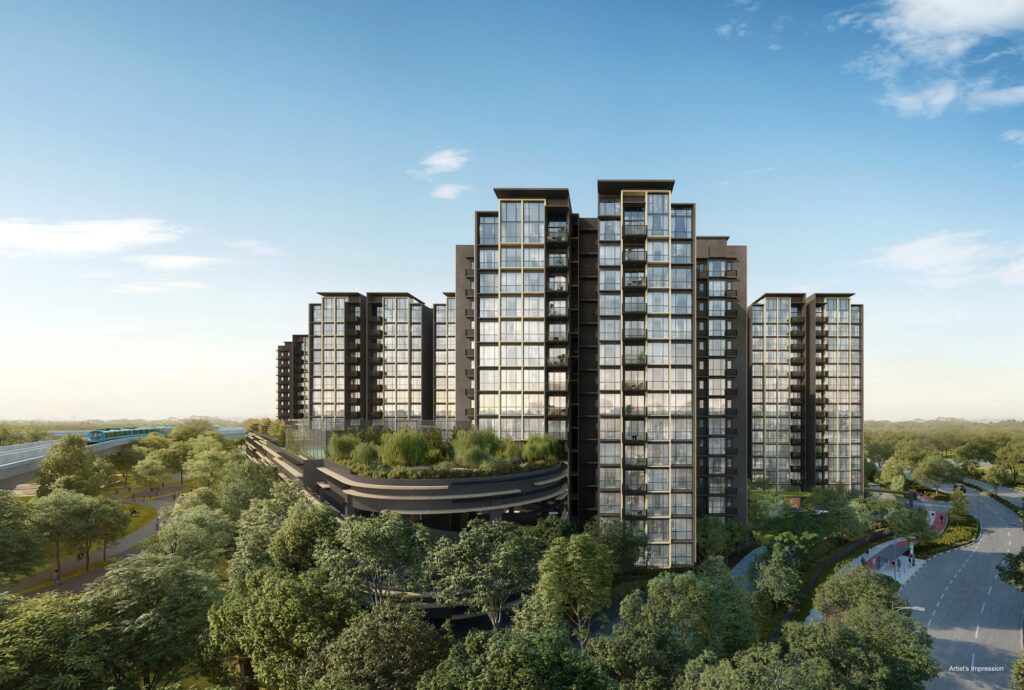
This Singapore EC guide compares a developer purchase with a resale EC and an ordinary private condo. Rules checked on 18 September 2026. The featured image is a developer’s artist’s impression of Copen Grand, an earlier EC project, supplied in its marketing material. It is not a photograph of a completed unit or an illustration of the new policy cohort.
Two dates determine which new EC rules apply
Under HDB’s current EC conditions, projects whose land sales tenders closed on or after 8 May 2026 have a ten-year minimum occupation period (MOP). Other projects have a five-year MOP. The period is measured from the Temporary Occupation Permit (TOP), so an uncompleted purchase also involves waiting for construction before that clock starts.
| Project cohort | Owner’s commitment and later buyer pool |
|---|---|
| Land tender closed before 8 May 2026 | Five-year MOP. After MOP, resale buyers must be Singapore Citizens or Permanent Residents until ten years from TOP. Subsequently, the EC citizenship restriction ends. |
| Land tender closed on or after 8 May 2026 | Ten-year MOP. After MOP, resale buyers must be Singapore Citizens or Permanent Residents until fifteen years from TOP. Subsequently, the EC citizenship restriction ends. |
HDB’s eligibility page separately sets an S$18,000 monthly household income ceiling for new units in EC projects with tenders closing on or after 24 August 2026. It retains S$16,000 for new units in sites with tenders awarded before that date. Ask the developer to identify the applicable tender and confirm your project’s ceiling in writing. An older EC launch does not automatically acquire the higher limit.
That distinction matters for a couple earning S$17,000: meeting the newer ceiling does not make them eligible for every unsold developer EC unit. Equally, the August income change does not reset an earlier project’s occupation period.
Can your household buy directly from the developer?
For the usual family application, HDB requires a Singapore Citizen applicant and at least one other Singapore Citizen or Permanent Resident, an eligible family nucleus and applicants aged at least 21. Two or more singles applying jointly must all be Singapore Citizens and at least 35. A single buyer should not assume that meeting the income ceiling is sufficient.
All applicants and occupiers must satisfy the relevant property-ownership conditions. In particular, they must not own a local or overseas private residential property, or have disposed of one within the preceding 30 months, counted from legal completion. Gifts, inherited interests and trust arrangements can matter; report them to the developer instead of treating only homes bought in your own name as relevant.
That private-property rule is different from owning an HDB flat. An HDB upgrader should have the existing flat’s MOP position checked before applying. HDB’s conditions after buying require disposal of any HDB interest within six months from EC key collection, based on legal completion of the disposal. Do not confuse signing the HDB sale option with completing its sale.
Previous subsidies also matter. A second-timer may owe a resale levy; a core member who has already taken two housing subsidies cannot apply or be listed as a core occupier. Ask for a household-specific eligibility and levy assessment before booking. These are developer applications, rather than an instruction to obtain an HFE letter as though purchasing an HDB resale flat. HDB sets out the EC application process.
Grants exist, but the income ceiling is not the grant ceiling
HDB’s CPF Housing Grant for ECs can provide up to S$30,000 for qualifying developer purchases. For an eligible first-timer household with two Singapore Citizens, the published bands are S$30,000 at household income of S$10,000 or less, S$20,000 from S$10,001 to S$11,000, and S$10,000 from S$11,001 to S$12,000. Above S$12,000, that grant is nil even if the household can buy the EC.
Citizen/PR and mixed first-timer/second-timer households have different grant amounts. Do not put the maximum into your budget without checking your household’s entitlement. A grant is credited through CPF; it is not cash for the booking cheque, renovation or moving bills. Resale EC purchases on the open market do not qualify for CPF housing grants.
Why a 75% loan can still be too large
EC purchases use financing from financial institutions, not an HDB housing loan. For a bank loan with no outstanding housing loans, the usual upper loan-to-value limit is 75%, with at least 5% cash under that tier. Age, tenure, valuation and the lender’s assessment can lower the amount.
For a new EC, the mortgage-servicing ratio (MSR) caps the assessed mortgage instalment at 30% of gross monthly income. Bank total-debt servicing ratio (TDSR) rules also apply, with a 55% limit covering total assessed debt commitments. Passing the larger TDSR percentage does not override the MSR. See MoneySense’s bank-loan and servicing-ratio guidance.
Illustrative affordability test, not a loan offer: assume a S$1.32 million EC, recognised household income of S$14,700, no other debt and a 25-year loan. At an assumed 4% annual rate, monthly repayments on a S$990,000 loan would be about S$5,226. The household’s 30% MSR allowance is S$4,410. The proposed 75% loan therefore fails this illustration.
| Illustrative calculation | Amount |
|---|---|
| Purchase price | S$1,320,000 |
| Loan at 75% of price | S$990,000 |
| Loan supported by S$4,410 monthly at 4%, over 25 years | About S$835,485 |
| Buyer funds towards price at that smaller loan | About S$484,515 |
| BSD, assuming value does not exceed price | S$37,400 |
The extra price contribution is approximately S$154,515 beyond a simple 25% downpayment. It is already included in the S$484,515, so do not add it twice. The example excludes legal fees, any applicable levy or additional duty, renovations and reserves. It assumes no grant and does not predict a bank’s recognised income, test rate or approval.
Put the payments on a calendar before booking
HDB’s EC buying process specifies a 5% option fee at booking and a further 15% according to the OTP timeframe, payable using eligible CPF funds or cash. Reaching 20% paid does not mean a bank will finance the other 80%. Your approved loan determines how much more buyer funding is needed.
Obtain the actual construction-payment schedule and map each demand to available cash, CPF and loan disbursements. Do not assume a deferred-payment arrangement is available. CDL’s June 2026 disclosure, page 125, describes the removal of deferred payment under the May EC changes and the move to construction-stage payments. Have your developer and solicitor confirm the terms for the specific project.
For an HDB upgrader, anticipated sale proceeds are not money available today. Model the period with existing housing costs and EC payments overlapping, plus a delayed sale or lower sale price. Ask the bank which existing debts it will count and what disposal evidence it needs. Have the solicitor confirm the applicable ABSD treatment and any remission conditions; do not import a private-condo upgrader tax assumption into a new EC purchase.
IRAS’s residential BSD schedule gives the S$37,400 above. CPF eligibility and the date funds can be released are separate questions. Confirm funding and stamp-duty deadlines before signing.
New EC, resale EC or ordinary private condo?
| Option | What to weigh |
|---|---|
| New EC | Eligibility, construction wait, applicable MOP, grant entitlement, bank borrowing and staged payments. Most suitable when the household can occupy for the required period without needing an early exit. |
| Resale EC after MOP | Inspect the actual unit, estate condition and accounts. No monthly household income ceiling or CPF housing grants. Check the project’s remaining citizenship restriction and TOP date. |
| Ordinary private resale condo | A wider choice of completed homes without the EC scheme’s MOP. Compare actual price, remaining lease, maintenance costs, financing, taxes and unit condition. An easier exit is not a guaranteed profitable exit. |
HDB’s resale EC rules allow individual buyers aged at least 21, whether single or buying as a family, subject to the applicable citizenship period. HDB owners must also check their existing flat’s conditions; SPR households must dispose of their HDB flat within six months of buying a resale EC. The developer-purchase and open-market routes should not be treated as interchangeable.
Test the home as an occupier, then as an investment
Check the route to work and school at the times your family will actually travel. Assess usable bedrooms, storage, laundry space, road noise, childcare arrangements and the maintenance charge for the exact unit. A showflat and a landscaped rendering cannot establish those answers for you.
During a new EC’s MOP, you cannot plan on renting out the entire unit as a fallback. HDB allows bedroom rental without prior approval but requires registration within seven days and notification of relevant changes; the occupation conditions still apply. Overseas postings, a growing family or caring for a parent can therefore change whether the commitment is sensible.
For investment analysis, compare specific properties using verified transactions and all ownership costs. A wider future buyer pool does not guarantee that an EC will converge to a private condo’s price. Interest, maintenance, taxes, selling costs and the remaining lease all affect the result. Choose an EC because the home and funding plan work without an assumed windfall.
For the transaction mechanics, read our OTP guide. For a completed private property, use the completion checklist.