Executive Condo Singapore 2026: Complete Guide to Buying an EC
💡 Quick Answer: Executive Condo Singapore 2026 — Key Facts
- An Executive Condominium (EC) is a hybrid housing type — built by private developers but initially subject to HDB eligibility rules, offering condo-quality finishes at 20–30% below comparable private launch prices.
- Eligibility: at least one applicant must be a Singapore Citizen; monthly household income must not exceed S$16,000; applicants must be at least 21 years old.
- ECs carry a 5-year MOP counted from TOP (Temporary Occupation Permit). During MOP they may only be resold to Singapore Citizens and Permanent Residents who meet HDB eligibility criteria.
- After 10 years from TOP, an EC is fully privatised and may be sold to foreigners — identical to any private condominium.
- No ABSD for Singapore Citizen first-time EC buyers; PR first-timers pay ABSD of 5% on the EC purchase price.
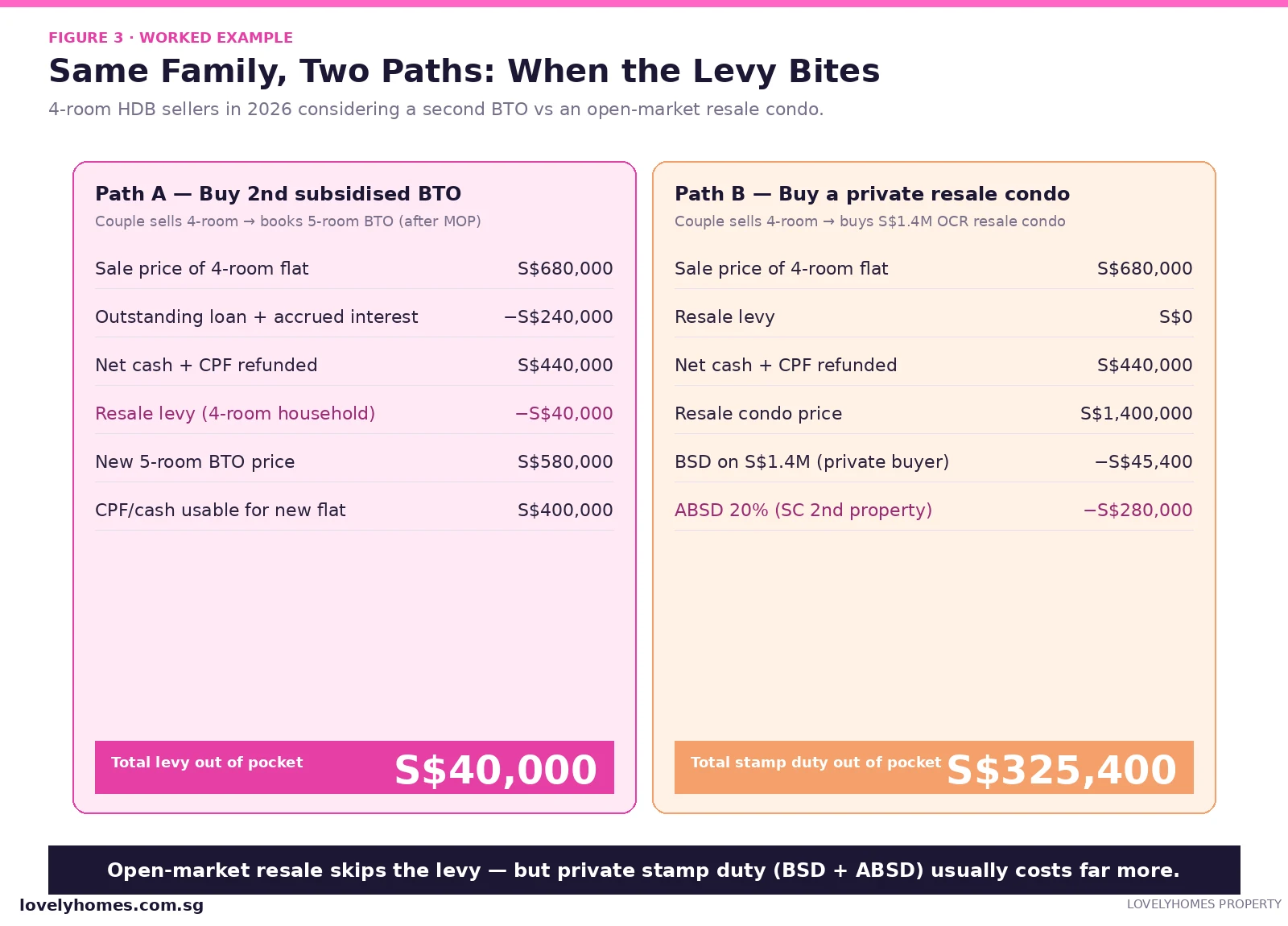
- ECs are not eligible for CPF housing grants (EHG, FHG, PHG) — but buyers who sold a resale HDB flat may face a resale levy.
- Banks (not HDB) finance EC purchases — the Loan-to-Value (LTV) limit is 75% (same as private), and the Total Debt Servicing Ratio (TDSR) of 55% applies.
- As at H1 2026, median EC launch prices range from approximately S$1,350–S$1,510 per sqft across the North, East, and West regions — roughly 25–30% below comparable new private launches.
What Is an Executive Condominium?
The Executive Condominium is a uniquely Singaporean housing innovation — a hybrid tenure type introduced in 1995 to serve the “sandwich class”: Singaporeans who earn too much to qualify for an HDB BTO flat but find private condominiums financially out of reach. An EC offers full condominium amenities — private pool, gymnasium, barbecue pits, 24-hour security, and landscaped grounds — at a price point that is materially below equivalent new private launches.
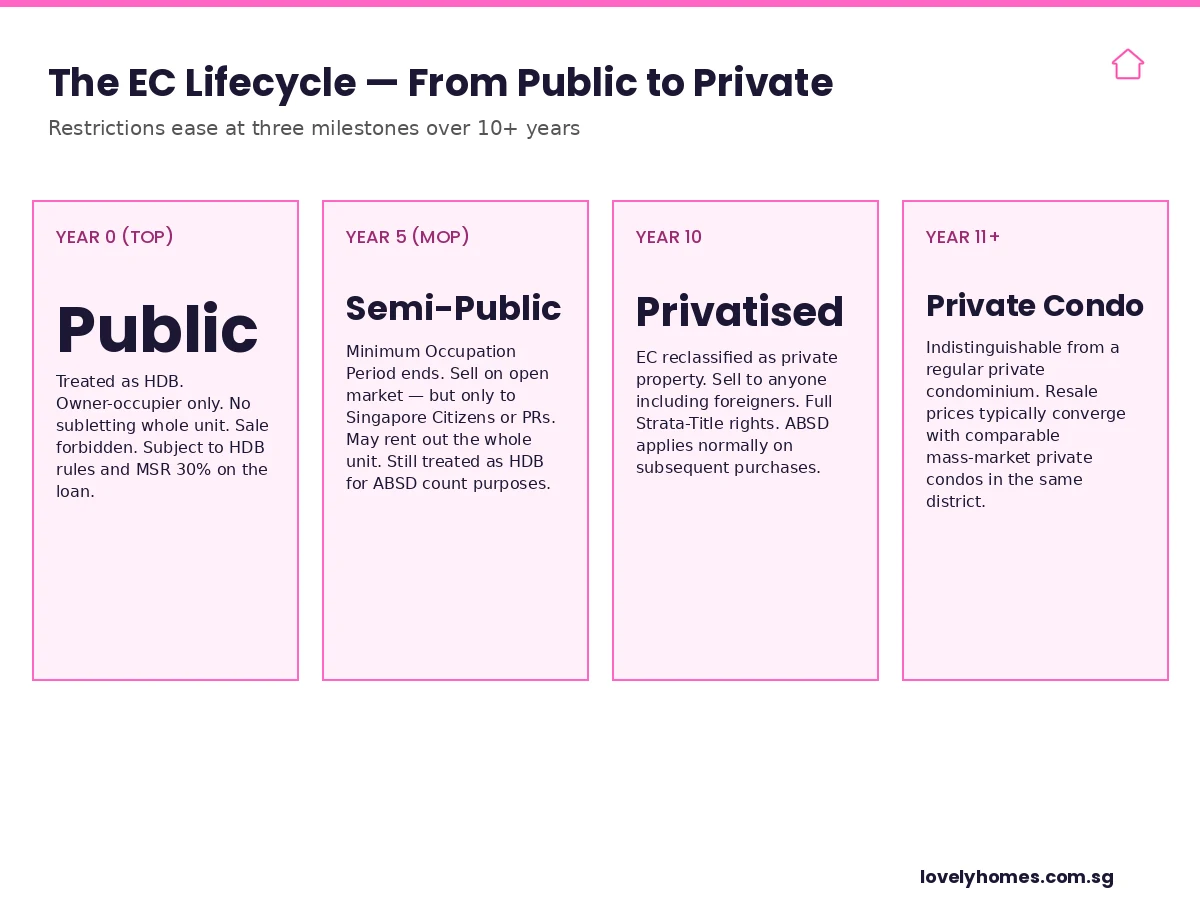
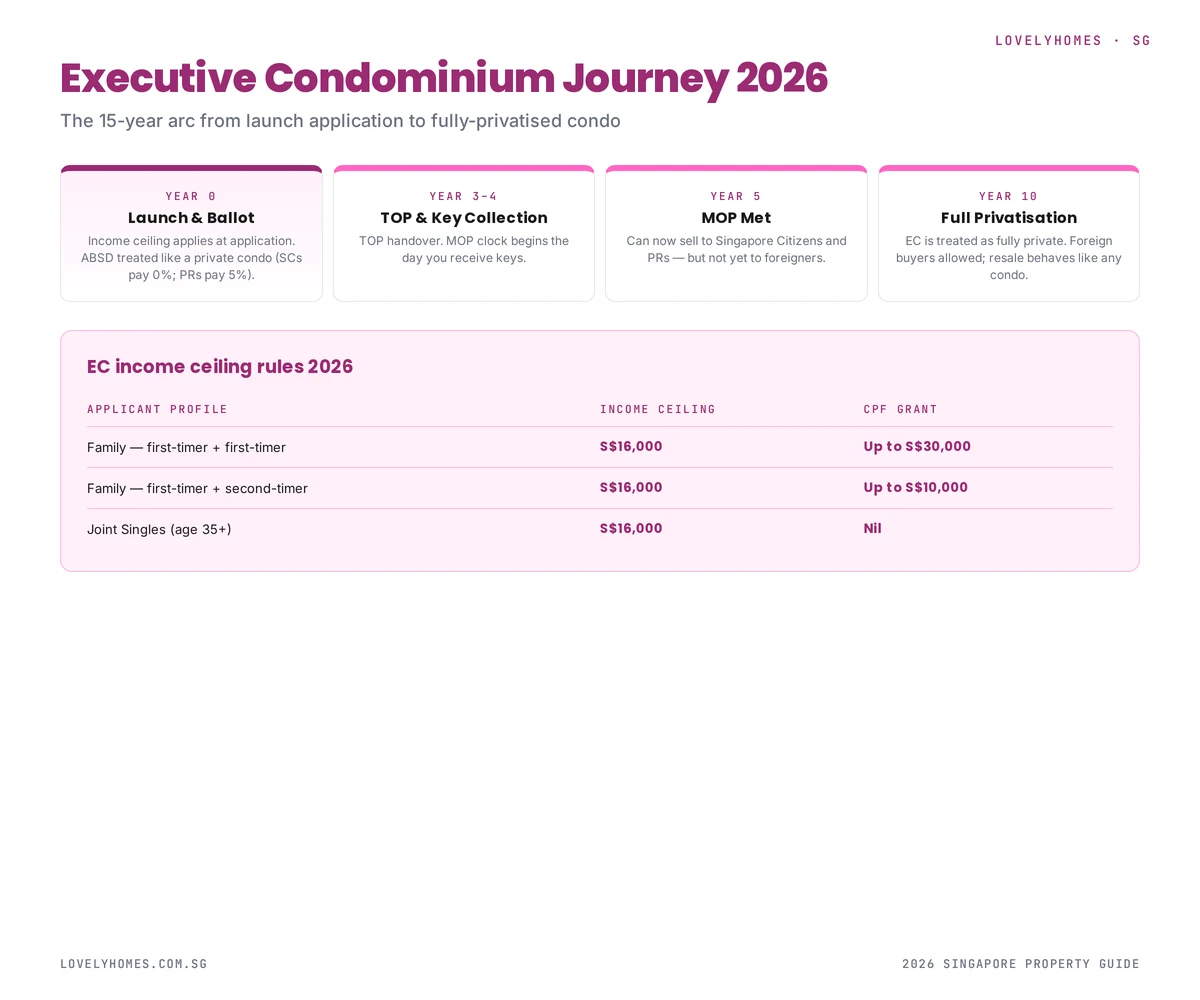
The key distinction from a standard private condominium is that ECs are initially subject to HDB ownership eligibility rules for the first 10 years after obtaining the Temporary Occupation Permit (TOP). The lifecycle unfolds in three distinct phases: during construction (HDB rules apply); 5 years after TOP (MOP complete, open to SC/PR resale market); and 10 years after TOP (full privatisation, open to foreigners and treated identically to private property).
ECs are developed exclusively by private developers who bid for Government Land Sales (GLS) sites earmarked for EC development by the Urban Redevelopment Authority (URA). The government controls EC supply by releasing sites through the GLS programme, and controls demand through the income ceiling and eligibility criteria administered by HDB.
EC Eligibility Criteria 2026
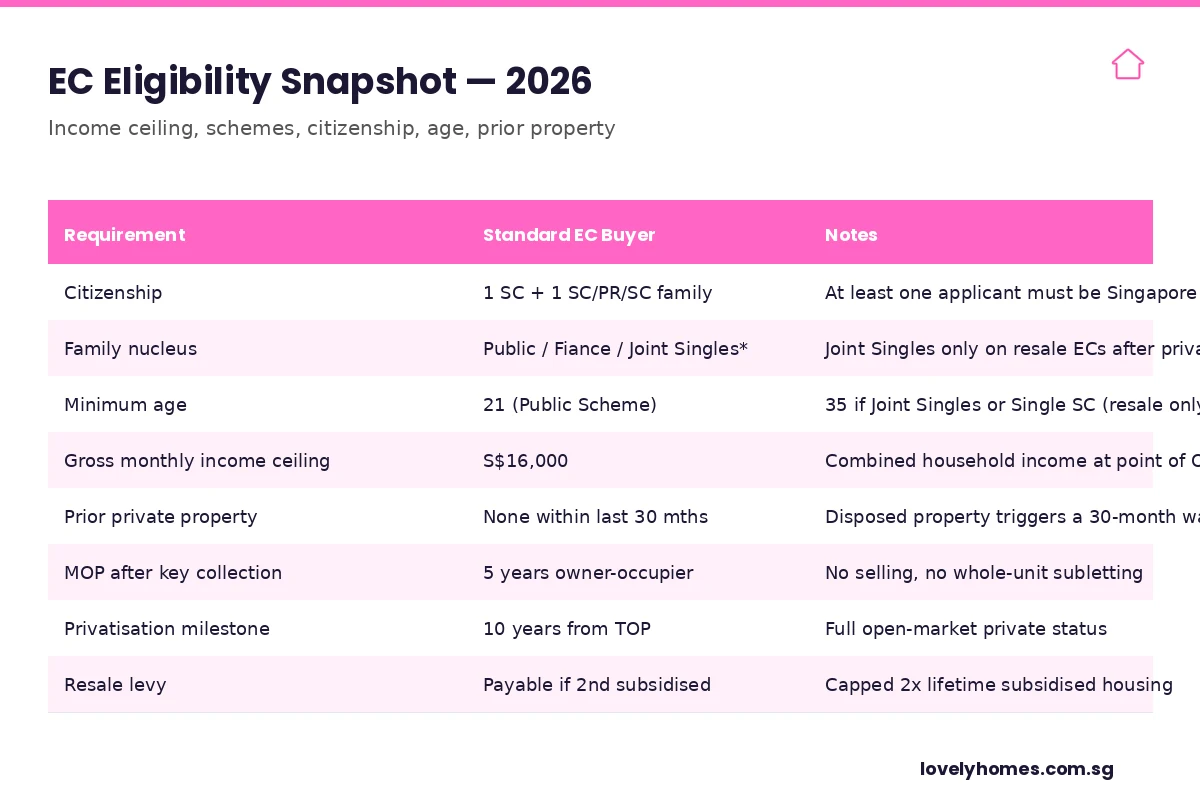
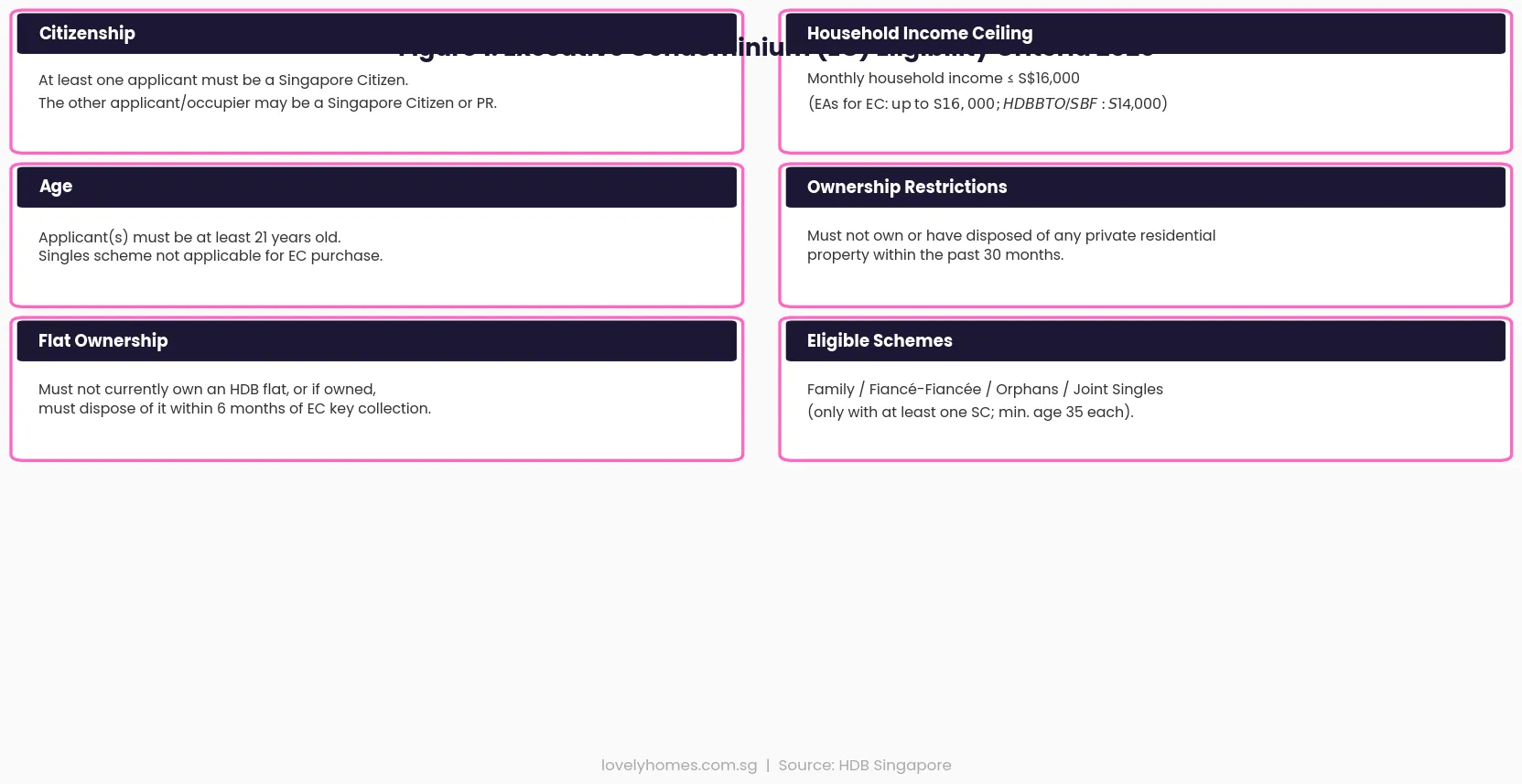
HDB administers the eligibility rules for EC purchases. The criteria are stricter than for private condominiums but more permissive than for BTO flats in some respects. As at August 2026:
| Criterion | Requirement | Notes |
|---|---|---|
| Citizenship | At least one applicant must be a Singapore Citizen | The other applicant/core occupier may be SC or Permanent Resident |
| Monthly Household Income | ≤ S$16,000 | All regular income of all listed applicants and occupiers is counted |
| Age | Minimum 21 years old | Singles scheme not applicable; must apply as a family or fiancé-fiancée unit |
| Private Property | Must not own or have disposed of private residential property within 30 months of EC application | Includes overseas properties for SC and PR applicants |
| HDB Flat | May own an HDB flat at point of application; must dispose within 6 months of EC key collection | Disposing of an HDB flat to buy an EC triggers a resale levy if the HDB flat was subsidised |
| Application Schemes | Family, Fiancé-Fiancée, Orphans, Joint Singles (SC only, age ≥ 35) | Joint Singles: both applicants must be SC; each at least 35 years old |
A key point often misunderstood: the income ceiling for ECs is S$16,000 per month, which is S$2,000 higher than the ceiling for HDB BTO flats (S$14,000). This has been a deliberate policy choice to make ECs accessible to the “sandwich class” — households earning in the S$14,001–S$16,000 range who are ineligible for BTO but benefit from the EC’s subsidised pricing relative to private launches.
EC Price vs Private Condo: The Value Gap
The most compelling argument for an EC — and the primary reason buyers accept the MOP constraints — is price. As at H1 2026, new EC launches are priced approximately 20–30% below equivalent new private condominiums in the same region. The exact discount varies by project, location, and market conditions.
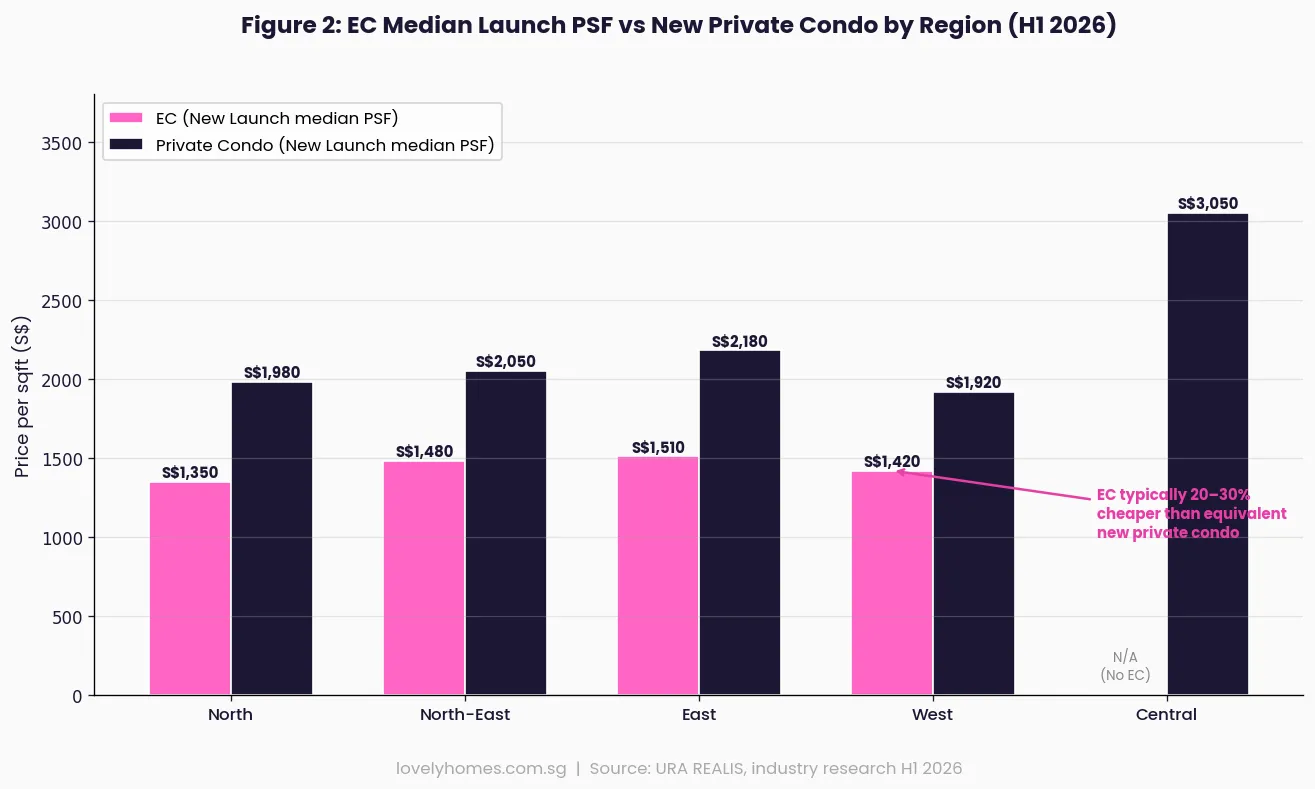
In the West region — historically one of the most active for EC launches given major EC clusters in Bukit Batok, Tengah, Jurong, and Sembawang — EC median launch PSF of approximately S$1,420 compares with new private condo launches at S$1,920 PSF. The S$500 PSF gap translates to a saving of S$500,000 on a 1,000 sqft unit — more than enough to offset the MOP constraints for most owner-occupier buyers.
The trade-off is real: EC buyers accept the 5-year MOP (from TOP), cannot sell to foreigners until 10 years post-TOP, and cannot benefit from CPF housing grants. But for genuine owner-occupiers who intend to live in the unit for the medium to long term, the price advantage is substantial and the MOP is largely a non-issue.
The EC Privatisation Lifecycle
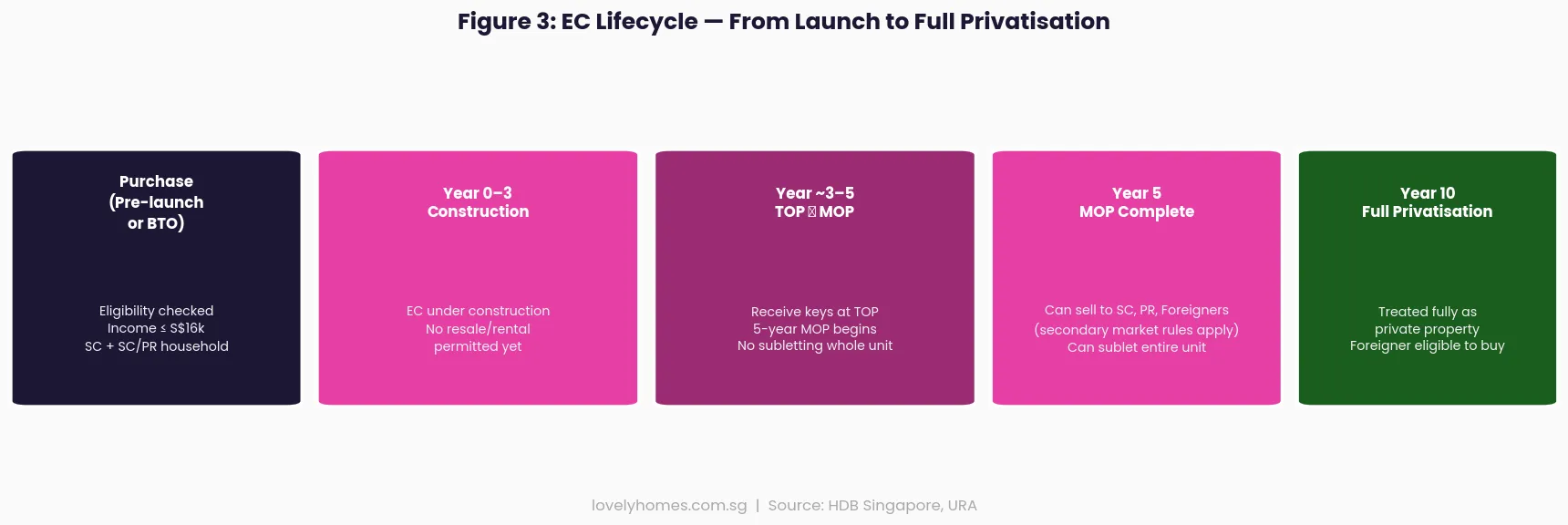
Understanding the EC’s privatisation journey is essential for buyers thinking about resale strategy and long-term wealth building:
At Purchase (Pre-TOP): You purchase the EC on a progress-payment schedule linked to construction milestones. The EC is treated as a private property purchase for stamp duty purposes — BSD applies, and ABSD applies if you are a PR or foreigner (Singapore Citizens buying their first EC pay zero ABSD). The purchase is financed by a commercial bank loan, not an HDB concessionary loan.
At TOP (typically 3–4 years after launch): You collect your keys. The 5-year MOP clock begins from this date — not from when you signed the sale and purchase agreement. During the MOP, you must occupy the unit. You cannot sublet the entire unit, though subletting of individual rooms is subject to HDB approval.
5 Years After TOP (MOP Complete): The EC enters the Singapore Citizens and Permanent Residents resale market. At this stage, the unit trades as a quasi-private property — priced at a discount to comparable fully-private condos because foreigners cannot yet buy. This MOP-completion wave typically sees a meaningful uplift in EC resale values as demand from SC/PR upgraders enters the market.
10 Years After TOP (Full Privatisation): The EC is now indistinguishable from any private condominium for all purposes. Foreigners may purchase it. The Foreign Ownership Rules under the Residential Property Act apply, but are no more restrictive than for any other private condo. At this stage, ECs typically trade at a very small discount to equivalent private condos (if at all), having completed their privatisation premium compression.
Financing an EC: Bank Loan, TDSR, and CPF Usage
Because ECs are financed exclusively by commercial banks (HDB concessionary loans are not available), the financing framework mirrors private property rules:
- LTV limit: Up to 75% of the purchase price or valuation (whichever is lower), for buyers with no outstanding home loans. This means you need at least 25% in cash or CPF for the down payment.
- Minimum cash component: At least 5% of the purchase price must be paid in cash. The remaining 20% can come from CPF Ordinary Account (OA) savings.
- TDSR: The Total Debt Servicing Ratio cap of 55% applies — total monthly debt obligations (including the EC loan) must not exceed 55% of gross monthly income.
- CPF usage: CPF OA savings can be used for the EC purchase and mortgage repayment, subject to the Valuation Limit and Withdrawal Limit rules administered by the CPF Board.
- No MSR: The Mortgage Servicing Ratio (MSR) cap of 30% — which applies to HDB loans and BTO purchases — does NOT apply to EC purchases. This is an important distinction: EC buyers can borrow more relative to their income than BTO buyers.
Stamp Duties on EC Purchase
EC purchases are subject to the same stamp duty rules as private property:
| Buyer Profile | BSD | ABSD | Net Stamp Duty on S$1.5M EC |
|---|---|---|---|
| Singapore Citizen — 1st property | Standard rates (1%–6%) | 0% | S$44,600 BSD |
| Singapore Citizen — 2nd property | Standard rates | 20% | S$44,600 + S$300,000 |
| Permanent Resident — 1st property | Standard rates | 5% | S$44,600 + S$75,000 |
| Permanent Resident — 2nd property | Standard rates | 30% | S$44,600 + S$450,000 |
The BSD rates are: 1% on first S$180,000; 2% on next S$180,000; 3% on next S$640,000; 4% on next S$500,000; 5% on next S$1.5M; 6% on remainder. For a S$1.5M EC purchase, BSD = S$44,600. See our complete BSD guide and ABSD guide for full calculations.
Worked Example: The Ng Family’s EC Purchase
📍 The Ng Family — First-Time EC Buyers in 2026
Background: Mr Ng (SC, age 33) and Ms Wong (SC, age 31) are newly married. Both are first-time property buyers. Combined monthly household income: S$13,500. They are applying for a new EC launch in Tengah, West region. Unit: 3-bedroom, 980 sqft, priced at S$1,478,600 (S$1,509 PSF).
Eligibility check:
- Household income S$13,500 ≤ S$16,000 ✓
- At least one SC (both SC) ✓
- Age ≥ 21 (both qualify) ✓
- No private property owned or disposed of within 30 months ✓
- No HDB flat owned ✓
Stamp duties:
BSD on S$1,478,600 = (1%×S$180k) + (2%×S$180k) + (3%×S$640k) + (4%×S$478,600) = S$1,800 + S$3,600 + S$19,200 + S$19,144 = S$43,744
ABSD: SC first property = S$0
Down payment (25% minimum):
Total purchase price: S$1,478,600
Min 5% cash: S$73,930
Remaining 20% CPF OA: S$295,720
Total down payment: S$369,650
Bank loan (75% LTV):
Loan amount: S$1,108,950
Assumed rate: 3.8% p.a. (floating SORA-based, H1 2026 indicative)
Tenure: 25 years
Monthly instalment: ~S$5,720
TDSR check: S$5,720 / S$13,500 = 42.4% — well within the 55% TDSR cap ✓
Day-1 cash outlay (excluding legal fees ~S$3,800):
Cash down payment: S$73,930
BSD: S$43,744 (payable within 14 days of OTP exercise)
Legal/disbursements: ~S$3,800
Total day-1 cash: ~S$121,474
EC schedule (projected):
Expected TOP: 2029
MOP completion: 2034
Full privatisation: 2039
Estimated resale value at 5-year MOP (2034): S$1.8M–S$2.0M (assuming 3–4% per annum capital appreciation — speculative).
Why ECs Make Strategic Sense for the Right Buyer
The EC is the most compelling value proposition in Singapore’s property market for buyers who meet the eligibility criteria and are comfortable with the MOP constraints. The value case rests on three pillars:
First: Entry price advantage. At 20–30% below comparable private launches, the EC provides immediate capital buffer. Even if private condo prices stagnate, the EC buyer has effectively bought in at a structural discount. Compare this with a private condo buyer paying full market price who then needs prices to appreciate just to break even on transaction costs.
Second: Privatisation premium. Historical data shows that ECs typically experience meaningful price appreciation at two points: at MOP completion (when the resale pool broadens to include all SC and PR buyers) and at full privatisation (when foreigners become eligible). This privatisation arc — from semi-public housing to fully private property over 10 years — is a unique return dynamic unavailable in any other Singapore property type.
Third: Upgrader pathway. For couples starting their property journey, an EC allows them to enjoy private condo living standards, build equity over the MOP period, and then use the proceeds of an EC resale to purchase a larger private home. The EC fits naturally into Singapore’s property upgrading ladder: HDB BTO → EC → private condo → landed.
The risk is equally clear: if the household’s income rises above S$16,000 between booking and key collection, eligibility may lapse (developers are required to verify income again). If you need to sell urgently before MOP, you cannot. And if you are a PR paying 5% ABSD, the entry cost is meaningfully higher than for an SC first-timer.
What Might Come Next: EC Policy Outlook
The EC market in 2026 faces a moderate supply pipeline. The URA‘s H2 2026 GLS programme included two confirmed EC sites. Demand continues to be supported by a large cohort of young professional households in the S$12,000–S$16,000 income bracket — precisely the demographic the EC is designed to serve.
Policy-wise, the income ceiling of S$16,000 has remained stable since 2019. Industry observers have periodically called for a review to S$18,000 or S$20,000 to account for wage inflation, but the government has not signalled any change. A ceiling increase would expand the eligible buyer pool significantly and could put upward pressure on EC launch prices.
The broader question of whether ECs should continue in their current form — given their blurring into the private market at privatisation — is debated periodically. For now, the government views ECs as a key mechanism for addressing the middle-income housing gap and they remain a permanent fixture of Singapore’s housing landscape.
Frequently Asked Questions: Executive Condo Singapore 2026
Can a foreigner buy an Executive Condo in Singapore?
Not directly, and not before 10 years post-TOP. During the first 5 years (MOP period), ECs may only be resold to eligible buyers under HDB’s scheme — which excludes foreigners entirely. From 5 to 10 years post-TOP, the EC is open to Singapore Citizens and Permanent Residents on the secondary market, but still not to foreigners. Only after 10 years from the date of TOP does the EC become fully privatised and eligible for purchase by foreigners. At that point, ECs are treated identically to any private condominium under Singapore’s Foreign Ownership Rules.
Can I use my CPF to buy an EC?
Yes — CPF Ordinary Account (OA) savings can be used for EC purchases, including for the down payment (the portion beyond the mandatory 5% cash) and for monthly mortgage instalments. However, ECs are not eligible for CPF housing grants such as the Enhanced CPF Housing Grant (EHG), Family Grant (FHG), or Proximity Housing Grant (PHG) — those grants are only available for HDB BTO and resale flat purchases. CPF usage for EC purchases is governed by the CPF Board’s Valuation Limit and Withdrawal Limit rules, which link the amount of CPF you can use to the flat’s valuation and your age.
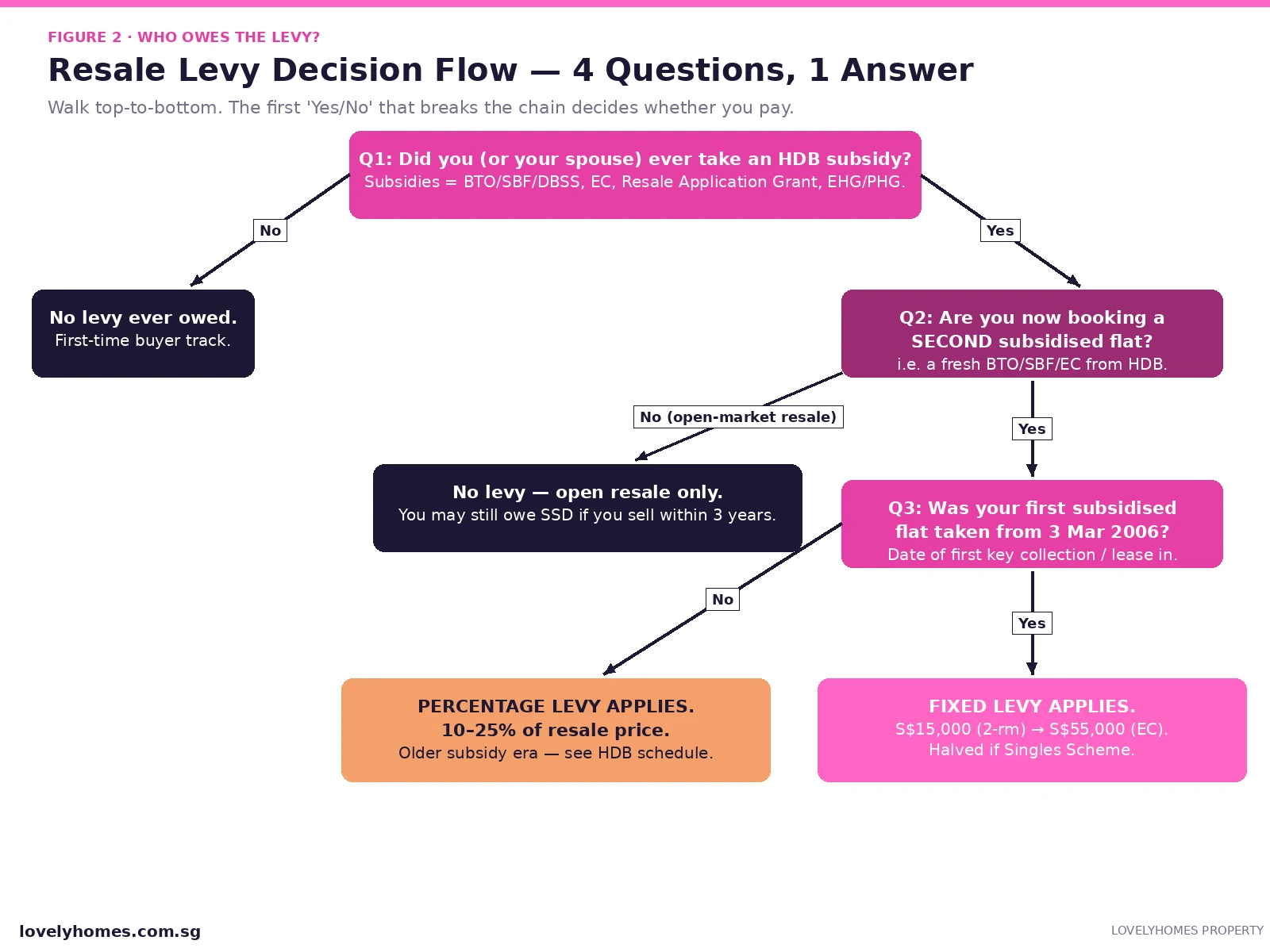
What is the resale levy, and does it apply to EC buyers?
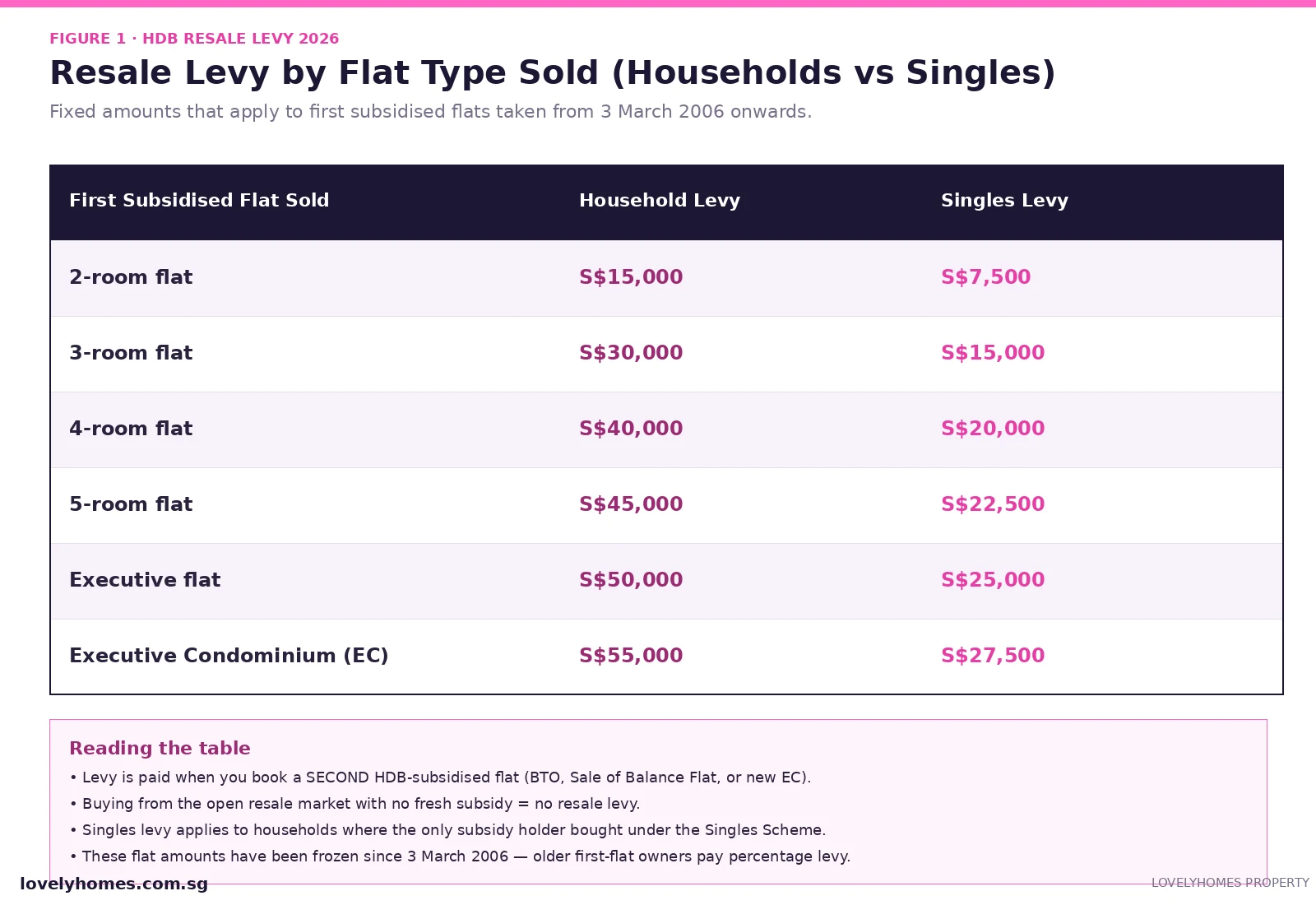
The resale levy is a charge payable to HDB when a subsidised HDB flat owner purchases another subsidised flat (including an EC). If you previously owned a BTO flat (or a resale flat purchased with a CPF housing grant) and are now buying an EC, a resale levy applies. The levy ranges from S$15,000 to S$55,000 depending on the flat type you previously owned: S$15,000 for a 2-Room Flexi, S$30,000 for a 3-Room, S$40,000 for a 4-Room, S$45,000 for a 5-Room, and S$55,000 for an Executive flat or DBSS. The levy is deducted from the EC purchase price — it does not come from you in cash, but reduces the amount available for your down payment from the flat sale proceeds.
What happens if my household income exceeds S$16,000 between booking and key collection?
HDB checks your household income at two key points: at the point of application (booking) and at the point of key collection. If your combined household income rises above S$16,000 between these two points, you may lose eligibility. Developers are legally required to report any income ceiling breaches to HDB, which can result in cancellation of the purchase with forfeiture of the booking fee (typically 5% of the purchase price). If income exceeds the ceiling due to extraordinary circumstances — for example, a one-off bonus — you should seek advice from the developer and HDB promptly. Stable salaried income is the primary metric; irregular or one-off payments are assessed differently.
Is an EC a better investment than an HDB flat or a private condo?
Investment outcomes depend heavily on timing, location, holding period, and individual financial circumstances — and LovelyHomes does not provide financial advice. That said, from a structural standpoint, ECs offer a combination that is difficult to match: the entry price discount of 20–30% versus private launches, full condo amenities, and a privatisation arc that has historically supported capital appreciation. Historical studies of past EC projects show that most have significantly outperformed equivalent HDB resale flat appreciation over comparable 10-year holding periods. Whether ECs outperform private condos net of opportunity cost depends on specific project selection and market timing. The answer is different for every buyer and every project — consult a licensed financial adviser for personalised analysis.
Can I buy an EC as a single person?
Generally no — the Singles scheme (which allows single SC citizens aged 35+ to buy HDB flats) is not available for EC purchases. ECs require a family nucleus: married couple, fiancé-fiancée, orphan scheme (siblings), or joint singles. The joint singles scheme allows two single SC citizens (each aged at least 35) to jointly purchase an EC — but both must be SC, and the household income ceiling of S$16,000 still applies to the combined income of both applicants. A single person buying alone cannot apply for an EC under any scheme.
How long does it take from EC launch to key collection?
Typically 3 to 4 years from the date of the Sales and Purchase Agreement (S&P) signing to the issuance of the Temporary Occupation Permit (TOP). Construction timelines vary by project and developer, but the standard EC construction period is 36 to 48 months. The MOP of 5 years then begins from TOP — so from the date you book your EC to the earliest you can sell on the open market is typically 8 to 9 years. From booking to full privatisation (when foreigners can buy) is typically 13 to 14 years. This long-term horizon is a fundamental characteristic of EC investment — it is not suitable for buyers who may need to liquidate in the short to medium term.