
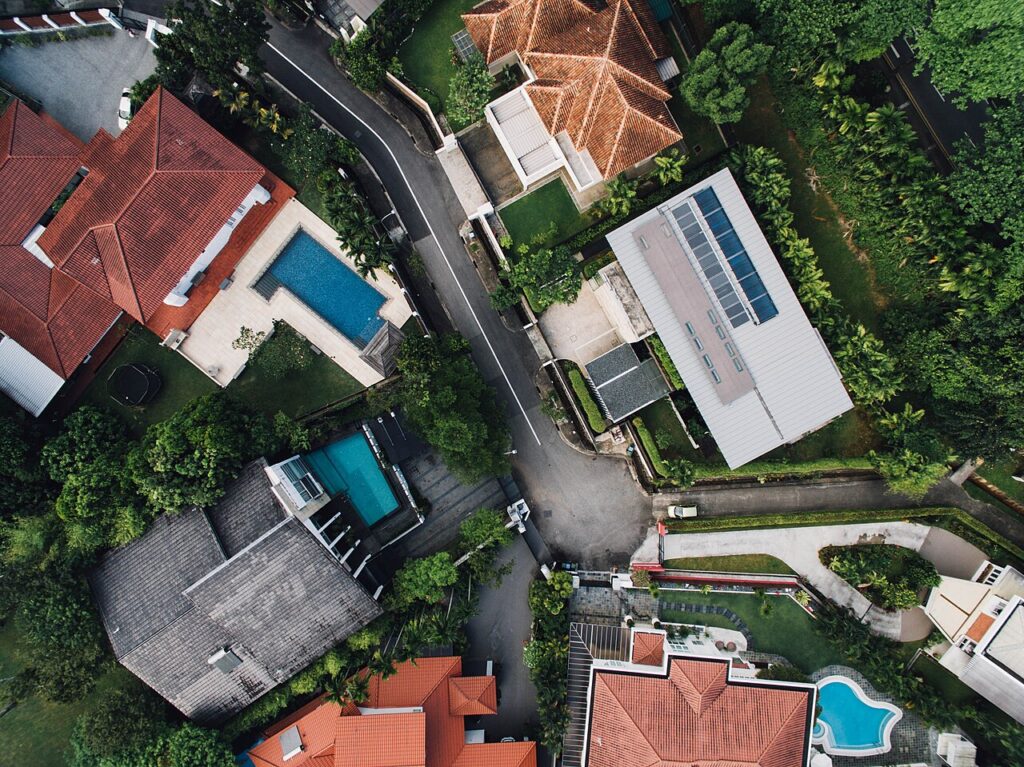
Landed property in Singapore carries a special weight in the local property psyche. A terrace house or bungalow in a good district is simultaneously a home, an heirloom, and one of the most illiquid but historically appreciating assets on the island. Supply is scarce by design , landed residential land accounts for less than 5% of Singapore’s total land area, and the Government strictly regulates who may buy it. Prices range from S$1.6 million for a modest intermediate terrace in an outlying town to S$50 million or beyond for a Good Class Bungalow (GCB) in Districts 10 or 11.
This guide covers the full landscape of landed property buying in Singapore in 2026 , the property types and their legal definitions, who is eligible to buy (including the restrictions under the Residential Property Act), the full stamp-duty and financing picture, the practical transaction process, and the investment considerations that distinguish landed from strata-title property.
- Singapore Citizens (SCs) may buy any landed property. Singapore PRs and foreigners need Singapore Land Authority (SLA) approval under the Residential Property Act 1976 (RPA), and approval is generally restricted to Singapore citizens only for GCBs.
- Landed property in Singapore comes in six main types: Good Class Bungalow, detached bungalow, semi-detached house, corner terrace (Type I and II), intermediate terrace, and cluster house (strata-title landed).
- Prices range from approximately S$1.6M (intermediate terrace, outer ring) to S$65M+ (GCB, prime districts).
- ABSD applies to landed property at standard rates , a Singapore Citizen buying a second landed property pays 20% ABSD. Foreigners pay 60% ABSD and need SLA approval.
- Gross rental yields for landed property are lower than condominiums (1.9–2.0% for semi-D and bungalow), but capital appreciation over the last five years has been strong (18–22%).
- The landed property market is highly illiquid , transaction volumes are thin and price discovery can be slow. Buyers should plan for a 3–6 month search and transaction process.
- BSD for a S$5M landed purchase is approximately S$199,600. For a foreigner buying at S$5M, ABSD adds another S$3,000,000 , making the total stamp duty S$3,199,600 (64.0% of purchase price).
- Land area, plot ratio, and development baseline rights all need verification before purchase , especially for older properties or those in conservation areas.
Types of Landed Property in Singapore
Singapore’s landed property landscape is legally defined by the Urban Redevelopment Authority (URA) through its development control plans and the Planning Act. The key property types are:
| Type | Key Characteristics | Min. Land Area | Typical 2026 Price Range |
|---|---|---|---|
| Good Class Bungalow (GCB) | Singapore’s most prestigious landed category. Gazetted GCB areas only (39 areas, mainly D10/D11). SCs only , PRs and foreigners may not purchase even with SLA approval. | 1,400 sq m (15,069 sq ft) land | S$10M – S$65M+ |
| Detached Bungalow (non-GCB) | Single-family detached home outside GCB areas. May be freehold or 999/99-year leasehold. | 400 sq m | S$5.5M – S$18M |
| Semi-Detached House | Shares one party wall with one neighbour. Often sold in pairs (mirror units). Good balance of space and price. | 200 sq m | S$3.2M – S$7M |
| Corner Terrace (Type I / Type II) | End-unit in a terrace row; larger plot than intermediate. Type I has a wider frontage; Type II has a smaller side garden. | 200 sq m (Type I); 80 sq m (Type II) | S$2.2M – S$4.5M |
| Intermediate Terrace | Most affordable landed type. Shares both party walls with neighbours. Typically 1,400–1,800 sq ft built-up. | 80 sq m land (approx) | S$1.6M – S$3.2M |
| Cluster House | Strata-title landed within a gated development. Governed by BMSMA (like a condo). No individual land title; owner holds a strata lot. Eligible for purchase by SCs and PRs in some cases. | Varies by development | S$1.8M – S$4M |
Who Can Buy Landed Property? The Residential Property Act 1976
The purchase of landed residential property in Singapore is regulated by the Residential Property Act 1976 (RPA), administered by the Singapore Land Authority (SLA). The RPA’s underlying policy is to prioritise landed property ownership for Singapore Citizens, given the scarcity of land.
| Buyer Profile | GCB | Other Landed (non-GCB) | Cluster House (Strata) |
|---|---|---|---|
| Singapore Citizen (SC) | ✓ Permitted (no approval needed) | ✓ Permitted (no approval needed) | ✓ Permitted |
| Singapore PR (SPR) | ✗ Not permitted (even with SLA approval) | Requires SLA approval under RPA; approval criteria are strict and rarely granted for non-GCB landed to SPRs | ✓ Permitted (no SLA approval needed for strata-title cluster houses) |
| Foreigner (non-PR) | ✗ Not permitted | Requires SLA approval; approval criteria very strict; Sentosa Cove bungalows are a specific gazetted area where foreigners may apply | ✓ Permitted for fully privatised cluster houses (subject to standard ABSD) |
| Companies / Entities | ✗ Not permitted | ✗ Not permitted (RPA restricts landed to individuals only) | Subject to strata title rules |
SLA approval for non-GCB landed property is theoretically available to Singapore PRs and foreigners under Section 25 of the RPA, but in practice approvals are granted rarely and only where the applicant can demonstrate a substantial economic contribution to Singapore (e.g., founding a significant local business, long-term residency, or contribution to arts/sciences). The processing time for an SLA application is typically 4–6 weeks. Engaging a conveyancing lawyer experienced in RPA applications is essential before proceeding.
Sentosa Cove exception: The Sentosa Cove precinct on Sentosa Island was gazetted under the RPA as an area where foreigners may apply to purchase bungalows. Approvals are not guaranteed and standard ABSD (60% for a foreigner) still applies on top of BSD. Sentosa Cove bungalows are 99-year leasehold and carry additional levy and maintenance costs.
Stamp Duties for Landed Property Purchases
BSD and ABSD apply to landed property purchases in exactly the same way as for any other residential property in Singapore. However, given the higher price points of landed property, the absolute BSD and ABSD figures are substantially larger. The BSD schedule for residential property is: 1% on the first S$180,000; 2% on the next S$180,000; 3% on the next S$640,000; 4% on the next S$500,000; 5% on the next S$1,500,000; and 6% on the portion above S$3,000,000.
As the infographic illustrates, ABSD transforms the economics dramatically. For a Singapore Citizen buying a S$5M semi-detached house as a second property, ABSD at 20% adds S$1,000,000 to the stamp duty bill , bringing total stamp duties to S$1,199,600 (24.0% of the purchase price). For a foreigner buying the same property at 60% ABSD, the stamp duty reaches S$3,199,600 , effectively making foreign landed property ownership economically prohibitive except at the very top of the market.
Financing a Landed Property Purchase
Landed property is financed via bank loans, with LTV, TDSR, and loan tenure rules set by MAS. There is no HDB concessionary loan or MSR rule for landed property , only TDSR (55% of gross monthly income) applies to the mortgage servicing requirement. CPF Ordinary Account savings may be used for downpayment and monthly instalments, subject to the Withdrawal Limit (150% of valuation for properties with remaining lease of at least 60 years).
A key financing consideration for landed property is the mortgage stress test. Banks in Singapore will loan only up to 75% LTV on a first property with no existing loans, but landed property valuations , particularly for older homes or those requiring significant rebuilding , can diverge from transaction prices. Where a bank’s valuation comes in below the purchase price, the shortfall must be funded in cash (the “cash over valuation” or COV).
| Financing Parameter | Applicable Rule |
|---|---|
| Maximum LTV (no existing loans) | 75% of purchase price or valuation (lower of the two) |
| Minimum cash downpayment | 5% of purchase price in cash (cannot use CPF) |
| TDSR | All monthly debt obligations ≤ 55% of gross monthly income |
| MSR | Not applicable to landed property (MSR is HDB/EC-specific) |
| Maximum loan tenure | 30 years for residential properties (capped so loan matures before borrower turns 65) |
| CPF Ordinary Account | May be used for remaining 20% downpayment and monthly instalments, subject to Withdrawal Limit (150% of valuation) |
| Stamp duty financing | BSD and ABSD cannot be funded by bank loans , must be paid in cash (or CPF OA after stamping) |
Worked Example: Mr and Mrs Wong Buying a Semi-Detached House
Mr and Mrs Wong are Singapore Citizens, both aged 45. They have sold their Toa Payoh condominium and wish to purchase a semi-detached house in Serangoon Gardens (District 19) at S$4,200,000. This would be their first landed property and their only property after selling the condo.
| Item | Amount | Notes |
|---|---|---|
| Purchase price | S$4,200,000 | Semi-detached house, District 19, freehold |
| ABSD | S$0 | First property after selling condo , no existing property at date of OTP |
| BSD | S$158,600 | 1%×180k + 2%×180k + 3%×640k + 4%×500k + 5%×1,500k + 6%×1,200k = S$1,800 + S$3,600 + S$19,200 + S$20,000 + S$75,000 + S$72,000 = S$191,600. Wait , recalculate: S$1,800+S$3,600+S$19,200+S$20,000+S$75,000 = S$119,600 to S$3M; 6% × S$1.2M = S$72,000; total S$191,600 |
| BSD (correct) | S$191,600 | On S$4.2M: progressive calculation per IRAS schedule |
| Conveyancing fees (buyer) | ~S$6,000–S$9,000 | Ad valorem legal fee + disbursements for S$4.2M transaction |
| Bank loan (75% LTV) | S$3,150,000 | 75% of S$4.2M |
| Cash downpayment (5%) | S$210,000 | Minimum cash; must be paid in cash |
| CPF OA (remaining 20%) | S$840,000 | If CPF OA balance is sufficient; Withdrawal Limit applies (150% of valuation = S$6.3M , sufficient headroom) |
| Monthly mortgage (25 yrs @ 3.5%) | ~S$15,765/mth | TDSR: if combined income is S$40,000/mth, TDSR = 39.4% , within 55% |
| Total upfront cash required | ~S$401,600 | BSD S$191,600 + cash downpayment S$210,000 (conveyancing fees funded from CPF/cash) |
This example shows that even a relatively straightforward landed purchase , with no ABSD because the Wongs are first-time buyers after selling their condo , requires significant upfront cash. The BSD alone of S$191,600 represents 4.6% of the purchase price. Buyers considering landed property must ensure they have not only the downpayment and stamp duties available in liquid form, but also an emergency fund given the ongoing maintenance and renovation costs that landed homes typically require.
Landed Property as an Investment: Yield, Capital Growth, and Liquidity
Landed property in Singapore is widely regarded as a store of wealth rather than a yield-generating asset. Gross rental yields for detached and semi-detached properties are typically 1.9–2.0%, well below the 3–4% achievable on OCR condominiums and the 4–5% available on HDB flats. However, the capital appreciation case has historically been compelling.
Over the five years to 2026, landed residential property in Singapore has appreciated approximately 18–22% on a PSF basis, slightly below OCR condominiums (+19.5%) but ahead of RCR condominiums (+14%) on a capital growth percentage basis. The URA Private Residential Property Price Index (PPI) for landed property, which rose sharply in 2021–2022 and softened slightly in 2023, resumed growth in 2024–2025. The Q1 2026 URA flash estimate showed landed property prices declining a modest 0.4% quarter-on-quarter , a brief softening after five years of strong appreciation , while the non-landed segment rose 0.9%.
Key structural drivers that support landed property values over the long term include: absolute supply constraint (landed residential zoning cannot be easily converted to other uses); freehold or long-leasehold tenure for many prime properties (GCBs are predominantly freehold); and the premium that Singaporean families place on land ownership and the ability to rebuild or add on extension structures. These factors make the asset class resilient to short-term market cycles.
The Landed Property Transaction Process , Key Steps
The legal mechanics of buying a landed property follow the same OTP-SPA framework as any private property purchase, with one additional step for PRs and foreigners: the SLA approval application must be obtained before the OTP is exercised. The full process:
- Identify and inspect the property. For landed homes, physical inspection is particularly important , check structural condition, drainage, boundary walls, and any URA permission for existing structures (e.g., attic rooms, outbuildings).
- Verify title and planning conditions. Your lawyer will search the SLA land register to confirm ownership, encumbrances, caveats, and any deed restrictions. A URA enquiry confirms the plot ratio, development baseline, and any conservation status.
- SLA RPA application (for PRs/foreigners only). Apply to the SLA’s Land Dealings Approval Unit (LDAU) via the Integrated Land Information Service (INLIS) portal. Allow 4–6 weeks. Proceed to OTP only after approval is received.
- Option to Purchase (OTP) granted. Standard 14-day exercise period. For landed property, a lawyer should review the OTP before payment of the option fee.
- Exercise OTP and pay stamp duties. BSD (and ABSD if applicable) within 14 days of exercising the OTP.
- Completion (10–12 weeks from OTP exercise). Title transferred; funds released; keys received.
What Might Come Next: Landed Property Policy Outlook
The Government has historically used the ABSD framework as its primary tool for managing landed property demand, particularly from foreign buyers. The April 2023 ABSD increase to 60% for foreigners was a decisive statement on this front. Going forward, it is speculative to predict whether further cooling measures will target the landed segment specifically, but the structural dynamics , limited supply, strong SC demand at the mid-to-high end, and near-zero foreign demand given 60% ABSD , suggest landed prices are driven primarily by domestic wealth accumulation and generational property transfer rather than by investment flows.
One policy area to watch is the development baseline rules for older landed areas. The URA periodically reviews Development Charge tables and floor area allowances for landed sites, which can affect the rebuilding potential of a property. Buyers of older landed homes should check the prevailing Gross Plot Ratio (GPR) and whether the existing built-up area is compliant with current rules before proceeding.
Landed Property Buying , Key Facts at a Glance
| Parameter | Rule / Typical Figure (2026) |
|---|---|
| SCs eligible? | Yes , any landed type, no approval needed |
| PRs eligible? | Non-GCB only, SLA approval required; rarely granted |
| Foreigners eligible? | SLA approval required; Sentosa Cove bungalows only in practice; 60% ABSD applies |
| GCBs to foreigners/PRs? | Not permitted under any circumstances |
| Cluster houses (strata-title) | No RPA restriction; purchased like condominiums; standard ABSD applies |
| HDB concessionary loan? | Not available , bank loan only |
| MSR applicable? | No , TDSR (55%) applies only |
| Max LTV (no existing loans) | 75% of purchase price / valuation (lower) |
| BSD on S$3M landed | S$99,600 |
| BSD on S$5M landed | S$199,600 |
| BSD on S$8M landed | S$349,600 |
| ABSD (SC 2nd property) | 20% of full purchase price |
| Gross rental yield (terrace) | ~2.0% per annum |
| 5-yr capital growth (terrace) | ~18–22% (2021–2026, URA PPI basis) |
Related Articles
- ABSD Singapore 2026: Complete Guide to Additional Buyer’s Stamp Duty
- Stamp Duty Calculator Singapore 2026: Complete BSD and ABSD Guide for Every Buyer
- Leasehold vs Freehold Property Singapore 2026: Which Tenure Should You Buy?
- TDSR and MSR Singapore 2026: Complete Guide to Property Borrowing Limits
- Conveyancing Fees Singapore 2026: Legal Costs for Buying and Selling Property
- Rental Income Tax Singapore 2026: Complete IRAS Guide for Landlords
- Jurong Lake District Property Outlook 2026: Prices, Investment Potential and What Is Coming
Frequently Asked Questions
Can a Singapore PR buy a terrace house in Singapore?
Technically yes, but only with SLA approval under the Residential Property Act, and such approvals are rarely granted to permanent residents for non-GCB landed property. A Singapore PR’s most practical route into the landed segment is to purchase a strata-title cluster house, which is treated as a condominium under the law and does not require RPA approval. GCBs are completely off-limits to PRs and foreigners regardless of SLA application.
Is freehold or leasehold better for landed property?
Most prime landed property in Singapore is freehold or 999-year leasehold (which is effectively freehold for all practical purposes). For GCBs, near-all are freehold. For intermediate and corner terraces in outlying towns, 99-year leasehold is common. The freehold premium for landed property is more pronounced than for condominiums , partly because landed homes are frequently passed down through generations and partly because CPF usage is restricted for properties with less than 60 years remaining lease. Buyers of leasehold landed homes should model the lease-decay trajectory carefully, particularly for properties with less than 70 years remaining.
Can I rebuild a landed property after purchasing it?
Yes, subject to URA planning permission and development control guidelines. The key parameters are the Gross Plot Ratio (GPR), maximum building height, setback requirements, and the development baseline for the specific landed housing zone. Most landed homes are in zones with a GPR of 1.4 (allowing a built-up area of 1.4 times the land area) and a height limit of two or three storeys. Before purchase, commission a feasibility study with an architect if you intend to rebuild , particularly for older properties where the existing built-up area may exceed current allowances (grandfathered as existing non-conforming development).
Does ABSD apply when I inherit a landed property?
No. Property acquired by inheritance is not a purchase and does not attract ABSD. However, the inherited property does count toward your property count for future purchases. If you subsequently buy another residential property, the inherited landed home is counted as an existing property when calculating your ABSD liability. BSD also does not apply to inherited property as there is no consideration paid.
What is a Good Class Bungalow and can anyone buy one?
A Good Class Bungalow is a gazetted category of landed property in Singapore, defined by URA as a detached house within one of 39 designated GCB areas (mainly Districts 10 and 11), with a minimum land area of 1,400 sq m (approximately 15,069 sq ft). Only Singapore Citizens may own a GCB , PRs and foreigners may not purchase a GCB under any circumstances, even with SLA approval. GCBs are predominantly freehold, single-storey to three-storey in height, and represent the pinnacle of Singapore residential property. Transaction volumes are thin , typically 30–60 transactions per year island-wide , and prices start at around S$10M, reaching S$65M or more for prime locations in Nassim Road, White House Road, or Dalvey Road areas.
How do I find out the development potential of a landed property before buying?
Submit a planning enquiry to URA via their online Development Control enquiry system before committing to any purchase. The enquiry will confirm the zoning (residential/landed housing zone), plot ratio allowance, height controls, and any conservation designation. Your conveyancing lawyer can also commission government requisitions to URA, LTA (for road-line setbacks), PUB (drainage reserves), and NEA (environmental restrictions). For properties you intend to redevelop, engage a licensed architect or Qualified Person (QP) for a preliminary feasibility assessment , this can often be done within 2–3 weeks and gives you the development ceiling before you commit to the purchase price.
Disclaimer: This article is for general information and educational purposes only. It does not constitute legal, financial, property, or architectural advice. Landed property eligibility under the Residential Property Act, stamp duty rates, CPF rules, and URA planning controls are subject to change. Always verify the current position with the Singapore Land Authority, Urban Redevelopment Authority, IRAS, and CPF Board, and consult a licensed conveyancing lawyer and CEA-registered property agent before making any property decision.
Supporting graphics
Original article illustrations are available below.
- Figure 1: Singapore landed property types and approximate price ranges (2026). Source: URA REALIS, EdgeProp, LovelyHomes research.
- Figure 2: BSD and ABSD costs for Singapore landed property at three price points (S$3M, S$5M, S$8M) and three buyer profiles. Source: IRAS 2026 BSD schedule; ABSD rates effective 27 April 2023.
- Figure 3: Landed property vs private condominium vs HDB resale , gross rental yield and 5-year capital growth (2021–2026). Source: URA PPI, HDB, LovelyHomes research.


