Singapore Strata-Titled Landed Property Guide 2026: Cluster Houses, MCST Fees, Eligibility and Stamp Duties

Singapore Strata-Titled Landed Property Guide 2026: Cluster Houses, MCST Fees, Eligibility and Stamp Duties

🏡 Quick Answer: Strata-Titled Landed Property Singapore 2026

  • Strata-titled landed (also called cluster housing) combines the feel of a landed home — your own ground floor, private garden or yard — with a shared strata scheme managed by a Management Corporation (MCST), similar to a condo.
  • Not a “restricted residential property” under the Residential Property Act (Cap. 274): Singapore Permanent Residents (PRs) may purchase cluster houses freely without Singapore Land Authority (SLA) approval. Foreigners also may buy, subject to ABSD.
  • Foreigners pay 60% ABSD (same as any private residential property). PRs pay 5% ABSD on their first purchase; 30% on subsequent. Singapore Citizens pay 0% ABSD on their first purchase.
  • Prices range from S$2.5 million (cluster terrace, OCR/RCR) to S$12 million+ (cluster bungalow, prime districts). About 15–25% below equivalent standalone landed in the same location.
  • Monthly MCST maintenance fees typically run S$300–S$700 for cluster terraces, S$500–S$1,200 for cluster bungalows, covering pool, gym, landscaping, security, and lift maintenance.
  • Same BSD and LTV rules as private condos — progressive BSD 1–6%, LTV 75% (first property), TDSR 55%.
  • Seller’s Stamp Duty (SSD) applies within 4 years of purchase at 16%/12%/8%/4% (new regime from 4 July 2025).
  • AV-based property tax: strata landed AV is assessed like a condo (rental comparison), not at the higher rates typical of standalone landed.

What Is Strata-Titled Landed Property?

Singapore’s property market features two broad categories of landed homes. The first — and most familiar — is standalone landed property: your own land title, no shared management, complete independence. The second, less understood but increasingly popular among upgraders and foreign buyers, is strata-titled landed property, more commonly called cluster housing.

A strata-titled landed development consists of multiple individual landed units (terraces, semi-detached houses, or bungalows) built within a single fenced development on a shared piece of land. Each owner holds a strata title under the Land Titles (Strata) Act (Cap. 158), which confers:

  1. Ownership of a defined strata lot (your house, including the ground floor footprint and any private yard or garden).
  2. A proportionate share in the common property — swimming pool, gymnasium, BBQ pavilions, guard house, landscaped gardens, driveways, and visitor parking.

The development is governed by a Management Corporation (MCST) under the Building Maintenance and Strata Management Act (BMSMA, Cap. 30C), administered by the Building and Construction Authority (BCA). The MCST collects monthly management fees and sinking fund contributions, maintains common facilities, and passes by-laws binding on all unit owners — exactly as in a condominium development.

Well-known strata-landed developments in Singapore include Luxus Hills (Sengkang, D19), Watercove (Sembawang, D27), The Cassia (East Coast, D15), Straits at Joo Chiat (D15), Fernvale Lea (Sengkang), and Jervois Prive (Holland, D10). Many are built to semi-luxury specifications with communal facilities rivalling mid-tier condos.

Singapore strata-titled landed property price ranges 2026 cluster terrace semi-D bungalow
Figure 1: Price ranges for strata-titled landed property types vs equivalent standalone landed in Singapore (2026). Cluster terraces are typically 15–25% cheaper than standalone equivalents in the same area. Source: URA Realis caveats, LovelyHomes analysis.

The Critical Legal Distinction: Why PRs and Foreigners Can Buy Cluster Houses

The Residential Property Act (RPA, Cap. 274) restricts foreigners and PRs from purchasing certain categories of Singapore residential property without SLA approval — specifically “restricted residential properties”, which include standalone terrace houses, semi-detached houses, detached houses, and Good Class Bungalows.

Strata-titled landed properties are explicitly excluded from the RPA’s restricted category. Because each unit is held on a strata title (rather than a freehold/leasehold land title for the soil beneath), it falls outside the RPA’s definition of restricted residential property. This has a profound practical implication:

  • Singapore Citizens: May purchase any cluster house freely. No approvals required.
  • Permanent Residents: May purchase cluster houses freely — no CRP (Clearance to Purchase Residential Properties) or SLA approval needed, unlike standalone landed homes.
  • Foreigners (non-PR): May purchase cluster houses freely — again, no SLA approval, unlike standalone landed which is generally only available to SCs and is rarely approved for foreigners. The 60% ABSD still applies.

This eligibility advantage makes strata-titled landed a strategic entry point for PRs who want the feel of a landed home but cannot yet obtain SLA approval for standalone landed, and for high-net-worth foreigners seeking a premium Singapore address with genuine ground-floor living.

Singapore strata landed property eligibility matrix SC SPR foreigner 2026
Figure 2: Eligibility to purchase by buyer nationality — strata-titled landed (green across all buyer types) vs standalone landed (restricted for PRs, prohibited for foreigners). Source: Residential Property Act (Cap. 274), SLA guidelines 2026.

Stamp Duties, Financing and Legal Process

Buyer’s Stamp Duty (BSD)

Strata-titled landed properties attract the same progressive BSD as any private residential property, administered by IRAS under the Stamp Duties Act. For a cluster terrace purchased at S$3.8 million:

BSD Band Amount Subject Rate BSD Payable
First S$180,000 S$180,000 1% S$1,800
Next S$180,000 S$180,000 2% S$3,600
Next S$640,000 S$640,000 3% S$19,200
Next S$500,000 S$500,000 4% S$20,000
Next S$1,500,000 S$1,500,000 5% S$75,000
Above S$3,000,000 S$800,000 6% S$48,000
Total BSD S$3,800,000 Effective 4.41% S$167,600

Additional Buyer’s Stamp Duty (ABSD)

ABSD applies at the same rates as for any private residential purchase: SC first property 0%, SC second 20%, SC third+ 30%; SPR first 5%, SPR second 30%; foreigner 60%. There are no ABSD concessions specific to strata landed — the strata nature of the title does not affect ABSD liability.

Financing: LTV, TDSR and CPF

Bank financing for cluster housing follows the same framework as private condos: LTV up to 75% of the lower of purchase price or market valuation (first property, no outstanding loans), subject to a 55% Total Debt Servicing Ratio (TDSR) and 30% Mortgage Servicing Ratio (MSR, applicable only for HDB purchases). CPF Ordinary Account may be used for the downpayment and monthly instalments on residential strata landed property, subject to the Valuation Limit and Withdrawal Limit rules.

Seller’s Stamp Duty (SSD)

The four-year SSD regime introduced on 4 July 2025 applies fully to cluster housing: sell within Year 1 = 16%, Year 2 = 12%, Year 3 = 8%, Year 4 = 4%. Hold beyond four years and no SSD applies.

Understanding MCST Fees and What They Cover

Unlike standalone landed homeowners who manage their own upkeep entirely, cluster house owners pay monthly MCST contributions. These comprise two components:

  • Management fund contributions (monthly): cover day-to-day operating expenses — security guard services, pool maintenance, landscaping, utilities for common areas, lift maintenance (where applicable), pest control, and MCST administrative costs.
  • Sinking fund contributions (monthly): set aside for long-term capital expenditure — repainting the development, replacing pool pumps, resurfacing driveways, upgrading the guard house, major structural repairs.

Typical monthly MCST fees in 2026 (all-in):

Property Type / Size Low-End (S$/mth) High-End (S$/mth) Typical Facilities
Cluster terrace, 2,000–2,800 sqft S$300 S$500 Pool, BBQ, 24hr security
Cluster terrace, 2,800–3,500 sqft S$400 S$650 Pool, gym, playground, guard
Cluster semi-D, 3,500–5,000 sqft S$500 S$900 Pool, gym, clubhouse, tennis
Cluster bungalow, 4,000–6,000 sqft+ S$700 S$1,300 Full resort facilities, lift

Before purchasing, check the MCST’s Annual General Meeting (AGM) minutes (last two years), the current sinking fund balance relative to the development’s age and size, and whether any special levies are pending. An underfunded sinking fund in an ageing development is a red flag — residents may face unexpected large levies. Sellers are obliged to disclose outstanding MCST debts to buyers as part of completion.

Worked Example: SPR Couple Buying Cluster Terrace

Mr and Mrs Patel — SPR Joint Purchase, Cluster Terrace, S$3.8 Million

Property: Cluster terrace, 2,800 sqft built-up, private garden, Sengkang (D19). New launch from developer.
Buyer profile: Mr Patel (Indian national, SPR); Mrs Patel (Indian national, SPR). Joint purchase. First property for both.

Stamp duties:
BSD: S$167,600 (4.41% effective rate on S$3.8M — calculated in full above).
ABSD: 5% × S$3.8M = S$190,000 (SPR first property).
Total stamp duties: S$357,600.

Financing:
LTV 75%: bank loan S$2,850,000. Downpayment 25%: S$950,000 (minimum 5% cash = S$190,000; balance S$760,000 may use CPF OA if available).
Assume S$190,000 cash + S$420,000 CPF + S$340,000 cash top-up (balance of 25%).
Bank loan S$2.85M @ 3.0% p.a., 30-year term → monthly instalment ~S$12,010/mth.
Gross income needed for TDSR 55%: S$12,010 / 0.55 = S$21,836/mth joint — Mr Patel S$14,000 + Mrs Patel S$10,000 = S$24,000/mth. TDSR PASS (50.0%).

MCST: S$480/mth (pool, gym, 24hr guard, landscaping).
Property tax (OO, est. AV ~S$48,000): ~S$3,160/yr (OO rate).
Total upfront costs: BSD + ABSD + legal S$4,500 + 25% downpayment = S$357,600 + S$4,500 + S$950,000 = S$1,312,100.
Monthly holding costs: Mortgage S$12,010 + MCST S$480 + property tax S$263 = ~S$12,753/mth.

Note: As SPR buyers, Mr and Mrs Patel enjoy one key advantage over standalone landed: no SLA approval required. Had they bought a standalone terrace, they would first need CRP clearance from the SLA — a discretionary process with no guaranteed outcome. The cluster house route removes that uncertainty entirely.

Singapore strata landed vs condo vs standalone landed cost comparison 2026
Figure 3: Comparative one-off and recurring costs for a S$3.5M property across three categories — strata-titled landed (pink), private condo OCR 4BR (navy), and standalone landed terrace (warm). MCST fees are the main added recurring cost for cluster housing vs standalone. Source: IRAS, LovelyHomes calculations, 2026.

Strata Landed vs Standalone Landed: The Trade-Off

The choice between cluster housing and standalone landed involves meaningful trade-offs:

Factor Strata-Titled Landed (Cluster) Standalone Landed
Eligibility (PR) ✅ No approval needed ⚠️ CRP required from SLA
Eligibility (Foreigner) ✅ Permitted (+60% ABSD) ❌ Generally not permitted
Freehold land ownership ❌ Share in common land ✅ Your land title
Renovation freedom ⚠️ Limited by MCST by-laws ✅ Subject only to URA/BCA rules
Shared facilities ✅ Pool, gym, BBQ, security ❌ Self-funded only
Monthly MCST fees ⚠️ S$300–S$1,300/mth ✅ None
Security ✅ Guardhouse, access control ⚠️ Self-arranged
Privacy ⚠️ Shared driveway, neighbours ✅ Highest privacy
Price (equivalent location) ✅ 15–25% cheaper ❌ Price premium
Capital appreciation ⚠️ Slightly lower vs standalone ✅ Historically stronger

What Might Come Next

Strata-titled landed remains a niche but growing segment of Singapore’s residential market. Several trends may shape the sector in the near term. First, the continued rise in standalone landed prices — driven by very limited GLS supply — is pushing more upgraders towards cluster housing as an accessible landed alternative. Second, developers have increasingly favoured mixed strata-landed and condo components within the same development (e.g., Jervois Prive), blurring the boundary between condo and landed lifestyle. Third, the government has shown no intention of reclassifying strata-landed as “restricted” under the RPA, so PR and foreigner access is expected to remain in place. However, ABSD policy for foreigners (currently 60%) is a political lever — any material change would affect foreign demand for this segment immediately.

Frequently Asked Questions

Is a cluster house the same as a townhouse? What about a shophouse?

The terms overlap informally but have distinct legal meanings in Singapore. A cluster house is a strata-titled landed residential unit within a development — each unit has its own ground floor, private yard/garden, and may span multiple storeys. A townhouse typically refers to a multi-storey cluster unit with a similar configuration, though the term is not defined in statute. Both are strata-titled landed in legal terms. A shophouse, by contrast, is a conservation building with commercial use on the ground floor; it is categorised as a non-residential or mixed-use property and carries a different BSD/property tax regime, plus distinct SLA rules for foreign purchasers (who generally may buy shophouses with mixed commercial use).

Can an SPR buy a cluster house on a HDB concession loan?

No. HDB concessionary loans are available only for the purchase of HDB flats. Private residential properties — including strata-titled landed cluster houses — must be financed through commercial bank loans, subject to the LTV cap of 75% (first property), TDSR 55%, and the prevailing mortgage rates offered by licensed financial institutions. There is no government-subsidised loan for private property in Singapore regardless of the buyer’s residency status.

What renovations am I allowed to carry out in a cluster house?

MCST by-laws typically prohibit or restrict works that affect the common property, structural elements, or the external facade of the development. You generally need MCST approval before making external alterations (e.g., installing a patio cover, enlarging windows), carrying out structural works, or adding fixtures that penetrate the boundary wall between your unit and common property. Internal works (painting, flooring, kitchen and bathroom fittings) are usually permitted without MCST approval but may require prior notification if they create noise or affect building services. For all works, standard URA development control rules and BCA building regulations apply — a licensed contractor must be engaged for structural work. Unlike standalone landed owners who deal only with URA/BCA, cluster house owners have an additional layer of MCST approval to navigate.

If I own a cluster house, can I also own an HDB flat?

No. If you (or any occupier of your household nucleus listed in your HDB application) owns a private residential property — including a strata-titled cluster house — you are not eligible to own an HDB flat simultaneously, subject to limited exceptions. HDB rules require flat owners to dispose of any private residential property within six months of purchasing an HDB flat (for resale flats), and bar current private property owners from applying for BTO flats. ECs privatised after 10 years are treated as private property for HDB eligibility purposes. If you already own an HDB flat, buying a cluster house requires you to sell the flat within six months of the cluster house purchase, unless you are beyond the HDB Minimum Occupation Period (MOP) and comply with the HDB’s concurrent ownership rules.

Does strata-titled landed property qualify for ABSD remission for SC upgraders?

Yes. The ABSD upgrader remission available to Singapore Citizen (SC) married couples applies to strata-titled landed purchases in the same way as to any private residential property. If an SC married couple purchases a cluster house while still owning an HDB flat, they pay 20% ABSD upfront on the cluster house, then apply for a refund after selling the HDB flat within six months of the cluster house’s Temporary Occupation Permit (TOP) issue date or date of purchase (for resale cluster houses). The ABSD remission is a refund — IRAS does not waive the payment upfront. The eligibility requirements (SC couple, at least one spouse must be SC, no third residential property) are identical to those for upgrading to a private condo.

How is property tax assessed on a cluster house compared to a standalone landed home?

Property tax is based on Annual Value (AV), which IRAS determines by referencing comparable rental transactions. For a cluster house, IRAS typically looks at rental transactions for similar strata-landed properties in the same development or nearby comparable cluster developments. Because cluster houses rent at slightly lower rates per sqft than equivalent standalone landed (partly due to the shared driveway and MCST constraints), their AVs tend to be assessed somewhat lower than standalone equivalents of the same floor area, making property tax marginally more favourable. For a cluster terrace with AV around S$45,000–S$55,000 owner-occupied, the annual tax would be approximately S$3,000–S$4,640 under the 2026 owner-occupier schedule — comparable to a large CCR condo, and well below the S$12,000–S$20,000 that a standalone terrace of similar rental value would attract under non-OO rates.

What should I look for in the MCST accounts before buying a cluster house?

Request the last two years of AGM minutes and the current MCST financial statements (management fund balance and sinking fund balance). Key red flags: sinking fund below S$500,000 for a development older than 10 years with more than 30 units (may signal deferred maintenance); pending special levies for major works; recurring disputes in AGM minutes about unpaid contributions; and a high percentage of units with overdue MCST fees (signals financial stress in the development). Also check whether there are any pending legal actions against the MCST or individual owners, and whether the MCST has current insurance covering the common property. A well-managed MCST with a healthy sinking fund and regular maintenance is a key quality-of-life factor in cluster living and supports property values.

Related Articles

Disclaimer

This article is intended for general informational purposes only and does not constitute legal, tax, or financial advice. Eligibility rules, stamp duty rates, MCST regulations, and ABSD rates for strata-titled landed property are governed by Singapore statute and administrative guidelines that are subject to change by the relevant authorities. The Singapore Land Authority (SLA) administers the Residential Property Act; the Building and Construction Authority (BCA) administers the BMSMA; and IRAS administers stamp duties and property tax. Readers should obtain independent legal, tax, and financial advice specific to their circumstances before entering into any property transaction. Price and market data are illustrative based on industry information current as at June 2026.
Buying Landed Property Singapore 2026: Eligibility, GCB Rules, BSD and Step-by-Step Guide

Buying Landed Property Singapore 2026: Eligibility, GCB Rules, BSD and Step-by-Step Guide

Quick Answer: Buying Landed Property in Singapore 2026

  • Who can buy: Singapore Citizens (SCs) may freely purchase all landed property types on the mainland. Singapore Permanent Residents (PRs) require approval from the Controller of Residential Property (CRP). Foreign nationals generally cannot purchase mainland landed property.
  • Good Class Bungalows (GCBs): Reserved exclusively for Singapore Citizens — PRs and foreigners are excluded even with CRP or SLA approval. Minimum plot 1,400 sqm; 39 gazetted areas across Singapore.
  • Strata-landed (cluster housing, townhouses): Generally purchasable by PRs and foreigners as these are classified as private residential (non-restricted) — but ABSD applies at the buyer’s applicable rate.
  • Sentosa Cove landed: Foreign nationals may apply to the SLA for approval; 60% ABSD still applies.
  • ABSD: SC first private property purchase: 0% ABSD. SC buying landed while still owning an HDB: 20% ABSD (or use the 6-month remission window). PR: 5% on first private property.
  • BSD: Progressive 1–6% on all purchases; for a S$4.2M terrace, BSD is S$191,600.
  • Property tax: Owner-occupied landed properties pay progressive property tax on Annual Value; revised rates effective 2023 can exceed S$10,000/year for higher-value landed homes.
  • Bank financing: LTV 75% (first property), TDSR 55%. No HDB concessionary loan — bank loans only for private property.

Why Landed Property Remains Singapore’s Most Coveted Real Estate

Singapore has roughly 73,000 landed residential properties — terraces, semi-detached houses, bungalows, and Good Class Bungalows — on an island of just 733 square kilometres. As a share of total housing stock, landed property represents less than 5% of all units. That scarcity, combined with land tenure that is often freehold, makes Singapore landed property one of the most tightly held and appreciating asset classes in Asia-Pacific.

For buyers who qualify — primarily Singapore Citizens — purchasing a landed home represents not just a lifestyle upgrade but a substantive long-term wealth accumulation strategy. URA data shows that the landed residential property price index has risen approximately 73% from Q1 2019 to Q1 2026, outpacing even the robust gains in the private non-landed segment.

This guide covers who may buy landed property in Singapore, the types of landed homes available, eligibility rules under the Residential Property Act (Cap 274) administered by the Singapore Land Authority (SLA), how stamp duties are calculated, and what a realistic transaction looks like from start to finish. All rules and figures reflect the position as at June 2026.

Types of Landed Property in Singapore

Singapore’s landed residential market is divided into five principal categories, each with its own planning parameters, price band, and ownership rules:

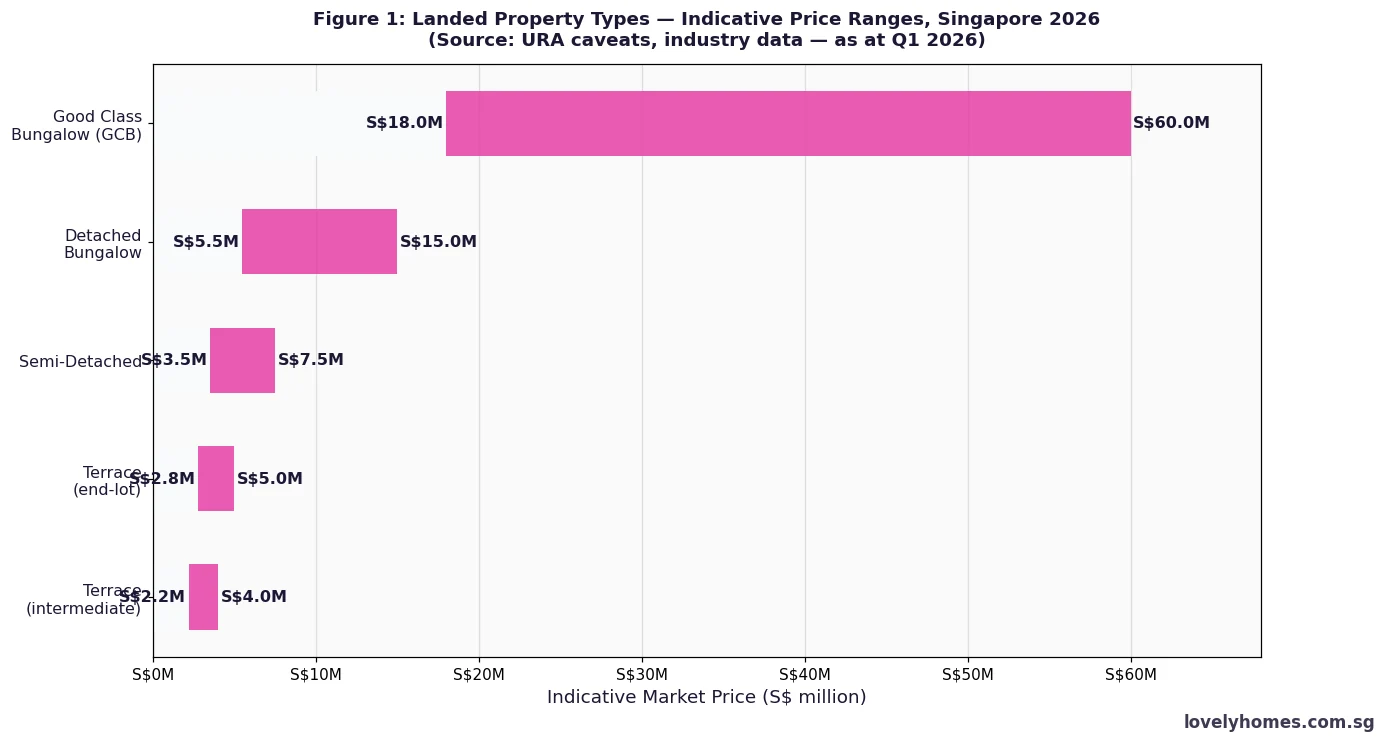
Landed property price ranges Singapore 2026 — terrace, semi-D, bungalow and GCB
Figure 1: Indicative Price Ranges by Landed Property Type, Singapore 2026. Source: URA caveats, industry data — Q1 2026. Ranges reflect the broad market; trophy assets and GCBs in prime districts can exceed the upper end shown.

1. Terrace Houses (Intermediate and End-Lot)

Terrace houses are the most accessible entry point into Singapore’s landed market. An intermediate terrace sits between two other units in a row; an end-lot terrace has one open side and typically commands a 10–20% premium. Standard terraces cover a land area of roughly 150–300 sqm (about 1,600–3,200 sqft). Prices range from approximately S$2.2 million for an older intermediate terrace in a non-prime district to S$5 million or more for a renovated freehold end-lot in a desirable estate like Serangoon Gardens (D19), Frankel Estate (D15), or Joo Chiat (D15).

2. Semi-Detached Houses

A semi-detached house shares one party wall with an adjacent unit; the other three sides are free-standing. Land areas typically range from 250 to 500 sqm. Semi-Ds in prime freehold estates (Bukit Timah D11, Holland Road D10) can fetch S$6–9 million, while newer leasehold developments in the north may trade at S$3.5–5 million.

3. Detached Bungalows

A detached bungalow stands on its own plot with no shared walls. Singapore’s Urban Redevelopment Authority (URA) stipulates minimum plot sizes for new detached dwellings, typically 400 sqm and above. Bungalows range widely: a mid-size freehold bungalow in D21 might list at S$6–8 million, while a trophy bungalow in prime D10 or D11 can exceed S$20 million.

4. Good Class Bungalows (GCBs)

GCBs are the pinnacle of Singapore’s residential hierarchy. Regulated by URA’s Good Class Bungalow Areas planning rules, these properties must sit on plots of at least 1,400 sqm (approximately 15,000 sqft), be capped at two storeys above ground plus one basement, and may not subdivide below the minimum plot size. There are 39 gazetted GCB areas across Singapore — concentrated in districts 10, 11, and 21 — including Nassim Road, Bishopsgate, Dalvey Estate, Swiss Club Road, Ridgewood, Caldecott Hill, and Frankel Estate. GCBs are reserved exclusively for Singapore Citizens; PRs and foreigners are ineligible regardless of wealth or residency track. Prices range from approximately S$18 million to over S$60 million, with the rarest Nassim Road GCBs occasionally transacting at S$3,500–S$5,000 psf of land.

5. Strata-Landed Housing

Strata-landed properties — cluster housing, townhouses, and similar formats that sit within a private condominium development on a strata title — occupy a unique middle ground. They are landed in appearance (each unit has its own ground floor and outdoor space) but are legally classified as strata units within a development, placing them outside the Residential Property Act’s “restricted residential property” regime. This means PRs and foreign nationals may purchase strata-landed homes without CRP or SLA approval (subject to the applicable ABSD). Prices are typically lower than equivalent standalone landed: a cluster terrace in a popular development might list at S$2.5–4 million.

Who Can Buy Landed Property: Eligibility by Buyer Status

Landed property purchase eligibility Singapore 2026 — SC, SPR and foreigner rules
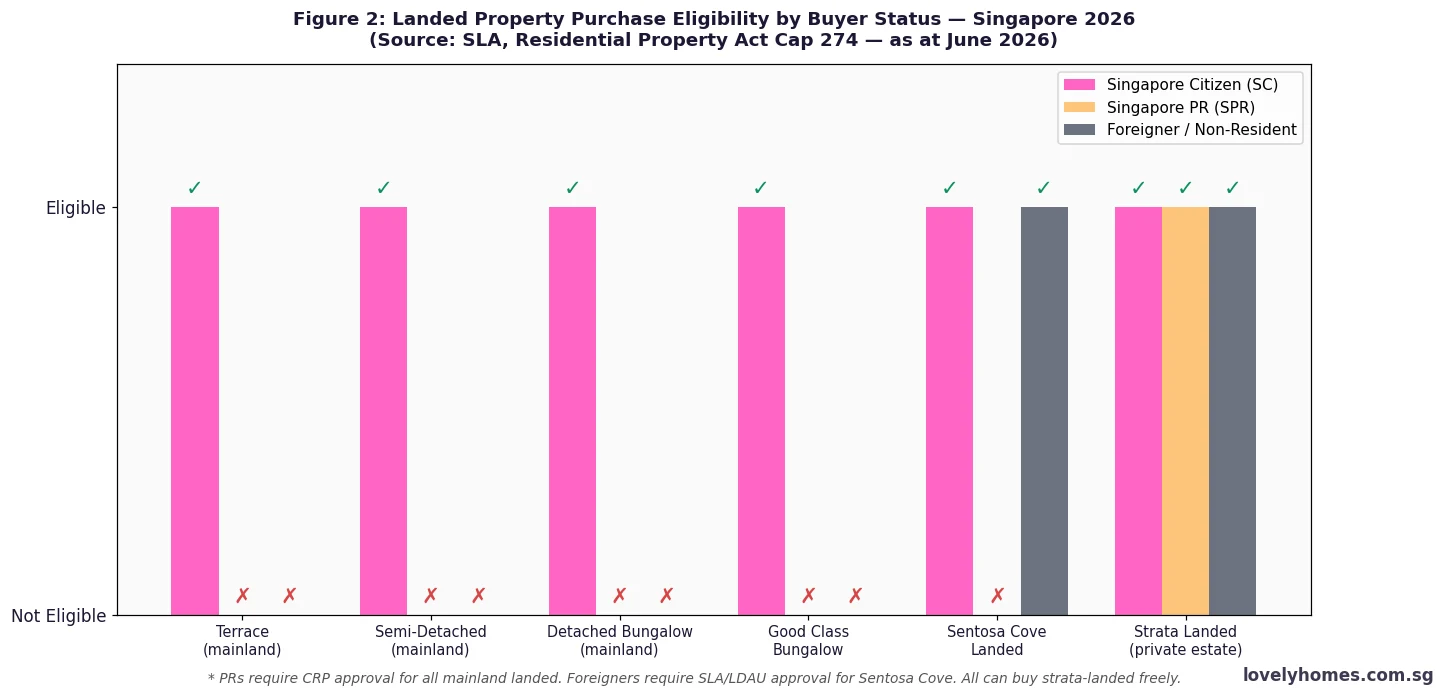
Figure 2: Landed Property Purchase Eligibility by Buyer Status, Singapore 2026. Source: SLA, Residential Property Act (Cap 274). * PRs require CRP approval; foreigners require SLA approval for Sentosa Cove only.

Singapore Citizens (SC): Full Access to All Mainland Landed Types

Singapore Citizens may purchase any landed residential property on the Singapore mainland — terrace, semi-detached, bungalow, or GCB — without any prior approval from the SLA or CRP. The only constraint is financial: stamp duties, financing limits, and the HDB ownership rules discussed below. SC buyers who already own an HDB flat face an important restriction: under HDB rules, a flat owner who acquires a private residential property (including landed) must dispose of the HDB flat within six months of completing the private purchase, unless they qualify for the married-couple ABSD remission scheme and choose to retain the HDB temporarily.

Singapore Permanent Residents (PRs): Approval Required

PRs wishing to purchase mainland landed property must first obtain approval from the Controller of Residential Property (CRP), a statutory position within the SLA established under the Residential Property Act (Cap 274). Applications are assessed individually, with the CRP considering factors such as the length of PR status, economic contributions to Singapore (including taxes paid and businesses run), family ties, and the applicant’s immigration trajectory. There is no guarantee of approval, and processing typically takes several months. If approval is granted, conditions may be attached — for example, a prohibition on subletting the property.

PRs may, however, purchase strata-landed housing freely, without CRP approval, as it falls outside the “restricted residential property” definition. PRs are also ineligible for GCBs even if they obtain CRP approval for other landed types.

Foreign Nationals: Mainland Landed Prohibited

Foreign nationals (including those on Employment Passes, Dependent Passes, Long-Term Visit Passes, or any other Singapore immigration status short of PR or citizenship) may not purchase any mainland landed property in Singapore. This prohibition is absolute under the Residential Property Act and does not vary based on wealth, tenure in Singapore, or the type of visa held. The only exceptions are Sentosa Cove landed properties (purchasable with SLA/LDAU approval, with the 60% ABSD still applying) and strata-landed homes in private estates, which foreigners may purchase freely as private residential property.

Key distinction — strata-landed vs standalone landed: A foreigner or PR looking at a “landed” property must always check the title. If it is a strata title within a condominium development (cluster housing), it is purchasable without SLA/CRP approval. If it is a Torrens title on its own plot of land (standalone terrace, semi-D, bungalow), it is restricted under the Residential Property Act and requires approval for PRs, and is prohibited for foreigners on the mainland entirely.

Stamp Duties on Landed Property: BSD and ABSD

Stamp duty on landed property transactions works identically to other residential purchases — BSD is payable by all buyers, ABSD is layered on depending on buyer status and property count. The key difference is that the transaction values are significantly higher, which means BSD in the 5% and 6% brackets applies to a large portion of the purchase price.

Buying costs landed property Singapore 2026 — BSD and down payment at S$3.5M, S$6M and S$12M
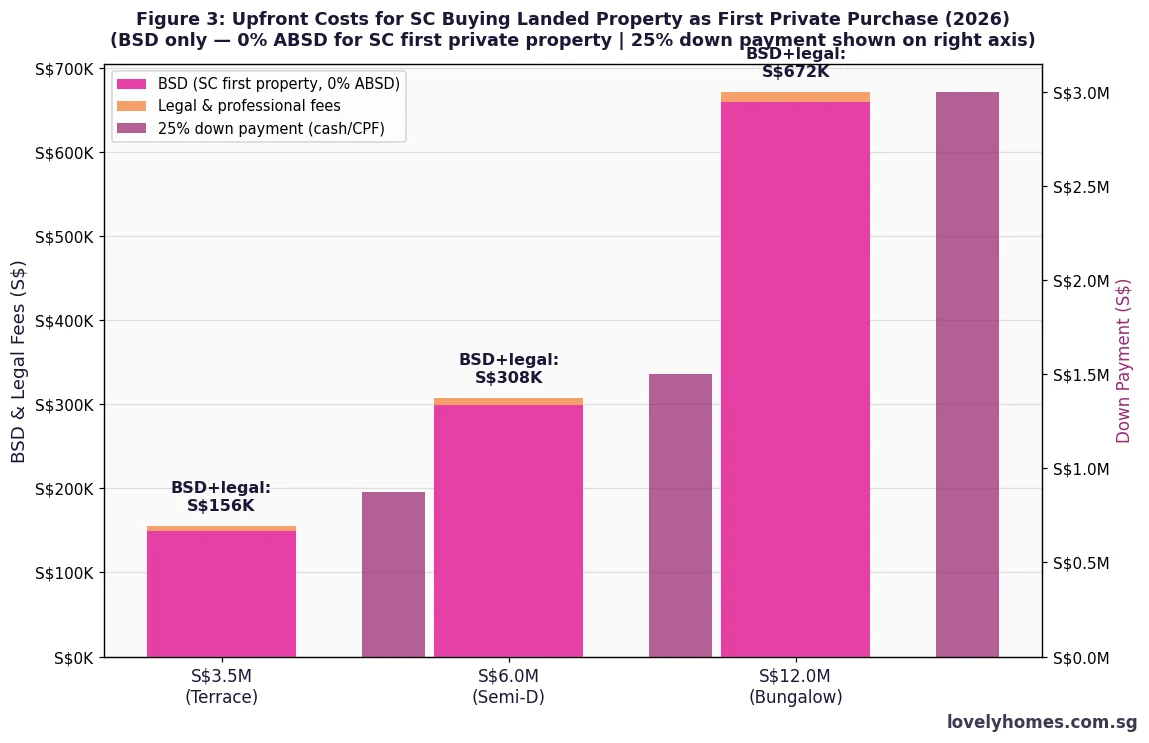
Figure 3: Upfront Costs for SC Buying Landed Property as First Private Purchase (2026). BSD calculated at progressive 1–6% tiers effective 15 February 2023. 0% ABSD assumes SC first private property, HDB sold prior. 25% down payment shown on right axis.

ABSD and Landed Property: Critical Points for Upgraders

Many landed buyers in Singapore are HDB flat owners upgrading to private residential property. For a Singapore Citizen purchasing their first private residential property (having either sold the HDB first, or qualifying under the married-couple remission window), ABSD is 0%. However, a SC who buys landed before selling their existing HDB or private property must pay 20% ABSD upfront on the second property and may apply for a remission of this ABSD if the first property (HDB or private) is sold within six months of the second purchase’s completion date. This remission applies to married SC couples only; single buyers are not eligible.

PRs buying their first private residential property (including landed with CRP approval) pay 5% ABSD. A second PR purchase attracts 30% ABSD. Foreigners buying strata-landed or Sentosa Cove landed pay 60% ABSD.

Financing Landed Property: LTV, TDSR and Practical Considerations

Landed property purchasers in Singapore must use bank financing — there is no HDB concessionary loan option for private residential property. The MAS-regulated parameters are the same as for condominiums: LTV cap of 75% for the first property loan, subject to TDSR of 55% of gross monthly income. For a S$5 million semi-detached property, a 75% LTV loan equals S$3.75 million — carrying a monthly repayment of approximately S$15,800 at 3.0% over 30 years, requiring a household income of at least S$28,700/month to pass TDSR (with no other debts). This reflects the buyer demographic typical of the Singapore landed market.

One practical consideration specific to landed property transactions is the use of CPF. While SC buyers may use CPF Ordinary Account savings for the down payment and monthly loan instalments on private property (subject to the Valuation Limit and Withdrawal Limit rules), the higher absolute values involved mean that CPF often covers only a fraction of the total cost. Most landed buyers also deploy significant savings or proceeds from prior property sales.

Property Tax on Landed Homes

Property tax is levied annually by IRAS on the Annual Value (AV) of a property — the estimated gross annual rent it could command in the open market. AV for landed homes depends on the property type, size, location, and condition. A terrace in Serangoon Gardens might carry an AV of S$60,000–80,000; a Nassim Road bungalow might have an AV of S$200,000 or more.

Owner-occupied residential property tax rates (revised upward from 1 January 2024) are progressive:

Annual Value (AV) Owner-Occupied Rate Non-Owner-Occupied Rate
First S$8,000 0% 10%
S$8,001–S$30,000 4% 12%
S$30,001–S$40,000 6% 14%
S$40,001–S$55,000 10% 16%
S$55,001–S$70,000 14% 18%
S$70,001–S$85,000 18% 20%
S$85,001–S$100,000 22% 22%
Above S$100,000 32% 36%

For an owner-occupied terrace with an AV of S$72,000, annual property tax would be approximately S$8,160. A non-owner-occupied landed home (i.e., one that is tenanted or vacant) is taxed at the higher non-owner-occupied rate, which could result in an annual property tax bill of S$11,400 or more on the same AV.

Summary: Key Rules for Buying Landed Property in Singapore 2026

Parameter Singapore Citizen Singapore PR Foreigner
Terrace / Semi-D / Bungalow (mainland) ✓ Free to buy CRP approval needed ✗ Prohibited
Good Class Bungalow (GCB) ✓ Free to buy ✗ Ineligible ✗ Prohibited
Strata-landed (cluster housing) ✓ Free to buy ✓ Free to buy ✓ Free to buy
Sentosa Cove landed ✓ Free to buy ✓ Free to buy SLA/LDAU approval needed
ABSD (first private property) 0% 5% 60%
BSD Progressive 1–6% Progressive 1–6% Progressive 1–6%
SSD (if sold within 3 years) 12%/8%/4% 12%/8%/4% 12%/8%/4%
LTV cap (first property loan) 75% 75% 75% (bank only)
Minimum cash down payment 5% cash + CPF 5% cash + CPF 5% cash only (no CPF)
HDB ownership: must dispose Within 6 months of private purchase Within 6 months N/A (no HDB ownership)

Worked Example: Mr & Mrs Tan (Singapore Citizens) — Upgrading to a Serangoon Gardens Terrace at S$4,200,000

Profile: Mr Tan (46) and Mrs Tan (42), both Singapore Citizens, joint gross income S$28,000/month. They currently own a Tampines HDB 5-room flat that they sell for S$950,000. After repaying the outstanding HDB loan (S$150,000) and refunding CPF accrued interest (S$220,000 principal + S$32,000 interest = S$252,000), they net approximately S$548,000 in cash proceeds. They have additional savings of S$550,000. Combined liquid assets: S$1,098,000.

Step 1 — BSD calculation on S$4,200,000:

  • 1% × S$180,000 = S$1,800
  • 2% × S$180,000 = S$3,600
  • 3% × S$640,000 = S$19,200
  • 4% × S$500,000 = S$20,000
  • 5% × S$1,500,000 (S$1.5M–S$3.0M) = S$75,000
  • 6% × S$1,200,000 (S$3.0M–S$4.2M) = S$72,000
  • Total BSD = S$191,600

Step 2 — ABSD: The Tans sell their HDB before exercising the OTP on the terrace, so this is their first private residential purchase — ABSD = 0%.

Step 3 — Bank loan and TDSR:

  • LTV 75%: loan = S$4,200,000 × 75% = S$3,150,000
  • At 3.0% p.a. over 30 years: monthly instalment ≈ S$13,280
  • TDSR = S$13,280 ÷ S$28,000 = 47.4% — PASS (below 55% threshold)
  • Stressed at 4.0%: S$15,037/month ÷ S$28,000 = 53.7% — borderline; lender may require 25-year tenure instead

Step 4 — Cash outlay summary:

Item Amount (S$) Funding Source
25% down payment (incl. 5% cash minimum) S$1,050,000 5% cash S$210k + CPF S$420k + cash S$420k
BSD S$191,600 CPF OA (if sufficient) / cash
Legal fees (conveyancing + bank) S$7,500 Cash
Property valuation fee S$800 Cash
Total upfront (excl. ABSD) S$1,249,900 Cash available: S$1,098,000 + CPF used

CPF OA balance (combined) assumed at S$380,000 — covers BSD and part of down payment. The Tans’ total cash and CPF resources of approximately S$1,478,000 comfortably cover the S$1,249,900 needed, leaving a liquidity buffer of approximately S$228,100 plus ongoing CPF contributions. Monthly instalment S$13,280 at 3.0%/30yr.

Why Landed Property Holds a Special Place in Singapore’s Wealth Architecture

Singapore’s land constraints are structural and permanent. The Government has stated that no new landed residential land will be released through the Government Land Sales programme — landed supply growth comes only from existing plots being redeveloped or amalgamated. This fixed supply, combined with relentless demand from Singapore’s growing population of high-net-worth Citizens, underpins the asset’s long-run outperformance. Industry data suggests that freehold landed property has appreciated at approximately 5–7% per annum over two decades in prime districts, with GCBs in particular serving as wealth-preservation vehicles for Singapore’s wealthiest families.

Unlike condominiums, landed homes generate no management fee or sinking fund contributions (for standalone properties), offer true ground-floor living, and permit significant customisation through rebuilding or A&A (additions and alterations) works subject to URA guidelines. The combination of scarcity, control, and customisation makes landed property a distinct asset class rather than simply “a more expensive condo”.

What Might Come Next for Landed Property Policy?

This section represents editorial analysis and should not form the basis of any investment decision. The core restrictions on PR and foreign purchases of mainland landed property have been in place since the Residential Property Act’s enactment in 1976 and are unlikely to change materially. There has been no policy signal of any relaxation. The GCB rules in particular — which restrict purchases to SCs only — reflect a deliberate policy to preserve the nation’s most prestigious residential stock for citizens.

Looking further ahead, some observers speculate that as Singapore’s population of long-tenured, economically integrated PRs grows, there may be gradual liberalisation of the CRP approval process for PR buyers in the mid-tier landed market. Others have suggested that the Government could use landed property supply to reward exceptional talent (through a fast-tracked CRP approval linked to an enhanced-tier talent scheme). For now, however, the policy stance is unchanged: landed ownership on the Singapore mainland remains principally a citizen prerogative.

Frequently Asked Questions

Can a Singapore PR apply to buy a landed property on their own?

Yes — a Singapore Permanent Resident may apply to the Controller of Residential Property (CRP) at the Singapore Land Authority (SLA) for approval to purchase mainland landed residential property. The application is assessed individually. Key factors include the applicant’s length of PR status, economic contribution to Singapore (employment, taxes paid, business ownership), family ties to Singapore Citizens, and whether the applicant has applied for or is eligible to apply for citizenship. There is no published approval rate, and decisions are at the CRP’s discretion. PRs who are granted approval may purchase terrace houses, semi-detached houses, and detached bungalows, but not Good Class Bungalows (which are restricted to SCs only). The CRP approval does not reduce or waive the applicable ABSD — a PR buying a first private property still pays 5% ABSD.

What is the minimum plot size for a Good Class Bungalow?

A Good Class Bungalow (GCB) must sit on a plot of at least 1,400 sqm (approximately 15,069 sqft), as stipulated in URA’s Good Class Bungalow Areas planning rules. The building envelope is limited to two storeys above ground plus one basement storey. GCBs may not be subdivided below this minimum plot size, and amalgamation (combining two or more plots) is permitted only if the resulting plot meets the minimum size requirement. The 39 gazetted GCB areas are concentrated primarily in Districts 10, 11, and 21, with pockets in Districts 15 and 16. Any redevelopment or rebuilding on a GCB plot requires BCA and URA approval and must comply with the GCB planning parameters. Singapore Citizens wishing to purchase a GCB do not need any special government approval beyond the standard conveyancing process.

Can an SC who owns an HDB flat buy a landed property without selling the HDB first?

Yes, but with significant stamp duty consequences. A Singapore Citizen who owns an HDB flat and purchases a private residential property (including landed) without first selling the HDB will pay 20% ABSD on the private property. This ABSD is payable within 14 days of the OTP exercise. However, if the HDB flat is sold — and the sale is completed — within six months of the private purchase’s completion date, the SC (or married SC couple) may apply to IRAS for a remission of the 20% ABSD. This is the “married couple ABSD remission” scheme under the Stamp Duties Act. Note: the remission requires the couple to be lawfully married, and both spouses must be Singapore Citizens to qualify. Single SCs are not eligible for this remission and must sell their HDB first to avoid ABSD.

What are the typical costs to rebuild a landed property in Singapore?

Rebuilding a landed property in Singapore — demolishing the existing structure and constructing a new home — typically costs between S$2.5 million and S$5 million or more depending on the plot size, the architectural specification, the quality of finishes, and the contractor selected. Rebuilding a standard two-storey terrace on a 200 sqm plot might cost S$1.5–2.5 million for a mid-range build (around S$500–900 psf of built-up area). A GCB rebuild to a high specification can cost S$5–15 million. Before any demolition or reconstruction, the owner must obtain Planning Permission from URA and a Building Plan approval from BCA. Typically the entire process from appointment of an architect to receipt of a Temporary Occupation Permit (TOP) takes 2–4 years. During the rebuild period, the owner must either rent alternative accommodation or — if they have not yet moved in — remain patient.

Are landed property gains subject to capital gains tax in Singapore?

No — Singapore does not impose a general capital gains tax. Gains realised on the sale of landed (or any other) residential property are not taxable under the Income Tax Act, as long as the seller is not considered to be carrying on a trade or business in property. IRAS may assess an individual as a property trader — and therefore liable for income tax on gains — if they demonstrate a pattern of frequent buying and selling with the intention of profit rather than genuine long-term ownership. In practice, IRAS’s scrutiny is most intense for buyers who flip properties shortly after purchase and for those with professional connections to the property industry. For most individual landed property owners who hold their home for several years, there is no capital gains liability on a sale. The Seller’s Stamp Duty (SSD) at 12%/8%/4% for sales within the first three years of ownership is a deterrent to short-term flipping, but this is a stamp duty obligation rather than a capital gains tax.

Can foreigners who become PRs apply for CRP approval immediately?

Technically, an applicant may apply for CRP approval as soon as they are granted PR status. However, in practice the CRP’s assessment places significant weight on the duration of PR status as evidence of genuine long-term residence commitment. A fresh PR applicant applying immediately after receiving their PR is unlikely to succeed unless there are exceptional circumstances. Most approved applicants have held PR status for several years and have additional compelling ties to Singapore. The CRP does not publish a minimum qualifying period, and decisions are made on a case-by-case basis. Would-be PR buyers of landed property are generally advised by solicitors to wait at least three to five years after receiving PR before applying, and to build a strong profile of economic and social contributions to Singapore in the meantime.

What is “strata-landed” property and is it a good substitute for a standalone landed home?

Strata-landed housing — cluster houses, townhouses, and similar formats within a private estate — offers a landed-style living experience (ground-floor access, small garden, no unit above or below) within a condominium’s legal framework. They are generally more affordable than equivalent standalone landed homes, often located in suburban or newer estates, and available to PRs and foreigners without CRP approval. However, strata-landed homes come with condominium management fees (covering common facilities and security), are subject to the strata title’s collective management and by-laws, and may carry restrictions on exterior modifications. The land beneath a strata-landed unit is held collectively, unlike the exclusive freehold or leasehold land title of a standalone landed property. For buyers who prioritise the lifestyle of a landed home but face eligibility constraints (PRs, foreigners) or budget constraints (strata-landed is often S$500k–S$1.5M cheaper than comparable standalone), strata-landed can be an attractive alternative — albeit one that does not carry the same scarcity premium as a true standalone landed property in a prime estate.

Disclaimer: This article is for general informational purposes only and does not constitute legal, financial, or taxation advice. Eligibility rules, stamp duty rates, property tax schedules, and planning regulations are subject to change by the Government at any time. The information reflects the position as at June 2026. Before making any property transaction — particularly one involving the Residential Property Act, ABSD remission applications, or CRP approvals — readers should consult a Singapore-licensed solicitor, MAS-licensed financial adviser, and the relevant authorities: SLA (sla.gov.sg), IRAS (iras.gov.sg), URA (ura.gov.sg), and HDB (hdb.gov.sg). LovelyHomes does not accept liability for any loss arising from reliance on this article.

Singapore Landed Property Buying Guide 2026: Terrace, Semi-D, Bungalow and GCB

Singapore Landed Property Buying Guide 2026: Terrace, Semi-D, Bungalow and GCB

Landed property in Singapore carries a special weight in the local property psyche. A terrace house or bungalow in a good district is simultaneously a home, an heirloom, and one of the most illiquid but historically appreciating assets on the island. Supply is scarce by design — landed residential land accounts for less than 5% of Singapore’s total land area, and the Government strictly regulates who may buy it. Prices range from S$1.6 million for a modest intermediate terrace in an outlying town to S$50 million or beyond for a Good Class Bungalow (GCB) in Districts 10 or 11.

This guide covers the full landscape of landed property buying in Singapore in 2026 — the property types and their legal definitions, who is eligible to buy (including the restrictions under the Residential Property Act), the full stamp-duty and financing picture, the practical transaction process, and the investment considerations that distinguish landed from strata-title property.

Quick Answer — Landed Property Buying in Singapore at a Glance

  • Singapore Citizens (SCs) may buy any landed property. Singapore PRs and foreigners need Singapore Land Authority (SLA) approval under the Residential Property Act 1976 (RPA), and approval is generally restricted to Singapore citizens only for GCBs.
  • Landed property in Singapore comes in six main types: Good Class Bungalow, detached bungalow, semi-detached house, corner terrace (Type I and II), intermediate terrace, and cluster house (strata-title landed).
  • Prices range from approximately S$1.6M (intermediate terrace, outer ring) to S$65M+ (GCB, prime districts).
  • ABSD applies to landed property at standard rates — a Singapore Citizen buying a second landed property pays 20% ABSD. Foreigners pay 60% ABSD and need SLA approval.
  • Gross rental yields for landed property are lower than condominiums (1.9–2.0% for semi-D and bungalow), but capital appreciation over the last five years has been strong (18–22%).
  • The landed property market is highly illiquid — transaction volumes are thin and price discovery can be slow. Buyers should plan for a 3–6 month search and transaction process.
  • BSD for a S$5M landed purchase is approximately S$199,600. For a foreigner buying at S$5M, ABSD adds another S$3,000,000 — making the total stamp duty S$3,199,600 (64.0% of purchase price).
  • Land area, plot ratio, and development baseline rights all need verification before purchase — especially for older properties or those in conservation areas.

Types of Landed Property in Singapore

Singapore’s landed property landscape is legally defined by the Urban Redevelopment Authority (URA) through its development control plans and the Planning Act. The key property types are:

Type Key Characteristics Min. Land Area Typical 2026 Price Range
Good Class Bungalow (GCB) Singapore’s most prestigious landed category. Gazetted GCB areas only (39 areas, mainly D10/D11). SCs only — PRs and foreigners may not purchase even with SLA approval. 1,400 sq m (15,069 sq ft) land S$10M – S$65M+
Detached Bungalow (non-GCB) Single-family detached home outside GCB areas. May be freehold or 999/99-year leasehold. 400 sq m S$5.5M – S$18M
Semi-Detached House Shares one party wall with one neighbour. Often sold in pairs (mirror units). Good balance of space and price. 200 sq m S$3.2M – S$7M
Corner Terrace (Type I / Type II) End-unit in a terrace row; larger plot than intermediate. Type I has a wider frontage; Type II has a smaller side garden. 200 sq m (Type I); 80 sq m (Type II) S$2.2M – S$4.5M
Intermediate Terrace Most affordable landed type. Shares both party walls with neighbours. Typically 1,400–1,800 sq ft built-up. 80 sq m land (approx) S$1.6M – S$3.2M
Cluster House Strata-title landed within a gated development. Governed by BMSMA (like a condo). No individual land title; owner holds a strata lot. Eligible for purchase by SCs and PRs in some cases. Varies by development S$1.8M – S$4M
Singapore landed property types and price ranges 2026 — terrace semi-detached bungalow GCB
Figure 1: Singapore landed property types and approximate price ranges (2026). Source: URA REALIS, EdgeProp, LovelyHomes research.

Who Can Buy Landed Property? The Residential Property Act 1976

The purchase of landed residential property in Singapore is regulated by the Residential Property Act 1976 (RPA), administered by the Singapore Land Authority (SLA). The RPA’s underlying policy is to prioritise landed property ownership for Singapore Citizens, given the scarcity of land.

Buyer Profile GCB Other Landed (non-GCB) Cluster House (Strata)
Singapore Citizen (SC) ✓ Permitted (no approval needed) ✓ Permitted (no approval needed) ✓ Permitted
Singapore PR (SPR) ✗ Not permitted (even with SLA approval) Requires SLA approval under RPA; approval criteria are strict and rarely granted for non-GCB landed to SPRs ✓ Permitted (no SLA approval needed for strata-title cluster houses)
Foreigner (non-PR) ✗ Not permitted Requires SLA approval; approval criteria very strict; Sentosa Cove bungalows are a specific gazetted area where foreigners may apply ✓ Permitted for fully privatised cluster houses (subject to standard ABSD)
Companies / Entities ✗ Not permitted ✗ Not permitted (RPA restricts landed to individuals only) Subject to strata title rules

SLA approval for non-GCB landed property is theoretically available to Singapore PRs and foreigners under Section 25 of the RPA, but in practice approvals are granted rarely and only where the applicant can demonstrate a substantial economic contribution to Singapore (e.g., founding a significant local business, long-term residency, or contribution to arts/sciences). The processing time for an SLA application is typically 4–6 weeks. Engaging a conveyancing lawyer experienced in RPA applications is essential before proceeding.

Sentosa Cove exception: The Sentosa Cove precinct on Sentosa Island was gazetted under the RPA as an area where foreigners may apply to purchase bungalows. Approvals are not guaranteed and standard ABSD (60% for a foreigner) still applies on top of BSD. Sentosa Cove bungalows are 99-year leasehold and carry additional levy and maintenance costs.

Stamp Duties for Landed Property Purchases

BSD and ABSD apply to landed property purchases in exactly the same way as for any other residential property in Singapore. However, given the higher price points of landed property, the absolute BSD and ABSD figures are substantially larger. The BSD schedule for residential property is: 1% on the first S$180,000; 2% on the next S$180,000; 3% on the next S$640,000; 4% on the next S$500,000; 5% on the next S$1,500,000; and 6% on the portion above S$3,000,000.

BSD and ABSD costs for Singapore landed property 2026 — three buyer profiles at three price points
Figure 2: BSD and ABSD costs for Singapore landed property at three price points (S$3M, S$5M, S$8M) and three buyer profiles. Source: IRAS 2026 BSD schedule; ABSD rates effective 27 April 2023.

As the infographic illustrates, ABSD transforms the economics dramatically. For a Singapore Citizen buying a S$5M semi-detached house as a second property, ABSD at 20% adds S$1,000,000 to the stamp duty bill — bringing total stamp duties to S$1,199,600 (24.0% of the purchase price). For a foreigner buying the same property at 60% ABSD, the stamp duty reaches S$3,199,600 — effectively making foreign landed property ownership economically prohibitive except at the very top of the market.

Financing a Landed Property Purchase

Landed property is financed via bank loans, with LTV, TDSR, and loan tenure rules set by MAS. There is no HDB concessionary loan or MSR rule for landed property — only TDSR (55% of gross monthly income) applies to the mortgage servicing requirement. CPF Ordinary Account savings may be used for downpayment and monthly instalments, subject to the Withdrawal Limit (150% of valuation for properties with remaining lease of at least 60 years).

A key financing consideration for landed property is the mortgage stress test. Banks in Singapore will loan only up to 75% LTV on a first property with no existing loans, but landed property valuations — particularly for older homes or those requiring significant rebuilding — can diverge from transaction prices. Where a bank’s valuation comes in below the purchase price, the shortfall must be funded in cash (the “cash over valuation” or COV).

Financing Parameter Applicable Rule
Maximum LTV (no existing loans) 75% of purchase price or valuation (lower of the two)
Minimum cash downpayment 5% of purchase price in cash (cannot use CPF)
TDSR All monthly debt obligations ≤ 55% of gross monthly income
MSR Not applicable to landed property (MSR is HDB/EC-specific)
Maximum loan tenure 30 years for residential properties (capped so loan matures before borrower turns 65)
CPF Ordinary Account May be used for remaining 20% downpayment and monthly instalments, subject to Withdrawal Limit (150% of valuation)
Stamp duty financing BSD and ABSD cannot be funded by bank loans — must be paid in cash (or CPF OA after stamping)

Worked Example: Mr and Mrs Wong Buying a Semi-Detached House

Mr and Mrs Wong are Singapore Citizens, both aged 45. They have sold their Toa Payoh condominium and wish to purchase a semi-detached house in Serangoon Gardens (District 19) at S$4,200,000. This would be their first landed property and their only property after selling the condo.

Item Amount Notes
Purchase price S$4,200,000 Semi-detached house, District 19, freehold
ABSD S$0 First property after selling condo — no existing property at date of OTP
BSD S$158,600 1%×180k + 2%×180k + 3%×640k + 4%×500k + 5%×1,500k + 6%×1,200k = S$1,800 + S$3,600 + S$19,200 + S$20,000 + S$75,000 + S$72,000 = S$191,600. Wait — recalculate: S$1,800+S$3,600+S$19,200+S$20,000+S$75,000 = S$119,600 to S$3M; 6% × S$1.2M = S$72,000; total S$191,600
BSD (correct) S$191,600 On S$4.2M: progressive calculation per IRAS schedule
Conveyancing fees (buyer) ~S$6,000–S$9,000 Ad valorem legal fee + disbursements for S$4.2M transaction
Bank loan (75% LTV) S$3,150,000 75% of S$4.2M
Cash downpayment (5%) S$210,000 Minimum cash; must be paid in cash
CPF OA (remaining 20%) S$840,000 If CPF OA balance is sufficient; Withdrawal Limit applies (150% of valuation = S$6.3M — sufficient headroom)
Monthly mortgage (25 yrs @ 3.5%) ~S$15,765/mth TDSR: if combined income is S$40,000/mth, TDSR = 39.4% — within 55%
Total upfront cash required ~S$401,600 BSD S$191,600 + cash downpayment S$210,000 (conveyancing fees funded from CPF/cash)

This example shows that even a relatively straightforward landed purchase — with no ABSD because the Wongs are first-time buyers after selling their condo — requires significant upfront cash. The BSD alone of S$191,600 represents 4.6% of the purchase price. Buyers considering landed property must ensure they have not only the downpayment and stamp duties available in liquid form, but also an emergency fund given the ongoing maintenance and renovation costs that landed homes typically require.

Landed Property as an Investment: Yield, Capital Growth, and Liquidity

Landed property in Singapore is widely regarded as a store of wealth rather than a yield-generating asset. Gross rental yields for detached and semi-detached properties are typically 1.9–2.0%, well below the 3–4% achievable on OCR condominiums and the 4–5% available on HDB flats. However, the capital appreciation case has historically been compelling.

Singapore landed property vs condo vs HDB rental yield and capital growth 2021 to 2026
Figure 3: Landed property vs private condominium vs HDB resale — gross rental yield and 5-year capital growth (2021–2026). Source: URA PPI, HDB, LovelyHomes research.

Over the five years to 2026, landed residential property in Singapore has appreciated approximately 18–22% on a PSF basis, slightly below OCR condominiums (+19.5%) but ahead of RCR condominiums (+14%) on a capital growth percentage basis. The URA Private Residential Property Price Index (PPI) for landed property, which rose sharply in 2021–2022 and softened slightly in 2023, resumed growth in 2024–2025. The Q1 2026 URA flash estimate showed landed property prices declining a modest 0.4% quarter-on-quarter — a brief softening after five years of strong appreciation — while the non-landed segment rose 0.9%.

Key structural drivers that support landed property values over the long term include: absolute supply constraint (landed residential zoning cannot be easily converted to other uses); freehold or long-leasehold tenure for many prime properties (GCBs are predominantly freehold); and the premium that Singaporean families place on land ownership and the ability to rebuild or add on extension structures. These factors make the asset class resilient to short-term market cycles.

The Landed Property Transaction Process — Key Steps

The legal mechanics of buying a landed property follow the same OTP-SPA framework as any private property purchase, with one additional step for PRs and foreigners: the SLA approval application must be obtained before the OTP is exercised. The full process:

  1. Identify and inspect the property. For landed homes, physical inspection is particularly important — check structural condition, drainage, boundary walls, and any URA permission for existing structures (e.g., attic rooms, outbuildings).
  2. Verify title and planning conditions. Your lawyer will search the SLA land register to confirm ownership, encumbrances, caveats, and any deed restrictions. A URA enquiry confirms the plot ratio, development baseline, and any conservation status.
  3. SLA RPA application (for PRs/foreigners only). Apply to the SLA’s Land Dealings Approval Unit (LDAU) via the Integrated Land Information Service (INLIS) portal. Allow 4–6 weeks. Proceed to OTP only after approval is received.
  4. Option to Purchase (OTP) granted. Standard 14-day exercise period. For landed property, a lawyer should review the OTP before payment of the option fee.
  5. Exercise OTP and pay stamp duties. BSD (and ABSD if applicable) within 14 days of exercising the OTP.
  6. Completion (10–12 weeks from OTP exercise). Title transferred; funds released; keys received.

What Might Come Next: Landed Property Policy Outlook

The Government has historically used the ABSD framework as its primary tool for managing landed property demand, particularly from foreign buyers. The April 2023 ABSD increase to 60% for foreigners was a decisive statement on this front. Going forward, it is speculative to predict whether further cooling measures will target the landed segment specifically, but the structural dynamics — limited supply, strong SC demand at the mid-to-high end, and near-zero foreign demand given 60% ABSD — suggest landed prices are driven primarily by domestic wealth accumulation and generational property transfer rather than by investment flows.

One policy area to watch is the development baseline rules for older landed areas. The URA periodically reviews Development Charge tables and floor area allowances for landed sites, which can affect the rebuilding potential of a property. Buyers of older landed homes should check the prevailing Gross Plot Ratio (GPR) and whether the existing built-up area is compliant with current rules before proceeding.

Landed Property Buying — Key Facts at a Glance

Parameter Rule / Typical Figure (2026)
SCs eligible? Yes — any landed type, no approval needed
PRs eligible? Non-GCB only, SLA approval required; rarely granted
Foreigners eligible? SLA approval required; Sentosa Cove bungalows only in practice; 60% ABSD applies
GCBs to foreigners/PRs? Not permitted under any circumstances
Cluster houses (strata-title) No RPA restriction; purchased like condominiums; standard ABSD applies
HDB concessionary loan? Not available — bank loan only
MSR applicable? No — TDSR (55%) applies only
Max LTV (no existing loans) 75% of purchase price / valuation (lower)
BSD on S$3M landed S$99,600
BSD on S$5M landed S$199,600
BSD on S$8M landed S$349,600
ABSD (SC 2nd property) 20% of full purchase price
Gross rental yield (terrace) ~2.0% per annum
5-yr capital growth (terrace) ~18–22% (2021–2026, URA PPI basis)

Related Articles

Frequently Asked Questions

Can a Singapore PR buy a terrace house in Singapore?

Technically yes, but only with SLA approval under the Residential Property Act, and such approvals are rarely granted to permanent residents for non-GCB landed property. A Singapore PR’s most practical route into the landed segment is to purchase a strata-title cluster house, which is treated as a condominium under the law and does not require RPA approval. GCBs are completely off-limits to PRs and foreigners regardless of SLA application.

Is freehold or leasehold better for landed property?

Most prime landed property in Singapore is freehold or 999-year leasehold (which is effectively freehold for all practical purposes). For GCBs, near-all are freehold. For intermediate and corner terraces in outlying towns, 99-year leasehold is common. The freehold premium for landed property is more pronounced than for condominiums — partly because landed homes are frequently passed down through generations and partly because CPF usage is restricted for properties with less than 60 years remaining lease. Buyers of leasehold landed homes should model the lease-decay trajectory carefully, particularly for properties with less than 70 years remaining.

Can I rebuild a landed property after purchasing it?

Yes, subject to URA planning permission and development control guidelines. The key parameters are the Gross Plot Ratio (GPR), maximum building height, setback requirements, and the development baseline for the specific landed housing zone. Most landed homes are in zones with a GPR of 1.4 (allowing a built-up area of 1.4 times the land area) and a height limit of two or three storeys. Before purchase, commission a feasibility study with an architect if you intend to rebuild — particularly for older properties where the existing built-up area may exceed current allowances (grandfathered as existing non-conforming development).

Does ABSD apply when I inherit a landed property?

No. Property acquired by inheritance is not a purchase and does not attract ABSD. However, the inherited property does count toward your property count for future purchases. If you subsequently buy another residential property, the inherited landed home is counted as an existing property when calculating your ABSD liability. BSD also does not apply to inherited property as there is no consideration paid.

What is a Good Class Bungalow and can anyone buy one?

A Good Class Bungalow is a gazetted category of landed property in Singapore, defined by URA as a detached house within one of 39 designated GCB areas (mainly Districts 10 and 11), with a minimum land area of 1,400 sq m (approximately 15,069 sq ft). Only Singapore Citizens may own a GCB — PRs and foreigners may not purchase a GCB under any circumstances, even with SLA approval. GCBs are predominantly freehold, single-storey to three-storey in height, and represent the pinnacle of Singapore residential property. Transaction volumes are thin — typically 30–60 transactions per year island-wide — and prices start at around S$10M, reaching S$65M or more for prime locations in Nassim Road, White House Road, or Dalvey Road areas.

How do I find out the development potential of a landed property before buying?

Submit a planning enquiry to URA via their online Development Control enquiry system before committing to any purchase. The enquiry will confirm the zoning (residential/landed housing zone), plot ratio allowance, height controls, and any conservation designation. Your conveyancing lawyer can also commission government requisitions to URA, LTA (for road-line setbacks), PUB (drainage reserves), and NEA (environmental restrictions). For properties you intend to redevelop, engage a licensed architect or Qualified Person (QP) for a preliminary feasibility assessment — this can often be done within 2–3 weeks and gives you the development ceiling before you commit to the purchase price.


Disclaimer: This article is for general information and educational purposes only. It does not constitute legal, financial, property, or architectural advice. Landed property eligibility under the Residential Property Act, stamp duty rates, CPF rules, and URA planning controls are subject to change. Always verify the current position with the Singapore Land Authority, Urban Redevelopment Authority, IRAS, and CPF Board, and consult a licensed conveyancing lawyer and CEA-registered property agent before making any property decision.

Landed Property Singapore 2026: Types, Who Can Buy, ABSD Rates and Prices

Landed Property Singapore 2026: Types, Who Can Buy, ABSD Rates and Prices

Landed Property Singapore 2026: Types, Who Can Buy, ABSD Rates and Prices

A complete guide to owning the most coveted residential asset class in Singapore — from terrace houses to Good Class Bungalows.

Quick Answer — Key Takeaways

  • Singapore has five categories of landed residential property: terrace houses, semi-detached houses, detached houses (bungalows), Good Class Bungalows (GCBs), and strata landed houses.
  • Only Singapore Citizens (SCs) may purchase landed residential property freely; Permanent Residents (PRs) require approval from the Singapore Land Authority (SLA); foreigners face severe restrictions and very high ABSD of 65%.
  • Good Class Bungalows (minimum 1,400 sqm plot) are exclusively reserved for Singapore Citizens — PRs and foreigners cannot purchase them under any circumstances.
  • ABSD on a 2nd property for an SC is 20%; on a 3rd or subsequent property it is 30%.
  • Landed property prices range from approximately S$2.5M for a modest terrace house in a non-prime area to S$80M+ for a GCB on Nassim, Cluny, or Leedon Road.
  • LTV limits for landed property mirror private condominiums: up to 75% for a first housing loan (subject to TDSR/MSR stress test at 4.0%).
  • Foreigners who receive Ministerial approval under the Residential Property Act to purchase landed property still pay ABSD of 65% and must obtain LDAU (Landed Dwelling Approval Unit) clearance.
  • Strata landed housing (within a development) is not available to foreigners — they are treated the same as non-strata landed under the Residential Property Act.

What Is Landed Property in Singapore?

Landed property refers to residential dwellings where the buyer obtains a share of, or title to, the underlying land parcel — not merely airspace rights as in a strata-titled condominium. It represents the apex of Singapore’s residential market and the most tightly regulated segment under the Residential Property Act (Cap. 274), administered by the Singapore Land Authority (SLA) and the Ministry of National Development (MND).

The distinction between landed and non-landed property carries profound implications for ownership eligibility, stamp duty computation, financing structure, and long-term capital appreciation. Singapore’s famously constrained land supply — the island covers just 733 km² — means landed supply is structurally capped and declines in relative terms as the country’s population grows.

As of May 2026, Singapore has approximately 72,000 landed residential units, representing under 5% of all dwelling units but accounting for a disproportionate share of total residential value. Understanding the rules governing this segment is essential for buyers, upgraders, and investors alike.

Landed property types Singapore 2026 — terrace, semi-detached, detached, GCB, strata landed who can buy
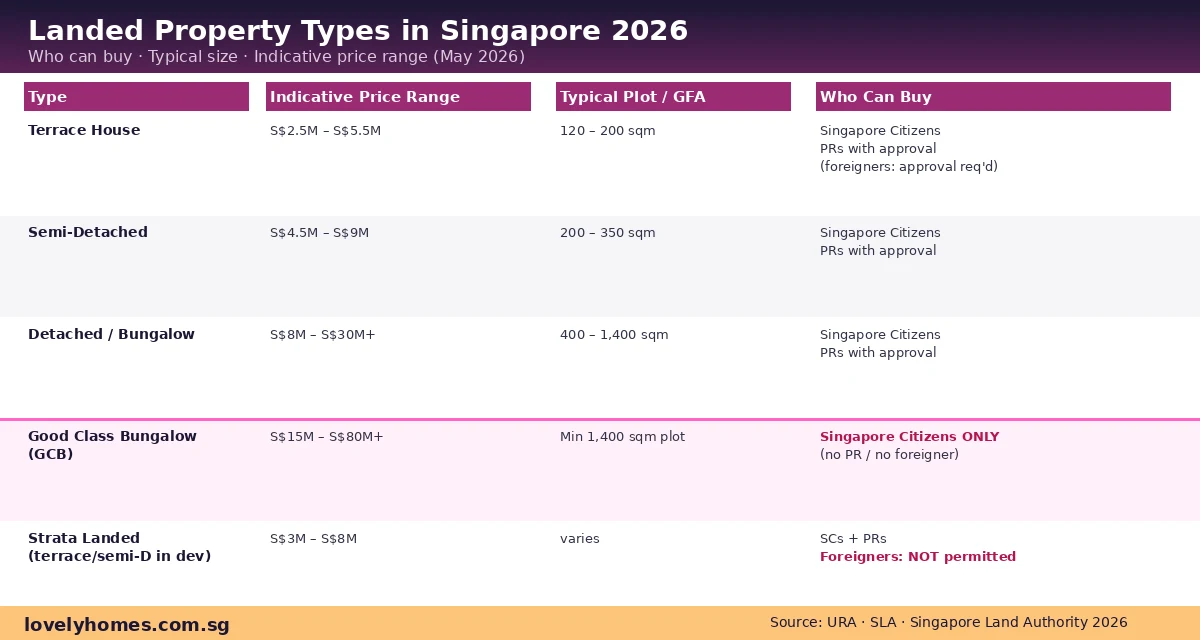
Figure 1: The five categories of landed residential property in Singapore, indicative price ranges, and eligibility by buyer profile (May 2026). GCBs are reserved exclusively for Singapore Citizens.

The Five Categories of Landed Residential Property

The Residential Property Act defines landed property by reference to the underlying physical structure and plot. The five recognised categories differ in minimum land area, typical quantum, and the degree of exclusivity afforded to owners:

1. Terrace House

A terrace house is part of a row of at least three dwellings that share party walls. Intermediary terraces share walls on both sides; end-of-terrace units have one party wall and one free side. Land areas typically range from 120 sqm to 200 sqm for standard terraces, though corner terraces and premium District 10/15 examples can exceed 300 sqm. Indicative market prices in May 2026 range from approximately S$2.5M (non-prime districts such as D22 Boon Lay or D23 Bukit Timah fringe) to S$5.5M (prime districts D9/D10/D11 and heritage enclaves such as Joo Chiat). Terrace houses are available to Singapore Citizens outright, to PRs with SLA approval, and — theoretically — to foreigners with Ministerial approval, though such approvals are exceedingly rare for non-Sentosa Cove properties.

2. Semi-Detached House

A semi-detached house is a pair of houses sharing a single party wall. Each unit sits on its own lot with three free elevations. Plots typically fall between 200 sqm and 400 sqm, and the form factor allows larger homes with enclosed gardens on three sides. Semi-detached prices in May 2026 range from approximately S$4.5M (fringe areas) to S$9M+ (prime D10 addresses). The type is popular with upgrading families who want more space than a terrace but find detached prices prohibitive.

3. Detached House (Bungalow)

A detached house — colloquially a “bungalow” — occupies its own free-standing plot with no shared walls. Standard bungalow plots are 400 sqm and above; “inter-bungalow” plots sit between 400 and 1,399 sqm. Prices range from S$8M for a modest detached in a non-prime district to S$30M+ for a large plot in D10 or D11. At the very top, “super bungalows” on plots approaching GCB minimums trade north of S$50M.

4. Good Class Bungalow (GCB)

GCBs represent the pinnacle of Singapore landed housing. Defined by URA as detached dwellings on plots of at least 1,400 sqm within one of 39 designated GCB areas — including Nassim Road, Cluny Road, Leedon Road, Victoria Park and Bin Tong Park — GCBs are reserved exclusively for Singapore Citizens. Neither PRs nor foreigners may purchase a GCB under any circumstances, and this restriction has no Ministerial-approval override. GCB transactions are low-volume (typically 80–120 per year island-wide) but high-profile: prices in 2026 range from S$15M on the fringe of a GCB estate to S$80M+ for prime plots on Nassim or Cluny. A GCB on Nassim Road transacted at approximately S$4,500 psf of land area in 2024.

5. Strata Landed Housing

Strata landed housing — terrace or semi-detached units within a gated development with shared facilities — sits in a hybrid category. Each unit has its own strata lot and a share in the common property. Unlike conventional landed titles, strata landed units within a residential development do not qualify for purchase by foreigners, even with Ministerial approval. Singapore Citizens and PRs may purchase strata landed units; PRs require SLA approval. Prices typically fall between S$3M and S$8M, depending on district and development quality.

Eligibility Rules and the Residential Property Act

The Residential Property Act (RPA) is the cornerstone legislation governing landed ownership. Its central principle is that Singapore’s limited landed housing stock is preserved primarily for Singapore Citizens:

Property Type Singapore Citizen Permanent Resident Foreigner
Terrace House ✓ Freely permitted SLA approval req’d Ministerial approval (rare)
Semi-Detached ✓ Freely permitted SLA approval req’d Ministerial approval (rare)
Detached / Bungalow ✓ Freely permitted SLA approval req’d Ministerial approval (rare)
Good Class Bungalow ✓ Freely permitted ✗ NOT permitted ✗ NOT permitted
Strata Landed ✓ Freely permitted SLA approval req’d ✗ NOT permitted

SLA Approval for PRs

A PR wishing to purchase a non-strata landed residential property must apply to the SLA’s Land Dealings (Approval) Unit (LDAU). Approval is not automatic — the SLA considers factors including the applicant’s economic contribution to Singapore, length of residency, and the nature of the property. PRs who acquire landed property are generally expected to use it as their primary residence and must satisfy a minimum occupation requirement. The approval process typically takes two to four weeks.

Ministerial Approval for Foreigners

Foreign nationals (and foreign entities) require approval from the Minister for Law under section 25 of the RPA to purchase landed residential property. Such approvals are granted selectively, typically to individuals who have made exceptional economic contributions, are long-term EP holders, or have other strong ties to Singapore. Approval does not exempt the buyer from ABSD — they still pay 65% ABSD on the purchase. In practice, the great majority of foreigners buying residential property in Singapore opt for non-landed condominium units, where no Ministerial approval is required.

ABSD and Stamp Duty on Landed Property

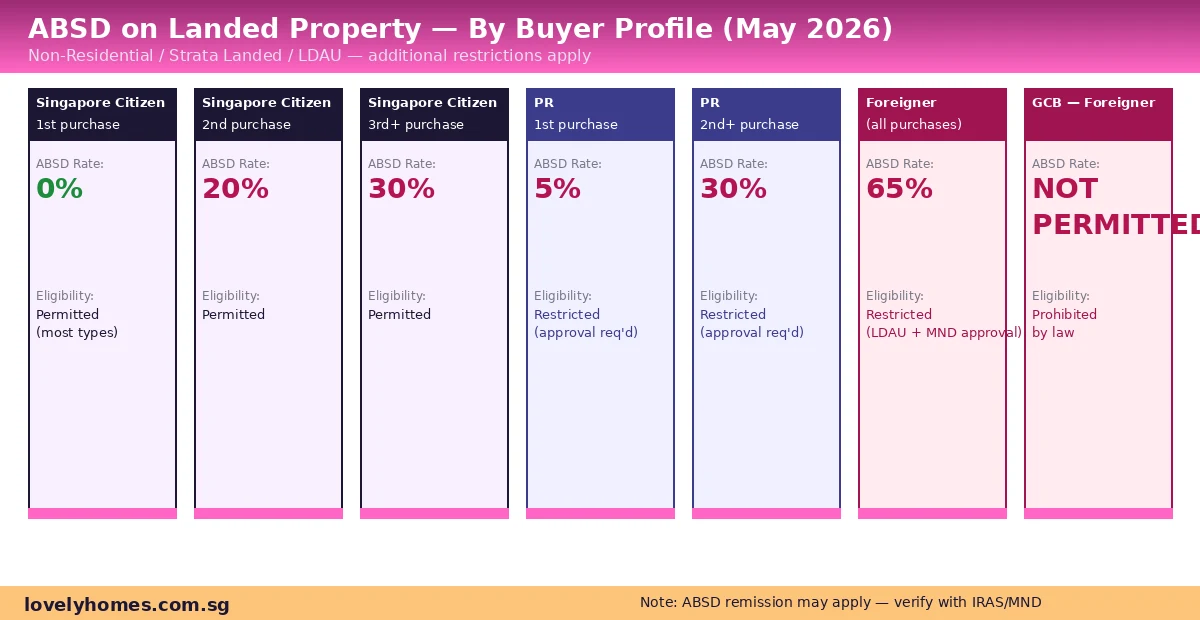
ABSD on landed property Singapore 2026 by buyer profile — SC, PR, foreigner rates
Figure 2: Additional Buyer’s Stamp Duty (ABSD) on landed property by buyer profile as at May 2026. Foreigners face a 65% ABSD rate and must also satisfy the Ministerial approval requirement under the Residential Property Act.

Landed property is subject to the same BSD and ABSD regime as all residential property in Singapore, administered by the Inland Revenue Authority of Singapore (IRAS). There is no special landed rate — ABSD applies at the standard percentage of the purchase price or market value, whichever is higher:

Buyer Profile ABSD Rate Notes
SC — 1st property 0% No ABSD if no other residential property
SC — 2nd property 20% Remission available for married couples in certain cases
SC — 3rd+ property 30% No remission for 3rd and subsequent properties
PR — 1st property 5% Also requires SLA approval for landed
PR — 2nd+ property 30% Applies to all subsequent purchases
Foreigner — any purchase 65% Plus Ministerial approval; GCB not available at any ABSD rate

BSD is computed on the standard tiered schedule (1% on first S$180,000; 2% on next S$180,000; 3% on next S$640,000; 4% on next S$500,000; 5% on next S$1.5M; 6% above S$3M). On a S$5.5M semi-detached purchase, BSD works out to approximately S$219,600.

Financing Landed Property: LTV, TDSR and MSR

Landed properties are financed through bank loans (the HDB Concessionary Loan is not available for private property). The key financing parameters set by the Monetary Authority of Singapore (MAS) are identical to those for private condominiums:

Loan-to-Value (LTV): Maximum 75% of the lower of purchase price or valuation for a borrower with no outstanding housing loans (55% if the loan tenure extends past the borrower’s 65th birthday, or loan tenure exceeds 30 years). LTV drops to 45% for a 2nd housing loan and 35% for a 3rd.

TDSR (Total Debt Servicing Ratio): Monthly loan obligations across all debts must not exceed 55% of gross monthly income, stress-tested at 4.0% per annum as at May 2026. Given the quantum of landed purchases, this is often the binding constraint.

MSR (Mortgage Servicing Ratio): The MSR 30% cap applies only to HDB and Executive Condominium purchases — it does NOT apply to landed property. For landed, only the TDSR 55% cap applies.

Worked Example: Buying a S$5.5M Semi-Detached as a 2nd Property

Worked example Singapore landed property cost breakdown — SC buying S$5.5M semi-detached as 2nd property
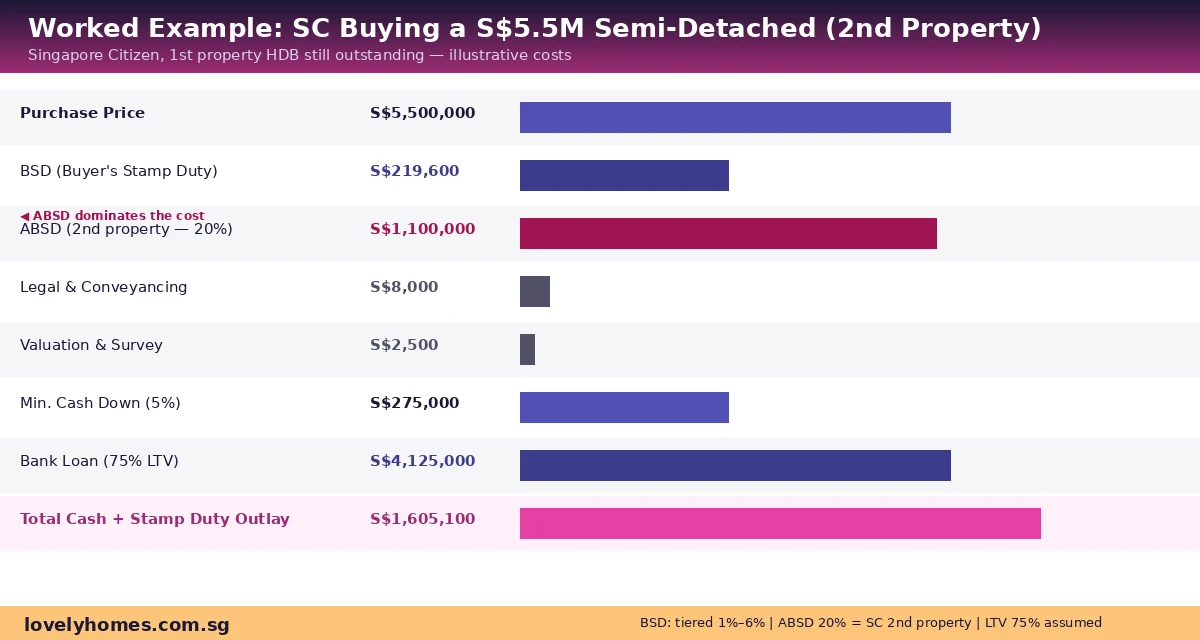
Figure 3: Full cost breakdown for a Singapore Citizen purchasing a S$5.5M semi-detached house as a second residential property (first property is an HDB flat). ABSD of 20% dominates total outlay.

Consider Mr and Mrs Wong, a Singapore Citizen couple aged 44 and 42. They own a 5-room HDB flat in Bishan (current value approximately S$850,000, with an outstanding loan of S$220,000). They wish to upgrade to a semi-detached house in District 20 priced at S$5,500,000. Their combined gross monthly income is S$28,000.

BSD: S$180,000 × 1% + S$180,000 × 2% + S$640,000 × 3% + S$500,000 × 4% + S$1,500,000 × 5% + S$2,500,000 × 6% = S$1,800 + S$3,600 + S$19,200 + S$20,000 + S$75,000 + S$150,000 = S$219,600.

ABSD (20% — SC 2nd property): S$5,500,000 × 20% = S$1,100,000. This is payable in cash within 14 days of signing the S&P agreement (it cannot be paid from CPF).

Minimum 5% cash component: S$5,500,000 × 5% = S$275,000 in cash (the remaining 20% of the 25% down payment may come from CPF).

TDSR check: Maximum monthly instalment at 4.0% stress test, 30-year tenure = 55% × S$28,000 = S$15,400. At 4.0% / 30yr, this supports a loan of approximately S$2.63M — well below the 75% LTV cap of S$4,125,000. They can borrow up to their TDSR-implied S$2.63M, meaning their cash + CPF down payment for the balance = S$5,500,000 − S$2,630,000 = S$2,870,000 (in addition to BSD and ABSD).

Total immediate cash and stamp duty outlay: BSD S$219,600 + ABSD S$1,100,000 + legal ~S$8,000 + valuation ~S$2,500 + minimum cash down S$275,000 = approximately S$1,605,100 in cash, plus up to ~S$1,100,000 from CPF for the remainder of the down payment, depending on CPF OA balances. This is why upgrading from HDB to landed as a second property requires substantial liquid assets — the ABSD alone exceeds S$1M.

Why Landed Property Retains Long-Term Value

Several structural factors support landed property as a long-term store of value in Singapore:

Absolute supply constraint: URA’s land use planning caps landed housing at approximately 5% of total dwelling stock. Unlike condominiums, where GLS sites and en-bloc redevelopment can incrementally increase supply, landed housing supply can only decline as amalgamation, GCB conversions, or redevelopment for higher-density use absorb existing stock.

Citizenship gating: The RPA’s exclusion of foreigners (and strict controls on PRs) insulates landed demand from the sort of speculative foreign capital that drove ABSD escalation in the condominium segment. Landed demand is structurally anchored to the SC population — the wealthiest cohort in Singapore’s citizenry.

Land appreciation dominates: In Singapore’s land-scarce environment, the site value of a landed property — particularly a GCB — tends to appreciate faster than the built structure depreciates. Redevelopment potential (a new house on the same plot) provides a hard floor on valuations.

Rental yield: Landed rental yields in Singapore are low by investment-property standards (typically 2.0%–2.8% gross for terrace and semi-detached houses), reflecting the enormous capital values. Investors in landed property are primarily driven by capital preservation and long-term appreciation, not near-term income returns.

What Might Come Next for Landed Property Rules

Singapore’s landed property framework has been remarkably stable since major revisions in the 1990s and 2000s. In the near term, two factors are worth monitoring. First, the government may tighten ABSD rates further if transaction volumes in the landed segment accelerate — the 2023 ABSD hike to 60% for foreigners and the 2021 hike to 30% for SCs (3rd+ property) suggest a willingness to intervene. Second, any relaxation of PR eligibility for landed purchases — which some advocate as a way to attract high-net-worth immigrants — would represent a significant policy shift and seems unlikely given Singapore’s stated goal of preserving landed stock for citizens.

FAQ — Landed Property Singapore 2026

Can a Singapore Permanent Resident (PR) buy a terrace house in Singapore?

Yes, but not freely. A PR must obtain prior approval from the Singapore Land Authority (SLA) before completing the purchase of any non-strata landed residential property — including terrace houses, semi-detached houses, and detached bungalows. The approval process typically takes 2–4 weeks, and the SLA evaluates factors such as the applicant’s economic contribution, residency duration, and intention to use the property as a primary residence. ABSD applies at 5% for a PR’s first property. PRs cannot purchase Good Class Bungalows (GCBs) under any circumstances.

What makes a property a Good Class Bungalow (GCB)?

A Good Class Bungalow is a detached residential dwelling on a plot of at least 1,400 sqm located within one of 39 designated GCB Areas gazetted by URA. The GCB Areas include prestigious addresses such as Nassim Road, Cluny Road, Dalvey Estate, Leedon Road, Victoria Park and Bin Tong Park. Beyond the minimum plot size, GCBs must comply with strict development controls: maximum plot coverage of 40%, gross plot ratio of 0.4, and a height limit of two storeys plus attic. Only Singapore Citizens may own GCBs — PRs and foreigners are excluded by law with no override mechanism.

Can I use CPF to buy landed property in Singapore?

Yes — CPF Ordinary Account (OA) savings may be used to fund the down payment and monthly mortgage instalments for landed property, subject to the applicable CPF withdrawal limits set by the CPF Board. The Valuation Limit (VL) governs total CPF usage for a given property: once total CPF withdrawn reaches the lower of purchase price or valuation (the VL), further CPF usage is restricted unless the Withdrawal Limit (WL) — typically 120% of the VL — has not yet been reached. However, ABSD cannot be paid from CPF — it must be paid in cash. The 5% minimum cash portion of the down payment must also be in cash, not CPF.

Is there an ABSD remission for married couples buying landed property?

Married couples where at least one spouse is a Singapore Citizen may apply for an ABSD remission under specific conditions: both spouses must be purchasing the property jointly, neither spouse must hold any other residential property at the time of purchase, and both must intend to occupy the property as their primary home. If both conditions are met, the couple can claim a remission that effectively gives them the “first purchase” ABSD rate (0% for SC/SC couple). This remission applies regardless of property type — landed included. However, where one spouse holds an existing property (e.g., an HDB flat), the higher “second property” ABSD rate of 20% typically applies and the remission path involves selling the existing property within a specified period under the transitional remission framework.

What is the difference between freehold and 999-year leasehold for landed property?

Freehold and 999-year leasehold landed properties are treated as economically equivalent for most practical purposes — both pass from one owner to the next with effectively permanent tenure. The premium for freehold over 999-year leasehold is minimal (typically below 5%). However, landed properties on 99-year leasehold tenure — of which there are a small number, typically estate-specific (e.g., some parts of Jalan Sinar Bulan near Sentosa) — are subject to the land value decay described by Bala’s Curve. A 99-year leasehold landed property at 50 years remaining retains roughly 74.7% of its land value relative to freehold, all else being equal. Buyers of 99-year leasehold landed properties should factor this into their long-term cost analysis.

How is property tax calculated for landed property in Singapore?

Property tax on landed residential property in Singapore is levied by the Inland Revenue Authority of Singapore (IRAS) on the Annual Value (AV) of the property — the estimated annual rental income the property would fetch on the open market. For owner-occupiers, the progressive owner-occupier rate scale applies (0% on the first S$8,000 of AV; 4% on the next S$47,000; up to 23% on AV above S$130,000 from 2024 onwards). For non-owner-occupied residential properties (investment holdings, rental properties), the non-owner-occupier rates are significantly higher — 12% on the first S$30,000 of AV, rising to 36% above S$90,000. On a large semi-detached with an AV of S$60,000, the annual property tax bill for a non-owner-occupier could exceed S$12,000.

What happens to landed property rules if I give up my Singapore Citizenship?

If an existing owner of landed residential property ceases to be a Singapore Citizen — for example, by renouncing citizenship or acquiring another nationality — the Residential Property Act imposes an obligation to dispose of the property within a reasonable period. The SLA will typically grant the former citizen a grace period to sell, usually two years, failing which enforcement action can follow. This rule underscores the citizenship-gating principle: Singapore’s landed stock is intended to remain in SC hands. Former citizens who become PRs may apply for SLA approval to retain a landed property, but approval is discretionary.

Related Articles


Disclaimer: This article is for general informational purposes only and does not constitute legal, financial, or tax advice. Landed property transactions in Singapore involve complex eligibility requirements, stamp duty computations, and financing considerations that vary by individual circumstances. Always verify current ABSD and BSD rates with the Inland Revenue Authority of Singapore (IRAS), and consult the Singapore Land Authority (SLA) regarding the Residential Property Act and landed purchase approvals. Seek advice from a qualified Singapore solicitor, licensed financial adviser, and MAS-regulated mortgage broker before entering into any property transaction. Prices referenced are indicative market-level figures based on industry transaction data and do not constitute a valuation.

Translate »