Singapore Property Cooling Measures 2026: Full Buyer Impact Guide

Singapore Property Cooling Measures 2026: Full Buyer Impact Guide

⚡ Quick Answer — Singapore Property Cooling Measures 2026

  • Singapore has five categories of property cooling measures in force in 2026: ABSD (Additional Buyer’s Stamp Duty), SSD (Seller’s Stamp Duty), LTV (Loan-to-Value) limits, TDSR (Total Debt Servicing Ratio) and MSR (Mortgage Servicing Ratio).
  • Singapore Citizens buying their first residential property pay 0% ABSD. Their second property attracts 20% ABSD; their third or subsequent, 30%.
  • Singapore Permanent Residents pay 5% ABSD on their first property and 30% on a second. Foreigners pay a flat 60% ABSD on all residential purchases.
  • TDSR caps total monthly debt obligations at 55% of gross income for all buyers. MSR applies an additional 30% cap specifically to HDB and EC loans.
  • The maximum bank LTV for a first property is 75%, falling to 45% for a second and 35% for a third or subsequent property.
  • ABSD remission is available for married Singapore Citizen upgraders who sell their existing HDB or private property within 6 months of purchasing the replacement unit.

Singapore’s property cooling measures are not a single rule. They are an interlocking system of five distinct policy instruments, each designed to target a different mechanism of demand or speculative risk. Together, they determine how much stamp duty you pay upfront, how much you can borrow, and how much it costs you to sell quickly. Understanding which tool affects which buyer profile is the essential first step in any property decision made in 2026.

This guide does not duplicate the comprehensive ABSD deep-dive or the historical timeline of cooling measure changes since 2009. Instead, it takes a buyer-profile approach: it works through each of the five instruments and then maps their combined effect on five distinct buyer types — the Singapore Citizen first-timer, the SC upgrader, the PR first-timer, the property investor (SC or PR buying a second or third property), and the foreign buyer. For each profile, the analysis includes specific SGD figures, the key constraints that bind most tightly, and the legitimate structural options available within the framework.
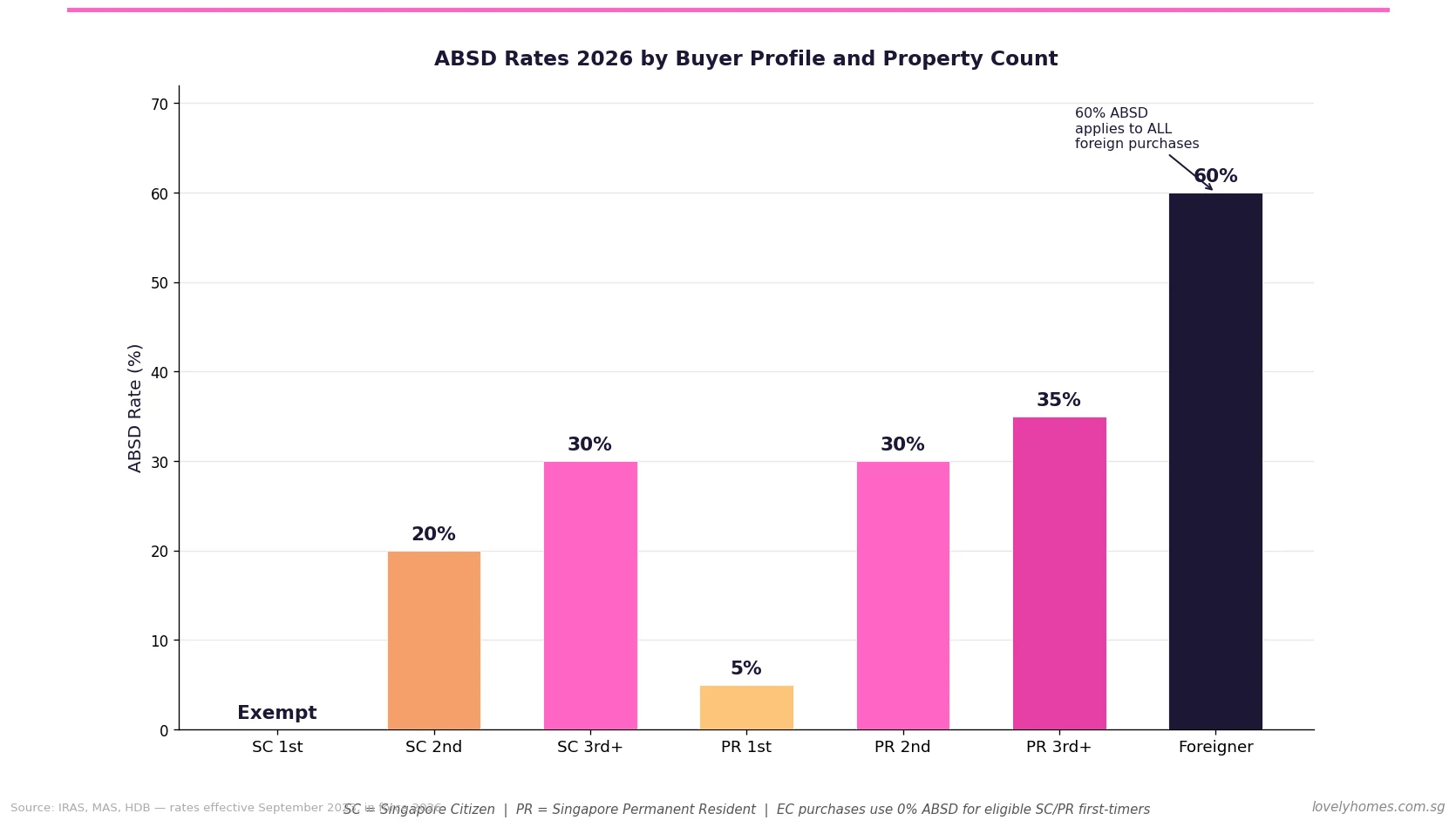
Singapore ABSD rates 2026 bar chart showing rates by buyer profile SC PR foreigner first second third property
Figure 1: Singapore ABSD Rates 2026 by Buyer Profile and Property Count. SC = Singapore Citizen; PR = Singapore Permanent Resident. Rates effective from September 2023 and in force throughout 2026. Source: IRAS.

The Five Cooling Measure Tools

1. Additional Buyer’s Stamp Duty (ABSD)

ABSD is the most visible and most discussed cooling measure. Administered by the Inland Revenue Authority of Singapore (IRAS), ABSD is payable within 14 days of signing the Option to Purchase (OTP) or the Sale and Purchase Agreement, whichever is earlier. It is payable in cash only — CPF Ordinary Account funds cannot be used to pay ABSD.

Rates as of 2026 (unchanged since the September 2023 revision that doubled most rates):

  • Singapore Citizens: 0% (1st property), 20% (2nd), 30% (3rd and subsequent)
  • Singapore PRs: 5% (1st), 30% (2nd), 35% (3rd and subsequent)
  • Foreigners: 60% on all residential purchases
  • Entities (companies, trusts): 65% on all residential purchases
  • ECs (Executive Condominiums): SC and PR first-timer buyers are exempt from ABSD for an EC — the standard EHG grant eligibility conditions apply

ABSD remission for upgraders: A married couple where at least one is a Singapore Citizen may purchase a private residential property while still owning an existing HDB flat or private property, and apply for an upfront ABSD remission (for a HDB upgrader) or a refund of the 20% SC second-property ABSD (for a private upgrader) — provided the existing property is sold within 6 months of the new property’s purchase completion. The remission system is important for the upgrader profile discussed below.

2. Seller’s Stamp Duty (SSD)

SSD is the exit tax — it penalises rapid resale of residential property. Administered by IRAS, SSD applies to all residential property in Singapore (including HDB flats) sold within three years of purchase. The rates are:

  • Sold within 1 year: 12% of the sale price or market value (whichever is higher)
  • Sold within 1–2 years: 8%
  • Sold within 2–3 years: 4%
  • Held for 3 years or more: 0% SSD

SSD affects all buyer profiles equally — it is a function of holding period, not citizenship. For HDB resale flats, the separate Minimum Occupation Period (MOP) of 5 years (or 10 years for Plus and Prime model flats) provides a parallel restriction that prevents resale regardless of SSD status.

3. Loan-to-Value (LTV) Limits

LTV limits, set by the Monetary Authority of Singapore (MAS), cap how much you can borrow relative to the lower of the purchase price or the property’s market valuation. For bank loans, the limits are:

  • 1st residential property: 75% LTV (i.e., minimum 25% cash and/or CPF downpayment)
  • 2nd residential property: 45% LTV
  • 3rd and subsequent: 35% LTV

For HDB concessionary loans (available only to eligible SC buyers for HDB resale and BTO flats), the LTV is 80%, and at least 10% of the purchase price (or the shortfall between valuation and price) must be paid in cash. HDB loans are not available for private property or for buyers who already own a property.

4. Total Debt Servicing Ratio (TDSR)

TDSR, introduced in June 2013 and tightened in December 2021 (from 60% to 55%), caps the proportion of a borrower’s gross monthly income that can go towards servicing all debt obligations — including the new mortgage, car loans, personal loans, credit card balances and any other monthly financial commitments. The limit is 55% for all property loan types.

TDSR stress-testing uses a medium-term interest rate of 4.0%–4.5% for private properties (above the actual loan rate), meaning the TDSR test is more restrictive than a simple monthly payment calculation at today’s rates. This ensures borrowers remain serviceable if interest rates rise.

5. Mortgage Servicing Ratio (MSR)

MSR applies only to loans for HDB flats and Executive Condominiums purchased directly from developers (new ECs). It caps the monthly mortgage payment at 30% of gross monthly income. MSR is a tighter constraint than TDSR for HDB and EC buyers — a buyer who passes the TDSR test at 55% may still fail the MSR test at 30% if the mortgage repayment alone exceeds that threshold.
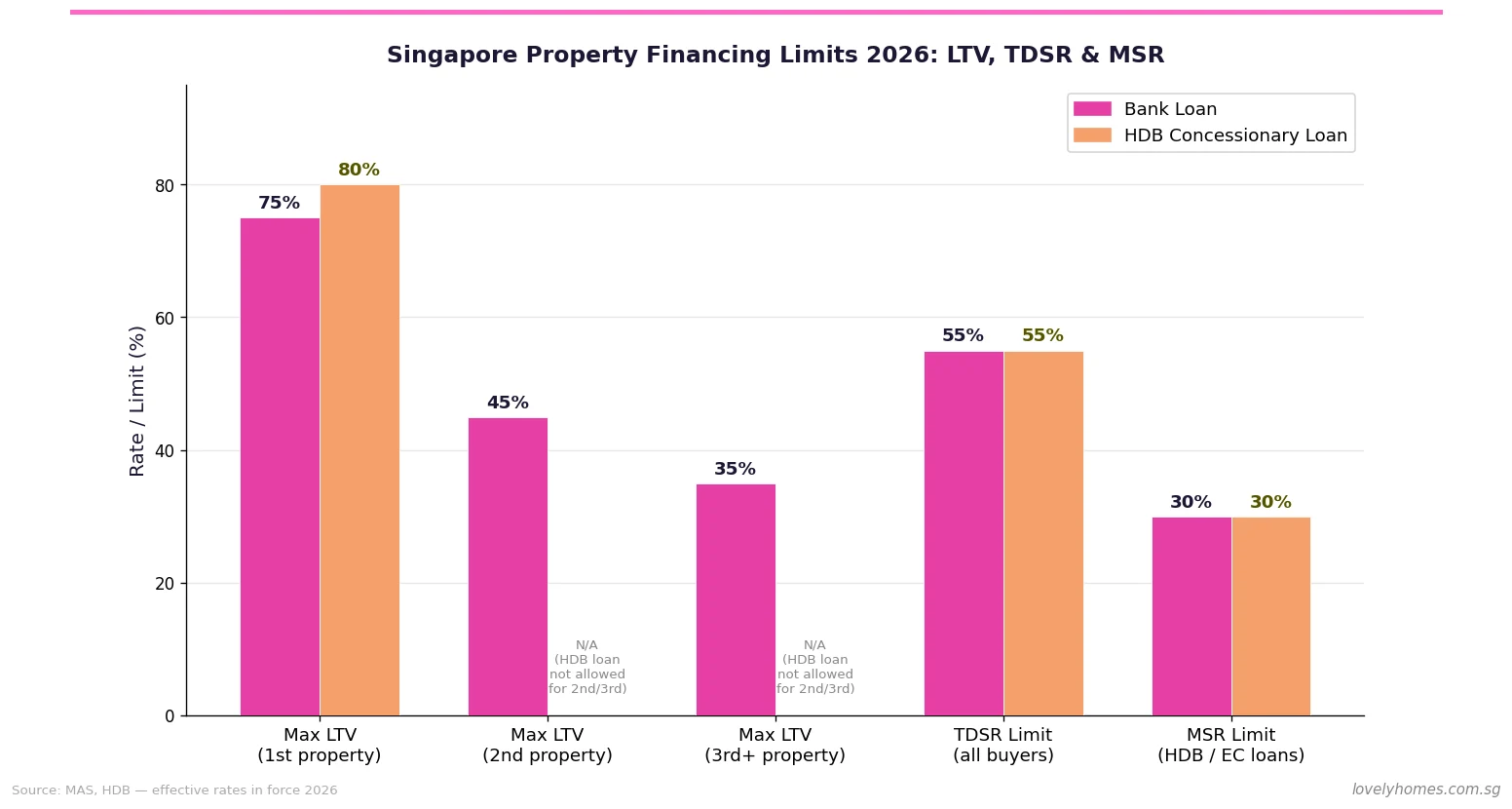
Singapore property financing limits 2026 chart showing LTV TDSR MSR by loan type bank loan vs HDB concessionary loan
Figure 2: Singapore Property Financing Limits 2026 — LTV, TDSR and MSR by Loan Type. Source: MAS, HDB (in force 2026).

Cooling Measures at a Glance — Summary Table

Measure Who It Targets Rate / Limit (2026) Administered By
ABSD Repeat buyers, PRs, foreigners 0% (SC 1st), 20% (SC 2nd), 30% (SC 3rd+), 5% (PR 1st), 30% (PR 2nd), 35% (PR 3rd+), 60% (foreigner) IRAS
SSD All sellers within 3 years 12% (yr 1), 8% (yr 2), 4% (yr 3), 0% (yr 4+) IRAS
LTV (bank loan) All buyers using bank financing 75% (1st), 45% (2nd), 35% (3rd+) MAS
LTV (HDB loan) SC buyers of HDB only 80% (1st HDB only) HDB / MAS
TDSR All property buyers 55% of gross monthly income (stress-tested at 4.0–4.5%) MAS
MSR HDB flat and new EC buyers 30% of gross monthly income MAS / HDB

Worked Example: Four Buyer Profiles Buying the Same S$1.5 Million Condo

To make the impact of cooling measures concrete, consider four buyers each purchasing the same S$1.5 million OCR condominium unit. Buyer’s Stamp Duty on S$1.5 million is fixed at S$44,600 (1% × S$180k + 2% × S$180k + 3% × S$640k + 4% × S$500k). Each buyer then faces a different ABSD liability and different financing constraints.

Profile A — Mr Lim (SC, first-timer, single, age 32, income S$8,000/month):

  • ABSD: 0% — total stamp duty: S$44,600
  • Bank LTV 75% → loan S$1,125,000; downpayment S$375,000 (5% OTP cash + 20% CPF/cash)
  • Monthly repayment (30yr, 3.5%): ~S$5,051; TDSR: 63.1% — FAILS TDSR
  • Extend to 35yr: ~S$4,722; TDSR: 59.0% — still FAILS TDSR
  • Reduce loan by S$100k (larger downpayment, loan S$1,025,000): ~S$4,173/mth, TDSR: 52.2% — PASSES. Or seek a co-borrower.
  • Key binding constraint: income insufficient for S$1.5m solo on S$8k/month — needs top-up of capital or a co-borrower.

Profile B — Mr and Mrs Tan (SC couple upgrading, income S$18,000/month, selling existing HDB):

  • ABSD: 20% (2nd property for SC) = S$300,000 cash upfront; remission applicable if HDB sold within 6 months of OTP completion
  • Total stamp duty without remission: S$344,600; with remission (after HDB sale): effectively S$44,600
  • Bank LTV 75% → loan S$1,125,000; downpayment S$375,000 (partly from HDB sale proceeds)
  • Monthly repayment (30yr, 3.5%): ~S$5,051; TDSR: 28.1% — PASSES TDSR comfortably
  • Key binding constraint: must fund S$300,000 ABSD upfront in cash, then recover via remission after HDB sale. Timing risk if HDB sale is delayed.

Profile C — Ms Wong (PR, first-timer, income S$15,000/month):

  • ABSD: 5% = S$75,000; total stamp duty: S$119,600
  • Bank LTV 75% → loan S$1,125,000; downpayment S$375,000
  • Monthly repayment (30yr, 3.5%): ~S$5,051; TDSR: 33.7% — PASSES TDSR
  • Key binding constraint: S$75,000 ABSD in cash on top of downpayment. No CPF usage for ABSD. Enough liquidity is the main hurdle.

Profile D — Mr Schneider (German national, income S$30,000/month, cash-rich investor):

  • ABSD: 60% = S$900,000; total stamp duty: S$944,600
  • Effective purchase cost: S$2,444,600 on a S$1.5 million unit
  • At S$5,000/month rental yield (3.8% gross on S$1.5m): net yield after ABSD amortised over 10yr hold ≈ 1.2% per annum — economically unviable as a pure investment
  • Key binding constraint: 60% ABSD makes residential property ownership economically irrational for most foreigners unless purely for owner-occupation or very long-term capital preservation.
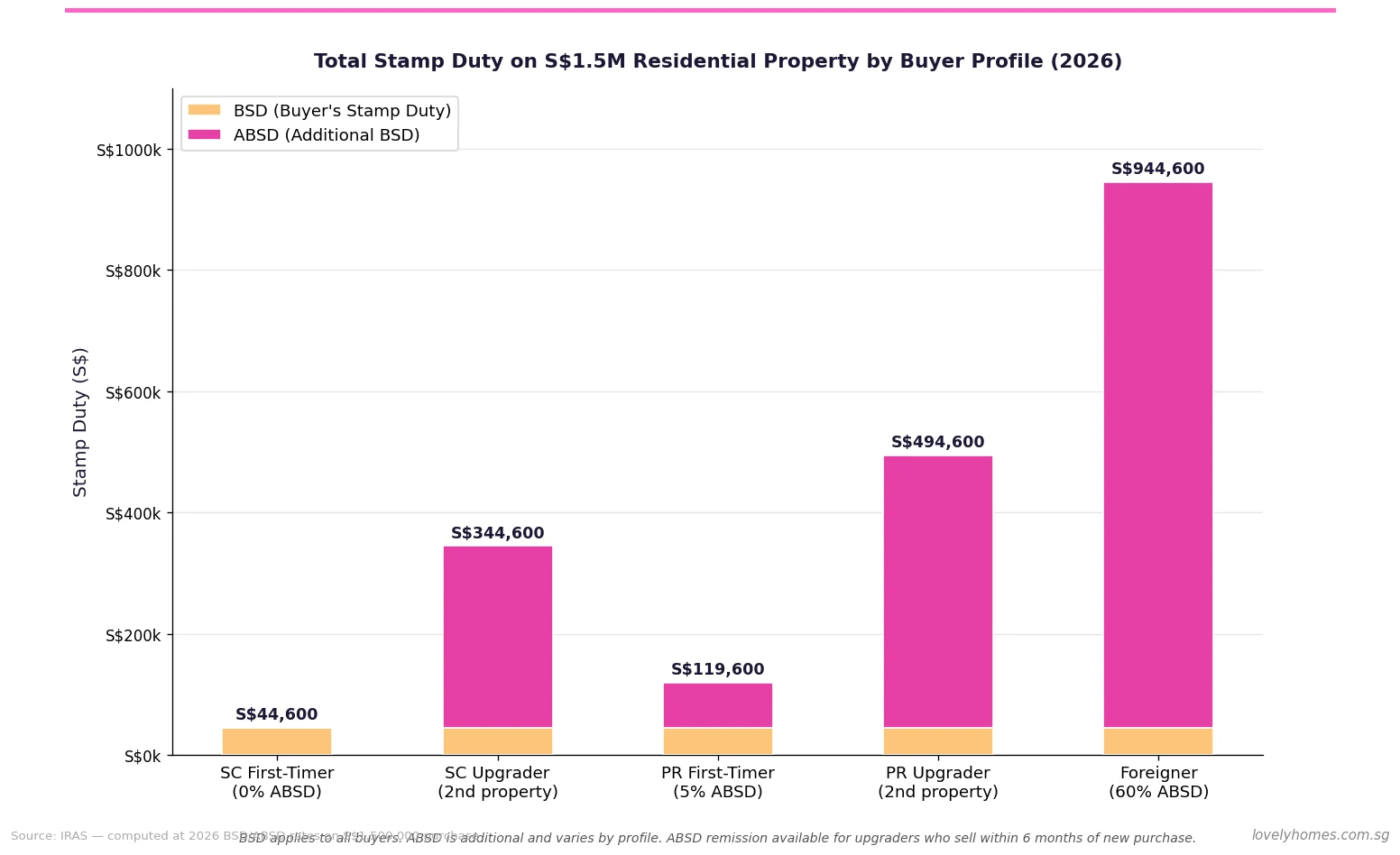
Singapore total stamp duty BSD and ABSD by buyer profile 2026 stacked bar chart on S$1.5 million property
Figure 3: Total Stamp Duty (BSD + ABSD) on a S$1.5 Million Residential Property by Buyer Profile, 2026. The SC first-timer pays S$44,600; a foreigner pays S$944,600 on the same purchase. Source: IRAS (computed at 2026 rates).

Why Singapore’s Cooling Measures Are Built to Last

Singapore’s cooling measures are sometimes characterised as temporary interventions pending correction. The evidence suggests otherwise. The suite has been in continuous operation since 2009, with periodic calibration (mostly tightening) rather than wholesale removal. The September 2023 revisions doubled ABSD for most non-first-timer buyer groups and raised the foreigner rate from 30% to 60% — the sharpest single adjustment since the measures began.

The policy rationale sits at three levels. First, demand management: ABSD and SSD directly cool speculative demand from repeat buyers and short-term traders. Second, financial stability: TDSR and LTV limits constrain household leverage, limiting contagion from any future correction in property prices to the banking system. Third, social equity: the HDB public housing system — the housing pathway for approximately 78% of Singapore’s resident population — depends on price-to-income ratios remaining accessible. Cooling measures on the private market reduce the risk of runaway private price inflation spilling into the HDB resale market and pricing out younger Singaporean households.

Compared to peer markets, Singapore’s framework is among the most comprehensive. Hong Kong’s ABSD-equivalent (the Buyer’s Stamp Duty and the New Residential Stamp Duty) was suspended for non-permanent residents in February 2024, leading to a spike in foreign buying. Australia uses state-based foreign investor surcharges that vary from 3% to 8% — a fraction of Singapore’s 60%. Canada’s national foreign buyer ban, introduced in January 2023, is categorical rather than price-based. The Singapore approach — calibrated rates rather than bans — preserves a functioning market while managing excess demand, a deliberate design choice consistent with the city-state’s broader philosophy of market mechanisms with targeted intervention.

What Might Come Next — Policy Calibration Risks

No announcement of cooling measure changes is expected imminently. MAS and the Ministry of National Development (MND) have signalled that they will monitor conditions closely and act if market data warrants. Several conditions could trigger a recalibration, in either direction:

Tightening risk: If surging GLS land costs translate into sharp private condo price increases that push first-timer affordability below threshold, policymakers may raise the SC first-timer ABSD from 0% (currently exempt) or tighten TDSR further. They may also introduce income-related thresholds for ABSD exemption, as some analysts have suggested.

Easing risk: If SORA continues declining and private property demand weakens materially — evidenced by sustained price declines in URA’s quarterly price indices — MAS and MND could selectively relax ABSD for PRs (already done once, briefly, for the luxury segment in an earlier cycle) or adjust the MSR threshold upwards for EC buyers. This is the less likely scenario in 2026, given that private prices are still rising and HDB resale prices, while cooling slightly, remain well supported.

For a complete chronological record of every cooling measure change since 2009, see Singapore Property Cooling Measures Timeline 2009–2026.

Frequently Asked Questions

Can I pay ABSD using my CPF Ordinary Account?

No. ABSD must be paid entirely in cash. It cannot be funded from CPF savings, including the Ordinary Account. The ABSD is payable within 14 days of signing the Option to Purchase or the Sale and Purchase Agreement, whichever is earlier. By contrast, Buyer’s Stamp Duty (BSD) — the base stamp duty payable by all buyers — can be paid using CPF OA funds for private properties, subject to the CPF withdrawal rules in force. For HDB resale and BTO flats, both BSD and any applicable ABSD must be paid in cash.

How does the ABSD remission work for SC upgraders?

An ABSD remission is available to married couples where at least one party is a Singapore Citizen and neither spouse currently owns more than one residential property. When such a couple purchases a private residential property while still owning an existing property (e.g., an HDB flat or a private condo), they must pay the 20% ABSD upfront. However, if they sell the existing property within 6 months of the date of purchase completion (for a new launch) or within 6 months of the date of signing the OTP (for a completed unit), IRAS will refund the ABSD paid, less S$1 processing fee. The 6-month window is strict — a one-day delay can result in forfeiture of the remission. HDB upgraders should note that the sale of the HDB flat, not merely the receipt of HDB proceeds, must be completed within the period. Check IRAS’s official ABSD remission guidance for the latest conditions.

Does ABSD apply to commercial property purchases?

No. ABSD applies only to residential property in Singapore. Commercial properties — offices, shophouses, industrial units, retail units and mixed-use developments where the residential component does not exist or is not being acquired — are not subject to ABSD. The surge in commercial investment sales in H1 2026 is partly explained by this fact: institutional investors seeking income-producing real estate in Singapore can acquire commercial assets without the ABSD burden that makes residential investment uneconomical for non-first-timers. Shophouses — heritage conservation buildings that typically combine a ground-floor commercial component with upper-floor residential space — are classified by IRAS based on the primary use of the property at the time of purchase. Buyers of shophouses should seek a specific tax ruling if in doubt about ABSD applicability.

How is TDSR stress-tested, and what rate does the bank use?

MAS requires financial institutions to stress-test mortgage applications at a medium-term interest rate rather than the prevailing contract rate. As of 2026, the stress-test rate for residential property loans is typically 4.0%–4.5% — significantly above the actual contracted rate, which for most floating-rate SORA-pegged loans sits closer to 3.0–3.7% all-in. This means a buyer whose TDSR passes at today’s actual repayment amount might still fail if the stress-tested repayment exceeds 55% of income. When planning your financing, always calculate affordability at the stress-test rate, not the current headline rate. Banks will not lend above this threshold regardless of your actual income or assets.

Are there any legal ways to reduce ABSD exposure?

Within the framework as it stands in 2026, the main legitimate approaches are: (1) SC upgrader remission — sell the existing property within 6 months of the new purchase completion, as described above; (2) EC route for first-timers — SC and eligible PR couples buying an Executive Condominium directly from a developer are exempt from ABSD, and ECs typically carry a lower launch price than comparable private condominiums in the same district; (3) Property held under a single name — in some structuring scenarios, a married couple can designate one spouse as the sole buyer of a second property (if the other spouse is a first-timer on paper), though this has specific eligibility conditions and does not work once both spouses own property; (4) Decoupling — where a joint-owned property is transferred to a single owner’s name, freeing the departing spouse to purchase a new property at the lower ABSD rate for a first-time buyer. Decoupling has been significantly curtailed by stamp duty rules and income-related limitations. Always consult a licensed property lawyer and financial adviser before proceeding — the rules are precise, and errors are costly.

How do cooling measures affect the HDB resale market specifically?

Cooling measures affect the HDB resale market primarily through the MSR (30%), which caps how much of monthly income can go towards the HDB mortgage, and the LTV limit for HDB loans (80%) and bank loans (75% for first-time HDB buyers). ABSD does not apply to the purchase of a first HDB resale flat by Singapore Citizens, but PRs buying their first HDB pay 5% ABSD. The HDB’s own Minimum Occupation Period (5 years for standard flats, 10 years for Plus and Prime model flats) operates in parallel with SSD to prevent short-term speculation. Sellers of HDB resale flats who have not met MOP must seek HDB’s approval before listing, and subletting before MOP is only allowed in specific circumstances. See the HDB Resale Price Guide 2026 for a full overview of how these rules interact with current market pricing.

Related Articles


Disclaimer: This article is for general informational purposes only and does not constitute financial, tax or legal advice. Stamp duty rates, financing limits and policy rules cited are based on publicly available information as at August 2026 and are subject to change without notice. Always verify current rates with IRAS, MAS and HDB directly, and consult a licensed conveyancing lawyer, mortgage broker and financial adviser before making any property transaction decision. Individual circumstances vary and the examples in this article are illustrative only.
Singapore Property Investment Strategy 2026: Rental Yields, Capital Gains and Net Returns

Singapore Property Investment Strategy 2026: Rental Yields, Capital Gains and Net Returns

Quick Answer: Singapore Property Investment Strategy 2026

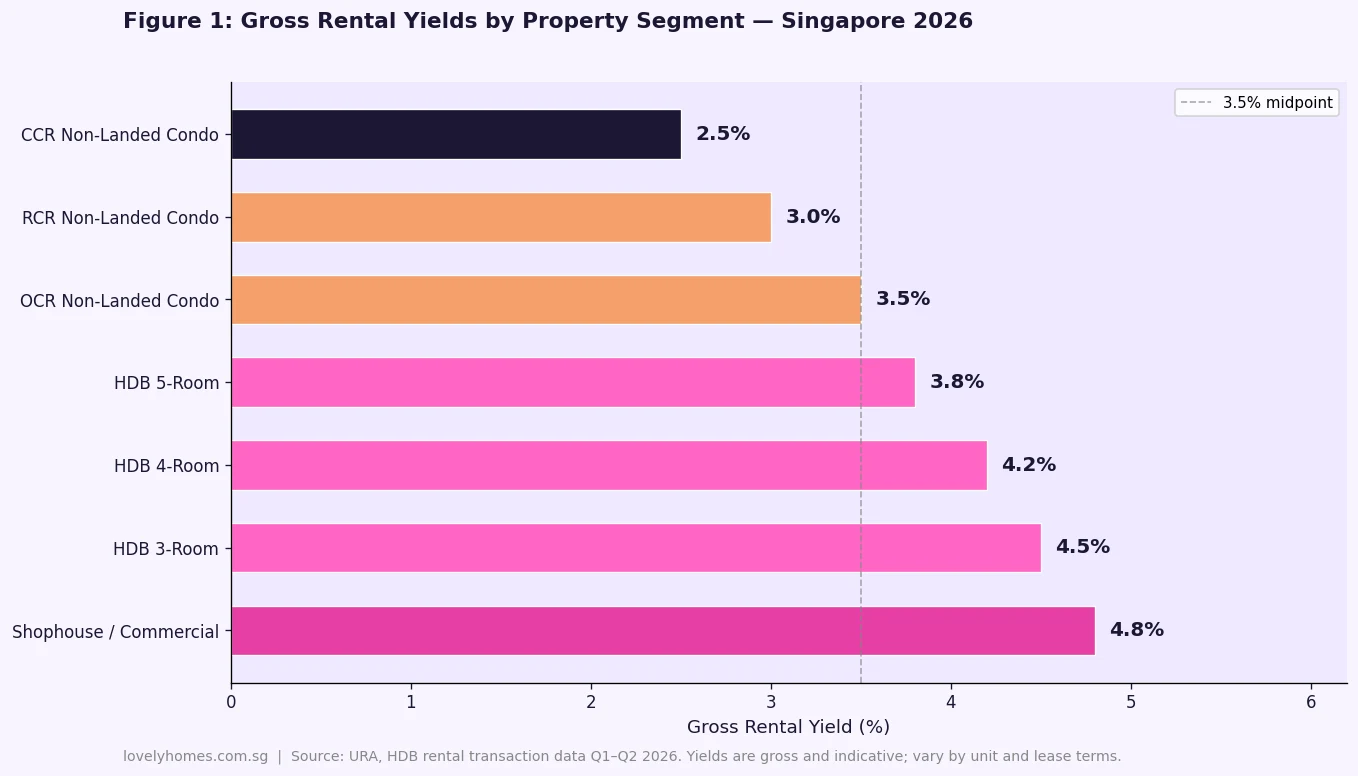
  • Singapore property gross rental yields range from 2.5% (CCR condos) to 4.8% (shophouse/commercial) — HDB flats offer the highest residential yields in 2026.
  • Capital appreciation since 2019 has been strongest in HDB resale (7.2% pa) and landed (6.1% pa), well ahead of CCR condominiums (3.5% pa).
  • The biggest drag on investor returns is ABSD: Singapore Citizens buying a 2nd property pay 20% — S$360,000 on a S$1.8M purchase — payable in cash only, not CPF.
  • After ABSD amortised over 10 years plus all operating costs, an OCR condo investor nets roughly S$44,000/yr total return — only if the property appreciates at ~4% pa.
  • Singapore Citizens on a first property (0% ABSD) and PRs on a first property (5% ABSD) enjoy meaningfully better net returns — estimated at 4.7% and 4.3% pa respectively.
  • S-REITs offer property exposure without ABSD or illiquidity, distributing 5.5–6.5% annually in 2026.
  • Record GLS supply (9,320 Confirmed-List units for 2026) could soften OCR/RCR prices by 2027 — monitor before committing at today’s entry prices.

Why Singapore Property Remains a Core Investment

Singapore’s property market has delivered consistent long-term returns since the Republic’s founding. Land is finite — the city-state covers just 720 square kilometres — yet it anchors a population approaching six million, a global financial hub, and one of the world’s busiest ports. This structural scarcity underpins values across all residential and commercial segments, and has historically cushioned the market against the deeper corrections seen in comparably-sized cities elsewhere in Asia.

The country’s legal and institutional framework adds a second pillar of confidence. Clear Torrens-system land titles, an independent judiciary, and the absence of capital controls make Singapore one of the few markets where property ownership has proved reliably secure across multiple economic cycles. Foreign institutional capital continues to flow into commercial and luxury-residential segments even at the 65% ABSD rate introduced in April 2023 — a telling signal of long-term conviction despite the punitive entry cost.

For Singapore Citizens and Permanent Residents, however, the investment case has shifted materially since the April 2023 cooling measures. A Singapore Citizen buying a second residential property now pays a 20% Additional Buyer’s Stamp Duty (ABSD), charged on the purchase price and payable entirely in cash within 14 days of exercising the Option to Purchase (OTP). On a S$1.8 million OCR condominium — modest by 2026 standards — that is S$360,000 in upfront tax. The critical question every investor must answer is: do the returns justify this cost?

Gross Rental Yields by Segment

Gross rental yield — annual rent divided by purchase price — is the simplest measure of a property’s income productivity before expenses. It varies significantly across Singapore’s property segments, reflecting both the absolute price level of each asset class and the depth and quality of tenant demand.

Gross rental yields by property segment Singapore 2026 horizontal bar chart
Figure 1: Gross rental yields by property segment, Singapore 2026. Shophouses lead at 4.8%; CCR non-landed condos trail at 2.5%. Source: URA, HDB rental transaction data Q1–Q2 2026. Yields are gross and indicative; they vary materially by unit, location, and lease terms.

HDB flats achieve the highest gross yields among residential assets — typically 3.8%–4.5% depending on flat type — because their purchase prices are substantially lower than private condominiums, while rents in mature estates are broadly competitive. A 4-room flat in Toa Payoh, Queenstown, or Bishan renting at S$2,500–S$3,000 per month on a resale price of S$600,000–S$750,000 generates a 4.0%–4.8% gross yield. The caveat is that HDB rental requires HDB approval, and subletting rules — including approved tenant nationalities and minimum lease terms — are more restrictive than private property.

OCR non-landed condominiums sit at approximately 3.5% gross. A 2-bedroom unit in the Tampines, Jurong, or Punggol corridors renting for S$3,200–S$4,000 per month against a purchase price of S$1.1M–S$1.4M falls comfortably in this range. RCR condominiums yield around 3.0%, reflecting higher per-square-foot prices and a somewhat more transient tenant pool. CCR condominiums trail at 2.5%, as their elevated pricing limits the universe of tenants who can afford market-rate rents in the core central region.

Shophouses and commercial units lead all segments at approximately 4.8%, but they come with critical caveats: minimum purchase prices of S$3M–S$15M, limited liquidity, specialist buyer pools, and very different stamp duty treatment — residential ABSD does not apply to commercial purchases, which materially skews headline yield comparisons.

Capital Appreciation by Segment: 2019–2026

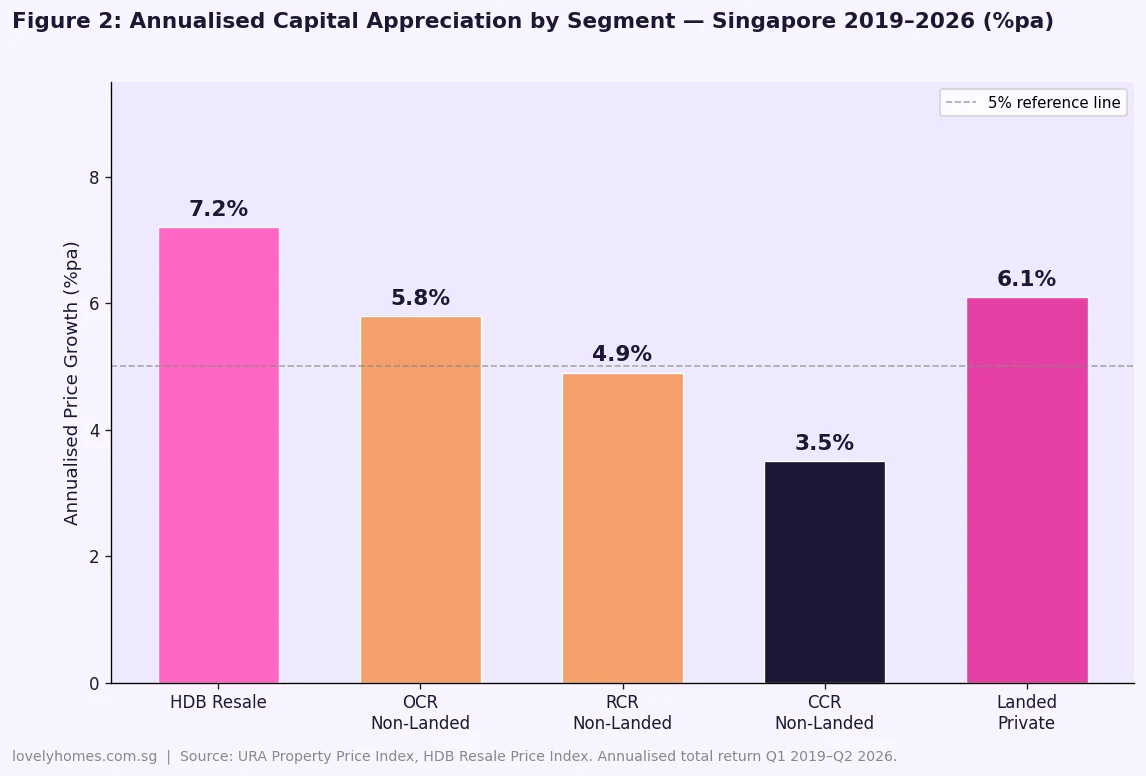
Rental income rarely explains why Singaporeans commit such large sums to direct property ownership. The real prize — historically — has been capital appreciation. The chart below shows annualised price growth across segments from Q1 2019 to Q2 2026 flash, covering the post-COVID boom and the subsequent cooling-measure moderation.

Annualised capital appreciation Singapore property segments 2019 to 2026 bar chart
Figure 2: Annualised capital appreciation by segment, Singapore 2019–2026. HDB resale leads at 7.2% pa; CCR non-landed trails at 3.5% pa. Source: URA Property Price Index, HDB Resale Price Index Q1 2019–Q2 2026 flash estimate.

The HDB resale segment’s 7.2% annualised gain is the most striking figure in the landscape. This reflects a chronic undersupply of resale flats in mature estates, persistent demand from first-time buyers who did not win a BTO ballot and are paying market price, and the government grant structure that pulls purchasing power from a wide income band into the same finite pool of homes.

Landed property at 6.1% pa reflects equally constrained supply — Singapore’s landed housing stock is constitutionally protected in most districts, and titles cannot be subdivided below minimum plot sizes. OCR non-landed private property at 5.8% has been propelled by the HDB upgrader pipeline: Singapore Citizens who have served their Minimum Occupation Period and graduated to private ownership. That demographic funnel, fed by BTO completions from 2018–2022 and the elevated HDB resale market of 2021–2024, has proved remarkably durable.

CCR’s more modest 3.5% pa gain reflects both the segment’s higher price base and the disproportionate impact of the 65% foreign ABSD — raised from 30% in April 2023 — on CCR demand, which had historically skewed towards foreign investors and expatriate purchasers.

The ABSD Impact: Quantifying the Investor’s Hurdle

For Singapore Citizens already owning property, the 20% ABSD on a second residential purchase is the dominant variable in any investment analysis. It is not merely an upfront cost: it is a 20% return hurdle the investment must clear before any real profit begins to accumulate.

Buyer Profile ABSD Rate ABSD on S$1.8M Est. Net Yield Cap. Gain (4% pa) Total Return pa
SC — 1st property (owner-occupier buying only) 0% S$0 +0.7% +4.0% ~4.7%
PR — 1st property 5% S$90,000 +0.3% +4.0% ~4.3%
SC — 2nd property 20% S$360,000 -1.3% +4.0% ~2.7%
PR — 2nd property 25% S$450,000 -1.6% +4.0% ~2.4%
SC — 3rd property 30% S$540,000 -2.5% +4.0% ~1.5%
Foreigner 65% S$1,170,000 Deeply negative +4.0% ~2.0%*

*Foreigner total return assumes 10yr hold and 4% pa capital appreciation; ABSD amortised at S$117K/yr. Estimates only; not financial advice. ABSD rates effective 27 April 2023 per IRAS.

Net Annual Return: The Full Breakdown

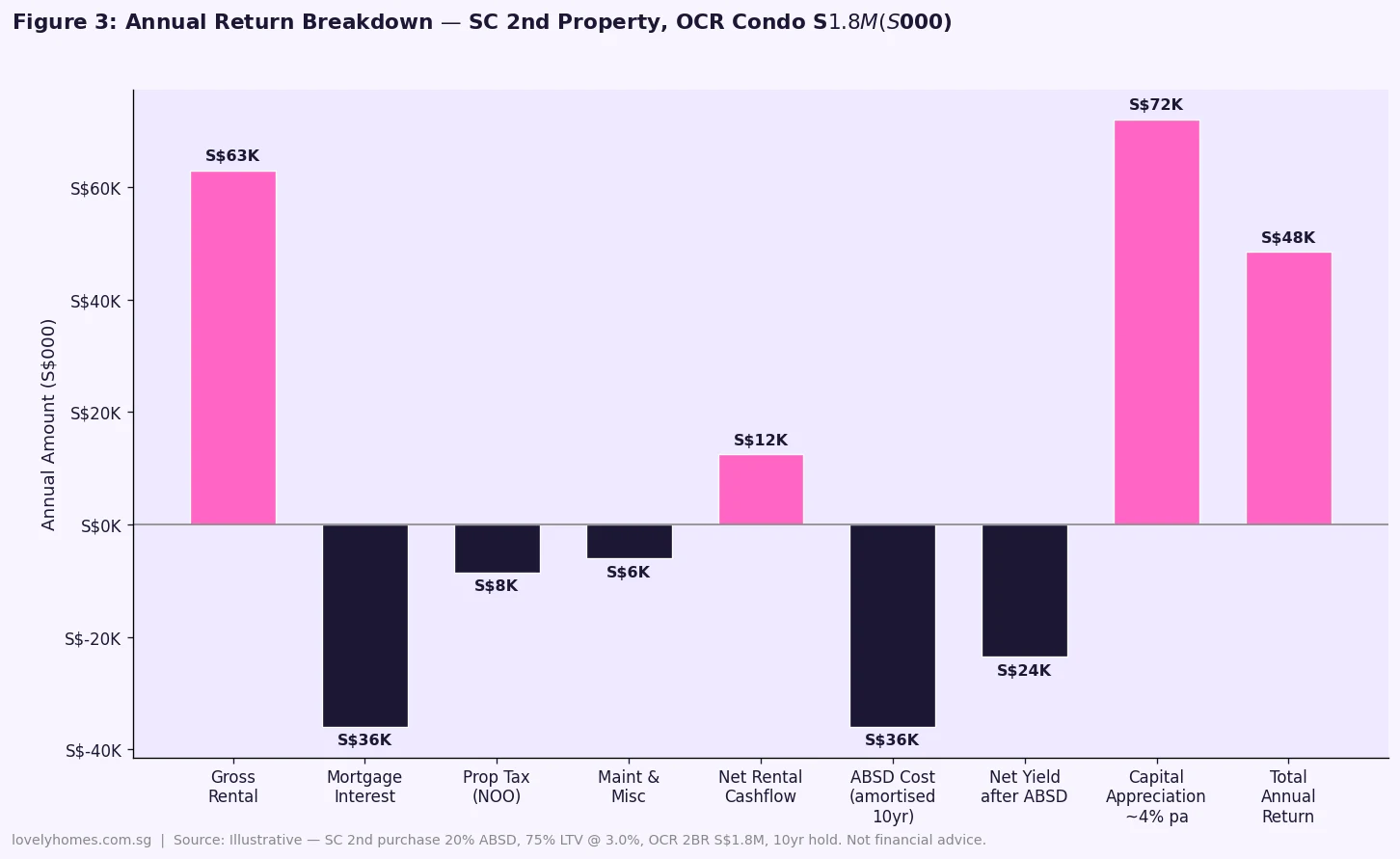
The chart below deconstructs every component of annual return for a Singapore Citizen buying a second property — a 2-bedroom OCR condominium at S$1,800,000 — showing precisely where income is earned and where costs erode it.

Net annual return breakdown Singapore OCR condo investment S$1.8 million 2026 waterfall chart
Figure 3: Annual return breakdown — SC 2nd property, OCR condo S$1.8M, 10-year hold, 75% LTV @ 3.0% pa. Pink bars = inflows; navy bars = costs. Source: LovelyHomes analysis based on URA market data. Illustrative only; not financial advice.

Gross rent at 3.5% yields S$63,000 per year. Mortgage interest on a S$1.35 million loan at 3.0% costs S$40,500. Non-owner-occupied property tax on an annual value of approximately S$63,000 costs around S$8,500. Maintenance fees and miscellaneous outgoings run another S$6,000 per year. That leaves a net rental cashflow of S$8,000 — barely 0.5% of the purchase price — before ABSD is factored in.

Amortised over a 10-year hold, the S$360,000 ABSD costs S$36,000 per year in opportunity cost. Subtracted from the S$8,000 net rental cashflow, the investor is running at S$28,000 negative annually from operations. Capital appreciation at 4% per annum on S$1.8M generates approximately S$72,000 per year in theoretical gain — rescuing the total return to roughly S$44,000 per year, or about 2.5% on purchase price. For comparison, the 10-year SGS bond yield in mid-2026 stood at approximately 3.0%, and S-REITs were distributing 5.5%–6.5% per annum. The risk-adjusted case for a second-property investment in Singapore demands real conviction in the capital-appreciation story.

Investment Strategies for 2026

Four broad strategies align with different investor profiles and risk appetites in the current environment.

Buy-to-let for income: Best suited to HDB flats (SC first purchase, mature estates near MRT) or OCR condominiums (first-time private buyer). Mature-estate HDB flats in Queenstown, Toa Payoh, and Bishan generate 4.0%–4.5% gross yields with low vacancy risk. Private condos in high-demand OCR rental catchments — near international schools, tech corridors, or major employment hubs — support consistent 3.3%–3.8% gross yields.

Capital-gain strategy via HDB-to-private upgrade: SC couples who sell their HDB flat and buy a private condominium as their primary residence pay zero ABSD on the private purchase and face no LTV penalty from an existing loan. This is structurally the most efficient entry into private property appreciation, and has driven OCR capital gains for over two decades.

En bloc positioning: Buying into an older, low-plot-ratio freehold property in a redevelopment-ready location — Greater Southern Waterfront fringe, Orchard/Newton corridor, or established OCR growth nodes — can deliver outsized capital gains if a collective sale proceeds. The trade-off is timeline uncertainty of 12–24 months and the 80% or 90% consent threshold. See our En Bloc Sale Guide 2026 for the full process and legal framework.

S-REITs — indirect exposure without ABSD: Singapore-listed REITs provide diversified property exposure across industrial, retail, logistics, and hospitality sectors, currently yielding 5.5%–6.5% annually. They are listed on SGX, liquid, and accessible from one lot. For income-focused investors who cannot justify the ABSD cost of direct second-property ownership, a portfolio of S-REITs is a compelling alternative — though it sacrifices the leverage and direct asset-selection advantages of physical property.

Financing: TDSR, LTV, and the Second-Property Rules

The Monetary Authority of Singapore (MAS) enforces the Total Debt Servicing Ratio (TDSR) across all property-linked loans. Monthly debt obligations — the new mortgage plus all existing commitments — must not exceed 55% of verified gross monthly income. For second-property investors, the binding constraint is often TDSR rather than ABSD alone.

Loan-to-Value rules compound this. With no outstanding loan, the bank LTV is 75% (meaning 25% downpayment, of which minimum 5% must be cash). With one outstanding loan — a common scenario for SC investors still servicing an HDB mortgage — the LTV on the new private loan drops to 45%, requiring a 55% downpayment. On a S$1.8M property, that is S$990,000 in equity required before ABSD, BSD, or legal fees are counted.

Note that ABSD cannot be paid with CPF. Only cash funds may be used. BSD may be paid from CPF Ordinary Account. These rules constrain the investable universe to buyers with substantial liquid savings beyond their CPF holdings.

What Might Come Next

The record GLS Confirmed List of 9,320 units for 2026 — the largest in the programme’s modern history — will translate into completions primarily in 2028–2030. Rental yields may compress modestly in 2027 as this wave of new supply enters the leasing market, particularly in the OCR and RCR segments where GLS activity is heaviest. Short-term investors entering at today’s prices face this headwind.

Interest rates are trending lower. The US Federal Reserve is expected to cut two to three times in 2026, pulling SORA from approximately 3.6% toward 2.8% by year-end. Lower financing costs improve net yields and could re-activate demand across all private segments. The full Q2 2026 URA private residential statistics, expected on 24 July 2026, will provide the most comprehensive data signal of whether the flash +0.5% figure holds across all sub-segments.

There is no credible expectation that ABSD rates will be reduced in the near term. MND has consistently signalled that housing affordability remains a priority concern, and any ABSD reduction risks reigniting the demand surge the 2023 measures were designed to prevent.

Frequently Asked Questions

Can I use CPF Ordinary Account funds to pay ABSD?

No. ABSD must be paid entirely in cash within 14 days of exercising the Option to Purchase. CPF Ordinary Account funds may be used for BSD, downpayments, and monthly mortgage instalments, but not for ABSD. This is a material liquidity constraint — buyers must hold sufficient cash above and beyond their CPF balances before committing to a second-property purchase.

Is there any ABSD remission for investors selling an existing property?

The ABSD remission for SC married couples allows a full ABSD refund on a second property if the first is sold within six months of the new property’s purchase date (completed property) or TOP (new launch). This is designed for the buy-before-sell upgrade path, not for investors who intend to retain both properties. There is no investor-specific ABSD waiver as at July 2026. Married SC/PR couples may apply for ABSD remission at the SC rate if the SC spouse is the sole or joint purchaser.

How does the TDSR apply to investment properties?

The TDSR applies equally to investment and owner-occupied residential properties. All monthly loan obligations must not exceed 55% of verified gross monthly income. Rental income from the investment property may be counted at a 70% haircut if you have evidence of existing rental receipts, but prospective rent from a newly purchased property is generally excluded. The TDSR is enforced by the MAS and applies to all financial institutions regulated in Singapore.

Is rental income from Singapore property taxable?

Yes. Net rental income is taxable as part of your assessable income under the Income Tax Act administered by IRAS. Net rental income is gross rent less allowable deductions: mortgage interest, agent commissions, property maintenance, fire insurance, property tax, and statutory depreciation on furniture and fittings (at 25% of monthly rent). Singapore residents pay progressive rates from 0% to 24%; non-residents pay a flat 24%. Rental income must be declared in your annual IRAS tax return by 15 April each year. Full guidance is available at iras.gov.sg.

Can foreigners buy investment property in Singapore?

Foreigners may purchase non-landed private residential property (condominiums and apartments). However, the 65% ABSD rate makes this prohibitively expensive for most investment theses — on a S$2M condominium, ABSD alone is S$1.3M. Foreigners cannot purchase HDB flats and require SLA written approval for landed property. Commercial property (shophouses, office, retail, industrial) is exempt from residential ABSD and remains fully open to foreign ownership, which is why shophouses continue to attract significant foreign institutional capital.

Are S-REITs a better investment than direct property?

S-REITs offer higher current yields (5.5%–6.5% in 2026), full liquidity (SGX-listed), no ABSD, and no minimum investment beyond one lot. The trade-off is that you do not select individual properties, you bear equity market volatility and interest-rate sensitivity, and capital appreciation is driven by unit-price movements rather than specific deals. For income-focused investors who cannot justify the ABSD cost of direct second-property ownership, a diversified S-REIT portfolio typically produces better risk-adjusted returns than a single leveraged property — though it sacrifices the leverage and bespoke asset-selection advantages of direct ownership.

Should I buy now or wait for the GLS supply to affect prices?

The record 9,320-unit GLS Confirmed List for 2026 translates into completions primarily in 2028–2030 — not an immediate price shock. Rental markets may soften from 2027 as supply arrives, particularly OCR/RCR. Short-term investors (3–5 year horizon) face elevated risk of entry-price headwinds from this supply wave. Long-term investors (8–10+ years) have historically found most Singapore entry points acceptable, as prices have recovered from every supply-driven moderation since 2013. Monitor the full Q2 2026 URA statistics (24 July 2026) and the October 2026 GLS announcement before committing.

Worked Example: SC Upgrader Buys OCR Investment Condo

Mr Tan, SC, 45, earns S$18,000 per month. He and his wife own a fully paid-up HDB flat in Bishan. He wishes to purchase an OCR 2-bedroom condominium in Tampines at S$1,800,000 as a 10-year investment.

Upfront costs: BSD S$56,600 (CPF OA) • ABSD 20% S$360,000 (cash only) • 25% downpayment: S$90,000 cash + S$360,000 CPF • Bank loan 75% LTV S$1,350,000 @ 3.0% 30 years = S$5,691/mth • TDSR 31.6% ✓ • Legal fees S$5,500. Total outlay: approximately S$455,500 cash + S$416,600 CPF.

Annual returns: Gross rent 3.5% = S$63,000 • Less mortgage interest (3.0% × S$1.35M) = S$40,500 • Less NOO property tax = S$7,560 • Less maintenance S$450/mth = S$5,400 • Less insurance and misc = S$1,200. Net rental cashflow: S$8,340/yr (0.5%). Less ABSD amortised over 10 years = S$36,000. Net yield after ABSD: −S$27,660/yr. Assumed capital appreciation 4% pa = S$72,000/yr. Estimated total annual return: S$44,340 (~2.5% pa on purchase price).

At a 10-year exit (no SSD having held more than three years), assuming 4% pa compound growth, the property is worth approximately S$2.66M — a S$860,000 gross capital gain. Less total ABSD (S$360,000), less selling costs (~S$36,000), less cumulative negative operating cashflow (approximately S$276,000 over 10 years): net 10-year return roughly S$188,000 on S$455,500 cash outlay. That is approximately 41% cumulative or 3.5% CAGR on cash invested. Compelling only if the 4% capital appreciation assumption holds across the entire decade.

Related Articles

Disclaimer: This article is for general information only and does not constitute financial, investment, or legal advice. Property investment involves risk, including possible loss of capital. Yield and appreciation figures are illustrative estimates based on historical and current market data; future performance may differ materially. ABSD rates, BSD schedules, and financing rules are correct as at 11 July 2026 but are subject to change by the relevant Singapore authorities. Readers should consult a licensed financial adviser or mortgage broker and conduct independent due diligence before making any investment decision. For official ABSD/BSD rates, refer to IRAS at iras.gov.sg. For market transaction data and GLS information, refer to URA at ura.gov.sg.

×
Enlarged view
Click anywhere to close

Translate »