Singapore Property Valuation & Cash-Over-Valuation (COV) Guide 2026: How Bank and HDB Valuation Really Works

Singapore Property Valuation & Cash-Over-Valuation (COV) Guide 2026: How Bank and HDB Valuation Really Works

Quick Answer: Valuation and Cash-Over-Valuation (COV)

  • Valuation is an independent assessment of a property’s fair market value — separate from the price you agree to pay the seller.
  • Your loan and CPF usage are capped at the LOWER of the purchase price or the valuation — never the higher figure.
  • If you pay more than the valuation, the gap is called Cash-Over-Valuation (COV) and must be paid entirely in cash — it cannot be financed by loan or CPF.
  • For HDB resale flats, valuation is requested only after the Option to Purchase (OTP) is signed, and is not disclosed to the seller beforehand.
  • Since HDB’s 2014 valuation reforms, median COV amounts have fallen sharply from the highs of 2011–2012.
  • For private resale property, banks appoint an independent valuer from their panel; valuations can vary slightly between banks.
  • Maximum Loan-to-Value (LTV) is 75% for a first housing loan within standard tenure limits — applied to the lower of price or valuation.
  • A valuation that comes in higher than your purchase price is good news — it doesn’t increase your loan, but it strengthens your equity position from day one.

What Is Property Valuation and Who Decides It?

Every property transaction in Singapore involves two separate numbers that buyers often conflate: the purchase price — what you and the seller agree to — and the valuation, an independent professional opinion of the property’s fair market value. They frequently match closely, but they don’t have to, and the gap between them has real financial consequences.

For private resale property, valuation is carried out by a professional valuer drawn from the bank’s approved panel, engaged once you apply for a home loan. For HDB resale flats, valuation is arranged through HDB’s own valuation process after the Option to Purchase (OTP) is exercised. In both cases, valuers assess comparable recent transactions (drawing on data such as URA’s REALIS caveats for private property), the unit’s floor level, orientation, condition, remaining lease, and other value drivers — arriving at an independent figure that neither buyer nor seller controls.

This is distinct from Annual Value (AV), which the Inland Revenue Authority of Singapore (IRAS) uses purely to calculate property tax, and which has no bearing on your loan quantum. Don’t confuse the two when budgeting.

How property valuation determines your loan quantum Singapore process flow
Figure 1: How property valuation determines your loan quantum. Applies to both HDB and private resale purchases.

The Golden Rule: Loan and CPF Are Capped at the Lower of Price or Valuation

This is the single most important mechanic to understand. The Monetary Authority of Singapore (MAS) sets Loan-to-Value (LTV) limits that banks must apply — up to 75% for a first housing loan with a tenure of 30 years or less (and where the loan does not extend past the borrower’s age of 65). But that 75% is calculated against the lower of the purchase price or the bank’s/HDB’s valuation — never the price alone.

The same logic applies to CPF usage: you can only draw CPF Ordinary Account savings up to the Valuation Limit, which is anchored to the valuation, not the agreed price. If you have agreed to pay above valuation, that excess sits entirely outside both the loan and CPF systems — it must come from cash savings.

What Is Cash-Over-Valuation (COV)?

Cash-Over-Valuation, universally shortened to COV, is the amount by which your agreed purchase price exceeds the property’s valuation. If you agree to pay S$850,000 for a flat that is subsequently valued at S$830,000, your COV is S$20,000 — an amount you must fund entirely in cash, on top of your normal downpayment.

COV became a well-known (and often painful) feature of the HDB resale market during the property boom of 2011–2012, when median COV amounts on some transactions were widely reported in the tens of thousands of dollars, as buyers competed for flats in a tight, fast-moving market with limited price transparency. HDB responded with a significant reform in March 2014: valuation would no longer be obtained and disclosed before price negotiations, but only after the OTP is signed, removing the anchoring effect that valuation figures had previously had on asking prices. Since then, median COV levels across the HDB resale market have fallen substantially, though COV has not disappeared entirely — it still surfaces for sought-after units in tight micro-markets.

Worked example purchase price versus valuation and cash over valuation gap Singapore HDB resale
Figure 2: Worked example — purchase price vs valuation and the resulting COV gap.

Private Property Valuation: How Bank Valuers Work

For private resale property, the process starts once you sign the OTP and apply for a home loan. The bank engages an independent valuer from its approved panel — not an estate agent, and not a party with any financial interest in the transaction — who conducts a desktop and often a physical inspection of the unit, benchmarking it against recent comparable transactions in URA’s caveat data, adjusting for floor level, stack, renovation condition and view. The valuer submits a report to the bank, typically within a few business days, and the bank bases your maximum loan quantum on that figure.

Because valuers exercise professional judgement, valuations can differ modestly between banks — it is common practice for buyers with a borderline COV situation to apply to more than one bank and compare valuations before committing to a lender.

LTV Limits at a Glance

Loan Scenario Tenure ≤30yrs & age ≤65 at maturity Tenure >30yrs or past age 65
1st housing loan 75% 55%
2nd housing loan 45% 25%
3rd & subsequent housing loan 35% 15%

All LTV percentages apply to the lower of purchase price or valuation. Source: MAS.

Worked Example: The Wongs Buy a Resale Flat Above Valuation

Profile: Mr and Mrs Wong, Singapore Citizens, agree to buy a 5-room HDB resale flat in Bukit Merah for S$850,000. They sign the OTP and request a valuation, which comes back at S$830,000 — a COV of S$20,000.

Loan quantum: Using a bank loan at 75% LTV, the loan is calculated on the lower figure — valuation, not price: 75% × S$830,000 = S$622,500.

Total downpayment required: S$850,000 (price) − S$622,500 (loan) = S$227,500. This breaks down into two distinct components: (a) the standard 25% downpayment on the valuation — 25% × S$830,000 = S$207,500, of which a minimum 5% of the purchase price (S$42,500) must be cash and the rest can be CPF; and (b) the S$20,000 COV, which sits entirely outside the loan and CPF system and must be paid in pure cash.

Buyer’s Stamp Duty: calculated on S$850,000 at progressive rates (1% on first S$180,000 = S$1,800; 2% on next S$180,000 = S$3,600; 3% on the remaining S$490,000 = S$14,700) = S$20,100, payable via cash and/or CPF.

Bottom line: the Wongs need at least S$62,500 in ready cash (S$42,500 minimum cash downpayment + S$20,000 COV) before CPF and BSD financing considerations, on top of their S$622,500 loan — a materially different cash-flow position than if the flat had valued at the full S$850,000 asking price.

How cash over valuation shrinks your loan and raises cash needed Singapore property
Figure 3: How a growing COV gap shrinks your loan and raises the cash you need to find.

Why This Matters: What a Big COV Gap Signals

A meaningful COV gap is rarely random — it usually signals that a specific unit is in unusually high demand relative to its comparable transactions: a rare high-floor stack, an unusually large layout for its flat type, or a location experiencing a fast-moving upgrade thesis (proximity to a new MRT line, for example). Buyers should treat a request for a price significantly above asking as a signal to budget conservatively for cash, particularly first-time buyers who may not have deep cash reserves beyond their CPF.

Singapore’s post-2014 valuation-after-OTP framework is, by regional standards, unusually transparent. In markets such as Hong Kong’s private resale sector, informal “over-ask” premiums persist without an equivalent independent bank-valuation checkpoint forcing price discipline, making Singapore’s system comparatively protective of buyers once the mechanics are understood. The trade-off is that Singapore buyers only discover their true financing gap after committing to an OTP — which is precisely why understanding this mechanism before you sign is so important.

What Might Come Next

The following is informed speculation, not confirmed policy. The HDB Resale Price Index has now recorded two consecutive quarters of decline (1Q2026 and 2Q2026), and HDB has already shown a willingness to ease adjacent rules in response — removing the 15-month wait-out period for private property owners on 28 July 2026. If resale price moderation continues, it is plausible that market-wide COV incidence could narrow further as competitive bidding pressure eases, though this is a market outcome rather than a policy lever HDB directly controls. No changes to the post-OTP valuation framework itself have been signalled.

Frequently Asked Questions

Can I ask for a second valuation if I disagree with the first?

For bank loans on private property, yes — you can apply to a different bank, which will engage its own panel valuer, and compare the two figures. For HDB resale flats, the valuation obtained through HDB’s process is generally treated as final for that transaction; there is no routine second-opinion mechanism in the same way.

Does a low valuation mean I overpaid?

Not necessarily. Valuation is a conservative, comparable-based estimate and can lag genuine market momentum, especially for unique units or in a fast-rising micro-market. A COV gap reflects what you’re willing to pay above that benchmark for a specific unit — it isn’t automatically a sign of a bad deal, though it does mean a larger cash outlay.

Can I use CPF to pay the Cash-Over-Valuation amount?

No. By definition, COV sits above the valuation, and CPF usage is capped at the Valuation Limit. The COV portion must be funded entirely from cash savings — it cannot be drawn from your CPF Ordinary Account under any circumstances.

How long does a valuation take?

For private property, bank-panel valuers typically return a report within a few business days of the request. For HDB resale flats, the valuation is processed as part of the standard resale application timeline, which runs roughly 8 to 12 weeks in total from OTP to completion.

Does valuation affect my property tax?

No. Property tax is calculated on Annual Value (AV), a separate figure determined by IRAS based on estimated market rental value, not on your transaction valuation or purchase price. The two are easy to confuse but serve entirely different purposes.

What if my property is valued higher than the price I’m paying?

That’s a favourable outcome. Your loan is still based on the purchase price in that case (banks lend against the lower of the two figures, and here price is lower), but you effectively start with built-in equity, since the property is independently assessed as worth more than you paid for it.

Do new launch condos get valued the same way?

New launch units are generally purchased directly from the developer at the listed price, and banks typically accept the developer’s price as the basis for the loan since there is no independent resale market comparison in the same sense. Valuation dynamics as described here mainly apply to resale transactions — HDB and private.

Disclaimer: This article is intended for general informational purposes only and does not constitute financial or legal advice. Valuation outcomes, LTV limits and stamp duty rates are subject to change and vary by individual circumstances. Always confirm current figures with the Housing & Development Board (HDB), the Monetary Authority of Singapore (MAS), the Inland Revenue Authority of Singapore (IRAS), and your bank’s mortgage specialist before making any purchase decision.
×

Click anywhere outside to close

Singapore LTV Limit Guide 2026: Loan-to-Value Rules for Home Loans Explained

Singapore LTV Limit Guide 2026: Loan-to-Value Rules for Home Loans Explained

📌 Quick Answer: Singapore LTV Limits 2026

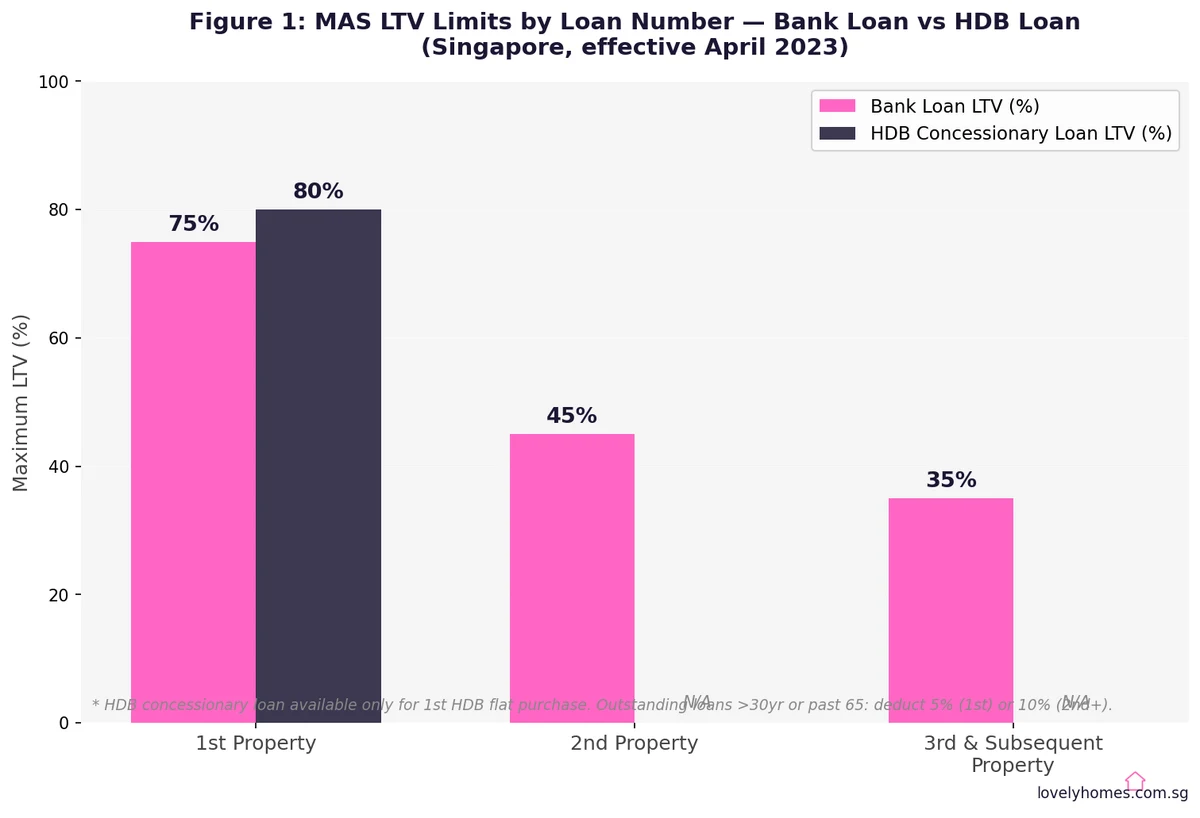
  • 1st property (bank loan): 75% LTV — minimum 5% cash downpayment.
  • 1st property (HDB loan): 80% LTV — minimum 10% downpayment (cash or CPF).
  • 2nd property (bank loan): 45% LTV — minimum 25% cash downpayment.
  • 3rd and subsequent property: 35% LTV — minimum 25% cash downpayment.
  • Loan tenure exceeding 30 years or extending past borrower's age 65: LTV reduced by a further 5–20%.
  • LTV limits are set by MAS (Monetary Authority of Singapore) under Notices 632 and 1115.
  • LTV interacts with TDSR (55% ceiling) and MSR (30% ceiling for HDB flats) — both constraints apply simultaneously.

The Loan-to-Value (LTV) limit is one of the most consequential rules in Singapore's property financing framework. It determines the maximum amount a financial institution may lend you as a proportion of the property's purchase price or market valuation — whichever is lower. Introduced by the Monetary Authority of Singapore (MAS) as part of Singapore's suite of property market cooling measures, LTV limits directly control how much cash and CPF you must put down when buying a home.

Understanding the LTV limits is essential before you commit to any property purchase. A buyer who overlooks the applicable LTV — particularly for a second property — can find themselves short of the required downpayment by hundreds of thousands of dollars, causing the transaction to collapse.

This guide explains Singapore's current LTV limits for 2026, how they interact with other MAS regulations, how CPF can be used to fund the non-loan portion, and what the rules mean in practice — with a worked dollar example.

Grouped bar chart MAS LTV limits first second third property bank vs HDB loan Singapore 2026
Figure 1: MAS LTV limits by loan number — bank loan vs HDB concessionary loan (Singapore, effective April 2023). Source: MAS Notices 632 and 1115; HDB.

What Is the Loan-to-Value Limit?

The LTV limit caps the ratio of your home loan to the property's value. If the LTV limit is 75% on a S$1M property, the bank may lend you at most S$750,000. You must fund the remaining S$250,000 from your own resources — a minimum of S$50,000 (5%) in cash, with the remainder paid in CPF Ordinary Account (OA) savings or further cash.

MAS sets LTV limits under MAS Notice 632 (for banks) and MAS Notice 1115 (for finance companies). HDB sets its own LTV limit for HDB concessionary loans under the CPF Housing Grant framework. The rules are updated from time to time as part of broader property cooling measure packages; the current limits have been in force since 30 September 2022 (for the 45% second-property limit) and 27 April 2023 (for certain tenure-related adjustments).

The LTV is calculated on the lower of purchase price or valuation. If you pay S$1.1M for a property but a bank valuation returns S$1.05M, your LTV is calculated on S$1.05M — meaning you borrow less than you might expect and must make up the gap yourself.

Current LTV Limits by Property and Loan Type (2026)

The LTV framework distinguishes between the number of outstanding home loans you currently hold, not merely the number of properties you own. A borrower who has fully repaid their first home loan is treated as a first-time borrower even if they already own property.

Loan Number No Loan >30yr & All Borrowers ≤65 Loan >30yr OR Any Borrower >65 Minimum Cash
1st loan — Bank 75% 55% 5% cash; remainder CPF/cash
1st loan — HDB 80% 75% 10% cash or CPF OA
2nd loan — Bank 45% 25% 25% cash; remainder CPF/cash
3rd+ loan — Bank 35% 15% 25% cash; remainder CPF/cash

Note: HDB concessionary loan is available only for HDB flat purchases, and only if the borrower does not own other residential property and meets income/flat-type eligibility criteria. Borrowers who previously used an HDB loan and still hold the flat they bought with it are treated as first-loan borrowers for that HDB loan, but would need a bank loan for a second property.

How the Downpayment Breaks Down: Cash vs CPF

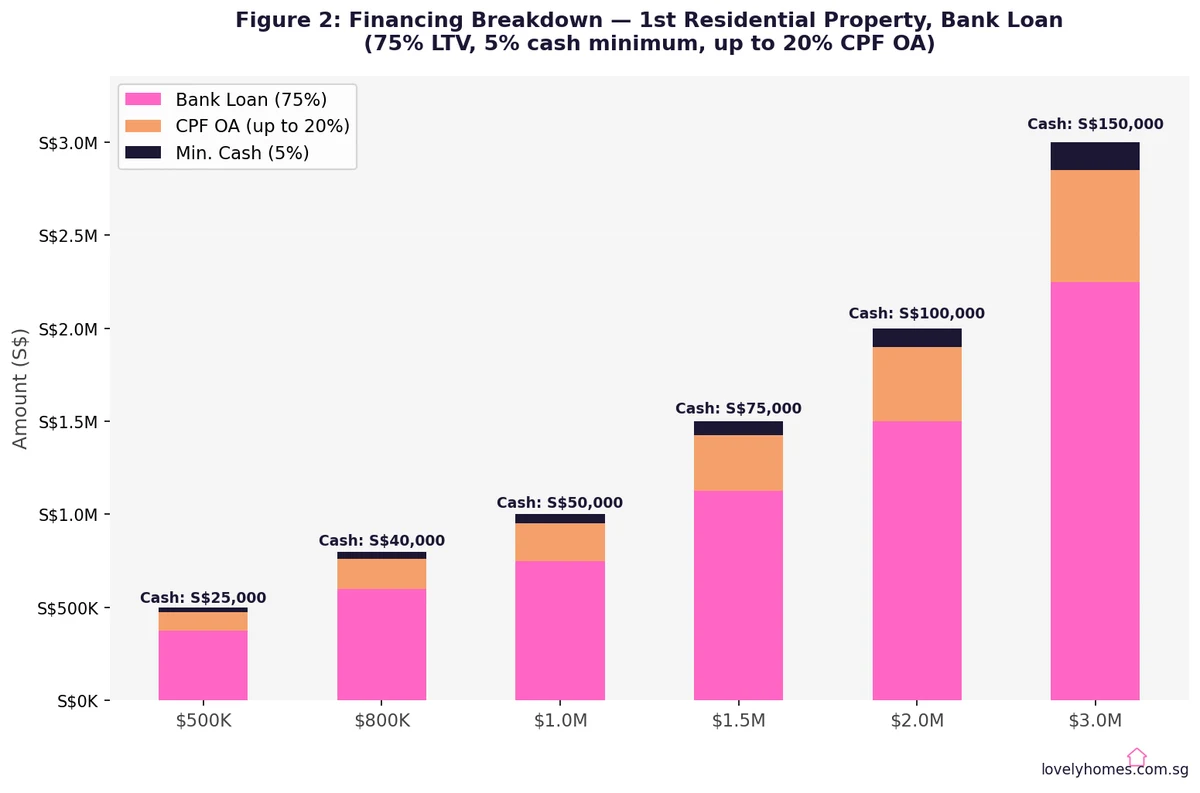
The LTV limit tells you the maximum loan; the downpayment rules tell you how to fund the rest. For a first residential property bought with a bank loan at 75% LTV, the remaining 25% of the purchase price or valuation must come from your own funds — but the split between cash and CPF is regulated:

  • Minimum 5% must be in cash (option money paid at OTP stage counts towards this).
  • The remaining 20% may be CPF OA savings, provided you have sufficient CPF OA balance.
  • If your CPF OA is insufficient, the shortfall must be covered in cash.
Stacked bar chart showing loan CPF and cash breakdown by property price Singapore 2026
Figure 2: Financing breakdown for a first residential property with a bank loan at 75% LTV. The 5% minimum cash applies regardless of CPF balance. Source: MAS, CPF Board. LovelyHomes analysis.

For a second property (45% LTV, bank loan), the downpayment requirements are significantly higher: a minimum of 25% must be in cash, with the remainder up to 55% allowed in CPF OA (subject to the CPF Valuation Limit). On a S$1.5M second property, this means at least S$375,000 in cash — a substantial liquidity requirement that has deterred many would-be investors.

Age and Loan Tenure Adjustments

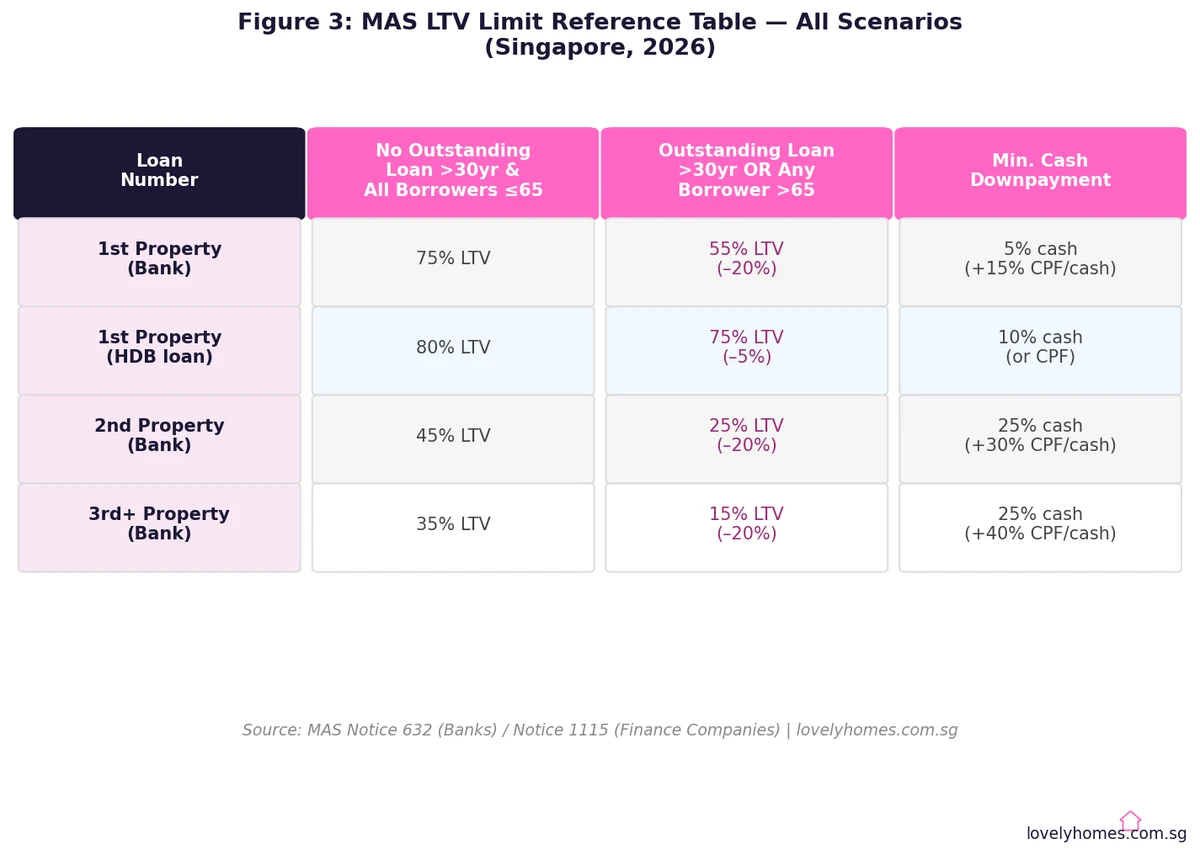
MAS introduced age and tenure adjustments to ensure borrowers are not over-leveraged into retirement. If the loan tenure exceeds 30 years, or if the loan term extends past any borrower's age of 65, the LTV limit is reduced:

  • 1st property, bank loan: Reduced from 75% to 55% (–20 percentage points).
  • 2nd property, bank loan: Reduced from 45% to 25% (–20 percentage points).
  • 3rd+ property, bank loan: Reduced from 35% to 15% (–20 percentage points).
  • 1st property, HDB loan: Reduced from 80% to 75% (–5 percentage points).

These reductions are designed to prevent borrowers from taking on mortgages that extend well beyond their working years — a common risk in high-cost property markets. A 35-year-old borrower taking a 31-year mortgage will still be under 65 at loan maturity (age 66) — this would trigger the reduction if the tenure exceeds 30 years.

Reference table showing all MAS LTV limit scenarios including age and outstanding loan adjustments Singapore 2026
Figure 3: Complete MAS LTV reference table covering all scenarios — loan number, tenure, and age adjustments (Singapore, 2026). Source: MAS Notices 632 and 1115.

LTV, TDSR and MSR: How All Three Work Together

LTV is one of three simultaneous constraints on your home loan quantum. The other two are:

  • Total Debt Servicing Ratio (TDSR): Your total monthly debt obligations (all loans, including the new mortgage) must not exceed 55% of your gross monthly income. This is enforced by MAS Notice 632 and applies to all bank loans. Even if the LTV allows a larger loan, the bank cannot lend you more than your TDSR permits.
  • Mortgage Servicing Ratio (MSR): For HDB flat purchases and executive condominium (EC) purchases from a developer, the monthly mortgage payment must not exceed 30% of gross monthly income. MSR applies on top of TDSR.

In practice, the binding constraint depends on the specific transaction. For high-income earners buying a modest property, TDSR may be non-binding, and LTV is the effective limit. For moderate-income buyers purchasing at the top of their budget, TDSR often caps the loan well below the LTV maximum.

Worked Example: LTV and Downpayment Calculation

Mr and Mrs Lim are Singapore Citizens purchasing their second private property (a 3-bedroom condo in Bishan) at S$1,800,000. They have an outstanding HDB loan on their existing flat (the HDB loan has not been fully repaid). This makes the condo purchase their second outstanding loan, triggering the 45% LTV limit.

Second Property — LTV Calculation

Purchase price S$1,800,000
LTV limit (2nd outstanding loan) 45%
Maximum bank loan S$810,000
Minimum cash (25% of purchase price) S$450,000
Remaining (CPF OA or additional cash) S$540,000
Of which: up to CPF Valuation Limit S$540,000 max CPF OA
ABSD (SC, 2nd property — 20%) S$360,000
BSD (on S$1.8M) S$54,600
Total cash required at purchase ≈S$864,600 (excl. CPF)

Note: TDSR check (not shown): monthly mortgage on S$810,000 at 4.0% stress-test rate, 25yr ≈ S$4,276/mo. Combined gross income needed at 55% TDSR ceiling: ≈S$7,775/mo. Subject to actual bank assessment.

This example illustrates why the second-property LTV regime is a significant barrier: the Lim family must find at least S$450,000 in cash for the downpayment alone — before stamp duties and legal fees. This is separate from any CPF they deploy.

Why LTV Limits Matter for Singapore Property Buyers

LTV limits are Singapore's most direct lever for managing household debt and property market risks. By capping leverage, MAS ensures that buyers retain meaningful equity stakes in their properties — reducing the risk of negative equity if prices correct. The progressive tightening across successive properties also channels investment demand into equity-funded transactions, where the buyer carries genuine risk rather than borrowing to speculate.

Compared internationally, Singapore's LTV framework is moderate by global standards for first-home buyers (75% compares favourably with many markets) but strict for investors (45% LTV for a second property is among the tightest in Asia). This asymmetry is deliberate: Singapore's policy goal is home ownership, not speculation.

What Might Come Next for LTV Limits

Adjustments to LTV limits are typically announced alongside broader cooling measure packages. MAS and the Ministry of National Development review market conditions periodically; relief measures (LTV easing) tend to follow sustained price corrections, while tightening follows runaway price growth. As at August 2026, there are no confirmed plans to adjust LTV limits. Market observers note that the robust transaction volumes in Q2 2026 and continued positive price sentiment in the private residential market make near-term easing unlikely.

Frequently Asked Questions: Singapore LTV Limits

Does the LTV limit apply to my total portfolio or each individual loan?

The LTV limit is assessed on each individual loan application, based on the number of outstanding home loans you hold at the time of the new application. If you have two properties but have fully paid off one mortgage, you are treated as having one outstanding loan when applying for financing on a third property — making the 45% LTV applicable, not the 35% third-property limit. This can create planning opportunities for buyers who time their loan repayments strategically before acquiring additional properties.

Can I use CPF to fund 100% of the downpayment?

No. For a first residential property with a bank loan, a minimum of 5% of the purchase price must be paid in cash (not CPF). The remaining 20% can come from CPF OA savings. For a second property with a bank loan, at least 25% must be in cash. CPF has no minimum cash requirement for HDB concessionary loans (all 20% can be CPF OA), but you must still have sufficient CPF OA balance. CPF withdrawal for property is also subject to the CPF Valuation Limit and the Basic Retirement Sum rules.

Does the LTV limit apply if I am purchasing through a company?

MAS Notice 632 applies to loans granted by financial institutions to individuals. Loans to companies are generally not subject to the same Notice 632 LTV limits, though banks will apply their own commercial lending criteria. However, purchasing residential property through a company triggers different ABSD rules (35% for entities as at 2026) and does not attract any preferential cooling measure treatment. The CPF and HDB concessionary loan systems are also not accessible for corporate purchasers. Most individuals find direct ownership more cost-effective than corporate structures.

What happens if the property valuation comes in lower than the purchase price?

The LTV is applied to the lower of purchase price or the bank's valuation. If the valuation is S$950,000 on a S$1,000,000 purchase at 75% LTV, the bank lends a maximum of S$712,500 (75% × S$950,000). The S$50,000 valuation shortfall must be funded entirely in cash — it cannot be covered by CPF. This is called a "cash over valuation" (COV) situation and was a significant feature of the HDB resale market before it was moderated by cooling measures. Buyers should conduct their own valuation research before committing to a purchase price.

Does refinancing a mortgage affect the LTV calculation for a new loan?

Refinancing an existing loan with a new lender does not create a new "loan number" for LTV purposes — it is treated as replacing the same outstanding loan. However, if you use a cash-out refinancing to release equity, the new loan quantum must still comply with the applicable LTV limit and TDSR rules. The relevant LTV for cash-out refinancing on an existing property is determined by the outstanding loan count at the time of the new application.

Is there any LTV relief for first-time HDB buyers?

Yes. First-time HDB flat buyers who take an HDB concessionary loan enjoy the highest LTV in Singapore's residential framework — 80% (or 75% if tenure or age adjustments apply). Combined with the Enhanced Housing Grant (EHG) and Family Grant which reduce the effective purchase price, first-time HDB buyers are the most generously supported segment of the Singapore property market. The HDB loan also has no stress-test rate requirement (unlike bank loans which apply a 4% floor under TDSR assessment), making it more accessible for moderate-income households.

Related Articles


Disclaimer: LTV limits in this article are based on MAS Notice 632, MAS Notice 1115, and HDB guidelines as at August 2026. Property regulations are subject to change; figures have been cross-referenced with official MAS and HDB publications. This article is for general informational purposes only and does not constitute financial, legal, or investment advice. All buyers should engage a qualified financial adviser and conveyancing solicitor before making any property decision. For official LTV regulations, refer to mas.gov.sg and hdb.gov.sg.

Translate »