East Coast Neighbourhood Guide Singapore 2026: D15 Prices, TEL Impact & Investment Outlook

East Coast Neighbourhood Guide Singapore 2026: D15 Prices, TEL Impact & Investment Outlook

×

Click outside or press Esc to close

District 15 (D15) — Singapore’s East Coast corridor — has long been one of the most sought-after residential addresses in the city-state. Anchored by Katong, Marine Parade, Siglap, Tanjong Katong, and the new Bayshore precinct, D15 blends Peranakan heritage, beachfront lifestyle, and increasingly, world-class MRT connectivity following the Thomson-East Coast Line (TEL) Stage 4 opening. This guide covers D15 property prices, HDB resale data, condo psf trends, TEL impact, investment outlook, and what to know before buying in 2026.

Quick Answer — East Coast D15 at a Glance (2026)

  • District 15 covers Katong, Marine Parade, Siglap, Tanjong Katong, Joo Chiat, and the upcoming Bayshore precinct.
  • HDB 4-room resale flats in D15 typically trade between S$520,000 and S$780,000 in Q1 2026.
  • Condo median psf ranges from ~S$2,100 psf (OCR fringes) to S$2,900+ psf (seafront / TEL-adjacent units).
  • TEL Stage 4 (seven stations opened June 2024) has cut commute times from East Coast to the CBD by 20–30 minutes.
  • Bayshore Road GLS site remains one of the most anticipated future launch sites along the Coast.
  • D15 rental yields for 2-bedroom condos average 3.0–3.8%, underpinned by strong expat and young-professional demand.
  • No freehold supply pipeline — almost all new launches are 99-year leasehold, elevating the premium for freehold pockets like Tanjong Katong Road.

What Is District 15 and Who Administers Property Here?

District 15 is one of Singapore’s 28 traditional postal districts, spanning the eastern corridor from Geylang Serai through Marine Parade, Siglap, and Bayshore to the fringe of D16 (Bedok). The Urban Redevelopment Authority (URA) administers land use planning, while HDB manages the substantial public-housing stock along Marine Parade Road, Siglap Plain, and the Lengkong areas. Marine Parade is one of Singapore’s older HDB towns, built out from the early 1970s on reclaimed land; this heritage gives D15 its unique mix of mature HDB estates, conservation shop-houses, private condos, and landed enclaves.

The district falls within the Rest of Central Region (RCR) under URA’s planning framework, meaning it is neither as expensive as the Core Central Region (CCR) nor as affordable as the Outer Central Region (OCR). This RCR positioning makes D15 attractive to both owner-occupiers who want an urban lifestyle and investors who see a price gap versus Districts 9, 10, and 11.

D15 Property Price Ranges — Q1 2026
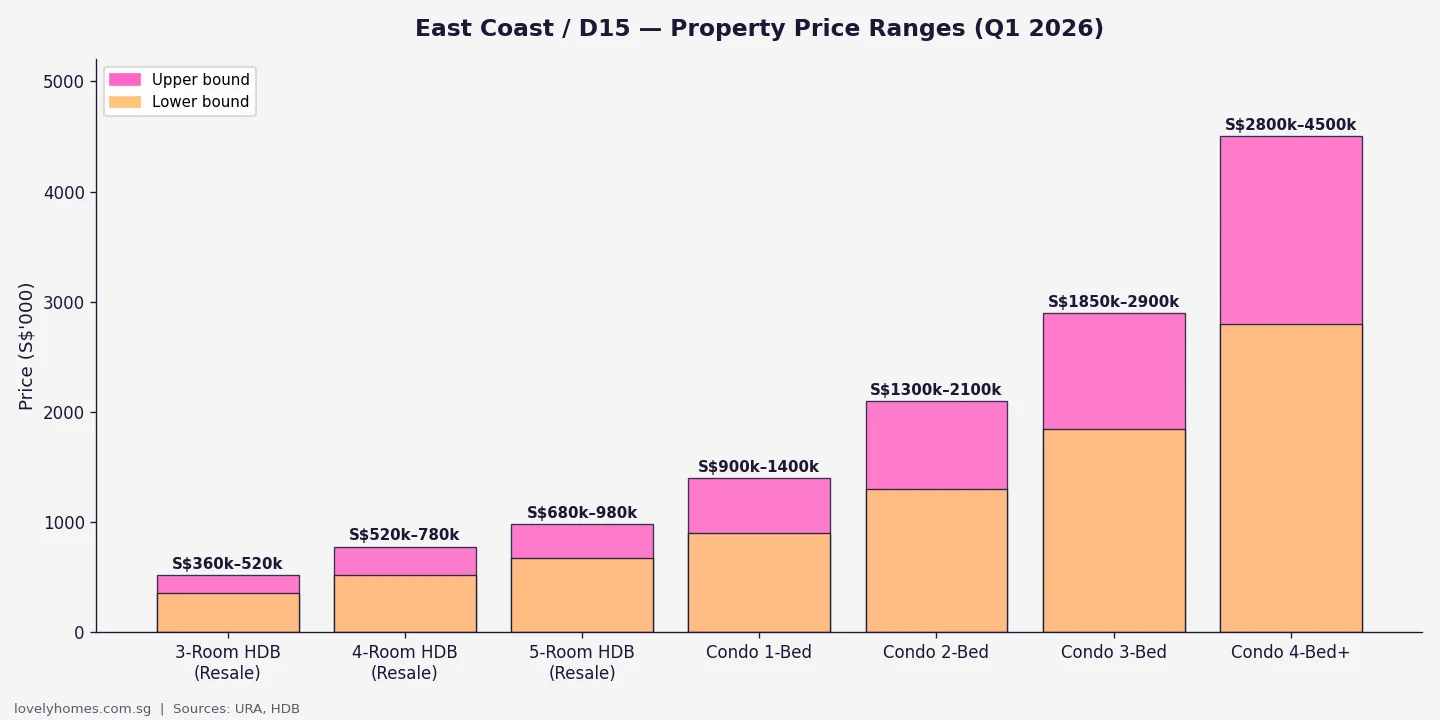
East Coast D15 property price ranges by type Q1 2026 HDB resale and condo
Figure 1: D15 East Coast property price ranges by type — Q1 2026. Sources: URA REALIS, HDB Resale Portal.

The D15 market is a tale of two submarkets. On the public housing side, Marine Parade’s mature HDB stock — 3-room, 4-room, and 5-room flats — trades at premiums well above the national median given their central location, sea views, and proximity to the new TEL stations. On the private side, a wide range of condos from 1980s-vintage developments to brand-new launches commands psf rates broadly in line with the RCR average, with TEL-adjacent and seafront addresses commanding a further 10–20% premium.

Property Type Typical Price Range (Q1 2026) Key Driver
HDB 3-Room Resale S$360k – S$520k Location, floor, TEL proximity
HDB 4-Room Resale S$520k – S$780k Sea view, high floor, age
HDB 5-Room Resale S$680k – S$980k Corner units, premium storey
Condo 1-Bedroom S$900k – S$1.4M Rental yield-driven
Condo 2-Bedroom S$1.3M – S$2.1M Most liquid size, expat demand
Condo 3-Bedroom S$1.85M – S$2.9M Family-size demand, school proximity
Condo 4-Bed / Penthouse S$2.8M – S$4.5M+ Scarcity, sea view, freehold tenure

The TEL Effect — How Thomson-East Coast Line Stage 4 Changed Everything

Before the Thomson-East Coast Line (TEL) Stage 4 opened in June 2024, East Coast residents faced a familiar frustration: despite living close to the city geographically, the absence of direct rail meant a bus-heavy commute or a drive. TEL Stage 4 introduced seven stations — Tanjong Rhu, Katong Park, Tanjong Katong, Marine Parade, Marine Terrace, Siglap, and Bayshore — fundamentally re-rating the district’s accessibility from “car-dependent” to “MRT-convenient”.
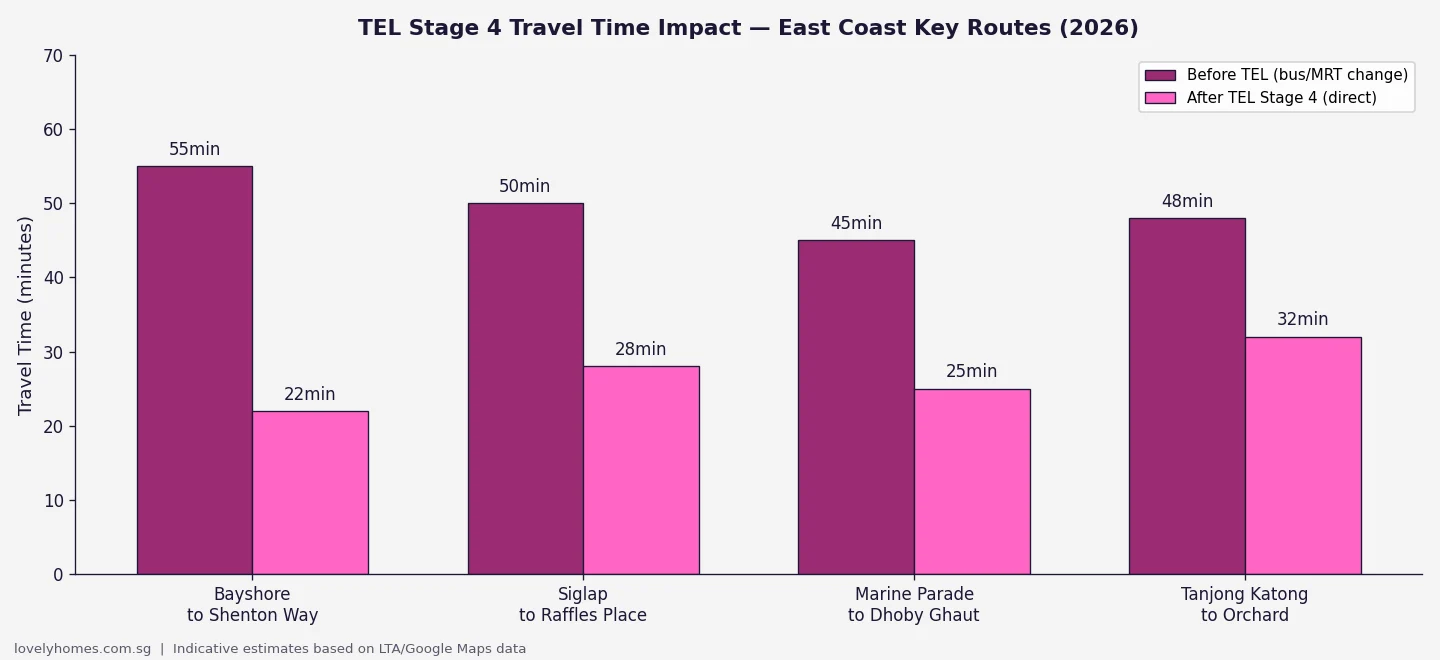
TEL Stage 4 travel time comparison East Coast to CBD 2026
Figure 2: TEL Stage 4 — indicative travel time reduction on key East Coast routes to the CBD (2026). Sources: LTA, Google Maps estimates.

The connectivity uplift has translated into measurable price momentum. Industry data suggests properties within 500 metres of a TEL Stage 4 station saw median psf appreciation of 8–12% in the 18 months following the line’s opening. The Bayshore precinct in particular — the eastern-most TEL stop in Stage 4 — has been flagged by URA as a future growth node, with rezoning planned for higher-density residential and mixed-use development along Bayshore Road.

Neighbourhood Character: Katong, Marine Parade, Siglap and Bayshore

Katong and Joo Chiat form the cultural heart of D15. Peranakan shop-houses line East Coast Road, with restaurants, heritage shopfronts, and boutique hotels giving the sub-precinct a character found nowhere else in Singapore. Property here — particularly freehold terraces and conservation shop-houses — commands a significant premium and rarely trades. Buyers who can afford the entry price acquire a genuinely irreplaceable asset.

Marine Parade is the most accessible sub-precinct, anchored by Marine Parade Road and its mature HDB precincts. Parkway Parade mall, the iconic East Coast Park, and a well-established network of amenities make this the most family-friendly address in D15. HDB resale prices here have historically tracked 10–20% below equivalent units in Bishan or Queenstown despite the beachfront lifestyle advantage — a gap that has since narrowed following TEL connectivity.

Siglap retains a village atmosphere that residents guard fiercely. Low-rise landed housing, a strong café culture along Upper East Coast Road, and proximity to good schools (CHIJ Katong, St Patrick’s School, Victoria School) make Siglap a perennial favourite for families. The new Siglap TEL station has changed the calculus for buyers who previously shied away due to the bus-only access to the city.

Bayshore is D15’s newest growth story. Located at the eastern fringe before the district transitions into D16, Bayshore benefits from both the East Coast Park Connector and its namesake MRT station. URA’s plans for Bayshore point towards higher-density condo development on the southern fringe, and a future Government Land Sales (GLS) site on Bayshore Road is anticipated to anchor the precinct’s transformation into a vibrant mixed-use node.

Condo PSF Trends — D15 vs RCR and Singapore Average (2019–2026)
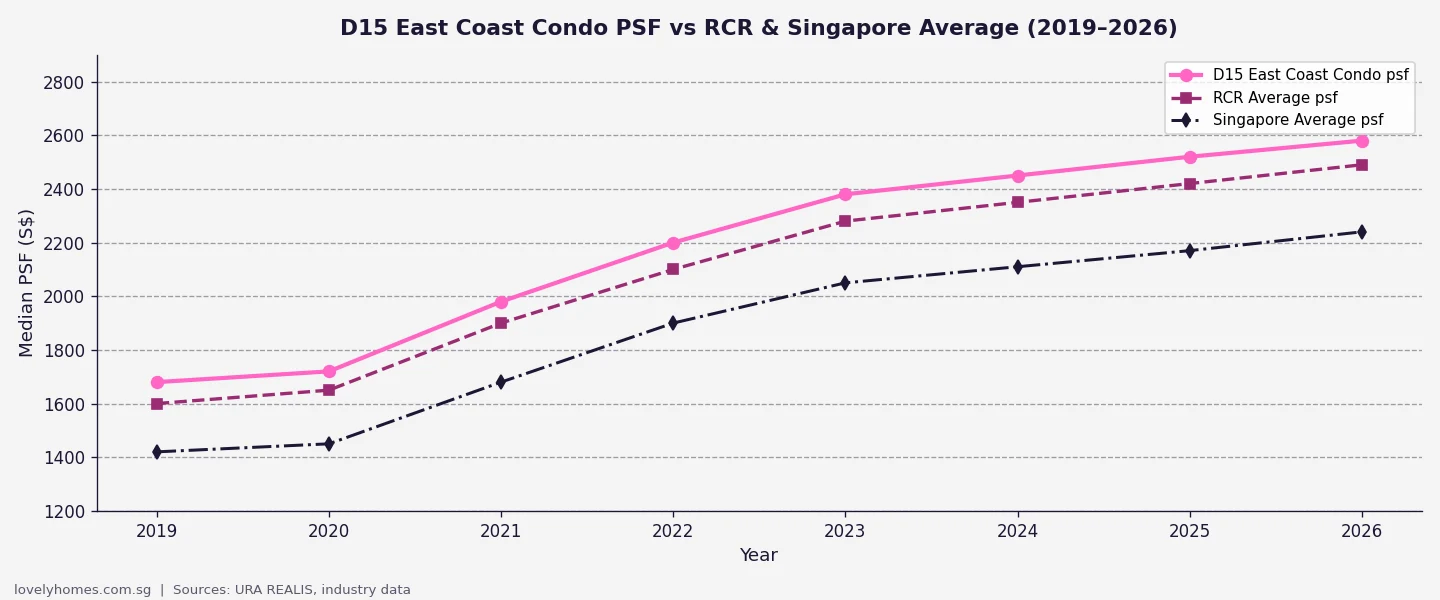
D15 East Coast condo PSF trend vs RCR Singapore average 2019 to 2026
Figure 3: D15 East Coast condo median psf vs RCR average and Singapore average (2019–2026). Sources: URA REALIS, industry data.

D15 condo prices have outpaced the Singapore average since 2021, partly driven by the TEL anticipation effect and partly by a shrinking freehold supply pool. By Q1 2026, D15 median psf sits at approximately S$2,580, which is modestly above the RCR average of S$2,490. This premium is structural — D15 has very little land for new development, so supply is constrained to occasional en-bloc rebuilds and infill GLS sites. The scarcity premium is likely to persist through the medium term.

Schools and Amenities in the East Coast

D15 is one of Singapore’s most amenity-rich districts. Key schools within or adjacent to the district include CHIJ Katong Primary, Tao Nan School, Victoria School, St Patrick’s School, Dunman High School, Temasek Secondary, and the Canadian International School (Tanjong Katong campus). The density of well-regarded schools within the 1-km and 2-km radii is a primary reason why family-sized 3- and 4-bedroom condos in D15 command a durable premium over equivalent units in less educationally dense districts.

For daily living, Parkway Parade, i12 Katong, Siglap Centre, and the East Coast Road stretch of independent restaurants, café chains, and hawker centres provide comprehensive retail and dining coverage. East Coast Park — Singapore’s most-used waterfront recreational space — runs the entire southern flank of the district, offering cycling, barbecue, sea sports, and camping facilities that are essentially impossible to replicate in inland districts.

Worked Example — Buying a D15 Condo in 2026

Profile: Ms Lim, Singapore Citizen, first-time buyer, age 33, monthly income S$9,800. She is considering a 2-bedroom resale condo in Tanjong Katong at S$1,680,000.

Cost Item Amount (S$) Notes
Purchase Price 1,680,000 Resale condo, D15
Buyer’s Stamp Duty (BSD) 53,400 Tiered: 1-6% on S$1.68M
ABSD (First Property, SC) 0 First property, SC — ABSD waived
25% Minimum Downpayment 420,000 5% cash + 20% cash/CPF
Bank Loan (75% LTV) 1,260,000 At ~3.8% p.a., 25 yr — est. monthly S$6,512
TDSR Check 66.5% S$6,512 / S$9,800 = 66.4% — FAILS TDSR 55%
Verdict Budget shortfall at S$9,800/mth single income. Ms Lim would need S$11,840/mth or a lower purchase price of ~S$1.3M, or a joint purchase. At S$1.3M: monthly repayment ~S$5,030; TDSR 51.3% — PASS.

This illustrates why D15 private property is increasingly a dual-income or high-income play, and why the HDB resale market remains the entry point of choice for single buyers at the S$8,000–S$10,000 income level.

Investment Case — Why East Coast Remains Compelling

D15’s investment appeal rests on three durable pillars. First, supply scarcity: unlike Jurong, Tengah, or Woodlands — districts where URA can release greenfield GLS sites at scale — D15’s private land is almost entirely built up, limiting new supply to occasional en-bloc redevelopments. This structural supply cap underpins prices even when transaction volumes soften. Second, lifestyle premium: East Coast Park, the coastal cycling paths, and the district’s café/dining culture create a quality-of-life premium that resonates with high-income locals and expats alike, supporting rental demand even when the broader market softens. Third, TEL optionality: the Bayshore precinct is still in the early stages of its transformation; investors who buy ahead of the anticipated GLS site award and subsequent launch are positioning for a significant uplift event in the 2027–2029 window.

What Might Come Next for East Coast (2026–2028)

This section reflects editorial analysis and should not be taken as a forecast or financial advice. The most significant near-term catalyst is the anticipated Bayshore Road GLS site, which is expected to attract developer interest given its direct TEL Bayshore station frontage and sea-view orientation. If awarded at a land rate above S$1,300 psf ppr, it would reset benchmark pricing for the eastern precinct. A second catalyst is the progressive ageing of Marine Parade’s HDB stock — a large cohort of flats are entering or approaching the 40-year mark, which historically triggers either en-bloc potential or Selective En Bloc Redevelopment Scheme (SERS) interest from HDB. Finally, the completion of the Greater Southern Waterfront masterplan, though primarily a D03–D04 story, may redirect some premium coastal living demand eastward to D15 as the western waterfront supply comes online.

Frequently Asked Questions

Is D15 East Coast a good area to buy property in Singapore?
D15 is consistently rated among Singapore’s most liveable districts for owner-occupiers. For investors, the structural supply scarcity, TEL connectivity uplift, and lifestyle premium make it a compelling hold. The principal risk is the high entry price — affordability constraints mean the pool of eligible buyers is thinner than in OCR districts, which can lead to longer marketing periods when selling. Buyers should ensure their holding horizon is at least 5–7 years to ride out any market cycles.
What is the cheapest way to enter the D15 market?
The most affordable entry point is a 3-room HDB resale flat in the Marine Parade or Joo Chiat sub-precincts, which can be acquired from around S$360,000 to S$520,000. For private property, older 99-year leasehold condos in the Tanjong Rhu or Haig Road areas can be found from S$900,000 to S$1.1M for a 1-bedroom unit, though buyers should pay close attention to remaining lease before purchasing, particularly for CPF usage eligibility.
How has TEL Stage 4 affected property prices in East Coast?
Industry data suggests that properties within 500 metres of the seven new TEL Stage 4 stations saw median psf appreciation of 8–12% in the 18 months following the June 2024 opening. The impact was sharpest at Siglap (where the station is the first MRT access ever) and Bayshore (future GLS catalyst). Properties further from the stations — particularly older landed in the Siglap interior — saw more modest appreciation as they were already priced for their lifestyle rather than connectivity premium.
What rental yield can I expect from a D15 condo?
For a 2-bedroom condo in D15 priced at S$1.5M–S$1.8M, gross rental yield is typically in the 3.0–3.8% range (S$4,500–S$5,500/month rent). 1-bedroom units can achieve slightly higher yields (3.5–4.0%) given their lower entry price relative to achievable rents. The East Coast’s popularity with expatriate families and the international school catchment (especially Canadian International School) provides a relatively stable tenant base. Net yield after maintenance fees, property tax, and vacancy periods is typically 2.2–3.0%.
Are there any new launch condos planned for D15?
The supply pipeline is thin, which is precisely the investment case. The most anticipated future launch is on a Bayshore Road GLS site, which remains unawarded as of mid-2026 but is expected to enter the 2H2026 GLS Confirmed or Reserve List. En-bloc redevelopments of older condos along Haig Road and Tanjong Rhu Road are also being quietly monitored by developers, though achieving the 80% owner consent threshold under Singapore’s Land Titles (Strata) Act remains challenging in a rising market where existing owners are reluctant to sell.
Can foreigners buy property in D15?
Foreigners can purchase strata-titled private residential properties (condos and apartments) in D15 without restriction, subject to the 60% Additional Buyer’s Stamp Duty (ABSD) on top of the standard progressive Buyer’s Stamp Duty (BSD). This makes foreign buying in D15 — or anywhere in Singapore — extremely expensive. HDB flats are restricted to Singapore Citizens and qualifying Permanent Residents only. Landed properties in D15 require specific approval from the Singapore Land Authority (SLA) for foreign nationals.
What schools are within 1 km of Marine Parade MRT station?
Marine Parade MRT (TEL) is within or near the 1-km school registration radius of CHIJ Katong Primary and Tao Nan School, both of which are consistently popular with families. Dunman High School and Victoria School (secondary) are also close by. Buyers purchasing specifically for school proximity should verify the precise distance against the Ministry of Education (MOE) school enrollment exercise dates, as the radius is measured from the child’s registered home address to the school gate.

Related Articles


Disclaimer: This article is produced by the LovelyHomes Editorial Team for informational purposes only and does not constitute financial, legal, or real estate advice. Property prices, stamp duty rates, and government policies are subject to change. All figures are indicative and sourced from publicly available data from the Urban Redevelopment Authority (URA), Housing and Development Board (HDB), Inland Revenue Authority of Singapore (IRAS), and the Monetary Authority of Singapore (MAS). Readers should consult a licensed property agent, financial adviser, or solicitor before making any property investment decision. Stamp duty calculations should be verified against the IRAS Tax Calculator at iras.gov.sg.
URA 1H 2026 GLS Programme: All 9 Confirmed List Sites Analysed — Supply, Locations and Price Outlook

URA 1H 2026 GLS Programme: All 9 Confirmed List Sites Analysed — Supply, Locations and Price Outlook

URA 1H 2026 GLS Programme: All 9 Confirmed List Sites Analysed — Supply, Locations and Price Outlook

Quick Answer — 1H 2026 GLS Confirmed List at a Glance

  • 9 sites on the 1H 2026 Confirmed List: 6 private residential, 1 mixed-use, 2 EC plots
  • Total supply: 3,940 private residential units + 635 EC units = 4,575 units via confirmed list
  • Bayshore Drive mixed-use site is the headline parcel — 1,280 residential units + 22,500 sqm commercial
  • Holland Plain (2nd site) sole bid received: Sim Lian at S$1,491 psf ppr (tender closed 7 May 2026)
  • Peck Hay Road (Newton CCR) tender closes 11 June 2026; River Valley Green Parcel C closes 18 June 2026
  • 1H 2026 confirmed list private supply is ~50% above the 10-year average — Government signalling adequate pipeline
  • Two EC sites at Canberra Drive (185 units) and Sembawang Drive (450 units) — now subject to 10-year MOP post-8 May reforms

The Urban Redevelopment Authority’s Government Land Sales (GLS) programme is the primary tool through which Singapore manages its private residential and executive condominium housing pipeline. Every new launch condo you see advertised — from Vela Bay to Tengah Garden Residences — originates with a developer winning a GLS tender years earlier. Understanding what is on the 1H 2026 confirmed list, where those sites sit, and what developers are likely to pay for them tells you a great deal about where new private supply will come from in 2028 and beyond.

This analysis covers all nine confirmed list sites from the 1H 2026 GLS programme, tracking tender timelines, indicative psf ppr ranges, expected launch pricing implications, and the macro supply picture. We cross-reference each site’s outcome against the most recent tender awards to give the clearest picture available as at 17 May 2026.

The 9 Confirmed List Sites — Overview and Unit Yield

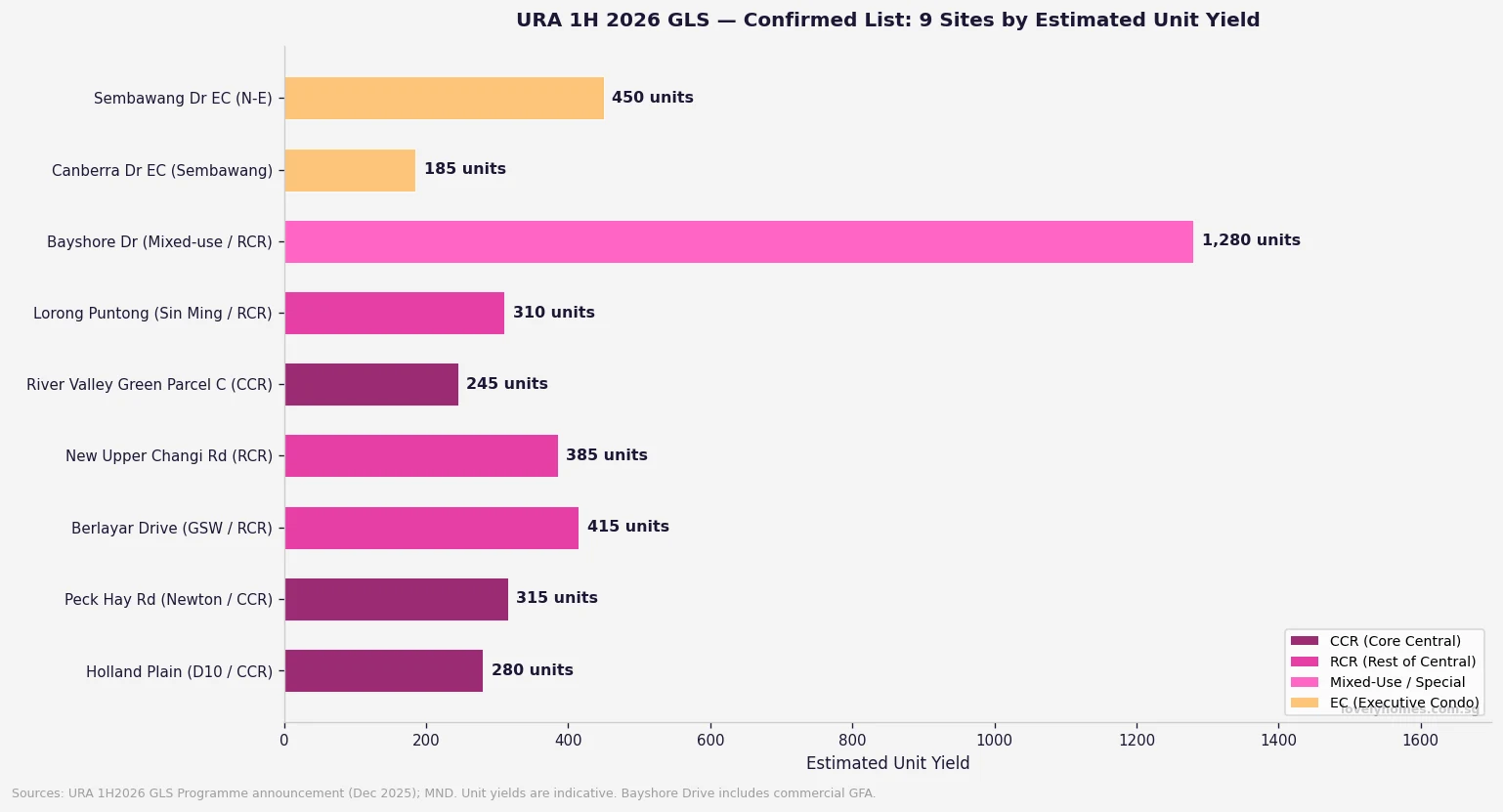
URA 1H 2026 GLS confirmed list 9 sites by unit yield Singapore
Figure 1: URA 1H 2026 GLS Confirmed List — all 9 sites by estimated unit yield, colour-coded by market segment (CCR, RCR, Mixed-Use, EC). Sources: URA, MND, December 2025.
Site Location / Region Units Tender Status (May 2026) Indicative Launch PSF
Holland Plain (2nd site) D10 / CCR, Bukit Timah ~280 Closed 7 May; Sim Lian sole bid S$1,491 psf ppr S$2,800–S$3,200+
Peck Hay Road Newton / CCR ~315 Tender closes 11 June 2026 S$3,200–S$3,800+
Berlayar Drive Gr Southern Waterfront / RCR ~415 Tender open / result pending S$2,400–S$2,900
New Upper Changi Road Bedok / RCR-adjacent OCR ~385 Tender open / result pending S$2,100–S$2,500
River Valley Green Parcel C River Valley / CCR ~245 Tender closes 18 June 2026 S$3,500–S$4,000+
Lorong Puntong (Sin Ming) Bishan–AMK / RCR ~310 Tender open / result pending S$2,400–S$2,800
Bayshore Drive (Mixed-Use) Bayshore / RCR-adjacent ~1,280 Tender just opened; est. closes Jul 2026 S$2,750–S$3,100
Canberra Drive EC Sembawang / North ~185 Tender result pending S$1,400–S$1,600 (EC)
Sembawang Drive EC Sembawang / North-East ~450 Tender result pending S$1,350–S$1,550 (EC)

The Supply Context — Is 1H 2026 GLS Generous or Restrained?

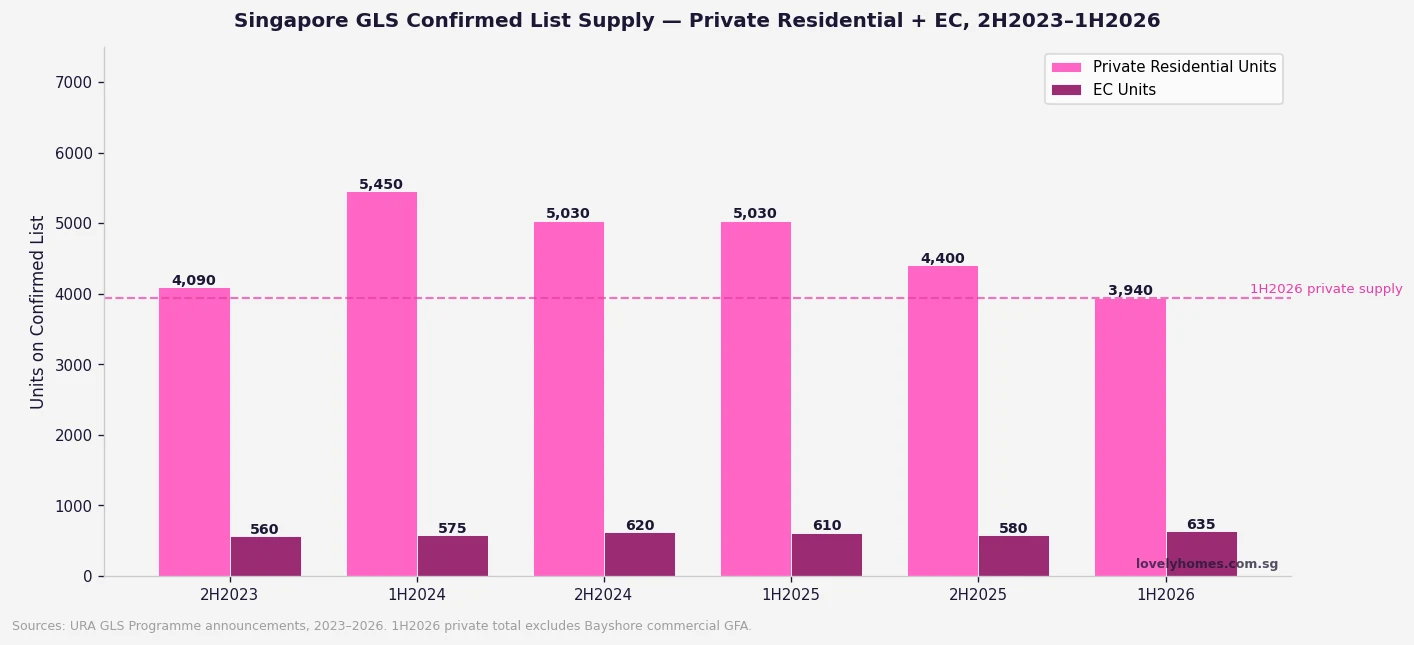
Singapore GLS confirmed list supply trend private residential and EC 2023 to 2026
Figure 2: Singapore GLS Confirmed List supply, 2H2023–1H2026 — private residential and EC units. Sources: URA GLS Programme announcements.

The 1H 2026 confirmed list private residential supply of 3,940 units is approximately 50% above the 10-year average for a half-year GLS confirmed list, according to URA’s own commentary on the programme at announcement in December 2025. The Government has explicitly stated that this elevated supply is intended to “provide adequate housing options to cater to housing demand” and to moderate price growth — particularly after private residential prices rose 0.9% in Q1 2026 (following 0.6% in Q4 2025), driven by outside central region (OCR) outperformance.

However, the 3,940 private units across six sites is still meaningfully below the 5,450 units offered in 1H 2024 (the cyclical peak). The pattern reflects the Government’s calibrated approach: high enough to signal commitment to supply, but not so aggressive as to flood the pipeline and depress developer sentiment. The Reserve List (which requires developer applications to activate) provides an additional buffer of approximately 5,200 private units that can be unlocked if demand signals warrant it.

Site-by-Site Analysis

Holland Plain (2nd Site) — A Sole Bid That Surprised Analysts

The second Holland Plain site drew a single bid from Sim Lian Group at S$1,491 psf ppr (S$454 million) when the tender closed on 7 May 2026. Analysts had expected three to five bidders; the sole bid reflects elevated construction cost pressure, the lingering premium already embedded in District 10 pricing, and the fact that Sim Lian already holds the adjacent first Holland Plain site. A sole bid does not automatically mean the site will be awarded — URA typically evaluates whether the bid meets the reserve price — but Sim Lian’s continued strategic interest in Holland Plain is clear.

If awarded at S$1,491 psf ppr, market observers indicate a launch PSF of approximately S$2,800–S$3,200 would be needed for the developer to achieve a reasonable margin. This would mark a modest premium to recent CCR resale comparables in the D10 corridor, but is not out of step with the broader trajectory of central region new launches.

Peck Hay Road — Newton’s Newest CCR Site (Closes 11 June 2026)

The Peck Hay Road site is arguably the most competitively positioned residential plot in the 1H 2026 programme. Located in the Newton MRT interchange area (North South and Downtown Lines), the 0.55-hectare former transitional office site is expected to yield approximately 315 units. Newton is one of Singapore’s most liquid and sought-after CCR sub-markets; recent comparable projects in the vicinity have transacted at S$3,000–S$3,800 psf for new launches.

The tender closes 11 June 2026. Given Newton’s track record with competing bids — the area consistently attracts four to six developers per tender — this is likely to be one of the more competitive tenders of the half. A top bid in the S$1,600–S$1,900 psf ppr range is plausible.

River Valley Green Parcel C — CCR Premium Pricing (Closes 18 June 2026)

River Valley Green Parcel C is the third plot in the River Valley Green precinct and sits within Singapore’s prime residential core. The previous two parcels in this precinct were awarded at S$1,246 psf ppr (Parcel A, 2023) and S$1,402 psf ppr (Parcel B, 2024). Parcel C is expected to follow this upward trajectory, with a likely bid range of S$1,450–S$1,700 psf ppr. At those land costs, launch pricing of S$3,500–S$4,000+ psf is feasible. The tender closes 18 June 2026.

Bayshore Drive Mixed-Use — The Billion-Dollar Site

Bayshore Drive is the marquee site of the 1H 2026 programme. As a mixed-use parcel combining 1,280 residential units with 22,500 sqm of commercial space and a direct underground link to Bayshore MRT station (Thomson-East Coast Line), it is the largest and most complex tender in the current cycle. URA and EdgeProp analysis suggests bids of S$1.2–S$2 billion are plausible — making it one of the largest single GLS transactions in Singapore’s history if realised at the upper end. The tender was recently opened and is expected to close around July 2026. We will report on the results as they emerge. See our full Bayshore Drive analysis published 17 May 2026 for detailed site-level commentary.

The Two EC Sites — First Launches Under the New Rules

Canberra Drive (185 units, Sembawang) and Sembawang Drive (450 units) are the first EC tender sites to be marketed entirely under the 8 May 2026 rule changes — specifically the 10-year MOP, 90% first-timer quota, Normal Payment Scheme only, and 15-year privatisation. Developers bidding for these sites must now price in a longer hold requirement and potentially reduced secondary-market liquidity for buyers, which may moderate land bids slightly relative to pre-May 2026 EC tenders. That said, the 90% first-timer quota actually increases base demand, partially offsetting the downward pricing pressure from the MOP extension.

Worked Example — How GLS Land Cost Translates to Launch Price

To understand why these GLS tender outcomes matter for buyers, consider a simple breakeven analysis. If Peck Hay Road is awarded at S$1,750 psf ppr (the psf per plot ratio applied to the maximum permissible gross floor area), a developer builds 315 units on a 0.55 ha site with a plot ratio of approximately 3.5 (hypothetical). Total land cost per unit: approximately S$960,000–S$1,100,000 per unit across a mix of 1-bedroom to 3-bedroom formats.

Adding construction costs (approximately S$450–S$550 psf of GFA in 2026), financing costs (~5–7% of total development cost over 4–5 years), professional fees, and developer margin (~15–18% on cost), the resulting launch price to achieve commercial viability is approximately S$3,200–S$3,600 psf for a typical Newton CCR new launch. This is the arithmetic that underpins the price forecasts in our summary table above.

For buyers, the practical implication is straightforward: land acquired in 1H 2026 tenders will yield projects launching in approximately 2028–2029. The prices you see in those launch brochures will reflect today’s land cost, construction cost inflation over the next two years, and developer expectations for market conditions at launch.

What to Watch in 2H 2026

The three immediate milestones for the GLS programme are: the Peck Hay Road tender result (11 June), River Valley Green Parcel C result (18 June), and the Bayshore Drive tender outcome (expected ~July 2026). Each will provide a live read on developer appetite, construction cost pressures, and land pricing at different market segments.

The 2H 2026 GLS programme (expected to be announced in June 2026) will also be watched closely for whether the Government adjusts the confirmed list size up or down — a signal of its read on both housing demand and developer capacity. Given Q1 2026’s 0.9% private price rise, any material reduction in the 2H confirmed list would likely be read as a market-positive signal by developers and investors alike.

Frequently Asked Questions

What is the GLS programme and how does it affect property prices?

The Government Land Sales (GLS) programme is the mechanism through which URA and HDB release state land for private and public housing development. Developers bid competitively for confirmed list sites, and the winning bid establishes the land cost that feeds through into eventual new-launch pricing approximately 3–5 years after the tender award. A higher volume of GLS sites — and more competitive bidding — generally anchors the supply pipeline and moderates price growth. Conversely, a lean GLS programme or weak bidding signals supply tightening and can anticipate future price pressure. For buyers of new launch condominiums, understanding the GLS pipeline helps set realistic expectations for the prices and supply timing of projects coming to market in 2027–2029.

Why did Holland Plain attract only one bid?

The sole bid for the Holland Plain second site reflects a combination of factors: (1) construction costs remain elevated in Singapore, squeezing developer margins on premium CCR land; (2) Sim Lian already holds the adjacent first Holland Plain site, giving them a strategic advantage that reduces other developers’ relative competitiveness; (3) rising interest rates globally (despite Singapore’s SORA decline) have increased the cost of development financing; and (4) the site’s expected launch PSF of S$2,800–S$3,200 sits in a segment where buyer depth (given ABSD and TDSR constraints) is more limited than in the OCR. A sole bid is unusual but not unprecedented in CCR tenders.

What is the Bayshore Drive mixed-use site and why is it significant?

The Bayshore Drive site is a 3.4-hectare mixed-use parcel that combines 1,280 residential units with 22,500 sqm of commercial gross floor area and a direct underground pedestrian connection to Bayshore MRT (Thomson-East Coast Line). Its significance lies in scale (it is among the largest single GLS parcels offered in several years), location (the emerging Bayshore precinct next to East Coast Park), and mixed-use zoning (which adds commercial value alongside residential). If awarded at estimated values of S$1.2–S$2 billion, it will be one of the highest-value individual land sales in Singapore’s GLS history. See our Bayshore Drive GLS Tender 2026 piece for full site analysis.

How does the 1H 2026 GLS supply compare to previous years?

The 3,940 private residential units on the 1H 2026 confirmed list is approximately 50% above the 10-year average for a half-year confirmed list, but below the 5,450-unit peak seen in 1H 2024. URA has explicitly framed the elevated supply as a measure to ensure adequate pipeline and moderate price growth. Combined with the 12-site reserve list providing a further ~5,200 private units that can be activated on demand, total potential supply from the 1H 2026 GLS programme is approximately 9,185 units — a robust buffer against near-term supply shortfalls.

Should I wait for GLS results before buying a new launch?

GLS results affect new launches that will be built and sold approximately 3–5 years from now — they do not directly affect the pricing of projects already in the market today (such as Bayshore Parcel A, Tengah Garden Residences, or projects under construction). If you are considering a new launch purchase in 2026, the relevant supply is what is already available and selling, not what developers will bid for land this year. That said, monitoring GLS demand (bid volumes, psf ppr paid) gives a useful forward signal: when developers bid aggressively, they believe in future demand and pricing — which is supportive for current buyers. When they bid conservatively or not at all (as with Holland Plain’s sole bid), it may suggest more caution about the premium segment’s near-term outlook.

Related Articles

Disclaimer: This analysis is for general informational and commentary purposes only and does not constitute financial, investment, or property advice. GLS tender outcomes, indicative unit yields, and launch price projections are estimates based on publicly available data from URA, MND, and industry commentary as at 17 May 2026, and are subject to change. Actual tender results, awarded prices, and developer launch strategies may differ materially from projections. Always conduct independent research and consult a licensed conveyancing lawyer, financial adviser, or property consultant before making any investment decision. For official data, refer to URA.gov.sg, MND.gov.sg, and HDB.gov.sg.

Singapore Double-Launch Weekend April 2026: TGR + Vela Bay Move 1,224 Homes in 48 Hours

Singapore Double-Launch Weekend April 2026: TGR + Vela Bay Move 1,224 Homes in 48 Hours

Published 28 April 2026. Reflects developer launch-weekend announcements and Singapore property press coverage of 25–26 April 2026.

Quick Answer — what happened

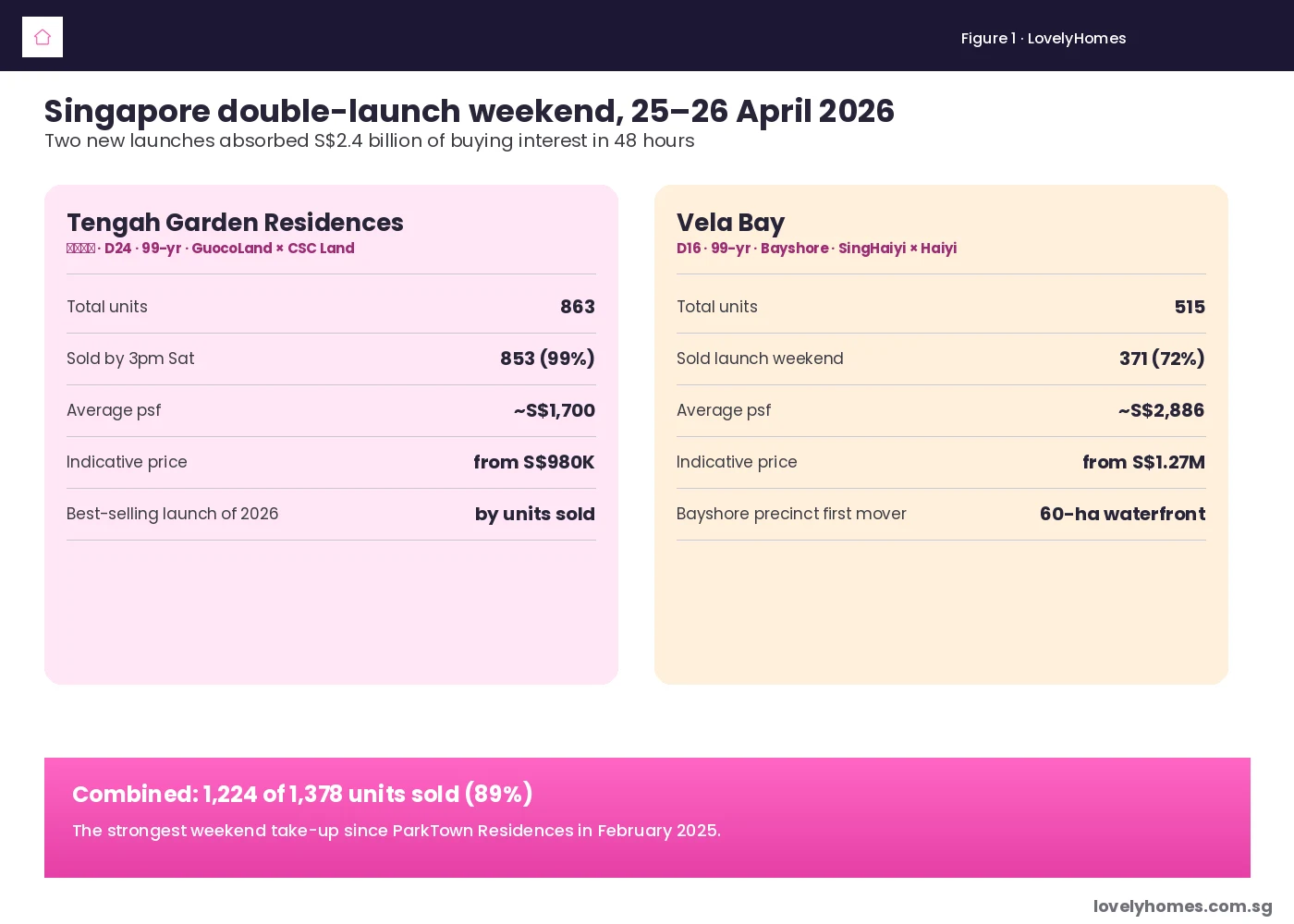
  • Two major Singapore new condo launches went live on the weekend of 25–26 April 2026: Tengah Garden Residences (863 units, 99-yr leasehold, GuocoLand × CSC Land) and Vela Bay (515 units, 99-yr leasehold, SingHaiyi × Haiyi Holdings).
  • Combined, the two projects sold 1,224 of 1,378 units (89%) over the launch weekend.
  • Tengah Garden Residences cleared 853 of 863 units (~99%) by Saturday afternoon, the strongest launch-day take-up since ParkTown Residences in February 2025.
  • Vela Bay sold 371 of 515 units (~72%), becoming the first private launch in the 60-hectare Bayshore waterfront precinct.
  • Average prices: Tengah Garden Residences ≈ S$1,700 psf, with units from S$980,000. Vela Bay ≈ S$2,886 psf, with units from S$1.27 million.
  • The weekend’s combined gross sales value is approximately S$2.4 billion, the largest dual-launch weekend on record for Singapore residential property.

The headline numbers

Singapore’s primary condo market has been described as “thin but priced firm” through Q1 2026. The weekend of 25–26 April 2026 ended that narrative with a single set of launch figures. By close of business Sunday, two new projects in different parts of the island had between them moved more units than the entire month of February 2026.

Tengah Garden Residences, the first private condominium launched inside the Tengah HDB-led new town, registered 853 sales out of 863 units — a 99% sell-through rate. Vela Bay, the first private residential launch in the Bayshore precinct in the East, sold 371 of 515 units. The two projects together absorbed buyer demand worth roughly S$2.4 billion in 48 hours.

Tengah Garden Residences and Vela Bay launch weekend results 25–26 April 2026 — combined 1,224 of 1,378 units sold
Figure 1: 1,224 of 1,378 units sold across the two projects — roughly 89% of available stock cleared in two days.

Tengah Garden Residences — the suburb story

Developed jointly by GuocoLand and CSC Land Group on a 99-year leasehold parcel along Tengah Garden Avenue (District 24), Tengah Garden Residences was launched at indicative prices from S$980,000 for one-bedroom units. Average pricing landed at roughly S$1,700 per square foot, slotting in between recent Outside-Central-Region (OCR) launches and the older Bukit Batok mass-market resale stack.

Key drivers of the near-sellout:

  • Pent-up Tengah demand. Tengah’s residential identity has been HDB-led since 2018, with no private launches inside the estate. The opening of the first private project tested an aspirational segment that had been waiting four years.
  • Pricing that read as “below ParkTown”. ParkTown Residences in Tampines launched at a higher OCR psf in February 2025; the Tengah price point felt restrained by comparison.
  • Singapore-Citizen-heavy buyer mix. Over 90% of buyers are reported to be Singapore Citizens, consistent with the post-2023 ABSD regime where foreign demand at OCR price points has thinned.
  • Connectivity story. Future Tengah MRT (Jurong Region Line, opening 2027–2028) and the proximity of the new Tengah town centre supported the long-hold buyer thesis.

Vela Bay — the Bayshore opener

Vela Bay, by SingHaiyi Group and Haiyi Holdings, launched at average prices of around S$2,886 psf, with one-bedroom units from S$1.27 million. The 515-unit project sits inside the Bayshore precinct, an emerging 60-hectare master-planned waterfront on the East Coast.

The Vela Bay take-up of 72% is more modest than Tengah Garden Residences’ 99%, but no less interesting:

  • Higher absolute price point. A typical 2-bedroom Vela Bay unit lands above S$2 million; that is a different buyer profile from Tengah.
  • First-mover premium. As the only private launch in a precinct still under construction, Vela Bay’s price had to absorb the discount buyers usually demand for “go-first” risk on infrastructure delivery.
  • Nine new sites in 1H 2026 GLS. URA’s 1H 2026 Government Land Sales programme released nine confirmed-list sites with capacity for ~9,185 units. The sequencing of those sites — including the Bayshore Drive mixed-use plot whose tender closes 15 July 2026 — is shaping how buyers price first-mover Bayshore stock.
  • SingHaiyi balance-sheet narrative. SingHaiyi has been a heavy participant in en-bloc and GLS bids in 2026 (it was also part of the consortium that won Loyang Valley en-bloc at S$880 million); its Bayshore launch is a clear conviction trade by the developer.
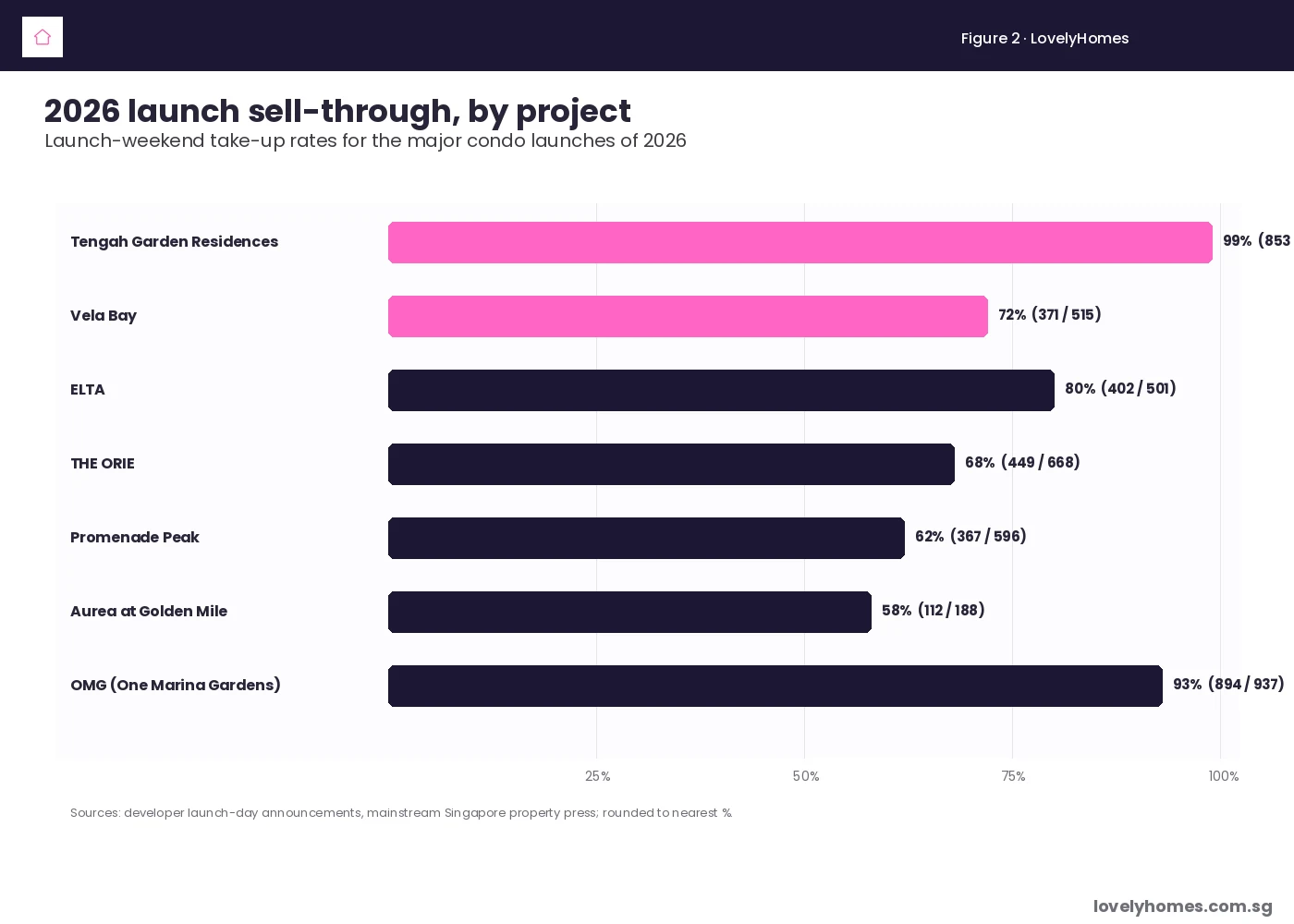
2026 Singapore condo launch sell-through rate comparison across major launches
Figure 2: Tengah Garden Residences sits at the top of the 2026 launch sell-through table. Vela Bay’s 72% is also above the 2026 OCR/RCR average.

What the weekend tells us about 2026 demand

Metric Reading Implication
Combined launch-weekend take-up 1,224 / 1,378 units (89%) Latent demand absorbing strongly when supply opens at the right price
OCR launch psf — Tengah ~S$1,700 Below recent comparable OCR launches; a “value” anchor for 2026 OCR pricing
RCR/East launch psf — Vela Bay ~S$2,886 Setting the benchmark for the Bayshore precinct ahead of the Bayshore Drive GLS tender
Buyer mix Predominantly Singapore Citizen Foreign demand still suppressed by the 60% ABSD; the market is local-driven
2026 launch pipeline ~17 projects, ~8,100 units 30% lower than 2025 — supply scarcity supports launch-day pricing power

What this means for buyers

For prospective Tengah buyers who missed the launch ballot, the resale option will likely sit at a 3–7% premium once units start changing hands — typical for a near-sellout launch. Tengah Garden Residences will not have additional release tranches for some months given the sell-through.

For Vela Bay, with 144 units (28%) still available, the post-launch phase remains accessible at launch pricing. Buyers should monitor whether units in Towers 1 and 2 are released before infrastructure milestones in the Bayshore precinct — first-mover units historically appreciate as the precinct fills out, but only if pricing on later launches doesn’t undercut them.

For the broader market, the weekend confirms that well-priced, well-located new launches in Singapore can still clear at speed in 2026, against the narrative of cooling-measure overhang. The discipline is on launch-day pricing: Tengah’s near-sellout came at a psf below what some industry watchers had projected for an OCR launch this cycle. Vela Bay’s slower (but still strong) take-up suggests that buyers in the higher-price RCR segment remain willing to pay up only for clearly differentiated locations.

What might come next

Two near-term watchpoints:

  • Bayshore Drive mixed-use GLS tender (closes 15 July 2026). The land bid will be read against Vela Bay’s launch psf as a price discovery point for the precinct.
  • BTO June 2026 ballot (~6,900 flats). If HDB pricing continues to compress against private OCR pricing, the substitution effect supports a second wave of OCR private demand later in 2026.

The next major private launches in the calendar — Bayshore Drive (if the tender awards in 1H 2026), Sembawang Drive EC, and a likely 2H 2026 District 5 OCR launch — will tell us whether the 25–26 April weekend was a one-off catch-up after a thin Q1, or the start of a measurably stronger primary market.

Frequently asked questions

Why did Tengah Garden Residences sell so much faster than Vela Bay?

Three reasons. First, price: at ~S$1,700 psf, Tengah’s entry price of S$980,000 sits below the typical OCR launch and is reachable for HDB upgrader couples. Vela Bay at ~S$2,886 psf and S$1.27 million entry sits in a different affordability cohort. Second, Tengah is a four-year-old new town with a built-out HDB community already in occupation; Vela Bay is the first launch in a precinct still under construction. Third, Tengah was the first private launch in the new town — a one-off scarcity premium that Vela Bay does not enjoy because more Bayshore launches will follow.

Is this evidence that cooling measures aren’t working?

Not necessarily. Cooling measures (the April 2023 ABSD hike, the September 2022 LTV / TDSR tightening) have visibly suppressed foreign demand and kept investor flows thin. The April 2026 launches were powered overwhelmingly by Singapore Citizen owner-occupier and upgrader demand, which is exactly the segment policy-makers wanted to remain active. The strong take-up reflects pent-up local demand meeting limited new supply, not a re-acceleration of speculative buying.

Should buyers chase a near-sellout launch like Tengah?

Generally no. Once a launch clears 90%+, the remaining stock is typically the less attractive layouts or units, and the resale market opens at a premium. The discipline for buyers is to be at the front of the queue at launch — or wait for the resale market to settle 6–9 months later when the urgency premium has softened.

What does this mean for the Bayshore Drive GLS tender?

Vela Bay’s 72% sell-through at ~S$2,886 psf gives bidders a reference point for what a Bayshore launch can absorb at price. If the Bayshore Drive GLS tender bids land at above S$1,400 psf ppr, the implied launch psf for the next Bayshore project would be approximately S$3,000+, which is testable against Vela Bay’s revealed demand curve.

How does this compare to historical strong launches?

The 99% Tengah figure is the highest launch-weekend take-up since ParkTown Residences in February 2025, which moved 87% on launch day. Going further back, Lentor Mansion (2024), Amo Residence (2022), and Treasure at Tampines (2019) all booked similar 90%+ launch-day percentages. Each of those projects shared the same ingredients as Tengah: a clear price-point anchor, an underserved sub-market, and a strong upgrader cohort.

Will more units be released?

For Tengah Garden Residences, the developer has not announced a second tranche; with only 10 units unsold, there is little to release. For Vela Bay, the remaining 144 units (28%) will be released in batches over the coming weeks at the same indicative price band; movements above launch pricing typically follow demonstrated take-up of 80%+.

Disclaimer. All sales figures, prices and dates are based on developer launch-day announcements and public reporting in the Singapore property press. Final transaction figures will be reflected in URA Realis caveats over the coming weeks. This article is general market commentary and does not constitute investment, legal or financial advice. Buyers should always verify current pricing and availability with the developer’s appointed sales gallery and consult a licensed Singapore conveyancing lawyer before exercising any Option to Purchase. Cooling-measure thresholds and ABSD rates are administered by the Inland Revenue Authority of Singapore and the Monetary Authority of Singapore.
New Launch
Tengah Garden Residences
Vela Bay
Singapore Property Market
Property News
OCR
Bayshore
Tengah
SingHaiyi
GuocoLand

Translate »