
CPF Property Guide 2026: How to Use Your CPF OA to Buy Property in Singapore
Your CPF Ordinary Account (OA) is the single most powerful financial tool most Singaporeans have access to when buying property — and also the most widely misunderstood. Used correctly, it can cover your down payment, service your monthly mortgage, and reduce the cash you need to bring to the transaction. Used without understanding the rules, it can result in an unpleasant surprise at the point of sale: a large “refund” obligation that dramatically reduces the cash proceeds you walk away with.
This CPF property guide 2026 walks through every rule governing CPF OA usage for Singapore residential property — which property types qualify, what the withdrawal limits are, how accrued interest works, and what the net financial impact looks like across different holding periods. All figures reflect CPF Board and IRAS policy as at 6 August 2026.
Quick Answer — CPF Property Usage at a Glance
- CPF OA can be used for down payment, monthly mortgage instalments, BSD, and legal fees
- CPF OA rate: 2.5% p.a. (confirmed January 2024; minimum rate guaranteed by CPF Act)
- HDB flat: CPF OA usable up to the property valuation (if lease covers youngest buyer to age 95)
- Private residential: CPF OA usable up to the Valuation Limit (VL) with additional withdrawal beyond VL if lease ≥ 30 years remaining covering buyer to age 95
- Properties with remaining lease < 60 years face pro-rated CPF withdrawal caps
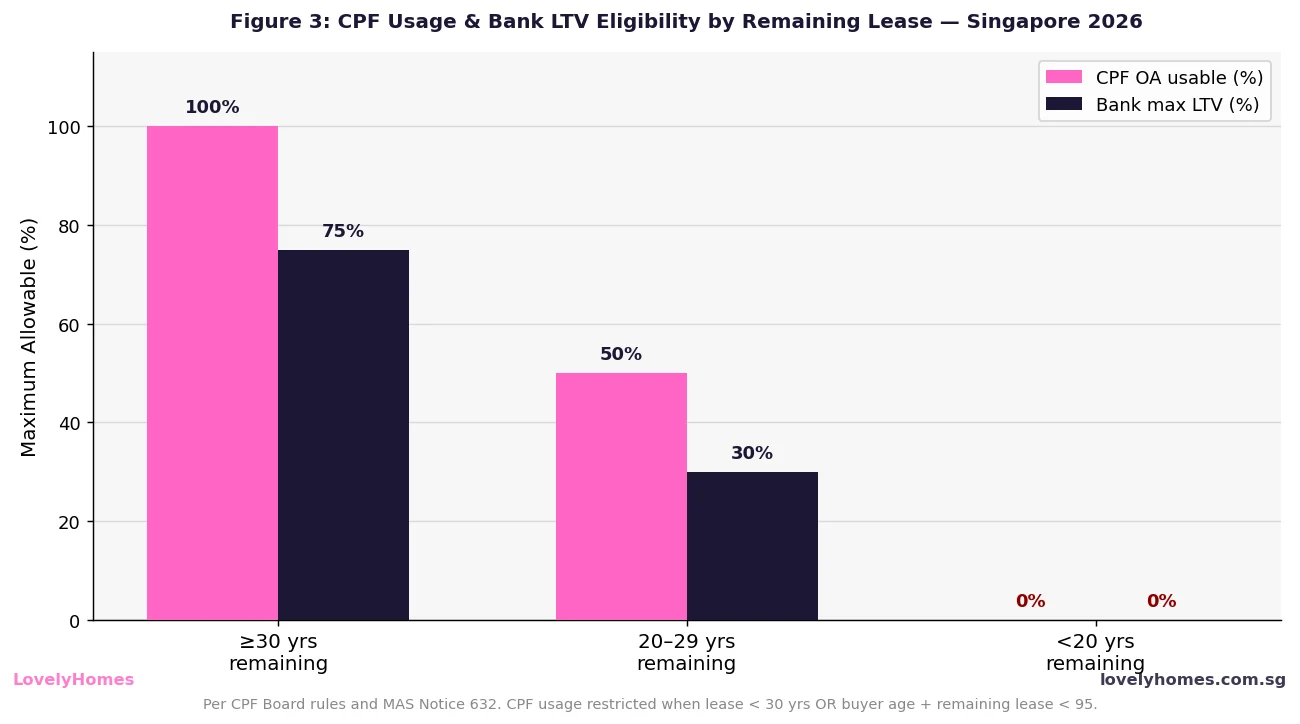
- Properties with remaining lease < 20 years are ineligible for CPF usage
- Upon sale, CPF principal and accrued interest must be refunded to CPF — not kept as cash
- This CPF refund obligation can substantially reduce apparent net cash proceeds
- CPF cannot be used for commercial or industrial properties
- For EC and private condo: only bank loans; CPF OA rules apply as for private residential
What Can CPF OA Be Used For in a Property Purchase?
The CPF Board, established under the Central Provident Fund Act, permits members to use their Ordinary Account savings for residential property purchases under the CPF Public Housing Scheme (for HDB flats) and the CPF Private Properties Scheme (for private residential, including ECs). Within these schemes, CPF OA funds may be applied towards four categories of property-related expenditure.
Down Payment: The initial cash portion of a property purchase — which for bank loans is at least 5% of the purchase price in cash (the Option to Purchase exercise fee) — cannot be covered by CPF. However, the remaining portion of the down payment above the 5% cash minimum (for a bank loan this is up to 20% of the purchase price for a 75% LTV loan) may be funded from CPF OA, subject to there being sufficient OA savings.
Monthly Mortgage Instalments: CPF OA savings can be used to service monthly loan instalments on an approved residential property loan. The amount drawn from CPF each month is subject to a cap: for HDB flats using an HDB loan, CPF can service the instalment in full (subject to the prevailing withdrawal limit rules). For bank loans, CPF can service the instalment up to the Valuation Limit (VL) — which is the lower of the purchase price or market valuation at the time of purchase.
Buyer’s Stamp Duty: BSD payable on the purchase price may be funded from CPF OA, within the applicable withdrawal limits.
Legal Fees: Conveyancing legal fees related to the property transaction may be funded from CPF OA. This typically amounts to S$2,000–S$4,000 for a standard residential purchase.

CPF Withdrawal Limits: HDB vs Private Property
The rules governing how much CPF OA can be withdrawn for a property purchase differ significantly between HDB flats and private residential properties. The key distinction is the concept of the Valuation Limit (VL), which applies to private properties (including ECs purchased under a bank loan) but not to HDB flats purchased with an HDB concessionary loan.
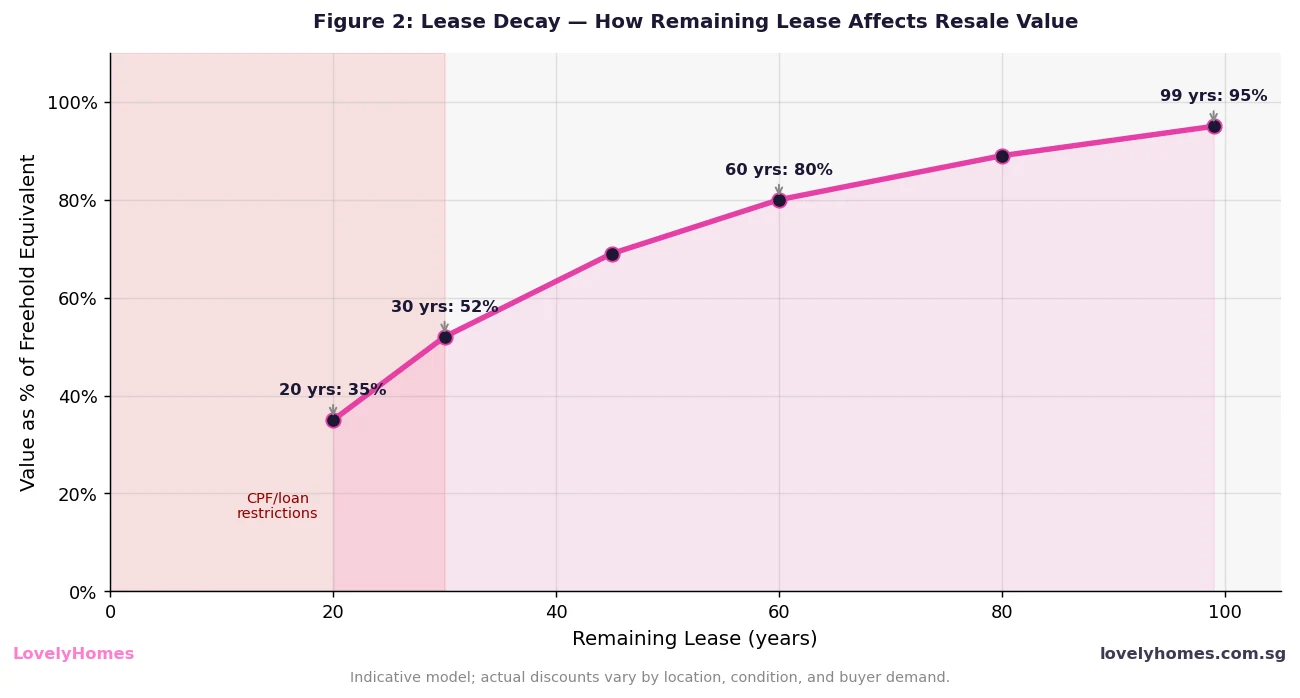
HDB Flats (HDB Concessionary Loan): There is no hard cap tied to the VL for HDB flat buyers using an HDB loan. CPF OA can generally be used up to the full purchase price / valuation of the flat, provided the property’s remaining lease at the time of purchase covers the youngest buyer to at least age 95. If the lease cannot cover to age 95, CPF usage is pro-rated based on the proportion of the lease that can cover the youngest buyer to age 95, relative to the total lease. Properties with remaining lease below 20 years are ineligible for any CPF usage.
Private Residential Properties (including ECs, Bank Loans): CPF OA may be used up to the Valuation Limit (VL), which is defined as the lower of the purchase price or the property valuation at the time of purchase. Beyond the VL, additional CPF withdrawal is only permitted if the property’s remaining lease at the time of purchase is at least 30 years and can cover the youngest buyer to age 95. If both conditions are met, CPF OA may be used beyond the VL for the remaining outstanding loan balance. If the remaining lease is between 20 and 59 years, CPF usage is further capped on a pro-rated basis.
The practical implication: for most buyers of newer private condos and ECs in Singapore (where remaining lease is typically 60+ years), the VL effectively poses no real constraint since the full loan can typically be serviced from CPF up to the VL. However, for older resale private properties — particularly leasehold properties built in the 1970s and 1980s — reduced remaining lease can sharply curtail CPF access and increase the cash requirement.
| Remaining Lease | CPF OA Usage (HDB) | CPF OA Usage (Private / EC) |
|---|---|---|
| ≥ 60 years (covers buyer to 95) | Up to full property value | Up to VL; beyond VL if lease ≥ 30yr covering buyer to 95 |
| 20–59 years (covers buyer to 95) | Pro-rated up to VL | Pro-rated up to VL only |
| < 60 years (does NOT cover buyer to 95) | Pro-rated based on proportion covering buyer to 95 | Pro-rated; stricter cap |
| < 20 years | No CPF usage allowed | No CPF usage allowed |
CPF Accrued Interest: The Hidden Cost of Using CPF for Property
Every dollar of CPF OA withdrawn for property accrues interest at the prevailing CPF OA rate — currently 2.5% per annum (confirmed January 2024, guaranteed minimum under the CPF Act), compounded annually. This interest is not paid to the Government; it is a bookkeeping adjustment reflecting what the withdrawn funds would have earned had they remained in the CPF OA. When the property is eventually sold, the CPF member must refund both the principal withdrawn and the accrued interest back to their CPF account.
This refund obligation is frequently misunderstood. It is not a penalty or a tax. The money goes back into the CPF member’s own OA, where it may be used again for another property purchase, withdrawn at age 55 above the Full Retirement Sum (FRS), or otherwise deployed under CPF rules. However, from the perspective of the property sale — where most sellers focus on the gross sale price — the CPF refund obligation can make a substantial dent in the net cash received from the transaction.

The accrued interest calculation works as follows: if a member withdraws S$300,000 from CPF OA on day one of the purchase and holds the property for 10 years, the CPF interest accrued on that principal alone amounts to approximately S$300,000 × ((1.025)^10 − 1) ≈ S$84,000. Over 25 years, that same S$300,000 would accrue approximately S$221,000 in interest, bringing the total CPF refund on sale to S$521,000 from a S$300,000 initial withdrawal — a significant obligation that must be factored into any sale-proceeds analysis.
How CPF Usage Affects Your Net Cash Proceeds on Sale
The full picture of CPF’s impact on property becomes clear only at the point of sale. Consider the following sequence on a completed property sale.
When a property is sold, the conveyancing process directs the sale proceeds as follows: first, any outstanding mortgage is redeemed with the sale proceeds (paid to the bank). Second, the CPF principal withdrawn (for down payment, stamp duty, legal fees, and all monthly mortgage instalments from OA) plus accrued interest at 2.5% p.a. is refunded to the seller’s CPF OA. Only then does the seller receive the net cash balance — from which agent commissions, legal fees on the sale, and any other costs are deducted.

Importantly, the CPF refund is not money lost — it returns to the seller’s CPF OA and can be redeployed for a future property purchase. However, it is cash that cannot be used freely, withdrawn for personal expenses, or invested outside CPF without meeting withdrawal conditions (such as reaching age 55 with the FRS set aside). Sellers who forget to account for the CPF refund obligation in their sale-proceeds projections often find themselves in a cash-constrained position after the sale closes.
HDB-Specific CPF Rules: The Accrued Interest and the CPF Refund at Sale
For HDB flat owners, the CPF Board maintains a running ledger of all CPF OA withdrawals for the property. When you sell your HDB flat, the CPF Board will issue a “CPF Refund on Sale” figure comprising the total CPF principal withdrawn plus compound accrued interest. The HDB conveyancing solicitors (HDB acts as the solicitor for HDB flat sales) will deduct this amount from the sale proceeds and remit it directly to the CPF Board on your behalf — you do not receive this portion as cash at all.
The accrued interest is calculated from the date of each CPF withdrawal, not just from the property purchase date. This means CPF withdrawn for each monthly mortgage instalment over the years each accumulates its own interest clock. The cumulative effect over a long holding period (15–25 years is not uncommon for HDB flat owners) can result in a total CPF refund obligation that exceeds the original CPF withdrawn, depending on the rate of appreciation relative to the 2.5% accrual rate.
Worked Example: Mr and Mrs Chen Sell Their 5-Room HDB After 10 Years
Mr and Mrs Chen, both Singapore Citizens, purchased a 5-room HDB flat in Bishan in June 2015 for S$500,000 using an HDB concessionary loan of S$400,000 at 2.6% p.a. They used CPF OA for the S$100,000 down payment and to service monthly mortgage instalments. Over 10 years, they withdrew a total of S$400,000 from CPF OA (comprising the S$100,000 down payment plus S$300,000 in monthly instalment withdrawals from OA). In August 2025, they sell the flat for S$800,000 with the loan fully redeemed.
CPF refund on sale (estimated):
- Total CPF principal withdrawn: S$400,000
- Accrued interest (approximate, 10yr @2.5% on weighted average balance): approximately S$112,000
- Total CPF refund to CPF OA: approximately S$512,000
Net cash proceeds calculation:
- Sale price: S$800,000
- Less outstanding loan (fully redeemed): S$0
- Less agent commission (1% typical for HDB): S$8,000
- Less legal fees and admin charges: ≈ S$2,540
- Less CPF refund: S$512,000
- Net cash in hand: approximately S$277,460
The S$512,000 CPF refund goes back to the Chens’ CPF OA, where they can use it for their next property purchase or withdraw it at age 55 subject to the Full Retirement Sum. But from a cash-in-hand perspective, their apparent S$800,000 sale price translates to only S$277,000 in free cash. This is the calculation that sellers often miss when planning a move or upgrade.
Why CPF Accrued Interest Matters: Planning Your Property Exit
Understanding the CPF refund obligation is not merely academic — it has material consequences for property planning at every stage.
Upgrade planning: Sellers who plan to buy a second, more expensive property after selling their first may find their cash surplus from the sale lower than expected. However, the CPF refund replenishes their OA, which can immediately be redeployed for the new purchase. The net financial position is not harmed — but the cash position is. Buyers who need cash for renovations, bridging costs, or other non-CPF-eligible expenses must plan around this constraint.
Comparison with peers: In many developed markets — Australia, United Kingdom, Canada — there is no equivalent of the CPF refund obligation because superannuation (pension) funds cannot be used directly for residential property purchases (Australia’s First Home Super Saver Scheme permits a limited amount, but not the full purchase price). Singapore’s CPF housing scheme is unusually permissive in allowing retirement savings to fund property purchases — the accrued interest mechanism is the CPF Board’s way of ensuring that using housing as an asset does not come at the expense of retirement adequacy.
Investment property: For investment properties (second or subsequent residential properties), CPF OA may also be used subject to the same withdrawal limit rules. However, buyers must be aware that ABSD on a second property for an SC is 20% — a significant additional cost that must typically be funded in cash. The CPF OA can be used for the mortgage but not for ABSD payments.
What Might Change in CPF Property Rules
This section reflects analysis and informed speculation, not confirmed Government policy.
The 2.5% CPF OA rate has been the guaranteed minimum since 1 January 1999. In 2023 and 2024, the CPF Board applied a 3.5% rate on the first S$20,000 of OA balances as a short-term floor adjustment, but the base rate for housing purposes remains 2.5%. With interest rates normalising globally after the 2022–2024 hiking cycle, pressure to review the CPF OA rate could emerge if market deposit rates return sustainably above 2.5%.
There has also been ongoing policy discussion about whether the Valuation Limit rules for private properties should be updated to reflect the significant increase in private property prices since the last major revision. As private residential prices in the Rest of Central Region (RCR) have risen materially since the 2023 cooling measures, the VL rule may increasingly constrain CPF usage for mid-range private property buyers who rely on OA savings.
Frequently Asked Questions: CPF for Property 2026
Can I use CPF to pay for ABSD on a second property?
No. Additional Buyer’s Stamp Duty (ABSD) on second and subsequent properties must be paid in cash. The CPF Board permits OA funds to be used only for Buyer’s Stamp Duty (BSD) on a property acquisition, not ABSD. This means that for a Singapore Citizen buying a second property worth S$1.5 million, the ABSD of 20% (S$300,000) must come entirely from cash, with no CPF offset available.
What is the CPF Valuation Limit (VL) and how does it affect how much I can use?
The Valuation Limit (VL) is defined as the lower of the purchase price or the bank’s market valuation of the property at the time of purchase. For private residential properties and ECs, CPF OA withdrawals for a property are capped at the VL. If the purchase price equals the valuation (the typical case in an arm’s length transaction), the VL equals the purchase price. Beyond the VL, CPF usage is only permitted if the property’s remaining lease is at least 30 years and can cover the youngest buyer to age 95, allowing CPF to be used for the remaining outstanding loan balance. For HDB flats purchased with an HDB loan, the VL concept does not apply in the same way — CPF usage is tied to the property’s remaining lease and the buyer’s age.
Does the CPF refund on sale go back to me or to the Government?
The CPF refund on sale goes back to your own CPF Ordinary Account — not to the Government. It comprises the CPF principal you withdrew plus accrued interest at 2.5% p.a. compounded. You retain full ownership of these funds and can use them for a subsequent property purchase, invest them in CPF-approved investments, or withdraw them at age 55 subject to the Full Retirement Sum and Enhanced Retirement Sum rules. The refund obligation is not a tax or a penalty; it is a restoration of your own retirement savings.
Can I use CPF for an Executive Condominium purchase?
Yes. CPF OA savings can be used for EC purchases in the same way as private residential properties, since ECs are classified as private developments for CPF purposes. The CPF Private Properties Scheme applies: CPF OA may be used for the down payment (the portion above the mandatory 5% cash), monthly mortgage instalments, BSD, and legal fees, subject to the Valuation Limit and lease rules. No CPF Housing Grants are available for ECs. See the Singapore EC Guide 2026 for eligibility details.
What happens to CPF if I sell the property at a loss?
The CPF refund obligation is fixed at the CPF principal withdrawn plus accrued interest at 2.5% p.a. — it is not reduced if the property sells at a loss. If the net sale proceeds (after outstanding loan repayment and selling costs) are insufficient to cover the full CPF refund, the CPF Board allows partial refund from the sale proceeds, but there is no requirement to top up from other personal funds. In practical terms, the outstanding CPF refund is simply not fulfilled — but this also means the CPF OA balance for future deployment is lower. In a severe shortfall, the CPF Board may work with the member on a recovery plan. This scenario underscores why property purchases with heavy CPF leverage carry the same downside risks as any leveraged investment.
Can I use my spouse’s CPF OA for my property purchase?
Yes, if your spouse is listed as a co-borrower or an occupier on the property. The CPF Board permits the use of a co-applicant’s CPF OA savings for a jointly owned property. Each co-owner’s CPF OA contributes to the property purchase up to their respective share of the property ownership and subject to the overall Valuation Limit. This is a commonly used strategy to maximise the CPF OA available for mortgage servicing — particularly useful when one spouse has a large CPF OA balance relative to their loan commitment.
Should I use more CPF or more cash to buy a property?
This is a common financial planning question and the answer depends on personal circumstances, investment horizon, and alternative uses of cash. Using more CPF OA reduces your upfront cash outlay but increases the accrued interest obligation on sale and reduces the CPF OA balance available for retirement. Using more cash preserves CPF OA for retirement savings (which earn a government-guaranteed 2.5% p.a., rising to 3.5% on the first S$20,000). Neither approach is universally better. LovelyHomes recommends consulting a MAS-licensed financial adviser to model both scenarios based on your specific income, savings, retirement goals, and property plans.
Related Articles
- ABSD Singapore 2026: Complete Guide to Additional Buyer’s Stamp Duty
- Singapore EC Guide 2026: HDB Price, Private Quality
- Singapore HDB Eligibility Guide 2026: Who Can Buy an HDB Flat?
- HDB Downsizing Guide 2026: Rightsize and Unlock Cash
- Singapore Property Cooling Measures 2026: Complete Guide
- Singapore Property Selling Guide 2026: Costs, Process and Net Proceeds
- Singapore Stamp Duty Guide 2026: BSD, ABSD and SSD Explained
Disclaimer: This article is produced for general informational purposes only and does not constitute financial, legal, or investment advice. All CPF rules, rates, and withdrawal limits are sourced from the CPF Board, Housing and Development Board (HDB), Inland Revenue Authority of Singapore (IRAS), and the Monetary Authority of Singapore (MAS), and are current as at 6 August 2026. CPF rules are subject to change; always verify the latest rules directly with the CPF Board at cpf.gov.sg and consult a licensed financial adviser before making any property purchase or sale decision.