Jurong East Neighbourhood Guide Singapore 2026: Property Prices, JLD Uplift, Schools and Investment Outlook

Jurong East Neighbourhood Guide Singapore 2026: Property Prices, JLD Uplift, Schools and Investment Outlook

Quick Answer: Jurong East 2026 — What Buyers and Investors Need to Know

  • Location: District 22 (D22), Outside Central Region (OCR). Well-connected on the East-West Line (EWL) and the incoming Jurong Region Line (JRL, ~2028).
  • JLD catalyst: Jurong Lake District (JLD) — 360 hectares — is Singapore’s largest mixed-use development outside the CBD. The URA has designated it as a second Central Business District, with URA’s 2H2026 GLS programme including a landmark JLD white site for tender in July 2026.
  • Property prices: HDB 4-room resale flats trade at S$370,000–S$530,000; OCR condos at S$1,050,000–S$1,480,000 (2BR) as at May 2026.
  • Rental yields: Condos in D22 yield 3.4–3.7% gross; HDB flats deliver higher at 4.3–5.1%.
  • 5-year HDB price growth: approximately +9.5% for 4-room flats — broadly in line with the national OCR trend.
  • JRL uplift thesis: the opening of JRL Phase 1 from approximately 2028 (J1 Jurong East as the key interchange) historically correlates with 8–15% price appreciation in proximate properties based on past MRT openings.
  • Retail and lifestyle: three major malls — JEM, Westgate, and IMM — plus Jurong Point, make Jurong East one of Singapore’s most self-contained suburban retail hubs.
  • Education: Ngee Ann Polytechnic and proximity to NUS and NTU create solid rental demand from students and academic professionals.

Jurong East: Location, Planning Context and Why It Matters

Jurong East is a mature HDB town in Singapore’s west, administered under District 22 of the Outside Central Region (OCR). It sits at the intersection of two major MRT lines — the East-West Line (EWL) at Jurong East station (EW24) and the future Jurong Region Line (JRL) at J1 — making it the gateway interchange for the western catchment. It borders Jurong West to the north-west, Clementi to the east, and Bukit Batok to the north.

What sets Jurong East apart from other OCR towns is the Jurong Lake District (JLD). In its Master Plan, the Urban Redevelopment Authority (URA) has designated the 360-hectare JLD — stretching from Jurong East MRT station to the Chinese and Japanese Gardens — as Singapore’s second CBD. The vision encompasses 100,000 new jobs, 20,000 new homes, a new integrated tourism development, and a network of car-lite streets around Jurong Lake Gardens. The June 2026 Government Land Sales programme confirmed a major JLD white site for tender in July 2026, capable of accommodating up to 1,200 residential units, at least 40,000 sqm of office space, and 44,000 sqm of complementary uses — marking a tangible next step in JLD’s realisation.

For property investors, the JLD story represents a medium-to-long-term structural re-rating of Jurong East and its immediate environs. The comparison most frequently drawn is to the Marina Bay Financial Centre development: Marina Bay residential properties within walking distance of the financial district saw significant price appreciation over the 2008–2018 development period. If JLD develops as planned — and the government’s investment in the JRL, Jurong Lake Gardens, and GLS pipeline suggests strong commitment — Jurong East’s pricing relative to the OCR average could narrow meaningfully over the next decade.

Connectivity: MRT and Public Transport

Jurong East’s transport infrastructure is already strong and improving. The East-West Line (EWL) connects Jurong East (EW24) to Raffles Place in approximately 32 minutes and to Changi Airport via transfer in around 50 minutes. The station is also served by a major integrated bus interchange handling cross-island routes. The Jurong Region Line (JRL), targeted to open in phases from approximately 2028, designates Jurong East as its J1 station — the key interchange with the EWL. The JRL’s three branches (Boon Lay Branch, Choa Chu Kang Branch, and Tengah Branch) will connect an estimated 150,000 residents in the Tengah, Choa Chu Kang, and Boon Lay corridors to Jurong East, substantially increasing footfall through the precinct. A future Jurong–Sembawang Line (JSL) — still in planning — has been identified in URA’s Long-Term Plan as eventually running through Jurong East, offering a cross-island link to the north.

Driving connectivity is similarly well-served. The Ayer Rajah Expressway (AYE), Pan Island Expressway (PIE), and Bukit Timah Expressway (BKE) intersect near Jurong East, providing fast access to the CBD (approximately 20–25 minutes off-peak), Changi (approximately 30–35 minutes), and the Second Link to Malaysia at Tuas. The proximity to the causeway is an important feature for Jurong East’s professional tenant pool, which includes engineers, logistics managers, and workers at Jurong Island’s petrochemical complex.
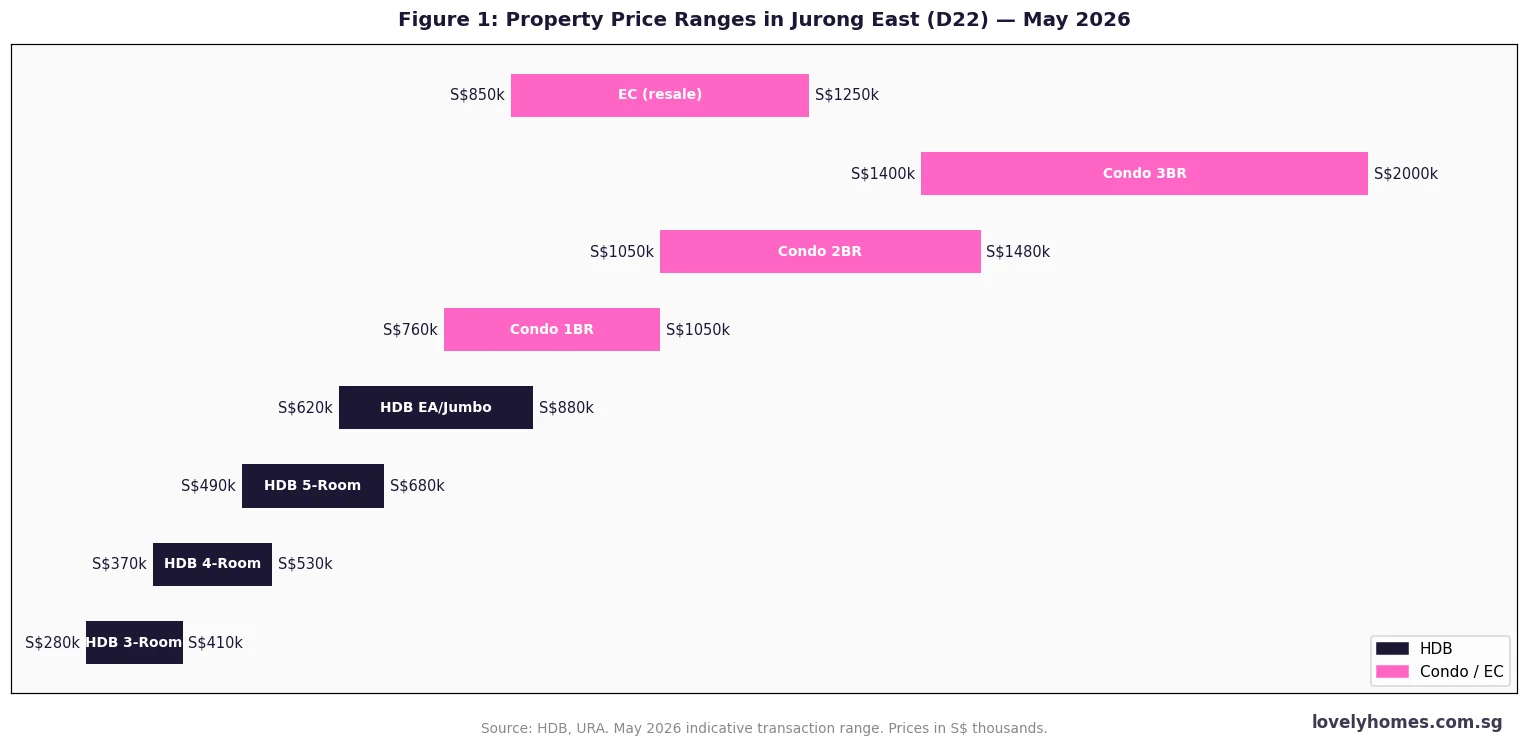
Jurong East D22 property price ranges 2026 — HDB 3-room to condo 3BR and EC resale horizontal bar chart
Figure 1: Property price ranges in Jurong East (District 22), May 2026. HDB 4-room resale flats trade at S$370k–S$530k; OCR condos at S$1.05M–S$2.0M. Source: HDB, URA.

Property Market: Prices, Types and Investment Profiles

Jurong East’s residential stock is predominantly HDB. The town has a well-established mix of 3-room, 4-room, 5-room, and executive apartment (EA) flats spread across estates like Yuhua, Toh Guan, Bukit Batok East (boundary), and the Jurong East town centre precincts. HDB 4-room resale flats in Jurong East currently trade at approximately S$370,000–S$530,000, with well-positioned units near Jurong East MRT or in high-floor blocks commanding the upper range. 5-room flats trade at S$490,000–S$680,000; executive apartments at S$620,000–S$880,000.

The private condominium supply in D22 is relatively thin compared to adjacent districts, which itself supports pricing. Key developments include J Gateway (99-year leasehold, 738 units, directly above Jurong East MRT), valued at approximately S$1,400–1,600 psf as at mid-2026; Vision (99-year, 294 units, Boon Lay Way/Jurong East Ave 1 corner), valued at approximately S$1,100–1,250 psf; and Lake Grandeur (99-year, 396 units, Jurong Lake area), valued at approximately S$1,050–1,200 psf. The scarcity of private supply in D22 — no new private residential GLS site in the immediate Jurong East precinct since J Gateway’s site was awarded in 2012 — means that the JLD GLS pipeline will be the first significant new supply in over a decade. New-build prices from the JLD white site (if awarded and launched) are expected to set new benchmarks for D22 pricing, potentially in the S$2,200–2,800 psf range based on comparable city-fringe mixed-use projects.

The EC resale market is represented primarily by Westwood Residences (EC, 480 units, Jurong West Ave 1, privatised 2024) trading at S$850,000–S$1,250,000, offering post-privatisation investors a mid-point between HDB and full private pricing.
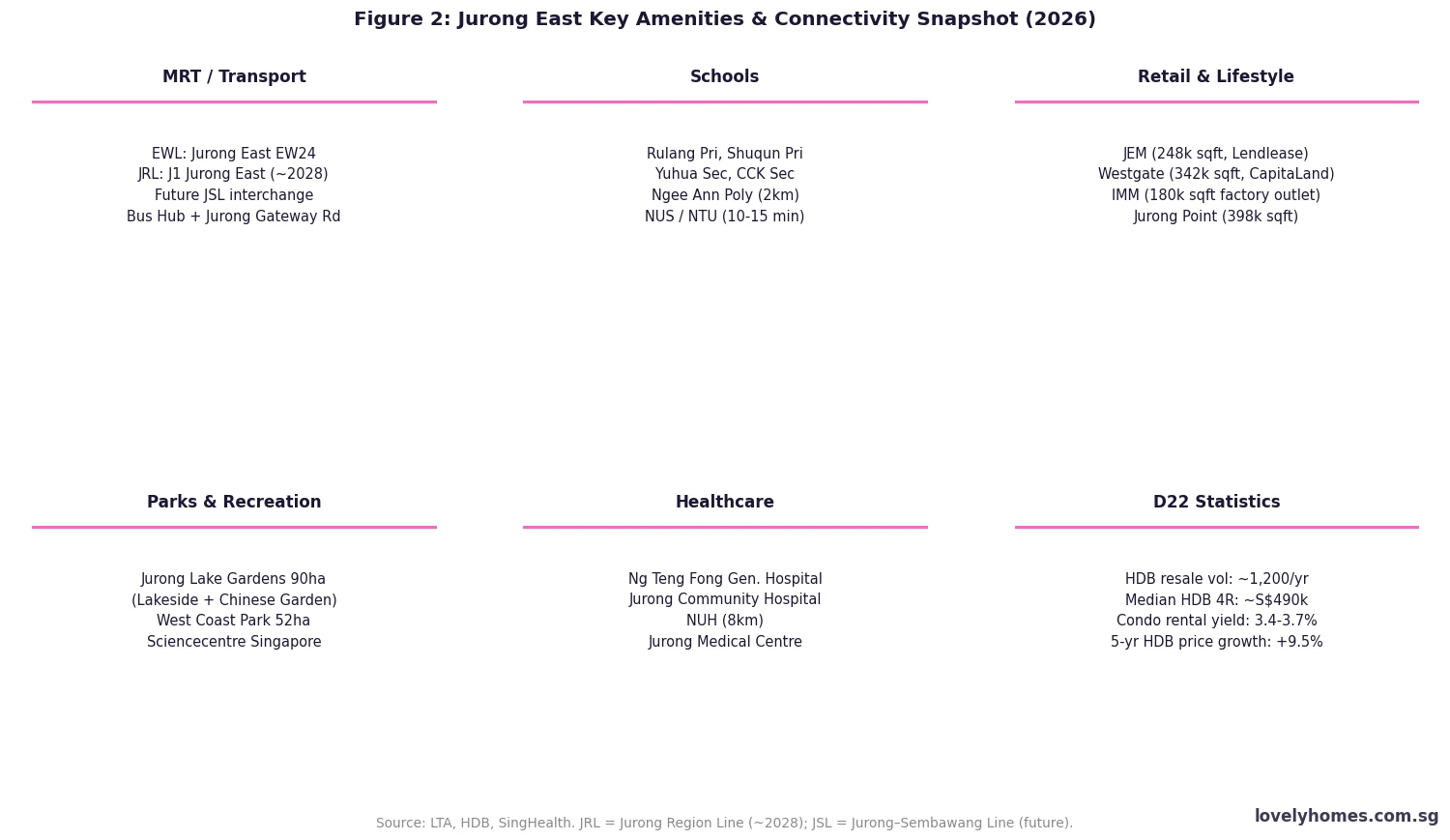
Jurong East amenities connectivity snapshot 2026 — MRT schools retail parks healthcare D22 statistics
Figure 2: Jurong East key amenities and connectivity snapshot, 2026. JRL opens in phases from approximately 2028. Source: LTA, HDB, SingHealth.

Schools, Education and Family Amenities

Jurong East is well-served for families at all school levels. Within 2 km of the town centre, primary schools include Rulang Primary School (well-regarded, popular in the primary-one registration priority exercise), Shuqun Primary School, Yuhua Primary School, and Fuhua Primary School. Secondary schools include Yuhua Secondary and Chua Chu Kang Secondary. At the tertiary level, Ngee Ann Polytechnic is approximately 2 km east (Clementi Road), while NUS Kent Ridge is approximately 8 km and Nanyang Technological University (NTU) is approximately 10–15 minutes by bus or future JRL. The student rental demand from NTU in particular is a significant driver of D22 condo rental volume, particularly for 1-bedroom and small 2-bedroom units.

For retail, Jurong East is exceptional by suburban Singapore standards. The Jurong Gateway commercial precinct contains three integrated malls: JEM (248,000 sqft, Lendlease REIT), Westgate (342,000 sqft, CapitaLand), and the adjacent IKEA Tampines equivalent replaced by IMM (180,000 sqft factory outlet, Lendlease REIT). A further 4 km down the EWL, Jurong Point (398,000 sqft, Singapore’s largest suburban mall) serves the Boon Lay/Jurong West catchment. The combined retail density within 5 km of Jurong East MRT is among the highest of any OCR town in Singapore.

Healthcare is anchored by Ng Teng Fong General Hospital (NTFGH) — the 700-bed regional hospital replacing the former Alexandra Hospital Jurong for the western region, opened in 2015 — and the co-located Jurong Community Hospital (JCH) (228 beds for intermediate and long-term care). National University Hospital (NUH) is approximately 8 km via AYE, and the Jurong Medical Centre serves polyclinic-level primary healthcare for the precinct.

Rental Market and Investment Case

The Jurong East rental market is underpinned by three distinct tenant pools. First, NTU/NGP students and academic professionals — particularly relevant for 1BR and studio condos, commanding rents of approximately S$2,400–3,200/month for 1BR units. Second, Jurong Island and western industrial workers — engineers, petrochemical and logistics professionals who prefer to rent in the western corridor to minimise their commute. Third, expats from Malaysian corporates and cross-border professionals — Jurong East’s proximity to the Tuas Second Link (approximately 25 minutes by car) attracts a segment of Malaysian professionals and senior managers who commute daily or bi-weekly.

As at Q1 2026, gross rental yields in D22 are approximately: HDB 3-room 5.1%, HDB 4-room 4.7%, HDB 5-room 4.3%, condo 1BR 3.7%, condo 2BR 3.4%, EC resale 3.4%. These are modest compared to D11 medical cluster or D19 student-driven markets, but they are supported by genuine occupational demand rather than speculative vacancy churn. Vacancy rates in D22 private condos are estimated at approximately 4–6%, consistent with the national OCR private average of approximately 5% in Q1 2026.

Summary: Jurong East Investment Snapshot by Property Type

Property Type Price Range Gross Yield 5-Yr Growth Tenure
HDB 3-Room S$280k–S$410k ~5.1% +8.2% 99yr (HDB)
HDB 4-Room S$370k–S$530k ~4.7% +9.5% 99yr (HDB)
HDB 5-Room / EA S$490k–S$880k ~4.2% +9.9% 99yr (HDB)
Condo 1BR S$760k–S$1,050k ~3.7% +11.2% 99yr (leasehold)
Condo 2BR S$1,050k–S$1,480k ~3.4% +12.5% 99yr (leasehold)
Condo 3BR S$1,400k–S$2,000k ~3.1% +13.8% 99yr (leasehold)
EC (resale) S$850k–S$1,250k ~3.4% +10.6% 99yr (privatised)

Worked Example: First-Time Buyer Purchasing a Jurong East HDB 4-Room Resale

Case Study — Mr & Mrs Lim, Singapore Citizens, first-time HDB buyers

Household profile: Mr & Mrs Lim, both Singapore Citizens, joint gross income S$8,500/month. First-time HDB buyers (no prior property ownership). Target: purchase a 4-room HDB resale flat in Jurong East at S$490,000.

Grants: Joint income S$8,500/month qualifies for Enhanced Housing Grant (EHG) of S$25,000 (family income S$7,001–9,000 bracket); Proximity Housing Grant (PHG) of S$30,000 if purchasing within 4 km of parents. Total grants: S$55,000.

Effective purchase price after grants: S$490,000 − S$55,000 = S$435,000 (for CPF/loan computation purposes).

Stamp duties: BSD on S$490,000 = (S$180,000 × 1%) + (S$180,000 × 2%) + (S$130,000 × 3%) = S$1,800 + S$3,600 + S$3,900 = S$9,300. ABSD: nil (SC first property).

Financing: HDB Loan LTV 80% on S$490,000 = S$392,000 loan @ 2.6% p.a. 25 years → monthly instalment S$1,776. MSR check: S$1,776 ÷ S$8,500 = 20.9% — within 30% PASS.

Upfront cash required: 5% cash downpayment on S$490,000 = S$24,500. BSD S$9,300 (payable via CPF). Legal/valuation ~S$2,500. Total cash outlay: approximately S$27,000.

Monthly household finances: Mortgage S$1,776 (20.9% MSR) + conservancy charges ~S$80 + property tax ~S$120 = approximately S$1,976/month total property cost. At S$8,500 gross income, net take-home after CPF (employee contribution 20% = S$1,700) is approximately S$6,800/month, leaving comfortable headroom.
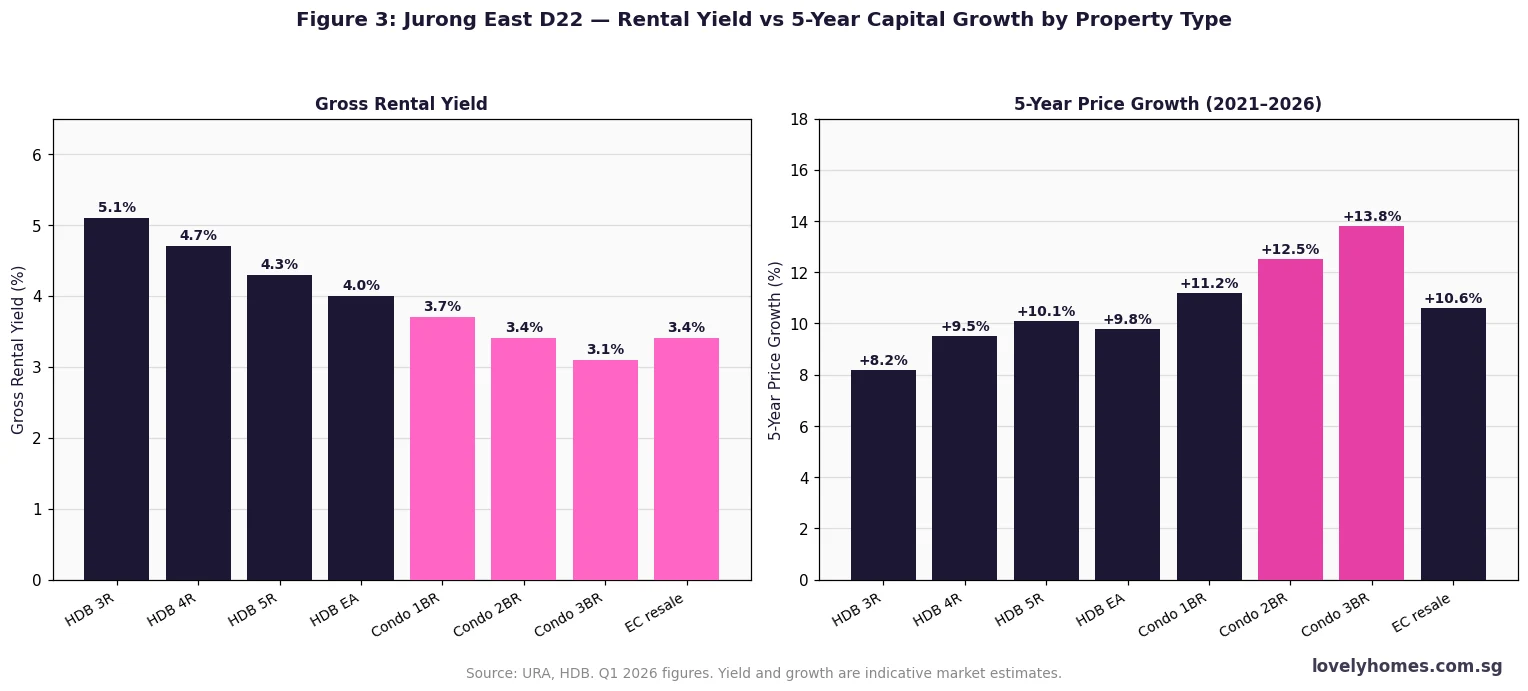
Jurong East D22 rental yield and 5-year capital growth by property type 2026 — HDB condo EC comparison
Figure 3: Jurong East gross rental yield and 5-year capital growth by property type, 2026. Condos have outperformed HDB on capital growth; HDB leads on yield. Source: URA, HDB.

Why Jurong East Matters to Property Investors in 2026

The JLD story is the most compelling single narrative in Singapore’s western residential market. No other OCR town has a comparable government-backed catalyst: a designated second CBD, a new MRT interchange (JRL J1), a landmark GLS white site under active tender, and the surrounding Jurong Lake Gardens — Singapore’s third national garden after Botanic Gardens and Gardens by the Bay — as a lifestyle anchor. Comparable transformations in Singapore’s history — the Marina Bay build-out from 2005 to 2018, the Dhoby Ghaut Circle Line opening in 2009 — consistently delivered residential price appreciation in the 8–20% range over a 3–5 year period following the key infrastructure milestones.

The practical investment case for most buyers today is straightforward: entry-level pricing in D22 remains accessible by OCR standards, yields are supportable, tenant demand is real, and the infrastructure spend committed by the government is unprecedented for any suburban town. The key risks are timeline slippage (JLD’s full development has a 20–30 year horizon) and interest rate sensitivity (a sustained SORA above 3.5% would compress condo yields to less than 2% net, making servicing costs uncomfortable).

What Might Come Next for Jurong East

The July 2026 JLD white site tender result will be the single most watched event in the Singapore western property market for the second half of 2026. A high bid — say S$1,800+ psf ppr — would signal developers’ confidence in JLD pricing and likely prompt a re-rating of existing D22 private condos. A below-expectation result could dampen enthusiasm but would not alter the structural story. The JRL’s opening in phases from approximately 2028, with J1 Jurong East as the key interchange, is widely expected to be the catalytic event for near-station premium appreciation. Investors monitoring the situation should also watch the Tengah New Town development (42,000 HDB flats planned, JRL-served) — as Tengah launches into the market from 2026 onwards, it will compete with Jurong East for western upgrader demand and may moderate Jurong East’s immediate-term HDB resale momentum.

Frequently Asked Questions: Jurong East Neighbourhood Guide 2026

Is Jurong East a good area to buy property in 2026?

Jurong East is one of the most strategically positioned OCR towns in Singapore for medium-to-long-term investors in 2026. The JLD development gives it a structural demand catalyst that most other OCR towns lack. Entry prices remain accessible (HDB 4-room resale at S$370k–S$530k; condo 2BR at S$1.05M–S$1.48M), yields are decent for the OCR, and the JRL interchange opening (~2028) provides a near-term price catalyst. The main caveat is that JLD is a very long-horizon project — buyers expecting a 1–2 year flip will likely be disappointed. The investment case is most compelling for buyers with a 5–10 year holding horizon who are simultaneously living in or near the area.

Which MRT stations serve Jurong East?

Jurong East is currently served by Jurong East MRT (EW24) on the East-West Line (EWL). It is an interchange station with a major bus hub. From July 2028 onwards (approximate), Jurong East will also be served by J1 Jurong East on the Jurong Region Line (JRL) — making it a two-line interchange. The JRL will connect Jurong East north to Choa Chu Kang and west to Boon Lay, significantly expanding the commuter catchment. A future Jurong–Sembawang Line (JSL) is referenced in URA’s Long-Term Plan Review but has no confirmed timeline. The EWL already connects Jurong East to the CBD (Raffles Place EW14) in approximately 32 minutes without a transfer.

Can PRs and foreigners buy property in Jurong East?

Singapore Permanent Residents (PRs) can purchase HDB resale flats in Jurong East subject to HDB eligibility criteria (PR households, no concurrent private property ownership, etc.) with a 5% ABSD on their first property. PRs cannot purchase new HDB BTO flats. For private condos (J Gateway, Vision, Lake Grandeur, Westwood Residences EC post-privatisation), PRs pay 5% ABSD on their first property and 30% on a second. Foreign nationals (non-PR) cannot own HDB flats at all, but may buy private condos at 60% ABSD. Given the 60% ABSD, foreign individual ownership of Jurong East condos is rare and concentrated among those using Singapore property as a long-term currency-diversification vehicle rather than a rental yield play.

What are the best condos to buy in Jurong East?

J Gateway (EW24 directly above station, 738 units, 99yr) is the most frequently cited for its unrivalled transport connectivity — with Jurong East MRT directly underfoot, rental demand from students and young professionals is among the strongest in D22. Vision (Boon Lay Way, 294 units, 99yr) offers a quieter residential setting with slightly lower psf and reasonable EWL access. Lake Grandeur (Jurong Lake area, 396 units, 99yr) is the best-positioned for JLD appreciation — walking distance to Jurong Lake Gardens and the future JLD commercial precinct. For buyers prioritising JLD capital upside over immediate rental yield, Lake Grandeur and the upcoming JLD GLS developments (once launched) represent the strongest bet. Note that all major D22 condos are leasehold (99-year), which affects long-term lease decay considerations for buyers with 30-year horizons.

How does Jurong East compare to Clementi and Bukit Batok for investment?

Clementi (D05 RCR boundary) benefits from NUS proximity, excellent CCL/EWL connectivity, and freehold land scarcity — it typically commands a 20–30% price premium over Jurong East for comparable property types. However, that premium already prices in much of the educational and transport uplift. Bukit Batok (adjacent OCR, D23) is more affordable — HDB 4-room resale at S$310,000–S$450,000 — and will benefit from the JRL Bukit Batok station, but lacks the JLD commercial anchor and has lower condo supply depth. For investors balancing yield, entry price, and structural upside, Jurong East sits in a superior position to Bukit Batok and offers better long-term appreciation potential than either D23 or the already-appreciated Clementi market.

Is there HDB BTO supply available in Jurong East in 2026?

Jurong East’s established HDB stock means BTO supply within the immediate town centre is limited. The 2026 HDB BTO exercise does not include a dedicated Jurong East precinct; the nearest June 2026 BTO projects are in Jurong West and Clementi. The primary acquisition route into Jurong East public housing is therefore the HDB resale market, which offers greater flexibility on flat type, floor, and move-in timeline but at market price (no BTO subsidy). Tengah New Town — a 42,000-flat new town directly adjacent to the JLD catchment — is receiving BTO allocations from 2024 onwards and represents an alternative for buyers seeking subsidised entry into the western corridor’s growth story, though at the cost of a longer wait time and MOP obligation.
Disclaimer: This article is for general educational and informational purposes only and does not constitute financial, investment, legal, or property advice. Property prices, MRT opening timelines, GLS programme details, HDB policies, and government development plans are subject to change without notice. JLD development timelines, JRL opening dates, and JSL plans referenced are based on publicly available URA and LTA announcements as at June 2026 and remain subject to revision. Readers should verify all information directly with the relevant authorities — URA, HDB, LTA, IRAS, and CPF Board — and consult a licensed professional before making any property decision.

Sembawang Neighbourhood Guide Singapore 2026: Property Prices, Schools, MRT and Investment Outlook

Sembawang Neighbourhood Guide Singapore 2026: Property Prices, Schools, MRT and Investment Outlook

Quick Answer — Sembawang at a Glance (2026)

  • District: D27, Outside Central Region (OCR). Predominantly HDB, with a small private condominium and EC segment.
  • MRT: North–South Line (NSL) — Sembawang (NS11), Canberra (NS12), Yishun (NS13). Approximately 15 minutes to Orchard Road.
  • Property prices: HDB 4-room resale S$470k–S$650k; condo 2-bedroom S$900k–S$1.32M; EC 4-bedroom S$1.25M–S$1.62M.
  • Gross rental yield: HDB 4-room ~4.8% p.a.; condo 2-bedroom ~3.2% p.a. — above-average for OCR.
  • 5-year HDB price growth: ~9.8% (4-room) — in line with the broader OCR HDB market.
  • June 2026 BTO: Approximately 2,000 new HDB units in Sembawang as part of the June 2026 exercise, including Nee Soon South Crescent — the largest allocation in the exercise.
  • Investment thesis: Proximity to the Johor Strait, upcoming RTS Link (Woodlands–JB, 2027) spillover, and NSC (Nee Soon Central) urban renewal make Sembawang a watch-list OCR name for long-term buyers.

Where Is Sembawang? A District Overview

Sembawang occupies the northernmost residential area of mainland Singapore, forming part of District 27 alongside neighbouring Yishun. The estate sits on the Johor Strait waterfront — a fact that shaped its character as a former British naval base, the site of HMS Terror and HMS Sultan, before being handed over to Singapore in 1971 and progressively redeveloped as an HDB new town from the 1970s onwards. Sembawang Park, located on the Johor Strait waterfront, preserves a small slice of that colonial-era landscape.

Today, Sembawang is administered by the Housing & Development Board as a mature HDB town, with approximately 60,000 residents housed predominantly in newer BTO flats and upgraded 1980s–1990s blocks. The private residential segment is modest: Parc Canberra EC (496 units, 99-year, launched 2019, MOP October 2024), The Brownstones EC (638 units, fully privatised), and a small cluster of strata-titled condominiums along Sembawang Drive and Admiralty Road West. Sembawang is not a headline district for luxury buyers, but it offers a compelling affordability-and-liveability proposition for first-time HDB buyers and yield-focused investors.

Sembawang Property Prices by Type (Q2 2026)

Prices below reflect Q2 2026 transaction data from the Urban Redevelopment Authority (URA) and HDB resale portal. All figures are indicative ranges and will vary by storey, facing and condition.

Sembawang District 27 property price ranges by type 2026 HDB condo EC Singapore
Figure 1: Sembawang (D27) Property Price Ranges by Type, Q2 2026. Source: URA, HDB.

HDB resale prices in Sembawang remain among the most affordable in the OCR for larger flat types. A 4-room resale flat typically transacts between S$470,000 and S$650,000 depending on storey and location; 5-room flats run S$600,000–S$820,000. Executive Apartments and Multi-Generation flats (where available) can reach S$720,000–S$950,000. The condo segment, dominated by Parc Canberra EC and The Brownstones, trades at S$900,000–S$1,320,000 for 2-bedroom units — pricing that aligns with upgraded OCR condominiums in Woodlands and Yishun rather than the tighter core OCR markets of Tampines or Bedok.

MRT Connectivity, Schools and Key Amenities

Sembawang is served by three North–South Line (NSL) stations — Sembawang (NS11), Canberra (NS12) and Yishun (NS13) — providing direct access to the city. Journey times from Sembawang MRT to Orchard Road (NS22) are approximately 25–28 minutes without interchange; to Woodlands Checkpoint (NS9) approximately 8–10 minutes for those with business or family ties across the Causeway.

The June 2027 opening of the Johor Bahru–Singapore Rapid Transit System (RTS) Link at Woodlands North (2 stops from Sembawang) is expected to increase demand for Sembawang and Woodlands properties from Johor-resident workers and families who commute to Singapore. Historical precedent from the opening of MRT extensions suggests a 5–15% property price uplift in the catchment area within 2 years of a new connectivity announcement materialising.

Sembawang key amenities 2026 MRT connectivity schools shopping parks healthcare Singapore
Figure 2: Sembawang — Key Amenities and Infrastructure at a Glance (2026).

The main retail anchor is Sun Plaza near Sembawang MRT, complemented by the newer Canberra Plaza (opened 2022) which houses a wet market, hawker centre, supermarket and F&B outlets. Northpoint City in neighbouring Yishun — the largest shopping mall in northern Singapore — is approximately 8 minutes by MRT. The Canberra Hawker Centre has quickly become one of northern Singapore’s most popular food destinations since opening in 2020.

For healthcare, Khoo Teck Puat Hospital (KTPH) in Yishun — 5 km from central Sembawang — is the primary acute hospital. The Admiralty Medical Centre (near Admiralty MRT, NS10) and Yishun Polyclinic serve as the primary care network. Schools within the catchment include Sembawang Primary, Canberra Primary, Canberra Secondary, Yishun Town Secondary, CHIJ St Joseph’s Convent and ITE College Central (Yishun campus).

Rental Yield and 5-Year Price Growth

Sembawang’s OCR location means it offers higher rental yields than CCR counterparts, driven by a combination of lower purchase prices and steady demand from NSF families (close to Sembawang Camp and Mandai precinct), Johor-side workers, and younger families priced out of more central estates.

Sembawang District 27 gross rental yield and 5 year price growth by property type 2026
Figure 3: Sembawang D27 — Gross Rental Yield vs 5-Year Price Growth by Property Type (Q2 2026). Source: URA, SRX, HDB.

HDB 3-room flats deliver the highest gross yield at approximately 5.1% p.a., reflecting the strong demand for affordable rental units from singles and young couples. EC units (Parc Canberra post-MOP, The Brownstones) offer a yield of approximately 3.0% — lower than HDB but with superior capital appreciation potential given their condo-equivalent finishes at OCR pricing. 5-year price growth for 4-room HDB flats runs at approximately 9.8%, consistent with the OCR HDB market average reported by HDB’s Resale Price Index (RPI reaching 216.3 in Q1 2026, up 41.2% from Q1 2021).

Sembawang vs Woodlands vs Yishun — Investment Comparison

Sembawang, Woodlands and Yishun form the northern residential triumvirate of Singapore. Each has a distinct investment profile. Woodlands commands a slight premium thanks to its Woodlands Regional Centre designation and the RTS Link station at Woodlands North — but higher prices compress yields. Yishun offers the most diversified amenity mix (Northpoint City, KTPH, Loop & Dine, Yishun Park Hawker Centre) but has a perception overhang that has historically kept prices lower than fundamentals might otherwise support. Sembawang sits between the two: less developed than Woodlands’ commercial node but benefiting from the same RTS Link proximity spillover, with prices that are still among the most affordable in the NSL corridor. For a first-time buyer prioritising yield and manageable entry cost, Sembawang offers a differentiated value proposition relative to the more competitive Tampines or Bishan markets.

Summary Table — Sembawang Property Overview 2026

Property Type Price Range (S$) Approx. PSF Gross Yield 5yr Growth
HDB 3-Room 350k–480k S$410–S$560 ~5.1% ~9.2%
HDB 4-Room 470k–650k S$400–S$550 ~4.8% ~9.8%
HDB 5-Room 600k–820k S$390–S$535 ~4.3% ~10.2%
HDB EA/EM 720k–950k S$370–S$510 ~4.0% ~9.5%
Condo 1-Bedroom 680k–980k S$1,200–S$1,500 ~3.8% ~8.5%
Condo 2-Bedroom 900k–1,320k S$1,150–S$1,450 ~3.2% ~9.0%
Condo 3-Bedroom 1,150k–1,680k S$1,100–S$1,400 ~2.8% ~9.5%
EC 4-Bedroom 1,250k–1,620k S$1,050–S$1,380 ~3.0% ~11.8%

Worked Example — Mr & Mrs Rajan Buying Sembawang 4-Room HDB Resale

Mr & Mrs Rajan are a Singapore Citizen couple. Joint gross income: S$8,200 per month. They plan to buy a 4-room HDB resale flat along Sembawang Drive for S$560,000. This is their first property. Combined CPF OA: S$75,000. They qualify for an Enhanced Housing Grant (EHG) of S$75,000 (income bracket S$8,001–S$9,000, per the HDB EHG schedule) and a Proximity Housing Grant (PHG) of S$30,000 (within 4 km of parents). Total grants: S$105,000.

  • Purchase price: S$560,000
  • HDB Loan (80% LTV): S$448,000
  • Downpayment (20%): S$112,000 — CPF OA S$75,000 + cash S$37,000
  • Grants applied: S$105,000 — EHG S$75,000 + PHG S$30,000 (reduce net outlay)
  • Monthly instalment (HDB loan, 2.6%, 25yr): S$2,028/month
  • MSR check: S$2,028 ÷ S$8,200 = 24.7% — PASS (threshold 30%)
  • BSD: 1% × S$180k + 2% × S$180k + 3% × S$200k = S$1,800 + S$3,600 + S$6,000 = S$11,400
  • ABSD: Nil (SC first property)
  • Legal fees: ~S$2,500
  • Total cash outlay: S$37,000 + S$11,400 + S$2,500 = ~S$50,900

The grants cover more than the CPF OA balance, meaning the Rajans’ effective upfront cash of ~S$51,000 is among the lowest feasible entry costs in the OCR market. At a 4.8% gross yield, a comparable Sembawang 4-room flat rented out would generate approximately S$2,688 per month — well above the S$2,028 monthly HDB loan instalment — confirming the estate’s investment-grade yield profile for future upgraders who may hold the flat as a rental asset post-MOP.

Is Sembawang a Good Place to Buy in 2026?

Sembawang is a solid choice for first-time HDB buyers and long-term OCR investors who prioritise affordability, community amenities and the NSL corridor’s proven long-term price trajectory. The key investment thesis rests on three legs: the RTS Link spillover (Woodlands North station from 2027, benefiting the entire northern corridor), the Nee Soon South urban renewal under HDB’s Remaking Our Heartland programme, and the June 2026 BTO supply absorption which, once MOP-cleared in 2031–2032, will add resale liquidity and benchmark new pricing for the estate. On a pure affordability-per-square-metre basis, Sembawang 4-room flats at S$400–S$550 psf remain significantly below the OCR HDB average of ~S$580–S$640 psf, suggesting room for mean reversion.

Risks to note: the estate’s northern periphery location means commute times to the Central Business District are relatively long (35–40 minutes by MRT). The private residential market is thin — Parc Canberra and The Brownstones are the primary liquid assets — which can widen bid-ask spreads and make exit timing less flexible than more liquid OCR markets like Tampines or Punggol.

Frequently Asked Questions

Is Sembawang a good place to buy property in 2026?

Yes, particularly for first-time HDB buyers and yield-focused investors. Sembawang offers some of the most affordable 4-room and 5-room HDB prices in the OCR corridor, strong grant eligibility (EHG up to S$80,000 for lower-income families), and above-average gross yields of 4.3–5.1% for HDB flat types. The June 2026 BTO exercise’s large Sembawang allocation (~2,000 units) signals HDB’s continued commitment to the estate. The RTS Link at Woodlands North (2027) is a medium-term catalyst for the entire NSL northern corridor.

What MRT stations serve Sembawang?

Three NSL stations cover the Sembawang estate: Sembawang (NS11), Canberra (NS12) and Yishun (NS13). From Sembawang MRT, journey time to Orchard Road (NS22) is approximately 26 minutes direct; to Raffles Place (NS26/EW14 interchange) approximately 35–38 minutes. From Canberra MRT (opened 2019), Orchard is approximately 24 minutes. There is no Downtown Line or Circle Line coverage in Sembawang, so NSL is the sole rail option — a consideration for buyers who work in eastern or western Singapore.

Can PRs and foreigners buy property in Sembawang?

Singapore Permanent Residents can purchase HDB resale flats in Sembawang but are not eligible to buy new BTO flats (only the Fiancé/Fiancée Scheme permits a non-citizen applicant, with restrictions). PRs pay 5% ABSD on their first residential property and 30% on their second. Foreigners can only purchase private residential property — they cannot buy HDB flats at all. For the private market in Sembawang (Parc Canberra, The Brownstones), foreigners pay 60% ABSD on any purchase. This effectively limits foreign buyers to the higher end of the market where yields can absorb the stamp-duty premium.

What are the best condos and ECs in Sembawang?

The most notable private and EC developments are Parc Canberra EC (496 units, 99-year leasehold, completed 2022, MOP cleared October 2024 — now resaleable on open market) and The Brownstones EC (638 units, 99-year, fully privatised). Both are well-maintained and reasonably priced relative to CCR and RCR condominiums. Outside the EC segment, there are limited private condo options within the Sembawang estate boundary — buyers seeking a broader private market choice tend to look at Yishun’s The Criterion EC, Skies Miltonia, or Eight Courtyards.

Sembawang vs Woodlands vs Yishun — which is best for investment?

Each estate has a different risk-reward profile. Woodlands offers the strongest near-term catalyst (RTS Link station directly in Woodlands North, Woodlands Regional Centre designation) but commands a price premium. Yishun has the best amenities (Northpoint City, KTPH) but has historically traded at a slight discount due to reputation. Sembawang offers the most affordable entry price in the corridor, the highest gross yields, and benefits from the same RTS Link spillover without Woodlands’ price premium. For a first-time buyer prioritising affordability and yield, Sembawang is the preferred starting point. For a buyer focused on capital appreciation and prepared to pay up, Woodlands is the stronger choice.

What is the HDB Minimum Occupation Period (MOP) for Sembawang flats?

Standard HDB BTO and resale flats in Sembawang carry a 5-year MOP from the date you collect keys. Plus and Prime classification flats have a 10-year MOP. During the MOP, you cannot sell the flat on the open market or rent out the entire flat (renting individual rooms is permitted under the HDB subletting rules). After MOP, you may sell the flat on the resale market, rent it out in full, or buy a private property whilst retaining the HDB flat (subject to ABSD on the private purchase). HDB flat owners who buy private property before selling the HDB flat are treated as holding two properties and pay SC second-property ABSD of 20%.

Related Articles

Disclaimer: This guide is for general information only and does not constitute financial, legal, or property advice. Property prices, rental yields, and grant eligibility figures are indicative and subject to change. Always verify transaction data on the URA and HDB portals, and consult a licensed property agent or financial adviser before making any purchase decision. HDB grant eligibility should be confirmed via the HDB HFE letter application.

Canberra Crescent Residences

Canberra Crescent Residences


Canberra / Sembawang · District 27

Canberra Crescent Residences

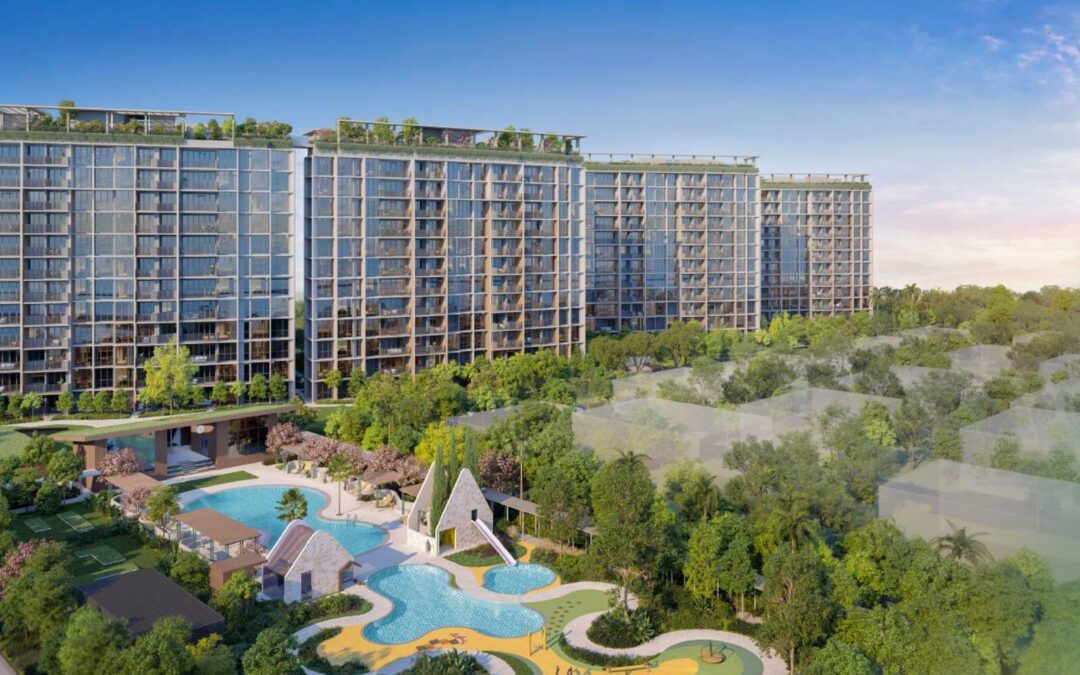
A 376-unit 99-year leasehold residence by Kheng Leong and Low Keng Huat, with the 3,000 sqm Canberra Club, sky garden and park-connector living in the North.
376
Residential Units
99 Years
Leasehold Tenure
30 Apr 2030
Expected NOVP
From S$1.966M
Current From Price

376
Residential Units
99 Years
Leasehold Tenure
Apr 2030
Expected NOVP
3,000 sqm
Canberra Club
74%
Greenery & Facilities

Why Canberra Crescent Residences

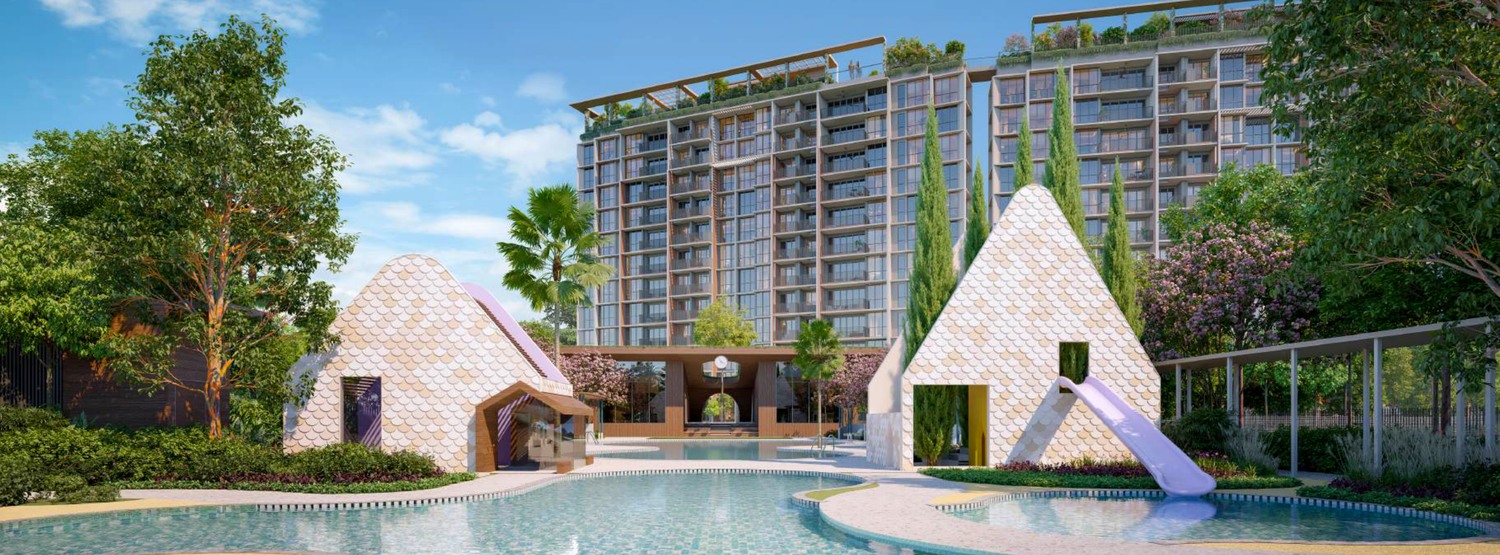
Canberra Crescent Residences is a 376-unit private residential new launch at 51, 53, 55 and 57 Canberra Crescent. The project is jointly developed by Kheng Leong Co. and Low Keng Huat through Peak Crescent Pte Ltd, with four 12-storey residential towers, a childcare centre and a wide 245 m site frontage.

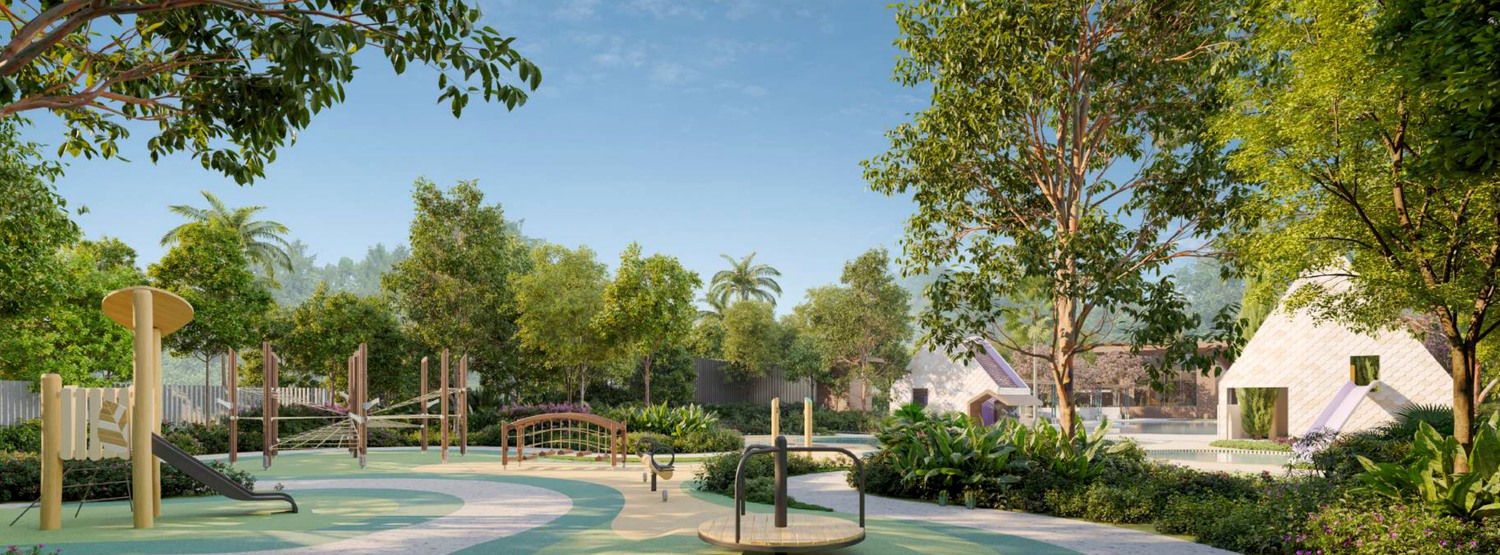
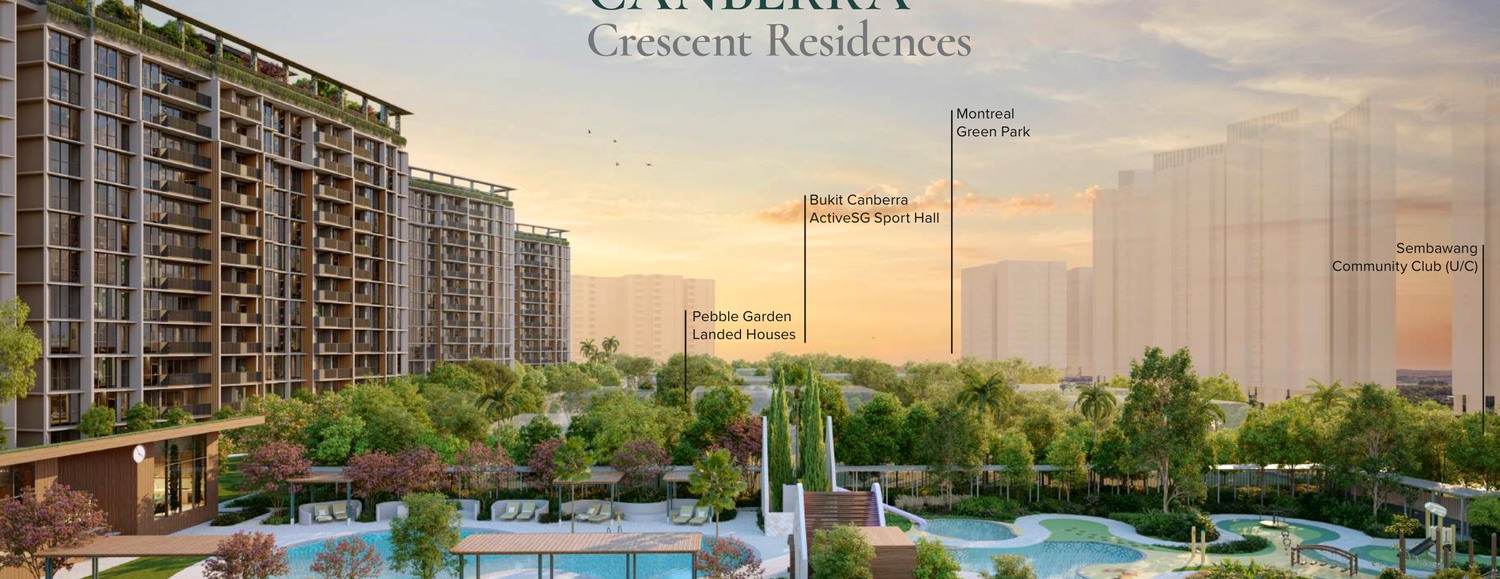
The proposition is family-led: approximately 74% of the site is dedicated to greenery and facilities, anchored by the 3,000 sqm Canberra Club, sky garden decks across Blocks 55 and 57, and direct access to the Northern Explorer Loop park connector network.

Pillar 01

Full private clubhouse

The Canberra Club brings the 50 m lap pool, family pool, kids’ water play, function rooms, social workspace, entertainment rooms and mini golf into one large amenity spine.

Pillar 02

Canberra daily convenience

Near Canberra MRT, Canberra Plaza, Bukit Canberra and everyday food/retail options, with Northpoint City and Causeway Point a short rail ride away.

Pillar 03

Flexible, family-sized homes

The unit mix runs from efficient 1-bedroom units to 4-bedroom premium homes; project documents note selected hackable walls subject to engineer approval.

Project At-a-Glance

Developer Peak Crescent Pte Ltd (Kheng Leong Co. x Low Keng Huat)
Address 51, 53, 55 and 57 Canberra Crescent
District D27 – Sembawang / Canberra
Tenure 99 years from 4 November 2024
Site Area 20,435.80 sqm
Gross Plot Ratio 1.6
Blocks and Storeys Four 12-storey residential towers
Total Units 376 residential units + childcare centre
Expected NOVP 30 April 2030
Expected Legal Completion 30 April 2033
Construction Method APCS (Advanced Precast Concrete System)
Carpark 382 residential lots incl. 4 EV and 4 accessible lots
Facilities 74% site greenery/facilities; 3,000 sqm Canberra Club
Buyer Notes Project factsheet/FAQ dated 10 July 2025

Unit Mix and Sizes

Type Size (sqft) Units % of Total
1-Bedroom 409 3 0.8%
2-Bedroom Compact 570 23 6.1%
2-Bedroom Premium 667 68 18.1%
3-Bedroom Compact 797-883 141 37.5%
3-Bedroom Premium 990 57 15.2%
4-Bedroom Compact 1,163-1,173 36 9.6%
4-Bedroom Standard 1,216 36 9.6%
4-Bedroom Premium 1,324 12 3.2%
Total 409 – 1,324 376 100%
Buyer note: Unit distribution and sizes are compiled from the local Canberra Crescent Residences factsheet/FAQ dated 10 July 2025. Buyers should verify the latest availability and price list before booking.

Indicative Pricing

3BR Premium
From S$1.966M

990 sqft

4BR Standard
From S$2.343M

1,216 sqft

4BR Premium
From S$2.627M

1,324 sqft

Current public balance-unit snapshot shows available 3BR Premium from S$1.966M, 4BR Standard from S$2.343M and 4BR Premium from S$2.627M. Source: Canberra Crescent Residences NewLaunches price list updated 4 Mar 2026, accessed 29 Apr 2026.

Why Buyers Are Watching

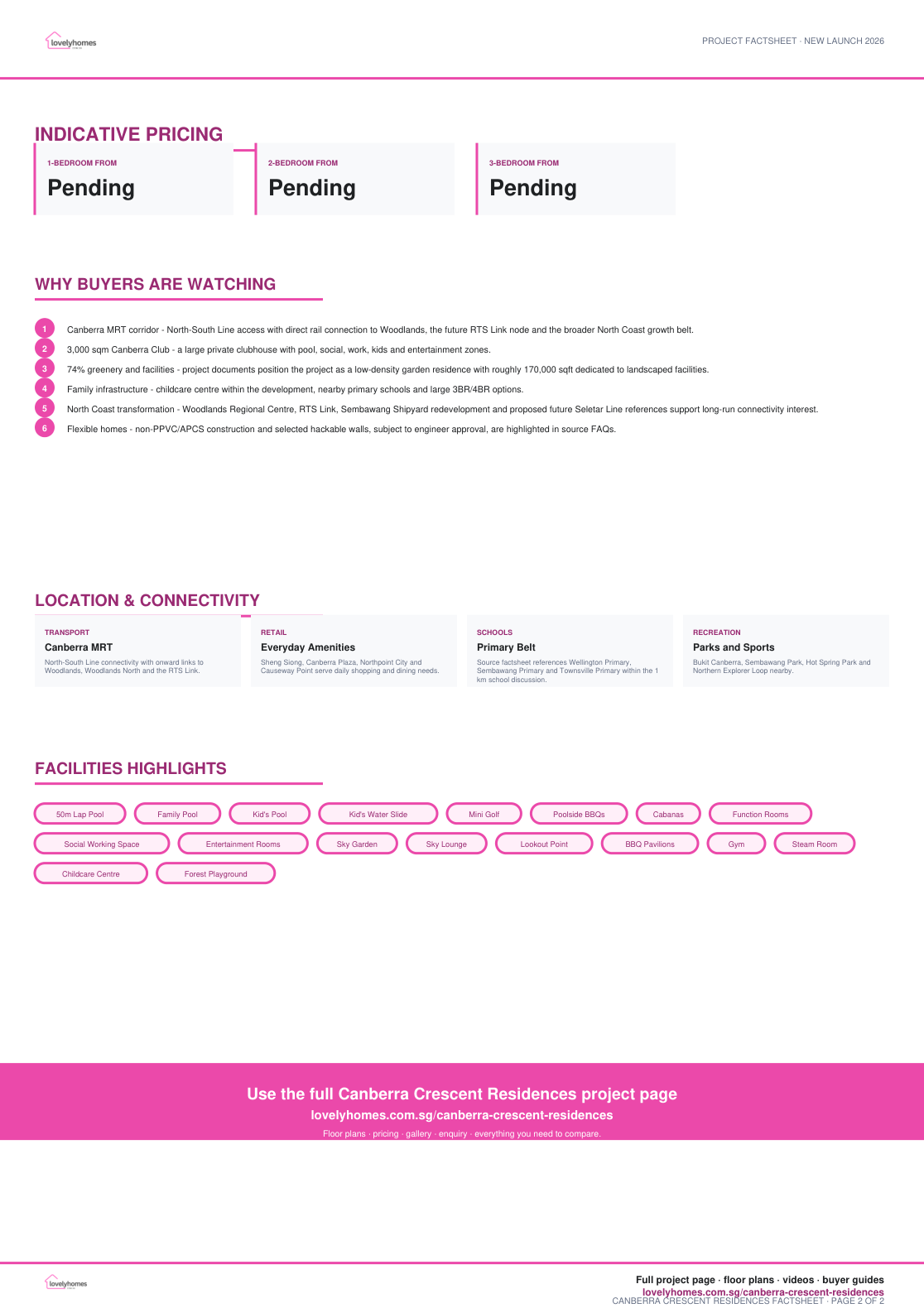
  1. 1Canberra MRT corridor – North-South Line access with direct rail connection to Woodlands, the future RTS Link node and the broader North Coast growth belt.
  2. 23,000 sqm Canberra Club – a large private clubhouse with pool, social, work, kids and entertainment zones.
  3. 374% greenery and facilities – project documents position the project as a low-density garden residence with roughly 170,000 sqft dedicated to landscaped facilities.
  4. 4Family infrastructure – childcare centre within the development, nearby primary schools and large 3BR/4BR options.
  5. 5North Coast transformation – Woodlands Regional Centre, RTS Link, Sembawang Shipyard redevelopment and proposed future Seletar Line references support long-run connectivity interest.
  6. 6Flexible homes – non-PPVC/APCS construction and selected hackable walls, subject to engineer approval, are highlighted in source FAQs.

Location and Connectivity

Transport
Canberra MRT
North-South Line connectivity with onward links to Woodlands, Woodlands North and the RTS Link.
Retail
Everyday Amenities
Sheng Siong, Canberra Plaza, Northpoint City and Causeway Point serve daily shopping and dining needs.
Schools
Primary Belt
Source factsheet references Wellington Primary, Sembawang Primary and Townsville Primary within the 1 km school discussion.
Recreation
Parks and Sports
Bukit Canberra, Sembawang Park, Hot Spring Park and Northern Explorer Loop nearby.
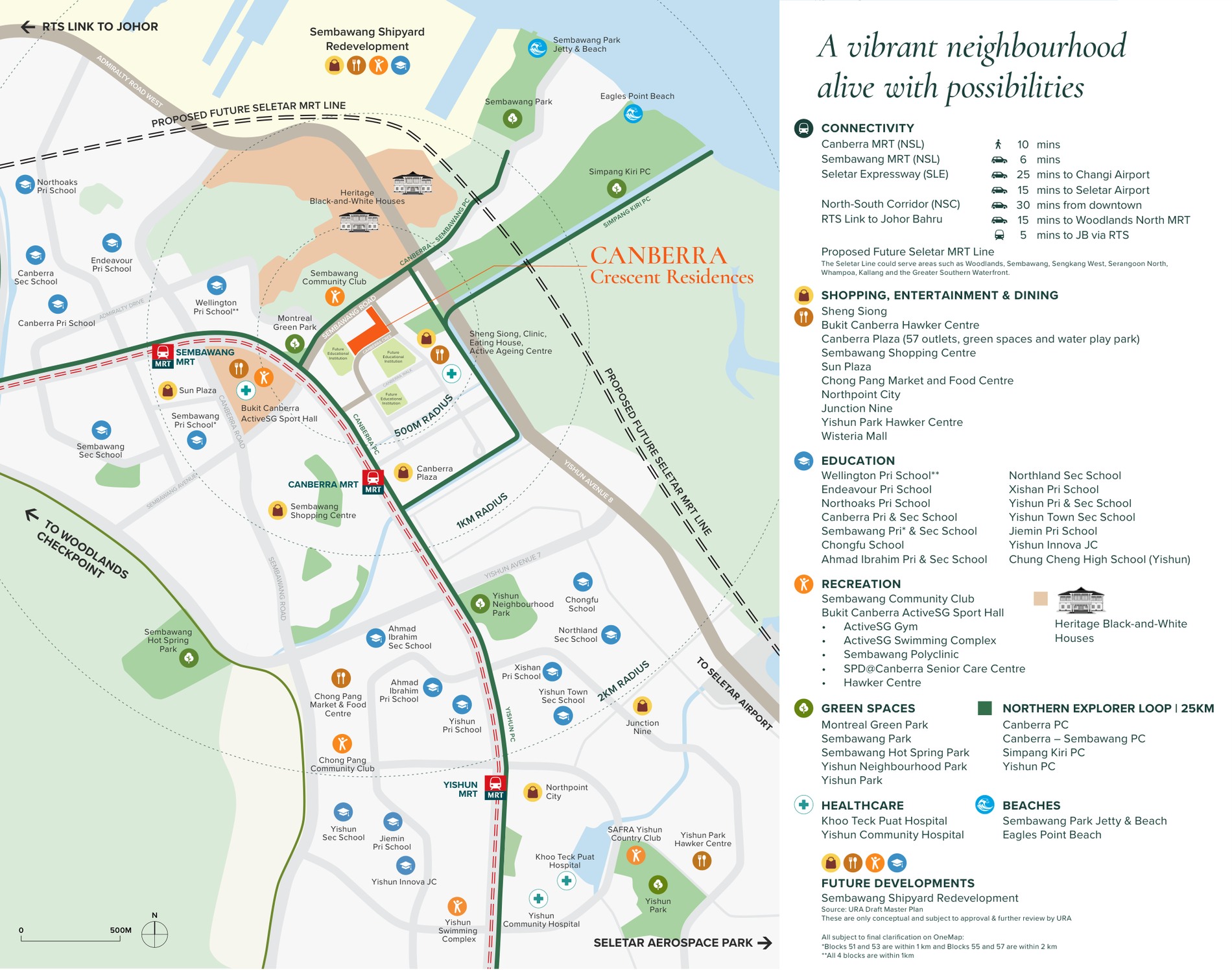
Canberra Crescent Residences location map
Higher resolution: Open location map image →

Schools Nearby

Primary (source 1 km notes) Wellington Primary School, Sembawang Primary School (applicable to Blocks 51 and 53), Townsville Primary School.
Nearby schools Canberra Primary, Endeavour Primary, Northoaks Primary, Canberra Secondary and Sembawang Secondary are referenced in the brochure location map.
Verification School eligibility should be checked against MOE SchoolFinder and OneMap by exact block address before purchase.

Lifestyle and Amenities

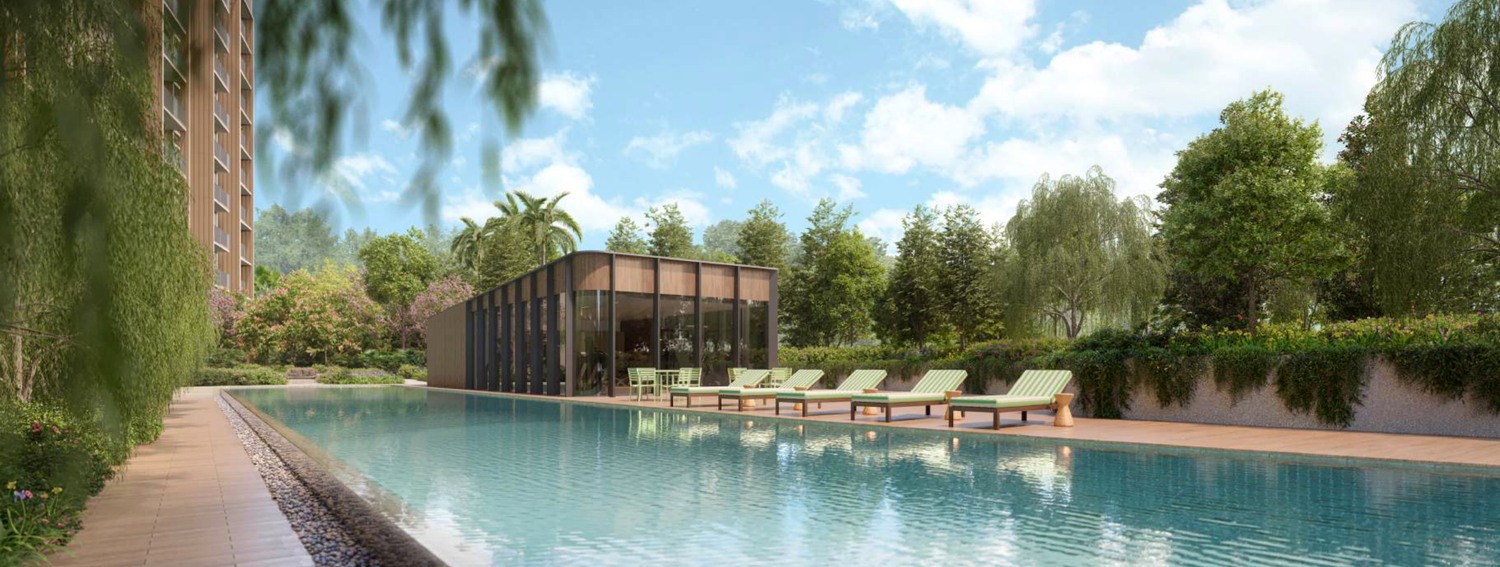
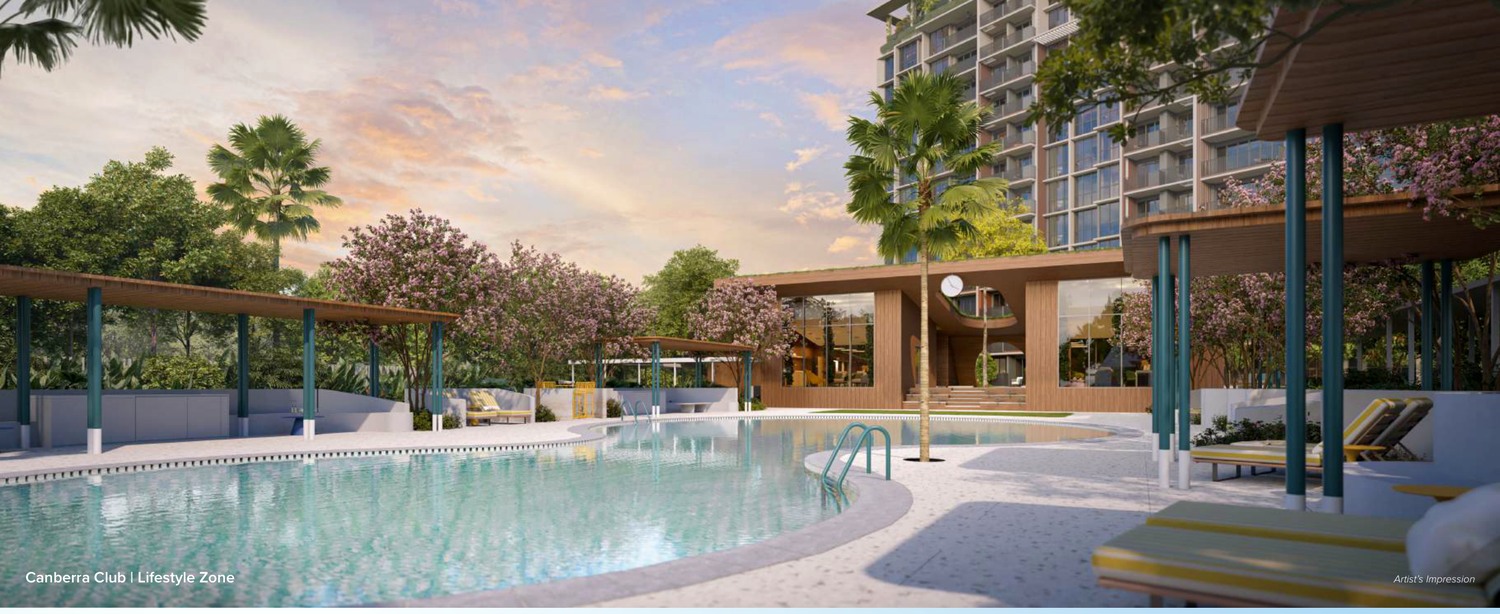
Canberra Club

50 m lap pool, family pool, kids’ water slide, function rooms, social workspace, entertainment rooms, cabanas and mini golf.

Outdoor Network

Northern Explorer Loop, Sembawang Park, Sembawang Hot Spring Park and Montreal Green Park support cycling and weekend activity.

Everyday Retail

Sheng Siong, neighbourhood eateries, Canberra Plaza, Northpoint City and Causeway Point cover groceries, food and services.

Site Plan

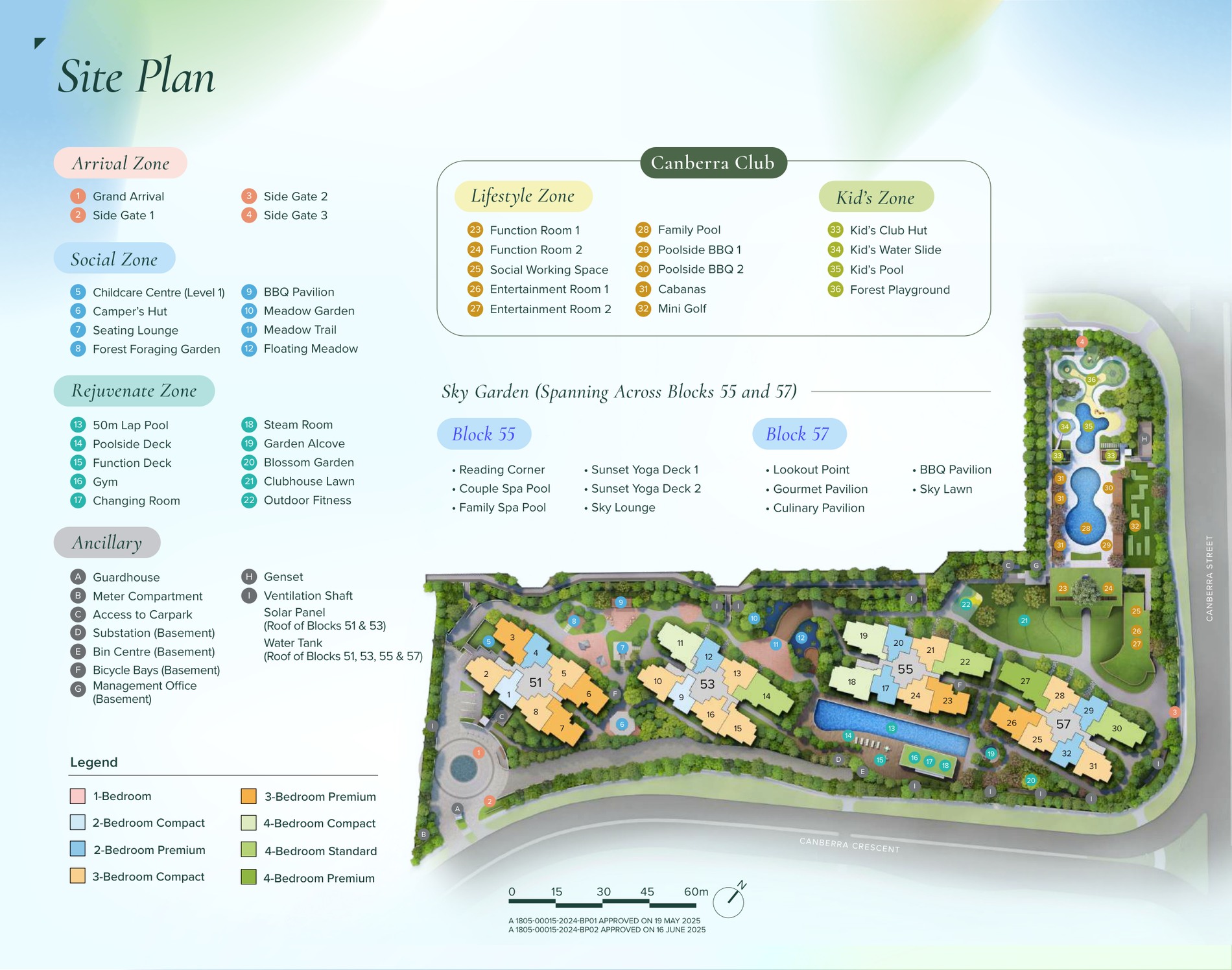
Canberra Crescent Residences actual site plan

Actual site plan from the project e-brochure · indicative only · subject to developer confirmation

Floor Plans (Selected)

Representative plans by bedroom type. Download the full floor-plan PDF below for the complete stack-by-stack floor-plan section from the e-brochure.

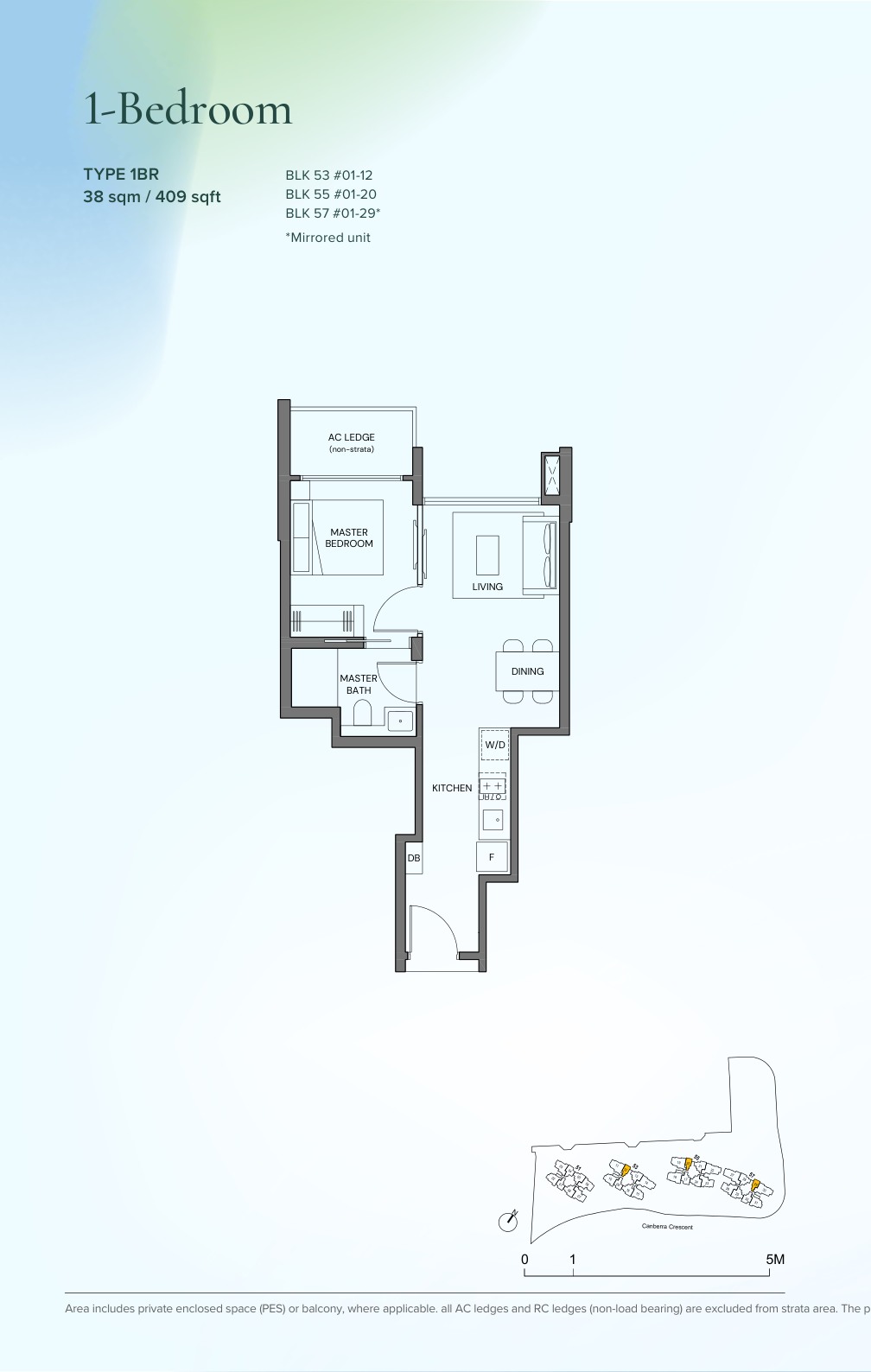
Canberra Crescent Residences 1 Bedroom Type 1BR floor plan

1 Bedroom · Type 1BR · 38 sqm / 409 sqft
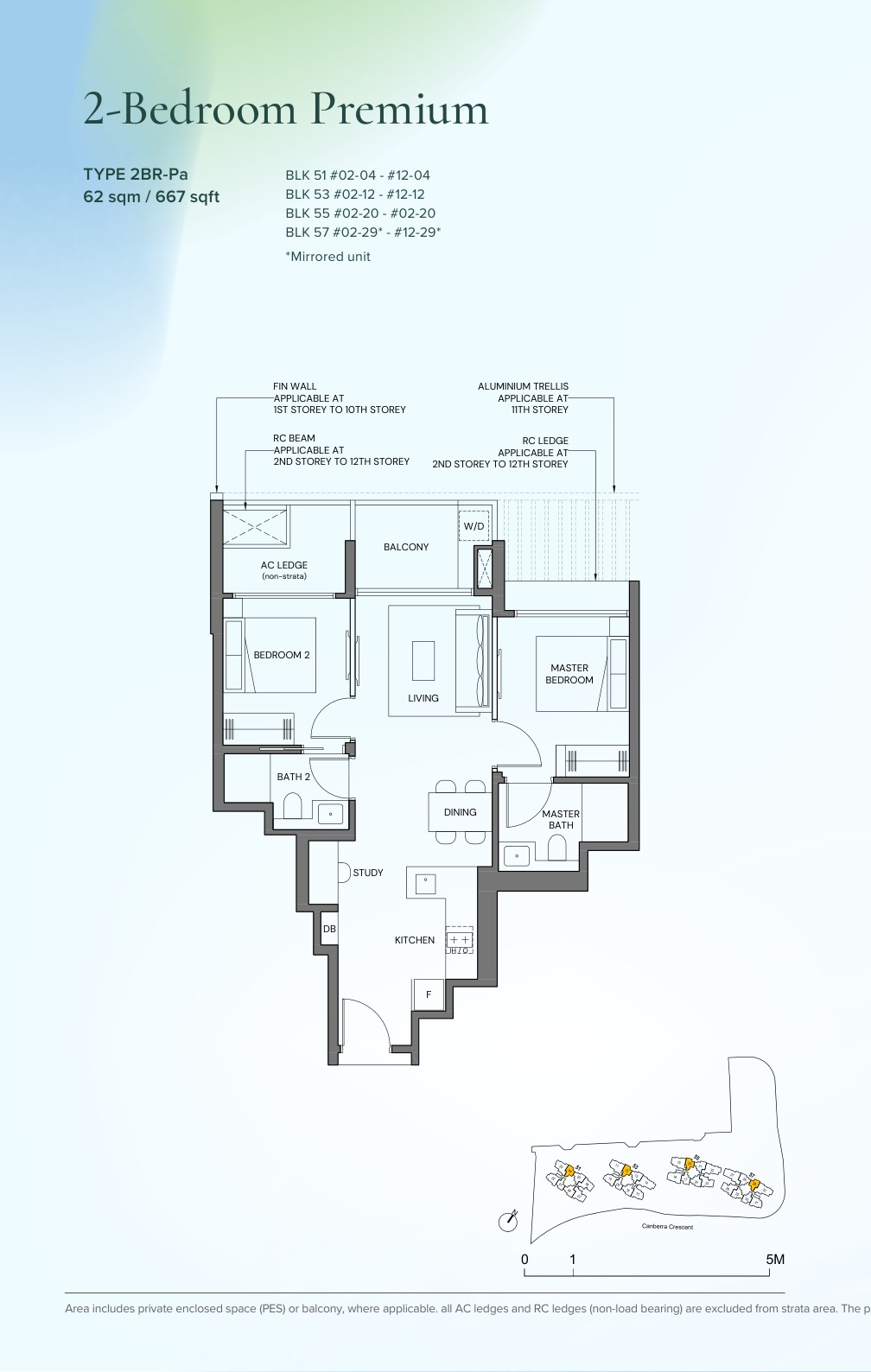
Canberra Crescent Residences 2 Bedroom Premium Type 2BR-Pa floor plan

2 Bedroom Premium · Type 2BR-Pa · 62 sqm / 667 sqft
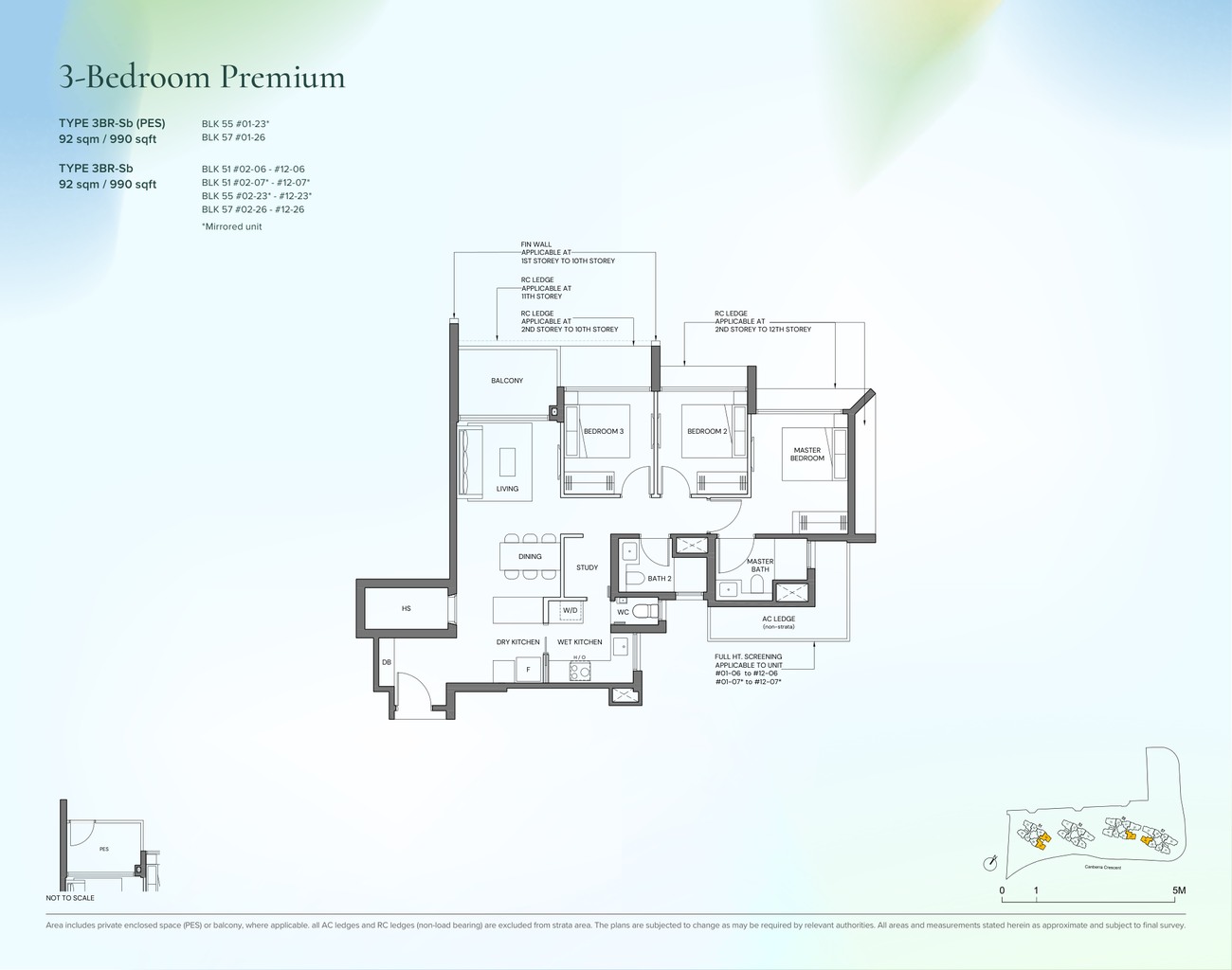
Canberra Crescent Residences 3 Bedroom Premium Type 3BR-Sb floor plan

3 Bedroom Premium · Type 3BR-Sb · 92 sqm / 990 sqft
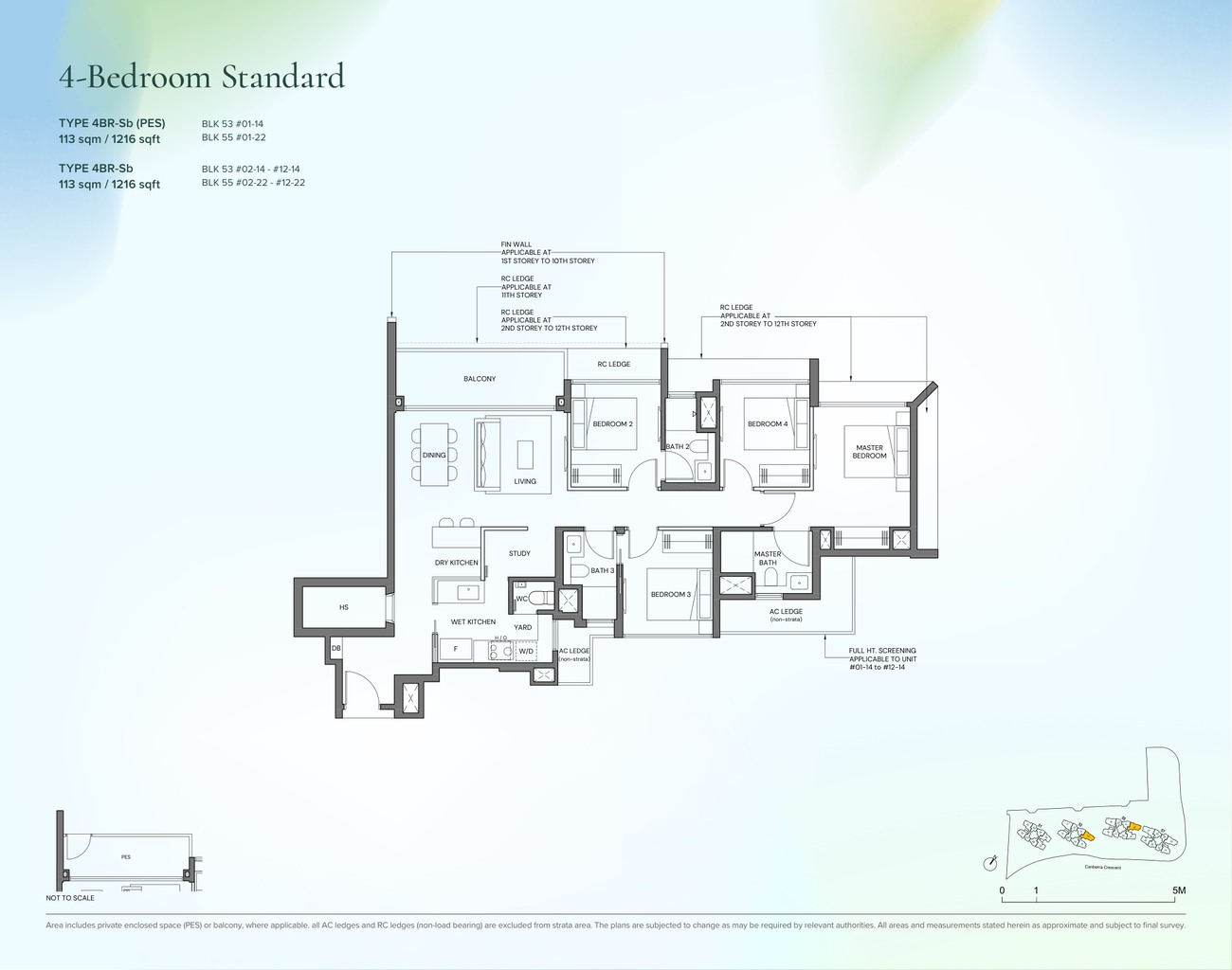
Canberra Crescent Residences 4 Bedroom Standard Type 4BR-Sb floor plan

4 Bedroom Standard · Type 4BR-Sb · 113 sqm / 1,216 sqft
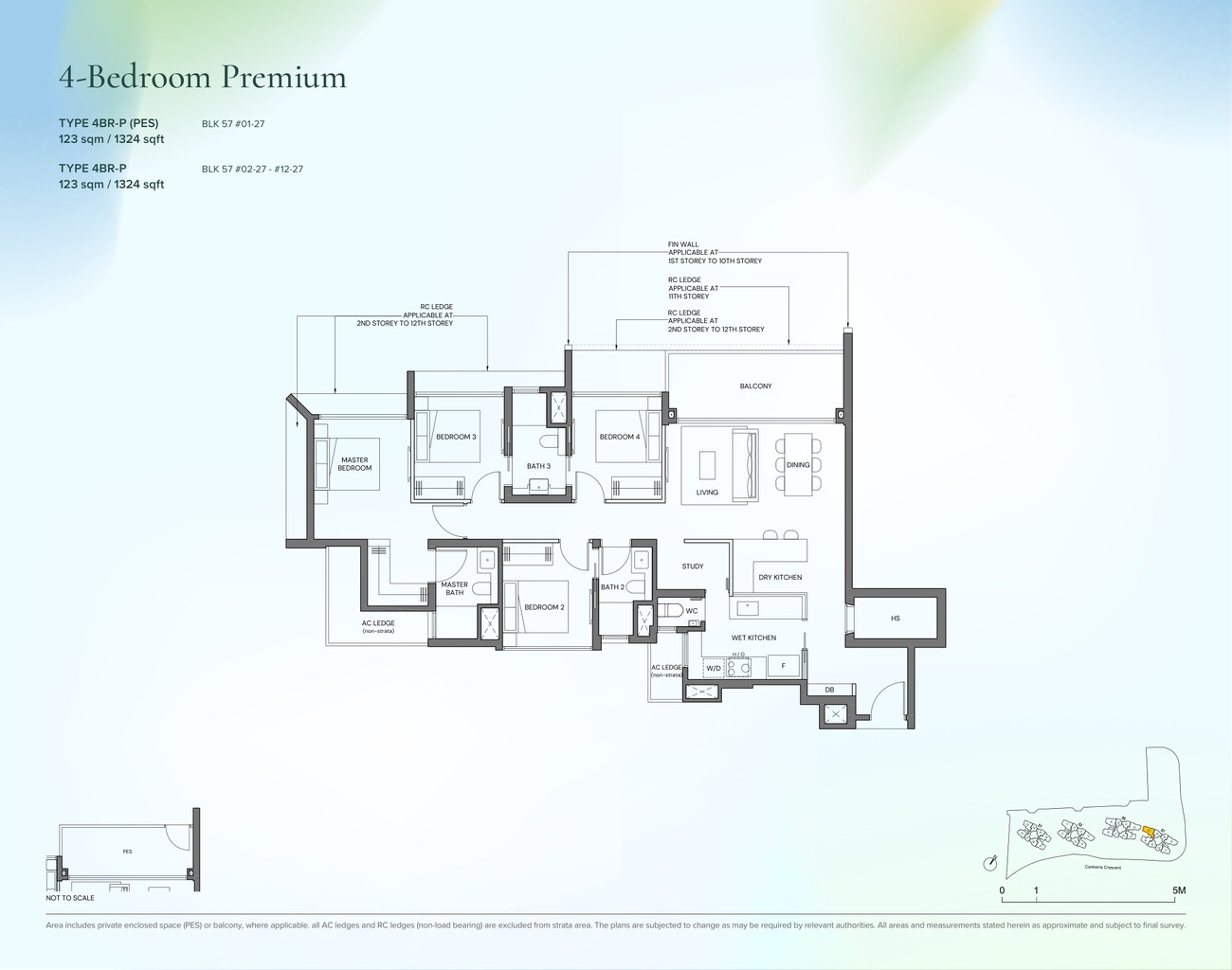
Canberra Crescent Residences 4 Bedroom Premium Type 4BR-P floor plan

4 Bedroom Premium · Type 4BR-P · 123 sqm / 1,324 sqft
Full Floor Plans PDF
All floor-plan pages extracted from the project e-brochure.

Download PDF

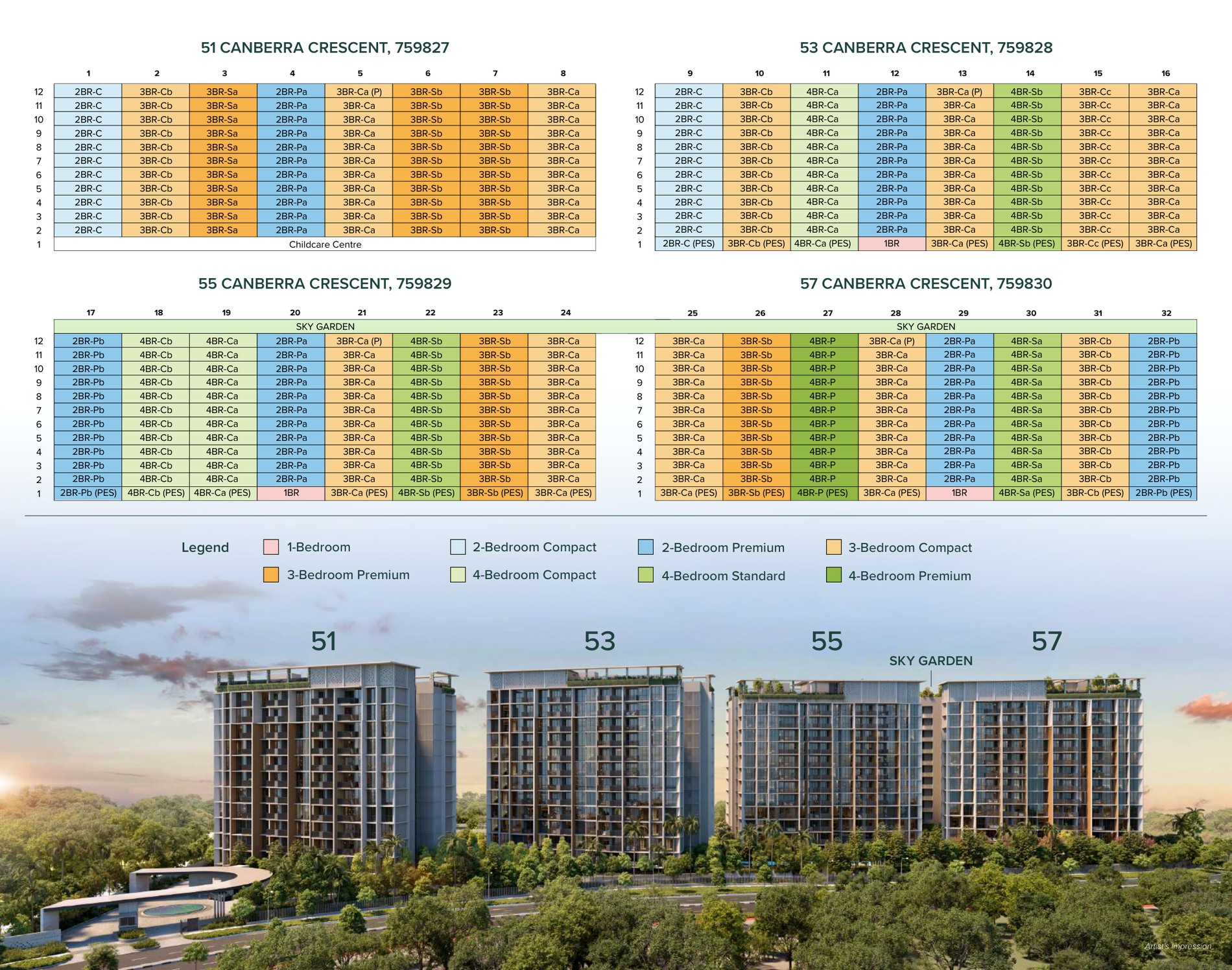
Elevation and Stack Chart

Canberra Crescent Residences elevation and stack chart

Elevation and stack chart · block/unit distribution from the project e-brochure

Facilities (30+)

50m Lap PoolFamily PoolKid’s PoolKid’s Water SlideMini GolfPoolside BBQsCabanasFunction RoomsSocial Working SpaceEntertainment RoomsSky GardenSky LoungeLookout PointBBQ PavilionsGymSteam RoomChildcare CentreForest Playground

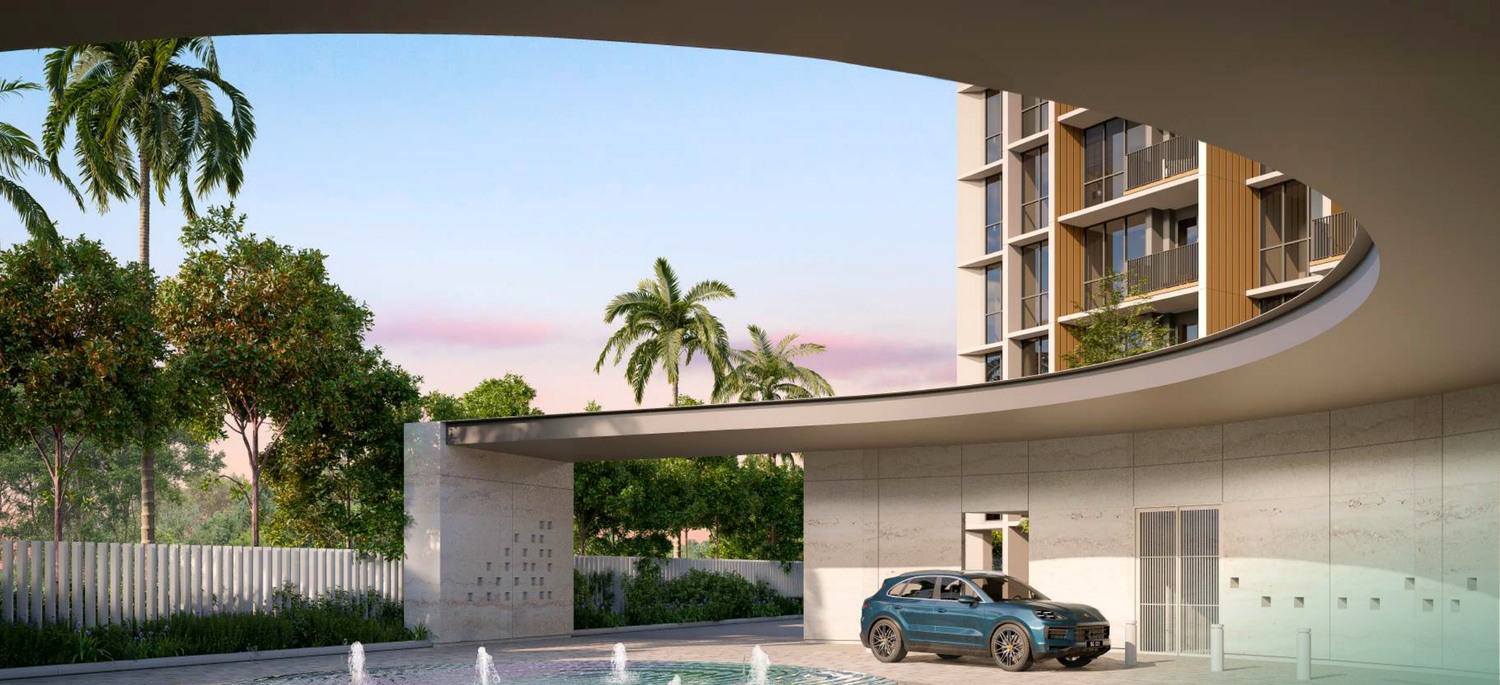
Gallery

Developer and Consultant Team

Peak Crescent Pte Ltd (Kheng Leong Co. x Low Keng Huat)

Verify the latest developer licence, sales documents and appointed project team before committing.

Sustainability and Specifications

Specifications, finishes, smart-home provisions and sustainability ratings vary by unit. Refer to the latest developer brochure and sale documents for final approved details.

Developer

Peak Crescent Pte Ltd

Canberra Crescent Residences is developed by Peak Crescent Pte Ltd, jointly developed by Kheng Leong Co. Pte Ltd and Low Keng Huat (Singapore) Limited. Project documents reference completed or known projects including MeyerHouse, The Watergardens at Canberra, The Minton and Klimt Cairnhill.


Project Timeline

Sales
Live new-launch project page
TOP / VP
30 Apr 2030

Project Factsheet

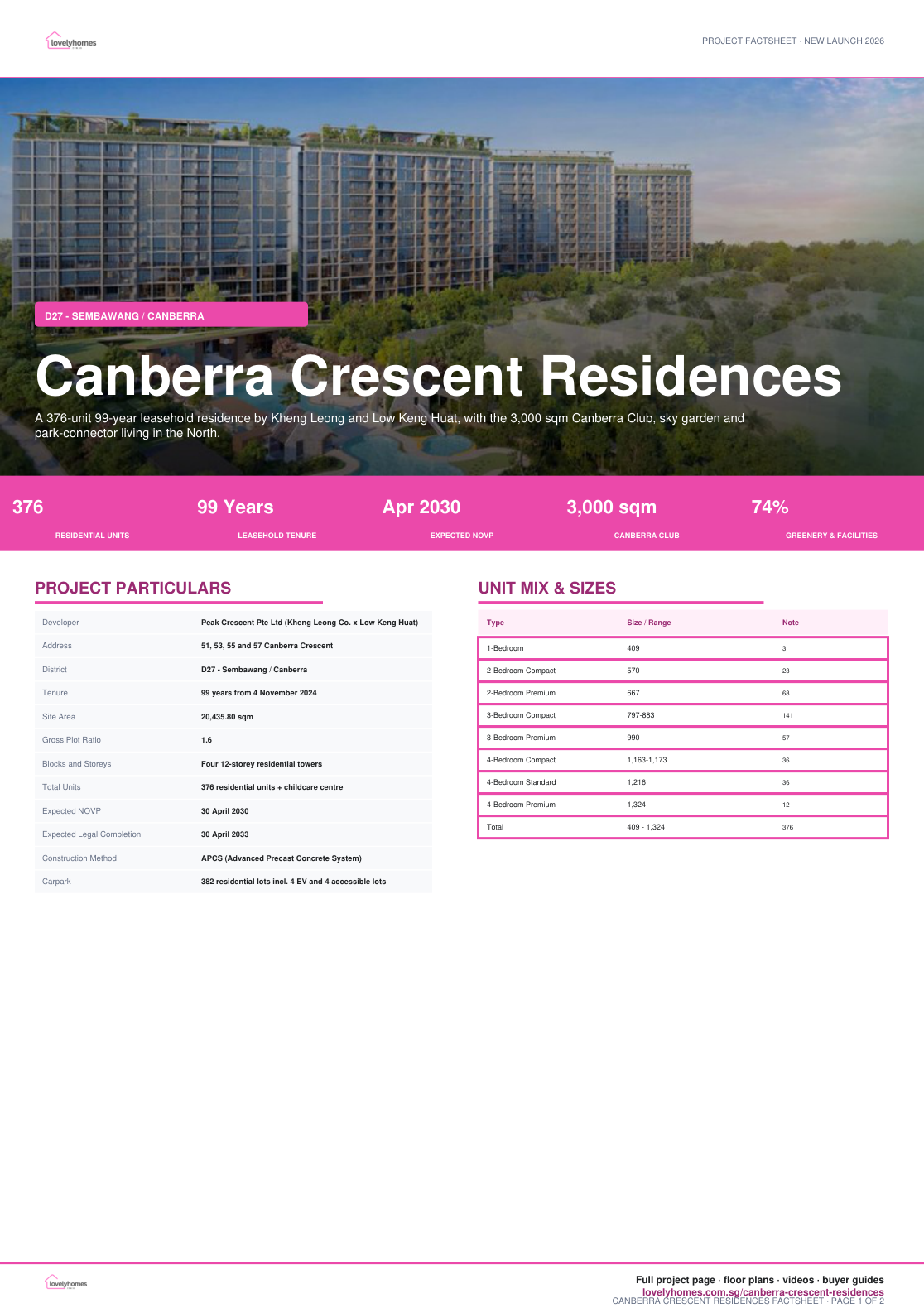
A shareable 2-page PDF snapshot of everything on this page — bring it to viewings, forward it to family.

Download the Full Sales Pack

PDF

Canberra Crescent Residences Factsheet

Two-page LovelyHomes summary with key facts, unit mix and buyer notes.

Download Factsheet

Plans

Full Floor Plans

Complete selected floor-plan PDF extracted from the official e-brochure.

Download Floor Plans

Map

Location Map

High-resolution project location map from the brochure.

Open Map

Frequently Asked Questions

Who is the developer of Canberra Crescent Residences?
The developer is Peak Crescent Pte Ltd, jointly developed by Kheng Leong Co. Pte Ltd and Low Keng Huat (Singapore) Limited.
How many units are there?
The source factsheet states 376 residential units across four 12-storey residential towers, with a childcare centre at Block 51.
When is vacant possession expected?
The source factsheet states expected Notice of Vacant Possession on 30 April 2030 and expected legal completion on 30 April 2033.
What is the current from-price?
Current public balance-unit snapshot shows available 3BR Premium from S$1.966M, 4BR Standard from S$2.343M and 4BR Premium from S$2.627M. Source: Canberra Crescent Residences NewLaunches price list updated 4 Mar 2026, accessed 29 Apr 2026.

Ready to see Canberra Crescent Residences in person?

Use the factsheet and selected floor plans above, then request the latest price list, availability and stack advice before shortlisting.

Enquire Now

Disclaimer: Project details, unit mix, floor plans, facilities and timelines are compiled from local Canberra Crescent Residences project documents and public project references available at the time of update. Prices and availability are subject to change by the developer. Buyers should verify all details, eligibility, taxes and financing with the developer’s appointed sales team and their own professional advisers before committing.

Related Buying Guides

ABSD Singapore 2026

Stamp-duty planning before purchase.

Condo Buying Guide

Budget, timeline and financing basics.

Property Investment

Holding cost and exit considerations.

Translate »