Singapore Dual-Key Condo Guide 2026: ABSD Benefits, Rental Strategy and Who Should Buy
Click anywhere to close
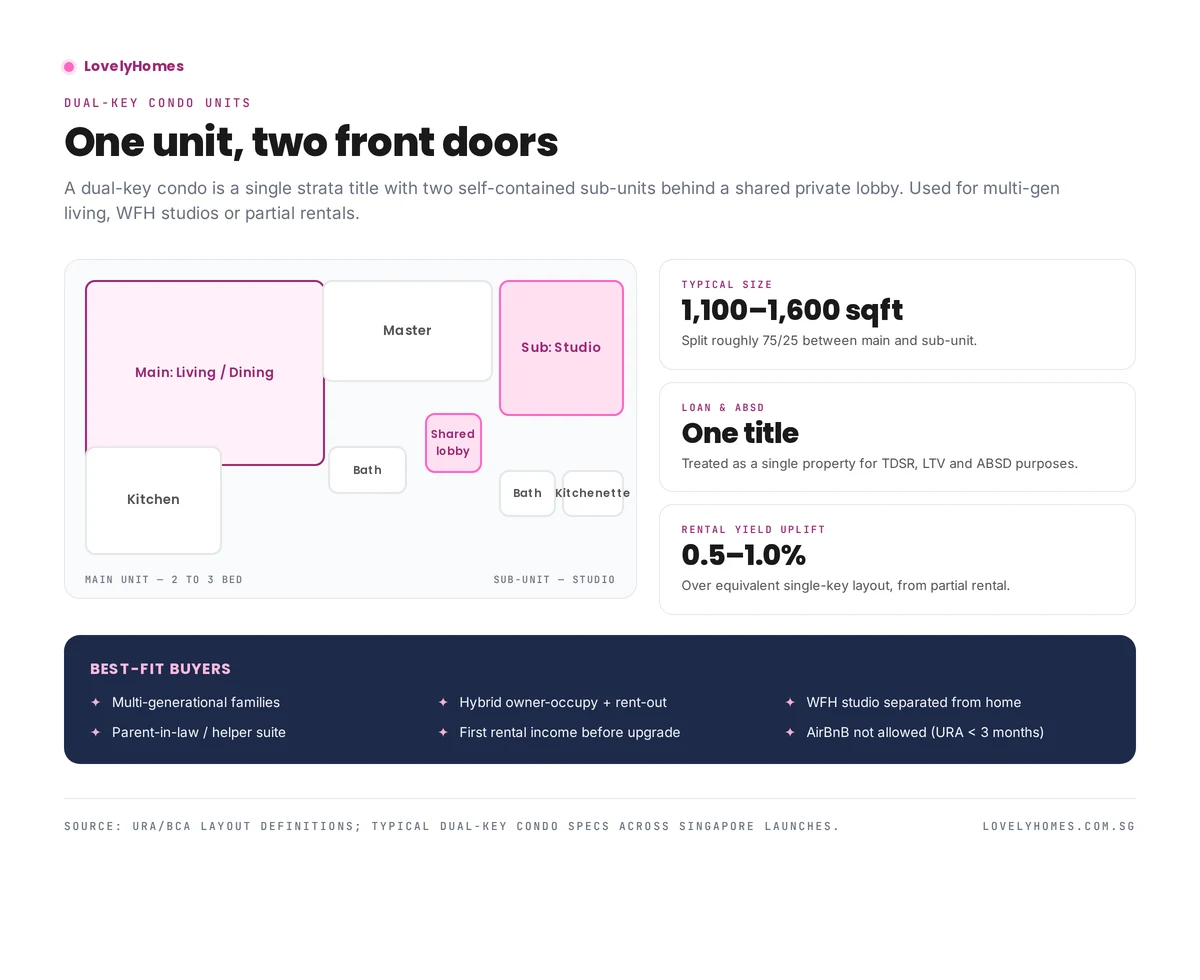
A dual-key condo in Singapore is a private residential unit with two self-contained living areas — a larger “main” unit and a smaller “sub-unit” (typically a studio) — each with its own entrance, kitchen, bathroom, and living space, all within a single strata title. The Urban Redevelopment Authority (URA) allows this configuration under its planning guidelines, and it has become one of the more strategically significant property formats available to Singapore buyers who want to live in one unit and rent out the other without triggering the Additional Buyer’s Stamp Duty (ABSD) that would apply to a separate second property.
This guide explains exactly how dual-key condos work, why they save buyers up to 20% ABSD on a second purchase, what the rental yield and CPF implications are, who they suit best, and what the full ownership cost looks like in 2026.
Key Takeaways — Dual-Key Condo Singapore 2026
- A dual-key unit occupies a single strata title, so it counts as your 1st or 2nd property for ABSD purposes — not as two separate properties.
- A Singapore Citizen couple who have sold their HDB and buy a dual-key condo as their first private property pay zero ABSD — saving up to 20% on a separate investment condo.
- The sub-unit can be rented out freely under URA residential use rules; no separate tenancy approval from HDB or URA is needed (as long as the tenant rules for private property are met).
- CPF Ordinary Account (OA) savings can be used for the full purchase price of a dual-key unit, subject to the usual Valuation Limit and Withdrawal Limit rules.
- TDSR of 55% applies; factor in both units’ potential rental income carefully — only confirmed rental income (via tenancy agreement) can offset TDSR.
- Dual-key units are typically priced at a 15–25% premium over conventional units of equivalent size, reflecting the structural fit-out and planning costs.
- Sub-unit gross rental yields in Singapore run around 4.0–4.8% p.a. for studio-sized units (Q2 2026 data).
- Stamp duty rules for dual-key are unchanged by 2023 and 2024 cooling measures — ABSD is assessed on the single purchase price of the whole unit.
What Exactly Is a Dual-Key Condo?
Under URA guidelines, a dual-key unit is an approved residential configuration where one strata title encompasses two independently functioning dwelling spaces separated by a lockable internal door (or separate entrances from a shared corridor). The smaller sub-unit generally ranges from 200 to 450 sq ft and functions as a self-contained studio, while the main unit covers the remaining floor area.
Key structural features include separate kitchens (or kitchenettes), separate bathrooms, and — critically — separate front doors. This means two households can occupy the unit simultaneously with full privacy. Owners are not required to live in either unit; some investors rent out both the main unit and the sub-unit to separate tenants, maximising rental income from a single strata title.
Dual-key units emerged in Singapore’s new launch market around 2012–2016 during a period of high ABSD rates, when developers and buyers alike searched for legitimate ways to structure ownership for both own-stay and investment purposes. Developments that have featured dual-key layouts include Caspian, Parc Centros, Parc Life EC, and Trilinq, among others. They remain available in selected new launches in 2026.

The ABSD Advantage: Why Dual-Key Matters in 2026
The Additional Buyer’s Stamp Duty, administered by the Inland Revenue Authority of Singapore (IRAS), applies to every residential property purchase based on the buyer’s profile and the number of properties already owned at the time of purchase. As at July 2026, the ABSD rates most relevant to dual-key buyers are:
| Buyer Profile | 1st Property | 2nd Property | 3rd+ Property |
|---|---|---|---|
| Singapore Citizen (SC) | 0% | 20% | 30% |
| Singapore Permanent Resident (SPR) | 5% | 30% | 35% |
| Foreigner (non-SPR) | 60% | 60% | 60% |
| SC + SPR (joint purchase) | 5% | 25% | 35% |
| SC + SC (joint, both 1st prop) | 0% | — | — |
| Entity (company, trust) | 65% | 65% | 65% |
Because a dual-key unit is a single strata title, IRAS treats it as one property. An SC couple who have sold their HDB flat and buy a dual-key condo as their first private residential property pay zero ABSD — the same as buying any other condo for own-stay. If they had instead purchased two separate condos (one to live in, one to rent), the second purchase would attract 20% ABSD.
On a S$1.8 million dual-key unit, 20% ABSD avoided equals S$360,000 — a saving larger than the BSD payable on the same purchase (approximately S$54,600 at the progressive BSD schedule). This structural ABSD advantage is the primary driver of dual-key demand and pricing premiums.
Rental Strategy: Renting Out the Sub-Unit
Private residential properties in Singapore can be rented to any tenant — Singaporean, PR, or foreigner holding a valid pass — without seeking URA or HDB approval. The key rules for dual-key rental are:
The minimum tenancy period is three consecutive months for private residential properties, as prescribed by URA. Short-term stays of less than three months (including Airbnb-style arrangements) are not permitted in private residential properties and are enforced by the Urban Redevelopment Authority. Owners who violate this rule face fines of up to S$200,000 for a first offence.
Rental income from the sub-unit is taxable. IRAS requires owners to declare gross rental income in their annual income tax return and allows deductions for mortgage interest (on an apportioned basis), maintenance fees (apportioned), property tax, insurance, and qualifying renovation costs. Net rental income is added to other income and taxed at the progressive resident rate (up to 22% for incomes above S$320,000 from YA 2024).

CPF Usage for Dual-Key Condos
CPF Board allows Ordinary Account (OA) savings to be used for dual-key condos in the same way as any other private residential purchase, subject to these limits:
The Valuation Limit (VL) is the lower of the purchase price or the market valuation at the time of purchase. CPF can be used up to 100% of the VL. Beyond the VL (if purchase price exceeds valuation), cash must be used for the shortfall and further withdrawal. The Withdrawal Limit (WL) is 120% of the VL for properties with remaining lease ≥ 60 years; for shorter leases, CPF usage tapers and may be restricted entirely if the remaining lease cannot cover the youngest buyer to age 95.
Because dual-key units often sit in new launches with 99-year leases commencing from the date of issue of Temporary Occupation Permit (TOP), most buyers in 2026 will face no lease-shortfall issue under CPF rules for decades. Freehold dual-key units have no CPF withdrawal limit aside from the 120% WL cap.
Who Should Buy a Dual-Key Condo?
Dual-key condos suit a specific buyer profile. They are most compelling for multi-generational households — a couple who want independent living quarters for their parents or adult children without buying a separate unit, avoiding stamp duty entirely. They are also popular with investors who want to be owner-occupiers — living in the main unit, renting the sub-unit, and treating the rental income as a partial offset to mortgage repayments.
They are less suitable for buyers who simply want maximum space for a given budget, since the dual-key configuration costs a structural premium, and may not suit buyers who need HDB grants (dual-key condos are private property — no HDB grants apply).
| Buyer Profile | Dual-Key Suitability | Reason |
|---|---|---|
| SC couple, sold HDB, want own-stay + rental | Highly suitable ✓ | 0% ABSD; sub-unit generates rental yield |
| SC/SPR, already own 1 property, want investment | Suitable (ABSD on full price) | ABSD applies, but 2-in-1 rental income from one title |
| Multi-gen family (parents + adult kids) | Highly suitable ✓ | Full privacy; no separate ABSD trigger |
| Single SC, first-time buyer | Suitable ✓ | 0% ABSD; rent sub-unit while living in main unit |
| Foreigner | Not recommended | 60% ABSD applies regardless; sub-unit does not create exemption |
| Investor seeking maximum rental income only | Compare alternatives | 15–25% size premium may reduce net yield vs two separate smaller units |
Worked Example: Tan SC/SC Couple — S$1.8M Dual-Key Condo (D19, 25yr Bank Loan)
Scenario: Mr and Mrs Tan, both Singapore Citizens, have sold their Bishan HDB flat and are looking for a dual-key condo in District 19 (Serangoon/Hougang area) priced at S$1,800,000. They plan to live in the main unit (approx. 900 sq ft) and rent the sub-unit (approx. 350 sq ft, studio) to a tenant at S$2,400/month. Combined gross income: S$14,500/month. No existing property.
Stamp Duty:
BSD at S$1.8M: S$1 × 1% + S$24,000 × 3% + S$640,000 × 4% + S$1,095,000 × 5% + S$40,000 × 6% = S$54,600 BSD (per IRAS progressive schedule)
ABSD: 0% (SC couple, no existing property) = S$0 ABSD saved vs S$360,000 if 2nd property
Financing (Bank Loan, 75% LTV):
Loan: S$1,350,000 at 3.5% p.a. over 25 years → monthly repayment ≈ S$6,762
TDSR: S$6,762 / S$14,500 = 46.6% — PASS (≤ 55%)
(Note: confirmed rental income from the sub-unit via tenancy agreement can reduce TDSR exposure once the tenancy is in place, potentially allowing a higher loan quantum.)
Upfront Cash/CPF Required:
5% down (cash): S$90,000 | 20% down (cash or CPF OA): S$360,000 | BSD: S$54,600 (CPF OA or cash) | Legal & misc ≈ S$6,000
Total upfront: ≈ S$510,600
Rental Yield:
Sub-unit rent: S$2,400/month → S$28,800 p.a. gross
Gross yield on sub-unit proportional value (≈ S$360,000): 8.0% p.a. — or 1.6% gross on total purchase price
Net effective mortgage cost after rental: S$6,762 − S$2,400 = S$4,362/month

What This Means for You
Dual-key condos occupy a very specific niche in the Singapore property market. Their key attraction — ABSD avoidance — is a genuine, legally sound structural benefit that the government has not moved to close since the format was approved under URA planning rules. The Monetary Authority of Singapore (MAS) has tightened TDSR and LTV rules repeatedly since 2013, but dual-key unit status for ABSD has remained unchanged through every cooling measure round, including the 2023 hike that raised SC second-property ABSD from 17% to 20%.
The trade-off is price and size efficiency. Developers charge a structural premium of roughly 15–25% over a comparable non-dual-key unit of the same total floor area, reflecting the additional fit-out cost (second kitchen, second bathroom, second entrance) and the planning entitlement value. Buyers should run a careful net present value comparison: does the ABSD saving (at 20% of purchase price) exceed the unit price premium paid AND the lower gross rental yield per square foot over a 10-year holding period? In most scenarios involving SC couples purchasing their first private property above S$1.2 million, the answer is yes — but the breakeven becomes less compelling for SPRs (who face 30% ABSD on a second property, making a second separate condo even more punishing) and almost irrelevant for SC holders of a single property considering a third (where 30% ABSD applies either way).
What Might Come Next
Industry observers and property analysts have noted that dual-key supply is constrained: URA must approve the configuration at the planning stage, and not all developers apply for dual-key planning permission. As of Q2 2026, dual-key units represent fewer than 3% of all new private residential launches in Singapore. Should ABSD rates be reduced in a future policy relaxation — a scenario that several banks’ research desks view as possible if economic conditions weaken materially — the ABSD-avoidance premium built into dual-key pricing would deflate. Conversely, any ABSD increase for third or subsequent properties could strengthen demand for dual-key units as a way to lock in multiple rental streams under one title. Buyers in 2026 should monitor the MAS Financial Stability Review (due November 2026) and the URA Q3 2026 price index for signals.
Frequently Asked Questions
Can I rent out both the main unit and the sub-unit of a dual-key condo?
Yes. There is no rule preventing an owner from renting out both dwelling areas of a dual-key unit simultaneously. Because the unit is a single strata title in a private residential development, standard URA private residential tenancy rules apply: minimum three-month tenancy periods, no short-term sub-letting (Airbnb), and tenants must hold valid immigration passes if they are non-citizens. Both rental income streams must be declared to IRAS. Some owners choose to rent out both units and live elsewhere — effectively treating the dual-key as a full investment property — which is entirely permissible.
Does buying a dual-key condo count as owning one property or two for ABSD purposes?
It counts as one property. ABSD is assessed on the number of residential properties owned, and ownership is determined by strata title. A dual-key unit is one strata title. Whether the sub-unit is rented, owner-occupied, or vacant makes no difference to the ABSD count. This is the most important legal feature of the dual-key format and has been confirmed by IRAS through its published guidance. If a couple later buys a second property — even if they rent out the entire dual-key unit — the second purchase attracts the prevailing ABSD rate for a second property.
Can I use my CPF Ordinary Account for the full purchase price of a dual-key condo?
CPF OA can be used up to the Valuation Limit (VL) — the lower of purchase price or bank valuation. Beyond the VL up to 120% of VL, CPF can be used provided the remaining lease of the property covers the youngest buyer to at least age 95. For a brand-new 99-year leasehold dual-key condo, most buyers in 2026 will face no lease-related restriction. For freehold dual-key units, there is no lease cap. The 5% minimum cash downpayment required by the Monetary Authority of Singapore (MAS) for private residential purchases cannot come from CPF — it must be cash.
Can I decouple ownership of a dual-key condo to avoid ABSD on a future purchase?
Decoupling is only possible for properties held under Tenancy-in-Common (TIC), not Joint Tenancy (JT). If a dual-key condo is owned under JT, one owner cannot sell their share to the other without triggering additional stamp duty on the transfer. If the unit is held under TIC, one owner can transfer their share to the other at market value (attracting BSD and potentially ABSD on the transferee’s existing property count). Decoupling a dual-key unit from TIC is structurally identical to decoupling any other private residential property. After decoupling, the remaining sole owner holds one property, freeing the departing owner to buy another property at first-property ABSD rates. Legal and financial advice is strongly recommended before proceeding.
What happens to the dual-key unit if I later buy a second property — does the sub-unit count separately?
No. The sub-unit does not count separately. When you buy a second property, IRAS assesses your ABSD based on the number of strata titles you own. If you own one dual-key condo (one title) and then buy another residential property, the new purchase is treated as your second property — attracting 20% ABSD for an SC. The sub-unit of your existing dual-key does not create a separate property count. However, if you later buy a third residential property (with the dual-key as your first and the second separate condo as your second), that third purchase attracts 30% ABSD for an SC.
Are dual-key condos resale-market friendly? Will I find buyers easily?
The resale market for dual-key units is narrower than for conventional condos because the buyer pool is self-selecting — typically multi-generational families or investors seeking ABSD savings on a combined own-stay/rental asset. Pricing is less comparable to surrounding units of similar strata area because the configuration premium must be explained to buyers. That said, in a market where ABSD rates remain elevated (as in 2026), the structural ABSD advantage sustains demand. URA caveats data show that dual-key units in well-located developments (MRT proximity, reputable developers) have transacted with positive capital appreciation over 5–10 year holding periods comparable to conventional condos in the same developments.
Is there a minimum income to buy a dual-key condo?
There is no minimum income rule set by URA or HDB for private residential purchases. However, MAS’s Total Debt Servicing Ratio (TDSR) of 55% effectively creates an income floor relative to the loan amount. For a S$1.8 million dual-key condo with a 75% LTV bank loan of S$1,350,000 at 3.5% p.a. over 25 years, the monthly repayment is approximately S$6,762. To pass TDSR without counting rental income, a borrower needs total monthly income of at least S$12,295 (S$6,762 ÷ 55%). Joint borrowers’ incomes are combined. Confirmed rental income from a signed tenancy agreement can be included in income for TDSR purposes, subject to lender policies (typically at a 30–50% haircut on gross rental).