An Executive Condominium (EC) is a hybrid housing type — built by private developers but initially subject to HDB eligibility rules, offering condo-quality finishes at 20–30% below comparable private launch prices.
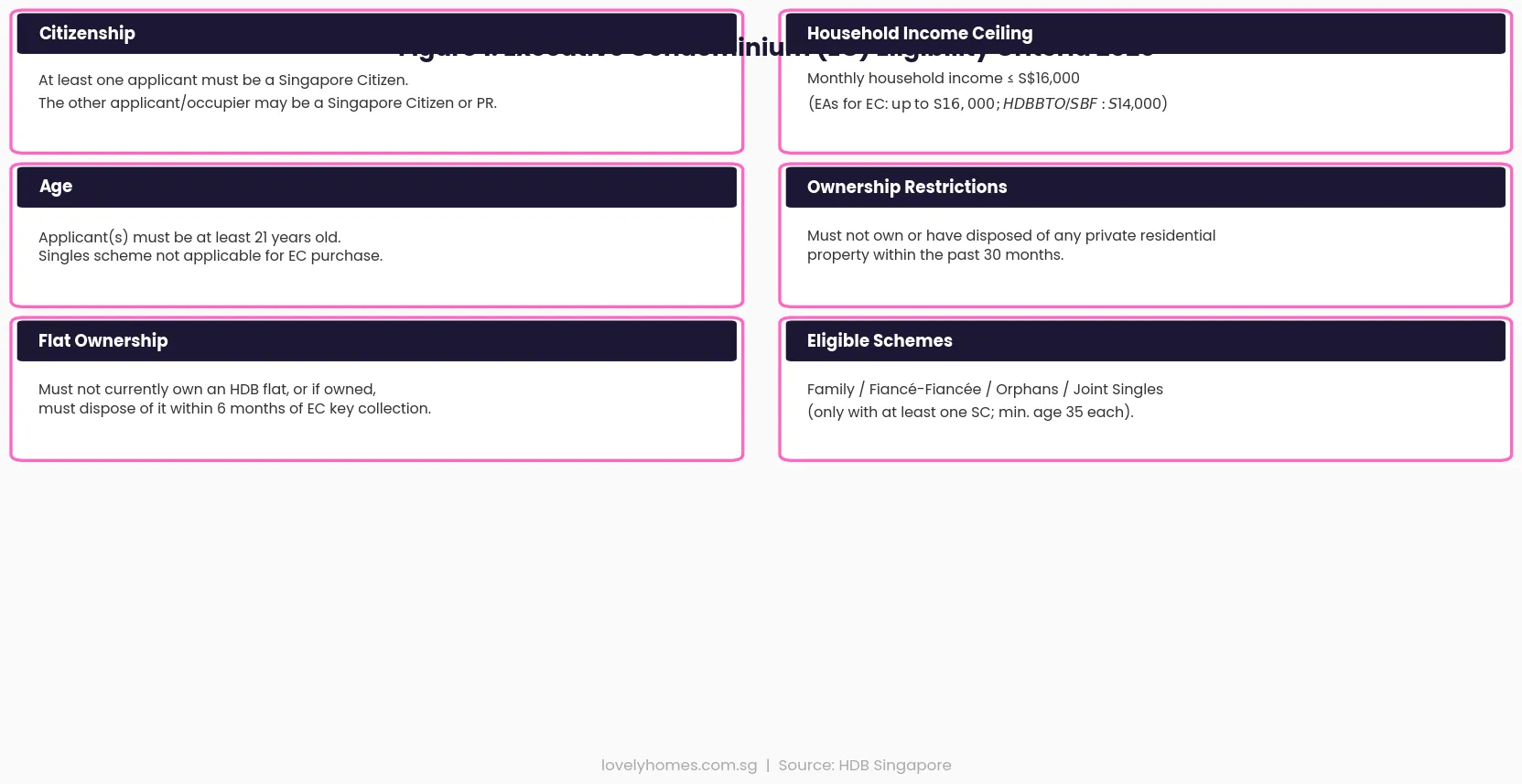
Eligibility: at least one applicant must be a Singapore Citizen; monthly household income must not exceed S$16,000; applicants must be at least 21 years old.
ECs carry a 5-year MOP counted from TOP (Temporary Occupation Permit). During MOP they may only be resold to Singapore Citizens and Permanent Residents who meet HDB eligibility criteria.
After 10 years from TOP, an EC is fully privatised and may be sold to foreigners — identical to any private condominium.
No ABSD for Singapore Citizen first-time EC buyers; PR first-timers pay ABSD of 5% on the EC purchase price.
ECs are not eligible for CPF housing grants (EHG, FHG, PHG) — but buyers who sold a resale HDB flat may face a resale levy.
Banks (not HDB) finance EC purchases — the Loan-to-Value (LTV) limit is 75% (same as private), and the Total Debt Servicing Ratio (TDSR) of 55% applies.
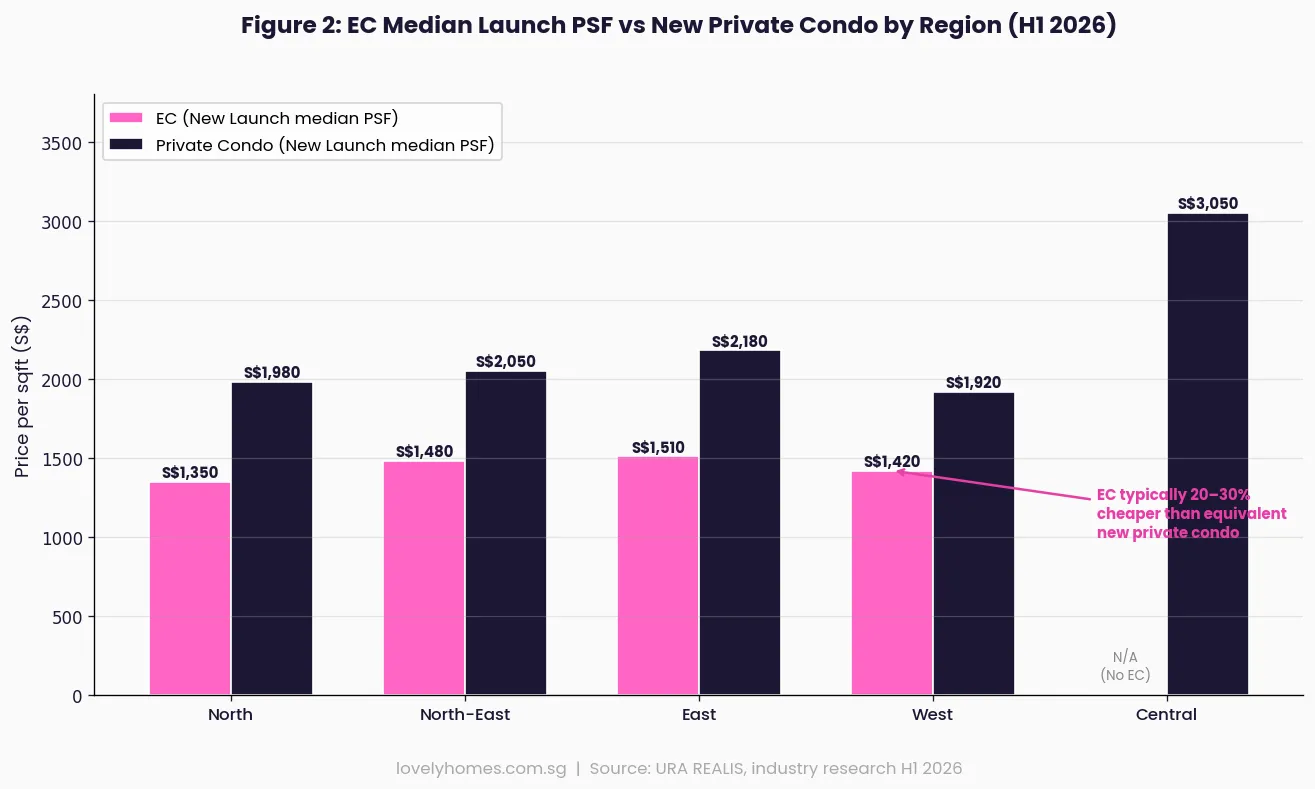
As at H1 2026, median EC launch prices range from approximately S$1,350–S$1,510 per sqft across the North, East, and West regions — roughly 25–30% below comparable new private launches.
What Is an Executive Condominium?
The Executive Condominium is a uniquely Singaporean housing innovation — a hybrid tenure type introduced in 1995 to serve the “sandwich class”: Singaporeans who earn too much to qualify for an HDB BTO flat but find private condominiums financially out of reach. An EC offers full condominium amenities — private pool, gymnasium, barbecue pits, 24-hour security, and landscaped grounds — at a price point that is materially below equivalent new private launches.
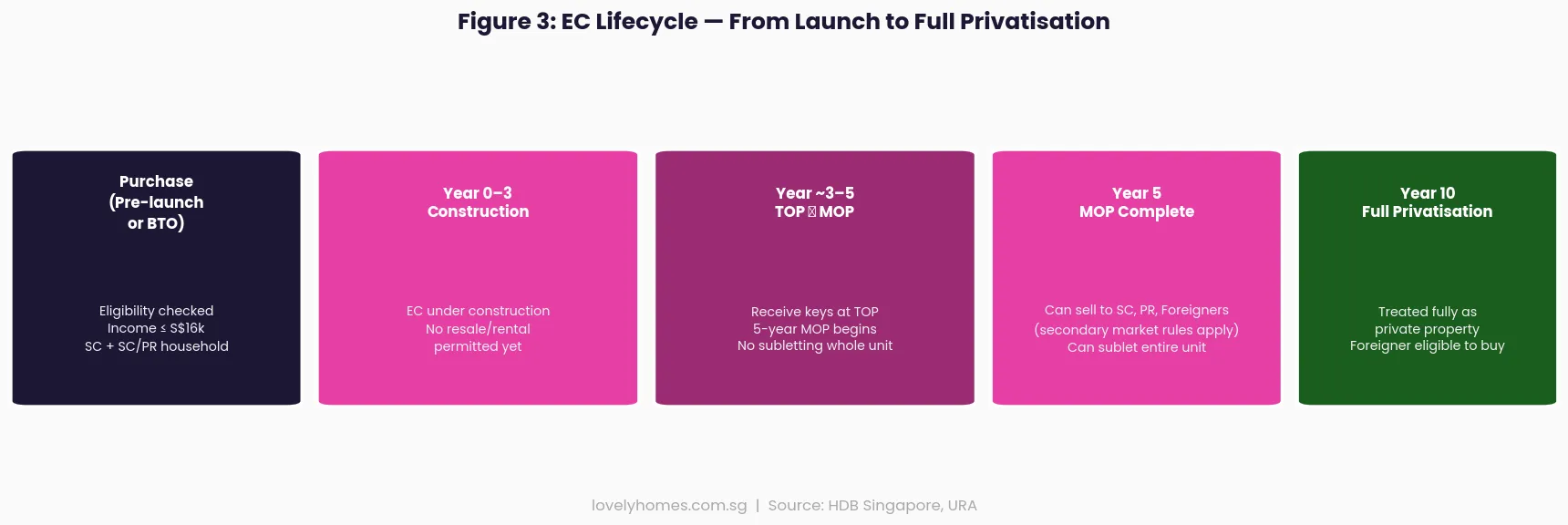
The key distinction from a standard private condominium is that ECs are initially subject to HDB ownership eligibility rules for the first 10 years after obtaining the Temporary Occupation Permit (TOP). The lifecycle unfolds in three distinct phases: during construction (HDB rules apply); 5 years after TOP (MOP complete, open to SC/PR resale market); and 10 years after TOP (full privatisation, open to foreigners and treated identically to private property).
ECs are developed exclusively by private developers who bid for Government Land Sales (GLS) sites earmarked for EC development by the Urban Redevelopment Authority (URA). The government controls EC supply by releasing sites through the GLS programme, and controls demand through the income ceiling and eligibility criteria administered by HDB.
HDB administers the eligibility rules for EC purchases. The criteria are stricter than for private condominiums but more permissive than for BTO flats in some respects. As at August 2026:
Criterion
Requirement
Notes
Citizenship
At least one applicant must be a Singapore Citizen
The other applicant/core occupier may be SC or Permanent Resident
Monthly Household Income
≤ S$16,000
All regular income of all listed applicants and occupiers is counted
Age
Minimum 21 years old
Singles scheme not applicable; must apply as a family or fiancé-fiancée unit
Private Property
Must not own or have disposed of private residential property within 30 months of EC application
Includes overseas properties for SC and PR applicants
HDB Flat
May own an HDB flat at point of application; must dispose within 6 months of EC key collection
Disposing of an HDB flat to buy an EC triggers a resale levy if the HDB flat was subsidised
Application Schemes
Family, Fiancé-Fiancée, Orphans, Joint Singles (SC only, age ≥ 35)
Joint Singles: both applicants must be SC; each at least 35 years old
A key point often misunderstood: the income ceiling for ECs is S$16,000 per month, which is S$2,000 higher than the ceiling for HDB BTO flats (S$14,000). This has been a deliberate policy choice to make ECs accessible to the “sandwich class” — households earning in the S$14,001–S$16,000 range who are ineligible for BTO but benefit from the EC’s subsidised pricing relative to private launches.
EC Price vs Private Condo: The Value Gap
The most compelling argument for an EC — and the primary reason buyers accept the MOP constraints — is price. As at H1 2026, new EC launches are priced approximately 20–30% below equivalent new private condominiums in the same region. The exact discount varies by project, location, and market conditions.
Figure 2: EC Median Launch PSF vs New Private Condo by Region, H1 2026 — Source: URA REALIS, industry research. Click to enlarge.
In the West region — historically one of the most active for EC launches given major EC clusters in Bukit Batok, Tengah, Jurong, and Sembawang — EC median launch PSF of approximately S$1,420 compares with new private condo launches at S$1,920 PSF. The S$500 PSF gap translates to a saving of S$500,000 on a 1,000 sqft unit — more than enough to offset the MOP constraints for most owner-occupier buyers.
The trade-off is real: EC buyers accept the 5-year MOP (from TOP), cannot sell to foreigners until 10 years post-TOP, and cannot benefit from CPF housing grants. But for genuine owner-occupiers who intend to live in the unit for the medium to long term, the price advantage is substantial and the MOP is largely a non-issue.
The EC Privatisation Lifecycle
Figure 3: EC Lifecycle — From Purchase to Full Privatisation — Source: HDB Singapore. Click to enlarge.
Understanding the EC’s privatisation journey is essential for buyers thinking about resale strategy and long-term wealth building:
At Purchase (Pre-TOP): You purchase the EC on a progress-payment schedule linked to construction milestones. The EC is treated as a private property purchase for stamp duty purposes — BSD applies, and ABSD applies if you are a PR or foreigner (Singapore Citizens buying their first EC pay zero ABSD). The purchase is financed by a commercial bank loan, not an HDB concessionary loan.
At TOP (typically 3–4 years after launch): You collect your keys. The 5-year MOP clock begins from this date — not from when you signed the sale and purchase agreement. During the MOP, you must occupy the unit. You cannot sublet the entire unit, though subletting of individual rooms is subject to HDB approval.
5 Years After TOP (MOP Complete): The EC enters the Singapore Citizens and Permanent Residents resale market. At this stage, the unit trades as a quasi-private property — priced at a discount to comparable fully-private condos because foreigners cannot yet buy. This MOP-completion wave typically sees a meaningful uplift in EC resale values as demand from SC/PR upgraders enters the market.
10 Years After TOP (Full Privatisation): The EC is now indistinguishable from any private condominium for all purposes. Foreigners may purchase it. The Foreign Ownership Rules under the Residential Property Act apply, but are no more restrictive than for any other private condo. At this stage, ECs typically trade at a very small discount to equivalent private condos (if at all), having completed their privatisation premium compression.
Financing an EC: Bank Loan, TDSR, and CPF Usage
Because ECs are financed exclusively by commercial banks (HDB concessionary loans are not available), the financing framework mirrors private property rules:
LTV limit: Up to 75% of the purchase price or valuation (whichever is lower), for buyers with no outstanding home loans. This means you need at least 25% in cash or CPF for the down payment.
Minimum cash component: At least 5% of the purchase price must be paid in cash. The remaining 20% can come from CPF Ordinary Account (OA) savings.
TDSR: The Total Debt Servicing Ratio cap of 55% applies — total monthly debt obligations (including the EC loan) must not exceed 55% of gross monthly income.
CPF usage: CPF OA savings can be used for the EC purchase and mortgage repayment, subject to the Valuation Limit and Withdrawal Limit rules administered by the CPF Board.
No MSR: The Mortgage Servicing Ratio (MSR) cap of 30% — which applies to HDB loans and BTO purchases — does NOT apply to EC purchases. This is an important distinction: EC buyers can borrow more relative to their income than BTO buyers.
Stamp Duties on EC Purchase
EC purchases are subject to the same stamp duty rules as private property:
Buyer Profile
BSD
ABSD
Net Stamp Duty on S$1.5M EC
Singapore Citizen — 1st property
Standard rates (1%–6%)
0%
S$44,600 BSD
Singapore Citizen — 2nd property
Standard rates
20%
S$44,600 + S$300,000
Permanent Resident — 1st property
Standard rates
5%
S$44,600 + S$75,000
Permanent Resident — 2nd property
Standard rates
30%
S$44,600 + S$450,000
The BSD rates are: 1% on first S$180,000; 2% on next S$180,000; 3% on next S$640,000; 4% on next S$500,000; 5% on next S$1.5M; 6% on remainder. For a S$1.5M EC purchase, BSD = S$44,600. See our complete BSD guide and ABSD guide for full calculations.
Worked Example: The Ng Family’s EC Purchase
📍 The Ng Family — First-Time EC Buyers in 2026
Background: Mr Ng (SC, age 33) and Ms Wong (SC, age 31) are newly married. Both are first-time property buyers. Combined monthly household income: S$13,500. They are applying for a new EC launch in Tengah, West region. Unit: 3-bedroom, 980 sqft, priced at S$1,478,600 (S$1,509 PSF).
Eligibility check:
Household income S$13,500 ≤ S$16,000 ✓
At least one SC (both SC) ✓
Age ≥ 21 (both qualify) ✓
No private property owned or disposed of within 30 months ✓
Down payment (25% minimum):
Total purchase price: S$1,478,600
Min 5% cash: S$73,930
Remaining 20% CPF OA: S$295,720
Total down payment: S$369,650
Bank loan (75% LTV):
Loan amount: S$1,108,950
Assumed rate: 3.8% p.a. (floating SORA-based, H1 2026 indicative)
Tenure: 25 years
Monthly instalment: ~S$5,720
TDSR check: S$5,720 / S$13,500 = 42.4% — well within the 55% TDSR cap ✓
Day-1 cash outlay (excluding legal fees ~S$3,800):
Cash down payment: S$73,930
BSD: S$43,744 (payable within 14 days of OTP exercise)
Legal/disbursements: ~S$3,800 Total day-1 cash: ~S$121,474
EC schedule (projected):
Expected TOP: 2029
MOP completion: 2034
Full privatisation: 2039
Estimated resale value at 5-year MOP (2034): S$1.8M–S$2.0M (assuming 3–4% per annum capital appreciation — speculative).
Why ECs Make Strategic Sense for the Right Buyer
The EC is the most compelling value proposition in Singapore’s property market for buyers who meet the eligibility criteria and are comfortable with the MOP constraints. The value case rests on three pillars:
First: Entry price advantage. At 20–30% below comparable private launches, the EC provides immediate capital buffer. Even if private condo prices stagnate, the EC buyer has effectively bought in at a structural discount. Compare this with a private condo buyer paying full market price who then needs prices to appreciate just to break even on transaction costs.
Second: Privatisation premium. Historical data shows that ECs typically experience meaningful price appreciation at two points: at MOP completion (when the resale pool broadens to include all SC and PR buyers) and at full privatisation (when foreigners become eligible). This privatisation arc — from semi-public housing to fully private property over 10 years — is a unique return dynamic unavailable in any other Singapore property type.
Third: Upgrader pathway. For couples starting their property journey, an EC allows them to enjoy private condo living standards, build equity over the MOP period, and then use the proceeds of an EC resale to purchase a larger private home. The EC fits naturally into Singapore’s property upgrading ladder: HDB BTO → EC → private condo → landed.
The risk is equally clear: if the household’s income rises above S$16,000 between booking and key collection, eligibility may lapse (developers are required to verify income again). If you need to sell urgently before MOP, you cannot. And if you are a PR paying 5% ABSD, the entry cost is meaningfully higher than for an SC first-timer.
What Might Come Next: EC Policy Outlook
The EC market in 2026 faces a moderate supply pipeline. The URA‘s H2 2026 GLS programme included two confirmed EC sites. Demand continues to be supported by a large cohort of young professional households in the S$12,000–S$16,000 income bracket — precisely the demographic the EC is designed to serve.
Policy-wise, the income ceiling of S$16,000 has remained stable since 2019. Industry observers have periodically called for a review to S$18,000 or S$20,000 to account for wage inflation, but the government has not signalled any change. A ceiling increase would expand the eligible buyer pool significantly and could put upward pressure on EC launch prices.
The broader question of whether ECs should continue in their current form — given their blurring into the private market at privatisation — is debated periodically. For now, the government views ECs as a key mechanism for addressing the middle-income housing gap and they remain a permanent fixture of Singapore’s housing landscape.
Can a foreigner buy an Executive Condo in Singapore?
Not directly, and not before 10 years post-TOP. During the first 5 years (MOP period), ECs may only be resold to eligible buyers under HDB’s scheme — which excludes foreigners entirely. From 5 to 10 years post-TOP, the EC is open to Singapore Citizens and Permanent Residents on the secondary market, but still not to foreigners. Only after 10 years from the date of TOP does the EC become fully privatised and eligible for purchase by foreigners. At that point, ECs are treated identically to any private condominium under Singapore’s Foreign Ownership Rules.
Can I use my CPF to buy an EC?
Yes — CPF Ordinary Account (OA) savings can be used for EC purchases, including for the down payment (the portion beyond the mandatory 5% cash) and for monthly mortgage instalments. However, ECs are not eligible for CPF housing grants such as the Enhanced CPF Housing Grant (EHG), Family Grant (FHG), or Proximity Housing Grant (PHG) — those grants are only available for HDB BTO and resale flat purchases. CPF usage for EC purchases is governed by the CPF Board’s Valuation Limit and Withdrawal Limit rules, which link the amount of CPF you can use to the flat’s valuation and your age.
What is the resale levy, and does it apply to EC buyers?
The resale levy is a charge payable to HDB when a subsidised HDB flat owner purchases another subsidised flat (including an EC). If you previously owned a BTO flat (or a resale flat purchased with a CPF housing grant) and are now buying an EC, a resale levy applies. The levy ranges from S$15,000 to S$55,000 depending on the flat type you previously owned: S$15,000 for a 2-Room Flexi, S$30,000 for a 3-Room, S$40,000 for a 4-Room, S$45,000 for a 5-Room, and S$55,000 for an Executive flat or DBSS. The levy is deducted from the EC purchase price — it does not come from you in cash, but reduces the amount available for your down payment from the flat sale proceeds.
What happens if my household income exceeds S$16,000 between booking and key collection?
HDB checks your household income at two key points: at the point of application (booking) and at the point of key collection. If your combined household income rises above S$16,000 between these two points, you may lose eligibility. Developers are legally required to report any income ceiling breaches to HDB, which can result in cancellation of the purchase with forfeiture of the booking fee (typically 5% of the purchase price). If income exceeds the ceiling due to extraordinary circumstances — for example, a one-off bonus — you should seek advice from the developer and HDB promptly. Stable salaried income is the primary metric; irregular or one-off payments are assessed differently.
Is an EC a better investment than an HDB flat or a private condo?
Investment outcomes depend heavily on timing, location, holding period, and individual financial circumstances — and LovelyHomes does not provide financial advice. That said, from a structural standpoint, ECs offer a combination that is difficult to match: the entry price discount of 20–30% versus private launches, full condo amenities, and a privatisation arc that has historically supported capital appreciation. Historical studies of past EC projects show that most have significantly outperformed equivalent HDB resale flat appreciation over comparable 10-year holding periods. Whether ECs outperform private condos net of opportunity cost depends on specific project selection and market timing. The answer is different for every buyer and every project — consult a licensed financial adviser for personalised analysis.
Can I buy an EC as a single person?
Generally no — the Singles scheme (which allows single SC citizens aged 35+ to buy HDB flats) is not available for EC purchases. ECs require a family nucleus: married couple, fiancé-fiancée, orphan scheme (siblings), or joint singles. The joint singles scheme allows two single SC citizens (each aged at least 35) to jointly purchase an EC — but both must be SC, and the household income ceiling of S$16,000 still applies to the combined income of both applicants. A single person buying alone cannot apply for an EC under any scheme.
How long does it take from EC launch to key collection?
Typically 3 to 4 years from the date of the Sales and Purchase Agreement (S&P) signing to the issuance of the Temporary Occupation Permit (TOP). Construction timelines vary by project and developer, but the standard EC construction period is 36 to 48 months. The MOP of 5 years then begins from TOP — so from the date you book your EC to the earliest you can sell on the open market is typically 8 to 9 years. From booking to full privatisation (when foreigners can buy) is typically 13 to 14 years. This long-term horizon is a fundamental characteristic of EC investment — it is not suitable for buyers who may need to liquidate in the short to medium term.
Disclaimer: This article is for general informational purposes only and does not constitute financial, legal, or property advice. EC eligibility rules, income ceilings, stamp duty rates, and CPF regulations are subject to change. Always verify current requirements with HDB, IRAS, the CPF Board, and your bank before making any property purchasing decisions. Consult a licensed financial adviser or property professional for personalised advice.
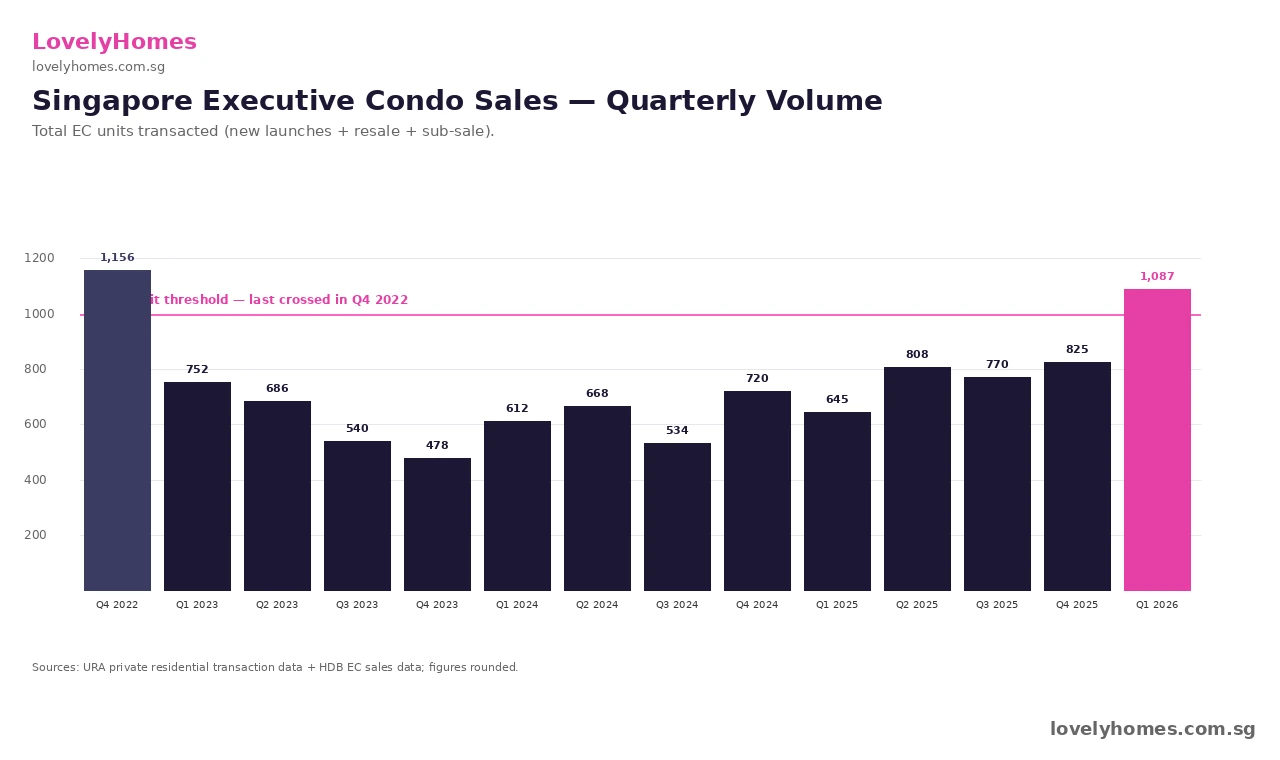
Executive Condominium (EC) sales in Singapore crossed the 1,000-unit-per-quarter threshold for the first time in three-and-a-quarter years in Q1 2026. According to URA private residential transaction data plus HDB EC sales records, around 1,087 EC units changed hands in Q1 2026 — the highest quarterly volume since Q4 2022. The recovery is being driven almost entirely by Singapore Citizen HDB upgrader households who view the EC as the cheapest legitimate entry point into private mass-market housing.
Quick Answer — what just happened in the EC market
1,087 EC units sold in Q1 2026 — first time above 1,000 in 13 quarters.
Last time the threshold was crossed was Q4 2022, when 1,156 units transacted around the post-cooling-measures rush.
Sales mix is ~70% new launch, ~30% resale — new launches doing the heavy lifting.
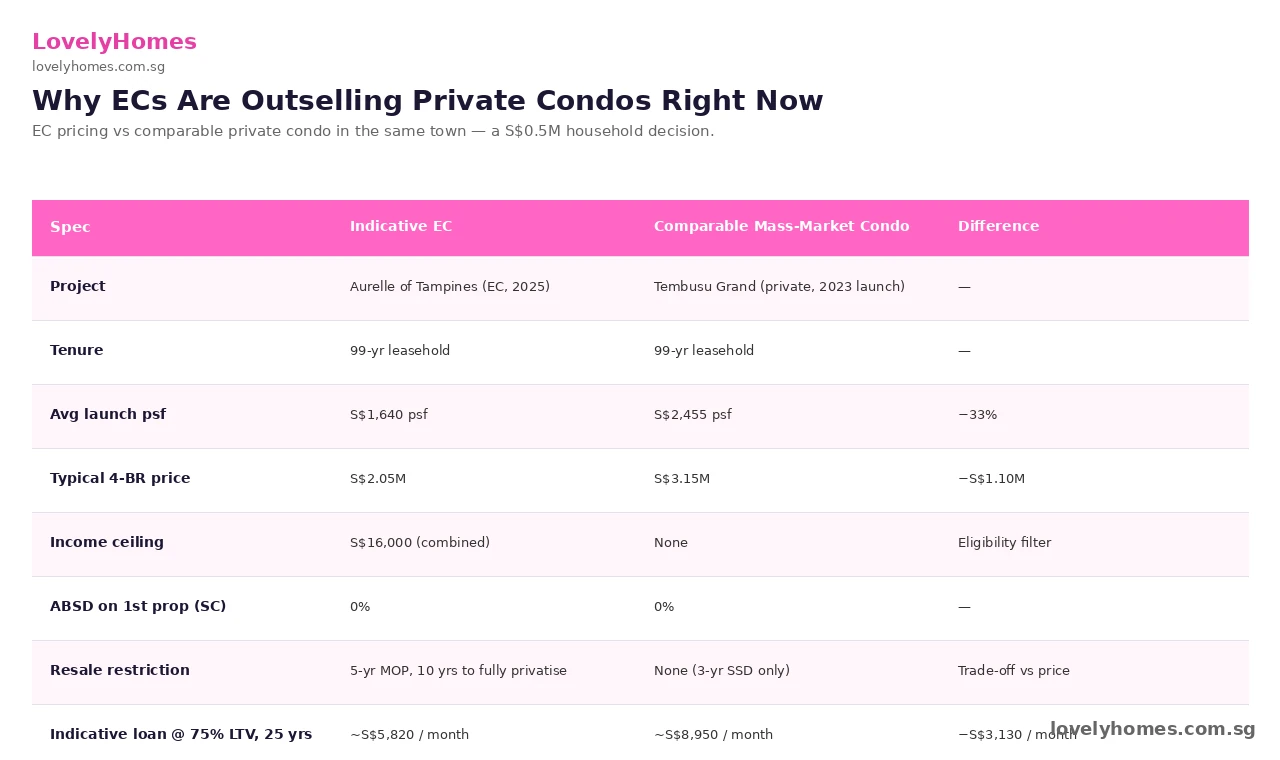
Average new-launch EC psf: ~S$1,640 — roughly a 33% discount to comparable mass-market private condos in the same town.
Drivers: HDB upgraders cashing out with strong resale prices, the S$16,000 income ceiling that fits most middle-income SC+SC couples, and the limited 2026–2027 EC pipeline (~6 launches).
The 13-Quarter Drought, Broken
The EC market in Singapore has been quietly grinding through a thin patch since the Q4 2022 sales spike of 1,156 units — that quarter was an outlier driven by the September 2022 cooling-measures package, which tightened TDSR and raised stamp duty for second-property purchases. Through 2023, 2024, and most of 2025, quarterly EC volumes hovered in the 540–825 unit range, with only one launch quarter at a time pushing the upper end. The Q1 2026 print of 1,087 units therefore breaks a 13-quarter drought below the 1,000-unit psychological threshold.
Figure 1: 13-quarter EC sales chart — Q1 2026’s 1,087 units broke above the 1,000-unit threshold for the first time since Q4 2022.
Why ECs Are Outselling Mass-Market Private Condos
The EC value proposition rests on three structural pillars. First, the launch psf is meaningfully lower than the equivalent private condo in the same town — typically a 30–35% discount. Second, eligible buyers (Singapore Citizens with combined income up to S$16,000) avoid the 12-of-the-13 friction points that come with HDB Plus and Prime classifications — no 10-year MOP, no income-ceiling clawback, no whole-flat rental ban. Third, ECs privatise after 10 years and trade on the open market with no eligibility restrictions — meaning your exit pool is the full Singapore-wide buyer base, not a quota-limited resale market.
Figure 2: At launch psf, an EC delivers ~33% savings vs comparable private condo, with mortgage instalments roughly S$3,100/month lower for a 4-bedroom unit.
For a S$2.05M EC versus a S$3.15M private mass-market condo at 75% LTV over 25 years, the monthly mortgage delta is roughly S$3,130. Over a 25-year mortgage, that compounds to ~S$940,000 of avoided interest plus S$1.1M of avoided principal — a S$2M lifetime difference. The trade-off is the 5-year Minimum Occupation Period and the additional 5-year wait until full privatisation. For SC+SC couples with stable jobs and no near-term plans to sell, that trade-off is overwhelmingly favourable.
Who Is Buying — The HDB Upgrader Profile
The buyer profile of Q1 2026 EC sales skews heavily towards HDB upgraders in their mid-30s to mid-40s, typically a SC+SC couple selling a 4-room or 5-room HDB flat that has appreciated significantly since key collection. The HDB Resale Price Index hit a record high in Q4 2024 before drifting -0.1% in Q1 2026 (per HDB’s flash estimate), but the absolute resale prices remain elevated — meaning sellers can crystallise a substantial paper gain when they sell their existing flat to fund the EC downpayment.
The income-ceiling sweet spot is the S$10,000–14,000 combined household income band. Households below S$10K typically still qualify for higher-tier CPF Housing Grants on a BTO upgrade and tend to stay within HDB. Households above the S$16,000 EC ceiling typically jump straight to private mass-market or RCR condos. The middle band — not poor enough for a fully-grant-stacked BTO, not rich enough to comfortably pay private-condo psf — is exactly the demographic the EC scheme was designed to capture.
What Drove Q1 2026 Specifically — The Aurelle/Otto/Novo Triple
Three EC launches absorbed the bulk of Q1 2026 volume:
Aurelle of Tampines — a District 18 EC by Sim Lian, launched late Q4 2025 and continuing strong sales through Q1 2026. Indicative launch psf around S$1,640.
Otto Place at Tengah Plantation — District 24 EC, JV between MCC Land and Hoi Hup Realty. Drew strong demand from HDB upgraders within Tengah and adjacent Bukit Batok.
Novo Place at Plantation Close — District 24 EC by Hoi Hup. Sister project to Otto, leveraging the same Tengah catchment.
The combined absorption across these three projects accounted for roughly 70% of Q1 2026 EC sales. Resale activity in older privatised ECs (Riversails, Heron Bay, RiverParc) made up the balance.
Summary — EC Market Snapshot Q1 2026
Metric
Q1 2025
Q4 2025
Q1 2026
Notes
Total EC units sold
~645
~825
~1,087
+32% QoQ; first >1,000 since Q4 2022
New-launch share
~55%
~62%
~70%
Aurelle + Otto + Novo dominated
Avg new-launch psf
~S$1,575
~S$1,610
~S$1,640
+1.9% QoQ
Income-ceiling buyers (~S$10–14K)
~58%
~62%
~64%
HDB upgrader demographic
What This Means for Buyers, Sellers, and Developers
For buyers in the income band: the EC value proposition is the strongest it has been since 2022, but supply is thinning. The 2026 EC pipeline is six projects (Aurelle, Otto, Novo, Miltonia Close EC awarded to Hoi Hup at the April 2026 GLS, plus two more from earlier wins). Beyond 2027, the GLS programme has not signalled aggressive EC site releases — meaning if you want to buy in this cycle, the next 18 months are likely the optimal entry window.
For HDB upgraders considering the move: the maths still works in 2026. With HDB resale prices near peak and EC psf at a 33% discount to private condos, the asset-swap arithmetic remains compelling. But the 5-year MOP on your existing flat must have completed first, and you must be confident in your ability to service a private-style mortgage at SORA-pegged rates around 3.5–3.8%.
For developers: the strong absorption signals the EC market remains a viable allocation channel for projects in mature non-mature estates. Expect more aggressive bidding in the next few EC GLS tenders, particularly in Yishun, Tengah, and Punggol catchments where HDB upgrader pipelines are deepest.
What Might Come Next
Three watch-points for Q2 2026. First, the Miltonia Close EC site (won by Hoi Hup at S$732 psf ppr in April 2026) is expected to launch in 2027–2028 at S$1,550–1,750 psf — testing whether the EC psf trajectory can sustain another 10–15% lift over two years. Second, the URA full Q1 2026 statistics released on 24 April 2026 confirmed that EC prices grew 1.4% QoQ — faster than the overall private 0.9% QoQ — suggesting the segment is leading the wider market. Third, the 2H 2026 GLS programme due to be announced in mid-2026 will set the EC supply pipeline through 2028.
Frequently Asked Questions
Why does the income ceiling for EC sit at S$16,000?
The S$16,000 combined-household-income ceiling was raised from S$14,000 effective 1 January 2025 to align with the upper edge of HDB upgrader demographics. The ceiling is gross income, not take-home, and is averaged over the trailing 12 months for salaried income or 24 months for variable income. Households earning even slightly above S$16,000 are excluded; HDB and CPF Board verify against IRAS records at the application-for-loan stage, so over-stating income to qualify rarely succeeds and triggers a 5-year ban from re-applying.
How does an EC differ from a private condo?
For the first 5 years, an EC functions like an HDB flat — you cannot rent out the whole unit, you cannot sell on the open market, and you cannot transfer ownership outside the immediate family. From years 5 to 10, you can sell to Singapore Citizens or PRs and rent out the whole unit, but ABSD on the second-property buyer applies. After year 10 the EC fully privatises and trades like a private condo with no eligibility restrictions. Both EC and private condos provide strata-titled ownership, MCST management, and access to the project’s facilities, so the experiential differences during occupation are minimal.
Are ECs a better investment than mass-market private condos?
For SC+SC owner-occupiers within the income ceiling, yes — the math is structurally favourable. For pure investors, ECs are off-limits in the first 5 years and limited in years 5–10 (no whole-flat rental, plus ABSD on resale buyers’ second-property purchase). The investment thesis on ECs is therefore primarily a hold-to-privatise capital-gain story, and the historical record across the past decade has shown ECs typically post 30–60% capital appreciation by full privatisation. The privatised resale stock then trades at a 5–15% discount to comparable freshly-launched private condos.
Can a couple combine HDB Resale Levy with EC purchase?
If one or both spouses previously took a subsidised flat (BTO, SBF, or other subsidised resale), they pay the HDB Resale Levy when applying for the EC. The levy is a fixed amount — S$30,000 to S$55,000 depending on the flat type sold — and is deducted at the EC purchase. Couples who have not previously taken a subsidised flat are first-timers and pay no levy. See our HDB Resale Levy guide for the full schedule.
What happens to my EC if my income later rises above the ceiling?
Nothing — the income ceiling applies at the point of application only. Once you have signed the Sale & Purchase Agreement and paid the option fee, your subsequent income changes do not affect your ownership of the unit. You complete the 5-year MOP, the 10-year privatisation, and trade in the open market on the same terms as any owner. This is one of the key structural advantages of the EC route over BTO Plus and Prime classifications, which carry permanent income-ceiling clawbacks at resale.
Is the limited 2026–2027 EC pipeline a buying signal?
Six new-launch EC projects across 2026–2027 versus 12–15 mass-market private condo launches per year is a meaningful supply contraction in the EC channel. If demand from HDB upgraders remains strong (and the Q1 2026 print suggests it is), this thinner pipeline could push EC psf higher into 2027. Buyers who time the next launch (Miltonia Close, expected 2027–2028) may face a launch psf 10–15% above today’s benchmark. Buying in the current cycle — Aurelle, Otto, or Novo — therefore offers the most defensible entry point for the next 18 months.
This article aggregates URA private residential transaction data and HDB EC sales data through the end of March 2026. Quarterly figures are preliminary and subject to revision. Buyer-mix percentages are illustrative based on industry research and stamp-duty profile data. Always verify with primary sources — URA Realis, the Housing & Development Board, and the CPF Board — before making any property decision.
For most Singapore citizens, the decision between a Build-To-Order (BTO) flat, an HDB resale flat, or an Executive Condominium (EC) represents the single largest financial commitment of their lives. Yet the answer is far from straightforward: each option offers distinct advantages and trade-offs in price, location, waiting time, and long-term wealth building.
In 2026, first-time buyers face more choices than ever before. HDB’s new Standard, Plus and Prime classification (introduced October 2024) has reshaped BTO pricing and subsidy structures. The Enhanced CPF Housing Grant (EHG) has been raised to S$120,000 for families and S$60,000 for singles. Executive Condos remain a viable middle ground for those earning S$10,000–S$16,000 monthly. Meanwhile, resale flats offer immediate occupancy but at a premium price.
This comprehensive guide walks you through all three options, compares the financial reality with worked examples, and helps you choose the path that fits your circumstances, timeline and budget.
Quick Answer — Which one is right for you?
Choose BTO if: You can wait 3–5 years, want the cheapest entry price, and prioritise subsidised flats in newer estates. Best for budget-conscious buyers and families.
Choose Resale if: You need to move in within 12 months, want an established neighbourhood with proven amenities, and have sufficient CPF savings. Best for upgraders and those near MOP.
Choose EC if: Your household income is S$10,000–S$16,000, you value hybrid public–private living, and you’re willing to pay a premium for potential capital appreciation after the 10-year privatisation period.
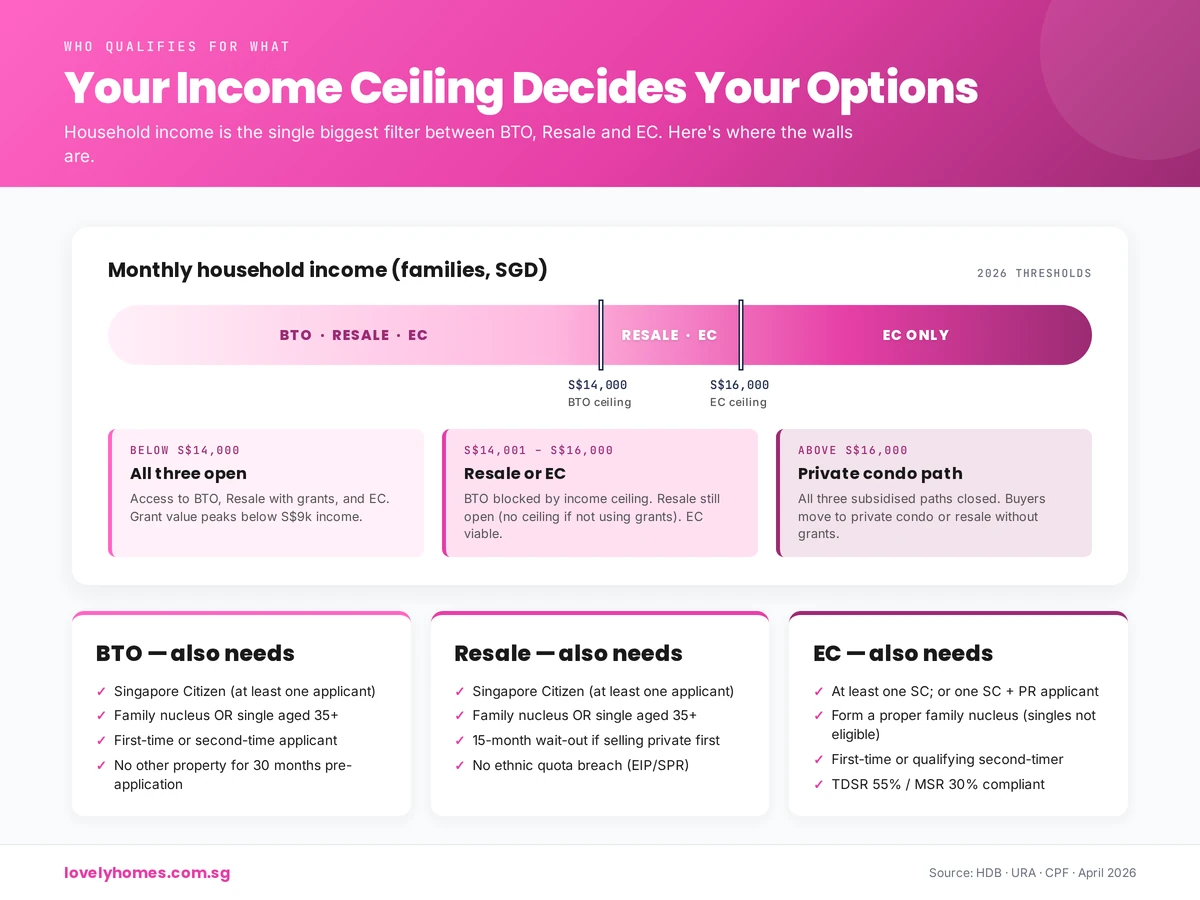
Figure 1: Household income is the biggest filter — it determines which paths are open to you.
HDB BTO Explained
What Is BTO?
Build-To-Order (BTO) flats are new HDB units built to demand. HDB launches BTOs in batches (typically every four months), offers them at subsidised prices below market rates, and constructs them over 3–5 years. Once completed and handed over, you own the flat outright and must occupy it for a minimum occupation period (MOP) before you can sell or rent it out.
Eligibility for BTO in 2026
Citizenship: At least one applicant must be a Singapore Citizen. For families, both applicants can be Singapore Citizens or one can be a Permanent Resident (SPR).
Age: You must be at least 21 years old. Singles aged 35 and above can now buy 2-room Flexi BTOs in any location (expanded from 12 non-mature estates in October 2024).
Income Ceiling (2026):
Families and couples: S$14,000 monthly
Singles (for all flat types and 2-room Flexi): S$7,000 monthly
Ownership: You and your spouse (if applicable) must not own any other property. Inheritance and co-ownership with parents do not disqualify you, provided the flat is not mortgaged.
BTO Pricing Framework: Standard, Plus & Prime (October 2024)
HDB replaced its old classification with three tiers based on location and amenities:
Classification
Features
MOP Period
Subsidy Clawback on Resale
Standard
Good connectivity, suburban, new estates
5 years
None (keep full subsidy)
Plus
Choicer locations, mature estates, proximity to city
10 years
6–8% of resale price
Prime
Choicest locations, central, excellent transport
10 years
9% of resale price
Example Prices (October 2024 Launch): A 4-room Standard BTO in Woodlands or Sengkang starts around S$400,000–S$450,000. A 4-room Plus BTO in a mature estate (e.g. Punggol, Hougang) costs S$550,000–S$650,000. Prime flats (rare) command prices above S$750,000.
Waiting Time & Build Cycle
From the launch month to handover typically takes 3–5 years. HDB now offers a “Shorter Waiting Time” (SWT) option for selected projects, reducing the wait to approximately 3 years. Check each BTO exercise’s buyer’s guide for your project’s expected handover date.
CPF Grants for BTO
Enhanced CPF Housing Grant (EHG) for BTO:
Families (SC+SC or SC+SPR): up to S$120,000 (income ceiling S$9,000/month)
Singles (aged 35+): up to S$60,000 (income ceiling S$4,500/month)
CPF Housing Grant (for those above EHG income ceiling): Families earning S$9,001–S$14,000 receive a grant tapering from S$120,000 to S$0.
All grants are paid into your CPF Ordinary Account and applied automatically at flat handover.
Minimum Occupation Period (MOP)
Standard flats: 5-year MOP. After 5 years, you can sell without restriction and keep the entire subsidy.
Plus & Prime flats: 10-year MOP. When you sell after 10 years, HDB claws back 6–9% of the resale price to recover a portion of the subsidy you received.
During MOP, you cannot rent out the entire flat (though private let of rooms is allowed for some schemes). You must occupy it as your main residence.
Advantages of BTO
Lowest entry price, especially for Standard flats
Large CPF grants (up to S$120,000 for families)
New flat – minimal repairs for first 5–10 years
Predictable pricing and transparent framework
New neighbourhoods with fresh amenities
Disadvantages of BTO
Long wait (3–5 years) – cannot move in immediately
Location not guaranteed (you choose from allocated projects)
Longer MOP for Plus/Prime (10 years vs. 5 for Standard)
Subsidy clawback on Plus/Prime resales reduces gains
Less mature neighbourhoods compared to older estates
HDB Resale Explained
What Is HDB Resale?
HDB resale flats are existing units on the open market, sold by current owners who have completed their MOP. You can view, negotiate and purchase immediately – no waiting for construction. The buyer’s 5-year MOP obligation begins on the date of transfer, even though the previous owner already completed theirs.
Eligibility for HDB Resale in 2026
Citizenship: You must be a Singapore Citizen or a Singapore Permanent Resident. For SC+SPR couples buying in non-mature estates, there is a quota limit (typically 10%) on SPR purchases.
Age: Minimum 21 years old (single or couple).
Income Ceiling: An income ceiling (S$14,000 for families, S$7,000 for singles) applies only if you are claiming CPF grants. If you have sufficient cash and CPF savings, you can buy a resale flat with any income level.
Ownership: You must not own any other property. First-timer status unlocks priority for certain grants.
Resale Flat Pricing
Resale prices are set by market forces and vary widely by location, flat type, floor level, condition and remaining lease:
4-room flats in mature estates (Tampines, Bedok, Punggol): S$550,000–S$750,000
4-room flats in central estates (Bukit Merah, Tanjong Pagar): S$700,000–S$950,000
3-room flats in non-mature estates: S$350,000–S$500,000
Prices fluctuate with economic cycles, interest rates and supply.
CPF Grants for HDB Resale
Enhanced CPF Housing Grant (EHG) – Families:
Up to S$120,000 (income ceiling S$9,000/month)
CPF Housing Grant (Family) – Standard:
SC+SC or SC+SPR couple: S$80,000
Proximity Housing Grant (PHG):
Living with parents (same flat): S$30,000
Living within 4 km of parents: S$20,000
For Singles (EHG – Resale): Up to S$60,000 (income ceiling S$4,500/month).
Total grant stack (families): EHG (S$120,000) + CPF Housing Grant (S$80,000) + Proximity Grant (S$30,000) = up to S$230,000 if all criteria met.
Minimum Occupation Period for Resale
Once you purchase a resale flat, you must occupy it as your main residence for 5 years before you can sell or rent it out. The previous owner’s MOP is already satisfied; yours begins afresh.
Multiple grants available (EHG, CPF, PHG) can stack to S$230,000+
Disadvantages of HDB Resale
Significantly higher purchase price than BTO
Older flats (20–40 years common) – higher repair/renovation costs
Lease decay – remaining lease affects resale value and loan eligibility
Must negotiate price, condition and terms yourself
Requires more cash upfront (HDB resale loans capped at 80% LTV, BTO can be 90%)
Executive Condominium (EC) Explained
What Is an EC?
An Executive Condominium is a hybrid public–private residential scheme. HDB sells the land to private developers, who build and sell the units directly to buyers. For the first 10 years (the “HDB control period”), ECs are subject to HDB-like rules: you must occupy it, cannot rent the whole unit, and are subject to an income ceiling. After 10 years, the building is privatised, and it becomes a full private condominium with no income restrictions, rental caps, or ownership limits.
Eligibility for EC in 2026
Citizenship: At least one applicant must be a Singapore Citizen.
Family Nucleus: You must be in a family nucleus – married couple, divorced/widowed with child, or parents with adult child (25+). Singles cannot buy ECs directly.
Income Ceiling (2026): Household monthly income must not exceed S$16,000. This applies to all new EC purchases from developers.
Ownership: You must not own any other property. First-timer priority applies to ballot allocation.
EC Pricing & Affordability
ECs are built by private developers and priced above HDB but below private condos:
2-bedroom EC: S$800,000–S$1,200,000
3-bedroom EC: S$1,200,000–S$1,600,000
4-bedroom EC (rare): S$1,600,000+
Price varies by location, developer, and finishing standard.
CPF Grants for EC
Enhanced CPF Housing Grant (EHG) – Families:
Up to S$30,000 (income ceiling S$9,000/month for maximum grant)
Note: EC grants are significantly lower than HDB resale (S$30,000 vs. S$120,000) and are based on a lower income threshold.
EC Financing & Loan Requirements
No HDB Concessionary Loan: Unlike HDB flats, ECs cannot be financed with an HDB concessionary loan. You must use a bank mortgage.
Bank Loan Criteria:
Loan-to-Value (LTV): up to 75% (vs. 90% for HDB)
Mortgage Servicing Ratio (MSR): 30% maximum monthly income
Your down payment must be at least 25%
Effective Cost: With a higher down payment (25% vs. 10% for HDB) and a bank mortgage at ~3.5% interest (versus HDB concessionary rates at ~2.6%), monthly payments are significantly higher than a comparable HDB flat.
Minimum Occupation Period & Privatisation
5-year MOP: You must occupy the EC as your main residence for 5 years. You cannot rent it out (whole unit) or sell it.
After 5 years: You can sell on the resale market (still subject to income ceiling if you wish to re-buy an EC or HDB).
After 10 years: The EC block is privatised. Income restrictions are lifted, and it becomes a private condo. You can then rent it out freely, sell to foreigners, or use it as an investment without restriction.
Advantages of EC
Hybrid lifestyle – condominium amenities (gym, pool, concierge) with HDB affordability
Privatisation upside – potential capital appreciation and rental income from year 11 onwards
Better quality finishes than new HDB (private developer standards)
Often in prime locations with strong transport and amenities
Eligible for CPF grants (though smaller than HDB)
Disadvantages of EC
Much higher purchase price than HDB (25–100% more)
Require 25% down payment vs. 10% for HDB – significant cash outlay
Bank mortgage at market rates (~3.5%) vs. HDB concessionary rate (~2.6%)
Lower LTV (75% vs. 90%) – less leverage possible
Smaller CPF grants (S$30,000 vs. S$120,000 for HDB)
No rental income for first 10 years (occupation requirement)
10-year MOP for first unit – cannot upgrade as easily as HDB
Service charges, maintenance fees and sinking funds (not present in HDB)
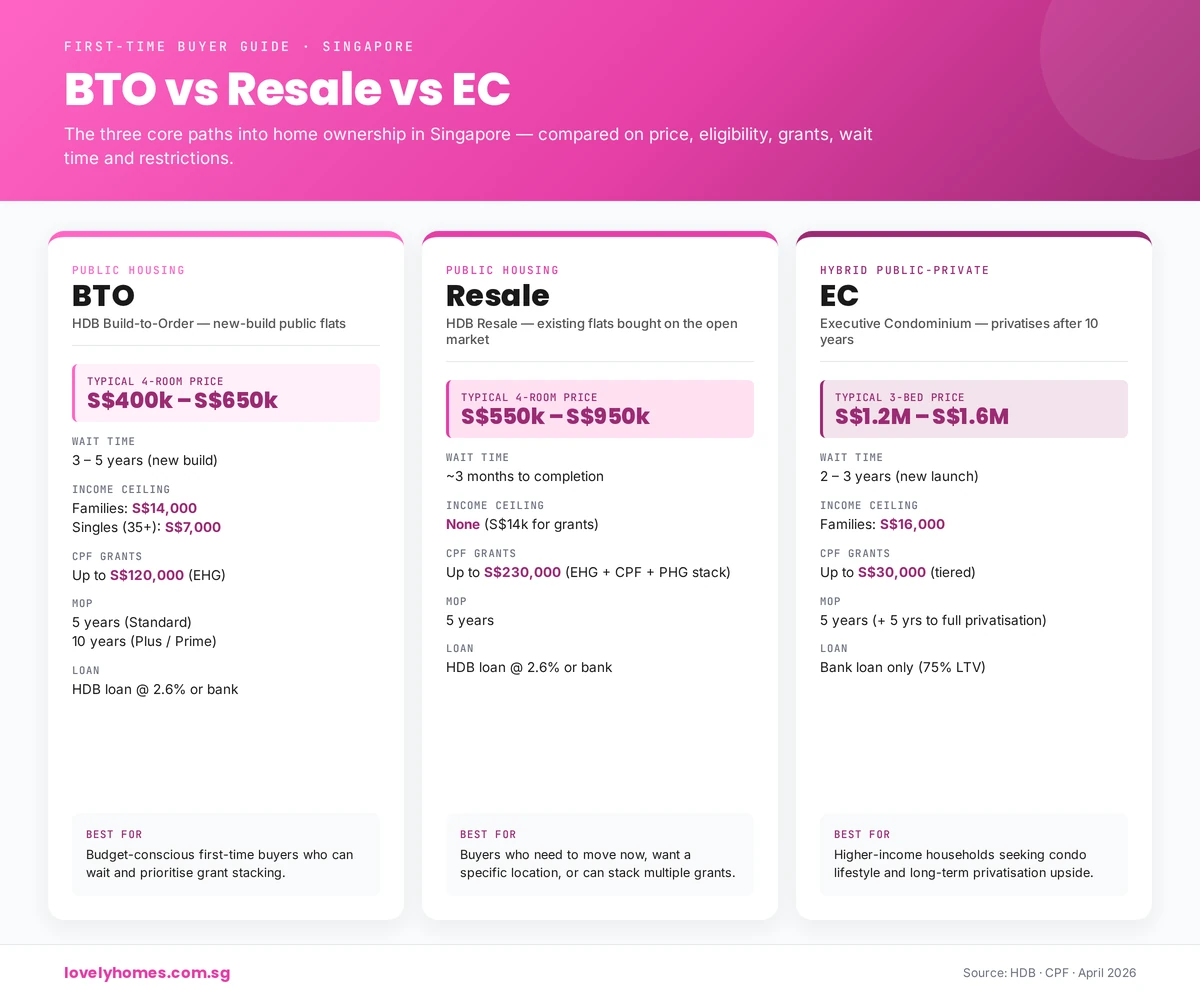
Figure 2: Price, wait time, grants, MOP and loan type compared across the three options.
Side-by-Side Comparison Table
Factor
BTO (Standard)
HDB Resale
Executive Condo
Entry Price (4-room)
S$400–450k
S$600–750k
S$1.2–1.6m
Occupancy Timeline
3–5 years wait
Immediate
Immediate
Max CPF Grant (Family)
S$120,000
S$230,000 (stacked)
S$30,000
Down Payment
10–15%
10–20%
25%
Financing
HDB concessional (~2.6%)
HDB concessional (~2.6%)
Bank mortgage (~3.5%)
Max LTV
90%
80–90%
75%
MOP Period
5–10 years
5 years
5–10 years
Subsidy Clawback
None (Standard); 6–9% (Plus/Prime)
None
None (private)
Rental During MOP
Room rental allowed; no whole-unit rental
Room rental allowed; no whole-unit rental
No rental (whole unit or rooms) for 10 years
Income Ceiling
S$14,000 (families); S$7,000 (singles)
S$14,000 (families) for grants only
S$16,000
Facilities
Basic (void deck, lift lobby)
Basic (void deck, lift lobby)
Premium (gym, pool, concierge)
Ethnic Quota
25% Chinese, 13% Malay, 9% Indian
Estate-dependent; no restrictions on resale
No ethnic quota
Worked Example: Which Option Costs Less?
The Scenario
Meet Sarah and Michael — both 30 years old, both Singapore Citizens, combined monthly income S$10,000 (S$5,000 each). They are HDB first-timers looking to buy a 4-room flat and need to decide between BTO, resale and EC. Both have S$80,000 in combined CPF Ordinary Account savings (after set-asides). They plan to hold the flat for 10 years, then either sell or upgrade.
Option 1: BTO (Standard 4-room in Sengkang)
Component
Amount (S$)
Purchase Price
420,000
CPF Housing Grant
–80,000
Net Price After Grant
340,000
Loan Amount (80% LTV)
336,000
Cash Down Payment
4,000
Monthly Mortgage (25 years @ 2.6% HDB)
~1,440
Total Interest Paid (25 years)
94,000
Total All-In Cost After 10 Years
~514,000
Est. Flat Value at Year 10 (assume 2% p.a. appreciation)
512,000
Notional Equity Gain/(Loss)
–2,000
Insight: The BTO is the cheapest entry and has the lowest ongoing costs. However, at only 2% annual appreciation, you barely break even on interest costs after 10 years. The real value is housing affordability now and long-term capital preservation.
Option 2: HDB Resale (4-room in Punggol)
Component
Amount (S$)
Purchase Price
630,000
Enhanced CPF Housing Grant
–80,000
Proximity Housing Grant (living 4km from parents)
–20,000
Net Price After Grants
530,000
Loan Amount (80% LTV)
504,000
Cash Down Payment
26,000
Monthly Mortgage (25 years @ 2.6% HDB)
~2,160
Renovation/Repair Estimate (older flat)
30,000–50,000
Total Interest Paid (25 years)
140,000
Total All-In Cost After 10 Years (incl. renovations)
~810,000
Est. Flat Value at Year 10 (assume 3% p.a. appreciation)
846,000
Notional Equity Gain
+36,000
Insight: Resale flats cost significantly more upfront (S$630k vs. S$420k for BTO). However, established Punggol flats appreciate faster (~3% p.a. vs. 2% for new Sengkang BTO), and you capture a modest gain after 10 years. You also benefit from higher grants (S$100,000 vs. S$80,000 with PHG) and immediate occupancy, valuable if you need to move within 12 months.
Option 3: Executive Condo (3-bed in Tampines)
Component
Amount (S$)
Purchase Price
1,300,000
CPF Housing Grant (EHG, S$9k income threshold)
–30,000
Net Price After Grant
1,270,000
Down Payment Required (25%)
325,000
Loan Amount (75% LTV)
975,000
Monthly Mortgage (25 years @ 3.5% Bank Rate)
~4,580
Monthly Service Charges & Maintenance
~300–500
Total Interest Paid (25 years)
371,000
Total All-In Cost After 10 Years
~1,910,000
Est. Flat Value at Year 10 (assume 4% p.a. appreciation pre-privatisation)
1,920,000
Notional Equity Gain (After Privatisation)
+10,000 (conservative)
Insight: ECs are dramatically more expensive — S$1.3m vs. S$420k BTO, or S$630k resale. Monthly payments are triple a BTO (S$4,580 vs. S$1,440). However, ECs benefit from stronger appreciation (4% p.a. vs. 2–3%) due to privatisation upside and prime locations. After 10 years (and especially after privatisation at year 11), rental income and capital gains potential accelerate. An EC makes sense only if your timeline is 15+ years and you can afford the premium monthly cost.
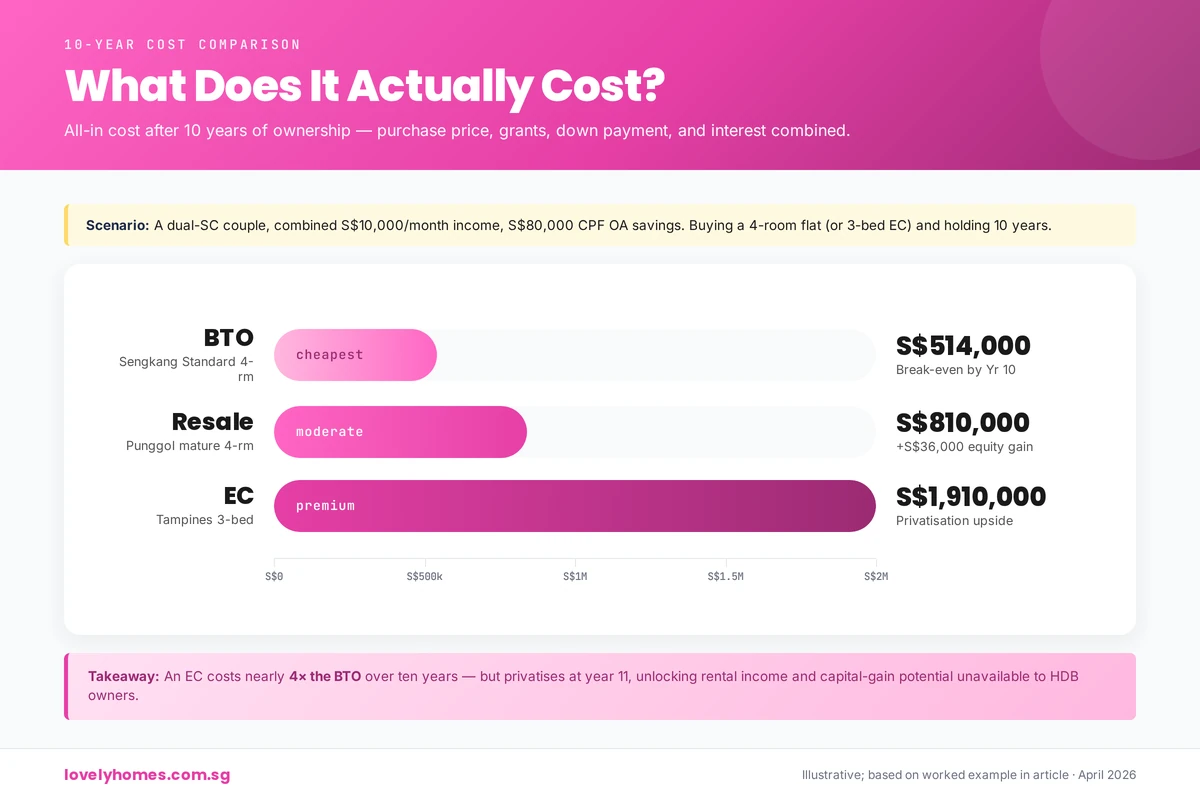
Figure 3: Ten-year all-in cost of ownership for the same couple — BTO S$514k, Resale S$810k, EC S$1.91M.
Resale (Moderate): S$810,000 all-in cost; modest capital gains (S$36,000)
EC (Premium): S$1,910,000 all-in cost; conservative gains, but privatisation upside at year 11+
Key Takeaway: If you want to minimise housing costs and build equity steadily, BTO wins. If you need to move now and expect moderate appreciation, resale is rational. If you want premium lifestyle and long-term wealth (15+ year hold), EC can pay off after privatisation.
Which Should You Choose?
Choose BTO If:
You can wait 3–5 years for occupancy
You want the lowest entry price and monthly mortgage
You prioritise maximising CPF grants (up to S$120,000 for families)
You value a brand-new flat with minimal repairs for 15+ years
You are budget-conscious and wish to minimise lifetime housing costs
You are comfortable with newer, less-established neighbourhoods
You are open to the estate HDB assigns you (limited location choice)
Choose Resale If:
You need to move in within 12 months (or less)
You want to choose your exact location, estate and block
You value established neighbourhoods with proven amenities and connectivity
You have sufficient CPF savings and can afford the higher purchase price
You are a second-time buyer or upgrader (eligible for larger grants)
You live near parents and are eligible for Proximity Housing Grant
You expect faster capital appreciation (established estates appreciate 2.5–3.5% p.a.)
You plan to hold the flat for 10+ years
Choose Executive Condo If:
Your household income is S$10,000–S$16,000 (above HDB ceiling but below private condo buyers)
You value condominium lifestyle (pool, gym, concierge) but cannot afford pure private condo
You can afford a 25% down payment and monthly mortgage of S$4,000+
You plan to hold for 15+ years, targeting post-privatisation rental income and capital gains
You prefer prime or central locations (ECs are often well-positioned)
You are willing to pay a premium for privacy, space and amenities vs. HDB
You can accept no rental income for the first 10 years and an income ceiling restriction
Frequently Asked Questions
1. Can I apply for BTO and HDB resale simultaneously?
Yes, but strategically. You can submit a BTO application for one project and bid for a resale flat at the same time. However, if you win the resale first, you must withdraw your BTO application (as you cannot own two properties). Many buyers use this two-pronged approach: they apply for BTO as a backup while actively bidding on resale flats.
2. Can a single person buy an Executive Condo?
No, singles cannot buy ECs directly. You must be in a family nucleus (married couple, divorced/widowed with child, or parent with adult child 25+). If you are single and interested in hybrid housing, your only option is HDB (BTO or resale).
3. What happens if I miss the BTO ballot multiple times?
You can keep applying. There is no limit to the number of BTOs you can apply for. However, if you consistently miss (do not win the ballot), it may be a signal that you should pivot to resale or EC if you have the means and timeline allows.
4. Is an Executive Condo considered a private condo?
For the first 10 years: No. ECs are HDB-controlled and subject to HDB rules (income ceiling, occupancy requirement, no whole-unit rental). After 10 years, the block is privatised, and it becomes a full private condo with no restrictions. At that point, it is legally and practically identical to any other private condo.
5. Can I rent out my BTO flat during the MOP?
Not the whole flat. During MOP, you can rent out individual rooms to lodgers, but you cannot rent out the entire flat to a tenant. This occupancy rule is strict. After MOP (5 years for Standard BTO), you can sell or rent out the whole flat freely.
6. What grants am I eligible for?
It depends on your household structure, income and purchase type:
For BTO: Enhanced CPF Housing Grant (families up to S$120,000; singles up to S$60,000, both with income ceilings S$9,000 and S$4,500 respectively).
For HDB Resale: Enhanced CPF Housing Grant + CPF Housing Grant (family) + Proximity Housing Grant, totalling up to S$230,000 if you meet all criteria.
For EC: Enhanced CPF Housing Grant (families up to S$30,000, tiered between S$9,000 and S$16,000 income).
Apply for an HDB Flat Eligibility (HFE) letter to confirm your exact grant amount.
7. Should I wait for BTO or buy resale now?
This depends on three factors:
Timeline: If you need housing within 12 months, buy resale. If you can wait 4–5 years, BTO may save you S$150k–S$250k.
Location: If a specific neighbourhood is critical (e.g. near parents, near your workplace), resale gives you certainty. BTO assigns location at ballot.
Finances: If you have substantial CPF savings but limited cash, resale grants are larger (S$230k vs. S$80k for BTO). If cash is tight, BTO’s lower entry price wins.
Pragmatic approach: Apply for BTO while simultaneously bidding for resale flats. Whichever closes first is your home; the other falls away.
Upgrader’s Guide — Planning your second property? Learn about upgrading from 4-room to 5-room, EC to private condo, and tax implications.
Property Finance Hub — Understand CPF Housing Grants, HDB loans, bank mortgages, and financing strategies.
Home Loans & Mortgages — Deep-dive into HDB concessionary loans, bank mortgage rates, MSR and TDSR calculations.
ABSD Complete Guide 2026 — If upgrading to private property, understand Additional Buyer’s Stamp Duty and tax planning.
Disclaimer
This guide is for general information only and does not constitute legal, tax or financial advice. HDB policy, grants, income ceilings and pricing frameworks change periodically. The figures and eligibility rules cited reflect policy as of April 2026, but may be subject to change. Always verify current information on HDB’s official website (https://www.hdb.gov.sg), consult HDB’s Customer Service or engage a licensed mortgage advisor or housing consultant before committing to any property purchase. CPF withdrawal limits and grant eligibility are subject to CPF Board rules (https://www.cpf.gov.sg). For EC and resale purchases, seek independent legal and financial counsel.