GLS Programme Guide Singapore 2026: How Confirmed List and Reserve List Land Tenders Work
Quick Answer: The GLS Programme
- The Government Land Sales (GLS) Programme is the mechanism through which the Singapore Government releases state land to private developers, administered by the Urban Redevelopment Authority (URA) on the Government’s behalf.
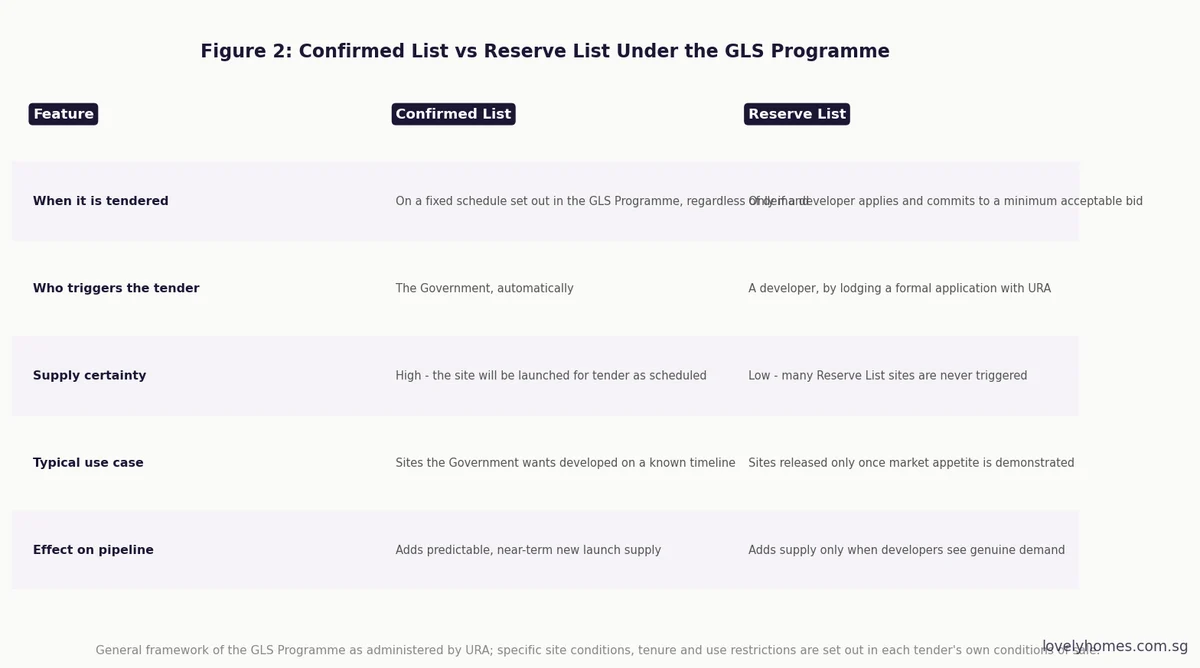
- URA announces the programme twice a year, for the first half (1H) and second half (2H) of each year, listing sites available for tender over the following six months.
- Sites are split into a Confirmed List, tendered on a fixed schedule regardless of demand, and a Reserve List, tendered only if a developer applies and commits to a minimum acceptable bid.
- Tenders are awarded by sealed bid, with the site generally going to the highest qualifying bidder, though some sites use additional evaluation criteria such as design or concept proposals.
- The land rate a developer pays at award becomes a key input into the eventual new launch price, since developers price units to recover land cost, construction cost, financing and professional fees, and a target profit margin.
- GLS supply is one of the most closely watched leading indicators for Singapore’s private housing pipeline, since it signals how many new private homes will enter the market roughly two to four years ahead.
- Not every Reserve List site is ever triggered; many sit untendered for years if no developer sees sufficient demand to justify committing to a minimum bid.
What Is the Government Land Sales (GLS) Programme?
The Government Land Sales (GLS) Programme is the primary channel through which the Singapore Government releases state-owned land for private development, spanning residential, commercial, industrial, hotel and mixed-use sites. It is administered by the Urban Redevelopment Authority (URA) on behalf of the Government, working alongside other agencies such as the Housing and Development Board (HDB), depending on the site’s intended use. The programme has operated in its current form since 2001, when the Confirmed List / Reserve List structure was introduced to give the Government more flexibility in managing land supply against fluctuating market demand, though government land sales themselves date back much further as a mechanism for planned urban development.
Twice each year, URA publishes the GLS Programme for the upcoming six-month period, the first half (1H) covering January to June and the second half (2H) covering July to December. Each announcement lists specific sites, their location, plot ratio, permitted use, and site area, together with an indicative number of housing units or commercial floor area the site could yield if developed at the maximum permitted intensity. This programme is one of the most closely watched data releases in Singapore’s property market, since it is the clearest public signal of how much new private housing and commercial space will enter the pipeline over the following several years.
Confirmed List vs Reserve List: Why the Distinction Exists
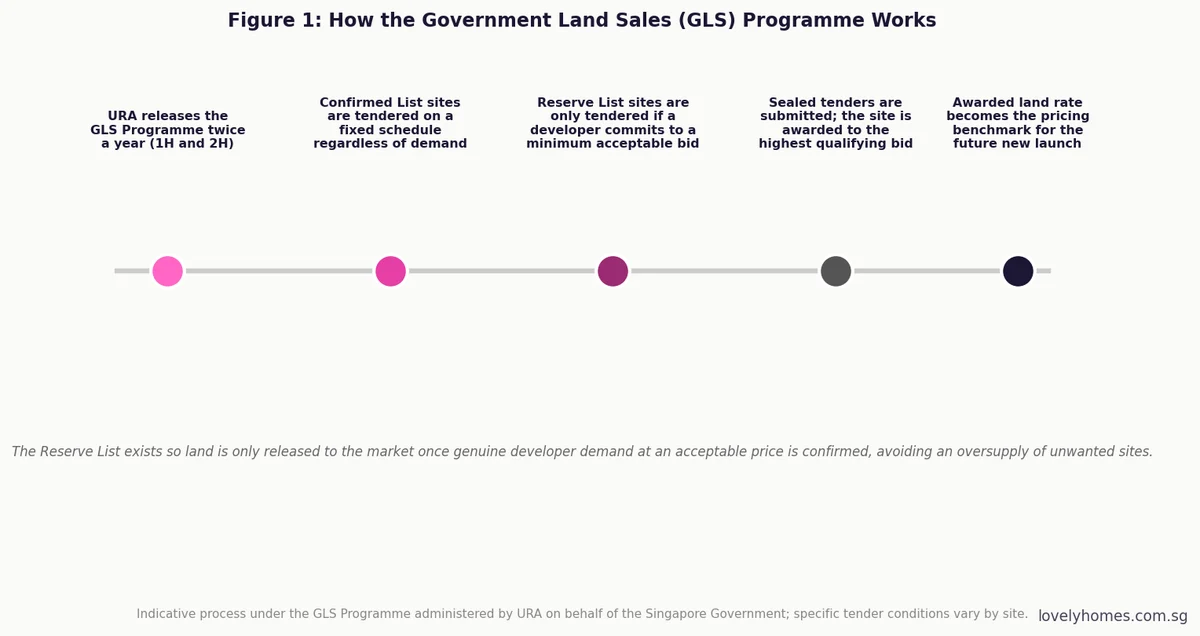
Every GLS site falls into one of two categories. A Confirmed List site is tendered on a fixed date within the six-month programme period regardless of how strong or weak developer demand appears to be at the time; the Government has committed to bringing this site to market on schedule. A Reserve List site, by contrast, is only put up for tender if a developer submits a formal application to URA and commits to a minimum price that the Government finds acceptable; if no developer applies, or no application meets the Government’s undisclosed reserve price, the site simply remains untendered and rolls over into the next programme period.
This two-tier structure exists to balance two competing goals: ensuring a predictable, steady supply of land to prevent housing shortages, while avoiding an oversupply of sites that developers do not actually want at prevailing prices, which could otherwise depress land values and leave sites undeveloped for years. In practice, the Confirmed List tends to be used for sites the Government has decided are needed regardless of near-term sentiment, while the Reserve List holds a much larger inventory of sites that are only activated when the market signals genuine appetite.
How a Tender Is Awarded
GLS tenders are conducted through a sealed-bid public tender process: interested developers submit their bids by a stated closing date, with all bids opened and made public simultaneously once the tender closes. For most residential sites, the tender is awarded to the highest bidder who meets the tender’s conditions, such as minimum development standards and completion timelines. A smaller number of sites, particularly those seen as especially significant to the surrounding precinct, are tendered under a Two-Envelope or concept-and-price system, where developers submit both a design concept and a price bid, with the design first assessed for suitability before price is considered, ensuring the eventual development meets specific urban design objectives rather than being awarded purely on the highest dollar figure.
The winning bid, expressed as a total quantum and also commonly quoted as a rate per square foot of gross floor area (psf ppr, short for per plot ratio), is published immediately and closely scrutinised by developers, analysts and prospective home buyers alike, since it directly signals what the eventual new launch on that site is likely to cost.
From Land Rate to New Launch Price
The psf ppr land rate paid at a GLS tender is only one component of the eventual launch price a buyer will see, but it is usually the single largest one. A developer’s total cost stack typically includes the land cost, construction and fit-out costs, financing costs (interest on the loan used to fund the purchase and development), professional fees (architects, engineers, marketing, legal), and a target profit margin, commonly cited in the industry as somewhere in the range of 10% to 20% depending on project risk and prevailing market conditions. Adding these together produces the developer’s breakeven price, above which the project becomes profitable; the actual launch price is then set with reference to this breakeven figure, recent comparable transactions in the vicinity, and overall market sentiment at the time of launch.
This is why a high-profile GLS award, particularly one that sets a new benchmark psf ppr for its district, is so closely watched: it effectively previews a floor for pricing on the eventual private residential launch that will emerge from that site, often years before any show flat opens.
Reading the GLS Programme as a Buyer
For prospective buyers, the twice-yearly GLS Programme announcement is a genuinely useful, freely available piece of market intelligence. A larger Confirmed List with more residential sites signals the Government is deliberately increasing near-term new-launch supply, which can, over time, moderate new launch pricing pressure in the affected districts. Conversely, a programme weighted heavily toward Reserve List sites, with few Confirmed List residential launches, suggests a more cautious near-term supply pipeline. Tracking which specific districts receive GLS sites is also useful for buyers targeting a particular area, since a GLS award today often previews a new launch roughly two to four years later, giving early-planning buyers useful lead time.
Summary: GLS Programme Facts at a Glance
| Question | Short Answer |
|---|---|
| Who administers the GLS Programme? | The Urban Redevelopment Authority (URA), on behalf of the Singapore Government. |
| How often is it announced? | Twice a year, for the first half (1H) and second half (2H) of each year. |
| What is the difference between Confirmed and Reserve List? | Confirmed List sites are tendered on a fixed schedule; Reserve List sites only if a developer applies with an acceptable minimum bid. |
| How is the winning bid decided? | Usually the highest sealed bid meeting tender conditions; some sites use a design-and-price two-envelope system. |
| Does the GLS land rate determine the launch price? | It is the largest single input, but launch price also reflects construction cost, financing, fees and developer margin. |
| Do all Reserve List sites eventually get tendered? | No, many remain untendered indefinitely if no developer applies with an acceptable bid. |
Worked Example: From a GLS Award to an Estimated Launch Price
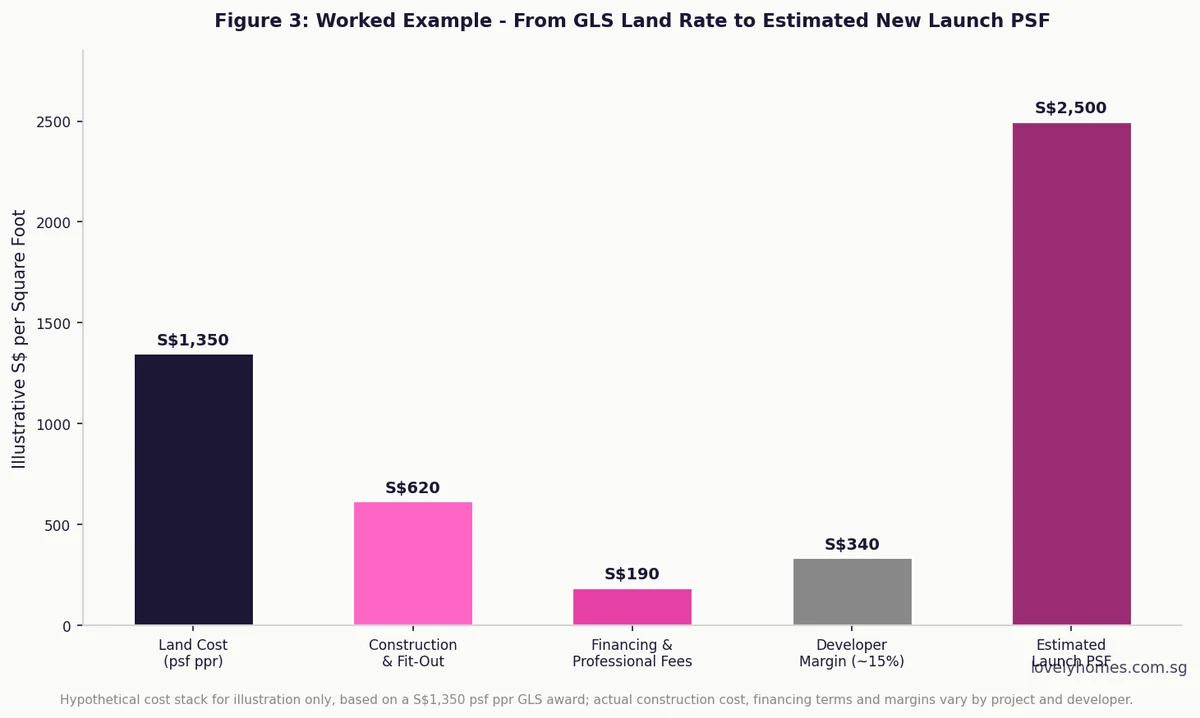
The award: a developer wins a Confirmed List residential site at an illustrative S$1,350 psf ppr, a benchmark land rate for its district.
Building the cost stack: adding illustrative construction and fit-out costs of S$620 psf, financing and professional fees of S$190 psf, and a target developer margin of roughly 15% (approximately S$340 psf at this cost base), the resulting estimated breakeven-plus-margin price works out to approximately S$2,500 psf.
What this means for buyers: a prospective 3-bedroom unit of around 900 square feet at this eventual launch could be priced in the region of S$2,250,000, illustrating how a single GLS award, reported as a land rate, translates several years later into an actual price tag a buyer will see at a show flat.
These figures are hypothetical and for illustration only; actual construction costs, financing terms, developer margins and final launch prices vary considerably by project, developer and prevailing market conditions at the time of launch.
Why This Matters for the Wider Property Market
The GLS Programme functions as one of the Government’s primary supply-side levers for managing Singapore’s private housing market, working alongside demand-side measures such as Additional Buyer’s Stamp Duty (ABSD) and loan curbs like the Total Debt Servicing Ratio (TDSR). Where cooling measures aim to moderate demand, the GLS Programme aims to calibrate supply, releasing more or fewer sites, and more or less generous Confirmed List quantities, in response to prevailing market conditions, price trends, and the Government’s own housing pipeline targets. Understanding this supply-side mechanism gives buyers, sellers and investors a fuller picture of why new launch prices move the way they do, well beyond simply watching headline transaction prices.
What Might Come Next
The following is informed speculation, not confirmed policy. As Singapore’s population and housing needs continue to evolve, the balance between Confirmed List and Reserve List sites in future GLS programmes is likely to keep shifting in response to private home price trends and take-up rates at recent launches, though the exact composition of any future half-yearly programme is not knowable in advance. Continued release of large, strategically located sites such as those in the Jurong Lake District and Greater Southern Waterfront is a plausible direction given long-stated Government planning priorities, though specific site-level decisions are announced only as each half-yearly programme is published.
Frequently Asked Questions
Who can bid in a GLS tender?
GLS tenders are open to registered property developers and consortiums that meet URA’s eligibility and financial capability requirements; individual home buyers cannot bid directly on GLS land.
Why do some Reserve List sites never get tendered?
If no developer applies, or no application meets the Government’s undisclosed reserve price, the site simply remains untendered and is carried forward into the next programme period.
Does a high GLS land rate always mean higher new launch prices?
Generally yes, since land cost is usually the largest input into a developer’s pricing, though construction costs, financing conditions and market sentiment at the time of launch also play a significant role.
What does “psf ppr” mean?
It stands for price per square foot per plot ratio, a standard way of expressing land cost relative to the maximum permitted gross floor area on a site, allowing land rates to be compared across sites of different sizes.
How long after a GLS award does a new launch typically appear?
Typically around two to four years, accounting for design, planning approval, and construction of the show flat and initial units, though this varies by project size and complexity.
Is Executive Condominium (EC) land also sold through the GLS Programme?
Yes, EC sites are included within the GLS Programme alongside private residential, commercial, industrial and hotel sites, though they are tendered under EC-specific eligibility and pricing conditions.
Where can I check the current GLS Programme?
URA publishes the current half-yearly GLS Programme, including site details and tender closing dates, on its official website.
Related Articles on LovelyHomes
Click anywhere outside to close