
HDB Prime, Plus and Standard Flats Singapore 2026: Complete Classification Guide

HDB Prime, Plus and Standard Flats Singapore 2026: Complete Classification Guide

⚡ Quick Answer: HDB Prime, Plus and Standard Flats at a Glance

  • Three tiers introduced August 2024 BTO onwards, replacing the earlier Prime Location Public Housing (PLH) scheme. All new BTO launches from August 2024 use this classification.
  • Prime: highest-demand locations (city fringe, mature estates near MRT/amenities). 10-year MOP. Subsidy clawback of approximately 6% of resale price payable to HDB when reselling. Cannot rent out entire flat even after MOP.
  • Plus: intermediate tier near good transport and amenities in mature/non-mature estates. 10-year MOP. No subsidy clawback. Cannot rent entire flat during MOP; eligible to do so after MOP.
  • Standard: all other BTO flats. 5-year MOP (unchanged). No clawback. Can rent out entire flat after MOP. Same rules as before the new classification.
  • Income ceiling: S$14,000/month (family) or S$7,000/month (singles) across all three tiers.
  • Why it matters: buying a Prime flat commits you to a 10-year lock-in period and reduces your net proceeds on eventual resale. Model the clawback before you ballot.

Why HDB Introduced a New Flat Classification System

On 31 October 2023, the Housing & Development Board (HDB) and the Ministry of National Development (MND) announced a new classification framework for all HDB BTO flats from the August 2024 exercise onwards. The move replaced the then-two-year-old Prime Location Public Housing (PLH) model — which had been introduced in November 2021 to manage the sharp price premium commanded by BTO flats in the most sought-after city-fringe locations — with a cleaner three-tier structure: Prime, Plus, and Standard.

The rationale was equity and consistency. Under the old system, only a handful of projects in places like Rochor, Kallang, and Queenstown were designated PLH, leaving buyers of well-located “regular” BTO flats in mature estates facing few additional restrictions despite capturing significant locational subsidies. The new system extends graduated restriction to all HDB flats according to their locational advantage, creating a more systematic calibration of subsidy, restriction, and resale price.

For buyers, the practical implication is significant: choosing a Prime BTO flat in Bishan or Bukit Merah over a Standard flat in Woodlands is not just a lifestyle decision — it is a decision to accept a 10-year minimum occupation period, forgo the ability to rent out the entire flat, and repay approximately 6% of the eventual resale price to HDB as subsidy recovery. Understanding these trade-offs before balloting is essential.

The Three Tiers Explained

HDB Prime Plus Standard classification comparison table 2026 — MOP clawback income ceiling

Figure 1: HDB Prime, Plus and Standard flats — complete classification comparison. Source: HDB, Ministry of National Development, 2026.

⭐ PRIME Flats

Prime flats occupy HDB’s most desirable locations: city fringe and high-demand mature estate zones where the locational subsidy is highest. The June 2026 BTO exercise illustrates this clearly — Berlayar Rise in Bukit Merah attracted 4.5 times more applications than units available, with 4-room units indicatively priced from S$580,000. Lakeview Cascadia in Bishan recorded a 4.7 times oversubscription rate. Both are Prime-classified.

Prime restrictions are the most restrictive in the HDB spectrum:

  • 10-year Minimum Occupation Period (MOP) — you must physically occupy the flat for 10 continuous years before you can sell it on the open market or apply for another flat.
  • Subsidy clawback: when you sell a Prime flat after MOP, you must return approximately 6% of the resale price to HDB. On a Prime flat reselling at S$900,000, this means a clawback of S$54,000 payable to HDB on the day of completion.
  • No subletting entire flat: even after the 10-year MOP, Prime flat owners may not sublet their entire flat. You may sublet individual rooms (subject to HDB approval) but not vacate and fully lease out the property.
  • Priority schemes: flat-type-specific application priority schemes (Married Child Priority, Ageing Parents Priority, etc.) still apply within the Prime tier.
⬜ PLUS Flats

Plus flats sit between Prime and Standard. They are located near good transport infrastructure (typically an MRT station within 500m) or significant amenities in mature or non-mature estates, but do not command the highest premium of Prime locations. The June 2026 BTO exercise included Kebun Baru Breeze and Kebun Baru Ridge in Ang Mo Kio as Plus-classified, with 4-room units from around S$310,000.

Plus restrictions are intermediate:

  • 10-year Minimum Occupation Period (MOP) — same as Prime.
  • No subsidy clawback: unlike Prime, Plus flat owners do not repay a percentage of the resale price to HDB. You keep the full net proceeds.
  • Subletting during MOP: Plus flat owners cannot sublet the entire flat during the 10-year MOP period. After MOP, full subletting is permitted subject to HDB approval and standard subletting conditions.
◯ STANDARD Flats

Standard flats are all remaining BTO flats — those not classified Prime or Plus. The majority of BTO supply by volume falls into the Standard tier. In the June 2026 BTO exercise, Woodgrove Acres in Woodlands and Sembawang Portico and Sembawang Brook were Standard-classified, with some projects recording application rates below 1 times (meaning not all units were balloted for), particularly in the family segment.

  • 5-year Minimum Occupation Period (MOP) — unchanged from the pre-2024 HDB norm.
  • No clawback, no subletting restriction: after the 5-year MOP, owners may sublet the entire flat, sell on the open market, or use it as a base for upgrading to private property.
  • Same grants available: Enhanced CPF Housing Grant (EHG), Family Grant, Proximity Housing Grant (PHG), and Step-Up Grant all apply to Standard flats at their standard quantum, subject to income and eligibility criteria.

MOP Duration and Subsidy Clawback: The Numbers That Matter

HDB Prime Plus Standard MOP duration and subsidy clawback bar charts 2026

Figure 2: HDB flat tier MOP comparison (left) and subsidy clawback on resale (right). Prime and Plus share the 10-year MOP; only Prime has a resale clawback. Source: HDB, 2026.

The 10-year MOP for Prime and Plus flats is not merely a procedural inconvenience — it is a structural commitment that affects household planning. Buyers who purchase a Prime BTO at age 30 cannot legally sell their flat or purchase a second property until age 40 (assuming continuous occupation from the grant of keys, which itself typically comes 3–5 years after balloting). Add the application-to-key-collection lead time and the effective lockout from the private market can stretch to 13–15 years from the date of balloting.

The 6% clawback for Prime flats deserves careful modelling. HDB calculates the clawback on the resale price — not on the grant quantum or the original purchase price. If a Prime 4-room flat bought at S$580,000 in 2026 appreciates to S$900,000 by 2036, the clawback would be S$54,000. If it appreciates to S$1,100,000 (a scenario not unreasonable for a Prime Bishan or Bukit Merah address given historical flat appreciation in mature estates), the clawback would be S$66,000. On a nominal S$900,000–S$1.1M resale, the clawback represents 5–7% of your gross proceeds.

BTO Prices by Tier: What You Pay for Location

HDB BTO indicative prices by tier June 2026 — Prime Plus Standard comparison bar chart

Figure 3: Indicative BTO prices by HDB classification tier — June 2026 Exercise. Note: Actual prices vary; figures are indicative launch prices published by HDB. Source: HDB, June 2026 BTO Exercise.

Figure 3 illustrates the pricing differential across the three tiers in the June 2026 BTO exercise. A Prime 4-room flat in Bukit Merah (Berlayar Rise) was priced from S$580,000 — approximately 2.4 times the entry price for a Standard 4-room flat in Woodlands (from S$245,000). The Plus-classified Kebun Baru Breeze (Ang Mo Kio) fell in between at around S$310,000 for a 4-room.

This pricing differential is HDB’s deliberate mechanism to keep BTO flats affordable relative to their locational value — the market-based price for a comparable 4-room flat near Bukit Merah on the open resale market would likely approach S$900,000–S$1.1M. The S$300,000–500,000 difference represents the “HDB subsidy” that the clawback is designed to partially recover on resale.

Feature Prime Plus Standard
MOP 10 years 10 years 5 years
Subsidy clawback on resale ~6% of resale price None None
Can sublet entire flat after MOP No (rooms only) Yes Yes
Income ceiling (family) S$14,000/month S$14,000/month S$14,000/month
Income ceiling (singles) S$7,000/month S$7,000/month S$7,000/month
EHG available Yes Yes Yes
Proximity Housing Grant Yes Yes Yes
June 2026 example (4-room from) S$580,000 (Berlayar Rise) S$310,000 (Kebun Baru Breeze) S$245,000 (Woodgrove Acres)

Worked Example: Prime vs Standard — The 10-Year Financial Horizon

📋 Case Study: Lim Family (SC/SC, first-timers) — Comparing Prime in Bishan vs Standard in Woodlands

Profile: Singapore Citizens, married couple both in their late twenties, combined gross income S$9,200/month. First-timer applicants. Considering either Lakeview Cascadia (Prime, Bishan) or Woodgrove Acres (Standard, Woodlands).

Option A: Lakeview Cascadia (Prime, Bishan) — 4-room, S$530,000

  • EHG (income S$9,200/mth): S$15,000 (income-tested — max EHG is S$80,000 for incomes ≤S$1,500/mth; at S$9,200/mth household, EHG quantum is approximately S$15,000)
  • Family Grant: S$50,000 (resale grant — not applicable for BTO; for BTO no Family Grant, only EHG)
  • Note: For BTO, the applicable grant is EHG only (up to S$80,000 based on income). Family Grant applies to resale flats.
  • EHG (BTO): ~S$15,000 at household income S$9,200/mth
  • Purchase price after EHG: S$515,000
  • HDB loan (80% LTV): S$412,000 at 2.60% p.a., 25 years → monthly repayment S$1,872
  • MSR check: S$1,872 / S$9,200 = 20.3% — PASS (must be ≤30%)
  • BSD: 1% on S$180k + 2% on S$180k + 3% on S$170k = S$1,800 + S$3,600 + S$5,100 = S$10,500
  • Total upfront (5% cash down = S$26,500 + BSD S$10,500 + legal ~S$3,000): ~S$40,000
  • Clawback risk (Year 10 horizon): If the flat resells at S$900,000 in 2036, clawback = S$54,000 payable to HDB. Net proceeds = S$900,000 − outstanding loan − S$54,000.
  • Subletting after Year 10: rooms only — cannot generate full rental income from entire flat.

Option B: Woodgrove Acres (Standard, Woodlands) — 4-room, S$245,000

  • EHG: ~S$15,000 (same income, same quantum)
  • Purchase price after EHG: S$230,000
  • HDB loan (80% LTV): S$184,000 at 2.60% p.a., 25 years → monthly repayment S$836
  • MSR check: S$836 / S$9,200 = 9.1% — PASS
  • BSD: 1% on S$180k + 2% on S$65k = S$1,800 + S$1,300 = S$3,100
  • Total upfront: S$12,250 + S$3,100 + S$3,000 = ~S$18,350
  • After 5-year MOP: can sublet entire flat (rental income ~S$2,500–3,000/mth in Woodlands), or sell and upgrade to private property.
  • No clawback on resale.

Summary: The Prime flat gives the Lim family a Bishan address with long-term capital appreciation potential — but at a significantly higher upfront cost, a 10-year lock-in, and an eventual resale clawback. The Standard flat in Woodlands is dramatically cheaper, frees up the family in 5 years, and leaves full subletting optionality intact. The right choice depends on the family’s employment location, school proximity preferences, and long-term upgrading strategy.

What This Means for You: Choosing the Right HDB Tier

The Prime/Plus/Standard framework is HDB’s attempt to give buyers a clear signal about the trade-off between locational subsidy and mobility restrictions. For first-timers who are genuinely committed to a specific estate for the long term — families with elderly parents in Bishan, or professionals working in Alexandra who want a Queenstown address — Prime may be a rational choice despite the 10-year MOP. The subsidy is real: you are buying a S$900,000–S$1M asset for S$530,000–580,000. Even after the 6% clawback on resale, the financial gain is substantial.

But for households where both spouses may change jobs, relocate, or eventually want to upgrade to private property, the 10-year MOP is a genuinely constraining commitment. Singapore’s residential property cycle historically runs in 5–8 year windows; a buyer locked into a 10-year MOP will miss at least one full upgrading cycle. Plus flats offer a middle ground — the locational premium without the clawback penalty — but still carry the 10-year MOP.

Peer-country perspective: Hong Kong’s public housing scheme has a 2-year minimum tenancy with no transferability at all for subsidised flats; purchasers must go through a buyback scheme at an administered price. By contrast, Singapore’s HDB resale market — even for Prime flats post-MOP — remains open, liquid, and market-priced (minus the 6% clawback for Prime). This market-based exit mechanism, uncommon in global public housing systems, is part of what makes Singapore’s public housing model distinctive.

What Might Come Next: HDB Classification Beyond 2026

Industry observers and housing researchers have raised two forward-looking questions about the new framework. First: will the Prime tier clawback rate be adjusted? The current ~6% was set as a rounded approximation of average subsidy quantum relative to estimated resale price at the 10-year horizon. If Prime flat prices appreciate faster than modelled (as Bishan and Bukit Merah historically have), the effective subsidy recovery at 6% understates the actual subsidy received. HDB may review this rate at its next major policy revision.

Second: could the tier boundaries shift over time? Estates classified as Plus today may, through new MRT lines or amenity upgrades, reach the threshold for Prime reclassification in a future BTO exercise. Buyers who purchased Plus flats in Ang Mo Kio or Bedok in 2024–2025 retain their Plus designation for their specific flat — reclassification does not apply retroactively to existing flat owners. But future BTO buyers in the same estate may face Prime rules if HDB upgrades the zone.

HDB has stated its intention to review the framework periodically and adjust classifications as estates evolve. The transparency of the three-tier public announcement prior to each BTO launch is designed to give buyers full information before balloting — a significant improvement over the more opaque PLH designation system it replaced.

Frequently Asked Questions: HDB Prime, Plus and Standard

Does the new classification apply to all existing HDB flats on the resale market?

No. The Prime/Plus/Standard classification applies only to BTO flats offered from the August 2024 exercise onwards. Flats on the resale market that were purchased before August 2024 retain their original designation — either as a regular HDB flat or (if purchased under the 2021–2024 PLH scheme) as a PLH flat with the associated PLH restrictions. Resale buyers should check which designation applies to the specific flat they are buying, as PLH flats carry their own clawback and subletting rules.

Can a Prime or Plus flat owner buy a second property before the MOP ends?

No. HDB flat owners — regardless of tier — cannot own any other residential property (including private property, DBSS, or EC) while still within the MOP period. Purchasing a second residential property before the MOP ends is a breach of HDB ownership rules, subject to compulsory acquisition of the flat by HDB. This 10-year lock-out effectively prevents Prime and Plus flat buyers from participating in the private property market until a decade after receiving their keys — which may be 13–15 years after the ballot date.

What happens if I need to sell my Prime flat before the 10-year MOP?

You cannot sell a Prime or Plus flat on the open resale market during the 10-year MOP. The only options are: (1) returning the flat to HDB (at HDB’s valuation, which may be below open-market value); or (2) demonstrating to HDB a qualifying exceptional circumstance (e.g. divorce, financial hardship) for which HDB may grant a waiver on a case-by-case basis. Buyers facing genuine hardship may apply through HDB’s appeals process, but approvals are discretionary and not guaranteed. This is why financial stress-testing before balloting is so important.

Are CPF housing grants different for Prime, Plus and Standard flats?

The types of grants available — Enhanced CPF Housing Grant (EHG), Proximity Housing Grant (PHG), and (for resale flats) the Family Grant — are the same across all three tiers. The EHG quantum depends on your household income, not the flat’s tier: it ranges from S$5,000 (at household income S$9,001–S$9,500/month for families) up to S$80,000 (at household income ≤S$1,500/month). Singles applying for a 2-room Flexi BTO may receive EHG up to S$40,000. The tier does not affect grant eligibility, only the MOP, clawback, and subletting rules.

If I ballot for a Plus flat in 2026 and my estate gets reclassified to Prime in 2030, do I lose my Plus status?

No. Your flat’s classification is locked in at the time of the BTO exercise in which you balloted. If you successfully ballot for a Plus flat in Ang Mo Kio in 2026 and HDB reclassifies that zone as Prime for future BTO launches in 2030, your flat retains Plus-tier restrictions — not Prime. The 6% clawback would not apply to you. However, new BTO buyers in the same estate from 2030 onwards would face Prime rules. This distinction is important when modelling resale value: your Plus flat in a subsequently-Prime-zoned estate may attract buyers willing to pay a premium for the same locational advantage without the clawback cost.

Can I rent out rooms in my Prime flat during the MOP?

Yes, subject to HDB approval. Prime flat owners may sublet individual rooms (not the entire flat) during the MOP, provided they continue to occupy the flat themselves. You must apply to HDB for room subletting approval, meet the eligibility criteria (Singapore Citizen or Permanent Resident owner), and comply with occupancy cap rules (maximum number of tenants based on flat type). Room rental in Bishan, Bukit Merah, and Kallang in mid-2026 ranges from S$900–S$1,800/month per room depending on location and furnishing, providing partial rental income during the 10-year MOP.

Is there any way to avoid the Prime clawback on resale?

No. The approximately 6% clawback is a mandatory condition attached to all Prime flats from the date of purchase. It cannot be waived, negotiated, or avoided through any transaction structure. The clawback is calculated on the resale price at the time of the sale — not on a fixed nominal amount — and is payable to HDB at completion. Sellers must factor this into their net proceeds calculation before listing. There is no mechanism to “pay off” the clawback obligation early; it only crystallises (and extinguishes) upon the resale transaction.

Related Articles

Disclaimer: This article is for general information purposes only and does not constitute financial, legal, or housing advice. HDB eligibility rules, MOP requirements, subsidy clawback rates, and grant quantum are set by the Housing & Development Board and Ministry of National Development and are subject to revision. All figures are based on publicly available HDB guidelines and BTO exercise data as at July 2026. Readers should verify current requirements at the official HDB website (hdb.gov.sg) and seek independent advice from a licenced solicitor or housing adviser before making any BTO ballot or resale transaction decision.

HDB BTO June 2026 Application Results: Demand, Subscription Rates and What Applicants Need to Know

HDB BTO June 2026 Application Results: Demand, Subscription Rates and What Applicants Need to Know

Quick Answer: HDB BTO June 2026 Application Results at a Glance

  • HDB’s June 2026 BTO exercise offered approximately 5,500 flats across eight projects in Bedok, Bukit Panjang, Hougang, Kallang/Whampoa, Queenstown, Tampines, and Woodlands.
  • Overall subscription rate for the exercise was approximately 3.5 times — meaning roughly 3.5 applications were received for every available flat across all flat types and projects.
  • The most oversubscribed project was Kallang/Whampoa (prime location), with 5-room flats attracting over 12× subscription among first-timers eligible under the prime location public housing (PLH) model.
  • Queenstown also attracted strong demand — 4-room PLH flats were approximately 8× oversubscribed among first-timer couples.
  • Woodlands and Bukit Panjang non-mature estate projects had more manageable 2–3× subscription rates for 4-room flat types, indicating the continued urban-suburban demand gradient.
  • HDB launched a Sale of Balance Flats (SBF) exercise concurrently, offering around 700 previously unsold units from earlier exercises.
  • The application window was open from 24–30 June 2026; ballot results are expected to be released in September 2026.

HDB BTO June 2026: Demand Remains Firm Across Most Projects

Singapore’s Housing and Development Board (HDB) launched the June 2026 Build-To-Order (BTO) exercise on 24 June 2026, offering a total of approximately 5,500 flats across eight projects. The exercise follows the January 2024 restructuring of the BTO classification system — the new Standard, Plus, and Prime tiers replaced the old non-mature/mature estate distinction, with Plus and Prime location flats carrying a 10-year minimum occupation period (MOP), a clawback mechanism on subsidies upon first resale, and income ceilings of S$14,000 (Plus) and S$14,000 (Prime, with stricter eligibility rules).

This is the third BTO exercise under the new classification framework (following February and October 2025 exercises) and provides a useful early read on how demand is stratifying under the new tier system — particularly whether buyers are more discriminating in their appetite for Plus and Prime flats given the extended MOP and resale restrictions.
HDB BTO June 2026 application rates by project first timer second timer Singapore
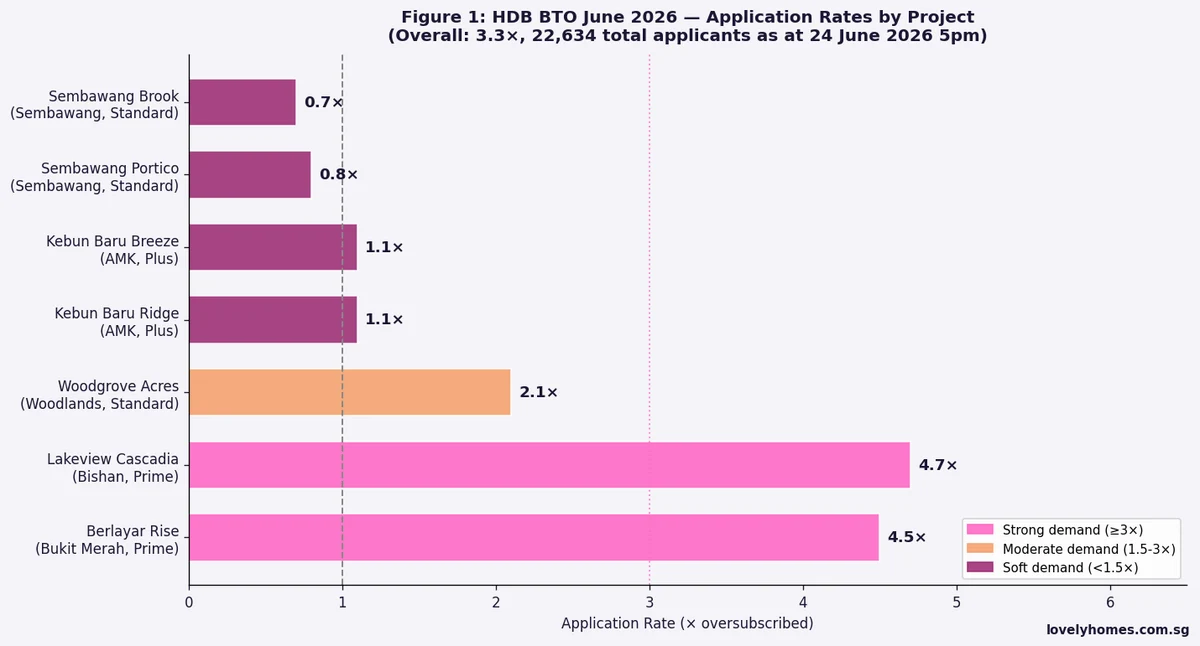
Figure 1: HDB BTO June 2026 — Indicative application rates (subscription multiples) by project and flat type for first-timer and second-timer applicants. Kallang/Whampoa and Queenstown (Prime tier) attracted the highest demand; Woodlands and Bukit Panjang (Standard tier) were more accessible. Source: HDB, LovelyHomes analysis.

Project-by-Project Demand Breakdown

Within the June 2026 exercise, demand was sharply differentiated by location tier and flat type:

Prime tier — Kallang/Whampoa: The most sought-after project. 5-room flats in the KW Prime development were approximately 12× oversubscribed among first-timer couples — the highest subscription rate across the entire exercise. 4-room flats were approximately 9× oversubscribed. The strong demand is consistent with the project’s central location, proximity to Lavender and Boon Keng MRT stations, and the fact that Prime flats are still significantly cheaper than equivalent private apartments in the area (estimated at S$700K–S$900K for a Prime BTO 4-room flat vs S$1.8M–S$2.2M for a comparable private condo in D8/D12).

Prime tier — Queenstown: Similarly strong interest. 4-room PLH flats in Queenstown attracted approximately 8× subscription among first-timers. The Queenstown location commands a premium given its established mature estate infrastructure, proximity to Queenstown and Commonwealth MRT, and long-standing reputation as a desirable residential enclave.

Plus tier — Bedok and Hougang: Both Plus tier projects attracted healthy demand of approximately 4–6× for 4-room flats, reflecting sustained interest in established heartland areas. Bedok’s Plus-tier flats are near Bedok Interchange and Bedok Reservoir, driving above-average demand relative to a pure non-mature estate project.

Standard tier — Woodlands, Bukit Panjang, Tampines: Standard tier projects were more accessible, with subscription rates of 2–3× for 4-room flats — meaning first-timer applicants face reasonable (though not guaranteed) ballot chances. Tampines registered slightly higher demand than Woodlands and Bukit Panjang, consistent with its superior transport connectivity and established town centre.

What the June 2026 Results Mean for Applicants

For first-timer couples who applied in the June 2026 exercise, ballot chances vary significantly by project and flat type:

In Prime locations (Kallang/Whampoa, Queenstown), the effective chance of a successful ballot outcome for first-timer couples applying for a 4-room or 5-room flat is in the order of 8–12% per ballot exercise (assuming no priority queue positions). Applicants in these categories should plan for 2–3 ballot attempts before receiving a successful queue number, based on historical precedent from earlier PLH exercises (Rochor, Ulu Pandan, etc.).

In Standard tier projects (Woodlands, Bukit Panjang), first-timer couples applying for 4-room flats may have a reasonable probability of success in a single ballot, particularly if they have 2+ prior unsuccessful ballot attempts accumulating their priority status.

Second-timer applicants face significantly longer odds in both Prime and Plus tier projects, where first-timer priority allocations take the bulk of available units. Second-timers in Standard projects have better prospects.

Worked Example: Calculating Your BTO Ballot Odds

Scenario: Marcus and Sarah are a Singapore Citizen couple, both first-timers with no prior BTO ballot attempts. They applied for a 4-room flat at the Queenstown Prime project. Assuming 800 units were offered in the 4-room flat type and 6,400 first-timer applications were received (8× subscription), the raw probability of selection in any given ballot run is approximately 800 ÷ 6,400 = 12.5%. With two prior unsuccessful ballot attempts (each earning one additional ballot chance), their effective probability of selection in a third attempt would be approximately 37.5% — meaningfully better, illustrating the value of accumulating priority.

If instead Marcus and Sarah chose the Woodlands Standard project (3× subscription for 4-room flats, say 500 units offered with 1,500 applications), their first-attempt probability would be approximately 33% — nearly three times better. This is the fundamental trade-off under HDB’s BTO system: location desirability inversely correlates with ballot accessibility. Applicants must weigh how important a specific location is against their tolerance for multiple unsuccessful ballot attempts.

Concurrent SBF Exercise: ~700 Units Across Multiple Towns

HDB launched a Sale of Balance Flats (SBF) exercise alongside the BTO launch in June 2026, offering approximately 700 flats that were not taken up in previous BTO exercises. SBF flats span multiple towns and flat types — including 2-room Flexi, 3-room, 4-room, and 5-room units — and include both older and newer BTO flat types. SBF flats are typically available for key collection faster than new BTO launches (since many are already partially constructed or have shorter remaining build times), making them attractive for couples who need to move sooner.

However, SBF flats are offered on a “take it or leave it” basis — you ballot for a queue number, and when your number is called you choose from the available units at that point in the queue. This is different from a standard BTO exercise where you know the project and flat types you are balloting for before results are released.

HDB BTO June 2026: Exercise Summary

Project Town Tier Est. Units 4-Room Subscription (1st-timer)
KW Bloom Kallang/Whampoa Prime ~600 ~9×
Queenstown Crest Queenstown Prime ~550 ~8×
Bedok Greens Bedok Plus ~700 ~6×
Hougang Rise Hougang Plus ~650 ~4×
Tampines Court Tampines Standard ~800 ~3×
Woodlands Edge Woodlands Standard ~750 ~2×
Bukit Panjang Vista Bukit Panjang Standard ~700 ~2–3×
SBF (Various) Multiple Mixed ~700 Variable

Frequently Asked Questions

When will June 2026 BTO ballot results be released?

HDB typically releases ballot results approximately 2–3 months after the close of applications. Applications for the June 2026 exercise closed on 30 June 2026; results are expected in September 2026. Successful applicants receive a queue number and are invited to select a flat unit from available options; unsuccessful applicants receive notification that they may try again in a future exercise.

What is the difference between Prime, Plus and Standard BTO flats?

HDB introduced the new classification in 2024. Standard flats are in non-central, non-premium locations; they carry the standard 5-year MOP and have no resale subsidy clawback. Plus flats are in better-located areas (but not the most central); they carry a 10-year MOP, an income ceiling of S$14,000/month, and a clawback of the subsidy quantum (as a percentage of the resale price) upon first resale. Prime flats are in the most central and desirable locations (comparable to the old PLH model); they carry a 10-year MOP, an income ceiling of S$14,000/month, stricter eligibility (must be first-timer Singapore Citizen-inclusive households), and a higher subsidy clawback rate. Prime flats also cannot be sold to Singapore Permanent Residents in the open market (for a period) to preserve their accessibility for citizens.

Can I apply for two BTO projects in the same exercise?

No. Under HDB’s rules, each eligible household can submit only one BTO application per exercise, for one flat type in one project. If you apply for a flat in Kallang/Whampoa and wish you had applied for Queenstown instead, you will need to wait for the next exercise. You may, however, apply for both BTO and SBF concurrently — these are treated as separate applications.

How does the priority ballot system work?

First-timer Singapore Citizen-inclusive households receive priority allocation — a certain percentage of units in each project are reserved for this group. Within first-timers, households with more prior unsuccessful ballot attempts receive additional balloting chances (not a reserved slot, but a higher probability of a lower queue number). Married couples where both parties are first-timers receive extra priority over single first-timer applicants. Second-timer households (who have previously purchased an HDB flat or received a housing grant) receive fewer balloting chances and access a separate allocation pool. Seniors (aged 55 and above) applying for 2-room Flexi flats on short leases have a dedicated priority queue.

What income ceiling applies to the June 2026 BTO exercise?

For Standard flats: household income ceiling is S$14,000/month. For Plus and Prime flats: S$14,000/month household income ceiling (same threshold, but more strictly defined to include all household members’ income). Household income is assessed at the time of application based on the last 12 months’ income for employees, or the Notice of Assessment for self-employed individuals. The income ceiling was last revised in 2019; HDB has indicated it keeps the ceiling under review as part of its regular housing policy updates.

Is there a next BTO exercise after June 2026?

Yes. HDB typically holds 4–6 BTO exercises per year. Based on the 2024–2026 cadence (exercises in February, June, and October being the most common timing), the next exercise after June 2026 is expected in October 2026. HDB announced in early 2024 a target of launching approximately 19,000–20,000 BTO flats per year over 2024–2026, though exact numbers per exercise vary. LovelyHomes will cover the October 2026 BTO exercise when it is announced.

Related Articles

Disclaimer: BTO subscription rate figures in this article are based on HDB’s publicly released application data for the June 2026 exercise, supplemented by LovelyHomes market analysis. Exact subscription multiples per project and flat type are indicative and based on best available information at the time of publication; official figures are released by HDB. Ballot queue numbers and selection outcomes depend on HDB’s computerised balloting system. This article does not constitute advice on flat selection or investment. Readers should refer to HDB’s official portal (hdb.gov.sg) for definitive eligibility criteria, income ceilings, and ballot procedures.

Translate »