Bukit Batok Neighbourhood Guide Singapore 2026: HDB Prices, JRL and Investment Outlook

Bukit Batok Neighbourhood Guide Singapore 2026: HDB Prices, JRL and Investment Outlook

⚡ Bukit Batok at a Glance — Quick Answer

  • District & Region: D23, West Region — predominantly HDB town with mature estate status and ~27,000 flats.
  • Transport: EW Line (Bukit Batok MRT, Bukit Gombak MRT); Jurong Region Line opening 2027 adds two new stations at Tengah Park and Bahar Junction.
  • HDB Resale Prices (Q1 2026): 4-room flats S$480k–S$640k; 5-room S$620k–S$790k.
  • Private Condos: OCR pricing ~S$1,300–S$1,550 psf; notable projects include Le Quest, Altura EC, and West Scape.
  • Rental Yields: ~3.2%–3.6% gross for HDB and condo units.
  • Schools: Six primary schools within 1 km of most precincts, including Bukit Batok Primary, St. Anthony’s Primary, and Bukit View Primary.
  • Key Catalysts: JRL Phase 1 (2027), Tengah new town development, and potential Bukit Timah–Dairy Farm masterplan uplift.
  • Best For: HDB upgraders, first-time buyers seeking OCR value, and investors targeting yield over capital appreciation.

Tucked between Bukit Timah Nature Reserve and the emerging Tengah new town, Bukit Batok is one of Singapore’s most established yet persistently underrated residential precincts. Administered under the West Region of Singapore’s planning framework, it occupies District 23 (D23) alongside Choa Chu Kang — a zone that has historically traded at a meaningful discount to the Rest of Central Region (RCR) while offering mature estate infrastructure, abundant greenery, and very strong rental fundamentals.

For buyers in 2026, Bukit Batok presents a compelling proposition: the Jurong Region Line (JRL), delayed but now confirmed for Phase 1 opening in 2027, will add two stations directly serving the estate and cut travel times to Jurong Lake District (JLD) significantly. Combined with the Tengah “Forest Town” development next door — which will eventually add 42,000 new public and private housing units — Bukit Batok is positioned as a quiet beneficiary of Singapore’s largest urban transformation project since Punggol.

This guide covers everything buyers, renters, and investors need to know about Bukit Batok in 2026: HDB resale prices, private condo options, school landscapes, transport connectivity, and the investment thesis for the decade ahead.
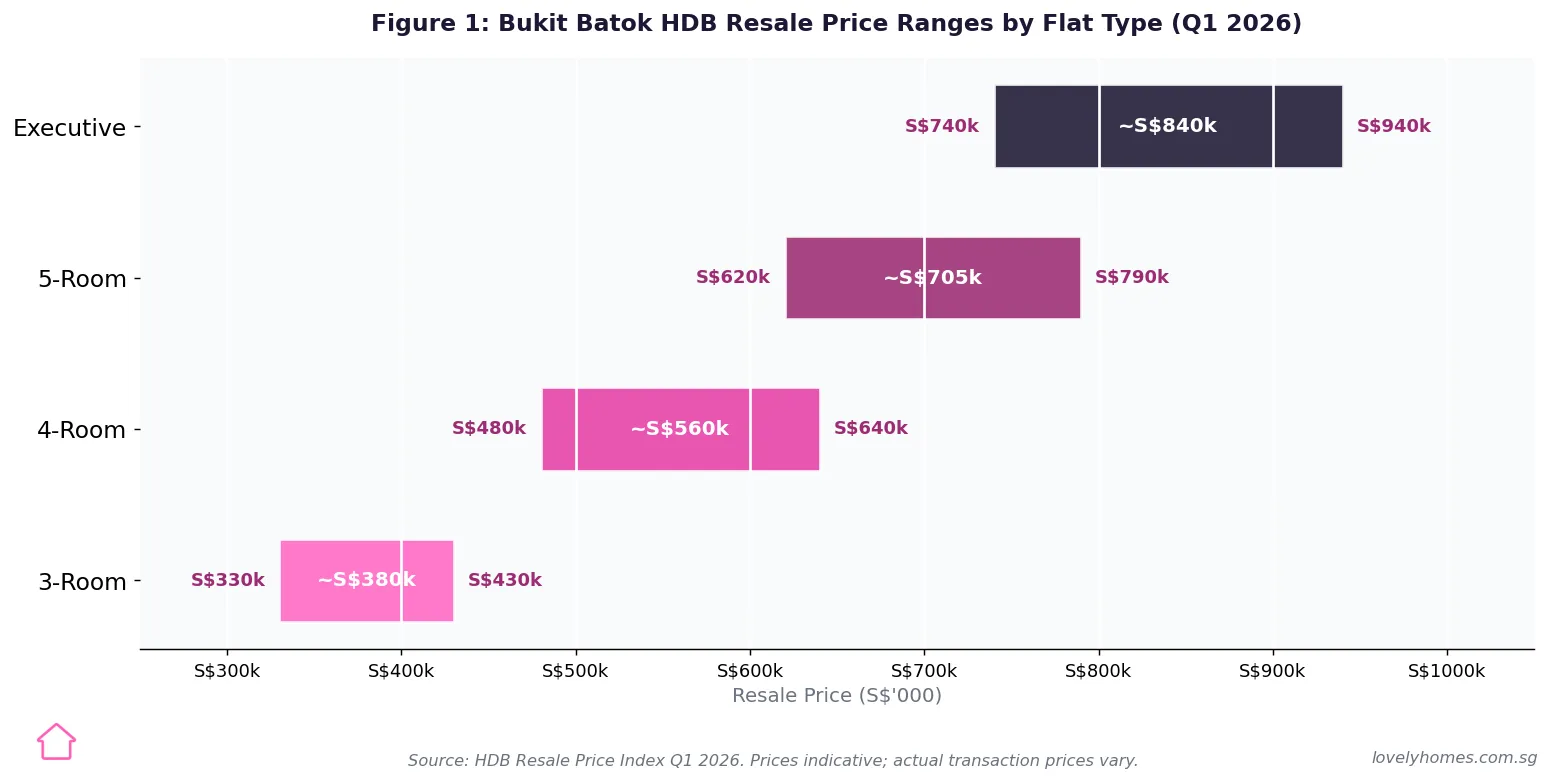
Figure 1: Bukit Batok HDB resale price ranges by flat type Q1 2026
Figure 1: Bukit Batok HDB resale price ranges by flat type, Q1 2026. Source: HDB Resale Statistics.

Location and Transport Connectivity

Bukit Batok sits in the West Region of Singapore, bounded by Bukit Timah to the east, Jurong East to the south, Choa Chu Kang to the north, and the emerging Tengah planning area to the west. The estate is roughly 20–25 km from the Central Business District (CBD), placing it firmly in Outside Central Region (OCR) pricing territory.

MRT Access

Today, Bukit Batok is served by two East-West Line (EW) stations: Bukit Batok (EW27) and Bukit Gombak (EW28). Journey time to Jurong East (the regional hub) is two stops (~5 minutes); to City Hall, it is 25–30 minutes with no transfers. The Jurong Region Line (JRL), confirmed for Phase 1 opening in 2027, will introduce stations at Tengah Park and Bahar Junction within or adjacent to Bukit Batok’s boundary, connecting directly to the JLD White Site and the future Jurong-Tuas Corridor.

Road and Bus

Bukit Batok sits along the Bukit Timah Expressway (BKE) and is well-served by trunk bus routes to Jurong East, Clementi, and the CBD. Cycling infrastructure under the Bukit Batok Active Mobility Network connects residential precincts to Bukit Batok Nature Park and West Mall.

Housing Stock: HDB, Executive Condominiums and Private Condos

Bukit Batok is overwhelmingly a public housing town, with approximately 27,000 HDB flats distributed across 17 precincts — from Bukit Batok West Avenue 5 to Bukit Batok Crescent. The flat stock skews toward the 1990s and early 2000s, meaning most flats carry 67–75 years of remaining lease — generally comfortable for CPF usage and bank lending under current HDB and MAS rules.

Private residential supply is limited but growing:

  • Le Quest (completed 2022): 516-unit mixed-development with a retail podium; one of the first integrated private-residential-commercial projects in Bukit Batok.
  • Altura EC (2023 launch, under construction): 360-unit executive condominium on Bukit Batok West Avenue 8; the first EC in Bukit Batok in over a decade. Fully sold.
  • West Scape: Smaller boutique private condo serving the Bukit Gombak catchment.

The limited private supply and proximity to Tengah — which will generate a substantial volume of new BTO launches — mean Bukit Batok’s HDB resale market is likely to face moderate upward price pressure over the next five to seven years as Tengah buyers seek established amenities nearby.
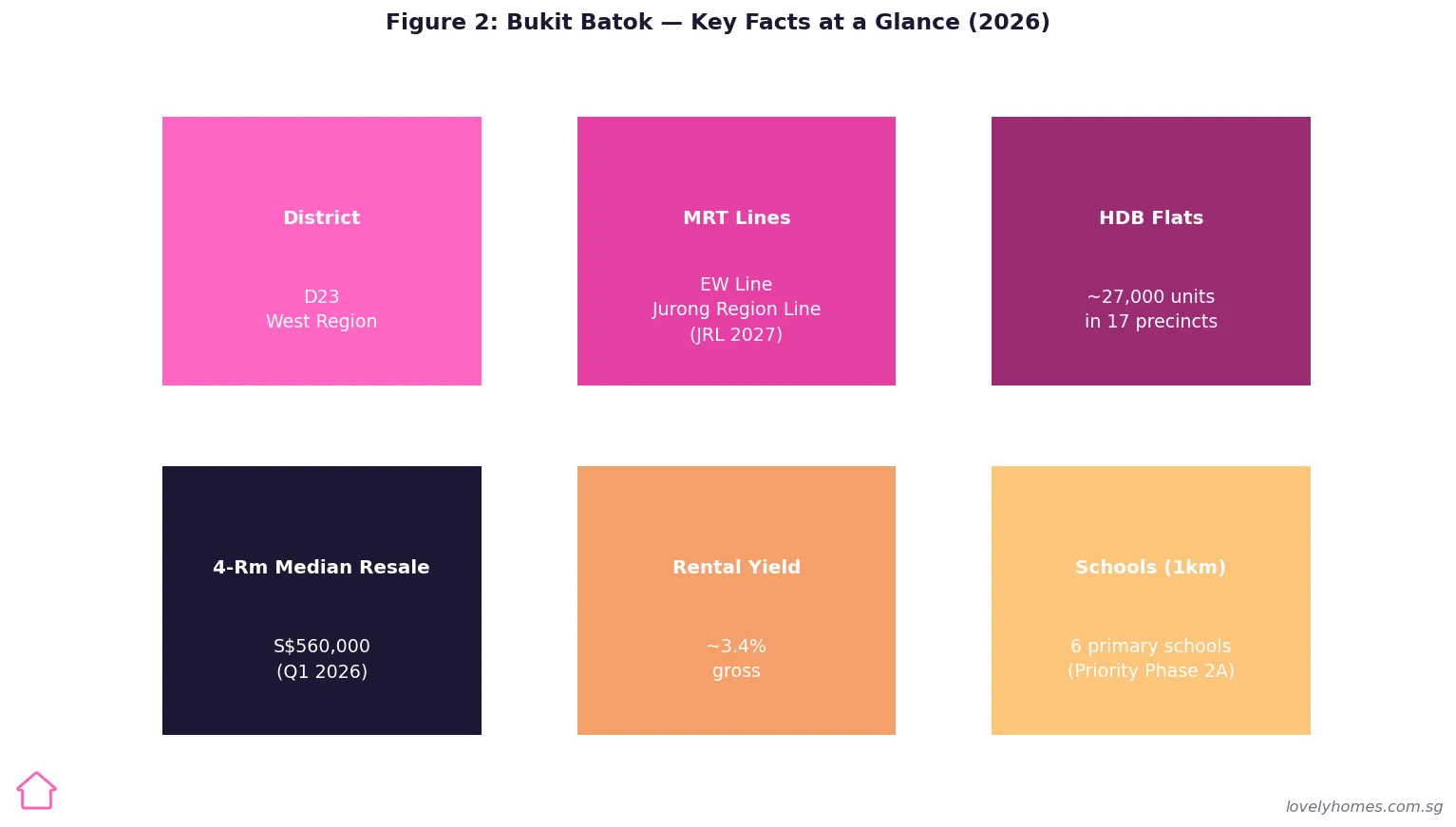
Figure 2: Bukit Batok key facts at a glance — district, MRT, schools, yield 2026
Figure 2: Bukit Batok — key facts at a glance (2026).

Property Prices and Rental Market in 2026

HDB Resale

Bukit Batok HDB resale prices have appreciated steadily since 2020, driven by broad OCR resale market strength and limited new private supply. In Q1 2026, the median 4-room resale transaction in Bukit Batok stood at approximately S$560,000 — below the OCR average of S$570,000 and the Singapore-wide average of S$618,000, presenting a modest value opportunity for buyers comparing like-for-like. Five-room flats command S$620k–S$790k depending on location, floor, and remaining lease.

Private Condominiums

For private property, Bukit Batok / D23 transacts at S$1,300–S$1,550 psf for non-landed units — well below the RCR average (~S$2,100 psf) and meaningfully below Districts 21 and 22 despite comparable green surrounds. Le Quest’s resale units have traded in the S$1,380–S$1,520 psf range in 2025–2026, anchoring buyer expectations.

Rental Market

HDB rental demand in Bukit Batok benefits from proximity to the International Business Park and Jurong Lake District, which house a growing expat and professional workforce. Gross rental yields for 4-room HDB flats average ~3.2%–3.6%; private condos (Le Quest) yield ~3.0%–3.4% gross, broadly in line with OCR benchmarks.

Schools and Amenities

Primary Schools (within 1–2 km)

Bukit Batok has six primary schools within a 1 km radius of most residential precincts, giving families access to the HDB Priority Admission (Phase 2A) advantage:

  • Bukit Batok Primary School
  • Bukit View Primary School
  • St. Anthony’s Primary School (Catholic; popular, competitive ballot)
  • Dazhong Primary School
  • Lianhua Primary School
  • Hillgrove Secondary School (secondary)

Shopping and Lifestyle

Bukit Batok’s main retail node is West Mall (Bukit Batok MRT), a mid-sized mall anchored by Giant Hypermarket, Cathay Cineplexes, and a public library. The nearby Le Quest Mall adds a boutique lifestyle component. Residents are also within driving distance of Jurong Point (15 min), one of the largest suburban malls in Singapore. Nature assets include Bukit Batok Nature Park, Little Guilin (a scenic granite quarry pool), and foot access to the Central Catchment Nature Reserve via Bukit Timah.

Bukit Batok Property Summary (2026)

Property Type Price Range Gross Yield Typical Size Notes
3-Room HDB Resale S$330k–S$430k 3.4%–3.9% 65–75 sqm Lease typically 55–70 yrs remaining
4-Room HDB Resale S$480k–S$640k 3.2%–3.6% 90–105 sqm Median ~S$560k Q1 2026
5-Room HDB Resale S$620k–S$790k 3.0%–3.4% 120–130 sqm Best lease: 2000s blocks
Executive HDB (EA/EM) S$740k–S$940k 2.8%–3.2% 140–155 sqm Rare; check lease carefully
Private Condo (Le Quest) S$1,380–S$1,520 psf 3.0%–3.4% 430–1,400 sqft Integrated mall; 99-yr lease
Altura EC ~S$1,300 psf (launch) N/A (TOP 2027) 614–1,711 sqft Fully sold; watch resale from 2028 (MOP 5yr)

Worked Example: SC Couple Buying a 4-Room HDB Resale in Bukit Batok

👥 The Wong Family — Joint SC Buyers, S$9,200/mth Household Income

Property: 4-room HDB resale flat, Bukit Batok West Avenue 6, 12th floor, 1999 block (64 years lease remaining), transacted at S$568,000 (no COV in this example; buyers paid valuation).

Financing: HDB Loan (2.60% p.a., 25-year tenure). Loan eligibility: up to 80% LTV = S$454,400. Downpayment 20% = S$113,600 (can be partly from CPF OA).

CPF check (lease sufficiency): Wong couple aged 32 + 29. Youngest buyer is 29. Lease of 64 years + 29 = 93 years — falls below the 95-year threshold, so CPF usage is pro-rated. Maximum CPF withdrawal = (64/65) × Valuation = 98.5% of S$568,000 = S$559,480. Full CPF usage effectively available; no material restriction here.

Monthly repayment: HDB loan S$454,400 @ 2.60%, 25 years = S$2,058/mth.
MSR check: S$2,058 ÷ S$9,200 = 22.4% — well below the 30% MSR cap. ✓

Stamp duty (BSD): First S$180k @ 1% = S$1,800; next S$180k @ 2% = S$3,600; next S$640k @ 3% = S$6,240; total BSD = S$11,640. (No ABSD — first property for both; both SC.)

Total upfront cost: Downpayment S$113,600 + BSD S$11,640 + HDB admin fee ~S$2,000 + legal S$3,500 ≈ S$130,740 (a portion covered by CPF OA balance).

CPF Housing Grant: Wong couple, first-timer HDB resale buyers. Family Grant: S$50,000 (income S$9,200 ≤ S$14,000 ceiling). Applied to reduce loan — effective outlay S$404,400. Monthly repayment drops to ~S$1,831/mth (MSR 19.9% ✓).

Why Bukit Batok Matters for Property Buyers in 2026

Bukit Batok punches above its weight for several structural reasons that differentiate it from comparable OCR towns such as Choa Chu Kang or Jurong West:

1. Bukit Timah nature premium at OCR prices. Few mature HDB towns can offer direct trail access to the Central Catchment Nature Reserve — a premium that adds lifestyle value without adding Central Region pricing. Bukit Batok’s proximity to Bukit Timah and Little Guilin is a genuine differentiator that does not show up in psf numbers yet.

2. JRL connectivity uplift arriving in 2027. The Jurong Region Line’s Phase 1 will connect Bukit Batok’s western fringe to Jurong Lake District — Singapore’s second CBD and the planned site of the Tuas Mega Port, the Singapore Terminus (HSR), and a major white-site commercial cluster. JRL accessibility is already being priced into Tengah BTO launches; Bukit Batok’s established resale stock has not moved as sharply, suggesting residual value.

3. Tengah demand spillover. Tengah new town will eventually house ~42,000 units, many of which are Standard and Plus classification with 5-year MOPs. Residents completing MOP from 2031 onwards will look for nearby resale options — and Bukit Batok, with its larger flat sizes, nature access, and established amenities, is a natural landing zone.

Key insight: Bukit Batok’s 4-room resale median is approximately 7–8% below the Singapore-wide OCR 4-room median in Q1 2026. This gap is narrower than the 12–15% discount seen in 2020–2021, suggesting gradual convergence — but there may still be buying opportunity before JRL opens.

What Might Come Next for Bukit Batok (Speculative)

The following are forward-looking possibilities, not confirmed plans, and should not be relied upon for financial decisions:

  • JRL Phase 1 (2027): The Land Transport Authority has confirmed Tengah Park and Bahar Junction stations in Phase 1 of the JRL. Once operational, Bukit Batok will be within two stops of both the EW Line (existing) and the JRL, enhancing its multi-modal connectivity.
  • Bukit Timah–Dairy Farm Long Valley: URA’s masterplan indicates a potential linear park and cycling-friendly corridor through this corridor. If realised, Bukit Batok would be a key access point, adding recreational value.
  • New BTO Supply: HDB has indicated potential BTO sites in the Bukit Batok West Extension area in 2026–2027. New BTO launches would set fresh pricing benchmarks and could generate resale demand 5 years post-occupation.
  • Commercial cluster at Le Quest: CapitaLand’s ongoing placemaking of the Le Quest podium retail could catalyse further F&B and lifestyle tenants, deepening the town’s amenity profile.
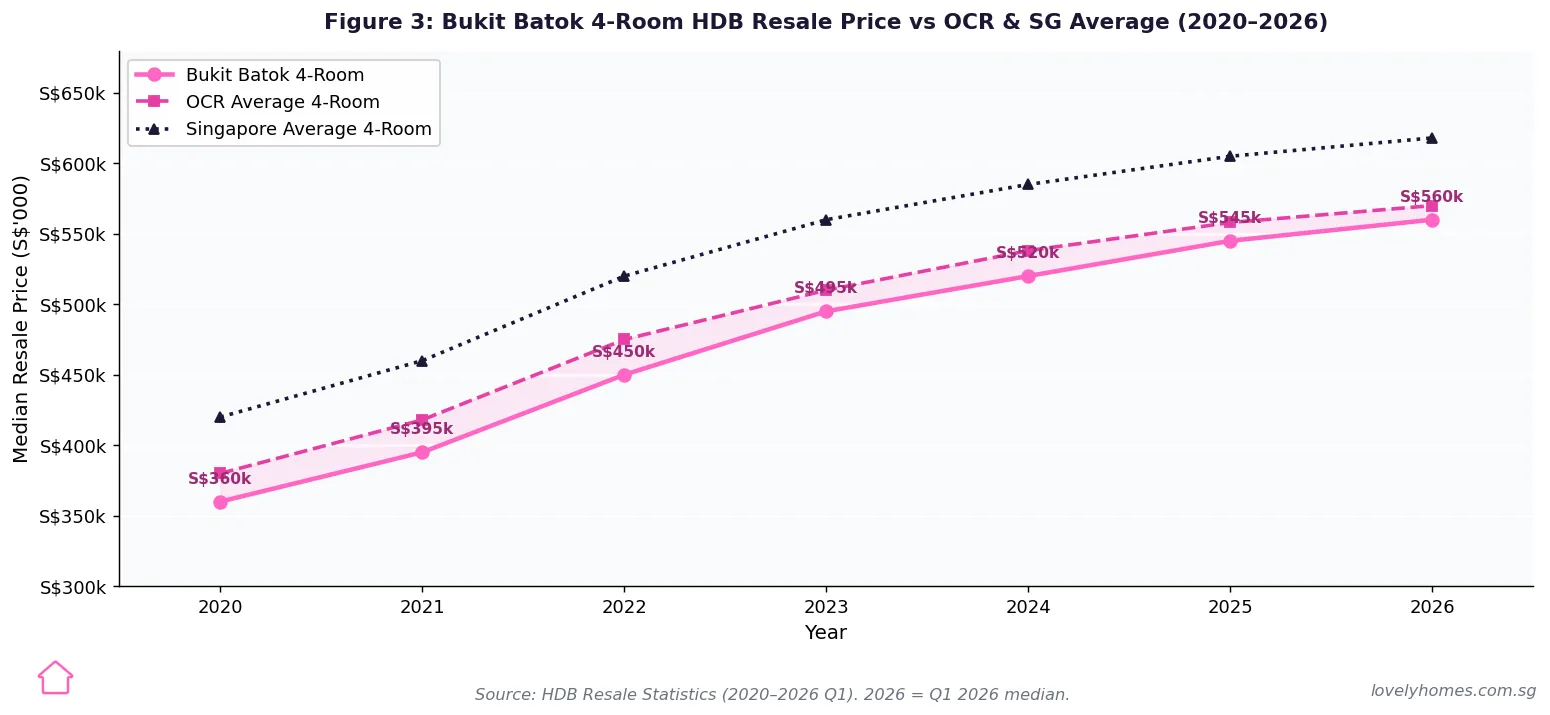
Figure 3: Bukit Batok 4-room HDB resale price trend vs OCR and Singapore average 2020 to 2026
Figure 3: Bukit Batok 4-room HDB resale price trend vs OCR average and Singapore average (2020–Q1 2026). Source: HDB Resale Statistics.

Frequently Asked Questions

Is Bukit Batok a good place to buy property in 2026?

Bukit Batok offers a solid value proposition for buyers prioritising lifestyle, nature access, and OCR pricing. HDB resale values have appreciated steadily since 2020, and the upcoming JRL Phase 1 (2027) adds a structural connectivity catalyst. For investors, gross rental yields of 3.2%–3.6% are competitive for an OCR town. The main risks are the estate’s age (much of the HDB stock dates to the 1990s), which means lease-decay considerations for CPF and bank financing become relevant for older blocks.

When will the Jurong Region Line (JRL) serve Bukit Batok?

JRL Phase 1 is confirmed for opening in 2027, according to the Land Transport Authority (LTA). Bukit Batok will benefit from the Tengah Park and Bahar Junction stations in the adjacent Tengah planning area, which are within cycling and bus-feeder distance of Bukit Batok West. The full JRL network, stretching from Jurong Lake District to Choa Chu Kang, is expected to be completed by 2028–2029. Property values in JRL-adjacent areas have historically seen 5–8% appreciation in the 12–24 months surrounding a line opening.

What is the minimum income needed to buy a 4-room HDB resale in Bukit Batok?

Using a median 4-room transacted price of S$568,000 and an HDB loan at 2.60% over 25 years, the monthly repayment is approximately S$2,058. The MSR cap is 30% of gross income, which implies a minimum household income of ~S$6,860/mth to service the loan without grants. With the Family Grant (up to S$50,000 for first-timer couples), the effective loan reduces and the income requirement drops to ~S$6,100/mth. Note: the actual income ceiling for HDB loans is S$14,000/mth for couples, so most buyers will be within the eligible range.

How does Bukit Batok compare to Choa Chu Kang or Jurong West for property investment?

All three are D23–D22 OCR towns with broadly similar HDB resale price ranges. Bukit Batok distinguishes itself through: (1) nature access (Bukit Timah, Little Guilin), which commands a lifestyle premium; (2) better MRT connectivity today via two EW Line stations; (3) slightly lower median prices than Choa Chu Kang’s most popular blocks. Jurong West offers lower psf pricing and is closer to the JLD employment cluster, making it a stronger pure-yield play. Choa Chu Kang (served by CCK MRT on both the EW and NS Lines) has the edge on MRT coverage for now. Bukit Batok’s JRL upgrade in 2027 may tip the balance for medium-term capital appreciation.

Are there any en-bloc opportunities in Bukit Batok?

Bukit Batok has limited private residential stock, meaning true private en-bloc activity is rare. Le Quest (2022 completion) is too new to be a realistic en-bloc candidate for at least a decade. For HDB owners, the SERS (Selective En Bloc Redevelopment Scheme) administered by HDB is the analogous process — HDB selects older, strategically located estates for redevelopment and offers residents replacement flats. Blocks in older precincts near Bukit Batok Town Centre have been SERS candidates historically, though HDB has not announced any new SERS exercises in Bukit Batok as at mid-2026. Any SERS announcement would be a strong positive catalyst for nearby resale values.

What CPF housing grants are available for Bukit Batok HDB resale buyers?

The main grants for first-timer couples buying HDB resale flats in Bukit Batok are: (1) Family Grant — S$50,000 (income ≤ S$9,000) or S$40,000 (income S$9,001–S$12,000) or S$20,000 (income S$12,001–S$14,000); (2) Half-Housing Grant — S$25,000 for couples where one partner is a first-timer; (3) Proximity Housing Grant (PHG) — S$30,000 (living with parents) or S$20,000 (within 4 km), provided the resale flat is within the stipulated proximity. Grants are administered by HDB and are credited to the CPF OA to reduce the outstanding loan. Eligibility rules are set by HDB and updated periodically; buyers should verify on the HDB website before OTP exercise.

Is Bukit Batok suitable for foreigners or permanent residents?

HDB resale flats are generally not available to foreigners (non-Singapore Citizens or Permanent Residents). Singapore Permanent Residents (SPRs) may purchase resale HDB flats subject to the Ethnic Integration Policy (EIP) and SPR quota, and must form an eligible SPR family nucleus. Foreigners are restricted to private residential properties in Singapore. In Bukit Batok, the only private options are Le Quest (99-year leasehold) and boutique private condos such as West Scape — both accessible to foreigners, though ABSD of 60% applies to all foreigners purchasing residential property in Singapore. SPRs pay ABSD of 5% on their first purchase and 30% on subsequent properties.

Disclaimer: This article is for general informational purposes only and does not constitute financial, legal, or property investment advice. Property prices, grant amounts, loan rates, and government policies are subject to change. HDB resale price data is indicative and sourced from the HDB Resale Price Index and publicly available transaction records. Readers should verify all figures and eligibility criteria directly with HDB (www.hdb.gov.sg), the Urban Redevelopment Authority (www.ura.gov.sg), and CPF Board (www.cpf.gov.sg) before making any property decision. LovelyHomes recommends consulting a licensed property agent (CEA-registered) and a licensed financial adviser before proceeding with any transaction.

×

Click anywhere to close

Choa Chu Kang Neighbourhood Guide Singapore 2026: Property Prices, Schools, MRT and Investment Outlook

Choa Chu Kang Neighbourhood Guide Singapore 2026: Property Prices, Schools, MRT and Investment Outlook

Quick Answer — Choa Chu Kang Neighbourhood Guide 2026: Key Takeaways

  • Location: District 23 (D23), OCR (Outside Central Region); western Singapore, bordering Bukit Batok, Tengah new town, and Bukit Panjang.
  • MRT: Choa Chu Kang MRT (NS4) on the North-South Line; Bukit Gombak (NS3); Bukit Panjang DT1 nearby; Bukit Gombak NS3 within walking distance for residents in the eastern portion. Jurong Region Line (JRL) stop at Choa Chu Kang expected mid-2027.
  • Property prices: HDB 4-room resale S$420k–S$610k; HDB 5-room S$580k–S$810k; Condo 2BR S$870k–S$1,230k (Q1 2026 indicative).
  • Key catalyst: JRL opening (mid-2027 estimated) + Tengah new town 42,000 HDB flats — transforms the western corridor’s connectivity and long-term supply dynamics.
  • Schools: Yew Tee Primary, Teck Whye Primary, South View Primary, Choa Chu Kang Secondary; ITE College West within 2 km.
  • Yield: HDB 4-room gross yield ~4.5%; EC resale ~4.2%; condo 2BR ~3.4% — competitive for OCR.
  • Ideal for: Young SC families seeking value in a well-serviced OCR estate; HDB upgraders; long-term investors with a 10-year+ horizon aligned to JRL and Tengah catalysts.

Choa Chu Kang (CCK) sits at the western edge of Singapore’s OCR (Outside Central Region), in Planning Area D23. It is one of the largest and most self-contained public housing estates in Singapore, home to roughly 190,000 residents spread across the sub-precincts of Choa Chu Kang, Yew Tee, Keat Hong, and the newer blocks along Teck Whye and Limbang. The estate has evolved considerably since the first HDB blocks were completed in the 1980s — today it offers a full range of flat types, a private and executive condominium sub-market, one of Singapore’s largest single-structure suburban malls (Lot One Shoppers’ Mall), and access to the Bukit Panjang LRT’s 14-station loop network via the integrated Choa Chu Kang interchange.

Two structural shifts are reshaping CCK’s investment profile. The first is the Jurong Region Line (JRL), Singapore’s newest MRT line, which will station a stop at Choa Chu Kang (alongside Tengah, Boon Lay, and Jurong Industrial Estate). JRL Stage 1 is expected to open around mid-2027, connecting CCK directly to Jurong East interchange and, via interchange, to the East-West Line. The second is Tengah — a 700-hectare new town immediately to the south-east of CCK, where HDB will build approximately 42,000 flats over the next 15 years. Tengah’s car-free town centre and eco-corridors bring a qualitatively different demographic and aesthetic to the western corridor, and its residents will commute through or around CCK.

This guide sets out what buyers, investors, and sellers need to know about Choa Chu Kang property in 2026 — prices, transport connectivity, schools, investment fundamentals, and the worked numbers behind a typical purchase.

Choa Chu Kang property price ranges 2026 — HDB resale and condo prices D23 bar chart
Figure 1: Choa Chu Kang Property Price Ranges by Type, Q1 2026 (D23 OCR). HDB resale, EC resale, and private condo. Source: HDB, URA REALIS.

Choa Chu Kang Location and Planning Context

Choa Chu Kang occupies the far western flank of Singapore’s main island, bounded by Bukit Batok to the east, Tengah to the south-east, Lim Chu Kang Road to the north-west, and the Central Catchment Nature Reserve in the north. The planning area is divided into two HDB towns: Choa Chu Kang (the western and central portion) and Bukit Batok (the eastern portion), though the Yew Tee precinct in the north of D23 is administratively part of Choa Chu Kang town.

The area is designated by URA as OCR — Outside Central Region — meaning it sits in Singapore’s heartland pricing band, below the Core Central Region (CCR) and Rest of Central Region (RCR) bands that cover the central, prime, and city-fringe districts. OCR designation generally implies lower absolute prices and higher initial rental yields, in exchange for longer commute times to the CBD. The typical door-to-door commute from Choa Chu Kang MRT to Raffles Place is approximately 45–55 minutes via the NSL, depending on the time of day and interchange waits.

The JRL changes this calculus materially. Once operational, CCK will be directly connected to Jurong East — Singapore’s second CBD node and home to major employers in the finance, healthcare (Ng Teng Fong General Hospital), education (NTU, IME), and industrial tech sectors. Jurong East also connects to the East-West Line (EWL) for onward travel east or west. The JRL adds a direct, one-interchange route to Jurong East that avoids the current single-line dependency on the NSL.

MRT and Public Transport in Choa Chu Kang

The MRT infrastructure serving CCK consists of the following stations, with the JRL addition anticipated to significantly enhance connectivity:

Choa Chu Kang (NS4): The primary station, on the North-South Line (NSL). An integrated bus interchange and mall (Lot One) sit above and adjacent to the station, making it one of the most used interchange points in Singapore’s western region. From NS4, northbound trains reach Kranji (NS7) and Woodlands (NS9); southbound trains reach Bukit Gombak (NS3), Bukit Batok (NS2 / NS3), Jurong East (NS1 / EW24), and eventually the CBD via Orchard (NS22) or Raffles Place (EW14).

Bukit Gombak (NS3): Three to four minutes south of Choa Chu Kang by train; serves the eastern portion of D23 and the Bukit Gombak sub-precinct. Residents of HDB blocks along Bukit Batok East Avenue and Choa Chu Kang Avenue 5 are often within walking distance.

Bukit Panjang LRT (BP): The 14-station loop services Bukit Panjang town to the north-east of CCK, with the LRT’s southern terminus connecting to Bukit Panjang DTL station (Downtown Line) at BP1/DT1. While the LRT does not serve Choa Chu Kang directly, HDB residents in the northern CCK precincts near Teck Whye may use feeder buses to Bukit Panjang LRT, gaining access to the DTL for the Botanic Gardens, Stevens, and CBD corridor.

Jurong Region Line (JRL) — Choa Chu Kang Station: The JRL is Singapore’s seventh MRT line, under construction and expected to open in stages from mid-2027. The Choa Chu Kang station on the JRL will form an interchange with the existing NSL Choa Chu Kang station (NS4). The full JRL network connects Jurong Industrial Estate, Tengah, and Choa Chu Kang with Boon Lay and Jurong East, enabling a multi-line interchange hub at CCK for the first time. For residents employed in Jurong, the JRL eliminates the need to change trains at Jurong East.

Choa Chu Kang amenities and key statistics 2026 — MRT schools retail parks healthcare
Figure 2: Choa Chu Kang Key Amenities and Statistics — MRT, Schools, Retail, Parks, and Healthcare. JRL = Jurong Region Line, expected mid-2027.

Schools and Education in Choa Chu Kang

Choa Chu Kang’s school cluster is solid at the primary and secondary levels, though it lacks the concentration of prestigious brand-name schools found in central districts such as Novena or Bukit Timah. This is typical of OCR estates and is appropriately priced into the property market — families prioritising proximity to ACS, Methodist Girls’, or Nanyang Girls’ will look elsewhere, while families valuing space, affordability, and community are well served in CCK.

At the primary level, Yew Tee Primary School (along Yew Tee Road) and Teck Whye Primary are well regarded within the town. South View Primary serves the southern CCK precincts. Bukit Panjang Primary and West Spring Primary in the adjacent Bukit Panjang planning area are accessible by feeder bus.

At the secondary level, Choa Chu Kang Secondary School is the main secondary in the town. The ITE College West, located along Choa Chu Kang Ave 5 approximately 2 km from the NS4 station, serves vocational education for the entire western corridor. Its student population generates a consistent rental demand for nearby HDB flats from families relocating closer to the campus.

For higher education, Nanyang Technological University (NTU) — approximately 10–12 minutes by bus from Choa Chu Kang — is one of the key generators of long-term rental demand in the western corridor. NTU’s 33,000-student population, combined with NIE and NUS Research, sustains occupancy in the CCK and Jurong West resale and rental markets.

Choa Chu Kang Property Prices and Market Trends 2026

Choa Chu Kang is one of Singapore’s more affordably priced non-mature HDB estates, though its resale prices have risen in line with the national trend. The HDB Resale Price Index for OCR flats has increased approximately 8–12% per annum over 2021–2022, moderating to 5–8% in 2023–2024 and further to 3–5% YoY in Q1 2026. CCK-specific resale prices reflect these macro trends overlaid by its location characteristics.

HDB Resale: As of Q1 2026, 3-room flats in the estate trade in the S$295,000–S$440,000 range; 4-room flats S$420,000–S$610,000 (with Yew Tee units typically commanding a premium over inland CCK blocks); 5-room flats S$580,000–S$810,000; and Executive Apartment (EA) units S$740,000–S$980,000. Million-dollar HDB transactions in D23 are rare — the market remains structurally below the mature-estate pricing bands of Bishan, Queenstown, or Toa Payoh.

Executive Condominiums (EC) Resale: Several EC developments in CCK, including the fully privatised (post-10-year) Yew Mei Green and Jurong West’s neighbouring Esparina Residences, offer resale prices in the S$820,000–S$1,150,000 range for 3-bedroom units. ECs that have passed 10 years can be sold to foreigners, expanding the pool of potential buyers.

Private Condominiums: The private condo market in CCK is thin relative to Jurong West or Bukit Batok. Landmark developments include Kingsford Waterbay in Jurong (D22 border) and smaller boutique condos along Choa Chu Kang Road. Condo 2BR units range from S$870,000 to S$1,230,000; 3BR units from S$1,180,000 to S$1,620,000. New supply is expected from any JRL-corridor GLS tender awards, as developers position for the uplift associated with MRT line openings.

Choa Chu Kang Property Summary — Q1 2026

Property Type Indicative Price Range Approx PSF Gross Yield 5-Yr Growth
HDB 3-Room (resale) S$295k – S$440k S$340–S$510 psf ~4.9% +9.2%
HDB 4-Room (resale) S$420k – S$610k S$420–S$610 psf ~4.5% +9.8%
HDB 5-Room (resale) S$580k – S$810k S$430–S$600 psf ~4.1% +8.8%
HDB Exec Apartment (resale) S$740k – S$980k S$420–S$555 psf ~3.8% +8.2%
EC Resale (post-10yr, 99yr) S$820k – S$1,150k S$800–S$1,100 psf ~4.2% +10.4%
Condo 2BR (99yr) S$870k – S$1,230k S$1,050–S$1,480 psf ~3.4% +10.8%
Condo 3BR (99yr) S$1,180k – S$1,620k S$950–S$1,300 psf ~3.0% +9.5%

Worked Example: Mr & Mrs Rajan — Choa Chu Kang 4-Room Resale

Scenario: Mr & Mrs Rajan, both Singapore Citizens, joint gross monthly income S$8,200. First-time buyers, aged 30 and 28. Mr Rajan’s parents live in Choa Chu Kang (same town — PHG eligible). Purchasing a 4-room flat along Choa Chu Kang Ave 3, agreed price S$560,000. Taking HDB Concessionary Loan.

Grants (HFE letter):
EHG (household income S$7,501–S$9,000 band): S$45,000 — credited to CPF OA
PHG (parents in same town): S$30,000 — disbursed as cash at completion
Total grants: S$75,000

Stamp duty:
BSD on S$560,000: S$180k×1% = S$1,800 + S$180k×2% = S$3,600 + S$200k×3% = S$6,000 = S$11,400 BSD
ABSD: nil (SC purchasing first residential property)

Financing:
HDB Concessionary Loan (80% LTV): S$560,000 × 80% = S$448,000 loan
Monthly instalment @ 2.6% p.a., 25 years: ≈ S$2,028/mth
MSR: S$2,028 ÷ S$8,200 = 24.7% — PASS (≤30%)

Downpayment (20% = S$112,000):
EHG S$45,000 credited to CPF OA; assume CPF OA S$48,000 combined → CPF OA available S$93,000
Shortfall to be made up: S$112,000 − S$93,000 = S$19,000 cash
PHG S$30,000 cash grant offsets this entirely → net cash from own pocket: ~S$0 on downpayment

Other upfront cash:
BSD S$11,400 (payable from CPF OA if available, or cash) + Legal ~S$2,300 + Misc ~S$500 = ~S$14,200
After PHG S$30,000 cash: effective out-of-pocket cash = ≈ S$0 to S$4,000 (highly grant-subsidised purchase)

Choa Chu Kang rental yield vs 5-year capital growth by property type 2026 chart
Figure 3: Choa Chu Kang Rental Yield vs 5-Year Capital Growth by Property Type, 2026. HDB yields remain competitive at 3.8–4.9%; ECs and condos balance lower yields with stronger price growth.

Why Choa Chu Kang Makes Sense for Long-Term Property Investment

At its current price point, CCK offers one of the higher gross rental yields among Singapore OCR estates — HDB 4-room units generating approximately 4.5% gross yield, and EC resale stock at 4.2%. These yields compare favourably to more premium OCR areas such as Tampines East or Pasir Ris (where prices have risen more sharply), and significantly better than CCR condominiums (2–3% gross yield range).

The five-year capital growth story in CCK is moderate but consistent. HDB 3-room and 4-room prices have appreciated approximately 9–10% in five years, driven by the overall HDB resale market uplift rather than CCK-specific demand surges. The area has not experienced the headline price spikes of Queenstown or Bishan, which partly reflects its non-mature estate classification and partially the historical single-line (NSL) dependency for commuting.

The JRL changes the investment case substantively. Historical evidence from MRT line openings in Singapore — notably the DTL Stage 3 (2017), the TEL Stages 1–3 (2020–2023), and the NSL Woodlands extension (2002) — demonstrates a consistent pattern of 8–15% price uplift in properties within 800m of new stations in the 24 months surrounding opening. The CCK JRL station, forming an interchange with the existing NS4 station, qualifies as one of the most strategically positioned JRL stops. Investors who buy before the mid-2027 JRL opening are positioned ahead of this potential re-rating.

The Tengah caveat is worth acknowledging. The injection of 42,000 new HDB flats in Tengah over the next 15 years introduces a large competing supply of newer stock in an adjacent area. Tengah’s BTO flats — with their car-free precinct design, wider corridors, and proximity to Tengah MRT stations on both the JRL and the planned extensions — will appeal to the same demographic cohort as CCK buyers. This supply overhang is a structural limitation on CCK’s ability to outperform the OCR market average over the next decade.

What Might Come Next — CCK Property Outlook 2027 and Beyond

This section contains analytical perspective, not financial advice. Property investment outcomes are uncertain; readers should seek licensed professional guidance.

The single most important near-term event for CCK property is the JRL Stage 1 opening, anticipated around mid-2027. The LTA has not confirmed a precise opening date beyond “2027”. Buyers who transact in CCK in 2026 are effectively acquiring before the re-rating catalyst — a window that historically has offered better risk-adjusted entry points than post-opening purchases, when MRT uplift is already priced in.

Tengah BTO exercises — beginning in 2023 and continuing through 2030 — will progressively bring new housing stock online immediately south of CCK. The first Tengah MRT stations (JRL) will also serve residents of Tengah’s Plantation District, Brickland, and Forest Hill precincts. The net effect on CCK prices is a structural competition for the same buyer and renter pool, partially offset by CCK’s superior existing infrastructure maturity (Lot One mall, bus interchange, schools already in place).

GLS supply in the Choa Chu Kang and Tengah corridors is currently limited — the bulk of D23 private supply is expected to flow from Tengah-adjacent GLS sites when URA releases them for tender in the mid-2020s. Any tender award in the CCK or Tengah precinct will signal institutional confidence in the JRL re-rating thesis and may catalyse a further uplift in nearby resale values.

Frequently Asked Questions — Choa Chu Kang Property 2026

Is Choa Chu Kang a good place to buy property in Singapore?

CCK is a solid value proposition for buyers who prioritise space and affordability over prestige address or shorter CBD commute times. The estate is well-served, mature, and self-contained — Lot One mall, a full hawker ecosystem, good primary and secondary schools, and the NSL/LRT combination give it genuine liveability credentials. The JRL catalyst in mid-2027 adds a forward-looking price support argument. It is particularly attractive for young families with household incomes of S$7,000–S$10,000 per month who qualify for meaningful EHG and PHG grants, bringing the effective out-of-pocket outlay for a 4-room flat down to near-zero with the right grant combination. For investors with a long-term (10-year+) horizon, the JRL + Tengah adjacency story supports a buy-and-hold strategy, though the large Tengah supply pipeline limits aggressive capital growth assumptions.

What MRT stations serve Choa Chu Kang, and how long is the commute to the CBD?

The primary station is Choa Chu Kang (NS4) on the North-South Line. Bukit Gombak (NS3) is one stop south and serves the eastern CCK and Bukit Batok precincts. The Bukit Panjang LRT network connects to Bukit Panjang DTL (DT1) for access to the Downtown Line CBD corridor. The JRL Choa Chu Kang interchange station is under construction and expected by mid-2027. Commute times from NS4 to Raffles Place (EW14) via the NSL are approximately 45–55 minutes (direct train, no interchange required, but the NSL journey is long). Via the JRL to Jurong East and onward by EWL, commute times to the CBD will remain similar; however, access to the Jurong employment cluster drops to under 15 minutes from the JRL opening.

Can PRs or foreigners buy HDB flats in Choa Chu Kang?

Singapore Permanent Residents (SPRs) may purchase HDB resale flats in CCK provided they form an eligible family nucleus with at least one SPR. SPR-only households are generally restricted to 3-room or larger resale flats in non-mature estates, which CCK qualifies as. They do not qualify for the EHG (which requires at least one SC) but may be eligible for the Proximity Housing Grant (PHG) if one applicant is an SC. Foreigners (non-SC, non-SPR) are not permitted to purchase HDB flats under any scheme. They may purchase private condominiums in CCK subject to the standard 60% ABSD for foreigners, which significantly increases the effective purchase cost.

What are the best condominiums in the Choa Chu Kang / D23 area?

The private condo stock in CCK is sparser than in Jurong West or Bukit Batok. However, fully privatised EC developments offer attractive entry points for buyers seeking condo-level facilities at OCR prices. These include units in Yew Mei Green (fully privatised, 99-year tenure, walking distance to NS4), which have historically traded at competitive PSF relative to newer private launches. For new or recently completed private condos, buyers in the D23 corridor typically extend their search to adjacent D22 (Jurong West) or Bukit Batok to access the most active condo sub-markets. The JRL catalyst is expected to trigger new private condo supply in Tengah-adjacent sites over the next five years.

How does Choa Chu Kang compare to Jurong West or Bukit Panjang for property investment?

CCK, Jurong West (D22), and Bukit Panjang (D23 boundary) occupy similar OCR price tiers but have distinct investment profiles. Jurong West benefits from direct proximity to Jurong East (Singapore’s second CBD), NTU, and the Jurong Lake District pipeline, giving it stronger long-term capital growth credentials — particularly for private condominiums. Bukit Panjang benefits from the DTL connection (faster CBD access) and is generally priced at a modest premium to CCK for that reason. CCK’s key advantage over both is the forthcoming JRL interchange status — no other station in the western corridor gains a new MRT line interchange in 2027 in the same way. That makes CCK the JRL “value pick” among the three towns for buyers entering now.

What is the Minimum Occupation Period (MOP) for HDB flats in Choa Chu Kang?

All HDB resale flats in Choa Chu Kang are subject to a five-year Minimum Occupation Period from the date of key collection. During the MOP, the flat cannot be sold on the open market, and the entire flat cannot be rented out (individual rooms may be sublet subject to HDB approval and quota). The extended ten-year MOP applies only to Plus and Prime classification flats purchased directly from HDB under a BTO exercise — and to PLH (Public Flat Housing) model BTO flats launched before October 2024. Choa Chu Kang BTO flats launched since the classification framework (October 2024 onwards) fall under the Standard or Plus tier depending on location within the town; resale buyers are subject only to the standard five-year MOP regardless of the flat’s original BTO classification.

Related Articles on LovelyHomes

Disclaimer

This article is for general informational purposes only and does not constitute financial, legal, or property advice. Property prices, grant amounts, MRT timelines, and planning information are subject to change. MRT line opening dates (including the Jurong Region Line) are subject to LTA announcements. All price data is indicative and based on Q1 2026 market conditions; past performance does not guarantee future returns. Readers should verify information with the Housing and Development Board (www.hdb.gov.sg), the Urban Redevelopment Authority (www.ura.gov.sg), and the Land Transport Authority (www.lta.gov.sg), and consult a CEA-registered salesperson and/or licensed financial adviser before making any property decision.

×

Translate »