
Smart Home & PropTech Guide for Singapore Homeowners 2026: Digital Locks, Costs and Does It Boost Resale Value

Smart Home & PropTech Guide for Singapore Homeowners 2026: Digital Locks, Costs and Does It Boost Resale Value

Quick Answer: Smart Home and PropTech in Singapore

  • Singapore has one of the highest smart home adoption rates in Asia, supported by a tech-comfortable population, high household income, and the Government’s own Smart Nation initiative.
  • Singapore’s smart home appliances market was valued at roughly US$160 million in 2024 and is projected to reach around US$440 million by 2033, a compound annual growth rate of about 11.9%.
  • Digital door locks have moved from an early-adopter novelty to a near-standard feature, appearing across new BTO flats in estates like Tengah and Bidadari as well as resale flats in established towns such as Tampines and Jurong.
  • Digital locks and smart gates must still comply with the Singapore Civil Defence Force (SCDF) Fire Code, which requires that main gates and locking mechanisms do not impede rapid evacuation or firefighter access during an emergency.
  • Installation costs range widely: a budget or DIY setup can cost a few hundred dollars, while a professionally installed mid-tier system for a 3 or 4-room flat typically runs S$3,000 to S$6,000.
  • The impact on resale value is real but modest: a “smart-ready” home is a genuine selling point that can widen buyer interest, particularly among younger, tech-comfortable buyers, but it rarely commands a measurable price premium on its own.
  • PropTech more broadly, covering digital property search, transaction and management tools, has made the buying, selling and renting process faster, though the fundamentals of due diligence and legal process remain unchanged.

What “Smart Home” and “PropTech” Actually Mean in Singapore

PropTech, short for property technology, is a broad umbrella covering any digital tool that changes how people search for, transact, finance or manage property, from listing portals and virtual tours through to e-conveyancing platforms and digital mortgage applications. Smart home technology is a narrower subset focused specifically on the physical home itself: internet-connected devices such as digital locks, smart lighting, air-conditioning controllers, security cameras and voice assistants that residents can monitor and control remotely, usually through a smartphone app or a central hub.

Singapore is unusually well positioned for both. High smartphone penetration, near-universal home broadband, and a Government that has actively promoted smart living through BTO flat infrastructure and the wider Smart Nation programme have combined to push smart home technology well beyond early-adopter territory. By 2026, choosing whether to add smart features has become a mainstream part of renovation planning for many homeowners, alongside more traditional choices like flooring and kitchen layout.
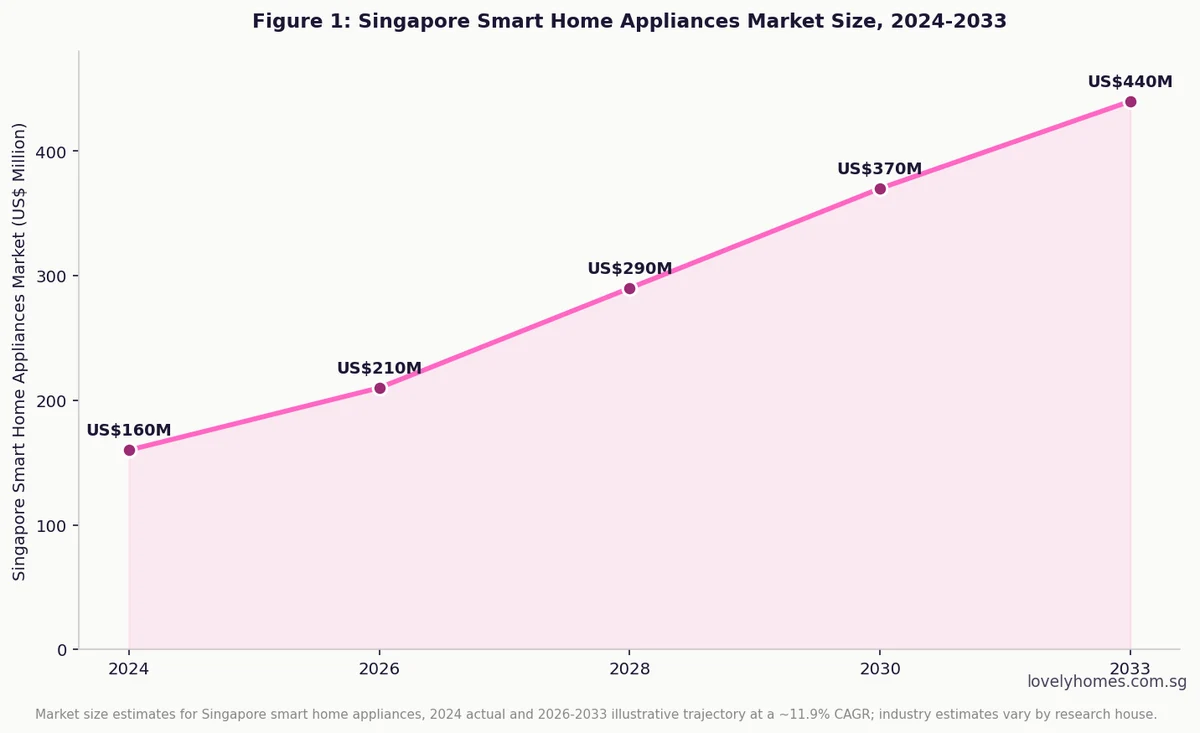
Singapore smart home appliances market size 2024 to 2033
Figure 1: Singapore’s smart home appliances market size, 2024 to 2033.

Digital Locks: The Most Common Starting Point, and the SCDF Rules That Apply

For most homeowners, a digital door lock is the entry point into smart home technology, and by 2026 it has become close to a default choice rather than a novelty upgrade. Modern digital locks typically offer a combination of fingerprint biometrics, facial recognition, PIN codes, RFID key cards and mobile app unlocking, along with features such as temporary guest access codes and break-in alarms. They appear as a standard fitting across many new BTO flats and are one of the most common single upgrades made by owners of older resale flats.

Homeowners should be aware that digital locks, and especially any accompanying smart gate or grille, remain subject to the Singapore Civil Defence Force (SCDF) Fire Code, which sets clear requirements to ensure a home’s main entrance does not impede rapid evacuation in a fire or block firefighter access to the unit. In practice, this means any digital gate or grille installed alongside a digital lock needs a mechanism that allows quick manual release from inside the home, even if the electronic system fails or loses power. Homeowners should check that any product and installer they use is compliant with current SCDF guidelines before installation, particularly for HDB flats where the main gate is part of the shared building’s fire safety plan.

Beyond the Lock: Building Out a Smart Home System

Once a digital lock is in place, the next most common additions are smart lighting and air-conditioning control, typically coordinated through a central hub using a wireless protocol such as Zigbee, which allows multiple devices from different brands to be controlled from a single app or voice assistant. Security cameras, video doorbells and leak or smoke sensors round out a typical mid-tier installation, giving homeowners remote visibility into their flat while away, whether checking that the stove was switched off or keeping an eye on an elderly parent or a pet.

At the premium end, full home automation extends this further to motorised curtains, integrated whole-home audio, and centralised control panels that manage every connected device from a single interface, often installed as part of a broader renovation rather than as a standalone project. The right tier for any given household depends on budget, how much of the work is done during an existing renovation versus retrofitted afterwards, and how much day-to-day convenience the household genuinely wants from automation versus simple manual control.
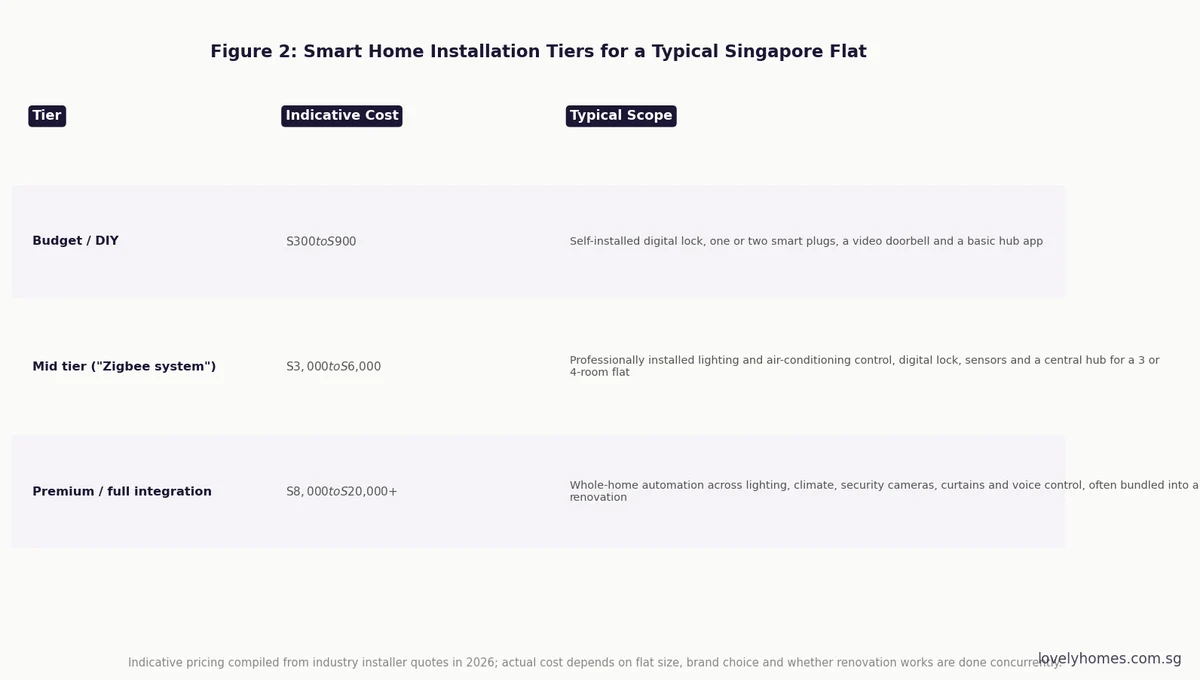
Smart home installation cost tiers Singapore 2026
Figure 2: Smart home installation cost tiers for a typical Singapore flat.

Does a Smart Home Actually Boost Resale Value?

This is the question most homeowners considering an investment in smart technology actually want answered, and the honest response is nuanced. A “smart-ready” home is a genuine selling point in 2026, and can help a listing stand out and draw stronger interest, particularly from younger, tech-comfortable buyers who increasingly expect at least a digital lock as standard. However, the direct impact on the final transacted price is modest: the cost of installing smart devices is generally small relative to the overall value of the property, and buyers who appreciate the technology are not necessarily willing to pay a specific dollar premium for it, especially since most smart devices can be added relatively cheaply and quickly by a new owner after purchase if they are not already present.

Where smart home technology does deliver clearer, quantifiable value is in ongoing running costs and convenience rather than resale price: smart lighting and air-conditioning control can meaningfully reduce electricity usage over time through scheduling and automatic shut-off, and security features provide genuine peace of mind that has value to the occupant even if it does not show up as a specific line item in a valuation report.

Summary: Smart Home and PropTech Facts at a Glance

Question Short Answer
How big is Singapore’s smart home market? Around US$160 million in 2024, projected to reach roughly US$440 million by 2033.
What is the most common first smart home upgrade? A digital door lock, now close to standard across new BTO flats and a common resale flat retrofit.
Do digital locks have to meet fire safety rules? Yes, SCDF Fire Code rules require quick manual release for rapid evacuation and firefighter access.
How much does a mid-tier smart home system cost? Roughly S$3,000 to S$6,000 for a professionally installed system in a 3 or 4-room flat.
Does smart home tech raise resale price? It widens buyer appeal but rarely commands a specific measurable price premium on its own.
What is PropTech, more broadly? Digital tools covering property search, transactions, financing and management, distinct from in-home smart devices.

Worked Example: Retrofitting a 4-Room HDB Flat

The household: Ms Wong owns a 4-room resale flat in an established estate and wants a mid-tier smart home retrofit alongside a planned renovation, without going as far as full whole-home automation.

The build-out: she installs a digital lock at approximately S$450, smart lighting across the living room and bedrooms at approximately S$900, smart air-conditioning control at approximately S$700, and a central hub tying the system together at approximately S$350, with professional installation labour adding a further S$600. The total comes to approximately S$3,000, sitting at the lower end of the mid-tier cost range.

What she gets in return: immediate convenience and security from the digital lock and lighting control, an estimated modest reduction in her air-conditioning electricity usage from scheduling and automatic shut-off, and a flat that, should she sell it later, presents as modern and well-equipped to prospective buyers, even though this alone is unlikely to add a specific measurable premium to her eventual asking price.

These figures are illustrative only; actual costs depend on the brands chosen, the flat’s existing wiring, and whether the work is bundled into a larger renovation project.
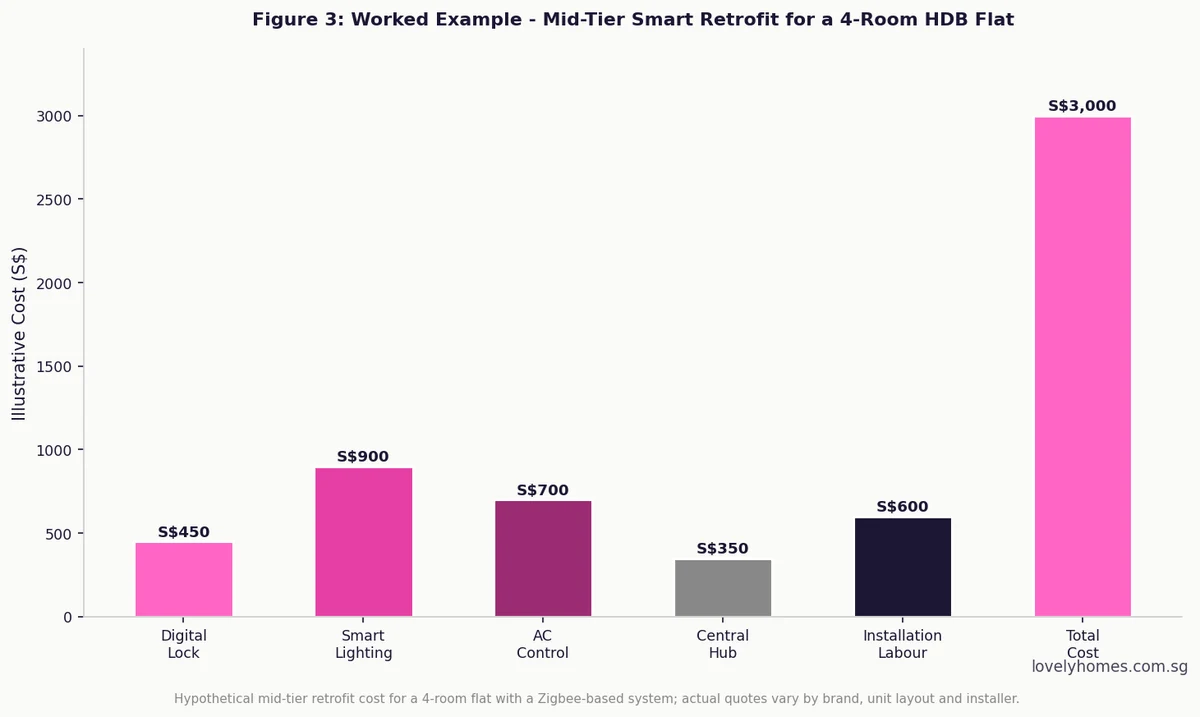
Worked example smart home retrofit cost 4-room HDB flat Singapore
Figure 3: Worked example, mid-tier smart retrofit cost for a 4-room HDB flat.

Why This Matters for Homeowners, Buyers and Landlords

For owner-occupiers, smart home technology is best thought of as a genuine quality-of-life investment rather than a resale strategy in itself: the convenience, security and running-cost benefits accrue to whoever lives in the home day to day, and any resale appeal is a secondary bonus rather than the primary reason to install it. For landlords, offering a unit with at least a digital lock and basic smart features can help a listing stand out in a crowded rental market, since it signals a well-maintained, modern property without requiring a large capital outlay. For buyers evaluating two otherwise comparable homes, existing smart home features are a pleasant convenience worth factoring into a decision, but should not be weighted too heavily relative to more fundamental considerations such as location, remaining lease and layout, since most smart devices can always be added later at relatively modest cost.

What Might Come Next

The following is informed speculation, not confirmed policy. As Singapore’s Smart Nation initiatives continue to mature, it is plausible that future BTO developments come pre-wired for smart home integration at a more comprehensive level than today, reducing retrofit costs for new owners from the outset. Continued growth in AI-assisted home security, including smarter anomaly detection from connected cameras and sensors, is also a plausible direction for the market given the pace of investment already seen in Singapore’s broader smart home sector, though the specific products and timelines are not yet confirmed.

Frequently Asked Questions

Is a digital lock allowed on an HDB main door and gate?

Yes, digital locks are widely used on HDB doors and gates, but any accompanying digital gate or grille must still comply with SCDF Fire Code requirements for rapid manual release during an emergency.

What is the cheapest way to start with smart home technology?

A budget or DIY approach, typically a self-installed digital lock, a smart plug or two and a video doorbell, can cost a few hundred dollars and still deliver meaningful convenience and security.

Will installing smart home devices increase my flat’s valuation?

Not in a formal valuation sense; bank and HDB valuations are based primarily on comparable transactions, not individual fittings, though smart features can support buyer interest and a faster sale.

Can I mix smart home brands, or do I need to stick to one ecosystem?

Many homeowners mix brands successfully using a shared wireless protocol such as Zigbee and a central hub or voice assistant that supports cross-brand control, though checking compatibility before purchase avoids frustration later.

Is PropTech the same as smart home technology?

No. PropTech is the broader category covering digital property search, transaction and management tools, while smart home technology refers specifically to connected devices inside the physical home.

Do smart home devices actually reduce electricity bills?

Smart lighting and air-conditioning scheduling can meaningfully reduce usage over time through automatic shut-off and optimised settings, though actual savings depend on household habits and existing appliance efficiency.

Should I install smart home features before selling my flat?

A basic digital lock can help a listing feel modern and well maintained, but a large smart home investment purely to boost sale price is unlikely to be recovered dollar-for-dollar, so it is better justified by your own convenience while living there.

Disclaimer: This article is for general informational purposes only and does not constitute engineering, safety or investment advice. Market size figures, cost ranges and adoption trends are illustrative and drawn from industry estimates that vary by research house. Always check current Singapore Civil Defence Force (SCDF) fire safety requirements before installing any digital lock or gate, and engage a licensed installer for any electrical work.
×

Click anywhere outside to close

Singapore Home Renovation Guide 2026: HDB Permits, APEX System, Condo Rules and Step-by-Step Process

Singapore Home Renovation Guide 2026: HDB Permits, APEX System, Condo Rules and Step-by-Step Process

Quick Answer: Singapore Home Renovation 2026 — Key Takeaways

  • HDB renovation permits are mandatory for hacking, flooring, plumbing, electrical and partition works — submitted via the APEX system by your HDB-registered contractor.
  • APEX is fully electronic — your contractor applies on your behalf; no HDB office visit required. Standard processing: 7–14 working days.
  • Condo owners need MCST written approval in addition to BCA compliance — budget a refundable S$500–S$1,000 security deposit.
  • Noisy works (hacking, drilling) are restricted to weekday 9am–5pm; quiet period 1–2pm in HDB estates; no renovation on Sundays or public holidays.
  • BTO renovation window: 3 months from permit issue; resale HDB: 1 month — works must complete within the permit period.
  • CaseTrust-RCMA accreditation is the gold standard for contractor selection — look for the logo for independent dispute mediation.
  • Typical renovation costs 2026: 4-room HDB S$40,000–S$60,000; 3-bedroom condo S$60,000–S$100,000. See the Singapore Renovation Cost Guide 2026.

What Is a Home Renovation and Why Does It Need Approval in Singapore?

A home renovation in Singapore covers any structural, mechanical or cosmetic change to a residential unit — from hacking walls and laying new tiles to rewiring circuits and relocating plumbing. Two separate regulatory regimes govern this depending on property type. For HDB flats, the Housing & Development Board (HDB) administers renovation rules under the Housing and Development Act; approvals flow through the APEX system via a licensed renovation contractor. For private condominiums and apartments, the Building and Construction Authority (BCA) sets structural safety requirements under the Building Control Act, while each development’s Management Corporation Strata Title (MCST) enforces its own by-laws registered under the Building Maintenance and Strata Management Act (BMSMA).

The permit framework exists because Singapore’s high-density housing means that an unpermitted structural alteration in one flat can compromise the structural integrity of an entire residential block. HDB detects thousands of permit violations annually through inspection and neighbour complaints. Penalties include fines of up to S$5,000, a mandatory stop-work order, and an Order to Reinstate — requiring the owner to demolish all unpermitted works and restore the flat to its original approved state at their own cost.

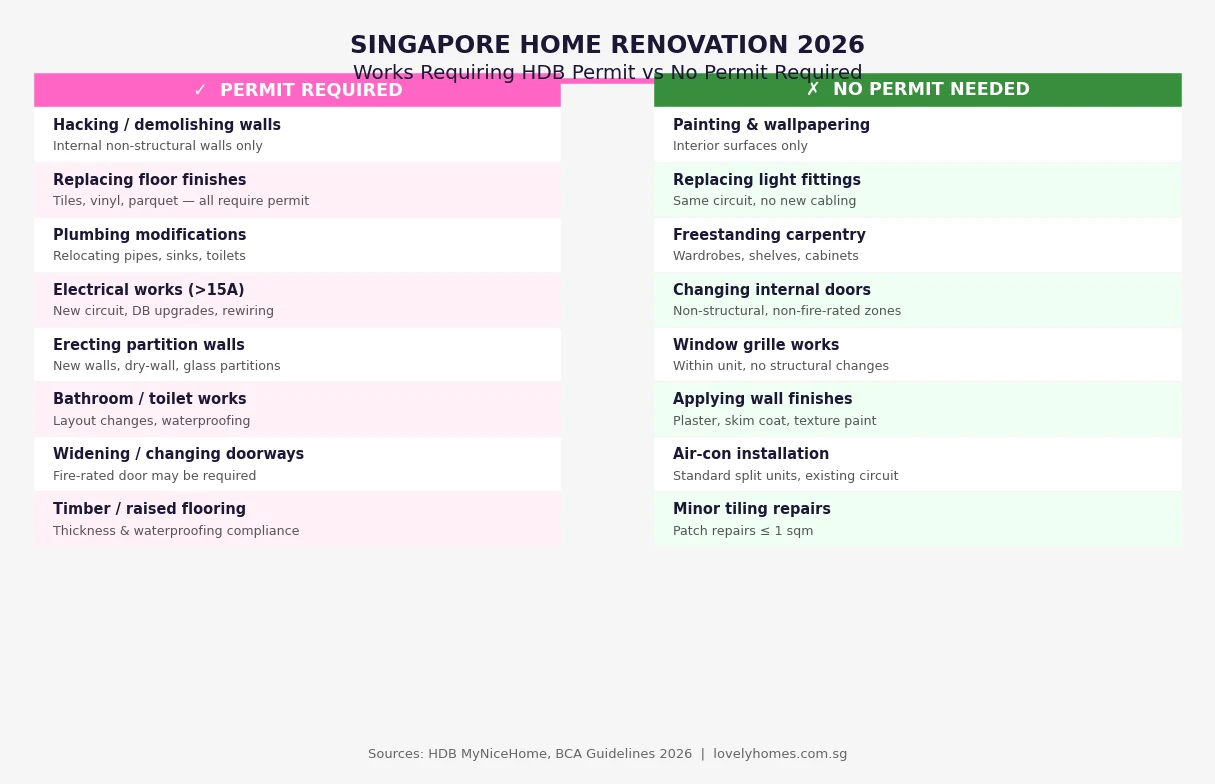
Singapore HDB renovation permit required vs no permit required works list 2026
Figure 1: Works requiring HDB permit versus works that require no permit — Singapore home renovation 2026. Source: HDB MyNiceHome, BCA Guidelines.
Click image to zoom

The APEX System: How HDB Renovation Permits Work in 2026

APEX (Application for Renovation Permit via Electronic Transaction) is HDB’s mandatory online portal for all permit applications. Since mid-2024, paper forms at HDB branches are no longer accepted. You do not apply yourself: your HDB-registered renovation contractor submits the application on your behalf via the APEX portal, attaching technical drawings confirming that the proposed works comply with HDB’s guidelines.

Works That Require an HDB Permit

Eight primary categories of works require a permit before commencement: hacking or demolishing internal (non-structural) walls; replacing floor finishes (tiles, vinyl, parquet); modifications to sanitary plumbing or water piping; electrical works exceeding 15A or involving new circuiting or distribution board (DB) upgrades; erecting new partition walls; all bathroom and toilet layout changes including waterproofing; widening or changing doorways (fire-rated doors may be required where the entrance faces an escape route); and installation of timber or raised flooring. A Professional Engineer (PE) endorsement is additionally required where works come within 300mm of load-bearing structural elements.

Application Timeline and Permit Validity

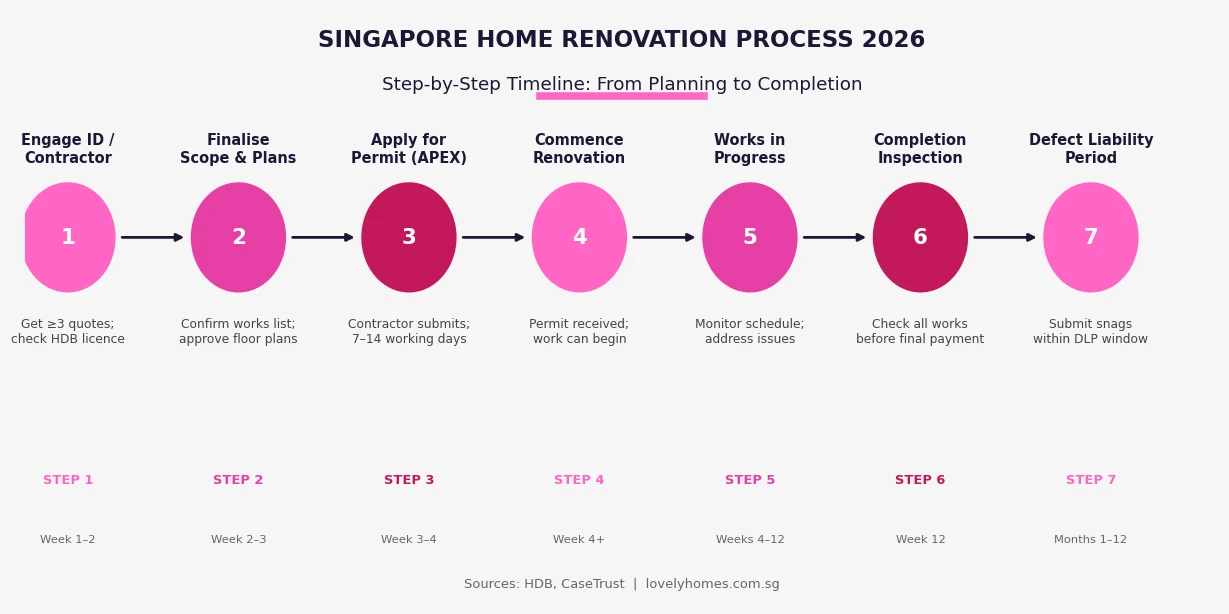
Standard APEX applications are processed within 7–14 working days. Complex cases involving PE endorsement or structural elements can take up to 21 working days. For BTO flats, all approved works must be completed within three months of permit issuance. For resale flats, the window is one month. Extensions must be applied for before the permit expires — not retrospectively.

Renovation Work Permit Required? Key Requirement (HDB 2026)
Wall hacking / demolishing Yes Non-structural only; PE endorsement if near structural wall
Replacing floor finishes Yes Thickness limits; waterproofing compliance
Plumbing relocation Yes Licensed plumber; HDB-approved contractor
Electrical works (>15A / new circuit) Yes Licensed electrical worker required
Erecting partition walls Yes Dry-wall, glass, masonry — all need permit
Bathroom / toilet layout changes Yes Waterproofing membrane mandatory
Widening / changing doorways Yes Fire-rated door if facing escape route
Timber / raised flooring Yes Thickness limit; waterproofing compliance
Painting / wallpapering No Internal surfaces only
Freestanding carpentry No Wardrobes, shelves, built-ins without hacking
Air-conditioner installation No (usually) Standard split units on existing circuit
Replacing light fittings No Same circuit; no new cabling

How to Renovate a Private Condominium: MCST Rules and BCA Requirements

Condominium renovation operates under a separate legal framework. The BCA Building Control Act governs structural safety — prohibiting works that touch load-bearing elements without BCA approval and a qualified person (architect or structural engineer) submission. Day-to-day renovation rules are set by your MCST under its registered by-laws, which vary significantly between developments.

What Always Requires MCST Written Approval

Works affecting common property or the building structure — wall hacking, bathroom waterproofing, plumbing relocation, electrical upgrades beyond 15A, and flooring changes from tiles to timber — require written MCST approval before your contractor begins. A typical MCST application requires: a completed renovation form; your contractor’s BCA licence details; proposed floor plans; an indemnity letter; and a refundable security deposit of S$500 to S$1,000. MCST committees typically respond within 5–10 working days.

Noise Restrictions and Working Hours

Under the National Environment Agency’s regulations and most MCST by-laws, noisy renovation works (drilling, hacking) are restricted to weekdays between 9am and 5pm. Sundays and public holidays are universally prohibited. Most MCSTes follow HDB’s model of a quiet period from 12pm to 2pm. Verify your development’s specific by-laws — registered with the Singapore Land Authority — before scheduling noisy trades.

Singapore home renovation step-by-step process timeline 2026
Figure 2: The seven-step Singapore home renovation process from contractor engagement to defect liability period. Source: HDB, CaseTrust.
Click image to zoom

Choosing a Renovation Contractor in Singapore

For HDB flats, you must engage a contractor on HDB’s registered list — only registered contractors can submit APEX applications. For private condominiums, BCA licencing is the minimum requirement, though your MCST may maintain its own approved contractor list.

Above and beyond minimum licencing, look for CaseTrust-RCMA (Renovation and Decoration) accreditation — a joint scheme operated by the Consumers Association of Singapore (CASE) and the Renovation and Decoration Advisory Centre (RADAC). Accredited contractors participate in independent dispute mediation and maintain financial accountability. If works are abandoned, defective or materially incomplete, CaseTrust accreditation gives you a formal escalation route without resorting to civil litigation.

What Your Renovation Contract Must Include

A properly drafted renovation contract should specify: the full scope of works by trade (carpentry, tiling, M&E, painting); detailed material specifications (tile brand and grade, cabinet material, paint finish); a payment schedule tied to milestones; project start and completion dates; a defect liability clause for post-completion rectification; and the APEX permit number once issued. Never pay more than 10% upfront before the permit is approved and work has commenced on site.

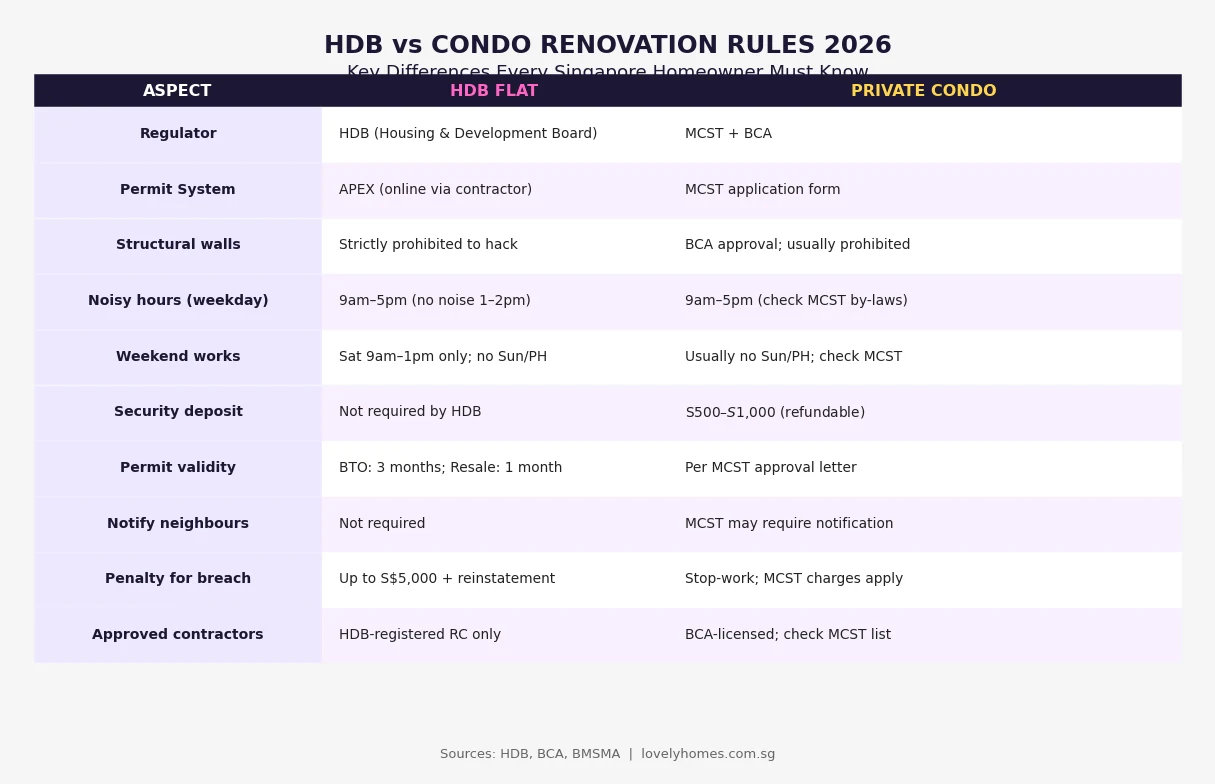
HDB vs condo renovation rules comparison Singapore 2026
Figure 3: HDB versus private condominium renovation rules — ten key differences. Source: HDB, BCA, BMSMA 2026.
Click image to zoom

HDB vs Condo Renovation Rules: Summary Table

Aspect HDB Flat Private Condo / Apartment
Regulator HDB MCST + BCA
Permit system APEX (contractor-submitted online) MCST application form
Structural walls Strictly prohibited to hack BCA approval required; usually prohibited
Noisy works hours (weekday) 9am–5pm; quiet period 1–2pm 9am–5pm; varies by MCST by-law
Weekend renovation Sat 9am–1pm only; no Sun/PH Usually no Sun/PH; check MCST
Security deposit Not required by HDB S$500–S$1,000 (refundable)
Permit validity BTO: 3 months; Resale: 1 month Per MCST approval letter
Neighbour notification Not legally required MCST may require written notification
Penalty for breach Up to S$5,000 fine + reinstatement order Stop-work; MCST may charge; Strata Titles Board enforcement
Contractor requirement HDB-registered RC only BCA-licensed; check MCST approved list

Worked Example: Full Renovation of a 4-Room BTO Flat, Tampines North 2026

Case Study: Mr & Mrs Lim — 4-Room BTO, Tampines North, TOP January 2026

Scope: Full renovation — hacking two non-structural partition walls; full tile overlay in living room and all bedrooms; kitchen and two bathrooms retiled; electrical DB upgrade; four built-in wardrobes; kitchen carpentry; and full-unit painting.

Permit process: Contractor engaged 1 February 2026. APEX application submitted 5 February 2026. Permit issued 17 February 2026 (8 working days). Renovation commenced 18 February 2026.

Timeline: BTO 3-month permit window expires 17 May 2026. Practical completion achieved 28 April 2026 (10 weeks). ✓ Within permit window.

Cost breakdown (2026 market rates):

  • Hacking and masonry: S$3,200
  • Tiling — living, bedrooms, bathrooms: S$14,500
  • Carpentry — wardrobes, kitchen, feature wall: S$22,000
  • Electrical works — DB upgrade, additional points: S$4,800
  • Painting — full unit including ceiling: S$3,500
  • Plumbing and sanitary fixtures: S$5,200
  • Total renovation cost: S$53,200

Compliance: No structural walls hacked. PE endorsement not required. Tiling thickness within HDB’s 75mm screed limit. Permit completed on time. No stop-work orders issued.

Why Singapore’s Renovation Rules Matter More Than You Might Think

Singapore’s renovation regulations are among the most prescriptive in the Asia-Pacific region, and they exist because the physical consequences of unpermitted renovation in high-density housing are real and irreversible. HDB estimates that several thousand permit violations are detected annually. The most serious cases involve hacking of structural elements — columns, shear walls, transfer beams — that directly compromise the load-bearing integrity of the entire residential block. In multi-storey buildings, the consequences of structural compromise cascade upward through every unit above.

For private condominiums, the BMSMA framework ensures that a renovation undertaken inside one unit does not depreciate the shared asset for hundreds of other subsidiary proprietors. MCST enforcement is backed by the Strata Titles Board, which can order reinstatement at the offending owner’s cost regardless of whether the contractor has since disappeared.

The practical takeaway for homeowners is straightforward: the permit process costs little in either time or money compared to the downside risk of enforcement. A S$5,000 fine and a reinstatement order on a S$50,000 renovation is a financially and emotionally costly outcome that is entirely avoidable.

What Might Come Next: Renovation Regulation Trends in Singapore

The BCA’s Built Environment Industry Transformation Map signals a push towards greater digitalisation of the permit and inspection process. Pilot programmes testing AI-assisted permit review — where computer vision analyses submitted drawings against HDB’s permitted and prohibited works matrix — could reduce APEX processing to 2–3 working days for straightforward applications by 2027. HDB has also signalled an upcoming review of renovation guidelines to accommodate sustainability upgrades: EV charging infrastructure, enhanced thermal insulation, and solar-ready flat designs are areas where current rules are expected to evolve before 2028. Homeowners planning longer-horizon renovation projects should watch the HDB MyNiceHome portal for rule updates.

Frequently Asked Questions: Singapore Home Renovation 2026

Can I do my own HDB renovation without a licensed contractor?

For works that do not require an HDB permit — painting, wallpapering, assembling freestanding furniture — you may carry out the works yourself. However, for all permit-required works (hacking, electrical, plumbing, tiling, partition walls), the APEX permit can only be submitted by an HDB-registered renovation contractor. DIY permit-required works constitute a breach of the Housing and Development Act and can result in fines and reinstatement orders. Electrical and plumbing works also carry personal safety risks and may void your home insurance. Use a licensed contractor for all structural and mechanical trades.

How do I verify that a contractor is HDB-registered?

The full, regularly updated list of HDB-registered renovation contractors is available on the HDB website at www.hdb.gov.sg under “Managing My Home → Renovation → Find a Registered Renovation Contractor”. You can search by contractor name, registration number or trade specialisation. For additional consumer protection, check whether the contractor also holds CaseTrust-RCMA accreditation via the CASE website at www.case.org.sg.

What happens if I renovate without an HDB permit?

HDB conducts routine inspections and investigates neighbour complaints about noise, dust or unusual works. If inspectors discover permit-required works carried out without approval, they will issue an immediate stop-work order. The homeowner — not the contractor — is legally liable and may be fined up to S$5,000. HDB will then issue an Order to Reinstate, requiring the works to be demolished and the flat restored to its original state at the homeowner’s expense. Your home insurance policy is unlikely to cover losses arising from unpermitted works.

Do I need to inform my neighbours before renovation starts?

For HDB flats, there is no legal obligation to notify neighbouring units, though it is courteous to do so for extended projects involving significant noise. For private condominiums, many MCSTes require written notification to immediately adjacent units before commencement, particularly for hacking or plumbing works. Failure to comply with MCST notification requirements can result in withdrawal of approval and a stop-work order. Check your specific development’s by-laws, which are registered with the Singapore Land Authority and available from your MCST management office.

What is the difference between an HDB renovation permit and a BCA building permit?

An HDB renovation permit is required for internal alterations to an HDB flat under HDB’s renovation guidelines. A BCA building permit (Building Plan Approval) is required for structural works affecting the building envelope, load-bearing elements, or gross floor area — such as an extension to a landed property, a new roof, or external wall modifications. For most HDB flat renovations, only the HDB permit is required. Landed property owners undertaking major structural works additionally need BCA approval, submitted by a qualified person (architect or structural engineer).

Can I renovate a resale HDB flat before the transfer is completed?

No. The HDB renovation permit can only be issued to the registered owner of the flat. Renovation cannot legally commence before the resale completion appointment has been concluded, keys collected, and ownership confirmed by HDB. Any renovation begun before this point is unpermitted, and the incoming owner inherits any enforcement consequences. Plan and select your contractor during the resale transaction period so that works can begin as soon as keys are in hand.

How long does a typical full HDB flat renovation take?

A full renovation of a 3-room HDB flat typically takes 6–9 weeks from permit approval to practical completion. A 4-room or 5-room flat generally takes 8–14 weeks depending on scope and contractor workload. The most time-intensive phases are hacking and masonry (week 1), tiling (weeks 1–3), and carpentry (weeks 3–6). Painting, final fixtures and clean-up complete the final two weeks. BTO flat owners must ensure the full scope is completed within the 3-month permit window, so engage your contractor immediately upon key collection.

Related Articles

Disclaimer: This article is for general informational purposes only and does not constitute legal, financial or renovation advice. Renovation rules, permit requirements and approved contractor lists are subject to change by HDB, BCA and individual MCSTes. Always verify current requirements directly with HDB (www.hdb.gov.sg), BCA (www.bca.gov.sg), and your development’s MCST management office before commencing any renovation works. For complex structural works, engage a qualified architect or structural engineer.

| Elegantly Designed by Little Big Red Dot | All Rights Reserved.

Translate »