Co-Living in Singapore 2026: Complete Guide to Room Rental, Co-Living Operator Rules and Tenant Rights

Co-Living in Singapore 2026: Complete Guide to Room Rental, Co-Living Operator Rules and Tenant Rights

Quick Answer: Co-Living in Singapore

  • Co-living is a rental model where an operator master-leases a private residential unit or building, furnishes and subdivides the bedrooms, and rents them out individually with bundled utilities, wifi, cleaning and community programming.
  • This differs from traditional master-tenant subletting, where an individual tenant or owner sublets a spare room directly to another person, informally, with terms negotiated bilaterally and no bundled services.
  • URA planning rules require a minimum stay of around three consecutive months for private residential property, which is why co-living operators typically set a similar minimum lease term rather than offering true short-term or hotel-style stays.
  • HDB flats have stricter rules than private property: whole-flat subletting requires meeting the Minimum Occupation Period (MOP) and getting HDB approval; room-only subletting doesn’t require MOP but still needs HDB approval and is subject to occupancy caps.
  • Co-living rooms typically cost more per month than a comparable master-tenant room, reflecting the bundled services, flexibility and furnishing, but usually work out cheaper than renting an entire studio apartment alone.
  • Tenants should always check the tenancy agreement, security deposit terms and notice period carefully, and know that unresolved rental disputes below a certain amount can be brought to the Small Claims Tribunal.
  • Landlords and master tenants subletting rooms, whether through a co-living platform or informally, remain responsible for complying with HDB or URA rules depending on the property type.

What Is Co-Living, and How Is It Different From Traditional Room Rental?

Co-living has grown into a distinct segment of Singapore’s rental market over the past several years, sitting between a hotel-style serviced apartment and a traditional flatshare. In the typical co-living model, an operator signs a master lease with the property owner for an entire unit, or sometimes an entire building, then furnishes and subdivides the bedrooms, and markets each room individually to tenants. The monthly rent usually bundles in utilities, wifi, regular cleaning of common areas, basic furnishings and appliances, and often some form of community programming or shared workspace, all managed through a single point of contact rather than a private landlord.

This is a meaningfully different arrangement from traditional master-tenant subletting, where an existing tenant (or the property owner) simply rents out a spare bedroom directly to another individual on an informal, bilaterally negotiated basis. In a master-tenant setup, utilities and wifi are typically split manually between housemates, furnishing standards vary widely, and there’s no dedicated operator managing the property, disputes, or maintenance requests. Both models exist across HDB flats and private property, though co-living operators concentrate almost entirely on private residential units, since HDB’s subletting framework does not accommodate a commercial operator business model.

Monthly cost comparison co-living versus room rental versus studio apartment Singapore 2026
Figure 1: Indicative monthly cost comparison for a single working professional across three common rental options.

URA’s Minimum Stay Rules and Licensed Co-Living Operators

A key regulatory backdrop shaping how co-living operates in Singapore is URA’s planning framework around minimum stay periods for private residential property. To prevent private homes from effectively operating as unlicensed hotels, URA generally requires that private residential units be leased out for a minimum of three consecutive months per stay, rather than being let out on a nightly or weekly short-term basis. This is why most co-living operators in Singapore structure their standard lease terms around a similar minimum, commonly three months or longer, even though the pitch is often “flexible” compared to a conventional twelve-month tenancy.

Some co-living operators hold specific approvals or operate in properties zoned or approved for a use that allows shorter stays (broadly comparable to serviced apartments), but this is the exception rather than the norm for ordinary private residential co-living spaces. Tenants and landlords considering co-living arrangements shorter than three months should clarify directly with the operator what approval basis, if any, permits this, since operating outside URA’s planning rules can carry consequences for the property owner and the operator managing the unit.

HDB Flats vs Private Property: Subletting and Occupancy Rules

The rules governing room rental differ substantially depending on whether the property is an HDB flat or private residential unit, and this is one of the most important distinctions for anyone comparing co-living against a traditional HDB room rental.

Comparison of HDB and private property subletting and co-living rules Singapore 2026
Figure 2: How HDB flats and private property differ on subletting and co-living-style rental.

For HDB flats, subletting the whole flat requires the owner to have met the Minimum Occupation Period (MOP), typically five years from the point of key collection, and to obtain HDB’s approval before subletting. Subletting individual rooms within a flat the owner still occupies does not require MOP to be met, but still requires HDB approval and is subject to an occupancy cap that varies by flat type (roughly four occupants for a one- or two-room flat, up to around nine for a five-room or executive flat, though owners and any existing tenants count towards this cap). There are also quota restrictions on subletting to non-Singapore Citizens and non-PRs in certain blocks and neighbourhoods, so HDB owners should always check current conditions before advertising a room.

For private property, there is no MOP-style lock-in period and no need for government approval to sublet, whether the whole unit or individual rooms, though owners should check their mortgage terms and any tenancy restrictions in their title. The main constraint is URA’s minimum stay rule discussed above, plus practical considerations like MCST by-laws in condos, which sometimes restrict short-term letting or the number of unrelated occupants per unit. This more permissive framework for private property is a major reason why commercial co-living operators concentrate almost exclusively on private residential units rather than HDB flats.

What Co-Living Rooms Typically Include

Without endorsing any specific operator, co-living rooms in Singapore’s private residential market generally fall into a few common configurations: a private ensuite or shared-bathroom bedroom, fully furnished with a bed, wardrobe and desk, with utilities, wifi and regular common-area cleaning bundled into a single monthly fee. Many operators also offer flexible lease lengths starting from three months, a simplified move-in process without the need to separately arrange furniture or utility accounts, and shared amenities such as a communal kitchen, lounge or occasionally a coworking space, along with periodic social or networking events aimed at tenants who are new to the neighbourhood or to Singapore. The trade-off for this convenience and flexibility is typically a higher monthly rent compared to a bare, unfurnished room rented directly from a private landlord.

Tenant Rights, Deposits and Lease Terms

Whether renting through a co-living operator or a traditional master tenant, a few protections and practices apply broadly across Singapore’s rental market. A security deposit of around one to two months’ rent is standard, refundable at the end of the tenancy subject to the unit being returned in good condition and all outstanding payments settled; tenants should document the room’s condition with photos at move-in to avoid disputes later. The tenancy agreement, even for a co-living room, should clearly set out the rent, deposit, notice period for termination, what’s included (utilities, wifi, cleaning) and any house rules, and tenants should read this carefully before signing rather than relying on verbal assurances. For disputes over deposits or other tenancy-related claims within its monetary jurisdiction, tenants can bring a claim to the Small Claims Tribunal, which offers a relatively fast, low-cost avenue compared to formal litigation. Tenants should also confirm early on whether their room rental (co-living or informal) is being conducted in compliance with the applicable HDB or URA rules described above, since a rental arrangement that breaches these rules can create complications for the tenant as well as the landlord or operator.

Summary: Co-Living and Room Rental Facts at a Glance

Question Short Answer
Minimum stay for private co-living? Typically around 3 months, following URA’s minimum-stay planning rule.
Does HDB room subletting need MOP? No, but it still needs HDB approval and is subject to occupancy caps.
Does whole-flat HDB subletting need MOP? Yes, the flat must have met MOP, plus HDB approval.
Typical co-living deposit? Around 1-2 months’ rent, refundable subject to condition and payments.
Where to resolve a deposit dispute? The Small Claims Tribunal, for claims within its monetary jurisdiction.
Do co-living operators run in HDB flats? Rarely; the commercial model concentrates on private residential units.

Worked Example: Comparing Monthly Costs for a Working Professional

Profile: Ms Wong, a working professional earning S$5,500 a month, is comparing three rental options in the Central region for a single-person budget.

Option 1 – Co-living private room: a furnished private room with ensuite in a co-living operated unit, all-inclusive of utilities, wifi and cleaning, at S$1,800 per month, on a 3-month minimum lease with a 1-month deposit (S$1,800).

Option 2 – Traditional master-tenant room rental: an unfurnished room rented directly from a condo owner acting as master tenant, at S$1,300 per month plus an estimated S$150 per month for her share of utilities and wifi, totalling S$1,450 per month, on a 6-month minimum lease with a 2-month deposit (S$2,600), and Ms Wong would need to source and pay for her own furniture separately.

Option 3 – Studio apartment, renting alone: a small private studio apartment at S$3,000 per month plus around S$250 per month in utilities and wifi, totalling S$3,250 per month, typically on a 12-month lease with a 2-month deposit (S$6,500).

Comparison: the co-living option costs S$350 more per month than the master-tenant room but requires a smaller upfront deposit, no furniture purchase, and offers the shortest minimum commitment. The studio apartment costs roughly 80% more per month than co-living, reflecting the premium of having an entire unit to herself, and requires the largest upfront cash outlay and longest lock-in. For a professional prioritising flexibility and low upfront cost over privacy of an entire unit, co-living or a master-tenant room are the more budget-efficient choices; the studio suits someone valuing full independence and willing to pay for it.

HDB subletting occupancy caps by flat type Singapore 2026
Figure 3: Indicative maximum occupants for HDB room and whole-flat subletting by flat type.

Why This Matters for Tenants and Landlords

Singapore’s co-living sector has grown because it solves a genuine friction point for young professionals, students and newly arrived expatriates: the difficulty of quickly finding a furnished room with clear, all-inclusive pricing and no need to negotiate directly with an individual landlord or set up utility accounts from scratch. For landlords and property owners, master-leasing a private unit to a co-living operator can also simplify management, since the operator typically handles tenant sourcing, rent collection and day-to-day issues. The trade-off, for both sides, is that this convenience is priced in, and tenants comparing options purely on headline monthly rent without accounting for bundled utilities, furnishing, deposit size and lease flexibility risk comparing apples to oranges.

What Might Come Next

The following is informed speculation, not confirmed policy. As co-living continues to mature as a rental category in Singapore, it’s plausible that clearer, more standardised guidance around operator licensing, minimum stay enforcement, and tenant protections specific to co-living arrangements could develop over time, particularly if the sector’s share of the private rental market continues to grow. Some industry commentary has also raised the question of whether HDB might explore more structured room-rental frameworks given persistent rental demand from students and young workers, though no specific policy change extending a co-living-style model to HDB flats has been signalled as at this writing.

Frequently Asked Questions

Is co-living legal in HDB flats?

HDB’s subletting framework does not accommodate the commercial co-living operator model. Individual HDB owners can sublet rooms directly to tenants with HDB approval, subject to occupancy caps, but this is traditional room subletting rather than an operator-run co-living arrangement.

Can I rent a co-living room for less than 3 months?

Generally no, for ordinary private residential co-living spaces, because URA’s planning rules require a minimum stay of around three consecutive months for private residential property. Some operators may offer shorter stays only where the specific property holds separate approval for shorter-term use.

What’s the difference between subletting a whole HDB flat and subletting just a room?

Subletting the whole flat requires the owner to have met the Minimum Occupation Period (MOP) and get HDB approval. Subletting just a room while the owner continues living there does not require MOP but still needs HDB approval and is subject to an occupancy cap based on flat type.

Is my deposit protected if a co-living operator or master tenant disappears?

There is no government-run deposit protection scheme for private residential tenancies in Singapore, unlike some other countries. Tenants should choose reputable operators or landlords, keep clear written records of payment and the tenancy agreement, and pursue unresolved disputes through the Small Claims Tribunal if needed.

Do foreigners face any restrictions renting a co-living room or HDB room?

Private property co-living rooms are generally open to any tenant with a valid pass or visa status. HDB room subletting to non-Singapore Citizens and non-PRs is subject to quota restrictions in certain blocks and neighbourhoods, so this should be checked with HDB or the flat owner before committing.

Can my landlord raise the rent partway through a co-living lease?

Not during a fixed lease term, unless the tenancy agreement specifically allows for it. Rent can typically only be adjusted at renewal, so tenants should check the agreement’s terms on rent review and renewal notice periods before signing.

Is co-living cheaper than renting a whole condo unit by myself?

Usually yes, on a per-month basis, since co-living splits the cost of a unit’s utilities, furnishing and space across multiple tenants. Renting an entire unit alone offers full privacy and independence but at a substantially higher monthly cost, as shown in the worked example above.

Disclaimer: This article is intended for general informational purposes only and does not constitute legal advice. Subletting rules, minimum stay requirements, occupancy caps and quota restrictions are set by HDB and URA respectively and are subject to change and to case-specific conditions. Always confirm current rules with the Housing & Development Board (HDB) and the Urban Redevelopment Authority (URA) before entering into any subletting or co-living arrangement.
×

Click anywhere outside to close

Tenancy Agreement Singapore 2026: A Landlord and Tenant’s Complete Guide to the Rental Contract

Tenancy Agreement Singapore 2026: A Landlord and Tenant’s Complete Guide to the Rental Contract

Last updated 28 April 2026. Reflects IRAS lease stamp duty rules current as at FY2026 and standard market norms reported by URA’s quarterly rental statistics.

Quick Answer — 30-second takeaways

  • A Singapore tenancy agreement is the binding contract between a landlord and tenant. It is governed by Singapore contract law and the principles of the Civil Law Act and the Conveyancing and Law of Property Act.
  • Standard residential terms are 12 or 24 months. Anything shorter than 3 months risks being treated as serviced accommodation, which is regulated separately.
  • Security deposit: typically 1 month’s rent per year of lease, capped at 2 months. Refundable within 14 days of handover, less reasonable deductions.
  • Diplomatic clause: standard on 24-month leases, lets the tenant terminate after 12 months on 2 months’ notice if posted out of Singapore.
  • Lease stamp duty (LSD): 0.40% of total rent across the lease term, payable by the tenant within 14 days of execution, e-stamped at iras.gov.sg.
  • Minor repairs cap: tenant pays first S$150–S$250 of any repair; landlord pays the excess. Aircon servicing 3-monthly is the tenant’s cost.
  • Disputes ≤ S$30,000 can be heard at the Small Claims Tribunals (SCT) with both parties’ consent. Larger disputes go to the State Courts.

What a tenancy agreement is — and what it isn’t

A tenancy agreement (often abbreviated TA) is the written contract that creates a legal lease between a property owner (the landlord) and an occupant (the tenant). It records the parties, the property, the term, the rent, the deposit, and the rules for living in and looking after the home.

Singapore does not have a dedicated Residential Tenancy Act. Tenancy agreements are governed by general contract law, supplemented by the Civil Law Act 1909, the Conveyancing and Law of Property Act 1886, and — for HDB rentals — by the rules of the Housing and Development Board. This means that what is “standard” in a Singapore tenancy is largely set by market practice and by widely-used template clauses, not by statute. Landlords and tenants who do not read every clause carefully can find themselves bound by terms the other side considers normal but they did not expect.

A tenancy agreement is not a Letter of Intent (LOI). The LOI is the pre-contract document the prospective tenant submits with a good-faith deposit. The TA is the binding lease that follows once the LOI is accepted. Stamp duty is payable on the TA, not the LOI.

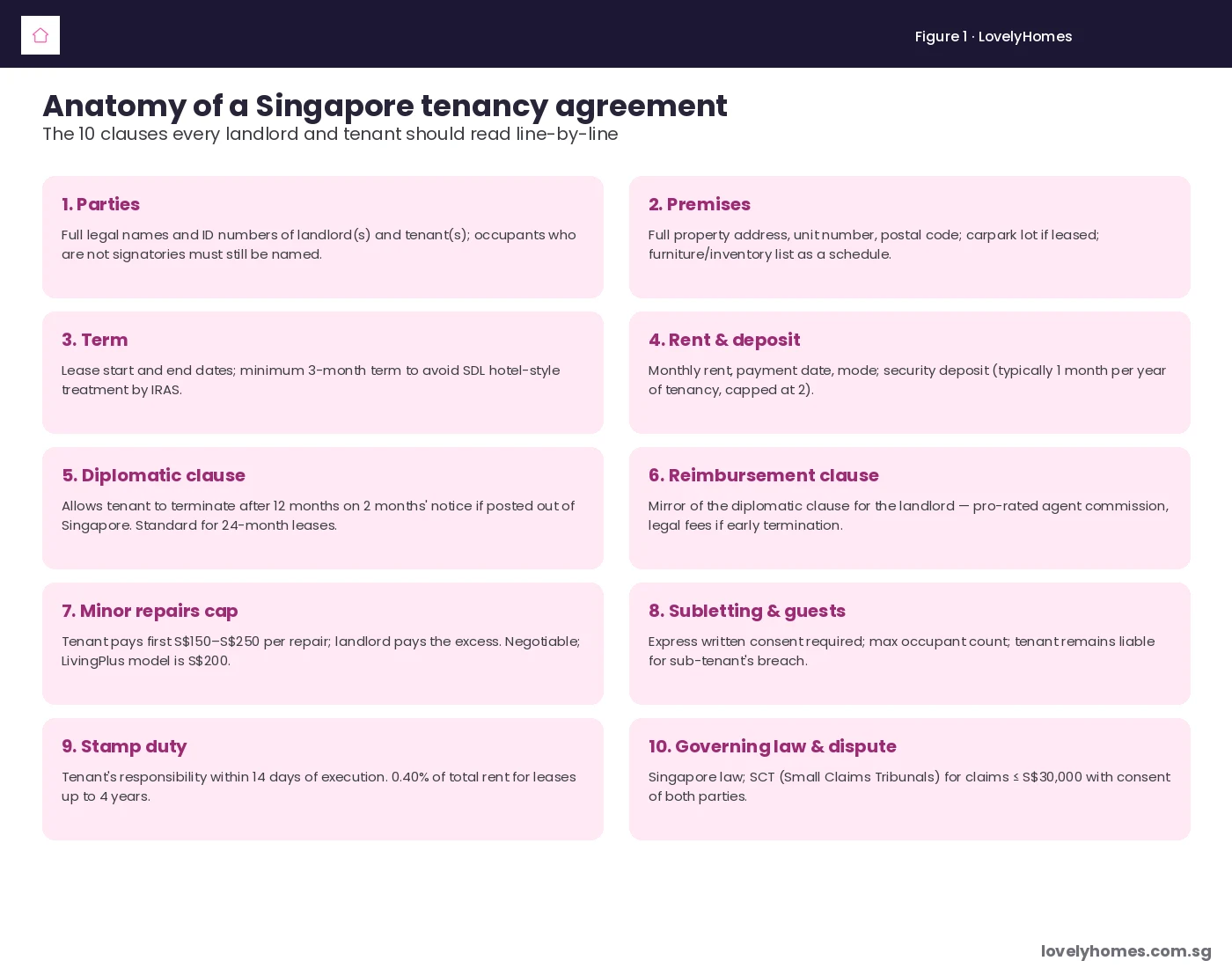
Singapore tenancy agreement 2026 — 10 key clauses every landlord and tenant should read line by line
Figure 1: The 10 clauses that do most of the work in a Singapore tenancy agreement.

Who can be a landlord, and who can be a tenant

For private property, any property owner can lease their unit, subject to building by-laws and the conditions of any mortgage. The Urban Redevelopment Authority requires a minimum lease of 3 months for private residential property; below that threshold the lease is treated as short-stay accommodation and is generally not allowed unless the unit is licensed serviced apartment stock.

For HDB flats, the rental rules are stricter:

  • The flat must have met its Minimum Occupation Period (MOP), which is typically 5 years for new flats and 5 years for resale flats with grant.
  • The owner must apply for HDB approval to rent out the whole flat or individual rooms.
  • Rentals to non-citizen households must respect the Ethnic Integration Policy (EIP) and Singapore Permanent Resident (SPR) quota.
  • Maximum 6 unrelated occupants per flat (4 for 1- and 2-room flats).
  • The minimum rental period is 6 months for whole-flat HDB rentals.

Tenants can be Singapore Citizens, Permanent Residents, work-pass holders, students or any other lawfully present individual. For non-resident tenants, landlords must verify that the tenant holds a valid pass throughout the lease — leasing to an individual without a valid pass is an offence under the Immigration Act.

The 10 clauses that do all the work

A typical Singapore residential TA runs to 8–14 pages. Most of the legal heavy-lifting happens in ten clauses, summarised in Figure 1 above and explored below.

Term and renewal

The lease term is fixed: it has a defined start date and end date. Holding-over (continuing to occupy after expiry without a new TA) creates a tenancy at will, which is terminable on short notice and offers neither party much protection. Most landlords negotiate renewal 2–3 months before expiry; the LSD on the renewal lease must be re-stamped at the new rent.

Rent and security deposit

Rent is payable monthly in advance. The market norm for the security deposit is 1 month’s rent per year of lease, capped at 2 months. The deposit secures the landlord against damage beyond fair wear and tear, unpaid rent, and unpaid utility bills. It is refunded within 14 days of handover, less itemised deductions. Disputes over deposit deductions are the single most common Singapore tenancy dispute, and the Small Claims Tribunals see hundreds each year.

Diplomatic clause and reimbursement clause

The diplomatic clause allows a tenant to terminate after 12 months on 2 months’ written notice if they are required to leave Singapore (typically because of a job posting or visa cancellation). It is market-standard on 24-month leases and rare on 12-month leases. The mirror is the reimbursement clause: if the tenant terminates early, they must reimburse the landlord on a pro-rated basis for the agent’s commission and legal fees of the original lease.

Minor repairs cap

Tenants are responsible for minor repairs up to a contractual cap, typically S$150–S$250 per item. Landlords pay the excess. The clause prevents petty disputes about light bulbs and tap washers, while keeping major repairs (aircon compressor failure, roof leaks, structural defects) on the landlord’s account. Air-conditioner servicing every 3 months is the tenant’s cost; receipts must be produced at handover.

Inventory and handover

An inventory list — usually a schedule attached to the TA — records every item of furniture, every appliance, and every fixture provided. At move-in, both parties walk through and sign off. At move-out, deductions for missing or damaged items are calculated against this list. Photo evidence at both ends saves arguments.

Stamp duty clause

The TA will state which party is responsible for paying lease stamp duty. By Singapore market practice and IRAS guidance, the tenant pays. Failure to e-stamp within 14 days exposes the lease to a penalty of 4 times the duty or S$10, whichever is higher, and the unstamped lease is inadmissible as evidence in a Singapore court (the duty must be paid before the lease can be relied on in litigation).

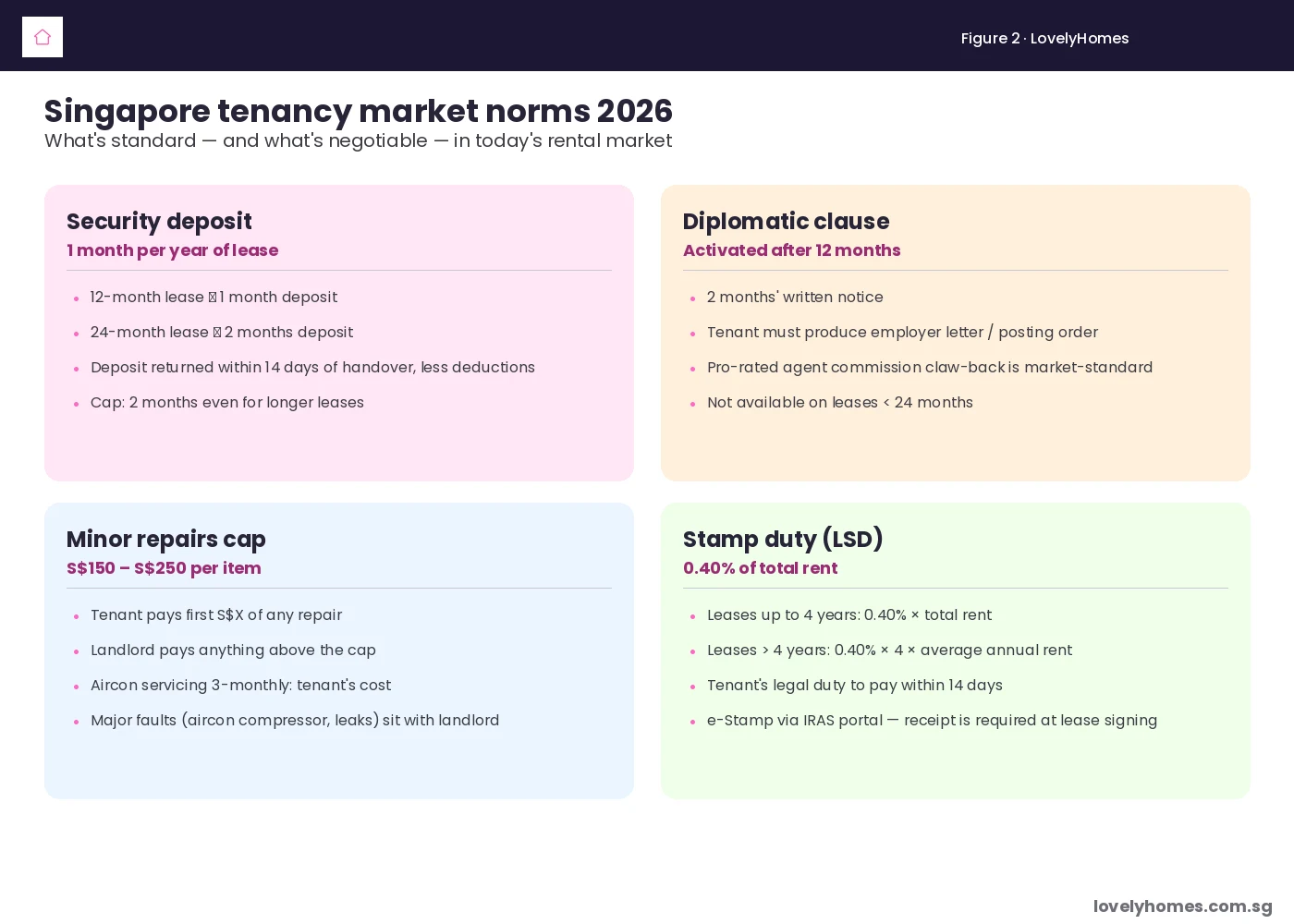
Singapore tenancy agreement 2026 — market norms for deposit, diplomatic clause, minor repairs cap, and stamp duty
Figure 2: The four “norms” most often negotiated — deposit, diplomatic clause, repairs cap, and stamp duty.

Lease stamp duty: the maths

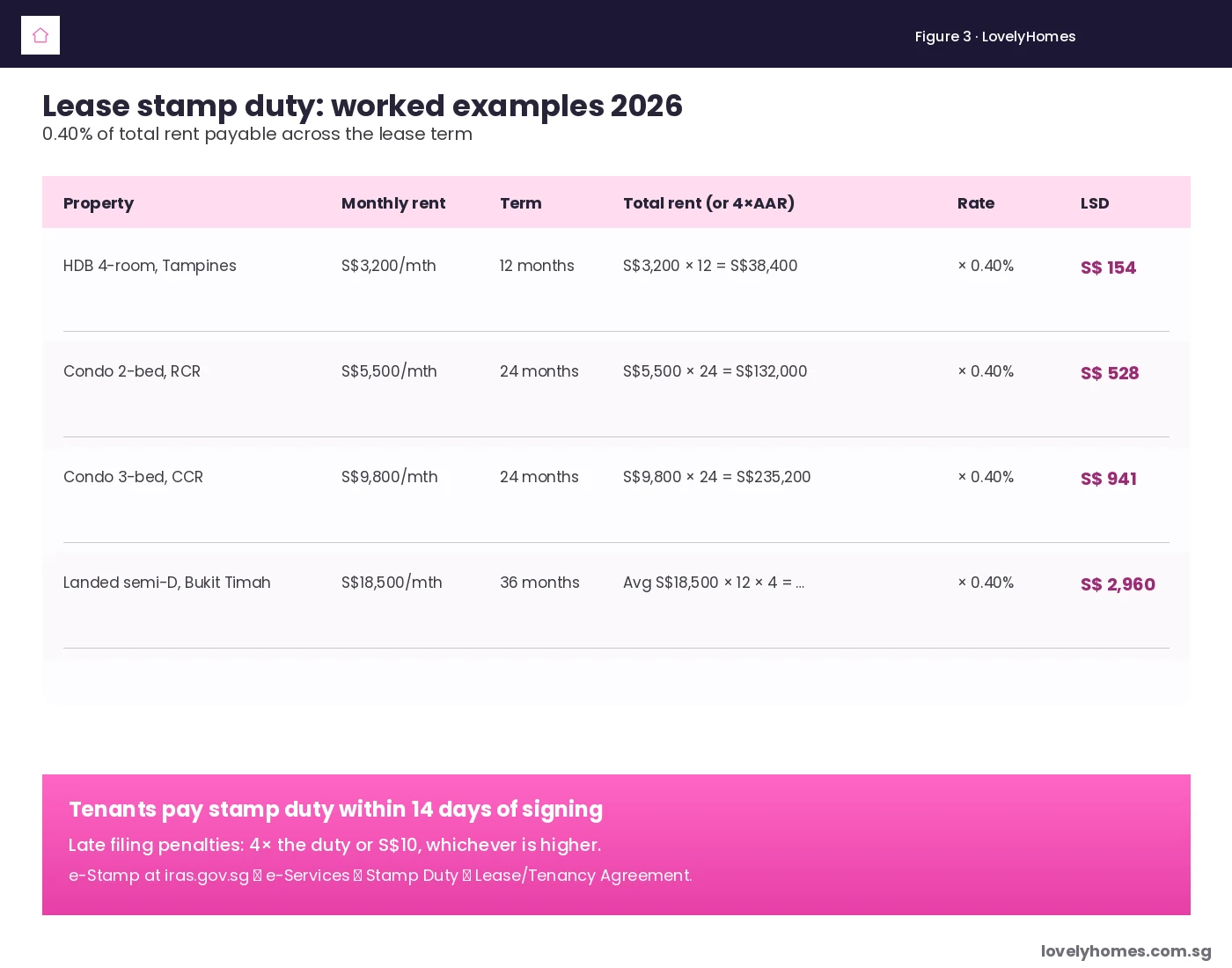
Lease stamp duty (LSD) is the only tax on a Singapore tenancy. It is levied at 0.40% of total rent across the lease term, capped at four times the average annual rent for leases longer than 4 years. The duty is the tenant’s legal obligation under section 33 of the Stamp Duties Act, payable within 14 days of execution.

Lease term Stamp duty formula Notes
≤ 4 years 0.40% × total rent across the term Most common; covers all 12- and 24-month leases
> 4 years 0.40% × 4 × average annual rent Caps the duty for long leases
Lease with premium / variable rent BSD-style staircase rates apply to premium; LSD on the rent component Rare in residential — common in commercial
Singapore lease stamp duty worked examples 2026 for HDB, condo and landed properties
Figure 3: Worked LSD examples across HDB and private property at 2026 market rents.

The IRAS portal e-stamps the lease in real time. The tenant pays via PayNow, eNETS or credit card, prints the certificate, and brings the original to the lease signing. Many landlords now make production of the e-stamp certificate a precondition to handing over keys — a sensible safeguard, because once keys are handed over the landlord’s leverage drops sharply.

Negotiating the lease — what to push on, what to leave alone

Singapore tenancy agreements are negotiable. The points that move most often:

  • Diplomatic clause activation date. Tenants often ask for activation at month 9 instead of month 12. Landlords typically refuse. The 12-month default holds.
  • Minor repairs cap. Tenants ask for S$300; landlords often want S$150. The S$200 LivingPlus number is the comfortable middle.
  • Whitegoods inclusion. Whether refrigerator, washer, dryer, microwave, oven, vacuum and rice cooker are included is line-by-line negotiation. List each item by brand and model in the inventory schedule.
  • Repainting before handover. A clause requiring the tenant to repaint before move-out used to be standard. It is increasingly replaced by a fixed reinstatement fee (S$300–S$800) plus normal wear-and-tear treatment.
  • Pet clause. “No pets” is the default. Tenants with pets must negotiate a specific carve-out and an additional deposit. HDB has its own approved-breed list for flats.
  • Smoking. “No smoking inside the unit” is now standard, and landlords reasonably claim against deposit if walls and curtains carry residual smoke odour.

What happens if things go wrong

The Singapore framework for tenancy disputes is informal but well-trodden:

  • Small Claims Tribunals (SCT). Hears disputes ≤ S$20,000 (or up to S$30,000 with both parties’ consent in writing) for tenancies of up to 2 years. Hearings are tenant- and landlord-friendly: no lawyers in the courtroom, fees from S$10, decisions usually within 4–6 weeks. The most common claims are deposit deductions, damage to inventory, and unpaid rent.
  • State Courts. Larger disputes, longer leases, and complex commercial-residential overlaps. Lawyers represent both sides; costs follow the event.
  • HDB and the Housing & Estate Disputes Resolution Centre. For HDB rental disputes specifically, HDB will mediate before parties resort to the SCT.
  • Mediation via the Singapore Mediation Centre. Voluntary and confidential. Useful where the parties want to preserve a working relationship — for example, a landlord who wants the tenant to stay another year.

What this means for you

For tenants: read every clause. Push back on anything ambiguous. Pay LSD on time and keep the certificate. Photograph the unit on move-in and move-out. Save every WhatsApp message about repairs — these are evidence in any future SCT claim.

For landlords: use a template TA from a Singapore conveyancing lawyer (not a generic internet template). Check the tenant’s pass status throughout the lease. Inspect the unit twice during a 24-month lease — once at month 6, once at month 18 — with proper notice. Reply in writing to repair requests. The landlord’s deposit deduction is much harder to defend in the SCT if the inspection trail is thin.

What might come next

The Ministry of National Development has been studying the case for codifying residential tenancy law in Singapore — the United Kingdom, Australia and several jurisdictions in continental Europe have moved in this direction. As at April 2026, no draft Bill has been tabled. The likeliest medium-term reforms are: a statutory deposit scheme along the lines of the UK Tenancy Deposit Scheme; a standard tenancy agreement template published by URA or HDB; and clearer rules on the deductibility of fair wear and tear. None of these are imminent, but landlords and tenants who structure their TAs around the existing market norms are well-positioned for any future statutory framework.

Frequently asked questions

Who pays the property agent’s commission?

Singapore market practice is that each side pays its own agent. The landlord pays the landlord’s agent (typically 1 month of annual rent on a 24-month lease, half a month on a 12-month lease). The tenant typically pays the tenant’s agent only on shorter or smaller-rent leases (under S$3,500/month) where the landlord’s agent’s fee is too thin to share. CEA’s Code of Ethics and Professional Client Care requires written disclosure of who pays whom before any signing.

Can a tenant break the lease before the diplomatic clause activates?

Only if the landlord agrees, or if the landlord is in fundamental breach (uninhabitable conditions, refusal to make repairs, harassment). Otherwise, an early termination is a breach of contract. The tenant remains liable for rent until the landlord re-lets the unit; the security deposit is forfeited; the original agent’s commission is clawed back pro-rata. Most landlords are willing to release a tenant if a replacement tenant on equivalent terms is presented.

Can the landlord enter the property without notice?

No. The TA grants the tenant exclusive possession. The landlord may enter only with reasonable notice (typically 24 hours in writing) and at reasonable times, except in emergencies (fire, flood, gas leak). Repeated unannounced visits are a breach of the covenant for quiet enjoyment and can support a tenant’s claim for damages.

What if the tenant has overstayed or won’t leave?

Self-help eviction is unlawful in Singapore. The landlord must give the contractual notice (or, if the lease has expired, a notice to quit), and if the tenant still does not leave, file for a Writ of Possession at the State Courts. Locking the tenant out, removing belongings, or cutting utilities is a criminal offence under the Protection from Harassment Act 2014 and the Distress Act 1872.

Does GST apply to residential rent?

No. Residential rent is exempt from GST under the Fourth Schedule to the GST Act. GST applies only to commercial leases — and only when the landlord is GST-registered (i.e., turnover above S$1 million in a 12-month period).

Can a tenant sub-let to a third party?

Only with the landlord’s written consent. Most TAs have an express anti-subletting clause. Even where consent is given, the head tenant remains liable to the landlord for the sub-tenant’s behaviour, rent and damage. For HDB rentals, all sub-letting must additionally have HDB approval; unauthorised sub-letting is a serious offence and can result in compulsory acquisition of the flat.

Is a verbal lease enforceable?

A verbal residential lease for 3 years or less is technically enforceable under the Conveyancing and Law of Property Act, but in practice it is almost impossible to prove the terms. For any lease over 3 years, the law requires a written, signed deed, registered with the Singapore Land Authority. As a landlord or tenant, you should never proceed without a written, e-stamped TA.

Disclaimer. This article is general guidance only and does not constitute legal advice. Singapore tenancy law is governed by the Civil Law Act 1909, the Conveyancing and Law of Property Act 1886, the Stamp Duties Act 1929, the Small Claims Tribunals Act 1984, and HDB regulations for public housing. Always read your specific tenancy agreement carefully and consult a licensed Singapore lawyer for high-value or unusual terms. Verify lease stamp duty rates against iras.gov.sg, HDB rental approval rules against hdb.gov.sg, and URA short-stay rules against ura.gov.sg.
Tenancy Agreement
Rental
Lease Stamp Duty
Singapore Property
Renting Guide
Diplomatic Clause
Security Deposit
Landlord
Tenant
HDB Rental

Translate »