Singapore BCA Green Mark Guide 2026: Ratings, Mandatory Requirements and Property Value Impact

Singapore BCA Green Mark Guide 2026: Ratings, Mandatory Requirements and Property Value Impact

⚡ Quick Answer: BCA Green Mark Singapore 2026 — Key Takeaways

  • What is Green Mark? Singapore’s national green building certification, administered by the Building and Construction Authority (BCA). Launched in 2005; mandatory for new buildings since 2008.
  • Rating tiers (GM:2021 framework): Certified (≥50 pts), Gold (≥65 pts), GoldPLUS (≥75 pts), Platinum (≥85 pts), and higher tiers: SLE (Super Low Energy), Zero Energy, Positive Energy.
  • Who must comply? All new private residential developments with ≥2,000 sqm GFA must achieve at least Green Mark Certified. New commercial/institutional buildings ≥5,000 sqm have been mandatory since 2008.
  • PSF premium: Industry research estimates Green Mark Platinum residential buildings command a 5–8% PSF premium over comparable non-certified buildings in Singapore.
  • 2030 target: 80% of all Singapore buildings (by GFA) to be certified Green Mark under the Singapore Green Building Masterplan 3.0 (2021).
  • GM:2021 framework: Evaluates 7 categories — Energy, Water, Indoor Environment Quality, Materials, Responsible Construction, Smart Building, and Resilience.
  • BCA’s SLE standard: Super Low Energy buildings must achieve 60–80% energy savings versus the 2005 baseline — the key threshold for the highest practical tier.
  • For buyers: Check the developer’s BCA Green Mark certification certificate; Platinum and SLE ratings are the strongest proxy for long-term running cost savings and resale premium.

What is the BCA Green Mark Scheme?

The BCA Green Mark scheme is Singapore’s comprehensive framework for certifying the environmental sustainability of buildings. Administered by the Building and Construction Authority (BCA) — a statutory board under the Ministry of National Development — Green Mark evaluates buildings across seven dimensions: energy efficiency, water efficiency, indoor environment quality, construction materials, responsible construction practices, smart building technology, and resilience to climate change.

Launched in January 2005, Green Mark began as a voluntary certification for new commercial buildings. Within three years, the government made it mandatory for most new developments above a minimum floor area threshold. Today, Green Mark certification is not merely a sustainability badge: it affects construction costs, operating costs, rental values, capital values, and — in the Singapore property market’s increasingly climate-aware investor base — investment attractiveness.

This guide covers everything a Singapore property buyer, investor, or homeowner needs to know about Green Mark: the rating tiers, what they mean in practice, the mandatory requirements, the financial implications for property values, and where the scheme is heading by 2030 and beyond.

BCA Green Mark rating tiers GM:2021 Singapore 2026 Certified Gold Platinum SLE Zero Energy
Figure 1: BCA Green Mark rating tiers under the GM:2021 framework — from Certified (≥50 points) through to Positive Energy (net exporter to the grid). Source: BCA Singapore.

BCA Green Mark Rating Tiers Explained

The GM:2021 framework, which came into effect for projects applying for a building permit from 1 April 2021, introduced a unified scoring system of 100 points across seven categories, with conditional requirements at each tier. Older projects certified under GM:2015 or earlier frameworks retain their certification but are assessed under the criteria applicable at the time of their certification.

Rating Tier Minimum Points Key Additional Requirements What It Means in Practice
Certified ≥ 50 Meet minimum mandatory requirements in all 7 categories Entry-level: satisfies regulatory minimum for mandatory submissions
Gold ≥ 65 Achieve conditional requirements in at least 2 categories Above-baseline; most new mass-market condos target this tier
GoldPLUS ≥ 75 Achieve conditional requirements in at least 3 categories; demonstrate energy reduction ≥20% vs 2005 baseline Mid-tier; common in mid-range residential projects in RCR and OCR
Platinum ≥ 85 Conditional requirements across most categories; energy reduction ≥25% vs 2005 baseline Premium standard; associated with higher PSF and developer prestige
SLE (Super Low Energy) Platinum ≥ 85 + SLE standard Achieve the SLE performance standard: EEI ≤35 kWh/m²/yr (non-residential) or EUI benchmark (residential) Best-in-class; required for future-proof buildings and GovTech properties
Zero Energy SLE standard + net zero Annual net energy consumption = zero (generation equals consumption) Rare; achieved by a handful of institutional buildings in Singapore
Positive Energy SLE standard + net export Annual net energy export to the grid exceeds consumption Aspirational; achieved by specific solar-optimised low-rise structures

In residential property, the vast majority of new condominiums launched in Singapore from 2018 onwards have achieved at least Green Mark Gold. Platinum has become the differentiating tier for premium developments, while SLE (Super Low Energy) remains rare in residential use — it is more common in institutional and government buildings where energy modelling is more granular.

Why Green Mark Matters for Singapore Property Buyers and Investors

For most Singapore property buyers, Green Mark certification is background noise: a certificate in the showflat, a line in the developer’s brochure. But the financial implications are more tangible than most buyers realise, operating through three channels: running costs, resale values, and regulatory future-proofing.

Running costs: A Green Mark Platinum condominium typically consumes 25–35% less energy per square metre than a pre-2005 building. For an owner-occupier, this translates to lower electricity bills for air-conditioning (the dominant energy use in Singapore homes), lower common area utility charges (reflected in maintenance fees), and lower air-conditioning servicing intervals. For a rental property, energy efficiency is increasingly a draw card for corporate tenants and expatriates from markets where green credentials are standard expectations.

Resale values: Industry analysis consistently identifies a PSF premium for Green Mark certified buildings in Singapore. While premium buildings tend to be concentrated in CCR and RCR where premium is harder to isolate from location, studies examining comparable pairs of certified vs non-certified condominiums in similar locations have identified statistically significant premiums at higher rating tiers. As the mandatory minimum certification level for all new buildings raises the baseline, the marginal premium for Certified and Gold tiers is expected to compress — while Platinum and SLE buildings may attract stronger relative premiums as the market bifurcates.

Green Mark PSF premium estimated by region OCR RCR CCR 2026 Certified Gold GoldPLUS Platinum
Figure 2: Estimated Green Mark PSF premium vs non-certified comparable buildings, by region and rating tier (2026). Premiums are industry estimates; actual outcomes vary by location, age and market conditions. Source: BCA / industry analysis / LovelyHomes research.

Mandatory Green Mark Requirements: What Developers Must Achieve

The mandatory Green Mark requirement for new residential developments was established by the Building Control (Environmental Sustainability) Regulations 2008, which came into effect on 15 April 2008. These regulations have been progressively tightened and the threshold types have broadened across subsequent revisions in 2013, 2018, and 2022.

As at 2026, the mandatory minimum requirements are:

  • New private residential buildings ≥2,000 sqm GFA: Green Mark Certified (minimum).
  • New commercial/retail/institutional buildings ≥5,000 sqm GFA: Green Mark Certified (minimum).
  • Government buildings (all new and major refurbishments): Green Mark GoldPLUS or better, since 2012.
  • Existing buildings undergoing major retrofits (≥50% mechanical and electrical works): Green Mark Certified (minimum), triggered since 2014.
  • All large new buildings from 2030 target: Super Low Energy standard as the mandatory floor.

In practice, most reputable Singapore developers now voluntarily target Platinum or GoldPLUS even where Gold would satisfy the regulatory minimum — partly for marketing differentiation, partly because the incremental cost of moving from Gold to Platinum (typically 1–3% of construction cost) is recoverable through PSF premium and tenant demand.

BCA Green Mark Policy Timeline

BCA Green Mark policy timeline 2005 to 2030 Singapore green building mandatory requirements
Figure 3: BCA Green Mark policy milestones from 2005 to the 2030 target. The scheme has progressively tightened its mandatory minimum and introduced advanced tiers (SLE, ZE, PE). Source: BCA Singapore.

Singapore Green Building Masterplan 3.0 and the 2030 Roadmap

Singapore’s commitment to green buildings accelerated materially with the Singapore Green Plan 2030 (launched February 2021) and its accompanying Singapore Green Building Masterplan (SGBMP) 3.0, published in March 2021 by the BCA in partnership with the Singapore Green Building Council.

SGBMP 3.0 sets three headline targets:

  • 80% of buildings (by GFA) to be certified Green Mark by 2030. This is measured against Singapore’s total building stock, not just new construction.
  • 80% of new buildings (by GFA) from 2030 to achieve Super Low Energy performance. This is a major step-up from the current Certified minimum.
  • Best-in-class buildings to achieve Zero Energy or Positive Energy performance by 2030.

To meet these targets, the BCA has expanded its incentive programmes (the Green Mark Incentive Scheme for Existing Buildings — GMIS-EB) and introduced the Super Low Energy (SLE) call for projects, which provides funding of up to S$2 million per project for owners of existing buildings pursuing SLE retrofits. For new developments, the mandatory minimum has been incrementally tightened, and from 2030, the target is for all new buildings to meet SLE as the baseline.

Worked Example: Green Mark in a Real Singapore Property Investment Decision

📚 Case Study: Ms Loh — Comparing a Platinum vs Gold+ 2BR Condo in the RCR

Background: Ms Loh (Singapore Citizen) is comparing two new-launch 2-bedroom condominiums in the Rest of Central Region (RCR), both within 300m of the same MRT station and with broadly similar layouts and project sizes.

Property A: Green Mark GoldPLUS. Developer launch price: S$1,850,000 (S$2,200 PSF). Estimated monthly maintenance fee: S$550. Estimated annual utility costs: S$3,800.

Property B: Green Mark Platinum (and SLE pre-qualified). Developer launch price: S$1,940,000 (S$2,307 PSF). Estimated monthly maintenance fee: S$520. Estimated annual utility costs: S$2,900.

Upfront cost premium: Property B costs S$90,000 (4.9% PSF premium) more at launch.

Annual operating savings on Property B:

  • Maintenance fee saving: (S$550 − S$520) × 12 = S$360/yr
  • Utility cost saving: S$3,800 − S$2,900 = S$900/yr
  • Total annual saving: S$1,260

Payback period: S$90,000 ÷ S$1,260/yr ≈ 71 years from operating savings alone. However, the investment calculus also includes the expected resale premium at exit (typically 5+ years later), which industry analysis suggests could recover 3–5% of the premium in a well-maintained Platinum building vs a similarly-aged GoldPLUS building in the same location.

Investment perspective: If Ms Loh holds Property B for 8 years and sells at a modest 3% PSF premium vs Property A’s resale value, the Platinum premium recovers approximately S$58,200 at exit (3% × S$1,940,000), reducing the net premium to S$31,800. Combined with S$10,080 in operating savings over 8 years, the net cost of the Platinum premium is approximately S$21,720 over the holding period — less than 1.2% of the purchase price.

Conclusion for buyers: Green Mark Platinum is increasingly worth paying for in prime RCR and CCR locations with strong resale depth; it is less compelling in deep OCR locations with shallower investment demand. Check the actual BCA rating on the developer’s marketing materials and verify the certificate number at bca.gov.sg/greenmark.

How Green Mark Affects Singapore Rental Values

Beyond the purchase price, Green Mark certification increasingly influences the rental market — particularly in the corporate and expatriate segment of the Singapore residential market. Multinational corporations relocating staff to Singapore are under pressure from their own ESG (environmental, social and governance) reporting obligations to demonstrate that the accommodation they provide meets sustainability standards. For larger serviced residences and corporate lettings, Green Mark Platinum or SLE certification has become a checklist item.

In the commercial market, this effect is far more pronounced. Grade-A offices with Green Mark Platinum certification in the CBD can command rental premiums of 8–12% over comparable non-certified Grade-B buildings — a premium that has been expanding as Singapore-listed companies and multinationals integrate building sustainability into their corporate real estate procurement. The BCA’s Green Mark Occupancy premium tracking indicates that vacancy rates in Green Mark Platinum commercial buildings have been consistently lower than the broader Grade-A market since 2020.

For residential landlords, the premium remains softer but is directionally positive, particularly in the CCR. LovelyHomes’ analysis of rental transactions in Districts 1–11 suggests that comparable units in Green Mark Platinum buildings command roughly 3–6% higher monthly rents than equivalent units in non-certified buildings of similar vintage, with the gap widening for newer SLE-certified developments.

What Might Come Next for Green Mark?

As Singapore approaches its 2030 milestone, BCA has signalled that the mandatory minimum for new buildings will progressively tighten towards SLE performance. Beyond 2030, Singapore’s net-zero 2050 commitment (announced at COP26) implies that all new buildings will eventually need to approach Zero Energy performance as the grid decarbonises.

For property investors, the most practical implication is generational: buildings built to today’s GoldPLUS standard that are not upgradable to SLE may face stigma in the 2035–2040 resale market, as buyers increasingly expect and demand the highest certified tier from new launches. This mirrors a pattern already visible in the office market, where older LEED/Green Mark Gold commercial buildings face compression of their yield relative to modern Platinum equivalents.

FAQ: BCA Green Mark Singapore 2026

How do I check if a Singapore condo is Green Mark certified?

BCA maintains a public registry of all Green Mark certified buildings at bca.gov.sg/greenmark. You can search by project name, address, or developer. Each listing shows the certification tier, the applicable framework (GM:2015, GM:2021, etc.), and the certificate validity period. For new-launch condominiums, developers are required to display the Green Mark certification prominently in their marketing materials; if a project is in construction, the provisional Green Mark award (if applicable) will be listed on BCA’s portal. If no record exists, the building is either not certified or is so old it pre-dates the mandatory period.

Does Green Mark certification expire?

Yes. Green Mark certification is valid for three years, after which the building owner must apply for renewal. The renewal assessment checks whether the building’s systems continue to perform at the certified level — energy consumption, water usage, indoor environment quality, and so forth. Buildings that fail to maintain performance can be downgraded or lose certification entirely. For new buildings, the provisional Green Mark award during construction is converted to a full certification upon Temporary Occupation Permit (TOP). For buyers, it is worth checking that the certification has been renewed and is current, particularly for buildings that were certified in the early years of the scheme (2005–2012) under now-superseded frameworks.

Is Green Mark certification the same as LEED or BREEAM?

Green Mark is Singapore’s own national scheme, developed by BCA to address Singapore’s specific tropical climate, building typologies, and regulatory context. LEED (Leadership in Energy and Environmental Design) is the US-based scheme administered by the US Green Building Council, while BREEAM (Building Research Establishment Environmental Assessment Method) is the UK-based equivalent. All three are internationally recognised. Singapore allows buildings to seek both Green Mark and LEED (or BREEAM) certification simultaneously — dual certification is common for premium office developments targeting international corporate tenants. For Singapore residential properties, Green Mark is the dominant and most relevant certification; LEED residential certifications are comparatively rare in the Singapore market.

Does Green Mark affect my Singapore property tax or ABSD?

Green Mark certification does not directly affect stamp duties (ABSD, BSD, SSD) or property tax calculations. IRAS determines Annual Value (AV) and property tax based on estimated market rental value, which may be marginally higher for Green Mark Platinum buildings given the rental premium evidence — but this effect, if any, is indirect and operates through market rents rather than a specific Green Mark adjustment. There is no tax incentive or rebate for residential property owners specifically linked to Green Mark status. For commercial buildings, BCA’s GMIS-EB incentive scheme provides a grant of up to S$2 million for qualifying retrofits, but this is a capital grant to the building owner rather than a tax benefit.

What is the Singapore Green Building Masterplan 3.0 target for 2030?

The Singapore Green Building Masterplan 3.0 (SGBMP 3.0), published by BCA in March 2021, sets three headline targets. First: 80% of all Singapore buildings by gross floor area (GFA) to be certified Green Mark by 2030. Second: 80% of new buildings (by GFA) launched from 2030 to achieve Super Low Energy (SLE) performance — a major step up from the current mandatory minimum. Third: the most advanced buildings to achieve Zero Energy or Positive Energy performance by 2030, demonstrating what is possible with current technology. As at mid-2026, BCA reports approximately 57% of Singapore’s building GFA as certified Green Mark, placing the 2030 target within reach if the current pace of new construction and retrofitting continues.

As a condo buyer, should I prioritise Green Mark Platinum over location?

No — location remains the primary determinant of property value in Singapore, as in virtually all markets. Green Mark certification is a secondary factor that can add 3–8% PSF on a like-for-like basis, but it cannot compensate for a fundamentally inferior location, weaker catchment, or poorer connectivity. The practical rule of thumb: if you are choosing between two developments in the same micro-location with similar unit sizes and layouts, Green Mark tier is a meaningful tiebreaker — a Platinum building is worth paying a modest premium for over a Gold equivalent. But choosing a Platinum building in a secondary OCR location over a Gold building with superior MRT connectivity in the RCR would almost certainly be a poor investment decision. Prioritise: (1) location; (2) connectivity; (3) developer track record; (4) Green Mark tier.

Related Articles

Disclaimer: This article is for general informational purposes and does not constitute financial, investment, or legal advice. Green Mark certification levels, PSF premiums, and BCA policy targets are subject to change. PSF premium estimates are based on published industry research and are not guaranteed. Verify a building’s current certification status at bca.gov.sg. For investment advice, consult a licensed financial adviser. This article was accurate as at 10 July 2026.
×Click anywhere outside to close

Singapore Luxury Homes and Safe-Haven Demand: CCR Surges +2.0% in Q2 2026

Singapore Luxury Homes and Safe-Haven Demand: CCR Surges +2.0% in Q2 2026

Quick Answer: What Is Driving Singapore Luxury Home Sales in 2026?

  • Singapore’s Core Central Region (CCR) posted a +2.0% price increase in Q2 2026 — the strongest of any market segment and a sharp reversal from Q1’s tepid +0.6%.
  • Industry observers and URA data point to a safe-haven demand thesis: high-net-worth individuals from Asia and globally are channelling wealth into Singapore amid geopolitical uncertainty in 2026.
  • Good Class Bungalow (GCB) deals in H1 2026 are reported to average S$2,121 per square foot — near all-time highs despite lower transaction volumes.
  • Foreigner buying share of private residential transactions remains below 2% due to the 65% ABSD, but dollar volumes in the CCR continue to outpace other regions.
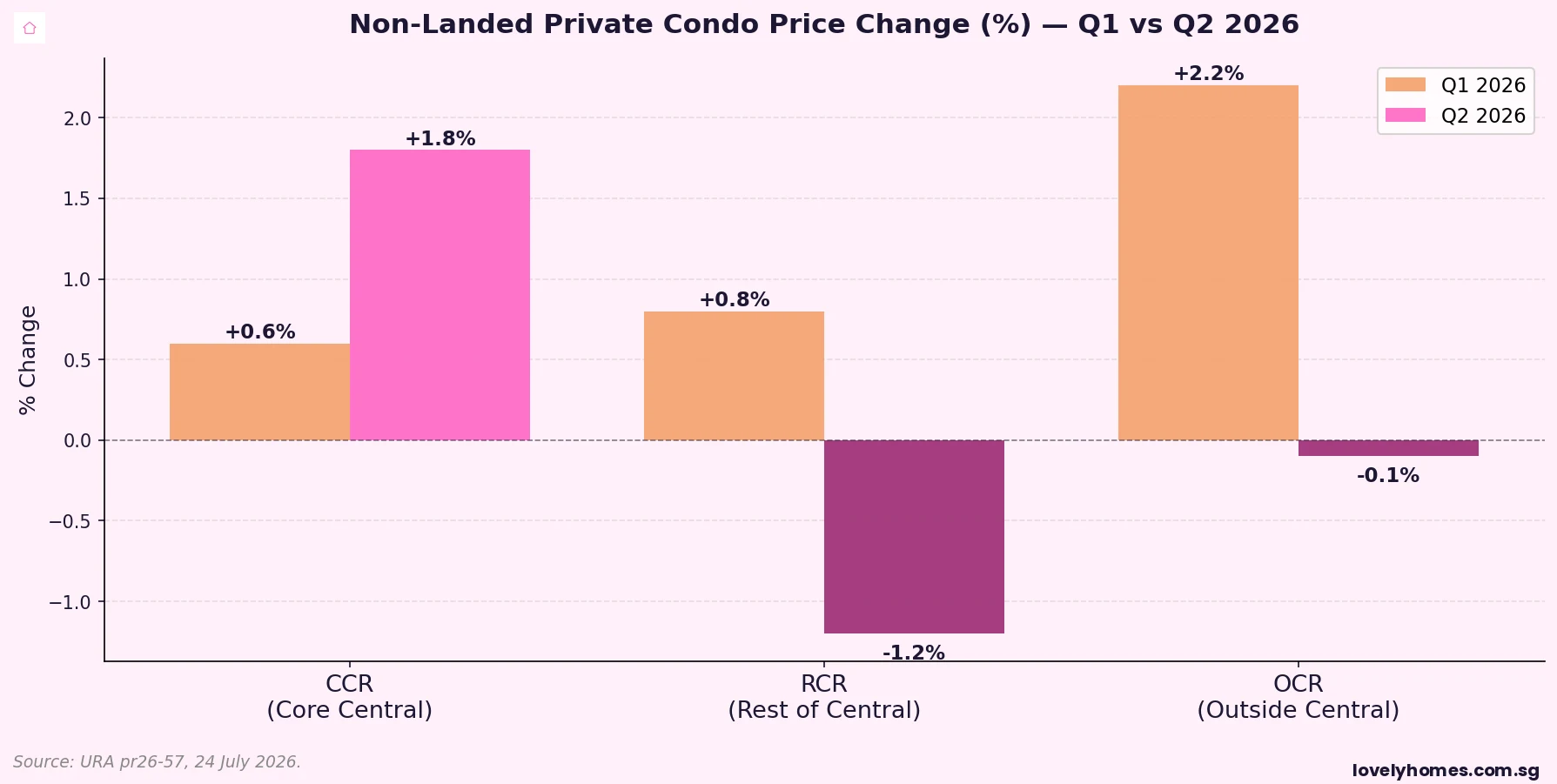
  • The luxury market is bifurcating: sub-S$3M OCR and RCR condos are softening (OCR -0.2%, RCR -1.4% in Q2 2026), while trophy assets above S$5M are tightening.
  • Singapore’s combination of rule of law, no capital gains tax, SGD strength, and geopolitical neutrality underpins its premium positioning among global wealth management centres.
  • Full Q2 2026 transaction data is expected from URA on 24 July 2026 — the flash estimate published 1 July 2026 covers pricing only, not full volumes.

CCR Surges 2.0% in Q2 2026 as Luxury Demand Returns

Singapore’s Core Central Region (CCR) property market recorded a 2.0% price increase in Q2 2026, according to the Urban Redevelopment Authority’s flash estimate released on 1 July 2026. This makes the CCR the best-performing segment of the entire private residential market for the quarter — outpacing the overall market gain of 0.5% and standing in sharp contrast to the Rest of Central Region (RCR, -1.4%) and Outside Central Region (OCR, -0.2%), which both posted price declines.

The CCR’s outperformance is particularly notable given the backdrop: the wider Singapore private residential market has been moderating since early 2025, with the URA Private Property Price Index (PPI) recording gains of just 0.9% in Q1 2026 and 0.5% in Q2 2026 — well below the 8.4% full-year gain of 2023. The surge in CCR prices reflects a specific dynamic: demand from wealth-preserving investors, both domestic and international, for premium Singapore residential assets.

The Safe-Haven Thesis: Why Singapore Is Attracting Global Wealth

Industry observers note that Singapore’s luxury property market has increasingly attracted demand driven not by speculative gain but by wealth preservation. Several structural factors reinforce Singapore’s position as a premium repository of global capital in 2026.

Geopolitical diversification: Ongoing conflicts in Europe, rising trade tensions between the United States and China, and political uncertainty in multiple Southeast Asian nations have prompted high-net-worth individuals to diversify their real-asset holdings into jurisdictions perceived as politically stable. Singapore — with its neutral foreign policy, independent judiciary, and transparent legal framework — is among a short list of global cities offering this combination.

No capital gains tax: Singapore does not tax capital gains on property disposal (subject to the IRAS’s anti-speculation rules around short-term trading). For investors holding a property for more than three years, any appreciation is fully exempt from tax. This contrasts sharply with major competing markets: the United Kingdom taxes property gains at 18–28%, Australia at the marginal income rate, and Hong Kong at stamp duty and property tax regimes that have been progressively tightened.

Singapore Dollar resilience: The Monetary Authority of Singapore (MAS) manages the Singapore Dollar within a policy band that has delivered steady appreciation against a trade-weighted basket since the 1980s. For USD or EUR-denominated investors, Singapore property effectively provides implicit currency protection alongside the real-asset yield.

Rule of law and property rights: Singapore property title is freehold or 99-year leasehold under a clear and well-enforced framework. Title searches are transparent, conveyancing is regulated, and disputes are adjudicated by courts with a strong track record of enforcing property rights. There is no risk of compulsory acquisition without fair compensation under the Land Acquisition Act.

Singapore private residential property price index CCR RCR OCR Q1 Q2 2026 URA flash estimate
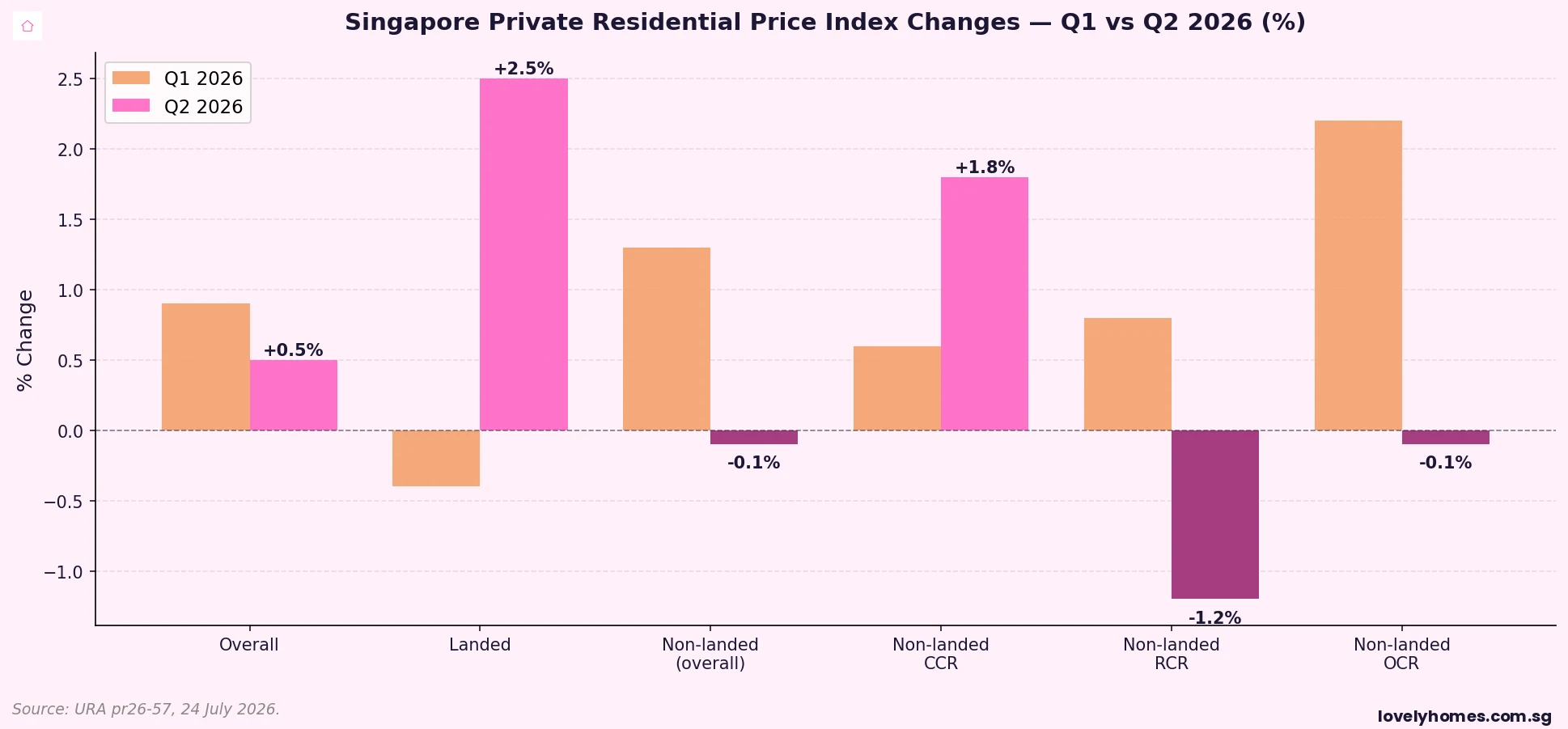
Figure 1: Singapore Private Residential PPI — Q1 vs Q2 2026 by Market Segment. Source: URA (Q2 based on flash estimate, 1 July 2026).

The Luxury Segment in Numbers: What the Data Shows

The Q2 2026 URA flash estimate provides pricing data but not full transaction volumes — those will be released with the full Q2 statistics on approximately 24 July 2026. However, the H1 2026 market narrative is already forming from the available data points.

Market Segment Q1 2026 PPI Change Q2 2026 PPI Change (Flash) H1 2026 Direction
Overall Private Residential +0.9% +0.5% Moderating
Non-Landed Overall +1.3% -0.1% Softening
CCR (Core Central Region) +0.6% +2.0% Accelerating
RCR (Rest of Central Region) +0.8% -1.4% Correcting
OCR (Outside Central Region) +2.2% -0.2% Cooling
Landed Residential -0.4% +2.6% Rebounding

The data shows a clear bifurcation: mid-market mass-market condominiums (OCR and RCR) are softening or correcting, while the premium CCR segment and landed residential — the two categories most associated with high-net-worth buying — are strengthening. This is consistent with the safe-haven demand thesis: wealth-preserving buyers are focused on premium Singapore assets, not the mass-market segment where supply from new GLS sites is more acute.

Landed residential and GCBs: Industry data cited in market commentary indicates that Good Class Bungalow (GCB) transactions in H1 2026 averaged approximately S$2,121 per square foot — near historical highs. While GCB volume has been subdued (fewer than 20–30 transactions per half typically), the average transacted PSF points to the depth of demand at the very top of the market. GCBs are the only residential asset class in Singapore where the absolute supply is fixed by planning policy: there are approximately 2,800 GCB plots gazetted in 39 designated GCB Areas, and no new GCB land has been released since the 1990s.

ABSD as a Structural Filter: Who Is Still Buying at the Top End?

The 65% ABSD for foreigners did not eliminate luxury CCR buying — it filtered it. At the S$5 million price point, a foreign buyer pays S$3,250,000 in ABSD alone. The buyers who can absorb this cost are a qualitatively different group from the pre-2023 foreign luxury buyer cohort: predominantly ultra-high-net-worth (UHNW) individuals or family offices for whom the ABSD represents a tolerable cost of admission to a prized asset class rather than a prohibitive barrier.

The primary luxury buyer base in 2026 remains Singapore Citizens and PRs, who face no ABSD (SC 1st property) or 5% ABSD (SPR 1st property) respectively. Singapore-based UHNW families who have grown their wealth over the past two decades through private equity, technology, or trade finance are the backbone of CCR demand. A secondary and growing segment is foreign family office principals who have established Single Family Office (SFO) structures in Singapore under the Monetary Authority of Singapore’s SFO incentive framework — these are resident in Singapore and may qualify for SC or PR status over time.

What This Means for Property Buyers in Singapore

The CCR’s Q2 2026 outperformance is both a market signal and a policy-test. It signals that the ultra-premium segment is resilient to macroeconomic headwinds and retains structural demand even at historically high price levels. The question for the government is whether this resilience in the top tier justifies ongoing caution about relaxing the foreigner ABSD — or whether the bifurcation (luxury up, mass-market softening) suggests the cooling measures are having their intended effect of segmenting demand without depressing the overall market.

For Singapore Citizens and PRs looking at the CCR, the data suggests that the window of Q4 2025 / Q1 2026 softness (CCR posted only +0.6% in Q1) may have already passed. If the CCR’s Q2 2026 momentum carries into Q3, the entry window could narrow further. Buyers targeting premium properties — Orchard Road, Sentosa Cove, River Valley, Buona Vista — may find pricing firming through the second half of 2026.

What Might Come Next

The full Q2 2026 private residential statistics from URA (expected 24 July 2026) will reveal whether the CCR volume recovery matched the price recovery. If CCR transaction volumes in Q2 2026 show a meaningful uptick from the subdued Q1 levels, it would confirm the demand recovery is broad-based rather than driven by a small number of high-value transactions. Conversely, a further Q3 2026 reading above +1.5% CCR PPI growth could bring the CCR back onto the radar of the government’s cooling measure review — though any specific policy response ahead of the next scheduled review is speculative.

The full Q2 2026 HDB resale statistics (expected from HDB around 23 July 2026) will provide a complementary read on the mass-market segment — and whether the flash estimate’s -0.3% RPI decline was accurately captured. Taken together, the two data releases in late July 2026 will give the market its clearest picture yet of whether Singapore’s property bifurcation — luxury strengthening, mass-market moderating — is the dominant theme for H2 2026.

Frequently Asked Questions

Why is the CCR doing better than the RCR and OCR in 2026?

The Core Central Region comprises Districts 1–4 and 9–11 — the prime downtown and Orchard Road belt. It attracts a qualitatively different buyer profile: high-income Singapore residents, wealth-preserving investors, and family office principals. This cohort is less sensitive to interest rate cycles and supply pipeline impacts because they are buying premium or trophy assets rather than investment units. In contrast, the RCR and OCR have seen more mid-market supply from new Government Land Sales (GLS) sites, and their buyer base — including upgraders and first-time condo buyers — is more sensitive to mortgage rates and HDB resale price trends.

Can foreigners still buy Singapore luxury property given the 65% ABSD?

Yes, but the economics have changed dramatically since the April 2023 cooling measures. On a S$5 million CCR condo, a foreign buyer faces S$3,250,000 in ABSD alone. This effectively restricts the foreign luxury buyer market to ultra-high-net-worth individuals or family office structures where the ABSD is an acceptable cost of entry. MAS data suggests foreign buyer volumes remain below 2% of all private residential transactions — but their average deal size is materially higher than the market average, meaning they contribute disproportionately to CCR dollar volume.

What is a Good Class Bungalow (GCB) and why are prices so high?

Good Class Bungalows are the most exclusive form of landed residential property in Singapore, located within 39 designated GCB Areas gazetted under the URA Master Plan. GCBs must occupy a minimum land area of 1,400 square metres (about 15,000 sqft) and are subject to strict development controls. The supply is fixed at approximately 2,800 plots — no new GCB land has been created since the 1990s. Combined with strong demand from Singapore’s wealthiest families and a long-standing restriction on foreign ownership (SLA approval required), GCBs represent the most inelastic supply in the Singapore property market. Average transacted PSF of approximately S$2,121 in H1 2026 reflects this structural scarcity premium.

When will the full Q2 2026 property transaction data be released?

The Urban Redevelopment Authority typically releases full quarterly private residential statistics approximately 3–4 weeks after the quarter ends. The Q2 2026 flash estimate (covering the PPI only) was released on 1 July 2026. The full data — including transaction volumes, unit counts, new sales, sub-sales, and resale transactions by region and property type — is expected around 24 July 2026. LovelyHomes will cover the full release when it is published. For HDB resale statistics, the Q2 2026 full data (including median prices by flat type and town) is expected around 23 July 2026.

Is Singapore’s luxury property market in a bubble?

This is a contested question among market analysts. Arguments against a bubble: Singapore property prices are underpinned by genuine end-use demand, a restricted land supply, and government cooling measures that actively suppress speculative demand; the ABSD itself is the most powerful anti-bubble tool in the market. Arguments for caution: CCR prices are near historical highs on a PSF basis; low transaction volumes mean that a small number of trophy deals can move the index; and if global macroeconomic conditions worsen materially — reducing the “safe-haven” narrative — demand could soften quickly. The MAS monitors private residential price trends closely through its Financial Stability Review process, and will act if it assesses that price growth is becoming detached from fundamentals. As at July 2026, the government has not signalled any concern about a bubble in the CCR.

Related Articles

Disclaimer: This article is for general information and editorial purposes only. Property market data is sourced from URA’s Q2 2026 flash estimate (released 1 July 2026) — full Q2 2026 data is expected on approximately 24 July 2026. GCB and luxury transaction figures are indicative industry data. This article does not constitute investment advice. Readers should conduct their own research and seek qualified advice before making any property or investment decisions. LovelyHomes.com.sg is not a licensed real estate agency.

HDB Minimum Occupation Period (MOP) Singapore 2026: Complete Guide

HDB Minimum Occupation Period (MOP) Singapore 2026: Complete Guide

Quick Answer: What Is the HDB Minimum Occupation Period?

  • The Minimum Occupation Period (MOP) is a mandatory holding period during which you must live in your HDB flat and cannot sell it on the open market.
  • The MOP is 5 years for all HDB flat types — BTO, resale, DBSS, and Executive Condominiums (ECs measured from TOP date).
  • The MOP clock starts from key collection for new flats and from the resale completion date for resale purchases.
  • During MOP: you cannot sell the flat on the open market, cannot sublet the entire flat, and cannot own private residential property in Singapore.
  • You can sublet individual rooms with HDB approval, and you may own overseas private property (subject to your citizenship status).
  • After MOP: you can sell on the open resale market, sublet the entire flat (register with HDB), and Singapore Citizens may buy private property while keeping their HDB flat.
  • Selling before MOP is over results in no Seller’s Stamp Duty (SSD) issue per se, but you will be in breach of HDB conditions — HDB will compulsorily acquire the flat and penalties may apply.
  • The resale levy applies when you purchase a second HDB flat with housing subsidy after completing the MOP on your first subsidised flat.

What Is the HDB Minimum Occupation Period and Why Does It Exist?

The Minimum Occupation Period (MOP) is a rule administered by the Housing and Development Board (HDB) that requires flat owners to physically occupy their HDB flat for a minimum period before they may sell it on the open resale market, rent it out in full, or purchase other subsidised or private residential property in Singapore.

The MOP serves as a public housing policy tool designed to achieve three objectives: to ensure that subsidised public housing is used for genuine owner-occupation rather than speculative investment; to moderate short-term resale supply and maintain price stability in the HDB resale market; and to preserve the social intent of Singapore’s public housing system, under which citizens and PRs who receive government housing grants and subsidies are expected to occupy the flat as their primary residence for a substantive period.

The MOP concept was strengthened progressively over the years, most significantly in 2010 when HDB raised the MOP for non-subsidised resale flats from 1 year to 5 years. As at July 2026, the 5-year MOP applies uniformly across all HDB flat types regardless of whether the purchase was subsidised or unsubsidised.

MOP Duration by Property Type

The MOP rules vary slightly in their application depending on the type of HDB or EC property involved. The table and infographic below set out the key parameters for each category.

HDB MOP rules by property type 2026 BTO resale EC minimum occupation period
Figure 1: HDB / EC Minimum Occupation Period Rules by Property Type (2026). Source: HDB.
Property Type MOP Duration MOP Start Date Reset if Sold?
New HDB BTO / SBF flat 5 years Date of key collection Yes — resets on each new purchase
HDB Resale flat 5 years Resale completion date Yes — resets on each resale purchase
DBSS (Design, Build & Sell Scheme) 5 years Date of key collection Yes
Executive Condominium (new launch) 5 years TOP date of the EC project Yes — if flat is sold & repurchased
EC (resale, after partial privatisation) Counted from original TOP Original TOP date No reset for resale buyers post-privatisation

Key distinction — BTO vs resale: For BTO buyers, the MOP starts from the date they collect the keys from HDB. For resale buyers, it starts from the date the resale transaction is completed and registered. This matters practically: a resale flat whose previous owner completed MOP years ago does not pass on an outstanding MOP to the new buyer — the new buyer’s fresh 5-year MOP commences from their own purchase date.

What You Can and Cannot Do During Your MOP

The most common questions HDB flat owners have are about what they are permitted to do — and what is prohibited — during the 5-year MOP. The restrictions are specific and HDB monitors compliance actively.

HDB MOP what you can and cannot do during minimum occupation period 2026
Figure 2: What You CAN and CANNOT Do During the HDB MOP (2026). Source: HDB.

You are NOT allowed to:

  • Sell the flat on the HDB Resale Portal or via any private arrangement.
  • Sublet the entire flat — renting out the whole unit to tenants is prohibited during MOP.
  • Purchase any Singapore private residential property, whether a condominium, apartment, landed home, or EC in the initial restricted period.
  • Own any Singapore private residential property — if you already own private property at the time of HDB purchase, you must dispose of it within 6 months (SPR) or within a stipulated period (SC — typically required to sell before or at point of HDB key collection).
  • Transfer ownership of the flat to another party, except by a court order in matrimonial or inheritance proceedings.

You are permitted to:

  • Sublet individual rooms in the flat — but you must apply for HDB’s approval and must continue to physically reside in the flat yourself.
  • Apply for and benefit from HDB’s Home Improvement Programme (HIP) and Lift Upgrading Programme (LUP).
  • Carry out approved renovation works — whether cosmetic or structural, subject to HDB and BCA requirements.
  • Own overseas private property — Singapore Citizens may own overseas property during their HDB MOP. SPRs face additional restrictions and should check current HDB rules, which require SPRs to obtain HDB’s prior approval.

Room Rental During MOP: The Rules in Detail

Room rental is the one form of income-generating activity permitted during the MOP period. Under HDB’s room rental rules, you may rent out up to 6 bedrooms in a flat (depending on flat size), provided you continue to physically reside in the flat as your primary residence. Subletting of individual rooms requires HDB approval — the application is made through the HDB Flat Portal. You must also register each tenant’s identity with HDB and notify HDB of any changes in tenancy within the stipulated timeframe.

The rental period for approved room subletting is typically granted in 1- or 2-year increments, renewable subject to re-application. Tenants must be Singapore Citizens, PRs, or eligible non-citizens holding valid passes. Short-term letting (such as via holiday rental platforms) is not permitted for HDB flats at any time, whether within or outside the MOP — this applies without exception.

Worked Example: The Tan Family’s MOP Journey

Mr & Mrs Tan (SC/SC), BTO 4-Room Flat, Tengah, Key Collection 15 August 2024

MOP start date: 15 August 2024

MOP completion date: 15 August 2029

Purchase price: S$545,000 (BTO)

Grants received: Enhanced Housing Grant (EHG) S$30,000 + CPF Family Grant S$50,000 = S$80,000 total subsidies

During MOP (Aug 2024 – Aug 2029):

  • Cannot sell the flat on the resale market — if they attempt to transfer ownership, HDB may compulsorily acquire it at below-market value
  • Cannot purchase any Singapore private residential property or EC in its restricted period
  • Can sublet the spare bedroom — applied for HDB approval in Jan 2026, approved for 1-year subletting at S$1,200/month

After MOP (from 15 August 2029):

  • May sell on HDB Resale Portal — current comparable 4-room Tengah prices estimated at S$620,000–S$680,000 (2029 projection, illustrative)
  • CPF housing refund (principal used + accrued interest at 2.5% p.a.) must be returned to CPF OA upon sale
  • Resale levy of S$40,000 (4-room) applies if they purchase another subsidised HDB flat
  • Mr Tan may buy a private condo while Mrs Tan retains the HDB flat — SC privilege post-MOP

Your Post-MOP Options

Completing the MOP unlocks a range of options for HDB flat owners. There is no single right answer — the best choice depends on your household income, family size, retirement goals, and property market conditions at the time.

HDB post MOP options sell rent buy private property upgrade Singapore 2026
Figure 3: Post-MOP Options — What You Can Do After the HDB Minimum Occupation Period (2026). Source: HDB.

Option 1 — Sell on the open resale market. List on the HDB Resale Portal at your asking price. BSD (refundable if previously paid via CPF) and CPF housing refund plus accrued interest will reduce your net cash proceeds. No Seller’s Stamp Duty applies after MOP completion (SSD applies only in the first 3 years after purchase, not tied to MOP).

Option 2 — Upgrade to a larger HDB flat (BTO/SBF/resale). After MOP, you are eligible to purchase a second HDB flat. If your first flat was purchased with a housing grant (subsidy), a resale levy applies on the second subsidised purchase (S$40,000 for 4-room sellers as at 2026). The levy is automatically deducted from your CPF refund proceeds at the point of resale.

Option 3 — Buy private property (Singapore Citizens only). Post-MOP, SC flat owners may purchase a Singapore private residential property while retaining their HDB flat. ABSD of 20% applies on the private purchase (SC 2nd property rate). SPRs must sell their HDB flat within 6 months of completing the private property purchase.

Option 4 — Sublet the entire flat. Full-unit subletting is only permitted after MOP is complete. The flat owner need not remain in residence. Subletting must be registered with HDB and is approved for up to 2 years initially (renewable). Subletting income is subject to income tax as rental income.

Option 5 — Continue staying. No action is required after MOP. Many owner-occupiers choose to continue living in their flat, especially if the location, neighbourhood amenities, or proximity to schools and family remain central to their needs. The flat continues to appreciate in value; the owner retains full optionality to exercise any of the above options at any future point.

What This Means for You: MOP as a Policy Signal

The 5-year MOP is one of Singapore’s most effective housing policy tools for a simple reason: it aligns the interests of subsidised homeowners with the long-term community stability goals of the HDB programme. Flats received at below-market BTO prices include substantial government subsidies — the MOP ensures the beneficiary of that subsidy provides genuine owner-occupier usage before extracting any speculative gain.

In the context of the current HDB resale market (RPI at 202.7 in Q2 2026 flash estimate, having declined for two consecutive quarters after peaking), the MOP continues to act as a supply damper: flats purchased during the 2021–2023 BTO boom are still largely within their MOP windows and will begin entering the resale market progressively from 2026 onwards. This anticipated supply pipeline is one reason analysts expect further moderation in HDB resale price growth over 2026–2028.

What Might Come Next: Could the MOP Change?

The 5-year MOP has been the standard for over a decade and there is no publicly signalled intention to change it as at July 2026. The government’s focus has instead been on differentiating between Standard, Plus, and Prime classification flats (introduced in the October 2024 BTO framework), which carry enhanced restrictions: Plus and Prime flats have a 10-year MOP, are subject to an income ceiling at resale, and can only be sold back to HDB in the first instance. This two-tier MOP framework — 5 years for Standard, 10 years for Plus/Prime — reflects a targeted approach rather than a blanket MOP extension.

For the vast majority of HDB buyers purchasing Standard-classification flats in non-prime areas, the 5-year MOP remains the applicable rule.

Frequently Asked Questions

What happens if I sell my HDB flat before the MOP is over?

Selling a HDB flat before the MOP expires is a breach of the sale conditions under the Housing and Development Act. HDB has the authority to compulsorily acquire the flat at its assessed market value (which may be lower than the transacted value). In addition to the financial loss, HDB may impose penalties and the owner’s eligibility for future HDB subsidies may be affected. Practically speaking, no conveyancing firm will facilitate a sale before MOP completion given the clear legal prohibition — the HDB Resale Portal’s system also prevents listing of flats within their MOP period.

Can I rent out my entire HDB flat during the MOP if I work overseas?

No. Full-unit subletting is not permitted during the MOP period under any circumstances, including when the owner is posted overseas for work. If you must relocate for employment, you may sublet individual rooms (with HDB approval) but must maintain the flat as your registered Singapore address and must return to physically occupy it. If you are overseas for an extended period, you must seek HDB’s advice in advance. Returning to Singapore and being unable to occupy the flat does not suspend the MOP clock — MOP runs continuously from key collection regardless of where the owner is physically located.

Can I own private property while I am under HDB MOP?

No, you may not own Singapore private residential property during the MOP. At the point of purchasing your HDB flat, you must not own any private residential property in Singapore — if you do, you must dispose of it before or within the stipulated period after HDB key collection. The prohibition includes any form of direct or indirect ownership, including through a company or trust. You may, however, own residential property overseas (SC holders may do so freely; SPR holders require HDB’s prior written consent). After completing the 5-year MOP, Singapore Citizens may purchase Singapore private property and retain the HDB flat simultaneously.

Does the MOP apply to both the buyer and all registered flat owners?

Yes. The MOP applies to all registered owners on the HDB title — not just the main applicant. All registered occupiers and co-owners must comply with the occupancy requirement during the MOP period. This means that if any registered owner or occupier moves out and acquires other housing, HDB may treat this as non-compliance. If a couple divorces during the MOP period and one party acquires a separate property, they must seek HDB’s guidance as the occupancy conditions may be affected. Transfers between co-owners on the title (such as adding or removing a spouse) during MOP typically require HDB approval.

What is the resale levy and when does it apply?

The resale levy is a payment required when an HDB flat owner who received a housing subsidy on their first flat purchases a second subsidised HDB flat or a new EC. It is administered by HDB and designed to ensure fairness between first-time and second-time subsidised buyers. As at 2026, the levy amounts are: 2-Room Flexi S$15,000; 3-Room S$30,000; 4-Room S$40,000; 5-Room S$45,000; Executive flat S$50,000; DBSS S$55,000; EC — 5% of resale price capped at S$55,000. The levy is paid to HDB from your CPF refund at the point of resale completion. It does not apply if you sell your first flat on the open resale market and buy a non-subsidised resale HDB flat or private property.

Does the MOP apply to Executive Condominiums?

Yes, but with differences. New ECs are subject to a 5-year MOP measured from the EC’s Temporary Occupation Permit (TOP) date — not from the individual buyer’s key collection date. During the EC MOP, owners cannot sell on the open market and private ownership restrictions apply. After 5 years from TOP (partial privatisation), EC owners may sell on the open market to SC and SPR buyers only. After 10 years from TOP (full privatisation), the EC is treated as private property and may be sold to any buyer including foreigners. Second-timer EC buyers (those who have previously owned an HDB flat) must sell their HDB flat within 6 months of TOP.

Can I inherit an HDB flat during my own MOP?

Inheriting an HDB flat through a deceased estate while you are still within the MOP of your own flat is a situation that requires immediate attention from HDB. Generally, you cannot simultaneously own two HDB flats. HDB will typically require you to either retain the inherited flat (and dispose of your existing flat) or disclaim your share of the inheritance. The specific resolution depends on your citizenship status, your existing flat’s MOP stage, and the value of the respective properties. You should contact HDB directly upon becoming aware of the inheritance situation — early engagement prevents inadvertent breaches of the MOP conditions.

Related Articles

Disclaimer: This article is provided for general information purposes only and does not constitute legal, financial, or professional advice. HDB rules, MOP periods, resale levy amounts, and eligibility conditions are subject to change by HDB and the Singapore government. The information in this article reflects rules as at 8 July 2026. Readers are advised to verify all information directly with HDB (hdb.gov.sg), CPF Board (cpf.gov.sg), and IRAS (iras.gov.sg) before making any property or financial decisions. LovelyHomes.com.sg is not a licensed real estate agency or legal practice.

Buying Property in Singapore as a Foreigner: Complete Guide 2026

Buying Property in Singapore as a Foreigner: Complete Guide 2026

Quick Answer: Can Foreigners Buy Property in Singapore?

  • Foreigners can freely buy private non-landed condominiums and apartments — no government approval required.
  • Buying landed residential property requires Singapore Land Authority (SLA) approval, which is rarely granted to foreigners.
  • Foreigners are not eligible to purchase HDB flats or new Executive Condominiums.
  • Foreigners pay 65% Additional Buyer’s Stamp Duty (ABSD) on any residential purchase, on top of standard Buyer’s Stamp Duty.
  • On a S$1.5 million condo, a foreigner pays approximately S$1.01 million in stamp duties — versus S$39,600 for a SC buying their first property.
  • Commercial and industrial properties are open to all buyers with no ABSD.
  • Foreigners can obtain Singapore bank mortgages; HDB loans are unavailable to non-citizens.
  • Permanent Residents (SPRs) pay 5% ABSD on a first residential purchase and are eligible to buy HDB resale flats under specified conditions.

Who Is a “Foreigner” Under Singapore Property Law?

Under the Residential Property Act (Cap. 274), a foreigner is any person who is not a Singapore Citizen (SC) or a Singapore Permanent Resident (SPR). This definition covers expatriates on Employment Passes, Dependant Passes, Long-Term Visit Passes, and individuals with no Singapore residency status. Companies, limited liability partnerships, and discretionary trusts are classified as entities and attract the highest stamp duty rates.

The rules governing foreign property ownership span three legislative frameworks: the Residential Property Act (administered by the Singapore Land Authority), the Stamp Duties Act (enforced by IRAS), and the Housing and Development Act (HDB). Understanding all three is essential before committing to any purchase in Singapore.

ABSD Rates in 2026: The True Cost of Buying

The Additional Buyer’s Stamp Duty (ABSD) is levied on top of the standard Buyer’s Stamp Duty (BSD). For foreigners, the rate is 65% of the purchase price — introduced in the April 2023 cooling measures package and unchanged as at 8 July 2026. This rate applies to every residential purchase regardless of whether it is the foreigner’s first or subsequent property in Singapore.

ABSD rates 2026 by buyer profile SC SPR foreigner entity Singapore
Figure 1: ABSD Rates by Buyer Profile — Residential Property, Singapore 2026. Source: IRAS.

Buyer’s Stamp Duty (BSD) applies to all buyers. It is calculated on a tiered basis: 1% on the first S$180,000; 2% on the next S$180,000; 3% on the next S$640,000; 4% on the next S$500,000; 5% on the next S$1,500,000; and 6% on any amount exceeding S$3,000,000. For a S$1.5 million property, BSD amounts to S$39,600.

Buyer Profile 1st Residential Purchase 2nd Purchase 3rd+ Purchase
Singapore Citizen (SC) 0% 20% 30%
Singapore PR (SPR) 5% 30% 30%
Foreigner (non-SC/SPR) 65% 65% 65%
Entity (company/trust/LLP) 65% 65% 65%

ABSD remission for married couples: Where one spouse is SC and the other is a foreigner, the couple may apply for ABSD remission under the Married Couples (Joint Purchase) scheme when purchasing their first joint residential property. This is not automatic — a formal application to IRAS is required and specific conditions must be met. Professional legal advice is essential in these situations.

What Can Foreigners Buy? Full Eligibility Matrix

The range of property types available to foreigners varies significantly depending on the asset class and whether government approval is required.

Singapore property eligibility matrix foreigners SC SPR what can foreigners buy 2026
Figure 2: Property Type Eligibility Matrix — Who Can Buy What in Singapore (2026). Source: SLA, HDB, URA.

Private non-landed condominiums and apartments are the most accessible asset class. No approval is required; only BSD and ABSD must be paid. Foreigners buy freely across all districts — OCR (Outside Central Region), RCR (Rest of Central Region), and CCR (Core Central Region).

Landed residential properties — terrace houses, semi-detached, bungalows, and Good Class Bungalows (GCBs) — are restricted under the Residential Property Act. Foreigners must apply to the SLA before purchasing. Approvals are rarely granted and limited to individuals who have made exceptional economic contributions to Singapore. Sentosa Cove is the one area where SLA approvals for foreigners are more regularly forthcoming, consistent with the original planning intent for the island enclave.

HDB flats are off-limits to foreigners entirely. Only Singapore Citizens may buy new BTO or open-booking HDB flats. SPRs are eligible for HDB resale flats under the Public Scheme but must form a family nucleus with another SC or SPR.

Executive Condominiums (ECs) during the new-launch and restricted resale period (first 10 years) are not available to foreigners. After full privatisation at the 10-year mark, ECs trade as regular private property and are purchasable by all nationalities.

Commercial and industrial property — shophouses, offices, retail strata units, industrial units — carry no ABSD and no nationality restriction. These are a common entry point for foreign investors seeking Singapore real estate exposure without the full residential stamp duty burden.

Stamp Duty Costs: SC First Property vs Foreigner

The financial difference between a Singapore Citizen buying their first property and a foreigner buying the same property is dramatic. The chart below illustrates the stamp duty gap across three common price points.

Singapore stamp duty cost comparison SC first property vs foreigner ABSD 65 percent 2026
Figure 3: Total Stamp Duty Costs — SC 1st Property vs Foreigner Buyer (2026). Source: IRAS.

Financing: What Mortgages Are Available to Foreign Buyers?

Foreigners may apply for bank mortgage loans from Singapore-licensed financial institutions. The Total Debt Servicing Ratio (TDSR) framework, administered by the Monetary Authority of Singapore (MAS), caps total monthly debt obligations at 55% of gross monthly income. The Loan-to-Value (LTV) limit for a first property loan is 75%. HDB loans are unavailable to foreigners.

A foreigner buying a S$2 million condo must fund: 25% downpayment (S$500,000) + ABSD 65% (S$1,300,000) + BSD (S$64,600) + legal fees (~S$15,000) = approximately S$1,879,600 in cash. The S$1,500,000 bank loan (75% LTV) at 2.90% for 30 years would cost approximately S$6,274 per month — requiring gross monthly income of at least S$11,408 to satisfy TDSR.

Worked Example: A French National Buying a CCR Condo

Marc (French national, Employment Pass), purchasing 2BR CCR condo at S$2,800,000

BSD: S$1,800 + S$3,600 + S$19,200 + S$20,000 + S$65,000 = S$109,600

ABSD (65%): S$2,800,000 × 65% = S$1,820,000

Total stamp duties: S$1,929,600 (100% cash — no CPF available to foreigners)

Bank loan (75% LTV): S$2,100,000 at 2.90% p.a. over 30 years = ~S$8,772/month

TDSR check: Marc earns S$28,000/month — TDSR 31.3% PASS (well within 55%)

Total cash required at purchase: S$700,000 downpay + S$1,929,600 stamp duties + S$15,000 legal = approximately S$2,644,600

Break-even holding period: At 3% annual capital appreciation, the property must be held for approximately 15 years before stamp duty entry costs are fully recovered through price appreciation alone, assuming no rental income offset.

What This Means for You: Singapore as a High-Cost Foreign-Buyer Market

Singapore’s 65% foreigner ABSD is one of the highest residential entry taxes for non-citizen buyers among developed global cities. Hong Kong imposes a 30% Buyer’s Stamp Duty for non-permanent residents; Australia restricts foreigners largely to new-build supply; the United Kingdom levies a 2% surcharge. Singapore’s deliberate policy positioning prioritises citizen home ownership above foreign investment demand.

The practical result: foreign residential buyers in Singapore are predominantly high-net-worth individuals for whom the ABSD represents an acceptable cost of entry into a stable, transparent, and appreciating market. URA transaction data shows foreign buyer share of private residential transactions fell from approximately 4–5% before April 2023 to below 2% post-hike. Despite the cost, Singapore remains attractive for long-tenure expatriates and global wealth holders because of rule of law, no capital gains tax, SGD currency stability, and Asia-Pacific gateway positioning.

What Might Come Next

As at July 2026, the government has given no indication of relaxing the 65% foreigner ABSD. The MAS Financial Stability Review (November 2025) noted that price growth had moderated — the URA Private Property Price Index rose just 0.5% in Q2 2026 — reducing immediate policy pressure. However, the CCR segment rose 2.0% in Q2 2026, the strongest performance among any segment, which may attract renewed attention to foreign demand in luxury districts. Buyers should plan on the basis that the 65% rate will persist through at least 2027–2028 and factor this into their financial modelling from the outset.

Frequently Asked Questions

Can a foreigner use CPF to pay ABSD?

No. ABSD must be paid entirely in cash. Only Buyer’s Stamp Duty can be funded from CPF Ordinary Account savings — and only by SC and SPR holders who maintain CPF accounts. Foreigners have no CPF accounts and must pay all stamp duties in cash. This is a material liquidity consideration: on a S$2 million purchase, ABSD alone is S$1.3 million in cash, payable within 14 days of the Sale and Purchase Agreement date.

Can a foreigner and SC jointly buy property to reduce ABSD?

When a foreigner and SC purchase jointly, ABSD is assessed at the highest applicable rate — meaning the foreigner’s 65% applies to the full purchase price regardless of ownership proportions. There is one exception: legally married spouses (one SC, one foreigner) purchasing their first joint residential property may apply to IRAS for ABSD remission under the Married Couples scheme. This requires a formal application and is subject to eligibility conditions. Couples should seek qualified tax and legal advice before structuring any joint purchase.

How does the SLA approval process work for landed residential property?

The Singapore Land Authority processes applications from foreigners wishing to purchase restricted residential property under the Residential Property Act. Applicants submit supporting documents including employment history, tax contribution records, length of Singapore residency, and evidence of community ties. SLA considers economic contribution to Singapore as the primary criterion. Approval rates for non-Sentosa Cove landed property applications by foreigners are estimated to be below 30% by industry practitioners, and GCB approvals for foreigners are exceedingly rare. Sentosa Cove applications have a higher success rate given the original planning intent for that precinct. Processing typically takes 8 to 16 weeks.

Can foreigners buy commercial or industrial property without ABSD?

Yes. Commercial properties (shophouses, offices, retail units) and industrial properties (factories, warehouses, business parks) are not subject to ABSD or residential property restrictions. BSD is payable on the purchase price at the same tiered rates as for residential purchases. This makes commercial and industrial Singapore property a more accessible entry point for foreign investors seeking Singapore real estate exposure. However, mixed-use properties containing a residential component may be partially subject to residential rules — professional advice is essential.

Does a foreigner pay Seller’s Stamp Duty (SSD) when selling?

Seller’s Stamp Duty applies to all sellers regardless of nationality for properties sold within the holding period: 12% within 1 year, 8% within 2 years, 4% within 3 years, and nil thereafter. There is no capital gains tax in Singapore — profits from property sold after the SSD window are not taxable. For foreigners who have already paid 65% ABSD on entry, the implication is clear: a minimum 3-year hold is almost always essential to make any residential investment viable. Short-term flipping is economically punitive for foreign buyers in Singapore.

Can a foreigner rent out their Singapore property?

Yes, foreigners may rent out private residential property without restriction. Rental income from Singapore property earned by non-residents is subject to Singapore income tax at the flat non-resident rate of 24%, assessed on net rental income after deducting allowable expenses such as mortgage interest, agent fees, maintenance charges, fire insurance premiums, and a statutory depreciation allowance. Non-resident landlords must file an annual Singapore income tax return with IRAS. Property tax at the non-owner-occupied (investment) rate also applies annually, calculated on the Annual Value assessed by IRAS.

Are there restrictions on foreigners buying through a Singapore company?

Purchasing residential property through any entity — including Singapore-incorporated companies — attracts the entity ABSD rate of 65%, the same as the individual foreigner rate. There is no advantage in using an entity structure for residential purchases from a stamp duty perspective. For commercial and industrial property, entity structures carry no ABSD and are commonly used by foreign investors for operational or tax-planning reasons. Entities holding residential property also pay higher annual property tax at non-owner-occupied rates and cannot benefit from CPF mortgage financing.

Related Articles

Disclaimer: This article is for general information only and does not constitute legal, financial, or tax advice. ABSD rates, SLA approval criteria, and eligibility rules are subject to change. Readers should verify all information with official sources — IRAS (iras.gov.sg), SLA (sla.gov.sg), HDB (hdb.gov.sg), MAS (mas.gov.sg) — and engage a qualified Singapore property lawyer before proceeding. LovelyHomes.com.sg is not a licensed real estate agency or legal practice.

Singapore Home Insurance Guide 2026: HDB Fire Insurance, Home Contents, MRTA and FDW Cover Explained

Singapore Home Insurance Guide 2026: HDB Fire Insurance, Home Contents, MRTA and FDW Cover Explained

Home insurance in Singapore is one of the most consistently misunderstood areas of property ownership. Many HDB flat owners believe they are fully covered by the mandatory HDB Fire Insurance policy that comes with their flat. Most are not. Private condo owners sometimes assume their building’s master policy protects their contents. It typically does not. And across all property types, the gap between what a homeowner thinks they are insured for and what they would actually receive in a claim can run to tens of thousands of Singapore dollars.

This guide explains exactly what each category of Singapore home insurance covers, what it does not cover, how much it costs, and what the appropriate level of coverage looks like for an HDB flat owner, a condominium resident, and a landed property owner in 2026.

Quick Answer — Singapore Home Insurance 2026 at a glance

  • HDB Fire Insurance is mandatory for HDB flat owners with an outstanding HDB loan. It covers only the building structure, not contents. Annual premiums start from approximately S$5.50 per year for a 2-room flat.
  • Home Contents Insurance is optional but highly recommended. It covers furniture, electronics, clothing, and valuables against fire, theft, water damage, and other perils.
  • Mortgage Reducing Term Assurance (MRTA) and Mortgage Level Term Assurance (MLTA) are life insurance policies that pay off the mortgage if the borrower dies or becomes totally and permanently disabled.
  • Foreign Domestic Worker (FDW) Insurance is mandatory for all households employing a maid in Singapore, administered under the Employment of Foreign Manpower Act.
  • Most comprehensive home insurance packages for a 4-room HDB flat with S$100,000 contents cover cost approximately S$120–S$200 per year in 2026.
  • Premiums are not regulated by MAS — shop around and compare at least three insurers before buying.
  • ABSD and stamp duties do not apply to insurance premiums; see our ABSD Singapore 2026 guide for property transaction costs

The Four Main Categories of Singapore Home Insurance

Singapore’s home insurance market is structured around four distinct insurance categories, each addressing a different layer of financial risk. Understanding which category applies to your situation is the essential first step before comparing policies or premiums.

The first category, HDB Fire Insurance, is a government-mandated basic policy administered under the HDB’s Fire Insurance Scheme. The second category, Home Contents Insurance, is a commercial product sold by private insurers to cover the movable assets inside your home. The third category encompasses Mortgage Insurance products (MRTA and MLTA), which are life-insurance instruments designed to discharge a mortgage on death or total permanent disability. The fourth category, FDW Insurance, is a mandatory cover for employers of foreign domestic workers.

Singapore home insurance types and indicative annual premiums 2026 comparison
Figure 1: Singapore Home Insurance Types — Indicative Annual Premiums 2026. Premiums are indicative only; actual quotes vary by insurer, property type, and individual risk profile.

HDB Fire Insurance: What It Covers and What It Does Not

The HDB Fire Insurance Scheme is administered by the Housing & Development Board and is compulsory for all HDB flat owners with an outstanding HDB loan. Private bank loans on HDB flats do not legally require HDB Fire Insurance, but most banks impose an equivalent building insurance requirement as a loan condition. The scheme is underwritten by a single insurer appointed by HDB through a tender process — as at 2026, Etiqa Insurance Pte Ltd holds the mandate.

What HDB Fire Insurance covers: The policy insures the structural components of the flat, including the original fixtures, internal walls, floors, ceilings, and the built-in fittings that were installed by HDB when the flat was first built (kitchen cabinets, bathroom fittings, electrical wiring). The insured sum is the estimated cost to rebuild the structural elements in the event of fire or an allied peril (smoke, explosion, lightning, impact).

What HDB Fire Insurance does NOT cover: It does not cover any renovations, additions, or alterations made by the flat owner after purchase. It does not cover furniture, electrical appliances, clothing, jewellery, art, or any other movable contents. It does not cover accidental damage, water damage from external sources (such as a burst pipe in the unit above), theft, or public liability. For most HDB owners, the renovation work they commission after purchase — which can cost S$30,000–S$100,000 for a 4-room flat — is entirely uninsured under the HDB Fire Insurance Scheme.

Singapore home insurance key facts 2026 mandatory optional HDB FDW MRTA contents cover
Figure 2: Singapore Home Insurance at a Glance — 2026 Key Statistics. Sources: HDB, MOM, MAS, industry data.

Home Contents Insurance: What It Is and How Much You Need

Home Contents Insurance is a private commercial product sold by insurers including NTUC Income, AIA, AXA, Sompo (formerly Sompo Japan), Great Eastern, and Etiqa, among others. Policies are not standardised, so coverage, exclusions, and premiums vary significantly between providers. Buyers should compare policy wordings carefully, not just premium prices.

A standard Home Contents Insurance policy typically covers: furniture and fittings (including renovation works), electronic appliances, clothing and personal effects, and jewellery (subject to per-item and aggregate sub-limits). Perils covered typically include fire, lightning, explosion, theft, vandalism, water damage from burst pipes or overflowing tanks, and in some policies, accidental damage. Most policies exclude flood, earthquake, and subsidence, though Singapore’s geography makes these perils relatively rare.

The key figure to determine is your sum insured — the amount of cover you are purchasing. Many homeowners significantly underestimate the replacement value of their contents. A practical exercise is to walk through your home and estimate the current replacement cost (not original purchase price) of every item: bedroom furniture, mattresses, wardrobe and clothing, kitchen appliances, television, computer equipment, power tools, jewellery, and children’s toys and equipment. For a 4-room HDB flat with moderate furnishings and a mid-range renovation, the replacement cost of contents and renovation works combined often exceeds S$100,000–S$150,000.

Mortgage Insurance: MRTA vs MLTA

Mortgage insurance addresses a different risk: the risk that the borrower dies or becomes totally and permanently disabled (TPD) before the mortgage is paid off, leaving the surviving family with a property but no capacity to service the loan.

Mortgage Reducing Term Assurance (MRTA) is the simpler instrument. It provides a death/TPD benefit that reduces over time in line with the outstanding mortgage balance. If you borrow S$500,000 and die in Year 5, the MRTA pays out approximately S$460,000 (the remaining balance), discharging the mortgage. MRTA does not pay out a lump sum beyond the mortgage balance; there is no residual benefit to the estate. Premiums for MRTA are typically paid as a single lump sum at loan inception, often capitalised into the loan amount itself. Indicative single-premium MRTA for a S$500,000 loan over 25 years for a 35-year-old non-smoker is approximately S$15,000–S$25,000.

Mortgage Level Term Assurance (MLTA) is a level-sum-assured life policy that provides a fixed death/TPD benefit (e.g. S$500,000) throughout the policy term regardless of the outstanding mortgage balance. If the insured dies in Year 20 and the mortgage balance is S$200,000, the MLTA pays S$500,000 — S$200,000 discharges the mortgage and S$300,000 goes to the estate. MLTA premiums are paid monthly or annually and are higher than MRTA on an equivalent sum-assured basis, but the policy accrues surrender value and provides greater financial protection for the family.

The Monetary Authority of Singapore (MAS) regulates both MRTA and MLTA as insurance products. HDB Home Loan borrowers are required to have adequate life insurance covering the loan amount, but are not required to purchase any specific product. Buyers who take a bank loan for a private property are typically not legally required to purchase mortgage insurance, though banks may offer (and recommend) these products as part of the loan package.

Foreign Domestic Worker (FDW) Insurance

Any household employing a Foreign Domestic Worker in Singapore must purchase FDW Insurance as a condition of the work permit, administered under the Employment of Foreign Manpower Act and enforced by the Ministry of Manpower (MOM). The mandatory minimum coverage includes personal accident insurance of S$60,000, hospitalisation and surgical expenses of S$15,000 per year, and a security bond of S$5,000 (waived if the employer meets certain criteria).

MOM-approved FDW Insurance policies are available from a range of insurers at annual premiums of approximately S$220–S$350, depending on the insurer, the coverage level, and whether optional add-ons (such as repatriation costs, maternity cover, or third-party liability) are included. Premiums have risen modestly since 2022 due to increased hospitalisation cost claims. Employers must renew FDW Insurance annually and cannot allow it to lapse without risking permit revocation and MOM sanctions.

Summary Table: Singapore Home Insurance Types 2026

Insurance Type Mandatory? What It Covers What It Does NOT Cover Indicative Annual Cost
HDB Fire Insurance Yes (HDB loan) Structure, original HDB fixtures & fittings Renovation, contents, accidental damage, water ingress from outside S$5.50–S$14.50
Home Contents Insurance No Furniture, appliances, renovation, clothing, jewellery Flood, earthquake, wear & tear, high-value items above sub-limit S$80–S$350+
MRTA (Mortgage) No Outstanding mortgage balance on death/TPD Critical illness, income protection, residual estate benefit Single premium ~S$15K–S$25K total
MLTA (Mortgage) No Fixed life sum assured on death/TPD Critical illness unless rider added S$800–S$1,800/yr (monthly premiums)
FDW Insurance Yes (maid employers) PA, hospitalisation, security bond Employer liability unless optional add-on purchased S$220–S$350
Personal Liability No Third-party bodily injury/property damage from your home Intentional acts, business use, motorised vehicles S$60–S$120

Worked Example: How Much Should a 4-Room HDB Owner Spend on Home Insurance?

Mr and Mrs Lim own a 4-room HDB flat in Tampines, purchased for S$580,000 with an outstanding HDB loan of S$380,000. They spent S$65,000 on renovation (kitchen, bathrooms, built-in wardrobes, flooring). Their home contents include furniture (S$15,000), electronics and appliances (S$12,000), clothing and personal effects (S$8,000), and Mrs Lim’s jewellery (S$25,000). They employ a Foreign Domestic Worker.

Mandatory insurance they already have: HDB Fire Insurance (approximately S$8.50/year for a 4-room flat), covering the original HDB structure. FDW Insurance for their domestic worker (approximately S$260/year). Total mandatory: approximately S$269/year.

What they need but do not yet have: The HDB Fire Insurance does NOT cover their S$65,000 renovation, S$55,000 in contents, or the S$25,000 jewellery. A Home Contents Insurance policy with S$150,000 sum insured (covering renovation and contents) with a jewellery rider up to S$30,000 would cost approximately S$170/year from a typical Singapore insurer. Personal Liability cover (S$500,000 limit for accidental injury to a third party in their home) would add approximately S$80/year.

Total recommended insurance spend: Mandatory S$269 + Home Contents S$170 + Personal Liability S$80 = approximately S$519/year for comprehensive home insurance protection. This represents approximately 0.09% of the flat’s purchase price annually — a modest cost relative to the financial risk of being uninsured against a fire, water damage event, or theft.

Mortgage insurance: For an outstanding loan of S$380,000, a single-premium MRTA would cost approximately S$12,000–S$18,000 capitalised into the loan, or an MLTA at S$500,000 sum assured would cost approximately S$1,200/year in monthly premiums for Mr Lim aged 38. Whether to choose MRTA or MLTA depends on their broader financial planning, life insurance coverage from existing policies, and whether they value the surrender value and estate planning aspects of MLTA.

Singapore home insurance HDB fire insurance premium by flat type and home contents cover tiers 2026
Figure 3: HDB Fire Insurance Annual Premiums by Flat Type (left) and Recommended Home Contents Cover by Property Type (right) — 2026. Data: indicative based on insurer premium schedules and industry estimates.

Why This Matters for Singapore Homeowners

Singapore’s property prices mean that most homeowners’ single largest financial asset is their property. The paradox is that many of these same homeowners carry inadequate insurance against the events most likely to cause a partial or total loss of that asset — fire, water damage, and theft. Insurance penetration for home contents in Singapore has historically been low relative to the value of assets at risk, a fact that the General Insurance Association of Singapore (GIA) has repeatedly flagged in its annual market reports.

The situation is compounded by two misunderstandings. First, HDB flat owners conflate the mandatory HDB Fire Insurance with comprehensive home protection, and feel covered when they are not. Second, strata condo owners assume their MCST’s building insurance covers the interior of their unit and its contents, when in fact the building policy typically covers only the structure and common areas — not renovations, fittings, or personal property within individual units. Understanding precisely what your current insurance does and does not cover is the critical first step.

From an investment standpoint, home insurance also protects rental income. If a flood or fire damages a tenanted property and makes it uninhabitable, most comprehensive policies include Loss of Rent cover (typically 10–15% of the sum insured) to compensate the landlord for the rental income lost during the repair period. Without this cover, a landlord faces both repair costs and lost income simultaneously — a double financial impact that can take years to recover from.

What Might Come Next for Singapore Home Insurance

Several developments are likely to shape the home insurance market over the medium term. Rising renovation costs — up an estimated 20–30% since 2019 due to supply chain disruptions and labour shortages — mean that sum-insured amounts set several years ago may be materially inadequate today. Homeowners who have not reviewed their Home Contents Insurance policy since completing their renovation should reassess their sum insured.

Climate-related risks are also receiving increasing attention from Singapore’s insurance regulators. The MAS’s climate risk framework has prompted insurers to review their underwriting models for flood and extreme weather events. While Singapore’s drainage infrastructure is among the world’s best, flash flooding in low-lying residential areas has caused property damage in recent years, and some insurers have introduced flood exclusions or sub-limits in their home policies. Buyers should read policy wordings carefully for flood coverage.

Finally, the increasing value of jewellery, watches, and art collections in Singapore homes — driven in part by the Ultra High Net Worth influx since 2021 — has prompted specialist insurers to develop dedicated high-value personal property floaters that sit above standard home contents policies. For homeowners with individual items worth more than S$10,000–S$15,000, a standard Home Contents policy’s per-item sub-limit (typically S$1,500–S$5,000) may be inadequate, and a specialist all-risks policy should be considered.

Frequently Asked Questions

Is HDB Fire Insurance compulsory if I take a bank loan instead of an HDB loan?

The HDB Fire Insurance Scheme is legally mandatory only for HDB flat owners with an outstanding HDB loan. If you take a bank loan for your HDB flat, you are not legally required to purchase HDB Fire Insurance specifically. However, most banks impose their own building insurance requirement as a loan condition — they typically require you to purchase a fire insurance policy covering at least the reinstatement value of the structural components. You may purchase this from any MAS-licensed insurer, not only the HDB scheme provider. In practice, most bank-loan HDB buyers do purchase fire insurance, and some also purchase comprehensive home contents insurance on top. Confirm your bank’s specific requirement in your loan letter of offer.

Does my condo’s MCST master policy cover my unit’s contents and renovation?

No. The MCST’s master building insurance policy covers the common areas, external structure, and the original building components — the concrete structure, lift shafts, roof, corridors, and shared facilities. It does not cover any renovations, fittings, furniture, appliances, or personal effects inside individual units. It also typically does not cover accidental damage or water ingress originating within your own unit (as distinct from structural ingress through the building envelope). As a condo owner, you need your own Home Contents Insurance policy to cover your interior renovations, contents, and personal effects. The MCST policy exists to protect the collective asset — not the individual unit owner’s possessions.

What is the difference between MRTA and MLTA, and which should I choose?

MRTA (Mortgage Reducing Term Assurance) is a pure protection product — the sum insured reduces over time in line with the outstanding loan balance. If you die or become totally and permanently disabled, the insurer pays out the remaining mortgage balance, clearing the debt. MRTA has no surrender value and no residual benefit beyond the mortgage discharge. It is typically cheaper than MLTA, especially when the premium is calculated at loan inception on a single-premium basis. MLTA (Mortgage Level Term Assurance) is a level-sum life policy. The sum assured remains constant throughout the term. If the insured dies in Year 20 and the remaining mortgage is S$150,000, the MLTA pays the full sum assured (e.g. S$500,000), clearing the mortgage and leaving S$350,000 for the estate. MLTA accrues surrender value and typically includes whole-of-life or extended coverage options. The choice between MRTA and MLTA depends on your broader life insurance holdings, estate planning objectives, and budget. Consult a licensed Financial Adviser before deciding.

How much Home Contents Insurance do I actually need?

The correct sum insured is the current replacement cost of everything in your home that is not part of the building structure — furniture, electronics, appliances, clothing, books, children’s equipment, sports gear, and jewellery — plus the full reinstatement cost of any renovation works you have carried out (new flooring, built-in wardrobes, kitchen cabinets, bathroom fittings, lighting, painting). For a 4-room HDB flat with a moderate renovation (S$50,000–S$70,000) and standard furnishings, the total replacement cost typically falls in the S$120,000–S$180,000 range. Many homeowners significantly underestimate this figure by forgetting to include renovation costs, systematically undervaluing their belongings, and failing to account for appreciation in replacement costs since the items were purchased. Reviewing and updating your sum insured every two to three years is advisable.

Can I use CPF to pay for home insurance premiums?

No. CPF funds may not be used to pay general insurance premiums, including Home Contents Insurance, HDB Fire Insurance, or FDW Insurance. CPF OA funds may be used for the purchase of a home (down payment, BSD, monthly loan instalments for certain loan types) but not for ongoing insurance premium payments. MLTA (Mortgage Level Term Assurance) premiums may be payable from CPF OA funds in certain approved schemes — verify this directly with the insurer and CPF Board. MRTA premiums capitalised into the loan amount are funded by the loan itself, not directly from CPF. For most home insurance products, premiums must be paid by GIRO, credit card, or cheque from a bank account.

What happens if my neighbour causes a fire that damages my flat?

If a fire originates in a neighbouring unit and spreads to damage your flat, your recourse depends on the specific facts and whether your neighbour was negligent. Under Singapore tort law, you may have a civil claim against a negligent neighbour for damage to your property. In practice, pursuing such claims can be lengthy and uncertain. The practical protection is to ensure you have your own Home Contents Insurance (and where applicable, Houseowner Insurance) that covers fire damage regardless of origin — your insurer will then subrogate against your neighbour’s insurer if negligence is established, relieving you of the burden of pursuing the claim directly. Never rely solely on a third party’s insurance to protect your assets.

Related Articles

Disclaimer

All insurance premium figures in this article are indicative and based on publicly available market information as at July 2026. Actual premiums depend on the insurer, policy terms, property type, sum insured, and individual risk factors. The MAS’s Financial Institutions Directory at mas.gov.sg lists all licensed insurers operating in Singapore. HDB Fire Insurance scheme details are published at hdb.gov.sg. FDW Insurance requirements are administered by MOM at mom.gov.sg. This article is for general information purposes only and does not constitute financial, legal, or insurance advice. Readers should consult a licensed Financial Adviser or insurance professional before purchasing any insurance product. LovelyHomes is an independent editorial property information platform and does not receive commissions from or recommend any specific insurer.

Commonwealth & Queensway Neighbourhood Guide Singapore 2026: HDB Prices, MRT, Schools and Investment Outlook

Commonwealth & Queensway Neighbourhood Guide Singapore 2026: HDB Prices, MRT, Schools and Investment Outlook

Commonwealth and Queensway sit at the geographic and historic heart of Singapore’s mature estate belt. Straddling District 3 within the Urban Redevelopment Authority’s Queenstown Planning Area, this neighbourhood is one of the first places the government built public housing after independence — and today it commands some of the highest HDB resale prices in Singapore outside the central business district. If you are evaluating where to live, invest, or right-size in 2026, Commonwealth and Queensway deserve close attention.

This guide covers everything you need to know: the neighbourhood’s character and infrastructure, HDB flat types and resale prices, private condo options, MRT connectivity, schools, the rental market, and a realistic view of what the area may look like over the next five years.

Quick Answer — Commonwealth & Queensway at a glance

  • Located in District 3, Queenstown Planning Area — Singapore’s first satellite town, developed from the late 1950s
  • Served by Commonwealth MRT (East-West Line) and Queenstown MRT (Circle Line)
  • HDB resale prices range from S$450,000 (3-room) to S$1,020,000+ (Executive) as at Q1 2026
  • Private non-landed condo median PSF is approximately S$1,990/sqft in H1 2026
  • Indicative gross rental yield: ~3.0–3.5% for private condos; up to ~5.5% gross for HDB post-MOP
  • Six primary schools within 2 km including Queenstown Primary and CHIJ (Queenstown)
  • Greater Southern Waterfront masterplan and Alexandra Corridor rejuvenation are medium-to-long-term price catalysts
  • No ABSD exemptions specific to this estate — standard buyer profiles apply; see our ABSD Singapore 2026 complete guide

Where Exactly Are Commonwealth and Queensway?

Queenstown is bounded by Alexandra Road to the north, the Ayer Rajah Expressway (AYE) to the south, Holland Road to the west, and Tanglin Road to the east. Within this planning area, Commonwealth and Queensway are the two most prominent sub-precincts, roughly separated by Commonwealth Avenue. Commonwealth is the western flank, anchored by Commonwealth MRT station on the East-West Line (EWL) and characterised by the Stirling Road and Tanglin Halt housing precincts. Queensway is the eastern sub-precinct, centred on the famous Queensway Shopping Centre and Queenstown MRT on the Circle Line (CCL).

Despite the administrative distinction, most buyers and tenants treat the two precincts as a single market. The walk from Commonwealth MRT to Queenstown MRT is under 15 minutes. Both areas share the same primary schools, the same Alexandra Retail Centre, and the same fundamental appeal: mature trees, low-rise residential blocks interspersed with mid-rise condominiums, and immediate proximity to the city centre. Journey time from Commonwealth MRT to Raffles Place is approximately 11 minutes by EWL with no interchange.

District 3 Queenstown Commonwealth HDB resale prices by flat type Q1 2026
Figure 1: District 3 (Queenstown/Commonwealth) HDB Resale Median Prices by Flat Type, Q1 2026. Data: indicative based on HDB resale transaction records. Values in S$’000.

HDB Flat Types, Supply and Resale Prices

Queenstown is home to approximately 25,000 HDB units spread across a wide mix of flat types, from legacy 2-room flats built in the 1960s through to modern blocks completed in the 2010s. The flat types available in the resale market include 3-room (approximately 60–70 sqm), 4-room (85–105 sqm), 5-room (115–130 sqm), and Executive flats (130–150 sqm). Studio and 1-room flats exist but are predominantly in the elderly housing segment and are not generally available for open-market resale.

As at Q1 2026, median resale prices in District 3 are approximately S$450,000 for a 3-room flat, S$695,000 for a 4-room flat, S$890,000 for a 5-room flat, and over S$1,020,000 for an Executive flat. These figures position Queenstown among the most expensive HDB estates in Singapore — comparable to Bishan and Toa Payoh, and significantly higher than OCR estates such as Jurong West or Woodlands. The premium reflects the estate’s central location, dual MRT coverage, and sustained demand from buyers who want mature-town living without paying the Buona Vista or Holland Village land premiums.

Cash Over Valuation (COV) is common here. Buyers acquiring 4-room resale flats in Queenstown should budget for COV of S$20,000–S$60,000 above HDB’s valuation, depending on block, floor, and facing. The Minimum Occupation Period (MOP) for most HDB flats in this area is five years from key collection, after which owners may sell on the open market or rent out the entire flat.

Commonwealth Queensway Singapore 2026 neighbourhood key facts MRT HDB units rental yield schools
Figure 2: Commonwealth & Queensway at a Glance — 2026 key statistics. Sources: HDB, URA, MOE.

Private Condominiums in Commonwealth and Queensway

The private condo market in District 3 is deep and diverse, spanning everything from 1990s-era developments to recently completed luxury towers. Key developments near Commonwealth MRT include Commonwealth Towers (completed 2017, 845 units, directly above Commonwealth MRT with an underground linkway), Queens (completed 2004, freehold, popular with the diplomatic community), and The Crest (completed 2017, 469 units, West Coast Road vicinity). Closer to Queensway, Alex Residences (completed 2016, 293 units) and boutique freehold developments along Alexandra Road offer an alternative to the larger developments.

In H1 2026, the median transacted price per square foot for non-landed private residential property in District 3 is approximately S$1,990/sqft, above the Rest of Central Region (RCR) average of S$1,880/sqft and well above the Singapore-wide non-landed average of S$1,680/sqft. The premium is driven partly by Commonwealth Towers, whose direct MRT integration commands a structural PSF premium, and partly by the freehold inventory in the estate, which tends to anchor pricing above 99-year leasehold equivalents in the same vicinity.

Buyers should note that several older freehold developments in District 3 have latent en bloc potential given their low plot ratios and proximity to MRT nodes. While no major Queenstown en bloc has completed in the current cooling-measure cycle, the redevelopment potential continues to provide a pricing floor. Buyers should factor this into their long-term holding strategies.

MRT Connectivity and Transport Infrastructure

Commonwealth MRT station on the East-West Line provides direct westbound access to Clementi, Jurong East (interchange with the North-South Line), and the western MRT corridor. Eastbound, the station connects to Queenstown, Outram Park (interchange with the North-East Line and Thomson-East Coast Line), and City Hall, Raffles Place and Expo beyond. Journey time to Raffles Place is approximately 11 minutes.

Queenstown MRT station on the Circle Line connects northward to Buona Vista (EWL interchange, two stops), Holland Village, and continues around the CCL arc to Bishan, Serangoon, and Marina Bay Financial Centre. One-interchange access to the Thomson-East Coast Line is available at Caldecott or Marina Bay. The planned Cross Island Line (CRL), with a Clementi station connection, will tighten travel times from Commonwealth Estate to the east and northeast of Singapore when it opens in the early 2030s.

Bus services are comprehensive. Alexandra Road serves routes 145, 147, 167, 175, 185, and 970, connecting to Orchard Road, Boon Lay, and Changi Airport. The Ayer Rajah Expressway (AYE) and Pan Island Expressway (PIE) are accessible from multiple junctions, making car travel to the CBD or Jurong Lake District practical during off-peak hours.

Schools and Educational Institutions

For families with school-age children, the Queenstown and Commonwealth area performs strongly. Six primary schools fall within 2 km of the Commonwealth MRT corridor: Queenstown Primary School, CHIJ (Queenstown) Primary, New Town Primary School, Gan Eng Seng Primary School, Alexandra Primary School, and Radin Mas Primary School. Two of these — Queenstown Primary and CHIJ Queenstown — are among the more sought-after schools in their HDB priority registration phase, which drives demand among families seeking to reside within the 1 km Phase 2B registration radius.

Secondary schools serving the area include Queenstown Secondary School and Crescent Girls’ School. The proximity of schools — combined with the mature estate character and dual MRT coverage — makes this neighbourhood particularly attractive to families upgrading from a 3-room flat in an OCR estate or right-sizing from a larger property in the Holland Road vicinity.

Amenities, Lifestyle and Commercial Infrastructure

The Commonwealth and Queensway precinct is well-served for daily needs. Alexandra Village Food Centre is one of Singapore’s most established hawker centres, with stalls that have operated for decades. NTUC FairPrice outlets, Cold Storage supermarkets, and the Alexandra Retail Centre cover grocery needs. The Queensway Shopping Centre remains a destination for sports goods and local retail, while VivoCity — one of Singapore’s largest malls — is two bus stops or a short cab ride away at Harbourfront.

Alexandra Hospital, a major public hospital administered by the National University Health System (NUHS), is located at the western edge of the planning area. The hospital is undergoing a major expansion as part of the Alexandra Corridor rejuvenation, which will add outpatient facilities, specialist centres, and community care services. For residents, this translates to healthcare access without the queuing pressures of a central Singapore hospital.

Recreation infrastructure includes Queenstown Stadium, Queenstown Public Library (being redeveloped as at mid-2026), and multiple community gardens and parks. The Alexandra Linear Park connects southward towards the Telok Blangah waterfront, and Alexandra Canal provides a green cycling and running corridor linking the estate to Labrador Nature Reserve.

Rental Market and Gross Yields

The rental market in Queenstown is consistently active, driven by the expatriate community (diplomatic staff, healthcare professionals at Alexandra Hospital, and tech workers in the Alexandra Technopark) alongside young Singaporean professionals who want city-fringe living at below-CCR rents. HDB 4-room flats in Queenstown achieve gross monthly rents of approximately S$2,800–S$3,800/month depending on condition, facing, and MRT proximity. Private 2-bedroom condos achieve S$4,200–S$6,500/month, with Commonwealth Towers 2-bedders commanding the upper end of this range given the integrated MRT linkway.

At a median 4-room resale price of S$695,000 and monthly rent of S$3,200, the indicative gross rental yield is approximately 5.5% — a figure that looks attractive to HDB investors buying with CPF OA financing. However, HDB flats can only be rented out (in full) after the 5-year MOP, and the entire flat must be leased rather than individual rooms. Private condo yields are lower: a S$2 million 2-bedroom condo at S$5,500/month yields approximately 3.3% gross. There are no MOP restrictions on private condos, and selective room rental to multiple tenants is permissible if structured under separate tenancy agreements.

Summary: Commonwealth & Queensway Property Quick Reference

Indicator Commonwealth / Queensway (D3) Comparison Benchmark
HDB 3-Room Median Resale ~S$450,000 ~S$320,000 (island-wide avg)
HDB 4-Room Median Resale ~S$695,000 ~S$550,000 (island-wide avg)
HDB 5-Room Median Resale ~S$890,000 ~S$650,000 (island-wide avg)
Executive Flat Median Resale ~S$1,020,000+ ~S$800,000 (island-wide avg)
Private Condo Median PSF ~S$1,990/sqft ~S$1,880/sqft (RCR avg)
HDB Gross Rental Yield (post-MOP) ~3.2–5.5% Varies by estate & flat type
MRT Lines EWL (Commonwealth) + CCL (Queenstown) Dual-line served
CBD (Raffles Place) Travel Time ~11 min by EWL
Primary Schools ≤ 2 km 6 schools
Nearest Major Hospital Alexandra Hospital (~1.2 km)

Worked Example: First-Timer SC Couple Buying a 4-Room HDB Resale in Queenstown

Mr and Mrs Ng are a Singapore Citizen couple with a combined gross monthly income of S$8,000. They are looking at a 4-room HDB resale flat at Block 69 Commonwealth Drive with an asking price of S$720,000. HDB’s assessed valuation is S$695,000, resulting in a Cash Over Valuation of S$25,000.

Grants available: Enhanced CPF Housing Grant (EHG) for first-timers at income S$8,000/month — approximately S$35,000. CPF Family Grant (FG) for resale 4-room flat — S$50,000. Proximity Housing Grant (PHG) — not applicable as parents are not within 4 km. Total grants: S$85,000.

Financing: HDB Loan at 80% LTV on the lower of purchase price or valuation = 80% × S$695,000 = S$556,000. Monthly instalment on HDB loan of S$556,000 at 2.60% p.a. over 25 years ≈ S$2,516/month. MSR check: S$2,516 ÷ S$8,000 = 31.5% — this exceeds the 30% Mortgage Servicing Ratio (MSR) cap. The couple should consider either negotiating the price down, increasing the cash component, or switching to a bank loan. On a bank loan at 2.85% p.a. over 30 years (LTV 75%), the monthly instalment is approximately S$2,330, giving MSR of 29.1% — PASS.

Upfront cash on completion day: COV S$25,000 (cash only, cannot use CPF), option fee S$1,000 (credited), legal fees approximately S$2,800, Buyer’s Stamp Duty S$14,400 (payable via CPF OA). Total cash outlay on completion day: approximately S$26,800. With grants of S$85,000 reducing the loan principal, the effective cost to the couple is substantially lower than the headline price.

Why Commonwealth and Queensway Matter for Singapore Property Buyers

Queenstown is one of only a handful of planning areas in Singapore that combines central location, dual MRT coverage, a large and liquid HDB resale market, established private condo supply, and an active government masterplan. Most mature estates with this location profile — Toa Payoh, Bishan, Ang Mo Kio — sit in the RCR or north-central region. Queenstown sits closer to the urban core, adjacent to the Greater Southern Waterfront development zone, which the government has earmarked as one of Singapore’s largest future urban transformation projects.

For buyers who cannot or do not wish to pay Core Central Region (CCR) prices, District 3 is one of the most compelling RCR alternatives. It outperforms the RCR average on PSF not because of speculative demand but because of genuine locational fundamentals: employment access to the CBD, established school catchments, healthcare proximity, and liveability benchmarks. Both the EWL and the CCL serve this area, providing residents with two independent routes to the CBD — a redundancy that has practical value during MRT disruptions, which occur periodically on Singapore’s network.

District 3 Commonwealth Queensway private condo median PSF trend 2020 to H1 2026 vs RCR and Singapore average
Figure 3: District 3 Private Non-Landed Median PSF vs RCR & Singapore Average — 2020 to H1 2026. Sources: indicative based on URA REALIS caveats.

What Might Come Next for Property in This Area

The medium-to-long-term outlook for property values in Queenstown is shaped by three government-led catalysts, all of which are in active planning or implementation stages as at mid-2026.

First, the Greater Southern Waterfront (GSW) masterplan will transform the Pasir Panjang, Keppel, and Tanjong Pagar waterfront zones — all within 2–3 km of Queensway — into a mixed-use waterfront city district spanning approximately 2,000 hectares. The GSW is expected to add tens of thousands of residential units and substantial commercial space over the next two to three decades. While construction timelines have been periodically revised (the Keppel Club site and Sentosa-Brani Island remain in planning as at mid-2026), the directional signal for property values in proximity is positive.

Second, the Alexandra Corridor rejuvenation — encompassing the Alexandra Hospital expansion, the repositioning of Alexandra Technopark into a mixed-use innovation district, and upgraded public realm along Alexandra Road — is expected to bring additional employment anchors to the western edge of the planning area. This increases the estate’s self-sufficiency and reduces residents’ dependence on the CBD as the primary employment destination.

Third, the completion of the Cross Island Line (CRL), Phase 1, expected in the early 2030s, will improve connectivity between the Commonwealth area and the east and northeast of Singapore via the Clementi interchange. This removes a connectivity asymmetry: the area is well-served westward and cityward today, but eastward connectivity currently requires an interchange at Jurong East or Bugis.

Prices in this area are not cheap, and there is no undiscovered-gem narrative to be constructed about Queenstown. What this estate offers is predictability: established infrastructure, consistent rental demand, a liquid resale market, and medium-term upside from the GSW and Alexandra Corridor. Buyers should conduct due diligence based on their individual financial profiles and consult licensed professionals before committing to any transaction.

Frequently Asked Questions

Can a Singapore Permanent Resident buy a HDB resale flat in Commonwealth or Queensway?

Yes. Singapore Permanent Residents (PRs) may purchase HDB resale flats provided they form a family nucleus with at least one Singapore Citizen or meet the PR household eligibility criteria under the Public Housing Scheme. PRs purchasing resale HDB flats in Queenstown are subject to ABSD at the first-property rate of 5% on the purchase price. PRs are not eligible for BTO flats. For resale purchases, PRs may qualify for the CPF Family Grant (up to S$50,000 for a 4-room flat under the SC-PR Couple scheme) but are not eligible for the Enhanced CPF Housing Grant. Ethnic Integration Policy (EIP) and Singapore Permanent Resident Quota conditions apply.

Are there BTO launches expected in Queenstown in 2026?

As at 8 July 2026, HDB has not announced a BTO exercise specifically for Queenstown or the Commonwealth Avenue corridor in 2026. Given the mature, densely built-up character of the estate and limited vacant land, BTO launches in Queenstown are infrequent. The last BTO in the area was the Queensway Canopy exercise (2021). Under HDB’s current flat classification framework, any future Queenstown BTO would likely be classified as Plus or Prime, carrying tighter resale and subletting restrictions. Buyers should monitor HDB’s BTO announcements (typically four exercises per year) and be prepared for highly competitive balloting given Queenstown’s perennial popularity.

What is COV and how much should I budget for it in this area?

Cash Over Valuation (COV) is the difference between the agreed purchase price and HDB’s independent assessed market valuation of a resale flat. COV is payable entirely in cash — it cannot be funded with CPF OA savings or the HDB home loan. In Queenstown and Commonwealth, COV is the norm rather than the exception. Industry figures show COV of S$20,000–S$60,000 is typical for 4-room and 5-room resale flats in this area, particularly for units with good facing, high floors, or close proximity to Commonwealth MRT. Buyers should factor COV into their liquid cash budget before making any viewing commitment. HDB conducts an independent valuation after the Option to Purchase is granted, so the actual COV may differ from what the asking price implies.

Can foreigners rent private condos in Commonwealth or Queensway?

Yes. Foreign nationals holding a valid Employment Pass, S Pass, Dependent Pass, or Long-Term Visit Pass may rent private condominiums in Singapore without nationality-based restriction. Commonwealth Towers, Queens, and other condos in the area are popular with expatriates in the diplomatic, healthcare, and tech sectors. Furnished 2-bedroom units typically achieve S$4,200–S$6,500/month, with lease terms of one to two years standard. Foreigners may not purchase HDB flats and are generally restricted from purchasing private landed property without SLA approval, but renting condominiums is unrestricted. Verify tenancy eligibility and tax obligations (e.g. withholding tax on rent paid to non-resident landlords) with a licensed property professional.

How does the Greater Southern Waterfront affect property values near Queensway?

The Greater Southern Waterfront (GSW) masterplan covers approximately 2,000 hectares along Singapore’s southern coast from Pasir Panjang through Keppel, Tanjong Pagar, and Marina Bay. Properties in Queensway and the Alexandra Road corridor are 1.5–3 km from the GSW boundary. The uplift on property values from the GSW is real but speculative: the masterplan spans multiple decades, individual precincts within the GSW are at varying stages of planning, and overall timelines have been revised. Buyers should treat GSW proximity as a directional positive over a 10–20 year investment horizon, not as a near-term price catalyst. No specific GSW-related government announcements affecting Queenstown directly have been made as at mid-2026.

Which primary schools qualify for Phase 2B priority (1 km) from the Commonwealth estate?

For MOE primary school registration, the Phase 2B priority distance is 1 km (for residents not affiliated with the school via the Phase 1 or 2A route). Large portions of the public housing blocks along Commonwealth Avenue, Stirling Road, and Tanglin Halt Road fall within 1 km of Queenstown Primary School. CHIJ (Queenstown) also draws its 1 km catchment from the surrounding residential precincts. Buyers who prioritise Phase 2B proximity for school registration should verify individual block-level distances using the MOE school finder at moe.gov.sg before completing any property purchase, as distances vary significantly across the estate.

Related Articles

Disclaimer

All property prices, rental estimates, MRT travel times, and school proximity data in this article are indicative and based on publicly available information as at July 2026. HDB resale prices are derived from HDB’s published resale transaction records. Private property PSF data is indicative based on URA REALIS transaction caveats. Grant amounts reflect CPF Board’s published eligibility criteria — verify current figures at hdb.gov.sg and cpf.gov.sg. Mortgage calculations are illustrative and do not constitute financial advice. ABSD, BSD, TDSR, and MSR rules are administered by IRAS and MAS respectively — always confirm current rules at iras.gov.sg and mas.gov.sg. This article is for general information purposes only and does not constitute property, legal, or financial advice. Readers should consult a licensed financial adviser, lawyer, or property professional before making any property transaction decision. LovelyHomes is an independent editorial property information platform and does not represent any property agency.

Translate »