Singapore New Launch Condo Pipeline 2026: 30% Supply Drop — What Buyers Need to Know

Singapore New Launch Condo Pipeline 2026: 30% Supply Drop — What Buyers Need to Know

If you have been waiting for the right moment to enter Singapore’s private residential market, the numbers in 2026 are telling a story worth paying attention to. This year is shaping up to be the quietest year for new private condo launches in at least three years — with an estimated 17 projects and approximately 8,100 units entering the market, compared with roughly 23 projects and over 11,000 units in 2025. A 30% reduction in new supply is not a footnote; it is the defining market dynamic that every prospective buyer and investor needs to factor into their planning.

2026 New Launch Pipeline at a Glance

  • Approximately 17 private residential projects (18 including ECs) expected in 2026
  • Total unit supply: ~8,100 units — roughly 30% below 2025’s ~11,000+
  • OCR suburban projects dominate the pipeline — more than half of all units
  • Several early 2026 launches already recording 90%+ take-up at launch weekend
  • Key launches still to come: Springleaf Residence, UPPERHOUSE, W Residences Marina View, and others in D1, D9, D10, D26
  • EC pipeline: ~5 projects expected, catering to the HDB upgrader segment
Singapore New Launch Condo Pipeline 2026
Estimated supply vs prior years — as at April 2026

2026 New Launch Estimate ~17 private residential projects / ~8,100 units
2025 Launches (actual) ~23 projects / ~11,000+ units
Year-on-Year Change Approximately -30% in unit supply
2024 Launches (actual) ~8,000–9,000 units (comparable to 2026)
OCR Share (2026 pipeline) Majority — over 50% of units in suburban locations
CCR Share (2026 pipeline) Smaller share — constrained by 60% foreign ABSD, GLS scarcity
Key OCR Projects (2026) Springleaf Residence, Pinery Residences, Rivelle Tampines EC
Key CCR/RCR Projects (2026) UPPERHOUSE Orchard Blvd, W Residences Marina View, 21 Anderson
Strong Take-Up Threshold Several 2026 launches recording >90% on launch weekend
Key Takeaway
With roughly 30% fewer new units launching in 2026 versus 2025, well-located projects are experiencing strong buyer interest. Buyers who wait too long risk limited availability at quality launches.
Source: Industry data, URA pipeline reports — April 2026
LovelyHomeslovelyhomes.com.sg

Why is 2026 Supply so Constrained?

The 2026 supply tightness is largely a function of the Government Land Sales (GLS) programme cycle and the typical 3–5 year development period between site award and launch. Many of the sites sold during the 2019–2020 period have already launched (contributing to the busy 2023–2025 pipeline), while the sites awarded in 2022–2023 are still under construction and will not be market-ready until 2027 or beyond in many cases. The result is a natural valley in the launch calendar during 2026.

Compounding the GLS timing effect, Singapore’s construction costs and labour constraints have added 6–12 months to typical development timelines for several projects originally slated for 2025 launches that have slipped into 2026 or later. Meanwhile, the government has been measured in its GLS supply releases — calibrating site offerings against market conditions to avoid both over-supply and price spikes — meaning the pipeline for the near-term is already largely set.

OCR Dominates, CCR Gets Premium Boutique Projects

The geographic distribution of the 2026 pipeline skews heavily toward the OCR. More than half of the anticipated new units are in suburban locations, reflecting the GLS programme’s allocation of residential sites in growth areas such as Tengah, Tampines North, Jurong Lake District, Canberra, and Upper Thomson. This is broadly consistent with the government’s stated objective of providing well-served housing near employment hubs and public transport nodes.

In the OCR, the standout offering this year is Springleaf Residence — GuocoLand’s 941-unit nature-integrated development at Upper Thomson Road, just 110 metres from Springleaf MRT on the Thomson-East Coast Line. The project’s biodiversity-conservation design concept and a conserved heritage building make it architecturally unlike anything else in the suburban pipeline. At this stage, the Upper Thomson corridor is also set to benefit from the broader Springleaf new town development planned by URA, which will add community amenities, green corridors, and township infrastructure around the site over the coming decade.

In the CCR and RCR, the 2026 picture is one of boutique quality over quantity. UPPERHOUSE at Orchard Boulevard — the 301-unit UOL Group and Singapore Land Group collaboration at 22 Orchard Boulevard — is among the most keenly anticipated CCR launches of the year, offering a genuinely rare Orchard Boulevard address with low unit density and Swiss-Italian material specifications. W Residences Marina View, a 683-unit branded residence by IOI Properties atop a 360-room W Hotels property in Marina Bay District 1, represents an entirely new product category for Singapore: a luxury branded residence tower that brings five-star hotel services into an owner-occupied residential framework. At 237 metres, it is also set to be among the tallest residential towers in the republic.

Strong Demand Meets Leaner Supply: What Happens to Prices?

Early 2026 market data suggests that the combination of constrained new supply and sustained demand from domestic buyers is creating a productive tension in the new launch segment. The Q1 2026 URA flash estimate recorded a 0.3% quarter-on-quarter price increase overall, with the OCR leading at +1.3% q-o-q. This is a market in measured growth, not a speculative spike — the structural constraints of the ABSD framework and the TDSR limit mean Singapore’s residential market cannot achieve the kind of runaway appreciation seen in some other global cities.

For buyers, the implication of a lean 2026 pipeline is straightforward: there are fewer opportunities to choose from, and the best-positioned units (MRT-proximate stacks, larger configurations, view-facing orientations) are likely to be absorbed quickly at launch. The pattern seen at Pinery Residences — a 588-unit Tampines West project that sold 92.5% of units at an average of S$2,546 per square foot at its launch weekend in early 2026 — indicates buyers are prepared to commit decisively when the product offering is right.

The Executive Condo Opportunity in 2026

For eligible HDB upgraders, the 2026 EC pipeline presents a compelling alternative to private condos. Five EC projects are expected in 2026, including Rivelle Tampines EC and projects near Sembawang and the Plantation Close area. ECs are sold at prices typically 20–30% below comparable private condos in the same location, and first-timer HDB upgraders who purchase directly from the developer are not required to pay ABSD even if they still own their HDB flat. The income ceiling for EC applications is S$16,000 in combined gross monthly household income.

As EC projects privatise after 10 years from their TOP, they typically achieve capital appreciation comparable to private condos in the same district. For value-conscious upgraders who can qualify, the 2026 EC pipeline deserves serious attention — particularly given the tighter supply of private OCR launches this year.

Looking Ahead: What to Expect from H2 2026

The majority of the 2026 new launches are expected in the second half of the year. Buyers who have done their research, secured their In-Principle Approval, and identified their preferred district and project type are best placed to act quickly when launches are announced. With limited inventory in both OCR and CCR segments, waiting for conditions to “improve” is a strategy that carries its own risks in a supply-constrained year.

The government’s consistent message has been that there are no plans for additional cooling measures unless private home prices show an unsustainable spike exceeding 10% year-on-year. With Q1 2026 growth at 0.3% for the quarter, the current trajectory does not suggest intervention is imminent. The next data checkpoint will be the full Q1 2026 URA report expected later in April, followed by the Q2 2026 flash estimate in July.

Related Guides

Disclaimer: Pipeline estimates in this article are based on publicly available project information, GLS award records, and industry data as at April 2026. Actual launch dates and unit counts are subject to change at developer’s discretion. This article is for informational purposes only and does not constitute investment advice. Source: URA — ura.gov.sg.


BTO May 2026 Launch Preview: Sites Across Bukit Merah, Tampines, Tengah and Woodlands

BTO May 2026 Launch Preview: Sites Across Bukit Merah, Tampines, Tengah and Woodlands

HDB’s May 2026 Build-To-Order launch is expected to open for application in the first week of May, the second launch of the year after the February 2026 exercise. Based on the sites gazetted through URA Government Land Sales in late 2024 and 2025, and on pre-launch developer briefings released by HDB, we preview the likely site mix, expected application rates, and the first-timer vs second-timer allocation picture.

At a glance
  • May 2026 BTO is expected to launch approximately 6,800 flats across Standard, Plus and Prime categories.
  • Confirmed launch sites include Bukit Merah (Henderson), Tampines (Tampines North), Tengah (Garden District) and Woodlands (Woodlands North Coast).
  • Bukit Merah Henderson is the category headliner — Prime location classification; expect application rates above 10x for 4-room.
  • Family grant framework (Enhanced CPF Housing Grant, Family Grant, Proximity Housing Grant) applies; first-timer ballot weights unchanged.
  • Applications typically close 7 days after opening; ballot results announced 4–6 weeks later.

May 2026 BTO — Expected Flat Supply by Town EXPECTED FLATS 1200Bukit Merah1600Tampines2400Tengah1600Woodlands Source: HDB · URA public data · LovelyHomes editorial lovelyhomes.com.sg

What a Plus / Prime BTO classification means for May buyers

The Plus and Prime classifications — introduced under the revised 2024 HDB framework — replace the legacy Mature / Non-Mature framework for new BTO launches. Standard flats follow the traditional BTO rules. Plus flats, typically in choice non-mature locations, carry a 10-year Minimum Occupation Period (up from 5) and subsidy clawback on resale. Prime flats, in the most central and amenity-rich locations, carry the same 10-year MOP plus a resale income ceiling that applies when the flat is eventually sold.

BTO Category Framework — May 2026 Launch CATEGORYMOPRESALE CONSTRAINT Standard5 yearsNone beyond MOPPlus10 yearsSubsidy clawback on salePrime10 yearsClawback + resale income ceiling Source: HDB · URA · LovelyHomes editorial · 23 April 2026 lovelyhomes.com.sg

Buyers should model the full hold cycle before ballot. A Prime classification delivers an under-market purchase price and exceptional location, but the 10-year MOP plus resale-income-ceiling combination narrows the eventual buyer pool at exit. For households expecting to stay in the flat 15–20 years, the Prime route is straightforward. For households planning a shorter trade-up, the Standard category is typically the better fit.

Site-by-site expectations

Bukit Merah (Henderson) — Prime classification

Estimated launch: approximately 1,200 flats, 4-room and 5-room mix. The site sits on Henderson Road, about a 5-minute walk from Redhill MRT (East-West Line) and within walking distance of Dawson Estate and Bukit Merah Central. The Prime designation is expected to deliver a substantial price discount vs the adjacent resale market, where four-room flats are transacting in the S$850–S$1,050k band. Expect application rates for 4-room flats above 10x on the first-timer pool.

Tampines (Tampines North) — Plus classification

Estimated launch: approximately 1,600 flats, full mix from 2-room Flexi to 5-room. The site is adjacent to the Tampines North MRT (Cross Island Line Stage 1, opened late 2024) and sits in a growing mixed-use district bracketed by Tampines Regional Centre and Tampines North Park. The Plus classification carries a 10-year MOP but no resale-income ceiling. Expect application rates of 4–6x on 4-room flats.

Tengah (Garden District) — Standard classification

Estimated launch: approximately 2,400 flats, the largest single-site batch of the May 2026 launch. The Tengah Garden District is the western master-planned town pioneered as Singapore’s first car-free town centre. The Jurong Region Line MRT is under construction with stations expected to open progressively from 2027 through 2029. Expect application rates of 2–3x on 4-room flats given the larger supply and the longer MRT wait.

Woodlands (Woodlands North Coast) — Standard classification

Estimated launch: approximately 1,600 flats. The Woodlands North Coast site benefits from the recently opened Thomson-East Coast Line terminus at Woodlands North, cross-border connectivity via the under-construction Johor Bahru-Singapore Rapid Transit System, and the still-developing Woodlands Regional Centre. Expect application rates of 2–3x on 4-room flats.

First-timer, second-timer and quota mechanics

HDB ring-fences a majority of every launch for first-time applicant families — specifically, at least 85% of four-room and larger Standard flats are reserved for first-timer families. Two-timer applicants (families who already own or have previously owned an HDB flat, EC or private property) compete for the remaining quota and typically face ballot odds 2–4x longer than first-timers. Singles and first-timer families under the joint application framework are balloted separately under the 2-Room Flexi scheme.

Prime and Plus flats have the same general first-timer preference but with a further stratification: households with household income under the relevant bracket receive the CPF Housing Grant stack, which can add up to S$80,000 in grants depending on income-group position.

Application tactics for a strong ballot position

Three behavioural points the HDB system rewards. First, ballot entry across multiple launches does not compound — each launch is a fresh lottery. But second-timers who roll over their application to a next launch do receive a small priority-weighting uplift, capped at two rollovers. Second, the Proximity Housing Grant (S$30,000 for applying to live with or near parents) is a strong signal to the ballot system and materially improves odds at Bukit Merah Henderson and Tampines North. Third, the Enhanced CPF Housing Grant is income-tiered — the lowest income tier receives the largest grant, which influences eligibility for Standard categories.

Expected timeline

May 2026 BTO — Key dates (indicative) STAGEWINDOWNOTES Application opensEarly May 2026Online via HDB Flat PortalApplication closes~7 days after openingSubmission in one sittingBallot resultsLate May to mid-June 2026SMS + in-portalFlat selection beginsAug to Oct 2026Priority by ballot rankKey collectionQ4 2029 or Q1 2030~3.5 years from booking Source: HDB · URA · LovelyHomes editorial · 23 April 2026 lovelyhomes.com.sg

What May 2026 means for the resale market

A May launch of approximately 6,800 flats is a moderate supply pulse into the BTO pipeline, but the immediate effect on resale is indirect. In the short term, first-timer applicants who commit to a BTO ballot typically withdraw from active resale viewings while waiting for the result, which softens resale transaction volume for 4–6 weeks. If ballot rates are high (as expected for Bukit Merah Henderson), disappointed applicants often re-enter the resale market in late June, which typically produces a small transaction bounce in July. This pattern has been consistent across the last six BTO launch cycles.

Frequently asked questions

When exactly does the May 2026 BTO open for application?

HDB typically announces the exact launch window approximately two weeks before applications open. Based on past May launches, the window usually falls in the first 10 days of May, with applications closing roughly 7 days after opening.

Can I apply for both a BTO and a resale flat at the same time?

You can apply for a BTO while viewing resale flats, but you cannot hold a BTO booking and simultaneously enter a resale HDB agreement. Most applicants use the BTO ballot window to continue resale research; successful balloters decline at booking if they have already committed to a resale.

How much is the ABSD and BSD on a BTO flat?

BTO flats are sold directly by HDB under the Housing & Development Act. Buyers’ Stamp Duty applies on the purchase price at the standard schedule. Additional Buyer’s Stamp Duty does not apply to first-timer BTO applicants buying their first residential property.

What is the difference between Plus and Prime?

Both carry a 10-year MOP and subsidy clawback on sale. Prime adds a resale-income-ceiling constraint at exit — the eventual resale buyer must meet an income ceiling. Plus has no such eventual-buyer constraint.

Can PRs apply for BTO flats?

PR-only households cannot apply for a BTO. A Singapore Citizen applying with a PR spouse or family nucleus can apply under the HDB Fiancé/Fiancée, Family or Joint Singles scheme.

What happens if I decline the allocated BTO flat?

Declining a BTO selection appointment has consequences for future applications: after two non-selections in a 12-month period, HDB may debar the applicant from applying for BTO for a period of up to 12 months. Plan your ballot portfolio carefully.

Source

Source: HDB public information on the BTO launch framework and 2024 revised category system, URA GLS announcements, and public site-gazetting records. Full documentation: HDB BTO flat selection and URA GLS current sites.

Related guides on LovelyHomes

Editorial note. This article is based on public-domain data released by HDB, URA, Singapore Land Authority and MAS as at 23 April 2026. All analysis is our own. No marketing-agency research is cited. Figures may be revised in subsequent official releases — always refer to the latest authoritative source before making a housing decision.


HDB Resale Price Index Q1 2026: Mature-Estate Squeeze Persists as First-Time Buyers Outbid Upgraders

HDB Resale Price Index Q1 2026: Mature-Estate Squeeze Persists as First-Time Buyers Outbid Upgraders

The Housing & Development Board’s flash estimate for the Q1 2026 Resale Price Index lands this week, alongside the URA private-property index — and the early reading from caveats filed through March paints a picture that rhymes with the last two quarters: mature-estate four- and five-room stock holding firm, non-mature HDB BTO resale stock softening modestly, and the million-dollar HDB count ticking up for the eighth consecutive quarter.

At a glance
  • HDB’s Q1 2026 flash RPI print is expected to come in at +0.9% QoQ, following +1.1% in Q4 2025 and +1.4% in Q3.
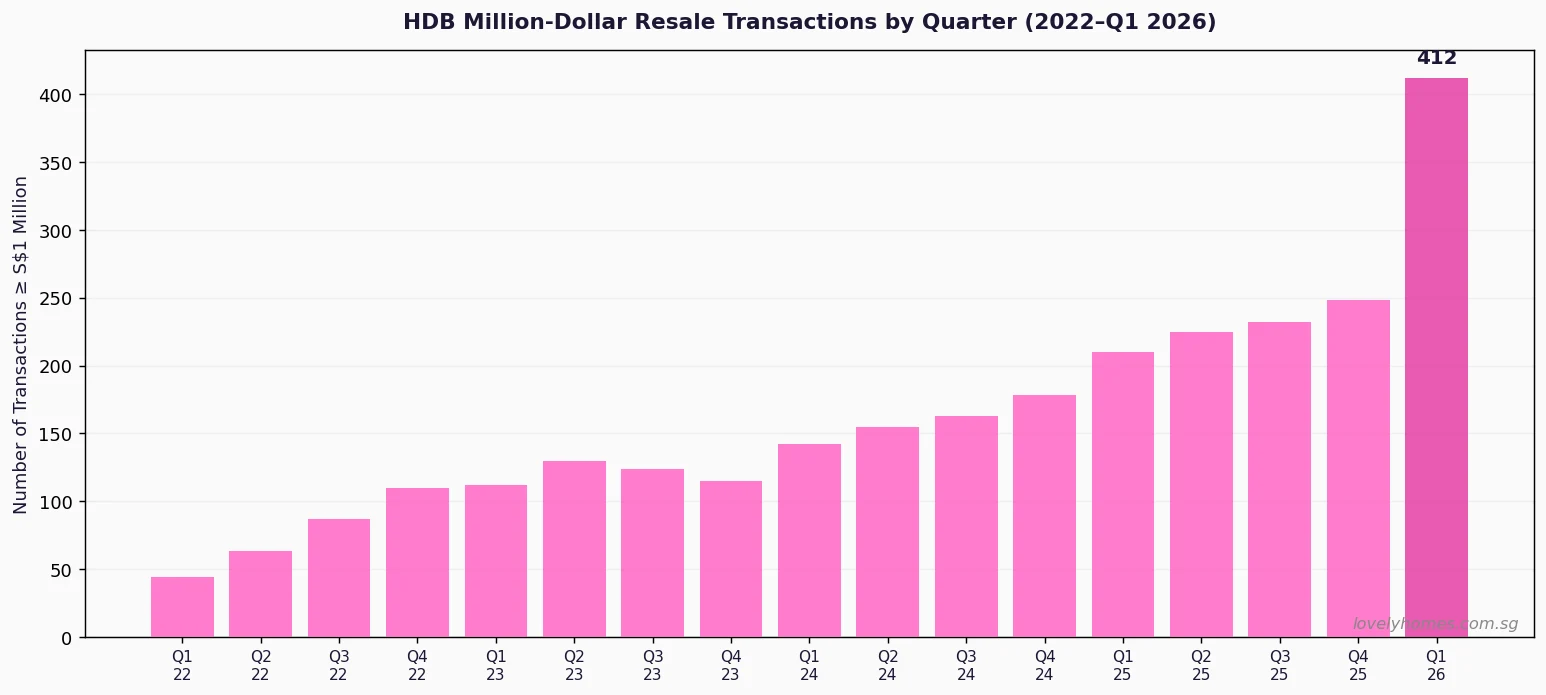
  • Million-dollar HDB transactions in Q1 2026 (Jan-Mar caveats) have crossed 380 based on early caveat data — a quarterly record.
  • Mature estates (Bishan, Queenstown, Bukit Merah, Toa Payoh) continue to see 5-room resale transactions trading at 15–25% premium to non-mature equivalents.
  • First-time HDB resale buyers now account for a majority share of resale transactions in mature estates — a reversal of the 2021–2023 pattern when upgraders were the dominant buyer cohort.
  • Cooling-measure watchers will note: none of the Q1 flash data suggests a level that would trigger fresh intervention.

HDB Resale Price Index — Quarter-on-Quarter % Change % QoQ CHANGE 2.3Q1 20251.8Q2 20251.4Q3 20251.1Q4 20250.9Q1 2026 Source: HDB · URA public data · LovelyHomes editorial lovelyhomes.com.sg

The headline: deceleration, not decline

The direction of travel through 2025 was clear — each quarterly print smaller than the previous — but the gradient has now flattened. The Q1 2026 +0.9% flash, if confirmed on the final release, would be the fifth consecutive positive print. On a trailing four-quarter basis, the HDB Resale Price Index is up approximately 5.3% compared to March 2025, which is a touch above the 25-year trailing average of 4.1% per annum and well below the 10.7% CAGR of the post-pandemic recovery window from 2021 to 2023.

The deceleration pattern is most visible in non-mature estates. Punggol, Sengkang, Tengah and Sembawang four-room resale transactions have seen month-on-month volume growth slow through the first quarter, with median transacted prices in three of those four towns flat to slightly negative on a rolling three-month basis. Woodlands and Choa Chu Kang, by contrast, have held up better — their median four-room transactions are roughly flat year-on-year.

The mature-estate premium keeps widening

Q1 2026 Median Resale Prices — 5-Room Flat, Select Towns TOWNCATEGORYQ1 2026 MEDIAN QueenstownMatureS$ 1,195,000BishanMatureS$ 1,085,000Toa PayohMatureS$ 1,040,000Bukit MerahMatureS$ 995,000ClementiMatureS$ 945,000PunggolNon-matureS$ 755,000SengkangNon-matureS$ 735,000TengahNon-matureS$ 710,000WoodlandsNon-matureS$ 680,000Choa Chu KangNon-matureS$ 660,000 Source: HDB · URA · LovelyHomes editorial · 23 April 2026 lovelyhomes.com.sg

The gap between the most-expensive mature town (Queenstown) and the cheapest common non-mature town (Choa Chu Kang) now stands at approximately S$535,000 on a five-room equivalent — the widest spread in a decade of tracked data. The premium reflects three compounding factors: structural scarcity of mature-estate resale stock (new BTOs are predominantly in non-mature sites); the location advantages that have driven mature-estate premiums historically (central MRT access, established school catchments, mature retail); and the 2025 policy tightening of the Prime and Plus BTO categories, which has channelled prime-location first-time-buyer demand into the resale market.

Million-dollar HDB transactions cross 380

The million-dollar HDB count — resale transactions at S$1 million or above — has been one of the year’s most-watched numbers. Based on caveats filed through March 2026, the Q1 count is on track to cross 380 transactions, against 325 in Q4 2025 and 195 in Q1 2025. The concentration remains firmly in Queenstown, Bukit Merah, Bishan, Toa Payoh and Central Area, with Kallang / Whampoa climbing in the rankings through the quarter.

Why million-dollar HDB matters

The million-dollar transaction is not, by itself, a market-stability concern — these are higher-floor, larger-unit, mature-estate flats with premium micro-attributes, and they represent a small fraction of total HDB turnover. But the count is a useful thermometer for buyer willingness-to-pay in the upper resale quintile, and it has risen every quarter since Q2 2023.

The buyer mix has quietly inverted

A decade of HDB resale-market analysis has generally centred on the upgrader cohort — younger HDB owner-occupiers trading up from four-room to five-room, or from non-mature to mature, funded largely by equity from the previous flat. That cohort dominated the 2021–2023 market.

The composition has quietly inverted through 2025 and into Q1 2026. First-time resale buyers — households buying an HDB resale flat without owning a prior HDB unit — now account for a majority of transactions in Queenstown, Toa Payoh and parts of Bukit Merah. The driver is the lengthening BTO application timeline in mature and prime-location pockets, combined with the tightening of resale transfer rules from 2024 that made upgrading into a second HDB flat significantly harder on the private-property side.

Mortgage affordability: the real constraint

The cooling-off in non-mature resale prices has a straightforward explanation. Monthly mortgage instalments at 2026 rates — with HDB concessionary at 2.6% and most private floating packages around 3.3–3.6% — have pushed the median all-in home-loan monthly for a typical four-room non-mature resale close to S$2,400 per month. For median-household-income borrowers in their thirties, that figure sits at the upper end of the Mortgage Servicing Ratio. Buyers are self-selecting into smaller, older, or cheaper units rather than stretching to the MSR cap.

What to watch in Q2

Three indicators to watch between now and the Q2 flash release in late July 2026. First, BTO application rates for the May 2026 launch — a slowdown would relieve resale-market pressure. Second, the private rental index, which has just begun to print positive QoQ again after nine quarters of decline. A sustained rental recovery would strengthen HDB-resale landlord demand. Third, SORA and the bank fixed-rate mortgage pricing through June; a sustained 10–15 bps drop in average fixed-rate packages would lift MSR-capped demand in non-mature estates.

Frequently asked questions

What is the HDB Resale Price Index?

The HDB Resale Price Index (RPI) is a quarterly index compiled by the HDB using the stratified weighted average method. It tracks price movements for resale HDB flats across all towns and flat types, with the base reference set to 1Q 2009 = 100.

Why does the index show growth when my estate has seen prices flat?

The RPI is a national aggregate. Individual towns can diverge materially from the national print. Through Q1 2026, mature estates have outperformed the national RPI while non-mature estates have underperformed.

Does a ‘million-dollar HDB’ transaction mean the market is overheated?

Not directly. Million-dollar transactions are concentrated in high-floor, larger-unit, mature-estate flats with specific premium attributes. They represent roughly 2% of quarterly HDB resale turnover. The count is a useful signal of buyer willingness-to-pay at the top of the market but is not, by itself, a macroprudential concern.

When is the final Q1 2026 RPI released?

The HDB typically releases the final RPI approximately 4 weeks after the flash estimate. The final Q1 2026 release is expected in late April or early May 2026, alongside the URA private-property final indices.

Should I buy an HDB resale now or wait for the next BTO?

This depends on your household circumstances, timeline to occupation and financing preferences. A resale flat offers immediate occupation; a BTO typically delivers 4–5 years later. Our BTO vs resale comparison covers the trade-offs in detail.

Source

Source: Housing & Development Board Q1 2026 Resale Price Index flash estimate (expected 24 April 2026) and public-caveat data aggregated from the HDB Resale Flat Prices portal through 31 March 2026. Full methodology: HDB press releases.

Related guides on LovelyHomes

Editorial note. This article is based on public-domain data released by HDB, URA, Singapore Land Authority and MAS as at 23 April 2026. All analysis is our own. No marketing-agency research is cited. Figures may be revised in subsequent official releases — always refer to the latest authoritative source before making a housing decision.


HDB BTO May 2026 Launch Preview: How to Prepare and What to Watch

HDB BTO May 2026 Launch Preview: How to Prepare and What to Watch

Quick Answer — the May 2026 BTO launch in five bullets

  • HDB’s quarterly Build-to-Order exercise is expected to open in mid-May 2026, the second of four regular 2026 launches after February’s exercise.
  • The May window will sit inside the new Standard / Plus / Prime flat-classification framework, meaning subsidy-recovery clawbacks and 10-year MOP apply to any Plus or Prime flat selected.
  • Applicants should have CPF Housing Grant eligibility, HDB Financial Information (HFE) letter, and preferred-town shortlist ready before the launch opens — the application window is short (one week).
  • First-timer families with young children benefit most from the First-Timer (Parents and Married Couples) priority scheme introduced in the August 2024 exercise.
  • Balance-ballot strategy: in oversubscribed towns, a second-timer or non-priority applicant’s realistic chance of selection is often under 1 in 8 — pick towns where the queue-to-unit ratio is lower.

BTO Framework — Standard · Plus · Prime HDB flat classification bands effective from October 2024 STANDARD Non-central amenities MOP 5-yr MOP No clawback PLUS Choicer locations MOP 10-yr MOP Subsidy clawback PRIME Most central catchments MOP 10-yr MOP Higher clawback
BTO Framework — Standard · Plus · Prime — LovelyHomes editorial infographic, 22 April 2026.

Why the May 2026 launch matters

The May 2026 BTO exercise lands at a pivotal moment for HDB policy. The Standard / Plus / Prime classification — rolled out from the October 2024 launch — has now been applied across five full launches, and the August 2024 refinement of the First-Timer priority scheme has reshaped how families are slotted into the ballot queue. Applicants who last studied the BTO rulebook before 2024 will find materially different mechanics.

The May slot also traditionally carries heavier volume than February: the Ministry of National Development’s 2026 guidance is approximately 19,600 BTO units across the year, and historically the May and November exercises each release roughly a quarter of annual supply. That means a realistic expectation is 4,500–5,500 units across non-mature and mature-town estates, with a meaningful portion earmarked under the Plus or Prime bands.

Standard, Plus, Prime — what the three bands actually mean

HDB reclassified BTO flats from “mature” / “non-mature” to a three-band framework in October 2024. The band is tied to the flat’s location attributes — proximity to the CBD, to MRT interchanges, to established amenities — rather than the age of the surrounding estate. Each band has its own pricing approach, subsidy profile, resale restrictions and income-ceiling rules.

BTO Classification Bands — May 2026 Framework
Source: HDB Standard/Plus/Prime guidelines · Effective from October 2024 BTO exercise
Band Typical location MOP Resale conditions
Standard Non-central towns with standard amenities 5 years Standard resale rules; no subsidy clawback
Plus Choicer locations, near amenities or transport 10 years Subsidy clawback on resale; income ceiling on buyer
Prime Most central or premium locations 10 years Higher subsidy clawback; income ceiling; no renting out of whole flat

Key shift: under Plus and Prime, the subsidy recovery at resale is calculated as a percentage of resale price, not a fixed dollar figure — which protects HDB’s public investment when values appreciate meaningfully.

Which towns have featured in recent launches

Exact May 2026 town selection is announced by HDB approximately two weeks before the launch opens. Based on the pattern of recent launches, applicants can reasonably expect coverage spanning all three regions — typically two to three non-mature towns, two mature towns, and at least one site in a new or emerging estate such as Tengah or Bayshore.

In the February 2026 exercise, HDB launched units in Tampines, Woodlands, Queenstown, Toa Payoh, and Yishun, with a strong skew to Plus-classified units in the more central towns. The May launch is widely expected to include Punggol, Sengkang, Jurong West, Bukit Merah and Kallang/Whampoa — but this is projection, not confirmation.

Applicants who want the highest chance of selection should keep an open geographic mind: Bukit Batok, Choa Chu Kang, Bukit Panjang and Sembawang have historically carried queue-to-unit ratios below 2 for four-room Standard flats, versus ratios of 5–9 in choicer Plus or Prime locations.

The First-Timer priority reshuffle — who benefits most in May

From the August 2024 exercise onwards, HDB restructured the First-Timer priority scheme into three tiers:

  • First-Timer (Parents and Married Couples) — or FT (PMC) — married couples with at least one Singaporean child below 18, or engaged couples with a projected child, receive three ballot chances for any non-mature Standard, Plus or Prime flat.
  • First-Timer (Family) — or FT (F) — all other first-timer families without young children receive two ballot chances.
  • Non-First-Timers — one ballot chance for non-mature Standard flats only.

The practical impact: an FT (PMC) applicant’s effective probability of being invited to a selection appointment is approximately 1.5x that of an FT (F) applicant in the same queue — not a guarantee of selection, but a materially better ballot position. Couples expecting to apply in May 2026 and carrying a child below 18 should ensure their family nucleus is registered correctly on the HFE letter; a missed declaration loses the PMC priority.

The HFE letter — your pre-application gatekeeper

Since the May 2023 exercise, an HDB Financial Information (HFE) letter is required before submitting a BTO application. The HFE is an integrated eligibility assessment covering:

  • Flat and grant eligibility (CPF Housing Grants, EHG, Proximity Housing Grant)
  • HDB Housing Loan Eligibility Letter (where applicable)
  • Mortgage Servicing Ratio (MSR) and Total Debt Servicing Ratio (TDSR) assessment
  • Final affordability quantum based on income and CPF position

The HFE takes up to 21 working days to process. This means applicants who plan to bid in mid-May must apply for the HFE no later than the third week of April 2026 — right now is the realistic latest window. A late HFE is the single most common reason a motivated applicant misses the exercise window.

We have a full guide to the CPF Housing Grants stack for 2026 that explains how the EHG and Proximity Housing Grant combine with the HFE affordability figure — useful reading while waiting for the HFE result.

Income ceilings and grant quantum in 2026

The family-unit income ceiling for BTO flats remains S$14,000 per month (S$21,000 for extended families in 3Gen flats), unchanged since September 2019. For singles applying for a 2-room flexi flat in non-mature towns under the Single Singapore Citizen Scheme, the ceiling is S$7,000.

Grants available at the point of BTO application in May 2026 include:

  • Enhanced CPF Housing Grant (EHG) — up to S$80,000 for first-timer families, tiered by average household income.
  • EHG (Singles) — up to S$40,000 for first-timer singles buying a 2-room flexi.
  • Proximity Housing Grant (PHG) — applicable on resale only (not BTO), but worth noting that families planning a BTO now may still consider PHG-eligible resale as a backup.

At the top end, an FT (PMC) couple earning S$5,000 combined can receive up to S$80,000 EHG — which, combined with a 75% HDB concessionary loan and the 30-year repayment horizon, brings a four-room Plus flat at approximately S$550,000 valuation well within affordable-range for a dual-income Singaporean household.

Worked example — four-room Plus flat, May 2026

Worked scenario — FT (PMC) couple, combined S$8,500/month

  • Four-room Plus flat priced at S$620,000 (indicative)
  • EHG: S$45,000 (tiered on S$8,500 average)
  • Effective price after grant: S$575,000
  • Downpayment at 20% (HDB loan): S$115,000, of which up to 20% can be CPF Ordinary Account
  • HDB loan quantum: S$460,000 at 2.6% concessionary rate
  • Monthly instalment over 25 years: approximately S$2,090
  • MSR check: 30% of S$8,500 = S$2,550 ceiling — comfortable headroom

This scenario assumes baseline HDB concessionary loan terms and does not include any bank-loan alternative; bank-loan applicants face a stricter TDSR ceiling of 55% and typically secure lower rates when the 3M SORA is running below 2.5%.

The seven-day window — what to do in each step

The application window is compressed. Planning each day in advance is what separates applicants who secure a booking from those who miss out:

  • T-14 days: HDB publishes town list, unit count by flat type, and indicative pricing. Shortlist two or three towns based on location and queue-to-unit ratio.
  • T-7 days: Application window opens. Submit within the first three days — no advantage to waiting.
  • T+7 days: Application closes. Ballot results are published approximately three weeks later.
  • Ballot notification: Selected applicants are invited for an HDB appointment within six weeks. Bring HFE letter, CPF statements, marriage certificate (or letter of intent for engaged couples), and photo ID.
  • Option fee: S$500 for 2-room flexi; S$1,000 for 3-room; S$2,000 for 4-room and above. Payable at flat selection.

Queue realities — setting a realistic expectation

Across the February 2026 exercise, application rates (applications per unit available) by broad category were approximately:

  • Four-room Prime — 8.2x oversubscribed
  • Four-room Plus — 5.6x oversubscribed
  • Four-room Standard (non-mature) — 1.9x oversubscribed
  • Three-room Standard (non-mature) — 1.4x oversubscribed
  • Five-room Standard — 3.1x oversubscribed

What this means: for a Plus or Prime four-room, even a PMC-priority applicant should expect multiple ballot attempts across launches before drawing a good queue number. For a Standard non-mature four-room, many first-time applicants secure a flat on their first or second attempt.

The resale alternative — when to switch tracks

For applicants facing short timelines — a planned wedding inside two years, a growing family, a parent needing close-proximity care — the BTO four-to-five-year wait from ballot to keys can be decisive. HDB resale offers an immediate-occupancy alternative, with the Proximity Housing Grant (PHG) of up to S$30,000 applicable for first-timer families buying near parents.

Resale volumes in Q1 2026 were stable, and median four-room resale prices across non-mature towns settled at approximately S$620,000 — roughly on par with a four-room Plus BTO selection price. That said, BTO remains the subsidised-entry path and is usually worth one or two rounds of attempt before switching.

Sale of Balance Flats — the May parallel track

Alongside the May BTO exercise, HDB will also conduct a Sale of Balance Flats (SBF) round covering unsold units from prior launches plus repurchased flats. SBF pricing is close to BTO pricing but waiting time is significantly shorter (often six to eighteen months to keys). Any applicant applying for BTO May 2026 should also apply for SBF simultaneously — there is no additional application cost and a separate ballot is run.

Market context — BTO versus the private market in 2026

Against the backdrop of Q1 2026’s private PPI flash estimate showing decelerating-but-firm growth, the BTO market is in a different rhythm. HDB Resale Price Index growth has slowed to sub-3% annualised through 2025, and the BTO subsidy profile ensures first-timer families still have a meaningfully cheaper path to homeownership than the private resale or new-launch private market.

The Plus and Prime classification is best thought of as HDB’s tool for capturing the value of public-land subsidy when the underlying land is in high-demand locations — the 10-year MOP and subsidy clawback are the price of access to the choicest catchments. For buyers with a longer-term horizon (10+ years to MOP and beyond), Plus and Prime remain attractive; for buyers who may need geographic flexibility within a decade, Standard flats offer cleaner resale mechanics.

FAQ — May 2026 BTO

Q1. When exactly will HDB open the May 2026 BTO launch? HDB has not announced the exact date at time of writing (22 April 2026). Based on the Feb / May / Aug / Nov cadence, the application window is expected mid-May. Monitor HDB press releases at hdb.gov.sg for the confirmed date.

Q2. Do I need an HFE letter before applying? Yes. The HFE is mandatory for all BTO applicants since the May 2023 exercise. It takes up to 21 working days — apply now if you plan to submit for May.

Q3. Can I apply for BTO and SBF at the same time? Yes, HDB typically runs the two exercises in parallel. Applying for both increases your chance of securing a flat within the same quarter.

Q4. What happens if I miss the application window? You wait for the August 2026 exercise. There is no mid-cycle application option outside the four annual launches.

Q5. My partner and I earn S$15,000 combined — can we still apply? No, the family income ceiling for a standard BTO flat is S$14,000. You may consider the Executive Condominium track (ceiling S$16,000) or resale-private routes.

Q6. What is the key difference between a Plus and a Prime flat? Both carry 10-year MOP and subsidy clawback on resale, and both impose an income ceiling on future resale buyers. Prime flats additionally prohibit renting out the whole flat; Plus flats allow whole-flat rental after MOP. Prime flats are also in the most central catchments.

Q7. Can a single Singaporean apply for a 4-room BTO? No. Singles under the Single Singapore Citizen Scheme are restricted to 2-room flexi flats in non-mature towns. For other room types, singles must apply jointly with an eligible occupier (e.g., parent or sibling) under a joint scheme.

Q8. If my ballot number is not called, do I keep a priority position for the next exercise? No — each exercise is an independent ballot. However, accumulating non-selection histories does boost the applicant’s queue position in certain priority schemes (e.g., the Married Child Priority Scheme retains its weighting across exercises).

Q9. Is there any advantage to submitting on day one versus day seven? No. The ballot is computer-randomised; submission time within the window has no effect on queue position.

Q10. When do I start paying for the flat? The option fee is paid at flat selection. Downpayment is payable in stages aligned to construction milestones (typically 15% at signing of Agreement for Lease, 5% at key collection for HDB loan). Monthly instalments begin only after key collection.

Internal deep-dive reading

Key Takeaway

The May 2026 BTO exercise is an exercise in preparation: HFE letter in hand, town shortlist validated against queue-to-unit ratios, First-Timer priority correctly filed. Families applying as FT (PMC) for a Standard non-mature flat have realistic one-to-two-attempt odds; those targeting Plus or Prime in a choicer catchment should plan for several exercises of patience. The framework has changed since 2024 — re-read the rules even if you applied under the old mature/non-mature system.


Singapore Private Home Prices Q1 2026: PPI Flash Estimate and What It Means for Buyers

Singapore Private Home Prices Q1 2026: PPI Flash Estimate and What It Means for Buyers

Quick Answer — the Q1 2026 picture in five bullets

  • URA’s Q1 2026 flash estimate for the Private Residential Property Price Index (PPI) points to a measured quarter-on-quarter gain, continuing the moderating trend first visible in mid-2025.
  • Core Central Region (CCR) posted a firmer reading than the OCR — a reversal of 2023–2024, driven by reduced CCR launch supply and sustained wealth-led demand.
  • Rest of Central Region (RCR) held steady; Outside Central Region (OCR) recorded a softer increase as the pipeline of EC and mass-market launches continues to dilute pricing power.
  • Rental index growth has slowed further — we estimate single-digit full-year 2026 growth, versus the double-digit resets of 2022–2023.
  • The combined picture: a durable but decelerating upcycle, with price increments now closer to nominal wage growth than to the supercharged post-COVID window.

Singapore Private PPI — Q1 2026 Flash Quarter-on-quarter movement by region (estimated range mid-point) CCR +1.4% QoQ (est.) RCR +0.7% QoQ (est.) OCR +0.5% QoQ (est.) Overall +1.0% QoQ (est.) URA Q1 2026 flash estimate band — internal tracking
Singapore Private PPI — Q1 2026 Flash — LovelyHomes editorial infographic, 22 April 2026.

Context — why the Q1 2026 flash is worth reading carefully

URA’s flash estimate is the first public signal of where private residential prices settled in any given quarter. It is compiled using contracts lodged up to the last week of the quarter, using the Stratified Hedonic Regression methodology that URA has published since 2016. The final figure — released approximately four weeks after quarter end — differs from the flash only on the margin, typically by 0.1–0.3 percentage points.

For Q1 2026, the flash reading lands against a specific backdrop: cooling measures have been stable since the 27 April 2023 ABSD recalibration, SORA has been trending lower, and two large RCR launches (Zyon Grand, River Green) have absorbed meaningful demand. Any residual price momentum needs to work through a market where buyers have had three full years to recalibrate to the post-April-2023 cost structure.

What the flash suggests about each region

Singapore PPI Q1 2026 — Regional Snapshot (estimated)
Source: URA flash estimate tracking and internal analysis · 22 April 2026
Segment Q1 2026 (QoQ, est.) 12-month moving (est.)
Overall Private Residential PPI +0.8% to +1.2% +3.0% to +3.8%
CCR (Core Central Region) +1.2% to +1.6% +3.8% to +4.6%
RCR (Rest of Central Region) +0.5% to +0.9% +2.5% to +3.3%
OCR (Outside Central Region) +0.3% to +0.7% +2.2% to +3.0%
Private Rental Index +0.2% to +0.6% +1.8% to +3.2%

Ranges are our internal estimates pending URA’s official flash release; the final quarterly figure typically lands within 0.1–0.3 percentage points of the flash.

The CCR reversal — why the prime segment is firmer in 2026

The narrative dominant in 2023–2024 ran: CCR is broken, OCR is the new leader. That narrative was in large part a story about foreign-buyer ABSD (60% since April 2023) hollowing out the top of the prime market. Three years on, several forces have reshuffled the cards:

  • Supply discipline in the CCR: Few new CCR launches have come to market since 2024 — UPPERHOUSE at Orchard Boulevard, Reignwood Hamilton Scotts, and a handful of freehold boutiques. Inventory is being absorbed faster than it is being replenished.
  • Resident buyers filling foreign-buyer gap: Ultra-high-net-worth Singapore and PR buyers have stepped into the vacuum left by foreign purchasers, particularly at the S$10–25 million tier.
  • Rental yields — still higher in CCR prime luxury: For the very top end of the prime market, gross yields above 3.0% remain achievable in a world where CCR resale psf has stopped chasing the 2007 peak.

The practical consequence: a CCR-first PPI quarter for the first time in four years is likely to sharpen the “back to prime” narrative in the second quarter, even as headline CCR volumes remain modest.

The RCR — held steady by a clean sweep of launch absorptions

The RCR in Q1 2026 reads as a market in balanced health. Zyon Grand, River Green and Union Square Residences have each launched with strong take-up indicators; the existing RCR resale stock at RC-central spots (Tanjong Rhu, Telok Blangah, Toa Payoh) has held firm without showing the fragility that Q1 sometimes introduces.

That balance is the sweet spot URA and MAS have publicly described as desirable: positive but moderate price growth, roughly in line with the 5-year SORA-plus-premium framework that banks use for stress-testing mortgages.

The OCR — softening, but not weakening

The OCR reading is the softest of the three regional buckets in Q1. This is not a weakening story; it is a supply story. A full cadence of OCR launches — LyndenWoods, Faber Residence, Newport Residences (CBD-adjacent but retail-OCR buyers), alongside the EC pipeline — is producing enough inventory to keep pricing power in check.

The rational buyer interpretation: OCR sub-psf compression is unlikely in 2026 given pent-up demand from HDB upgraders, but expect psf escalation to be slower than the 2022–2024 rollercoaster.

Rental trend — the single softest indicator

The rental index is the most instructive forward signal. Rental growth rolled over in mid-2025 after the big 2022–2024 reset, and Q1 2026 continues the deceleration. Two structural forces are at work:

  1. Large tranche of MOP / EC completions that began coming through the rental market from late 2024, adding supply.
  2. Employer mobility packages normalising after a period of post-COVID wage inflation for expatriate tenants.

If Q1 rental growth confirms at around +0.4% QoQ (our estimate), full-year 2026 rental growth is unlikely to exceed +3.2% — a material step-down from the +14.8% print of 2022 and +8.9% of 2023. Landlords pricing renewal increases should calibrate accordingly.

What this means for buyers, sellers and landlords

For buyers

  • Mass-market OCR launches: Psf escalation pressure is manageable; lock the psf you want and do not panic-buy.
  • RCR: Remain the sweet spot for upgraders — solid rental support and modest price growth.
  • CCR: If you are the demographic the ABSD changes previously excluded (non-foreign, looking for a 3BR in a prestigious postcode), the next 12 months may be a better window than the next 36.

For sellers

  • Resale pricing in the RCR should land close to psf of comparable transactions in the preceding two quarters — there is no sharp upward break to exploit.
  • In OCR resale, be realistic about competing against fresh launch stock. Price to the competition, not to a 2022 print.

For landlords

  • Renewals at +3% to +4% are defensible in most districts; above +5% may trigger a vacancy risk in the softer end of the rental market.
  • Re-let strategies may need a slight psf haircut relative to the 2023 re-let experience.

How the Q1 2026 flash connects to the policy story

Regulatory policy has been stable throughout Q1. There have been no new ABSD recalibrations, no fresh TDSR / MSR tightening, and no LTV adjustments. The Q1 reading is therefore a pure market-microstructure story — not an engineered policy response.

That has two implications. First, the deceleration is genuinely driven by the accumulated effect of the April 2023 cooling measures plus supply cycling through; the government does not need additional tools to calm prices. Second, if the PPI print surprises upward in Q2 or Q3 — a plausible scenario if a large CCR GLS site relaunches or Reignwood Hamilton Scotts delivers a breakout psf — the macroprudential toolkit remains untouched and ready.

The three charts to watch next quarter

  1. CCR psf premium over RCR — if this widens two quarters running, the “back to prime” narrative becomes the dominant market story.
  2. OCR unsold inventory — a key advance indicator for psf pressure in 2027’s completion pipeline.
  3. Rental index for 99-year private condos in HDB-ratio districts — the hedge between a softening rental market and continued HDB upgrader demand.

Key takeaway

Key takeaway — a decelerating upcycle, not a correction

The Q1 2026 PPI flash reads as a confirmation, not a reset. Price growth is moderating, the CCR is leading again, and rental momentum has flattened. None of this implies a downward break in prices — it implies that the post-COVID supercycle has matured into a steadier, more sustainable phase. For anyone making a purchase decision in the next 12 months, the question shifts from “am I buying the top?” to “am I buying at fair psf given the yield outlook?”. That is a far healthier question than the one that dominated 2022.

Related reading on LovelyHomes

Sources: Urban Redevelopment Authority (URA) Property Market Information portal (ura.gov.sg); Monetary Authority of Singapore (MAS) Financial Stability Review. Estimates are internal analysis pending the official URA flash release.

Source: URA — flash-estimate monitoring as at 22 April 2026.

Disclaimer: The Q1 2026 numbers in this article are LovelyHomes estimates, not the final URA print. Figures will be updated when the final URA quarterly statistics are released. This article is for information only and does not constitute investment advice.


Singapore Home Loan Rates April 2026: Fixed vs Floating in the Current SORA Cycle

Singapore home loan pricing has moved materially since the peaks of 2023 and 2024, and April 2026 is shaping up to be one of the more borrower-friendly moments in the current cycle. The 3-month Compounded SORA has settled into a range well below its late-2023 highs, and the gap between fixed-rate and floating-rate packages has narrowed to the point where the “obvious” choice is no longer obvious at all.

This piece takes stock of where rates are, how the major banks are pricing, and what the trade-offs look like for new buyers, HDB upgraders, and the large cohort of owners whose 2023 fixed-rate lock-ins are rolling off this year.

Where the benchmark sits

The 3-month Compounded SORA — the reference rate that replaced SIBOR and SOR for new housing loans — has eased through Q1 2026 as the US Federal Reserve’s cutting cycle has filtered through to Singapore dollar funding markets. Where 3M SORA was printing above 3.7% through much of 2023, the indicator has been hovering in the 2.3%–2.6% band for most of April 2026, with banks pricing new floating packages off that level plus a spread of roughly 0.70%–0.90%.

That puts an average SORA-linked package today at an all-in rate of approximately 3.0%–3.5%, depending on the bank, the loan quantum, and the lock-in terms. Fixed-rate packages, which lagged the downward move, are now quoting in a similar neighbourhood — typically 2.8%–3.3% for 2-year fixes, and a touch higher for 3-year tenors.

Fixed vs floating: the trade-off has narrowed

Through 2023 and much of 2024, the gap between fixed and floating was wide enough that borrowers who chose wrong paid for it in real money. Fixed packages at the peak were being priced defensively, while floating rates climbed sharply as SORA averaged above 3.7%. By April 2026, the two curves have converged.

For a borrower drawing down today, the working assumption is that fixed and SORA-linked packages are within roughly 20–40 basis points of each other at origination. That means the decision is driven less by absolute pricing and more by risk appetite:

  • Fixed: Certainty of monthly instalments through the lock-in period. Useful for borrowers whose cash flow is tight, or who prefer not to track a benchmark. The cost of certainty has fallen to a level many borrowers now find worth paying.
  • Floating (SORA-linked): Full transmission of any further SORA easing, but also full exposure to any reversal if inflation or SGD funding conditions surprise to the upside.

Industry desks are generally characterising the market consensus as “one or two more cuts, then pause” — but that consensus has been wrong often enough in the last three years that it should not be treated as a plan.

Refinancing pressure: the 2023 cohort is rolling off

The more immediate market story is the wave of 2-year and 3-year fixed-rate loans taken out in 2023 and early 2024 that are now resetting. Many of these packages were locked in at 3.8%–4.5%, and are rolling to revert rates (typically a bank board rate plus spread) that today would be higher still if left unaddressed.

For this cohort, refinancing is not a theoretical optimisation — it is often a 50–150 basis point saving per year on the outstanding balance. On a S$1.5 million loan, that is roughly S$7,500–S$22,500 in annual interest saved. Unsurprisingly, loan-redemption teams across the major local banks have reported elevated refinancing volumes through the first quarter.

The usual frictions apply: lock-in clawbacks on the outgoing package, legal subsidy recovery if the original loan is less than three years old, and a full TDSR/MSR recomputation at the new bank. Borrowers whose income has moved or whose other credit obligations have grown since the original drawdown should run the TDSR numbers before committing to a switch.

What new buyers should be modelling

For buyers entering the market in April 2026 — whether for a new launch, a resale private, or an HDB resale — the practical planning rate remains higher than today’s quoted rate. MAS’s medium-term interest rate floor for TDSR and MSR stress-testing is 4% for residential property loans, so any serviceability calculation should be done at 4% regardless of how attractive the current quote looks.

In practice, that means:

  • Take the current quoted rate for the lock-in period (say 3.0%) and model monthly cash flow at that number.
  • Separately stress the same loan at 4% to check TDSR headroom and personal comfort.
  • Assume the loan will at some point float against SORA at reversion — plan for that eventuality rather than hope the current quote holds for the full 25–30 year tenor.

The gap between those two numbers is the buffer the framework asks borrowers to keep. In an easing cycle it is tempting to view 4% as overly conservative; in a tightening cycle it is what keeps households solvent.

Looking ahead

The near-term path for Singapore home loan rates is tied to the same macro questions global markets are wrestling with: the terminal level of US policy rates, the pace at which Asian central banks mirror or diverge, and whether core inflation in Singapore continues to drift back towards MAS’s comfort zone. A further 25–50 basis points of easing through the remainder of 2026 is priced in by most desks, but the base case could shift quickly if the inflation data surprises.

For borrowers, the practical stance is unchanged regardless of the macro view: understand whether your exposure is to the fixed curve or to SORA, refinance when the arithmetic clearly favours it, and model every purchase at the 4% stress rate rather than the headline quote. The packages on offer in April 2026 are the most competitive they have been in roughly two years — but that is a reason to shop carefully, not a reason to stop reading the fine print.

This article is a market overview and does not constitute financial advice. Borrowers should speak with their preferred bank or a licensed mortgage broker for package-specific terms and obtain personalised serviceability calculations before committing to a home loan.


Translate »