June 2026 BTO Launch Preview: 6,900 Flats Across 7 Projects in 5 Towns

June 2026 BTO Launch Preview: 6,900 Flats Across 7 Projects in 5 Towns

HDB has unveiled the June 2026 Build-to-Order (BTO) sales exercise — the largest single launch of the year and the broadest geographic spread Singapore has seen in the post-classification era. Roughly 6,900 flats across seven projects in five towns will go on sale in the second week of June 2026, with the headline names being the first BTO at Lakeview (Bishan) in over forty years, the Berlayer Crescent project in Bukit Merah, two Plus-class projects in Ang Mo Kio, two big-supply Standard projects in Sembawang, and a 640-unit Standard project in Woodlands. About 47% of the supply has been classified Prime, 5% Plus, and the remaining 48% Standard — which means most of June’s launches will sit under HDB’s tighter resale framework with 10-year MOP and subsidy clawback.

This preview consolidates what HDB has confirmed, what industry research desks are guiding on indicative prices, and what Lovelyhomes’ own readers are likely to weigh up before the BTO portal opens. Application closes 15 June 2026 (rounded — exact date in HDB’s portal); ballot results follow approximately three weeks later.

Quick Answer — June 2026 BTO at a glance

  • Total supply: ~6,900 flats across 7 projects.
  • Towns: Bishan, Ang Mo Kio, Bukit Merah, Sembawang, Woodlands.
  • Mix: ~3,250 Prime (47%), ~370 Plus (5%), ~3,280 Standard (48%).
  • First-of-kind: first BTO at Lakeview in over forty years; first Pasir Panjang Prime since the classification framework launched.
  • Indicative 4-room price range: ~S$360k Sembawang/Woodlands → ~S$820k Bishan Lakeview, before EHG / PHG.
  • MOP: 10 years (Prime, Plus); 5 years (Standard).
  • Resale buyer income ceiling: S$14,000/month for Prime and Plus; none for Standard.
  • Application window: opens approximately 11 June 2026; closes mid-June; ballot ~early July.

The Seven Sites
June 2026 BTO seven sites table — Lakeview, Ang Mo Kio twin, Berlayer Crescent, Sembawang Drive, Sungei Sembawang, Woodlands
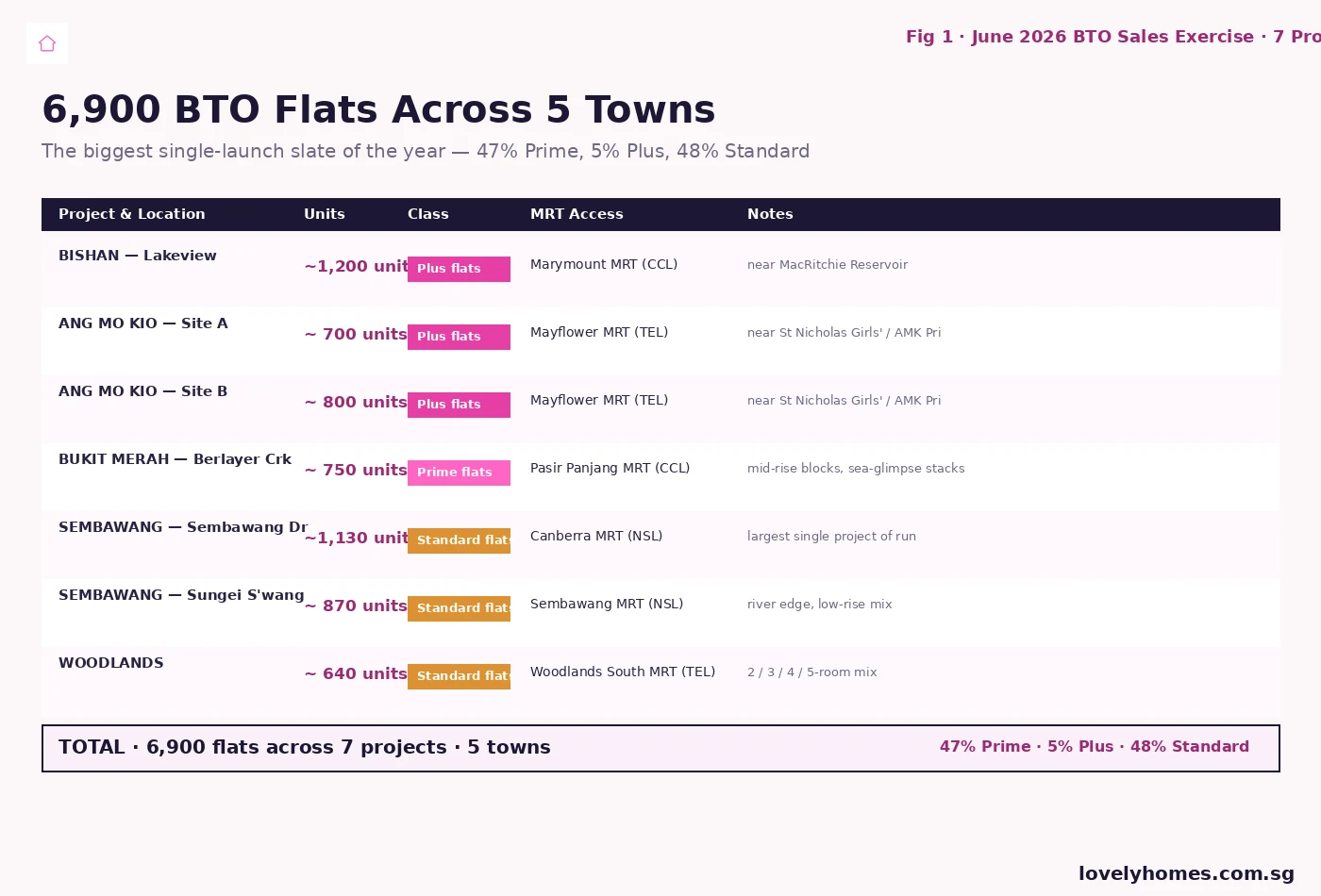
Figure 1: All seven June 2026 BTO sites, with rough unit counts, classification, and MRT access.

The June launch is dominated by two town clusters. The first is the Sembawang–Woodlands northern corridor, contributing roughly 2,640 of the 6,900 flats. Sembawang Drive alone is the single largest site of the run at around 1,130 units, with the smaller Sungei Sembawang project adding another ~870 units along the river edge near Sembawang MRT. Woodlands South contributes the remaining ~640 units. All three are Standard-class — the cheapest segment, the shortest MOP, and the largest pool of eligible resale buyers come 2031–32.

The second cluster is the central-mature corridor: Bishan’s Lakeview project (~1,200 units, Prime), the twin Ang Mo Kio sites near Mayflower MRT (combined ~1,500 units, Plus), and Bukit Merah’s Berlayer Crescent project near Pasir Panjang MRT (~750 units, Prime). This is where the headline-grabbing prices will sit. Indicative talk on Lakeview 4-room flats has run as high as S$820,000 before grants — a level that historically would have been a Bukit Merah or Tiong Bahru number, not a Bishan one. The Lakeview supply is the first BTO at the site since the late 1970s, and the project is positioned to be the tallest in its immediate area, with stacks oriented for MacRitchie Reservoir views.

Classification — Three Different Resale Worlds
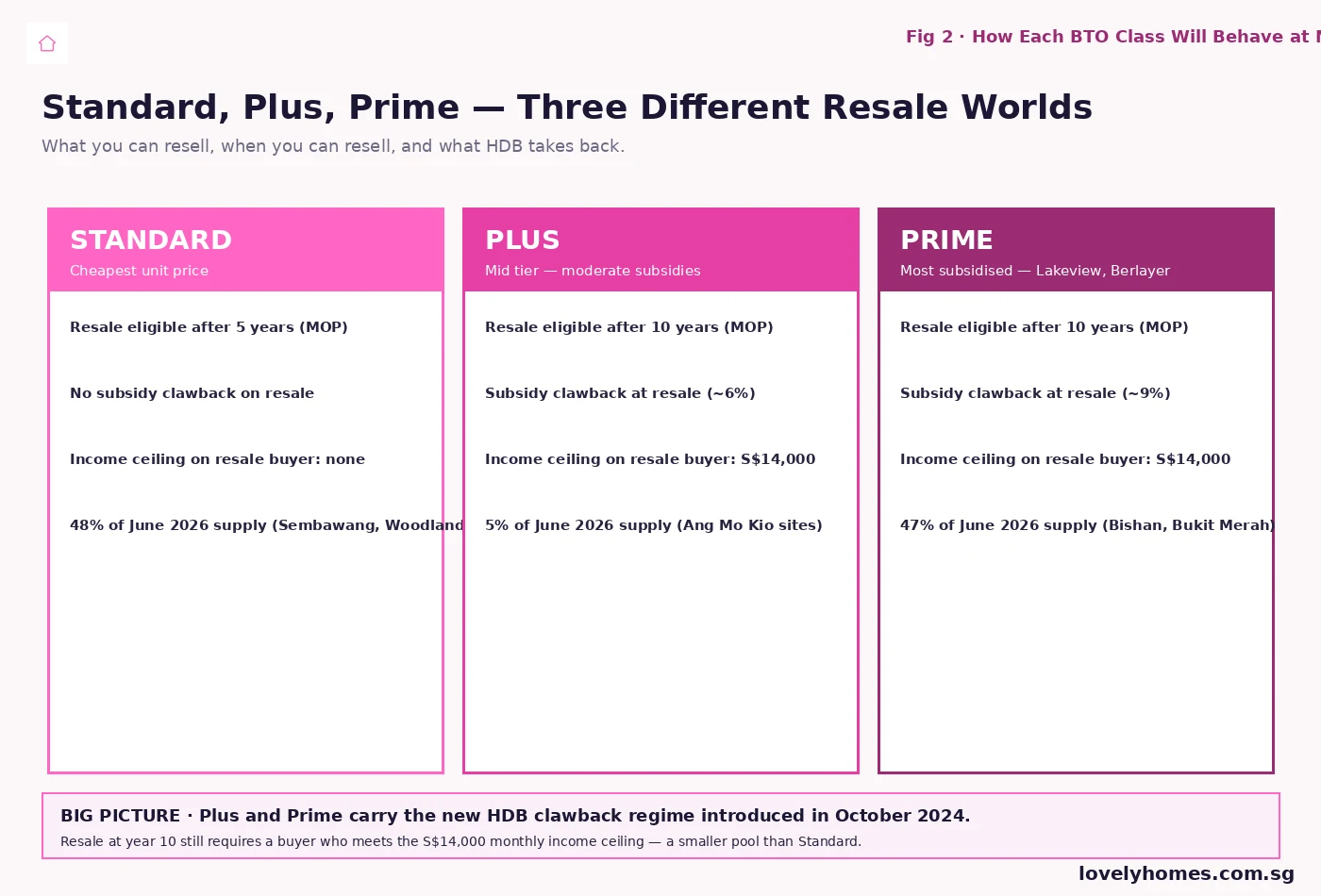
June 2026 BTO Standard Plus Prime classification — MOP, resale rules, subsidy clawback comparison
Figure 2: How each class will behave at MOP — Standard at year 5 with no clawback; Plus and Prime at year 10 with subsidy clawback and a S$14,000 buyer income ceiling.

HDB’s October 2024 classification framework is in full effect for the June 2026 launch. The Standard class behaves like the BTOs of the last two decades: 5-year MOP, open resale market on graduation, no clawback. The Plus class — represented in June by the Ang Mo Kio twin — carries a 10-year MOP, a ~6% subsidy clawback at first resale, and a S$14,000 income ceiling on the resale buyer. The Prime class — Lakeview, Berlayer Crescent — runs the same 10-year MOP and S$14,000 buyer ceiling, with a heavier ~9% clawback on first resale to reflect the deeper original subsidy.

The implication for buyers is that Plus and Prime are explicitly engineered as long-hold homes with a smaller resale pool. Standard is the one that retains the historical “BTO as wealth-builder” pattern. For first-time-buyer households running the affordability vs upside arithmetic, Standard at Sembawang or Woodlands is structurally different from Prime at Bishan — even before the price difference is factored in.

Indicative Pricing — Where the Money Lands
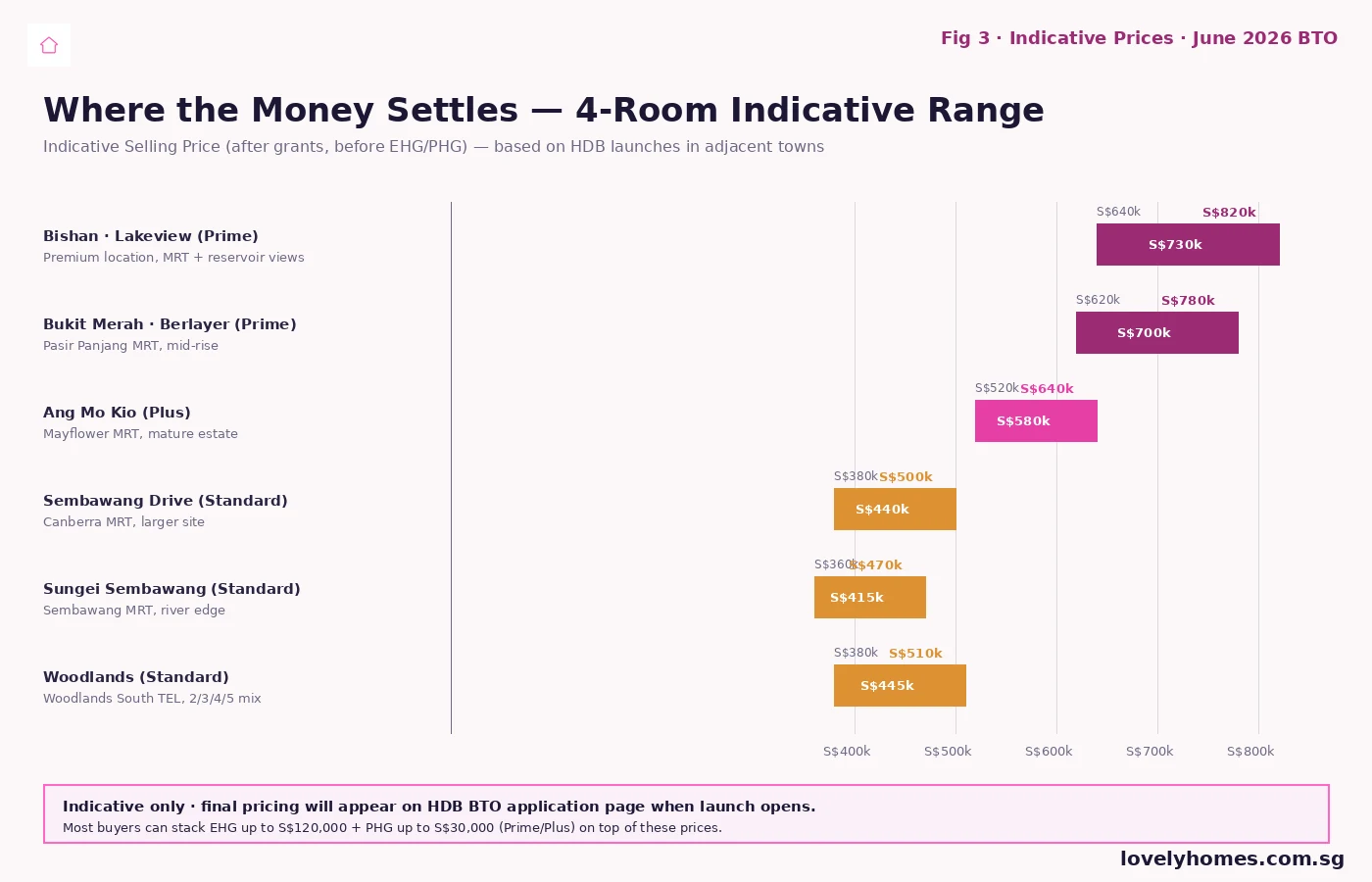
June 2026 BTO indicative 4-room prices — Bishan to Woodlands ranges from S$360k to S$820k before grants
Figure 3: Indicative 4-room prices before EHG and PHG grants. Final selling prices will appear on HDB’s BTO application page when the launch window opens.

HDB will publish the firm price tables when the application window opens. The indicative ranges sit roughly as follows for 4-room flats: Bishan Lakeview at S$640,000 to S$820,000; Bukit Merah Berlayer Crescent at S$620,000 to S$780,000; Ang Mo Kio at S$520,000 to S$640,000; Sembawang sites at S$360,000 to S$500,000; Woodlands at S$380,000 to S$510,000. These are mid-launch indications drawn from neighbouring BTO comparables and the early-2026 launch curve, not committed HDB figures. The Enhanced CPF Housing Grant (EHG) of up to S$120,000 and the Proximity Housing Grant (PHG) of up to S$30,000 are still claimable on top — meaning eligible first-timer households at Sembawang could see net selling prices as low as S$240,000 for a 4-room.

Worked Example — The Lim Household at Lakeview

Consider Mr Lim (33) and Mrs Lim (31), Singapore Citizens, first-timers with combined gross household income S$8,500/month. They apply for a 4-room flat at the Bishan Lakeview Prime project. Indicative price: S$760,000. They qualify for EHG of S$30,000 (combined-income tier) — Prime/Plus PHG of S$30,000 if Mrs Lim’s parents live within 4km, which they do. Net price: S$700,000. CPF OA balance: S$110,000. They opt for an HDB Concessionary Loan at 80% LTV (S$560,000 loan, S$140,000 downpayment).

The MSR check: at HDB’s stress rate of 4%, an S$560,000 loan over 25 years yields a monthly instalment of approximately S$2,956. That is 34.8% of S$8,500 — above the 30% MSR cap. To pass MSR, they must lengthen tenure to 30 years (instalment drops to ~S$2,672 / 31.4% — still over) or accept a smaller loan (~S$481,000 / S$2,539 / 29.9% — clears MSR). The MSR is the hardest constraint here, and at S$8,500 income the Lakeview Prime price point is right at the edge of affordability. Households below S$8,000/month will struggle to pass MSR at S$760,000 even with the maximum-tenure stretch; households at S$10,000–11,000/month clear it comfortably.

What this means for the ballot: Lakeview Prime will draw a higher-income applicant pool than typical first-timer BTO. Sembawang Standard at S$420,000 list pulls a much wider applicant pool that easily clears MSR at S$5,000–6,000/month combined. Application strategy follows the price gradient.

Comparison Table — June 2026 vs Recent Quarters

Sales Exercise Total Flats Towns Prime / Plus / Standard
Feb 2026 BTO ~5,500 Bedok, Bukit Batok, Hougang, Tengah, Toa Payoh ~22% / ~10% / ~68%
May 2026 BTO (preview) ~3,800 Bukit Merah, Tampines, Tengah, Woodlands ~30% / ~12% / ~58%
June 2026 BTO ~6,900 Bishan, AMK, Bukit Merah, Sembawang, Woodlands ~47% / ~5% / ~48%
Oct 2026 BTO (announced) ~7,200 Toa Payoh-Caldecott, Punggol, Yishun, others TBC TBC

What This Means for Different Buyer Profiles

First-time HDB buyer at S$5,000–7,000 combined income. Sembawang Drive, Sungei Sembawang, and Woodlands are the right fit. Standard class, 5-year MOP, prices that pass MSR comfortably with EHG-stacked subsidies. The northern corridor will face heavy first-timer demand but the supply is large enough to keep ballot odds reasonable for first-timers.

First-time HDB buyer at S$8,000–11,000 combined income. Ang Mo Kio Plus is the sweet-spot. Mature estate, MRT proximity, school catchment, and a price band that clears MSR with margin. The 10-year MOP and S$14,000 resale-buyer ceiling are real downsides if the household is upgrade-minded, but for buy-and-hold it is the strongest value-for-money in the launch.

First-time HDB buyer at S$11,000+ combined income. Bishan Lakeview and Bukit Merah Berlayer Crescent become serious. The Prime classification means the household must accept a long hold and a smaller resale pool, but the locations are in the top decile of HDB-accessible neighbourhoods. Affordability at S$760,000–820,000 only works at the higher income tier.

Second-timers and upgraders. The Plus and Prime sites apply the second-timer 70/30 quota; second-timers should expect lower ballot odds at Lakeview and Berlayer specifically. Standard sites at Sembawang and Woodlands are more accessible to second-timers because of the larger supply and the absence of the income ceiling on resale.

What Might Come Next

HDB has guided 19,600 BTO flats across 2026 (Feb + May/June + October). The October 2026 exercise is expected to be even larger than June, anchored by the Toa Payoh West / Caldecott MRT project (~1,600 flats including 240 Community Care Apartments) and supplementary supply at Punggol and Yishun. With Pearl’s Hill (60 storeys, ~1,700 flats) confirmed for the 2027 pipeline as Singapore’s tallest public housing, the next 18 months are looking like the highest-supply year of the post-COVID cycle. Whether that supply pulls down the HDB Resale Price Index — which slipped 0.1% in Q1 2026, the first quarterly decline in seven years — is the watch-point analysts will be tracking through 2H 2026.

Worked Example — Sembawang Drive Standard for the Median Household

Mr & Mrs Wong, both 30, combined income S$6,500/month, apply for Sembawang Drive Standard 4-room at indicative S$430,000. They claim EHG S$70,000 (combined income tier) — net price S$360,000. HDB Concessionary Loan at 80% LTV (S$288,000 loan; S$72,000 downpayment, fully claimable from CPF Ordinary Account). MSR at 4% / 25 years on S$288,000 = approximately S$1,521/month, which is 23.4% of S$6,500 — clears MSR with margin. TDSR not relevant for HDB Concessionary Loan. Cash outlay at completion: roughly S$5,000 of legal and stamp-duty incidentals. This is the median-income BTO arithmetic that the Standard class is engineered to deliver — and Sembawang Drive is one of the cleanest examples of it in the entire 2026 calendar.

Frequently Asked Questions

When does the June 2026 BTO application open and close?

HDB will open the application portal in the second week of June 2026, typically running for one calendar week. Ballot results follow approximately three weeks after the close. The exact dates appear on the HDB BTO application page once the launch is live; this preview was prepared from HDB’s announcement timeline and will be updated when firm dates are published.

What is the difference between Prime, Plus, and Standard?

HDB’s October 2024 framework defines three classes by location desirability and subsidy depth. Prime (~47% of June supply) carries the deepest subsidies, a 10-year MOP, a ~9% subsidy clawback on first resale, and a S$14,000/month income ceiling on the resale buyer. Plus (~5% of June supply) sits one tier below — same 10-year MOP and S$14,000 resale ceiling, with a lighter ~6% clawback. Standard (~48% of June supply) is the historical BTO model — 5-year MOP, no clawback, no resale ceiling.

Can I stack EHG and PHG on a Prime or Plus flat?

Yes. The Enhanced CPF Housing Grant (EHG) of up to S$120,000 for first-timer families is available across all three classes. The Proximity Housing Grant (PHG) of S$30,000 (married applicants living within 4km of parents) and S$10,000 (single applicants) is also available across all classes. Step-up Grant and Family Grant follow the same rules. Grant stacking does not change the MOP or clawback rules.

Why is Bishan Lakeview so much more expensive than Sembawang?

Three reasons. First, the location quality — proximity to MRT, mature estate amenities, and reservoir views — drives a higher base price band before subsidy. Second, Lakeview is Prime, which means HDB is delivering a larger absolute subsidy on a higher base price; the indicative price you see is already net of that subsidy. Third, redevelopment or land-cost factors specific to a central site push the underlying construction and tendering cost above an outer-town site like Sembawang Drive.

What is MSR and will I clear it?

MSR (Mortgage Servicing Ratio) caps your HDB or EC mortgage instalment at 30% of gross monthly income, computed at HDB’s 4% stress-test rate over your chosen tenure. For a 4-room flat at S$760,000 (Lakeview indicative) with an 80% loan and 25-year tenure, MSR clears at roughly S$8,800/month combined household income or higher. At S$420,000 (Sembawang indicative) the clear-MSR threshold drops to roughly S$5,000/month combined. See the LovelyHomes TDSR Singapore 2026 guide for the detailed mechanics.

Can I sell my Plus or Prime BTO before MOP?

Generally no. The MOP for Plus and Prime is 10 years from key collection, during which you cannot sell, rent out the entire flat, or buy a private property. Limited exceptions exist for divorce, financial hardship, and bereavement — applied case by case by HDB. Renting out individual rooms is permitted from the start, subject to HDB’s room-rental rules.

Related Articles

Disclaimer: This preview is based on HDB’s published announcements and industry-research-desk indications as of 04 May 2026. Final unit counts, classifications, indicative prices, and application dates appear on the HDB BTO application page once the sales exercise opens. All figures should be verified against the official HDB website before acting on them. This guide is for general information only and does not constitute legal, tax, or financial advice. Consult a licensed mortgage broker or HDB officer for advice specific to your circumstances.
HDB Million-Dollar Flats Singapore 2026: Where, Why, and Whether One Is Worth Buying

HDB Million-Dollar Flats Singapore 2026: Where, Why, and Whether One Is Worth Buying

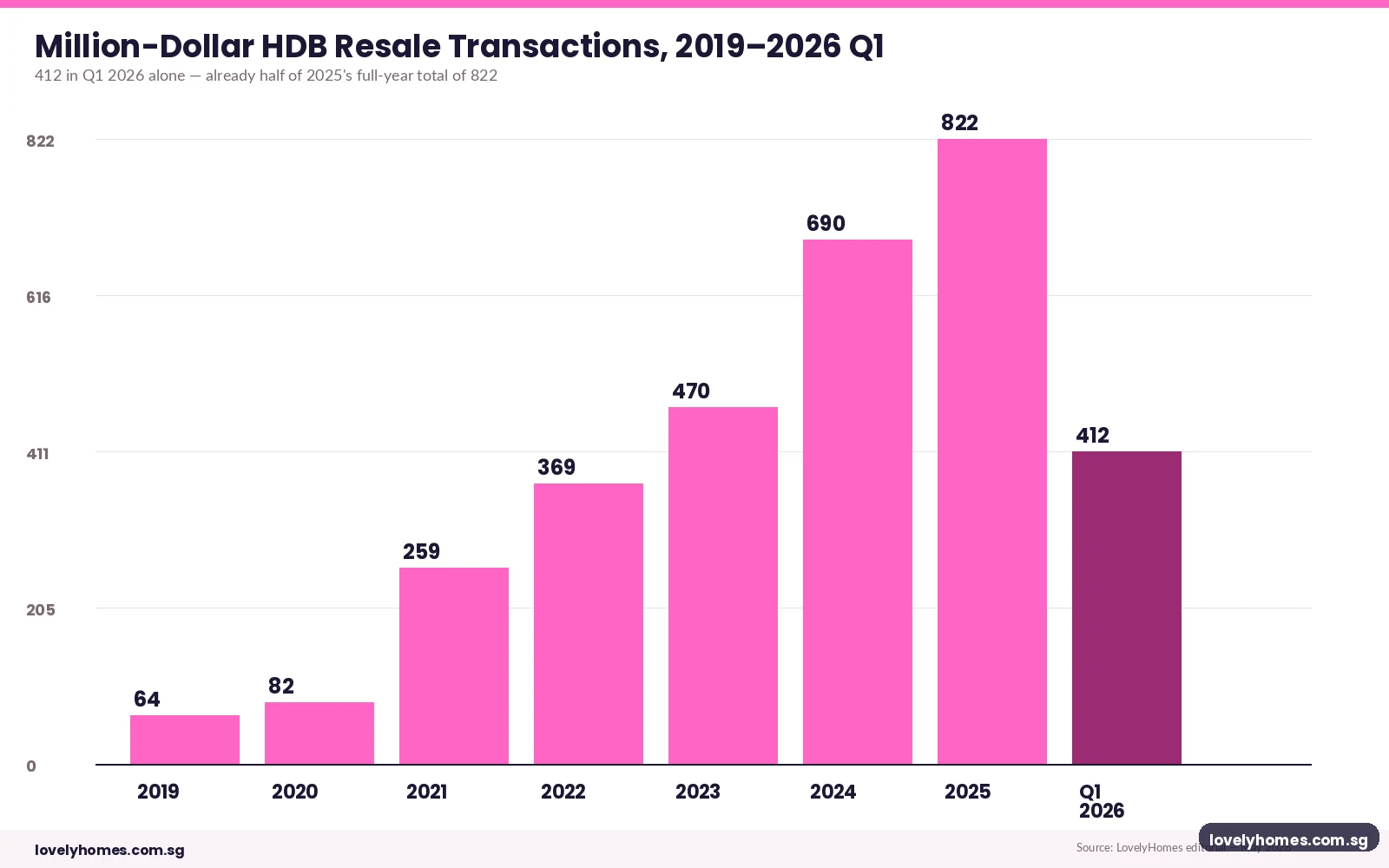
Million-dollar HDB flats are no longer the freak occurrence they once were. In the first quarter of 2026, 412 HDB resale transactions crossed the S$1,000,000 line — a single-quarter record, and already roughly half of the 822 logged across the whole of 2025. Bukit Merah, Toa Payoh, Queenstown, Bishan, and Kallang/Whampoa do most of the heavy lifting, but flats in Tampines, Sengkang and even outer-ring towns are now occasionally clearing the bar.

If you own one of these flats, you are sitting on a paper windfall that the rest of the market can only watch. If you are thinking about buying one, the question is harder: are you paying for a real long-run asset, or for a short-lived premium that will reset the moment supply normalises? This guide walks through the data, the geography, the buyer profile, and the upgrade math — with worked numbers in Singapore dollars.

For the full quarterly market context, see our companion piece on the HDB resale price decline in Q1 2026, the earlier flash-estimate analysis, and the URA private-market Q1 final figures.

Quick Answer — Million-Dollar HDB at a glance

  • 412 transactions crossed S$1,000,000 in Q1 2026 alone — a record quarter.
  • 2025 full-year total: 822, up from 690 in 2024 and 470 in 2023.
  • Top five towns: Bukit Merah, Toa Payoh, Queenstown, Kallang/Whampoa, Bishan — all mature, rail-served estates.
  • Typical winning unit: 4-room or 5-room flat, high floor, walking distance to MRT, with most lease years remaining.
  • Highest single sale on record: S$1.7 million at Dawson Road (5-room, Q1 2026).
  • For owners, the headline is paper wealth; the cash you walk away with after CPF refund + accrued interest is much smaller.
  • For buyers, factor MOP (5 years), the LTV cap on subsequent property, and the limited resale liquidity above S$1.2 million.

How Common Are Million-Dollar HDB Flats Now?

Think of it as a slow build, then a sharp acceleration. Pre-pandemic Singapore saw fewer than a hundred million-dollar HDB transactions a year, almost all of them at Pinnacle@Duxton or other iconic central blocks. From 2021 onwards, two things changed: the COVID-era price surge in resale lifted everything by about 30%, and a steady drip of well-located DBSS / SBF estates hit their MOP and entered the resale market. The result is the curve in Figure 1.

Million-dollar HDB resale transactions per year, 2019 to Q1 2026, rising from 64 in 2019 to 822 in 2025 and 412 in Q1 2026 alone
Figure 1 — Million-dollar HDB resale transactions per year, 2019 to Q1 2026.

The Q1 2026 number deserves its own line. At 412 it is roughly half a normal full-year total compressed into 12 weeks. It is also doing this while the broader HDB Resale Price Index fell 0.1% quarter-on-quarter for the first time since the second quarter of 2019. Two things are going on at once: the average flat is finally cooling after 25 consecutive quarters of growth, while the top end keeps climbing because demand for irreplaceable mature-estate stock has not budged.

Where Million-Dollar HDB Flats Cluster

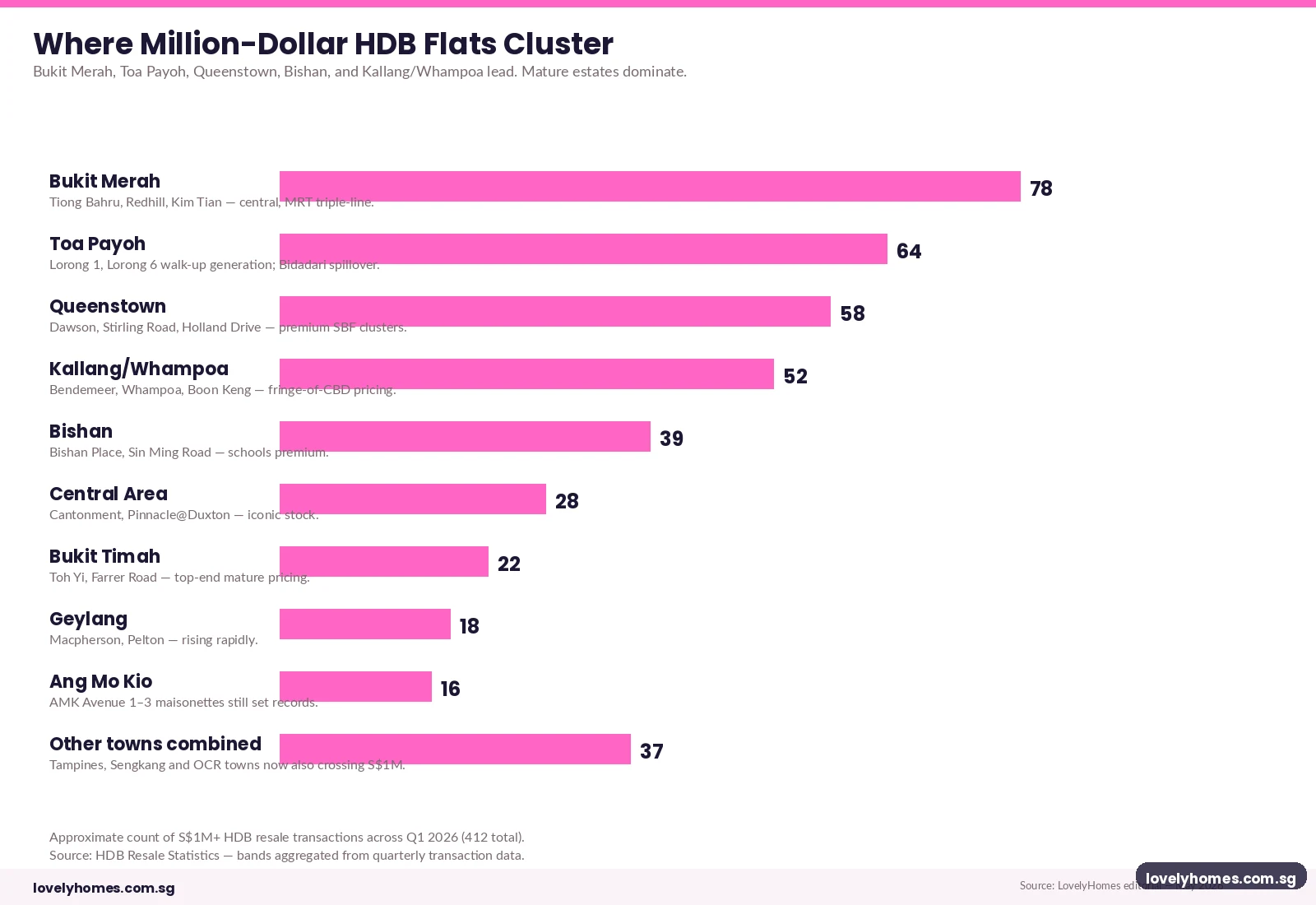
Geography is the single biggest determinant of whether a flat will sell above the million-dollar mark. The flats that clear the bar share three traits almost without exception: a mature estate within ten kilometres of the central business district, direct rail connectivity (preferably to two or three lines), and most of the 99-year lease still intact. Figure 2 maps the leading towns for Q1 2026.

Bukit Merah, Toa Payoh, Queenstown, Kallang Whampoa, Bishan lead million-dollar HDB transactions in Singapore Q1 2026
Figure 2 — Towns leading million-dollar HDB transactions in Q1 2026.

Bukit Merah alone accounts for nearly one in five million-dollar transactions, anchored by Tiong Bahru, Redhill, and the Kim Tian / Bukit Ho Swee corridor. The pattern repeats: high-floor 4 and 5-room flats from the early 2010s build cycle, ten minutes by walking link to two MRT lines, with views over the city. Toa Payoh and Queenstown sit just behind — the Dawson and Stirling Road clusters in particular have produced multiple S$1.4–1.7 million sales over the past 18 months.

The pattern starts to break down further out. Tampines, Sengkang and Punggol flats now occasionally cross S$1 million, but they tend to be flagship corner units, executive maisonettes from the 1990s, or DBSS sales like the Pinnacle-style towers. They do not yet form a stable resale pool above the bar in the way that the central towns do. For broader town-level pricing context, see our HDB resale flat buying guide.

Why Million-Dollar HDB Pricing Holds Up

Three structural forces keep the top end of the HDB resale market firm even as the overall index turns:

  1. Supply is genuinely scarce. Most million-dollar flats are 4 or 5-room units in mature estates with high floors and short walks to MRT. HDB does not build new flats with those characteristics any more — central-area BTO supply has shifted to smaller 3 and 4-room units in tower blocks at higher densities.
  2. Demand is mostly cash-rich upgraders and second-time buyers. First-time buyers cannot compete here. The market for million-dollar flats is dominated by households trading down from a private property to a centrally-located HDB, or by Singapore Citizens cycling out of an executive condo and buying back into HDB before applying for a Build-To-Order replacement.
  3. Private-condo prices have set the ceiling. When a freehold city-fringe condo trades at S$2,400 per square foot, a 1,200 sq ft 5-room HDB at S$1,400,000 is still S$1,166 per sq ft — less than half. Buyers see relative value, not absolute expense.

That last point matters for the path ahead. As long as the gap between mature-estate HDB and city-fringe condos remains north of 50%, the top end of HDB pricing has a floor. The risk is a meaningful condo correction or a sustained leasehold-decay narrative shift — either of which would pull the ceiling lower.

Summary Table — Profile of Q1 2026 Million-Dollar Sales

Metric Q1 2026 2025 Full Year 2024 Full Year
Million-dollar transactions 412 822 690
Share of total HDB resale ~5.4% ~3.1% ~2.3%
Highest sale S$1.70m (Dawson, 5-room) S$1.65m (Dawson, 5-room) S$1.58m (Pinnacle, 5-room)
Most common flat type 5-room 5-room Executive / 5-room
Top town Bukit Merah Bukit Merah Queenstown

Indicative figures cross-referenced from HDB’s quarterly resale statistics and SRX/EdgeProp reporting; minor variances arise from cut-off dates.

Worked Example — What S$1.2 Million Actually Looks Like in Cash

Let’s anchor on a realistic scenario. A Singapore Citizen couple, both 42, own a 5-room flat in Bukit Merah bought new from HDB in 2010 for S$520,000. Their outstanding HDB Concessionary Loan balance is S$220,000. They have used a combined S$420,000 of CPF Ordinary Account funds across the holding period, and CPF accrued interest has compounded to S$260,000. They list the flat and accept an offer at S$1,200,000.

HDB upgrader scenarios — sell flat to buy condo vs keep flat to buy second condo, with ABSD wall comparison
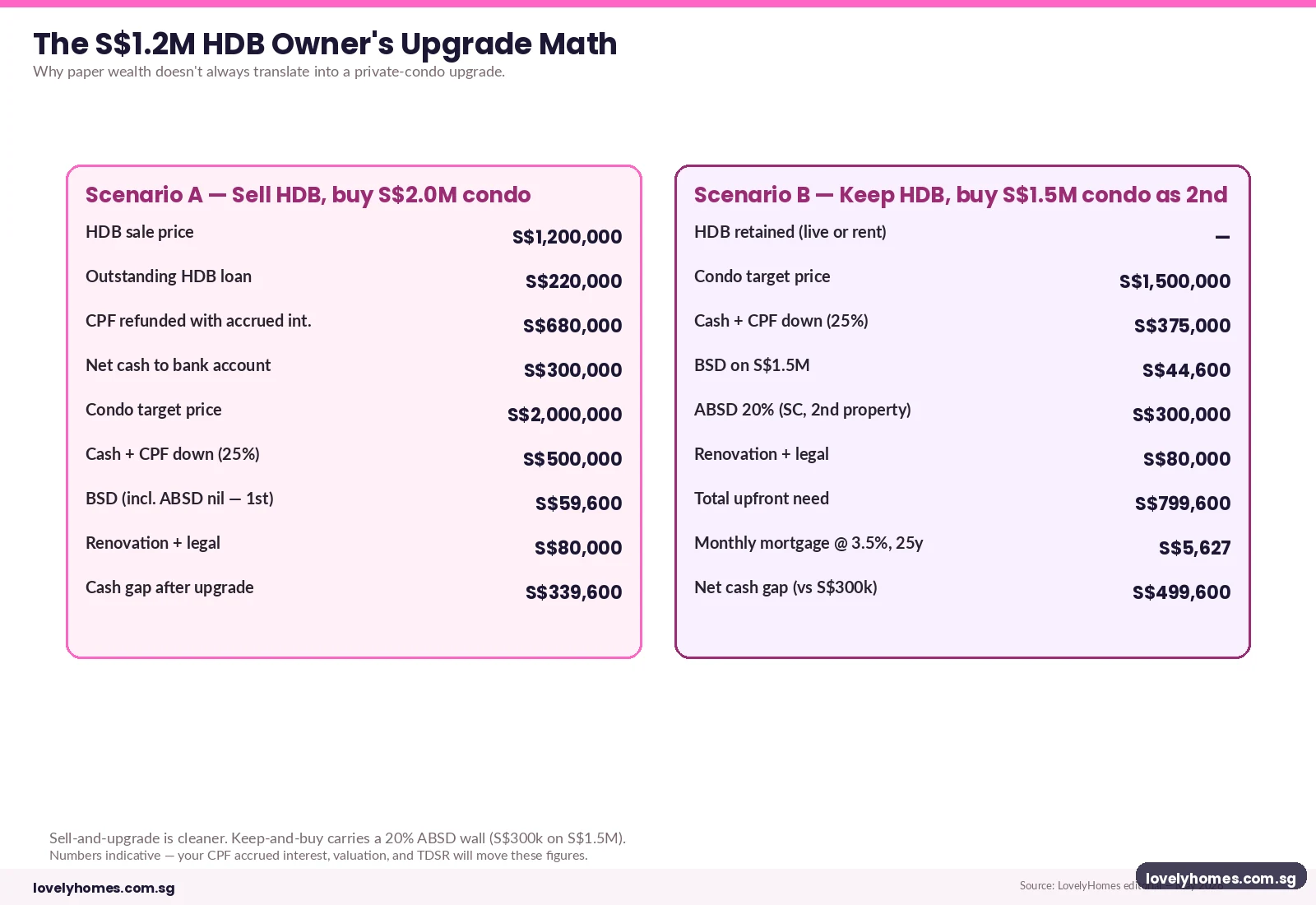
Figure 3 — The S$1.2 million HDB owner’s upgrade math.

What hits the bank account? Sale price S$1,200,000, less HDB loan repayment S$220,000, less CPF refund S$420,000 + S$260,000 accrued interest = S$680,000 returned to CPF (not cash), less legal and agent costs of around S$30,000. Net cash to the seller: S$270,000. Net CPF balance: S$680,000 (which can be redeployed for a next property purchase). The headline million-dollar print is real, but it travels in two channels — cash and CPF — and most of it is not cash.

Now layer on the upgrade decision. Scenario A — sell HDB and buy a S$2.0M condo: the couple uses S$500,000 down payment (cash + CPF mix), pays Buyer’s Stamp Duty of about S$59,600, no ABSD (it is a first private property after disposing of the HDB), and a S$1.5M loan at around S$7,520 per month over 25 years at 3.5%. Scenario B — keep the HDB, buy a S$1.5M condo as a second property: they need S$375,000 down, pay BSD of S$44,600, and an additional 20% ABSD on the S$1.5M = S$300,000. The ABSD wall changes the maths fundamentally; total upfront need is S$799,600. For most upgraders, scenario A wins for cash flow; scenario B wins only if the rental yield on the retained HDB is meaningfully positive after MSR and HDB sub-letting rules are factored in.

For the full mechanics on the second-property tax, see our ABSD complete guide.

Why This Matters for Buyers, Sellers, and Upgraders

If you are a seller sitting on a likely million-dollar flat: the asset is real, but realise that less than 30% of it lands as cash if you have used CPF heavily across the holding period. Run the cash-out arithmetic before listing — especially if you intend to fund a private upgrade. The CPF for Property Purchase guide walks through the refund and accrued-interest mechanics in detail.

If you are a buyer considering a million-dollar HDB: be honest about exit liquidity. Above S$1.2M the resale buyer pool is thin and dominated by HDB-eligible, MOP-cleared upgraders trading sideways; foreign demand and PR demand are zero by regulation. Hold periods of less than seven to eight years can leave you exposed to a price reset if the index turns and the cash-rich upgrader cohort sits out a cycle.

If you are an upgrader: the S$1M HDB and the S$2M condo are not the same dollar. The HDB is mostly CPF; the condo down payment must be cash + CPF in regulated proportion, and the ABSD wall sits between you and a second property. For the full upgrade decision tree, see our HDB-to-condo upgrade guide.

How Singapore Compares

Comparing public-housing premium pricing across cities is messy — few jurisdictions have a system as institutionalised as HDB. The Hong Kong public estate market trades at very different scarcity premiums. Sydney’s former public-housing stock at Waterloo and Glebe has occasional A$1m+ trades, but those are usually privatised dwellings in markets with no income-cap rules. The closest comparable framework is South Korea’s LH-built apartments at high floors in Seoul, where the cap-relaxation cycles drive episodic premium pricing. Against those benchmarks, HDB’s top-end resale market is unusually deep, unusually well-policed for ownership, and unusually liquid.

What Might Come Next

Forward-looking commentary — clearly speculative. Three scenarios bear watching over the rest of 2026 and into 2027:

  • Continued top-end strength even as the index falls. The most plausible scenario. Mature-estate scarcity is structural; the top end carries on as the broader resale market cools through fresh BTO supply (around 13,000 flats expected in 2026, roughly double 2025).
  • Targeted cooling. If the Government feels the optics of S$1.7M HDB sales are inconsistent with public-housing affordability messaging, a targeted measure — expanded Prime / Plus restrictions on high-priced resale, or a longer MOP — is possible. None has been signalled, but the policy lever is real.
  • Material condo correction pulling the HDB ceiling down. The least likely in the near term but the most disruptive: a 10–15% private-condo correction would compress the relative-value gap and remove the implicit ceiling on million-dollar HDB pricing.

None of these scenarios changes the basic logic for owners or considered buyers. Million-dollar HDB pricing is geographic, structural, and slow-moving. Trying to time it is a poor use of attention; understanding what you actually own (or are buying) is the better use.

Frequently Asked Questions

What is the highest price ever paid for an HDB resale flat?

As at Q1 2026, the published record sits at S$1.70 million for a 5-room SBF flat at Dawson Road in Queenstown. Prior records included a S$1.65 million Dawson sale in 2025 and a S$1.58 million Pinnacle@Duxton sale in 2024. HDB and SRX publish resale transaction records monthly; record-breakers are usually high-floor 5-room or executive flats in central, MRT-served estates.

Why are million-dollar HDB flats clustering in Bukit Merah and Queenstown?

Three reasons: most of the high-floor 4 and 5-room SBF flats from the 2010–2014 build cycle are now MOP-cleared and entering the resale market; the central location supports very high relative-value pricing against private condos; and the rail connectivity (Tiong Bahru / Redhill / Queenstown / Commonwealth on the East-West Line) means buyers are paying for both location and convenience. Toa Payoh and Bishan show similar patterns on the North-South Line corridor.

Can foreigners or PRs buy million-dollar HDB resale flats?

Foreigners cannot buy any HDB resale flat. Permanent Residents can, but only as part of a family nucleus where the eligibility scheme is met (PR Quota for the block applies, and the standard SPR holding rules), and never as a sole household. The buyer pool above S$1 million is therefore entirely Singapore Citizen + PR family nuclei — this is one of the structural reasons the market behaves differently from private resale.

Should I buy a million-dollar HDB or a similarly-priced city-fringe condo?

The honest answer depends on horizon and household composition. The HDB delivers more living space, better proximity to schools and transport in the affected estates, and lower maintenance fees, but it locks you into the public-housing rule set (MOP, ethnic quota, no rental until MOP, restrictions on second-property ownership). The condo trades floor space for asset class flexibility — you can rent it, sell it without MOP, and own it alongside other properties (subject to ABSD). Many buyers find the HDB the better lifestyle choice and the condo the better balance-sheet choice; very few buyers should pretend the two are equivalent.

How much cash will I actually walk away with from a S$1.2 million HDB sale?

Less than the headline. From a typical S$1.2M sale you must repay the outstanding HDB or bank loan, then refund used CPF principal plus accrued interest at 2.5% per annum into your CPF account, then pay legal and agent fees. In a representative scenario with S$220k loan outstanding, S$420k of OA used over 14 years, S$260k accrued interest and S$30k transaction costs, the seller receives roughly S$270k as cash to the bank account and S$680k restored to CPF. The CPF portion can fund a next purchase but is not free cash. See our CPF for Property Purchase guide for the mechanics.

Will the price falls in Q1 2026 reach the million-dollar segment?

The Q1 2026 HDB Resale Price Index fell 0.1% — the first quarterly decline since Q2 2019 — while million-dollar transactions hit a record. The two facts coexist because the broader index is moved by the volume centre of the market (3 and 4-room flats in non-mature towns), while the million-dollar segment depends on the supply of mature-estate, rail-served, larger flats. The mechanisms that have lifted the top end (scarcity, relative value vs condos) are not the mechanisms cooling the broader index (fresh BTO supply, transactional fatigue). The two segments can diverge for an extended period.

What should I do if I bought my flat for S$400,000 and it’s now worth S$1.2 million?

First, separate the unrealised gain from your decision: the windfall does not change whether your home suits your household. Second, if you intend to monetise, run the cash-out + CPF refund maths before listing — many sellers find their actual cash-in-hand is far less than expected. Third, if you intend to upgrade to a private property, model both the “sell + upgrade” path and the “keep + buy second” path with full ABSD; the answer is rarely obvious. Fourth, engage a conveyancing solicitor and (where relevant) a CPF-aware financial planner before signing any OTP. The numbers are too large for shortcuts.

Related Articles

Disclaimer

This article is general information about HDB resale pricing in Singapore as at May 2026 and does not constitute financial, tax, or legal advice. Transaction figures are aggregated from HDB’s published resale statistics, with cross-reference from URA, MAS, IRAS and CPF Board guidance where applicable. Individual transaction values, CPF balances, and accrued interest computations vary materially by household; for a transaction of this size always engage a licensed Singapore conveyancing solicitor, a CPF-aware financial adviser, and (if upgrading) a chartered tax practitioner before signing any Option to Purchase or Sale & Purchase agreement.

Translate »