HDB June 2026 BTO Launch: 6,900 Flats Across 5 Towns — Complete Buyer’s Guide

HDB June 2026 BTO Launch: 6,900 Flats Across 5 Towns — Complete Buyer’s Guide

Quick Answer

  • The June 2026 BTO exercise will offer approximately 6,900 flats across 7 projects in 5 towns: Ang Mo Kio, Bishan, Bukit Merah, Sembawang, and Woodlands. The application window opens in the second week of June 2026.
  • Nearly half the supply (approximately 3,250 units, or 47%) is classified as Prime — concentrated in Bishan (Lakeview Crescent) and Bukit Merah (Berlayar). Prime flats carry a 10-year MOP, SC-only resale, and a subsidy clawback on first resale.
  • Bishan — Lakeview Crescent is the headline project: the first new HDB development in Bishan in over 40 years, near Marymount MRT. Indicative 4-room prices are approximately S$820k before grants. Classified as Prime.
  • Berlayar (Bukit Merah) offers 1,960 units on the former Keppel Club site. Indicative 4-room: approximately S$710k. Classified as Prime.
  • Sembawang North offers the largest Standard supply (~2,000 units) at the most affordable prices — indicative 4-room from approximately S$350k before grants, with full EHG eligibility.
  • First-timer SC households earning up to S$9,000/month qualify for the Enhanced Housing Grant (EHG) of up to S$120,000 on Standard and Plus flats.
  • Ballot results are expected approximately 3 weeks after the application window closes, with flat selection appointments typically following 1–2 months later.

Overview: What Is on Offer in June 2026

The June 2026 BTO exercise is the second of three sales exercises HDB has planned for 2026, following the February 2026 exercise (4,692 flats) and ahead of the October 2026 exercise. At approximately 6,900 flats, it is the largest of the three 2026 tranches and includes some of the most sought-after locations in years — particularly the Bishan and Bukit Merah (Berlayar) projects.

HDB will launch the exercise on its HDB Flat Portal in the second week of June 2026. Potential buyers should prepare eligibility documents — including income declaration and citizenship verification — in advance, as these must be on file before a successful application can proceed to booking.

June 2026 HDB BTO projects unit supply and indicative pricing chart Singapore
Figure 1: June 2026 BTO — Unit Supply by Project and Indicative Pricing | Source: HDB, industry estimates. Before grants.

Project-by-Project Analysis

Bishan — Lakeview Crescent (~1,210 units, Prime): This is the standout project of the exercise and arguably the most significant HDB launch in years. Bishan last received new BTO flats in 1984 — a gap of over 40 years. Lakeview Crescent sits near Marymount MRT (Circle Line) adjacent to the vast Bishan-Ang Mo Kio Park. CCL connectivity is excellent: Marymount to Dhoby Ghaut interchange in three stops, to Marina Bay in approximately seven. Blue-chip schools in the catchment include Catholic High School and St Gabriel’s Primary. Being classified Prime, it carries a 10-year MOP, income ceiling on resale, SC-only resale pool, and a subsidy clawback. Indicative 4-room: approximately S$820k before grants (EHG not available for Prime).

Bukit Merah — Berlayar (~1,960 units, Prime): Located on the former Keppel Club site off Telok Blangah Road, adjacent to the Southern Ridges nature corridor. Nearest MRT: Labrador Park or Telok Blangah (CCL). Unit mix is heavy on 4-room (~980) and 2-room Flexi (~810). Classified Prime: 10-year MOP, SC-only resale. Indicative 4-room: S$695k–S$730k. Strong lifestyle appeal for those who value the Southern Ridges and Harbourfront precinct.

Ang Mo Kio — Mayflower Rise (~1,050 units, Standard/Plus): Two projects near Mayflower MRT (Thomson-East Coast Line). Project 1 (480 units, Plus) near CHIJ St Nicholas Girls’: 3-room and 4-room at ~S$440k. Project 2 (570 units, Standard) near Bishan-AMK Park: 2-room Flexi and 4-room at ~S$430k. TEL provides direct access to Orchard Road and Marina Bay without interchange. EHG eligible for Standard project.

Sembawang North (~2,000 units, Standard): Largest town supply, most affordable pricing. Two projects near Canberra and Sembawang MRT (NSL). Indicative 4-room: S$350k–S$370k before EHG. Full EHG eligibility for qualifying households. Site A includes eating house, minimart, preschool, Residents’ Network Centre.

Woodlands — Woodgrove Avenue (~640 units, Standard): Moderate supply near Marsiling/Woodlands MRT (NSL). Indicative 4-room: ~S$375k before grants. Woodlands Regional Centre is undergoing long-term transformation as a northern business hub.

June 2026 BTO classification mix Prime Standard Plus and 4-room price ranges by town
Figure 2: June 2026 BTO Classification Mix and Indicative 4-Room Pricing (Before Grants) | Source: HDB, industry estimates

Classification Mix and Ballot Strategy

The June 2026 exercise is polarised: 47% Prime (Bishan + Berlayar), 48% Standard (Sembawang + Woodlands + AMK Project 2), and just 5% Plus (AMK Project 1). Buyers who need to sell or upgrade within five to eight years should avoid Prime flats — the 10-year MOP is a genuine life commitment and the subsidy clawback at resale partially offsets the apparent price advantage.

For Standard and Plus flats, first-timer SC applicants receive 95% of ballot queue allocations. Demand for Standard flats in Sembawang and Woodlands is historically more moderate than for central locations, improving odds for applicants who are flexible on location.

Summary Table: June 2026 BTO at a Glance

Town / Project Units Class MOP Indicative 4-Rm Nearest MRT
AMK Mayflower Rise 1 480 Plus 10 yr ~S$440k Mayflower (TEL)
AMK Mayflower Rise 2 570 Standard 5 yr ~S$430k Mayflower (TEL)
Bishan Lakeview Crescent 1,210 Prime 10 yr ~S$820k Marymount (CCL)
Bukit Merah Berlayar 1,960 Prime 10 yr ~S$710k Labrador Pk (CCL)
Sembawang North A 1,130 Standard 5 yr ~S$360k Canberra (NSL)
Sembawang North B 870 Standard 5 yr ~S$360k Canberra (NSL)
Woodlands Woodgrove Ave 640 Standard 5 yr ~S$375k Marsiling (NSL)
Total ~6,860 47% Prime · 48% Standard · 5% Plus

Worked Example: The Lim Couple Comparing Sembawang vs Bishan

Mr and Mrs Lim are both Singapore Citizens aged 30, applying as first-timers for the June 2026 BTO. Combined household income: S$7,000/month. They are comparing a Sembawang North Standard 4-room at S$360,000 versus a Bishan Lakeview Prime 4-room at S$820,000.

Item Sembawang Standard Bishan Prime
Selling price (indicative) S$360,000 S$820,000
EHG (income S$7,000/mth) – S$20,000 Not eligible (Prime)
Net price after EHG S$340,000 S$820,000
CPF OA downpayment (20%) S$68,000 S$164,000
HDB loan (80%, 25-yr, 2.60%) S$272,000 S$656,000
Monthly instalment (HDB loan) ~S$1,230 ~S$2,966
MSR check (30% of S$7,000) PASS (S$2,100 limit) FAIL (exceeds S$2,100)
MOP duration 5 years 10 years
Earliest eligible to sell ~2031 ~2036
Resale eligibility after MOP SC/SPR buyers SC only (income ceiling)

The MSR check reveals an important constraint: the Lim couple on S$7,000/month can borrow at most 30% × S$7,000 = S$2,100/month via an HDB loan. On the Bishan Prime flat, the required monthly instalment of ~S$2,966 exceeds this limit — meaning an HDB loan is insufficient and a bank loan would be required (subject to TDSR and prevailing rates). On the Sembawang Standard flat, the monthly instalment of ~S$1,230 easily clears the MSR, leaving S$870/month in MSR headroom for other debts. For a first-timer couple with moderate income, the Sembawang Standard flat is clearly the financially sound choice.

What Happens After You Apply

The BTO application process follows HDB’s standard sequence: applicants submit via the HDB Flat Portal within the application window (second week of June 2026, approximately one week long) and pay a S$10 application fee. Ballot results are typically released 3 weeks after the window closes. First-timers receive 95% of ballot queue allocation. Applicants with a queue number are called for flat selection in order — upon selecting a unit, a booking fee of approximately S$2,000 is payable. Key collection for June 2026 flats is estimated in the 2029–2030 range, depending on project and contractor progress.

Related Articles

Frequently Asked Questions

When does the June 2026 BTO application window open?

The application window is expected to open in the second week of June 2026 for approximately one week. HDB will announce the exact dates on the HDB Flat Portal (homes.hdb.gov.sg). There is no advantage to applying on the first day — all applications within the window are treated equally in the computer ballot. Prepare eligibility documents (income declaration, citizenship, prior HDB ownership history) before the window opens to avoid delays.

Is the Bishan Lakeview Prime flat worth the premium?

For a SC couple in their late 20s to early 30s with stable employment and no plans to move for at least 10 years, Bishan Lakeview at approximately S$820k is excellent value relative to nearby private condo prices of S$1.8M–S$2.5M. The Circle Line connectivity and park access are genuine quality-of-life advantages. The 10-year MOP is the key constraint — if there is any chance of needing to upgrade, downsize, or relocate internationally within a decade, a Standard flat is the more prudent choice. Buyers should also confirm they can satisfy the Mortgage Servicing Ratio (30% of income cap) at the Bishan price point before applying.

Can SC-SPR couples apply for the June 2026 BTO?

Yes. An SC-SPR household is eligible to apply for HDB BTO flats as a family nucleus. For Plus and Prime flats, the SC member’s status governs the resale conditions — the SPR spouse co-owns but the SC-only resale restriction (Prime) or income ceiling (Plus/Prime) applies when the flat is later sold. Both spouses’ incomes are counted for grant eligibility and MSR purposes.

Can I apply for two June 2026 BTO projects?

No. Each household may submit only one BTO application per exercise. If unsuccessful or if no suitable unit remains in the ballot, you receive enhanced priority (deferred applicant status) in the next exercise.

Are Prime flats eligible for the EHG grant?

No. Enhanced Housing Grant (EHG) is not available for Prime BTO flats. The EHG is designed to make Standard and Plus housing affordable for middle-income first-timers; Prime flats already carry a significant built-in subsidy through their pricing. The Proximity Housing Grant (PHG) — which gives S$20k–S$30k for buying near parents — is available for Prime flats. Verify the latest grant conditions directly with HDB at the time of application.

Disclaimer: This article is for general information only. All pricing is indicative and based on publicly available industry estimates as at 16 May 2026; actual selling prices will be released by HDB at the time of launch. Grant eligibility and amounts are subject to HDB review and may change. Always verify the latest requirements at hdb.gov.sg before making housing decisions. Monthly instalment figures are illustrative only.

HDB Plus and Prime Flats Singapore 2026: What the BTO Classification Means for Buyers

HDB Plus and Prime Flats Singapore 2026: What the BTO Classification Means for Buyers

Quick Answer: What Are HDB Plus and Prime Flats?

  • Since February 2023, HDB classifies all new BTO flats into three tiers: Standard, Plus, and Prime.
  • Plus and Prime flats carry a 10-year Minimum Occupation Period (MOP) — double the 5-year MOP on Standard flats.
  • Income ceiling is S$14,000/month (family) and S$7,000/month (singles) for all three tiers.
  • Subsidy clawback: when you sell a Plus or Prime flat, HDB recovers a percentage of the resale price as a subsidy clawback. Standard flats have no clawback.
  • After MOP, Plus and Prime flats can only be sold to Singapore Citizens with income below the ceiling. Permanent Residents may buy Plus, but not Prime.
  • Renting out your entire Plus or Prime flat is not allowed even after MOP; only room sub-letting is permitted.
  • Prime flats are in the most central or waterfront locations (Toa Payoh, Kallang, Pearl’s Hill, Marina South); Plus flats are near transport nodes or commercial hubs (Bishan, Queenstown fringe, Ang Mo Kio).
  • The framework aims to keep public housing in desirable locations accessible and affordable for genuine owner-occupiers.

Background: Why Did HDB Introduce the Classification?

For decades, HDB’s flagship grant-subsidised flats in prime locations — think Pinnacle@Duxton, SkyTerrace @ Dawson, and Kallang Residences — were sold to buyers at heavily subsidised prices, then resold five years later at market rates for windfall gains of several hundred thousand dollars. A flat purchased at S$500,000 in 2016 might be resold at S$1.2 million in 2022 — a S$700,000 profit subsidised partly by taxpayers and the wider public.

The Rejuvenated Flat Categorisation (RFC) framework, announced by the Ministry of National Development (MND) in August 2022 and fully implemented from the February 2023 BTO exercise, attempts to rebalance this equation. Better-located flats receive more generous subsidies upfront, but are subject to tighter resale restrictions and a longer MOP — ensuring that the subsidy benefits the household for a meaningfully longer period before it can be monetised.

The framework does not change eligibility rules for purchasing directly from HDB. Family or fiance/fiancée applicants must meet the usual citizenship, age, and household composition requirements, and must not own other properties at the time of booking.

The Three Tiers Explained
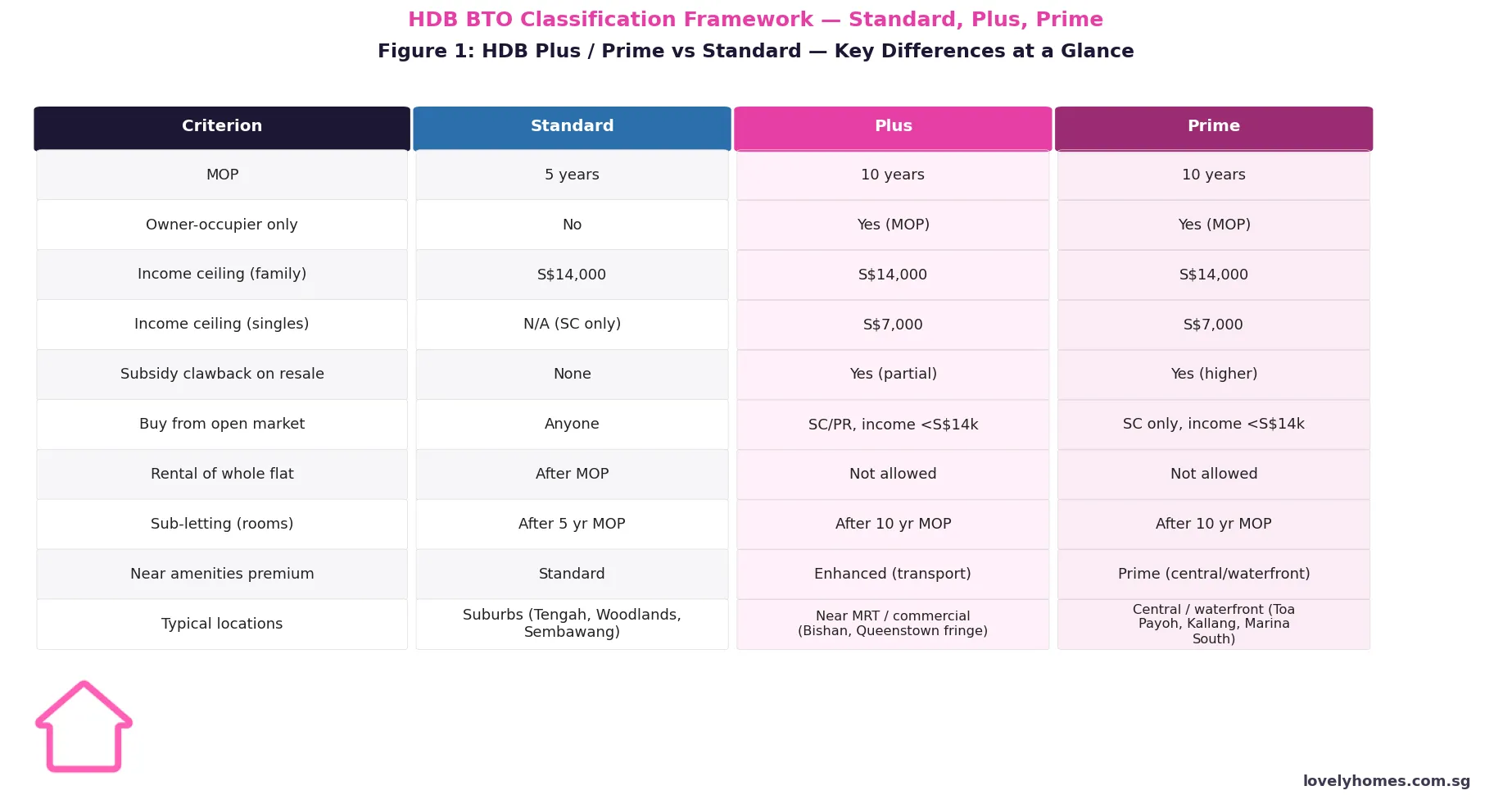
HDB Standard Plus Prime flats comparison table 2026 — MOP, income ceiling, subsidy clawback
Figure 1: HDB Plus / Prime vs Standard — Key Differences at a Glance. Source: HDB, MND (2023–2026).

Standard Flats

Standard flats are built in suburban towns and non-central estates — Tengah, Woodlands, Sembawang, Jurong West, Punggol, and Sengkang. They carry the same terms as legacy BTO flats: a 5-year MOP, no subsidy clawback on resale, and no restriction on the citizenship or income of the buyer when the flat comes to the open market. Grants such as the Enhanced Housing Grant Singapore 2026 (up to S$120,000) and the Family Grant (up to S$50,000) apply in full based on household income.

Plus Flats

Plus flats are located near major transport nodes, commercial hubs, or town centres — examples include projects adjacent to Bishan MRT, the Buona Vista area, and the Ang Mo Kio town centre. They carry a 10-year MOP and a subsidy clawback when resold in the open market. The clawback percentage is determined by HDB based on the subsidy provided and the resale price at the time of sale; a rough guide is that it recovers a portion of the price uplift attributable to the subsidy. After MOP, the flat may be sold to Singapore Citizens or Permanent Residents whose household income does not exceed the prevailing income ceiling.

Prime Flats

Prime flats occupy the most sought-after locations in Singapore: Toa Payoh, Kallang, Queenstown, Pearl’s Hill, and the future Marina South estate. These carry the same 10-year MOP as Plus flats, but a higher subsidy clawback rate. After MOP, resale is restricted to Singapore Citizens only — Permanent Residents are excluded. The entire flat may not be rented out at any time, though room sub-letting after MOP is permitted under standard HDB rules.

Market Context: Resale Prices and MOP Timing
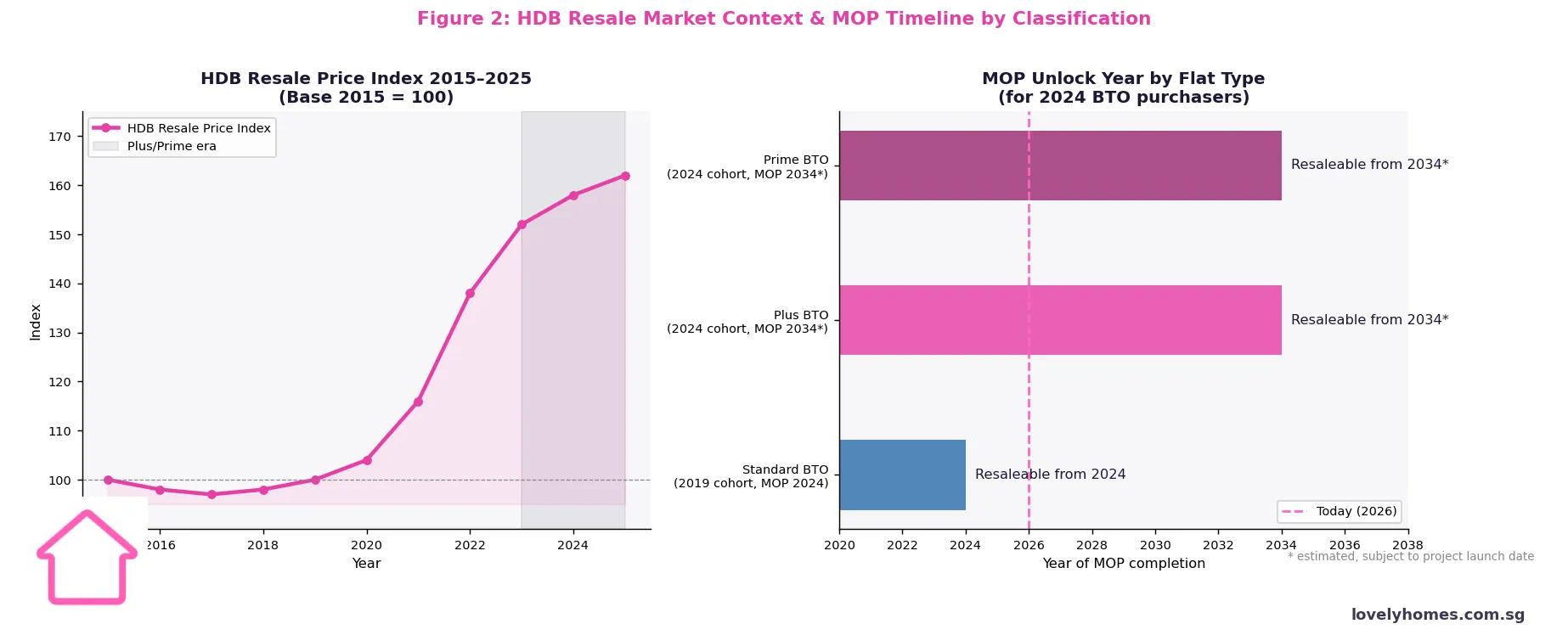
HDB resale price index 2015 to 2025 and MOP unlock year by classification Singapore
Figure 2: HDB Resale Price Index 2015–2025 (indicative, base 2015=100) and MOP unlock year by classification for 2026 buyers. Sources: HDB, URA.

The HDB Resale Price Index rose approximately 62% between 2015 and 2025, driven by ultra-low interest rates during 2020–2022 and persistent supply shortfalls. The index moderated from its 2022 peak but remained elevated through 2025. A buyer who purchased a Standard flat in 2019 and MOP’d in 2024 could realise a gain of 50–65% based on average price movements.

For Plus and Prime buyers in 2026, MOP only completes around 2036. By that date, market conditions, government policy, and the broader economic environment will all have shifted considerably. The extended lock-in is a genuine trade-off: buyers receive a deeper subsidy and access a better location, but cannot monetise that gain for a decade.

Subsidy Clawback: How It Works in Practice

The subsidy clawback is computed by HDB based on the subsidy quantum provided at launch and the transacted resale price at the point of sale. It is deducted from the resale proceeds — effectively a partial return of the government subsidy. The exact formula has not been publicly disclosed, but HDB has indicated that the clawback increases with the resale price (i.e., if the flat appreciates significantly, more is recovered).

Important: the clawback is applied to the gross resale price, not net of your purchase cost. This means a seller does not get to deduct the original purchase price, renovation cost, or CPF accrued interest before the clawback is computed. Buyers planning to treat a Plus or Prime flat as an investment vehicle should model their net return carefully, accounting for both the clawback and CPF accrued interest returned to the CPF Ordinary Account.

Eligibility: Who Can Buy and Sell Plus/Prime Flats?

Buying from HDB at launch follows the same eligibility conditions as Standard BTO — at least one Singapore Citizen applicant, the household must not own or dispose of a residential property within 30 months before application, and income must not exceed S$14,000/month (family) or S$7,000 (singles). The HDB Income Ceiling Singapore 2026 provides a detailed breakdown of all ceiling tiers including Executive Condominium rules.

Resale restrictions from the secondary market perspective mean that a buyer of a Plus flat in the open market (post-MOP) must be a Singapore Citizen or Permanent Resident with household income below the ceiling, and must not own other property. A buyer of a Prime flat in the open market must be a Singapore Citizen — not a Permanent Resident or foreigner. This materially narrows the pool of potential resale buyers, which may affect liquidity and price discovery at the 10-year mark.

Which 2025–2026 BTO Projects Are Plus or Prime?

HDB classifies each BTO project when it is launched. As a general guide: projects in established central areas (Queenstown, Toa Payoh, Kallang) tend to be Prime; projects near MRT interchanges or town centres in mature estates (Ang Mo Kio, Bishan, Bedok) tend to be Plus; and projects in non-mature estates (Tengah, Woodlands, Sembawang) tend to be Standard. The June 2026 BTO exercise includes projects in Bishan and Ang Mo Kio — check the HDB Flat Portal at launch for each project’s specific classification.

Summary Table: At-a-Glance Comparison

Criterion Standard Plus Prime
MOP 5 years 10 years 10 years
Subsidy clawback None Yes (partial) Yes (higher)
Resale to PRs Yes Yes No
Rent out whole flat After MOP Not allowed Not allowed
Typical family grant Up to S$80,000 Up to S$40,000 Up to S$20,000
Typical locations Suburbs / non-mature MRT nodes / mature Central / waterfront
Estimated price premium Baseline +20–40% +40–80%

Worked Example: The Lee Family

Lee family worked example comparing Standard Plus Prime BTO costs and projected resale profit 2026
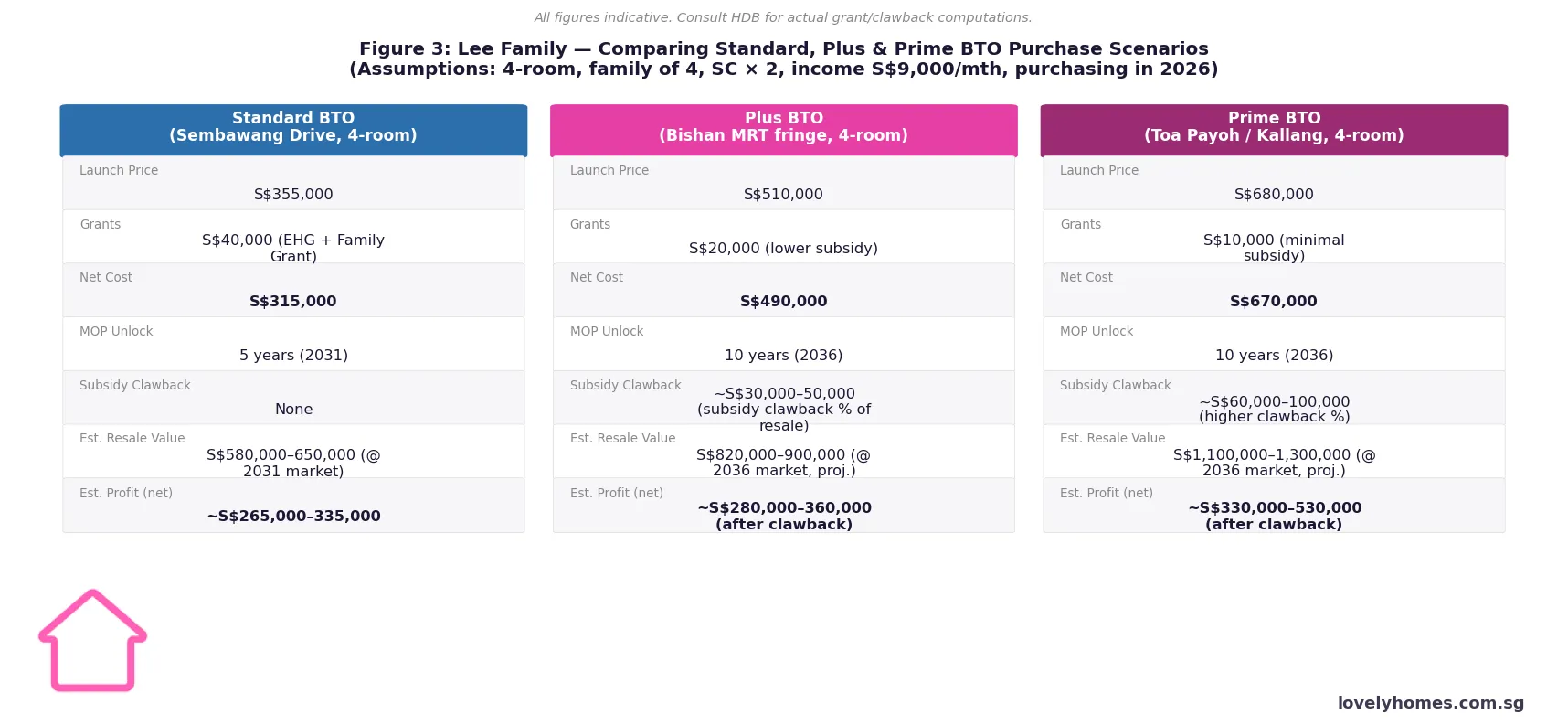
Figure 3: Lee Family — Comparing Standard, Plus & Prime BTO Scenarios. Figures are indicative projections only.

Suppose the Lee family — Wei Ming and Hui Lin, both Singapore Citizens aged 30 and 28, household income S$9,000/month — is applying for a 4-room BTO in 2026.

  • Standard option (Sembawang Drive): estimated price S$355,000. With EHG (S$35,000) and Family Grant (S$5,000), net cash and CPF needed is approximately S$315,000. Monthly mortgage on a 25-year HDB concessionary loan at 2.6% p.a. ≈ S$1,425. MOP completes 2031; no clawback; resale estimated at S$580,000–650,000 (indicative).
  • Plus option (Bishan MRT fringe): estimated price S$510,000. Grants reduced (approximately S$20,000 combined). Net cost ≈ S$490,000. Monthly ≈ S$2,200. MOP completes 2036; partial clawback on resale; estimated resale S$820,000–900,000 (indicative after clawback).
  • Prime option (Toa Payoh / Kallang): estimated price S$680,000. Minimal grants (≈ S$10,000). Net cost ≈ S$670,000. Monthly ≈ S$3,000+. MOP 2036; higher clawback. Estimated resale S$1,100,000–1,300,000 (indicative after clawback). Restricted to SC resale buyers only.

The Standard flat offers the lowest entry cost, the quickest MOP, and no clawback — making it the clearest choice for households who need flexibility within the decade. The Prime flat may yield the largest absolute gain, but the extended MOP and restricted buyer pool introduce meaningful uncertainty. The Plus tier sits between the two in both cost and restriction intensity.

What This Means for You

The Plus/Prime framework changes how buyers should evaluate a BTO project. In the past, a Queenstown or Toa Payoh BTO was an almost unambiguously good deal — low entry cost plus strong capital appreciation in five years. Under RFC, that entry cost is lower than a private condo but higher than a Standard BTO, and the 10-year MOP significantly reduces your flexibility to respond to life changes: a growing family requiring a larger flat, a job change requiring relocation, or a property ladder upgrade.

For genuine owner-occupiers who plan to live in the flat for 15–20 years, a Plus or Prime flat in a desirable location may still be the right choice — the location quality, amenities proximity, and long-term living experience can justify the higher price and tighter restrictions. For households who value flexibility or anticipate major life changes within the next decade, a Standard BTO in a well-served non-mature town (Tengah, Punggol North) is likely the more prudent selection.

The framework is also relevant to resale flat buyers in the open market. As the first Plus and Prime cohorts approach MOP from 2033 onwards, the restricted resale buyer pool (income-capped, SC-only for Prime) may dampen price discovery compared to unrestricted Standard resale flats. Buyers purchasing Plus or Prime resale flats in the 2033–2040 window should model this liquidity risk explicitly.

What Might Come Next

The RFC framework is still relatively new; the first Plus and Prime flats will only MOP from roughly 2033 (the February 2023 exercise cohort). As that cohort approaches MOP, the government will need to balance the competing objectives of affordability (restricting resale to income-eligible buyers) and market confidence (ensuring sellers can achieve reasonable prices). There is a non-trivial possibility that the subsidy clawback rates or resale eligibility rules are refined before 2033. Buyers purchasing Plus or Prime flats should monitor MND/HDB announcements closely in the 2030–2033 period.

The government has also flagged that the classification boundary between Plus and Standard may shift over time as new towns mature or transport infrastructure changes — a project classified as Standard today near a future MRT line may be reclassified in a future BTO exercise.

Frequently Asked Questions

Can I apply for HDB grants when buying a Plus or Prime BTO flat?

Yes. All three BTO grant schemes — the Enhanced Housing Grant (up to S$120,000 for low-income families), the Family Grant (up to S$50,000), and the Proximity Housing Grant (up to S$30,000) — are available for Plus and Prime flats. However, the actual grant amount may be lower for Plus and Prime buyers because HDB factors in the deeper base subsidy when determining total assistance. The income ceiling conditions remain S$14,000 per month for families.

What happens if I need to sell my Plus or Prime flat before the 10-year MOP?

You cannot sell a Plus or Prime flat on the open market before the 10-year MOP, just as you cannot sell a Standard flat before 5 years. In exceptional circumstances (financial hardship, divorce, or relocation out of Singapore), you may approach HDB to request early disposal. HDB will assess on a case-by-case basis, and if approved, the flat is typically sold back to HDB at a price determined by HDB — which may be significantly below market value. The 10-year MOP therefore represents a genuine long-term commitment.

How is the subsidy clawback amount calculated?

HDB has not published the precise formula, but it is linked to the quantum of subsidy provided at the point of BTO booking and the transacted resale price. A higher resale price generally results in a higher absolute clawback amount. The clawback is deducted from the gross sale proceeds before the seller receives cash or CPF refunds. HDB is expected to publish clearer guidance as the first cohort of Plus and Prime flats approaches MOP around 2033. Buyers should ask HDB directly at the time of booking for an indicative clawback schedule.

Can a Permanent Resident buy a Prime flat on the resale market?

No. After MOP, Prime flats may only be sold to Singapore Citizens whose household income does not exceed the prevailing income ceiling (currently S$14,000 per month for families). Permanent Residents are excluded from buying Prime resale flats. This is a key restriction that limits the pool of eligible buyers and may affect resale liquidity compared to Standard or Plus flats. Plus flats, by contrast, can be sold to both Singapore Citizens and Permanent Residents in the open market after MOP (subject to income ceiling).

Are Plus and Prime classifications permanent, or can a flat be reclassified?

A flat’s classification is determined at the point of first sale by HDB and is binding for that flat. It does not change based on subsequent market events or policy revisions. If you buy a Plus flat, it remains a Plus flat in perpetuity — the 10-year MOP, subsidy clawback, and resale restrictions are permanent features of that specific unit. The government has noted that future BTO projects in an area could be given a different classification if the neighbourhood character changes (e.g., a new MRT line), but existing flats already sold under a classification are not reclassified retroactively.

Is the income ceiling applied to individual buyers or the household?

The HDB income ceiling is assessed at the household level — that is, the combined income of all persons listed in the application, including the applicant and any co-applicants or occupiers whose income is assessable. For family applications, the ceiling is S$14,000 per month. For single applicants (the Singles Scheme), the individual income ceiling is S$7,000 per month. The ceiling applies both at the point of BTO application and (separately) to buyers of resale Plus/Prime flats on the open market after MOP.

Can I rent out a Plus or Prime flat to supplement my income?

Room sub-letting (renting individual rooms while you remain in residence) is allowed after the 10-year MOP under the same rules as Standard flats. However, renting out the entire flat — vacating the premises entirely and renting to tenants — is permanently prohibited for Plus and Prime flats, even after MOP. This rule is designed to prevent Plus and Prime flats from becoming investment vehicles generating rental income. Standard flats can have the whole unit rented out after the 5-year MOP, subject to HDB approval and tenant eligibility rules.

Related Articles

Disclaimer

This article is for general informational purposes only and does not constitute financial, legal, or property advice. HDB classification criteria, grant amounts, subsidy clawback rates, and income ceilings are subject to change. All prices and projections are indicative estimates based on publicly available data and should not be relied upon for investment decisions. Consult the HDB official website, the Ministry of National Development, and a licensed financial adviser before making any property purchase decision.

Tags: HDB Plus Flats, HDB Prime Flats, BTO Classification Singapore, HDB MOP 2026, Subsidy Clawback, HDB BTO Application, Singapore Public Housing, HDB Resale Restrictions, Standard Plus Prime, BTO 2026 Singapore
HDB 2-Room Flexi for Seniors Singapore 2026: Short Lease, Silver Housing Bonus and Lease Buyback Explained

HDB 2-Room Flexi for Seniors Singapore 2026: Short Lease, Silver Housing Bonus and Lease Buyback Explained

Singapore’s HDB system includes a category of flat specifically designed for seniors and older singles who want to right-size, reduce their mortgage burden, or access their housing equity without leaving public housing. The HDB 2-Room Flexi flat — and its cousin, the Studio Apartment — give buyers aged 55 and above a route to a smaller, more manageable home, often with significant grant support on top. If you are approaching retirement and wondering what to do with a large, nearly-paid-off flat, this guide explains every option available to you in 2026.

Quick Answer — HDB 2-Room Flexi for Seniors 2026

  • Who can buy: Singles aged 35+; couples where at least one party is 55+ (for Short Lease option)
  • Short Lease option: 15, 20, 25, 30, or 35 years — choose a lease matching your remaining life expectancy
  • Studio Apartments: Available at Selective En-bloc Redevelopment Scheme (SERS) sites; 30-year lease; for buyers 55+
  • Silver Housing Bonus (SHB): Up to S$30,000 cash when right-sizing from a larger flat
  • Lease Buyback Scheme (LBS): Sell part of your remaining HDB lease back to HDB; proceeds top up your CPF Retirement Account
  • CPF use: Proportional for short leases — you can only use CPF savings up to the value of the remaining lease
  • No resale market for Studio Apartments; 2-Room Flexi 99-year units can be resold after 5-year MOP

What Is a HDB 2-Room Flexi Flat?

The 2-Room Flexi flat is a Build-To-Order (BTO) flat type rolled out by HDB in 2015 to replace the discontinued Studio Apartment in new BTO exercises. It comes in two variants. The first is the Short Lease option, designed specifically for seniors aged 55 and above and singles aged 35 and above, with a lease of 15 to 35 years (in five-year increments) chosen at the point of application. The second is the Standard 99-Year Lease option, available to singles aged 35 and above and to families. Floor area is modest by design: Type 1 units are 36 sqm and Type 2 units are 45 sqm. Both include a living/dining area, one bedroom, one bathroom, a kitchen, and a service yard.

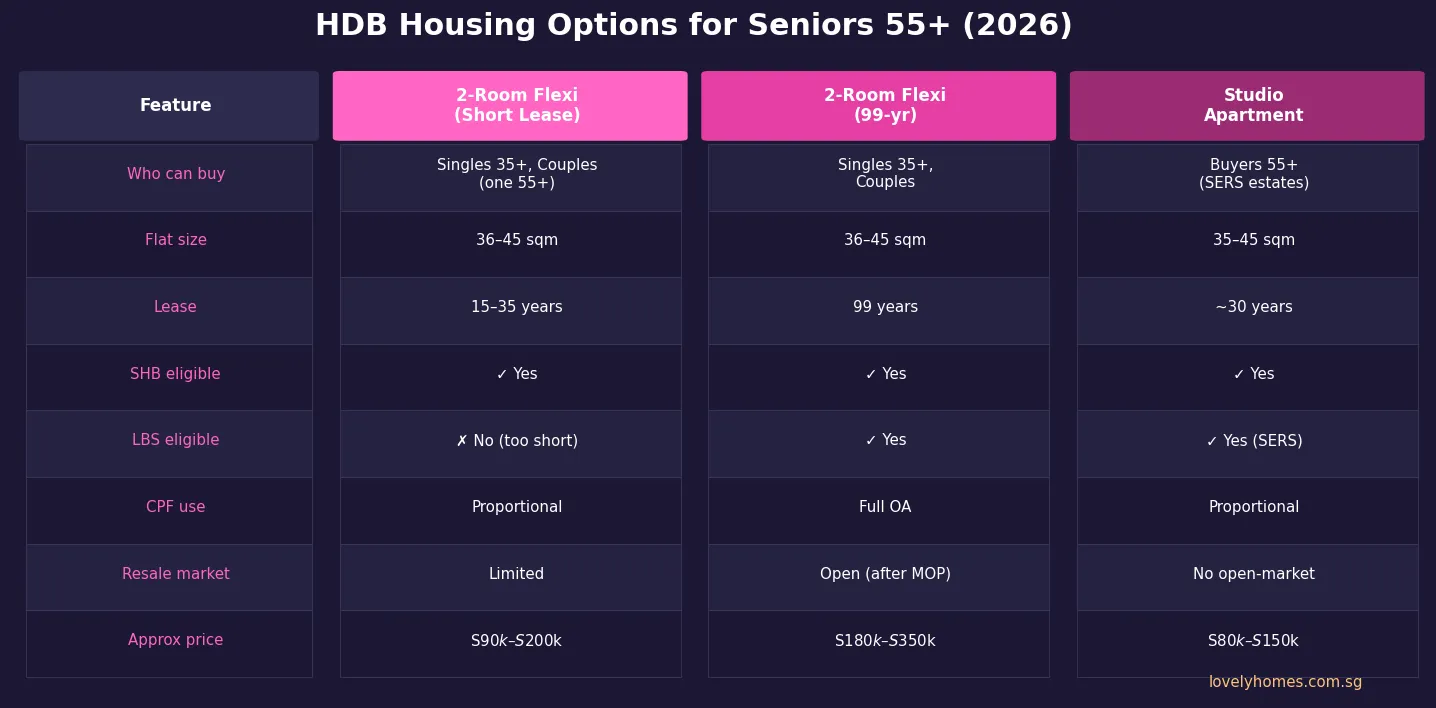
HDB flat types for seniors 55+ comparison 2026 — 2-Room Flexi short lease vs 99-year vs Studio Apartment
Figure 1: HDB Housing Options for Seniors 55+ — key features compared (2026)

Short Lease vs 99-Year: Which Should Seniors Choose?

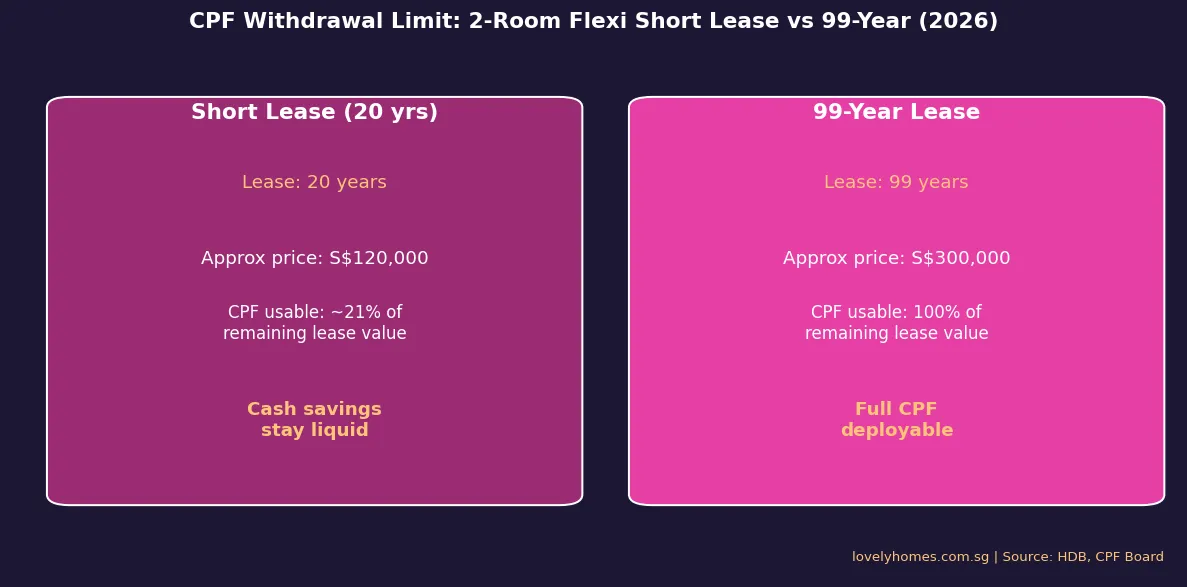
The Short Lease variant is usually the financially smarter choice for buyers who are primarily right-sizing for comfort, not investment. By choosing a shorter lease — say, 25 years for a buyer aged 65 — you pay a significantly lower price for the flat. The sale proceeds from your current, larger flat are then available for other needs. CPF use on a short-lease flat is proportional: the CPF Board limits your Ordinary Account (OA) withdrawal to a fraction of the flat’s valuation based on the ratio of the chosen lease relative to 65 years. In practice, buyers on a 20-year short lease will use mostly cash and have less CPF deployed in the flat, leaving more CPF savings liquid for drawdown in retirement.

The 99-Year Lease option makes more sense for younger singles in their 30s or early 40s who want a small flat as a starter or long-term home with full resale flexibility. After the 5-year MOP, the unit can be sold on the open market.

CPF withdrawal limit comparison — HDB 2-Room Flexi short lease vs 99-year lease Singapore 2026
Figure 2: CPF Use for Short Lease vs 99-Year HDB Flat — how the proportional rule works (2026)

Studio Apartments — The Legacy Option

Studio Apartments were HDB’s original senior-friendly product, built from the 1990s. They are no longer built in new BTO exercises (replaced by the 2-Room Flexi from 2015), but existing units occasionally come up through SERS (Selective En-bloc Redevelopment Scheme) rehousing exercises. Studio Apartments are typically 35–45 sqm, carry a 30-year lease from the date of offer, and are sold to buyers aged 55 and above. There is no open-market resale — you can only surrender the flat back to HDB if you need to leave.

Silver Housing Bonus — Up to S$30,000 in Cash

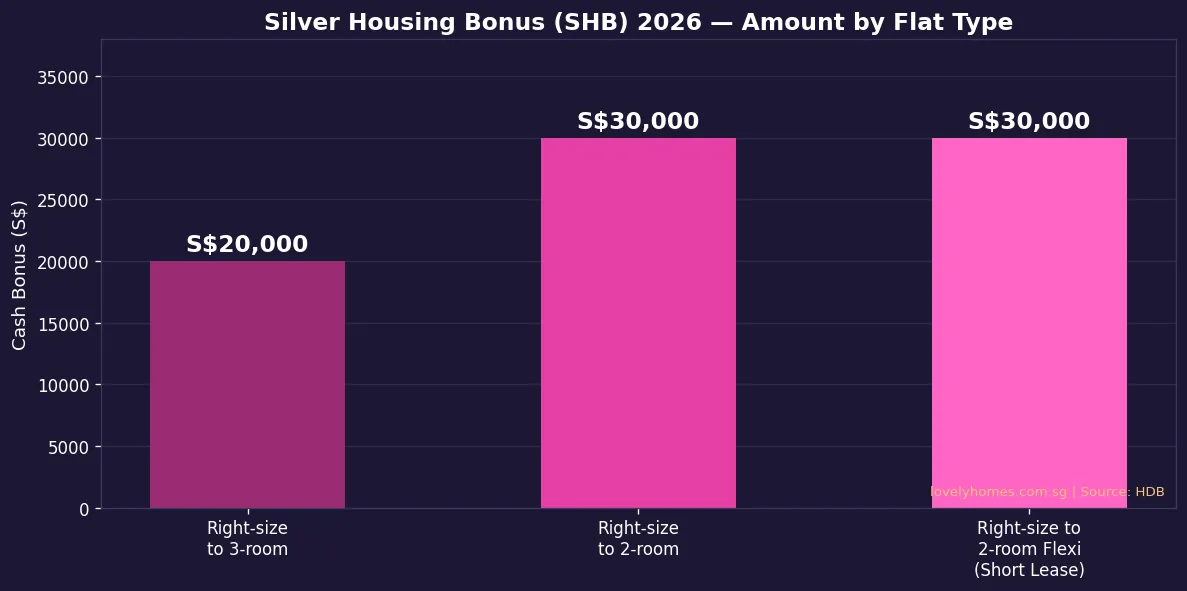
The Silver Housing Bonus (SHB), administered by the CPF Board and HDB, provides eligible seniors with a cash bonus of up to S$30,000 when they right-size to a smaller flat. Eligibility: At least one flat owner must be a Singapore Citizen aged 55 or above. The seller must use the net sale proceeds of their current flat to top up their CPF Retirement Account (RA) up to the current Enhanced Retirement Sum (ERS). For right-sizing to a 2-room or 2-Room Flexi flat (Short Lease), the maximum bonus is S$30,000. For right-sizing to a 3-room flat, the bonus is S$20,000.

Silver Housing Bonus amounts by flat type — right-sizing to 3-room, 2-room or 2-Room Flexi Singapore 2026
Figure 3: Silver Housing Bonus (SHB) 2026 — cash bonus amount by target flat type

Lease Buyback Scheme — Converting Your Flat’s Value to Retirement Income

The Lease Buyback Scheme (LBS) allows eligible seniors to sell part of their flat’s remaining lease to HDB for a lump sum, which is used to top up their CPF Retirement Account. The retained lease must be at least 20 years and cover the youngest owner to age 95. HDB buys the tail end of the lease at assessed market value of that lease proportion, with proceeds going into the owner’s CPF RA to meet the Full Retirement Sum (FRS) or Basic Retirement Sum (BRS) — excess is paid in cash. The couple continues living in the flat under the retained lease and receives monthly CPF LIFE payouts from the topped-up RA.

LBS is not available for 2-Room Flexi Short Lease flats because the chosen lease is already short by design. It is available for 2-Room Flexi 99-Year flats and for larger flats (3-room and above).

Summary: HDB Senior Housing Options at a Glance

Scheme Who Qualifies Key Benefit Amount / Price Range
2-Room Flexi Short Lease Singles 35+; couples with one 55+ Smaller, cheaper flat; choose lease ~S$90k–S$200k
2-Room Flexi 99-Year Singles 35+; families Full resale rights after MOP ~S$180k–S$350k
Studio Apartment Buyers 55+ (SERS estates) Below-market; 30-yr lease ~S$80k–S$150k
Silver Housing Bonus SC 55+, right-sizing from larger flat Cash bonus S$20k (3-rm) / S$30k (2-rm)
Lease Buyback Scheme SC/SPR 65+, own 3-room or larger HDB Convert lease equity to CPF LIFE Lump sum into RA; monthly payout
Proximity Housing Grant Buyers near parents/children Grant on resale purchase S$20k (1km) / S$30k (same estate)

Worked Example — The Lim Couple Right-Sizes at 68

Mr and Mrs Lim, both aged 68, Singapore Citizens, live in a 5-room HDB flat in Bishan with 55 years of lease remaining. Their children have moved out. They right-size to a 2-Room Flexi, Short Lease (25 years) in the same estate.

  • Sale proceeds from the 5-room flat: S$650,000 (after refunding CPF + accrued interest of S$220,000)
  • Purchase price of 2-Room Flexi (25-year short lease): S$145,000
  • CPF use for purchase: proportional to 25/65 years ≈ 38% of flat value → S$55,000 from OA (if available)
  • Cash needed: S$145,000 − S$55,000 = S$90,000 cash
  • Silver Housing Bonus: S$30,000 cash (right-sizing to 2-room)
  • CPF RA top-up from sale proceeds to meet ERS (say S$190,000 per person)
  • Net free cash in hand after purchase, SHB, and CPF RA top-up: approximately S$235,000
  • Monthly CPF LIFE payout after RA top-up (ERS scheme): approximately S$2,200–S$2,500 per person

Why This Matters — Housing as a Retirement Asset

A very large proportion of household wealth in Singapore is locked inside HDB flats. The 2-Room Flexi, SHB, and LBS framework is the Government’s systematic answer: offering seniors structured, HDB-administered routes to convert housing equity into retirement cash flow without moving out of public housing. The 2026 environment makes right-sizing particularly attractive — HDB resale prices remain elevated after years of growth, while 2-Room Flexi Short Lease prices remain relatively modest, offering a significant arbitrage between what seniors receive for their existing flat and what they pay for the right-sized replacement.

What Might Come Next

HDB has been gradually expanding 2-Room Flexi supply in mature and prime estates. The Government may introduce enhancements to the Silver Housing Bonus quantum or Lease Buyback Scheme proceeds as Singapore’s population continues to age. Monitor the annual MND Budget statement, National Day Rally, and the HDB website for the latest BTO schedule and grant amounts before committing to any right-sizing decision.

Frequently Asked Questions

Can a single person buy a 2-Room Flexi short-lease flat?

Yes. Singapore Citizens and Permanent Residents aged 35 and above who are singles can apply for a 2-Room Flexi flat — both the 99-year and Short Lease variants. For the Short Lease, HDB targets it at buyers aged 55 and above, but the formal eligibility lower bound is 35. Singles are not eligible for most family-tier HDB grants, but may qualify for the Silver Housing Bonus if they are at least 55 and right-sizing from a larger flat.

What happens when the short-lease flat’s chosen tenure expires?

When the lease expires, the flat reverts to HDB with no residual value or compensation. This is by design — the flat’s utility is fully consumed during the chosen lease period. Buyers should choose a lease length covering at least to age 95 per CPF Board guidelines. If the owner passes away before expiry, the remaining lease value may be passed to eligible family members under HDB estate transmission rules.

Can I use CPF OA to buy a 2-Room Flexi Short Lease flat?

Yes, but proportionally. The CPF Board allows OA use up to the value corresponding to the lease coverage from your youngest owner’s age to 95. For a 25-year lease chosen by a 65-year-old (covering to age 90), the CPF-usable proportion is roughly 25/65 ≈ 38% of assessed value. A significant portion must therefore be paid in cash. This is intentional — it preserves CPF savings for retirement income rather than locking them into housing.

How do I apply for the Silver Housing Bonus?

The Silver Housing Bonus is administered jointly by HDB and the CPF Board. You apply at the point of booking your new (smaller) flat or during the resale application process. HDB assesses eligibility and the bonus amount based on the size of your current flat, your new flat, and whether you meet the RA top-up requirement from sale proceeds. The cash bonus is paid directly to you — not into CPF — once the transaction is completed. Check HDB’s 2-Room Flexi page for current SHB quantum and conditions.

Does the Lease Buyback Scheme work with a 2-Room Flexi flat?

LBS is available for 3-room and larger HDB flats and for Studio Apartments in SERS estates. It is not available for 2-Room Flexi Short Lease flats because the chosen lease is already short. For 2-Room Flexi 99-year flats, LBS is in principle available but less commonly used, since most LBS participants hold larger flats with more lease equity to monetise. Contact HDB directly to assess eligibility for your specific lease position.

Can I rent out my 2-Room Flexi flat?

You may rent out individual bedrooms after satisfying the MOP (5 years for the 99-year variant). HDB generally does not approve whole-unit rentals for short-lease 2-Room Flexi flats. Renting a bedroom is subject to HDB’s standard subletting approval process and tenant nationality quotas. You may not rent out the entire flat while listed as the owner-occupier.

What is the difference between the 2-Room Flexi and the old Studio Apartment?

Studio Apartments (1990s–2000s) are no longer available in new BTO exercises — replaced by the 2-Room Flexi from 2015. Studio Apartments carry a 30-year lease and are offered at SERS estates to sitting residents. The 2-Room Flexi offers greater flexibility: choice of lease from 15–35 years or a full 99-year lease, two floor-area variants, and (for the 99-year unit) open-market resale rights after MOP. Studio Apartments have no resale market. For most seniors today, the 2-Room Flexi is the primary option.

Disclaimer: This article is for general informational purposes only and does not constitute financial, legal, or professional advice. Property rules, grant amounts, eligibility criteria, and tax treatments are subject to change. Always verify current details with the relevant authorities — HDB, IRAS, CPF Board, URA — and consult a licensed professional before making any property or financial decision.

S$1.728M HDB Resale Record: City Vue @ Henderson Sets New All-Time High in April 2026

S$1.728M HDB Resale Record: City Vue @ Henderson Sets New All-Time High in April 2026

Click anywhere to close

Quick Answer — S$1.728M Henderson Road HDB Record

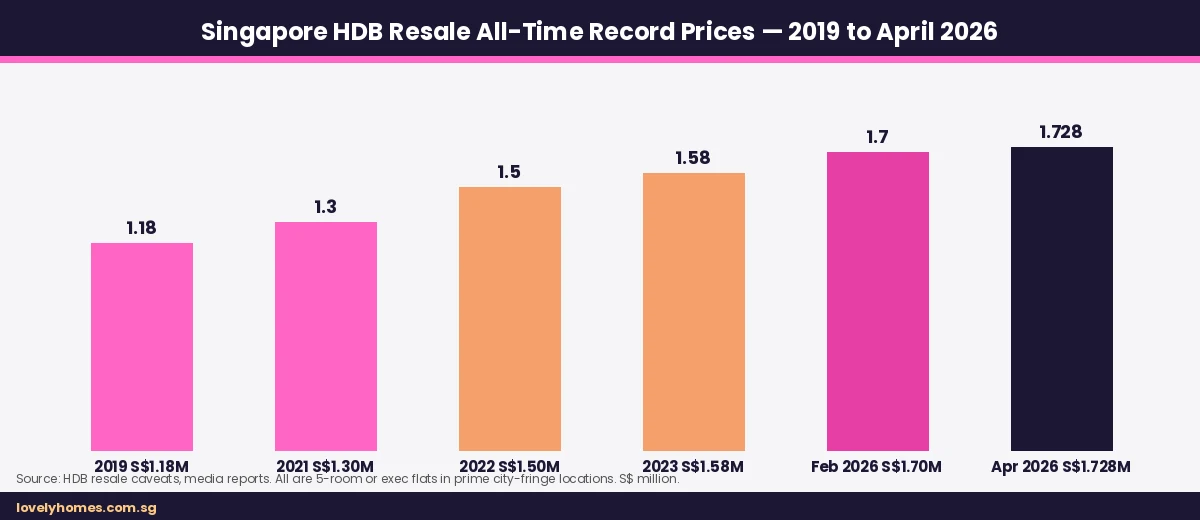
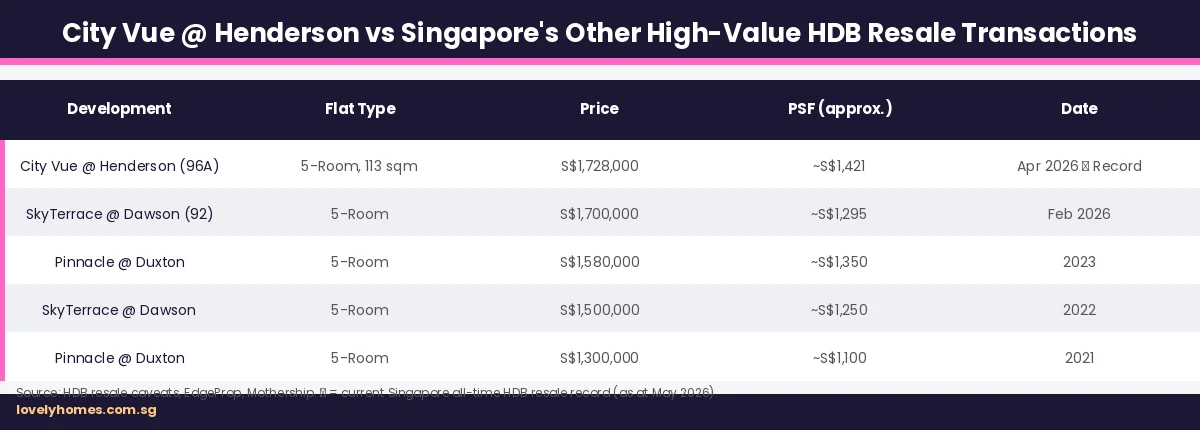
  • New record: A 5-room flat at 96A Henderson Road (City Vue @ Henderson) sold for S$1,728,000 in April 2026 — Singapore’s most expensive HDB resale flat on record.
  • Previous record: S$1,700,000 — a 5-room flat at SkyTerrace @ Dawson (92 Dawson Road), transacted in February 2026.
  • Price per square foot: Approximately S$1,421 psf on a 113 sq m (1,216 sq ft) floor area — reflecting the unit’s high floor, long remaining lease (92+ years), and prime city-fringe location.
  • Location premium: City Vue @ Henderson is in District 3/4, Bukit Merah — within walking distance of Redhill MRT and the CBD, straddling Tiong Bahru and the Greater Southern Waterfront redevelopment corridor.
  • Q1 2026 HDB resale market context: HDB resale prices fell 0.1% in Q1 2026 (first quarterly decline since Q2 2019), yet individual record transactions continue in premium projects where lease longevity, height, and location converge.
  • No capital gains tax: The seller pays no tax on the gain — Singapore does not impose capital gains tax on residential property profits (unless IRAS classifies the seller as a property trader).

Singapore’s HDB Resale Record Falls Again — S$1.728M at City Vue @ Henderson

Singapore’s HDB resale market has produced another all-time record. A five-room flat at 96A Henderson Road, in the City Vue @ Henderson development in Bukit Merah, was transacted in April 2026 for S$1,728,000 — eclipsing the previous record of S$1,700,000 set just two months earlier at SkyTerrace @ Dawson in Queenstown. The sale was first reported by EdgeProp Singapore and subsequently confirmed by multiple property media outlets citing HDB resale data.

The unit spans 113 square metres (approximately 1,216 sq ft), placing it at a price per square foot of roughly S$1,421 — significantly above the median resale psf for 5-room HDB flats in mature estates. The block is a high-rise development with the unit reportedly located between the 46th and 48th floor, delivering unobstructed views consistent with the premium that buyers in this market are demonstrably willing to pay.

Singapore HDB resale record price history 2019 to April 2026 bar chart
Figure 1: Singapore HDB resale all-time record price progression from 2019 to April 2026. Source: HDB resale caveats, EdgeProp, media reports. S$ million.

Why City Vue @ Henderson Commands Such a Premium

Several factors distinguish City Vue @ Henderson from other high-value HDB developments. The project’s 99-year lease commenced in 2019, meaning the unit sold in April 2026 still carries approximately 92 years and one month of remaining lease — an unusually long lease for resale HDB stock, and a key driver of bank financing terms (CPF usage and bank LTV are both tied to remaining lease calculations). Buyers’ CPF withdrawals are significantly less restricted on units with long leases, which expands the effective buyer pool and supports higher transaction prices.

The development sits at the nexus of three mature estates — Tiong Bahru, Redhill, and Bukit Merah — with convenient access to Redhill MRT (East-West Line), the Ayer Rajah Expressway, and the emerging Greater Southern Waterfront corridor. The proximity to the CBD (approximately 10–12 minutes by car or 20 minutes by MRT) makes City Vue a compelling alternative to city-fringe private condominiums that now command S$2,500–S$3,000 psf.

The Record in Context: Where Singapore’s HDB Prices Have Travelled

The S$1.728M transaction is the latest milestone in a decade-long upward march in Singapore’s most sought-after HDB units. The first time any HDB flat crossed S$1 million was in 2012, when a Bishan flat changed hands at that landmark price. Since then, the number of million-dollar HDB transactions has grown from a handful per year to 412 in Q1 2026 alone — a quarterly record that LovelyHomes reported in May 2026.

City Vue Henderson HDB record vs comparable high-value HDB resale flats Singapore 2026
Figure 2: The Henderson Road record transaction versus comparable high-value HDB resale flats since 2021. Source: HDB resale caveats, media reports. ★ = current all-time record.

The record has changed hands four times in the past four years: Pinnacle @ Duxton held it for much of 2021–2022, SkyTerrace @ Dawson took over in 2023 and again in February 2026, before City Vue @ Henderson set the current benchmark. All four record-holding projects share a common profile: post-2010 completion, high-rise towers (40+ storeys), long remaining lease, and prime or city-fringe locations.

The Broader Q1 2026 HDB Resale Market — A Paradox

What makes this record particularly striking is its timing. HDB resale prices fell 0.1% in Q1 2026 — the first quarterly decline in nearly seven years, according to HDB’s flash estimate released in April 2026. This retreat reflects the impact of cooling measures (particularly the tightening of HDB loan terms and tighter CPF usage rules on shorter-lease flats), a surge in BTO completions adding resale supply, and broader buyer caution. Yet the top end of the market appears immune to this softening: premium units in iconic developments continue to find buyers willing to pay record prices.

This bifurcation — where aggregate prices soften while individual top-tier transactions set records — reflects a structural feature of Singapore’s HDB resale market. The mass market is sensitive to interest rates, CPF limits, and HDB loan policy. But the sub-segment of luxury-equivalent HDB units (high-floor, long-lease, prime-location) attracts a different buyer profile: affluent upgraders, property investors seeking ABSD-free alternatives, and owner-occupiers prioritising lifestyle over value. For this cohort, S$1.7 million on a 92-year lease in the city fringe competes directly with a S$2.5–3M private condo nearby.

Summary: Key Facts About the Record Transaction

Detail Particulars
Block / Address 96A Henderson Road, Singapore
Development City Vue @ Henderson
Flat type 5-Room (113 sq m / approx. 1,216 sq ft)
Transaction price S$1,728,000
Price per sq ft ~S$1,421 psf
Transaction date April 2026
Remaining lease ~92 years 1 month (lease commenced 2019)
Nearest MRT Redhill MRT (East-West Line)
Previous record S$1,700,000 at SkyTerrace @ Dawson (Feb 2026)

What This Means for HDB Buyers and Sellers

For sellers of similar premium HDB units — high-floor, long-lease, city-fringe — the Henderson Road transaction provides a fresh comparable that may support higher asking prices. For buyers in this sub-segment, the record signals that the ceiling for what the market will pay is still rising, even as aggregate HDB resale prices soften. Buyers should note that at S$1.7M+, they are firmly in competition with suburban private condominiums (and paying significant premiums over mass-market HDB resale) — the decision must weigh the long lease, the ABSD savings versus a private purchase, and the resale liquidity of a premium HDB flat versus a private condo in the same location.

Is S$2 million the next HDB resale milestone? Multiple industry commentators cited in media coverage of this transaction believe so — pointing to the growing supply of post-2015 high-rise HDB blocks with 90+ year remaining leases, rising aspirations for public housing living standards, and the structural ABSD wedge that makes a high-value HDB more economical than a comparable private condo for a second-property buyer. LovelyHomes will track this space closely.

Frequently Asked Questions

Is the seller liable for any taxes on the S$1.728M gain?

Singapore has no capital gains tax, so the seller pays no tax on any profit from the sale. The Seller’s Stamp Duty (SSD) for HDB flats was removed in August 2010 — so unlike private residential property, there is no SSD on HDB resale transactions regardless of the holding period. The seller does have to refund any CPF monies withdrawn for the purchase (plus accrued interest at 2.5% per annum) to their CPF Ordinary Account, and repay any outstanding HDB or bank mortgage from the proceeds. The net cash in hand after those deductions is entirely tax-free.

Can foreigners or PRs buy a resale HDB flat?

Singapore Permanent Residents (SPRs) may purchase resale HDB flats under the Non-Citizen family scheme or the Non-Citizen Spouse scheme, subject to forming an eligible family nucleus and satisfying the Ethnic Integration Policy (EIP) and SPR quota for the block. Foreigners (non-PR, non-citizen) may not purchase HDB resale flats — HDB ownership is restricted to Singapore Citizens and approved SPRs. SPR buyers of resale HDB flats pay the standard buyer’s stamp duty; they do not pay ABSD on the resale HDB flat itself (ABSD applies only to the purchase of private residential property by PRs and foreigners).

Why does remaining lease length matter so much for high-value HDB flats?

Three key mechanisms tie HDB flat value to remaining lease: (1) CPF withdrawal rules — buyers can withdraw CPF savings only up to the portion of the purchase price proportionate to the remaining lease covering the buyer to age 95; flats with shorter leases restrict CPF usage, reducing effective buying power. (2) Bank financing — most banks cap the loan quantum so that the loan tenure does not extend beyond the remaining lease, meaning shorter-lease flats may only qualify for short-term loans at higher monthly repayments. (3) Resale liquidity — flats with very short leases (below 30–40 years) become increasingly difficult to sell, as buyers face compounding restrictions. City Vue @ Henderson’s 92-year remaining lease eliminates all three constraints entirely, making it as financeable as a new-build.

Are there income restrictions on buying a resale HDB flat at this price level?

No income ceiling applies to the purchase of a resale HDB flat — any eligible buyer (regardless of household income) may purchase a resale flat at any price. However, the grants available to help buyers are income-capped. At S$1.728M, the buyer almost certainly has a household income well above the S$9,000/month EHG ceiling and likely above the S$14,000/month Family Grant ceiling, meaning they probably received no CPF housing grants. The HDB Flat Eligibility (HFE) letter — now a mandatory pre-condition for any HDB resale purchase — will confirm a buyer’s grant eligibility before they exercise the OTP.

What is the Greater Southern Waterfront and how does it affect Henderson Road values?

The Greater Southern Waterfront (GSW) is Singapore’s largest urban transformation project — a 30-kilometre stretch of waterfront from Pasir Panjang to Marina East, including the relocation of Pasir Panjang terminal and the redevelopment of the former Keppel shipyard site into approximately 9,000 new homes and mixed commercial uses. Henderson Road sits at the northern fringe of this precinct. As GSW developments materialise over the 2025–2035 period, property analysts expect the surrounding Bukit Merah/Redhill area to benefit from improved amenities, green corridor access, and increased connectivity — providing a structural tailwind to property values in City Vue @ Henderson and similar developments in the area.

Related Articles

Disclaimer: This article is for general informational and editorial purposes only. Transaction data cited is sourced from publicly available HDB resale caveat records and media reports; individual transactions may be subject to verification. Property values, HDB policies, and grant conditions may change. This is not financial or property investment advice. Always consult a licensed property agent and your financial adviser before making any property decision. Official references: HDB, IRAS, URA.

HDB Income Ceiling Singapore 2026: BTO, EC, EHG & Resale Grant Limits Explained

HDB Income Ceiling Singapore 2026: BTO, EC, EHG & Resale Grant Limits Explained

Click anywhere to close

Quick Answer — HDB Income Ceiling Singapore 2026

  • Standard BTO: Household gross income ≤ S$7,000/month (family); S$3,500/month (singles applying for 2-room Flexi).
  • PLH and Plus BTO flats: Higher ceiling of S$14,000/month applies to flats in prime and plus locations (e.g., Pearl’s Hill, Rochor, Tengah Plantation).
  • Executive Condominium (EC): S$16,000/month — the highest income ceiling among subsidised housing schemes, effective 1 January 2025.
  • EHG (Enhanced CPF Housing Grant): S$9,000/month household income ceiling for grant eligibility; the lower your income, the higher the grant (up to S$120,000 for families).
  • Family Grant (resale flats): S$14,000/month ceiling; up to S$80,000 grant for buying a resale flat from a non-related seller.
  • Income is assessed on a household basis — all persons listed in the application must declare their income, including variable pay averaged over 12 months.
  • Investment income is excluded — dividends, capital gains, and interest income are not counted. NS allowance is also excluded.
  • No income ceiling for resale HDB flats — there is no maximum income limit to purchase a resale HDB flat itself, though the grants you can receive are income-capped.

What Is the HDB Income Ceiling?

The HDB income ceiling is the maximum gross monthly household income a family or individual may earn in order to be eligible to purchase a new HDB flat (BTO), an Executive Condominium, or to receive CPF housing grants for a resale flat. The ceilings are set by the Housing and Development Board (HDB) and the Ministry of National Development (MND) as part of Singapore’s public housing means-testing framework, which aims to ensure that subsidised housing resources are directed to households that genuinely need them.

Income ceilings have evolved significantly since HDB first introduced means-testing. The current standard BTO ceiling of S$7,000/month was set in September 2019 when the Enhanced CPF Housing Grant (EHG) was introduced, replacing the earlier S$12,000 cap for non-mature estate BTOs and S$8,000 for mature estate BTOs. The PLH and Plus flat ceilings of S$14,000 were introduced with the new housing classification framework in October 2021 and October 2024 respectively.

HDB income ceiling by flat type and grant Singapore 2026 comparison table
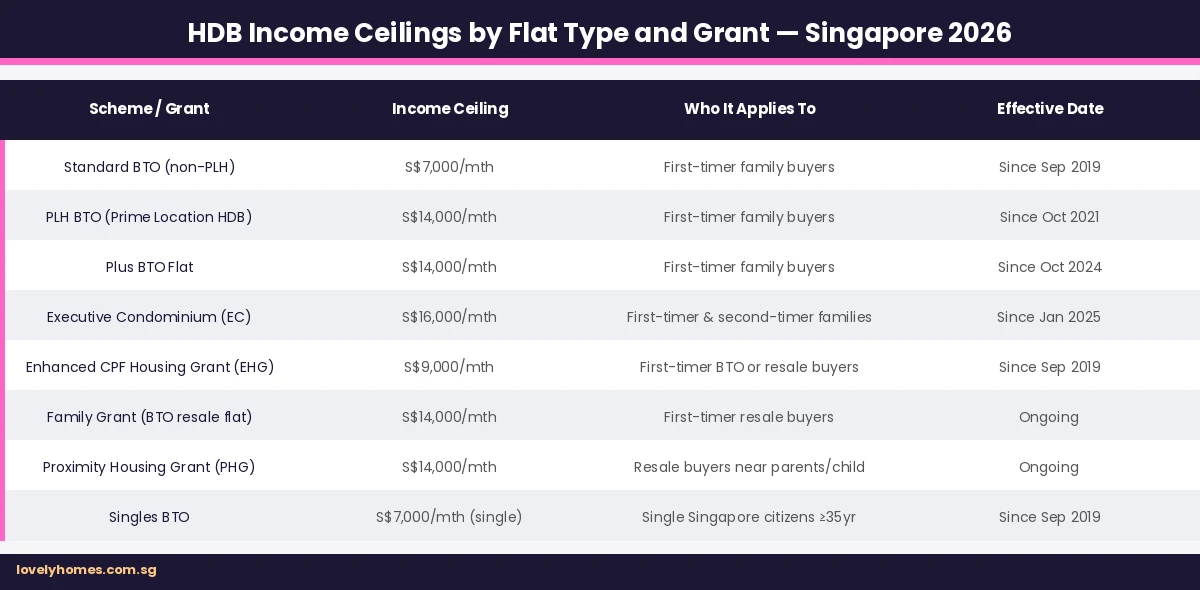
Figure 1: HDB income ceilings by scheme and grant type, Singapore 2026. All amounts are gross monthly household income. Source: HDB, CPF Board.

Income Ceilings by Flat Type — Full 2026 Breakdown

Standard BTO Flats: S$7,000/Month

For the majority of new HDB BTO flats in non-prime, non-plus locations (classified as “Standard” flats), the household gross income ceiling is S$7,000 per month. This applies to families — defined as a married or engaged couple (or family nucleus including parent/child). Singles applying under the Single Singapore Citizen scheme for a 2-room Flexi flat in the non-mature estates have a ceiling of S$7,000 per person (individual income, not household).

The S$7,000 ceiling is intentionally conservative — it targets the bottom 60–65% of Singapore’s household income distribution. Households above this ceiling are expected to either purchase an EC, a private condominium, or a resale HDB flat (where there is no income ceiling for the purchase itself, though grants are still capped).

PLH and Plus BTO Flats: S$14,000/Month

Introduced under HDB’s new flat classification framework that took effect in October 2024, Plus and Prime Location Housing (PLH) flats carry a higher income ceiling of S$14,000/month. These flats are located in attractive areas close to the city (e.g., Bukit Merah, Queenstown, Toa Payoh for PLH; Woodlands, Tengah for Plus). The higher ceiling reflects the greater demand for these locations and the recognition that buyers in these markets tend to have higher incomes, while still needing a subsidised option. Plus and PLH flats come with stricter resale conditions — a 10-year Minimum Occupation Period (compared to 5 years for Standard), and an income ceiling on resale (buyers of PLH resale flats must also satisfy a S$14,000 income ceiling).

Executive Condominiums: S$16,000/Month

The EC income ceiling was raised from S$14,000 to S$16,000 per month effective 1 January 2025. This makes ECs accessible to a wider band of dual-income professionals who earn too much for standard BTOs but are priced out of private condominiums. An EC is a hybrid housing type — built by private developers but sold at subsidised prices with HDB eligibility rules for the first 10 years, before it privatises and becomes fully marketable. The S$16,000 ceiling targets households at roughly the 80th percentile of Singapore’s income distribution.

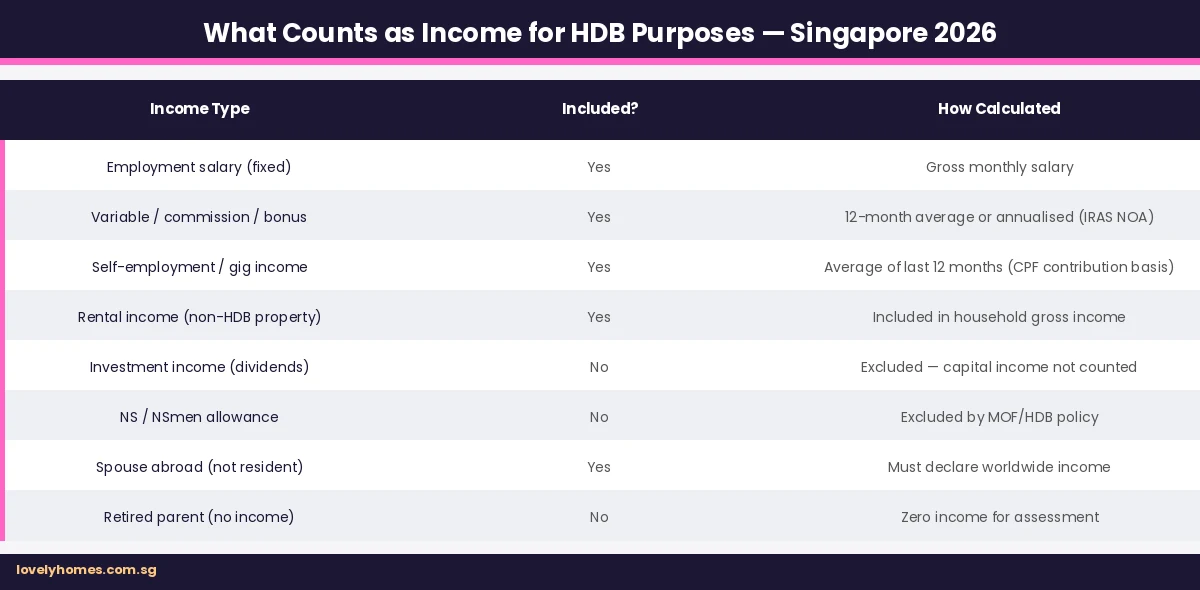
What counts as income for HDB BTO application Singapore 2026
Figure 2: Income types and how they are treated in HDB income ceiling assessment. Source: HDB, CPF Board.

How HDB Calculates Household Income

HDB assesses household income based on the gross monthly income of all persons listed in the flat application (the applicant, occupiers, and any essential occupiers). The income of all listed individuals is summed to arrive at the household total.

Fixed Employment Income

For salaried employees, the assessed income is the gross monthly salary as reflected in the applicant’s payslip or CPF contribution records. Gross salary includes basic pay plus any fixed allowances, and is assessed before deduction of employee CPF contributions, income tax, or other deductions.

Variable, Commission, and Bonus Income

Variable income (commissions, performance bonuses, overtime pay) is averaged over the preceding 12 months. If the applicant has been employed for less than 12 months, the average is calculated over the actual period of employment. Applicants who received a large one-off bonus in a single month cannot exclude it — HDB takes the 12-month average, which will include that month’s higher figure.

Self-Employment and Gig Income

For self-employed persons, freelancers, and gig workers, HDB assesses income based on the average monthly income from the preceding 12 months, typically computed from the latest available Notice of Assessment (NOA) from IRAS, or from CPF contribution records for self-employed persons who make voluntary MediSave contributions. Applicants who have not filed an IRAS tax return may be required to submit a statutory declaration of income.

What Is Excluded

Investment income (dividends, interest, capital gains from shares or property) is explicitly excluded from HDB’s income assessment. National Service (NS) full-time allowances and NSmen in-camp training allowances are also excluded. A family member who is currently on no-pay leave, studying full-time, or retired with zero employment income contributes S$0 to the household total.

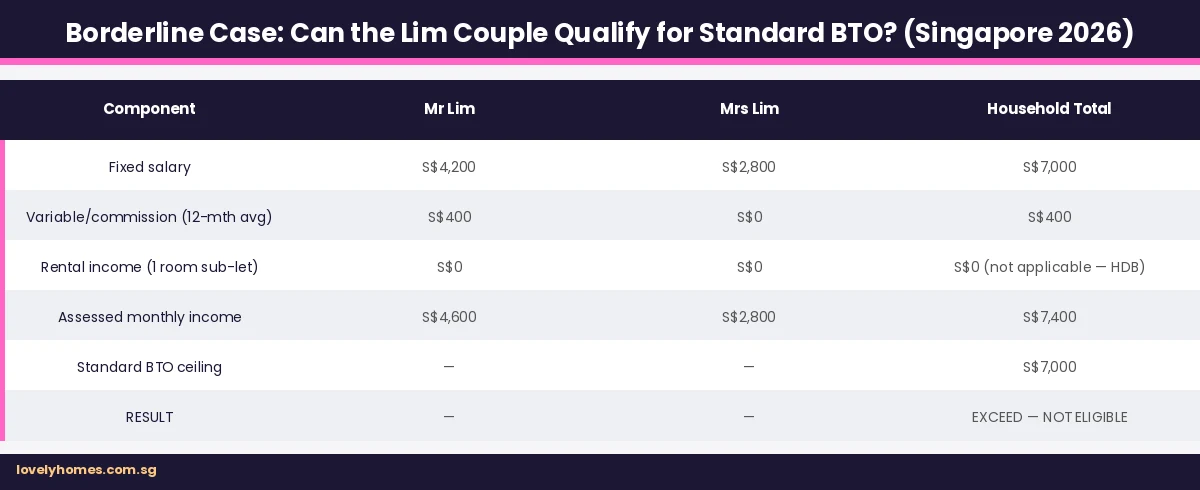
HDB income ceiling worked example Lim couple borderline case Singapore 2026
Figure 3: Worked example — the Lim couple’s borderline income assessment for standard BTO eligibility.

Grant Income Ceilings — EHG, Family Grant, and PHG

Even where a household meets the income ceiling for purchasing a flat, the grants available are separately subject to their own income tests. The Enhanced CPF Housing Grant (EHG) — the largest and most progressive grant — has a ceiling of S$9,000/month for families. Below this ceiling, the EHG scales from S$5,000 (household income S$7,001–S$9,000) up to S$120,000 (household income ≤ S$1,500). Families earning between S$7,001 and S$9,000 can still receive the EHG for a resale flat purchase even though they are ineligible for a standard BTO.

The Family Grant for resale flats (up to S$80,000 for buying from a non-related party) and the Proximity Housing Grant (up to S$30,000 for living near parents or married child) both have a ceiling of S$14,000/month. These grants can be stacked with the EHG where eligibility is met, for a maximum combined grant of S$230,000 on a resale flat.

Summary Table — Income Ceilings and Grant Amounts at a Glance

Scheme / Grant Income Ceiling (Family) Max Amount Notes
Standard BTO (purchase eligibility) S$7,000/mth No income ceiling for resale HDB purchase
PLH / Plus BTO S$14,000/mth 10-yr MOP; resale also income-capped
Executive Condominium (EC) S$16,000/mth Raised from S$14,000 effective Jan 2025
EHG (family) S$9,000/mth S$120,000 Progressive — lower income = higher grant
EHG (singles) S$4,500/mth S$60,000 2-room Flexi BTO or resale
Family Grant (resale) S$14,000/mth S$80,000 Buying from unrelated seller
Proximity Housing Grant (PHG) S$14,000/mth S$30,000 Within 4 km of parents/married child
Max combined grants (resale) Depends S$230,000 EHG + Family Grant + PHG stacked

Worked Example: The Lim Couple’s Borderline Income Situation

Mr Lim, 31, earns S$4,200 basic salary per month as a logistics executive, plus an average of S$400 monthly commission over the past 12 months. Mrs Lim, 29, earns S$2,800 as a primary school teacher. They are first-timer applicants hoping to ballot for a 4-room Standard BTO flat in Sengkang.

Income assessment: Mr Lim’s assessed income = S$4,200 + S$400 = S$4,600/mth. Mrs Lim’s assessed income = S$2,800/mth. Household total = S$4,600 + S$2,800 = S$7,400/mth.

Result: S$7,400 exceeds the S$7,000 standard BTO ceiling — the Lim couple is not eligible for a Standard BTO flat. They have three practical options: (1) apply for a PLH or Plus BTO flat (S$14,000 ceiling) in a prime location; (2) apply for a resale HDB flat (no income ceiling on the purchase itself, though their EHG would be capped at S$9,000 ceiling — which they meet, so they’d receive some EHG); or (3) consider an EC (S$16,000 ceiling). Note that if Mr Lim’s commission is reduced (e.g., in a slow quarter), his income for that 12-month window may average below S$400, potentially bringing the household total to or below S$7,000.

Why Income Ceilings Matter for Singapore’s Housing Market

Income ceilings are the primary demand-management tool for Singapore’s public housing system. By restricting BTO eligibility to lower- and middle-income households, HDB ensures that its heavily subsidised flat supply — which often prices new flats at 20–40% below comparable resale market values — reaches the households that most need the subsidy. Without income ceilings, wealthier households would compete for and crowd out subsidised flats, undermining the social purpose of public housing.

The existence of multiple ceiling tiers (S$7,000, S$14,000, S$16,000) also creates a housing ladder that mirrors Singapore’s income distribution: Standard BTOs for lower-middle income families, Plus/PLH and ECs for upper-middle income families, and the private market for those above S$16,000/month household income.

What Might Change: Income Ceiling Reviews

(This section contains editorial analysis; it does not constitute financial or housing advice.)

HDB reviews income ceilings periodically in line with median household income growth. The last major revision was in September 2019 (standard BTO ceiling reduced from varying rates to a uniform S$7,000 with EHG introduced simultaneously). The EC ceiling was raised from S$14,000 to S$16,000 in January 2025. With Singapore’s median household income having grown approximately 15–20% between 2019 and 2025, some housing analysts expect MND to review the standard BTO ceiling again in the 2026–2028 planning cycle. A rise to S$8,000 or S$8,500 would make a meaningful difference for dual-income couples earning in the S$7,000–S$8,500 range who are currently excluded from BTO eligibility.

Frequently Asked Questions

Is there an income ceiling to buy a resale HDB flat?

No — there is no maximum income ceiling for purchasing a resale HDB flat. Any Singapore Citizen or Permanent Resident who meets the general eligibility conditions (citizenship/PR status, family nucleus or age requirement, ownership restriction) may buy a resale flat regardless of how high their household income is. Income ceilings only apply to new BTO flats and ECs. However, the grants available for resale flat buyers (EHG, Family Grant, PHG) do have income ceilings as described in this article, so higher-earning households buying resale may receive reduced or zero grants.

What happens if my income exceeds the ceiling after I ballot for a BTO flat?

Income eligibility is assessed at the time of flat application (ballot) and again at the time of flat booking (signing the agreement for lease). If your household income exceeds the ceiling at the time of booking, HDB may disqualify the application. However, if income rises after booking but before key collection (completion), you generally remain eligible as the assessment was already made. Applicants should be honest about their income at both key assessment points, as a deliberate misrepresentation can result in disqualification and potentially being barred from future HDB applications.

Does my spouse’s income count if we apply together?

Yes. All persons listed in the HDB flat application — whether as applicants or occupiers — must declare their income, and all declared incomes are summed to form the household income. If your spouse is listed in the application (even as an occupier), their income is included. If your spouse has zero income (e.g., they are a homemaker or full-time student), their contribution to the household total is zero. Couples who are applying under the Fiancé/Fiancée scheme must also include their future spouse’s income.

Can I include rental income from my current property to meet the income threshold for EHG?

Rental income from non-HDB private property is generally included in HDB’s income assessment as it forms part of gross monthly income. However, this question is more often asked in the opposite direction — households trying to keep their income below the ceiling for grant eligibility. If including rental income pushes your household total above the relevant ceiling, you would lose eligibility for that grant tier. IRAS’ Notice of Assessment is the documentary basis for verifying rental income. Rental income from a sub-let HDB room (which is subject to HDB’s sub-letting rules) is also included in gross income.

What is the income ceiling for single Singaporeans buying a BTO?

Single Singapore Citizens aged 35 and above may apply for a 2-room Flexi BTO flat under the Single Singapore Citizen scheme. The income ceiling is S$7,000 per month (individual income, not household). Singles are not eligible for 3-room, 4-room, or larger BTO flats in the open market, though they may apply jointly with parents under the Joint Singles Scheme or with a single sibling. For resale flats, singles may purchase any size flat (from 2-room up to 5-room) without an income ceiling on the purchase, and may receive the EHG for Singles (ceiling S$4,500/month, max S$60,000).

How is income assessed for a person who recently started a new job?

For a person who has been employed for less than 12 months, HDB averages their gross income over the actual period of employment — not a full 12 months. For example, if Mr Tan started his job 6 months ago with a gross salary of S$5,000/month, his assessed income is S$5,000 (the monthly figure, not S$30,000 / 12 = S$2,500). Fixed monthly salary is straightforward; variable pay would be averaged over those 6 months. Someone who recently joined a new employer at a higher salary cannot use the income figure from their previous lower-paying job — HDB uses the current employment’s income for the averaging calculation.

Is the Ethnic Integration Policy (EIP) related to the income ceiling?

No. The Ethnic Integration Policy (EIP) and the SPR Quota are separate eligibility rules that restrict the racial composition of each HDB block and neighbourhood — they ensure no single ethnic group dominates any given HDB block. EIP applies at the point of resale flat purchase (you can only buy in certain blocks depending on your ethnicity and the current racial mix of that block) and has nothing to do with income. The income ceiling and the EIP are independent eligibility checks — a buyer must satisfy both, but they measure completely different things.

Related Articles

Disclaimer: This article is for general informational purposes only and does not constitute financial or housing advice. HDB income ceilings, grant amounts, and eligibility conditions may be revised by HDB, MND, or CPF Board at any time. Always verify the latest eligibility requirements directly with HDB at hdb.gov.sg or via the HDB Flat Portal before submitting any application. Additional references: CPF Board, IRAS.

HDB Resale Procedure Singapore 2026: HFE Letter, OTP, Resale Portal & Key Collection

HDB Resale Procedure Singapore 2026: HFE Letter, OTP, Resale Portal & Key Collection

Buying an HDB resale flat is the most common large-ticket transaction Singaporeans ever make outside the BTO ballot — and the procedure has changed materially since the HDB Resale Portal went fully digital in 2018, and again with the HDB Flat Eligibility (HFE) letter taking over from the old HLE / HDB Loan Eligibility letter on 9 May 2023. This guide walks you through the eight milestones, the ~8 to 12-week timeline, the four eligibility schemes, the cash-versus-CPF split for a S$650,000 4-room buyer, and the small-print mistakes that delay completion.

Quick Answer

  • The end-to-end HDB resale runs ~8 to 12 weeks once buyer and seller have a valid HFE letter.
  • The buyer pays a S$1 to S$1,000 option fee for the OTP, then up to a further S$5,000 in option exercise fee within 21 days.
  • Resale applications are filed jointly via the HDB Resale Portal; both parties must submit within 7 days of each other.
  • The buyer’s cost stack on a S$650,000 flat includes a 20% to 25% down-payment, BSD (~S$14,400), legal fees, COV if any, and grant offsets.
  • Eligibility flows through one of five schemes (Public, Fiancé, Single SC, Joint Singles, Non-Citizen Spouse) — each with its own income ceiling and age gate.
  • HDB approval typically issues 2 to 4 weeks after submission; completion appointment is roughly 6 to 8 weeks after approval.
  • The buyer collects the keys at the completion appointment after paying the remaining balance and confirming all CPF refunds and stamp duties are settled.
HDB Resale Procedure Singapore 2026 hero — buyer step-by-step guide
LovelyHomes — the HDB resale procedure broken down for first-time and second-time buyers.

Step 1: HDB Flat Eligibility (HFE) letter

Since 9 May 2023 the HFE letter has consolidated what used to be three separate documents (HLE letter, eligibility-to-buy and CPF housing grant). Both buyer and seller obtain it via the HDB Flat Portal using Singpass, and it tells you in one document: which schemes you qualify under, the maximum HDB-loan amount, the CPF housing grants available, and the time-stamped income ceiling check. The letter is valid for 6 months; if it expires before completion you must reapply (frequent in slow-moving markets).

Sellers get an HFE too, because HDB needs to verify the seller’s MOP status, ownership share, and any outstanding subsidies that affect the next-flat resale levy. If you are about to list and you have not pulled an HFE in the last 6 months, do that first — listings without a valid HFE create the highest rate of completion-stage delays.

Step 2: Searching, viewing, and the OTP

Resale flats are listed on a mix of platforms: HDB’s own listings, classifieds, and private property portals. Once a buyer and seller agree on a price, the seller grants an Option to Purchase (OTP), accompanied by a non-refundable option fee of between S$1 and S$1,000 (mutually agreed; capped by HDB at S$1,000). The OTP locks the flat for 21 days during which the buyer must decide whether to exercise.

If the buyer exercises the OTP, an option exercise fee (option fee + exercise fee combined cannot exceed S$5,000) is paid. The seller is now contractually committed to sell. If the buyer does not exercise within 21 days, the OTP lapses and the option fee is forfeited; the seller is then free to grant a new OTP to another buyer.

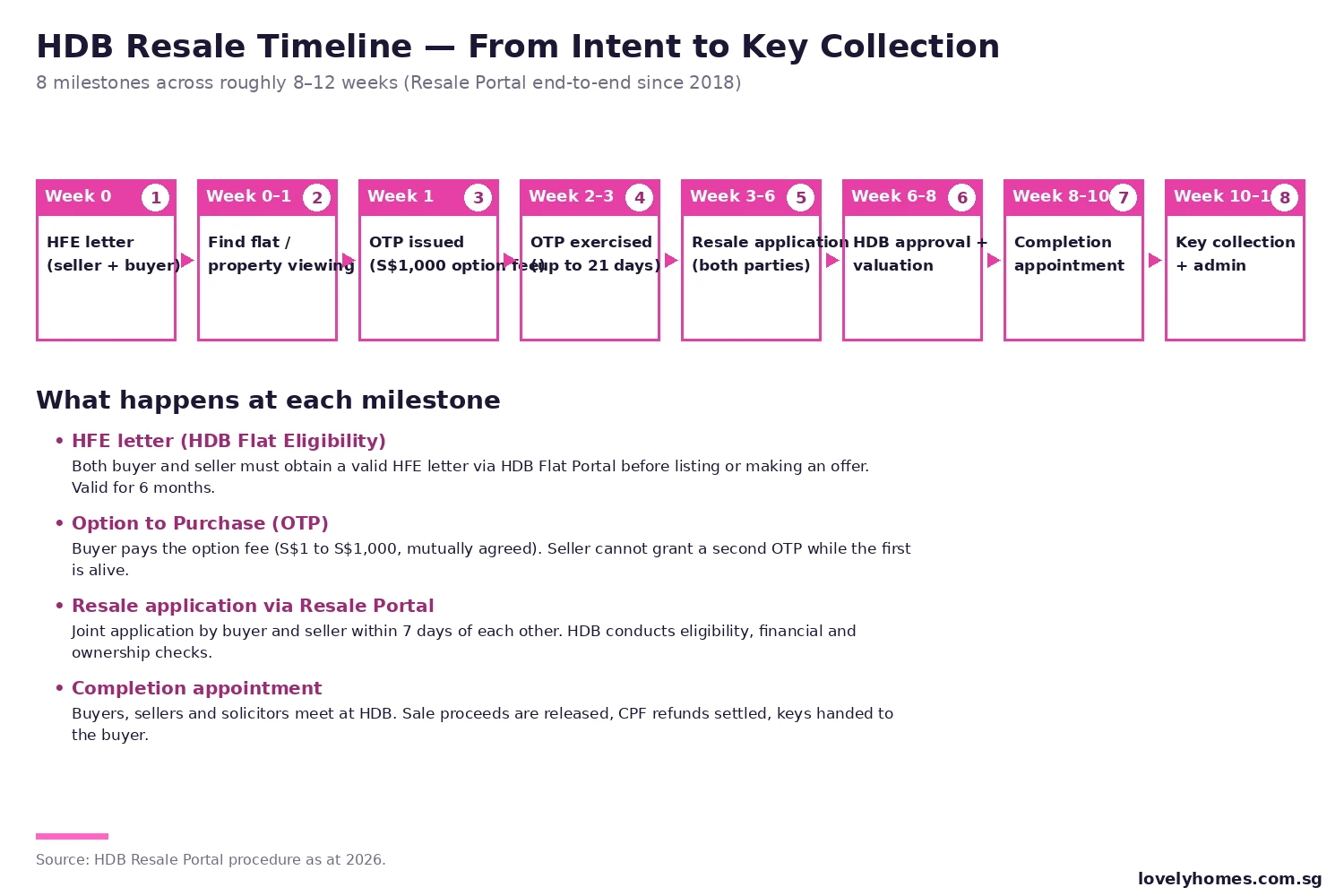
HDB resale 8-step timeline Singapore 2026
Figure 1: HDB resale eight-milestone timeline from HFE letter to key collection (~8 to 12 weeks).

Step 3: Resale application via Resale Portal

Both buyer and seller submit a resale application on the HDB Resale Portal, ideally within 7 days of each other. The portal validates eligibility, the OTP details, sale price, financing intent, and the schemes claimed. HDB then runs financial-credibility checks, MOP checks, and ABSD-cross-checks against any other residential property held.

This stage requires both parties to be available digitally (Singpass), to upload supporting documents (NRIC, marriage certificate where applicable, supporting income evidence if claiming grants), and to acknowledge HDB’s resale terms. Most rejections at this stage are administrative — mismatched dates, missing documents, lapsed HFE — so attention to detail saves weeks.

Step 4: Valuation, BSD and stamp duty

HDB’s appointed valuer assesses the flat. Valuation determines the maximum HDB-loan amount and the maximum CPF that can be used. If the agreed sale price exceeds the valuation, the difference is Cash-Over-Valuation (COV), payable in cash by the buyer. COV cannot be loaned, cannot be paid from CPF, and cannot be financed in any way.

Buyer’s Stamp Duty (BSD) is then levied on the higher of price or valuation: 1% on the first S$180,000, 2% on the next S$180,000, 3% on the next S$640,000, and 4% on the balance up to S$1.5m (5% above S$1.5m, 6% above S$3m). For a S$650,000 4-room flat, BSD comes to S$14,400. ABSD applies if the buyer already owns another residential property (5% to 60% depending on profile).

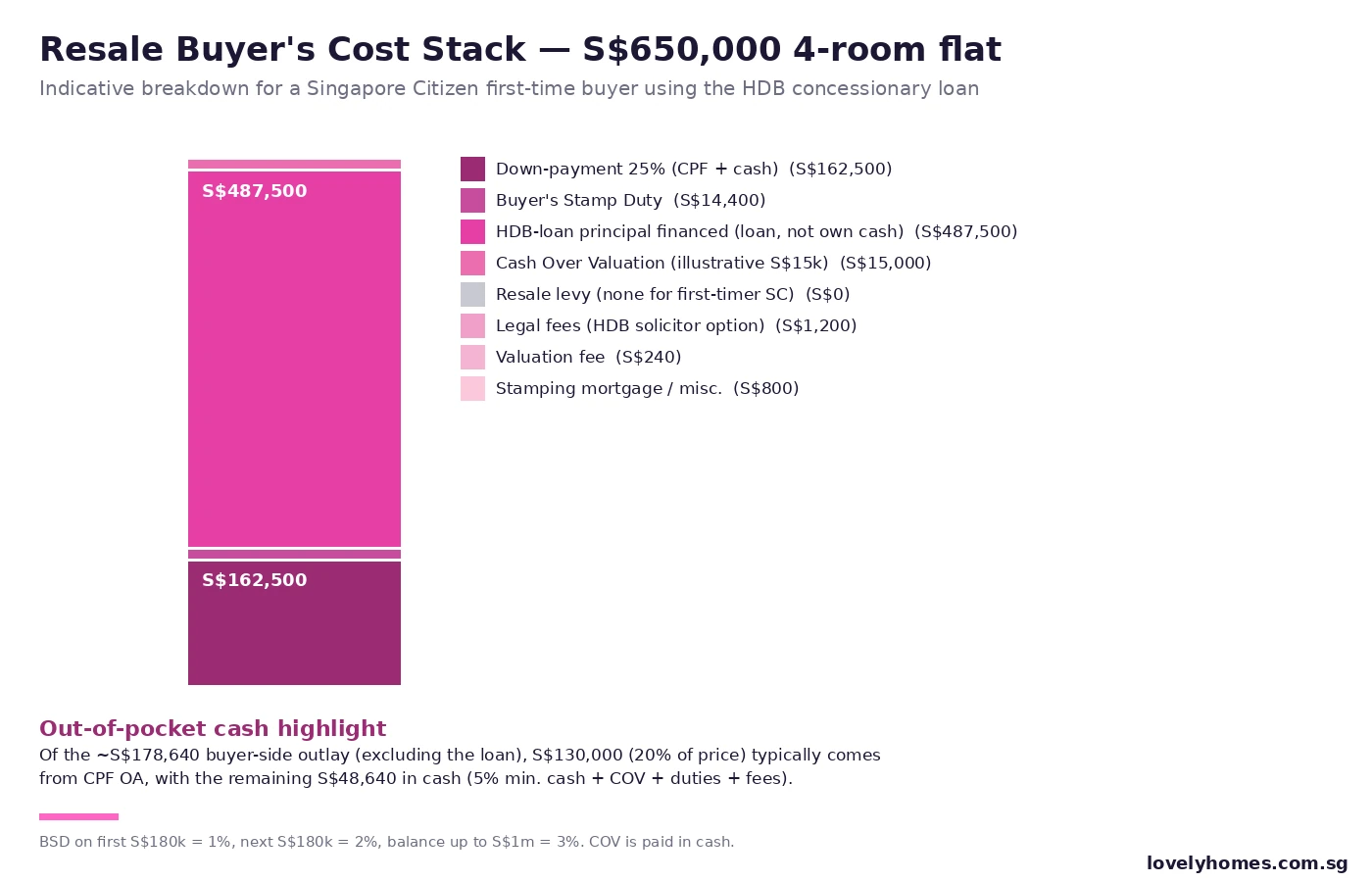
HDB resale buyer cost breakdown S$650k 4-room flat Singapore 2026
Figure 2: indicative buyer cost stack for a S$650,000 4-room HDB resale (CPF-funded down-payment, BSD, COV, fees).

Step 5: Eligibility schemes

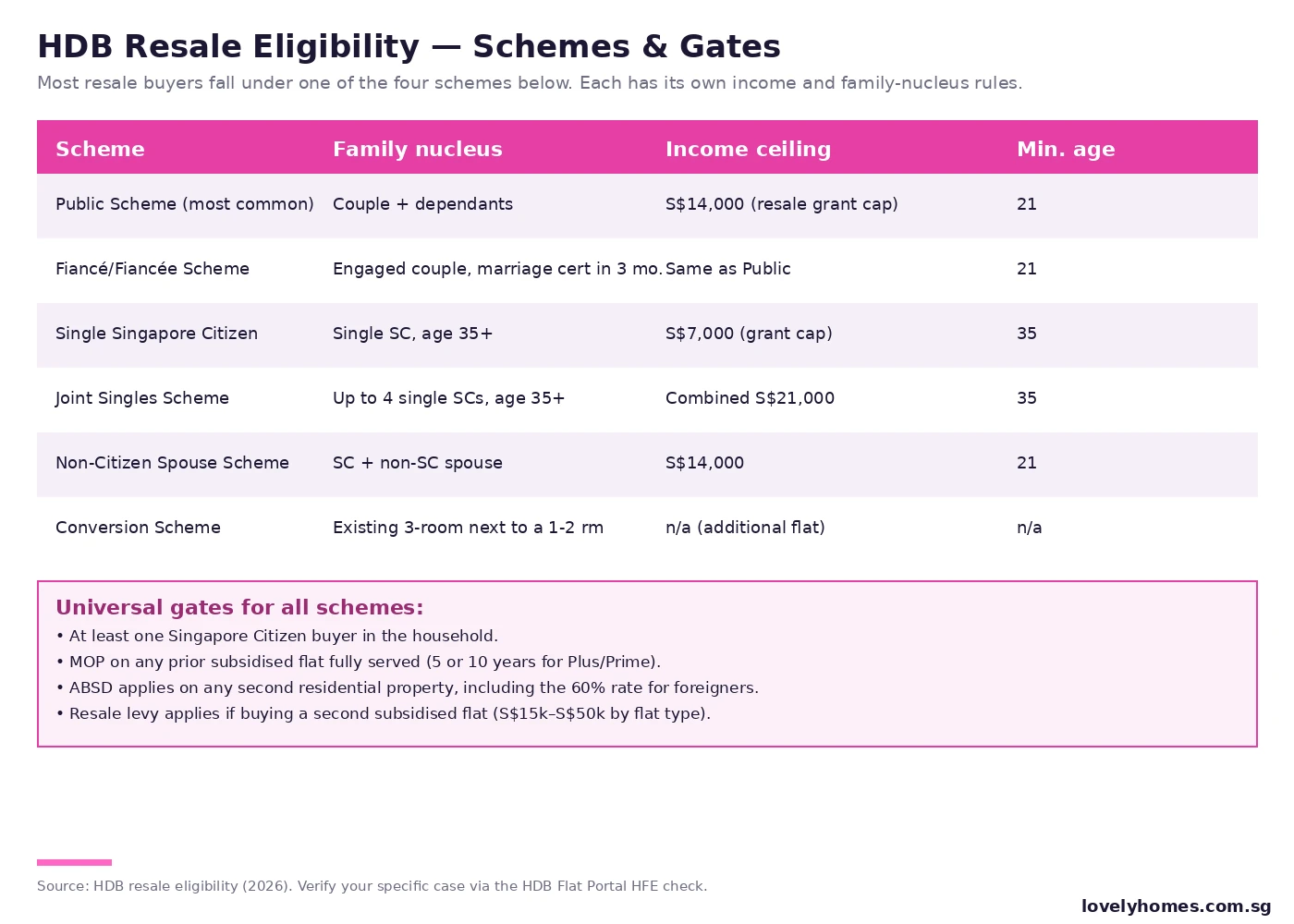
Most resale buyers fall under the Public Scheme (married couple plus dependants, S$14,000 grant income ceiling). Engaged couples use the Fiancé/Fiancée Scheme, with a marriage certificate due within 3 months of key collection. Single Singapore Citizens 35 and above use the Single Singapore Citizen Scheme (S$7,000 grant ceiling) or the Joint Singles Scheme (up to four single SCs aged 35+). The Non-Citizen Spouse Scheme covers a Singapore Citizen plus a foreign or PR spouse.

HDB resale eligibility schemes Singapore 2026
Figure 3: HDB resale eligibility schemes with income ceilings and minimum-age gates.

Step 6: Completion appointment and key collection

Roughly 6 to 8 weeks after HDB approval, both parties attend the completion appointment at HDB Hub. Solicitors are present (most buyers and sellers use HDB’s appointed solicitor for cost efficiency at S$1,200 to S$2,400 typical), and the appointment confirms: full payment of the balance, settlement of any outstanding bank loans on the seller’s side, CPF refunds with accrued interest to the seller’s CPF accounts, BSD payment, and the formal transfer of the lease.

The buyer then receives the keys. The flat is now legally yours, subject to any encumbrances disclosed and survives a “deemed handover” on the completion date.

Summary table — milestone to action

Stage Buyer Action Seller Action Typical Time
HFE letter Apply via HDB Flat Portal Apply via HDB Flat Portal 7–14 days
OTP issued Pay option fee S$1–S$1,000 Issue OTP, lock flat 21 days Day 0
OTP exercised Pay exercise fee (combined ≤S$5k) Receive exercise fee Day 1–21
Resale application Submit on Resale Portal Submit within 7 days Day 21–35
Valuation Cover valuation fee Provide access to flat Week 4–6
HDB approval Receive in-principle approval Receive in-principle approval Week 6–8
Completion appointment Pay balance, receive keys Receive sale proceeds Week 8–12

Worked Example: Tan family, S$650,000 4-room Sengkang resale

Profile. Mr Tan, 32, and Mrs Tan, 30, both Singapore Citizens, both first-time buyers. Combined household income S$11,200/mth, both employed. Buying a S$650,000 4-room resale flat in Sengkang from an upgrader couple. Using the HDB concessionary loan (HFE letter cleared at S$520,000 max loan).

Day 0. OTP issued. Tan family pays S$1,000 option fee.

Day 18. OTP exercised. Tan family pays S$4,000 exercise fee (S$5,000 combined). Resale application submitted to HDB Resale Portal same day. Seller follows on Day 22.

Week 5. Valuation comes in at S$640,000 — i.e. S$10,000 COV due in cash on top of the loan and CPF.

Buyer’s cost breakdown:

  • HDB-loan principal: S$487,500 (75% of price) — HDB pays the seller directly at completion.
  • Down-payment: S$162,500 (25% of price) — typically S$130,000 from CPF OA + S$32,500 cash (5% min cash). Tan family uses S$130,000 CPF OA + S$32,500 cash.
  • BSD: S$14,400 on S$650,000 (1%/2%/3% tiers).
  • COV: S$10,000 in cash.
  • Legal fees (HDB solicitor): ~S$1,200.
  • Valuation + admin fees: ~S$240 + misc.
  • Enhanced CPF Housing Grant: not applicable (income S$11.2k > S$9k ceiling for EHG).
  • Family Grant: S$50,000 (Public Scheme, both first-timers, household income S$11.2k qualifies).

Net cash out-of-pocket on day of completion: S$32,500 (cash down-payment) + S$14,400 (BSD) + S$10,000 (COV) + S$1,200 (legal) + ~S$300 (valuation/misc) = ~S$58,400 cash, plus S$130,000 from CPF OA. The S$50,000 Family Grant lands in the Tan family’s CPF OA after completion, partially refunding the CPF deduction.

What this means for you

The single most expensive mistake first-time resale buyers make is over-reaching on COV in a hot market. COV is paid in cash, not CPF, and it is not loanable. A S$30,000 COV adds ~5% to the immediate cash burden of a S$650,000 flat. Track recent transacted prices for the same block on HDB’s resale price portal and use that — not asking-price averages — as your valuation anchor.

The second most common delay is the HFE letter expiring mid-process. If the seller takes more than 6 months from HFE issuance to completion (rare but happens with disputes or financing delays), the HFE must be reapplied, which can add 1 to 2 weeks. Re-pulling early is cheap insurance.

What might come next

HDB has signalled further digitalisation of the resale workflow over 2026 to 2027, with potential e-conveyancing extensions and a tighter integration between the Resale Portal, IRAS stamp-duty endpoints and CPF Board’s grant-disbursement system. Expect the typical 8 to 12-week timeline to compress towards 6 to 9 weeks for clean cases. Plus and Prime flats coming on the market in the early 2030s will reach this same procedure with the additional 10-year MOP and clawback layers — but the eight-step shape will remain.

FAQ

Do I need an agent to buy a resale flat?

No. The HDB Resale Portal lets buyer and seller transact directly without an agent — many DIY transactions complete cleanly. That said, an experienced conveyancing solicitor is essential at the OTP stage and the completion appointment. Most buyers use HDB’s appointed solicitor (S$1,200 to S$2,400) rather than appointing private counsel.

Can I use CPF for the entire down-payment?

For an HDB-loan buyer, the 25% down-payment can be funded entirely from CPF OA in most cases (5% must be in cash for the first-mortgage 20% CPF route). For a bank-loan buyer, the LTV is 75% and a minimum of 5% must be in cash. The remaining 20% can be CPF OA. The Tan family example uses the standard CPF + 5% cash structure.

What is the resale levy and does it apply to me?

The resale levy applies if you are buying a second subsidised flat (i.e. you have already taken a subsidy from HDB before, whether BTO, SBF, EC, or DBSS). The levy ranges from S$15,000 (2-room) to S$50,000 (Executive). First-time buyers — most of the resale market — pay no levy. The levy is paid at the time of the second purchase, or when the second flat reaches MOP if buying via BTO.

What grants are available for resale buyers?

Singapore Citizen first-timer couples can receive up to S$80,000 in stacked grants: the Family Grant (S$50,000 to S$80,000 by income), the Enhanced CPF Housing Grant (up to S$80,000 for incomes ≤S$9,000), and the Proximity Housing Grant (S$20,000 to S$30,000 for buying near or with parents). The HDB Flat Portal HFE letter shows your exact entitlement.

What if the seller backs out after the OTP is granted?

The seller has contracted to sell. If they renege after the buyer has paid the option fee, the buyer can sue for specific performance (i.e. force the sale to complete) or claim damages. In practice, sellers very rarely renege once the OTP is granted because the legal exposure is real and the option fee is treated as part-consideration of the sale.

Do I pay GST on a resale flat?

No. Residential resale property in Singapore is GST-exempt. Stamp duty (BSD and ABSD where applicable) is paid in cash to IRAS within 14 days of OTP exercise. CPF can also be used to pay stamp duty in some financing structures.

Can I list and buy at the same time?

Yes — and many upgraders do. Sellers transitioning to a private property must take care to plan timing so the sale of the HDB flat completes before key collection of the new home, otherwise ABSD on the second residential property kicks in. ABSD remission is available if the existing HDB flat is sold within six months of the new private completion, but that requires careful sequencing and an experienced solicitor’s eye.

Related Articles

Disclaimer

This article is general guidance for Singapore HDB resale buyers. Verify the latest procedure, eligibility ceilings and grant amounts on the HDB portal and via the HDB Flat Portal HFE letter. Stamp duty rates are governed by IRAS. CPF housing rules sit with the CPF Board. Prices in worked examples are illustrative; consult a licensed solicitor for your specific transaction.

Tags: HDB resale, HFE letter, Resale Portal, OTP, Option to Purchase, Buyer’s Stamp Duty, Cash Over Valuation, COV, Family Grant, Enhanced CPF Housing Grant, Singapore Citizen, eligibility scheme, completion appointment, key collection.

Translate »