Singapore Property Valuation & Cash-Over-Valuation (COV) Guide 2026: How Bank and HDB Valuation Really Works

Singapore Property Valuation & Cash-Over-Valuation (COV) Guide 2026: How Bank and HDB Valuation Really Works

Quick Answer: Valuation and Cash-Over-Valuation (COV)

  • Valuation is an independent assessment of a property’s fair market value — separate from the price you agree to pay the seller.
  • Your loan and CPF usage are capped at the LOWER of the purchase price or the valuation — never the higher figure.
  • If you pay more than the valuation, the gap is called Cash-Over-Valuation (COV) and must be paid entirely in cash — it cannot be financed by loan or CPF.
  • For HDB resale flats, valuation is requested only after the Option to Purchase (OTP) is signed, and is not disclosed to the seller beforehand.
  • Since HDB’s 2014 valuation reforms, median COV amounts have fallen sharply from the highs of 2011–2012.
  • For private resale property, banks appoint an independent valuer from their panel; valuations can vary slightly between banks.
  • Maximum Loan-to-Value (LTV) is 75% for a first housing loan within standard tenure limits — applied to the lower of price or valuation.
  • A valuation that comes in higher than your purchase price is good news — it doesn’t increase your loan, but it strengthens your equity position from day one.

What Is Property Valuation and Who Decides It?

Every property transaction in Singapore involves two separate numbers that buyers often conflate: the purchase price — what you and the seller agree to — and the valuation, an independent professional opinion of the property’s fair market value. They frequently match closely, but they don’t have to, and the gap between them has real financial consequences.

For private resale property, valuation is carried out by a professional valuer drawn from the bank’s approved panel, engaged once you apply for a home loan. For HDB resale flats, valuation is arranged through HDB’s own valuation process after the Option to Purchase (OTP) is exercised. In both cases, valuers assess comparable recent transactions (drawing on data such as URA’s REALIS caveats for private property), the unit’s floor level, orientation, condition, remaining lease, and other value drivers — arriving at an independent figure that neither buyer nor seller controls.

This is distinct from Annual Value (AV), which the Inland Revenue Authority of Singapore (IRAS) uses purely to calculate property tax, and which has no bearing on your loan quantum. Don’t confuse the two when budgeting.

How property valuation determines your loan quantum Singapore process flow
Figure 1: How property valuation determines your loan quantum. Applies to both HDB and private resale purchases.

The Golden Rule: Loan and CPF Are Capped at the Lower of Price or Valuation

This is the single most important mechanic to understand. The Monetary Authority of Singapore (MAS) sets Loan-to-Value (LTV) limits that banks must apply — up to 75% for a first housing loan with a tenure of 30 years or less (and where the loan does not extend past the borrower’s age of 65). But that 75% is calculated against the lower of the purchase price or the bank’s/HDB’s valuation — never the price alone.

The same logic applies to CPF usage: you can only draw CPF Ordinary Account savings up to the Valuation Limit, which is anchored to the valuation, not the agreed price. If you have agreed to pay above valuation, that excess sits entirely outside both the loan and CPF systems — it must come from cash savings.

What Is Cash-Over-Valuation (COV)?

Cash-Over-Valuation, universally shortened to COV, is the amount by which your agreed purchase price exceeds the property’s valuation. If you agree to pay S$850,000 for a flat that is subsequently valued at S$830,000, your COV is S$20,000 — an amount you must fund entirely in cash, on top of your normal downpayment.

COV became a well-known (and often painful) feature of the HDB resale market during the property boom of 2011–2012, when median COV amounts on some transactions were widely reported in the tens of thousands of dollars, as buyers competed for flats in a tight, fast-moving market with limited price transparency. HDB responded with a significant reform in March 2014: valuation would no longer be obtained and disclosed before price negotiations, but only after the OTP is signed, removing the anchoring effect that valuation figures had previously had on asking prices. Since then, median COV levels across the HDB resale market have fallen substantially, though COV has not disappeared entirely — it still surfaces for sought-after units in tight micro-markets.

Worked example purchase price versus valuation and cash over valuation gap Singapore HDB resale
Figure 2: Worked example — purchase price vs valuation and the resulting COV gap.

Private Property Valuation: How Bank Valuers Work

For private resale property, the process starts once you sign the OTP and apply for a home loan. The bank engages an independent valuer from its approved panel — not an estate agent, and not a party with any financial interest in the transaction — who conducts a desktop and often a physical inspection of the unit, benchmarking it against recent comparable transactions in URA’s caveat data, adjusting for floor level, stack, renovation condition and view. The valuer submits a report to the bank, typically within a few business days, and the bank bases your maximum loan quantum on that figure.

Because valuers exercise professional judgement, valuations can differ modestly between banks — it is common practice for buyers with a borderline COV situation to apply to more than one bank and compare valuations before committing to a lender.

LTV Limits at a Glance

Loan Scenario Tenure ≤30yrs & age ≤65 at maturity Tenure >30yrs or past age 65
1st housing loan 75% 55%
2nd housing loan 45% 25%
3rd & subsequent housing loan 35% 15%

All LTV percentages apply to the lower of purchase price or valuation. Source: MAS.

Worked Example: The Wongs Buy a Resale Flat Above Valuation

Profile: Mr and Mrs Wong, Singapore Citizens, agree to buy a 5-room HDB resale flat in Bukit Merah for S$850,000. They sign the OTP and request a valuation, which comes back at S$830,000 — a COV of S$20,000.

Loan quantum: Using a bank loan at 75% LTV, the loan is calculated on the lower figure — valuation, not price: 75% × S$830,000 = S$622,500.

Total downpayment required: S$850,000 (price) − S$622,500 (loan) = S$227,500. This breaks down into two distinct components: (a) the standard 25% downpayment on the valuation — 25% × S$830,000 = S$207,500, of which a minimum 5% of the purchase price (S$42,500) must be cash and the rest can be CPF; and (b) the S$20,000 COV, which sits entirely outside the loan and CPF system and must be paid in pure cash.

Buyer’s Stamp Duty: calculated on S$850,000 at progressive rates (1% on first S$180,000 = S$1,800; 2% on next S$180,000 = S$3,600; 3% on the remaining S$490,000 = S$14,700) = S$20,100, payable via cash and/or CPF.

Bottom line: the Wongs need at least S$62,500 in ready cash (S$42,500 minimum cash downpayment + S$20,000 COV) before CPF and BSD financing considerations, on top of their S$622,500 loan — a materially different cash-flow position than if the flat had valued at the full S$850,000 asking price.

How cash over valuation shrinks your loan and raises cash needed Singapore property
Figure 3: How a growing COV gap shrinks your loan and raises the cash you need to find.

Why This Matters: What a Big COV Gap Signals

A meaningful COV gap is rarely random — it usually signals that a specific unit is in unusually high demand relative to its comparable transactions: a rare high-floor stack, an unusually large layout for its flat type, or a location experiencing a fast-moving upgrade thesis (proximity to a new MRT line, for example). Buyers should treat a request for a price significantly above asking as a signal to budget conservatively for cash, particularly first-time buyers who may not have deep cash reserves beyond their CPF.

Singapore’s post-2014 valuation-after-OTP framework is, by regional standards, unusually transparent. In markets such as Hong Kong’s private resale sector, informal “over-ask” premiums persist without an equivalent independent bank-valuation checkpoint forcing price discipline, making Singapore’s system comparatively protective of buyers once the mechanics are understood. The trade-off is that Singapore buyers only discover their true financing gap after committing to an OTP — which is precisely why understanding this mechanism before you sign is so important.

What Might Come Next

The following is informed speculation, not confirmed policy. The HDB Resale Price Index has now recorded two consecutive quarters of decline (1Q2026 and 2Q2026), and HDB has already shown a willingness to ease adjacent rules in response — removing the 15-month wait-out period for private property owners on 28 July 2026. If resale price moderation continues, it is plausible that market-wide COV incidence could narrow further as competitive bidding pressure eases, though this is a market outcome rather than a policy lever HDB directly controls. No changes to the post-OTP valuation framework itself have been signalled.

Frequently Asked Questions

Can I ask for a second valuation if I disagree with the first?

For bank loans on private property, yes — you can apply to a different bank, which will engage its own panel valuer, and compare the two figures. For HDB resale flats, the valuation obtained through HDB’s process is generally treated as final for that transaction; there is no routine second-opinion mechanism in the same way.

Does a low valuation mean I overpaid?

Not necessarily. Valuation is a conservative, comparable-based estimate and can lag genuine market momentum, especially for unique units or in a fast-rising micro-market. A COV gap reflects what you’re willing to pay above that benchmark for a specific unit — it isn’t automatically a sign of a bad deal, though it does mean a larger cash outlay.

Can I use CPF to pay the Cash-Over-Valuation amount?

No. By definition, COV sits above the valuation, and CPF usage is capped at the Valuation Limit. The COV portion must be funded entirely from cash savings — it cannot be drawn from your CPF Ordinary Account under any circumstances.

How long does a valuation take?

For private property, bank-panel valuers typically return a report within a few business days of the request. For HDB resale flats, the valuation is processed as part of the standard resale application timeline, which runs roughly 8 to 12 weeks in total from OTP to completion.

Does valuation affect my property tax?

No. Property tax is calculated on Annual Value (AV), a separate figure determined by IRAS based on estimated market rental value, not on your transaction valuation or purchase price. The two are easy to confuse but serve entirely different purposes.

What if my property is valued higher than the price I’m paying?

That’s a favourable outcome. Your loan is still based on the purchase price in that case (banks lend against the lower of the two figures, and here price is lower), but you effectively start with built-in equity, since the property is independently assessed as worth more than you paid for it.

Do new launch condos get valued the same way?

New launch units are generally purchased directly from the developer at the listed price, and banks typically accept the developer’s price as the basis for the loan since there is no independent resale market comparison in the same sense. Valuation dynamics as described here mainly apply to resale transactions — HDB and private.

Disclaimer: This article is intended for general informational purposes only and does not constitute financial or legal advice. Valuation outcomes, LTV limits and stamp duty rates are subject to change and vary by individual circumstances. Always confirm current figures with the Housing & Development Board (HDB), the Monetary Authority of Singapore (MAS), the Inland Revenue Authority of Singapore (IRAS), and your bank’s mortgage specialist before making any purchase decision.
×

Click anywhere outside to close

HDB Resale Flat Eligibility Singapore 2026: Who Can Buy, Income Limits and CPF Grants

HDB Resale Flat Eligibility Singapore 2026: Who Can Buy, Income Limits and CPF Grants

Quick Answer: HDB Resale Flat Eligibility Singapore 2026

  • At least one applicant must be a Singapore Citizen (SC). PR-only households and foreigners cannot buy HDB resale flats.
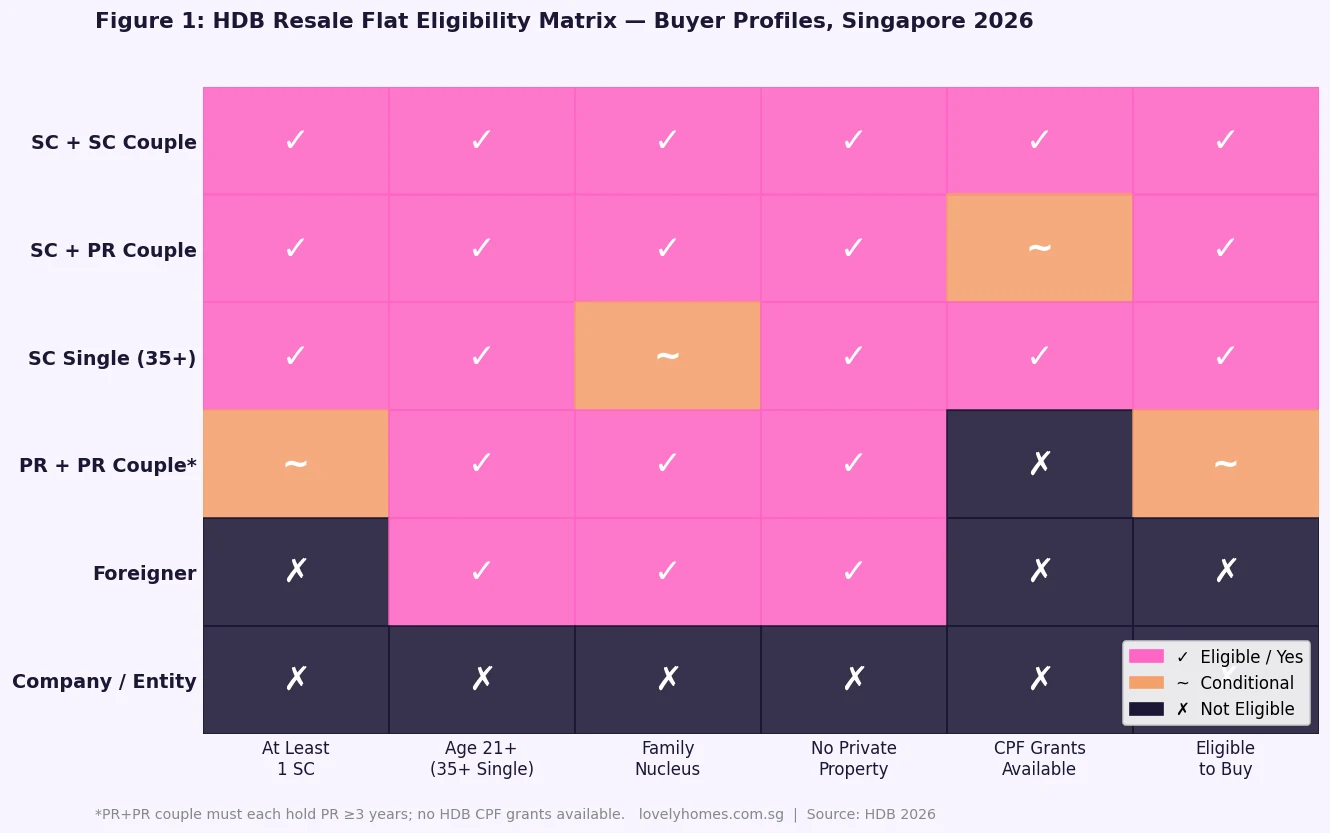
  • Eligible profiles include SC + SC couples, SC + PR couples, and SC singles aged 35 or above. PR + PR couples may buy only if both have held PR status for at least three years, and they receive no CPF housing grants.
  • There is no income ceiling for the purchase itself — income limits apply only to CPF housing grants, not to eligibility to buy.
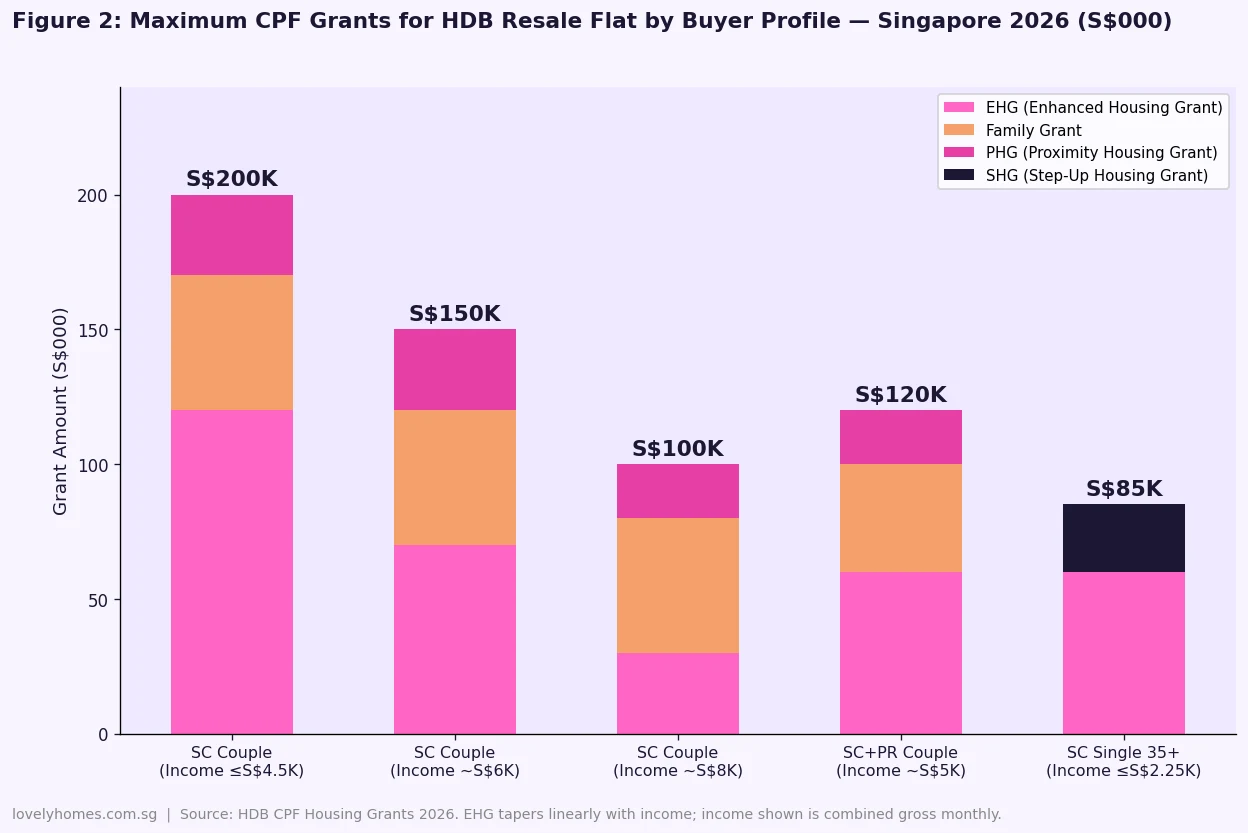
  • Maximum CPF grants reach S$200,000 for an SC couple with combined gross monthly income at or below S$4,500 (EHG + Family Grant + Proximity Housing Grant combined).
  • Buyers must not own private property locally or overseas, and must not have disposed of one within the 30 months before the resale application.
  • The resale process typically takes 8–12 weeks from granting the Option to Purchase to key handover.
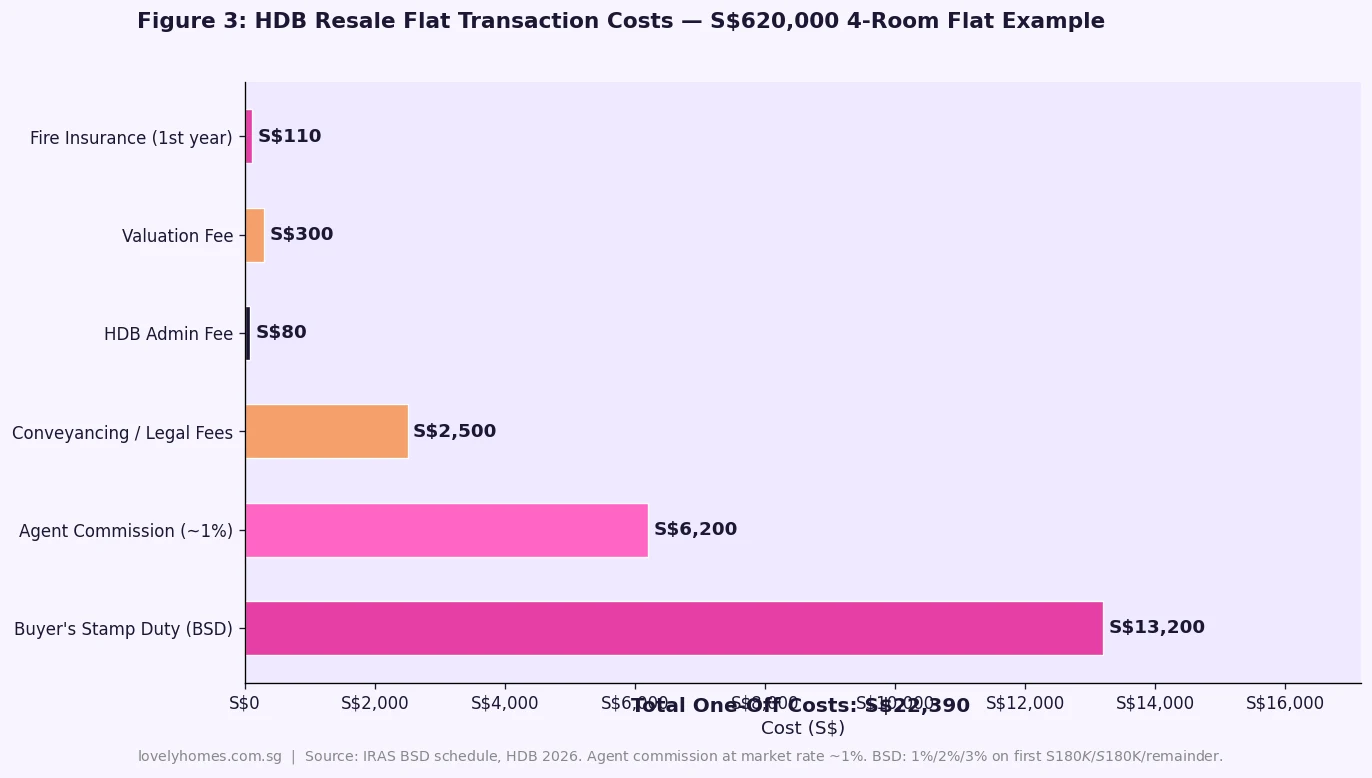
  • Transaction costs on a S$620,000 4-room resale flat total approximately S$22,390 in one-off fees (BSD, legal, agent, HDB admin, valuation, insurance).

What Is an HDB Resale Flat?

HDB resale flats are public housing units sold on the open market between private buyers and sellers — not by HDB directly — at prices negotiated between the parties. Unlike new Build-To-Order (BTO) flats, which HDB prices at a significant discount to market and allocates by ballot, resale flats are available for immediate purchase without a queue, at market prices that reflect location, condition, remaining lease, and current demand.

Resale flats represent the bulk of Singapore’s secondary residential transaction volume. In the first half of 2026, approximately 12,553 HDB resale transactions were recorded — compared with roughly 4,000–5,000 new BTO flat completions per half-year — making the resale market the primary route to home ownership for buyers who need a flat quickly, who missed a BTO ballot, or who prefer an established neighbourhood over waiting three to five years for a new flat’s completion.

The resale flat market is open to a wider range of buyers than the BTO market. No income ceiling applies to the purchase itself (though grants are income-capped). Certain foreigner-involving family structures — such as an SC married to a non-PR foreigner — are eligible under specific schemes. And the flat can be purchased in any location, any flat type, at any remaining lease length above 20 years (subject to CPF and HDB loan restrictions on shorter leases).

Who Can Buy an HDB Resale Flat? Core Eligibility Conditions

HDB’s eligibility framework for resale flat purchases is built around five core requirements, all of which must be satisfied at the time of application.

1. Singapore Citizenship: At least one applicant must be a Singapore Citizen. Permanent Residents may co-purchase with a SC spouse or parent, or may purchase as a PR couple provided both have held PR status for at least three years. Foreigners — regardless of marital status or length of residence — cannot purchase HDB resale flats.

2. Age: All applicants must be at least 21 years old. SC or PR singles applying under the Single Singapore Citizen Scheme or Joint Singles Scheme must be at least 35 years old at the time of application. Divorcees and widowed persons may apply under the relevant single-person scheme regardless of age, subject to other conditions.

3. Family Nucleus: Applicants must form a recognised family nucleus — typically a married or engaged couple, a parent-child unit, or siblings buying together. SC singles aged 35 or above may purchase a flat of any type except 5-room or larger under the Single Singapore Citizen Scheme.

4. Property Ownership: Applicants must not own any other residential property, whether in Singapore or overseas, at the time of application. If they have disposed of a private property, they must have done so at least 30 months before the HDB resale application date. This rule applies to all applicants listed on the application — including a spouse who owns overseas property.

5. HDB Ownership History: Applicants who have previously purchased a subsidised HDB flat or executive condominium (EC) must have served the full Minimum Occupation Period (MOP) of their current or most recent flat before they can purchase another resale flat. Buyers who have received two or more housing subsidies face additional restrictions.

HDB resale flat eligibility matrix buyer profiles Singapore 2026
Figure 1: HDB resale flat eligibility matrix by buyer profile, Singapore 2026. Pink = eligible; orange = conditional; navy = not eligible. *PR + PR couples require both holders to have held PR for at least three years; no CPF grants apply. Source: HDB 2026.

Income Ceiling: For Grants, Not for Purchase

One of the most common misconceptions about HDB resale flat purchases is that an income ceiling applies to eligibility. It does not. Any household that meets the five core conditions above may purchase a resale flat regardless of income — a household earning S$20,000 per month is just as eligible as one earning S$4,000 per month.

Income ceilings apply only to CPF housing grants. The Enhanced Housing Grant (EHG) — HDB’s most generous grant — is available only to households with a combined gross monthly income at or below S$9,000 (couples) or S$4,500 (singles). The EHG tapers on a sliding scale: at the S$4,500 combined-income threshold, an eligible couple receives the maximum S$120,000; at S$9,000, the grant is S$0. Family Grants and Proximity Housing Grants have no income ceiling.

Higher-income households purchasing resale flats at market prices simply forgo the EHG. They remain fully eligible to purchase and may still receive other grants — notably the Family Grant and Proximity Housing Grant — if they qualify by household composition and proximity to parents.

CPF Grants for HDB Resale Flats

CPF housing grants for resale flat purchases are among the most generous in Singapore’s housing policy toolkit, reflecting the government’s intent to keep resale flat ownership accessible to lower- and middle-income households even as market prices have risen through the 2020s.

CPF housing grants HDB resale flat by buyer profile Singapore 2026 stacked bar chart
Figure 2: Maximum CPF housing grants for HDB resale flat purchases by buyer profile, Singapore 2026. An SC couple on combined income at or below S$4,500/mth may receive up to S$200,000 in total grants. Source: HDB CPF Housing Grants 2026.

The Enhanced Housing Grant (EHG) is the flagship grant: up to S$120,000 for eligible couples and S$60,000 for eligible singles, disbursed into the CPF Ordinary Account and applied towards the purchase price. The EHG is a first-timer grant — it is available only to buyers who have not previously received any HDB housing subsidy. It applies to both new BTO and resale purchases, making it portable across the two markets.

The Family Grant provides S$50,000 to SC couples (or S$40,000 to SC + PR couples) purchasing a resale flat as first-timers. Unlike the EHG, the Family Grant has no income ceiling — it is available to all eligible first-time SC and SC + PR couples regardless of household income. Eligible flat types are 2-room to 5-room (the grant quantum varies slightly by flat size in some schemes).

The Proximity Housing Grant (PHG) rewards buyers who live with or near their parents or children. S$30,000 is available for buyers moving into the same town or within 2 kilometres of a parent’s home; S$20,000 is available for buyers living within 4 kilometres. The PHG is available to both first-timer and second-timer buyers and has no income ceiling.

The Step-Up Housing Grant provides S$15,000 to eligible public rental flat residents purchasing a 2-room Flexi or 3-room resale flat for the first time, supporting the transition from rental to ownership.

The HDB Resale Process: Step by Step

The resale process follows a structured sequence managed primarily through the HDB Flat Portal. Both buyer and seller must complete their respective steps through the portal; HDB acts as regulator and facilitator rather than direct party to the transaction.

Step 1 — Check eligibility: Buyers should verify their eligibility using HDB’s My Flat Dashboard and, if planning to use an HDB loan, obtain an HDB Flat Eligibility (HFE) letter before starting their search. The HFE letter confirms loan eligibility, grant eligibility, and any existing HDB ownership restrictions.

Step 2 — Secure financing: Buyers using a bank loan should obtain an Approval-in-Principle (AIP) from their chosen bank. This confirms the borrowing quantum and demonstrates financial readiness to sellers. Buyers using an HDB loan must have a valid HFE letter.

Step 3 — View flats and negotiate: Buyers may view flats listed on the HDB Flat Portal, PropertyGuru, or other property listing platforms. Negotiation covers the resale price and, where applicable, a cash premium above valuation (Cash Over Valuation, or COV).

Step 4 — Grant the Option to Purchase (OTP): The seller issues an OTP to the buyer on payment of a 1% option fee (negotiable; capped at S$1,000 for flats priced up to S$100,000 and at S$5,000 for higher-priced flats). The OTP grants the buyer an exclusive right to purchase the flat for 21 days.

Step 5 — Exercise the OTP: Within 21 calendar days, the buyer exercises the OTP by paying an additional 4% exercise fee (making 5% total initial payment). At this stage, both parties must register the OTP exercise on the HDB Flat Portal and submit their respective resale applications simultaneously.

Step 6 — HDB processes the application: HDB verifies eligibility, computes the grant amounts, and appoints a resale completion date. This typically takes four to eight weeks. HDB may request additional documents — CPF statements, income proofs, or statutory declarations — during this period.

Step 7 — Resale completion: On the completion date, the balance of the purchase price is paid (via CPF, HDB loan, or bank loan drawdown), BSD is paid (from CPF or cash), and the property title is transferred. The buyer receives the keys.

Total timeline from OTP grant to key handover: typically 8–12 weeks.

HDB Resale Transaction Costs

HDB resale flat transaction costs breakdown S$620000 4-room Singapore 2026
Figure 3: HDB resale flat transaction costs — S$620,000 4-room example, Singapore 2026. Total one-off costs approximately S$22,390. BSD computed on the standard IRAS sliding scale. Agent commission at prevailing market rate. Source: IRAS, HDB 2026.

The Buyer’s Stamp Duty (BSD) is the largest one-off transaction cost. BSD is computed on the purchase price (or market value, whichever is higher) using the IRAS sliding scale: 1% on the first S$180,000, 2% on the next S$180,000, and 3% on the remainder up to S$1,000,000. For a S$620,000 flat, BSD is S$13,200 — payable from CPF Ordinary Account.

Conveyancing fees cover the legal cost of transferring title and registering the mortgage. For a S$620,000 resale flat, these typically run S$2,000–S$3,000 depending on the law firm engaged. HDB charges an administrative fee of S$80 for processing the resale application. A formal valuation, if required by HDB or the bank, costs approximately S$200–S$400.

Agent commission — if a licensed agent is engaged — is typically around 1% of the purchase price paid by the buyer (S$6,200 on a S$620,000 flat), though this is negotiable. Many buyers transact directly through the HDB Flat Portal without an agent, particularly for straightforward resale purchases in familiar estates.

Summary: HDB Resale Eligibility at a Glance

Buyer Profile Eligible? HDB Loan? CPF Grants? Max Grants
SC + SC Couple (first-timer) ✓ Yes ✓ Yes EHG + FG + PHG Up to S$200,000
SC + PR Couple (first-timer) ✓ Yes ✓ Yes EHG + FG + PHG Up to S$180,000
SC Single (35+) ✓ Yes ✓ Yes EHG + SHG Up to S$85,000
PR + PR Couple (both 3yr+ PR) ✓ Yes* ✗ No None S$0
Foreigner (any status) ✗ No ✗ No None N/A
Company or Entity ✗ No ✗ No None N/A

*PR + PR couple: both must have held Permanent Residence for at least three years at time of application. No HDB loan or CPF housing grants available. Bank loan only. Source: HDB 2026.

Worked Example: SC + PR Couple Buying 4-Room Resale in Tampines

Mdm Farah (SC, 30) and her husband Ahmad (SPR, 31) have a combined gross monthly income of S$7,200. They wish to purchase a 4-room resale flat in Tampines at S$560,000 to live near Mdm Farah’s parents in the same town.

Eligibility check: SC + PR couple ✓ • Both aged 21+ ✓ • Married (family nucleus) ✓ • No private property locally or overseas ✓ • First-time buyers ✓. Result: Eligible to purchase.

CPF grants:
EHG: combined income S$7,200 (below S$9,000 ceiling) → approximately S$40,000 (SC + PR couple EHG rate; SC + SC couple would receive slightly more).
Family Grant (SC + PR): S$40,000.
Proximity Housing Grant (PHG): living in same town as Mdm Farah’s parents → S$30,000.
Total grants: S$110,000 (disbursed to CPF OA).

Financing: Combined income S$7,200 — below the HDB loan income ceiling of S$9,000 — so an HDB loan is available. LTV 80%. Loan amount = 80% × S$560,000 = S$448,000. Less grants applied to downpayment: S$110,000 exceeds the S$112,000 downpayment required, so the effective loan is S$560,000 − S$110,000 − S$2,000 (option fee already paid) = approximately S$448,000. Monthly instalment at 2.60% over 25 years: approximately S$2,041. MSR: S$2,041/S$7,200 = 28.3% ✓ PASS (below 30% MSR limit).

Transaction costs:
BSD: S$11,400 (1% × S$180K + 2% × S$180K + 3% × S$200K = S$1,800 + S$3,600 + S$6,000) — payable from CPF OA.
Legal fees: S$2,500. HDB admin fee: S$80. Valuation: S$300. Fire insurance: S$110.
Cash required upfront: approximately S$2,990 (option fee S$5,600 less exercise credit; legal + admin + valuation + insurance).

What Might Come Next

HDB resale prices have posted back-to-back quarterly declines in 2026: the Resale Price Index (RPI) fell -0.1% in Q1 2026 and a further -0.3% in Q2 2026 (flash estimate), the first consecutive decline since 2018–2019. Total Q2 transactions of 6,268 were down from the elevated volumes of 2022–2023, and the 1H 2026 total of 12,553 is 8.3% below the 12-month 2025 pace. Full Q2 2026 HDB resale statistics are expected around 23 July 2026 and will provide a more complete picture of price movements by flat type, town, and transaction tier.

HDB’s expanded BTO supply programme — including the newer Plus and Prime classification of flats in better-located estates — may gradually reduce demand pressure on resale flats in sought-after mature estates as more buyers gain access to subsidised options in those locations. However, the five-year MOP on BTO flats means any supply-side relief from Plus and Prime launches in 2024–2026 will only filter into the resale pool from 2029 onwards.

CPF housing grants are unlikely to be reduced in the near term. The government has consistently maintained and expanded the grant framework as a counterbalance to rising resale prices.

Frequently Asked Questions

Can I buy an HDB resale flat if my spouse is a foreigner (not a PR)?

Yes — under the Non-Citizen Spouse Scheme. A Singapore Citizen may purchase a resale flat with a non-citizen, non-PR spouse provided the couple is legally married. The SC spouse must be listed as the primary applicant. Eligible flat types under this scheme are 2-room Flexi to 5-room; Executive flats may not be purchased. The non-citizen spouse is not eligible for CPF housing grants and cannot use their CPF (if any) to finance the purchase. The family must use a bank loan, as HDB loans are not available under this scheme.

What is Cash Over Valuation (COV), and do I have to pay it?

COV is the amount by which the agreed resale price exceeds HDB’s commissioned valuation of the flat. If a flat is valued at S$580,000 but the seller and buyer agree to a price of S$620,000, the COV is S$40,000. COV must be paid entirely in cash — it cannot be financed by CPF, HDB loan, or bank loan, all of which are based on the valuation figure. COV is negotiable between buyer and seller. If the agreed price is at or below valuation, there is no COV. Buyers are not obliged to agree to COV; they may negotiate the price or walk away from a flat where the COV is unacceptable.

Can I use my CPF Ordinary Account to pay for the entire resale flat?

CPF Ordinary Account funds may be used to pay BSD, the downpayment (excluding the minimum cash portion), and monthly mortgage instalments. They cannot be used to pay the option fee, COV, or conveyancing fees. The minimum cash downpayment is 5% of the purchase price for a bank loan or 10% for an HDB loan (though HDB loan allows 10% from any source including CPF). Additionally, if the remaining lease of the flat at the time of purchase is below 60 years, there are stricter limits on CPF usage for older buyers — the CPF withdrawal limit may be reduced proportionally based on the buyer’s age relative to the flat’s remaining lease.

What is the Minimum Occupation Period (MOP) and how does it affect resale eligibility?

The MOP is the minimum period during which a subsidised HDB flat owner must physically occupy their flat before they are permitted to sell it on the open market or purchase private residential property. For most flats, the MOP is five years from the date of key collection (for new BTO flats) or flat completion. Buyers applying to purchase an HDB resale flat who previously owned a subsidised flat must confirm they have completed the MOP on that earlier flat before their application will be approved. If you are currently within your MOP, you cannot simultaneously purchase a resale flat as an investment or a second property — you would need to sell or wait until the MOP is served.

Are resale flats eligible for HDB loans?

Yes, HDB loans are available for resale flat purchases provided eligibility conditions are met. These include: at least one SC applicant; combined gross monthly household income at or below S$9,000; not having previously taken two or more HDB concessionary interest rate loans; and not owning private property. The HDB loan rate is currently 2.60% per annum — pegged at 0.10% above the prevailing CPF OA interest rate — and is fixed for the life of the loan. The LTV for HDB loans is 80%. Buyers who do not meet HDB loan eligibility must use a bank loan, typically at a floating rate linked to the Singapore Overnight Rate Average (SORA).

Can I buy a resale flat and rent it out immediately?

No. You must physically occupy the resale flat as your principal home for the first five years (the MOP) before you may sublet the entire flat. However, you may sublet individual rooms within the flat immediately after purchase, provided you continue to reside in the flat yourself and obtain prior HDB approval for the subletting arrangement. HDB requires that tenants for the entire flat (post-MOP) or individual rooms must be Singapore Citizens, PRs, or certain non-citizens with valid long-term passes — HDB approval is required and tenant details must be registered with HDB within seven days of commencement of tenancy.

Related Articles

Disclaimer: This article is for general information and educational purposes only. It does not constitute legal, financial, or housing advice. HDB eligibility rules, CPF grant amounts, income ceilings, and loan conditions are correct as at 11 July 2026 but are subject to revision by HDB, CPF Board, MAS, and IRAS. Readers should verify all eligibility conditions and grant amounts directly with HDB at hdb.gov.sg and consult a licensed conveyancing solicitor or HDB-appointed solicitor before transacting. BSD rates are set by IRAS at iras.gov.sg.

×
Enlarged view
Click anywhere to close

Translate »