GLS Programme Guide Singapore 2026: How Confirmed List and Reserve List Land Tenders Work

GLS Programme Guide Singapore 2026: How Confirmed List and Reserve List Land Tenders Work

Quick Answer: The GLS Programme

  • The Government Land Sales (GLS) Programme is the mechanism through which the Singapore Government releases state land to private developers, administered by the Urban Redevelopment Authority (URA) on the Government’s behalf.
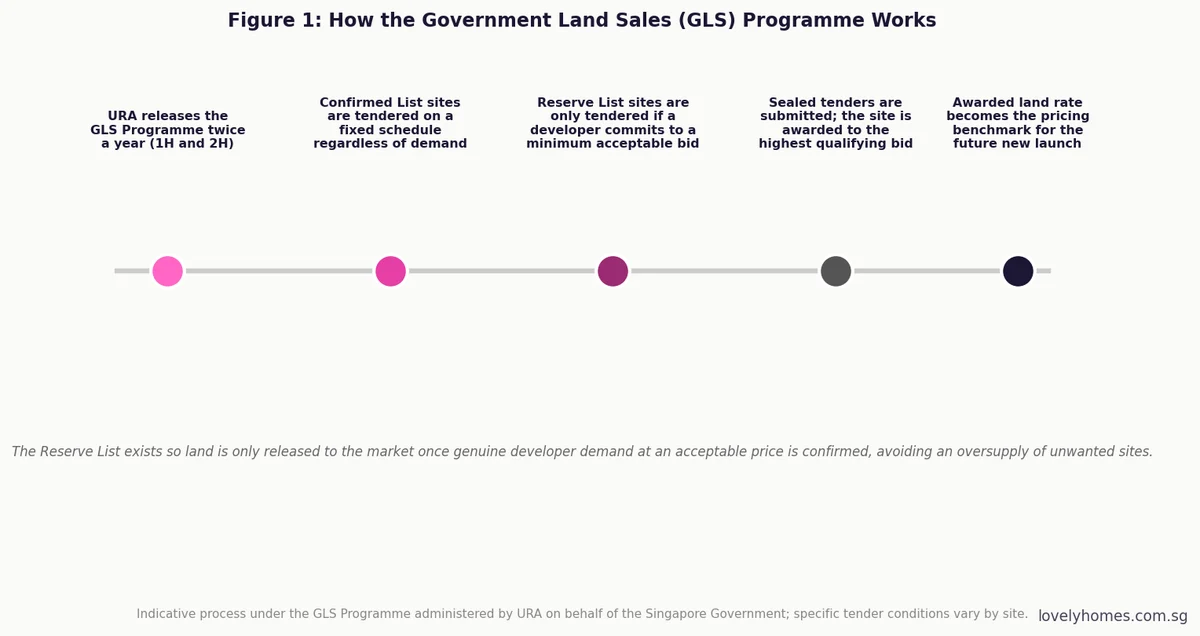
  • URA announces the programme twice a year, for the first half (1H) and second half (2H) of each year, listing sites available for tender over the following six months.
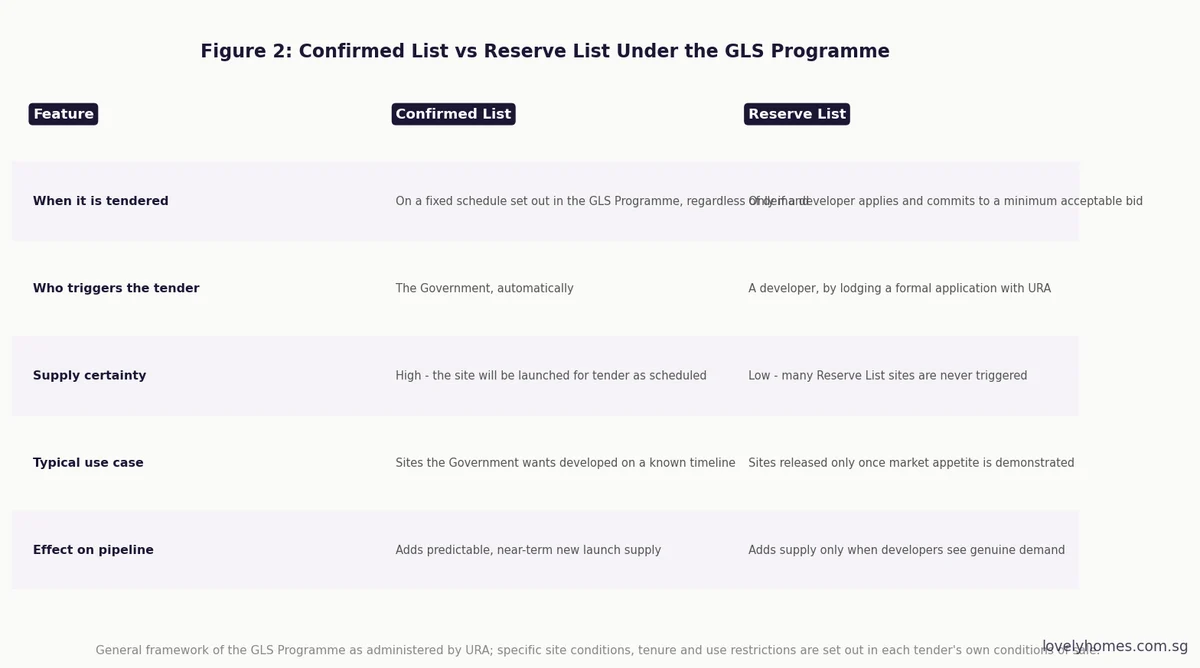
  • Sites are split into a Confirmed List, tendered on a fixed schedule regardless of demand, and a Reserve List, tendered only if a developer applies and commits to a minimum acceptable bid.
  • Tenders are awarded by sealed bid, with the site generally going to the highest qualifying bidder, though some sites use additional evaluation criteria such as design or concept proposals.
  • The land rate a developer pays at award becomes a key input into the eventual new launch price, since developers price units to recover land cost, construction cost, financing and professional fees, and a target profit margin.
  • GLS supply is one of the most closely watched leading indicators for Singapore’s private housing pipeline, since it signals how many new private homes will enter the market roughly two to four years ahead.
  • Not every Reserve List site is ever triggered; many sit untendered for years if no developer sees sufficient demand to justify committing to a minimum bid.

What Is the Government Land Sales (GLS) Programme?

The Government Land Sales (GLS) Programme is the primary channel through which the Singapore Government releases state-owned land for private development, spanning residential, commercial, industrial, hotel and mixed-use sites. It is administered by the Urban Redevelopment Authority (URA) on behalf of the Government, working alongside other agencies such as the Housing and Development Board (HDB), depending on the site’s intended use. The programme has operated in its current form since 2001, when the Confirmed List / Reserve List structure was introduced to give the Government more flexibility in managing land supply against fluctuating market demand, though government land sales themselves date back much further as a mechanism for planned urban development.

Twice each year, URA publishes the GLS Programme for the upcoming six-month period, the first half (1H) covering January to June and the second half (2H) covering July to December. Each announcement lists specific sites, their location, plot ratio, permitted use, and site area, together with an indicative number of housing units or commercial floor area the site could yield if developed at the maximum permitted intensity. This programme is one of the most closely watched data releases in Singapore’s property market, since it is the clearest public signal of how much new private housing and commercial space will enter the pipeline over the following several years.
How the Government Land Sales GLS Programme works Singapore 2026
Figure 1: How the GLS Programme moves a site from listing to tender award.

Confirmed List vs Reserve List: Why the Distinction Exists

Every GLS site falls into one of two categories. A Confirmed List site is tendered on a fixed date within the six-month programme period regardless of how strong or weak developer demand appears to be at the time; the Government has committed to bringing this site to market on schedule. A Reserve List site, by contrast, is only put up for tender if a developer submits a formal application to URA and commits to a minimum price that the Government finds acceptable; if no developer applies, or no application meets the Government’s undisclosed reserve price, the site simply remains untendered and rolls over into the next programme period.

This two-tier structure exists to balance two competing goals: ensuring a predictable, steady supply of land to prevent housing shortages, while avoiding an oversupply of sites that developers do not actually want at prevailing prices, which could otherwise depress land values and leave sites undeveloped for years. In practice, the Confirmed List tends to be used for sites the Government has decided are needed regardless of near-term sentiment, while the Reserve List holds a much larger inventory of sites that are only activated when the market signals genuine appetite.
Confirmed List versus Reserve List comparison GLS Programme Singapore 2026
Figure 2: How the Confirmed List and Reserve List differ under the GLS Programme.

How a Tender Is Awarded

GLS tenders are conducted through a sealed-bid public tender process: interested developers submit their bids by a stated closing date, with all bids opened and made public simultaneously once the tender closes. For most residential sites, the tender is awarded to the highest bidder who meets the tender’s conditions, such as minimum development standards and completion timelines. A smaller number of sites, particularly those seen as especially significant to the surrounding precinct, are tendered under a Two-Envelope or concept-and-price system, where developers submit both a design concept and a price bid, with the design first assessed for suitability before price is considered, ensuring the eventual development meets specific urban design objectives rather than being awarded purely on the highest dollar figure.

The winning bid, expressed as a total quantum and also commonly quoted as a rate per square foot of gross floor area (psf ppr, short for per plot ratio), is published immediately and closely scrutinised by developers, analysts and prospective home buyers alike, since it directly signals what the eventual new launch on that site is likely to cost.

From Land Rate to New Launch Price

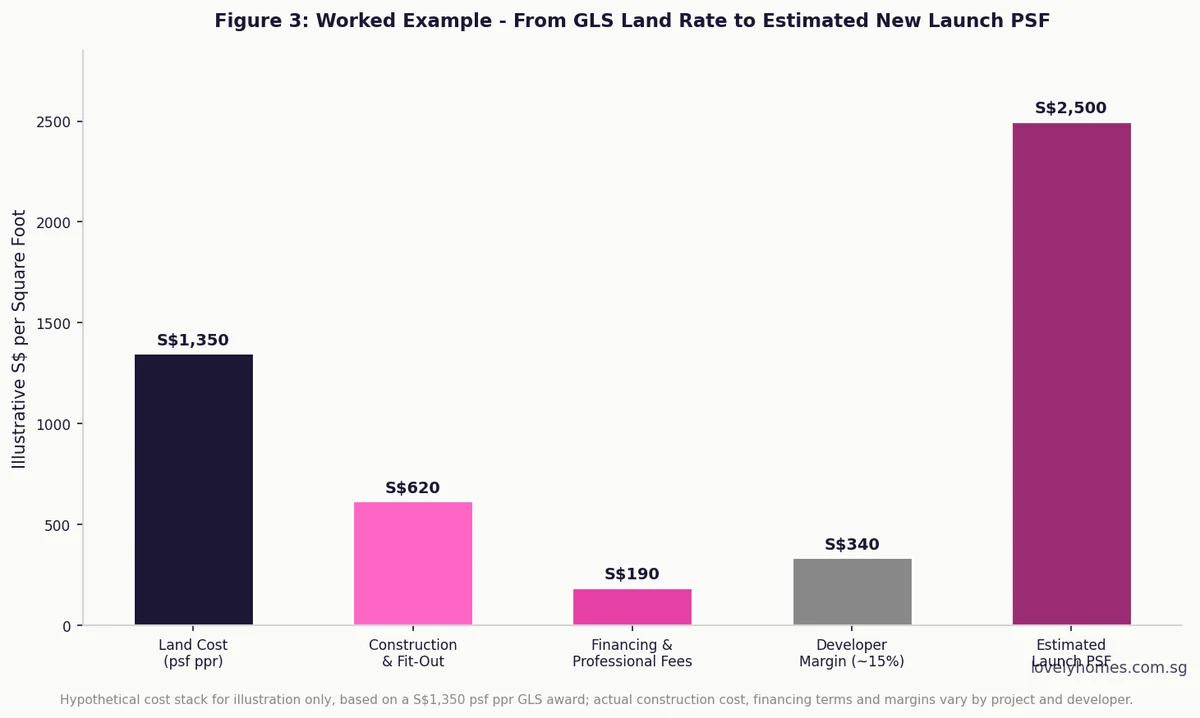
The psf ppr land rate paid at a GLS tender is only one component of the eventual launch price a buyer will see, but it is usually the single largest one. A developer’s total cost stack typically includes the land cost, construction and fit-out costs, financing costs (interest on the loan used to fund the purchase and development), professional fees (architects, engineers, marketing, legal), and a target profit margin, commonly cited in the industry as somewhere in the range of 10% to 20% depending on project risk and prevailing market conditions. Adding these together produces the developer’s breakeven price, above which the project becomes profitable; the actual launch price is then set with reference to this breakeven figure, recent comparable transactions in the vicinity, and overall market sentiment at the time of launch.

This is why a high-profile GLS award, particularly one that sets a new benchmark psf ppr for its district, is so closely watched: it effectively previews a floor for pricing on the eventual private residential launch that will emerge from that site, often years before any show flat opens.
Worked example GLS land rate to new launch price Singapore 2026
Figure 3: Worked example – from GLS land rate to an estimated new launch price per square foot.

Reading the GLS Programme as a Buyer

For prospective buyers, the twice-yearly GLS Programme announcement is a genuinely useful, freely available piece of market intelligence. A larger Confirmed List with more residential sites signals the Government is deliberately increasing near-term new-launch supply, which can, over time, moderate new launch pricing pressure in the affected districts. Conversely, a programme weighted heavily toward Reserve List sites, with few Confirmed List residential launches, suggests a more cautious near-term supply pipeline. Tracking which specific districts receive GLS sites is also useful for buyers targeting a particular area, since a GLS award today often previews a new launch roughly two to four years later, giving early-planning buyers useful lead time.

Summary: GLS Programme Facts at a Glance

Question Short Answer
Who administers the GLS Programme? The Urban Redevelopment Authority (URA), on behalf of the Singapore Government.
How often is it announced? Twice a year, for the first half (1H) and second half (2H) of each year.
What is the difference between Confirmed and Reserve List? Confirmed List sites are tendered on a fixed schedule; Reserve List sites only if a developer applies with an acceptable minimum bid.
How is the winning bid decided? Usually the highest sealed bid meeting tender conditions; some sites use a design-and-price two-envelope system.
Does the GLS land rate determine the launch price? It is the largest single input, but launch price also reflects construction cost, financing, fees and developer margin.
Do all Reserve List sites eventually get tendered? No, many remain untendered indefinitely if no developer applies with an acceptable bid.

Worked Example: From a GLS Award to an Estimated Launch Price

The award: a developer wins a Confirmed List residential site at an illustrative S$1,350 psf ppr, a benchmark land rate for its district.

Building the cost stack: adding illustrative construction and fit-out costs of S$620 psf, financing and professional fees of S$190 psf, and a target developer margin of roughly 15% (approximately S$340 psf at this cost base), the resulting estimated breakeven-plus-margin price works out to approximately S$2,500 psf.

What this means for buyers: a prospective 3-bedroom unit of around 900 square feet at this eventual launch could be priced in the region of S$2,250,000, illustrating how a single GLS award, reported as a land rate, translates several years later into an actual price tag a buyer will see at a show flat.

These figures are hypothetical and for illustration only; actual construction costs, financing terms, developer margins and final launch prices vary considerably by project, developer and prevailing market conditions at the time of launch.

Why This Matters for the Wider Property Market

The GLS Programme functions as one of the Government’s primary supply-side levers for managing Singapore’s private housing market, working alongside demand-side measures such as Additional Buyer’s Stamp Duty (ABSD) and loan curbs like the Total Debt Servicing Ratio (TDSR). Where cooling measures aim to moderate demand, the GLS Programme aims to calibrate supply, releasing more or fewer sites, and more or less generous Confirmed List quantities, in response to prevailing market conditions, price trends, and the Government’s own housing pipeline targets. Understanding this supply-side mechanism gives buyers, sellers and investors a fuller picture of why new launch prices move the way they do, well beyond simply watching headline transaction prices.

What Might Come Next

The following is informed speculation, not confirmed policy. As Singapore’s population and housing needs continue to evolve, the balance between Confirmed List and Reserve List sites in future GLS programmes is likely to keep shifting in response to private home price trends and take-up rates at recent launches, though the exact composition of any future half-yearly programme is not knowable in advance. Continued release of large, strategically located sites such as those in the Jurong Lake District and Greater Southern Waterfront is a plausible direction given long-stated Government planning priorities, though specific site-level decisions are announced only as each half-yearly programme is published.

Frequently Asked Questions

Who can bid in a GLS tender?

GLS tenders are open to registered property developers and consortiums that meet URA’s eligibility and financial capability requirements; individual home buyers cannot bid directly on GLS land.

Why do some Reserve List sites never get tendered?

If no developer applies, or no application meets the Government’s undisclosed reserve price, the site simply remains untendered and is carried forward into the next programme period.

Does a high GLS land rate always mean higher new launch prices?

Generally yes, since land cost is usually the largest input into a developer’s pricing, though construction costs, financing conditions and market sentiment at the time of launch also play a significant role.

What does “psf ppr” mean?

It stands for price per square foot per plot ratio, a standard way of expressing land cost relative to the maximum permitted gross floor area on a site, allowing land rates to be compared across sites of different sizes.

How long after a GLS award does a new launch typically appear?

Typically around two to four years, accounting for design, planning approval, and construction of the show flat and initial units, though this varies by project size and complexity.

Is Executive Condominium (EC) land also sold through the GLS Programme?

Yes, EC sites are included within the GLS Programme alongside private residential, commercial, industrial and hotel sites, though they are tendered under EC-specific eligibility and pricing conditions.

Where can I check the current GLS Programme?

URA publishes the current half-yearly GLS Programme, including site details and tender closing dates, on its official website.

Disclaimer: This article is for general informational purposes only and does not constitute investment advice. GLS site details, tender outcomes and cost figures are illustrative and subject to change. Always refer to the Urban Redevelopment Authority (URA) for the current Government Land Sales Programme and official tender results, and consult a qualified property professional for guidance specific to your situation.
×

Click anywhere outside to close

URA Launches GLS Sites at Marina Gardens Lane and Orchard Boulevard: 500 New Homes for Singapore’s 2H 2026 Land Programme

URA Launches GLS Sites at Marina Gardens Lane and Orchard Boulevard: 500 New Homes for Singapore’s 2H 2026 Land Programme

Quick Answer: URA GLS Marina Gardens Lane and Orchard Boulevard — 6 Key Facts

  • The Urban Redevelopment Authority (URA) released two residential GLS sites on 13 August 2026 under the 2H 2026 Government Land Sales Programme.
  • Marina Gardens Lane (near Marina South MRT, Thomson-East Coast Line): ~390 residential units; tender closes 15 October 2026.
  • Orchard Boulevard (near Orchard Boulevard MRT, TEL): ~110 residential units; tender closes 29 October 2026.
  • Both sites form part of the 2H 2026 Confirmed List, which totals 4,745 residential units — more than 50% above the 10-year annual average Confirmed List supply.
  • Marina South is a planned car-lite, waterfront residential precinct that URA has been developing progressively since the early 2020s.
  • Orchard Boulevard offers rare prime District 10 (CCR) land in a location that has seen very limited new private supply in recent years.

Two Prime Sites Released Under Singapore’s 2H 2026 GLS Programme

The Urban Redevelopment Authority (URA) today released two residential land parcels for sale under the Confirmed List of the second-half 2026 Government Land Sales (GLS) Programme. The sites — at Marina Gardens Lane and Orchard Boulevard — are among the most closely watched land parcels in the 2H 2026 programme, given their locations in two distinctly different but equally sought-after precincts of Singapore.

The GLS programme is the Singapore government’s primary mechanism for releasing state land for private residential and commercial development. Sites on the Confirmed List are launched regardless of market demand signals; the Reserve List operates on application. Today’s release expands the already large 2H 2026 Confirmed List — one that URA has deliberately sized at well above historical norms to address the persistent supply-demand imbalance in Singapore’s private residential market.

I. Marina Gardens Lane: Marina South’s Next Chapter

The Marina Gardens Lane site is located in Marina South, a waterfront precinct that URA has been developing as Singapore’s newest large-scale residential neighbourhood. The area is positioned along the Greater Southern Waterfront, adjacent to Marina Bay, and is designed as a car-lite community with high-quality public transport connectivity via the Thomson-East Coast Line (TEL) at Marina South MRT station.

The Marina Gardens Lane site can potentially yield approximately 390 residential units. The tender closes at noon on 15 October 2026. This is consistent with previous Marina South GLS releases — the area has seen multiple sites released since 2021, and the emerging neighbourhood is beginning to take shape with the first residential towers under construction.

Marina South’s appeal to developers lies in several factors. It offers large, contiguous land parcels of a size that is extremely difficult to assemble through en bloc collective sales in the established private market. It has direct MRT connectivity. And it benefits from URA’s planning vision for the precinct — a walkable, green, waterfront residential community with proximity to Marina Bay’s business, lifestyle, and entertainment hub. Industry data suggests Marina South launches in the surrounding area have attracted significant buyer interest, particularly from upgraders and investors who see the long-term development trajectory of the precinct.

II. Orchard Boulevard: Rare Prime CCR Supply

The Orchard Boulevard site is located in District 10, one of Singapore’s most prestigious residential addresses. At approximately 110 units, it is a significantly smaller site than Marina Gardens Lane — reflecting both the limited scale of developable land in this part of the Core Central Region (CCR) and the very high land values that make large sites financially prohibitive.

The Orchard Boulevard site is near the Orchard Boulevard MRT station on the Thomson-East Coast Line, providing direct connectivity along the TEL corridor from Woodlands to the East Coast. New private residential supply in District 10 has been extremely limited over the past several years — the combination of high land costs, few available sites, and the long development timeline means that buyers seeking brand-new freehold or 99-year leasehold private apartments in this part of Singapore have had very few options. The tender for this site closes at noon on 29 October 2026.

Note on scale: With only ~110 potential units, the Orchard Boulevard site is likely to attract developers aiming at the luxury or ultra-luxury CCR buyer segment. Unit sizes are typically larger in CCR developments — this site may yield fewer than 110 units if the developer opts for larger floor plates, or could push to maximum plot ratio to maximise saleable area.

III. The Bigger Picture — 2H 2026 GLS Supply in Context

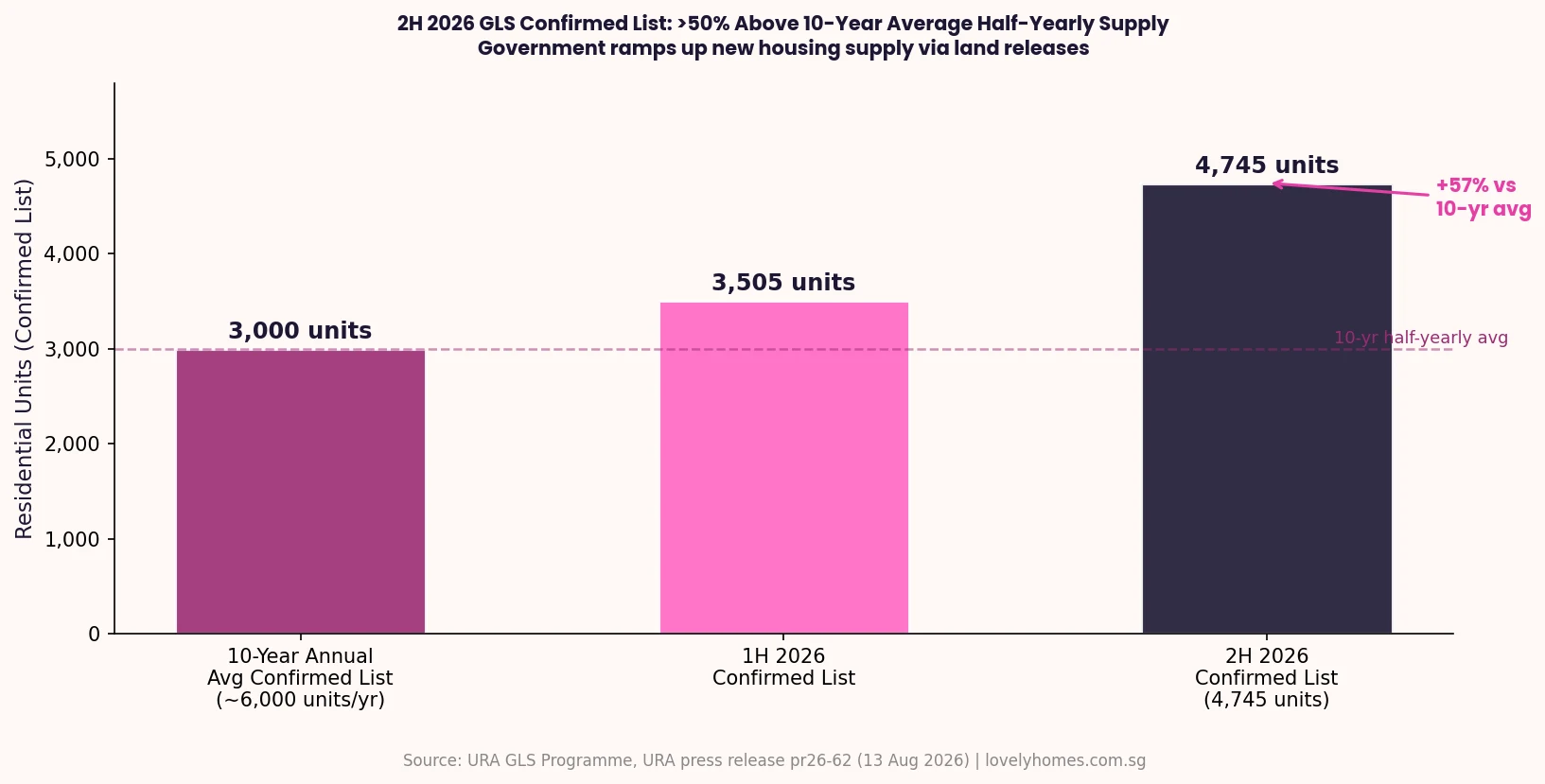
Both sites are part of the URA’s 2H 2026 GLS Confirmed List, which was announced earlier this year and totals 4,745 residential units across all confirmed sites for the second half of 2026. To put this figure in context:

URA 2H2026 GLS Confirmed List 4745 units supply comparison Singapore 2026 bar chart
Figure 1: 2H 2026 GLS Confirmed List at 4,745 Units — More Than 50% Above the 10-Year Average Half-Yearly Confirmed List Supply. Source: URA GLS Programme, URA press release pr26-62 (13 August 2026)
GLS Period Confirmed List Units Vs 10-Yr Avg (half-yr)
10-Year Average (annual) — approx. ~6,000 per year (~3,000 per half) Baseline
1H 2026 Confirmed List ~3,505 units +17% vs half-yr avg
2H 2026 Confirmed List 4,745 units +58% vs half-yr avg

The 2H 2026 Confirmed List represents a deliberate policy decision by the Singapore government to front-load supply into the market at a time when private residential prices have continued to rise despite multiple rounds of ABSD adjustments. The view from URA is that the medium-term supply pipeline — comprising GLS sites, en bloc redevelopments, and executive condominium launches — must be sufficiently deep to moderate price growth and maintain housing affordability, particularly for Singaporean upgraders who face the 20% ABSD rate on their second purchase.

A larger GLS pipeline has two effects on the broader market. First, it increases future supply, which in time translates to more completed units available for buyers. Second, it gives developers alternatives to en bloc bids — with more GLS land available, developers are less compelled to pay high premiums for collective sale sites in the secondary market. Industry analysts suggest this is one reason the en bloc market has been comparatively muted in 2H 2026, even as individual sites like City Plaza (S$970M, 13 August tender) have attracted interest.

IV. What This Means for Buyers, Sellers and Investors

For buyers considering new launch properties in Marina South or the Orchard Boulevard corridor, the release of these sites signals that new developments are in the pipeline, but completion will be 3–5 years away from tender close. Buyers who need to transact now should look at existing new launches in adjacent areas (TEL-connected precincts, Marina Bay fringe) rather than waiting for these specific sites to be marketed.

For sellers of existing private residential properties in Marina South or District 10, a larger GLS pipeline may apply some price discipline to new launches (as developers face higher land costs from competitive bidding for GLS sites alongside a larger total supply). However, resale properties in established prime districts with immediate availability and leasehold tenure clarity continue to command buyer attention from owner-occupiers.

For en bloc owners in nearby precincts, the point made above is relevant: a more active GLS programme reduces developer urgency to acquire en bloc sites at significant premiums. Developments pursuing collective sales in Marina-adjacent or Orchard-adjacent locations may find that their expected premiums are moderated as developers weigh GLS alternatives.

V. What Might Come Next

The next GLS tender deadlines — 15 October 2026 for Marina Gardens Lane and 29 October 2026 for Orchard Boulevard — will be followed by a period of evaluation by URA. Developers typically submit a single sealed bid at tender close, and URA evaluates bids on the basis of price (highest acceptable bid) and development quality criteria (for some sites with specific design requirements). Results for both sites can be expected approximately 4–8 weeks after tender close.

Following any award, the developer typically has 5 years from the date of award to complete the development (with possible extensions). Given the 2026 award timeline, residents could expect new completions from these sites as early as 2030–2031, adding to Singapore’s private residential inventory in that period.

Frequently Asked Questions: URA GLS Sites 2026

What is the Government Land Sales (GLS) programme?

The Government Land Sales programme is administered by URA (for residential and commercial sites) and JTC (for industrial sites). Under the GLS, the government releases state-owned land for private development through competitive tender. The Confirmed List comprises sites that will be launched regardless of market demand; the Reserve List comprises sites that are only launched if a developer applies and the government accepts the proposed price. The GLS programme is the primary mechanism by which Singapore regulates the supply of private residential land and ensures that housing supply keeps broadly pace with demand.

What is Marina South and why is it significant?

Marina South is a planned residential and mixed-use precinct at the southern tip of the Marina Bay area, adjacent to the Gardens by the Bay waterfront. URA has designated it as a car-lite neighbourhood, meaning it is designed with high-quality public transport connections (Marina South MRT on the TEL), cycling infrastructure, and minimal surface car parking. It is part of the broader Greater Southern Waterfront transformation that will eventually link Tanjong Pagar, Keppel, Sentosa, and Marina Bay into a continuous waterfront live-work-play corridor. The Marina Gardens Lane site released today is one of several GLS sites URA has progressively released in the precinct since 2021 to build up the neighbourhood’s residential population.

When will the new developments on these sites be ready for buyers?

Developers who win the tender typically have 5 years from the award date to obtain Temporary Occupation Permit (TOP). With tender closes in October 2026 and a typical development timeline of 3–5 years post-award, buyers could expect TOP for these developments as early as 2030 and as late as 2031–2032. New launch marketing (sales prior to construction completion) would typically begin 6–18 months after the award, subject to the developer’s marketing strategy and the prevailing market conditions at that time.

Does a higher GLS supply mean property prices will fall?

Not necessarily, and not immediately. New GLS supply does not translate into completed units for 3–5 years. In the near term, a larger pipeline signals future supply additions, which can moderate buyer expectations of price appreciation and give buyers and sellers more negotiating latitude. Over the medium term, if completed supply outpaces demand growth, prices in certain segments may experience softer growth or modest corrections. However, Singapore’s property market is also supported by population growth, strong GDP, continued expatriate demand, and limited land — structural factors that underpin long-term demand. URA’s GLS calibration is designed to moderate prices, not engineer sharp falls.

Are these sites freehold or leasehold?

GLS sites released by the Singapore government are almost always on 99-year leasehold tenure, as the government retains underlying ownership of state land. Freehold land in Singapore predominantly comprises private land that has been in private ownership since colonial times or was converted. The Marina Gardens Lane and Orchard Boulevard sites released today are expected to be 99-year leasehold — the full terms and conditions are available in the eDeveloper’s Packet sold through URA’s One-Stop Developer Portal at digitalservice.ura.gov.sg.

Disclaimer: This article is for general information only and is based on publicly available information from URA press release pr26-62 dated 13 August 2026. Development unit counts, tender timelines, and site details are subject to change. Pricing and development outcomes will depend on competitive bidding and subsequent developer decisions. This article does not constitute financial or property investment advice. For official GLS site information, visit URA Land Sales (ura.gov.sg). For official property statistics, refer to URA Property Data.

×

Click anywhere to close

Bayshore Drive GLS Award 2026: Gemini Residential Wins at S$2.13B — What It Means for East Coast Property

Bayshore Drive GLS Award 2026: Gemini Residential Wins at S$2.13B — What It Means for East Coast Property

Click anywhere or press Esc to close

⚡ Quick Summary — Bayshore Drive GLS Award, 20 July 2026

  • The Urban Redevelopment Authority (URA) awarded the Bayshore Drive GLS site to Gemini Residential Pte. Ltd. and Gemini Trustee Pte. Ltd. (as trustee-manager of Gemini Mall Trust) on 20 July 2026.
  • Winning bid: S$2,128,000,000 — equivalent to S$14,243.83 per sqm of gross floor area (GFA).
  • Site area: 57,460.6 sqm; maximum permissible GFA: 149,398 sqm; tenure: 99 years.
  • Allowable development: commercial and residential — a mixed-use site in the emerging Bayshore precinct of District 16 (East Coast).
  • The land cost implies a break-even selling price of approximately S$2,400–S$2,700 PSF for private residential units on the site, depending on construction cost and margin assumptions.
  • This is the highest ever GLS price for an East Coast / Bayshore site, reflecting strong developer confidence in the Long Island project and upcoming TEL proximity.

The Deal at a Glance

On 20 July 2026, URA announced that it had awarded the tender for the Bayshore Drive Government Land Sales site — launched for tender on 30 March 2026 and closed on 15 July 2026 — to Gemini Residential Pte. Ltd. and Gemini Trustee Pte. Ltd., acting as trustee-manager of Gemini Mall Trust. The winning bid of S$2.128 billion equates to a land rate of S$14,243.83 per sqm of permissible GFA, a figure that market observers describe as aggressive but defensible given the site’s strategic position.

The Bayshore Drive site spans 57,460.6 sqm of land with a maximum GFA of 149,398 sqm — permitting a sizeable mixed commercial and residential development. The site is offered on a 99-year leasehold basis, consistent with all GLS residential land in Singapore.

Detail Data
Location Bayshore Drive, District 16 (East Coast), Singapore
Allowable development Commercial and Residential (mixed-use)
Site area 57,460.6 sqm
Maximum GFA 149,398 sqm
Tenure 99 years
Successful tenderer Gemini Residential Pte. Ltd. & Gemini Trustee Pte. Ltd.
Winning bid S$2,128,000,000
Land rate (PSM GFA) S$14,243.83
Tender launch date 30 March 2026
Tender close date 15 July 2026
Award announcement 20 July 2026 (URA pr26-55)
Bayshore Drive GLS award land price per sqm GFA vs comparable East Coast GLS sites Singapore
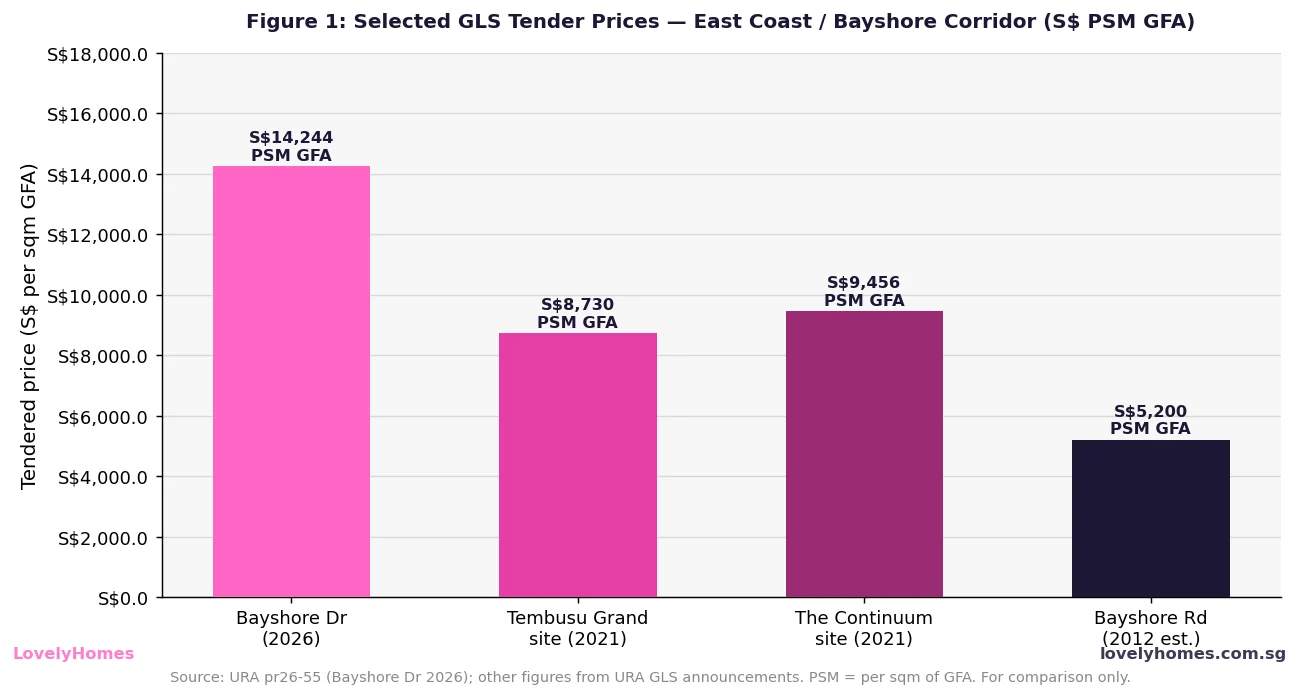
Figure 1: The S$14,243.83 PSM GFA Bayshore Drive award significantly exceeds comparable East Coast GLS transactions from 2021 and a 2012 benchmark estimate, reflecting the precinct’s enhanced infrastructure outlook. Source: URA pr26-55; LovelyHomes research.

Why S$14,243 PSM GFA Is Significant

To contextualise the land rate: residential GLS sites in the East Coast / Marine Parade corridor have historically traded at S$5,000–S$9,500 PSM GFA. The Bayshore Drive award at S$14,243 PSM represents a substantial step up, driven by several factors converging in the Bayshore precinct in 2026.

First, the Thomson-East Coast Line (TEL) brings new MRT connectivity to the East Coast, with Bayshore MRT station (TEL Stage 4, opened 2024) significantly reducing travel times to the CBD. TEL access materially enhances the Bayshore precinct’s residential appeal compared to the historically bus-dependent East Coast corridor.

Second, the Long Island reclamation project — preparatory works for which commenced from end-2026 per URA’s pr26-50 (30 June 2026) — promises to extend the East Coast’s waterfront significantly over the coming decades, with a projected 570-hectare Phase 1 reclamation west of Bedok Jetty creating new coastal land that could underpin property values in the area for generations.

Third, the site’s mixed commercial and residential allowance enables Gemini to build a retail or F&B podium beneath the residential towers, enhancing lifestyle amenity and supporting higher average selling prices for the residential component.

Implied Break-Even and Launch Price Estimates

Using standard developer margin assumptions and Singapore construction cost benchmarks for 2026:

  • Land cost: S$14,243 PSM GFA → at an assumed plot ratio of 2.6 and residential-commercial GFA split, the residential land cost component translates to approximately S$1,050–S$1,100 PSF of saleable residential area.
  • Construction cost: S$550–S$650 PSF (mid-to-high spec, mixed-use).
  • Developer margin: 15–20%.
  • Implied break-even (residential units): approximately S$2,350–S$2,600 PSF.
  • Expected launch selling price: S$2,500–S$2,800 PSF, depending on unit mix, floor levels, and market conditions at launch (expected 2027–2028).

At S$2,600 PSF for a 700 sqft 2-bedroom unit, the ticket price would be approximately S$1.82 million. This positions Bayshore Drive as a premium East Coast launch — above the current OCR average but reflecting the TEL uplift and Long Island location premium.

What This Means for D16 Property Buyers and Owners

For existing D16 (Bedok, East Coast, Bayshore) property owners, the strong GLS award price is generally supportive of values in the surrounding area. Developers do not bid aggressively for land unless they believe they can achieve selling prices that justify the land cost — and Gemini’s willingness to commit S$2.128 billion signals confidence in the Bayshore sub-market. Comparable new launches in the area — including upcoming projects near Bedok MRT and along the East Coast Parkway — may find their pricing benchmarks elevated by this award.

For buyers considering D16 resale purchases in 2026, the Bayshore Drive award provides a useful data point: if the new launch from this site prices at S$2,500–S$2,800 PSF, comparably-located resale condominiums trading at S$1,700–S$2,000 PSF represent a meaningful relative discount that may narrow over time as the new launch sets a higher market reference.

What Might Come Next — Project Pipeline and Market Implications

Forward-looking commentary; not confirmed plans.

Gemini is likely to take 12–18 months to finalise architectural plans, obtain the necessary development approvals from URA, and prepare for a new launch sale. Industry expectations place the first preview sales in 2027, with TOP (Temporary Occupation Permit) around 2030–2031. The mixed-use format means Gemini Mall Trust’s commercial component will likely include a neighbourhood retail centre, potentially anchored by a supermarket and F&B cluster catering to the Bayshore residential population — comparable to the model at developments like Pasir Ris 8 or Tengah Plantation.

Watch for URA’s Q2 2026 full data release on 24 July 2026, which will provide updated D16 transaction volumes and median PSF data for the East Coast submarket, helping buyers benchmark current market conditions before this project launches.

Frequently Asked Questions

Who is Gemini Residential Pte. Ltd.?

Gemini Residential Pte. Ltd. and Gemini Trustee Pte. Ltd. (as trustee-manager of Gemini Mall Trust) are the winning bidding entities for the Bayshore Drive GLS site. As at the award date, further details about the developer behind the Gemini entities — whether a major listed developer or a private consortium — had not been publicly confirmed by URA. Buyers should monitor URA’s project approval records and the developer’s public communications in due course for more information on the project concept and timeline.

What will be built on the Bayshore Drive site?

The site has been tendered and awarded for “commercial and residential” development under URA’s GLS framework. This means the completed project will include both a residential component (private condominiums) and a commercial component (retail, F&B, or office). The exact mix — number of residential units, commercial GFA, design concept, and project name — will be determined by Gemini following URA approval of a development application, which typically takes 6–12 months. A marketing launch is not expected before 2027 at the earliest.

Does this affect my existing D16 condo’s value?

High GLS land bids are generally supportive of surrounding property values, as they signal developer confidence in the area’s future price trajectory. However, the direct impact on your individual unit’s value depends on its specific location, age, facing, and floor level relative to the new development. Owners in Bayshore Road, Eastwood, and Upper East Coast Road estates are likely to see the most direct uplift in market sentiment. Owners in Bedok North, Tanah Merah, or other D16 sub-zones further from Bayshore MRT may see a more indirect effect.

When will the URA Q2 2026 full data be released?

URA’s full real estate statistics for 2nd Quarter 2026 are scheduled for release on 24 July 2026, per the flash estimate press release (pr26-51). The full data will include detailed transaction volume, median PSF, and price index figures by market segment and district — providing the most comprehensive picture of Singapore’s property market performance in April–June 2026. LovelyHomes will publish an analysis of the full data upon release.

Is Bayshore a good area to invest in Singapore?

Bayshore (broadly the stretch from Marine Parade to Bedok along the East Coast) has become increasingly attractive as an investment location following the opening of Bayshore MRT on the Thomson-East Coast Line in 2024. The Long Island reclamation project (preparatory works from end-2026) adds a long-term waterfront development catalyst. Strong fundamentals include proximity to East Coast Park, established schools (Temasek Primary, Victoria Junior College), and a diverse residential community. However, buyers should note that new launch prices in 2027–2028, anchored by the Gemini project, may set a higher reference that reduces relative yield on resale purchases made at current prices. As always, individual unit factors — facing, floor, lease remaining — drive actual returns.

Disclaimer: This article is based on URA’s public press release pr26-55 (20 July 2026). Break-even and launch price estimates are illustrative projections based on industry assumptions and are not official developer or URA figures. Property values and market conditions are subject to change. Always verify information with URA (ura.gov.sg) and seek advice from a licensed property agent and financial adviser before making investment decisions. LovelyHomes does not represent any developer or agent in connection with the Bayshore Drive GLS site.

Translate »