Long Island Singapore Preparatory Works 2026: What It Means for East Coast Property

Long Island Singapore Preparatory Works 2026: What It Means for East Coast Property

Source: URA / HDB Press Release pr26-50, 30 June 2026 — “Preparatory works for ‘Long Island’ project to commence from end-2026”

Key Takeaways: Long Island Preparatory Works 2026

  • What: Preparatory marine works for Singapore’s large-scale ‘Long Island’ coastal protection and land reclamation project, to begin end-2026 off East Coast Park
  • Phase 1: ~570 ha, west of Bedok Jetty, starts end-2026; 7km long, up to 1km wide, at least 130m from shoreline
  • Phase 2: ~155 ha, east of Bedok Jetty — deferred until after the Southeast Asian (SEA) Games 2029
  • Public impact: Beaches at East Coast Park remain open throughout; near-shore swimming continues; sea sports (especially kiteboarding) will be temporarily displaced
  • Environmental study: Water quality expected to meet marine criteria; minor impacts on coral and seagrass beds; dust and sediment managed by silt screens and EMMP
  • Property implications: East Coast (D15) property holders should view Long Island as a long-term positive catalyst — ultimately creating new land, extended waterfront, and a future reservoir adjacent to Singapore’s most liveable eastern corridor
  • Full reclamation: The preparatory works area is NOT the final Long Island profile; detailed plans will be developed through further technical studies and public engagement over the coming years

Singapore took a significant step forward on its most ambitious coastal infrastructure project on 30 June 2026, when the Urban Redevelopment Authority (URA) and the Housing & Development Board (HDB) jointly announced that preparatory marine works for the ‘Long Island’ project will begin from end-2026. For property owners and buyers along the East Coast corridor — particularly in District 15 (D15), Bedok (D16), and the Tampines/Pasir Ris eastern stretch — the announcement marks the formal start of a multigenerational transformation that will ultimately reshape Singapore’s entire southern coastline.

LovelyHomes has previously covered the Greater Southern Waterfront (GSW) — the western bookend of Singapore’s coastal transformation — in our Tanjong Pagar Neighbourhood Guide and East Coast Neighbourhood Guide. Long Island is the eastern counterpart: a critical flood protection measure that will eventually create new land and a future reservoir east of Bedok, protecting the entire East Coast from rising sea levels over the coming century.
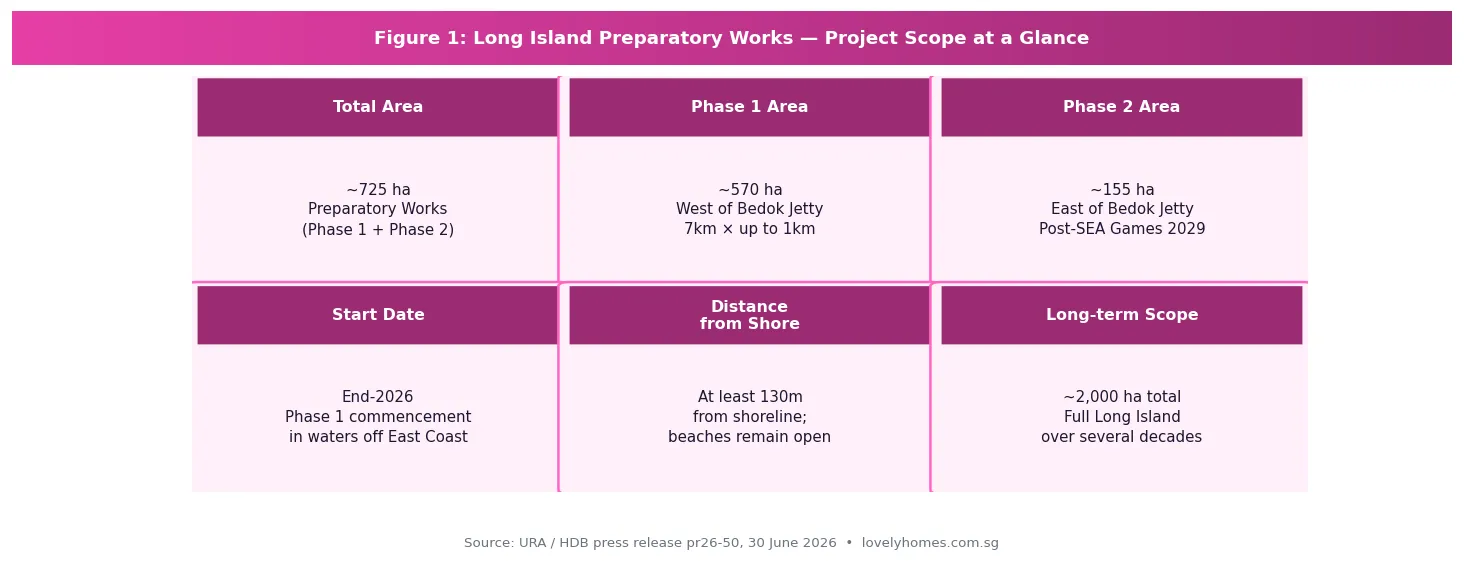
Figure 1: Long Island preparatory works project scope — Phase 1 and Phase 2 areas and timeline
Figure 1: Long Island preparatory works — project scope, Phase 1 and Phase 2 parameters, and long-term scale. Source: URA / HDB press release pr26-50, 30 June 2026.

What Are the Preparatory Works, Exactly?

Long Island is Singapore’s planned response to climate change and rising sea levels along its vulnerable East Coast. The full project — which will ultimately involve major land reclamation to create a new island and a freshwater reservoir — is a decades-long undertaking. What begins at end-2026 is the preparatory phase: essential marine construction works that lay the groundwork for eventual reclamation, but do not yet constitute reclamation itself.

The preparatory works involve three primary activities: removal of seabed obstructions (historical debris, hazards); construction of temporary sand bunds (underwater containment structures); and sand infilling within the bunded areas. These works will take place entirely offshore, at least 130 metres from the shoreline, and will be clearly demarcated by silt screens and floating barriers visible from the beach.

The works are split into two phases:

Phase Location Area Dimensions Timing
Phase 1 Waters west of Bedok Jetty ~570 ha ~7km long × up to 1km wide Commences end-2026
Phase 2 Waters east of Bedok Jetty ~155 ha TBC After SEA Games 2029 completion
Full Long Island Entire East Coast offshore zone ~2,000+ ha (indicative) TBC through technical studies Over several decades

The deferral of Phase 2 until after the 2029 SEA Games is a deliberate accommodation: the waters east of Bedok Jetty are currently used for water sports and will host major aquatic events for the SEA Games. This sequencing shows that the government is managing the project’s community impact thoughtfully — a signal that should give East Coast residents some comfort about near-term disruption.

Environmental Findings: What the Study Revealed

HDB commissioned a formal Environmental Study covering the preparatory works, consulting nature groups on scope. The study’s key findings are reassuring for the majority of East Coast users:

Water quality: No significant changes expected; water will continue to meet Singapore’s prevailing marine water quality criteria throughout the works.

Currents and waves: Slight localised changes near Bedok Jetty are expected to have minimal impact on near-shore activities. Swimming can continue along the entire East Coast stretch.

Air quality and visibility: Up to minor visual impact from sand infilling operations; intermittent sediment plumes and dust are expected, mitigated by silt screen deployment and active dust monitoring under the Environmental Monitoring and Management Plan (EMMP).

Biodiversity: Some coral and seagrass beds found near the work site may experience short-term, localised impact from sediment plumes. However, the majority of coral and seagrass — including Sisters’ Islands Marine Park — is assessed as largely unaffected. HDB has committed to EMMP monitoring throughout.

Sea sports displacement: This is the most tangible near-term impact for active East Coast users. Kiteboarding is most affected; other sea sports face minor to moderate displacement. Agencies are working with affected user groups to identify alternative sites within the sea space east of Bedok Jetty in the interim.

Key Takeaway: The environmental study concludes that preparatory works will have manageable, temporary, and localised impacts — not the large-scale ecological disruption that some stakeholders had feared. Beaches remain open. Swimming is unaffected. The most significant disruption is displacement of marine leisure activities, particularly kiteboarding, which will require temporary relocation.

What This Means for East Coast Property Buyers and Owners

For property owners in the East Coast corridor — covering D15 (Katong, Tanjong Katong, Marine Parade), D16 (Bedok, Siglap, Upper East Coast), and the eastern planning areas (Tampines, Pasir Ris, Changi) — the Long Island announcement is a long-term positive with a short-term noise caveat.

Short-term (2026–2029): Managed Disruption

The preparatory works will generate visible marine activity offshore — construction vessels, sand infilling operations, and temporary bunds. From the shoreline, this will be noticeable but distant (at least 130m offshore). Air quality impacts are expected to be minor and intermittent. Beaches remain open. The practical implication for property values is minimal in the short term: these works are a public infrastructure programme, not a lifestyle degradation, and they come with an explicit government commitment to environmental monitoring and mitigation.

Medium-term (2029–2035): Planning Uplift Begins

As the preparatory phase completes and the URA begins formal planning for Long Island’s reclamation profile, the East Coast will progressively benefit from the same planning-uplift dynamic that has historically preceded major Singapore waterfront transformations. When Marina Bay was being planned in the 1980s and 1990s, property in D1 and D2 began appreciating in anticipation of the new precinct long before a single building was complete. Long Island represents a similar, though slower, catalyst for the D15/D16 corridor.

Long-term (2035+): Transformative Uplift

When the full Long Island reclamation creates new land along the East Coast — including a future reservoir — the implications for D15 and D16 property are substantial: extended waterfront promenade access, reduced flood risk (supporting insurance and bank valuations), new residential parcels potentially creating supply (a risk to existing owners) but also major new amenity and connectivity (a positive for the precinct as a whole). The 2026 URA Q2 price data already showed D15 benefiting from TEL Stage 4 connectivity; the Long Island catalyst is additive to this structural tailwind over the 2030s and beyond.

Horizon Impact on East Coast Property Key Risk
2026–2029 (prep works) Neutral to marginally negative optics; no material price impact expected Marine activity visible from beachfront; minor sea-sport disruption
2029–2035 (early planning) Positive sentiment as Long Island masterplan solidifies; planning uplift begins Timeline may slip; full reclamation profile remains unconfirmed
2035+ (reclamation & beyond) Transformative — new waterfront, reduced flood risk, new amenity corridors New residential supply on Long Island may moderate prices on existing stock

Public Engagement and What Comes Next

The URA reiterated in the 30 June 2026 announcement that Singapore’s commitment to public engagement on Long Island planning remains firm. The government has engaged more than 14,000 people to date on Long Island’s vision. From end-2026, a new phase of public engagement will invite Singaporeans to shape key planning topics including recreational uses along the new coastline, the design of the future reservoir, and the character of new precincts that will eventually emerge.

Crucially, the URA clarified that the area used for preparatory works is not the final Long Island land profile. The reclamation profile will be determined through subsequent technical studies — covering environmental impact assessments for the actual reclamation, engineering studies, and further public engagement — expected to take several more years. Main reclamation works will only commence after these studies are complete and mitigation measures are determined.

The Environmental Study report was published for public feedback for four weeks from 30 June 2026. Members of the public may view it and submit feedback at go.gov.sg/long-island.

Frequently Asked Questions: Long Island and East Coast Property

Will the preparatory works affect East Coast Park beach access?

No. All beaches along East Coast Park will remain open throughout the preparatory works. Near-shore swimming can continue along the entire stretch of the East Coast. Exercise paths and tracks for jogging and cycling also remain fully accessible. The works are offshore (at least 130m from the shoreline) and cordoned off for public safety. Safety advisories will be posted at East Coast Park and on government agency websites.

How might Long Island affect property values in D15 and D16?

In the short term (2026–2029), the preparatory works are unlikely to have a material impact on property values in D15 (Marine Parade, Katong, Tanjong Katong) or D16 (Bedok, Upper East Coast, Siglap). The works are offshore, temporary, and environmentally monitored. In the medium to long term, Long Island is broadly a positive catalyst for the East Coast corridor — creating new waterfront, improved flood protection, and eventually new amenities. However, buyers should note that full Long Island reclamation is decades away and carries execution and timeline uncertainty. Purchase decisions should be based on the neighbourhood’s existing merits, with Long Island treated as optionality, not a near-term price driver.

What is the difference between the preparatory works and the main Long Island reclamation?

The preparatory works (beginning end-2026) involve seabed clearance, temporary bund construction, and sand infilling — foundational marine works that create the conditions for eventual reclamation without being the reclamation itself. The area used for preparatory works is not the final land profile of Long Island. The main reclamation works — which will actually create the new island — will only commence after the government completes further technical studies, determines mitigation measures, and incorporates feedback from additional public engagement rounds. This could be many years away. Think of the preparatory works as clearing and grading a site before construction, not as the construction itself.

Will Long Island create new HDB or private residential areas in the future?

Long Island’s ultimate land use profile — including any residential development — has not been finalised. The URA has noted that planning will incorporate findings from technical studies and public engagement, and that the government retains flexibility to meet evolving national needs. Historically, Singapore’s reclaimed land has been used for a mix of residential, commercial, and infrastructure purposes. It is reasonable to expect that some Long Island land will eventually be developed for housing, but the specific profile, tenure, and density remain undecided. Any residential development on Long Island is likely to be 15–25 years away.

Can I still use East Coast Park for water sports during the works?

Most water sports can continue, but with some adjustment. Near-shore swimming is unaffected. However, sea sports that require more sea space — particularly kiteboarding — will be the most significantly impacted, as the Phase 1 work area covers much of the sea space west of Bedok Jetty. Agencies are working with affected groups to identify alternative sites, including the sea space east of Bedok Jetty (until Phase 2 begins post-2029). Recreational paddling, kayaking, and water skiing in near-shore areas should be largely unaffected, though users should maintain safe distances from vessels and the cordoned work area.
Disclaimer: This article is an editorial summary of URA/HDB press release pr26-50 (30 June 2026). All project details, timelines, areas, and environmental findings cited are drawn from that official source. Property value commentary reflects editorial analysis only and does not constitute investment advice. Long Island timelines are subject to change by the Singapore Government. Readers should consult official sources — go.gov.sg/long-island, URA, HDB — and qualified property professionals before making property decisions based on this or any infrastructure announcement.

×

Click anywhere to close

Tanjong Pagar Neighbourhood Guide Singapore 2026: D02 Prices, GSW and Investment Outlook

Tanjong Pagar Neighbourhood Guide Singapore 2026: D02 Prices, GSW and Investment Outlook


Quick Answer: Tanjong Pagar (D02) at a Glance

  • Location: District 02, Core Central Region (CCR), southern edge of Singapore’s CBD — Chinatown, Tanjong Pagar, Anson Road corridor
  • HDB resale prices (Q1 2026): 3-room S$480k–S$640k; 4-room S$700k–S$970k; 5-room at Pinnacle@Duxton S$930k–S$1.18M
  • Private condo PSF: S$1,550–S$2,050 (older leasehold) to S$2,100–S$2,850 (newer/freehold)
  • MRT access: Tanjong Pagar EWL (EW15), Shenton Way TEL (TEL17), Cantonment CCL (CC28) — three-line connectivity
  • Rental yield: ~2.6–3.2% gross (CCR typical range); stronger for smaller-format units near CBD
  • Key catalyst: Greater Southern Waterfront (GSW) — ~2,000 ha of land transformation planned over the next two to three decades
  • Who buys here: Expat professionals, CBD workers, upgraders seeking CCR address, investors targeting GSW uplift
  • Watch: Supply is thin — no major new private residential GLS in D02 for several years; scarcity premium is real

Tanjong Pagar is one of Singapore’s most layered neighbourhoods. It is at once a bustling CBD business district, a conserved Peranakan and shophouse enclave, a mature HDB heartland anchored by the globally celebrated Pinnacle@Duxton, and the gateway to Singapore’s most ambitious land transformation project — the Greater Southern Waterfront (GSW). For property buyers and investors in 2026, the neighbourhood presents a rare combination: tight existing supply, a proven rental market, and a long-term government-backed regeneration catalyst that will reshape the southern coast of Singapore over the coming decades.

This guide covers everything you need to know about buying, renting, and investing in Tanjong Pagar — from live Q1 2026 price data across HDB resale and private condominiums, to the eligibility rules that govern who can buy what, a worked cost example, and an honest assessment of what the Greater Southern Waterfront means for property values in D02.

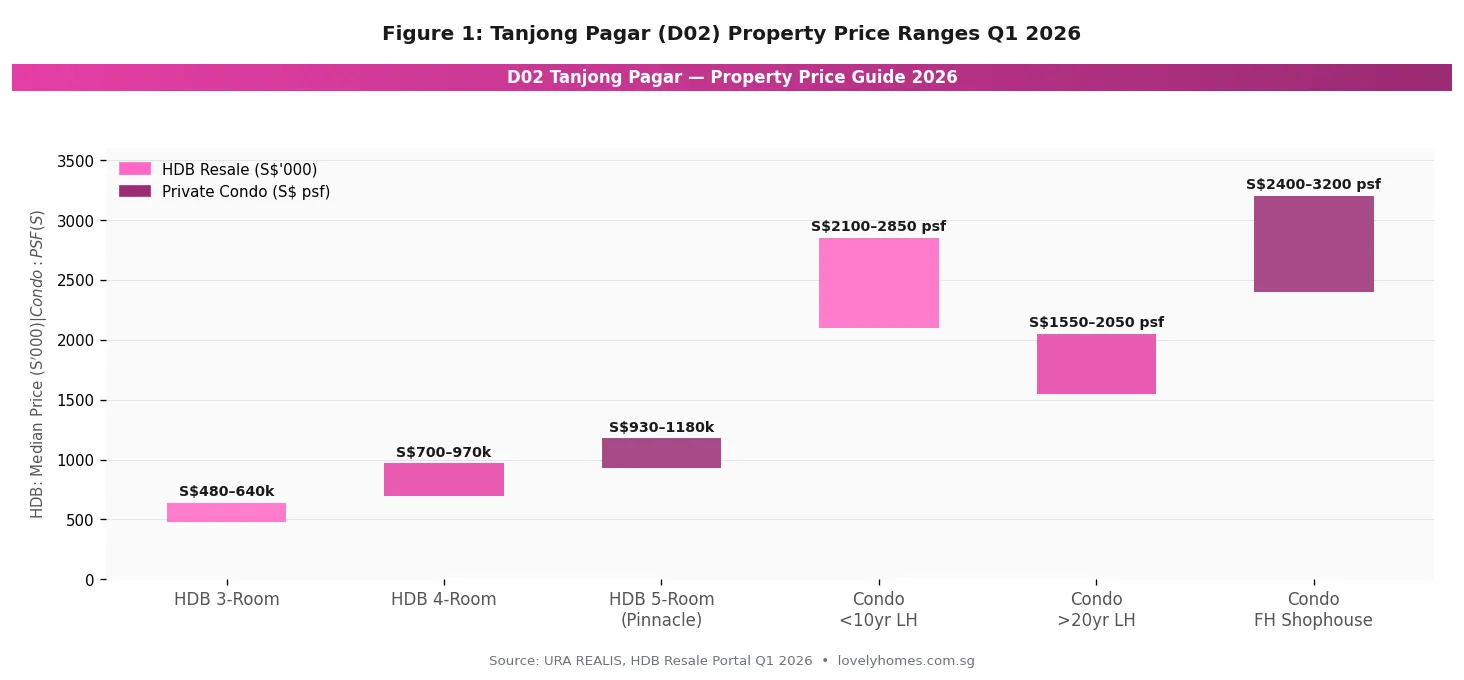
Figure 1: Tanjong Pagar D02 property price ranges 2026 — HDB resale and condo PSF
Figure 1: Tanjong Pagar (D02) property price ranges, Q1 2026. HDB resale prices are medians in S$’000; private condo data reflects median PSF (S$) for non-landed units ≤1,500 sqft. Sources: URA REALIS, HDB Resale Portal.

Where Is Tanjong Pagar and What Makes It Distinctive?

Tanjong Pagar sits in District 02, bounded roughly by Outram Road to the west, Maxwell Road and Neil Road to the north, Keppel Road to the south, and Anson Road to the east. The district is administered within the Outram planning area, and sits firmly within Singapore’s Core Central Region (CCR) — the premium market segment encompassing the traditional prime districts (D9, D10, D11), the CBD core (D1, D2, D6), and Sentosa.

What distinguishes Tanjong Pagar from the rest of the CCR is its mix. Unlike Orchard Road (D9/D10) or Holland Village (D10), which are predominantly private residential, Tanjong Pagar houses approximately 5,400 HDB flats alongside office towers, conserved shophouses, food courts, Chinatown Heritage Centre, and one of Singapore’s most recognisable public housing landmarks. This diversity of tenure and use gives the neighbourhood an urban texture that attracts a broad buyer and tenant base.

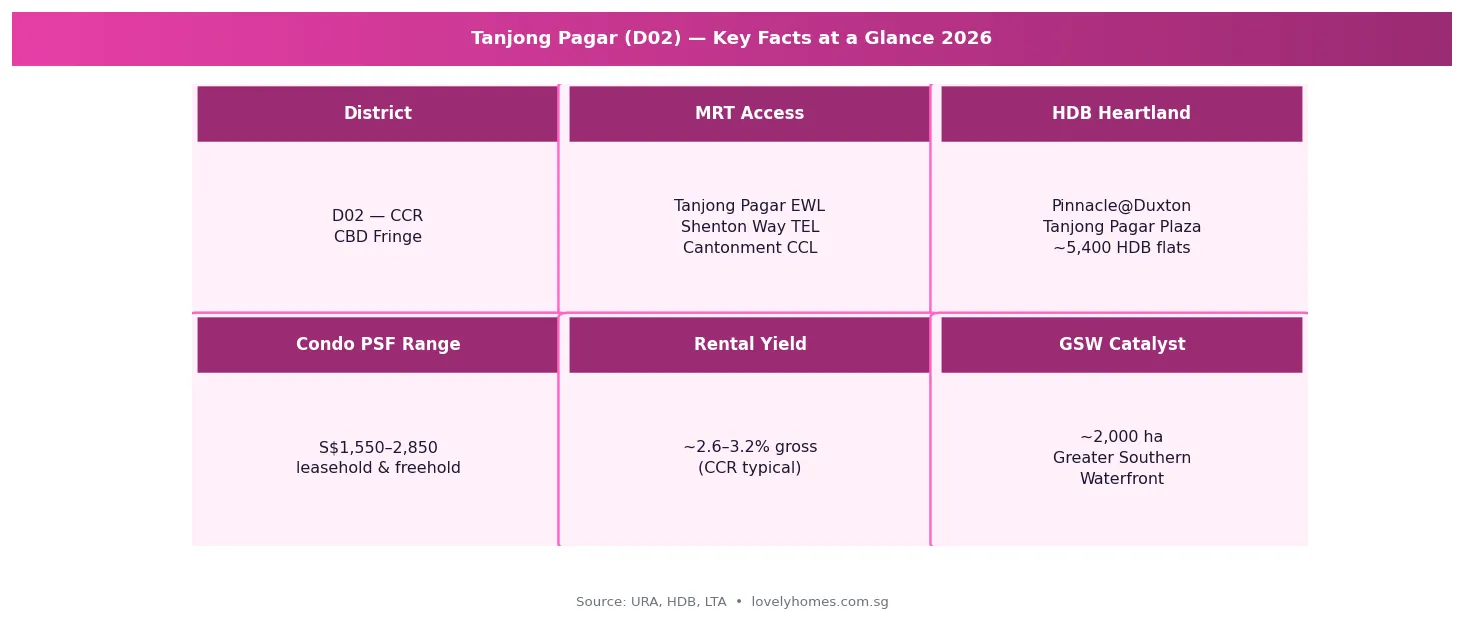
Figure 2: Tanjong Pagar D02 key facts 2026 — district, MRT, HDB, condo, rental yield, GSW
Figure 2: Tanjong Pagar (D02) key facts at a glance, 2026. Sources: URA, HDB, LTA.

Transport Connectivity: Three MRT Lines and Walking-Distance Access

Connectivity is one of D02’s strongest selling points. Residents can access three MRT lines without a bus transfer:

Tanjong Pagar MRT (EW15 — East-West Line): The original station, opened in 1987, connects directly west to Jurong and east to Tampines, Changi Airport, and Pasir Ris. The one-stop hop to Raffles Place (EW14) places the financial district within a two-minute train ride. Outram Park (EW16/NE3/TE17) — one stop west — offers further cross-platform access to the North-East Line and Thomson-East Coast Line.

Shenton Way TEL (TEL17 — Thomson-East Coast Line, Stage 3): Opened in November 2022, Shenton Way TEL sits a short walk north of the Tanjong Pagar residential cluster. The TEL offers seamless one-transfer connectivity to Woodlands (via Orchard and Newton), to East Coast (via Bayshore and Bedok South on TEL Stage 4), and eventually to Sungei Bedok where a cross-platform interchange with the East-West Line will complete the full loop. For Tanjong Pagar residents, the TEL meaningfully reduces commute times to the northern towns and to the Katong/Marine Parade corridor.

Cantonment MRT (CC28 — Circle Line): Opened in September 2022 as part of the Circle Line Stage 6 (closing the loop), Cantonment station sits on Cantonment Road just south of the Pinnacle@Duxton. The Circle Line connects Tanjong Pagar residents directly to one-north, Harbourfront, Dhoby Ghaut, and the eastern nodes of the CCL without going through the city centre interchange.

This three-line connectivity is uncommon even by Singapore standards. Most heartland towns have one or two lines; D02’s triple access gives it a commuting advantage that supports both tenant demand and rental premiums.

HDB Resale Market in Tanjong Pagar: Prices, What to Expect

The HDB resale market in Tanjong Pagar is among the most expensive in Singapore for public housing. The reasons are structural: limited supply (most of the area is private or commercial), exceptional connectivity, and the prestige associated with the Pinnacle@Duxton address. Buyers should expect to pay a meaningful premium over comparable flats in Queenstown or Buona Vista, let alone OCR towns like Tampines or Sengkang.

Flat Type Approx. Floor Area Q1 2026 Median Price Price Range Key Precinct
3-Room ~65–73 sqm S$555,000 S$480k–S$640k Tanjong Pagar Plaza, Cantonment Rd
4-Room ~90–105 sqm S$820,000 S$700k–S$970k Tanjong Pagar Plaza, Pinnacle (lower floors)
5-Room (Pinnacle) ~110–120 sqm S$1,050,000 S$930k–S$1.18M Pinnacle@Duxton exclusively

Pinnacle@Duxton — the seven-tower, 50-storey public housing development completed in 2010 — warrants special mention. Units here, particularly those on higher floors with city and sea views, have consistently transacted above S$1 million since 2021. The development enjoys Minimum Occupation Period (MOP) completed status, and resale units come with the added draw of the iconic sky bridge and rooftop gardens, which are open to the public. Buyers should note: as a leasehold HDB flat with a 99-year tenure commencing 2010, Pinnacle units have approximately 83 years remaining as at 2026 — factoring in lease decay is essential when assessing long-term value.

HDB Eligibility Rules That Apply in D02

The standard HDB resale eligibility framework applies — Singapore Citizens and Permanent Residents who meet the citizenship/family nucleus requirements may purchase. There are no specific restrictions unique to D02, but buyers should note: if any flat in the precinct falls within a Prime classification zone (under HDB’s August 2024 Prime/Plus/Standard framework for BTO), resale of those units after MOP will attract a clawback on subsidies received at purchase. As at 2026, most Tanjong Pagar resale flats are legacy stock not subject to new-framework clawbacks — but prospective buyers should verify the specific block’s classification with HDB before committing.

Private Condo and Freehold Market in D02

D02 Tanjong Pagar has a limited supply of private condominiums compared to neighbouring districts. Development sites are scarce in this dense, mixed-use environment. Notable private residential projects in and around the precinct include Icon (leasehold, completed 2007), One Shenton (leasehold, Shenton Way), V on Shenton (leasehold), 76 Shenton (freehold conservation shophouse redevelopment), and the Artra development at Alexandra View. Freehold conservation shophouses on Club Street, Tanjong Pagar Road, and Duxton Hill command premium valuations as alternative assets.

The PSF range varies significantly by age, tenure, and location within the precinct. As a general guide for Q1 2026:

Property Type Tenure PSF Range (S$) Typical Monthly Rent (2BR) Est. Gross Yield
Condo <10 yr old, LH 99-year S$2,100–S$2,850 S$5,800–S$7,500 ~2.8–3.1%
Condo >15 yr old, LH 99-year S$1,550–S$2,050 S$4,200–S$5,600 ~2.9–3.2%
Freehold shophouse resi Freehold S$2,400–S$3,200 S$6,000–S$9,000 ~2.5–2.9%

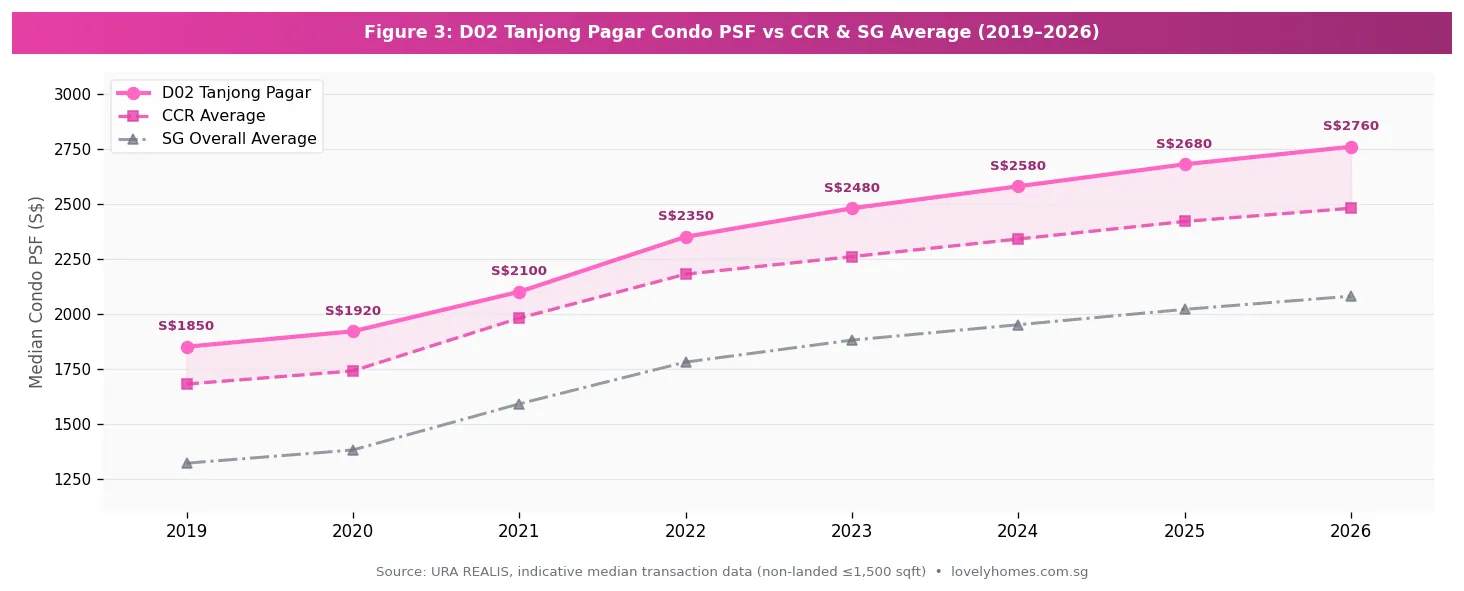
Figure 3: Tanjong Pagar condo PSF trend 2019–2026 versus CCR and Singapore average
Figure 3: D02 Tanjong Pagar median condo PSF (non-landed, ≤1,500 sqft) versus CCR average and Singapore overall, 2019–2026. Sources: URA REALIS, indicative median transaction data.

As Figure 3 illustrates, D02 has consistently traded at a premium above the CCR average — reflecting the district’s CBD-adjacency advantage. The gap widened between 2021 and 2023 as post-pandemic demand for city-fringe living spiked. Since 2024, the gap has stabilised, with D02 running approximately S$250–S$320 psf above the CCR mean. The absence of significant new supply — no major GLS site has been released in D02 in recent years — has supported prices even as broader CCR activity moderated in 2024.

The Greater Southern Waterfront: What It Means for Tanjong Pagar Property

The Greater Southern Waterfront (GSW) is the Singapore Government’s most ambitious urban transformation project south of the city. It encompasses approximately 2,000 hectares of land stretching from Pasir Panjang in the west to Marina East in the east — a stretch of southern coastline currently occupied by port terminals, industrial facilities, golf courses, and government land. As the Tanjong Pagar Port (the world’s largest container port by throughput when it operated) progressively relocates to Tuas by the early 2030s, this vast land bank becomes available for mixed-use development over the following two to three decades.

For Tanjong Pagar property owners, the GSW is both an opportunity and a long-dated one. Key facts that property buyers should understand:

Scale and timeline: At 2,000 ha, the GSW is larger than Marina Bay and Tampines combined. Development will be phased over 20–30 years. The first parcels to emerge will be around Keppel and Telok Blangah; those closest to Tanjong Pagar could see activity within 10–15 years.

Planned character: URA’s masterplan envisions a live-work-play precinct with new residential districts, public green spaces, a new waterfront promenade, cultural institutions, and a potential new MRT connection along the southern coast. The Keppel Club site (approximately 44 ha) was the first major GSW parcel to be tendered, with the winning developer awarded the white site in early 2023 for a mixed-use development that will include over 9,000 residential units — becoming one of Singapore’s largest planned private housing estates.

Property value implications: Historical precedent from Marina Bay and one-north suggests that government-planned transformations deliver measured but real uplift to surrounding residential values — typically concentrated in the 5–10 years before and during initial development. For D02 owners, the GSW catalyst is a hold thesis rather than an immediate trading play.

Key Takeaway: The GSW will materially reshape Singapore’s southern coast but on a multigenerational timeline. Buyers who purchase in Tanjong Pagar for own occupation benefit from the neighbourhood’s current strengths (connectivity, heritage, supply scarcity) and receive the GSW as optionality — not as a near-term flip thesis.

Worked Example: Buying a Tanjong Pagar Condo in 2026

The Scenario: Mr and Mrs Tan (SC/SC), first-time buyers, purchasing a 2-bedroom condo

Property: 2-bedroom leasehold condo near Tanjong Pagar, 700 sqft at S$2,400 psf = S$1,680,000

Stamp duty: Buyer’s Stamp Duty (BSD) = 1% on first S$180k + 2% on next S$180k + 3% on next S$640k + 4% on next S$500k + 5% on remainder
= S$1,800 + S$3,600 + S$19,200 + S$20,000 + S$9,000 = BSD S$53,600

ABSD: S$0 — SC first property, ABSD exempt

LTV and downpayment: With income of S$15,000/mth combined, TDSR ceiling is 55% → max monthly debt S$8,250. Assume 75% LTV bank loan at 3.5% over 25 years:
Loan = S$1,260,000; monthly repayment ≈ S$6,310 → TDSR 42.1% PASS

Cash required upfront:
— 5% cash downpayment: S$84,000 (cash only; CPF cannot cover first 5%)
— 20% balance: S$336,000 (cash or CPF OA)
— BSD: S$53,600
— Legal fees / stamp duty / valuation: ~S$6,000
Total upfront: approx. S$479,600 (depending on CPF OA balance)

Note: SPR or SC second-property buyers would pay ABSD of 5% (SPR first) or 20% (SC second) respectively, materially increasing the total cost. Always compute your personal profile’s ABSD liability before committing.

Why Tanjong Pagar Matters for Property Investors in 2026

In a market where OCR prices have risen sharply since 2020 and the gap between CCR and OCR has narrowed, Tanjong Pagar offers a rare proposition: a CCR address at a price point that, in historical context, is more accessible than it has been. The CCR-to-OCR price differential compressed significantly between 2021 and 2024 as mass-market demand pushed OCR prices upward while CCR remained relatively range-bound.

For long-term holders, D02 has three structural advantages that distinguish it from comparable CCR districts. First, the supply pipeline is thin — no significant new private residential completions are expected in D02 through 2028, meaning existing stock bears no dilution risk from new units coming online. Second, the tenant pool is diversified across CBD professionals, Chinatown heritage seekers, and increasingly, short-stay visitors and digital nomads who value the neighbourhood’s walkable character. Third, the GSW represents a call option on Singapore’s next major urban precinct — one that, unlike speculative GLS bids, requires no premium payment.

Comparable CCR districts (D9 Orchard, D10 Bukit Timah, D11 Novena) all carry higher average PSFs and lower yield profiles. D02’s position as the undervalued cousin of the prime districts has been a persistent feature of the Singapore market, partly because of the neighbourhood’s historic industrial associations and partly because of its relative unfamiliarity to overseas buyers. Both factors are changing.

What Might Come Next for Tanjong Pagar Property

This section reflects editorial analysis and speculation based on current trends. It should not be treated as a forecast or investment advice.

The most consequential near-term catalyst for D02 values is likely the Keppel integrated development — the first major GSW residential project — which, if it proceeds on schedule, could deliver initial units by the late 2020s to early 2030s. When Marina Bay Sands and the Marina Bay Financial Centre arrived, surrounding Districts 1 and 2 saw demonstrable price appreciation driven by improved amenity, connectivity, and perception uplift. A similar dynamic is plausible as the first GSW precincts activate, though the scale and timeline introduce significant uncertainty.

The URA Q2 2026 price index (released 1 July 2026, URA pr26-51) showed the CCR rebounding +2.0% quarter-on-quarter, outperforming the RCR (-1.4%) and OCR (-0.2%). If the CCR rebound is sustained, D02 stands to benefit disproportionately given its supply constraints and improving sentiment around the GSW. That said, global interest rate trajectories and Singapore’s continued vigilance on cooling measures (ABSD rates remain elevated since 2023) remain the key headwinds for any near-term price acceleration.

Frequently Asked Questions: Tanjong Pagar Property

Can a foreigner buy property in Tanjong Pagar?

Foreigners may purchase private condominiums in Tanjong Pagar freely, but may not purchase HDB flats (including Pinnacle@Duxton). Foreign buyers pay a 60% ABSD on their purchase price, on top of BSD. Freehold conservation shophouses classified as strata commercial or strata residential may be available, but restrictions apply — consult a licensed property agent and conveyancing solicitor before proceeding. Singapore Permanent Residents (SPRs) pay 5% ABSD on their first residential property purchase.

What is the MOP for HDB flats in Tanjong Pagar?

HDB resale flats in Tanjong Pagar (including Pinnacle@Duxton) have a standard Minimum Occupation Period of 5 years from the date the seller obtained the keys. You cannot resell or rent out the entire flat during MOP. After MOP, the full flat may be rented out, subject to HDB’s rental eligibility rules. New BTO flats in prime-classified zones carry an extended 10-year MOP under the framework introduced in August 2024.

How does buying a Pinnacle@Duxton flat differ from a standard HDB purchase?

Pinnacle@Duxton units transact as standard HDB resale flats under the HDB resale process — there is no special purchase mechanism. However, buyers should be aware of several unique features: the 50-storey height means piped gas is unavailable above certain floors; the sky bridge and rooftop garden access was previously charged (S$6 for residents) and open to the public; and the premium commanded by higher floors can be substantial. Lease decay is an important consideration: with a 99-year lease commencing 2010, the remaining lease in 2026 is approximately 83 years. HDB’s loan eligibility will be affected by the lease duration — ensure the flat meets the remaining-lease requirement for your desired loan tenure.

Is there a significant COV (Cash Over Valuation) in Tanjong Pagar?

In a tight supply market like D02, COV is common. COV is the amount a buyer pays above the HDB-commissioned bank valuation — it must be paid entirely in cash, not CPF. For popular blocks and high floors at Pinnacle@Duxton, COV of S$30,000–S$80,000 has been observed in recent transactions. Buyers should budget for COV explicitly and factor it into their cash liquidity planning alongside the standard 5% cash downpayment and BSD.

What is the Greater Southern Waterfront and when will it affect property prices?

The Greater Southern Waterfront (GSW) is Singapore’s government-planned transformation of approximately 2,000 hectares of southern coastal land, from Pasir Panjang to Marina East, as the Tanjong Pagar Port relocates to Tuas by the early 2030s. Development will proceed in phases over 20–30 years. The Keppel integrated development (white site awarded 2023) is the first major residential precinct to emerge from the GSW, with an estimated 9,000+ homes planned. Property values in D02 are unlikely to see an immediate step-change from GSW; the effect will be gradual, strongest when the first GSW precincts open and new amenities, waterfront access, and additional MRT nodes materialise. Buyers today are effectively pre-positioning.

What rental income can I expect from a Tanjong Pagar condo?

Based on Q1 2026 rental market data, a 2-bedroom unit (600–800 sqft) in a leasehold condo in D02 typically commands S$4,200–S$7,500 per month, depending on age of the building, floor level, and furnishing. Smaller studio or 1-bedroom units (400–500 sqft) rent in the S$3,200–S$5,000 range and are popular with single CBD professionals. Gross rental yields typically fall in the 2.6–3.2% range for private condos at current price levels — not the highest in Singapore but supported by consistently low vacancy given the CBD tenant base. HDB flats may be rented out after MOP; rental returns on HDB in D02 can be relatively attractive given the lower absolute price relative to nearby private units.

Are there upcoming GLS or new launch condos in Tanjong Pagar?

As at July 2026, there are no confirmed GLS sites in District 02 Tanjong Pagar on the URA Confirmed List for 1H or 2H 2026. The GSW Keppel integrated development is the closest major upcoming supply, but it is physically distinct from the current D02 residential cluster and is expected to be launched as a new growth node rather than a competitor to existing D02 stock. Supply scarcity in D02 proper is expected to persist through at least 2028, which supports both rental and capital values.

Disclaimer: This article is produced for general information and educational purposes only. Price data represents indicative medians drawn from publicly available URA REALIS, HDB Resale Portal, and industry sources for Q1 2026; individual transactions may differ materially. Nothing in this article constitutes financial, investment, legal, or property advice. The Greater Southern Waterfront projections are based on URA planning documents and are subject to change. Readers should conduct their own due diligence and consult a licensed property agent, conveyancing solicitor, and independent financial adviser before making any property purchase decision. Official resources: URA, HDB, IRAS, MAS.

×

Click anywhere to close

URA Launches Two New GLS Sites in May 2026: Berlayar Drive and New Upper Changi Road — 1,425 Homes in the Pipeline

URA Launches Two New GLS Sites in May 2026: Berlayar Drive and New Upper Changi Road — 1,425 Homes in the Pipeline

⚡ Quick Answer — URA Berlayar Drive & New Upper Changi Road GLS Launch

  • The Urban Redevelopment Authority (URA) launched two new residential Government Land Sales (GLS) sites in May 2026 — at Berlayar Drive (District 3, Bukit Merah) and New Upper Changi Road (District 16, Bedok).
  • Berlayar Drive is a 271,929 sqft site with GPR 1.4, expected to yield ~415 homes; tender closes 4 August 2026.
  • New Upper Changi Road is a larger 331,194 sqft site with GPR 2.8, potentially yielding ~1,010 homes — a future mega-development; tender closes 1 September 2026.
  • Both sites are 99-year leasehold; no land price benchmark yet — developers submit sealed bids by the respective tender close dates.
  • Berlayar Drive sits within the Greater Southern Waterfront (GSW) transformation corridor — one of Singapore’s most significant long-term urban rejuvenation projects.
  • New Upper Changi Road is the first large OCR residential GLS site in Bedok since the Bayshore Drive parcel (Vela Bay, awarded 2025), bringing much-needed OCR supply to the eastern region.
  • Together, both sites add 1,425 estimated units to the 1H 2026 GLS pipeline, contributing to MAS and URA’s stated goal of maintaining adequate private housing supply.

URA Launches Two New Residential GLS Sites in May 2026

The Urban Redevelopment Authority (URA) released two residential sites for sale by public tender in May 2026 under the 1H 2026 Government Land Sales (GLS) programme — at Berlayar Drive in Bukit Merah and New Upper Changi Road in Bedok. The launch adds approximately 1,425 private homes to the confirmed list supply pipeline, reinforcing the government’s commitment to ensuring adequate housing supply as private residential prices continue to be closely monitored by both URA and the Monetary Authority of Singapore (MAS).

The two sites are markedly different in character. Berlayar Drive is a smaller, low-density waterfront parcel within the emerging Berlayar estate — part of the broader Greater Southern Waterfront transformation masterplan. New Upper Changi Road is a high-density OCR site that could become one of Singapore’s largest single condominium developments, with analysts projecting 1,000 or more units. Both sites will be sold by closed tender, with bids evaluated on the highest price basis subject to the technical conditions of tender.

Berlayar Drive vs New Upper Changi Road GLS site comparison 2026 — area, GPR, units, tenure, tender dates
Figure 1: Site-by-site comparison — Berlayar Drive (D3 RCR, ~415 units, tender 4 Aug 2026) vs New Upper Changi Road (D16 OCR, ~1,010 units, tender 1 Sep 2026). Source: URA GLS Programme 1H 2026.

Berlayar Drive — Waterfront Living at the Edge of the Greater Southern Waterfront

The Berlayar Drive site is located in the Bukit Merah planning area (District 3), adjacent to Telok Blangah MRT station on the Circle Line (CC29). The site forms part of the nascent Berlayar estate, a new residential precinct being carved out from the southern edges of Bukit Merah and Telok Blangah, with proximity to the Southern Ridges park connector system, Henderson Waves, and the Labrador Nature Reserve.

At 271,929 sqft with a gross plot ratio of 1.4, the Berlayar Drive site is notably low-density for a Singapore residential GLS parcel — reflecting URA’s planning intent to create a mid-rise, waterfront-adjacent neighbourhood rather than another high-rise tower cluster. The estimated 415 units would make this a boutique-to-mid-sized development, and the lower density is expected to attract premium pricing from developers given the site’s proximity to the Southern Waterfront and the overall scarcity of new residential supply in D3.

The Greater Southern Waterfront (GSW) masterplan — one of Singapore’s most ambitious urban transformation programmes — encompasses a 30km waterfront stretch from Pasir Panjang to Marina East, including the relocation of Tanjong Pagar Terminal (to Tuas by 2027), the repurposing of Pulau Brani, and the creation of new waterfront precincts at Keppel, Mount Faber, Berlayar, Labrador and Pasir Panjang. Berlayar Drive sits directly within this transformation zone. Industry analysts expect the developer to price land at S$1,300–1,600 psf ppr, reflecting the GSW premium, the D3 RCR location and the low-density advantage — which typically supports higher per-unit ASP.

New Upper Changi Road — Bedok’s Potential Mega-Development

The New Upper Changi Road site occupies a 331,194 sqft parcel in the Bedok planning area (District 16), a mature residential neighbourhood in Singapore’s eastern region. With a gross plot ratio of 2.8, the site could yield approximately 1,010 residential units — making it one of the largest GLS residential parcels on the 1H 2026 confirmed list. The nearest MRT station is Bedok (East-West Line), a major interchange point in D16 with established amenities including Bedok Mall, Bedok Interchange Hawker Centre, and bus interchange connectivity.

Bedok is a well-established mature estate, home to a large HDB population and a smaller but growing private condominium market. Notable recent transactions in D16 include units at Grandeur Park Residences (TOP 2019, ~S$1,600–2,000 psf) and Coco Palms (~S$1,400–1,700 psf). The New Upper Changi Road site’s OCR location means it will attract primarily HDB-upgrader buyers and Singapore Citizen first-time private buyers, for whom 0% ABSD applies on a first private property purchase. For these buyers, an OCR mass-market entry point (estimated launch price S$1,600–2,000 psf) represents an accessible entry into private property ownership in a mature, well-connected eastern district.

The mega-development scale — if fully realised at 1,010 units — carries both supply and marketing risk. Mega-developments require phased launches over 12–18 months to absorb market demand without undercutting their own prices. Developers who tender for this site will need deep marketing resources and a willingness to sustain a long selling campaign. The 2-year deadline from award to launch (under ABSD developer rules) adds urgency to the tender and project development timeline.

Singapore 1H 2026 GLS confirmed list units and land price benchmark — Berlayar Drive New Upper Changi Road pipeline
Figure 2: 1H 2026 GLS confirmed list supply by site (left) and recent land price benchmarks for comparison (right). New Upper Changi Road at ~1,010 units is the largest single site. Holland Plain (S$1,491 psf ppr) and Dover Drive (S$1,281 psf ppr) are the latest comparable land price benchmarks. Source: URA.

What the Two Sites Mean for the 1H 2026 Supply Programme

The URA’s 1H 2026 GLS confirmed list includes nine sites in total, with a combined estimated supply of approximately 5,050 private residential units. The two new sites — Berlayar Drive and New Upper Changi Road — account for 1,425 of these units, or roughly 28% of the confirmed list supply for the first half of 2026. Other sites on the confirmed list include Peck Hay Road (D9, ~350 units, tender closing 11 June 2026), River Valley Green Parcel C (D9, ~420 units, closing 18 June 2026), Dunearn Road (D11, ~325 units, already awarded), Holland Plain (D10, ~280 units, awarded to Sim Lian May 2026) and Kallang Close (D12, ~520 units, awarded to Frasers+Mitsubishi April 2026).

The geographic spread of the 1H 2026 sites — D3, D9, D10, D11, D12, D16 — reflects the URA’s deliberate intention to distribute supply across CCR, RCR and OCR markets. Including New Upper Changi Road (D16 OCR) ensures that affordable mass-market units are entering the pipeline, while the concentration of CCR sites (D9, D10, D11) addresses sustained high-end demand from upgraders and investors.

Site District Region Est. Units Tender/Award Status Land Price (psf ppr)
Holland Plain D10 CCR ~280 Awarded (May 2026, Sim Lian) S$1,491
Dunearn Road D11 CCR ~325 Awarded (Apr 2026) S$1,250 (est.)
Kallang Close D12 RCR ~520 Awarded (Apr 2026, Frasers) S$1,415
Peck Hay Road D9 CCR ~350 Tender closes 11 Jun 2026 TBD
River Valley Green C D9 CCR ~420 Tender closes 18 Jun 2026 TBD
Berlayar Drive D3 RCR ~415 Tender closes 4 Aug 2026 TBD
New Upper Changi Road D16 OCR ~1,010 Tender closes 1 Sep 2026 TBD

Buyer and Investor Implications

For prospective buyers, the Berlayar Drive and New Upper Changi Road sites represent future pipeline supply that is unlikely to launch before 2028 in both cases — developers typically require 18–24 months from award to project launch, with construction-to-TOP timelines of an additional 3–4 years. A buyer registering interest in a Berlayar Drive development today would likely see a launch preview in mid-to-late 2027, with TOP potentially in 2031–2032. New Upper Changi Road, being larger and more complex, may launch in late 2027 or 2028 depending on the developer’s phasing strategy.

For investors tracking the pipeline, these two sites confirm that RCR (Berlayar, Kallang) and OCR (New Upper Changi Road) supply is building — which may moderate price growth in those segments beyond 2028 as completions arrive. The CCR, by contrast, has lighter confirmed list supply (Holland Plain and Dunearn Road are relatively small), which may support continued CCR price resilience through 2026–2027 even as OCR and RCR stock accumulates.

The worked example below illustrates what a buyer of a future Berlayar Drive unit might expect in acquisition costs, assuming an indicative launch price of S$2,200 psf for a 850 sqft 2-bedroom unit.

Worked example — Future Berlayar Drive 2-bedroom, est. S$1,870,000:
SC buyer (first private property, after selling HDB). BSD: 1%×S$180k (S$1,800) + 2%×S$180k (S$3,600) + 3%×S$640k (S$19,200) + 4%×S$500k (S$20,000) + 5%×S$370k (S$18,500) = S$63,100 BSD. ABSD: S$0. Bank loan 75% = S$1,402,500 @ 3.0% 25yr = S$6,649/month. TDSR: minimum income S$12,089/month required. Total upfront: S$467,500 downpayment + S$63,100 BSD + S$10,000 legal = est. S$540,600.

What Might Come Next

The immediate pipeline of tender closings is busy through Q3 2026: Peck Hay Road closes 11 June, River Valley Green Parcel C closes 18 June, Berlayar Drive closes 4 August, and New Upper Changi Road closes 1 September. Award announcements typically follow within 2–4 weeks of the tender close, at which point land price benchmarks will be set. If Peck Hay Road and River Valley Green (both D9 CCR) attract strong bids above S$1,500 psf ppr, it would signal continued developer appetite for CCR land despite the 60% foreigner ABSD headwind. If bids are soft (below S$1,200 psf ppr), it may indicate developer caution about CCR demand sustainability at current price levels. LovelyHomes will report on each tender award as results are released by URA.

Frequently Asked Questions

When will the Berlayar Drive and New Upper Changi Road projects launch for sale?

Developer launches are typically 18–24 months after GLS award and subject to planning approvals. Given the Berlayar Drive tender closes 4 August 2026 and award follows approximately 3–4 weeks later, the earliest a developer could realistically launch a Berlayar Drive project would be Q1–Q2 2028, with New Upper Changi Road slightly later given its larger scale. Buyers should register interest directly with developers (via project marketing teams) once the tender is awarded and the developer is publicly known, typically in Q4 2026 for Berlayar Drive.

How does the Greater Southern Waterfront affect Berlayar Drive’s investment case?

The Greater Southern Waterfront (GSW) transformation is one of Singapore’s most significant long-term urban projects — it will eventually create new residential, commercial and recreational precincts across a 30km southern coastal corridor. In the near term (2026–2028), the primary catalyst for Berlayar Drive is proximity to the Southern Ridges, Telok Blangah MRT (CC29) and the nascent Berlayar estate identity rather than operational GSW amenities, which remain years away. Longer term (2030+), as Keppel Terminal land is repurposed and waterfront promenades connect Sentosa to Marina East, Berlayar Drive’s capital appreciation could benefit significantly. Buyers should view GSW as a long-horizon catalyst, not a near-term price driver.

Is the New Upper Changi Road site a good investment given its mega-development scale?

Mega-developments (1,000+ units) in Singapore carry specific risks and benefits. On the risk side: a large supply of similar units in one development creates internal price competition during resale, especially when multiple sellers list simultaneously post-MOP. On the benefit side: mega-developments attract developer marketing resources, typically feature comprehensive facilities, and benefit from economies of scale in management fees. For owner-occupiers in Bedok seeking a large community and established facilities, the New Upper Changi Road project may be highly attractive. For investors focused on rental or capital gain, smaller boutique developments in the same area may offer tighter supply dynamics post-TOP.

Who can buy these properties once they launch — are there foreign buyer restrictions?

Both sites are non-landed residential developments and may be purchased by Singapore Citizens, Permanent Residents and foreigners subject to the applicable stamp duties. Singapore Citizens buying their first private property pay BSD only (0% ABSD). PRs pay 5% ABSD on a first property. Foreigners pay 60% ABSD on all residential property. There are no additional restrictions specific to the Berlayar Drive or New Upper Changi Road locations beyond these standard rules. GCB areas and landed housing restrictions do not apply to apartment/condominium developments.

How do I track when developers register interest for Berlayar Drive and New Upper Changi Road?

Once a developer is awarded a GLS site, they typically announce a sales gallery opening and register-interest campaign within 6–12 months of award. LovelyHomes will publish updates as each tender is awarded. You can also monitor URA’s website (ura.gov.sg), the respective developer’s official website (once known), and property portals such as PropertyGuru and 99.co, which aggregate new launch previews. Alternatively, a CEA-registered property agent can notify you directly when the developer’s marketing team begins collecting expressions of interest.

Related Articles

Disclaimer

This article is for general informational purposes only. All unit yield estimates are projections based on site area and GPR and actual development plans will be determined by the awarded developer subject to URA’s planning approval. Land price forecasts are market speculation and may differ materially from actual tender results. Nothing in this article constitutes investment or financial advice. Readers should conduct independent due diligence and consult licensed advisers before making any property decisions. Official information about these GLS sites is available at ura.gov.sg.

×Click image or press Esc to close

Greater Southern Waterfront: The 2030+ Masterplan Explained (2026)

Greater Southern Waterfront: The 2030+ Masterplan Explained (2026)

QUICK ANSWER

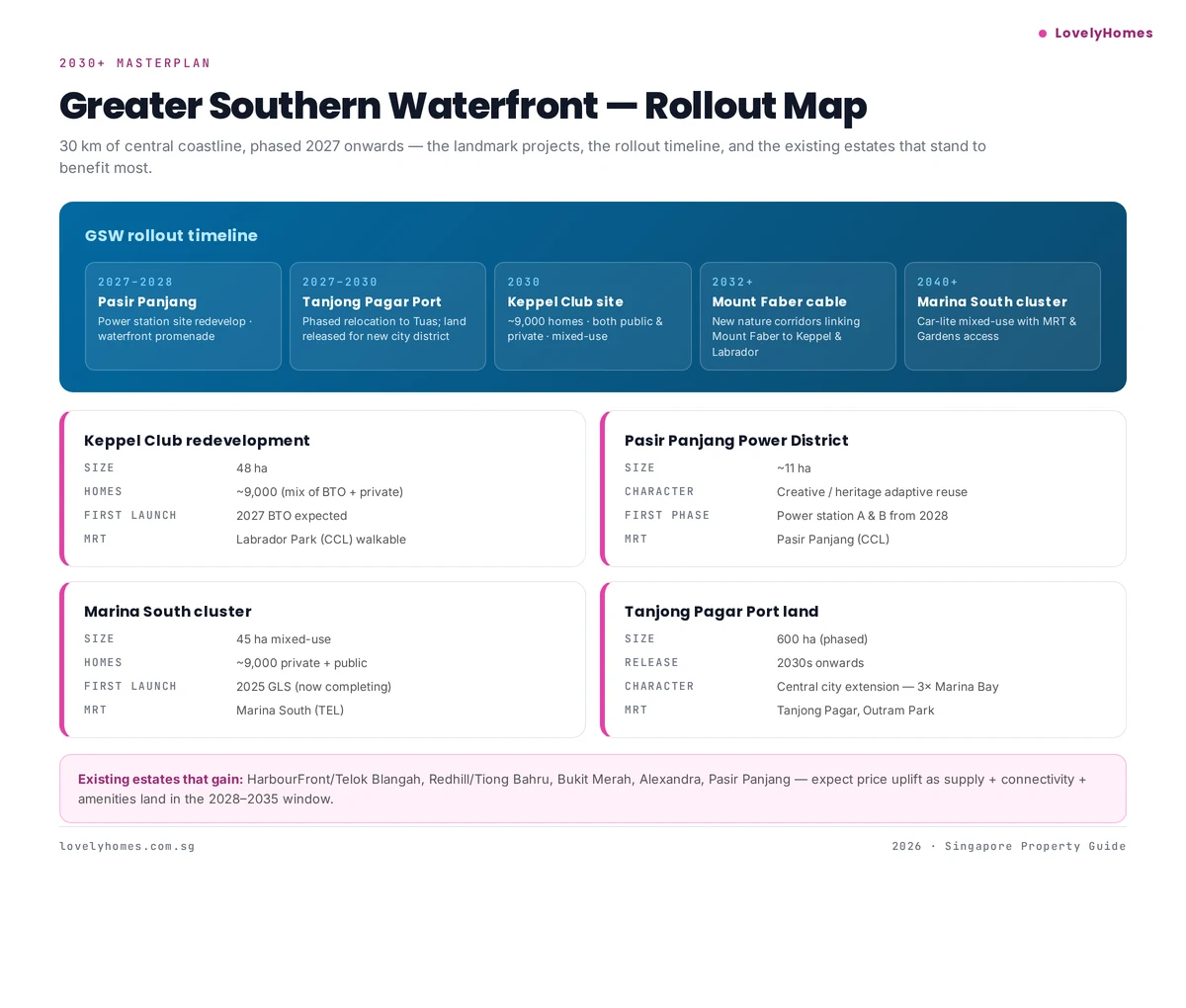
The Greater Southern Waterfront (GSW) is Singapore’s next major urban frontier — 30 km of coastline from Gardens by the Bay to Pasir Panjang, freed up by the Tanjong Pagar port relocation to Tuas (by 2027). ~2,000 ha will be released over 20–30 years, with Keppel Club redevelopment (9,000 homes, 2027+), Pasir Panjang power district (2028+), and the Marina South cluster (2025+ launches) the early anchors.

The GSW was first announced in the 2013 Land Use Plan and firmed up through successive URA Master Plans. It represents Singapore’s biggest redevelopment opportunity outside Marina Bay — about three times the land area of Marina Bay, and stretches along the entire central south coast. This guide covers the projects, timelines, and which existing estates stand to benefit most.

For broader market context, see our Singapore property market outlook 2026.

Greater Southern Waterfront rollout timeline and projects infographic
GSW rollout phases and the marquee projects per phase

Why the GSW exists

The driver is port relocation. Tanjong Pagar, Keppel, Pulau Brani, and Pasir Panjang container terminals are consolidating at Tuas Mega Port, which opens in phases from 2021 and completes by 2040. When Tanjong Pagar’s lease expires in 2027, about 325 hectares of prime central land is freed, plus another 600 ha as Pasir Panjang terminals phase out.

This land is the closest large redevelopment opportunity to the CBD. URA’s stated intent is a mix of residential, commercial, leisure, and nature — a “live-work-play-learn” district spanning the south coast.

The rollout timeline

Phase Timeline Focus
Phase 1 2025–2030 Marina South, Keppel Club, Pasir Panjang Power District
Phase 2 2030–2040 Tanjong Pagar port land, Keppel Terminal, integrated waterfront
Phase 3 2040+ Sentosa-Pulau Brani integration, Marina South expansion

The anchor projects

Keppel Club redevelopment (~2027+)

Keppel Club’s lease was not renewed; its 48-hectare site will deliver ~9,000 homes (mix of public and private), plus community and retail amenities. First BTO launches expected from 2027. The site is walkable to Labrador Park MRT (CCL).

Marina South cluster (2025+)

URA Government Land Sales launched Marina South plots from 2023. The district is planned as car-lite, with ~9,000 homes and mixed-use nodes. The Marina South MRT station (TEL) opened in 2022, anchoring access. Early private launches are already trading around S$2,500–S$2,800 PSF.

Pasir Panjang Power District (2028+)

The old Pasir Panjang “A” and “B” Power Stations will be adaptively reused as a creative and heritage district. Complementary uses include arts spaces, offices, dining, and retail. Pasir Panjang MRT (CCL) serves the site.

Tanjong Pagar port land (2030s+)

The largest phase — 325 ha released in the early 2030s, with comprehensive planning still underway. Expected to include major residential, commercial, leisure, and waterfront green spaces, anchored by Tanjong Pagar MRT (EWL).

Which existing estates benefit

  • HarbourFront / Telok Blangah — best early beneficiary, adjacent to Keppel Club and VivoCity, on the CCL.
  • Redhill / Tiong Bahru — direct access to the GSW corridor via EWL; property values already reflect partial uplift.
  • Bukit Merah — en bloc redevelopment activity is picking up; close to future GSW homes and offices.
  • Alexandra — commercial office supply will deepen; rental demand expected to rise.
  • Pasir Panjang — direct vicinity of Power District; landed property has already risen significantly.

What this means for buyers

GSW exposure isn’t a short-term play. The phases are 15+ years out, and the property market in Singapore is cyclical — don’t overpay for an asset expecting linear GSW-premium capture. The best approach is:

  1. Buy fundamentally sound property within 1–2 MRT stops of a confirmed GSW node.
  2. Hold 10+ years to ride multiple launches and infrastructure openings.
  3. Watch for new launches in Keppel Club (2027–2028) and Marina South (ongoing) — these could be early-cycle buys.

Frequently asked questions

When will I see GSW flats launched?

Keppel Club BTOs are expected from 2027. Marina South private condo GLS are already live. Major Tanjong Pagar land parcels come online early 2030s.

Is Sentosa part of GSW?

Sentosa and Pulau Brani will be integrated with the GSW vision in later phases (~2040+), with upgraded leisure, residential, and transport links.

Should I buy now to get GSW uplift?

GSW is a 20–30 year programme — buying specifically for the uplift requires long holding periods. If you’re buying to live AND benefit from GSW, HarbourFront, Telok Blangah, Redhill, Tiong Bahru, and Bukit Merah are reasonable targets. Always assess each property on its own merits — amenity, layout, tenure — not just masterplan exposure.

Disclaimer

This guide is for general information only. Estate pricing, upcoming launches, MRT opening dates, and masterplan details change over time. Always verify the latest HDB, URA, LTA and MND announcements before making property decisions. LovelyHomes is not a licensed property agent. For personalised advice, please engage a registered CEA agent.


My review of One Marina Gardens by the Kingsford Group

My review of One Marina Gardens by the Kingsford Group

[This article was first posted on daryllum.com on 26 Mar 2025]


You know what I find perplexing? If location is key when it comes to property investment, then why are properties in the core central region getting so little interest from developers and buyers alike? Little when comparing the interest in places like Tampines. Buyers do realise that projects like Parktown Residences are located in Tampines and Tampines is located at the east end of Singapore yup? Was the pricing so impressively attractive that buyers needed to flood the showrooms? Yes it is an integrated development but why do buyers not consider something in the core central region as well?

The highly restrictive Additional Buyers’ Stamp Duties (ABSD) levied on foreign buyers has put the brakes on almost all foreign purchases. I have always maintained that if a foreigner chooses to pay the 60% ABSD, there is something that should be scrutinised. Imagine this, a foreigner purchases an SGD$5 million property. He pays SGD$3 million as ABSD. His total acquisition cost, including the usual Buyers’ Stamp Duty and other fees amount more than SGD$8 million. As a foreigner with more than SGD$8 million, he would have choices galore. He has access to properties all around the globe. If that individual can purchase properties from all over the world, what is his motivation to pay more than SGD$8 million for something that is perhaps valued at around SGD$5 million? This means that the moment he purchases the property, the asset that he is holding is worth much less than what he paid for. This, in investing sense, is purely illogical. However, if that individual acquired his monies relatively easily, then he would not mind losing that value. Foreign buyers are almost non-existent. In fact, if I were the authorities, I would question and scrutinise the very few purchases by foreigners. I would want to understand the motivation and purpose for such a purchase. Well, if there were no clear motivation for the buyer to purchase Singapore properties then it would be prudent to scrutinise his source of funds for the property purchase.

So then, foreign property purchases have slowed to a trickle. This perverts the normal demand for Singapore properties. Foreigners would be less motivated by things like familiarity and proximity to other family members. For example, if my family members and I have been living in a certain part of Singapore, say Toa Payoh, then if there is a new property launch in Toa Payoh, I would be more likely to be enticed to make a purchase because I want to live near my family members and also to live in a part of Singapore that I am familiar with. This is why, to me, properties like Chuan Park are selling well as compared to a property like Aurea. There are fewer existing families living around Aurea as compared to Chuan Park. Hence there will be less “familiar” buyers for Aurea. Go to Chuan Park and the typical buyer will be someone who lives or lived around the area. Or has family members living in the area.

Location, despite what we have always focused on, may not weigh as much on current buyers’ consideration in today’s market. Familiarity with a particular location is high on buyers’ consideration. This is why many developers look at marketing their projects to HDB upgraders. This can be seen in the weak bids for land in areas with less HDB upgraders. Let me turn you back to end 2024 where the Marina Gardens Crescent site drew just one bid of SGD$770.5 million, or SGD$984 per square foot per plot ratio (psf per) This bid was too low and URA did not award this site to the bidder. This bid is nearly 30% lower than the neighbouring Marina Gardens Lane site. This is the site on which One Marina Gardens is located on. This one Marina Gardens Lane site was awarded to the Kingsford Group in July 2023 for SGD$1.03 billion or SGD$1,402 psf ppr. Look around this area. There are no residential properties around the area. It is inconceivable that someone will walk into the One Marina Gardens sales gallery and say, “I lived in this area for the past few decades and would like to purchase a unit in this development due to my familiarity with the location”.


Details about the development

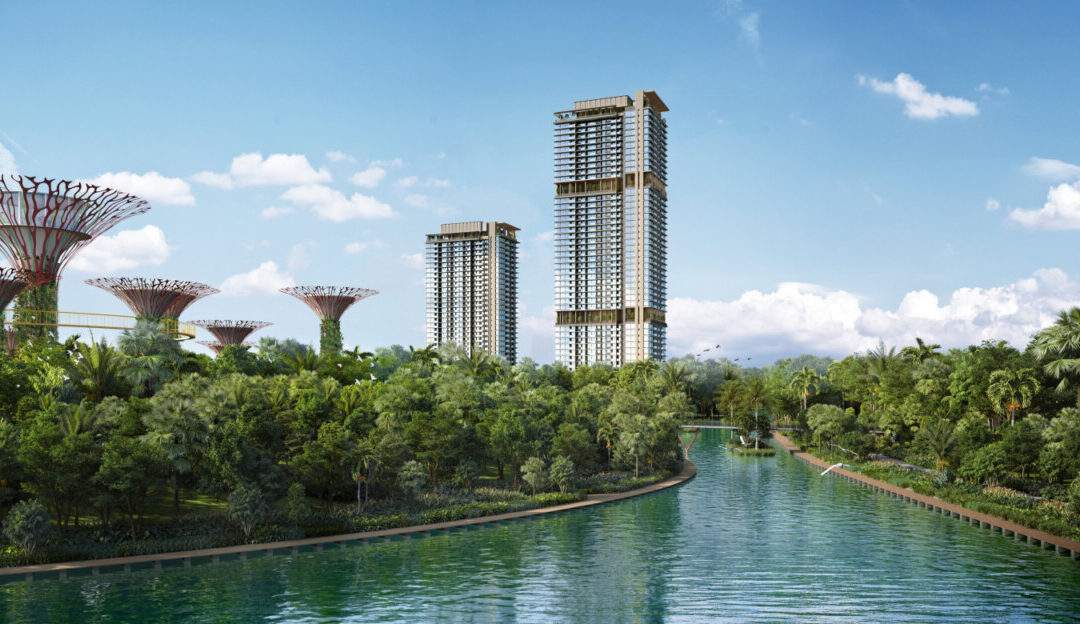
One Marina Gardens is a 99-year leasehold development. The total site area is 12,245.10 square meters. The development consists of 937 units spread across two blocks. The two blocks are 30 and 44 storeys. It will also have commercial units like 2 restaurants, 2 shop units and a childcare centre. There will be 445 carpark lots. The expected completion is in 2029.


Where is the development located?

One Marina Gardens is located along Marina Boulevard.

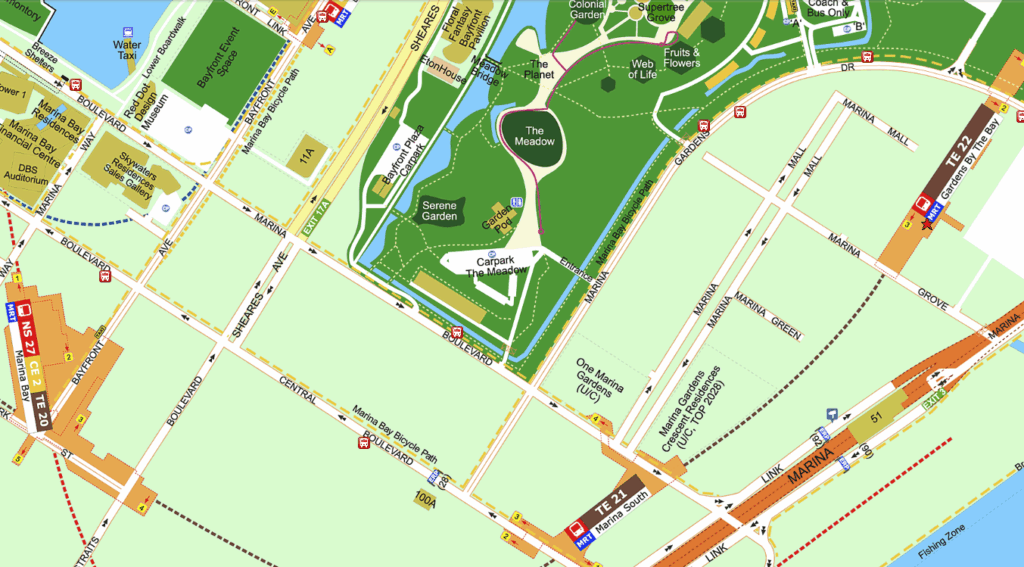
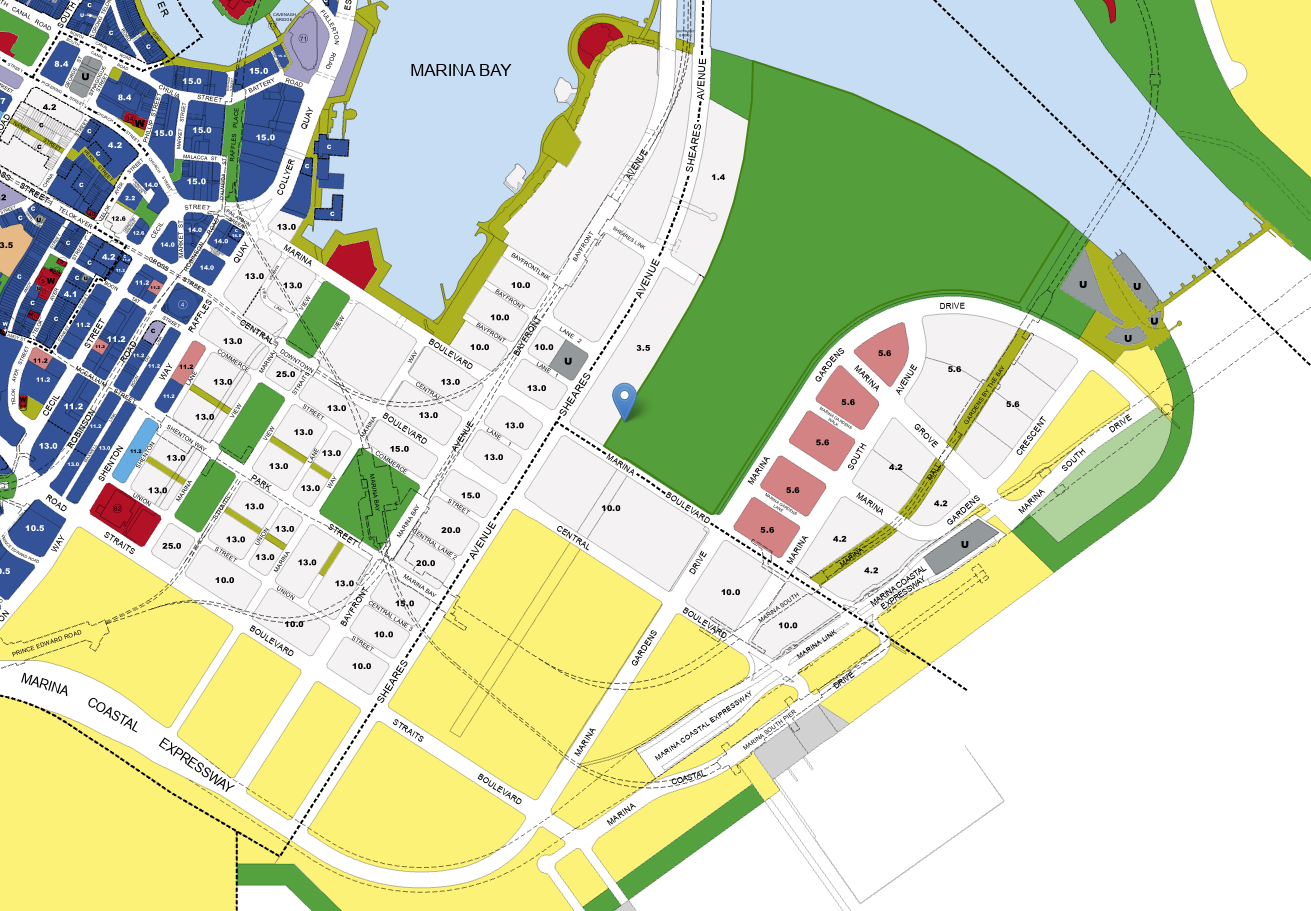
One Marina Gardens Location Map


It is located right next to exit 4 of Marina South MRT Station. Marina South MRT Station is one of the stations on the Thomson East Coast Line. Marina South MRT Station is not yet opened. It is scheduled to open in tandem with developments in this area. I believe that this means that when One Marina Gardens is completed, Marina South MRT Station will be operational. For the purposes of this review, we will refer to TE22 Gardens by the Bay MRT Station rather than TE21 Marina South MRT Station.

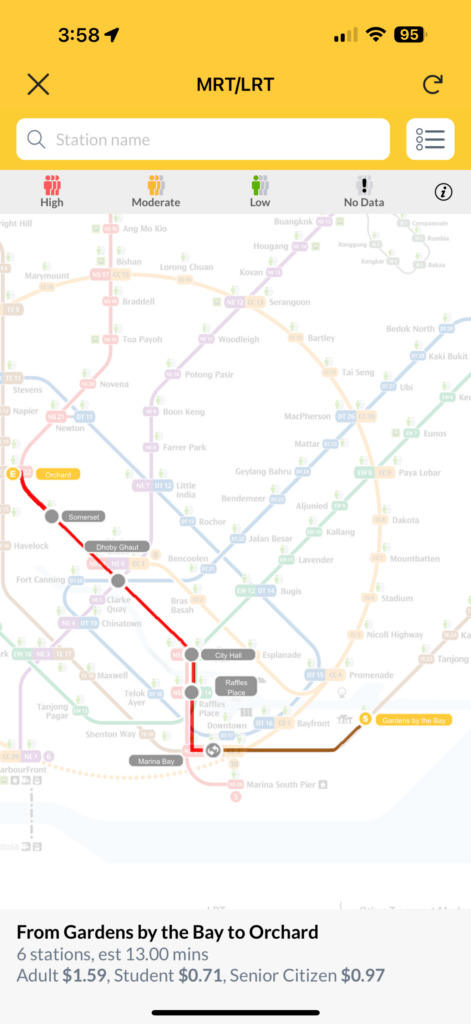
Travelling from Gardens by the Bay MRT station to Orchard MRT station would take a total of 13 minutes over 6 stations. The cost is $1.59.

Gardens by the Bay MRT to Orchard MRT


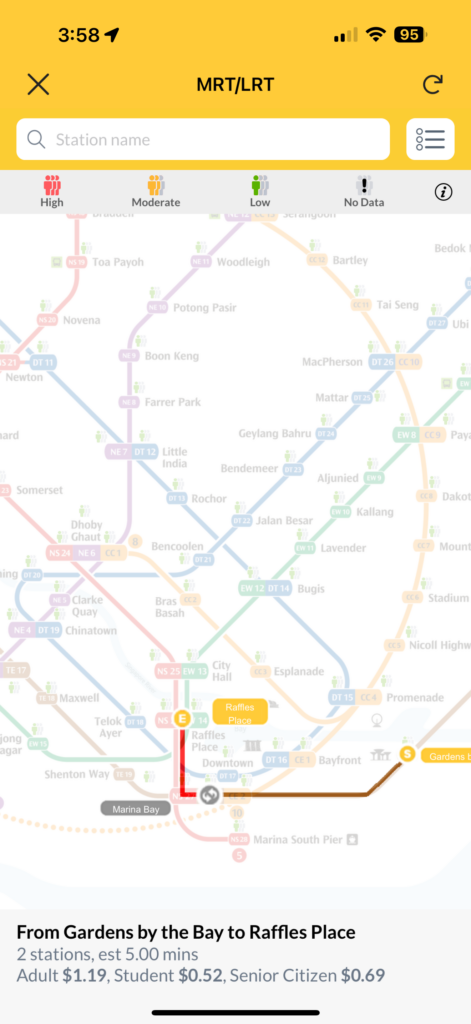
Travelling from Gardens by the Bay MRT station to Raffles Place MRT station would take a total of 5 minutes over 2 stations. The cost is $1.19.

Gardens by the Bay MRT to Raffles Place MRT


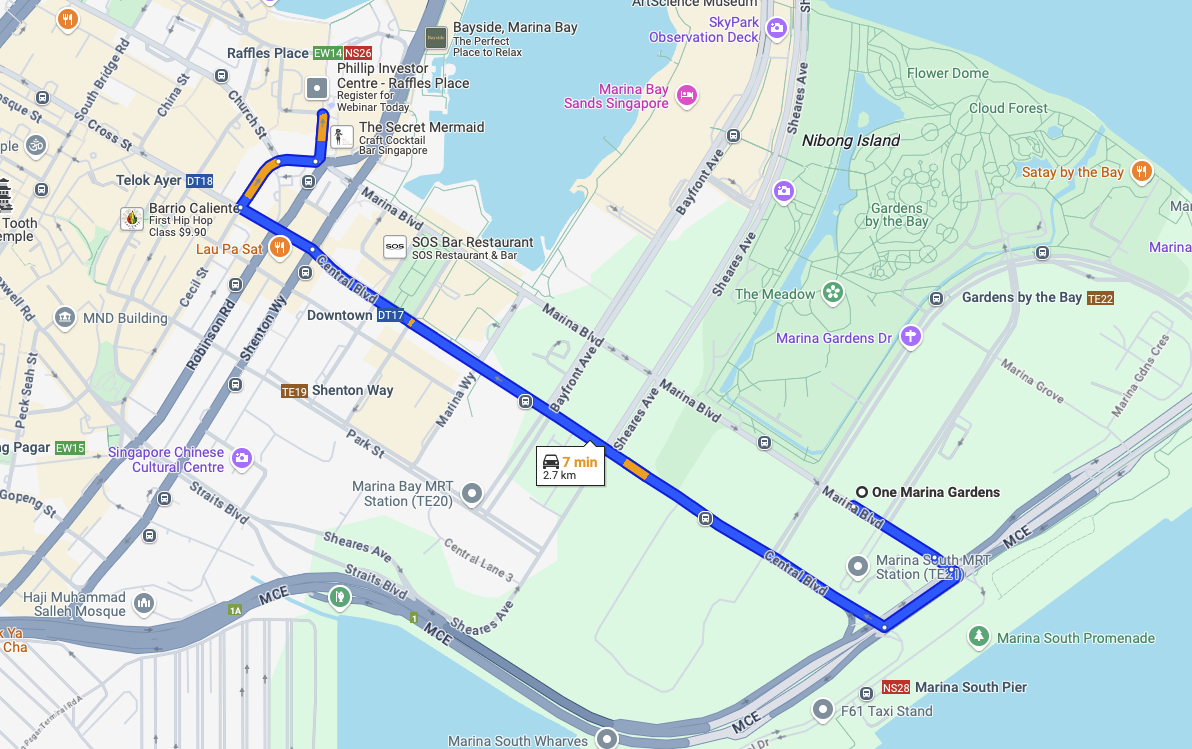
The drive from One Marina Gardens to Raffles Place would take approximately 7 minutes and the distance travelled is about 2.7 kilometres.

The drive from One Marina Gardens to Raffles Place


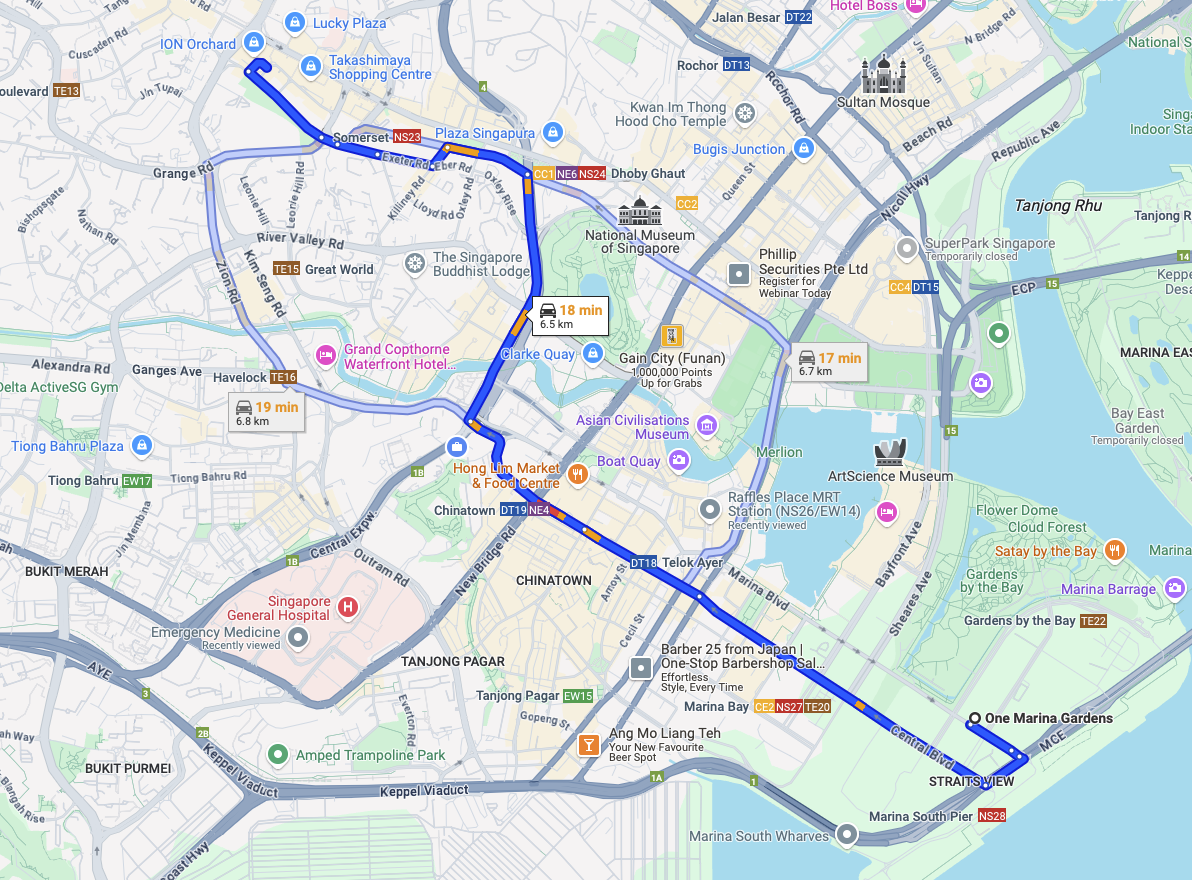
The drive from One Marina Gardens to Orchard Road would take approximately 18 minutes and the distance travelled is about 6.5 kilometres.

The drive from One Marina Gardens to Orchard Road


One Marina Gardens is located at the fringe of the Marina Bay Financial District. I do not think that residents would drive to Raffles Place. I believe the short train ride would be the most ideal option. As a point of reference, the Google Map query was done in the afternoon at about 4pm. Hence traffic is light. If you are driving during peak hours, do factor in additional travelling time.


Who is this development for?

I genuinely think that if you believe in the concept of catchment areas, then why are you not considering properties in and around the Marina Bay Financial District? Are your tenants not coming from people who work in offices in the area? If so, I do think that if you are looking to purchase for rent, then this is the ideal property for you. I am a person who always focuses on what is around the area. If the area is littered with offices with highly paid employees, then this is a huge plus.

One of the reasons I can offer as to why many Singaporeans do not think this way is because of the ABSD. On multiple properties, ABSD applies. Hence Singaporeans only have one property purchase which is not subject to ABSD. If so, that first property is likely to be a property in a location which they are familiar with. In certain cases where a married couple plans to have two private properties, one under the husband’s name and another one under the wife’s name, then this is an ideal second property.

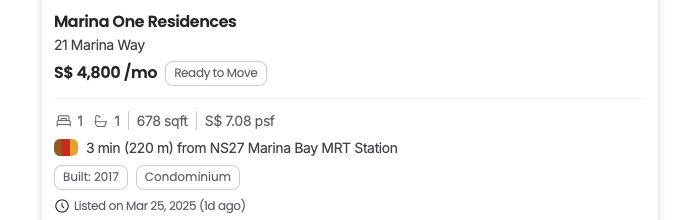
Marina One Residences One Bedroom for rent


A simple search on PropertyGuru would show that a 1 bedroom condominium at Marina One Residences is going for about $4,800 a month.

According to a recent Business Times article, the 1 bedroom units at One Marina Gardens starts at SGD$1.16 million.

Working out the yield based on an assumed rent of $4,800 a month or $57,600 per annum,

$57,600 / $1,160,000 = 4.97% per annum

Of course there are a few assumptions when it comes to my calculation. I am making the assumption that the 1 bedroom unit at One Marina Gardens can be rented out for $4,800 in about four years time. I believe my assumption is reasonable because it is likely that rents are likely to increase in the next four years, albeit at a much slower pace. The $4,800 is based off the current rent in an older development. Secondly, the purchase price is based on the lowest priced unit. However, if you factor in a higher purchase price, you would still receive a yield of more than 4%.

Ever heard the notion that yields tend to be lower in the city centre? Well not necessarily so. Especially when current property prices in the Outside Central Region (OCR) are so close to the prices in the Core Central Region (CCR) and Rest of Central Region (RCR). Try going to Chuan Park and getting a 1 bedder for less than SGD$1 million. I do not think it is possible. Then look at the prices at developments in areas that are so much closer to Singapore’s Central Business District (CBD).

Hence I firmly believe that if I were looking for a property with good rentability, One Marina Gardens is something I would look at.


The selling points of the development

Rentability and closeness to the MRT station and Singapore’s CBD. If location is the prime determinant of how much one should pay for a certain property, is the market making a mistake in looking away from developments in the Marina Bay Area?

Oh yes, heard of the Marina Bay Development Plan? The Greater Southern Waterfront?

If you require more information about developments in this area, you can refer to the URA website on The Marina Bay Story.

If you need more confirmation that there will be developments in the area, this is the URA Master Plan. The reddish pink areas where One Marina Gardens sits on are zoned Residential with Commercial at 1st storey. Those in white are White sites. It is clear that this is an area slated for future development. There will be HDB flats built in this area as well. It was announced in 2023 that more homes are planned in central locations to let more people enjoy city living. Marina South is one of those areas stated. With HDB flats in the vicinity, the usual amenities that are associated with HDB neighbourhoods are likely to also follow suit. Hence, if you do not have a food centre or supermarkets in the vicinity currently, if HDB flats are built here, then all these conveniences should make their way to this neighbourhood.

URA Master Plan


Possible bad points of the development

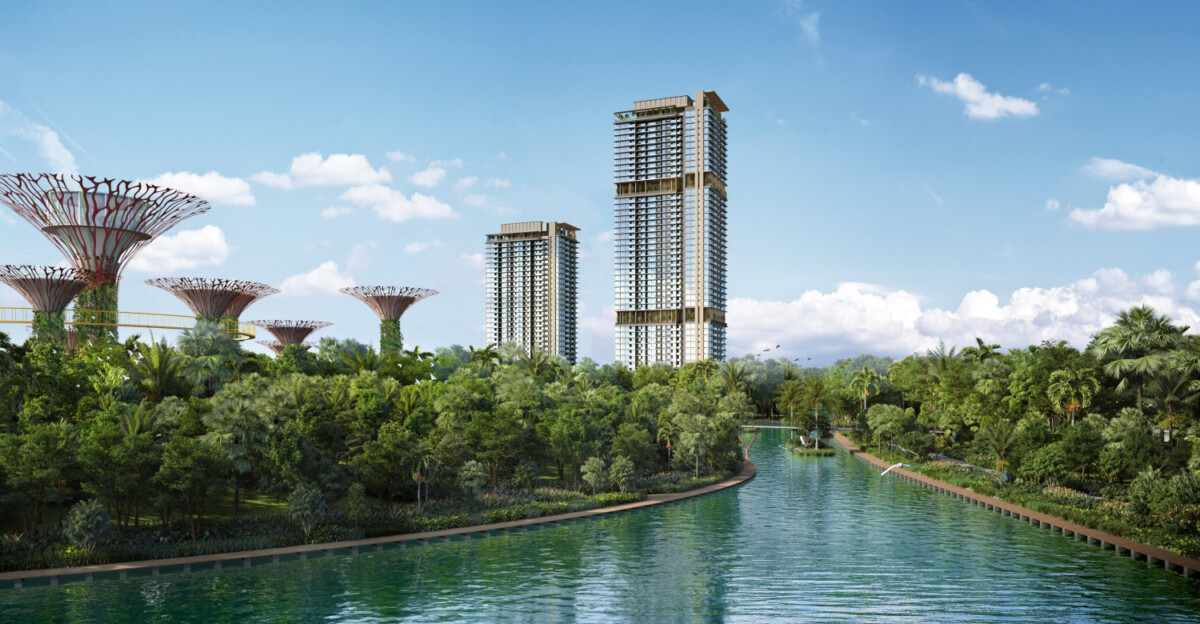
There is another plot of land slated for development right next to One Marina Gardens. This would block, perhaps partially, the sea view of units facing the sea. However, it is likely that there will be many new developments in the area so having an unblocked view would not be a permanent thing.


One Marina Gardens


Pricing 4/5

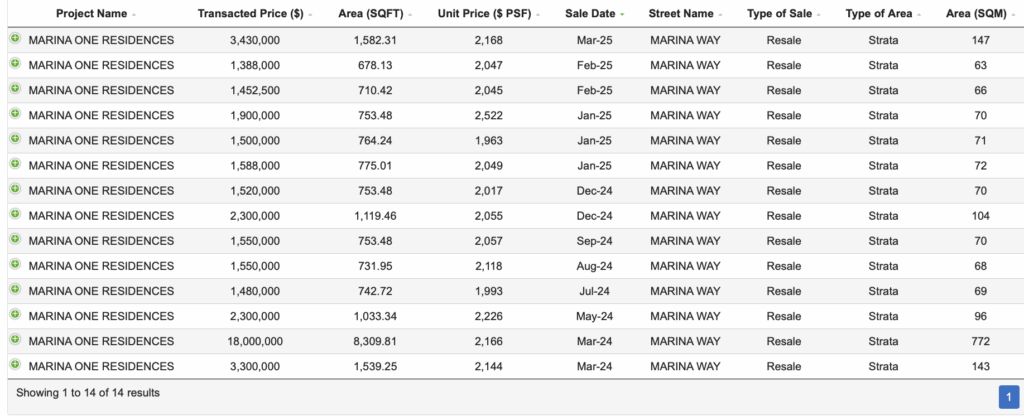
Prices start from $1.15 million or about SGD$2,762 psf. Yes you can get a Marina One Residences unit for $1,993 psf but then for some reason there is also an outlier that transacted at $2,522 psf. The average psf for transactions within the last 1 year is $2,112. Assuming an average price of about $2,900 psf, One Marina Gardens is going for a 37% premium over Marina One Residences. Of course you are getting a new lease and this is in an area with a lot of new developments. Hence you will need to factor this into the premium that you are paying.

Marina One Residences Past Transactions


Location 4.5/5

I believe this area is going to be filled with amenities as private developments as well as HDB developments start to fill the area. One Marina Gardens is the closest you can get to the Marina South MRT Station. The thing about the URA is that once it has announced developments in the area, it is most certainly going to happen. I believe in time to come this area is going to develop into an extremely desirable area.


If there were no ABSD on purchases beyond a Singaporean’s first property, I would seriously consider a property like One Marina Gardens.


Yours sincerely,

Daryl Lum


My other recent Singapore property reviews:

My review of Aurea by Far East Organization and Perennial Holdings

My review of Parktown Residence by CapitaLand, UOL and Singapore Land


Translate »