Singapore HDB Plus & Prime Classification Guide 2026: Standard, Plus and Prime Explained
Quick Answer: HDB Plus & Prime Classification 2026
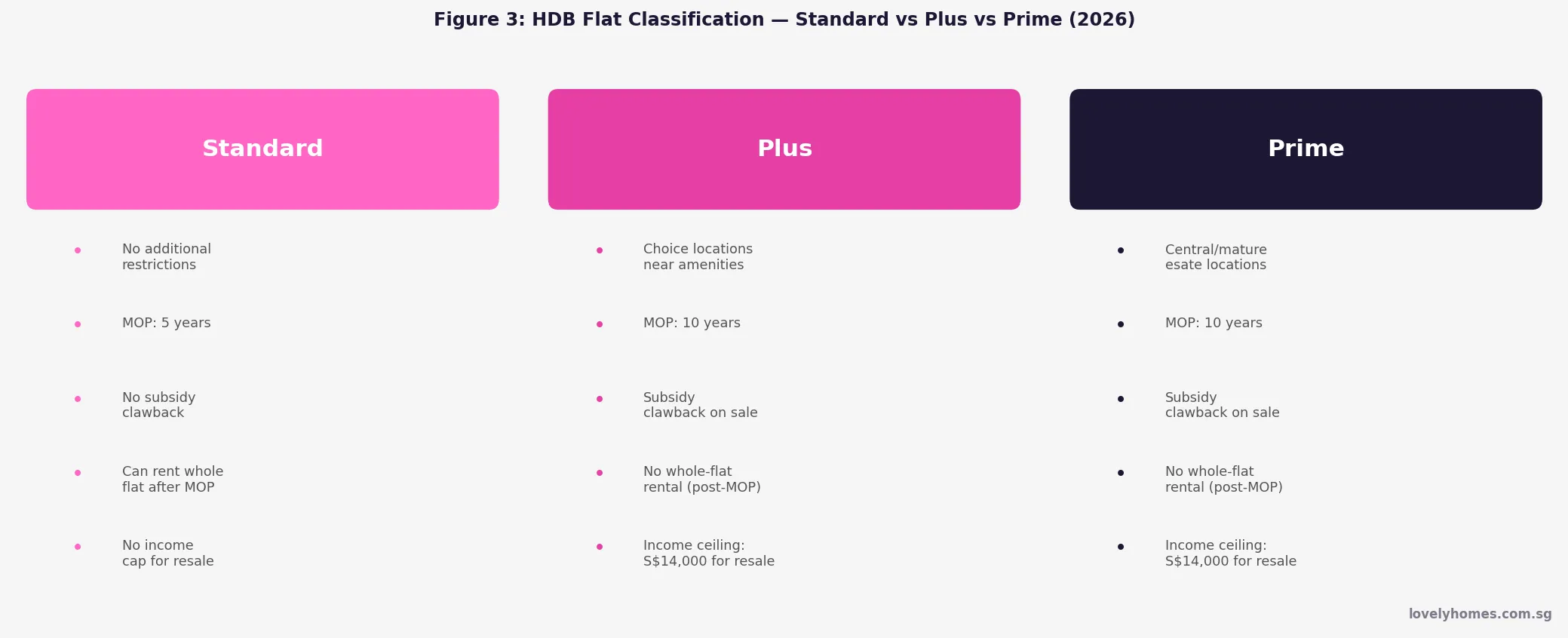
- Three tiers: Standard, Plus and Prime — introduced from 22 October 2024 for new BTO flats and applicable resale transactions.
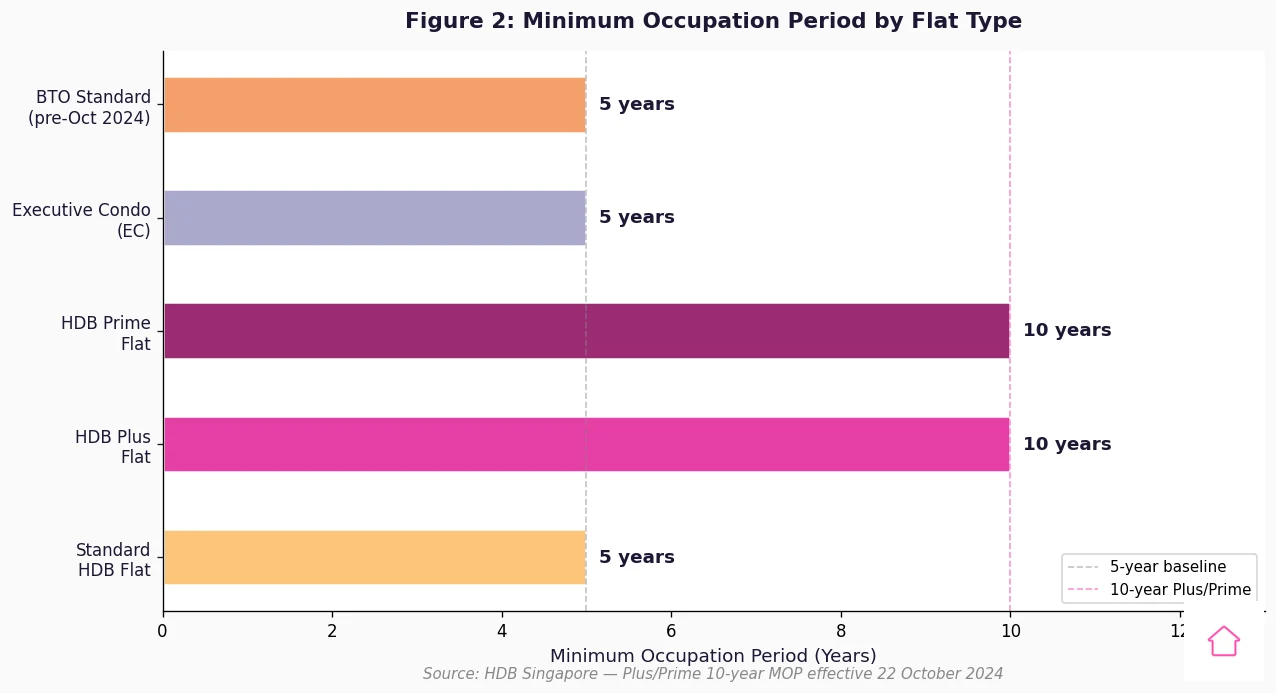
- Minimum Occupation Period: Standard = 5 years; Plus and Prime = 10 years.
- Resale restriction: Plus and Prime flats can only be sold to eligible buyers with household income at or below S$14,000 per month.
- Rental restriction: Plus and Prime flat owners cannot rent out the entire flat — individual rooms may be rented after MOP.
- Subsidy clawback: Plus flats attract a 6%–9% clawback on resale; Prime flats attract a 9% clawback payable to HDB on resale.
- Higher grants: Plus and Prime buyers receive higher CPF Housing Grants to compensate for additional restrictions.
- Geographic logic: Standard = general HDB estates; Plus = near MRT interchanges or well-connected nodes; Prime = central locations and mature estates.
- Purpose: The tiered framework aims to keep public housing affordable across all income brackets while reducing speculative premiums on well-located HDB flats.
I. What Is the HDB Plus & Prime Classification System?
Singapore’s Housing & Development Board administers the world’s most successful public housing programme, housing over 80% of Singapore’s resident population. As land constraints intensify and well-located BTO sites grow scarcer, the HDB introduced a landmark policy overhaul in 2024: the Standard, Plus and Prime classification framework.
Announced by Minister for National Development Desmond Lee on 20 September 2023 and implemented from the October 2024 BTO exercise, the framework assigns every new BTO flat to one of three tiers based on the flat’s location, accessibility and proximity to amenities. The tier determines the buyer’s obligations for occupation, rental and resale, with more centrally located flats carrying longer hold periods and stricter resale conditions.
The policy addresses a longstanding tension in Singapore’s public housing market: flats in prime or centrally located estates command substantial resale premiums, allowing early buyers to profit considerably from a heavily subsidised asset. The Plus and Prime tiers reduce this premium by doubling the MOP to 10 years, imposing an income ceiling on future buyers, and levying a clawback on resale — ensuring that a portion of the capital gain flows back to the public purse rather than accruing entirely to the flat owner.
II. Standard Flats — The Baseline Tier
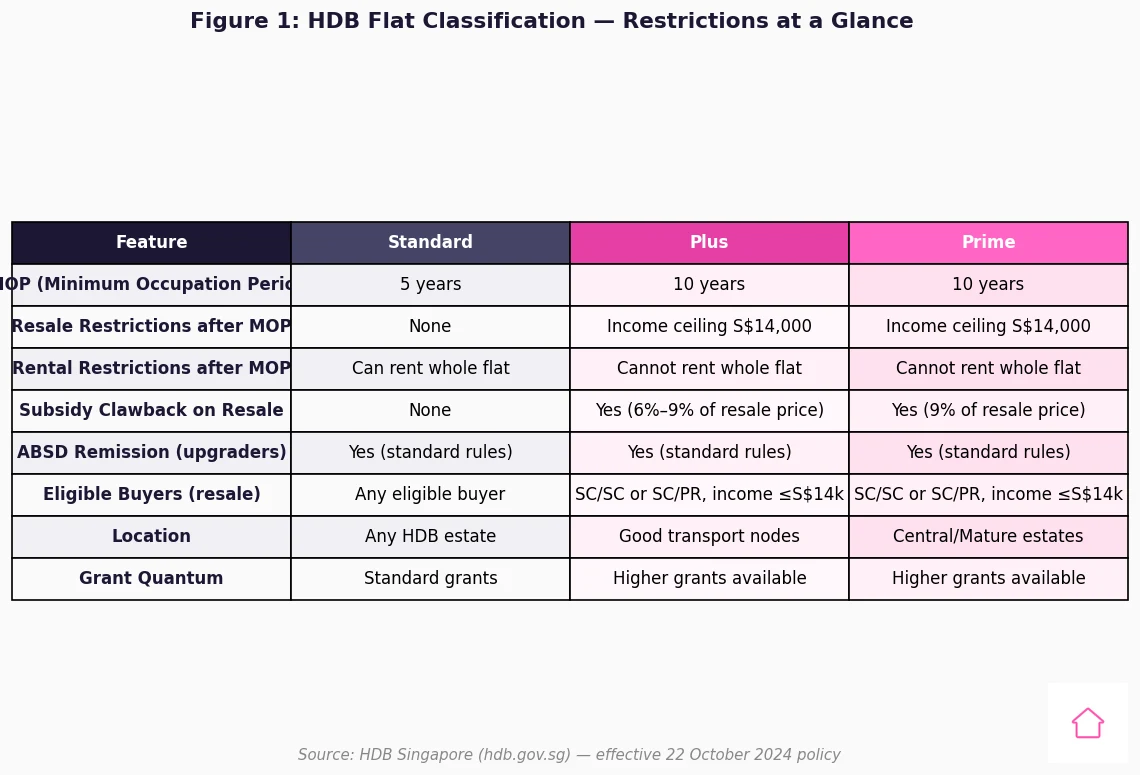
Standard flats are the broadest category and follow the rules most Singaporeans are familiar with. They carry the original five-year Minimum Occupation Period: you must live in the flat as your principal place of residence for at least five continuous years before you are permitted to sell on the open resale market. There are no restrictions on the income of the buyer at the point of resale — any eligible HDB buyer may purchase a Standard flat on the resale market.
Standard flats also permit whole-flat rental once the MOP is satisfied, meaning an owner who has met the five-year occupation requirement may apply to HDB to rent out the entire flat. This flexibility is not available to Plus or Prime flat owners. No subsidy clawback applies on the resale of a Standard flat. Standard flats are located across all HDB estates but generally occupy sites that do not command a premium for centrality or transport connectivity — typically outer estates such as Woodlands, Sembawang, Sengkang and Punggol, though Standard flats also exist within mature towns where they are not classified Plus or Prime.
III. Plus Flats — Enhanced Restrictions for Well-Connected Sites
Plus flats occupy an intermediate tier. They are situated near MRT interchanges, town centres or nodes with above-average connectivity and amenities, but not in the premium core central location that defines Prime. The October 2024 BTO exercise introduced Plus flats in towns such as Kallang/Whampoa, Queenstown and specific sites in mature estates with outstanding transport access.
Buyers of Plus flats must satisfy a 10-year Minimum Occupation Period before selling on the resale market. After this period, Plus flat sellers can only transact with buyers who meet standard HDB eligibility requirements and whose household income does not exceed S$14,000 per month. Plus flat owners may rent out individual bedrooms but cannot rent out the whole flat — a restriction that applies permanently even after the MOP is satisfied.
Upon resale, a subsidy clawback ranging from approximately 6% to 9% of the transacted resale price is payable to HDB. The exact clawback rate depends on the original purchase price and the subsidy quantum embedded in that price — HDB will compute the clawback amount at the point of each resale transaction. To compensate, Plus flat buyers receive higher CPF Housing Grants than comparable Standard flat buyers, calibrated upward to reflect the longer holding obligation and reduced liquidity.
IV. Prime Flats — Maximum Restrictions for Central and Mature Estate Sites
Prime flats are the most tightly restricted tier. They occupy the most desirable HDB locations: centrally situated estates, highly connected sites near the CBD, or areas historically commanding the highest HDB resale premiums. Toa Payoh, Queenstown, Kallang, Bishan and certain city-fringe locations have been designated Prime. As the programme matures, HDB expects to designate additional BTO sites as Prime where they meet the locational criteria.
Prime flat buyers face a 10-year MOP — the same as Plus. After satisfying the MOP, sellers may only transact with buyers whose household income is at or below S$14,000 per month. The whole-flat rental ban also applies permanently. The subsidy clawback on Prime flats is set at 9% of the resale price — somewhat higher than Plus flats — to account for the greater capital gain potential in central locations. Prime flat buyers receive the highest CPF Housing Grant quantum in the entire HDB framework to make central-location ownership accessible to qualifying households.
V. Eligibility and Grant Mechanics
The income ceiling for purchasing a new BTO flat — regardless of tier — remains S$14,000 per month for families and S$7,000 for singles applying under the Single Singapore Citizen scheme. The income ceiling relevant to Plus and Prime resale transactions is also S$14,000, meaning buyers whose household income exceeds this threshold are ineligible to purchase a Plus or Prime flat on the resale market even after the MOP.
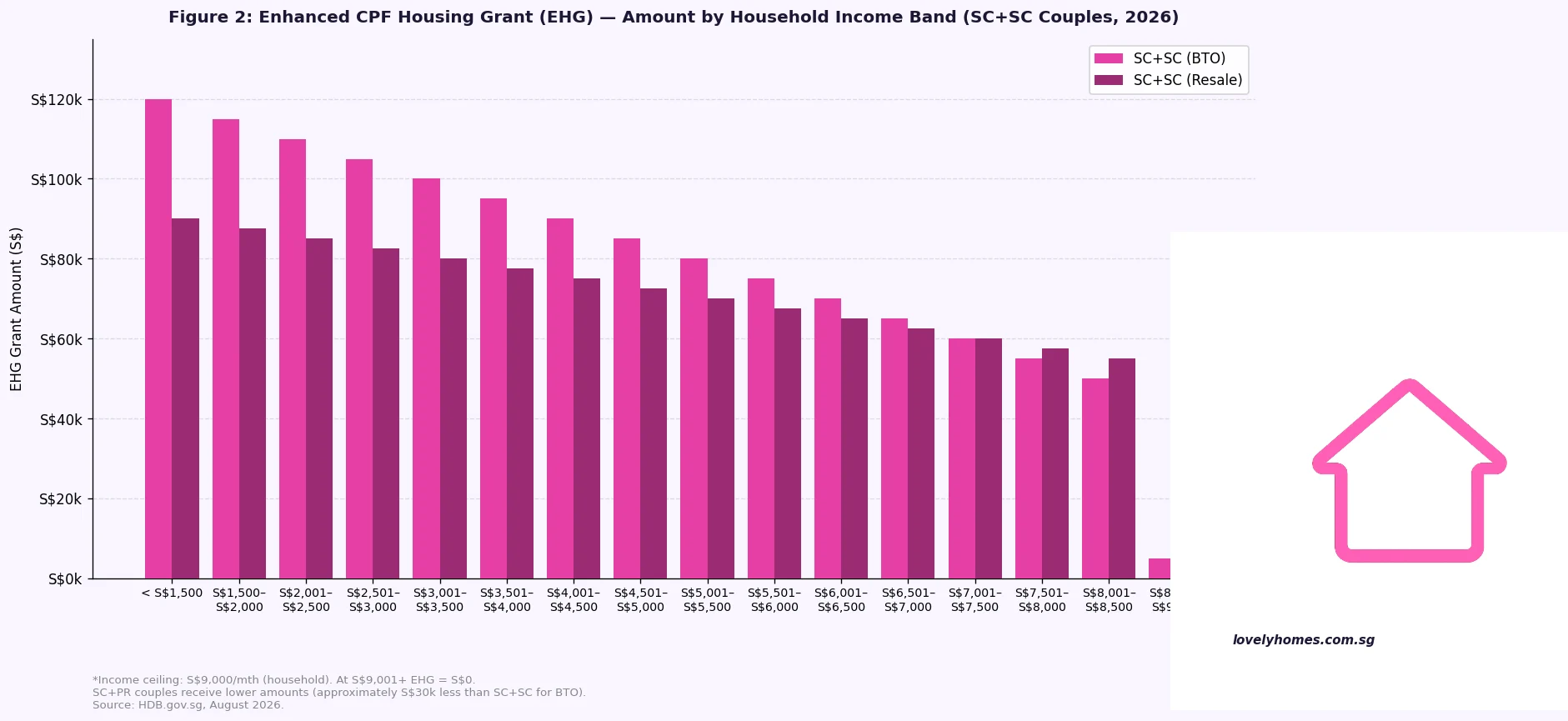
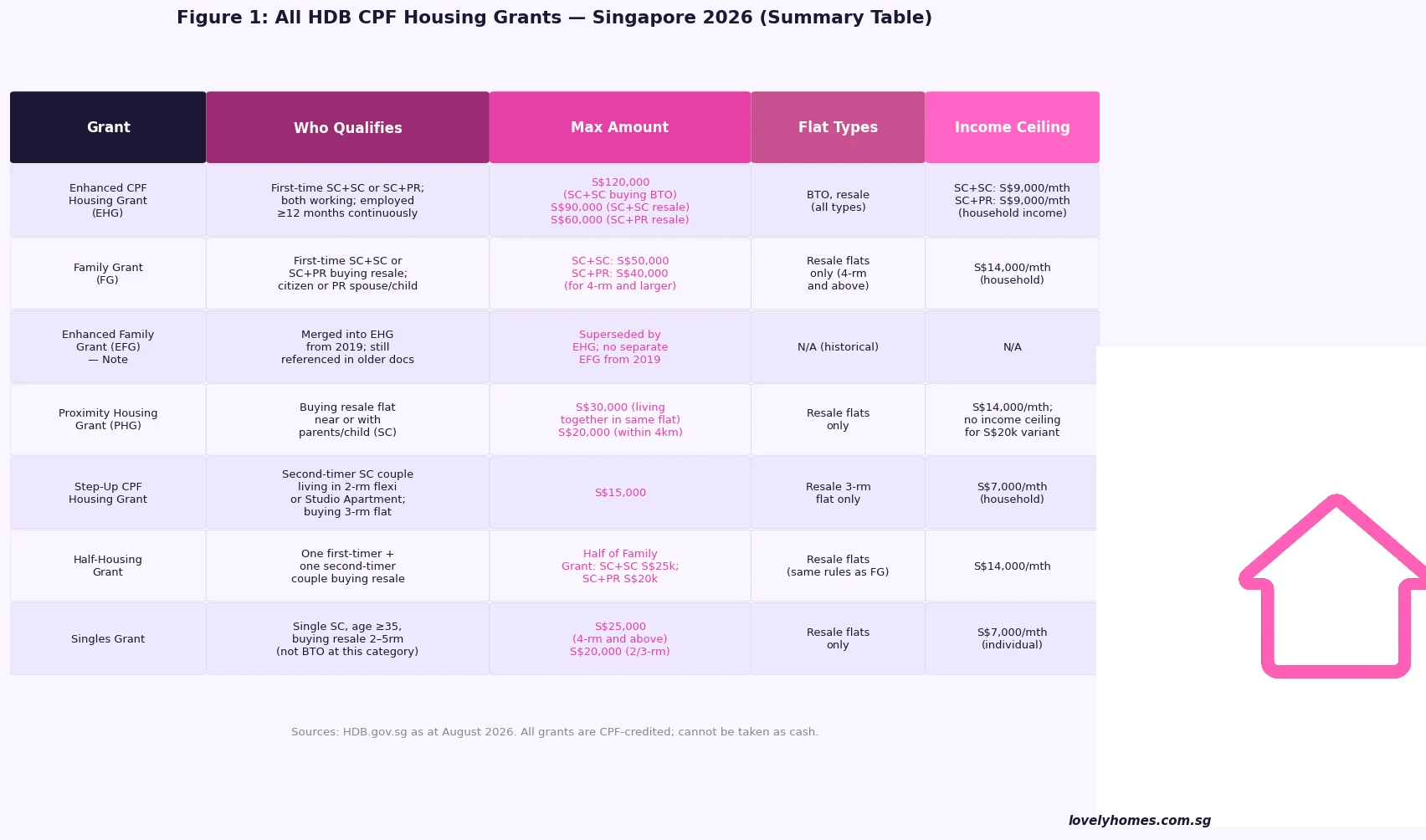
Grant eligibility follows the standard HDB framework. The Enhanced CPF Housing Grant (EHG) of up to S$120,000 for new BTO (income at or below S$9,000 per month), the Family Grant of up to S$50,000 for resale, and the Proximity Housing Grant (PHG) of up to S$30,000 for buyers living near parents or children all remain available. For Plus and Prime flats, the EHG quantum is calibrated to be higher than for equivalent Standard flats, reflecting the longer MOP obligation. Buyers should confirm the exact grant quantum with HDB at the application stage, as amounts are reviewed each BTO exercise.
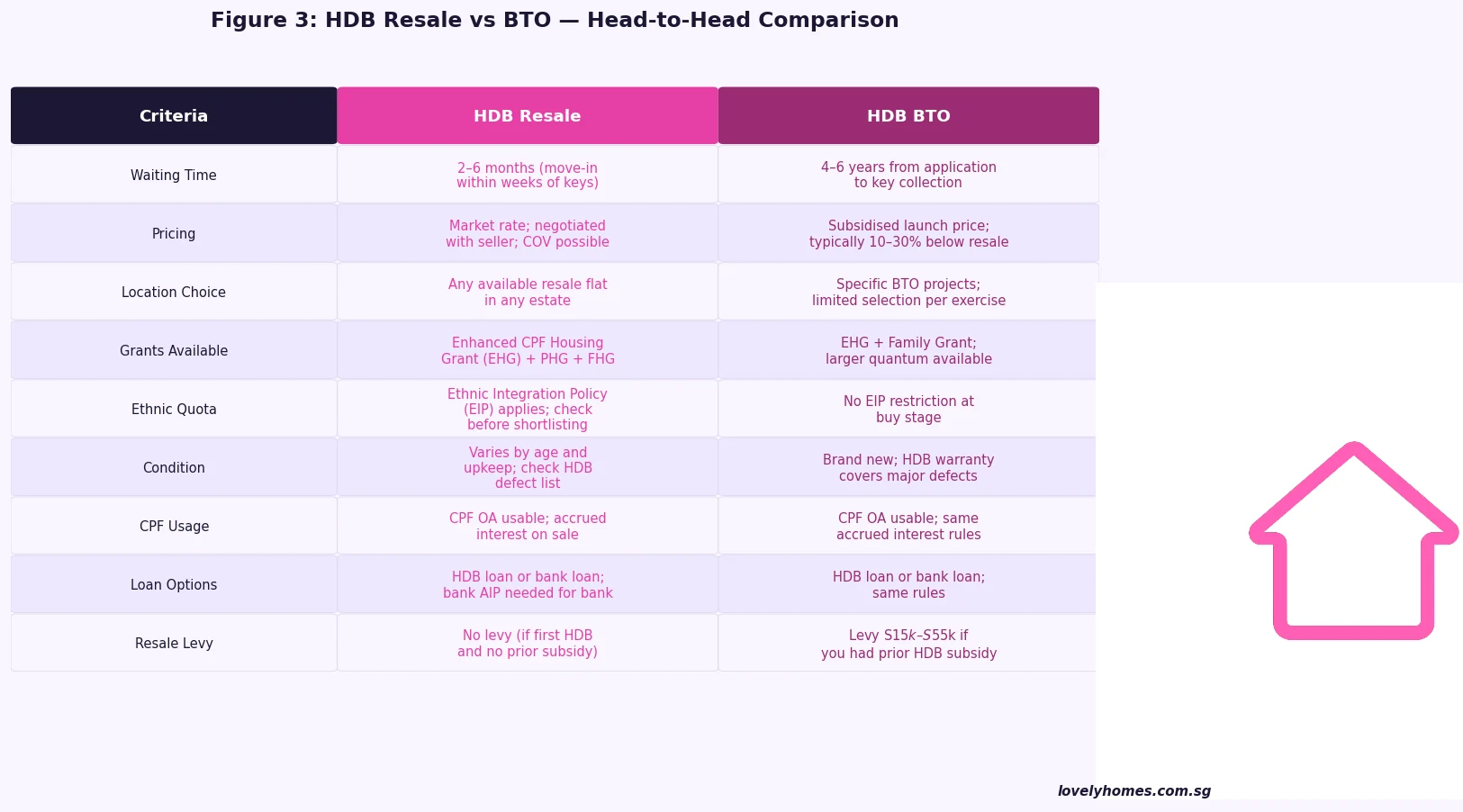
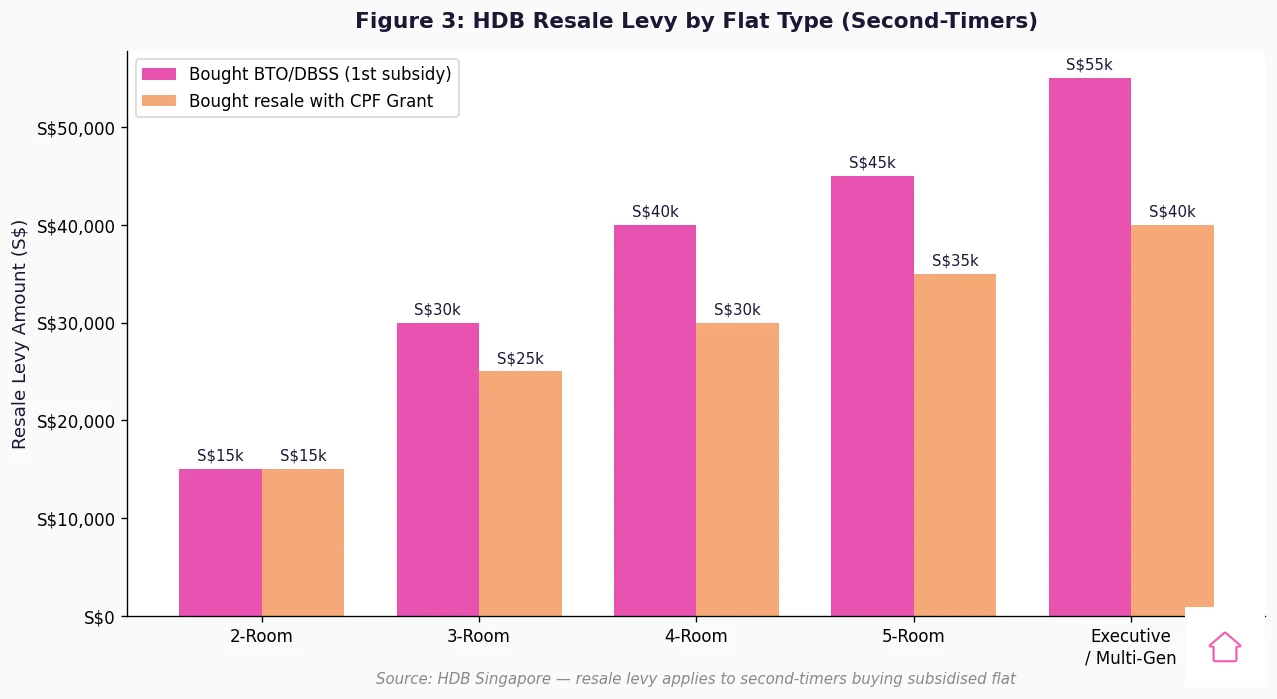
The resale levy — applicable to second-timer buyers purchasing a new subsidised flat after having already enjoyed one housing subsidy — remains unchanged by the Plus/Prime framework. A second-timer buying a Plus BTO flat still pays the standard resale levy based on the flat type of their previous subsidised flat, ranging from S$15,000 for a 2-room up to S$55,000 for an Executive flat.
VI. Summary Comparison Table
| Feature | Standard | Plus | Prime |
|---|---|---|---|
| MOP | 5 years | 10 years | 10 years |
| Resale income ceiling | None | S$14,000/mth | S$14,000/mth |
| Whole-flat rental (post-MOP) | Permitted with HDB approval | Not permitted | Not permitted |
| Room rental (post-MOP) | Permitted | Permitted (owner must occupy) | Permitted (owner must occupy) |
| Subsidy clawback on resale | None | ~6%–9% of resale price | 9% of resale price |
| CPF Housing Grants | Standard quantum | Higher quantum | Highest quantum |
| Typical locations | Outer and general HDB estates | Near MRT interchanges, town centres | Central locations, mature estates |
| Introduced | Legacy (all pre-Oct 2024 BTO) | October 2024 BTO exercise | October 2024 BTO exercise |
VII. Worked Example — The Plus Flat Buyer in Queenstown
Mr & Mrs Chen are a Singapore Citizen couple, combined household income S$9,500 per month, applying for a Plus 4-room BTO flat in Queenstown in the February 2025 BTO exercise. Indicative flat price: S$620,000 (after government subsidy).
Grants received: EHG S$40,000 (income S$9,500, qualifying for mid-tier EHG for Plus flat) + Family Grant S$50,000 (SC+SC, 4-room equivalent) = S$90,000 total grants. Effective price paid after grants: S$530,000.
Financing: HDB concessionary loan at 2.6% per annum (LTV 80%). Loan amount: S$424,000. Monthly instalment on a 25-year loan: approximately S$1,924. MSR on S$9,500 household income = 20.3% — well within the 30% Mortgage Servicing Ratio cap.
BSD payable: 1% on first S$180,000 = S$1,800; 2% on next S$180,000 = S$3,600; 3% on next S$260,000 = S$7,800. Total BSD: S$13,200 (payable in cash or CPF).
At resale (10 years later, estimated): Assuming a resale price of S$850,000, the subsidy clawback is approximately 7.5% = S$63,750 payable to HDB at completion. The Chens also repay CPF principal + 2.5% accrued interest into their CPF Ordinary Account. Net cash in hand depends on outstanding loan balance and total CPF accrued interest at that date.
Key risk to note: The income ceiling of S$14,000 at resale restricts the buyer pool. Buyers planning to sell exactly at year 10 should factor in buyer pool depth and income distribution in Queenstown at that future point when planning their finances.
VIII. Why the Plus/Prime System Exists — Policy Context
Before October 2024, Singapore’s HDB resale market had seen growing divergence between price appreciation of well-located flats and those in outer estates. Mature-estate and central-location flats — particularly in Queenstown, Toa Payoh and Kallang/Whampoa — regularly transacted at S$1 million or more, with some 5-room flats approaching S$1.5 million. This created a perception that public housing in desirable locations had become a speculative vehicle rather than a housing utility, undermining one of HDB’s founding principles: that public housing should be affordable and accessible.
The Plus/Prime framework attacks this problem from two directions. First, the 10-year MOP discourages speculative flipping: a buyer must commit to a decade of owner-occupation. Second, the subsidy clawback ensures that a portion of the state subsidy embedded in the initial purchase price is returned to HDB when the flat is sold, recycling capital for future public housing programmes.
IX. What Might Come Next
As at August 2026, HDB has indicated that the Plus/Prime framework will continue to expand. Future BTO exercises will designate additional sites as Plus or Prime where the locational criteria are met. Analysts expect that as the Bayshore Drive and Greater Southern Waterfront sites mature, some of the new HDB developments in those areas may attract Prime designation given their coastal frontage and proximity to the city.
There has been industry discussion — as yet unconfirmed by HDB — about whether the framework might eventually be applied to resale transactions in designated Prime locations: specifically, whether resale buyers of pre-October 2024 legacy flats in Prime estates might face income ceiling restrictions. As at the date of publication, these restrictions apply only to new BTO flats purchased under the Plus/Prime classification and to future resale of those specific flats. Buyers purchasing legacy resale flats in Queenstown or Toa Payoh are not subject to any income ceiling or clawback.
X. Frequently Asked Questions
Can I sell a Plus or Prime flat to a buyer whose income exceeds S$14,000?
No. The income ceiling of S$14,000 per month applies strictly to the purchasing household’s combined income at the time of the resale transaction. If you attempt to transact with a buyer whose income exceeds S$14,000, HDB will not approve the resale application. This restriction narrows the buyer pool relative to Standard flats, which have no income ceiling at resale. Buyers planning to sell their Plus or Prime flat after the 10-year MOP should price this liquidity discount into their financial planning from the outset.
When does the 10-year MOP start — from key collection or from application?
The MOP is measured from the date of key collection (the date you receive the keys to the flat and it is registered in your name), not from the date of ballot success or application. For BTO flats, key collection typically occurs three to five years after the ballot date, given construction lead times. So if you collect keys in January 2026, your 10-year MOP expires in January 2036.
Can I convert a Plus flat to a Standard flat to avoid the restrictions?
No. The classification is permanently attached to the flat at the point of designation. There is no mechanism to reclassify a Plus or Prime flat as Standard once it has been built and allocated. This is deliberate: the restrictions must follow the flat, not the owner, to ensure that future resale buyers are also bound by the same conditions.
What happens to the subsidy clawback if I sell my Plus flat at a loss?
HDB computes the clawback as a percentage of the actual transacted resale price, not the original purchase price or the market value. If you sell at a price lower than your original purchase price, the clawback percentage still applies on the actual sale price. HDB has indicated that the clawback is waived only in exceptional circumstances, such as compulsory acquisition by HDB. In practice, most Plus/Prime flat sellers in central locations are unlikely to transact at a loss given the subsidy embedded in the initial purchase.
Does the Plus/Prime framework affect Executive Condominiums (ECs)?
No. ECs are a distinct housing type governed by the Housing Developers (Control and Licensing) Act, not the HDB Act. They are developed and sold by private developers on 99-year leasehold land sold by HDB. ECs carry a separate five-year MOP before the unit can be sold on the open market; after ten years, the EC is fully privatised. The Plus/Prime HDB framework does not affect EC restrictions.
Can Plus and Prime flat owners sublet rooms while still within the MOP?
No. During the MOP, Plus and Prime flat owners may not sublet any part of the flat — neither the whole unit nor individual rooms. The HDB’s subletting rules require the MOP to be satisfied before any subletting application can be submitted. After the 10-year MOP, room rental is permitted provided the flat owner continues to occupy the flat as their principal place of residence and holds a valid subletting permit from HDB. Whole-flat rental remains permanently prohibited for Plus and Prime flats.
I am a permanent resident buying a Plus flat with my SC spouse — are we subject to the restrictions?
Yes. The Plus and Prime restrictions apply to the flat itself, not solely to the citizen owner. An SC/PR couple purchasing a Plus BTO flat will be bound by the 10-year MOP, the income ceiling at resale, the whole-flat rental ban, and the subsidy clawback in exactly the same way as an SC/SC household. The restrictions follow the flat through its entire life on the market.
Disclaimer: This article is intended as general information and educational reference only. It does not constitute legal, financial or housing advice. HDB policies, grant amounts, income ceilings, clawback rates and classification criteria may change. Always verify current requirements directly with the Housing & Development Board at hdb.gov.sg before making any housing decision. Consult a licensed financial adviser or property professional for advice specific to your circumstances.