
Singapore Conveyancing Fees Guide 2026: What Every Buyer and Seller Needs to Know

Singapore Conveyancing Fees Guide 2026: What Every Buyer and Seller Needs to Know

⚡ Quick Answer: Singapore Conveyancing Fees at a Glance

  • What are conveyancing fees? Legal fees charged by a solicitor to handle the transfer of property ownership — mandatory for every Singapore property transaction.
  • Who sets them? The Law Society of Singapore prescribes minimum fee scales under the Solicitors’ Remuneration Order (SRO); fees are non-negotiable below these floors.
  • HDB resale: Buyer’s lawyer fees typically S$1,500–S$2,500; seller’s lawyer S$1,200–S$2,000 (excluding disbursements and 9% GST).
  • Private property (S$1.5M condo): Buyer’s lawyer ~S$6,400; seller’s lawyer ~S$4,500; mortgage lawyer S$2,000–S$3,500 (bank’s panel).
  • Disbursements (title searches, caveats, SLA registration) add approximately S$500–S$1,500 per transaction.
  • GST: 9% applies to all professional fees and most disbursements as of 1 January 2024.
  • Timeline: Typical private property conveyancing takes 8–12 weeks from Option to Purchase to legal completion.
  • Key tip: Always engage your own independent solicitor — never use the seller’s or developer’s lawyer exclusively, as there is an inherent conflict of interest.

Conveyancing is the legal process by which ownership of a property is transferred from seller to buyer. In Singapore, it is governed by the Conveyancing and Law of Property Act (Cap. 61), overseen by the Singapore Land Authority (SLA) and the Law Society of Singapore. Whether you are buying an HDB flat, a condominium, or a landed property, engaging a conveyancing solicitor is not optional — it is a statutory requirement for the transaction to be registered at the SLA.

Yet despite its mandatory nature, conveyancing fees remain poorly understood by most buyers and sellers. This guide explains the full fee structure, what each component pays for, how to estimate your total legal costs, and the common pitfalls that end up costing buyers thousands more than expected.
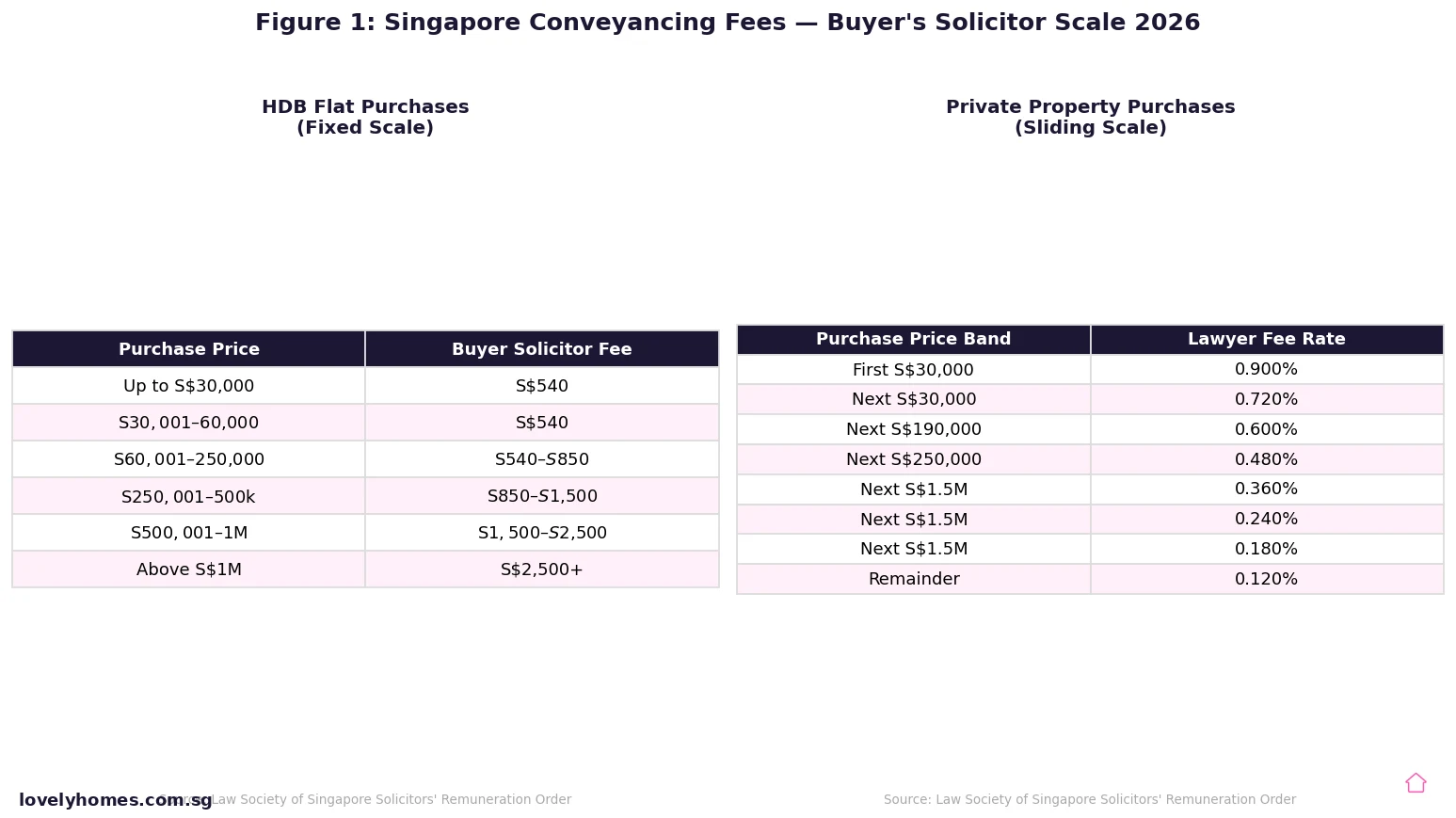
Singapore conveyancing fees 2026 — buyer's solicitor fee scale for HDB and private property transactions
Figure 1: Buyer’s Solicitor Fee Scale 2026 — HDB flats (fixed scale) vs Private Property (Law Society sliding scale). Source: Law Society of Singapore, Solicitors’ Remuneration Order.

What Is Conveyancing and Why Is It Compulsory?

Conveyancing encompasses the full suite of legal work required to transfer a property: verifying the seller’s title, conducting property searches, preparing the sale and purchase agreement, registering the transfer with the Singapore Land Authority, and arranging the discharge of any existing mortgages. Because Singapore uses the Torrens title system — where the SLA register is the definitive record of ownership — all transactions must pass through the legal system to be valid.

In practice, this means every buyer must appoint a conveyancing solicitor, and so must every seller. For HDB resale transactions, the process is facilitated through HDB’s resale portal and the Singapore Academy of Law (SAL) e-conveyancing system, but a solicitor is still required to advise both parties. For private property transactions, the parties’ solicitors handle everything from the Option to Purchase through to legal completion.

Who Administers Conveyancing Fees?

The Law Society of Singapore prescribes minimum fee scales for legal work under the Solicitors’ Remuneration Order (SRO). These are statutory minimums — solicitors may charge more, but they cannot charge less. In practice, most established conveyancing firms charge within a narrow band above the minimum scale. The SRO applies to private property transactions; for HDB transactions, HDB-approved solicitors follow a schedule set in consultation with HDB.

For mortgage-related conveyancing (preparing the mortgage instrument and lodging the CPF charge), there is a separate mortgage conveyancing scale — again a non-negotiable statutory minimum.

Types of Conveyancing Fees You Will Pay

A Singapore property transaction typically involves four distinct streams of legal fees. Understanding each one prevents budget surprises at completion.

1. Buyer’s Solicitor Fees

These cover the buyer’s lawyer reviewing and approving the Option to Purchase, advising on legal issues (encumbrances, planning restrictions, strata title requirements), conducting property searches, and lodging a caveat to protect the buyer’s interest. For HDB resale transactions, buyer’s lawyer fees typically range from S$1,500 to S$2,500. For private property, the Law Society sliding scale applies (see Figure 1 above).

2. Seller’s Solicitor Fees

The seller’s lawyer prepares the sale documents, investigates any outstanding mortgages, discharges the mortgage with the seller’s bank, and manages the transfer of the sale proceeds. Seller’s lawyer fees are slightly lower than buyer’s fees — typically 60–80% of the buyer’s scale — because the scope of work is narrower (no title search from scratch, no caveat lodging).

3. Mortgage Conveyancing Fees

When you take a bank loan, there are two sets of mortgage legal fees. The mortgagor’s solicitor (your lawyer) prepares and reviews the mortgage documents on your behalf. The mortgagee’s solicitor (the bank’s panel lawyer) acts for the lender; you, as the borrower, typically bear this cost. For private property, the combined mortgage conveyancing fees add S$2,000–S$4,000 depending on the loan quantum.

Many banks offer to absorb or subsidise legal fees as part of their home loan package — particularly for refinancing. This subsidy typically covers the mortgagee’s legal fees only, not your own conveyancing costs.

4. CPF Charge Fees

If you use CPF funds to purchase property, the CPF Board requires a CPF charge to be registered against the property. The fee for lodging this charge (prepared by your solicitor and submitted to CPF Board and SLA) is approximately S$228–S$428 depending on the property type and number of CPF members involved.
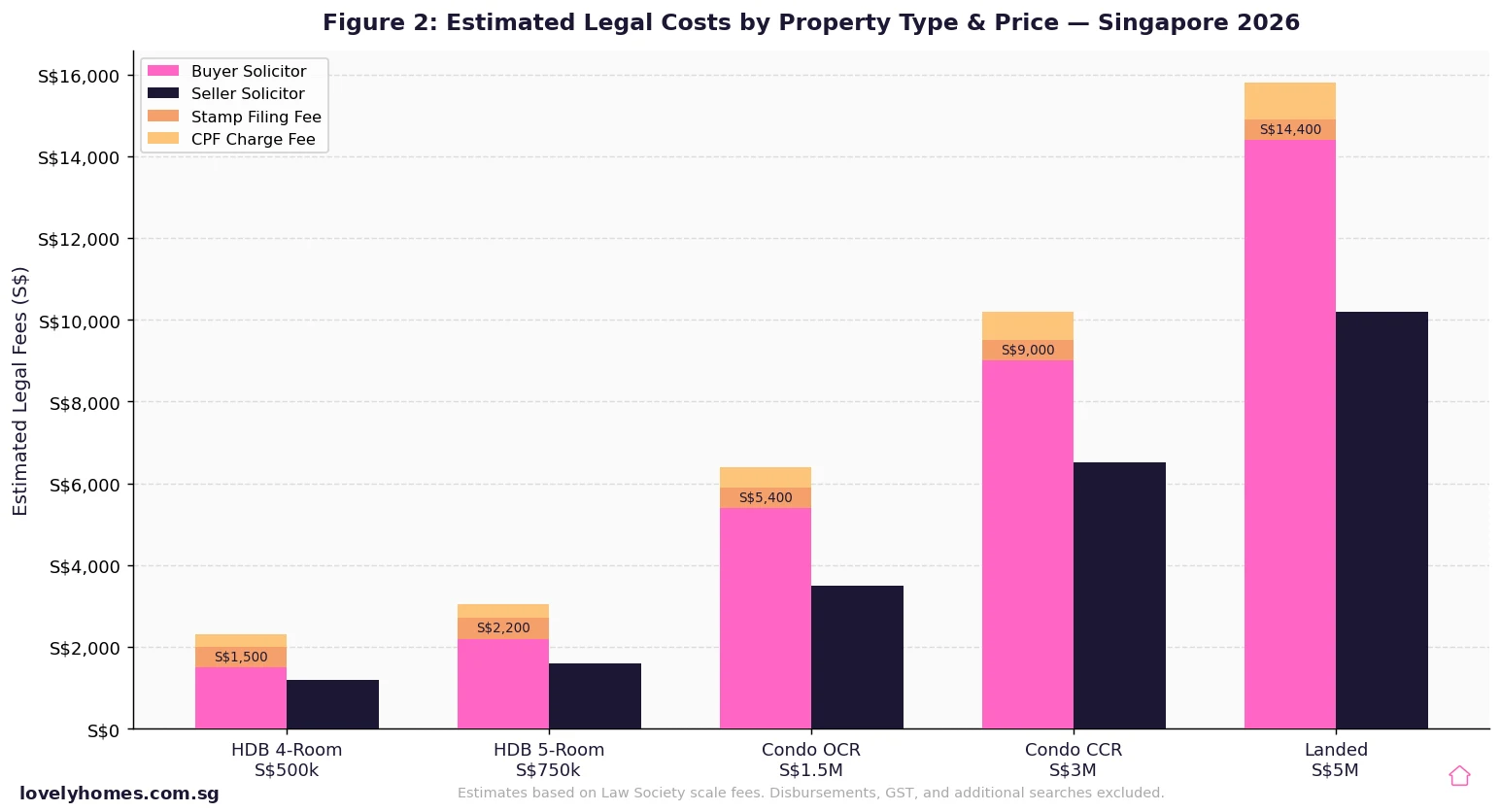
Singapore legal costs breakdown by property type 2026 — HDB resale vs private condo vs landed
Figure 2: Estimated Total Legal Costs by Property Type — Singapore 2026 (buyer’s fees, seller’s fees, stamp filing and CPF charge). Figures are illustrative averages; actual costs depend on firm, complexity and disbursements.

Disbursements: The Hidden Add-Ons

On top of professional fees, your solicitor will pass through a range of disbursements — third-party costs incurred on your behalf. These are not the lawyer’s income; they are payments to government agencies and third-party search providers. Common disbursements include:

Disbursement Item Approx. Cost (S$) Paid To
Caveat lodging fee S$64.45 per caveat Singapore Land Authority
Title search fee S$75–S$150 SLA / approved search providers
Land register inspection S$25–S$60 Singapore Land Authority
Property tax search S$10–S$25 IRAS
Bankruptcy search (per person) S$6–S$10 Insolvency Office
CPF charge registration S$228–S$428 CPF Board / SLA
Stamp duty filing S$10–S$50 IRAS (via e-Stamping)
Photocopying & postage S$50–S$150 Law firm

Total disbursements for a straightforward purchase typically run S$500–S$1,200. Complex transactions — those involving multiple caveats, joint buyers across different nationalities, or CPF from multiple members — can push disbursements past S$1,500.

The Law Society Sliding Scale Explained

For private property, the buyer’s solicitor’s professional fees follow the Solicitors’ Remuneration Order scale. The scale is tiered: a higher percentage applies to the first tranche, declining as the purchase price increases. As of 2026, the scale for purchase conveyancing is:

Purchase Price Band Rate Fee on Band
First S$30,000 0.900% S$270 (min S$540 across first two bands)
Next S$30,000 0.720% S$216
Next S$190,000 (up to S$250k) 0.600% S$1,140
Next S$250,000 (up to S$500k) 0.480% S$1,200
Next S$1,500,000 (up to S$2M) 0.360% Up to S$5,400
Next S$1,500,000 (up to S$3.5M) 0.240% Up to S$3,600
Next S$1,500,000 (up to S$5M) 0.180% Up to S$2,700
Remainder (above S$5M) 0.120% Variable

A minimum fee of S$1,080 applies to all purchase transactions regardless of scale. Firms may add a complexity premium for particularly involved transactions (e.g., foreign buyers, multi-party agreements, urgent transactions).
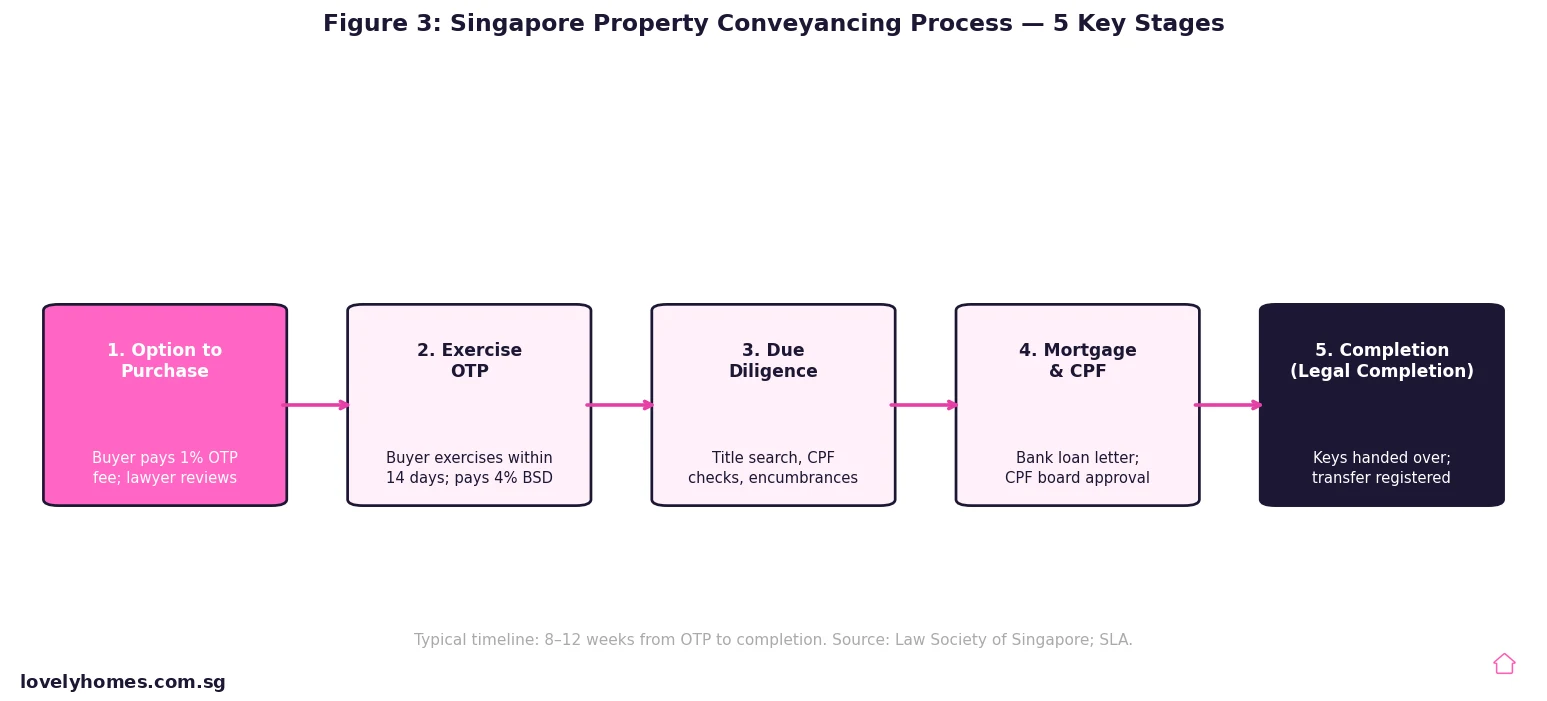
Singapore property conveyancing process flow 2026 — 5 stages from OTP to legal completion
Figure 3: Singapore Conveyancing Process — The 5 Stages from Option to Purchase to Legal Completion. Typical timeline: 8–12 weeks for private property; 8–10 weeks for HDB resale.

HDB vs Private Property: Key Differences

The conveyancing process differs meaningfully between HDB and private property transactions. For HDB resale flats, both buyer and seller must engage HDB-approved solicitors, and the process is administered through HDB’s Resale Portal and the Singapore Academy of Law’s e-conveyancing platform. HDB conveyancing fees are lower than private property fees and are fixed by HDB within a prescribed schedule. Importantly, HDB levies no agent commission cap but does require all legal work to be conducted by approved solicitors on its panel.

For private property — condominiums, executive condominiums sold in the secondary market, and landed property — the buyer and seller appoint solicitors from the wider pool of Singapore-practising firms. The Law Society scale governs fees. Timelines are slightly longer because the due diligence is more extensive, including strata title verification, Management Corporation Strata Title (MCST) checks, and developer clearance for new launches.

Worked Example: Conveyancing Costs for a S$1.5M Condominium

🏢 Case Study — SC Buyer Purchases a S$1.5M OCR Condo (31 July 2026)

Buyer profile: Singapore Citizen (SC), first property, no ABSD payable. Bank loan of S$1.05M (70% LTV). CPF OA balance used: S$300,000.

Buyer’s solicitor fees (Law Society scale):

  • First S$30,000 @ 0.900% = S$270
  • Next S$30,000 @ 0.720% = S$216
  • Next S$190,000 @ 0.600% = S$1,140
  • Next S$250,000 @ 0.480% = S$1,200
  • Next S$1,000,000 @ 0.360% = S$3,600
  • Subtotal (professional fees): S$6,426

Disbursements (est.): caveat S$64.45 + title search S$120 + CPF charge S$328 + searches S$100 = S$612

Mortgage conveyancing (buyer’s lawyer acting for mortgagor): S$1,400 (professional) + S$150 (disbursements)

Bank’s lawyer (mortgagee’s legal costs, borne by borrower): S$2,200

9% GST on all professional fees + disbursements: S$924

Total legal and conveyancing costs:S$11,712

Note: Buyer stamp duty (BSD) of S$44,600 on S$1.5M is separate from conveyancing fees — it is a tax paid to IRAS, not a legal fee. See the ABSD Singapore 2026 Complete Guide for a full stamp duty breakdown.

What Does “Good” Conveyancing Cost?

Because the Law Society scale is a statutory floor, the real differentiator between law firms is service quality, responsiveness, and the ability to handle complications. Boutique conveyancing firms often charge within 10–15% above scale and can complete standard transactions faster than large full-service firms. For straightforward HDB resale transactions, HDB-approved conveyancing firms provide very competitive packages. For complex transactions — joint purchases across nationalities, CPF accrued interest waivers, or properties with encumbrances — it is worth paying for a more senior practitioner.

Property buyers should be aware that some developers and banks will recommend their own panel solicitors. While these firms are reputable, it is important to understand that they may be acting for both the developer/bank and for you. Engaging an independent solicitor who acts exclusively for you — even at a marginal extra cost — is strongly advisable for any transaction above S$1M.

What This Means for Singapore Buyers in 2026

As property prices have risen — the URA’s second-quarter 2026 private residential index showed an overall increase of 0.9% QoQ — the absolute cost of conveyancing has risen proportionally, since most fee scales track purchase price. A buyer purchasing at S$3M pays roughly S$10,800 in buyer’s solicitor professional fees alone before disbursements and GST. Budgeting for total legal costs at approximately 0.8–1.0% of the purchase price (for private property) is a reasonable rule of thumb, though it should be treated as a floor, not a ceiling.

What Might Come Next

The Law Society periodically reviews the Solicitors’ Remuneration Order. The last substantive revision was in 2011; legal practitioners and consumer advocates have argued that the minimum scales no longer reflect the complexity of modern real estate transactions, particularly given the proliferation of ABSD, CPF-for-property, and en-bloc considerations. A revision to the SRO in 2026 or 2027 is considered possible, particularly as 9% GST continues to be layered on top of statutory minimums, effectively raising the real cost to buyers without a corresponding increase to lawyers’ net income.

Frequently Asked Questions

Can I negotiate conveyancing fees below the Law Society scale?

No. The Solicitors’ Remuneration Order sets statutory minimums — it is a legal requirement, not a guideline. Solicitors who charge below the prescribed scale risk disciplinary action by the Law Society. You can, however, negotiate for the inclusion of certain disbursements in a fixed package fee, or request that the firm waive small ancillary charges. For competitive quotes, approach two or three HDB-approved or conveyancing-specialist firms and compare their full quotations including all disbursements and GST.

Do I need a lawyer for an HDB resale purchase, or can I DIY?

You must engage a solicitor for an HDB resale transaction. HDB’s Resale Portal requires that both buyer and seller appoint an HDB-approved solicitor to advise on the transaction, complete the legal documentation, and register the transfer with the Singapore Land Authority. There is no self-conveyancing option for HDB resale. For HDB BTO (Build-to-Order) purchases, HDB acts as its own solicitor for the buyer as part of the purchase process, with much-reduced legal fees.

What happens if I use CPF for my property purchase — does it add to legal costs?

Yes. Using CPF OA funds to pay for your property requires a CPF charge (essentially a mortgage in favour of the CPF Board) to be registered against the property. Your solicitor prepares and lodges this charge, which incurs additional professional fees and a disbursement to CPF Board and SLA. The CPF charge registration fee typically adds S$228–S$428 to your disbursements. Additionally, if your CPF accrued interest amount changes the refund calculation at sale, your solicitor may need to obtain a CPF Board statement and possibly an updated charge instrument — again at additional cost.

Who pays the conveyancing fees — buyer, seller, or both?

Both buyer and seller each pay their own solicitor’s fees. These are entirely separate bills. The buyer bears: (a) buyer’s solicitor fees, (b) mortgage conveyancing fees (both their own and the bank’s panel lawyer), and (c) CPF charge fees where applicable. The seller bears: (a) seller’s solicitor fees and (b) the cost of discharging any existing mortgage on the property. In a private sale negotiation, it is uncommon (but not impossible) for either party to offer to bear the other’s legal costs as part of the deal terms — seek legal advice before agreeing to any such arrangement.

How are conveyancing fees affected if the transaction falls through?

If you pay a 1% option fee but decide not to exercise the Option to Purchase, you forfeit the option fee. Your solicitor will still charge for work done to that point — typically a partial fee or a fixed abortive fee. If the transaction collapses after the option is exercised but before completion (e.g., due to financing failure or a defect in title), you may lose the 4% deposit and face a bill for your solicitor’s work up to that stage. Always clarify your solicitor’s abortive fee policy upfront. Some firms charge abortive fees at full scale; others charge only for disbursements incurred.

Is conveyancing more expensive for foreigners buying Singapore property?

The Law Society scale fees apply equally regardless of the buyer’s citizenship. However, foreigners purchasing restricted property types face additional steps — in particular, obtaining approval from the Singapore Land Authority’s Legal Group for purchases of landed residential property. This approval process adds both time (4–12 weeks for SLA processing) and legal work, typically adding S$1,500–S$3,000 to the solicitor’s professional fees. Foreign buyers should also account for 60% ABSD on top of BSD — an amount that dwarfs the legal costs. See our complete ABSD guide for details.

What is the difference between the buyer’s solicitor and the developer’s solicitor in a new launch purchase?

In a new launch (developer sale) transaction, the developer appoints its own solicitor to handle the Sale and Purchase Agreement. Technically this solicitor acts for the developer, not the buyer — though in many standard-form HDB DBSS and private condo launches, the same firm may be appointed to act for both parties with the buyer’s informed consent. For purchases above S$500,000 or where you have any concerns about the standard terms, engaging your own independent solicitor is strongly recommended. The cost of doing so (S$2,000–S$4,000 for a standard new launch review) is modest relative to the price of the property and the contractual risks involved.

Disclaimer: This article is for general information purposes only and does not constitute legal advice. Conveyancing fee scales cited are based on the Law Society of Singapore’s Solicitors’ Remuneration Order as in force in 2026; readers should verify the current schedule directly with the Law Society of Singapore. Property searches, SLA fees and CPF charge costs are sourced from the Singapore Land Authority and CPF Board published schedules. Stamp duty rates are administered by the Inland Revenue Authority of Singapore (IRAS). Nothing in this article should be relied upon as legal advice. Engage a qualified Singapore solicitor to advise on your specific transaction. LovelyHomes is not a law firm and does not provide legal services.

HDB BTO Application Process Singapore 2026: Step-by-Step Guide from Eligibility to Keys

HDB BTO Application Process Singapore 2026: Step-by-Step Guide from Eligibility to Keys

Quick Answer — HDB BTO Application Process 2026

  • BTO stands for Build-to-Order — HDB launches new flats for sale before construction begins, then builds only the units that were successfully balloted and purchased.
  • BTO exercises are held quarterly (typically February, May, August and November) with application windows of about two weeks per exercise.
  • Eligibility requirements include Singapore Citizenship (at least one SC in a family nucleus), minimum age 21 for families (35 for singles), and a monthly household income cap of S$7,000 (2-room/3-room) or S$14,000 (4-room and above).
  • Successful applicants receive a queue number via ballot — first-timers receive priority balloting chances.
  • Construction typically takes 3 to 4 years from booking to keys collection.
  • CPF Housing Grants — the Additional CPF Housing Grant (AHG), Proximity Housing Grant (PHG), and Enhanced CPF Housing Grant (EHG) — can reduce your purchase price by up to S$80,000 or more, depending on income and family situation.
  • Under the 2023 reclassification, BTO flats are now categorised as Standard, Plus or Prime, each carrying different subsidy levels, Minimum Occupation Periods (MOP) and resale restrictions.
  • You can only own one HDB flat at a time; buying a BTO requires you to dispose of any existing private property within six months of key collection.

What is the HDB BTO Scheme?

The Housing and Development Board’s Build-to-Order (BTO) scheme is the primary pathway for Singapore Citizens to purchase a subsidised new public housing flat. Unlike a developer pre-sale, where a developer speculates on demand, the BTO model means HDB constructs only those units that have been successfully applied for and paid a deposit on — dramatically reducing the risk of oversupply and keeping public housing prices aligned with demand.

In any given BTO exercise, HDB offers flats across several estates, ranging from mature towns such as Bishan and Queenstown to non-mature estates such as Tengah, Sembawang and Punggol. As of 2023, flats are further classified as Standard, Plus or Prime under the HDB Flat Classification Framework (RFC), with Plus and Prime flats attracting tighter resale restrictions and longer Minimum Occupation Periods (MOP) in exchange for larger subsidies in higher-demand locations.

HDB BTO application 8-step process flowchart Singapore 2026
Figure 1: HDB BTO Application Process — 8 key steps from eligibility check to keys collection. Source: HDB Singapore; LovelyHomes.

Step 1: Check Your Eligibility

Before you apply for a BTO flat, you must satisfy HDB’s eligibility criteria. Failing to check these upfront can mean losing your application fee or, worse, having to return a flat after booking.

Citizenship: At least one person in the family nucleus must be a Singapore Citizen. A Singapore Permanent Resident (SPR) spouse may co-apply, but both buyers cannot be SPR if applying as a family — the SC must be the primary applicant.

Age: For family applications, the minimum age is 21 years old. For Joint Singles Scheme (JSS) applicants (two or more unrelated singles buying together), the minimum age is 35. Single applicants buying a 2-room Flexi flat must also be at least 35.

Income ceiling: There is a gross monthly household income ceiling, assessed over the preceding 12 months. For 2-room and 3-room flats, the ceiling is S$7,000. For 4-room flats and larger, the ceiling is S$14,000. For 2-room Flexi flats under the Single scheme, the ceiling is S$7,000 per single applicant.

Property ownership: You must not own any private residential property locally or overseas. If you or your co-applicant currently owns or has recently sold a private property, an MOP or 15-month wait-out period may apply before you are eligible to apply for a BTO. HDB also requires that you must not have previously sold an HDB flat within the past 30 months under certain grant conditions.

Relationship status: BTO flats under the Public Scheme require a valid family nucleus — married couples, engaged couples (intent to marry), parent(s) with children, siblings, or parent(s) with unmarried children. Single applicants are restricted to 2-room Flexi flats in non-mature estates.

Step 2: Research Estates and Flat Types

Once you confirm eligibility, the next step is to decide where and what type of flat to target. HDB publishes details about upcoming BTO exercises on the HDB website and the HDB Flat Portal several weeks before the application window opens.

Key considerations include estate maturity (mature vs non-mature affects grant eligibility and historical resale values), flat classification (Standard/Plus/Prime determines MOP and resale restrictions), proximity to your parents’ home (important for the Proximity Housing Grant), school catchment areas, and transport connectivity.

It is worth shortlisting two or three options across different exercises — if your first-choice ballot is unsuccessful, having a backup plan reduces the wait time significantly.

Step 3: Apply Online During the Exercise Window

BTO applications are submitted online through the HDB Flat Portal (flatportal.hdb.gov.sg) during the application window, which is typically open for approximately two weeks. You cannot walk into an HDB branch to apply — the entire process is digital.

Each application requires a non-refundable application fee of S$10 per application. You may only submit one application per exercise. You can, however, apply for different flat types within the same exercise (e.g., a 4-room in Estate A and a 5-room in Estate B), though you will need to choose one if both succeed.

During the application, you will need your NRIC, co-applicant details, income documents (for grant assessment), and declarations of property ownership. HDB’s MyHDBPage and SingPass integration allow most fields to be pre-filled.

HDB BTO income ceiling and CPF housing grants by flat type Singapore 2026
Figure 2: HDB BTO income ceilings and CPF Housing Grants by flat type — Singapore 2026. AHG = Additional CPF Housing Grant; PHG = Proximity Housing Grant; EHG = Enhanced CPF Housing Grant. Source: CPF Board, HDB; LovelyHomes analysis.

Step 4: Receive Your Ballot Queue Number

Approximately two months after the application window closes, HDB releases ballot results. You will receive an email and SMS notification if you have been successful in the ballot. Your queue number determines your booking appointment date — a lower queue number means you get to choose from a larger pool of available units.

First-timer priority: HDB reserves 85–95% of units in most exercises for first-timers (those who have never previously bought a subsidised flat). Second-timers and seniors compete for the remaining quota. First-timers who are unsuccessful in five or more exercises are granted Deferred Income Assessment (DIA) status, making their next application more competitive.

If you receive a queue number but it is too high for the number of available units, you are treated as a non-selection — your first-timer count is preserved, and you can try again in the next exercise without losing any priority status.

Step 5: Attend the Flat Selection Appointment

When your queue number is called, you will be invited to a flat selection appointment at the HDB Hub or via the HDB Flat Portal (for later exercises, HDB has digitised this step). You must bring your NRIC, the original signed declarations, and supporting income documents.

At this appointment, you will see the remaining available units on a real-time availability display, select your preferred unit, and pay a non-refundable booking fee: S$500 for 2-room Flexi, S$1,000 for 3-room, and S$2,000 for 4-room and larger. Choosing wisely matters — floor level, facing, proximity to lift lobbies, and stack orientation all affect both your living experience and eventual resale value.

Step 6: Sign the Agreement for Lease (AFL)

Approximately four to six months after your flat selection, HDB will invite you to sign the Agreement for Lease (AFL). This is the binding contract that commits you to purchasing the flat. At the signing, you will also pay the down-payment:

  • If using an HDB concessionary loan (up to 80% LTV): down-payment = 20% of purchase price (can be fully paid from CPF Ordinary Account).
  • If using a bank loan (up to 75% LTV): minimum 25% down-payment, of which at least 5% must be cash, and the remaining 20% can be CPF OA.

CPF Housing Grants (AHG, PHG, EHG) are disbursed at this stage, reducing your outstanding loan amount. Your HDB loan eligibility letter (HLE) or bank’s Letter of Offer must be in hand by the AFL signing date.

Step 7: Await Construction

Once the AFL is signed, construction begins (or continues — some exercises have already broken ground). The typical BTO construction timeline is 3 to 4 years, though projects in mature estates can sometimes run slightly longer due to more complex site conditions. HDB publishes progress updates via the My HDBPage portal, and you can track construction milestones — superstructure completion, temporary occupation permit (TOP) application, and handover dates — online.

During this period, most buyers continue living in their existing home. If you are renting, factor the construction period into your rental budget. If you sold an HDB flat to apply, you would typically have arranged for a Temporary Extension of Stay or moved into alternative accommodation.

Step 8: Keys Collection and Final Payment

When the development receives its TOP, HDB will contact you to book a keys collection appointment. You will need to pay the balance of your purchase price (minus down-payment and grants already applied), and your bank loan will be disbursed to HDB at this stage. Your CPF Ordinary Account will also be debited for the approved CPF usage amount.

At the appointment, you will inspect the flat, receive your keys, and sign the Lease in Escrow document. The Minimum Occupation Period (MOP) clock begins from the date of key collection — 5 years for Standard flats, and 10 years for Plus and Prime flats under the 2023 framework.

HDB BTO ballot success rates by flat type Singapore 2026
Figure 3: Estimated BTO ballot success rates by flat type and applicant status, based on HDB subscription data 2023–2025. Actual rates vary by estate, classification and exercise. First-timers receive priority balloting chances. Source: HDB subscription reports; LovelyHomes analysis.

Summary Table: BTO Application Process at a Glance

Stage Timing Key Action Cost / Payment
Check eligibility Before exercise Confirm citizenship, age, income, property status Free
Research & decide Before exercise Shortlist estates, flat types, classification Free
Apply online Exercise window (~2 wks) Submit via HDB Flat Portal S$10 (non-refundable)
Ballot result ~2 months post-exercise Receive queue number (if successful) Nil
Flat selection When queue called Choose unit; pay booking fee S$500–S$2,000
AFL signing ~4–6 mths after booking Sign Agreement for Lease; pay down-payment 20% (HDB loan) or 25% (bank loan)
Construction ~3–4 years Monitor progress on MyHDBPage Progress payments if applicable
Keys collection Upon TOP Inspect flat; sign Lease in Escrow; pay balance Balance purchase price (via CPF/cash/loan)

Worked Example: The Lims Apply for a 4-Room BTO

Mr and Mrs Lim are a Singapore Citizen couple, both aged 29, with a combined gross monthly income of S$8,500. They are first-time applicants with no prior HDB flat ownership and no private property. They are interested in a 4-room Standard BTO flat in Tengah, priced at S$380,000.

Eligibility check: Both SC ✓. Age 29 (≥ 21) ✓. Combined income S$8,500 < S$14,000 ceiling ✓. No property ownership ✓. Married ✓. They qualify.

Grants:

  • Enhanced CPF Housing Grant (EHG): Based on S$8,500/mth income, they qualify for an EHG of approximately S$35,000 (EHG tapers from S$80,000 at S$4,500 income to S$5,000 at S$9,000 income — the exact amount for S$8,500 is S$35,000 per the CPF Board’s schedule).
  • Proximity Housing Grant (PHG): If Mrs Lim’s parents live within 4km of Tengah (non-mature estate threshold), they receive an additional S$20,000 PHG.
  • Total grants: S$55,000

Net purchase price: S$380,000 – S$55,000 = S$325,000.

Financing via HDB loan: HDB loan maximum at 80% LTV = S$260,000. Down-payment 20% = S$65,000, fully payable from CPF OA. Monthly repayment at HDB concessionary rate (currently 2.60% p.a.) over 25 years: approximately S$1,175/month. MSR check: S$1,175 / S$8,500 = 13.8% — well below the 30% MSR cap. ✓

Timeline: They apply in the August 2026 BTO exercise. Ballot result in October 2026. Flat selection appointment in December 2026 (assuming low queue number). AFL signing mid-2027. Keys collection estimated Q4 2030. MOP ends Q4 2035 (Standard flat, 5-year MOP), after which they may sell on the open market or upgrade to a private property.

CPF Housing Grants in Detail

Singapore’s CPF Housing Grant framework for BTO buyers in 2026 encompasses three main components. The Enhanced CPF Housing Grant (EHG) is the most significant, providing up to S$80,000 for families earning S$4,500/month or less, tapering to S$5,000 for those just below the income ceiling. The EHG is available for both new BTO and resale flat purchases.

The Additional CPF Housing Grant (AHG) applies to buyers earning S$5,000/month or less and provides an additional S$5,000 to S$40,000 depending on income and flat type. The Proximity Housing Grant (PHG) rewards buyers who choose to live near their parents — S$30,000 if within 4km of parents, S$20,000 if living with parents. All grants are disbursed by the CPF Board directly to HDB at the AFL stage and reduce your outstanding loan principal.

What Might Change

HDB has signalled that BTO supply will remain elevated through 2026 and 2027, with approximately 19,000 to 23,000 flats planned annually, partly to address pent-up demand from pandemic delays. The June 2026 exercise (6,900 flats) is already confirmed. Looking ahead, BTO exercises from 2027 may gradually incorporate more Plus and Prime developments as Tengah and Jurong Lake District mature. Any adjustment to the MSR or income ceiling thresholds — last revised in 2019 for the S$14,000 cap — would be flagged by HDB well in advance of any exercise.

Frequently Asked Questions

How many times can I apply for a BTO before losing first-timer priority?

There is no hard limit on the number of applications a first-timer can submit. However, if you are unsuccessful in five or more BTO exercises as a first-timer, you receive Deferred Income Assessment (DIA) status, which improves your priority in subsequent applications. Additionally, HDB periodically grants enhanced priority to first-timers who have been waiting for an extended period. Your first-timer status is maintained until you successfully purchase a subsidised flat.

Can I apply for BTO if I currently own a private property?

You are not eligible to apply for a BTO flat if you currently own any private residential property in Singapore or overseas. You must dispose of the private property — and complete the sale — before you can apply. Additionally, if you or your co-applicant has disposed of a private property within the last 15 months (the wait-out period introduced in September 2022), you are also ineligible until the 15-month cooling period expires.

What is the difference between HDB concessionary loan and a bank loan for BTO?

An HDB concessionary loan is offered by HDB directly at a rate of 0.10% above the CPF Ordinary Account interest rate, currently 2.60% per annum (fixed quarterly). It allows up to 80% LTV, and the entire down-payment (20%) can be funded from CPF OA with no cash component required. A bank loan offers potentially lower rates (SORA-linked, often 2.8–3.5% in 2026) but is capped at 75% LTV, requires at least 5% cash as down-payment, and rates are variable. For most first-time BTO buyers, the HDB loan’s stability and zero-cash-down-payment requirement make it the simpler initial choice.

What is the MOP and does it differ by flat classification?

The Minimum Occupation Period (MOP) is the period you must live in the flat as your principal residence before you are allowed to sell it on the open market or rent out the entire flat. For BTO flats launched from 2024 onwards under the new classification framework: Standard flats carry a 5-year MOP (unchanged); Plus and Prime flats carry a 10-year MOP. During the MOP, you may rent out individual bedrooms (but not the entire flat). Violations of MOP rules — such as not residing in the flat for extended periods without HDB approval — can result in HDB repossessing the flat.

Can singles buy a BTO flat?

Yes, but with restrictions. Single Singapore Citizens aged 35 and above may apply for a 2-room Flexi flat in non-mature estates under the Single Singapore Citizen (SSC) Scheme. They are also eligible for the Enhanced CPF Housing Grant (EHG) at a capped income of S$7,000/month. Singles cannot apply for 3-room or larger BTO flats under the single scheme. Two or more unrelated singles aged 35+ may apply together under the Joint Singles Scheme (JSS) for 2-room Flexi or 3-room flats (the latter in non-mature estates only).

What happens if I cannot collect my keys when called?

If you are unable to attend the keys collection appointment, you must inform HDB in advance. HDB will generally allow one deferment for medical or work-related reasons, but cannot defer indefinitely. If you fail to collect your keys and pay the balance without an acceptable reason, HDB may cancel the Agreement for Lease and forfeit your booking fee. In practice, HDB is willing to accommodate reasonable requests — contact them early if your circumstances change.

How is the BTO purchase price determined?

HDB prices BTO flats at a subsidised rate below market value, with the subsidy embedded in the initial selling price. The price is set by HDB based on the comparable resale values in the surrounding estate, adjusted downward for the subsidy. This is why BTO prices can vary significantly between a Standard flat in Tengah and a Prime flat in Queenstown with similar floor areas — the Prime flat’s price reflects the higher land value and deeper subsidy given. When you eventually sell the flat, you sell at open market value (minus applicable CPF accrued interest repayment), so the subsidy is effectively recouped by the nation through the resale market over time.

Related Articles

Disclaimer

This article is for general informational and educational purposes only. It does not constitute financial, legal, or property advice. HDB BTO eligibility criteria, grant amounts, income ceilings, MOP rules, and application procedures cited reflect publicly available information from the Housing and Development Board (HDB) and CPF Board as at May 2026. Rules and thresholds are subject to change. Readers should verify current information at hdb.gov.sg and consult a licensed financial adviser, HDB-approved mortgage specialist, or conveyancing solicitor before making any property decisions.


Click anywhere outside to close

Translate »