Buying Your Second Property in Singapore 2026: ABSD, Decoupling and the Upgrade Path
Quick Answer: Buying a Second Property in Singapore (2026)
- Singapore Citizens pay 20% ABSD on their second residential property (from 27 April 2023); this is payable upfront, within 14 days of signing the Sale and Purchase Agreement.
- Singapore PRs pay 30% ABSD on a second property; foreigners pay 60% on any purchase.
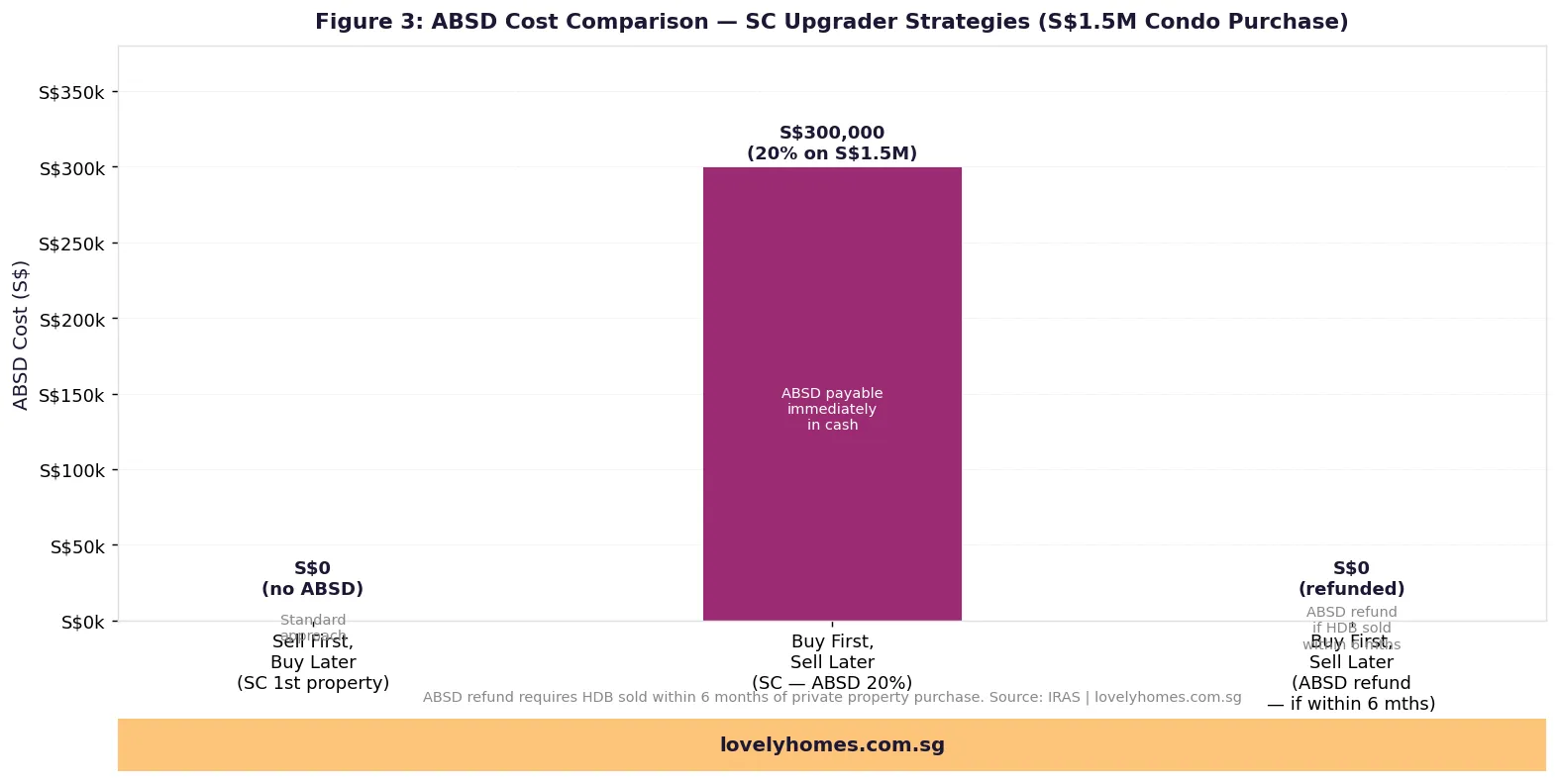
- On a S$1.5M condo, 20% ABSD = S$300,000 — payable in cash, not CPF.
- Decoupling allows an SC couple to transfer one partner’s share to the other, making the exiting partner a “first-time” buyer with 0% ABSD on the next purchase.
- Retaining an HDB flat and buying a private property as a second property incurs ABSD and reduces LTV to 45% on the new loan (MAS rules for borrowers with an existing outstanding mortgage).
- Selling HDB first and then buying private means no ABSD (SC first property = 0%), but requires careful timing management.
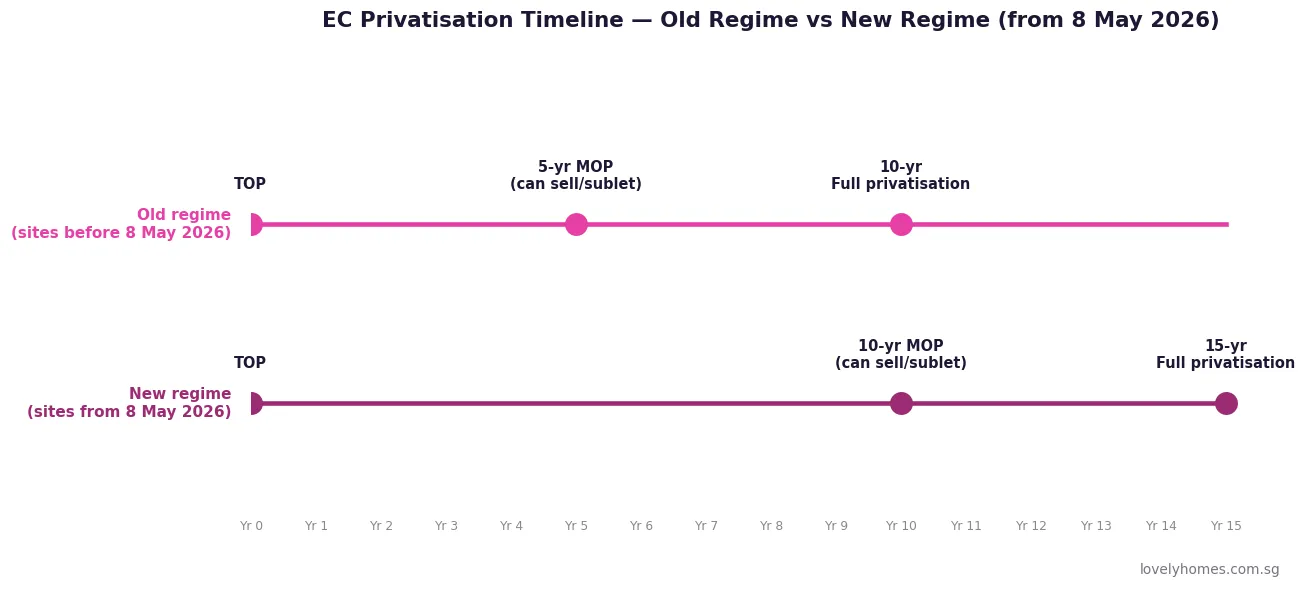
- HDB flat owners must fulfil the Minimum Occupation Period (5 years for standard BTO; 10 years for Plus and Prime flats from the 2024 reclassification) before selling.
- TDSR of 55% applies to all buyers — existing loan repayments reduce borrowing capacity for property two.
Why Buying a Second Property in Singapore Is a Calculated Decision
Singapore’s residential property market has produced consistent long-term price appreciation — the Urban Redevelopment Authority’s Private Residential Property Index (PPI) has risen roughly 80% over the decade from 2015 to 2025, with particular strength in the Outside Central Region (OCR) and Rest of Central Region (RCR). It is no surprise that many Singapore Citizens, once their first home is paid down sufficiently, turn their attention to buying a second property in Singapore as an investment, a retirement hedge, or an upgrade play. The challenge is that the Government has deliberately made second-property purchases more costly since 2023, and the financial modelling requires care.
This guide covers the current ABSD regime for second purchases, the TDSR impact of holding two mortgages, the decoupling strategy used by couples to navigate the rules, the HDB-to-private upgrade pathway, and the worked example of a typical upgrader couple making their move in 2026.
ABSD on Your Second Property: The Core Cost
The Additional Buyer’s Stamp Duty, administered by the Inland Revenue Authority of Singapore (IRAS), was increased sharply in the April 2023 Budget. For Singapore Citizens, the rate on a second residential property rose from 17% to 20%. For PRs, it rose from 25% to 30%. These rates have remained unchanged through to August 2026.
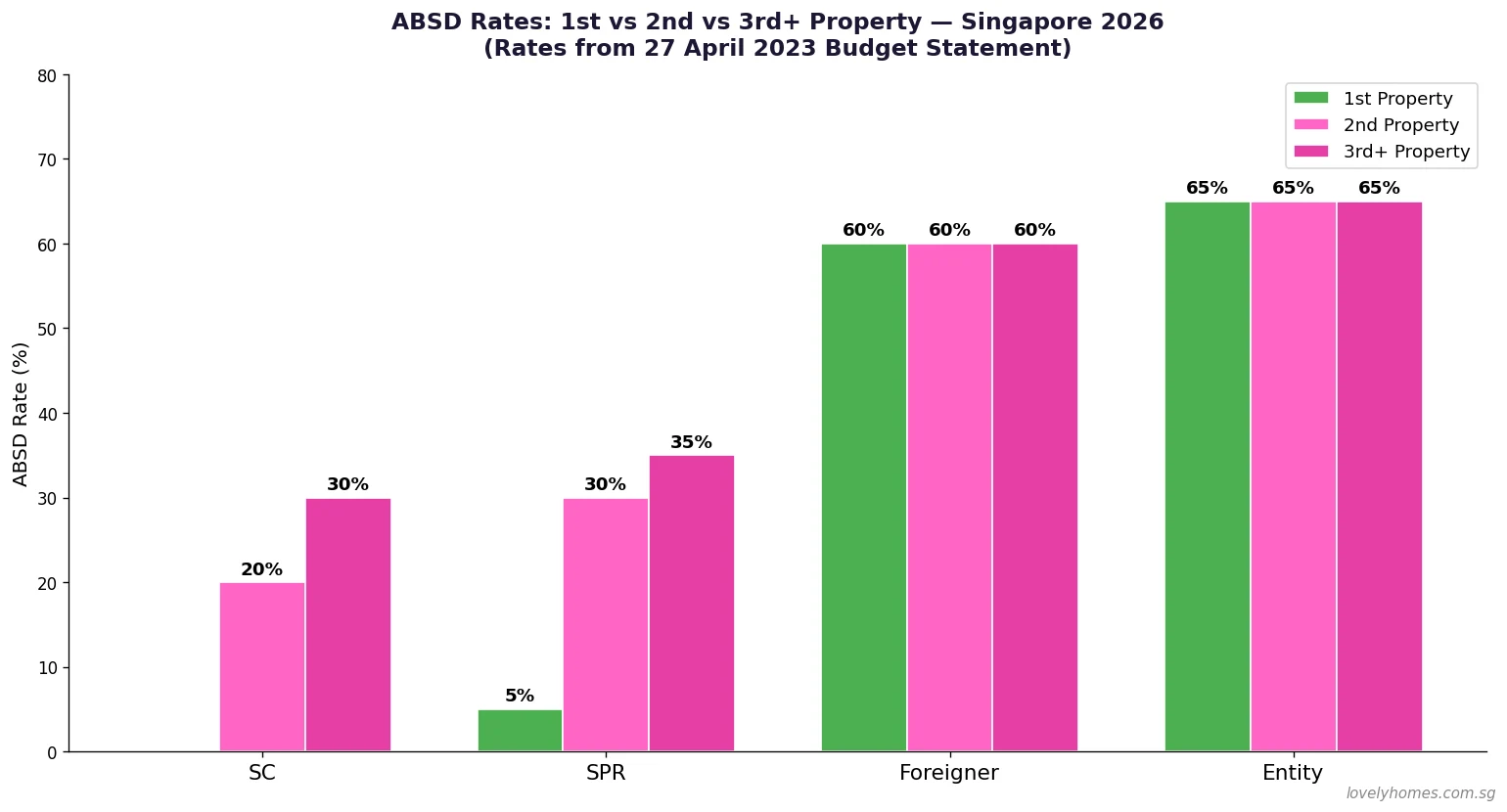
ABSD is levied on the higher of the purchase price or market value of the property, and must be paid within 14 days of signing the Sale and Purchase Agreement (or 30 days if signed overseas). Critically, ABSD cannot be paid using CPF Ordinary Account savings — it must be funded entirely from cash. On a S$1.5M condominium, 20% ABSD equals S$300,000 in cash. Buyers who are planning a second purchase must ring-fence this cash well before exercising any Option to Purchase (OTP), as the timeline between OTP exercise and SPA signing is typically only 14 days.
A property is counted as “owned” for ABSD purposes from the date the OTP is exercised (not from completion). If you exercise the OTP on a second property before your first property’s sale is completed, both properties count simultaneously and the higher ABSD rate applies. The Government does offer an ABSD remission for SC citizens who sell their first property within six months of purchasing the second — effectively allowing upgraders to avoid 20% ABSD if the sequence is managed correctly. However, the remission must be claimed and is conditional on the sale completing within the window. See our ABSD Singapore 2026 Complete Guide for the detailed remission rules.
Decoupling: The Strategy to Reclaim a “First Purchase”
Decoupling is one of the most widely discussed strategies for SC couples seeking to purchase a second property without paying 20% ABSD. The logic is straightforward: if a property is currently held jointly between spouses (or any two co-owners), one party transfers their ownership share to the other. The exiting party is then legally a non-property-owner and, when they subsequently purchase a new property in their own name alone, it counts as their first residential property — attracting 0% ABSD for an SC.
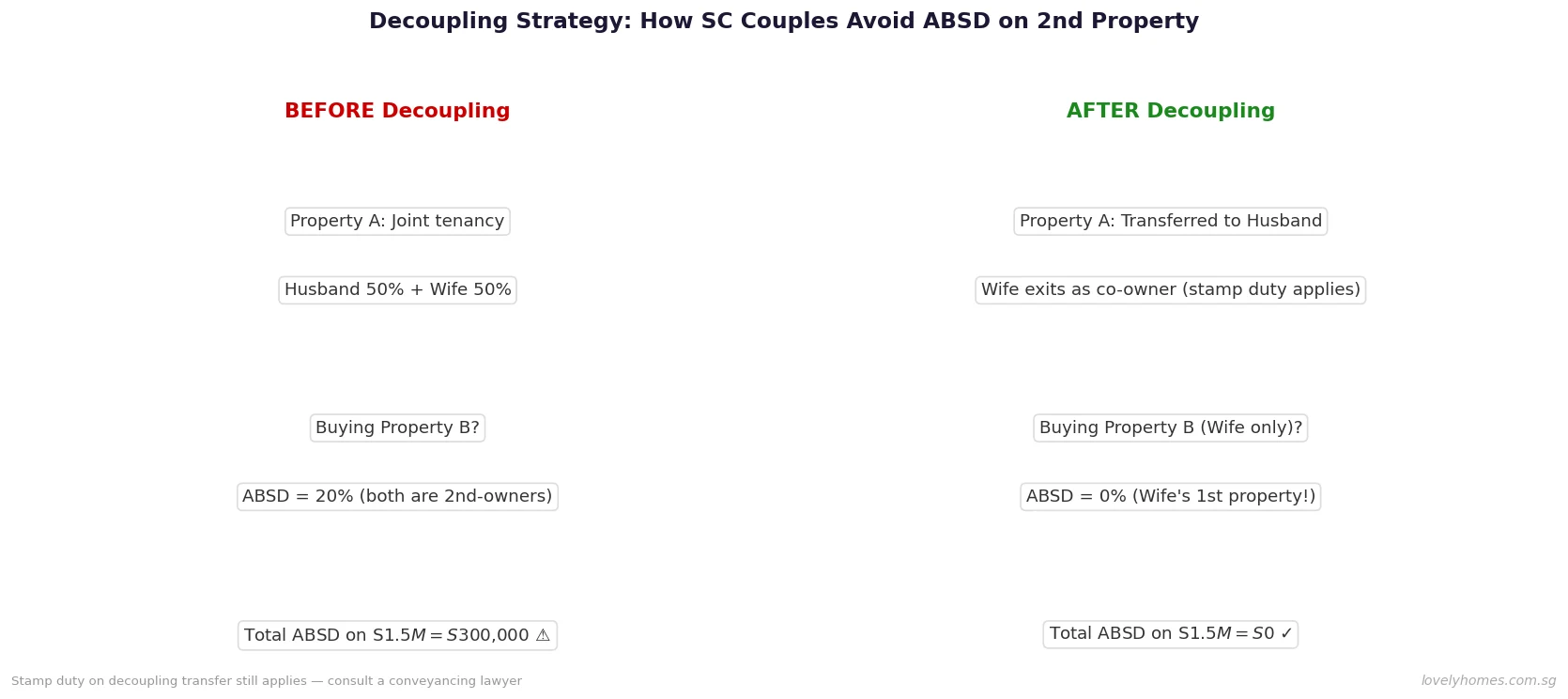
Decoupling is not free. The transfer of a share from one spouse to another is itself a property transaction that attracts BSD at the prevailing rates on the value of the share transferred. If Property A is worth S$1.2M and Husband transfers his 50% share (worth S$600,000) to Wife, BSD is payable on S$600,000: (S$180,000 × 1%) + (S$180,000 × 2%) + (S$240,000 × 3%) = S$1,800 + S$3,600 + S$7,200 = S$12,600. Legal fees for the transfer add another S$2,000–S$4,000. ABSD on the transfer between spouses used to be remitted, but since April 2023 this remission has been substantially curtailed — buyers should confirm the current ABSD position on spouse transfers with their conveyancing lawyer before proceeding.
After decoupling, the exiting spouse purchases the new property in their sole name, paying 0% ABSD as an SC first-timer. The net saving compared with a joint purchase at 20% ABSD can be very large: on a S$1.5M condo, 20% = S$300,000 saved, against a decoupling cost of perhaps S$15,000–S$20,000 all-in. The arithmetic is compelling, but execution requires careful sequencing (the transfer must complete before the OTP on the new property is exercised) and the bank’s consent to refinance the remaining spouse’s mortgage on the existing property in their sole name.
TDSR Impact: Two Mortgages, One Income
The Total Debt Servicing Ratio (TDSR), set by the Monetary Authority of Singapore (MAS) at 55% of gross monthly income, applies to the total of all debt repayments — existing mortgage on Property A plus new mortgage on Property B, plus car loans, personal loans, and any other credit commitments. This constraint often limits how much upgraders can borrow for a second property when they retain the first.
Additionally, MAS applies stricter Loan-to-Value (LTV) limits when the borrower already has an outstanding residential mortgage. For a borrower with one existing property loan, the LTV on a second property loan is capped at 45% (down from 75% for a borrower with no outstanding loans). This means the minimum down payment on the second property rises from 25% to 55%. On a S$1.5M second property, the buyer needs S$825,000 in cash and CPF combined for the down payment (after ABSD, BSD, and legal fees on top of that).
| Scenario | LTV Available | Down Payment on S$1.5M | ABSD (SC) | BSD | Total Cash Need (Day 1) |
|---|---|---|---|---|---|
| Sell Property A first, buy Property B (SC 1st property) | 75% | S$375,000 (cash+CPF) | S$0 | S$44,600 | ~S$424,000 |
| Retain Property A, buy Property B (SC 2nd property) | 45% | S$825,000 (cash+CPF) | S$300,000 cash | S$44,600 | ~S$1,173,000 |
| Decouple Property A, buy Property B (first-timer) | 75% | S$375,000 (cash+CPF) | S$0 | S$44,600 + ~S$15,000 (decoupling BSD) | ~S$439,000 |
The HDB Upgrade Pathway
For the majority of Singapore homeowners, the first property is an HDB flat. The decision of whether to sell the HDB before buying a private unit, or to retain the HDB and buy a second property, is one of the most consequential financial choices an SC family makes.
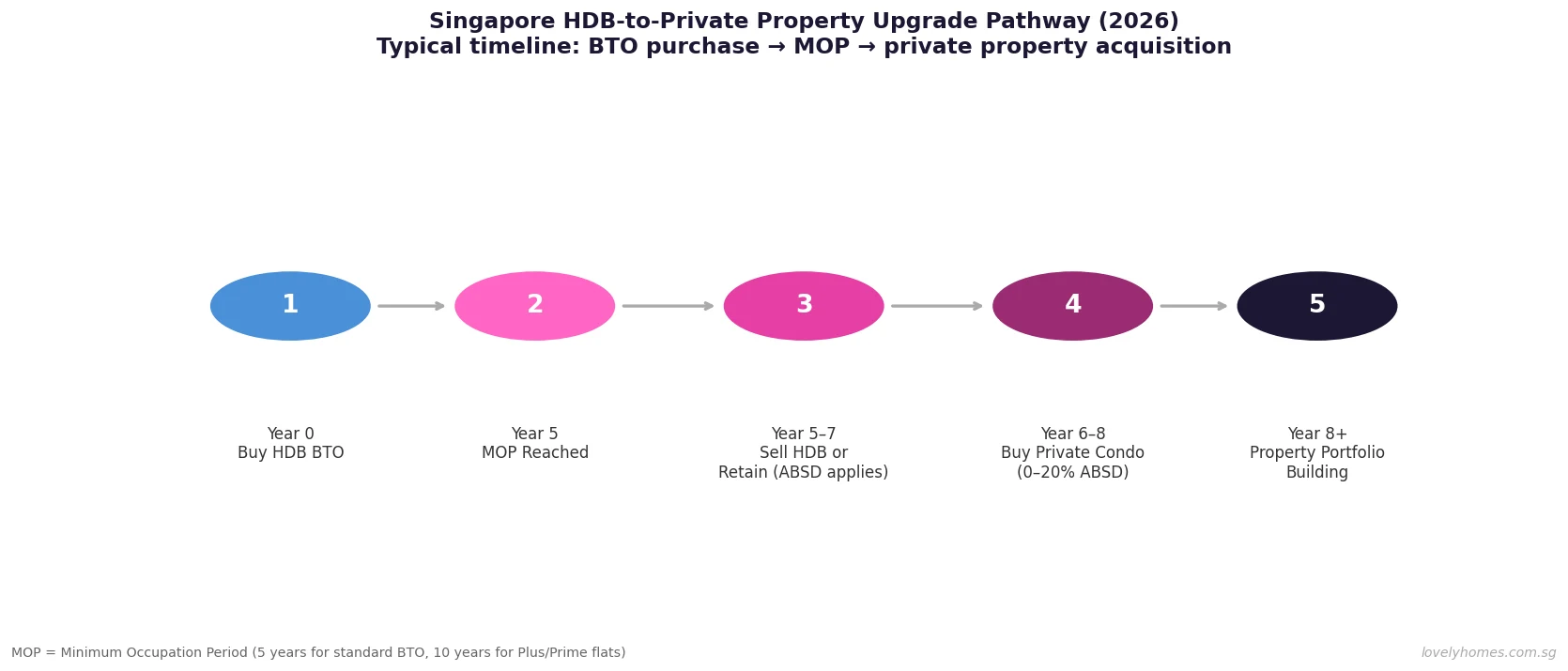
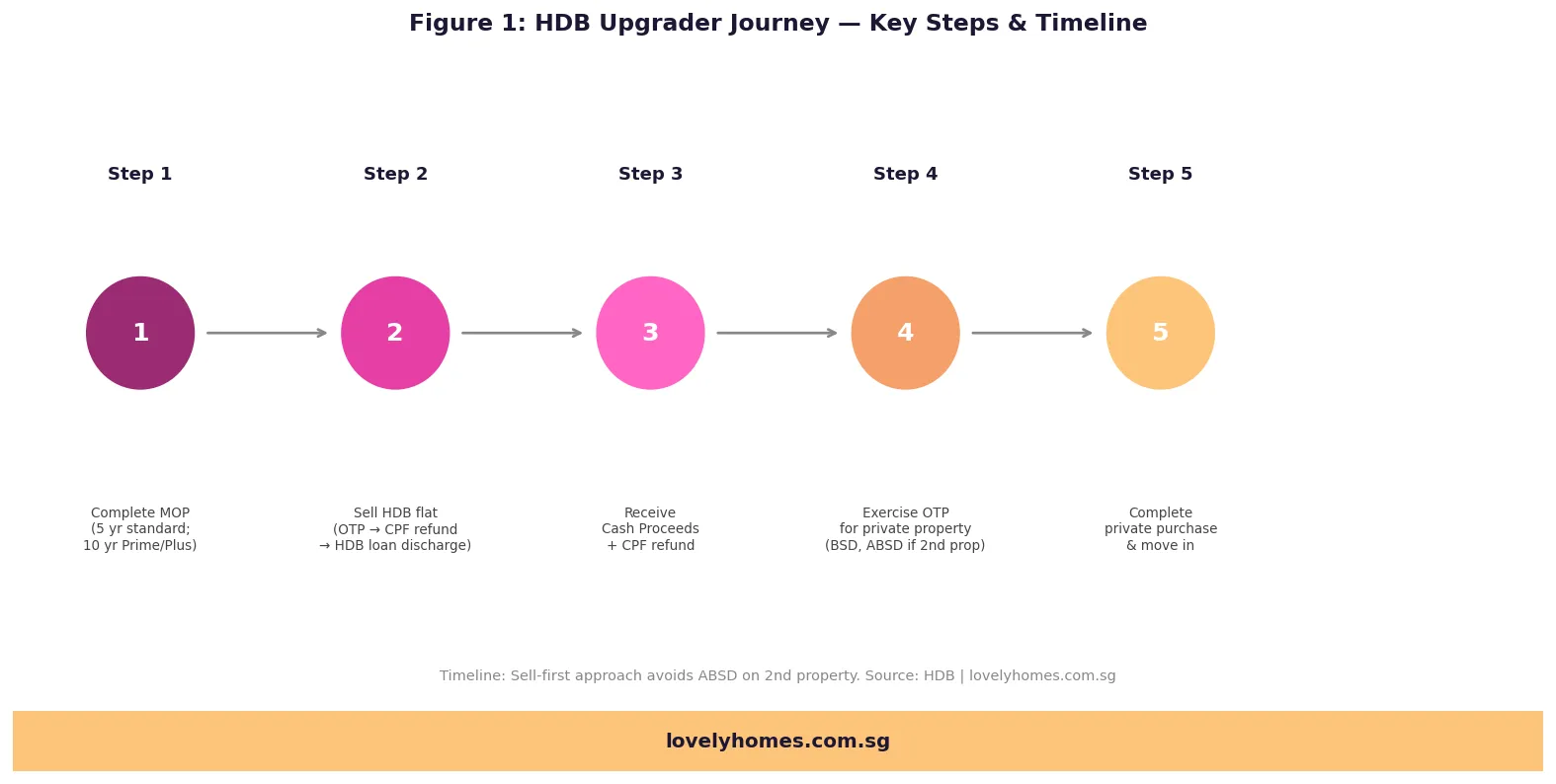
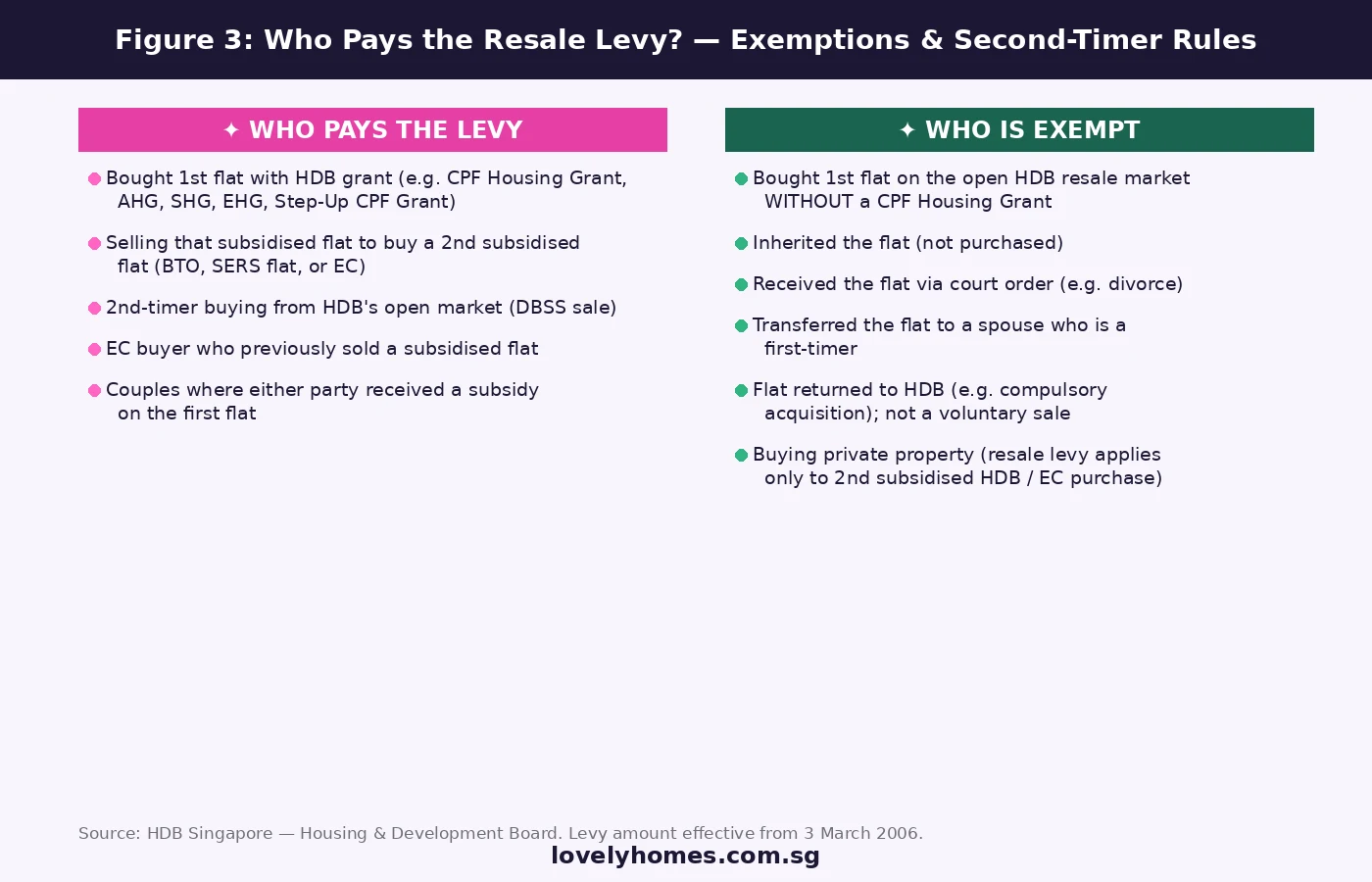
The Minimum Occupation Period (MOP) is the first constraint. HDB flat owners must live in their flat for a minimum of five years from the date of key collection before they can sell on the open market, sublet the whole flat, or use the flat as collateral for a private property purchase. For Plus and Prime BTO flats launched under the 2024 BTO reclassification, the MOP extends to ten years. During the MOP period, the flat cannot be sold, and the family cannot purchase a private residential property in Singapore — HDB rules are explicitly designed to prevent simultaneous HDB flat ownership and private property ownership among resident citizens and PRs.
Once MOP is reached, the upgrader has two primary routes:
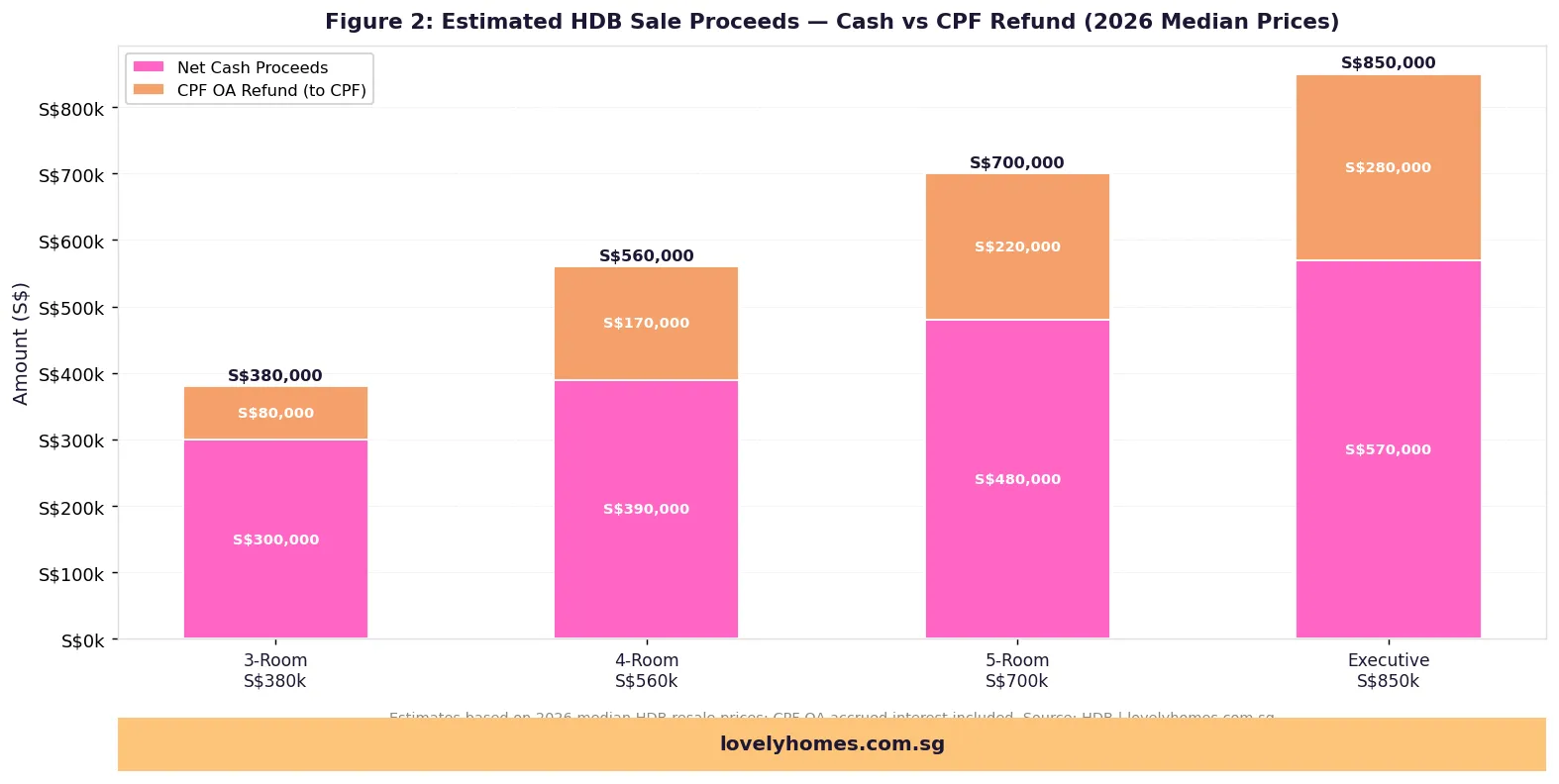
- Route 1: Sell HDB, then buy private. The sale of the HDB flat resets the buyer to zero property ownership. The subsequent private purchase is treated as a first residential property — zero ABSD for SC, 75% LTV, standard down payment. Proceeds from the HDB sale (net of CPF Ordinary Account accrued interest repayment) fund the cash component. The timing risk is the gap between HDB sale completion and new property key collection, during which the family must rent.
- Route 2: Retain HDB, buy private as second property. This preserves the HDB flat as a rental income asset (gross yield on a mature estate 4-room flat: approximately 3.5–4.5% at 2026 market rents). However, the 20% ABSD, the 45% LTV cap, and the combined TDSR of both mortgages make this capital-intensive. For most HDB upgraders with household incomes below S$20,000/month, Route 1 is more practical.
For a detailed guide to the BTO process and ballot system that produces Singapore’s HDB upgrader pipeline, see our Singapore HDB BTO Ballot Guide 2026.
Private-to-Private Upgrading
Owners of private property who wish to upgrade to a larger or more central unit face the same ABSD arithmetic, but often have more flexibility in timing because private property sale and purchase timelines can be aligned more precisely than HDB timelines. A private-property upgrader can exercise the OTP on the new property and simultaneously place the existing property on the market, targeting sale completion before the new property’s SPA is signed. If the existing property’s sale completes before the SPA is signed on the new property, the buyer avoids 20% ABSD — they are again a first-time buyer on the private property. If the dates overlap by even a day, the 20% applies and the ABSD remission must be claimed (subject to the six-month sale completion condition).
The market dynamics in 2026 — with OCR and RCR resale prices broadly flat to mildly positive and new launch prices elevated by selective developer launches — generally favour the sell-first strategy for upgraders who value certainty. For context on current price trajectories, see our Singapore Private Property Market Outlook H2 2026.
Worked Example: The Upgrader Couple (SC + SC)
Mr and Mrs Tan are both Singapore Citizens, both 36 years old, with a combined gross household income of S$18,000 per month. They own a 4-room HDB flat in Jurong West, purchased via BTO in 2016, with a current market value of approximately S$520,000. Their outstanding HDB loan balance is S$280,000 (at 2.6% p.a., 12 years remaining), with a monthly instalment of approximately S$2,780. MOP was satisfied in 2021. They wish to purchase a 2-bedroom private condominium in the OCR priced at S$1,500,000.
Scenario A — Sell HDB First:
- HDB sale proceeds (estimated): S$520,000. After CPF OA accrued interest repayment (~S$65,000) and HDB loan repayment (S$280,000) and legal/transaction costs (~S$8,000), net cash proceeds: approximately S$167,000. CPF refunded: ~S$280,000 (principal) + returned interest from proceeds to CPF OA.
- ABSD on condo purchase: S$0 (SC, first property after HDB sale).
- BSD on S$1.5M: S$44,600.
- LTV: 75% = S$1,125,000 loan. Down payment: S$375,000 (cash + CPF).
- Monthly instalment at 3.65% p.a., 25 years: approximately S$5,780/month.
- TDSR: S$5,780 / S$18,000 = 32.1% — well within the 55% cap.
- Pros: No ABSD, better LTV, cleaner TDSR. Cons: Must rent during the gap (typically 6–9 months).
Scenario B — Retain HDB, Buy Condo as Second Property:
- ABSD: 20% × S$1,500,000 = S$300,000 (cash — cannot use CPF).
- BSD: S$44,600.
- LTV: 45% = S$675,000 loan. Down payment: S$825,000 (cash and CPF).
- Monthly instalment at 3.65% p.a., 25 years: approximately S$3,445/month.
- TDSR: (S$2,780 + S$3,445) / S$18,000 = 34.6% — passes. But total debt commitment is S$6,225/month.
- HDB rental income (if rented out after MOP): approximately S$2,200–S$2,600/month for a 4-room flat in Jurong West (net of vacancy and management costs, and property tax at non-owner-occupied rate).
- Net cash position (mortgage commitments minus rental income): approximately S$3,600–S$4,000/month, or ~22% of household income.
- Pros: Retains HDB as income-generating asset. Cons: S$300,000 ABSD upfront in cash, S$825,000 down payment needed, higher monthly cash outflow.
For most upgrader couples at this income level, Scenario A (sell HDB first) is significantly more capital-efficient. The S$300,000 ABSD alone represents approximately 17 months of household income.
What This Means for Second-Property Buyers in 2026
The post-April 2023 ABSD landscape has meaningfully cooled the second-property market. Transaction volumes for second purchases among Singapore Citizens declined sharply in 2023 and have remained subdued through 2026 relative to the 2021–2022 peak. The gap between the “sell first” and “buy and hold” strategies has widened: the mandatory cash component and tighter LTV for second properties have made holding two mortgages simultaneously a genuinely wealthy person’s exercise.
Decoupling remains legal and widely practised, but the narrowing of the spouse-transfer ABSD remission means the strategy’s net benefit has declined. Buyers considering decoupling should obtain updated legal advice — the specific stamp duty position on the transfer itself is material and changes with government policy. For the full history of how cooling measure packages have evolved, including every ABSD adjustment since 2011, see our Singapore Property Cooling Measures Timeline 2009–2026.
What Might Come Next
Budget 2026 made no changes to ABSD rates for second properties. Government communications consistently emphasise that cooling measures will remain until there is sustained evidence that the private residential market has stabilised at levels consistent with economic fundamentals. The private residential PPI showed a modest +0.5% overall gain in Q2 2026 (CCR +2.0%, RCR -1.4%, OCR -0.2%), suggesting a differentiated market rather than across-the-board pressure. Any easing of the 20% SC second-property ABSD is likely to lag improvements in market conditions by several quarters, and buyers planning for 2027–2028 acquisitions should model their scenarios on current rates. A reduction in ABSD is a potential upside, not an assumption.
Frequently Asked Questions
Can I use CPF to pay the ABSD on my second property?
No. ABSD must be paid entirely in cash. CPF Ordinary Account savings may be used for the down payment and for monthly mortgage repayments (subject to the required cash component rules), but ABSD is not eligible for CPF usage. On a S$1.5M second property, the S$300,000 ABSD must come from liquid cash savings. This is one of the reasons the Government’s cooling measure is effective — it requires buyers to demonstrate substantial cash reserves before acquiring a second residential property.
Can I sell my HDB and buy a private property without paying ABSD?
Yes, provided the HDB sale completes before you exercise the Option to Purchase on the private property. Once the HDB flat is sold and title transferred, you are no longer a property owner and your subsequent private purchase is treated as a first residential property — 0% ABSD for a Singapore Citizen. The practical challenge is the timing gap between HDB completion and private property key collection (new launch completion timelines can be 3–5 years). Most upgraders bridge this period by renting. Alternatively, some buyers purchase a resale condominium to minimise the timing gap to 8–12 weeks between HDB sale and condo key collection.
How does decoupling work and what does it cost?
Decoupling involves one co-owner transferring their share of an existing property to the other co-owner, making the exiting party free to purchase a new property as a first-time buyer. BSD is payable on the value of the share transferred (at the standard BSD tiered rates), plus legal fees of approximately S$2,000–S$4,000. The key steps are: (1) both parties agree on the transfer valuation; (2) the bank consents to refinance the remaining owner’s mortgage in their sole name; (3) the transfer is completed and legal title updated at SLA; (4) the exiting party then purchases the new property in their name. The total cost of decoupling (BSD on transfer + legal fees) is typically S$12,000–S$25,000 depending on the property value, compared with S$300,000 or more in ABSD on a S$1.5M property — making the maths strongly in favour of decoupling for couples with suitable existing property.
What is the ABSD remission for upgraders who sell their first property?
Singapore Citizens who purchase a second residential property and then sell their first property within six months of the second property’s completion (or within six months of the purchase if it is a completed resale property) may apply for a refund of the 20% ABSD paid on the second purchase. This remission effectively allows upgraders to bridge the gap between their new purchase and their existing property’s sale without permanently bearing the ABSD cost — provided they complete the sale in time. The remission must be applied for through IRAS and the conditions are strict: the buyer must be an SC, the first property must be sold (not just listed) within six months, and the second property must be in the buyer’s sole name or jointly with an SC spouse. Failing to sell within six months means the 20% ABSD is forfeited — no extensions are granted.
Does retaining my HDB flat reduce the loan I can get for a private condo?
Yes, significantly. If you have an outstanding HDB mortgage when you apply for a private property bank loan, the LTV cap drops from 75% to 45% under MAS rules. This means on a S$1.5M condo, the maximum loan drops from S$1,125,000 to S$675,000, and the minimum down payment rises from S$375,000 to S$825,000. On top of this, the combined monthly repayments on both mortgages are factored into your TDSR calculation, further limiting the loan quantum available. Many upgraders with incomes below S$20,000/month find that the combined TDSR and LTV constraints make retaining the HDB impractical, and choose to sell the HDB first instead.
Can I buy a second property in my child’s name to avoid ABSD?
No — and attempting to do so constitutes a criminal offence under Singapore law. Purchasing property in another person’s name while retaining beneficial ownership is called a “strawman” arrangement and is explicitly prohibited under the Residential Property Act. IRAS and the courts take a very serious view of ABSD avoidance structures. Genuine transfers to family members who independently own and occupy the property are legally distinct, but these must be genuine transfers of both legal and beneficial ownership, and the recipient must have the independent financial means to support the purchase. Buyers should obtain legal advice before any intra-family property transfer to ensure it does not create ABSD avoidance exposure.
Related Articles
- ABSD Singapore 2026: Complete Guide to Additional Buyer’s Stamp Duty
- Singapore Expat Property Buying Guide 2026: What Foreigners and PRs Need to Know
- Singapore Leasehold vs Freehold Guide 2026
- Singapore Property Loan Refinancing Guide 2026
- Singapore First-Timer Property Guide 2026
- Singapore Private Property Market Outlook H2 2026
Disclaimer: This article is for general informational purposes only and does not constitute legal, financial, or tax advice. ABSD rates, LTV limits, TDSR rules, and CPF usage regulations are subject to change by the Government of Singapore at any Budget or policy announcement. Figures cited are based on publicly available information from IRAS, MAS, HDB, and URA as at August 2026. Readers should verify all figures and obtain independent legal, financial, and tax advice before making any property purchase decision. LovelyHomes is not a licensed estate agency and does not facilitate property transactions.