Property Division in a Singapore Divorce 2026: What Happens to Your HDB Flat and Private Property

Property Division in a Singapore Divorce 2026: What Happens to Your HDB Flat and Private Property

Quick Answer: Property Division in a Singapore Divorce

  • Under Section 112 of the Women’s Charter, the Family Justice Courts divide “matrimonial assets”, not just assets held in joint names, and the matrimonial home is almost always included in that pool, whichever spouse’s name it is registered under.
  • For an HDB flat, one spouse can apply to retain the flat by buying over the other’s share (subject to HDB eligibility and approval), or the couple can sell the flat and split the net proceeds according to the court-ordered ratio.
  • For private property, the same principle applies: retain-and-buy-over, sell-and-split, or transfer of the whole property to one party with a payout to the other.
  • The Court of Appeal’s “structured approach” (from ANJ v ANK) is the standard method for dividing assets in a long dual-income marriage: direct financial contributions and indirect (including homemaking) contributions are each ratioed, then averaged, then adjusted for other factors.
  • A transfer of property pursuant to a divorce court order is exempt from Additional Buyer’s Stamp Duty (ABSD), but ordinary Buyer’s Stamp Duty (BSD) is still payable on the value of the share being transferred.
  • Any CPF savings (principal plus accrued interest at 2.5% p.a.) used towards the property generally must be refunded to the relinquishing spouse’s CPF account upon transfer, unless the court orders otherwise.
  • Contested divorces involving significant assets or young children can take well over a year to resolve; simplified, uncontested divorces with an agreed consent order can move considerably faster.
  • This is a general guide only. Every marriage’s facts are different, and specific legal advice from a family lawyer is essential before agreeing to any division of property.

What Happens to Property When a Marriage Ends in Singapore?

When a marriage in Singapore ends in divorce, the couple’s property, including the family home, does not automatically split down the middle or stay with whoever’s name is on the title. Instead, the Family Justice Courts apply the framework set out in the Women’s Charter (Cap 353), primarily Section 112, to divide what the law calls “matrimonial assets” between the two parties in a manner the court considers just and equitable. This is a fundamentally different concept from simple legal ownership: a flat registered solely in the husband’s name can still be treated as a shared matrimonial asset if it was acquired during the marriage or used as the family home, and a wife with no income of her own can still be awarded a substantial share for her non-financial contributions as a homemaker and caregiver.

For most Singaporean couples, the family home, whether an HDB flat or private property, is by far the largest asset in the pool, which is why property division is usually the single most consequential financial outcome of a divorce. This guide walks through how the courts decide what counts, how the division ratio is worked out, what actually happens to an HDB flat or private property afterwards, and the stamp duty and CPF mechanics that follow.

What counts as a matrimonial asset under the Women's Charter Singapore divorce 2026
Figure 1: A general summary of what is typically included in, and excluded from, the matrimonial asset pool.

What Counts as a “Matrimonial Asset”?

Under Section 112, a matrimonial asset is broadly any asset acquired by either or both parties during the marriage, plus any asset acquired before the marriage by one party that was ordinarily used or enjoyed by both parties (or their children) or that was substantially improved during the marriage by the other party or both parties together. In practice, this sweeps in far more than most people expect: salaries and bonuses earned and saved during the marriage, investment portfolios, CPF balances, insurance policies with cash value, the family car, and, critically, the matrimonial home, even if that home was purchased by one spouse before the wedding, because a home lived in by both spouses is almost always treated as a matrimonial asset regardless of whose name is on the title or when it was bought.

Assets that generally fall outside the pool include property acquired by one spouse through gift or inheritance and kept separate throughout the marriage, and assets one party owned before the marriage that were never used, enjoyed or improved by the other spouse. The key qualifier is “generally”: if a gifted or inherited asset was subsequently used as the family home, or was substantially improved using matrimonial funds or the other spouse’s efforts, it can be pulled back into the divisible pool. Because this line is fact-sensitive and frequently disputed, couples with pre-marital property, inheritances or significant gifts should get specific legal advice early rather than assume an asset is automatically excluded.

How the Courts Divide Assets: The Structured Approach

For long, dual-income marriages, the Court of Appeal’s decision in ANJ v ANK [2015] SGCA 34 set out what has become the standard “structured approach” for dividing the matrimonial asset pool. The court first works out each party’s direct financial contribution ratio, based on how much each party paid towards acquiring, improving and paying down the assets, including CPF contributions and mortgage instalments. It then separately works out an indirect contribution ratio, which captures both indirect financial contributions (such as paying for household expenses or children’s education while the other party services the mortgage) and non-financial contributions, most importantly homemaking and caregiving, which the courts have repeatedly emphasised deserve real, not token, recognition.

The structured approach to dividing matrimonial assets Singapore divorce 2026
Figure 2: The four-step structured approach the Family Justice Courts commonly use for a long, dual-income marriage.

The two ratios (direct and indirect) are then averaged to produce each party’s headline entitlement percentage of the asset pool. Finally, the court considers whether the “other factors” listed in Section 112(2), such as the duration of the marriage, the needs of any children, the age and health of each party, and each party’s future earning capacity, warrant an adjustment from that headline figure. For shorter marriages, single-income households, or cases where a strict structured calculation would not achieve a just outcome, the courts retain discretion to apply a more “broad-brush” or global assessment instead. There is no fixed formula that guarantees any particular split; every case ultimately turns on its own facts, which is why obtaining advice from a family lawyer before agreeing to (or contesting) a proposed division is so important.

What Happens to an HDB Flat After a Divorce?

For couples whose main asset is an HDB flat, there are broadly three outcomes once the court has decided the division ratio, or once the parties reach an agreed consent order. First, one spouse can apply to retain the flat by buying over the other’s share of the flat’s value, effectively becoming the sole owner, subject to HDB’s eligibility rules (citizenship or PR status, not owning another HDB flat or private property beyond permitted limits, and HDB’s approval of the ownership transfer). Second, the couple can agree to sell the flat on the open market and split the net sale proceeds according to the court-ordered ratio, after settling the outstanding mortgage, CPF refund and any resale levy considerations. Third, in some cases, the court may order the flat to be retained temporarily for the benefit of the children, with a spouse granted a right of occupation until a later trigger event (such as the youngest child turning 21) before the flat is eventually sold or transferred.

Because HDB flats sit within a public housing scheme, any of these outcomes still requires HDB’s approval of the change in ownership or occupancy, on top of the family court’s order; a court order alone does not automatically override HDB’s eligibility framework, so parties should factor in this additional administrative step and its processing time when planning next steps after the ancillary matters hearing.

What Happens to Private Property After a Divorce?

Private property division follows the same underlying Section 112 principles, but without HDB’s eligibility overlay, giving couples somewhat more flexibility in how they structure the outcome. A spouse can retain the property by refinancing the existing mortgage into their sole name and paying the other spouse their share of the equity, the property can be sold on the open market with proceeds split per the court order, or, less commonly, the property can be transferred into joint names under a different ownership structure (for example, converting a joint tenancy into a tenancy-in-common with unequal shares reflecting the court’s division ratio) so both parties retain an interest pending a later sale. Whichever route is chosen, refinancing or transferring sole ownership will require the retaining spouse to qualify for a mortgage on their own income and creditworthiness, which is often a genuine practical constraint, particularly if the property was originally financed based on both spouses’ combined income.

Stamp Duty and CPF Considerations on a Divorce-Related Transfer

Two financial mechanics apply whenever a property (or a share of one) changes hands as part of a divorce settlement. First, stamp duty: a transfer of property pursuant to a court order made in divorce or judicial separation proceedings is exempt from Additional Buyer’s Stamp Duty (ABSD), recognising that this is a division of existing matrimonial assets rather than a fresh purchase. However, ordinary Buyer’s Stamp Duty (BSD) still applies, calculated on the market value of the share being transferred to the retaining spouse, on the same progressive BSD scale that applies to any other residential property transaction.

Second, CPF refunds: where CPF Ordinary Account savings were used to fund the property (whether for the downpayment, monthly instalments, or both), the spouse who is relinquishing their share is generally required to refund the CPF principal amount used plus accrued interest at 2.5% per annum, compounded over the years the CPF monies were utilised, back into their own CPF account upon the transfer, unless the court’s order specifies a different treatment. This CPF refund obligation can be a significant, sometimes underestimated, cash-flow consideration for the retaining spouse, since it effectively adds to the buyout cost even though the money is going into the other spouse’s CPF account rather than being paid out in cash.

Summary: Property Division in a Singapore Divorce at a Glance

Question Short Answer
Which law governs property division? Section 112 of the Women’s Charter (Cap 353).
Is the home included even if in one spouse’s name? Almost always yes, if it was used as the matrimonial home.
What is the “structured approach”? Average of direct and indirect contribution ratios, then adjusted for other factors.
Is ABSD payable on a divorce transfer? No, it is exempt; BSD is still payable on the transferred share’s value.
Does CPF need to be refunded? Generally yes, principal plus 2.5% p.a. accrued interest, unless the court orders otherwise.
Does HDB need to approve the outcome? Yes, HDB’s own eligibility and approval rules apply on top of the court order.

Worked Example: Dividing the Asset Pool for Mr and Mrs Tan

Profile: Mr and Mrs Tan have been married for 14 years and are divorcing. Their matrimonial asset pool, comprising their private condo (net of the outstanding mortgage), joint savings, CPF balances used towards the home, and investment accounts, totals S$1,450,000.

Step 1, direct contributions: Mrs Tan’s income funded roughly 40% of the direct financial contributions towards the assets (mortgage instalments, CPF, cash savings); Mr Tan’s income funded the remaining 60%.

Step 2, indirect contributions: Mrs Tan took a career break for six years to care for their two children and managed the household throughout the marriage; the court assesses her indirect contribution ratio at 70%, against Mr Tan’s 30%.

Step 3, average the ratios: Mrs Tan’s headline entitlement is (40% + 70%) / 2 = 55%. Mr Tan’s headline entitlement is (60% + 30%) / 2 = 45%.

Step 4, adjustment: the court considers the children’s needs and Mrs Tan’s reduced earning capacity after her career break, and decides no further adjustment is warranted, confirming the 55/45 split.

Outcome: Mrs Tan is entitled to S$1,450,000 x 55% = S$797,500; Mr Tan is entitled to S$1,450,000 x 45% = S$652,500. Mr Tan chooses to retain the condo (valued at S$1,650,000, with S$650,000 outstanding on the mortgage, giving net equity of S$1,000,000 within the pool); he refinances the mortgage in his sole name and pays Mrs Tan a cash equalisation sum to reflect her 55% share of the total pool, alongside her share of the other assets, and separately refunds the CPF used towards the home (principal plus 2.5% p.a. accrued interest) into her CPF account. Buyer’s Stamp Duty is payable on the value of the share being transferred into Mr Tan’s sole name, while ABSD is exempt because the transfer is made pursuant to the divorce court order.

Worked example asset pool division 55 45 split Singapore divorce 2026
Figure 3: Illustrative division of the S$1.45m asset pool in the Tan family worked example above.

Why This Matters When You’re Going Through a Divorce

Property is usually the single largest, and often the most emotionally charged, asset in a divorce, which makes understanding the framework before entering negotiations genuinely valuable. Couples who understand how the structured approach works, and who gather clear documentation of their direct and indirect contributions early, are typically better placed to reach a fair consent order without a lengthy contested hearing. Equally important is recognising the practical follow-through: a court order determining the division ratio is not the end of the process for property specifically, since HDB approval, mortgage refinancing eligibility, stamp duty and CPF refund calculations all still need to be worked through afterwards, and underestimating these steps can delay finalising the split even after the ancillary matters hearing has concluded.

What Might Come Next

The following is informed speculation, not confirmed policy. As dual-income households and more equal caregiving arrangements become more common in Singapore, it is plausible that future case law could continue refining how indirect, non-financial contributions are weighted relative to direct financial contributions, building further on the structured approach set out in ANJ v ANK. Some family law commentary has also floated whether HDB’s approval process for post-divorce ownership transfers could be streamlined or made more predictable in processing time, given how frequently this step follows a court order, though no specific change to HDB’s process has been announced as at this writing.

Frequently Asked Questions

Does it matter whose name the HDB flat or property is registered under?

Not as much as many people assume. The court looks at whether the asset is a “matrimonial asset” under Section 112, not simply whose name appears on the title. A flat solely in one spouse’s name is still very likely to be divided if it served as the matrimonial home.

Is inherited property automatically excluded from division?

Generally, yes, if it was kept separate and never used or improved during the marriage. However, if inherited property was used as the family home, or substantially improved with matrimonial funds or the other spouse’s efforts, it can still be brought into the divisible pool, so this should be checked with a family lawyer rather than assumed.

Can a spouse who never worked still get a share of the property?

Yes. The structured approach explicitly recognises indirect, non-financial contributions such as homemaking and caregiving, and the Court of Appeal has repeatedly emphasised these deserve genuine, not token, weighting, sometimes resulting in the non-earning spouse receiving close to or even above half of the pool.

Do we have to sell the flat if we cannot agree on who keeps it?

If neither party can afford or qualify to buy over the other’s share, or the parties cannot agree, the court can order the flat to be sold on the open market with proceeds divided according to the ordered ratio. Selling is the common fallback when a buy-over is not practically achievable.

Is ABSD really exempt for a divorce-related property transfer?

Yes, a transfer of property made pursuant to a court order in divorce or judicial separation proceedings is exempt from Additional Buyer’s Stamp Duty. Ordinary Buyer’s Stamp Duty, however, still applies to the value of the share being transferred.

How long does the property division process usually take?

This varies enormously. An uncontested divorce with an agreed consent order on property division can be finalised in a matter of months, while a contested case involving disputed valuations, significant assets, or young children can take well over a year before the ancillary matters are resolved.

Can we agree on our own division without going through the full court process?

Yes. Many couples negotiate a consent order, often with the help of family lawyers or mediators, setting out an agreed division of assets, which the court then formalises. This is typically faster and less costly than a fully contested hearing, provided both parties genuinely agree on the terms.

Disclaimer: This article is intended for general informational purposes only and does not constitute legal advice. Matrimonial asset division depends entirely on each couple’s specific facts, and outcomes vary case by case. Always consult a qualified family lawyer, and refer to the Family Justice Courts, the Housing & Development Board (HDB), the Inland Revenue Authority of Singapore (IRAS) and the CPF Board before making any decisions about dividing property in a divorce.
×

Click anywhere outside to close

Property Decoupling Singapore 2026: Complete Guide to ABSD Savings Strategy

Property Decoupling Singapore 2026: Complete Guide to ABSD Savings Strategy


Quick Answer: Property Decoupling Singapore 2026

  • What it is: Property decoupling is a legal strategy where joint property owners transfer one owner’s share to the other, allowing the “transferred-out” spouse or co-owner to purchase the next property as a first-time buyer — and avoid Additional Buyer’s Stamp Duty (ABSD).
  • Why it works: ABSD is assessed per-buyer based on the number of residential properties they own. After decoupling, one spouse owns zero properties and qualifies for the 0% ABSD rate on their next purchase (as a Singapore Citizen first-time buyer).
  • Cost: BSD (Buyer’s Stamp Duty) is payable on the transferred share — typically S$15,000–S$30,000 depending on the share value. Legal fees add another S$3,000–S$5,000.
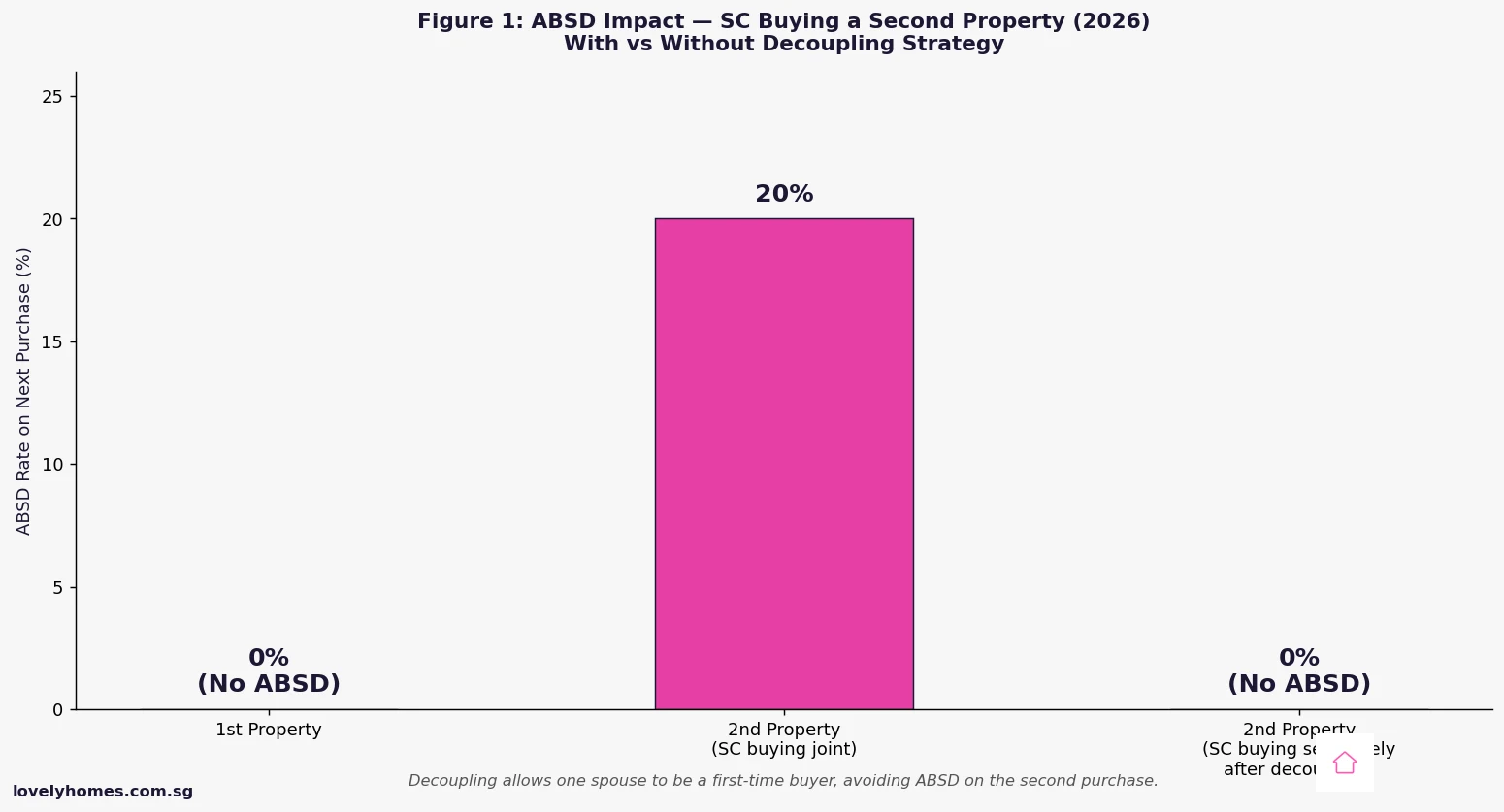
  • Savings: ABSD for a SC buying a second property is 20% (as of 2026). On a S$1.5M purchase, that is S$300,000 saved — versus a decoupling cost of roughly S$20,000.
  • SSD risk: If the property being decoupled is within 3 years of purchase, the intra-couple transfer may trigger Seller’s Stamp Duty (SSD) on the transferred share.
  • HDB flats cannot be decoupled — only private residential properties and ECs (after MOP) are eligible.
  • Legal advice is mandatory — decoupling has tax, CPF, and loan implications that require professional guidance tailored to your specific situation.
  • IRAS monitors decoupling transactions closely — arrangements that lack genuine commercial rationale may be scrutinised under Section 33A of the Stamp Duties Act (anti-avoidance).

Of all the property strategies discussed in Singapore’s property community, decoupling is perhaps the most widely talked about yet least thoroughly understood. At its core, it is a legal ownership restructuring — couples who jointly own a property arrange for one partner to transfer their share to the other, so that the departing owner is then free to buy a new property without triggering Additional Buyer’s Stamp Duty (ABSD).

The strategy surged in popularity following the January 2013 ABSD hike, when the duty for Singapore Citizens buying a second property jumped from 3% to 7% (and has since risen further, to 20% effective 27 April 2023). With ABSD now at levels that represent S$200,000–S$600,000 on mid-range property purchases, decoupling has become a serious financial planning tool for owner-occupiers and investors alike.

However, decoupling is not without cost, risk, or complexity. This guide walks through exactly how it works, what it costs, when it makes sense, and what the government has said about it.

Property decoupling ABSD savings Singapore 2026 chart
Figure 1: ABSD impact with and without decoupling for a Singapore Citizen buying a second property in 2026. Decoupling converts a 20% ABSD liability into a 0% first-purchase rate.

How Property Decoupling Works in Singapore

Decoupling is a sale-and-purchase transaction between co-owners. In the most common scenario, a married couple jointly owns a private condominium. They arrange for one spouse (the “transferee”) to buy out the other’s 50% share. After the transfer is complete:

  • The transferee spouse now owns 100% of the existing property.
  • The transferred-out spouse now owns zero properties — and is treated as a first-time buyer for ABSD purposes on any future purchase.

Crucially, the transaction is a genuine sale — the transferring spouse must receive fair consideration (typically the market value of their share, less any outstanding mortgage and CPF refund obligations). This is not a gift: IRAS assesses BSD on the sale at market value, and a below-market transfer would be treated as a gift for stamp duty purposes, still assessed at market value.

Why ABSD Is Avoided

ABSD is assessed at the point of purchase, based on how many residential properties the buyer owns at that time. After decoupling, the transferred-out spouse owns zero properties. When they subsequently purchase a new property, they are treated as a first-time buyer — attracting 0% ABSD if they are a Singapore Citizen. The government has confirmed that ABSD citizenship-and-count status is assessed at the buyer level, not the household level.

What “Joint Ownership” Means Here

In Singapore, joint ownership of private property can be structured as either joint tenancy (equal share, automatic survivorship) or tenancy-in-common (specified share, no automatic survivorship). Decoupling is most commonly done by tenants-in-common, as the share percentage is already documented — but joint tenants can first sever the joint tenancy and then proceed with a transfer. Both structures are eligible for decoupling.

The Decoupling Process: Step by Step

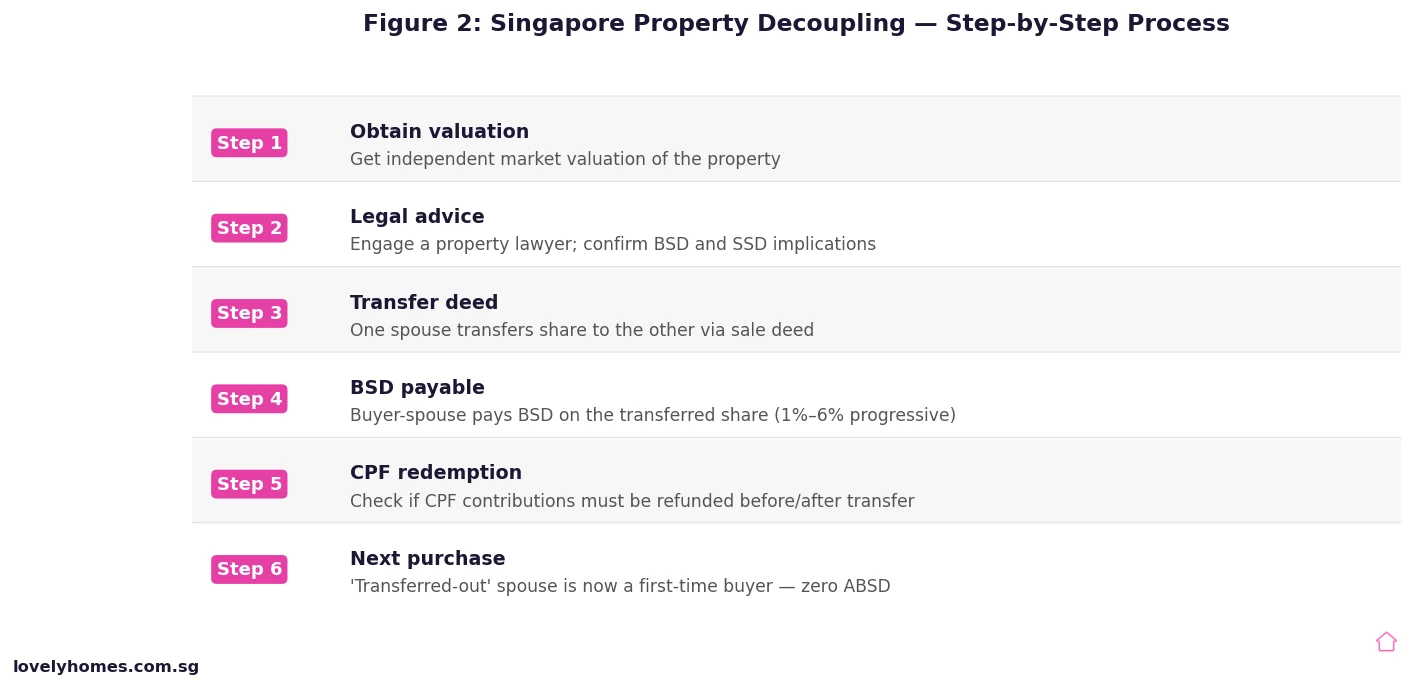
Singapore property decoupling process steps flowchart 2026
Figure 2: The decoupling process from valuation to next purchase. Each step has financial and legal implications that require professional advice.

The decoupling process involves several sequential steps, each with distinct financial implications:

  1. Get an independent valuation of the property. IRAS will assess BSD on the higher of sale price or market value — so establishing market value is the first priority. Valuation costs S$500–S$1,000 and should be done by a licensed valuer.
  2. Engage a property lawyer experienced in stamp duty and conveyancing. The lawyer will advise on the transfer structure, draft the sale and purchase agreement, and submit the stamped documents to the Singapore Land Authority (SLA).
  3. Assess CPF implications. If both spouses used CPF funds to purchase the property, both CPF accounts must be refunded (principal + accrued interest) when the property is partially transferred. The transferring spouse’s CPF must be refunded before or as part of the transaction. This can reduce the net proceeds available to the transferred-out spouse for their next purchase.
  4. Assess mortgage implications. If the property carries an outstanding mortgage, the bank must consent to the restructuring of the loan. The transferee spouse will now own 100% and must demonstrate they can service the full loan under TDSR (Total Debt Servicing Ratio) rules. If TDSR is breached, the bank may require partial loan repayment before consenting.
  5. Execute the transfer deed. The sale and purchase agreement is executed, BSD is paid on the transferred share, and the SLA is notified to update the title register.
  6. Transferred-out spouse is now a first-time buyer. Once the title is updated, they are free to purchase a new property without ABSD (as a SC first-time buyer).
Important: Decoupling does not happen overnight. Allow 4–8 weeks for the full process including valuation, legal drafting, bank consent, CPF adjustment, and SLA registration. Plan your next property purchase timeline accordingly — you cannot commit to a new OTP until the decoupling transfer is legally complete and registered.

What Does Decoupling Cost?

The primary cost of decoupling is BSD on the transferred share. BSD is calculated on the market value of the transferred share (e.g. 50% of the property’s value). The BSD rate schedule (effective from 20 February 2018) is progressive:

Property Value Band BSD Rate
First S$180,000 1%
Next S$180,000 2%
Next S$640,000 3%
Next S$500,000 4%
Next S$1,500,000 5%
Remainder 6%

For a 50% share in a S$2M property (share value: S$1M), the BSD is approximately:

  • 1% × S$180,000 = S$1,800
  • 2% × S$180,000 = S$3,600
  • 3% × S$640,000 = S$19,200
  • Total BSD ≈ S$24,600

Additional costs include legal fees (S$3,000–S$5,000), valuation fees (~S$800), and potentially bank refinancing fees if the mortgage is restructured.

Decoupling Worked Example: S$1.8M Condo, Buying a S$1.5M Next Property

Scenario: Married SC Couple, Both SC, Own One Property Jointly

Existing property: District 15 condominium, purchased in 2021 for S$1.6M, now worth S$1.8M. Jointly owned 50/50. Purchased more than 3 years ago (no SSD risk). Outstanding mortgage: S$900,000. Combined CPF used: S$200,000 (both must refund on any disposal).

Goal: Husband wants to buy a S$1.5M investment property. Without decoupling, he pays 20% ABSD = S$300,000.

Decoupling plan: Wife transfers her 50% share to husband. Wife becomes a first-time buyer for the next purchase.

Decoupling costs:
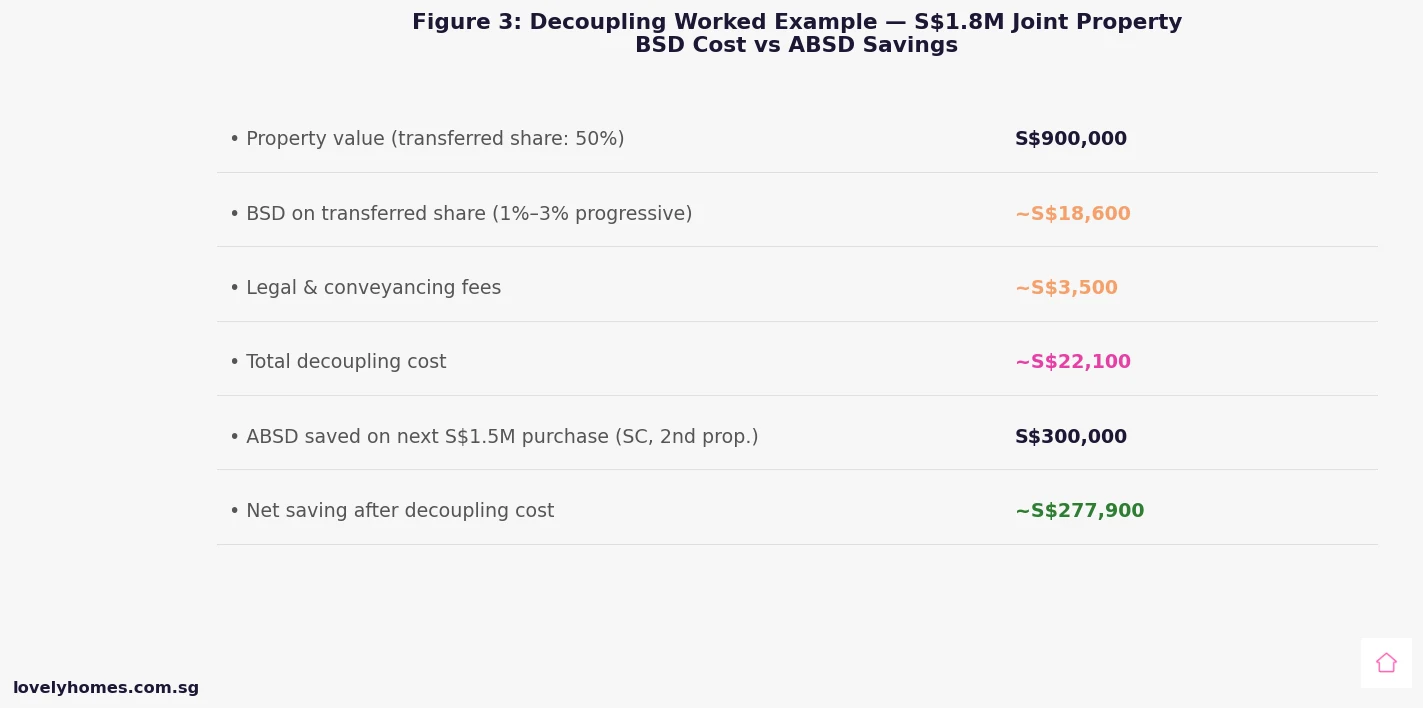
Share value: 50% × S$1,800,000 = S$900,000
BSD on S$900,000: ~S$18,600
Legal fees: ~S$3,500
Valuation: ~S$800
Total decoupling cost: ~S$22,900

Net result:
Husband owns 100% of existing property (TDSR reviewed — he can support the loan).
Wife’s CPF refunded — she receives cash/equity from transfer.
Wife buys the new S$1.5M property as a first-time SC buyer — ABSD = 0%.
ABSD saved: S$300,000.
Net saving after decoupling cost: ~S$277,100.

Scenario B — What if SSD applies? If the property had been purchased in 2024 (within 3 years), the transfer would attract SSD at 8% on the share value: 8% × S$900,000 = S$72,000. Total decoupling cost rises to ~S$94,900. Net ABSD saving: ~S$205,100 — still very significant, but considerably less attractive.

Property decoupling cost savings Singapore 2026 breakdown
Figure 3: Decoupling cost vs ABSD saving breakdown for an illustrative S$1.8M property. The strategy is most powerful when the existing property is beyond the 3-year SSD window.

The SSD Risk in Decoupling

The most significant financial risk in decoupling is Seller’s Stamp Duty (SSD). SSD applies to the disposing party — in a decoupling transfer, the spouse who sells their share may trigger SSD if the property was purchased less than three years ago.

SSD rates for residential property (from 1 January 2024): 12% within 1 year; 8% within 2 years; 4% within 3 years. Applied to the transfer price (or market value of the share, whichever is higher), SSD on a 50% share can amount to tens of thousands of dollars and significantly erode the ABSD savings.

Rule of thumb: Decoupling is financially viable only when the existing property is at least 3 years old (past the SSD window). If the property is newer, model both scenarios (with and without SSD) before proceeding.

What IRAS Says: Anti-Avoidance Provisions

IRAS is aware of decoupling as a stamp-duty planning strategy. Under Section 33A of the Stamp Duties Act, IRAS has the authority to disregard, vary, or counteract any arrangement that has the effect of reducing, avoiding, or postponing stamp duty that would otherwise be payable, where the arrangement lacks genuine commercial rationale.

To date, IRAS has not issued specific guidance declaring that all decoupling arrangements are impermissible. However, it has noted that each case is assessed on its facts. A decoupling that is clearly motivated purely by ABSD avoidance — with no other genuine reason for restructuring ownership — carries heightened scrutiny risk compared to one accompanied by legitimate estate planning, divorce proceedings, or business reorganisation rationale.

Practically, most lawyers advise documenting a genuine commercial rationale (e.g. the transferred-out spouse needs to purchase a property for a specific purpose, or the couple is restructuring their estate planning) alongside any decoupling transaction. Purely mechanical ABSD-motivated transfers, especially when immediately followed by a new property purchase, are more likely to attract IRAS review.

Legal caution: IRAS’ anti-avoidance powers are broad. While decoupling remains legal and is widely practised, the risk of IRAS challenge is real. Always obtain written legal advice specific to your circumstances before proceeding. This article is general information only.

What Might Change: Future Regulatory Risk

The following is editorial analysis, not official policy.

The government has periodically tightened the ABSD regime when it judged that property market conditions warranted it. Decoupling, as a legal strategy that effectively reduces the ABSD burden on household property accumulation, sits in a policy grey area. As ABSD rates have increased significantly (SC second-property rate: 3% in 2011 → 7% in 2013 → 12% in 2018 → 17% in 2022 → 20% in 2023), decoupling has become more financially attractive — which means it attracts more policy attention.

Two potential regulatory changes are worth monitoring:

  • Household-level ABSD assessment: IRAS could assess ABSD based on the total number of properties owned by a household (both spouses combined) rather than individually. This would eliminate the core mechanism behind decoupling.
  • Stamp duty on transfers between related parties: A future rule could impose ABSD on transfers between spouses where the transferee is a first-time buyer purchasing within a defined period after the transfer.

Neither change has been announced, and the government has reiterated its general policy of not pre-announcing cooling measures. Property buyers considering decoupling should seek current legal advice rather than relying on the current regulatory framework persisting indefinitely.

Frequently Asked Questions About Property Decoupling

Can I decouple an HDB flat?

No. HDB flat ownership is governed by HDB rules which do not permit partial transfers to convert one owner into a first-time buyer for ABSD purposes. HDB regulations require that any flat transfer (including divorce-related transfers) must comply with strict eligibility criteria, and the result would still be treated as an HDB-flat ownership for ABSD purposes. Decoupling is only available for private residential property and Executive Condominiums (ECs) that have fulfilled their minimum occupation period (MOP) and crossed into the private market.

Does my CPF have to be refunded when I transfer my share?

Yes. When the transferring spouse sells or transfers their share in the property, any CPF funds they used (both the principal and accrued interest at the CPF Ordinary Account rate) must be refunded to their CPF account. This is not optional — the CPF Board requires the refund as a condition of releasing the property’s CPF charge. The cash available to the transferred-out spouse after decoupling is reduced by the amount they must refund to their own CPF. They can then use those CPF funds again for the next property purchase.

Is decoupling legal?

Yes, decoupling is a legal strategy under Singapore law. There is no legislation that expressly prohibits the transfer of a property share between co-owners for the purpose of ABSD planning. However, IRAS has anti-avoidance powers under Section 33A of the Stamp Duties Act, which allows it to disregard arrangements that lack genuine commercial rationale and are structured purely for tax avoidance. In practice, decoupling transactions accompanied by genuine commercial or personal rationale and properly documented are generally completed without IRAS challenge. This does not mean the risk is zero — it is advisable to obtain legal and tax advice before proceeding.

What if my bank doesn’t agree to the restructuring?

Bank consent is required because the mortgage is a charge over the entire property, and restructuring ownership changes the borrower profile. Banks will assess whether the remaining borrower (the transferee spouse) can service the full loan under Total Debt Servicing Ratio (TDSR) rules — currently 55% of gross monthly income. If the transferee cannot meet TDSR on their own, the bank may require partial loan repayment, a guarantor, or may decline the restructuring. It is critical to model the TDSR position before committing to decoupling, as a bank refusal after legal fees are incurred can be costly.

Can the transferred-out spouse buy the next property immediately?

The transferred-out spouse can technically commit to a new Option to Purchase (OTP) as soon as the decoupling transfer is legally registered with the Singapore Land Authority (SLA). Practically, this means waiting 4–8 weeks for the full decoupling process to complete. Committing to a new OTP before the SLA registration is complete creates risk — if the decoupling fails or is delayed, the buyer could be in breach of the new OTP. Always ensure decoupling registration is confirmed before signing a new OTP.

Does decoupling work for Executive Condominiums (ECs)?

Yes, but only after the EC has fulfilled its 10-year restriction period (when it becomes fully privatised) and both the MOP (5 years from key collection) and the additional privatisation lock-in are passed. During the MOP or private-restricted period, EC resale and transfers are restricted to Singapore Citizens and Permanent Residents who meet HDB eligibility criteria, making decoupling effectively unavailable. After full privatisation, an EC is treated as private property for stamp duty purposes and decoupling works the same way as for any private condominium.

What is the difference between decoupling and a divorce settlement?

Both involve transferring property ownership between spouses, but the context, process, and tax treatment differ. Decoupling is a voluntary, commercially-negotiated transaction that attracts BSD and potentially SSD. A divorce-related property transfer made pursuant to a court order may be eligible for stamp duty remission or exemption under IRAS’ family law provisions — though this is assessed case by case and is not automatic. Attempting to use a legal separation or divorce purely as a stamp-duty vehicle is likely to attract IRAS scrutiny and is not recommended. Genuine divorce-related transfers should be handled by a family lawyer who can advise on both matrimonial law and stamp duty implications simultaneously.

Disclaimer: This article is for general informational purposes only and does not constitute legal, tax, or financial advice. Stamp duty rules, ABSD rates, and anti-avoidance provisions may change without notice. Property decoupling involves complex legal, tax, CPF, and mortgage considerations. Always obtain independent advice from a qualified property lawyer and tax adviser before proceeding with any property ownership restructuring. LovelyHomes is not a licensed financial adviser or property agent. Official information is available from IRAS, CPF Board, and the Monetary Authority of Singapore (MAS).


Translate »