Novena Neighbourhood Guide Singapore 2026: D11 Medical Hub, Prices & Investment Outlook

Novena Neighbourhood Guide Singapore 2026: D11 Medical Hub, Prices & Investment Outlook

⚡ Quick Answer: Novena Neighbourhood D11 at a Glance

  • District 11 (D11) — Newton and Novena planning areas in the Core Central Region (CCR). Almost entirely private residential.
  • Freehold condos average S$2,600–3,200 psf in Q1 2026; 99-year leasehold condos range from S$2,100–2,600 psf.
  • Medical hub demand: Mount Elizabeth Hospital, Mount Elizabeth Novena Hospital, and Tan Tock Seng Hospital (TTSH) generate sustained rental demand from healthcare professionals and medical tourists.
  • MRT connectivity: Novena (North South Line) and Newton (NSL + Downtown Line) provide direct access to Raffles Place, Marina Bay, and Orchard Road.
  • Gross rental yield: approximately 2.5%–3.2% for condos, comparable to other prime CCR districts.
  • Supply constraint: no new Government Land Sales (GLS) sites have been released in D11 since 2019, reinforcing price resilience for existing freehold stock.
  • Ideal buyer: upgraders, medical professionals, expatriate tenants, long-term capital preservation investors.

What Makes Novena Singapore’s Medical Hub Precinct?

Novena sits within District 11 — one of Singapore’s most established and tightly held residential precincts. Bounded roughly by Thomson Road to the north, Bukit Timah Road to the west, Newton Circus to the south, and Balestier Road to the east, D11 is home to a cluster of private hospitals that is unmatched anywhere else on the island. Mount Elizabeth Hospital on Orchard Road, its sister facility Mount Elizabeth Novena Hospital on Novena Rise, and Tan Tock Seng Hospital on Moulmein Road together form Singapore’s largest private medical hub. This concentration of world-class healthcare institutions is not just a lifestyle amenity — it is a structural driver of residential demand.

Medical professionals, hospital support staff, and visiting doctors on short-term rotations all need housing within comfortable distance of these facilities. International patients and their families, many from across Southeast Asia, the Middle East, and China, often prefer to base themselves in Novena rather than Orchard so they can be close to treatment. The result is a rental market that is unusually resilient even during broader property downturns, because hospital activity does not follow the economic cycle in the same way that corporate leasing does.

Beyond healthcare, Novena offers the quiet residential character of the old Central Region without the intensity of Orchard Road. United Square on Thomson Road is Singapore’s best-known education mall, drawing families with school-age children. Novena Square 1 and 2 and Square 2 along Thomson Road provide everyday retail and dining. St. Joseph’s Institution International, Anglo-Chinese School (Primary), and the Singapore Chinese Girls’ School are all within close proximity, adding an education premium on top of the medical one.

D11 Property Price Ranges — What Buyers Pay in 2026

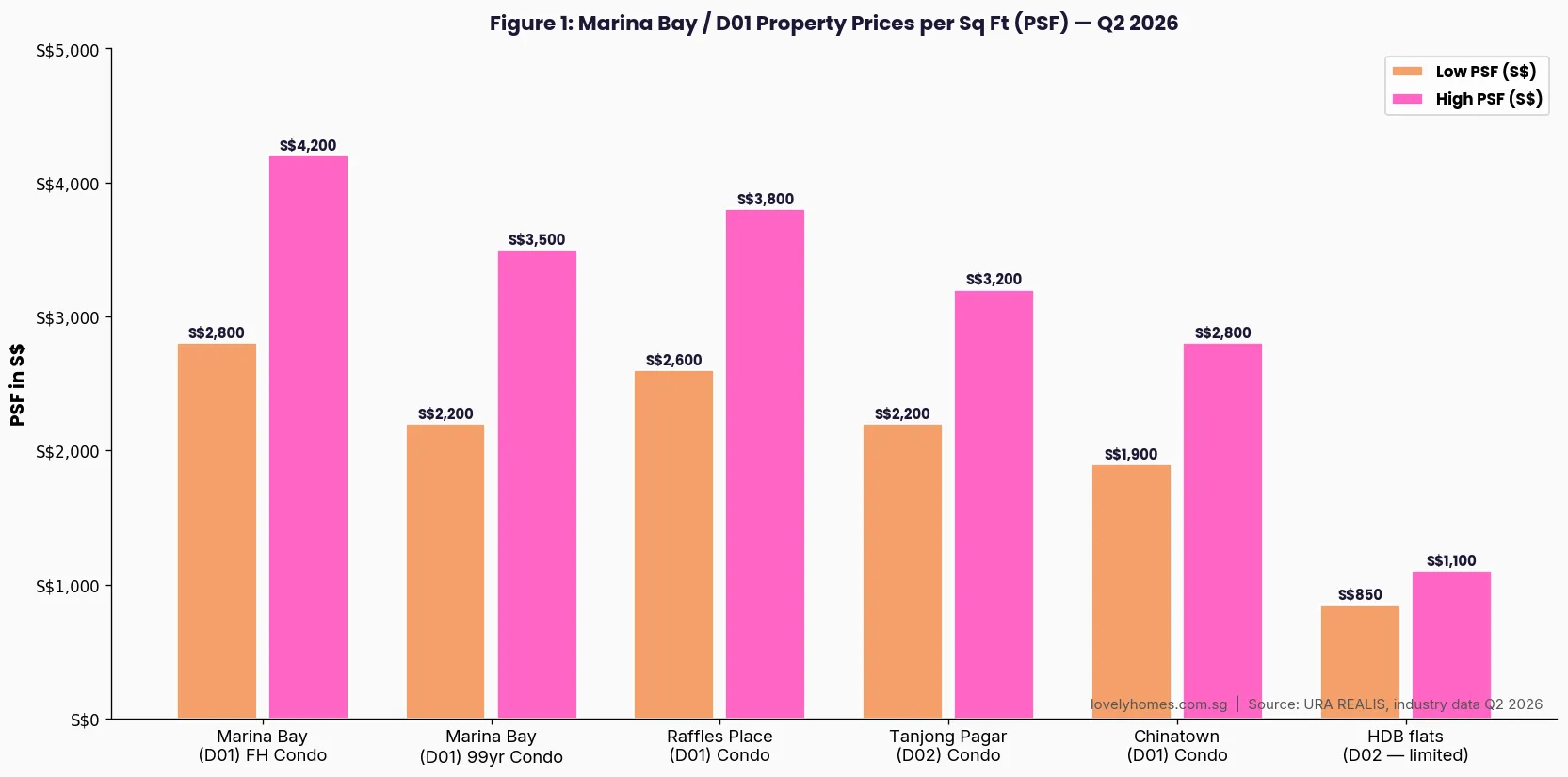
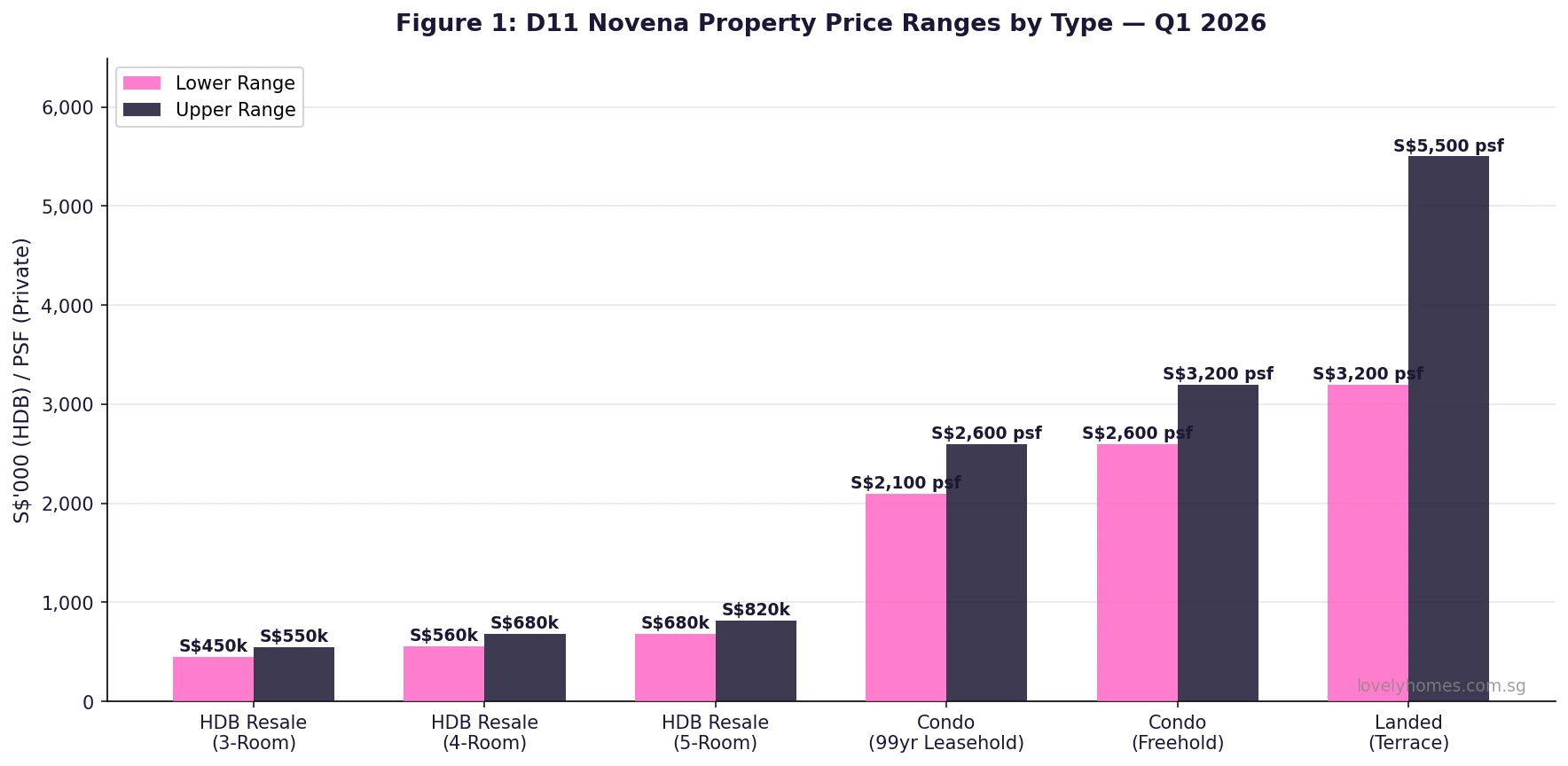
D11 Novena property price ranges by type Q1 2026 — HDB resale and condo PSF bar chart

Figure 1: D11 Newton/Novena residential property price ranges by type — Q1 2026. HDB resale figures reflect fringe estates (Moulmein/Thomson). Sources: URA REALIS, HDB Resale Portal Q1 2026.

District 11 is overwhelmingly private residential. The handful of HDB resale flats that fall within or immediately adjacent to the planning area — mainly in the Moulmein and Newton fringe — transact at a premium to equivalent flat types elsewhere, given their central address. A 4-room HDB resale in this catchment has fetched S$560,000–680,000 in Q1 2026, reflecting the locational scarcity: only a few hundred HDB flats exist across the entire D11 footprint.

The dominant residential product in D11 is the private condo. Freehold condos — which make up the majority of stock given the age of development — have held between S$2,600 and S$3,200 psf in Q1 2026. Key developments such as City Square Residences (freehold, Kitchener Road), Novena Regency (freehold, Thomson Road), and The Trizon (freehold, off Mount Sinai) sit in this range. Newer 99-year developments have traded at a 15–20% discount to equivalent freehold stock, at S$2,100–2,600 psf, reflecting the leasehold haircut that remains deeply ingrained in Singapore buyer psychology.

Landed property in D11 — predominantly terrace and semi-detached houses in the Upper Thomson and Spring Road areas — commands S$3,200–5,500 psf on land area depending on remaining lease, configuration, and orientation. Good Class Bungalow (GCB) plots in the adjacent Ridout Road and Nassim areas start well above S$15 million for eligible parcels.

Property Type Typical Size Price From Price To Notes
HDB Resale (3-Room) 65–70 sqm S$450,000 S$550,000 Moulmein/Newton fringe only
HDB Resale (4-Room) 90–100 sqm S$560,000 S$680,000 Moulmein/Newton fringe only
Condo 1-Bed (FH) 45–55 sqm S$1,200,000 S$1,600,000 Strong rental demand from medical staff
Condo 2-Bed (FH) 75–95 sqm S$1,700,000 S$2,400,000 Most liquid unit type in D11
Condo 3-Bed (FH) 120–150 sqm S$2,800,000 S$4,200,000 Family-friendly, education catchment
Landed Terrace (FH) 150–200 sqm land S$3,200 psf land S$5,500 psf land Only Singapore Citizens eligible

Location and Connectivity: MRT, TEL and Road Networks

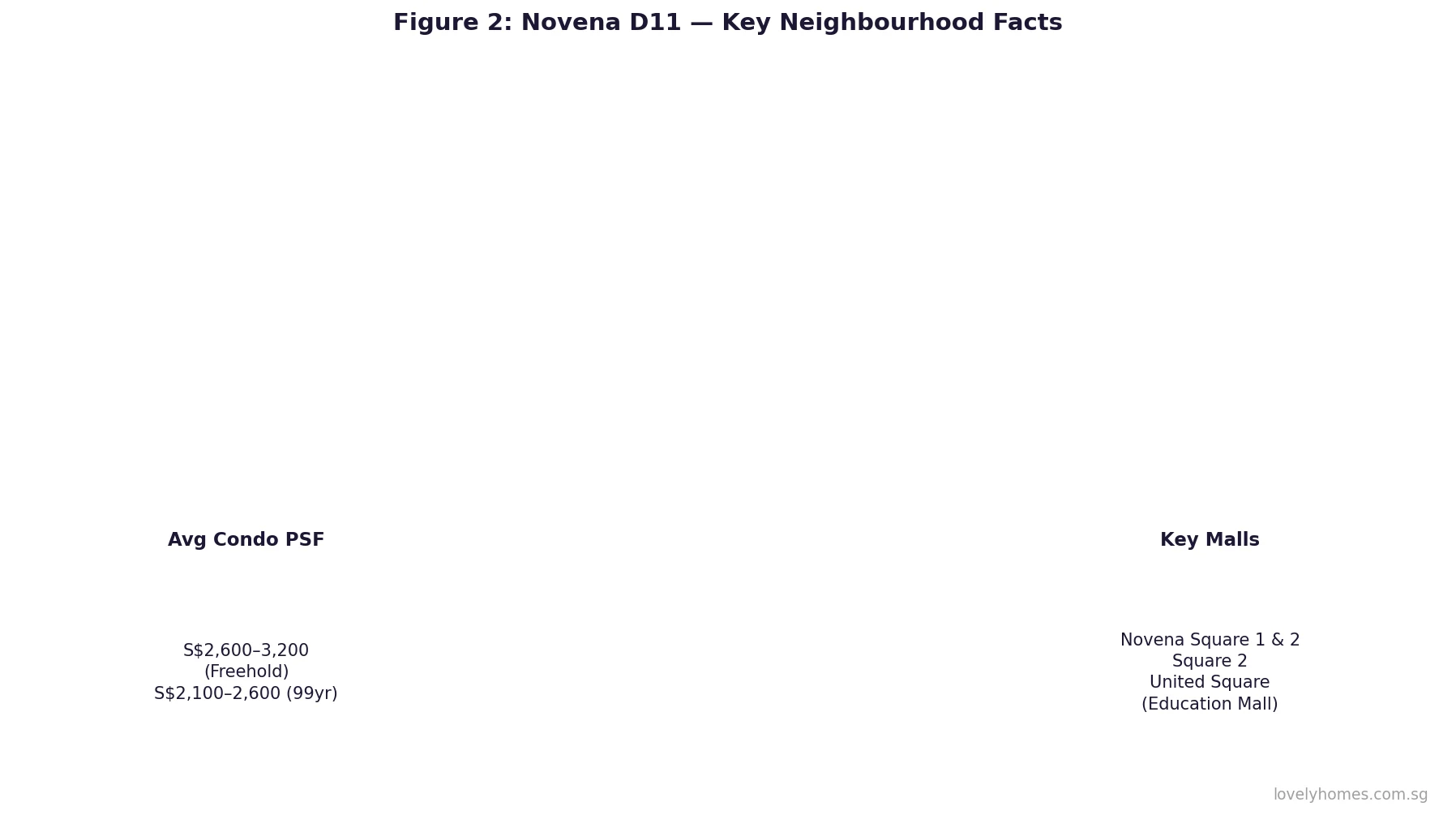
Novena neighbourhood key facts 2026 — district D11 MRT lines medical hub condo yields and malls

Figure 2: Novena D11 — key neighbourhood facts for property buyers and investors, 2026.

Novena station on the North South Line (NSL) gives residents a 4-minute train ride to Toa Payoh and a 6-minute ride to Orchard. Newton interchange station — one of only five interchange stations on the NSL — connects to the Downtown Line (DTL), enabling direct access to Buona Vista, one-north, and the Botanic Gardens without a transfer. Journey times to Raffles Place run at approximately 13–15 minutes, making D11 one of the best-connected residential precincts for CBD workers in Singapore.

The Thomson-East Coast Line (TEL) has further enhanced D11’s connectivity position without D11 itself sitting on the new line. Stevens interchange (TEL + DTL, opened December 2022) is a 5-minute drive or short bus ride from Novena, linking residents to TE1 (Woodlands North) and the full TEL corridor south through Stevens, Napier, Orchard Boulevard, and Orchard into the eastern spine. For Novena residents, TEL Stage 4’s opening in 2024 — connecting Founders’ Memorial, Tanjong Rhu, and the East Coast corridor — extended journey time savings for those commuting eastward.

By road, the Central Expressway (CTE) entrance at Moulmein Road provides fast north-south access. The Pan Island Expressway (PIE) junction at Adam Road is under 10 minutes from Novena. These road links are especially valued by residents who need to reach Changi Airport, the western industrial corridor, or the north.

The Medical Hub Premium: Why Hospitals Drive Novena Property Values

Singapore’s position as Southeast Asia’s foremost medical tourism destination directly benefits D11 landlords. Mount Elizabeth Novena Hospital — a 333-bed private tertiary hospital opened in 2012 by Parkway Pantai — anchors the Novena Specialist Centre cluster along Irrawaddy Road, home to more than 200 specialist clinics. Tan Tock Seng Hospital, Singapore’s second-largest public acute care hospital with approximately 1,700 beds, generates thousands of shift-based healthcare workers who need residential options within cycling or walking distance.

The practical implication is a rental market that outperforms broader D11 yield expectations in the sub-S$5,000/month segment. A typical 1-bedroom freehold condo (50–55 sqm) in Novena commands S$3,800–4,500/month, yielding approximately 2.8–3.2% gross on an acquisition cost of S$1.4–1.6 million. Two-bedroom units (80–95 sqm) attract medical families and senior specialists, renting at S$5,500–7,000/month for a gross yield of 2.5–3.0% on a S$2.0–2.4 million entry price.

This yield compression relative to fringe districts reflects the capital value premium commanded by CCR freehold stock — buyers are partly paying for capital preservation and the scarcity of new supply, not just income return. Investors who entered D11 between 2017 and 2020 and chose freehold units are now sitting on total returns (rental + capital appreciation) of approximately 30–45% over six years, comfortably outperforming CPF Ordinary Account returns and most balanced investment portfolios.

D11 Condo Price Trend 2019–2026

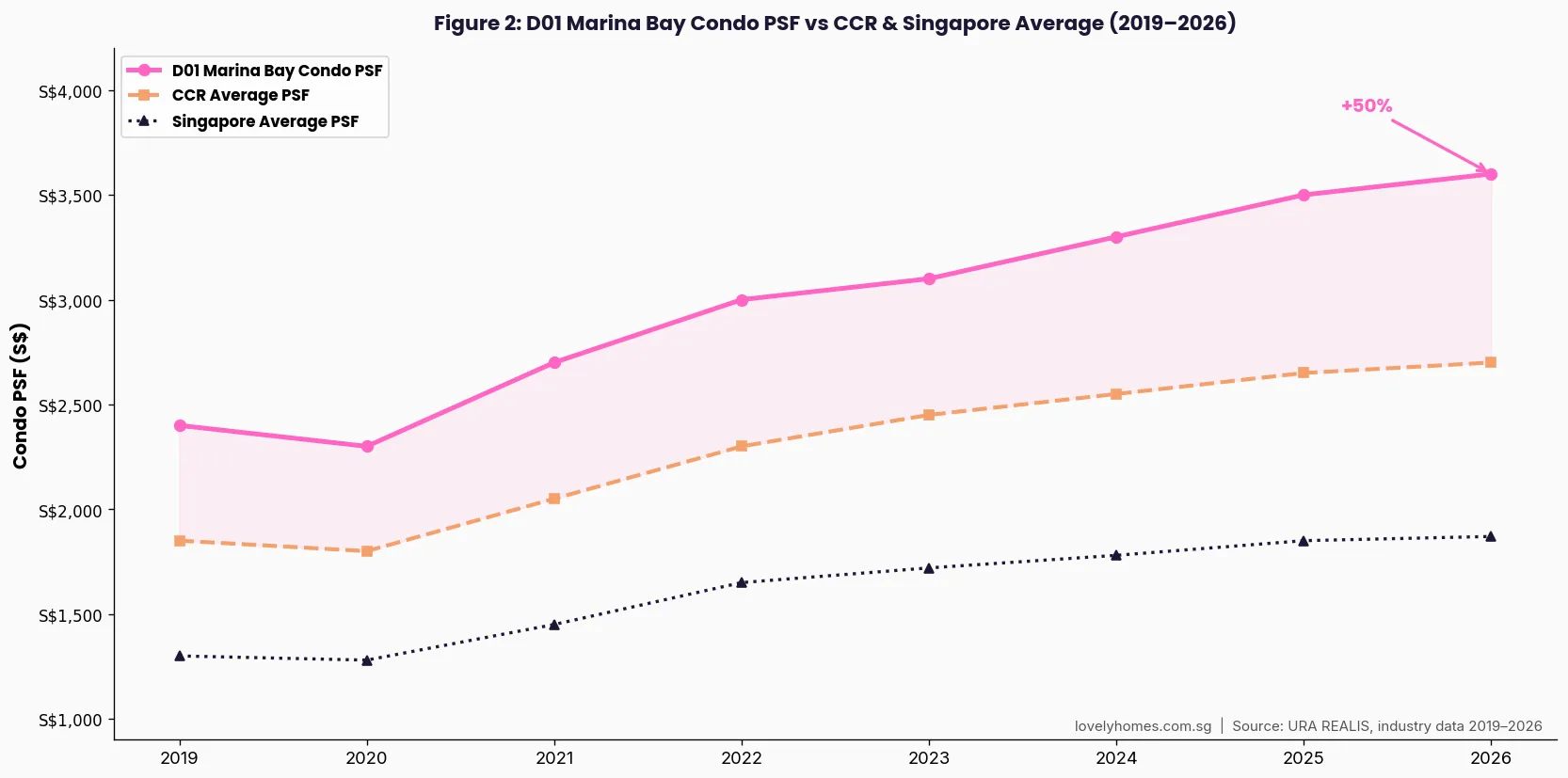
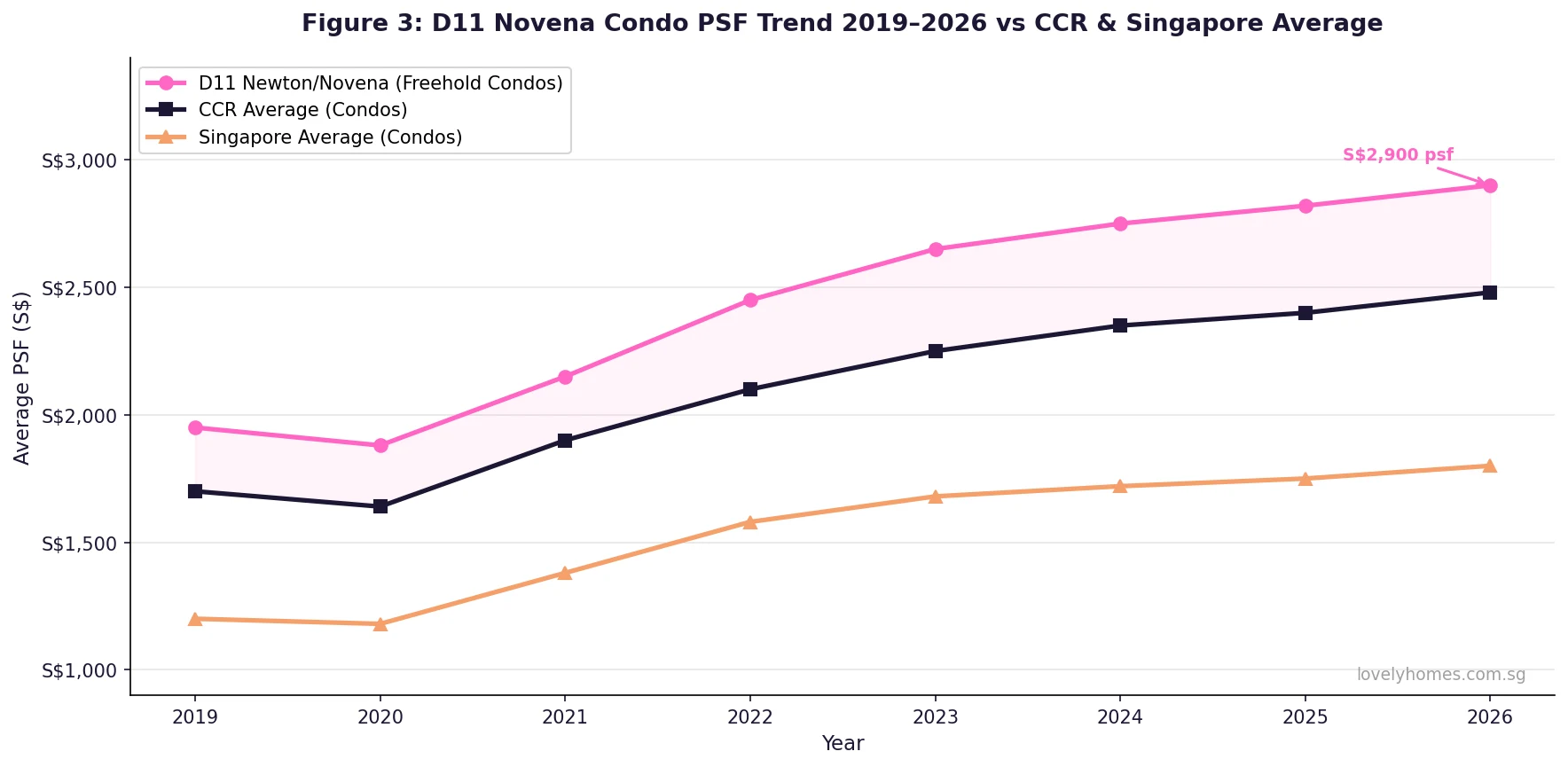
D11 Novena condo PSF trend 2019 to 2026 versus CCR and Singapore average line chart

Figure 3: D11 Newton/Novena average condo PSF trend 2019–2026 versus CCR and Singapore overall average. Source: URA REALIS, LovelyHomes analysis.

The chart above illustrates D11’s trajectory over the past seven years. Starting from roughly S$1,950 psf in 2019, freehold D11 condos contracted slightly during the pandemic-affected 2020 period before recovering strongly through 2021–2022 on the back of Singapore’s post-Covid reopening and a structural shift in buyer demand toward quality freehold assets. By 2023, D11 average freehold condo PSF had crossed S$2,600 psf for the first time. The 2022 and 2023 ABSD increases tempered transaction volumes — particularly for foreigners and second-property buyers — but did not dent per-unit pricing meaningfully, as supply in D11 is too constrained for any oversupply dynamic to emerge.

The shaded pink band in Figure 3 represents the D11 freehold premium over the broader CCR average. This premium has widened from approximately S$250 psf in 2019 to over S$420 psf in Q1 2026, reflecting both the structural scarcity of freehold stock in D11 and growing buyer preference for fully private, low-density living with minimal commercial encroachment.

Worked Example: Buying a 2-Bedroom Freehold Condo in Novena

📋 Case Study: Mr & Mrs Lee (SC/SC) — 2-Bed Freehold Condo, Novena, S$2,100,000

Profile: Singapore Citizens, first property purchase for both, combined gross income S$14,000/month. Buying a 2-bedroom freehold condo in Novena at S$2,100,000 for owner-occupation, no existing properties.

  • ABSD: S$0 (SC buying first residential property — no ABSD)
  • BSD (Buyer’s Stamp Duty):
    • 1% on first S$180,000 = S$1,800
    • 2% on next S$180,000 = S$3,600
    • 3% on next S$640,000 = S$19,200
    • 4% on next S$500,000 = S$20,000
    • 5% on next S$600,000 = S$30,000 (i.e. 2,100k less 1,500k threshold)
    • Total BSD: S$74,600 (effective 3.55%)
  • Loan: 75% LTV = S$1,575,000. At 3.5% p.a. over 25 years → monthly repayment ≈ S$7,882
  • TDSR check: S$7,882 / S$14,000 = 56.3% — exceeds the 55% TDSR limit. FAIL.
  • Resolution: Increase down payment to 35% (S$735,000), reducing loan to S$1,365,000 (65% LTV). Monthly repayment ≈ S$6,830. TDSR = 48.8% — PASS.
  • Or: Look at 99yr leasehold option at S$1,750,000 — TDSR at 75% LTV = S$6,568/mth = 46.9% — PASS with standard down payment.
  • Total upfront (with increased 35% down payment + BSD + legal fees ~S$8,000): approximately S$817,600

This example illustrates that D11 freehold condos at S$2M+ often push buyers to the TDSR boundary. Buyers with household income below S$13,000/month should model carefully before committing to prime CCR property at full 75% LTV.

What This Means for You: Investment Outlook for Novena 2026

D11’s investment case rests on three pillars: supply scarcity, institutional demand from the medical cluster, and the freehold tenure of the majority of its stock. No new GLS residential sites have been released in D11 since 2019, and URA’s long-term planning approach for the Novena area — classified as a Medical and Healthcare Hub in the 2019 Concept Plan — is to intensify medical uses rather than add residential supply. This means existing condo owners benefit from a structurally undersupplied rental market.

Peer-country comparison is instructive: Singapore’s medical tourism arrivals have recovered to pre-2020 levels and are projected to grow at 6–8% per year through 2030, according to Singapore Tourism Board data. Bangkok’s Sukhumvit medical precinct and Kuala Lumpur’s Bangsar medical cluster — both D11 comparators — trade at significantly lower absolute values but have shown similar rental demand dynamics when anchored by hospital clusters.

The 2023 ABSD increase to 20% for Singapore Citizens purchasing their second property has been the primary headwind, reducing the pool of upgrader-investors who would previously have held a D11 condo as a rental asset. However, institutional landlords, family offices, and HNW individuals — many of whom hold D11 property through structures exempt from or partially insulated from ABSD — have partially absorbed this demand withdrawal. Transaction volumes in D11 are lower than 2021–2022 peaks but prices have held firm.

For owner-occupiers, Novena remains one of Singapore’s best-value CCR living addresses on a “livability per dollar spent” basis: lower psf than Orchard/River Valley (D09/D10), with arguably better day-to-day amenities (healthcare, education, F&B) and equivalent MRT connectivity. First-time buyers with sufficient income ($13,000+/month household) priced out of Orchard condos will increasingly look to D11 freehold units as a value entry point into the CCR.

What Might Come Next for Novena?

URA’s Draft Master Plan 2025 (public consultation 2025–2026) has not released any residential-zoned GLS parcels within D11. The long-term direction for Novena is healthcare intensification: the Novena Health City vision positions the precinct as a full-service integrated medical district, with possible expansion of outpatient facilities and specialist centres along Irrawaddy Road and Balestier. Any rezoning of existing commercial or industrial sites in the area for residential use would be a meaningful catalyst — but industry observers see this as unlikely before 2030.

In the shorter term, the broader TEL completion in 2025 (Stages 4–5) and the continued growth of the Cross Island Line (CRL) network — which brings better connectivity to D11 feeder suburbs — are expected to sustain buyer appetite for CCR property including D11. If Singapore’s government chooses to recalibrate ABSD for second properties (reducing the 20% SC rate) as part of a future cooling-measures review, D11 would be among the prime beneficiaries given its investor-grade stock base.

Frequently Asked Questions: Buying Property in Novena

Are there HDB flats available in Novena for purchase?

Very few. D11 is almost entirely private residential, with only a small number of HDB resale flats in the Moulmein and Thomson fringe of the district. Buyers seeking public housing close to D11 typically look at nearby Toa Payoh (D12) or Novena-adjacent blocks in Moulmein Road. There are no BTO launches planned for D11 given the Master Plan’s designation of the area as a Medical and Healthcare Hub.

Can foreigners buy property in Novena?

Foreigners (non-Singapore Citizens and non-Permanent Residents) may purchase private condominiums (strata-titled, non-landed) in D11, including Novena, subject to paying Additional Buyer’s Stamp Duty (ABSD) of 60% on the purchase price as of April 2023. Landed property in D11 is restricted to Singapore Citizens only, with limited exceptions requiring Singapore Land Authority (SLA) approval for Permanent Residents in non-GCB landed categories.

What is the ABSD rate for a second property purchase in Novena?

As at 1 July 2026, a Singapore Citizen purchasing a second residential property pays ABSD of 20% on the purchase price. A Permanent Resident buying a first property pays 5% ABSD. A foreign buyer pays 60%. There is no ABSD for a Singapore Citizen purchasing their first residential property. For a D11 condo priced at S$2.0 million, the ABSD for a SC second-property purchase would be S$400,000 — a significant holding cost that most investors factor into their return model before committing.

What is the typical rental yield for condos in Novena?

Gross rental yields for condominiums in D11 Newton/Novena typically range from 2.5% to 3.2% per year in 2026, depending on unit size, floor level, and age of development. Smaller 1-bedroom units (45–55 sqm) tend to achieve the highest yields (2.9–3.2%) due to strong demand from single medical professionals, while larger 3-bedroom family units yield closer to 2.5% gross. Net yields after maintenance fees, property tax, and agent fees are typically 0.5–0.8% lower than gross.

What is the Minimum Occupation Period (MOP) for a condo in D11?

Private condominiums do not have a Minimum Occupation Period (MOP) requirement. Only HDB flats are subject to MOP (5 years for Standard flats, 10 years for Prime and Plus BTO flats). Private condo owners may rent out their unit from day one of ownership, provided they comply with URA tenancy regulations including the 3-month minimum rental period. This makes D11 condos immediately income-generating for buyers who intend to lease the property out.

How does Novena compare to Orchard Road (D09/D10) for property investment?

Novena (D11) generally offers lower entry prices than Orchard (D09) and River Valley (D10) at equivalent quality levels, with freehold condos in D11 averaging S$2,600–3,200 psf versus D09/D10 freehold at S$3,200–4,500 psf. Rental yields are comparable (2.5–3.2% across both zones). D11 benefits from the medical hub demand driver, which is more stable than the expatriate corporate demand that historically underpinned D09/D10 rentals. Buyers seeking CCR exposure with lower absolute outlay and a differentiated demand driver typically favour D11 over D09/D10.

Is Novena suitable for families with school-age children?

Yes — D11 is one of Singapore’s best-positioned districts for families prioritising education access alongside healthcare. Anglo-Chinese School (Primary) is located off Barker Road within the district. The Singapore Chinese Girls’ School (SCGS) is on Emerald Hill in adjacent D10. St. Joseph’s Institution International (SJI International) on Malcolm Road serves the international school market. United Square on Thomson Road is Singapore’s premier education-focused mall, housing enrichment centres, tuition providers, and learning-focused retail. Proximity to the Botanic Gardens (5 minutes by car) adds park space for families.

Related Articles

Disclaimer: This article is for general information purposes only and does not constitute financial, legal, or property advice. Property prices, stamp duty rates, HDB eligibility rules, and mortgage terms are subject to change. All figures cited are indicative based on publicly available URA REALIS data and industry analysis as at Q1/Q2 2026. Readers should verify current rules with the Urban Redevelopment Authority (ura.gov.sg), Housing & Development Board (hdb.gov.sg), Inland Revenue Authority of Singapore (iras.gov.sg), and seek advice from a licenced property agent, mortgage broker, and solicitor before making any property transaction decision.

Singapore Prime District Property Guide 2026: D9, D10 and D11 Complete Buyer’s Guide

Singapore Prime District Property Guide 2026: D9, D10 and D11 Complete Buyer’s Guide

⚡ Quick Answer — Singapore Prime District Property 2026

  • Prime district refers to Districts 9, 10 and 11 — Singapore’s Core Central Region (CCR), covering Orchard, River Valley, Bukit Timah, Holland Village, Newton and Novena.
  • Prices range from approximately S$2,200 to S$5,500 psf for non-landed condominiums; Good Class Bungalows (GCBs) in D10 can exceed S$3,500 psf or S$30–S$65M per plot.
  • ABSD for foreigners buying in prime districts is 60% on residential property — making CCR far more expensive for non-Singapore Citizens than OCR or RCR alternatives.
  • CCR price growth since 2018 is +40% (URA PPI), lagging OCR’s +73% — but CCR’s rental yields (2.5–3.8%) and tenant quality (expats, HNW individuals) remain superior.
  • No ABSD exemption for prime districts specifically — buyer profile (SC, PR, foreigner) determines ABSD, not location.
  • Bank loans only for prime condos above S$4M; TDSR 55% applies; most buyers will need 25–40% cash/CPF downpayment.
  • Rental demand remains strong: D9/D10/D11 house the bulk of Singapore’s international community and senior expatriate workers.

What Are Singapore’s Prime Districts?

When property professionals and analysts refer to “prime” residential property in Singapore, they mean Districts 9, 10 and 11 — three postal districts that together constitute the Core Central Region (CCR) residential belt. Administered under Singapore’s Urban Redevelopment Authority (URA) planning framework, the CCR is distinguished by its central location, high land values, superior amenity density and a tenant pool dominated by international businesses, embassies and high-net-worth individuals.

District 9 covers Orchard Road, River Valley, Cairnhill, Killiney and the Somerset corridor — Singapore’s retail and entertainment spine. District 10 encompasses Bukit Timah, Holland Road, Holland Village, Balmoral, Tanglin and the Good Class Bungalow (GCB) enclave of Nassim Road and Dalvey Estate. District 11 spans Newton, Novena, Thomson, Moulmein and the Dunearn Road corridor — a quieter, hospital-cluster area with strong medical professional demand. Together, these three districts contain some of Singapore’s most prestigious addresses, and set the benchmark against which all other residential property is measured.

This guide covers what you need to know in 2026: current prices by type and district, URA price index trends, stamp duty calculations by buyer profile, financing constraints, rental dynamics, and a full worked example for a Singapore Citizen purchasing a S$3.5M D10 condominium.

Singapore prime district PSF price ranges 2026 — D9, D10, D11 residential and landed property per square foot
Figure 1: Prime district price per square foot ranges 2026 — D9 (Orchard/River Valley), D10 (Bukit Timah/Holland), D11 (Newton/Novena) for non-landed condominiums and landed housing. Source: URA REALIS, LovelyHomes research.

District 9 — Orchard and River Valley: Singapore’s Glamour Belt

District 9 commands the highest non-landed residential values in Singapore outside of Sentosa Cove. The Orchard Road corridor — stretching from Tanglin Mall to Plaza Singapura — anchors the district’s commercial identity, while the River Valley residential enclave (along River Valley Road, Kim Seng Road and Great World City) offers a slightly less frantic but equally prestigious residential address. Key developments in D9 include the freehold Ardmore Park (Scotts Road, ~S$4,200–5,500 psf), Claymore Connect, Cairnhill 16, and newer launches such as Haus on Handy and Orchard Sophia.

As at Q1 2026, URA REALIS data shows median non-landed transacted prices in D9 at approximately S$3,100–3,800 psf for newer freehold units and S$2,400–2,900 psf for 999-year leasehold or older freehold stock. Rental yields in D9 average 2.8–3.6% gross, supported by demand from multinational executives, banking professionals and the region’s diplomatic community. Studio and 1-bedroom units (400–700 sqft) targeting single expatriates rent for S$5,500–9,000 per month; 3-bedroom units (1,200–1,600 sqft) command S$8,000–14,000 per month in prime D9 buildings.

District 10 — Bukit Timah and Holland Village: GCBs and the Green Corridor

District 10 is arguably Singapore’s most prestigious postal district by land value and per-plot price. The Good Class Bungalow (GCB) Areas — including Nassim Road, Dalvey Estate, Swettenham Road, Ford Avenue and Bin Tong Park — are restricted to Singapore Citizens and house some of Singapore’s wealthiest individuals. GCBs in D10 have transacted at S$3,000–9,000 psf on land area, with entire plots changing hands at S$15M–S$65M. Under URA rules, GCBs must have a minimum land area of 1,400 sqm; demolition and rebuild is common, driving construction activity even in established enclaves.

For non-landed condominiums, D10 offers a range from established projects such as One Holland Village Residences (Holland Village MRT, ~S$3,100–3,600 psf), Leedon Green (Farrer Road, S$2,600–3,000 psf freehold), The Grange (S$3,000–3,500 psf) and boutique developments along Bukit Timah Road. The recently awarded Holland Plain GLS site (Sim Lian, S$1,491 psf ppr, April 2026) is expected to launch in Q3–Q4 2027 at indicative prices of S$3,100–3,800 psf, reinforcing D10’s CCR premium.

Proximity to international schools — United World College of South East Asia (UWCSEA), Anglo-Chinese School (International) and Tanglin Trust School — makes D10 especially attractive for families with school-age children. This factor consistently underpins rental demand even during market downturns.

District 11 — Newton and Novena: Medical Hub and Quiet Prestige

District 11 occupies the northern edge of the CCR belt, anchored by the Novena medical cluster (Tan Tock Seng Hospital, Mount Elizabeth Novena, KK Women’s and Children’s Hospital) and the Thomson/Newton MRT interchange. It is quieter and less trophy-centric than D9/D10, making it attractive to medical professionals, senior expats and buyers seeking CCR addresses at a slight PSF discount relative to Orchard or Bukit Timah.

Key non-landed developments in D11 include Pullman Residences (Newton Road, ~S$3,000–3,400 psf), The Atelier (Makeway Avenue, ~S$2,400–2,900 psf), and older leasehold stock along Thomson Road and Balestier. The Thomson-East Coast Line’s Stage 4 (TEL4) with Novena, Newton and Stevens stations puts D11 on Singapore’s most comprehensive transit corridor. Gross rental yields for D11 condominiums average 2.5–3.2%, with studios at S$3,800–5,500/month and 3-bedrooms at S$7,000–11,000/month.

District Coverage Area Non-Landed PSF Range (2026) Landed / GCB Avg Gross Yield Key MRT Stations
D9 Orchard, River Valley, Cairnhill, Somerset S$2,400–S$5,500 psf Limited (no GCB area) 2.8–3.6% Orchard, Somerset, Dhoby Ghaut (NSL/CCL/NEL)
D10 Bukit Timah, Holland, Balmoral, Nassim, Tanglin S$2,600–S$5,200 psf GCBs: S$3,000–9,000 psf land; S$15M–S$65M/plot 2.5–3.5% Holland Village (CC21/TE17), Farrer Road (CC28), Stevens (DT10/TE11)
D11 Newton, Novena, Thomson, Moulmein, Dunearn S$2,200–S$4,800 psf Semi-D / terrace: S$2,600–4,500 psf land 2.5–3.2% Newton (NSL/DTL), Novena (NSL), Thomson (TEL)

URA private residential price index by region 2018–2026 — CCR, RCR, OCR growth comparison
Figure 2: URA Private Residential Property Price Index — Core Central Region (CCR), Rest of Central Region (RCR) and Outside Central Region (OCR), rebased 2018 = 100. CCR +40%, RCR +49%, OCR +73% over 8 years. Source: URA.

CCR vs RCR vs OCR — Price Growth, Yield and What the Data Shows

A common question from buyers is why CCR — the premium region housing D9/D10/D11 — has recorded the lowest absolute price growth over the past eight years. URA’s Private Residential Property Price Index (rebased 2018=100) shows CCR at approximately 140 as at Q1 2026 (+40%), versus RCR at 149 (+49%) and OCR at 173 (+73%). The explanation lies in three structural factors.

First, CCR’s 2017–2019 base was already elevated. Before the 2018 cooling measures, CCR prices were at multi-year highs driven by foreign buyer demand and en bloc proceeds; the 60% ABSD imposed in April 2023 then sharply curtailed new foreign buyer activity, which had historically been a CCR price driver. Second, OCR’s strong growth was partly driven by the HDB upgrader cohort — Singapore Citizens paying zero ABSD on their first private purchase — who targeted affordable OCR mass market condos. CCR’s price floor (~S$2,000 psf) is already beyond many upgraders’ reach, narrowing the buyer pool. Third, the sheer volume of new OCR and RCR supply from government land sales in Tengah, Jurong, Woodlands and Punggol has compressed per-unit land cost for developers in those regions.

However, CCR’s lower capital growth must be read alongside rental dynamics. CCR’s tenant pool — primarily multinational corporations on housing allowances, and high-net-worth individuals — tends to sustain rental demand through economic cycles better than mass-market OCR. During the 2022–2023 rental surge, CCR rents climbed 30–40% in absolute terms, narrowing the yield disadvantage versus OCR.

Stamp Duty and Total Acquisition Cost in Prime Districts

Buying in the prime districts involves the same stamp duty framework applied across all Singapore residential property — Buyer’s Stamp Duty (BSD) administered by the Inland Revenue Authority of Singapore (IRAS) and Additional Buyer’s Stamp Duty (ABSD) at rates set by the Ministry of Finance. No premium or surcharge exists simply because a property is in D9/D10/D11; however, the higher absolute prices mean BSD dollars are substantially larger.

BSD rates effective from 15 February 2023: 1% on first S$180,000; 2% on next S$180,000; 3% on next S$640,000; 4% on next S$500,000; 5% on next S$1.5M; 6% on any balance above S$3M. For a S$5M prime district condominium, BSD alone is S$234,600.

ABSD rates (as at 25 May 2026): Singapore Citizens purchasing a first residential property — 0%; second property — 20%; third and subsequent — 30%. Singapore Permanent Residents: first property — 5%; second — 30%; third+ — 35%. Foreigners (all residential property) — 60%. Entities — 65%. A German national buying a S$5M Orchard condominium therefore pays S$234,600 BSD + S$3,000,000 ABSD = S$3,234,600 in stamp duties — 65% of the purchase price — before any legal costs, renovation or financing.

Total acquisition cost in Singapore prime district by buyer profile — BSD and ABSD at S$3M and S$5M
Figure 3: Total stamp duty (BSD + ABSD) by buyer profile for S$3M and S$5M prime district properties. Singapore Citizens buying their first property pay BSD only; foreigners face 60% ABSD. Source: IRAS.

Financing a Prime District Purchase — TDSR, LTV and Bank Loan Reality

All private condominium purchases in Singapore are subject to the Total Debt Servicing Ratio (TDSR) limit of 55% of gross monthly income, administered by the Monetary Authority of Singapore (MAS). At CCR price levels, this is often the binding constraint rather than the loan-to-value (LTV) cap.

For a S$3.5M condominium with a 75% LTV bank loan (S$2.625M) at 3.2% over 25 years, the monthly repayment is approximately S$12,748. A borrower would need minimum gross monthly income of S$23,178 to satisfy TDSR at 55%. Total upfront cash/CPF required (25% downpayment + 5% cash minimum + BSD S$154,600 + legal S$8,000–12,000) approximates S$1,050,000. This is the financial reality of prime district ownership and explains why many buyers are either existing asset-rich upgraders, HNW individuals, or institutional buyers.

CPF Ordinary Account (OA) savings may be used to pay the downpayment and monthly instalments for private property, subject to the Withdrawal Limit (WL) — 120% of the property’s Valuation Limit. For a S$3.5M valuation, the WL is S$4.2M; this effectively means CPF OA can fund the full loan until the borrower turns 55 or reaches the WL ceiling, whichever is earlier.

Worked Example: SC Couple Buying S$3.5M D10 Condominium

Mr and Mrs Goh are Singapore Citizens, both in their early 40s, with a joint gross monthly income of S$26,000. They currently own a HDB flat (MOP completed) which they plan to sell prior to completion of their private purchase, making this effectively their first private property (no ABSD applies as they will deregister ownership of the HDB).

Property: 3-bedroom, 1,249 sqft condominium in Holland Village (D10), purchase price S$3.5M. Freehold tenure.

BSD: 1% × S$180,000 (S$1,800) + 2% × S$180,000 (S$3,600) + 3% × S$640,000 (S$19,200) + 4% × S$500,000 (S$20,000) + 5% × S$2,000,000 (S$100,000) = S$144,600 BSD

ABSD: S$0 (SC, first private property after HDB sold)

Bank loan: 75% LTV = S$2,625,000 @ 3.00% fixed 2yr + floating thereafter, 25 years → S$12,474/month

TDSR check: S$12,474 / S$26,000 = 48.0% — within 55% TDSR limit. ✓

Upfront cash/CPF required: 25% downpayment S$875,000 (of which minimum 5% cash = S$175,000) + BSD S$144,600 + legal/disbursements est. S$10,500 + stamp certificate S$72 = approx. S$1,030,000 total

Note: If HDB is sold first (prior to private purchase completion), CPF OA refund and net sale proceeds can fund the downpayment and BSD — reducing the cash requirement substantially depending on outstanding HDB loan.

Why Prime District Property Matters — And Who It’s Really For

Singapore’s prime districts serve a structural role that goes beyond trophy ownership. D9/D10/D11 house the bulk of Singapore’s Grade A residential rental stock, which in turn supports the country’s ability to attract and retain senior multinational executives and wealthy international residents. The URA’s planning intent — preserving D9/D10/D11 as high-density, high-quality residential-commercial precincts — means future supply in these districts is constrained. GLS confirmed sites for CCR in the 1H 2026 GLS programme include only the Holland Plain site and Morrison Lane; there are no large-scale new CCR parcels equivalent to the OCR mega-projects in Jurong or Tengah.

For Singapore Citizens, prime districts offer a first-property opportunity with zero ABSD — but the entry price is S$2,200–3,000 psf minimum, meaning even a 1-bedroom unit costs S$1.2M–S$1.8M. The majority of SC buyers in D9/D10/D11 are upgraders from larger HDB flats or smaller private properties, with existing property equity supporting the jump. Permanent Residents face a 5% ABSD on their first purchase — a material S$60,000–S$150,000 cost on typical D9/D10/D11 units — which tends to push PR buyers toward the upper end of the mass market (D5, D15, D18) instead.

For foreign investors, the 60% ABSD remains prohibitive at CCR prices. A S$5M D9 unit now costs a foreign buyer S$8M all-in before financing. However, some ultra-HNW foreigners continue to purchase in D9/D10/D11 for estate planning, long-term Singapore residency or family lifestyle reasons, viewing the ABSD as a sunk cost against a generational asset. GCB purchases (freehold, D10) remain SC-only under the Residential Property Act, 1976.

What Might Come Next — Prime District Outlook H2 2026

Several factors may influence CCR pricing in the second half of 2026. First, the Federal Reserve rate path: MAS’s exchange rate-based monetary policy means SORA follows USD rate expectations; if the Fed begins cutting rates in late 2026, Singapore bank mortgage rates will ease, potentially unlocking additional buyer demand at current CCR price levels. Second, the Holland Plain GLS launch by Sim Lian (~Q3–Q4 2027) will set a new CCR price benchmark — market consensus is S$3,100–3,800 psf — and if it sells strongly, it may catalyse price momentum across surrounding D10 projects. Third, any changes to ABSD rates (currently at political equilibrium following April 2023 increases) are unlikely in the near term; the government has signalled ABSD as a demand management tool, not a revenue measure, and will only adjust in response to material price overheating.

The wild card for D10 specifically is the GCB market: GCB transactions in 2025 totalled 57 deals (S$2.1B) — near the historical average — and the market remains thin but liquid for the right plots. Any loosening of ABSD for SC buyers on their second property (currently 20%) would disproportionately benefit CCR, as SC upgraders are the largest buyer cohort for S$3M–S$5M prime district condominiums.

Frequently Asked Questions — Singapore Prime District Property 2026

Can foreigners buy property in D9, D10 or D11?

Yes, foreigners may purchase non-landed residential property (condominiums and apartments) in D9, D10 and D11 without restriction — but they must pay the 60% Additional Buyer’s Stamp Duty (ABSD) introduced in April 2023. Foreigners may not purchase landed residential property (including Good Class Bungalows) anywhere in Singapore without specific approval from the Singapore Land Authority (SLA), which is rarely granted outside of Sentosa Cove. Certain nationalities (US citizens, nationals of Iceland, Liechtenstein, Norway and Switzerland) benefit from FTA arrangements and pay 0% ABSD on their first residential property purchase, subject to compliance with the relevant free trade agreement terms.

What is the minimum price I should expect for a D9 or D10 condominium in 2026?

As at Q1–Q2 2026, the practical entry point for a studio or 1-bedroom unit in District 9 (Orchard/River Valley) is approximately S$1.4M–S$1.8M, reflecting unit sizes of 400–650 sqft at S$2,600–3,000 psf. In District 10 (Holland Village precinct), 1-bedrooms in newer developments (post-2020 TOP) begin at S$1.5M–S$2.2M. Larger 2-bedroom units (750–950 sqft) typically start at S$2.5M–S$3.5M across D9/D10/D11. Freehold units carry a 10–20% price premium over 99-year leasehold equivalents in the same location.

Is District 11 (Novena/Newton) cheaper than D9 and D10?

Generally yes — District 11 trades at a modest discount to D9 and D10, typically 8–15% lower in PSF terms for comparable unit types and age. This reflects D11’s less glamorous address (no Orchard Road, no Bukit Timah enclave), slightly longer walk to amenities in some sub-areas, and a more varied building quality mix. However, D11 still falls firmly within the CCR premium tier, and buildings adjacent to the Newton MRT interchange or Novena medical cluster command strong rents from medical professionals. The Thomson-East Coast Line (TEL) has added transit value to D11, partly closing the gap with D9/D10.

Are prime district properties good for rental investment in 2026?

Prime district properties offer lower gross yields (2.5–3.8%) than OCR mass market condos (3.5–5.0%), but the tenant profile is fundamentally different. CCR tenants are predominantly corporate-let expatriates and HNW individuals, who pay on time, cause less wear, and often renew for multi-year terms. Net yield after property tax (10–20% IRAS non-owner-occupier rate on Annual Value), maintenance fees (typically S$500–900/month for prime condos), and occasional vacancy can narrow to 1.8–2.8% net. For yield maximisation, OCR wins; for capital preservation, tenant quality and long-term asset liquidity, CCR prime districts remain the preferred institutional choice.

What is a Good Class Bungalow (GCB) and can I buy one in D10?

A Good Class Bungalow (GCB) is a landed residential property within one of 39 designated GCB Areas gazetted by the URA. GCBs must have a minimum land area of 1,400 sqm and are restricted to Singapore Citizens only — permanent residents and foreigners may not own GCBs without specific SLA approval, which is not granted in GCB Areas. District 10 hosts several of Singapore’s most exclusive GCB Areas, including Nassim Road, Dalvey Estate, Swettenham Road, Ford Avenue and Leedon Park. As at 2026, GCB asking prices range from S$20M (smaller, older rebuilds) to over S$60M for large freehold plots on Nassim Road.

Will cooling measures on prime districts ever be lifted?

The government has not signalled any plans to reduce the 60% ABSD for foreigners or the 20% ABSD for SC second-property buyers, both of which disproportionately affect prime district demand. The April 2023 ABSD increases were explicitly designed to cool the high-end residential market following a sustained post-pandemic surge. Any easing would most likely be incremental and targeted (e.g., reducing SC second-property ABSD from 20% to 15%, or adjusting PR rates), rather than wholesale removal. Buyers should plan on current ABSD rates remaining in place through at least 2027.

Related Articles

Disclaimer

This article is for general informational and educational purposes only. Property prices, stamp duty rates, MAS financing rules, URA planning guidelines and CPF policies are subject to change; readers should verify all figures with official sources including the Urban Redevelopment Authority (ura.gov.sg), Inland Revenue Authority of Singapore (iras.gov.sg), Monetary Authority of Singapore (mas.gov.sg), CPF Board (cpf.gov.sg) and Singapore Land Authority (sla.gov.sg). Nothing in this article constitutes financial, legal, tax or investment advice. Before purchasing any property, consult a licensed financial adviser, a practising lawyer and a CEA-registered property agent. LovelyHomes publishes this content in good faith but accepts no liability for decisions made in reliance on the information presented.

×Click image or press Esc to close

Translate »