Pasir Ris Neighbourhood Guide Singapore 2026: Property Prices, Schools, MRT and Investment Outlook

Pasir Ris Neighbourhood Guide Singapore 2026: Property Prices, Schools, MRT and Investment Outlook

Pasir Ris Neighbourhood Guide Singapore 2026: Property Prices, Schools, MRT and Investment Outlook

Quick Answer — Pasir Ris at a Glance

  • HDB 4-room resale: median S$638,000; 5-room: S$735,000; Executive: S$930,000
  • Private condo (resale): S$1,550–S$1,900 psf; Pasir Ris 8 (new launch): S$1,934–S$3,728 psf
  • MRT: EW1 Pasir Ris on East West Line today; Elias MRT on Cross Island Line (Punggol Extension) expected ~2032
  • Gross rental yield (HDB 4-room): ~4.1–4.2% — among the higher-yielding OCR estates
  • ~1,200–1,400 HDB flats reaching MOP in Pasir Ris during 2026 — creating upgrader demand
  • Pasir Ris Park (70 ha), White Sands, Downtown East and Changi General Hospital all within the estate
  • Investment catalyst: Elias MRT, Neighbourhood 8 precinct development, and growing CRL network

Pasir Ris sits at the far east of Singapore — coastal, spacious, and historically associated with family living rather than prestige addresses. But in 2026, that picture is changing. Cross Island Line infrastructure is being built, a new Neighbourhood 8 precinct is taking shape around the former MINDEF land near Elias Road, and Pasir Ris 8 — the integrated development at the MRT station — has firmly repriced what private property in this estate can command. For HDB upgraders watching MOP numbers and investors hunting yield in the Outside Central Region, Pasir Ris is an estate worth examining carefully.

This guide covers everything you need to know about buying, renting, or investing in Pasir Ris in 2026 — from exact resale prices by flat type, to the MRT connectivity timeline, to a worked upgrader cost analysis.

Property Prices in Pasir Ris — 2026 Overview

Pasir Ris is predominantly an HDB estate, with approximately 50,600 public housing flats across the town. Private residential supply is anchored by Pasir Ris 8 (the integrated development directly above Pasir Ris MRT station) and a small number of older condominiums and landed houses along the coastal and park-fronting streets.
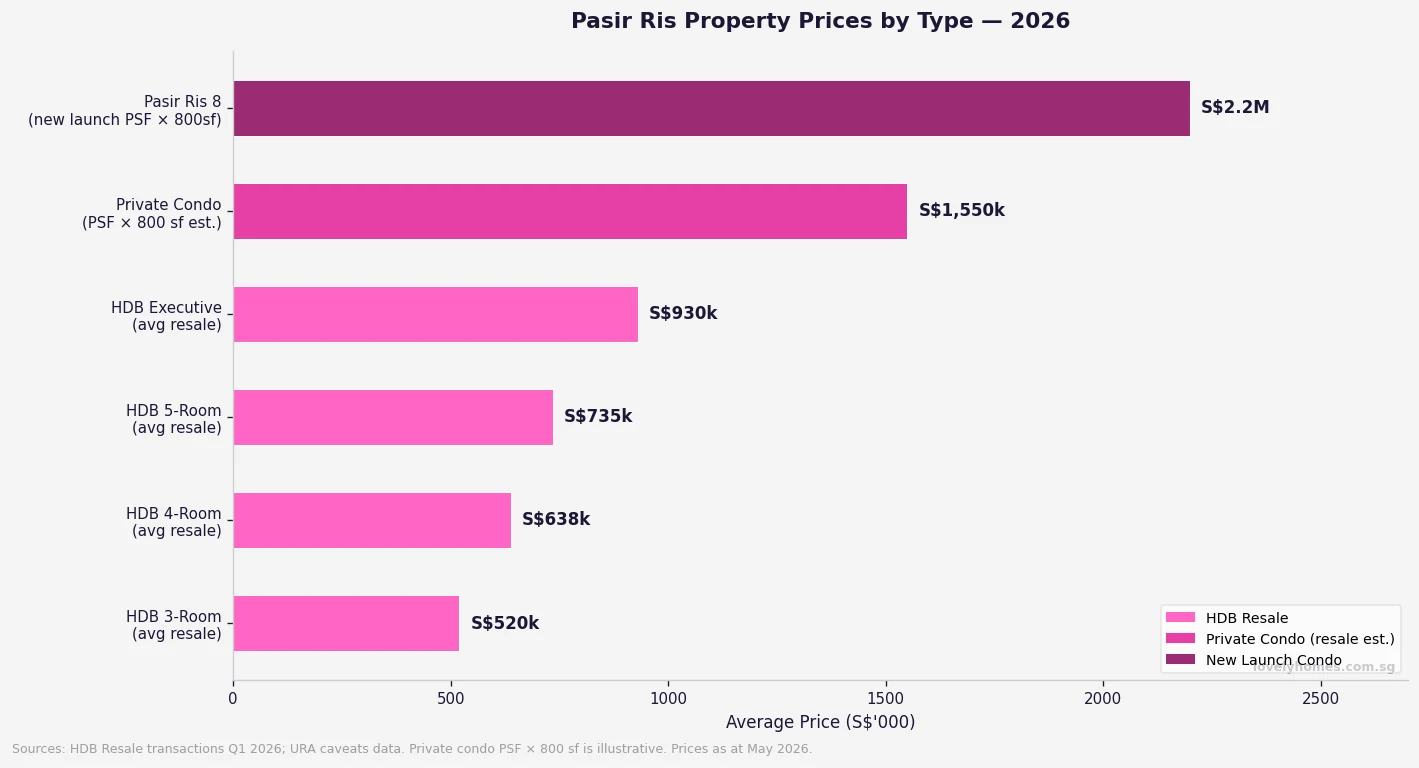
Pasir Ris property prices by type 2026 — HDB resale and private condo comparison
Figure 1: Pasir Ris property prices by type — HDB resale averages and private condo estimates, May 2026. Sources: HDB Resale Statistics, URA Caveats.
Property Type Typical Price Range Median / Avg Notes
HDB 3-Room (resale) S$400k – S$620k ~S$520k Older stock; strong rental demand from singles
HDB 4-Room (resale) S$548k – S$720k ~S$638k Most traded flat type; strong median
HDB 5-Room (resale) S$650k – S$850k ~S$735k Larger format; MOP supply wave lifting liquidity
HDB Executive / Jumbo (resale) S$800k – S$1.08M ~S$930k Limited supply; strong demand from large families
Private Condo (resale, OCR) S$1,200 – S$1,900 psf ~S$1,550 psf Older projects; limited resale stock
Pasir Ris 8 (new launch) S$1,934 – S$3,728 psf ~S$2,600 psf est. Integrated development above MRT; luxury positioning

The wide range within Pasir Ris 8 reflects its mixed product offering — from studio-format units to spacious 4-bedroom penthouses. For buyers focused on yield, the older resale condominiums at S$1,200–S$1,600 psf offer a more favourable entry point relative to rental demand, though they come with shorter remaining lease durations.

HDB Resale Market Dynamics

Pasir Ris has approximately 700 HDB resale transactions per year across all flat types, placing it in the mid-tier for transaction volume among OCR estates. Of these, 4-room flats account for roughly 40% of transactions, making them the most liquid asset class in the estate.

A notable dynamic in 2026 is the MOP wave. Nationally, around 13,480 HDB flats are reaching the end of their five-year (or ten-year Plus/Prime) minimum occupation period this year. Of these, Pasir Ris contributes an estimated 1,200–1,400 flats — primarily 4-room and 5-room units from developments built in 2019–2021. Sellers from these developments are typically younger upgraders, and their exit into the resale market is creating both additional supply and, indirectly, upgrader demand for private condominiums within and around the estate.

MRT Connectivity — Today and Tomorrow

Pasir Ris’s connectivity story is defined by two chapters: today’s East West Line (EWL) coverage and tomorrow’s Cross Island Line (CRL) expansion.

Today, Pasir Ris MRT station (EW1) is the eastern terminus of the East West Line — one of Singapore’s busiest rail corridors. From Pasir Ris, commuters can reach Raffles Place in approximately 38 minutes and Jurong East in roughly 55 minutes. The station is integrated with Pasir Ris 8, White Sands shopping centre, and a bus interchange, making it one of the better-connected suburban interchanges in the east.

By approximately 2032, the Cross Island Line’s Punggol Extension will add a second MRT station to the estate: Elias MRT, located at the junction of Pasir Ris Drive 10 and Pasir Ris Drive 3. Pasir Ris main station itself will also become an interchange with the CRL Punggol Extension, creating a direct link to Punggol, Sengkang, and the broader north-eastern corridor without requiring a change at Tampines. This dual-line connectivity, when realised, would meaningfully reduce Pasir Ris’s current perceived remoteness for residents commuting to the north-east.

Neighbourhood Amenities at a Glance
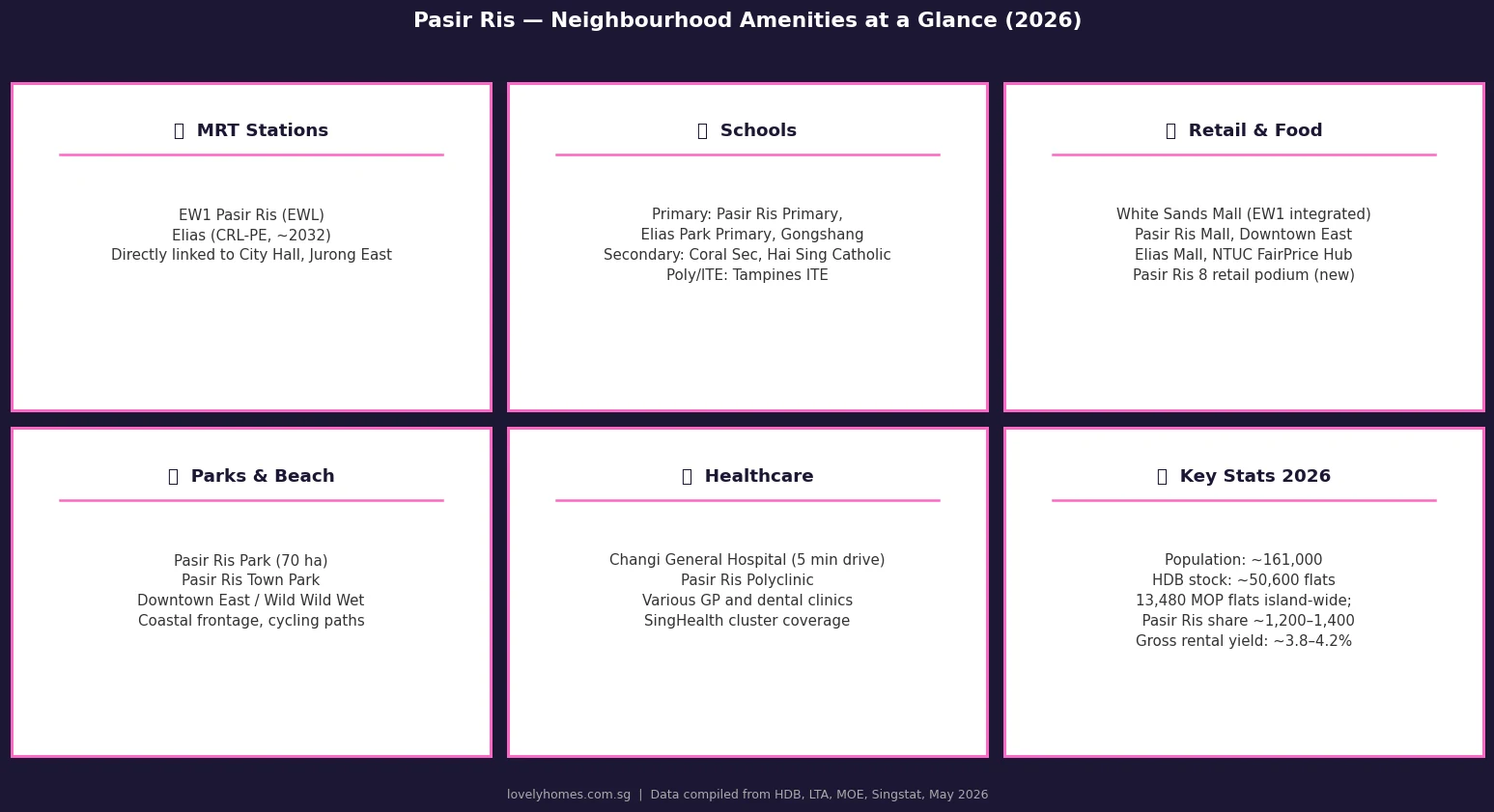
Pasir Ris neighbourhood amenities grid 2026 — MRT, schools, retail, parks, healthcare, key stats
Figure 2: Pasir Ris neighbourhood amenities — schools, retail, healthcare, parks and key statistics, 2026. Source: HDB, MOE, LTA, SingStat.

Schools and Education

Pasir Ris is well-served for primary education, with several schools within 1–2 km of most residential blocks. Pasir Ris Primary School, Elias Park Primary School, and Gongshang Primary School are the main feeder schools for the estate. For secondary education, Coral Secondary School and Hai Sing Catholic School sit within the town’s boundaries, while Dunman High School (an autonomous school offering the Integrated Programme) is accessible via a short bus or car journey near the Tampines–Pasir Ris border.

The MOE School Finder shows that families seeking a primary school within 1 km of popular Pasir Ris residential streets — particularly around Pasir Ris Drive 1, 3, and 6 — generally have strong in-zone admission chances at Pasir Ris Primary and Elias Park Primary. This factor alone drives family buyer demand for 5-room and executive HDB flats in those streets.

For post-secondary and tertiary education, the ITE College East and Tampines Meridian Junior College are both accessible within 20 minutes by bus or rail.

Retail, Food and Lifestyle

White Sands (integrated with Pasir Ris MRT) is the estate’s anchor mall, offering a full suite of food courts, supermarkets, pharmacies, and lifestyle retailers. Downtown East — one of Singapore’s largest lifestyle and entertainment hubs — sits adjacent to Pasir Ris Park and provides a Wild Wild Wet waterpark, indoor sports facilities, hotel accommodation, and an extensive food and beverage offering. Elias Mall and Pasir Ris Mall serve the internal town areas.

The upcoming Pasir Ris 8 development adds a retail podium above the MRT station, expanding the commercial offering with higher-end dining and lifestyle options that have historically been absent in the estate.

Pasir Ris Park and Outdoor Living

One of Pasir Ris’s most tangible lifestyle advantages is its greenery. Pasir Ris Park covers 70 hectares of managed parkland abutting the coastline — featuring cycling paths, mangrove boardwalks, a family-friendly beach, and barbecue pits. Singaporeans who value nature proximity will find Pasir Ris among the more green-affluent estates in the OCR, comparable to Bishan’s proximity to Bishan-AMK Park but with the added dimension of coastal access.

Investment Outlook — Rental Yield and Capital Growth
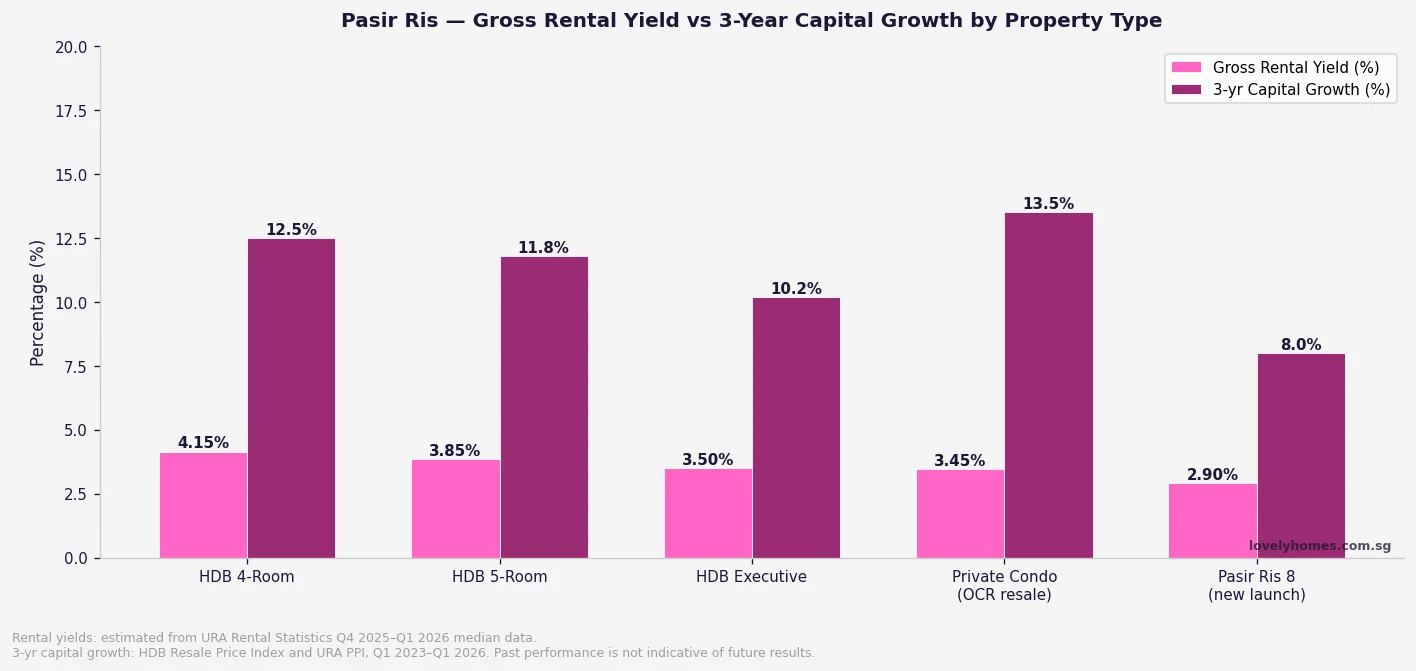
Pasir Ris gross rental yield versus 3-year capital growth by property type 2026
Figure 3: Pasir Ris gross rental yield vs 3-year capital growth by property type, Q1 2023–Q1 2026. Sources: URA Rental Statistics, HDB Resale Price Index, URA Private Property Price Index.

For HDB landlords, Pasir Ris delivers gross rental yields of approximately 3.8–4.2% on 4-room and 5-room flats — above the HDB island-wide average and driven by proximity to Changi Airport, Changi Business Park, and the wider east industrial corridor. Median monthly rents for a 4-room flat in Pasir Ris were approximately S$2,600–S$2,900 as at Q1 2026, according to HDB rental data.

For private condo investors, the older resale condominiums in Pasir Ris generate gross yields of approximately 3.4–3.6%, while Pasir Ris 8’s premium pricing means net yields will be tighter. The investment case for Pasir Ris 8 buyers rests more on capital appreciation (from MRT connectivity, new-launch premium, and precinct gentrification) than on near-term rental income cover.

Over the three years from Q1 2023 to Q1 2026, HDB resale prices in Pasir Ris have appreciated approximately 11–13% on a total-return basis across 4-room and 5-room flats, in line with broader OCR HDB trends as tracked by the HDB Resale Price Index.

Worked Example — HDB Upgrader Buying a Pasir Ris Condo in 2026

Consider Mr and Mrs Lim, a Singapore Citizen couple aged 38 and 36, with a combined monthly income of S$14,500. They own a 5-room HDB flat in Pasir Ris that cleared its five-year MOP in early 2026. They purchased the flat as a BTO for S$350,000; it is now transacting at S$750,000 on the resale market. They have S$260,000 in CPF Ordinary Account used for the flat, with accrued interest of S$48,000 (at 2.5% p.a. over six years).

Step 1 — Sale proceeds: Gross sale S$750,000 → outstanding bank loan S$220,000 → CPF principal refund S$260,000 → accrued interest S$48,000 → legal and agent costs S$12,000. Estimated cash-in-hand: approximately S$210,000.

Step 2 — Buying a S$1.60M Pasir Ris condo: As they are selling first, they hold zero residential properties at OTP signing. ABSD: 0% (Singapore Citizens, first property). BSD on S$1.60M = 1%×S$180k + 2%×S$180k + 3%×S$640k + 4%×S$600k = S$1,800 + S$3,600 + S$19,200 + S$24,000 = S$48,600.

Step 3 — Financing: 75% LTV (bank loan on private property, SC first property) = S$1,200,000 loan. 25% down = S$400,000 (S$308,000 CPF OA re-deposited after refund + S$92,000 cash). Legal and miscellaneous costs: ~S$7,000 cash. Total immediate cash outlay: S$48,600 (BSD) + S$92,000 (cash top-up on down payment) + S$7,000 = ~S$147,600.

Step 4 — Monthly repayment: S$1,200,000 at a fixed rate of 1.80% over 25 years = approximately S$4,930/mth. TDSR check: S$4,930 ÷ S$14,500 = 34.0% — comfortably within the 55% TDSR ceiling. The couple’s post-purchase cash reserve is approximately S$62,000, providing a meaningful liquidity buffer.

What Might Come Next for Pasir Ris

The 2032 completion of Elias MRT is the most significant near-term catalyst for the estate. New MRT stations in Singapore have historically generated price premium expansion in the two-to-four years leading up to opening, as market participants anticipate connectivity improvements. Areas within 600–800 metres of the future Elias station — particularly the emerging Neighbourhood 8 precinct — will be worth tracking.

The former MINDEF training land adjacent to Elias Road is earmarked for public and private housing development as part of Neighbourhood 8. While no definitive URA masterplan details or GLS tenders have been announced for this precinct as at May 2026, it represents a potential supply of several thousand new homes on relatively underutilised land in an estate where new private supply has historically been scarce.

On the rental side, Changi Airport’s continued expansion (Terminal 5, expected post-2030) and the growth of Changi Business Park as a technology and financial services hub both support sustained rental demand in the eastern corridor, benefiting Pasir Ris landlords.

Frequently Asked Questions

Is Pasir Ris a good place to buy property in 2026?

Pasir Ris offers a compelling combination of yield (HDB gross yields of 4%+), greenery, family-friendly infrastructure, and a clear near-term catalyst in the Cross Island Line’s Elias station (~2032). It is not a prestige address and will not command the PSF of Bishan, Queenstown, or the CCR — but for owner-occupiers seeking space and affordability, and for investors prioritising yield, it performs well within the OCR category. The key risk is the estate’s current single-line MRT exposure (EWL only) until the CRL Punggol Extension is operational.

Which MRT stations serve Pasir Ris?

Currently, Pasir Ris MRT (EW1) on the East West Line is the sole station. It is the eastern terminus of the EWL and is integrated with the Pasir Ris Bus Interchange. By approximately 2032, the Cross Island Line’s Punggol Extension will add Elias MRT within the estate (at Pasir Ris Drive 10 / Drive 3), and Pasir Ris station itself will become an interchange with the CRL Punggol Extension — enabling direct connectivity to Punggol, Sengkang, and Bishan without changing trains.

What is the HDB resale record in Pasir Ris?

The highest recorded HDB resale transaction in Pasir Ris, as at our research date, is an Executive flat that transacted at approximately S$1.08M — reflecting the scarcity of large-format flats in the estate. For 5-room flats, transactions in excess of S$850,000 have been recorded for well-located blocks near Pasir Ris Park and the MRT. These represent outlier premium transactions; the estate-wide median for 5-room flats remains approximately S$735,000 as at Q1 2026.

How does Pasir Ris compare to Tampines and Bedok for property investment?

Compared to Tampines, Pasir Ris tends to offer slightly higher HDB rental yields (4%+ vs Tampines’ ~3.8%) but lower private condo capital growth potential in the short term, as Tampines benefits from more established commercial infrastructure and multiple MRT lines. Compared to Bedok, Pasir Ris offers lower entry prices for similar flat types but lacks Bedok’s three-MRT-line advantage. The upcoming Elias MRT and Neighbourhood 8 development are Pasir Ris-specific catalysts that neither Tampines nor Bedok can replicate on the same timeline.

Can HDB upgraders avoid ABSD when buying Pasir Ris 8?

Yes — if the HDB flat is sold before (or simultaneously with) the OTP signing for the private property. When a Singapore Citizen sells their only existing residential property before acquiring a new one, they hold zero properties at the point of OTP and therefore pay 0% ABSD. This is the standard “sell-first, then buy” upgrader route. The key constraint is timing: you will need to arrange bridging accommodation between your HDB sale completion and your new condo’s TOP date. See our Upgrading from HDB to Private Property guide for the full timeline and cost analysis.

Are there BTO flats available in Pasir Ris in 2026?

As at May 2026, no standard BTO launch has been announced specifically for Pasir Ris in the June 2026 BTO exercise, which covers Bishan, Ang Mo Kio, Bukit Merah, Sembawang, and Woodlands. However, the emerging Neighbourhood 8 precinct (former MINDEF land near Elias Road) is expected to yield future BTO launches — likely announced in the 2027–2028 BTO exercise window once planning and land clearance is completed. Prospective buyers wanting to live in Pasir Ris in the near term should look at the resale market, the Sale of Balance Flats (SBF) exercises, or the Pasir Ris EC at Jalan Loyang Besar for qualifying buyers.

Related Articles

Disclaimer: This neighbourhood guide is for general informational purposes only and does not constitute financial, investment, or property advice. All prices, yields, and market data cited are drawn from publicly available sources including HDB Resale Statistics, URA Caveats Lodged, LTA announcements, and SingStat as at May 2026, and are subject to change without notice. Past performance and historical price trends are not indicative of future results. Always conduct independent verification and consult a licensed property agent, financial adviser, or conveyancing lawyer before making any property decision. For official data, refer to HDB, URA, LTA, SingStat, and MAS.
Rental Yield Singapore 2026: Complete Guide to Gross, Net and Location-Adjusted Yields

Rental Yield Singapore 2026: Complete Guide to Gross, Net and Location-Adjusted Yields

Understanding gross yield, net yield and leveraged returns is essential before committing capital to any Singapore investment property. This guide breaks down the numbers honestly.

Quick Answer

  • Gross rental yield in Singapore ranges from about 2.0% (landed) to 4.2% (HDB 3-room OCR) as of Q1 2026.
  • Net yield — after property tax, maintenance, agent fees and vacancy — is typically 0.9–1.4 percentage points lower than gross.
  • OCR condos (Jurong, Bukit Batok, Tampines, Sengkang) generally offer the best risk-adjusted net yields at 1.9–2.6% for condominiums.
  • HDB flats deliver the highest gross yields but come with restrictions: only Singapore Citizens and Permanent Residents may own them as investment vehicles through the resale market.
  • Leveraged net yields (30% equity down on a condo) can reach 7–10% in the early years — but this figure omits loan interest costs, which must be modelled separately.
  • The break-even period (years to recover purchase price via rent alone) ranges from ~38 years for an HDB flat to over 90 years for a landed property — reinforcing that rental income complements but does not drive Singapore property returns.
  • The Total Debt Servicing Ratio (TDSR) caps mortgage obligations at 55% of gross monthly income; rental income from the property counts only at a 30% haircut in TDSR calculations.

What Is Rental Yield and Why Does It Matter?

Rental yield is the annual rental income expressed as a percentage of the property’s purchase price or market value. It is the primary metric Singapore investors use to compare the income-generating efficiency of different asset classes — condominiums, HDB resale flats, commercial shophouses and industrial units — against each other and against fixed-income alternatives such as Singapore Savings Bonds (currently ~2.8% p.a.) or the CPF Ordinary Account rate (2.5%).

The Urban Redevelopment Authority (URA) publishes quarterly rental indices for private residential properties, and the Housing and Development Board (HDB) tracks the HDB Rental Index — both of which feed into the rental yield calculation. As of Q1 2026, private residential rents are broadly stable after a post-pandemic surge that saw CCR rents rise over 45% between 2021 and 2023. The correction phase has softened yields slightly from their 2022 peaks, but the OCR and RCR remain attractive relative to interest rates.

Gross Rental Yield by Property Type

Gross rental yield uses contract rent (what the tenant actually pays) divided by the property’s transacted or current market price. It ignores all costs on the landlord’s side.

Gross rental yield by property type Singapore 2026 horizontal bar chart
Figure 1: Indicative gross rental yield by property type — Singapore Q1 2026. Source: URA rental caveats; SingStat.

Key observations from the data:

  • HDB 3-room OCR flats lead at ~4.2% gross, because median transaction prices remain moderate (S$450k–S$580k for non-mature estates) while monthly rents of S$2,200–S$2,500 remain robust, driven by PRs and upgraders who cannot yet buy a condo.
  • OCR 1BR condominiums (≤500 sq ft) typically achieve 3.3–3.7%, with median transacted prices of S$800k–S$1.05M and rents of S$2,800–S$3,200/month.
  • CCR 2BR units in Districts 9, 10, 11 deliver gross yields of only 2.2–2.6%, reflecting premium transaction prices of S$2.5M–S$3.5M against rents that have softened from 2022 peaks as expat headcount stabilises.

Net Rental Yield: What You Actually Pocket

Net yield strips out all landlord-side costs: property tax (levied by IRAS at 10–20% of Annual Value for non-owner-occupied residential property since 1 January 2023), maintenance and sinking fund, property management or agent fees (one month’s rent per tenancy for a 12-month lease, amortised annually), and a vacancy allowance of approximately 4–6% for the typical between-tenancy gap.

Gross vs net rental yield comparison table Singapore 2026
Figure 2: Gross yield vs net yield and implied break-even period — Singapore Q1 2026.

The deduction gap between gross and net yield widens as property value rises, because Annual Value assessments by IRAS scale with rental evidence in the district, while absolute maintenance costs rise more slowly. A Sentosa Cove villa carrying S$180,000 in annual gross rent might have an Annual Value of S$150,000, generating a property-tax bill of ~S$22,500 at the 15% non-owner-occupied tier — a disproportionate cost for a S$12M asset yielding only 1.5% gross.

Location-Adjusted Yields: OCR vs RCR vs CCR

Singapore’s three market regions — Outside Central Region (OCR), Rest of Central Region (RCR) and Core Central Region (CCR) — display structurally different yield profiles driven by tenant demographics, supply-demand dynamics and capital value trajectories.

Region Typical Tenant Avg Gross Yield (2BR) Avg Net Yield (2BR) Vacancy Risk
OCR PRs, young professionals, upgraders 3.0–3.5% 1.9–2.5% Low–Moderate
RCR Mid-tier expats, dual-income households 2.7–3.1% 1.7–2.2% Moderate
CCR Senior expats, C-suite, institutional 2.2–2.6% 1.3–1.8% Moderate–High

OCR condominiums have historically offered the best combination of rental stability and yield depth for individual investors. Districts 19 (Serangoon, Hougang), 22 (Jurong West), 23 (Bukit Batok, Hillview) and 27 (Yishun, Sembawang) consistently rank among the top-yielding non-landed private residential submarkets.

Worked Example: 2BR OCR Condo, S$1.1M

Worked example net rental yield 2BR OCR condo S$1.1M Singapore 2026
Figure 3: Worked example — 2BR OCR condo purchased at S$1.1M, monthly rent S$3,200 (Jurong/Bukit Batok area).

Worked Example: The Tan Family’s Investment Property

Mr and Mrs Tan — both Singapore Citizens, owning one HDB flat — purchase a second property, a 2BR OCR condo at S$1,100,000 in Bukit Batok, for investment. This is their second residential property, triggering a 20% ABSD charge of S$220,000 payable within 14 days of the option being exercised. They plan to rent it out immediately.

  • Purchase price: S$1,100,000
  • BSD: S$30,600 (1% on S$180k + 2% on S$180k + 3% on S$640k + 4% on S$100k)
  • ABSD (SC 2nd property, 20%): S$220,000
  • Total acquisition cost: S$1,350,600
  • Monthly rent: S$3,200 | Annual gross rent: S$38,400
  • Annual deductions: property tax ~S$3,100 + maintenance ~S$2,400 + agent fee (amortised) ~S$1,600 + vacancy allowance ~S$1,920 + repairs/insurance ~S$1,200 = S$10,220
  • Annual net rental income: S$28,180
  • Gross yield on purchase price: 3.49%
  • Net yield on purchase price: 2.56%
  • Net yield on total acquisition cost (incl. ABSD + BSD): 2.09%

The ABSD drag is significant: when measured against total acquisition cost including ABSD, the net yield falls to 2.09% — well below the current Singapore Savings Bond rate of ~2.8%. This is the economic reality of owning a second residential property in Singapore. The investment case depends on capital appreciation — historically strong — rather than rental income alone.

HDB Rental Yield: The Special Case

HDB flats cannot be purchased as direct investments by most buyers: you must intend to occupy the flat, and only after the 5-year Minimum Occupation Period (MOP) — or 10 years for Plus/Prime classification flats — may you rent out the entire unit. That said, after MOP, many households do move to a private property and rent out the HDB flat, effectively converting it to an income asset.

Gross yields on HDB resale flats in non-mature estates (Punggol, Sengkang, Sembawang, Yishun) tend to be the highest in Singapore’s residential market at 3.8–4.5%, because resale prices have moderated while rents remain firm. The key restriction is that the tenant must also be a Singapore Citizen, PR, or hold a valid Employment Pass, Work Permit or Student Pass — and the flat cannot be sublet to more than 6 occupants without HDB approval.

Leveraged Yield: Handle With Care

When financed with a bank loan (maximum LTV 75% for a first private property; 45% for a second property under existing MAS guidelines), the return on equity deployed can look dramatically higher. For the Tan family’s example above: equity deployed of S$330,000 (30% downpayment) + S$220,000 ABSD + S$30,600 BSD = S$580,600 total cash outflow. Against an annual net rent of S$28,180, the leveraged yield on cash deployed is ~4.8% — better, but the loan interest (at current SORA-pegged rates of roughly 3.6–4.0% effective) must be deducted before any true profit is made. At 75% LTV on S$1.1M = S$825,000 loan at 3.8% for 25 years, annual interest in year 1 is approximately S$31,350 — which exceeds the annual net rent. The property is cash-flow negative until rents rise or the loan is substantially paid down.

What This Means for You: Is Singapore Property Worth Buying for Yield?

The honest answer, for most individual investors, is: not primarily for yield. Singapore property generates competitive income only if you own it free and clear (no mortgage) and have navigated the ABSD correctly (first property, or HDB after MOP). For leveraged investors or those paying ABSD on second/third properties, the rental income rarely covers holding costs in the near term.

The investment thesis for Singapore residential property has historically rested on capital appreciation — with the URA Private Residential Price Index rising approximately 3.8% per annum compounded over 20 years — augmented by rental income as a partial carry offset. Viewed that way, a 2.5% net yield on a leveraged position that appreciates at 3–4% per annum generates a total return of 5.5–6.5%, which compares reasonably well to a Singapore REIT yielding 5–6% with lower capital upside.

The structural advantages of direct property investment remain: leverage (not available in REITs), CPF usage (for the first property), exemption from capital gains tax (absent a finding of trading intent by IRAS), and the psychological comfort of a tangible, Singapore-based asset.

What Might Come Next for Singapore Rental Yields

Several structural forces could compress or expand rental yields over 2026–2028. On the supply side, MAS and URA have projected ~40,000 private residential units in the pipeline, with significant completions in 2026–2027. This supply overhang is most acute in the OCR, where the bulk of GLS sites have been awarded. On the demand side, Singapore’s S Pass and Employment Pass headcount — the backbone of the expat rental pool — is sensitive to global economic conditions and the pace of multinational relocations to Singapore. In a downside scenario where global firms retrench Asian headcount, CCR and RCR rents would feel the pressure first.

Interest rates remain the most important swing factor: a 100 basis-point fall in SORA over 2026–2027 would turn many currently cash-flow-negative second properties cash-flow-positive, potentially releasing pent-up investment demand. The converse — a rate spike — would further widen the gap between gross yield and financing cost.

Frequently Asked Questions

How is rental yield calculated in Singapore?

Gross rental yield = (annual rent ÷ property purchase price) × 100. For example, a condo bought at S$1.2M generating S$3,500/month rent has a gross yield of (S$42,000 ÷ S$1,200,000) × 100 = 3.5%. Net yield further deducts property tax (administered by IRAS), maintenance fees, agent commissions and a vacancy allowance — typically reducing the headline figure by 1.0–1.4 percentage points.

What is a “good” rental yield in Singapore?

Context matters enormously. In the current interest-rate environment (effective mortgage rates 3.5–4.0%), a gross yield below 3.5% on a mortgaged property means the rental income will not cover financing costs in the early years of the loan. A net yield above 2.5% is generally considered solid for a private residential property in Singapore. For HDB flats held after MOP, gross yields of 3.8–4.5% in non-mature estates are achievable and are broadly competitive with Singapore Savings Bonds or CPF rates.

Do I need to declare rental income to IRAS?

Yes. Rental income from Singapore properties is assessable income under the Income Tax Act (Cap. 134) and must be declared in your annual income tax return. You may deduct allowable expenses — mortgage interest, property tax, maintenance fees, agent commissions, fire insurance, and wear-and-tear on furnishings (at 20% of the cost of fittings under IRAS’s deemed-expense basis). IRAS offers two deduction methods: actual expenses (you must keep receipts) or a simplified 15% deemed-expense deduction of gross rental income.

Can I use CPF to finance an investment property?

Yes, subject to limits. CPF Ordinary Account savings may be used for the downpayment and monthly mortgage instalment on a private residential property (bank loan only — CPF cannot be used with an HDB concessionary loan for a private property purchase). However, for a second property, the Valuation Limit and Withdrawal Limit rules under the CPF Housing Withdrawal Scheme apply, and any CPF used attracts accrued interest that must be refunded to your CPF account upon sale. This accrued interest — compounding at 2.5% per annum from the date of each withdrawal — can significantly erode the net sale proceeds if the property is held for many years.

Is the rental income counted in TDSR for my next purchase?

Rental income from investment properties counts towards TDSR calculations, but only at a 30% haircut. That is, if you receive S$3,200/month in rent, only S$960/month is counted as eligible income for TDSR purposes. This conservative treatment, mandated by MAS, is intended to prevent investors from using projected rental income to qualify for larger loans than their employment income alone would support. You must also provide documentary evidence — a signed tenancy agreement — for the rental income to be included.

What are the ABSD implications of buying a second property for rental?

If you are a Singapore Citizen purchasing your second residential property (including condominiums, landed homes, or HDB resale flats), you pay 20% ABSD on the full purchase price, payable within 14 days of the Option to Purchase being exercised. This is a significant upfront cash cost — S$220,000 on a S$1.1M property — that meaningfully dilutes rental yield when measured against total acquisition cost. Singapore Permanent Residents purchasing a second residential property pay 30% ABSD. Foreigners pay 65% ABSD on any residential property. The ABSD is administered by IRAS and there is no remission for investment purposes.

How does Singapore rental yield compare to REITs?

Singapore-listed REITs (S-REITs) currently yield 5.5–7.0% in dividend terms for diversified and industrial sub-sectors, and 4.5–5.5% for retail-focused trusts — well above the 2.0–3.5% net yield available on direct residential property. However, S-REITs do not benefit from leverage in the hands of the individual investor (the REIT itself is leveraged at 30–45% gearing), CPF cannot be used to buy REITs in the same way as CPF investment scheme rules apply, and historical capital appreciation has been more muted. Many Singapore investors hold both — residential property for capital appreciation and CPF-backed stability, S-REITs for income stream and liquidity.

Related Articles


Disclaimer: Rental yield figures in this article are derived from publicly available URA rental caveats, HDB rental transaction data and SingStat as at Q1 2026. They are indicative and will vary by specific unit, floor, facing, condition and negotiated rent. This article is for general information only and does not constitute financial, investment or tax advice. Readers should consult a licensed financial adviser (MAS-regulated), a property tax specialist and IRAS official guidance before making any investment decision. For authoritative data, refer to the URA Real Estate Information System (REALIS), HDB’s InfoWeb resale portal, IRAS property tax guidelines, and MAS’s property loan rules at mas.gov.sg.

Singapore Q1 2026 Flash Estimates: Private Up, Public Down — The First Divergence in Seven Years

Singapore Q1 2026 Flash Estimates: Private Up, Public Down — The First Divergence in Seven Years

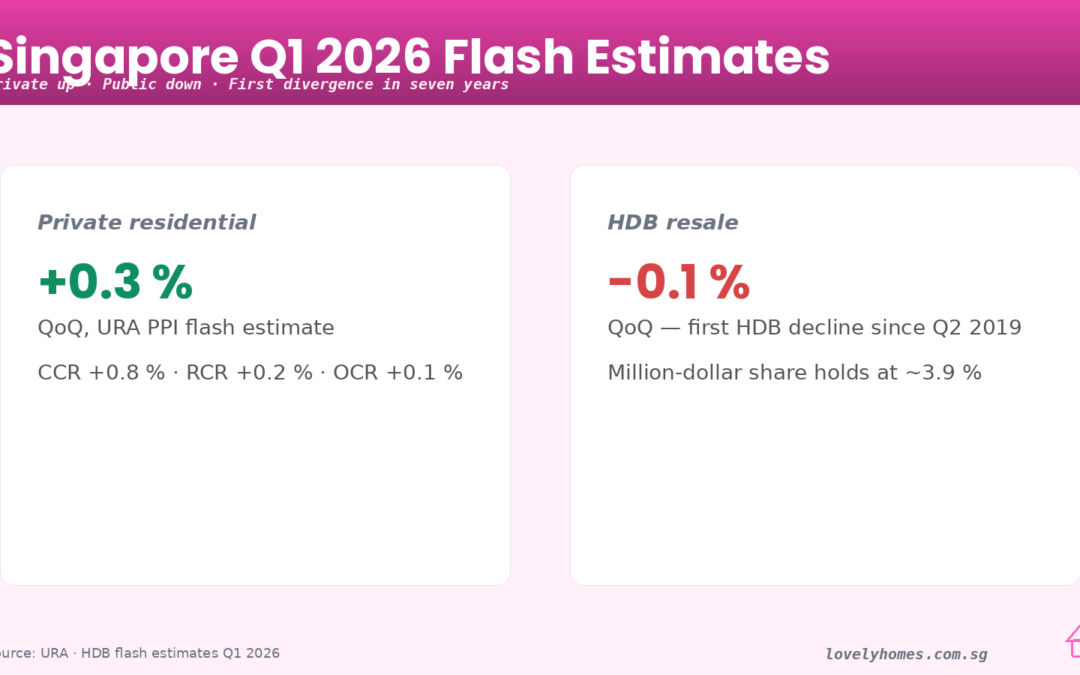
Singapore Q1 2026 flash estimates: private residential +0.3% vs HDB resale -0.1%
Private residential and HDB resale flash indices diverged for the first time in seven years. Source: URA and HDB flash estimates, 1 April 2026.

Quick take: On 1 April 2026, URA’s flash estimate showed the overall private residential price index rising 0.3% quarter-on-quarter in Q1 2026, while HDB’s flash estimate put the Resale Price Index at -0.1% quarter-on-quarter — the first public-housing decline since Q2 2019. The two segments have moved in the same direction almost every quarter since mid-2019. This quarter, they have not.

What the numbers actually say

URA’s flash estimate is a fast read on transactions caveated in the first ten weeks of the quarter. For Q1 2026, the non-landed segment carried the whole index: non-landed prices were up an estimated 1.0%, led by the Outside Central Region at +1.3%, followed by the Rest of Central Region at +0.8% and the Core Central Region at +0.4%. Landed homes pulled the headline the other way at about -2.4%, a reminder that the landed market trades thinly and can swing on a handful of deals.

The other private-market signal behind the flash is volume. New-sale launches collapsed to roughly 60% below Q4 2025. With only a thin slate of launches in January and February and most developers holding fire until after Chinese New Year, the bulk of Q1 price action came from resale and sub-sale transactions rather than showflat pricing power. When new launches return in strength from Q2, the price signal will widen again.

On the public side, HDB’s flash estimate at -0.1% is small in headline terms but large in narrative. The Resale Price Index has risen in every single quarter since Q3 2019 — twenty-six consecutive quarters of gains. A flash print at zero, or marginally below it, breaks that run. Final numbers, due in late April, may revise the estimate either way by a tenth or two, but the direction is the news.

Why the two markets are diverging now

Three forces are separating private and public prices this quarter.

1. The cooling measures have landed unevenly. The August 2024 LTV tightening for HDB loans (90% to 75%) and the continued 15-month wait-out rule for private downgraders have compressed HDB resale demand more than the private market. Private buyers financing with bank loans at lower LTV ceilings were already used to higher cash-and-CPF components; HDB resale buyers, many of whom are upgraders or first-timers, feel the tightening at the margin where deals close.

2. BTO supply has materially improved. HDB is pushing through roughly 50,000 flats across the 2025 and 2026 programmes. The June 2026 BTO exercise will offer about 6,900 flats across Ang Mo Kio, Bishan, Bukit Merah, Sembawang and Woodlands. When first-timers have a realistic shot at a BTO within 18 to 24 months, the urgency premium in resale prices eases. That is exactly the mechanism HDB publicly described when it reintroduced the Prime, Plus and Standard classification in late 2024.

3. The private market found a new OCR anchor. The OCR leading at +1.3% reflects the mass-market bid for newer freehold and 99-year projects where the price-per-square-foot still reads as a discount to the RCR. Buyers priced out of the core are not disappearing — they are rotating outward. HDB resale, by contrast, has no similar pressure valve; the product is the product.

How the divergence compares historically

The last time HDB resale fell while the URA index rose was Q2 2019 — the final stretch of the post-2018-cooling-measures adjustment, when public housing was absorbing ABSD-driven demand shifts. Before that, divergence episodes clustered around the 2013-2014 tightening and the 2008-2009 cycle. Divergence is not unprecedented; what is unusual is how long the two markets have moved together. From Q3 2019 to Q4 2025, both indices posted gains in every single quarter.

One quarter is not a trend. The signal here is less “HDB is falling” and more “HDB has stopped rising.” That is still a meaningful shift after seven years of one-way pressure.

What this means for buyers and sellers

HDB resale buyers: The urgency is lower. If the June BTO ballot in a town you would consider is a serious option, running both tracks in parallel is now a more defensible strategy than it was 12 months ago. Million-dollar resale records will continue to happen in flagship locations, but the median flat in a mature estate is no longer compounding at 8-10% a year.

HDB sellers: Price realism matters. COV (cash-over-valuation) expectations set in 2024 no longer hold in most estates. Sellers who fix an asking price based on a neighbour’s Q3 2025 transaction are increasingly missing the window and sitting on the listing for two to three months before cutting.

Private buyers: The OCR is where the action is, and the Q2 launch slate will test how much pricing power developers actually have. Watch median PSF for OCR new launches in Q2 against late-2025 comparable projects. If developers push prices 3-5% above comparables and still clear 30% on launch weekend, the private cycle re-accelerates. If they stall, the flash estimate flatters a cooler underlying market.

Private sellers and sub-sale owners: The CCR-to-OCR spread narrowed again in Q1. Holders of older freehold CCR stock should benchmark against current RCR new-launch pricing rather than historical CCR premiums — the buyer pool has shifted.

What to watch between now and late April

Three things will sharpen the picture in the next three weeks:

  • Final Q1 numbers (late April): URA and HDB publish the full quarterly indices with sub-indices by region and flat type. The flash can revise by up to 0.2 percentage points in either direction.
  • April and May new-launch pricing: Two to three large OCR launches are pencilled in for Q2. Median PSF at launch will tell us whether developers are testing the ceiling or holding.
  • June 2026 BTO application rates: First-timer subscription ratios in Ang Mo Kio and Bishan will signal how much pressure is still in the resale market. Application rates above 3x in non-mature estates typically foreshadow resale strength; ratios closer to 1x suggest buyers are comfortable waiting.

The bigger frame

Singapore’s residential market has been remarkable for its synchronised climb since 2019. That era is pausing. Whether Q1 2026 turns out to be a one-quarter wobble or the start of a sustained rebalancing between public and private depends on three things: the new-launch pipeline in Q2 and Q3, the pace of BTO completions absorbing first-timer demand, and whether any further cooling measures are signalled in the mid-year review.

For now, the most honest read of the flash estimates is this: the private market is still advancing, the public market has stopped, and the gap between them is the most interesting number in Q1.

FAQ

How reliable is the URA flash estimate?

The flash estimate is based on the first ten weeks of caveated transactions and is typically revised by ±0.1 to ±0.2 percentage points when the final index is published three to four weeks later. Direction is usually preserved; magnitude can shift.

Is the HDB flash estimate the first decline since 2019?

Yes. HDB’s Resale Price Index last posted a quarter-on-quarter decline in Q2 2019. The Q1 2026 flash at -0.1% is the first negative print in twenty-seven quarters. The final number, due in late April, will confirm or revise this.

Why did private new launches drop 60% QoQ?

Q1 is seasonally slow because of Chinese New Year and because developers typically time launches to coincide with stronger post-Lunar-New-Year demand in Q2. Q1 2026 had a thinner launch slate than usual with most of the pipeline deferred to April onwards, which amplified the quarter-on-quarter drop.

Will the June 2026 BTO exercise affect resale prices?

At the margin, yes. 6,900 flats across five towns is a meaningful supply signal, especially in non-mature estates where first-timer application ratios drive most of the urgency pricing in resale. Towns included are Ang Mo Kio, Bishan, Bukit Merah, Sembawang and Woodlands.

Should I wait to buy?

Flash estimates are one input among many. If you have found the right unit at the right price relative to comparable transactions in the last 60-90 days, macro prints rarely change the calculus. If you are timing the cycle, wait for the final Q1 numbers and the Q2 launch pricing before committing.


Disclaimer: This article reports on URA and HDB flash estimates published on 1 April 2026 and is for general information only. Flash estimates are preliminary and subject to revision. Individual transactions vary by project, unit, tenure and timing. This is not financial, investment or property advice. Buyers and sellers should seek advice from qualified professionals and verify figures against the official URA and HDB releases before making decisions.

Related reading on lovelyhomes.com.sg: TDSR and MSR: How Much Can You Actually Borrow in Singapore 2026 · Freehold vs 99-Year Leasehold Singapore 2026: The Real Price of Time.

Translate »