HDB Grants Singapore 2026: EHG, CPF Housing Grant, Proximity Grant and Step-Up Grant Explained

HDB Grants Singapore 2026: EHG, CPF Housing Grant, Proximity Grant and Step-Up Grant Explained

Quick Answer: HDB Grants Singapore 2026 — Key Facts

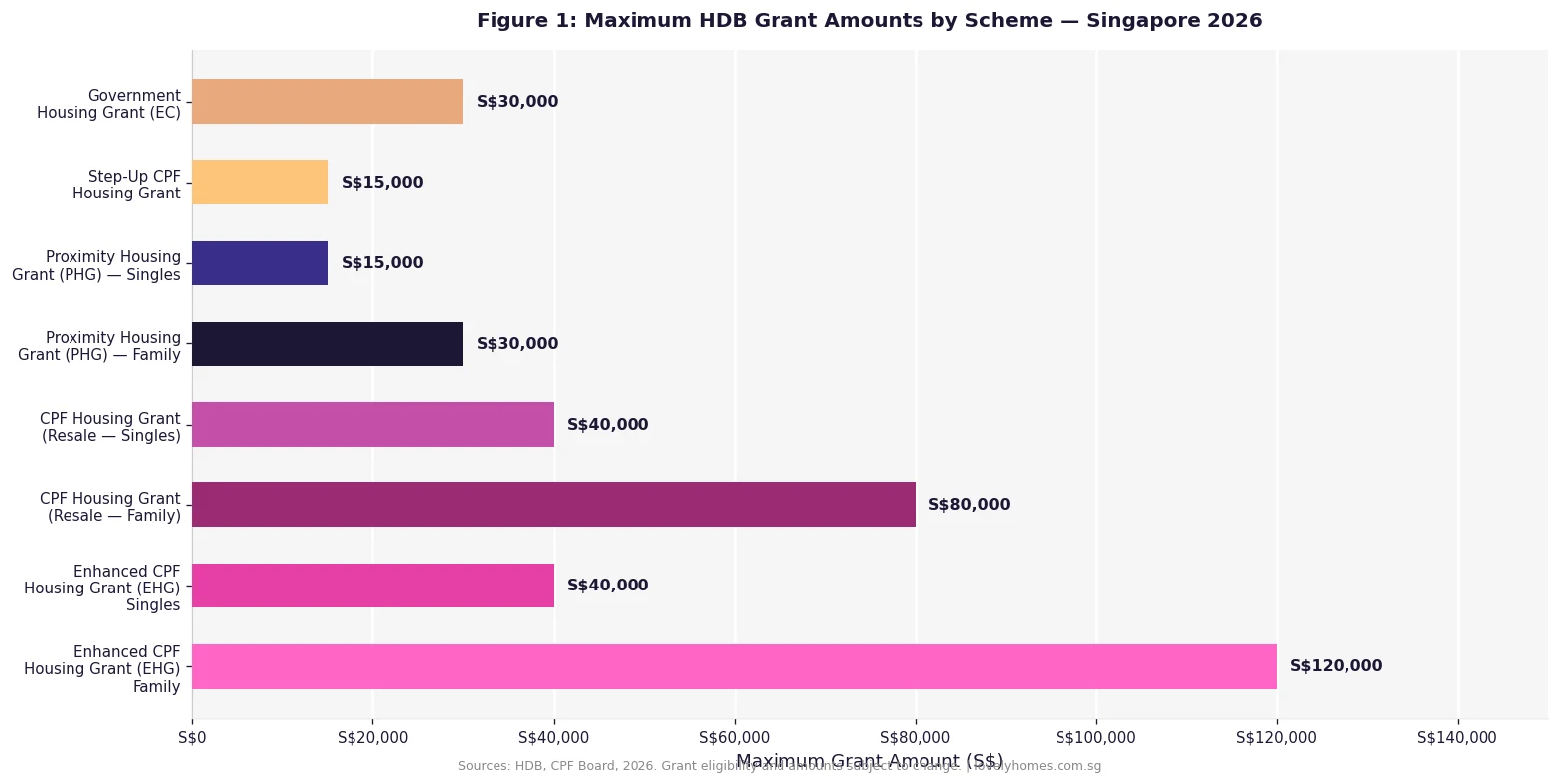
  • Enhanced CPF Housing Grant (EHG): Up to S$120,000 for eligible first-timer families; up to S$40,000 for eligible singles. Applies to both BTO and resale flats.
  • CPF Housing Grant (CHG): Up to S$80,000 for first-timer families buying a resale HDB flat; S$40,000 for singles.
  • Proximity Housing Grant (PHG): Up to S$30,000 for families who buy a resale flat to live with or near parents; S$15,000 for singles.
  • Step-Up CPF Housing Grant: S$15,000 for second-timer families upgrading from a 2-room to a 3-room or larger flat in a non-mature estate.
  • Government Housing Grant (EC): S$30,000 for eligible first-timer families buying a new Executive Condominium.
  • Grants are CPF-credited: All grants go into your CPF Ordinary Account and offset the purchase price — you do not receive cash.
  • No double-counting: You can stack compatible grants (e.g., EHG + PHG for resale) but each grant type can only be used once per application.

What Are HDB Grants and Who Administers Them?

HDB housing grants are government subsidies administered jointly by the Housing & Development Board (HDB) and the Central Provident Fund (CPF) Board. They are designed to make homeownership accessible to Singapore Citizens and, in some cases, Permanent Residents, by directly reducing the effective purchase price of an HDB flat.

Grants are credited into your CPF Ordinary Account (OA) — not paid as cash — and can be applied towards the purchase price of your flat or used to reduce your outstanding home loan. This is an important distinction: you cannot withdraw grant amounts in cash, and they are subject to the CPF accrued interest rules when you eventually sell your property.

The grant framework in Singapore is tiered by household income, citizenship status, flat type, and whether you are a first-timer or second-timer applicant. First-timers consistently receive significantly higher grants than second-timers, reflecting the government’s policy of prioritising owner-occupancy and discouraging property speculation within the public housing segment.

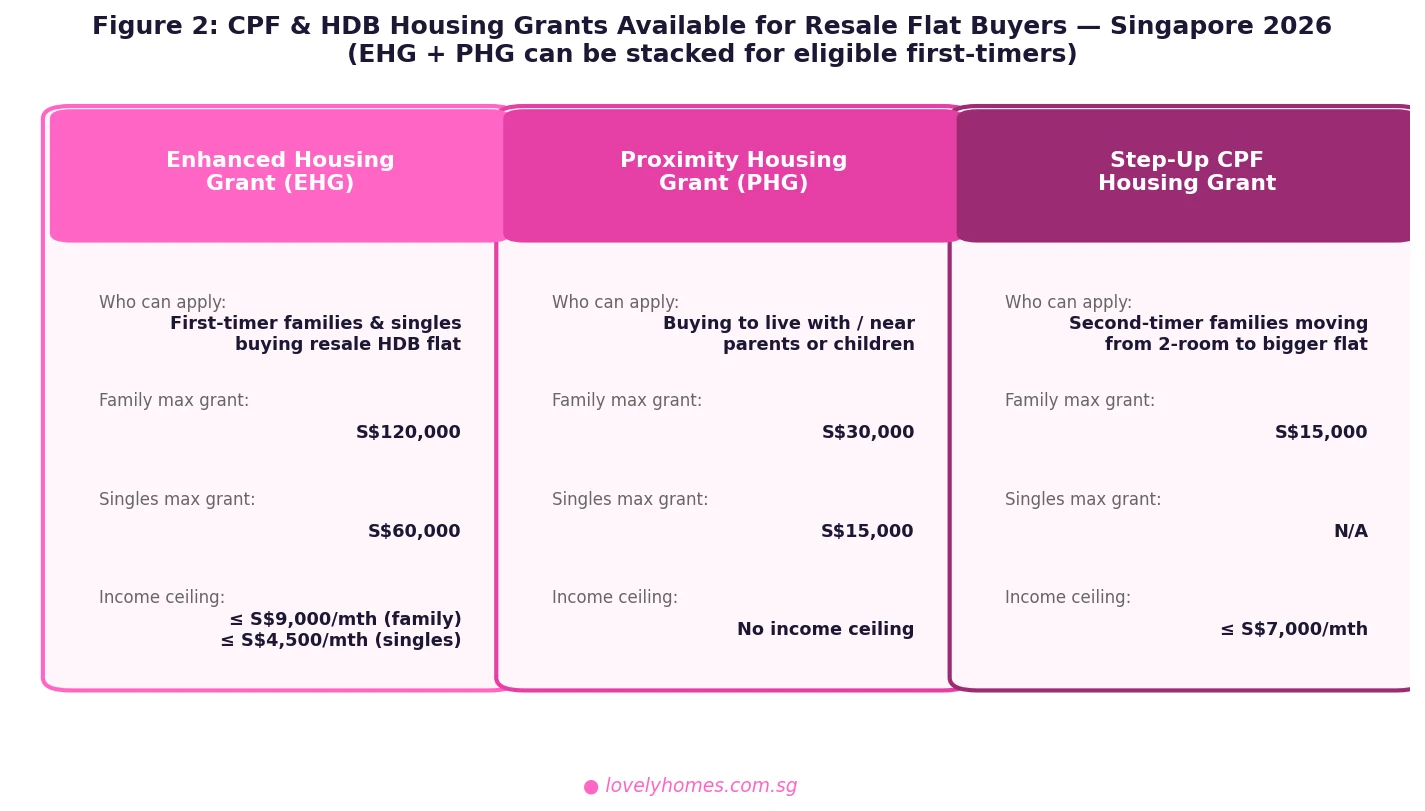
HDB grant amounts by scheme Singapore 2026 — EHG CPF Housing Grant PHG Step-Up Government Housing Grant EC
Figure 1: Maximum grant amounts across all HDB and EC grant schemes as at 2026. Subject to individual eligibility — verify with HDB/CPF Board before purchase.

Enhanced CPF Housing Grant (EHG) — The Largest Grant Available

The Enhanced CPF Housing Grant, introduced in September 2019, replaced the Additional CPF Housing Grant (AHG) and Special CPF Housing Grant (SHG). It is the most substantial grant available to first-timer Singapore Citizen households and is specifically calibrated to assist lower- and middle-income buyers.

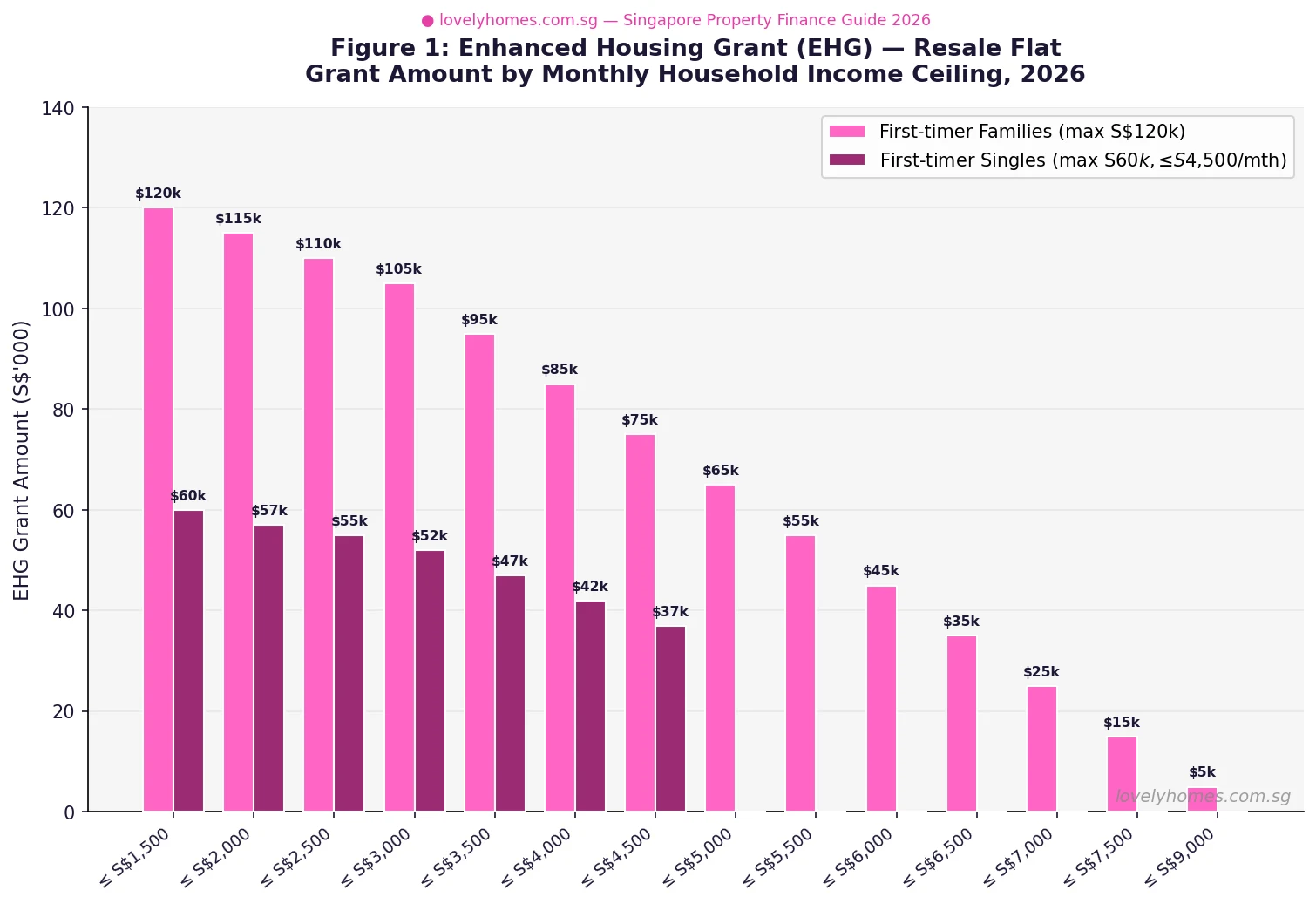
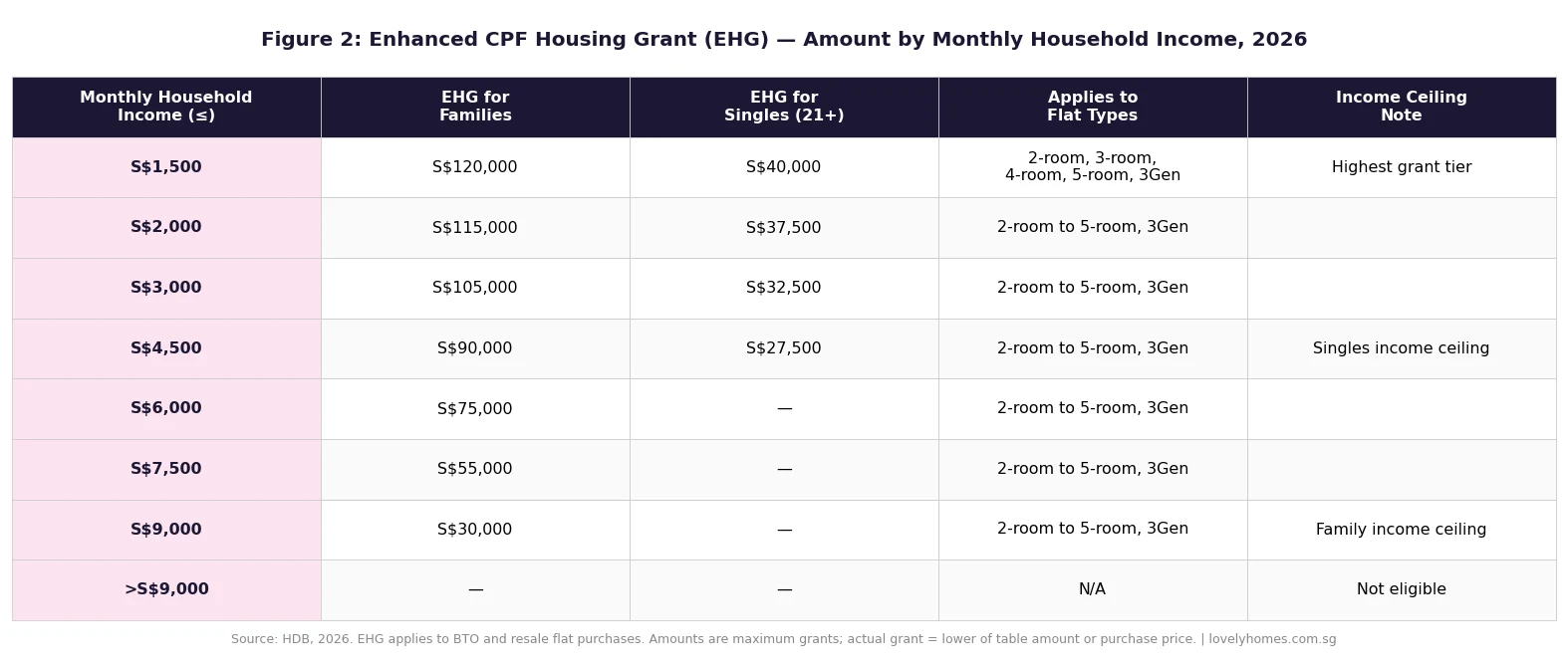
The EHG is means-tested: the amount decreases as household income rises, and the eligibility ceiling is S$9,000 per month for families and S$4,500 per month for singles (as at 2026). To qualify, at least one applicant must have worked continuously for at least twelve months before the flat application date, and must continue working at the time of application.

One critical requirement that catches many applicants off-guard: the EHG is only available for flats purchased with a remaining lease of at least 20 years at the time of application, and whose remaining lease can cover the youngest buyer to at least age 95. This lease requirement affects certain older resale flats, which may otherwise be eligible by income but fail the lease longevity test.

EHG Enhanced CPF Housing Grant income tiers and amounts table Singapore 2026
Figure 2: EHG grant amounts by monthly household income bracket, 2026. Grants are maximum amounts; actual award = lower of EHG table amount or flat purchase price.

CPF Housing Grant (CHG) — For Resale Flat Buyers

The CPF Housing Grant (sometimes called the Family Grant or Singles Grant in older HDB materials) is specifically available to first-timer buyers purchasing a resale HDB flat on the open market. Unlike the EHG, which applies to both BTO and resale purchases, the CHG is resale-only — BTO buyers receive the EHG instead.

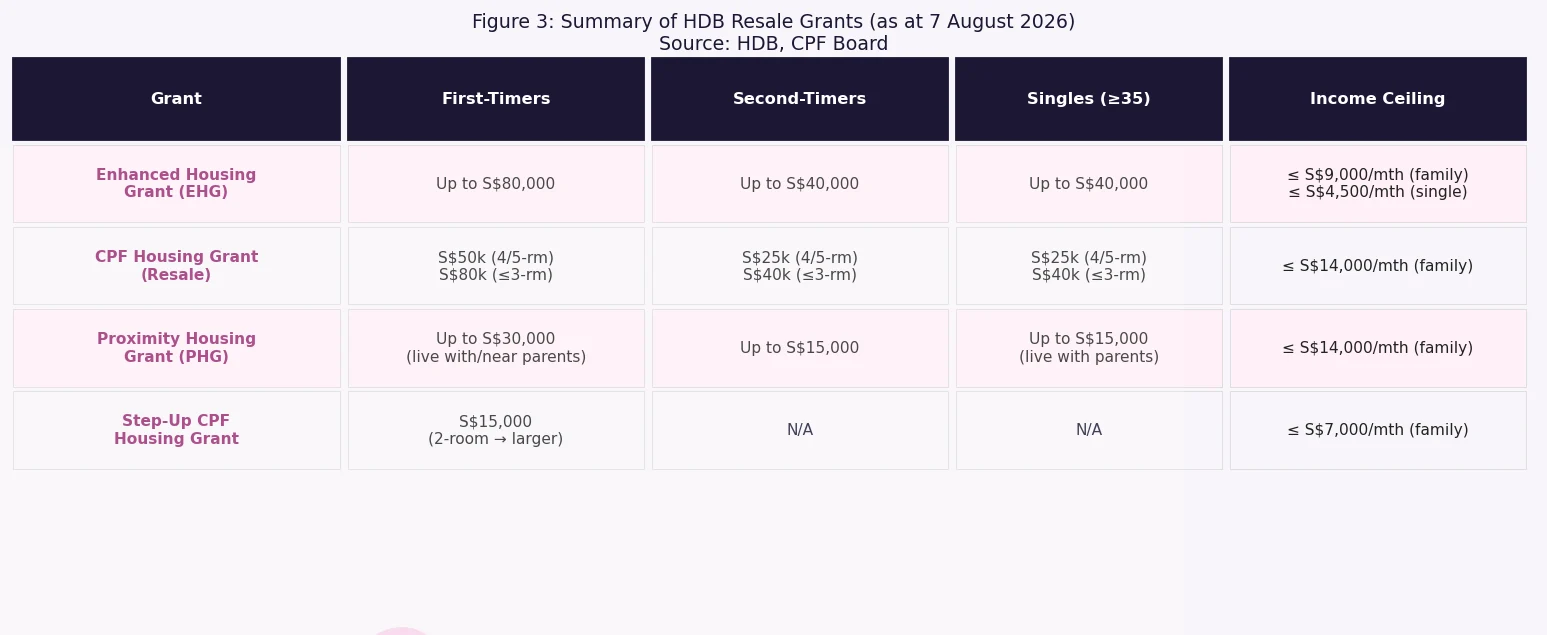
As at 2026, the maximum CHG is S$80,000 for first-timer Singapore Citizen families (where both applicants are Singapore Citizens) and S$40,000 for first-timer Singles aged 35 or above. For households where one applicant is a Singapore Citizen and the other is a Permanent Resident, the grant reduces to S$50,000. The income ceiling for the CHG is S$14,000 per month — notably higher than the EHG ceiling, meaning more households are eligible.

Proximity Housing Grant (PHG) — For Families Buying Near Parents

The Proximity Housing Grant incentivises multigenerational living by rewarding families who buy a resale HDB flat to live with or within 4 kilometres of their parents’ or children’s existing HDB flat. It is a resale-only grant and is available regardless of whether the buyer is a first-timer or second-timer, making it one of the few grants accessible to second-timers on a meaningful scale.

To live with parents or married children (same address), the PHG is S$30,000 for families and S$15,000 for singles. To live within 4 km of parents’ or children’s existing flat, the PHG is S$20,000 for families and S$10,000 for singles. There is no income ceiling for the PHG — any household, regardless of income, may apply as long as the proximity and family relationship conditions are met.

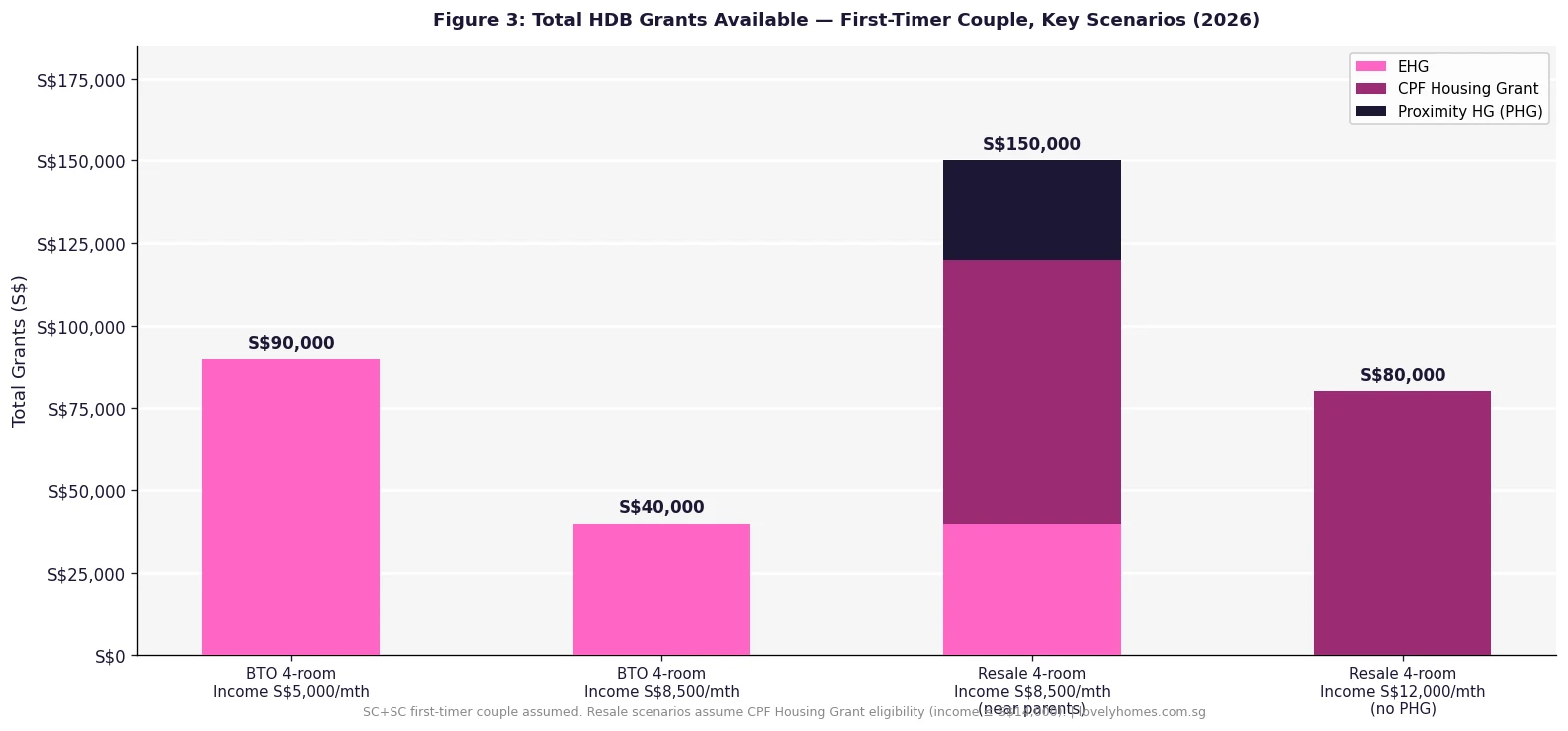
The PHG can be stacked with the EHG and CPF Housing Grant for resale buyers. A first-timer SC+SC couple earning S$8,500 per month buying a resale flat to live near parents could, in theory, receive EHG of S$40,000 + CHG of S$80,000 + PHG of S$30,000 = a total of S$150,000 in grants — making a resale flat in a mature estate substantially more affordable than it appears at headline price.

Step-Up CPF Housing Grant — Second-Timers Upgrading Within HDB

The Step-Up CPF Housing Grant of S$15,000 is specifically for second-timer Singapore Citizen families who currently live in a 2-room HDB flat (Flexi or standard) and wish to upgrade to a larger 3-room or bigger flat in a non-mature housing estate, sourced directly from HDB (i.e., a BTO flat in the relevant sales exercise). It is not available for resale flat purchases.

The income ceiling for the Step-Up Grant is S$7,000 per month, and at least one applicant must have been a Singapore Citizen for at least five years. This grant is deliberately narrow in scope — it targets a specific population of residents in smaller flats who need a capacity upgrade but remain in the lower-to-middle income band.

Government Housing Grant (GHG) for Executive Condominiums

First-timer Singapore Citizen families purchasing a new Executive Condominium (EC) directly from a developer are eligible for the Government Housing Grant of S$30,000, credited into the purchaser’s CPF OA. The income ceiling for the EC grant is the same as the EC purchase income ceiling — S$16,000 per month as at 2026. This grant cannot be combined with the EHG or CHG, as those apply only to HDB flat purchases; the GHG is the equivalent grant mechanism for the EC segment.

Total HDB grants available first-timer couple BTO resale scenarios Singapore 2026
Figure 3: Total grants available across key first-timer scenarios, 2026. Scenario 3 (resale near parents) shows maximum stacking of EHG + CHG + PHG = S$150,000.

Summary: Grant Comparison Table

Grant Max (Family) Max (Singles) Income Ceiling BTO? Resale? First-Timer?
EHG S$120,000 S$40,000 S$9,000 / S$4,500 Required
CPF Housing Grant S$80,000 S$40,000 S$14,000 Required
PHG (live with) S$30,000 S$15,000 None Not required
PHG (within 4km) S$20,000 S$10,000 None Not required
Step-Up Grant S$15,000 S$7,000 Not required
Govt HG (EC) S$30,000 S$16,000 EC only Required

Worked Example: The Lim Family — Maximising HDB Grants on a Resale Flat

Mr and Mrs Lim are a Singapore Citizen married couple, both aged 29. Their combined gross monthly household income is S$6,500. They are first-timers. Mrs Lim’s parents own an HDB flat in Queenstown, and the couple would like to buy a resale 4-room flat in Buona Vista to live together with the parents.

Step 1 — EHG eligibility: Income S$6,500 → EHG for families at this income bracket = S$75,000. (From the EHG tier table: ≤S$7,500/mth = S$55,000. Correcting: S$6,000–S$7,500 range → S$55,000 EHG.)

Step 2 — CPF Housing Grant (resale): Income S$6,500 ≤ S$14,000 → CHG = S$80,000 (both SCs, first-timers, resale flat).

Step 3 — PHG (living with parents): Living with parents at same address → PHG = S$30,000. No income ceiling.

Step 4 — Total grants:

Grant Amount
Enhanced CPF Housing Grant (EHG) S$55,000
CPF Housing Grant (CHG) S$80,000
Proximity Housing Grant (PHG — live with parents) S$30,000
Total Grants (CPF OA credited) S$165,000
Indicative resale flat price (Buona Vista 4-room) S$780,000
Effective price after grants S$615,000
HDB Concessionary Loan (80% of S$780k − grants offset) ~S$459,000
Cash + CPF down payment (20%) ~S$156,000

The Lims’ S$165,000 in grants reduces a S$780,000 resale flat to an effective out-of-pocket position requiring approximately S$156,000 in down payment (cash + CPF, with grants credited to OA first). Their HDB Concessionary Loan at 2.6% p.a. on approximately S$459,000 produces a monthly repayment of roughly S$2,060 — a MSR-compliant 31.7% of their S$6,500 combined income, below the 30% MSR cap when rounded down on the concessionary loan basis (HDB concessionary loan MSR = 30% of gross monthly income).

Note: CPF accrued interest will apply to the grants and CPF OA amounts used, payable upon eventual sale of the flat. The Lims should factor this into their long-term financial planning.

Why HDB Grants Matter in Singapore’s Property Market

Singapore’s HDB grant system is one of the most comprehensive public housing subsidy frameworks in the world. Unlike many countries where housing subsidies take the form of direct cash payments or tax credits, Singapore’s approach links grants directly to the CPF system and the property purchase process — ensuring subsidies are deployed towards asset acquisition rather than consumption spending.

For first-timer households earning S$6,000–S$8,000 per month — the Singapore median household income bracket — the combined effect of EHG, CHG, and PHG can reduce the effective purchase price of a resale flat by S$100,000 to S$165,000. On a S$600,000–S$800,000 resale flat, this represents a 15–25% effective discount, which is transformative for affordability.

The grant structure also reveals HDB’s policy priorities clearly: it heavily favours first-timers over second-timers, rewards proximity to elderly parents, and calibrates generosity inversely to income. Buyers who understand this structure can make significantly better purchase decisions — for example, choosing a resale flat with PHG eligibility over a BTO flat, purely because the grant stacking arithmetic makes the resale option more affordable net of grants.

What Might Come Next

The Singapore government reviews HDB grant parameters periodically, typically in line with National Day Rally announcements or budget statements. The most recent significant change was the introduction of the EHG in 2019 and the progressive upward revision of resale grant amounts in 2023. Given the ongoing focus on housing affordability — and the political salience of the HDB resale market — further adjustments to grant ceilings or income thresholds cannot be ruled out ahead of the next general election cycle. Buyers currently in the planning phase should check for the most current figures on the official HDB website before committing to a purchase.

Frequently Asked Questions

Can I receive grants as cash instead of CPF?

No. All HDB housing grants — EHG, CPF Housing Grant, PHG, Step-Up, and the Government Housing Grant for ECs — are credited directly into your CPF Ordinary Account. You cannot receive them as cash and you cannot use them for renovation or any purpose other than the property purchase. When you eventually sell the flat, the grant amounts (plus CPF accrued interest at 2.5% per annum) must be refunded to your CPF OA.

Do Singapore Permanent Residents qualify for HDB grants?

PRs have limited access to HDB grants. A PR who is part of an SC-PR couple applying for a resale flat may be eligible for a reduced CPF Housing Grant (S$50,000 for SC+PR families versus S$80,000 for SC+SC families). The EHG is only available where at least one applicant is a Singapore Citizen. The PHG and Step-Up Grant require at least one Singapore Citizen applicant. PRs applying as singles (single-nucleus PR household) are generally not eligible for HDB grants.

What is the difference between a first-timer and a second-timer?

A first-timer is a Singapore Citizen who has not previously received any HDB housing subsidy — meaning they have never owned an HDB flat bought directly from HDB, received a CPF Housing Grant, or been listed as an occupier of a subsidised flat that subsequently received a grant. A second-timer is anyone who has previously received an HDB housing subsidy. First-timers receive substantially higher grants and priority balloting across BTO exercises.

Can I use grants for the down payment?

Grants are credited to your CPF OA, which can then be used for the CPF-eligible portion of the down payment. For an HDB Concessionary Loan, the minimum cash down payment is 10% of the purchase price; the remaining 10% can be funded from CPF (including grants credited to CPF OA). For a bank loan, the cash down payment is 5% and the next 20% can be from CPF. So yes — grants effectively reduce the CPF component you need to contribute from your own savings, improving cash affordability.

What happens to grants when I sell my HDB flat?

When you sell your HDB flat, the total grant amount received — plus CPF accrued interest at 2.5% per annum compounded from the date of purchase — must be returned to your CPF OA. This is not a penalty; the accrued interest compensates for the fact that the grant money was in your CPF OA earning interest that was “diverted” to your flat purchase. The refunded amount forms part of your CPF savings and can be used for your next property purchase, subject to the applicable rules.

Do HDB grants affect how much I can borrow?

Not directly — grants do not increase your borrowing capacity, as loan quantum is determined by your income, credit profile, TDSR, and MSR (for HDB loans). However, grants reduce the effective purchase price, which means the loan quantum required to complete the purchase is lower. A lower loan quantum means lower monthly repayments, which in turn may make a higher-priced flat MSR/TDSR-compliant that would otherwise breach the borrowing limit.

Can grants be used to buy private property?

No. HDB housing grants — EHG, CHG, PHG, and Step-Up Grant — can only be used to purchase HDB flats (for BTO or resale). The Government Housing Grant can be used for EC purchases. None of these grants may be applied to the purchase of a fully private condominium, landed property, or commercial property. If you use grants to purchase an HDB flat and subsequently sell it to buy private property, the grant amounts plus accrued interest must first be refunded to your CPF OA.

Related Articles

Disclaimer: This article is for general informational purposes only and does not constitute financial or legal advice. HDB grant amounts, eligibility criteria, and income ceilings are subject to change by HDB and CPF Board at any time. Readers are strongly advised to verify current grant parameters directly with HDB at www.hdb.gov.sg, the CPF Board at www.cpf.gov.sg, and to consult a licensed financial adviser before making any property purchase decision.

HDB BTO Application Guide Singapore 2026: Eligibility, Income Ceilings, Ballot & the EIP Quota

HDB BTO Application Guide Singapore 2026: Eligibility, Income Ceilings, Ballot & the EIP Quota

The Build-To-Order (BTO) flat is the default starting point for most Singaporean households — subsidised, brand-new, and built on land released by the Housing & Development Board (HDB) only when there are enough committed buyers. In 2026, every BTO launch in a mature estate sees a 4-7x oversubscription rate; popular projects in Queenstown or Kallang/Whampoa cross 10x. That ballot pressure is why understanding the eligibility schemes, income ceilings, grant stack, and Ethnic Integration Policy quota is the single most leveraged hour you will spend before keying in your application.

This 2026 guide walks you through every gate — from the four eligibility schemes and the S$14,000 income ceiling, through the ballot mechanics and queue numbers, into the grants stack that can knock S$80,000 off your purchase price, and the EIP/SPR quota that decides which racial profiles can bid for which units. Figures reflect HDB’s policy stack as at April 2026.

Quick Answer — BTO at a glance

  • Income ceiling: S$14,000 (combined, family scheme); S$21,000 (extended-family or joint singles); S$7,000 (single SC, 2-room Flexi only).
  • Citizenship: at least one Singapore Citizen for any scheme except Joint Singles (which requires all SC).
  • Minimum age: 21 for couples; 35 for singles applying alone.
  • Ballot: queue number is randomly drawn within priority groups; first-timers get up to 3 queue numbers (vs 1 for second-timers).
  • Top grant stack (first-timer SC+SC): EHG S$120k + Family Grant S$80k + Proximity Grant S$30k = up to S$230k for resale; up to S$80k for BTO.
  • EIP/SPR quotas: apply at both block and neighbourhood level; a unit may show as “quota reached” for your race even if available physically.
  • Application fee: S$10 non-refundable; ballot results in 4–6 weeks.

What is BTO and Why Does the Scheme Exist?

The Build-To-Order scheme is HDB’s primary public-housing supply channel: instead of speculatively building flats and trying to sell them, HDB collects applications first and only proceeds to construction when at least 65–70% of units in a project have committed buyers. The buyer commits early (signing the lease and paying the 5% downpayment) and waits 3.5–4.5 years for completion, in exchange for a steeply subsidised price relative to comparable resale stock.

The scheme replaced an earlier system called Registration for Flats (RFS) in April 2002 and has since become the dominant route for first-time HDB buyers. Roughly 20,000–25,000 BTO flats are launched per year across four launches (typically February, May, August, November). The 2026 supply target announced by the Ministry of National Development is 22,000 units.

The Five Eligibility Schemes — Pick One

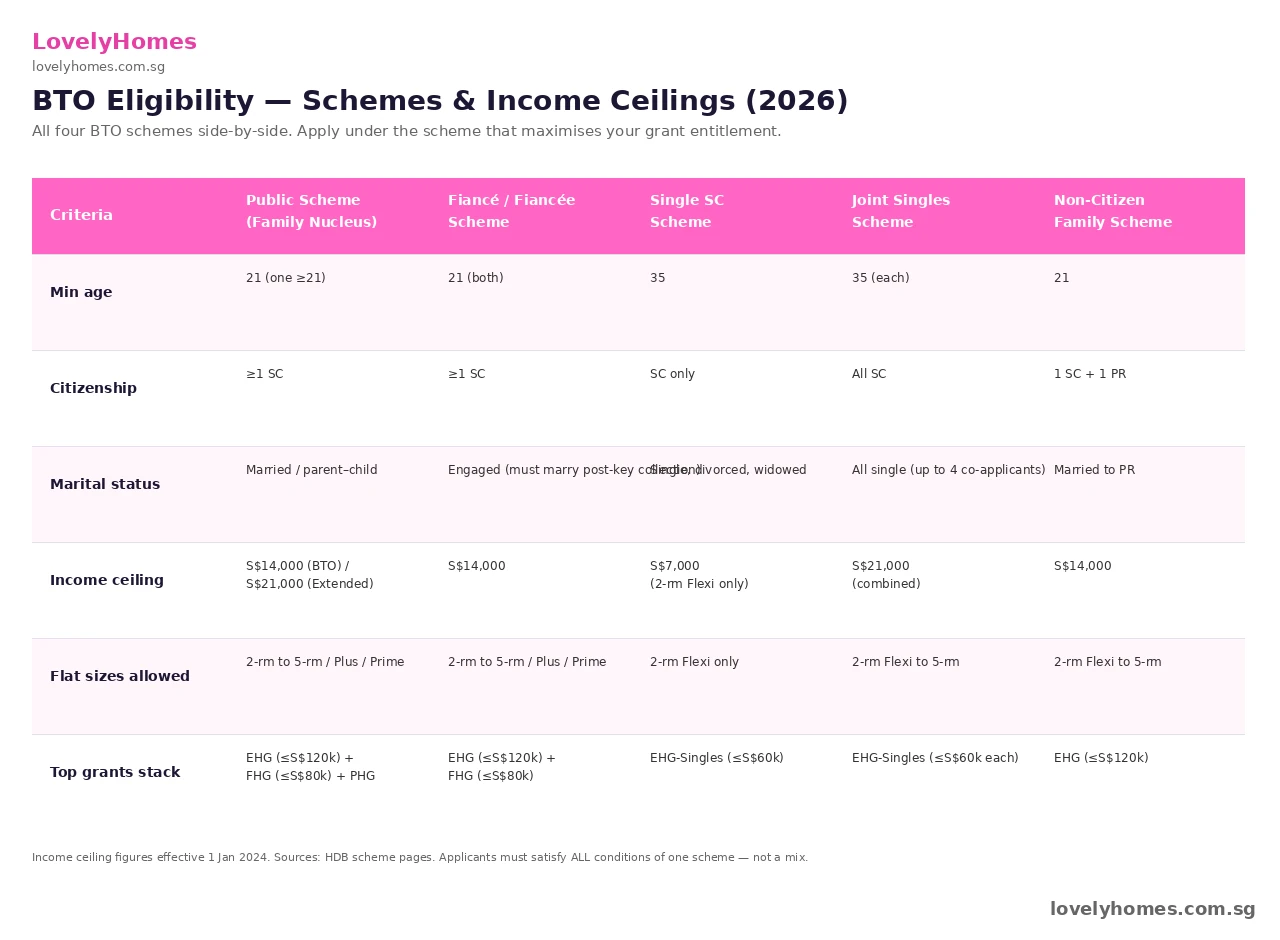
HDB classifies every applicant into exactly one of five schemes. Your scheme determines the income ceiling, age limits, allowed flat sizes, and the grant stack you qualify for. Choosing the right scheme is not optional — HDB will reject the application if you fit one scheme but apply under another.

HDB BTO application guide Singapore 2026 — eligibility schemes and income ceilings comparison
Figure 1: All five BTO eligibility schemes side-by-side — pick the one that maximises your grant entitlement.

Public Scheme (Family Nucleus)

The default scheme for married SC couples or parent-child households. At least one applicant must be a Singapore Citizen and at least one must be 21 or older. Combined gross household income is capped at S$14,000 for a standard application, or S$21,000 for an Extended-Family application (applicant + parents). The full range of flat types is available — 2-room Flexi to 5-room and 3Gen, including Plus and Prime locations.

Fiancé/Fiancée Scheme

For couples not yet married. Both applicants must be 21 or older and at least one a Singapore Citizen. The S$14,000 ceiling applies. The catch: you must produce a marriage certificate within 3 months of key collection, otherwise HDB has the right to repossess the unit. Couples who break off the engagement before key collection can withdraw without forfeiting the option fee.

Single Singapore Citizen Scheme

For singles aged 35 or older holding Singapore Citizenship. Only 2-room Flexi flats are available, and only in selected non-mature estates. Income ceiling is S$7,000. Couples who do not qualify under the Family or Fiancé schemes (e.g. one party is a foreigner) cannot use this route — it is genuinely a singles-only scheme.

Joint Singles Scheme

Two to four singles aged 35+ may co-apply. All must be Singapore Citizens. The combined income ceiling rises to S$21,000. Flat types extend up to 5-room. Joint singles must all hold equal shares; ownership cannot be reorganised after key collection. This scheme is increasingly used by adult siblings and long-term unmarried partners.

Non-Citizen Family Scheme

Where a Singapore Citizen is married to a Singapore Permanent Resident. The SC applicant must be 21 or older, the income ceiling sits at S$14,000, and only 2-room Flexi to 5-room flats are available (Plus and Prime are off-limits). Note: a Singapore Citizen married to a foreigner who is not a PR cannot apply under any HDB scheme — the household must wait for the foreigner to obtain PR status.

Income Ceilings — What Counts and How They Calculate

HDB’s income ceiling is based on average gross monthly household income. “Gross” means before CPF and tax. “Average” means the trailing 12-month average for salaried income; for variable income (commissions, bonuses, self-employment), HDB uses the most recent 24 months, divides by 24, then adds a 30% buffer to be conservative.

Applicants must submit Notice of Assessment (NOA) tax statements, the latest 3 months of payslips, and an Income Declaration (IRAS-issued for self-employed). HDB cross-checks against IRAS records. Inflated declarations to qualify for higher grants will be caught at the HFE (HDB Flat Eligibility) letter stage and the application rescinded; the ban from re-applying is 5 years.

For couples planning a BTO purchase but expecting one party to receive a windfall bonus or commission, timing matters: buy now while the trailing-12-month average is still under the ceiling, or wait until the 12 months have rolled past the bonus event.

The Application Process — What to Do, In Order

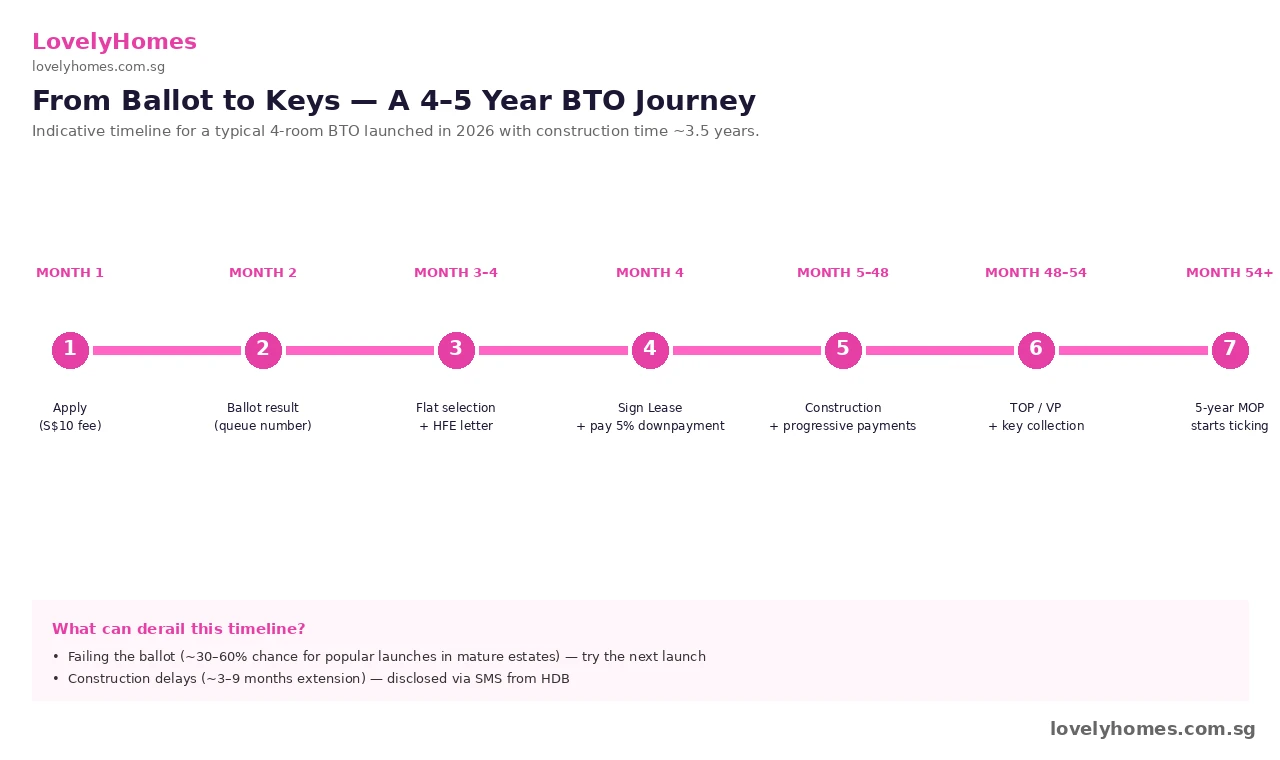
HDB BTO application guide Singapore 2026 — application timeline from ballot to key collection
Figure 2: Indicative 4–5 year BTO journey from ballot to key collection.

The mechanics of a BTO application have not changed materially since 2018, but the digital tooling has. Today every step bar key collection happens through the HDB Flat Portal and CPF/MyInfo integration:

  1. Obtain HFE Letter — the HDB Flat Eligibility letter (introduced 9 May 2023) bundles eligibility assessment, grant assessment, and loan eligibility into one document valid for 6 months. You need it before you can apply for any BTO. Generated through the HDB Flat Portal in 21 working days; lenders use it to issue an in-principle approval.
  2. Application window — each launch opens for 7 days. Apply via the HDB Flat Portal; the application fee is S$10 non-refundable. Applicants choose up to two flat types in their preferred town.
  3. Ballot — 3–5 weeks after close. Each application is randomly drawn within its priority group (First-Timer Family, First-Timer Single, Second-Timer, etc.) and assigned a queue number. First-timers receive up to 3 queue-number chances (the “3 queue numbers” rule introduced in 2022); second-timers receive 1.
  4. Flat selection appointment — you are booked into a 4-hour slot starting from queue number 1 onward. Lower queue numbers see the full selection; later applicants see only what is left. Bring your spouse, your HFE letter, and the option fee (S$500–2,000 by flat type, paid by NETS).
  5. Sign Agreement for Lease — about 4 months after selection. You pay 5% downpayment, less the option fee already paid. Funds may come from CPF OA + cash; if you are taking an HDB concessionary loan, no cash is required.
  6. Construction — typically 3.5–4 years. HDB releases progress updates by SMS and the Flat Portal.
  7. Notice of Vacant Possession + Key Collection — the final 5% of the price is paid; you collect keys and the 5-year Minimum Occupation Period (MOP) clock starts ticking.

The Ballot — How Queue Numbers Are Decided

The single biggest source of confusion among first-time applicants is the difference between “ballot” and “flat selection”. The ballot determines your queue number; flat selection is when you actually pick a unit. The queue is sequenced by:

  1. Priority groups (in order): Married Couples Priority Scheme (MCPS); Parenthood Priority Scheme (PPS); Multi-Generation Priority Scheme (MGPS); Tenants Priority Scheme; First-Timer Family; First-Timer Single; Second-Timer; Joint Singles.
  2. Within a priority group: a random ballot.
  3. Tiebreakers: later launches have started using the SC1 (sole-citizen 1-applicant) tiebreaker first.

Practical implication: a first-timer SC+SC couple with one child applying under PPS gets a meaningfully better queue position than the same couple without the priority application. Each launch reserves 30% of supply for first-timers, with the balance for second-timers and singles — so even a poor queue number does not necessarily mean exclusion if you are a first-timer.

The EIP and SPR Quotas — Why “Available” Doesn’t Mean “Available to You”

The Ethnic Integration Policy (EIP) was introduced in 1989 to prevent the formation of mono-ethnic enclaves. Every HDB block and every neighbourhood has a maximum proportion of flats that may be sold to each ethnic group:

  • Chinese: 84% of a neighbourhood, 87% of a block.
  • Malay: 22% of a neighbourhood, 25% of a block.
  • Indian / Other: 10% of a neighbourhood, 13% of a block.

The Singapore Permanent Resident (SPR) Quota sits on top of EIP and limits the proportion of non-Malaysian SPR households per neighbourhood (5%) and per block (8%). Malaysian SPRs are exempt because they are considered demographically and culturally close to Singaporean groups.

Each unit at flat selection shows the live EIP/SPR status. A unit may be physically vacant but unavailable to your ethnic group because the quota is full. You see this most acutely in popular projects in Bishan, Queenstown, or Bukit Merah, where Chinese-quota units sell out first while Indian-quota units may still be open at queue number 200+. Plan your back-up unit choices accordingly.

Grants — The Stack That Can Pay for Your Furniture

For BTO applicants, grants are awarded in fewer types than for resale buyers, but the absolute amounts are still material. As of 1 February 2024 the BTO-side grants are:

  • Enhanced CPF Housing Grant (EHG): S$5,000 to S$120,000 sliding scale by household income. The full S$120k is available for households earning up to S$1,500/month; the grant tapers to S$5,000 at the S$9,000–9,500 income band.
  • Family Grant: S$10,000 to S$80,000 depending on flat type and income, available only for resale BTO and for Plus/Prime BTO under the new classification. Standard BTOs do not qualify (the subsidy is built into the price).
  • Proximity Housing Grant (PHG): S$30,000 if buying with parents living in the same household; S$15,000 if buying within 4 km of parents’ existing flat.
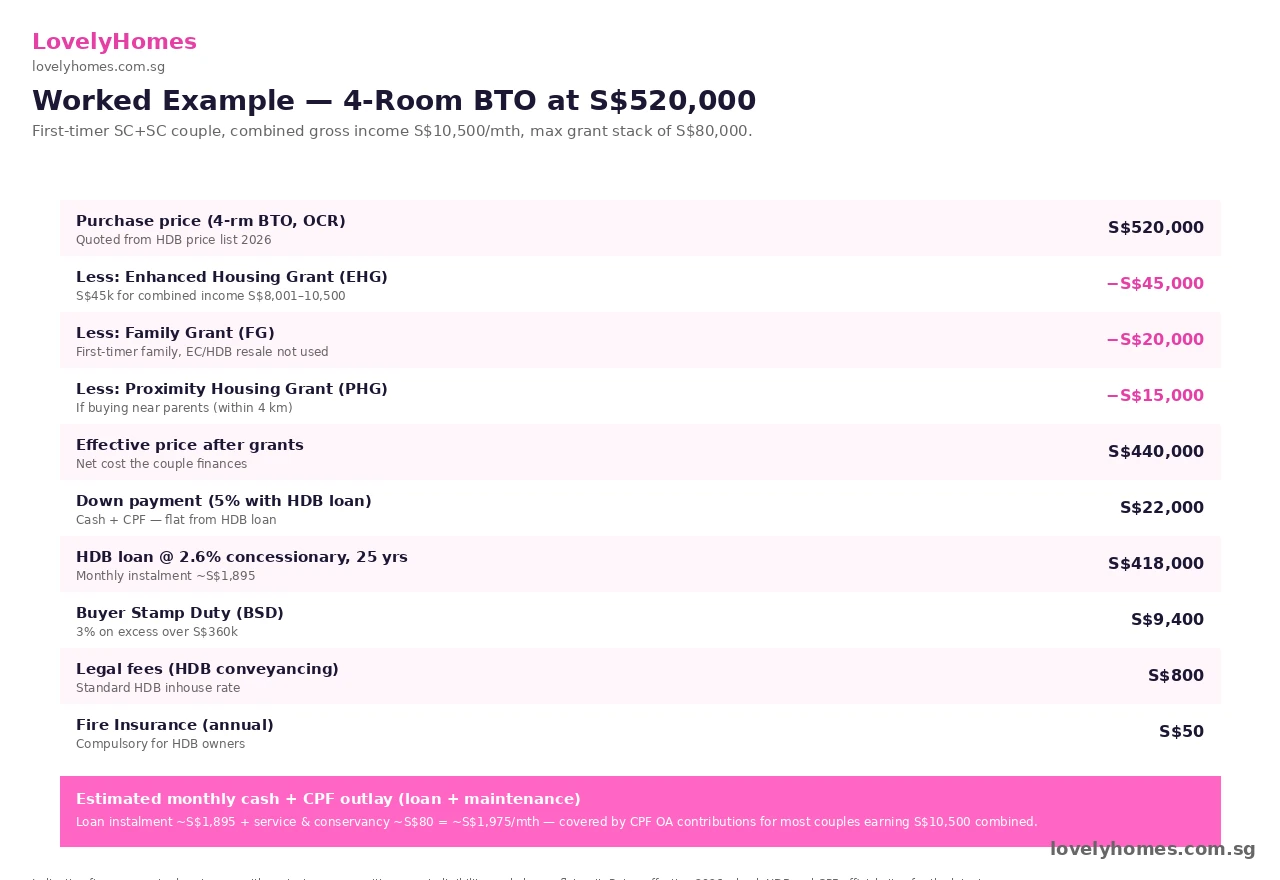
HDB BTO application guide Singapore 2026 — S$520K 4-room cost stack with grants
Figure 3: Worked example — SC+SC couple buying a S$520K 4-room BTO with a S$80K grant stack.

BTO Classification — Standard, Plus, Prime

From October 2024 onwards, every new BTO is classified as Standard, Plus, or Prime. This shifts the subsidy structure and the resale rules:

  • Standard: the legacy framework. 5-year MOP, no resale-price clawback, no income ceiling on the resale buyer. The default for non-mature estates.
  • Plus: 10-year MOP, income ceiling of S$14k applies even on resale, partial subsidy clawback at resale. Found in choicer locations within outer-mature estates.
  • Prime: 10-year MOP, S$14k income ceiling on resale, 6% subsidy clawback, no whole-flat rental ever (only room rental). Reserved for the most attractive locations like Queenstown and Kallang/Whampoa.

The classification affects your effective return on the flat 10 years out. A Plus flat in Hougang sold to a quota-restricted resale buyer will trade at a discount to the equivalent Standard flat in nearby Sengkang — that is the design intent, to keep the subsidy in the public-housing system.

Worked Example — SC+SC Couple, Combined S$10,500/Month

Take a 32-year-old + 30-year-old SC+SC couple, married, no children, combined gross income S$10,500/month. They are first-timers and applying under the Family Scheme. They target a 4-room BTO at S$520,000 in Punggol Coast (a Standard project).

  • Income ceiling check: S$10,500 < S$14,000. PASS.
  • Grants: EHG at the S$8,001–10,500 income band = S$45,000. Family Grant: not applicable for Standard BTOs. PHG: S$15,000 if their parents live within 4 km. Total: S$60,000.
  • Effective price: S$520,000 − S$60,000 = S$460,000.
  • Down payment (5% with HDB loan): S$23,000, payable from CPF OA.
  • HDB loan @ 2.6%, 25 years: S$437,000 principal × 2.6% ⇒ monthly instalment ~S$1,985.
  • BSD: 1% on first S$180k + 2% on next S$180k + 3% on next S$160k ≈ S$8,200, payable in cash or CPF OA.
  • Legal fees (HDB conveyancing): ~S$800.

Total upfront cash + CPF outlay: ~S$32,000 (downpayment + BSD + legal + option fee). Monthly outlay during construction: ~S$95/month service & conservancy charges only. Monthly outlay after key collection: ~S$2,070 (loan + S&C). Against a household income of S$10,500/month gross (~S$8,400 take-home), the loan is comfortably within the 30% MSR (Mortgage Servicing Ratio) limit for HDB loans.

Common Mistakes BTO Applicants Make

  1. Skipping the HFE letter — without it, you cannot apply. Generate the HFE 6–8 weeks before the launch you want.
  2. Choosing a project where your ethnic quota is already full — check the EIP status on the launch site before applying.
  3. Underestimating the income ceiling buffer — HDB adds a 30% buffer for variable income. Sit just under the ceiling, not at it.
  4. Applying as Family before marriage — if you are not yet married, you must use the Fiancé scheme. The Family scheme is for already-married couples.
  5. Ignoring the 5-year MOP — or now 10-year for Plus/Prime. The MOP starts on key collection, not application; selling within MOP requires HDB’s express consent and is rarely granted.

What This Means for You

For most Singaporean first-timer households, BTO remains the single most subsidised real-estate transaction available. A successful 4-room BTO in 2026 typically delivers a paper gain of 60–100% by the end of the 5-year MOP — not because the project is special, but because the price gap between BTO and resale is structurally maintained. The key is winning the ballot. Increase your odds by applying under the right priority scheme (PPS for couples with children, MCPS for newlyweds), targeting non-mature estates where oversubscription is lower, and being flexible on flat type (4-room ballots have higher success rates than 5-room).

What Might Come Next

The Ministry of National Development has signalled three policy directions for the 2026–2028 horizon. First, BTO supply is forecast to remain at 22,000–25,000 per year through 2028, after which the pipeline tapers to 18,000 as the demographic bulge passes. Second, the Plus/Prime classification is expected to be applied to roughly 30% of new launches by 2028, up from ~15% in 2025. Third, the Joint Singles Scheme age threshold may be lowered from 35 to 30 if the Singapore Together Forward dialogue feedback gains policy traction. None of these is yet officially confirmed; watch the COS speech each March for the firm announcements.

Summary — Eligibility & Grant Stack by Scheme (Quick Reference)

Scheme Min Age Citizenship Income Ceiling Flat Sizes Top Grant Stack
Public (Family Nucleus) 21 (one) ≥1 SC S$14,000 2-rm to 5-rm + 3Gen EHG up to S$120k + PHG S$30k
Fiancé/Fiancée 21 (both) ≥1 SC S$14,000 2-rm to 5-rm EHG up to S$120k + PHG
Single SC 35 SC only S$7,000 2-rm Flexi only EHG-Singles up to S$60k
Joint Singles 35 (each) All SC S$21,000 (combined) 2-rm Flexi to 5-rm EHG-Singles up to S$60k each
Non-Citizen Family 21 (SC) 1 SC + 1 PR S$14,000 2-rm Flexi to 5-rm EHG up to S$120k

Frequently Asked Questions

Can I apply for a BTO if I already own a private property?

Yes, but you must dispose of your private property within 30 months of key collection of the BTO. If you fail to do so, HDB may compulsorily acquire the BTO at original cost. The 30-month window is intended to allow for sale logistics. You also forfeit any first-timer status — you will be treated as a second-timer for grant calculations. Most second-time HDB applicants in this position are downsizing from a private property after children leave home, or rebalancing portfolios after en-bloc proceeds.

How long does the entire process take, from application to keys?

Plan for 4 to 4.5 years from application close to key collection on a typical BTO project, with a further 5 years (Standard) or 10 years (Plus/Prime) of Minimum Occupation Period before you can sell. The construction stage is the longest phase — typically 36–48 months from breaking ground. Projects in Tengah and Punggol have generally tracked the lower end; mature-estate projects in Queenstown and Bishan have hit the upper end due to site constraints.

What happens if I fail the ballot?

You forfeit only the S$10 application fee and may apply again at the next launch. There is no penalty or queue-number penalty for non-selection — in fact, first-timers retain their first-timer status and the 3-queue-number allocation. Many couples cycle through 4–6 launches before securing a unit in their preferred town. To shorten the wait, broaden the geographies you are willing to apply in, or apply under a priority scheme like Parenthood Priority if you have children.

Can I use a private bank loan instead of an HDB concessionary loan?

Yes — bank financing is allowed for BTO buyers, and currently many do because SORA-pegged floating rates have hovered around 3.5–3.8% (vs the HDB concessionary rate at 2.6%, fixed at CPF OA + 0.1%). The trade-off: bank loans require a 25% downpayment (5% cash + 20% cash/CPF) instead of the 0% cash + 20% CPF on an HDB loan. Once you choose bank financing for your first BTO, you cannot switch back to an HDB concessionary loan for the same flat. Most first-timer BTO buyers stay on the HDB loan for the cash-flow flexibility.

If we are not yet married, can we still apply?

Yes — under the Fiancé/Fiancée Scheme. Both applicants must be 21+ and at least one a Singapore Citizen. You declare your intention to marry; HDB requires you to produce a marriage certificate within 3 months of key collection. If the relationship breaks down before key collection, you may withdraw from the application and forfeit only the option fee — HDB will not pursue you for damages.

How does the EIP affect resale value of my flat?

The EIP can constrain the buyer pool when you eventually sell. If your block’s Chinese quota is full and you are Chinese, you can only sell to a non-Chinese buyer — which is a smaller market and typically yields a 1–3% price discount. The reverse is also true: minority-quota sellers in mature estates often see a small premium. Most owners do not feel this until they list; consult your conveyancing lawyer for an EIP-aware listing strategy.

Can I rent out my BTO flat after MOP?

For Standard BTOs: yes, after the 5-year MOP, you may rent out the entire flat under HDB’s Whole Flat Rental scheme (subject to a 6-monthly registration). For Plus and Prime BTOs: only room rental is permitted, never whole-flat rental. The whole-flat rental rule is a permanent restriction designed to keep the subsidy in the owner-occupier pool. Non-citizen sub-tenant quotas also apply: the Non-Citizen Quota caps non-Malaysian PRs at 5% of a neighbourhood and 8% of a block.

Related Articles

Disclaimer

This guide is for general information only and does not constitute legal, financial, or housing advice. Eligibility schemes, income ceilings, grant amounts, EIP/SPR quotas, and BTO classification rules are illustrative as at April 2026 and are subject to change at the discretion of the Housing & Development Board, the Ministry of National Development, and the Central Provident Fund Board. Always verify the latest figures with primary sources — the Housing & Development Board, the CPF Board, the Inland Revenue Authority of Singapore, and consult a qualified housing consultant or conveyancing lawyer before signing any agreement.

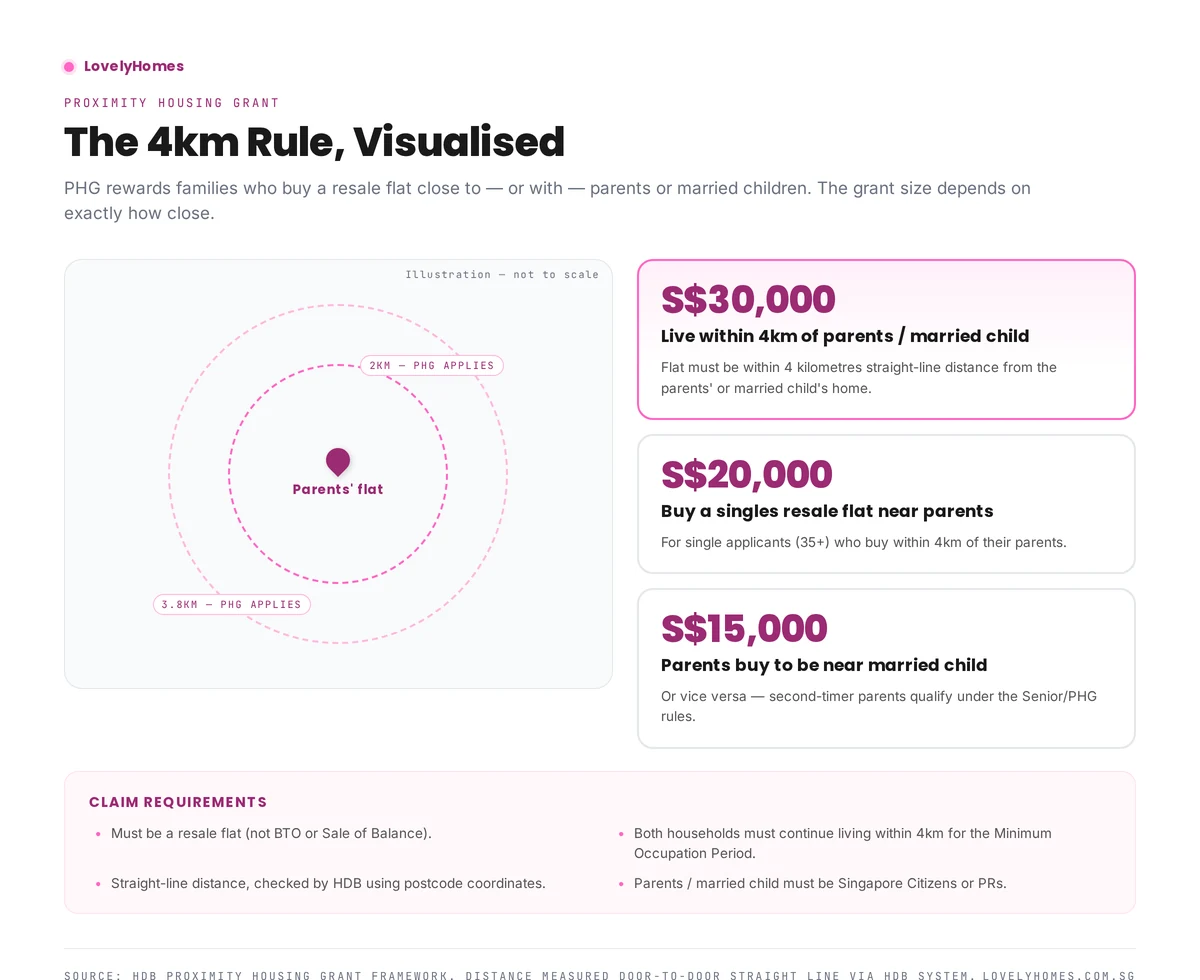
Proximity Housing Grant (PHG) Singapore: The 4km Rule Explained

Proximity Housing Grant (PHG) Singapore: The 4km Rule Explained

Quick answer
The Proximity Housing Grant pays S$30,000 to a first-timer or second-timer household that buys a resale HDB flat within 4km (straight-line) of parents or a married child. Families that buy to live together receive a S$20,000 variant. Singles aged 35+ get S$20,000 for a resale flat within 4km of their parents.

PHG is the only CPF housing grant that rewards location choice rather than income. In practice, it reshapes a lot of purchase decisions: a S$30,000 grant is worth one to two months of mortgage payments on a median 4-room resale flat, and it tilts many couples toward estates their parents live in.

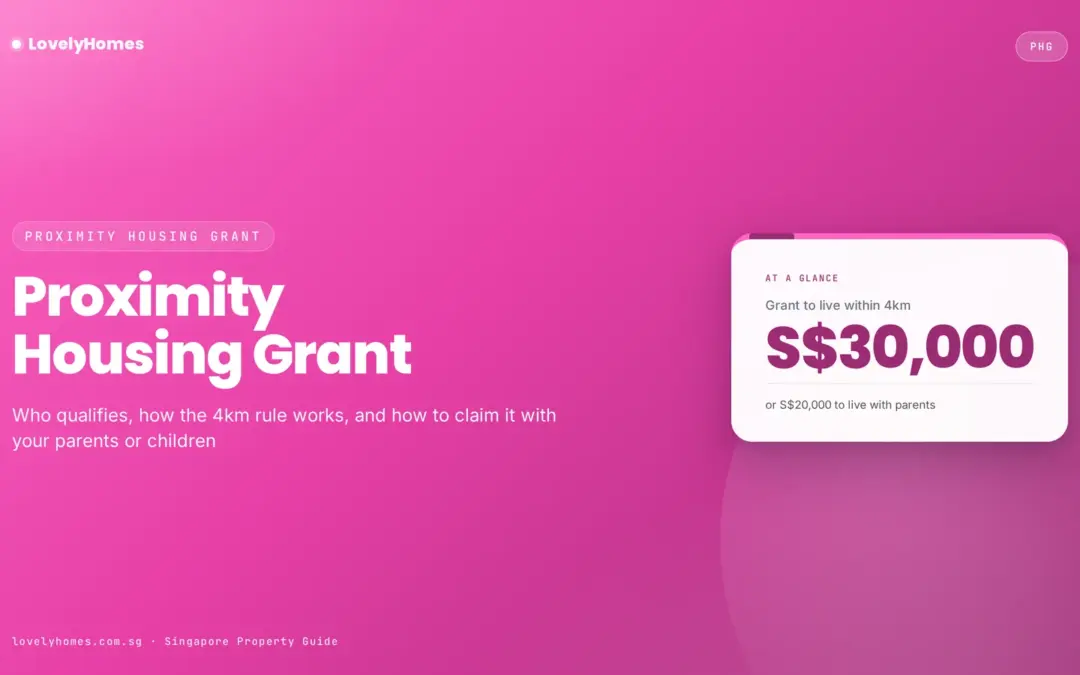
Proximity Housing Grant 4km rule diagram — S$30,000 near parents, S$20,000 singles, S$15,000 parents near child
The three PHG variants and the 4km rule visualised (illustration, not to scale).

What PHG is (and isn’t)

PHG is a resale-only grant. It does not apply to BTO purchases, because HDB already allocates BTO flats through balloting and schemes like the Multi-Generation Priority Scheme. It applies to both first-timers and second-timers, which is unusual — most grants close once you have had one.

Three variants exist:

Variant Quantum Who
Live near parents / married child S$30,000 Couples / families buying within 4km
Live with parents / married child S$15,000 (top-up) Joint purchase / same flat
Singles (35+) near parents S$20,000 Singles-scheme resale buyers within 4km

How the 4km rule actually works

HDB measures straight-line distance between the postal centroids of your new flat and your parents’ (or married child’s) address. It does not care about walking distance, MRT travel time, or which town you’re in. A flat across a canal in a different town may still be within 4km; a flat in the same estate might fall just outside.

You can check the distance on the HDB portal before you commit to an OTP. Sellers often advertise whether a resale flat qualifies; verify it yourself before exercising, because getting the distance wrong means S$30,000 left on the table.

Who counts as parents / child

PHG is more generous about family definitions than many buyers assume. For a married couple, “parents” includes the biological or adoptive parents of either spouse — so living near your in-laws also qualifies. “Married child” means a Singapore Citizen or PR child who has formed a family nucleus of their own.

Step-parents generally do not qualify unless you were legally adopted. The parent(s) must be SC or SPR and must live in Singapore on a regular basis — HDB checks this against their NRIC-registered address.

The post-purchase obligation

PHG carries a follow-through obligation: both households must continue to live within the 4km threshold through your standard 5-year Minimum Occupation Period. If your parents sell up and move further away before MOP ends, you will normally keep the grant — the rule is tested at application time, not continuously — but HDB has clawed back grants in a small number of cases where the relocation happened unusually close to purchase.

A few buyers try to “pass the test” with an in-law’s short-term rental address. HDB has flagged this as a concern and routinely asks for evidence of genuine, stable parental residence.

Worked example

Field Value
Buyers Married SC couple, first-timers
Flat 4-room resale in Clementi at S$680,000
Parents’ flat 3-room HDB in Queenstown, 2.6km straight-line
PHG S$30,000
Family Grant S$50,000
EHG (income S$8,500) S$5,000
Total grants S$85,000

How PHG shapes negotiation

A PHG-qualifying flat is slightly more attractive than an identical flat that falls outside the 4km radius, which means well-informed buyers sometimes bid a touch more for it. Savvy sellers mention “within 4km of XYZ parents’ flat” in the listing because it widens the qualifying buyer pool.

Frequently asked questions

Does PHG apply to EC purchases?

No. Executive Condominiums do not qualify for PHG. It is HDB-resale only.

What if my parents move after I buy?

You are not normally required to refund the grant. However, the Minimum Occupation Period rules around residence still apply to you as the flat owner.

Can I use PHG with my in-laws?

Yes, if they are the legal parents of your spouse. Step-parents usually do not qualify.

Is PHG paid in cash?

No. Like other CPF housing grants, PHG is disbursed via your CPF Ordinary Account against the flat price.


This guide is for general information only and is accurate as of April 2026. CPF grants, scheme quantum and eligibility rules are set by HDB / the Ministry of National Development and can change. Always confirm current rules on the HDB Flat Portal or with an HDB officer before committing. We are not a financial or legal advisor.


CPF Housing Grants 2026: Complete Eligibility & Quantum Table

CPF Housing Grants 2026: Complete Eligibility & Quantum Table

Quick answer
A first-timer Singaporean couple buying a resale HDB flat in 2026 can potentially stack three CPF housing grants — EHG (up to S$120,000), Family Grant (up to S$80,000) and Proximity Housing Grant (up to S$30,000) — for a theoretical maximum of roughly S$230,000. The actual amount depends on household income, flat type, and whether you live near parents or a married child.

Few parts of the Singapore housing system are as life-changing — and as easy to get wrong — as CPF housing grants. A fully-stacked grant package can shave a year or two of mortgage payments off a typical HDB purchase. Miss one, and you leave tens of thousands of dollars on the table.

This guide sets out the 2026 eligibility and quantum tables for the three grants most first-timer buyers will care about, plus how they interact with the Loan Eligibility / Housing Financial Eligibility (HFE) process. If you are earlier in the buying journey, start with our first-time buyer walkthrough.

CPF housing grant stack — EHG + Family Grant + Proximity Housing Grant up to S$230,000
Illustrative grant stack for a first-timer couple on a resale HDB flat (2026 framework).

The three main grants, at a glance

Grant Max quantum Applies to Core eligibility
Enhanced CPF Housing Grant (EHG) S$120,000 BTO & resale First-timer; income-laddered; 12 months continuous work
Family Grant S$80,000 Resale only First-timer couple (or family nucleus); income ≤ S$14,000
Proximity Housing Grant (PHG) S$30,000 Resale only Buy within 4km of parents / married child (or live with them)

Singles (aged 35+) get a parallel set of grants at roughly half the quantum, so a single first-timer can still stack a meaningful amount if they buy near parents.

EHG — the workhorse grant

EHG is the single biggest number on most HDB grant statements. It replaced the older Additional CPF Housing Grant and Special CPF Housing Grant in 2019 and now covers both BTO and resale flats. Quantum is a sliding income ladder: every extra S$500 of monthly household income typically drops you down one step of the ladder.

For the detailed income ladder and the employment rule, see our EHG deep-dive.

Family Grant — the resale booster

Family Grant only applies to resale purchases. For a first-timer Singaporean couple buying a 4-room or smaller resale flat, the quantum is typically S$50,000; for 2- to 4-room flats bought by first-timers, HDB has published enhancements that can push it toward S$80,000 in specific cases. The income ceiling sits at S$14,000 for the standard variant.

If only one spouse is a first-timer, the grant is normally halved (the “Half-Housing Grant” variant).

Proximity Housing Grant — the location reward

PHG is the grant that quietly reshapes purchase decisions. S$30,000 for buying within 4km of parents or a married child is big enough to nudge many buyers toward a particular estate or town. For the full rule set — including what “within 4km” actually means, how HDB measures it, and how singles qualify — see the Proximity Housing Grant guide.

How stacking works in practice

Grants are applied sequentially against the flat price and your CPF Ordinary Account at completion. They do not come to you as cash. The stack changes your effective purchase price, which in turn changes the amount you need to cover from CPF savings, cash, and housing loan.

A common error is assuming that you always get the headline maximum. In reality, the first-timer couple with S$7,000 monthly income will rarely see EHG of S$5,000 and Family Grant and PHG all at once — they usually skip EHG because the ladder has run out.

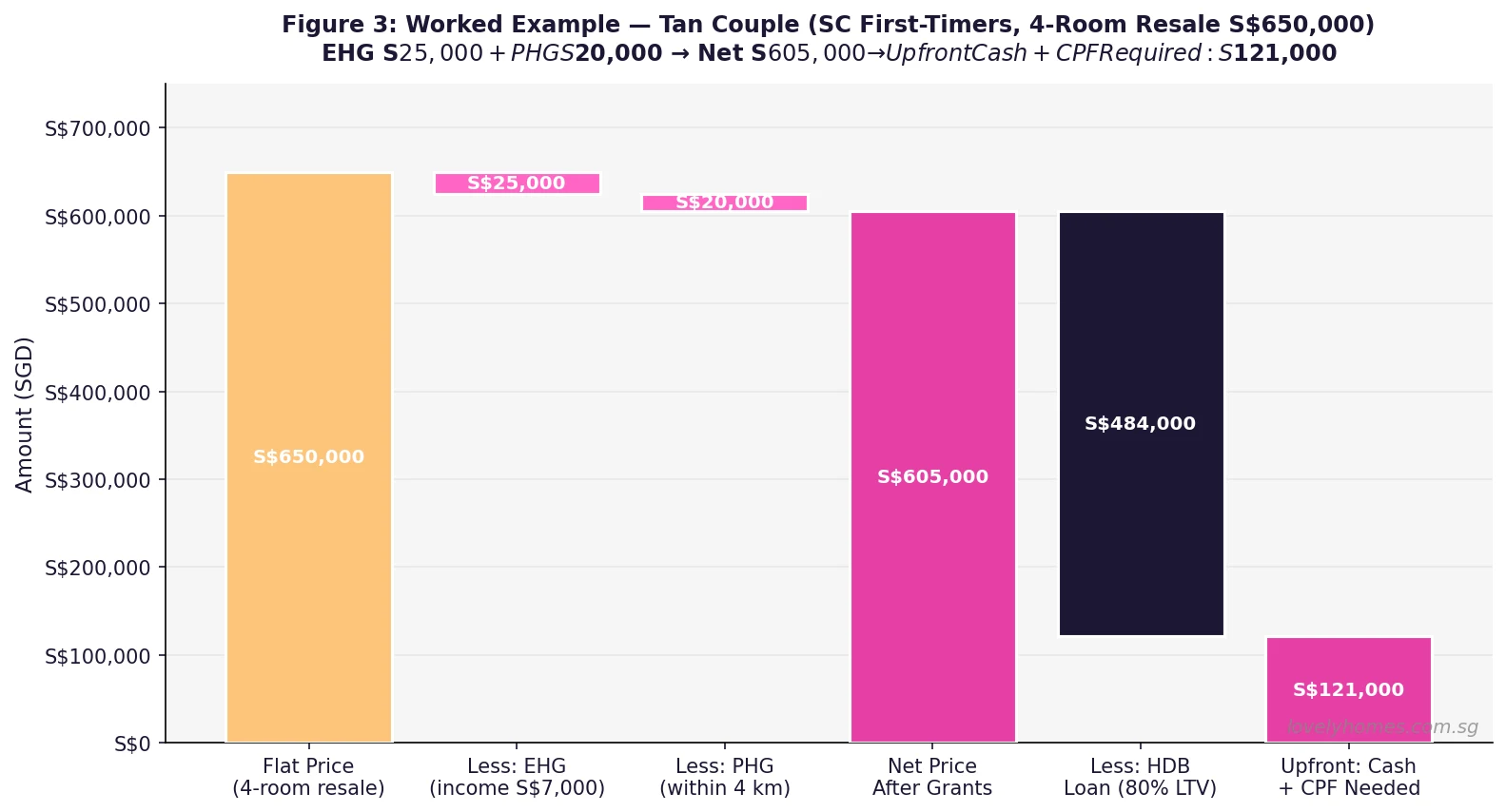
Worked example: first-timer couple, resale 4-room

Assumption Value
Combined household income S$6,500/month
Flat bought 4-room resale at S$650,000
Distance from parents 3.2km (straight line)
EHG (indicative) S$30,000
Family Grant S$50,000
Proximity Housing Grant S$30,000
Total grant S$110,000
Effective price S$540,000

How and when to apply

Grants are decided as part of your HFE letter and the subsequent resale or BTO application. You do not apply for each grant separately — HDB computes your eligible stack based on the information you declare. The practical sequence is:

  1. Apply for an HFE letter on the HDB Flat Portal before you shop. The HFE already tells you which grants you are likely to receive.
  2. Keep your documents ready — income proofs (Income Tax NOA, CPF contribution history), parents’ addresses for PHG, and the first-timer statuses of both applicants.
  3. Submit the application (BTO ballot or resale application). HDB confirms your final grant eligibility once the flat is identified.
  4. Disbursement happens at completion (resale) or key collection (BTO). Grants top up your CPF OA and flow into the flat payment.

Common pitfalls

Four traps catch buyers most often: (a) one spouse quietly failing the 12-month continuous-work rule for EHG; (b) using gross vs net income incorrectly when estimating; (c) assuming PHG automatically applies to in-laws — it applies to married children, and to the biological or adoptive parents of either spouse; and (d) not realising Family Grant halves if only one of you is a first-timer.

Frequently asked questions

Can I get EHG twice?

No. EHG is a first-timer grant. If you already used EHG on a BTO, you cannot receive it again on a later resale purchase — you become a second-timer for grant purposes.

Do I need to pay the grant back if I sell?

The grant amount (plus accrued interest) is treated like a CPF withdrawal. When you sell the flat, you refund the grant + accrued interest to your CPF Ordinary Account — not back to HDB.

Does PHG require me to live in the same flat as my parents?

No. The S$30,000 PHG is for living within 4km. A S$20,000 variant applies for living together (as part of a single application with parents or married child).

Can singles apply?

Yes, from age 35 for most resale grants, at roughly half the couple quantum. Single EHG, Single Family Grant, and a singles version of PHG all exist.


This guide is for general information only and is accurate as of April 2026. CPF grants, scheme quantum and eligibility rules are set by HDB / the Ministry of National Development and can change. Always confirm current rules on the HDB Flat Portal or with an HDB officer before committing. We are not a financial or legal advisor.


Translate »