Singapore Property Selling Guide 2026: Costs, Process and Net Proceeds Explained
- The typical private property selling process takes 12–16 weeks from listing to completion. For HDB flats, the HDB-managed resale process adds administrative steps and typically takes 16–24 weeks from Option to Purchase to key handover.
- Seller’s Stamp Duty (SSD) applies to private residential properties sold within four years of purchase (for properties bought on or after 4 July 2025): 16% in Year 1, 12% in Year 2, 8% in Year 3 and 4% in Year 4. HDB flats are not subject to SSD but must satisfy the Minimum Occupation Period (MOP) before resale.
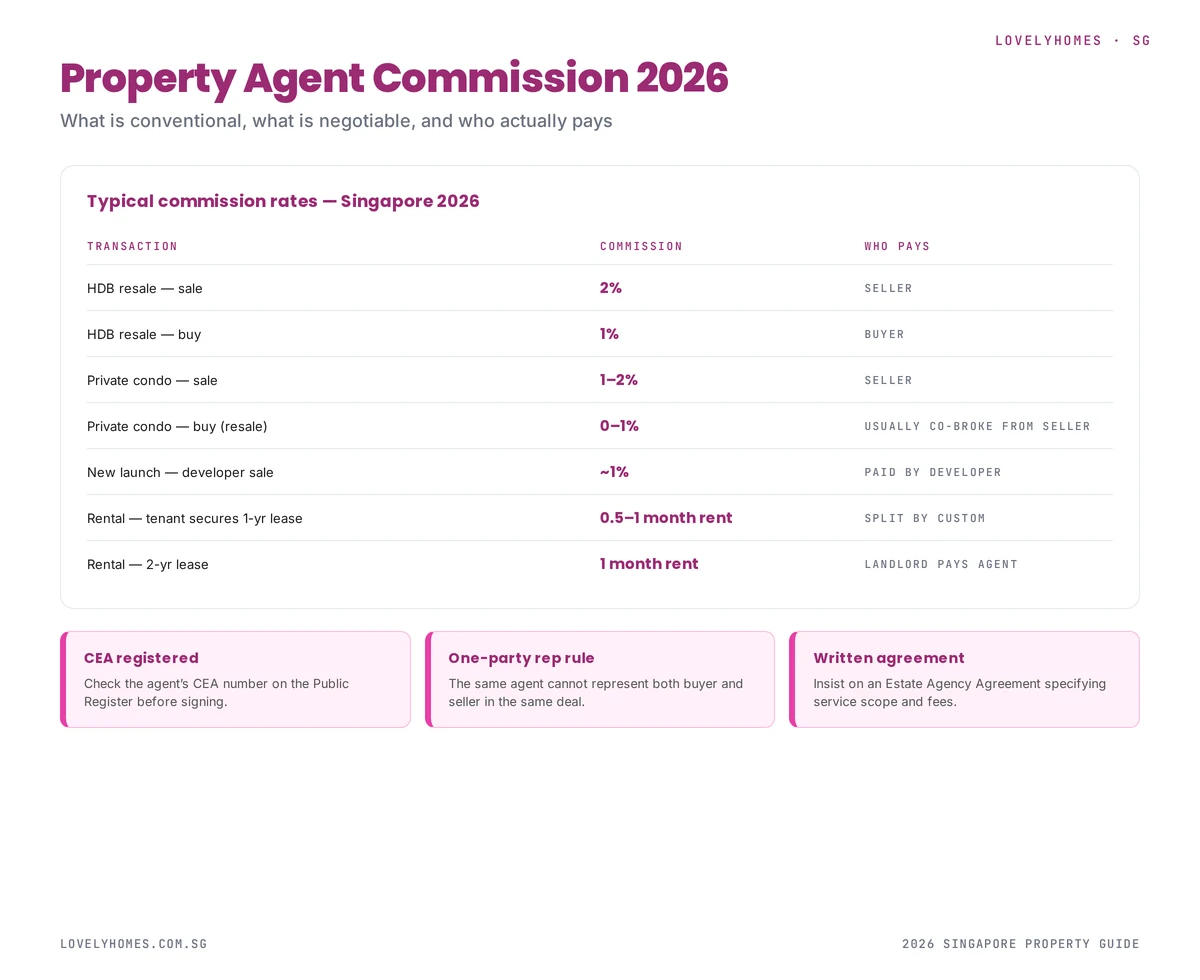
- Agent commission for sellers is typically 1% to 2% of the sale price, negotiable. It is not fixed by law but is governed by the Council for Estate Agencies (CEA) Code of Ethics. No commission is payable until a valid transaction is completed.
- When you sell a property in which CPF Ordinary Account funds were used for the purchase, you must refund the CPF principal used plus accrued interest (at 2.5% p.a. compounded) before any cash proceeds are available to you.
- Legal fees for a private property sale are typically S$2,500–S$5,000; for HDB resale, S$1,500–S$2,800. Conveyancing lawyers handle the title transfer, mortgage discharge and CPF charge release.
- There is no capital gains tax in Singapore on property disposals. However, if IRAS determines that a seller is a property trader (buying and selling frequently for profit), gains may be assessed as income and taxed at the applicable income tax rate.
- Upon completion, your proceeds flow in this order: mortgage redemption → CPF refund with accrued interest → agent commission → legal fees → net cash to seller.
Should You Sell? The Pre-Sale Decision
Deciding to sell a Singapore property involves more than agreeing on an asking price. Before you appoint an agent or list a property, three questions must be answered: Have you satisfied the applicable holding-period rules? What will the net proceeds look like after repaying CPF, the mortgage and transaction costs? And — if you own an HDB flat and plan to purchase a private property after selling — what are the ABSD implications of your next move?
For HDB flat owners, the key holding-period rule is the Minimum Occupation Period (MOP): five years for Standard flats, ten years for Plus and Prime flats introduced under the 2024 classification. You may not list your HDB flat for resale until the MOP is satisfied. Violating the MOP by selling prematurely (including sub-letting the entire flat during the MOP without HDB approval) can result in compulsory acquisition of the flat at the purchase price — a severe financial penalty.
For private residential property owners, the governing holding-period rule is the Seller’s Stamp Duty (SSD). Selling within the prescribed period triggers an SSD bill payable by the seller within 14 days of the disposal. For properties bought before 4 July 2025, the SSD holding period is three years; for those bought on or after 4 July 2025, it is four years. At SSD rates of up to 16%, selling too early can eliminate any capital gain and more.

Stage 1: Pre-Sale Preparation
Before listing, you should complete four tasks. First, confirm your MOP or SSD position. For HDB sellers, log in to the HDB Flat Portal to verify the exact MOP end date. For private property owners, calculate the four-year SSD holding period from the date of the Option to Purchase or Sale and Purchase Agreement — not the date of legal completion.
Second, obtain a formal valuation. HDB sellers must submit a Request for Value through the HDB portal — this valuation determines the benchmark for Cash Over Valuation (COV) discussions. Private property sellers typically rely on comparative market analyses from agents and, for bank refinancing purposes, formal valuations commissioned by lenders.
Third, appoint a CEA-registered agent. The Council for Estate Agencies (CEA) maintains the Public Register of property agents (cea.gov.sg/public-register). You should verify your agent’s registration before signing an Exclusive Listing Agreement. The agreement specifies commission rate, exclusivity period, and the agent’s obligations — read it carefully before signing.
Fourth, consider decluttering, repainting and minor repairs. Data from industry surveys consistently shows that well-presented properties sell 10–15% faster and closer to the asking price than properties in poor condition. For HDB flats especially, fresh paint and clean common areas make a material difference in a competitive resale market.
Stage 2: Listing, Marketing and Negotiation
Once listed, your agent will market the property on portals (PropertyGuru, 99.co, SRX) and conduct viewings. A professionally photographed listing — including a virtual tour for private properties — is no longer optional in the current market; buyers routinely shortlist on the basis of photographs before agreeing to a physical viewing.
Negotiations typically proceed through the agent. Buyers will make verbal offers, and you may counter. Key negotiation levers include the asking price, the option fee quantum (typically 1% for private, S$1–S$10,000 for HDB), the option exercise period, the completion timeline, and what fixtures and fittings are included. For private property, it is common for sellers to grant a 14-day Option to Purchase after agreeing on the price and basic terms.
An important discipline: do not accept more than one option fee from different buyers for the same property at the same time. Granting multiple options simultaneously is unlawful. Once you accept an option fee and issue an Option to Purchase, the buyer has the exclusive right to exercise it within the validity period.

Stage 3: Granting the Option to Purchase (OTP)
For private property, the Option to Purchase is a bilateral agreement that grants the buyer an exclusive right to purchase at the agreed price within a specified period (typically 14 days). Upon receiving the option fee (usually 1% of the purchase price), you sign and date the OTP. You cannot sell the property to anyone else during the option period. If the buyer does not exercise the option by the deadline, the option lapses and you retain the option fee as compensation.
For HDB resale flats, HDB prescribes a standard OTP format. The seller grants the option after the HDB Flat Eligibility (HFE) letter has been issued to the buyer and the Request for Value submitted. The option fee for HDB is between S$1 and S$1,000 (negotiable), and the option exercise fee is between S$1 and S$5,000 (for 4-room and smaller) or S$1 and S$10,000 (for 5-room and larger). The total of option fee plus exercise fee must not exceed S$5,000 or S$10,000 respectively. The HDB OTP has a 21-day validity: the buyer has 14 days to decide and 7 days after exercise to register the resale application with HDB.
Stage 4: Exercise, S&P Agreement and BSD/ABSD
When the buyer exercises the Option to Purchase, they pay the balance of the agreed deposit (typically 4–9% for private property; the exercise fee for HDB). For private property, the parties then execute a formal Sale and Purchase (S&P) Agreement drafted by the buyer’s conveyancing lawyers. The seller’s lawyers review and negotiate the S&P terms.
The buyer must pay Buyer’s Stamp Duty (BSD) and Additional Buyer’s Stamp Duty (ABSD, if applicable) within 14 days of exercising the Option. This is the buyer’s obligation, not the seller’s — but understanding it matters to sellers because it can affect how quickly a buyer is willing or able to complete the transaction.
For HDB resale, after the buyer exercises the option, both parties submit the resale application through the HDB Resale Portal. HDB verifies eligibility, processes the CPF withdrawals and housing grant (if any), and sets the completion date — typically 8–10 weeks after the resale application is accepted.
Stage 5: Completion and Net Proceeds
Completion day (or key collection day for HDB) is when legal ownership transfers. On completion, the proceeds flow in a prescribed order:
- Mortgage redemption — the outstanding loan balance is repaid to the bank (or HDB). The bank simultaneously releases the mortgage charge on the title.
- CPF refund — the CPF Board is repaid the principal withdrawn for the property plus accrued interest at 2.5% per annum (compounded annually). This refund goes back into your CPF Ordinary Account, not to you in cash.
- Legal fees and disbursements — conveyancing and title search fees paid to your solicitors.
- Agent commission — typically deducted from proceeds or paid on completion date.
- Net cash to seller — the residual after all the above deductions.
Sellers are sometimes surprised to discover that their CPF refund obligation (including decades of compounded accrued interest) absorbs a substantial portion of the sale proceeds. For a property held for 15 years with CPF heavily used, the CPF refund may exceed the original CPF principal withdrawn by 30–40%.

Selling Costs at a Glance
| Cost Item | HDB Resale | Private Condo | Landed Property | Payable By |
|---|---|---|---|---|
| Agent Commission | ~1% (negotiable) | ~1–2% (negotiable) | ~1–2% (negotiable) | Seller |
| Legal / Conveyancing | S$1,500–S$2,800 | S$2,500–S$4,500 | S$3,500–S$6,000 | Seller |
| HDB Admin Fee | S$40 (resale levy admin) | — | — | Seller |
| SSD (if within hold period) | Nil (HDB exempt) | Up to 16% | Up to 16% | Seller |
| CPF Refund (principal + interest) | Yes — full refund required | Yes — full refund required | Yes — full refund required | Seller (to CPF Board) |
| Mortgage Early Redemption | Nil (no prepayment penalty on HDB loans) | Check loan documents; typically nil after lock-in period | Check loan documents | Seller |
| Property Agent Registration | Both agent and seller must use CEA-registered agents | — | — | — |
Worked Example: Selling a Bishan 5-Room HDB Flat
Scenario: Mr and Mrs Lim, both Singapore Citizens, purchased their 5-room HDB flat in Bishan in June 2019 for S$450,000 using an HDB concessionary loan of S$360,000 (fully repaid by 2026) and CPF Ordinary Account withdrawals totalling S$200,000 over the seven-year holding period. In August 2026, they receive an offer of S$780,000. Their MOP was satisfied in June 2024.
CPF refund obligation: CPF principal used = S$200,000. Accrued CPF interest at 2.5% p.a. compounded over 7 years = approximately S$37,500. Total CPF refund to CPF Board: S$237,500. This amount re-enters their CPF Ordinary Account — it is not lost, but it is not available as liquid cash.
Agent commission (1%): 1% × S$780,000 = S$7,800.
Legal fees: approximately S$2,500.
HDB admin fee: S$40.
SSD: Nil — HDB flats are not subject to SSD.
Mortgage outstanding: Nil — fully repaid.
Net cash proceeds calculation:
| Item | Amount |
|---|---|
| Sale Price | +S$780,000 |
| CPF Refund (principal + interest) | −S$237,500 |
| Agent Commission (1%) | −S$7,800 |
| Legal Fees | −S$2,500 |
| HDB Admin Fee | −S$40 |
| Net Cash Proceeds | S$532,160 |
The Lims walk away with S$532,160 in cash, plus S$237,500 back in their CPF OA. Their next move determines ABSD exposure: if they buy a private condo as their sole property (having sold the HDB), they pay 0% ABSD as SC buying a first residential property. If they retain the HDB and buy a private condo as a second property, they pay 20% ABSD — approximately S$300,000 on a S$1.5M condo. Selling first and buying second, with the 6-month overlap remission if needed, is therefore the financially dominant sequence for most upgraders.
Why This Matters: The Upgrade vs. Retain Calculation
The ABSD framework has fundamentally altered the upgrade decision for HDB owners. Before April 2023, a Singapore Citizen buying a second property paid 12% ABSD. At S$1.5 million, that was S$180,000 — significant but potentially manageable for a dual-income household with substantial HDB equity. After April 2023, the same transaction costs S$300,000 in ABSD — roughly equivalent to two years of median household income.
This has driven a structural shift in upgrader behaviour. Increasingly, HDB sellers opt to complete their HDB sale before purchasing their next home, accepting a period of rental tenancy (or temporary stay with family) to avoid the ABSD surcharge. This “sell first, buy later” approach has the incidental effect of increasing HDB resale supply and, by removing one source of demand from the private market, moderating private property prices — which is, of course, precisely the policy intention.
The SSD tightening of July 2025 (extending the holding period from three to four years) similarly reinforces long-term ownership. A private property investor who purchased in 2024 and wishes to exit in 2027 now faces 8% SSD rather than nil — adding a S$100,000–S$200,000 friction cost on a typical mid-market transaction.
What Might Change: Outlook for Sellers in 2026–2027
As at August 2026, no relaxation of SSD or ABSD has been announced. Private residential prices have been rising at a modest pace — 0.9% in Q1 2026 and approximately 0.8% in Q2 2026 — suggesting the government sees no imminent need to stimulate market activity through measure relaxation.
Sellers considering whether to hold or exit in 2026–2027 should note two supply-side dynamics. First, the GLS pipeline remains active: the 2H 2026 Confirmed List contains nine sites, and completions from 2023–2025 launches are adding supply through 2026–2028. Second, the June 2025 revision to the HDB Minimum Occupation Period for Plus and Prime flat types (extended to ten years) will continue to lock in HDB supply for years to come, keeping resale volumes for newer flats subdued.
For sellers who are approaching the end of their SSD holding period on private properties bought in 2022–2023, the fourth year of holding (now relevant for post-July-2025 purchases) may become a timing consideration. Sellers of properties bought in 2021 or earlier who have fully cleared the (then) three-year SSD window are in the most liquid position.
Frequently Asked Questions
Can I sell my HDB flat if I still have an outstanding HDB loan?
Yes. The outstanding HDB loan is repaid on completion using the sale proceeds. The sequence on key handover day is: sale proceeds arrive at the conveyancing account → HDB loan is redeemed in full → CPF principal and accrued interest are refunded to the CPF Board → legal fees and agent commission are deducted → the remaining cash is released to the seller. You do not need to clear the HDB loan before listing the flat for sale. However, you must have satisfied the Minimum Occupation Period (five years for Standard; ten years for Plus/Prime) before you can list. If you have a negative equity situation (unlikely on HDB flats given their price trajectory), you would need to top up the shortfall in cash to complete the sale.
Does selling my HDB flat and buying a private condo trigger ABSD?
No — provided you sell your HDB flat before you purchase the private condominium. A Singapore Citizen with no other property ownership pays 0% ABSD on the purchase of a first private residential property. The sequence matters: if you purchase the condo first and then sell the HDB, you own two properties simultaneously, and you will be assessed 20% ABSD on the condo purchase price. You may subsequently apply for an ABSD remission from IRAS after the HDB sale completes, provided the HDB is sold within six months of the private property’s Temporary Occupation Permit (TOP) or the date of purchase (for completed units). The remission is not automatic — you must file a claim with IRAS.
What happens to my CPF savings when I sell my property?
When a CPF-charged property is sold, the CPF Board must be refunded the full CPF principal withdrawn for that property plus accrued interest at 2.5% per annum (compounded annually from the date each withdrawal was made). This refund is deposited back into your CPF Ordinary Account — it is not a loss, but it is not cash-in-hand. On a property held for many years with large CPF withdrawals, the accrued interest component can be substantial. For example, S$200,000 of CPF used over ten years at 2.5% compounded produces approximately S$55,750 in accrued interest — total refund S$255,750, all back into CPF. You can subsequently use this CPF OA balance for your next property purchase, subject to CPF withdrawal limits.
Is there capital gains tax on property sales in Singapore?
Singapore does not have a capital gains tax. Gains on the sale of residential property are generally not taxable. However, IRAS monitors property transactions and may assess gains as income if it concludes that the seller is engaged in property trading (i.e., buying and selling properties with the primary intention of making a profit, rather than for personal use or long-term investment). Indicators that IRAS considers include frequency of purchases and sales, holding period, financing method, reasons for purchase, and whether the property was self-occupied. If IRAS categorises your gains as trading income, they are taxable at your marginal income tax rate. Most owner-occupiers and genuine long-term investors do not face this risk.
Can I sell a HDB flat before the MOP if I move overseas?
Generally no. The HDB Minimum Occupation Period applies regardless of where you live. You may not sell your flat, rent out the entire flat, or transfer ownership during the MOP without HDB’s approval, and such approval is rarely granted except in exceptional hardship circumstances. If you are posted overseas by your employer, the permitted approach is to sublet your flat (with HDB approval) subject to HDB subletting rules — not to sell it. Selling during MOP results in compulsory acquisition of the flat at the original purchase price, with you forfeiting any grant subsidies received and potentially being barred from applying for another HDB flat for a period.
What is the correct procedure for terminating an Exclusive Listing Agreement with an agent?
An Exclusive Listing Agreement binds the seller to one agent for the exclusivity period stated in the agreement, typically one to three months. To terminate early, you should give written notice to the agent. If the agent has performed their duties (conducting viewings, marketing the property) and you terminate without cause before the exclusivity period ends, you may be liable for a partial commission or reasonable marketing expenses. If the agent has breached the agreement (e.g., failing to conduct viewings, misrepresenting the property) you have grounds to terminate without liability. Disputes between sellers and agents may be referred to the CEA (Council for Estate Agencies) for mediation or adjudication.
Related Articles
- Singapore Property Cooling Measures 2026: Complete Guide to ABSD, SSD, LTV and TDSR
- ABSD Singapore 2026: Complete Guide to Additional Buyer’s Stamp Duty
- Singapore MOP Guide 2026: Minimum Occupation Period Rules Explained
- Singapore Option to Purchase (OTP) Guide 2026
- Singapore HDB Downsizing Guide 2026: How to Rightsize and Unlock Cash
- Singapore Stamp Duty Guide 2026: BSD, ABSD and SSD Explained
- Singapore Property Buying Checklist 2026: Step-by-Step Guide
Disclaimer: This article is for general informational purposes only and does not constitute legal, tax or financial advice. All figures, timelines, fees and regulatory requirements cited are based on information available as at August 2026 and are subject to change. SSD, ABSD and BSD computations should be verified with IRAS (iras.gov.sg). HDB transaction procedures should be confirmed via the HDB Resale Portal and HDB InfoWEB (hdb.gov.sg). Readers should engage a licensed conveyancing lawyer and a CEA-registered property agent for all property transactions. Official sources: IRAS (iras.gov.sg), HDB (hdb.gov.sg), CEA (cea.gov.sg), CPF Board (cpf.gov.sg), URA (ura.gov.sg).