Singapore Property Inheritance Law Guide 2026: Intestate Succession, CPF Nomination and Estate Planning Explained

Singapore Property Inheritance Law Guide 2026: Intestate Succession, CPF Nomination and Estate Planning Explained

When a property owner dies in Singapore, what happens to their flat or condo depends on three things: how the property is held, whether there is a valid Will, and whether CPF was used to finance the purchase. Get any one of these wrong and the outcome can be starkly different from what the owner intended — delays of months or years, unintended beneficiaries, or unexpected stamp duty costs for heirs. This guide explains Singapore property inheritance law in plain English: the Intestate Succession Act, CPF nomination, survivorship rules for Joint Tenancy and Tenancy-in-Common, the probate process, and the estate-planning steps every property owner should consider.

Quick Answer — Key Takeaways

  • No estate duty in Singapore since 15 February 2008 (Estate Duty Act repealed).
  • CPF monies are NOT part of your estate — they pass via CPF nomination and bypass your Will entirely.
  • Joint Tenancy triggers the right of survivorship: the surviving co-owner receives the deceased’s share automatically, overriding any Will.
  • Tenancy-in-Common means your share forms part of your estate and is distributed per your Will or the Intestate Succession Act (Cap 146) if you die without one.
  • Without a valid Will, the Intestate Succession Act governs distribution — it does not follow the wishes of the deceased.
  • Probate (Grant of Probate or Letters of Administration) is required for TiC shares and sole-ownership properties before the property can be transferred.
  • Inherited property may attract ABSD if the beneficiary already owns residential property in Singapore.
  • Muslims in Singapore are governed by Islamic Inheritance Law (Faraid) under the Administration of Muslim Law Act — the Intestate Succession Act does not apply to them.

What Governs Property Inheritance in Singapore?

Singapore property inheritance sits at the intersection of three legal regimes. The Intestate Succession Act (Cap 146), administered by the Ministry of Law, governs who receives a deceased’s estate when there is no valid Will — or when a Will does not dispose of all assets. The Conveyancing and Law of Property Act (Cap 61) and the Land Titles Act (Cap 157) govern how the registered title in a property is dealt with on death, including the operation of survivorship in Joint Tenancy. Finally, the Central Provident Fund Act governs CPF monies separately — CPF savings, including amounts used for property, are handled via a CPF nomination and sit entirely outside the estate.

The result is that two co-owners of the same property can have their shares pass in completely different ways depending solely on whether they hold as Joint Tenants or Tenants-in-Common. Understanding this distinction is arguably the single most important estate-planning decision a Singapore property owner can make.

Intestate Succession: Who Inherits If There Is No Will?

If you own a property share (or own solely) and die without a valid Will, your share passes according to the Intestate Succession Act. The Act lays down a fixed priority order — spouse, children, parents, siblings, and so on — and the proportions are non-negotiable. You cannot “informally” direct assets to a partner, a sibling you are close to, or a charity: only a valid Will achieves that.

Singapore intestate succession act property distribution table 2026
Figure 1: Singapore Intestate Succession Act (Cap 146) — How Your Property Share Is Distributed Without a Will. Source: Singapore Statutes Online / Ministry of Law.

A few critical points the Act does not protect against. If you are in a long-term relationship but unmarried, your partner receives nothing under the ISA. If you have step-children but never legally adopted them, they too receive nothing. And if you have children from a prior relationship, the Act distributes equally between all biological children — which may not match your intentions at all. A properly drafted Will, reviewed by a Singapore-qualified solicitor, is the only reliable remedy.

Scenario Spouse Receives Children Receive Parents Receive
Spouse only (no children, no parents) 100% — —
Spouse + children 50% 50% equally —
Spouse + parents (no children) 50% — 50%
Children only (no spouse) — 100% equally —
Parents only (no spouse, no children) — — 100%
No spouse, no children, no parents Siblings → uncles/aunts → grandparents → Government (bona vacantia)

Joint Tenancy vs Tenancy-in-Common: The Death Outcome

How a property is co-owned is registered in the Certificate of Title held by the Singapore Land Authority (SLA). The two modes — Joint Tenancy and Tenancy-in-Common — have diametrically different consequences on death.

In a Joint Tenancy, all co-owners hold the property as a single, undivided whole. On the death of one co-owner, their interest extinguishes and vests automatically in the surviving co-owner(s) by the right of survivorship. This transmission is recorded by SLA via a statutory declaration — no Grant of Probate is needed, no estate administration is required. Critically, a Joint Tenant cannot bequeath their “share” in a Will because they do not hold a severable share to give: the moment you die, it is gone. This makes Joint Tenancy an extremely efficient mechanism for a married couple intending the property to pass to the surviving spouse, but a potentially inflexible one if their wishes are more nuanced.

In a Tenancy-in-Common, each co-owner holds a defined percentage share (e.g., 60%/40%). That share is a distinct legal asset belonging to the individual. On death, it forms part of their estate and passes per their Will — or per the ISA if there is no Will. The estate must go through probate before the share can be transferred to a beneficiary. This extra step takes time and costs money, but it gives the property owner complete flexibility over who receives their share.

Joint tenancy vs tenancy in common property death Singapore 2026
Figure 2: Joint Tenancy vs Tenancy-in-Common — How Your Property Share Passes on Death in Singapore.

CPF Nomination: The Asset That Bypasses Your Will

Many Singaporeans do not realise that CPF savings — including amounts used for property under the Public Housing Scheme or the Private Properties Scheme — are not part of the estate on death. Under the Central Provident Fund Act, CPF savings are distributed by the CPF Board directly to nominees in the proportions specified in a CPF nomination form. If no nomination is made, the monies are transferred to the Public Trustee for distribution under the ISA. They cannot be directed by a Will.

This creates a common planning gap. Suppose a homeowner uses S$200,000 of CPF OA to pay for a flat over 15 years. When they die, that S$200,000 (with accrued interest) does not form part of the property — it is a CPF debt secured against the estate. CPF will require the estate to refund the principal plus 2.5% per annum accrued interest before the property net proceeds are distributed. If the CPF nomination names different beneficiaries from the Will’s property beneficiaries, the two streams can conflict: the property proceeds go one way, the CPF refund goes another. Co-ordinating CPF nominations and Will provisions is essential.

The Probate and Estate Administration Process

For any property that passes via the estate — either sole ownership or a Tenancy-in-Common share — the personal representative must obtain a Grant of Probate (if there is a Will) or Letters of Administration (if there is no Will) from the Family Justice Courts before title can be transferred to beneficiaries. The process is administered under the Probate and Administration Act (Cap 251) and the Family Justice Act.

Singapore estate administration probate flowchart property 2026
Figure 3: Singapore Estate Administration Flowchart — 7 Steps from Death to Property Transfer.

The timeline for an uncontested, straightforward Singapore estate is typically two to six months from death to completion. Complexity arises when assets are held overseas, when there are disputes between beneficiaries, when the deceased held property under a trust, or when the Will itself is challenged. Cross-border estates involving property in multiple jurisdictions (e.g., a Singapore condo plus a Malaysian property) require re-sealing of the Singapore Grant of Probate or separate proceedings in each jurisdiction.

One important point: no estate duty has applied in Singapore since 15 February 2008. The Estate Duty Act was repealed and the IRAS no longer requires any filing of estate duty returns. This makes Singapore one of the most estate-duty-friendly jurisdictions in Asia.

ABSD on Inherited Property

Receiving a property share by inheritance does not exempt you from Additional Buyer’s Stamp Duty. IRAS treats an inheritance as an acquisition just as any other transfer. If, at the date you inherit the property, you already own one or more residential properties in Singapore, ABSD applies at the rate corresponding to your profile and the number of properties you will then own. As at 2026, for Singapore Citizens, a second residential property attracts ABSD at 20%, and a third or subsequent property attracts 30%.

Buyer Profile 1st Residential Property 2nd Residential Property 3rd+ Residential Property
Singapore Citizen (SC) 0% 20% 30%
Singapore PR (SPR) 5% 30% 35%
Foreigner 60% 60% 60%
Entity (company/trust) 65% 65% 65%

There is a limited ABSD remission for married couples who inherit through a deceased spouse under the Joint Tenancy survivorship mechanism: survivorship does not constitute a separate acquisition, so no ABSD is payable on the automatic transmission to the surviving spouse. However, where a beneficiary inherits via a Will or the ISA and is already a property owner, ABSD is payable.

Worked Example: The Lim Family Estate

Background. Mr Lim Ah Kow (SC) passed away on 1 March 2026. He owned two properties: a 4-room HDB flat in Ang Mo Kio (held in Joint Tenancy with his wife, Mrs Lim) and a 40% share in a D15 condo held as Tenants-in-Common with his brother (60% share).

HDB flat (Joint Tenancy). Mrs Lim, the surviving Joint Tenant, lodges a statutory declaration of survivorship with SLA. The HDB flat vests automatically in Mrs Lim. No probate needed. No ABSD (survivorship is not a fresh acquisition). Total time: approximately 3–4 weeks for SLA to update the title. The HDB flat does not go through Mr Lim’s estate at all.

D15 condo share (40%, Tenancy-in-Common). Mr Lim had a valid Will leaving his entire estate to Mrs Lim. The executor (Mrs Lim’s solicitor) applies for a Grant of Probate at the Family Justice Courts. This takes approximately 6–8 weeks. Once the Grant is issued, SLA transmission orders the condo share registered in Mrs Lim’s name. Because Mrs Lim already owns the HDB flat (her first property), this condo share is her second residential property. ABSD at 20% is payable on the market value of the 40% share. If the condo’s value at the date of transmission is S$2,200,000, the 40% share = S$880,000 Ɨ 20% ABSD = S$176,000 payable by Mrs Lim.

CPF refund. Mr Lim used S$95,000 CPF OA principal for the condo, accumulated over 8 years. Accrued interest at 2.5% p.a. ā‰ˆ S$21,000. Total CPF refund required from the estate: S$116,000. This is deducted from the condo share’s net sale/transfer proceeds before the estate is distributed.

Takeaway. A well-drafted Will and advance CPF nomination review could have positioned the transfer differently — for example, placing the condo share in trust for adult children who do not yet own property, potentially deferring or eliminating the ABSD exposure.

Why This Matters: Estate Planning for Singapore Property Owners

Singapore’s property market is one of the most valuable wealth stores for middle-class families in Asia. Many households have 70–80% of their net worth locked in residential property. Despite this, surveys consistently find that a large majority of Singaporeans do not have a valid Will. The combination of no estate duty and a straightforward probate system means that the barriers to basic estate planning are genuinely low — a simple Will costs as little as S$200–S$500 through a qualified solicitor, or slightly more through the Public Trustee’s office.

The stakes are high. A Joint Tenant who wants to leave their share to their children (not the co-owner) must first sever the Joint Tenancy — converting to Tenancy-in-Common — before a Will can take effect. Failing to do so means the survivorship mechanism overrides the Will entirely. Conversely, a Tenancy-in-Common owner who wants an immediate, hassle-free transfer to a spouse may benefit from converting to Joint Tenancy to remove the probate burden.

Compared to many Asian jurisdictions, Singapore has no forced heirship rules for non-Muslims (Malaysia, Indonesia, and others do). This means a Singapore resident can, subject to the Inheritance (Family Provision) Act (Cap 138), effectively direct their entire estate to whomever they wish — provided they do so in a valid Will. The flexibility is a planning opportunity that many families leave on the table.

What Might Come Next: Estate Planning Trends in Singapore

Several developments on the horizon are worth monitoring. The Ministry of Law’s ongoing review of the Electronic Wills framework — proposed to allow remote witnessing of Wills in certain circumstances — may reduce friction for Singaporeans who live overseas or who lack access to a physical notary. Any reforms here would be welcome given that Singapore’s expatriate and overseas-resident community is large and mobile.

On the ABSD front, there is no current indication that the government intends to introduce an inheritance exemption for residential property. The ABSD regime, which was significantly tightened in April 2023, continues to treat all acquisitions — including inheritances — on the same footing. Families with complex multi-generation property holdings should seek specialist legal and tax advice rather than assuming future policy relief.

Finally, as more Singapore property assets are held through family trusts and private trust companies — a structure increasingly popular with high-net-worth families — the interaction between trust law and property transmission will become more important. The Trustees Act (Cap 337) and the Variable Capital Companies Act 2018 provide a sophisticated toolkit for those with sufficient assets to justify the complexity.

Frequently Asked Questions

If I hold my HDB flat as Joint Tenants with my spouse, does it still go through my estate when I die?

No. The right of survivorship operates automatically on your death. Your share extinguishes and vests in your surviving spouse without any need for probate or Letters of Administration. The surviving spouse simply files a statutory declaration of survivorship with the Singapore Land Authority (SLA). This process takes approximately three to four weeks. The HDB flat does not form part of your estate and cannot be directed by your Will.

Can I override the Intestate Succession Act by naming someone in my CPF nomination?

No — CPF nominations and the Intestate Succession Act operate on entirely separate assets. A CPF nomination directs only your CPF monies (Ordinary Account, Special Account, Retirement Account, and MediSave), not your property. If you die intestate, your property share passes according to the ISA regardless of what your CPF nomination says. To direct your property to a specific person outside the ISA rules, you must make a valid Will. The two instruments complement each other but address different assets.

My father died without a Will and held his condo solely. How long will it take before I can sell the property?

For an intestate estate (no Will), the appointed administrator must apply for Letters of Administration at the Family Justice Courts. In uncontested cases where the estate is straightforward, this typically takes four to eight weeks from the filing date. Once the Letters are issued, the administrator can instruct solicitors to transfer title to beneficiaries (or to sell). If the estate must first be distributed to multiple beneficiaries who then need to agree to sell, the process can take several months longer. Total timeline from death to sale completion in a typical uncontested case: approximately four to eight months.

Will I have to pay ABSD when I inherit a property from a deceased family member?

It depends on your existing property holdings. IRAS treats an inheritance as an acquisition. If you already own one or more residential properties in Singapore, you will pay ABSD at the applicable rate on the inherited share’s value. The only exception is where property passes via Joint Tenancy survivorship to the surviving co-owner — that automatic vesting is not treated as a fresh acquisition for ABSD purposes. For all other transmissions (Will, intestate succession), ABSD applies. Always seek IRAS and legal advice before accepting an inherited property if you already own residential property.

What is the difference between a Grant of Probate and Letters of Administration?

A Grant of Probate is issued by the Family Justice Courts when the deceased left a valid Will naming an executor, who then applies for the grant. It confirms the Will is valid and authorises the executor to administer the estate. Letters of Administration are issued when there is no Will (intestate), or when the named executor is unable or unwilling to act. An administrator is appointed — usually the next of kin according to a statutory priority order — and letters are issued authorising them to administer the estate. Both documents carry the same practical legal effect: they authorise the holder to deal with the deceased’s assets, including transferring Singapore property via SLA.

Can a Singapore foreigner or Permanent Resident own inherited landed property?

Foreigners (non-Singapore Citizens) are generally prohibited from owning restricted residential property in Singapore, including most landed housing on the mainland (detached houses, semi-detached houses, terrace houses), under the Residential Property Act (Cap 274). However, the RPA contains an exemption for property acquired by inheritance — a foreigner who inherits a restricted property does not automatically breach the RPA. The foreigner has a reasonable period to divest the property. The Singapore Land Authority will generally allow a temporary exemption for estate administration, but the beneficiary should seek legal advice promptly on the timeline and conditions.

Does Singapore recognise foreign Wills for Singapore property?

Singapore courts generally recognise a foreign Will if it is validly executed according to the law of the place where it was made, the place where the testator was domiciled, or the law of Singapore, under the Wills Act (Cap 352). However, even with a recognised foreign Will, a Grant of Probate must still be obtained from the Family Justice Courts (or a foreign grant re-sealed in Singapore) before property in Singapore can be transferred. The practical advice is to make a separate Singapore Will if you own Singapore property and are domiciled overseas — this significantly reduces delay and cost for your estate.
Disclaimer: This article is for general informational purposes only and does not constitute legal or financial advice. Singapore property inheritance law — including intestate succession, probate, CPF nominations, and ABSD on inherited property — is a complex area where individual circumstances vary significantly. Always consult a qualified Singapore solicitor for estate planning, Will drafting, and probate matters, and an IRAS-registered tax professional for stamp duty advice. For authoritative information, refer to the Ministry of Law (mlaw.gov.sg), the Singapore Statutes Online (sso.agc.gov.sg), the IRAS (iras.gov.sg), the CPF Board (cpf.gov.sg), and the Singapore Land Authority (sla.gov.sg). All rates and thresholds are current as at June 2026 and subject to change.
×

Click anywhere or press Esc to close

Singapore Property Inheritance Guide 2026: Wills, CPF Nominations, HDB Flats and Stamp Duty Explained

Singapore Property Inheritance Guide 2026: Wills, CPF Nominations, HDB Flats and Stamp Duty Explained

Inheriting property in Singapore is rarely straightforward. Whether you are the surviving spouse of an HDB flat owner, a child named in a parent’s will, or a beneficiary who just discovered their loved one died without any estate planning, the rules governing how Singapore residential property passes on death are layered, sometimes counterintuitive, and — if you get them wrong — expensive. This Singapore property inheritance guide 2026 consolidates everything you need to know: the Intestate Succession Act, making a valid will, CPF nomination rules that override your will, HDB flat transfer procedures, stamp duty obligations, the probate process, and the legitimate planning strategies every property owner in Singapore should consider.

Quick Answer — Singapore Property Inheritance at a Glance

  • Without a will, the Intestate Succession Act (Cap 146) governs distribution — your spouse gets 50%, your children share the other 50% (or spouse takes all if no children).
  • CPF savings bypass your will entirely — they go to your CPF nominees, or to the Public Trustee if you have none.
  • HDB flats may be retained by eligible family members under the Right of Occupancy Scheme; if no eligible occupier exists, HDB buys back the flat at market value.
  • No estate duty applies in Singapore — abolished in February 2008. Inherited property itself is not subject to stamp duty on the death transfer.
  • However, a subsequent gift or sale of inherited property to another person can trigger Buyer’s Stamp Duty (BSD) and, critically, ABSD based on the recipient’s property count and citizenship.
  • A properly executed will, CPF nomination, and LPA can prevent months of delays, court applications, and avoidable costs.
  • Probate in Singapore typically takes 4–9 months for a straightforward estate; more complex multi-property or overseas-asset estates may take 12–24 months.

The Intestate Succession Act — What Happens Without a Will

When a Singapore resident who is not a Muslim dies without a valid will, the Intestate Succession Act (Cap 146), administered by the Family Justice Courts, determines who inherits the estate. The Act follows a fixed hierarchy of beneficiaries and applies to both HDB flats and private residential property (subject to the special HDB rules discussed later).

The most important thing to understand is that the Act’s rules are inflexible — the court has no discretion to vary them based on your wishes or circumstances. If you want a different outcome, you need a will.

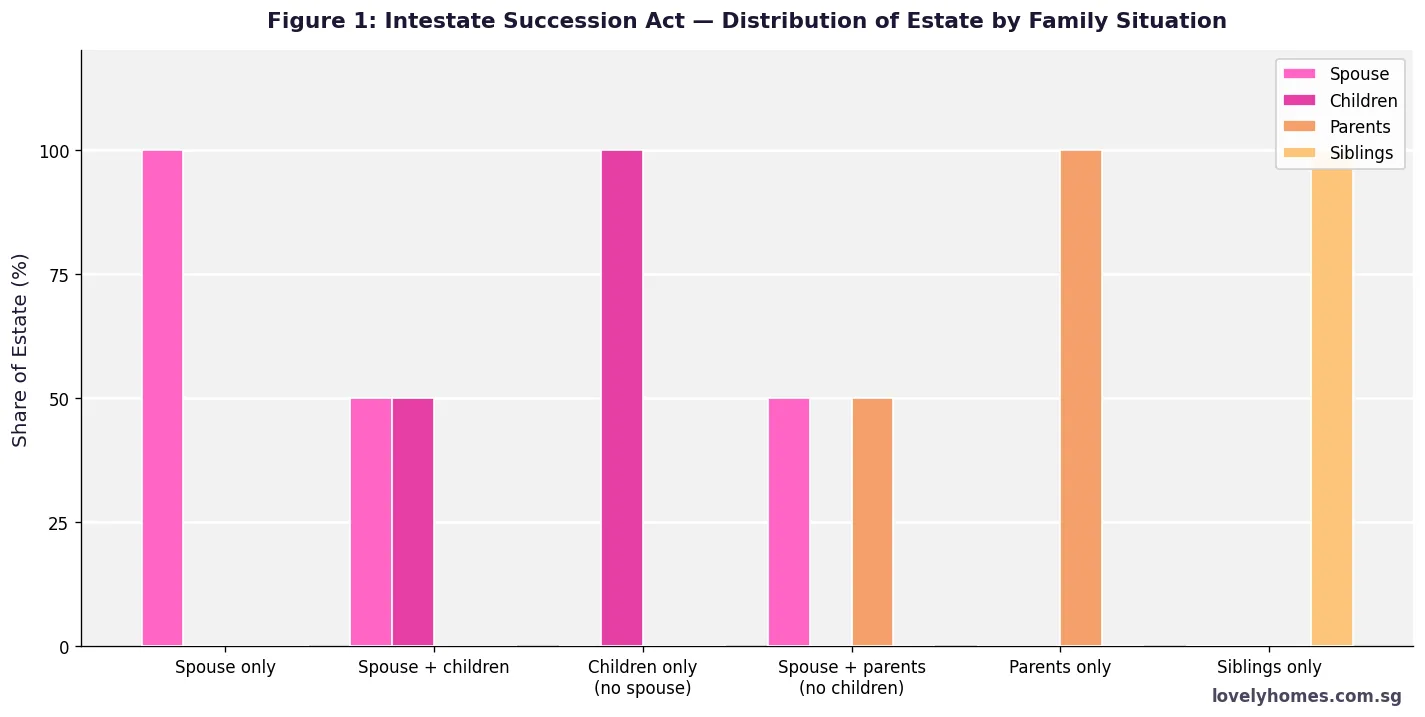
Singapore intestacy distribution chart by family situation 2026 — Intestate Succession Act shares for spouse, children, parents, siblings
Figure 1: Distribution of estate under the Intestate Succession Act by family situation. Percentages represent share of the full estate.
Survivors at Death Who Inherits (and Share)
Spouse only (no children, no parents) Spouse — 100%
Spouse + children Spouse 50% / Children share 50% equally
Children only (no spouse) Children — 100% shared equally
Spouse + parents (no children) Spouse 50% / Parents 50%
Parents only (no spouse, no children) Parents — 100% equally
Siblings only Siblings — 100% equally
No family at all Government — bona vacantia

Critically, the Intestate Succession Act does not apply to Muslims in Singapore — Muslim estates are governed by Islamic inheritance law (faraid) administered through the Syariah Court and Muslim Trust Fund (MUIS). If you are Muslim, consult a lawyer or MUIS directly.

Making a Valid Will in Singapore

A will is the cornerstone of any estate plan. Under the Wills Act (Cap 352), a valid Singapore will must be:

  • In writing (typed or handwritten).
  • Signed by the testator (the person making the will) at the foot of the document.
  • Witnessed by two independent witnesses — both present at the same time when the testator signs. Neither witness (nor their spouse) can be a beneficiary.
  • Made by a person aged 21 or older (or a member of the armed forces on active service).

There is no requirement to register a will with any government body in Singapore, though many solicitors recommend lodging it with the Wills Registry at the Singapore Academy of Law for a small fee (~S$50). A will can be revoked at any time by making a new one or by destroying the original with the intention to revoke. Marriage automatically revokes a prior will in Singapore.

What your will can do: direct who receives your private residential property; name your executor; appoint guardians for minor children; specify funeral wishes; establish testamentary trusts for minors or dependants. What it cannot do: override CPF nominations, bypass HDB rules on flat ownership, or transfer assets held in joint tenancy (these pass automatically to the surviving joint tenant by operation of law).

CPF Nominations — The Rule That Overrides Your Will

Many Singapore property owners are surprised to learn that their CPF Ordinary Account (OA) savings — which are frequently used to fund property purchases and monthly mortgage instalments — do not form part of their estate and cannot be distributed via a will. CPF monies are governed separately by the Central Provident Fund Act and paid out exclusively to CPF nominees upon death.

If you have not made a CPF nomination, your CPF savings (OA, SA, MediSave) will be transferred to the Public Trustee’s Office, which then distributes them according to the Intestate Succession Act — but charges an administration fee (0.75%–2.75% of the CPF balance, capped at S$6,000). This process can take 6–12 months. A CPF nomination is free, takes about 10 minutes via the CPF Board website, and can be updated any time.

Note also: if you bought your HDB flat using CPF, the CPF funds drawn plus accrued interest must be refunded to your CPF account on the sale or transfer of the flat. This affects the net cash proceeds available to your estate or your surviving family members.

HDB Flat Inheritance — Special Rules Apply

HDB flats come with a unique set of rules on death that do not apply to private residential property. The guiding principle is that an HDB flat should continue to be used as an owner-occupied home for a qualifying Singapore household — it is not freely tradeable inheritance that can be sold at will.

Scenario A: Joint tenancy — surviving joint tenant takes all

Most married couples own their HDB flat as joint tenants. On the death of one owner, the surviving joint tenant automatically becomes the sole owner by right of survivorship — no probate is required, and no will can override this. The surviving owner needs only to lodge a Notice of Death with HDB and the Singapore Land Authority (SLA) to update the title.

Scenario B: Tenancy-in-common — estate share passes via will or ISA

If the flat was held as tenancy-in-common, the deceased’s share passes to the estate and is then distributed via the will or the Intestate Succession Act. The beneficiary of the share must be an eligible person under HDB’s policies — meaning they must form a family nucleus with the remaining flat owner(s), be a Singapore Citizen or PR, and meet the HDB eligibility criteria. If the beneficiary is not eligible (e.g. a foreigner child), HDB will require the flat to be sold.

Scenario C: Sole owner dies — HDB’s Retention Scheme

If the deceased was the sole owner, HDB allows eligible occupiers (family members currently living in the flat who meet eligibility criteria) to apply to retain the flat under the Right of Occupancy Scheme. If no eligible occupier exists, HDB will buy back the flat at market value, and the proceeds go to the estate.

Importantly, the Minimum Occupation Period (MOP) for the inherited flat is assessed separately. An inheriting family member does not automatically “reset” the MOP clock — HDB’s rules on this have specific carve-outs. Always check with HDB directly at the time of inheritance.

Private Residential Property — Inheritance and Stamp Duty

Private condominiums, landed houses, and freehold/leasehold private apartments follow a different set of rules from HDB flats. There is no HDB eligibility requirement — foreigners can inherit private property — but stamp duty implications arise when the property is subsequently transferred or sold.

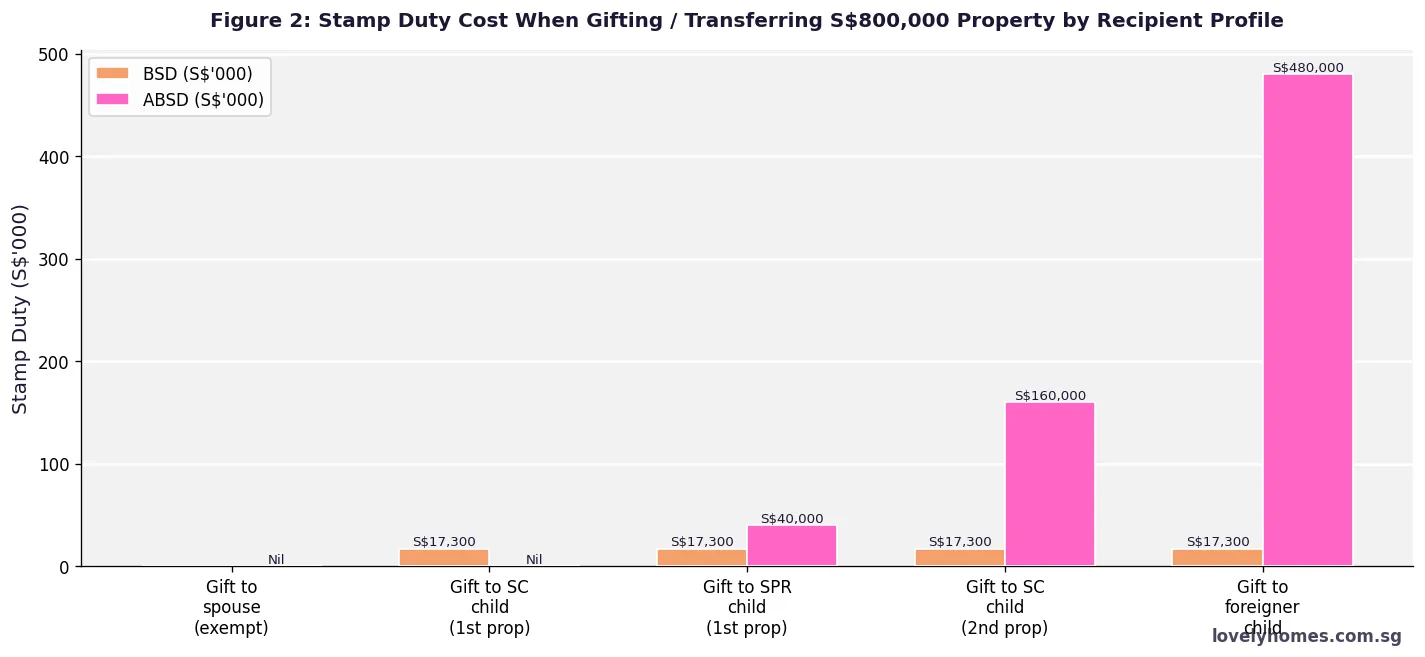
Stamp duty BSD and ABSD costs on property transfer by recipient profile Singapore 2026 — gifting S$800,000 property
Figure 2: Indicative BSD and ABSD payable when gifting/transferring a S$800,000 private residential property by recipient profile. Note: inheritance itself (via estate) is not subject to stamp duty; duty is triggered by a subsequent gift or sale.

No stamp duty on the death transfer itself

The transfer of property to a beneficiary via a will or intestacy is treated as a transmission on death. Under the Stamp Duties Act, such transmissions are exempt from Buyer’s Stamp Duty and ABSD. No duty is payable when the executor or administrator assents the property to the beneficiary. Singapore also abolished estate duty in February 2008, so there is no inheritance tax on the total value of the estate.

ABSD when you inherit a second or third property

However, the inherited property is counted toward your property count for future purchases. This is a critical but frequently misunderstood rule. If you are a Singapore Citizen who already owns one condominium and then inherb a second private property from a deceased parent, your property count becomes two. If you subsequently buy a third property, ABSD of 30% (SC rate for 3rd property) applies. Plan accordingly.

Gifting property inter vivos (lifetime transfers)

If you choose to gift a property to a family member during your lifetime (rather than leaving it via will), BSD is triggered on the market value of the property at the time of transfer. ABSD also applies based on the recipient’s citizenship and property count. A gift to your Singapore Citizen child who already owns one property would attract 20% ABSD on the market value — potentially hundreds of thousands of dollars.

šŸ  Worked Example: The Tan Family Estate

Situation: Mr Tan (Singapore Citizen) passed away on 15 March 2026, leaving a 4-bedroom condominium in Bishan worth S$2,100,000 and a 5-room HDB flat in Ang Mo Kio worth S$780,000. Mr Tan had a valid will leaving both properties to his wife (Mrs Tan, SC) and two adult children (both SC, each with their own private condominiums). The HDB flat was held in joint tenancy with Mrs Tan; the condo was held in Mr Tan’s sole name.

HDB flat (joint tenancy):

  • Passes automatically to Mrs Tan by right of survivorship — no probate required for HDB.
  • Mrs Tan lodges a Notice of Death with HDB and SLA. Title updated in her sole name.
  • No stamp duty on this transmission. Mrs Tan now holds the HDB as sole owner.

Bishan condominium (sole name, covered by will):

  • Executor obtains Grant of Probate from the Family Justice Courts — estimated 4–6 months.
  • Will bequeaths the condo 50% to Mrs Tan and 25% each to Child 1 and Child 2.
  • Transmission to all three beneficiaries: BSD = Nil; ABSD = Nil (transmission on death exempt).
  • Mrs Tan’s property count: now HDB flat + 50% share in Bishan condo = 2 properties held.
  • Each child’s property count: now their existing condo + 25% Bishan share = 2 properties each.
  • If any of them buys another property, ABSD will be charged at the 3rd-property SC rate (30%).

BSD + Legal costs for probate:

  • Probate solicitor fees (estimated): S$3,500–S$6,000 for a clean estate
  • Court filing fee (estimated): S$750–S$1,500
  • Assent (Conveyancing for condo transfer): S$1,500–S$2,500 legal fees + SLA registration ~S$165
  • Total estate settlement cost: approximately S$6,500–S$10,000

Key lesson: Having a valid will allowed Mr Tan’s estate to be distributed efficiently. Without a will, the ISA would have given Mrs Tan 50% and split the other 50% equally between the two children — a similar result here, but in more complex family structures the ISA’s rigid hierarchy can produce very different outcomes from what the deceased intended.

The Probate Process in Singapore

When a person dies leaving a will, the executor named in the will applies to the Family Justice Courts for a Grant of Probate, which authorises the executor to administer the estate. If there is no will, the next-of-kin applies for Letters of Administration — a broadly equivalent process but typically requiring two sureties (guarantors).

Key steps in the process:

  1. Death registration — the attending doctor issues a Cause of Death certificate; the Registrar of Deaths (ICA) issues the Death Certificate, usually within a few days.
  2. Identify and value assets — bank accounts, CPF balances, property title searches (SLA), shareholdings, insurance policies, foreign assets.
  3. Engage a probate solicitor — unless the estate is very simple (below S$50,000 with no immovable property), legal representation is strongly recommended.
  4. File for Grant of Probate / Letters of Administration at the Family Justice Courts — fees are payable on a sliding scale based on the estate value.
  5. Advertise for creditors — in a local newspaper, to flush out any outstanding liabilities.
  6. Pay outstanding debts and liabilities — including any outstanding mortgage (the estate must redeem the mortgage or service it until the property is transferred or sold).
  7. Transfer or sell the property — the executor assents (transfers title) to the beneficiary or conducts a sale, remitting proceeds to the estate.
  8. Distribute balance to beneficiaries — with a proper estate account and receipts.

A straightforward Singapore estate with no overseas assets, no disputes, and a valid will typically takes 4–9 months from death to final distribution. Estates with overseas property can take significantly longer due to separate probate requirements in each jurisdiction.

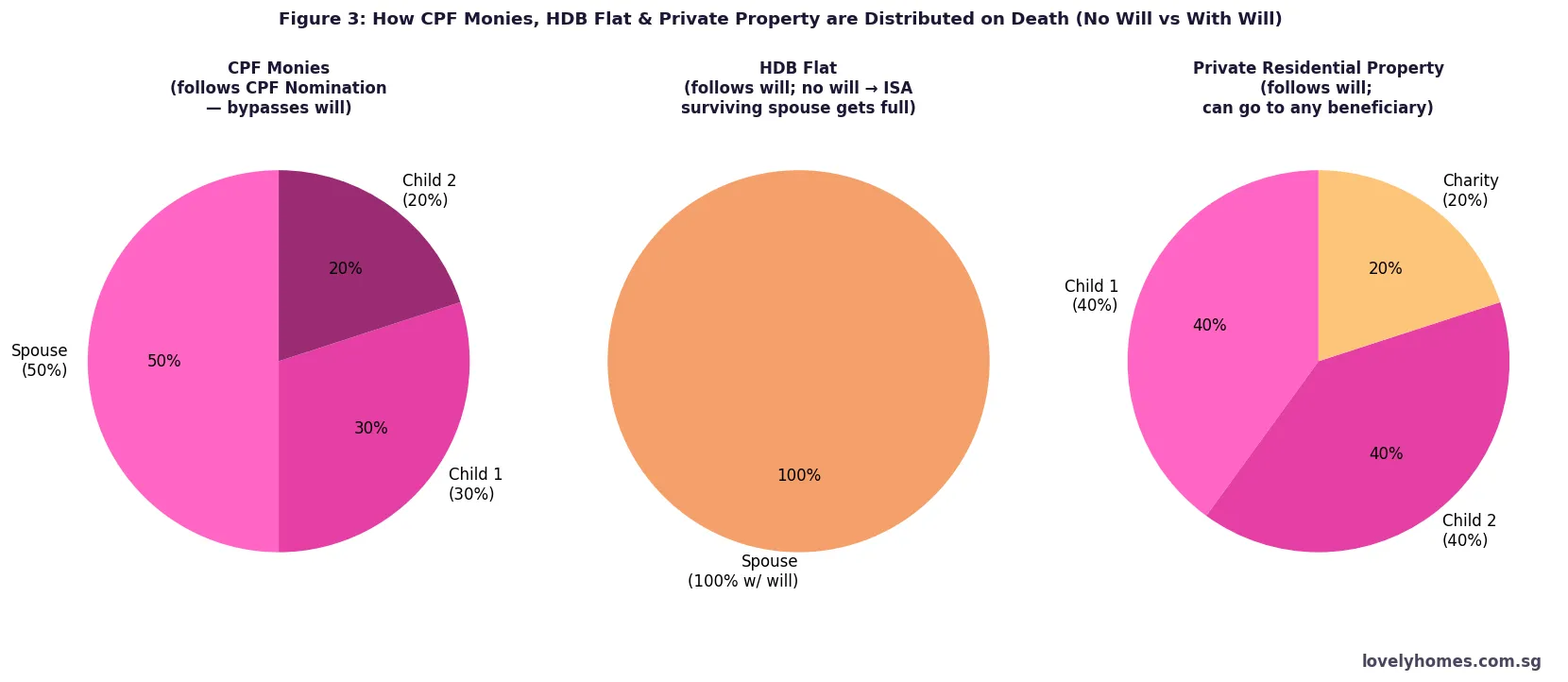
How CPF monies, HDB flat and private property are distributed on death with and without a will Singapore 2026
Figure 3: Distribution of CPF monies, HDB flat, and private residential property on death under different planning scenarios.

Estate Planning — What Every Singapore Property Owner Should Do

Singapore’s property market is one of the most valuable asset classes for most families. Leaving the transmission of that wealth to chance — or to the rigidities of the Intestate Succession Act — is a risk that is easily and cheaply avoided. A comprehensive estate plan for a property-owning Singapore family typically involves four instruments:

Instrument What it Covers Who Administers Cost (Approx.)
Will Private property, bank accounts, personal effects, guardianship of minor children Family Justice Courts (probate) S$300–S$1,200 (straightforward)
CPF Nomination CPF OA, SA, MediSave balances CPF Board (direct payment) Free
HDB Nomination (if applicable) Share in HDB flat (for tenancy-in-common owners) HDB Free
Lasting Power of Attorney (LPA) Decision-making if you lose mental capacity (not on death) Office of the Public Guardian S$75 (standard); free if certified by legal aid

Why Singapore Property Inheritance Matters in 2026

Singapore is in the midst of a significant intergenerational wealth transfer. According to industry estimates, the cohort of HDB flat owners who purchased under SERS and other early schemes in the 1970s–1990s are now in their 70s and 80s. Hundreds of thousands of HDB flats — many now in the S$600,000–S$1,100,000+ resale range — will change hands via inheritance over the next decade. Add private condominiums and landed property to the mix, and the scale of property wealth being inherited is unprecedented in Singapore’s history.

At the same time, the 2023 ABSD increase to 60% for foreigners and 20%/30% for Singapore Citizens on 2nd/3rd properties has made the counting of inherited properties a material financial issue. An unexpected inheritance that tips a SC buyer from “first property” to “second property” status can turn a planned purchase into an ABSD liability of 20% — potentially S$400,000+ on a typical CCR condominium.

What Might Come Next

This section contains editorial speculation and is clearly labelled as such.

Singapore’s government has occasionally reviewed the rules around HDB flat inheritance, particularly in the context of ageing lease profiles and the VERS (Voluntary Early Redevelopment Scheme) pipeline. There is some industry discussion about whether the Right of Occupancy Scheme might be tightened as Singapore’s HDB stock ages and more flats with shorter remaining leases pass between generations — since family members inheriting a flat with 30 or 40 years of lease remaining face a very different investment proposition from those inheriting a newer flat.

On the stamp-duty side, there is no indication that Singapore intends to reintroduce estate duty (abolished 2008). The MND and MOF have historically viewed the abolition as positive for Singapore’s competitiveness as a wealth hub. For now, the transmission-on-death BSD/ABSD exemption also appears stable. Changes to ABSD for inherited properties — e.g. a grace period or exemption from the property count for inherited shares — have been discussed in industry circles but have not been signalled by the Government.

Frequently Asked Questions

Does inheriting a property count toward my ABSD property count?

Yes. Once a property is transmitted to you as a beneficiary and you are registered as owner (or part-owner) at the Singapore Land Authority, it counts toward your residential property count for ABSD purposes. This means that if you already own one private property and you inherit a second one, you are considered a second-property owner. A subsequent purchase would attract the SC third-property ABSD rate of 30%. There is currently no grace period or inherited-property exemption from this counting rule. If you are planning a purchase and know an inheritance is likely, speak to a lawyer about the timing and sequencing.

My parent passed away and left an HDB flat in their sole name. What happens?

If the deceased was the sole HDB owner and there is a valid will, the executor will apply for Grant of Probate. HDB will then assess whether any of the occupiers listed in the flat (or beneficiaries named in the will) qualify to retain it under their eligibility criteria — they must be a Singapore Citizen or PR, form a proper family nucleus, and satisfy income/property ownership requirements. If an eligible person exists, the flat can be transferred to them (subject to HDB’s approval). If no eligible occupier or beneficiary qualifies, HDB has the right to buy back the flat at market value, and the proceeds form part of the estate. Contact HDB’s Branch directly early in the probate process to understand your options.

Can I sell an inherited private property immediately, or do I need to wait?

There is no mandatory holding period for private property inherited via an estate. Once the Grant of Probate or Letters of Administration is obtained and the title is assented to you, you can sell the property. However, Seller’s Stamp Duty (SSD) applies if the property is sold within 3 years of the deceased’s purchase date — not from the date you inherited it. SSD is 12%/8%/4% for disposals in the 1st/2nd/3rd year respectively. Check the original purchase date on the title register before deciding to sell quickly after inheritance. For HDB flats, the 5-year MOP from the original flat purchase date must also be observed before the flat can be sold on the open market.

What is the difference between a CPF nomination and a will for property?

A CPF nomination governs your CPF savings only (OA, SA, MediSave balances) and completely overrides your will for those assets. The CPF Board pays out directly to your nominees without going through probate. A will governs your private property, bank accounts, personal assets, and other estate assets — but not CPF savings. If you have bought your property using CPF funds and there is an outstanding CPF accrued interest amount, that is refunded to the CPF account on sale or transfer of the property, and then distributed to your CPF nominees. You should make both a valid will and a CPF nomination to ensure all assets are covered.

Is there any tax payable on inherited property in Singapore?

Singapore abolished estate duty in February 2008. No estate duty or inheritance tax is levied on the value of an estate. The transmission of a property to a beneficiary via will or intestacy is also exempt from Buyer’s Stamp Duty (BSD) and Additional Buyer’s Stamp Duty (ABSD) at the point of transfer. However, once you are registered as the owner of an inherited property, normal property tax (administered by IRAS) applies going forward at the prevailing rates — owner-occupied or non-owner-occupied depending on whether you live in the property. Annual property tax on a S$800,000 private condominium (non-owner-occupied) is approximately S$3,200–S$6,400 depending on the Annual Value assessed by IRAS.

What happens to an inherited HDB flat if none of the beneficiaries are eligible to own it?

If none of the will’s beneficiaries (or ISA-entitled family members) meet HDB’s eligibility criteria to retain the flat — for instance, all of them are foreigners, or they each already own private property — HDB will issue a directive requiring the estate to sell the flat on the open market or surrender it to HDB. If sold on the open market, any SC or PR eligible buyer can purchase it as a resale HDB flat in the normal manner. The net proceeds (after mortgage redemption and CPF refund obligations) are distributed to the estate’s beneficiaries. HDB typically allows up to 12 months for the estate to resolve the flat’s status before taking further action.

How long does probate take in Singapore and how much does it cost?

A straightforward Singapore estate with a valid will, no overseas assets, and no disputes typically takes 4–9 months from death to final distribution. An estate requiring Letters of Administration (no will) adds 1–3 months for additional surety and advertising requirements. Complex estates with foreign property, trust structures, or contested claims can take 12–36 months or more. Professional costs typically include: probate lawyer fees (S$3,500–S$8,000 for a clean estate, higher for complexity), Court filing fees on a sliding scale based on estate value, property assent legal fees (S$1,500–S$3,000 per property), and SLA registration fees (~S$165 per property). The Public Trustee’s Office also charges a fee of 0.75%–2.75% of CPF monies distributed where there is no CPF nomination.

Disclaimer: This guide is for general information only and does not constitute legal, tax, or financial advice. Inheritance and estate law is complex and fact-specific. Rules around HDB flat eligibility, CPF nominations, stamp duty, and probate procedures may change. Always verify the current position on the Intestate Succession Act (Singapore Statutes Online), the CPF Board nomination portal, and HDB’s official guidance. Consult a licensed Singapore lawyer for advice specific to your situation. For tax implications, refer to IRAS Property Tax.

×

Click anywhere outside the image to close

Translate »