
Singapore Property Cooling Measures 2026: Complete Guide to ABSD, SSD, LTV and TDSR
- Singapore has deployed five categories of cooling measures since 2009: Additional Buyer’s Stamp Duty (ABSD), Seller’s Stamp Duty (SSD), Loan-to-Value (LTV) limits, Total Debt Servicing Ratio (TDSR) and Mortgage Servicing Ratio (MSR).
- ABSD rates effective 27 April 2023 remain in force: 0% for Singapore Citizens buying their first home, 20% on the second property, 30% on the third and subsequent; 5%/30%/35% for Permanent Residents; 60% for foreigners; 65% for entities.
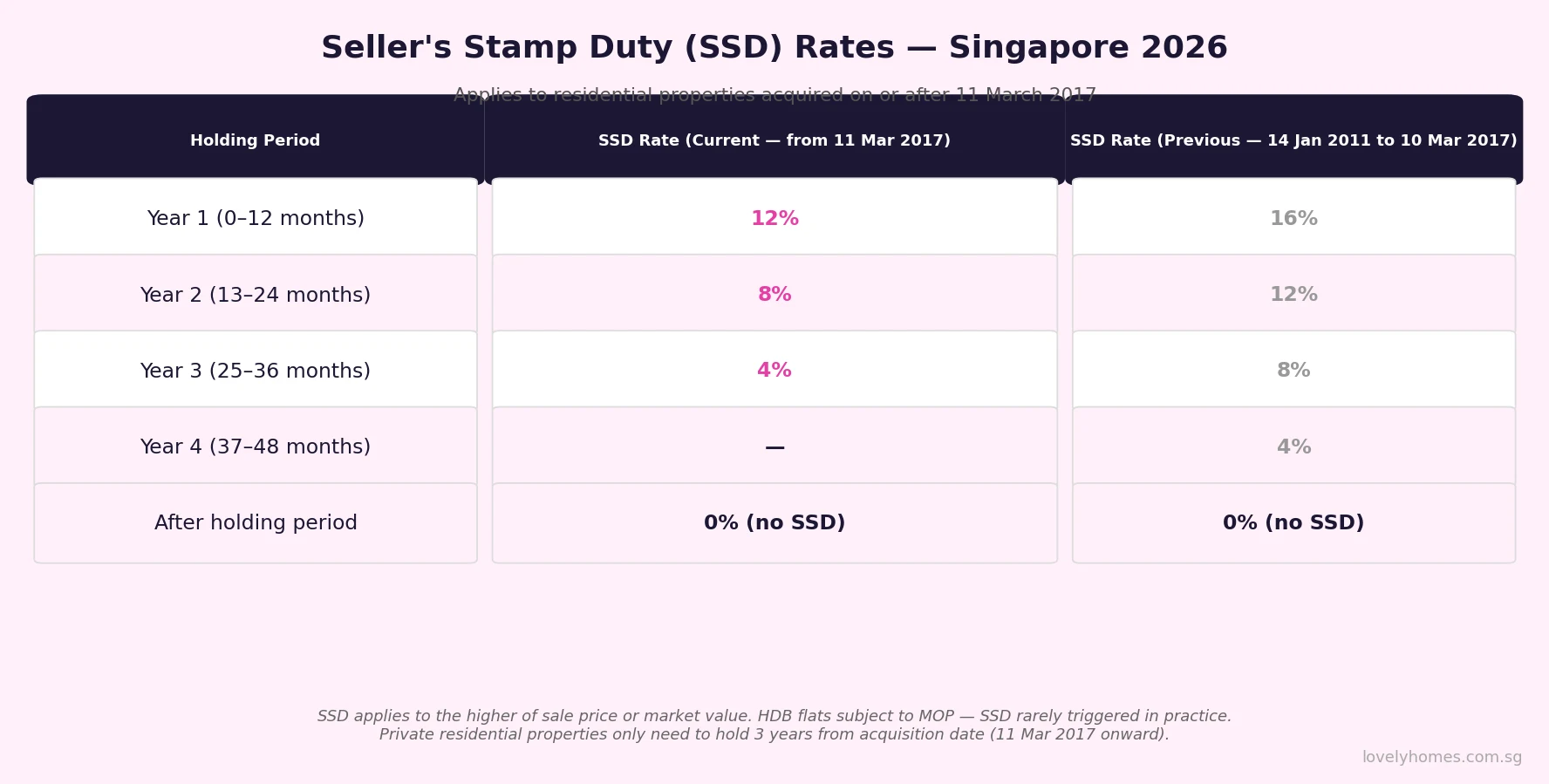
- The Seller’s Stamp Duty (SSD) was tightened on 4 July 2025: private residential properties bought from that date and sold within four years face rates of 16%, 12%, 8% and 4% respectively. Prior SSD covered only three years at 12/8/4%.
- HDB LTV was cut from 80% to 75% in August 2024, aligned with private-property bank loan limits. The Enhanced CPF Housing Grant (EHG) was raised simultaneously to partially offset the larger downpayment for first-timers.
- TDSR (Total Debt Servicing Ratio) is capped at 55%, stress-tested at a 4% p.a. floor rate. MSR (for HDB and Executive Condominiums) is capped at 30%.
- No cooling measure has been relaxed since April 2023. The government has signalled it will keep measures in place until it is confident that market conditions are stable.
- A Singapore Citizen couple buying a S$1.5 million private condo as their second property pays ABSD of S$300,000 — cash only, non-CPF.
What Are Property Cooling Measures?
Singapore’s property cooling measures are a suite of demand-management policies administered jointly by the Ministry of National Development (MND), the Monetary Authority of Singapore (MAS) and the Inland Revenue Authority of Singapore (IRAS). Their stated purpose is to ensure that residential property prices remain stable and affordable, prevent speculative activity from building up, and align demand with long-term economic fundamentals.
Unlike direct price controls, cooling measures work through the tax and lending system. They raise the cost of speculative purchases, restrict borrowing headroom, and impose holding-period penalties on quick resales. Singapore has been willing to deploy these tools aggressively: between 2009 and 2026, policymakers tightened measures at least 15 times, pausing only briefly in 2017 when they partially eased some rules after a period of price moderation.
The result is a market that has risen in nominal terms — prices roughly doubled between 2009 and 2025 — but has done so far more slowly than peer cities such as Hong Kong or Vancouver, which applied fewer demand constraints. Understanding what each measure does, who it targets, and when it was introduced is essential for any property buyer or investor in Singapore today.

ABSD — Additional Buyer’s Stamp Duty
ABSD is the most consequential cooling measure for most buyers. It is a stamp duty surcharge levied on the purchase price (or market value, whichever is higher) at the time of acquisition. Unlike the basic Buyer’s Stamp Duty (BSD), which applies to all purchases, ABSD is structured by the buyer’s citizenship and property ownership count. It cannot be paid from CPF Ordinary Account balances — it must be settled in cash.
ABSD was first introduced in December 2011 to address a surge in foreign purchases. It has been raised in December 2013, July 2018, December 2021, September 2022 and — most dramatically — in April 2023. The April 2023 round doubled the rate for foreigners from 30% to 60% and raised the SC second-property rate from 12% to 20%.
| Buyer Profile | 1st Residential Property | 2nd Residential Property | 3rd & Subsequent |
|---|---|---|---|
| Singapore Citizen (SC) | 0% | 20% | 30% |
| Singapore PR (SPR) | 5% | 30% | 35% |
| Foreigner | 60% | 60% | 60% |
| Entity (company / trust) | 65% | 65% | 65% |
| SC + SPR couple (co-purchase) | 5% (PR rate applies) | — | — |
ABSD remissions are available in specific circumstances: married SC-and-SC couples buying their first jointly-owned property may claim a remission if they sell their existing HDB flat within six months of the private property’s completion. Developer ABSD (applicable at 35% for unsold units) is remitted if the development is sold out within five years (extended to six or seven years for large sites under the April 2023 framework).
Free Trade Agreement (FTA) provisions grant national treatment to citizens of the United States, Iceland, Liechtenstein, Norway and Switzerland under their respective FTAs with Singapore — those buyers pay SC rates for ABSD.
SSD — Seller’s Stamp Duty
Seller’s Stamp Duty is an exit tax on private residential properties sold within a holding period of the purchase date. It targets short-term flipping and speculative resales. Unlike ABSD, SSD is payable by the seller, not the buyer, and is triggered only when the property is sold (or a deemed sale occurs) within the prescribed holding period. HDB flats are not subject to SSD; SSD applies only to private residential properties.
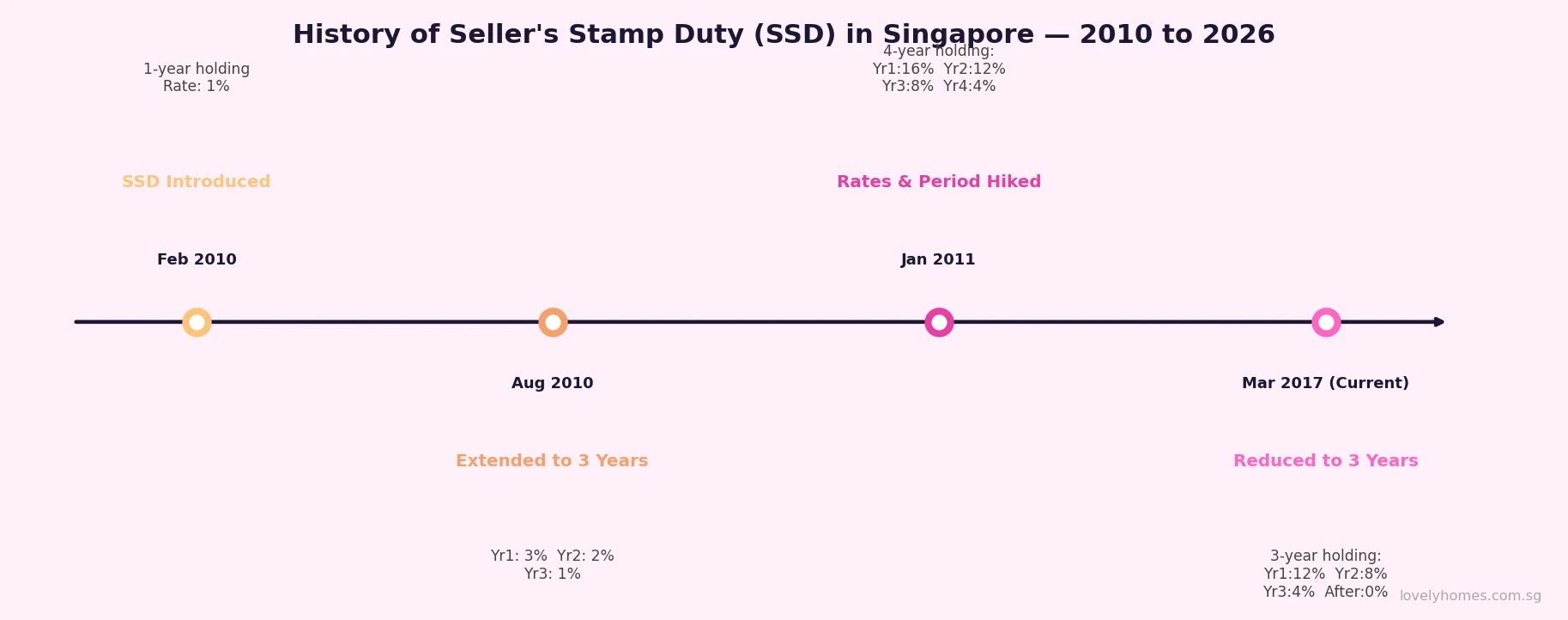
SSD was first reintroduced in February 2010 (covering one-year holdings) and progressively extended. The most recent tightening on 4 July 2025 extended the holding period from three to four years and raised the rates:
| Year of Sale After Purchase | SSD Rate — Bought Before 4 Jul 2025 | SSD Rate — Bought On or After 4 Jul 2025 |
|---|---|---|
| Year 1 (within 1 year) | 12% | 16% |
| Year 2 (1–2 years) | 8% | 12% |
| Year 3 (2–3 years) | 4% | 8% |
| Year 4 (3–4 years) | Nil | 4% |
| After Year 4 | Nil | Nil |

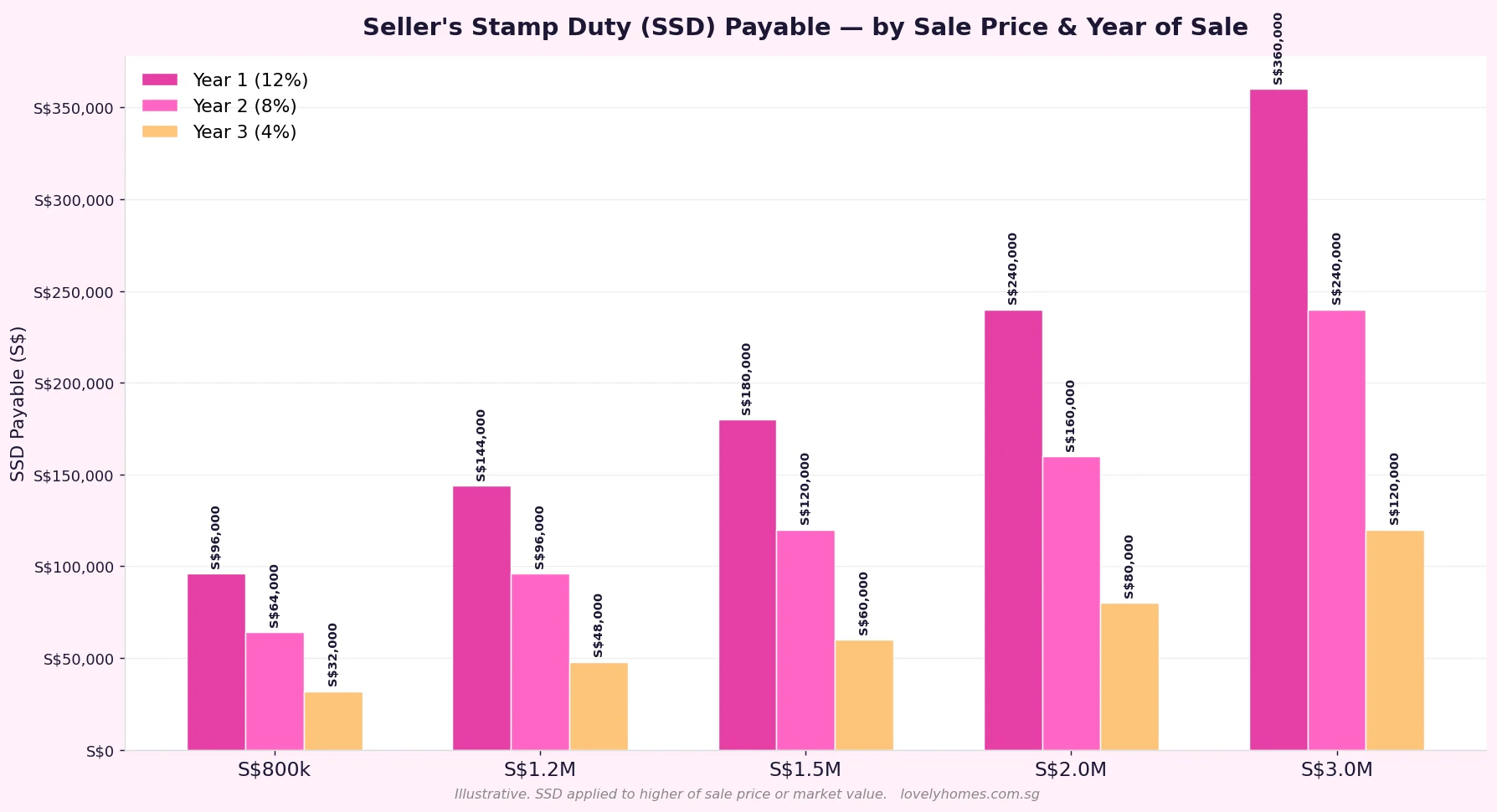
SSD is computed on the higher of the transacted price or market value. For a property sold for S$2 million in Year 2 (bought after 4 July 2025), the SSD bill would be 12% × S$2,000,000 = S$240,000 — a material holding cost that effectively rules out short-term speculation.
LTV — Loan-to-Value Limits
LTV limits cap the maximum amount a buyer may borrow relative to the property’s value (or purchase price, whichever is lower). MAS administers LTV limits for bank loans; HDB administers its own concessionary loan LTV. Reducing LTV forces buyers to bring more cash and CPF funds upfront, cooling demand among highly-leveraged purchasers.
| Loan Type | 1st Housing Loan | 2nd Housing Loan | 3rd & Subsequent |
|---|---|---|---|
| Bank loan (private property / EC) | 75% LTV, min 5% cash | 45% LTV, min 25% cash | 35% LTV, min 25% cash |
| HDB concessionary loan | 75% LTV (from Aug 2024; was 80%) | Not available | Not available |
The August 2024 HDB LTV reduction from 80% to 75% was the first change to the HDB loan limit since 2014. On a S$500,000 HDB flat, this means the maximum HDB loan falls from S$400,000 to S$375,000 — buyers must find an extra S$25,000 in cash or CPF. The Enhanced CPF Housing Grant (EHG), raised to S$120,000 for families at the same time, was designed to offset this for first-timers.
TDSR and MSR — Income-Based Limits
The Total Debt Servicing Ratio (TDSR) was introduced in June 2013 by MAS to prevent over-leveraged purchases. It caps the share of a borrower’s gross monthly income that can be committed to all debt repayments (mortgages, car loans, credit card instalments, etc.) at 55%. Lenders must stress-test the mortgage at a floor rate of 4% per annum, regardless of the actual prevailing rate. This means a S$1.5 million loan at 3.5% is assessed as though the repayment were at 4% when computing TDSR headroom.
The Mortgage Servicing Ratio (MSR) applies only to HDB flat purchases and Executive Condominiums (during the first five years before MOP). MSR caps the share of gross monthly income going to mortgage repayments alone at 30%. For a household earning S$9,000 per month, the maximum monthly mortgage is S$2,700 — and MSR generally binds before TDSR for HDB buyers.
The Full Cooling Measures Timeline 2009–2026

The measures have followed Singapore’s property cycle closely. The first SSD reintroduction in 2010 came as prices rebounded sharply from the 2008–2009 global financial crisis. The introduction of ABSD in December 2011 was a direct response to rising foreign purchases of private property and HDB resale flats. The June 2013 TDSR framework was a structural reform — rather than raising rates again, the government imposed a systemic borrowing limit that continues to govern all property financing to this day.
The 2017 partial relaxation was notable because it was the first time the government unwound any cooling measure — reducing SSD from four years to three, and lowering ABSD for PRs buying their first property and for entities buying residential property. It signalled that measures were calibrated to conditions, not permanent.
The post-COVID acceleration in 2021–2023 produced the sharpest tightening cycle since 2011. By April 2023, the government had raised ABSD three times in 18 months. The July 2025 SSD extension — from three to four years with higher rates — added a further layer of friction for short-term investors in private property.
Worked Example: The Real Cost for a SC Second-Property Buyer
Scenario: Mr and Mrs Chen, both Singapore Citizens, own an HDB flat (MOP cleared). They wish to purchase a S$1.5 million OCR private condominium as a second property for investment and rental income.
BSD (Buyer’s Stamp Duty): First S$180,000 at 1% = S$1,800; next S$180,000 at 2% = S$3,600; next S$640,000 at 3% = S$19,200; next S$500,000 at 4% = S$20,000 (where the BSD schedule tops out at S$1m threshold for SC). Wait — revised BSD rates: S$180k at 1% = S$1,800; S$180k at 2% = S$3,600; S$640k at 3% = S$19,200; remaining S$500k at 4% = S$20,000. Total BSD: S$44,600.
ABSD (Second Property — SC rate 20%): 20% × S$1,500,000 = S$300,000. This must be paid in cash within 14 days of exercising the Option to Purchase. It cannot be funded from CPF or the bank loan.
Bank loan (75% LTV): Maximum loan S$1,125,000. At 3.5% over 25 years, the monthly repayment is approximately S$5,626. TDSR at this income floor (for the loan to clear 55% TDSR) requires gross monthly household income of at least S$10,229.
Total upfront outlay: Down payment 25% = S$375,000 (min 5% cash = S$75,000; remainder CPF or cash) + BSD S$44,600 + ABSD S$300,000 = S$719,600, of which at least S$375,000 must be cash/CPF and S$300,000 must be pure cash.
This worked example illustrates why the April 2023 ABSD hike (which doubled the foreigners’ rate and raised the SC second-property rate from 12% to 20%) materially changed the investment calculus for most local property investors. At the old 12% rate, the Chens would have paid S$180,000 in ABSD — S$120,000 less than the current S$300,000.
Why Singapore Uses Cooling Measures: The Policy Rationale
Singapore’s government has consistently articulated three reasons for maintaining cooling measures: first, housing affordability — ensuring that owner-occupier demand, rather than speculative investment, drives prices; second, financial stability — preventing households from taking on unsustainable mortgage debt; and third, social equity — public housing (HDB) should remain accessible to the broad middle class.
The April 2023 ABSD hike was explicitly framed around the last point. With foreign buyers — particularly from mainland China and the United States — accounting for a disproportionate share of luxury-market transactions, the government raised the foreigners’ ABSD from 30% to 60% to “cool the market and ensure that Singapore’s housing remains primarily for Singaporeans”, as Minister of Finance Lawrence Wong stated in Parliament.
Critics sometimes argue that ABSD is a blunt instrument — it raises the bar for Singaporeans buying a second property as much as it does for foreign speculators. The counter-argument from policymakers is that the market distortion of not intervening is worse: unchecked price rises would erode HDB upgrader pathways and price out first-time buyers entirely.
What Might Come Next for Singapore Cooling Measures
As of August 2026, no relaxation of the April 2023 ABSD rates has been signalled. Government statements have consistently emphasised that the measures will remain until policymakers are confident that the risk of a price spiral has abated. Private residential prices rose 0.9% in Q1 2026 and showed a modest 0.8% increase in Q2 2026 — a pace of appreciation consistent with long-term fundamentals, which may reduce pressure for further tightening.
Potential triggers for partial relaxation include: a sustained period of subdued price growth; a significant cooling in transaction volumes; or a supply glut from completions in the GLS pipeline. Conversely, any resurgence in foreign capital flows — particularly if the Singapore dollar appreciates materially or global equity markets enter a risk-off phase — could prompt the government to tighten further.
The July 2025 SSD extension to four years, applied only to properties purchased from that date, suggests the government is comfortable with the current ABSD regime and is using SSD as an additional supply-side tool. Whether the ABSD foreigners’ rate of 60% proves permanent or is partially wound back as part of broader geopolitical calibration remains the key open question for 2027 and beyond.
Quick-Reference Summary: All Active Measures
| Measure | Current Rate / Limit | Administered By | Effective From |
|---|---|---|---|
| ABSD — SC 1st property | 0% | IRAS | 27 Apr 2023 |
| ABSD — SC 2nd property | 20% | IRAS | 27 Apr 2023 |
| ABSD — SC 3rd+ property | 30% | IRAS | 27 Apr 2023 |
| ABSD — PR 1st property | 5% | IRAS | 27 Apr 2023 |
| ABSD — PR 2nd property | 30% | IRAS | 27 Apr 2023 |
| ABSD — Foreigner | 60% | IRAS | 27 Apr 2023 |
| ABSD — Entity | 65% | IRAS | 27 Apr 2023 |
| SSD (bought on/after 4 Jul 2025) | 16/12/8/4% (yrs 1–4) | IRAS | 4 Jul 2025 |
| SSD (bought before 4 Jul 2025) | 12/8/4% (yrs 1–3) | IRAS | Ongoing |
| LTV — bank loan, 1st loan | 75% | MAS | Ongoing |
| LTV — bank loan, 2nd loan | 45% | MAS | Ongoing |
| LTV — HDB concessionary loan | 75% | HDB / MAS | Aug 2024 |
| TDSR | 55% of gross income | MAS | Ongoing |
| MSR (HDB / EC) | 30% of gross income | MAS / HDB | Ongoing |
Frequently Asked Questions
Can I avoid ABSD if I sell my first property before buying the second?
Yes — with conditions. Singapore Citizens who already own a property and wish to buy a replacement first property may purchase the new property first and then sell the existing one. If the existing property is disposed of within six months of the new property’s completion (or purchase, for resale), they may claim an ABSD remission. The remission is not automatic — it must be applied for through IRAS after the sale. This provision does not apply to upgraders buying a permanent second property; it applies only where the first property will be sold and the buyer genuinely intends to own just one residential property.
Does ABSD apply to HDB flats?
ABSD applies to all residential property purchases, including HDB flats. However, Singapore Citizens buying their first HDB flat pay 0% ABSD. The practical impact of ABSD on HDB buyers is mainly felt by PRs (who pay 5% on their first HDB flat) and by SC upgraders buying a second property (who pay 20% ABSD on the private condo or EC even if they retain the HDB flat). Note that HDB regulations separately restrict HDB flat ownership to eligible households — a SC cannot own both an HDB flat and a private property during the HDB Minimum Occupation Period (MOP).
Who pays Seller’s Stamp Duty — the buyer or the seller?
SSD is paid by the seller. It arises on a disposal (sale, transfer, or assignment) of a private residential property within the prescribed holding period. The SSD obligation sits with the vendor, not the purchaser, and is computed on the higher of the sale price or the market value determined by IRAS. It is payable within 14 days of the disposal date. SSD does not apply to HDB flats, which have their own resale restrictions (the five-year Minimum Occupation Period). For private properties bought before 4 July 2025, the SSD holding period is three years (12/8/4%). For those bought on or after 4 July 2025, it is four years (16/12/8/4%).
How does TDSR affect how much I can borrow?
TDSR limits total monthly debt obligations to 55% of gross monthly income. Lenders apply a 4% per annum stress-test rate, regardless of the actual prevailing SORA rate. For a single borrower earning S$10,000 per month, maximum total debt service is S$5,500 per month. If the borrower already has a car loan of S$700 per month, the maximum available for a mortgage is S$4,800 per month. At 3.5% over 25 years, that translates to a maximum loan of approximately S$910,000. The stress test at 4% would further reduce the effective loan capacity, since the lender models repayments at 4% when checking TDSR — not the borrower’s actual rate. This is why borrowers who pass the quoted rate often find their approved loan is smaller than expected.
Are Singapore Citizens who are first-time buyers completely exempt from all cooling measures?
Not entirely. SC first-time buyers pay 0% ABSD on their first residential property — so ABSD is effectively nil. However, LTV limits (75% for bank loans, 75% for HDB loans), TDSR (55%) and MSR (30%, for HDB and EC purchases) all apply regardless of buyer profile or ownership count. The HDB’s five-year Minimum Occupation Period is also a demand management measure in its own right — it prevents first-timer buyers from selling immediately after acquiring a subsidised flat. First-time buyers who use HDB loans and grants benefit from a more generous package, but the income-based borrowing limits still bind.
What is the 15-month wait-out period, and does it still apply?
The 15-month private-property wait-out period was introduced in September 2022. It required private residential property owners (or former private property owners) to wait 15 months after disposing of their private property before they could purchase an HDB resale flat. This was designed to prevent downsizing “arbitrage” — extracting value from a private property sale and using it to compete in the HDB resale market with cash over valuation. The wait-out period was subsequently removed as part of the August 2024 policy package, when HDB LTV was cut from 80% to 75%. As of August 2026, there is no wait-out period for former private property owners buying an HDB resale flat, provided they meet HDB’s standard eligibility criteria.
Does the 60% ABSD for foreigners apply to Singapore Permanent Residents from FTA countries?
No. Citizens (not PRs) of the United States, Iceland, Liechtenstein, Norway and Switzerland are treated as Singapore Citizens for ABSD purposes under Singapore’s Free Trade Agreements with those nations. They pay SC ABSD rates — meaning 0% on a first property, 20% on a second. This FTA exception applies only to citizens of those five countries, not to PRs, and not to passport holders of other nations even if they are resident in Singapore under an Employment Pass or other visa.
Related Articles
- ABSD Singapore 2026: Complete Guide to Additional Buyer’s Stamp Duty
- Singapore Property Cooling Measures Timeline 2009–2026
- Singapore Stamp Duty Guide 2026: BSD, ABSD and SSD Explained
- Foreigner Buying Property in Singapore 2026: Complete Guide
- Singapore Home Loan Guide 2026: HDB & Bank Loans Explained
- Singapore Condo Rental Income Guide 2026: Yields, Tax and How to Maximise Returns
- Singapore En Bloc Reform 2026: New Consent Thresholds Explained
Disclaimer: This article is for general informational purposes only and does not constitute legal, tax or financial advice. Stamp duty rates, LTV limits, TDSR/MSR caps and all other figures cited are based on information available as at August 2026 and are subject to change without notice. ABSD, SSD and BSD computations should be verified with IRAS (iras.gov.sg) directly. For purchase or investment decisions, readers should consult a licensed property agent registered with the Council for Estate Agencies (CEA), a qualified lawyer and, where applicable, a licensed financial adviser. Official sources: IRAS (iras.gov.sg), MAS (mas.gov.sg), HDB (hdb.gov.sg), MND (mnd.gov.sg), URA (ura.gov.sg).