Singapore Property Agent Commission Guide 2026

Singapore Property Agent Commission Guide 2026

⚡ Quick Answer: Property Agent Commission Singapore 2026

  • Agent commission is negotiable — there are no legally fixed rates in Singapore. Industry benchmarks exist but are not mandated.
  • HDB resale sellers typically pay 1%–2%; HDB resale buyers typically pay 0%–1% of purchase price, plus 9% GST.
  • Private property sellers typically pay 1%–2%; private property buyers typically pay 0%–1%, plus 9% GST.
  • New launch condo buyers pay nothing — the developer pays the buyer’s agent commission directly (typically 1%–3% of purchase price).
  • Rental transactions: landlords and tenants each typically pay half a month’s rent for leases under 24 months; one month’s rent for longer leases.
  • All agents must be CEA-licensed and must sign a Client’s Agreement (CA) with you before conducting any work on your behalf — mandated under the Estate Agents Act.
  • Verify your agent at cea.gov.sg before signing anything. An unlicensed “agent” cannot legally claim commission and may expose you to fraud risk.

Property Agent Commission in Singapore: Who Pays What and Why

In Singapore’s property market, agent commission is one of the largest transaction costs after stamp duties — yet it remains one of the least understood. Unlike stamp duty, which is set by law and published in IRAS schedules, agent commission has no statutory fixed rate. The Council for Estate Agencies (CEA), which regulates all property agents under the Estate Agents Act (Cap. 95A), has never mandated a specific commission percentage. Instead, it publishes broad guidelines and requires that all commissions be agreed in writing via a Client’s Agreement before an agent begins work.

This means that the rates you see quoted — 1% for HDB buyers, 2% for private sellers — are industry convention rather than law. In practice, they are widely observed but negotiable, particularly for high-value transactions or where a single agent represents both buyer and seller (co-broking arrangements).

Understanding the standard rates, who pays whom, and what the commission covers can help you plan your transaction budget accurately and negotiate confidently.
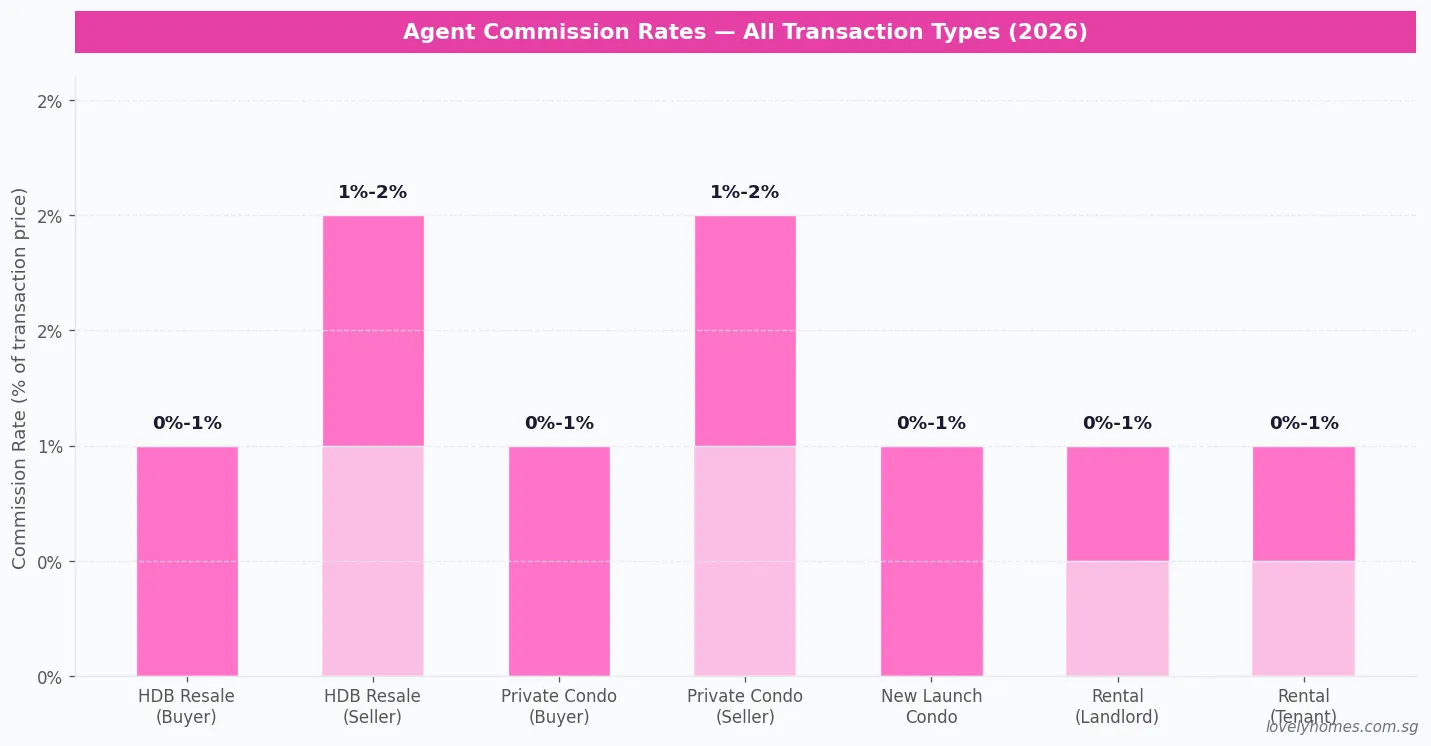
Singapore property agent commission rates 2026 — all transaction types including HDB, private condo, and rental
Figure 1: Industry benchmark commission rates by transaction type. All rates are subject to negotiation and exclusive of 9% GST. New launch buyer commission is paid by the developer, not the buyer. Source: CEA guidelines; LovelyHomes research.

Commission Rates by Transaction Type

HDB resale transactions: For buyers, the industry benchmark is 0% to 1% of the purchase price; many HDB buyers negotiate the buyer-side commission down or even to zero, since developers do not incentivise buyer agents the way new-launch projects do. For sellers, the benchmark is 1% to 2%. A seller paying 2% on an S$620,000 HDB flat will pay S$12,400 plus 9% GST = S$13,516.

Private residential (resale condominiums, apartments, landed): For buyers, 0%–1% is typical. For sellers, 1%–2% is typical. Co-broking is standard — each agent receives their respective commission from their own client. At S$2,000,000, a seller paying 2% pays S$43,600 inclusive of GST.

New launch condominiums: Buyers pay nothing — developer commission structures compensate the buyer’s agent directly, typically at 1%–3% of the purchase price depending on developer marketing budget. This is why agents are often more enthusiastic about showing new launches than resale properties. The commission comes from the developer’s marketing spend, which is embedded in the developer’s pricing model.

Rental transactions: The standard for leases of 24 months or less is one month’s rent split equally between the landlord’s agent and the tenant’s agent (0.5 months each, plus GST). For leases longer than 24 months, the benchmark rises to one month’s rent each. Short-term rentals or corporate leases may attract different structures negotiated case by case.

GST note: Property agents are GST-registered if their annual turnover exceeds the GST registration threshold. As of 1 January 2024, GST is charged at 9%. Always confirm whether a quoted commission is inclusive or exclusive of GST.
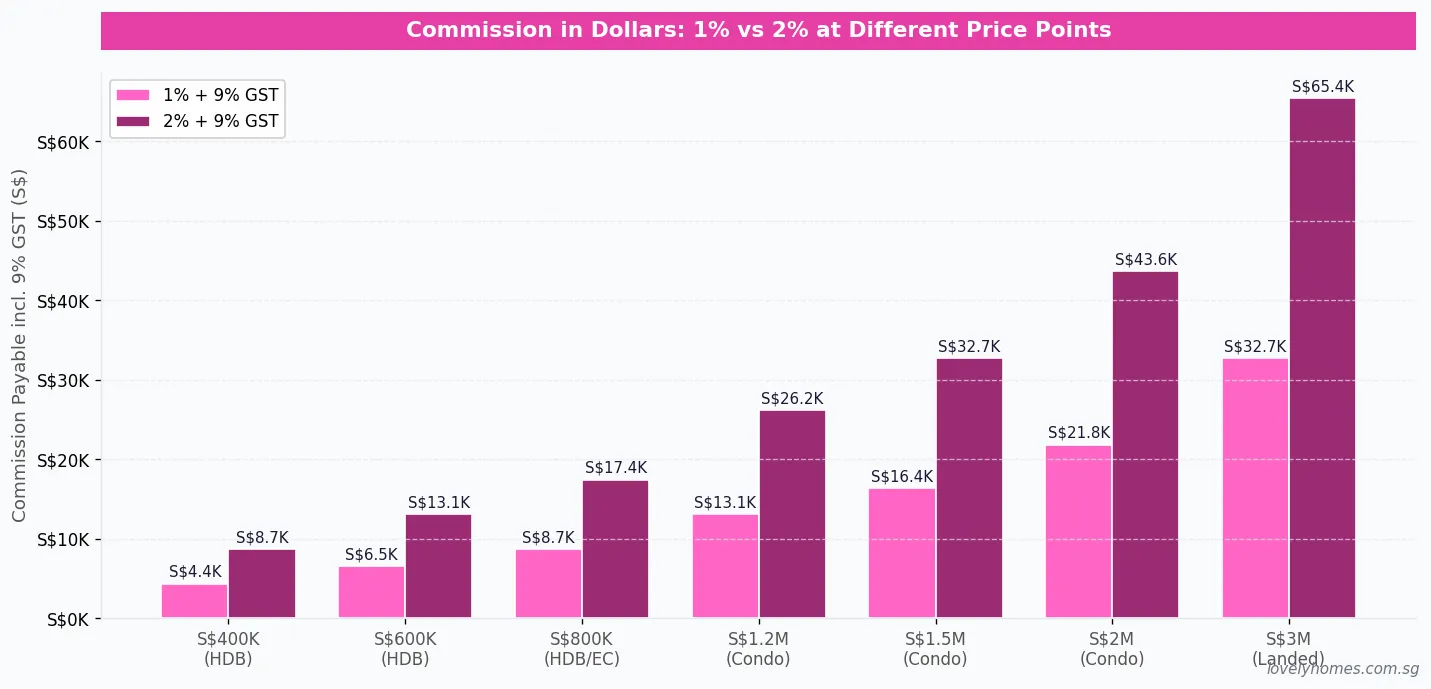
Singapore property agent commission in dollars 2026 — at different price points, 1% vs 2% plus 9% GST
Figure 2: Commission payable in absolute dollar terms (inclusive of 9% GST) at 1% and 2% for a range of property prices. The left bar in each pair is 1% (buyer-side benchmark); the right bar is 2% (seller-side upper benchmark). Source: LovelyHomes calculation.

Commission Summary Table

Transaction Type Buyer Pays Seller / Landlord Pays Basis Notes
HDB resale flat 0%–1% of purchase price 1%–2% of sale price % of transacted price Both + 9% GST. Negotiable.
Private condo / apartment resale 0%–1% of purchase price 1%–2% of sale price % of transacted price Both + 9% GST. Negotiable.
Landed property resale 0%–1% of purchase price 1%–2% of sale price % of transacted price Both + 9% GST. Negotiable.
New launch condominium Nil (paid by developer) Developer pays buyer agent 1%–3% Developer marketing budget Buyer incurs no direct commission cost.
Residential rental (≤24 mths) 0.5 mth rent + GST 0.5 mth rent + GST Per-lease Split 50/50 between landlord agent and tenant agent.
Residential rental (>24 mths) 1 mth rent + GST 1 mth rent + GST Per-lease Higher commission for longer commitments.

CEA Licensing and the Client’s Agreement

Every person conducting estate agency work in Singapore must hold a valid salesperson registration or estate agency licence issued by the Council for Estate Agencies (CEA), established under the Estate Agents Act 2010. The CEA maintains a public register at cea.gov.sg where anyone can look up an agent’s registration number, licence status, agency affiliation, and disciplinary history.

Before an agent may commence any work on your behalf — searching for properties, arranging viewings, submitting offers — they are required by the CEA Code of Practice to provide and have you sign a Client’s Agreement (CA). The CA specifies the scope of work, the agreed commission rate, and the duration of the engagement. Signing the CA creates a binding contract. Without a signed CA, any commission claim by the agent is difficult to enforce.

If an agent pressures you to make an offer or view properties without first providing a CA, this is a CEA breach and a red flag. You should decline and find another agent.

CEA agent verification 6-step process — how to check a Singapore property agent is licensed in 2026
Figure 3: Six-step process for verifying a property agent via the CEA Public Register. Red flags in the final column indicate situations where you should cease dealings immediately. Source: CEA Estate Agents Act Cap 95A; LovelyHomes.

Worked Example: The Nair Family Sells Their D15 Condo

Mr and Mrs Nair decide to sell their freehold 3-bedroom condominium in District 15 (East Coast area). The property is listed at S$2,200,000 and eventually transacts at S$2,150,000.

They engage a seller’s agent at a negotiated commission of 1.5% (rather than the 2% upper benchmark), inclusive of marketing costs. Their buyer transacts through a separate buyer’s agent at 1% (paid by the buyer).

Commission calculation for the Nairs (sellers): S$2,150,000 × 1.5% = S$32,250. Add 9% GST = S$32,250 × 1.09 = S$35,152.50.

Commission calculation for the buyer: S$2,150,000 × 1% = S$21,500. Add 9% GST = S$21,500 × 1.09 = S$23,435.

The Nairs save S$10,750 pre-GST by negotiating from 2% to 1.5%. The saving is meaningful — equivalent to roughly one additional monthly mortgage payment.

Negotiation tip: Commission is most negotiable when (a) the property is priced competitively and likely to move quickly, (b) you offer exclusivity to one agent rather than engaging multiple agents simultaneously, or (c) you are conducting both a sale and purchase simultaneously through the same agency. Use these levers before signing the Client’s Agreement.

Why Agent Commission Matters: Singapore in Context

At first glance, 1%–2% might sound modest. But on a S$2,000,000 private condominium, the combined buyer and seller commission (at 1% + 2%) totals S$60,000 before GST — S$65,400 inclusive of GST. That is a material transaction cost, often comparable to two to three months of gross household income for many Singapore buyers.

Unlike in some markets where buyer agents are paid from a shared commission pool, Singapore’s market structure is transparent: each side typically pays their own agent. This reduces conflicts of interest but means buyers who forgo representation on new launches (where they pay nothing for a buyer’s agent) are effectively subsidising the developer’s marketing cost through the purchase price.

The CEA has discussed introducing more formal commission disclosure requirements in recent consultations, though no regulatory change had been announced as at June 2026. Buyers and sellers should nonetheless insist on a written, signed Client’s Agreement specifying the exact commission before any agent commences work on their behalf.

What Might Change in Agent Commission Rules

The CEA periodically reviews its Code of Practice for professional standards. Industry observers have noted ongoing discussion about whether a formal commission disclosure framework — similar to what exists in Australia — should be introduced to increase transparency. As at June 2026, commission rates remain entirely negotiable with no mandatory disclosure beyond what must appear in the Client’s Agreement. Buyers should monitor CEA announcements for any changes to co-broking standards or commission disclosure obligations.

Frequently Asked Questions

Is agent commission legally fixed in Singapore?

No. The Council for Estate Agencies (CEA) does not prescribe fixed commission rates. What it mandates is that any agreed commission must be documented in a signed Client’s Agreement before the agent commences work. The rates quoted throughout this article — 1%, 2%, half a month’s rent — are industry conventions that have become widely expected but are legally negotiable. An agent cannot demand a specific rate; the rate is whatever you and the agent agree and document.

Do I need a buyer’s agent when buying a new launch condo?

No, you do not — but having one costs you nothing because the developer pays the buyer’s agent commission directly. A buyer’s agent for a new launch can help you compare projects, assess floor plans, check price comparables, and advise on unit selection without charging you any fee. Using a buyer’s agent for new launches is therefore generally rational from a cost perspective.

Can one agent represent both buyer and seller (dual representation)?

Yes, but with restrictions. The CEA code permits an agent to act for both parties in a transaction (known as dual representation or co-broking by the same agent), but the agent must inform both parties, obtain their written consent, and act fairly to both sides. In practice, many experienced buyers and sellers prefer independent agents to avoid any conflict of interest. If a single agent represents both sides, it is common for the commission arrangement to be negotiated down to reflect the reduced workload.

What is the CEA Client’s Agreement and is it compulsory?

The Client’s Agreement (CA) is a written contract between you and your agent that specifies the scope of work (e.g., marketing your property, sourcing a tenant), the agreed commission, the duration of the engagement, and the agent’s obligations under the CEA Code of Practice. Signing the CA is compulsory under CEA rules before the agent may commence any estate agency activity on your behalf. Without a signed CA, the agent cannot legally enforce a commission claim if the transaction is completed.

What if I find a buyer myself — do I still owe commission?

It depends on your Client’s Agreement. If you signed an exclusive CA with an agent for a specified period, and you introduce a buyer yourself during that exclusive period, the agent may still be entitled to commission under the terms of the agreement. If you have a non-exclusive CA, and you find a buyer independently without the agent’s involvement, you may be able to argue no commission is owed — but the exact terms of your signed CA govern. Always read the CA carefully before signing, particularly the exclusivity clause.

How do I check if my agent is properly licensed?

Visit the CEA Public Register at cea.gov.sg/public-register and search by the agent’s name or registration number (which all agents are required to display on namecards, marketing materials, and messaging). Verify the status shows “Active”, check the estate agency affiliation matches what the agent told you, and review any disciplinary records. This takes under two minutes and is strongly recommended before signing any agreement.

Is agent commission subject to GST?

Yes, for GST-registered agents. As of 1 January 2024, GST in Singapore is charged at 9%. If your agent or their agency is GST-registered (mandatory once their annual turnover exceeds S$1 million), they will charge GST on top of the agreed commission. This means a 2% commission on a S$1,500,000 property becomes S$30,000 + 9% GST = S$32,700. Always clarify whether quoted commission rates are inclusive or exclusive of GST before signing the Client’s Agreement.

Related Articles


Disclaimer: This article is for general informational purposes only and does not constitute professional real estate, financial, or legal advice. Commission rates are industry benchmarks and are subject to negotiation. All agents must be CEA-licensed; verify at cea.gov.sg. For official guidance on estate agency regulation, refer to the Council for Estate Agencies at cea.gov.sg and the IRAS GST guidelines at iras.gov.sg.
How to Choose a Property Agent in Singapore 2026: CEA Checks, Red Flags and Questions to Ask

How to Choose a Property Agent in Singapore 2026: CEA Checks, Red Flags and Questions to Ask

Choosing how to select a property agent in Singapore 2026 is a decision that could save — or cost — tens of thousands of dollars. With approximately 35,000 licensed real estate salespersons registered with the Council for Estate Agencies (CEA) as at 2026, the quality and suitability of agents varies widely. This guide gives you a structured, step-by-step framework for finding, vetting, and working with the right agent for your specific transaction — whether you are buying, selling, or renting.

Quick Answer: How to Choose a Property Agent Singapore 2026 — Key Facts

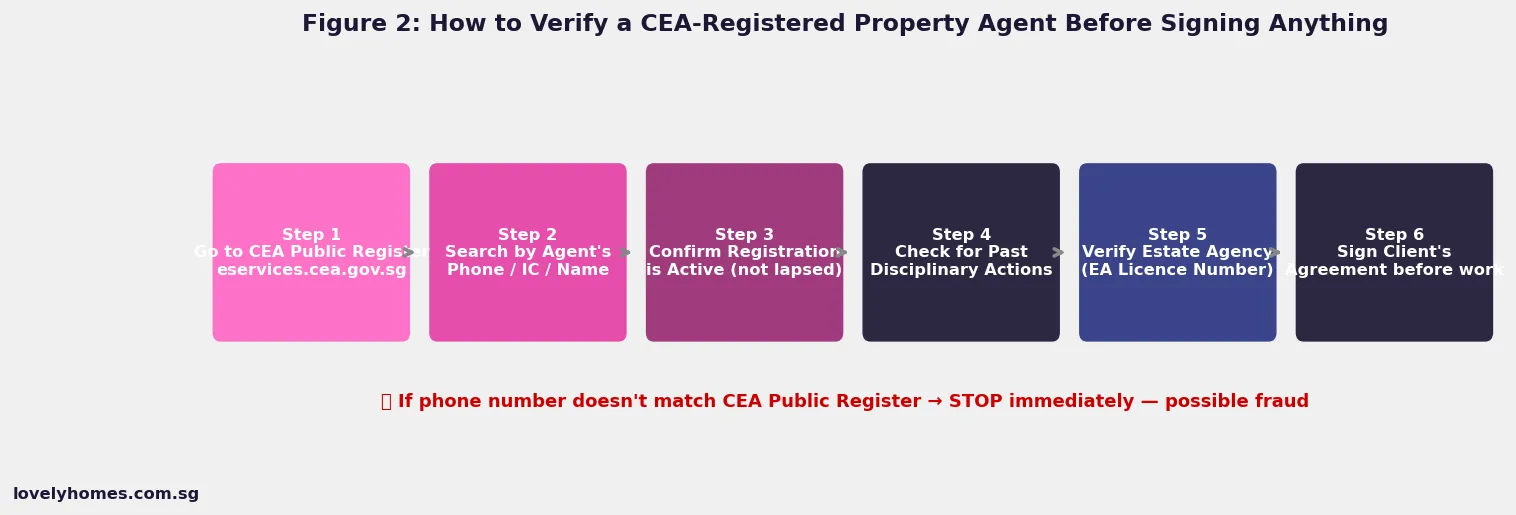
  • CEA registration is mandatory: Every property agent in Singapore must be registered with the Council for Estate Agencies. Unregistered agents cannot lawfully conduct property transactions. Verify at eservices.cea.gov.sg using the agent’s phone number — if it does not match, stop dealing immediately.
  • Client’s Agreement is required by law: Under the Estate Agents Act, an agent must enter into a written Client’s Agreement with you before conducting any work on your behalf. Refuse any agent who asks you to proceed without one.
  • Dual representation is restricted: An agent cannot represent both buyer and seller in the same transaction — unless both parties give informed written consent. This is a common cause of conflict-of-interest disputes.
  • Commission rates are advisory, not fixed: CEA publishes advisory rates as a market benchmark; actual commission is negotiable. New launch buyer agents are paid by the developer, not the buyer.
  • Check disciplinary record: CEA’s Public Register shows past sanctions, fines, and licence suspensions. This is a critical check many buyers skip.
  • Specialisation matters: An agent who primarily transacts HDB resale may not have the market knowledge, network, or sub-sale experience for a D9 new launch.
  • Red flags: WhatsApp-only contact, pressure to pay before viewing, no CEA registration match on phone number, reluctance to sign Client’s Agreement.

Why the Right Property Agent Matters More Than the Platform

Online property portals, valuation tools, and AI-assisted market data have made property information more accessible than ever. But the actual execution of a property transaction — negotiating on price, managing the OTP timeline, coordinating between buyer’s and seller’s solicitors, handling mortgage applications, navigating HDB procedures — still depends heavily on the agent’s competence, ethics, and market network. A well-chosen agent protects your interests actively; a poor choice, or worse, a fraudulent one, can expose you to misrepresentation, conflicts of interest, and financial loss.

Step 1: Verify CEA Registration Before Anything Else

This is the single most important step and takes under two minutes. Visit eservices.cea.gov.sg and search using the phone number the agent contacted you from. If the phone number does not return a matching, currently active salesperson licence, stop all engagement immediately — this is a classic fraud indicator.

Do not rely solely on the business card, name, or IC number that the agent provides. Scammers regularly impersonate real agents by using stolen photos and legitimate-sounding names while substituting a different phone number that you are meant to contact.

The Public Register also shows:

  • The estate agency the agent is currently registered under.
  • Whether the licence is active, lapsed, or suspended.
  • The agent’s transaction history for the past 36 months (categories: HDB resale, HDB rental, private sale/resale, private rental).
  • Any disciplinary actions taken by CEA, including fines, reprimands, and licence revocations.
How to verify a CEA-registered property agent Singapore step by step guide 2026
Figure 2: How to Verify a CEA-Registered Property Agent — Six Steps from the CEA Public Register to signing the Client’s Agreement.

Step 2: Match the Agent’s Specialisation to Your Transaction

Transaction history is your most objective indicator of an agent’s specialisation. An agent with 50 HDB resale transactions in the past 36 months and zero private property transactions is unlikely to be the best choice for a high-value CCR condominium purchase. Conversely, a specialist in D9–D11 luxury resales may be unfamiliar with HDB procedures and the nuances of the CPF Housing Grant application process.

Ask the agent directly: “How many transactions of this specific type — resale 4-room HDB in Tampines / new launch in OCR / commercial shophouse — have you done in the past 12 months?” A trustworthy agent will show you their track record rather than deflect the question.

Key specialisation signals to look for:

  • HDB resale buyer: Look for 10+ HDB resale transactions in the past 36 months, familiarity with HFE letter procedures, and knowledge of the NCQ (Non-Citizen Quota) for rental scenarios.
  • Private resale buyer: Look for private property transaction history, knowledge of current sub-sale volumes in your target district, and relationships with mortgage brokers.
  • New launch buyer: Developer accreditation and attendance at developer previews; knowledge of ballot priority systems; familiarity with the Progressive Payment Scheme.
  • Seller (HDB or private): Track record of actual listings sold, average days on market for recent listings, familiarity with comparative market analysis.
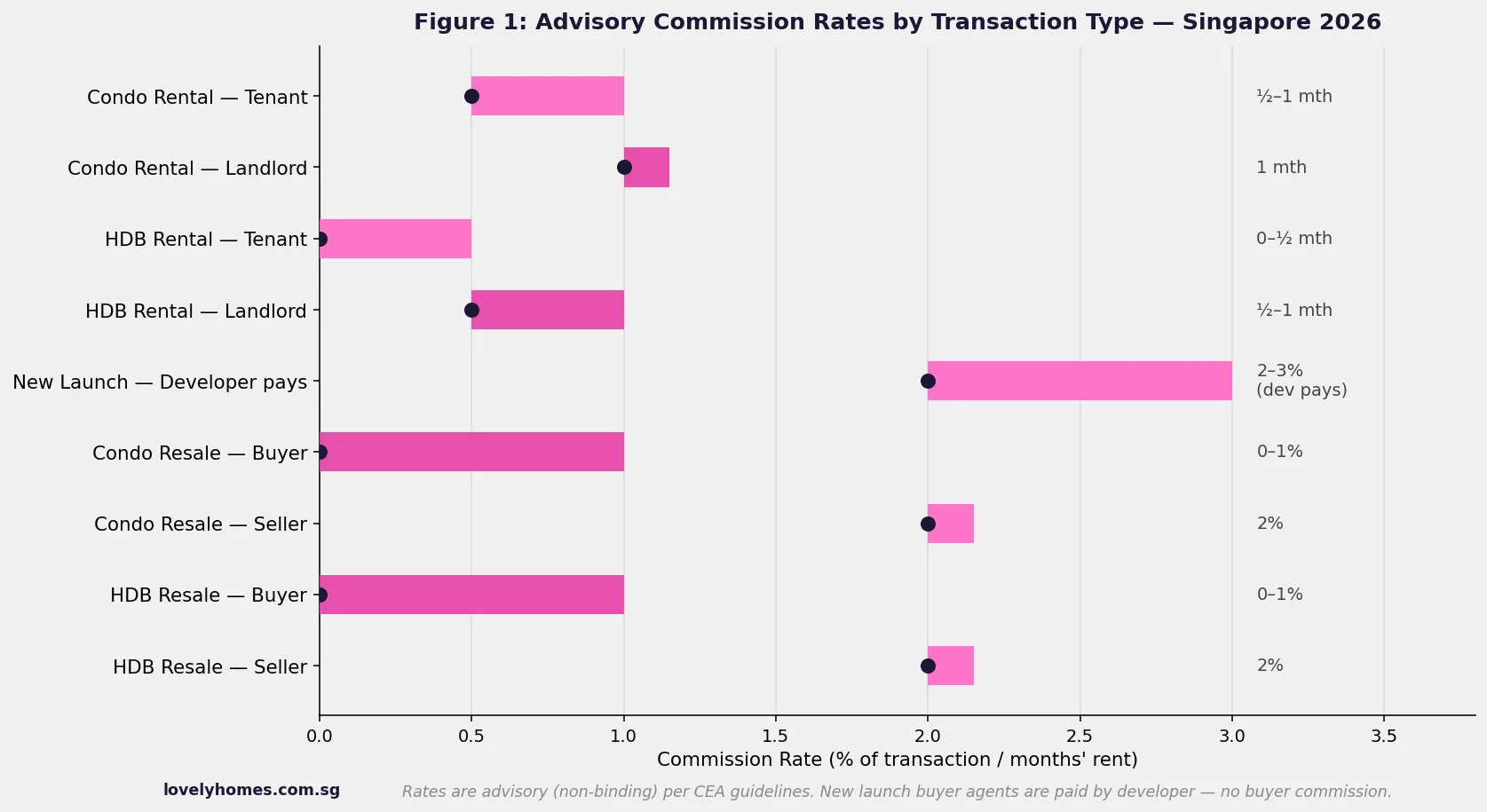
Singapore property agent advisory commission rates 2026 by transaction type
Figure 1: Advisory Commission Rates by Transaction Type — Singapore 2026. Rates are non-binding benchmarks published by CEA. New launch buyer agents are compensated by the developer at no cost to the buyer.

Step 3: Understand Commission and Negotiate Clearly

Commission rates in Singapore are not regulated by law — the figures published by CEA are advisory rates that serve as market benchmarks. They are not binding on either party. In practice, most HDB seller agents charge around 2% of the transaction price; HDB buyer agents typically charge 0–1%. For private property, seller agents charge approximately 2% and buyer agents 0–1% on resale transactions.

For new launch private condominiums, the developer pays the buyer’s agent directly — the buyer pays no commission. Developer commissions for buyer’s agents typically range from 2% to 3% of the purchase price, sometimes higher for international buyers or premium units. This creates a structural incentive that is worth understanding: the buyer’s agent in a new launch transaction is economically the developer’s agent. Ask whether the agent has compared alternative units in different projects at the same price point before endorsing a specific development.

Always agree on commission in writing as part of the Client’s Agreement before any work begins. Verbal agreements on commission are difficult to enforce and frequently the source of disputes lodged with CEA.

Step 4: Insist on a Client’s Agreement

Under section 64 of the Estate Agents Act (Cap 95A), an estate agent and a registered salesperson must sign a Client’s Agreement with any client before performing any estate agency work. The Client’s Agreement must specify: the scope of services, the commission rate (or formula), the duration of the exclusive arrangement (if any), and the salesperson’s and agency’s registration details.

An agent who is reluctant to sign a Client’s Agreement is operating outside the legal framework — and likely has good reason to avoid a paper trail. Refuse to proceed without a signed Client’s Agreement in every circumstance. The Client’s Agreement also gives you a formal dispute mechanism: if an agent breaches its terms, you have grounds to file a complaint with CEA and seek compensation.

Dual Representation: Know Your Rights

Dual representation occurs when a single agent acts for both the buyer and the seller (or both landlord and tenant) in the same transaction. CEA rules permit dual representation only if both parties provide informed written consent — and only if the agent discloses the arrangement and both clients agree they understand the conflict of interest involved.

If an agent introduces you to a property and then reveals they are also representing the seller, you have every right to refuse and engage a separate buyer’s agent. In practice, the seller’s agent who shows you a property is acting for the seller; you should either negotiate directly or engage your own buyer’s agent to represent your interests.

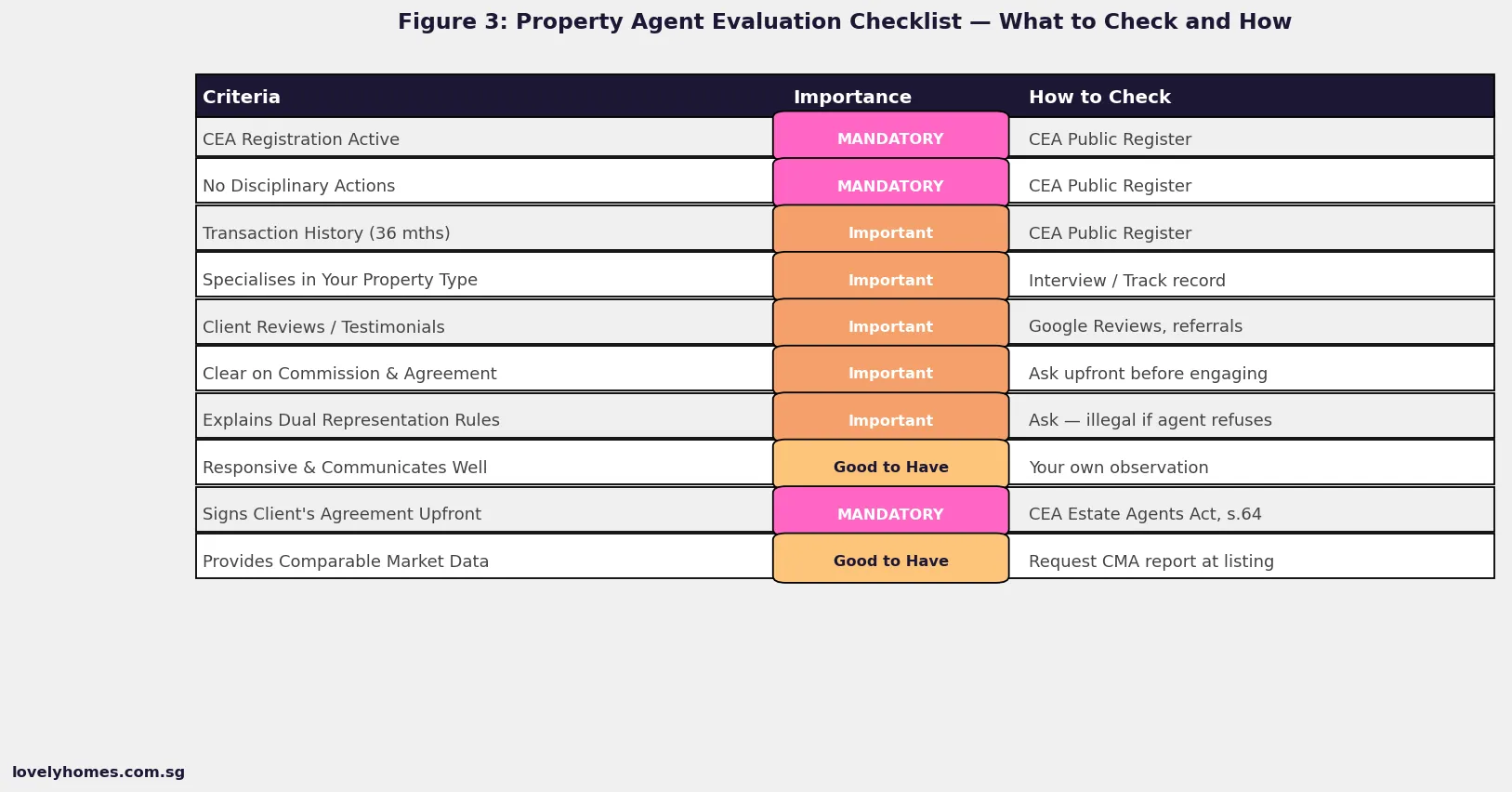
Singapore property agent evaluation checklist criteria importance how to check 2026
Figure 3: Property Agent Evaluation Checklist — criteria ranked by importance and how to check each one before engaging.

Summary Table: What to Check When Choosing a Property Agent

Check How to Do It Importance
CEA licence is active Search phone number at eservices.cea.gov.sg Mandatory — do not proceed without this
No disciplinary record CEA Public Register → check actions tab Mandatory
Transaction history matches your property type CEA Public Register → transaction history tab High
Client’s Agreement signed before any work Request before first viewing or listing appointment Mandatory by law
Commission agreed in writing Included in Client’s Agreement High
Dual representation disclosed and consented to (if applicable) Ask directly; get written confirmation High
Reviews from past clients for same property type Google Business profile, referrals, developer feedback Moderate
Comparative market data provided Request a CMA report before pricing your listing or making an offer Moderate

Worked Example: Mr Tan — Selling an HDB Flat in Tampines

Mr Tan holds a 5-room HDB resale flat in Tampines (MOP completed). He shortlists three agents by asking each the same set of questions:

  • Agent A: CEA-registered, 22 HDB resale transactions in past 36 months including 8 in Tampines, no disciplinary record, quoted 2% commission, offered to sign Client’s Agreement immediately. Provided a Comparative Market Analysis showing recent 5-room transacted prices in Tampines (S$680K–S$760K range). Explained the SSD regime for his acquisition year (no SSD applicable — MOP completed, held more than 4 years).
  • Agent B: CEA-registered, 5 transactions in past 36 months (mix of HDB and private), quoted 1.5% but said “we can discuss after the listing”. Did not proactively offer the Client’s Agreement. Could not provide a CMA on the spot.
  • Agent C: Could not be verified by phone number on CEA Public Register — immediately disqualified.

Decision: Mr Tan engaged Agent A. The higher commission (2% vs 1.5%) was justified by the stronger local track record and the immediate CMA. The listing was priced at S$720,000, received three offers within 10 days, and was sold at S$736,000 — S$16,000 above asking price.

Commission paid: 2% × S$736,000 = S$14,720 + 9% GST = S$16,044.80 — fully accounted for in Mr Tan’s net sale proceeds.

Questions to Ask a Property Agent Before Engaging

The following 10 questions help filter out unsuitable agents quickly and give you the information you need to make an informed choice. A competent, ethical agent will answer each question directly:

  1. Can I search for your CEA registration using your phone number right now?
  2. How many transactions have you completed in the past 12 months for my specific property type and area?
  3. Are you willing to sign a Client’s Agreement today before we proceed further?
  4. Are you representing the seller (or buyer) of any properties you will show me?
  5. What is your commission rate and is it inclusive of GST?
  6. Can you provide a Comparative Market Analysis for my target area or my listing price?
  7. What is your exclusive period, and what are the exit conditions if I am unhappy?
  8. How do you handle co-broking — will you share commission with a buyer’s agent?
  9. Have you been subject to any CEA disciplinary proceedings?
  10. How and how often will you update me on enquiries and market feedback?

Why This Matters: The Cost of Getting It Wrong

CEA received approximately 370 consumer complaints against property agents in FY2025, the majority relating to misrepresentation, failure to disclose material facts, and commission disputes. An agent who misrepresents the remaining lease, the NCQ position, or the property’s Minimum Occupation Period status can expose you to legal liability and significant financial loss. The consequences of working with an unverified or unregistered agent are even more severe — any contract entered into with an unregistered person is voidable, and the agent has no professional indemnity insurance.

The estate agency industry in Singapore is regulated under the Estate Agents Act (Cap 95A) and the CEA Code of Ethics and Professional Client Care. CEA has the power to fine agents, suspend or revoke licences, and impose a public reprimand. These enforcement tools exist precisely because the consequences of dishonest or incompetent agency work in a high-value property market are severe.

What Might Change: Digital Tools and AI in Property Agency

Several platforms now offer AI-assisted valuations and transaction matching that reduce the information asymmetry between buyers, sellers, and agents. Industry watchers expect the share of transactions involving “self-service” buyer portals to grow modestly, particularly for straightforward HDB resale transactions. However, for higher-value or more complex transactions (CCR condos, commercial properties, en-bloc proceedings, cross-border purchases), the regulatory, legal, and negotiation complexities mean the licensed agent remains the essential professional for the foreseeable future.

CEA is also exploring digital licence verification tools embedded in property portal listings, which would surface real-time CEA registration status alongside every listing. If implemented, this would make basic verification automatic — though the more nuanced checks (disciplinary history, specialisation fit, commission terms) will always require the buyer or seller to engage directly.

Frequently Asked Questions

Do I have to pay an agent as a buyer in Singapore?

For new launch private condominiums, no — the developer pays the buyer’s agent’s commission. For HDB resale and private resale transactions, the convention is that the seller pays the seller’s agent and the buyer may or may not engage their own buyer’s agent (typically at 0–1% of the purchase price). Some buyers choose to rely on the seller’s agent to facilitate the transaction, which is permitted only if dual representation is disclosed and consented to in writing. Engaging your own buyer’s agent provides independent representation for a relatively modest fee and is generally advisable for high-value or complex transactions.

What is a Co-Broking arrangement and should I be concerned?

Co-broking occurs when a listing agent (representing the seller) works with another agent (representing the buyer), splitting the total commission between them. This is a standard and healthy market practice — it incentivises seller’s agents to accept viewings from co-brokers, widening the pool of buyers. The seller typically pays the full commission, which the two agents then divide. As a buyer, co-broking generally means you are properly represented. As a seller, you should ask whether your listing agent is willing to co-broke; an agent who refuses co-broking is limiting your buyer pool, which can reduce your final sale price.

What are the consequences if an agent misrepresents a property to me?

Misrepresentation by a licensed property agent is actionable under both the Estate Agents Act and the Misrepresentation Act (Cap 390). You may file a complaint with CEA for disciplinary action against the agent, claim damages from the agent’s estate agency (which carries professional indemnity insurance), and, in cases of fraudulent misrepresentation, pursue civil action or a police report. If the misrepresentation relates to material facts — remaining lease, whether the property is encumbered, rental tenancy status — and you can demonstrate reliance and loss, damages claims can be substantial. Always get material facts confirmed in writing during the offer process, and instruct your solicitor to conduct due diligence independently.

How do I check if a property agent has been disciplined by CEA?

The CEA Public Register at eservices.cea.gov.sg shows the disciplinary record for every registered salesperson, including the date, nature, and sanction of any disciplinary proceedings. You can search by the agent’s name, registration number, or phone number. Disciplinary actions range from advisory letters and fines (minor breaches) to licence suspension or revocation (serious breaches such as misrepresentation, unauthorised receipt of monies, or criminal convictions). An advisory letter for a minor procedural breach should not necessarily disqualify an otherwise strong candidate; a licence suspension for misrepresentation is a clear disqualifier.

Can I switch agents if I am unhappy after signing a Client’s Agreement?

The Client’s Agreement will specify its duration, typically 60–90 days for an exclusive listing or buyer-representation arrangement. Most agreements include early termination provisions with notice periods of 7–14 days. If the agent has materially breached the agreement — failed to meet agreed obligations, made misrepresentations, acted without authority — you may have grounds to terminate immediately without notice. If the agent has merely been unsatisfactory without a clear breach, you will typically need to wait out the notice period or negotiate a mutual early termination. Any dispute about termination rights can be escalated to CEA’s Dispute Resolution Scheme before going to the courts.

What if I want to buy or sell property without an agent?

Transacting without an agent is legally permissible for private property and HDB resale (the HDB also facilitates direct seller-to-buyer transactions through its Resale Portal). However, you take on the full responsibility for negotiating the OTP, conducting due diligence, managing the conveyancing timeline, coordinating with the other party’s solicitor, and ensuring all regulatory conditions are met. A licensed solicitor is still required for the legal transfer. For straightforward transactions in a familiar market, experienced buyers and sellers sometimes transact direct; for first-time buyers, those unfamiliar with Singapore property law, or those handling complex transactions, engaging a qualified agent is strongly advisable.

Related Articles

Disclaimer: This article is for general information only and does not constitute financial, legal, or professional advice. Information on CEA registration requirements and the Estate Agents Act may be updated by the Council for Estate Agencies. Verify all agent details at eservices.cea.gov.sg and consult the CEA website for the current Code of Ethics and professional standards. Engage a licensed solicitor for all conveyancing matters.

Tampines North Neighbourhood Guide Singapore 2026: Property Prices, MRT, Schools and Investment Outlook

Tampines North Neighbourhood Guide Singapore 2026: Property Prices, MRT, Schools and Investment Outlook

Quick Answer — Tampines North 2026 at a Glance

  • Tampines North is Singapore’s newest planned sub-town within the established Tampines New Town in District 18 (D18), located in the northeast of Singapore, approximately 25 km from the CBD.
  • The area currently has excellent EWL access via Tampines MRT (EW2) and DTL access via Tampines DT32; the upcoming Cross Island Line (CRL) Tampines North Station (~2030) will significantly reduce journey times to the west and Jurong Lake District.
  • Parktown Residence (1,193 units), the largest launch in Tampines in years, is integrated with the future Tampines North MRT station and includes a new hawker centre, community club, and retail space.
  • HDB resale 4-room flats in Tampines currently trade between S$520,000 and S$700,000; executive condominiums such as Aurelle of Tampines launched from around S$1,100,000.
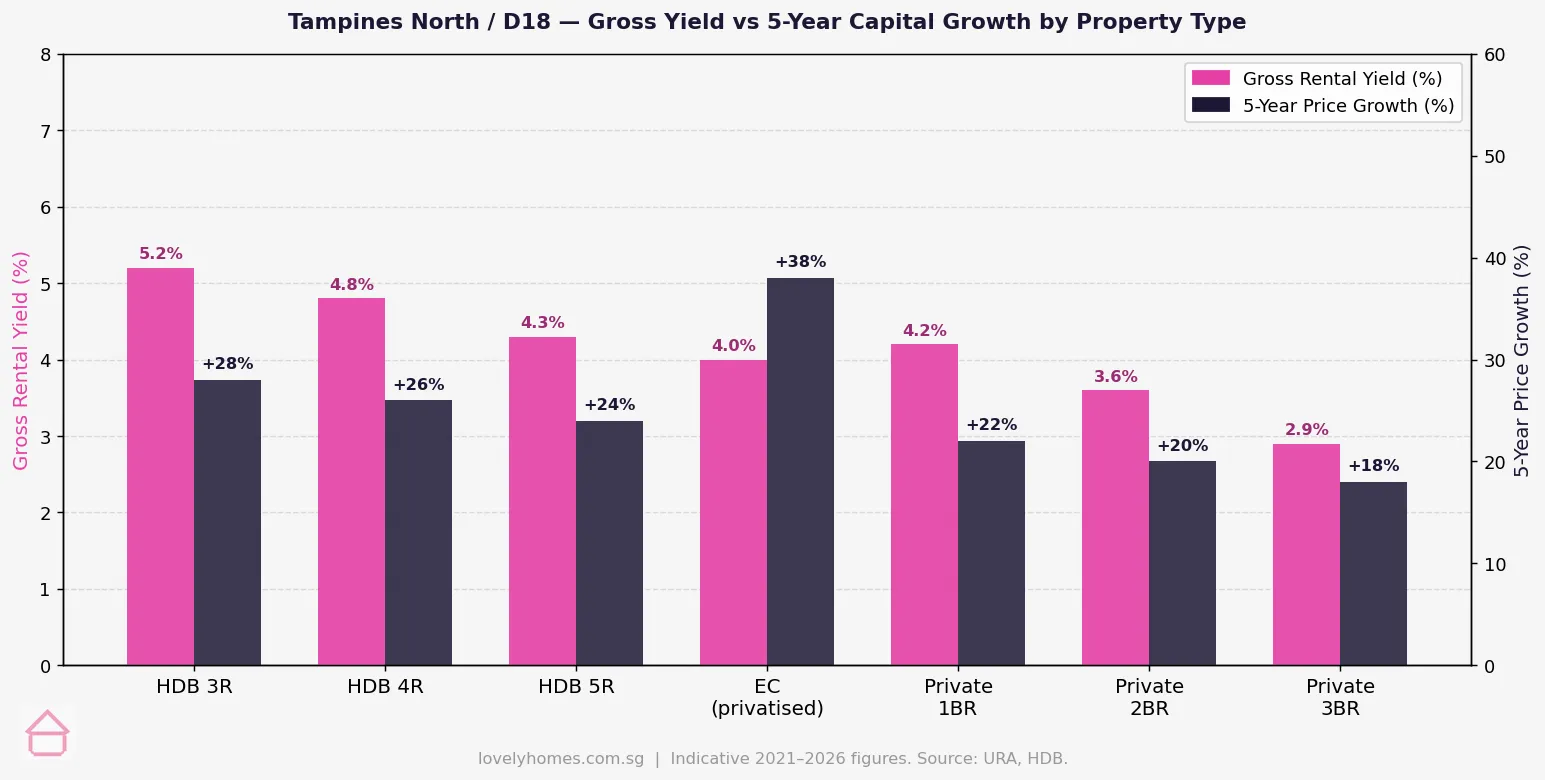
  • Gross rental yields in D18 run from 4.8% (HDB 4-room) down to 2.9% (private 3-bedroom), above the Singapore average for the same flat types.
  • UWCSEA East Campus, Temasek Polytechnic, and Singapore University of Technology and Design (SUTD) all anchor the area’s education catchment.
  • Tampines Hub, Singapore’s largest community centre (60,000 sqm), Tampines Mall, Century Square, White Sands, and IKEA make Tampines North one of the best-served retail sub-markets outside the city.
  • The 5-year HDB resale price growth in D18 has been approximately 24–28%, in line with the broader OCR market and supported by the CRL pre-announcement uplift.

Tampines North: Where Is It and Why Does It Matter?

Tampines North is the designated northern section of Tampines New Town — a planned urban extension built out on land that was, until the mid-2010s, largely farmland and industrial reserve. In URA’s parlance, “Tampines North” refers specifically to the sub-town north of Tampines Avenue 10, anchored by the future Tampines North MRT station on the Cross Island Line. The rest of Tampines — served by Tampines MRT on the East-West Line and Tampines DTL on the Downtown Line — is the mature, established town Singaporeans know well.

For property buyers, the distinction matters because Tampines North carries a CRL uplift thesis — the Cross Island Line station is expected to open circa 2030, bringing a third MRT line to the area and cutting the journey time to Jurong Lake District, Singapore’s second CBD, by more than 30 minutes compared to the current EWL route. This pre-station infrastructure play is similar to the uplift enjoyed by Jurong East in the early 2010s as the EWL–NSL interchange became a recognised commercial hub.

The broader Tampines district is classified as an OCR (Outside Central Region) submarket by URA, commanding lower per-square-foot prices than the city core but delivering superior gross rental yields for buy-to-let investors. In Q1 2026, URA data shows OCR private residential prices up approximately 2.2% quarter-on-quarter and HDB resale prices broadly stable across the east.

Property Prices — What You Can Expect to Pay in 2026

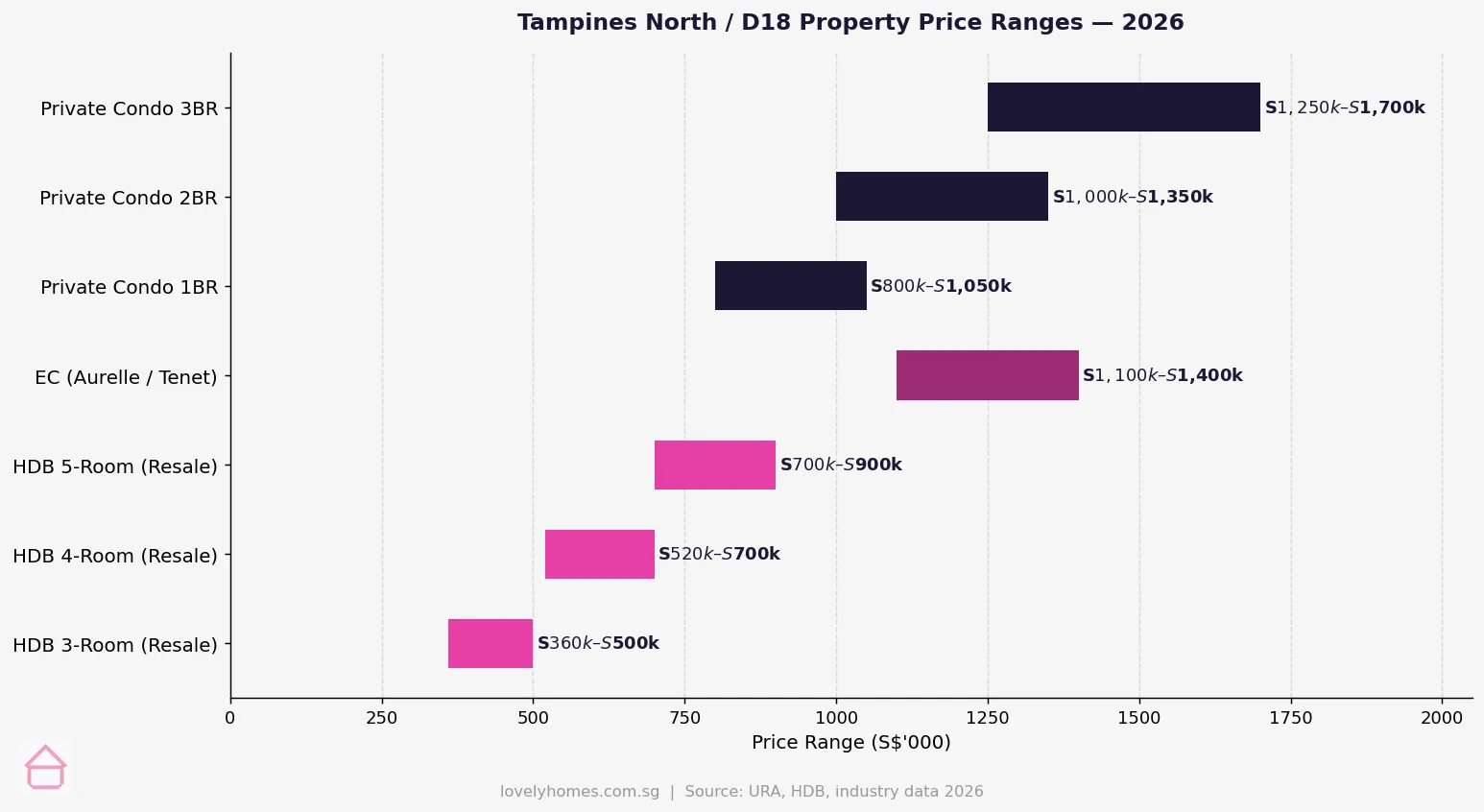
Tampines North D18 property price ranges 2026 — HDB resale EC and private condo
Figure 1: Tampines North / D18 property price ranges — 2026. Indicative. Source: URA, HDB, industry data.

HDB resale prices in Tampines have risen meaningfully since the 2021 cooling-measure-driven market trough. A typical HDB 4-room resale flat in the Tampines North sub-town trades between S$520,000 and S$700,000 depending on floor level, specific block location relative to greenery and noise, and remaining lease. Units closer to Tampines North (the newer blocks built from 2018–2023) tend to command slight premiums given longer remaining leases and proximity to the future CRL station.

Executive Condominiums — a uniquely Singaporean asset class that blends subsidised pricing for SC/PR buyers with private condominium facilities — are prominent in Tampines North. Aurelle of Tampines EC (583 units, Sim Lian Group) launched in 2025 at an average of approximately S$1,350 per square foot, with entry prices from around S$1.1M for 2-bedroom units. The project sits within a 10-minute walk of the future CRL station site. Tenet EC, an older privatised EC in the area, now trades on the resale market between S$1.0M and S$1.3M for 3-bedroom units.

Private condominiums in Tampines North are dominated by the mega-project Parktown Residence — a 1,193-unit, 99-year leasehold integrated development launched in 2025 by a UOL Group, CapitaLand and HDB co-development. It is physically integrated with the Tampines North MRT station and includes a hawker centre, a community club, and a retail precinct. Entry pricing for 1-bedroom units started at approximately S$800,000–S$900,000; 3-bedroom units were in the S$1.35M–S$1.7M range at launch.

MRT Connectivity — The CRL Catalyst

Tampines North is already well-connected by two existing MRT lines and will gain a third by around 2030, making it one of the best-positioned OCR sub-towns for transport connectivity outside the mature estates closer to the city.

The East-West Line (EWL) passes through Tampines (EW2) and Simei (EW3), connecting directly to Changi Airport in one stop and to the city core via Paya Lebar in seven stops. The Downtown Line (DTL) has Tampines (DT32) as its eastern terminus, connecting via Bedok Reservoir, Kembangan, and Marine Parade to the Botanic Gardens and Buona Vista, then turning north-west toward the city. The DTL journey from Tampines to the Botanic Gardens is approximately 30 minutes.

The transformative addition is the Cross Island Line (CRL), specifically Phase 2 (CRL2), which brings a dedicated Tampines North station. CRL links Tampines North westwards through Defu, Hougang, Serangoon North, Ang Mo Kio, and onwards to Jurong Lake District — bypassing the city core and eliminating the need for a transfer at Paya Lebar or City Hall for passengers heading west. The LTA has indicated Phase 2 is targeted for completion around 2030. For property buyers, the practical implication is that the CRL uplift is currently priced into Parktown Residence (which fronts the station site) but only partially priced into the wider HDB resale market, meaning today’s buyers may capture some of the remaining discount-to-station pricing.

Amenities — Everything You Need Within 10 Minutes

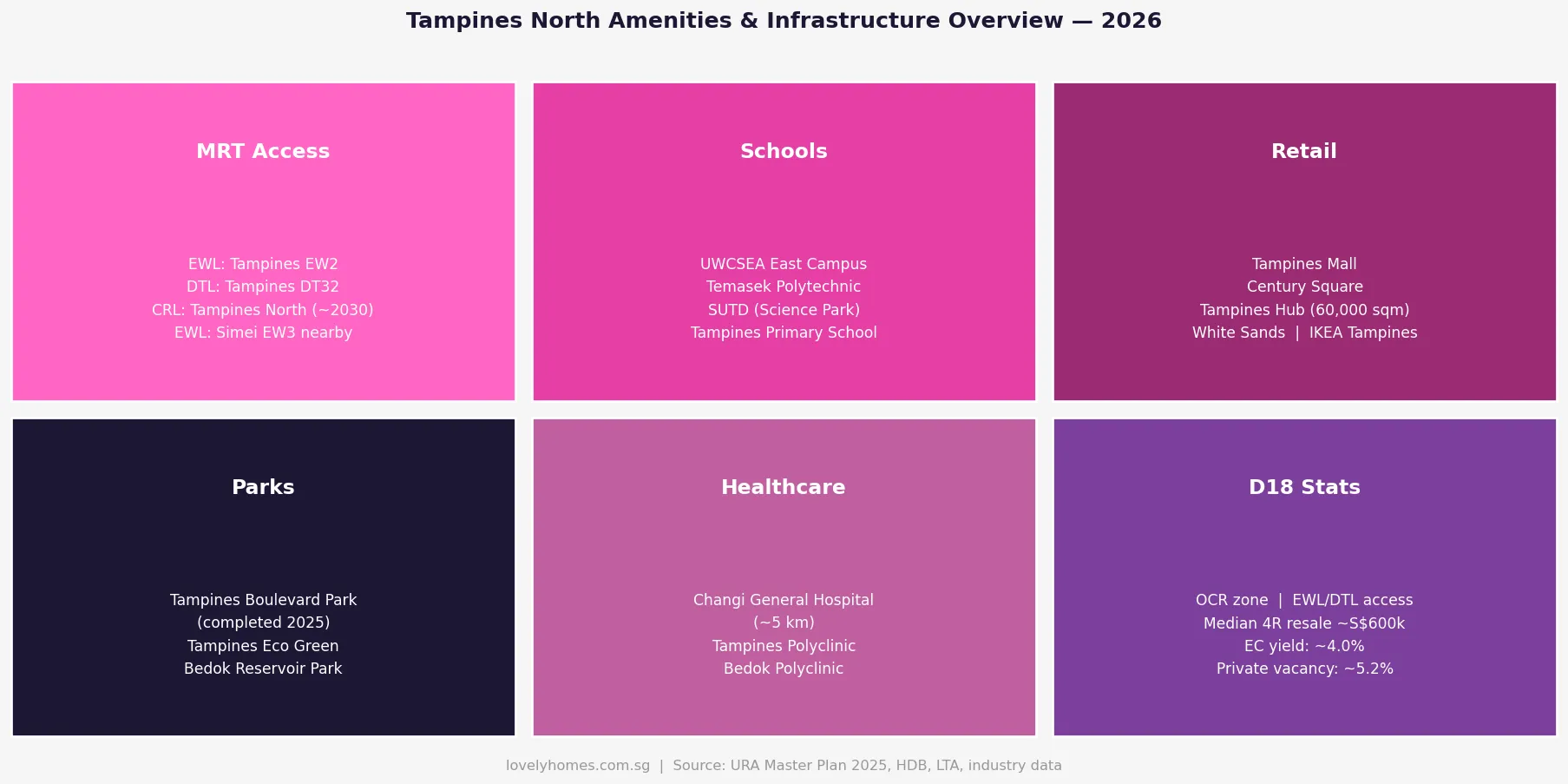
Tampines North Singapore amenities overview 2026 MRT schools retail parks healthcare
Figure 2: Tampines North key amenities overview — MRT, schools, retail, parks, healthcare and district statistics.

Retail and food. Tampines is arguably the best-served OCR sub-market for retail outside Bishan/Ang Mo Kio. The town centre is anchored by Tampines Mall (280,000 sqft), Century Square (revamped in 2021, 560,000 sqft), and White Sands. The IKEA Tampines store and Courts Megastore on Tampines North Link add destination retail. Tampines Hub — opened in 2017 and at 60,000 sqm Singapore’s largest integrated community and lifestyle hub — houses the community library, an Olympic-sized swimming complex, a hawker centre, sports courts, and a 5,000-seat stadium.

Parks and greenery. The Tampines Boulevard Park (completed late 2025) runs along the length of Tampines Avenue 9 as a 3.2-km linear park connecting Tampines North to the Central Catchment, with cycling paths, fitness stations, and community gardens. Tampines Eco Green (36 ha) is a secondary forest reserve within the town, unusual for an urban estate and valued by residents for birdwatching and nature trails. The Bedok Reservoir Regional Park is a 10-minute cycle away.

Healthcare. Changi General Hospital (CGH), a 1,000-bed acute regional hospital, is approximately 5 km from Tampines North. Tampines Polyclinic and Bedok Polyclinic both serve the broader catchment, with a third polyclinic at Pasir Ris serving the eastern corridor.

Schools — A Strong Education Catchment

UWCSEA East Campus (United World College of South-East Asia) sits within Tampines, consistently ranked among the top international schools in Singapore and drawing an expat tenant base that anchors higher-end rental demand. Temasek Polytechnic (TP), one of Singapore’s five polytechnics, is located on Tampines Avenue 1 and adds a significant student population of approximately 18,000 enrolled students. Singapore University of Technology and Design (SUTD), a research university set up in partnership with MIT and ZHEJIANG University, is located at the Changi-Tampines border and draws an educated demographic to the wider east. Primary and secondary schools within the Tampines North catchment include Tampines Primary School, Elias Park Primary, Junyuan Secondary, and St. Hilda’s Primary (popular 1-km circle school further south).

Investment Outlook — Yield vs Capital Growth

Tampines North D18 gross rental yield vs 5-year capital growth by property type 2026
Figure 3: D18 Tampines North — estimated gross rental yield vs 5-year capital growth (2021–2026) by property type. Indicative.

The investment case for Tampines North rests on two distinct thesis strands depending on the buyer’s horizon. Short-to-medium-term (1–5 years), the yield-on-cost argument favours HDB resale and older privatised ECs: gross yields of 4.8% on a S$600,000 4-room resale flat, with low vacancy and a large tenant pool anchored by UWCSEA, SUTD, and TP staff and students. Longer-term (5–10 years), the capital growth argument points to the CRL opening circa 2030 as the primary catalyst, with EC and Parktown Residence buyers positioned to benefit from station-adjacency re-rating.

Five-year price growth (2021–2026) in D18 has been approximately 24–28% for HDB resale and 35–38% for privatised ECs, both broadly in line with or slightly above the URA OCR PPI growth over the same period. Private condominiums have grown more modestly at 18–22% given higher absolute entry prices. The important caveat is that the Tampines North private market is predominantly occupied by projects launched from 2022–2025 whose resale data is limited; the 2030 CRL opening is the true test of the station-adjacency premium thesis.

Property Comparison Summary

Property Type Price Range (2026) PSF (est.) Gross Yield Tenure Key Development
HDB 3-Room (Resale) S$360k – S$500k S$420–S$560 psf ~5.2% 99yr (remaining) Various blocks
HDB 4-Room (Resale) S$520k – S$700k S$450–S$600 psf ~4.8% 99yr (remaining) Tampines North BTO blocks
HDB 5-Room (Resale) S$700k – S$900k S$420–S$540 psf ~4.3% 99yr (remaining) Various blocks
EC (privatised/resale) S$1.0M – S$1.4M S$900–S$1,200 psf ~4.0% 99yr leasehold Tenet EC, Aurelle of Tampines
Private Condo 1BR S$800k – S$1,050k S$1,400–S$1,700 psf ~4.2% 99yr leasehold Parktown Residence
Private Condo 2BR S$1.0M – S$1.35M S$1,300–S$1,600 psf ~3.6% 99yr leasehold Parktown Residence, Pinery
Private Condo 3BR S$1.25M – S$1.70M S$1,200–S$1,500 psf ~2.9% 99yr leasehold Parktown Residence

Worked Example — Mr & Mrs Ng, Buying Tampines North 4-Room HDB Resale

Mr and Mrs Ng are a Singapore Citizen married couple, both in their early 30s. Their combined gross monthly income is S$9,500. They wish to sell their current 3-room HDB flat in Jurong West (fully paid off at S$480,000) and upgrade to a 4-room resale HDB flat in Tampines North, targeting proximity to Temasek Polytechnic where Mrs Ng works.

They identify a 4-room resale flat on the 12th floor of a Tampines North block with a remaining lease of 72 years, listed at S$660,000.

Stamp duties: BSD on S$660,000 — first S$180,000 at 1% = S$1,800; next S$180,000 at 2% = S$3,600; next S$300,000 at 3% = S$9,000. BSD = S$14,400. ABSD: nil — SC married couple, concurrent sale of existing HDB means property count stays at one.

Grants: At S$9,500 joint income, EHG for resale is S$15,000. PHG: if Tampines North is within 4 km of Mrs Ng’s parents’ home in Pasir Ris — qualifying distance — PHG = S$20,000 (living near parents). Total grants = S$35,000. Net effective price = S$660,000 − S$35,000 = S$625,000.

Financing: HDB concessionary loan LTV 80% = S$500,000. Monthly instalment: S$500,000 at 2.6% over 25 years ≈ S$2,274/month. MSR: S$2,274 / S$9,500 = 23.9% — within the 30% MSR limit. TDSR: 23.9% — well within 55%. Cash upfront (5% cash + BSD): S$33,000 + S$14,400 = S$47,400.

Outcome: The Ngs can feasibly complete the purchase, using the S$480,000 proceeds from their Jurong West flat to fund the upfront costs and CPF top-up, with the CRL opening in 2030 providing a potential capital gain catalyst within their 10-year holding horizon.

What Might Come Next for Tampines North

The structural story for Tampines North is the CRL. Once the Cross Island Line Tampines North station opens (~2030), the area transitions from “well-connected east sub-town” to “triple-line MRT hub” — a designation shared by fewer than ten stations in Singapore. The immediate consequence is typically a rental yield compression (higher prices) and a transaction volume uplift as buyers from outside the east discover the area.

Beyond CRL, the URA Master Plan 2025 identifies a stretch of land near Sungei Loyang — northeast of Tampines North — as a potential new neighbourhood study area. An environmental study is underway; if positive, this could yield an additional residential supply pipeline of several thousand units beyond 2030, including park space and community facilities that would benefit Tampines North residents further north.

For existing Tampines residents, the advice is to document their lease adequacy carefully: flats with remaining leases dropping below 60 years within a 20-year horizon will lose CPF financing eligibility, which progressively reduces the buyer pool for those units on resale. This is a watch-point particularly for older blocks in the southern part of Tampines town.

Frequently Asked Questions

Is Tampines North a good area to buy property in 2026?

For buyers with a 7-10 year investment horizon, Tampines North has a credible structural case built on the CRL opening (~2030), strong rental demand from UWCSEA and TP, one of Singapore’s best OCR retail hubs, and prices that remain below RCR comparables for similar connectivity. Short-term buyers should be aware that private condo prices in Tampines North are already partly pricing in the CRL uplift, particularly Parktown Residence. HDB resale buyers get better value relative to future connectivity than private condo buyers.

Which MRT lines serve Tampines North?

As of 2026, Tampines North is served by the East-West Line (EWL) at Tampines (EW2) and the Downtown Line (DTL) at Tampines (DT32). Both stations share a common paid concourse. The upcoming Cross Island Line (CRL) Tampines North station, targeted around 2030, will add a third line specifically serving the northern sub-town and integrated with Parktown Residence. Simei (EW3) on the EWL also serves the southern edge of Tampines North.

Can foreigners buy property in Tampines North?

Foreign individuals (non-PRs) may purchase private condominium units in Tampines North, such as Parktown Residence, subject to the 65% Additional Buyer’s Stamp Duty (ABSD) on the purchase price. Singapore PRs buying their first property pay 5% ABSD. Foreigners and PRs cannot purchase HDB flats or executive condominiums below 10 years old (except PRs buying resale HDB with a Citizen spouse). The 65% ABSD rate was introduced in April 2023 and remains in force as of June 2026.

What is Parktown Residence and how is it different from a regular condo?

Parktown Residence is a 1,193-unit 99-year leasehold integrated development co-developed by UOL Group, CapitaLand, and HDB, launched in 2025. “Integrated” in this context means it is physically connected to the Tampines North MRT station (CRL), a hawker centre, a community club, and a retail precinct within a single development. Residents will have sheltered, direct access to the CRL station without going to street level. This is similar to the Bidadari integration model (Woodleigh Residences + Woodleigh MRT) and commands a moderate premium over non-integrated private condos nearby.

How does Tampines North compare to nearby Bedok or Pasir Ris for property investment?

Tampines North has a younger housing stock on average than Bedok (where many leases are entering the 40-50 year range) and a cleaner CRL catalyst story than Pasir Ris (which benefits from the EWL and the Pasir Ris-Punggol Regional Line, but has already partly priced in those upgrades). Bedok offers more mature amenities and better CBD commute times via the EWL, while Pasir Ris offers more land area and green space. Tampines North is the strongest play for buyers specifically betting on the CRL station uplift over a 5-10 year horizon.

What income is needed to buy a condo in Tampines North in 2026?

For a 2-bedroom private condo in Tampines North at approximately S$1.2M, assuming a bank loan at LTV 75% and a 30-year tenure at 3.0% per annum: the loan quantum is S$900,000 and the monthly instalment approximately S$3,795. Under TDSR at 55%, the required gross monthly income is approximately S$6,900. In practice, lenders typically want comfortable headroom, so a combined household income of S$10,000–S$12,000 per month is advisable for sustainable financing at this quantum. Cash/CPF available for the downpayment (25%) plus BSD should be in the S$320,000–S$350,000 range.

Related Articles

Disclaimer: This article provides general information about the Tampines North property market as at 3 June 2026. Property prices, yields, and infrastructure timelines are indicative and subject to change. This is not investment advice. Refer to official sources including URA, HDB, and LTA for authoritative figures, and consult a licensed property agent and financial adviser before making any property purchase decision.

Translate »