TDSR & MSR Singapore 2026: Complete Guide to Mortgage Servicing Limits and the Stress Test Rate

TDSR & MSR Singapore 2026: Complete Guide to Mortgage Servicing Limits and the Stress Test Rate

Quick Answer: TDSR and MSR in Singapore

  • TDSR (Total Debt Servicing Ratio) caps all your monthly debt repayments, mortgage plus everything else, at 55% of your gross monthly income, and applies to every residential property loan in Singapore.
  • MSR (Mortgage Servicing Ratio) is a stricter, narrower limit that applies only to HDB flats and Executive Condominiums (ECs) bought directly from a developer, capping the mortgage instalment alone at 30% of gross monthly income.
  • Both ratios are administered under rules set by the Monetary Authority of Singapore (MAS); HDB applies the same underlying framework to bank loans used for HDB purchases.
  • Banks must calculate your eligibility using a stress test interest rate (an MAS-set floor, commonly cited at 4% per annum) rather than the actual rate on your loan, which is almost always lower.
  • The TDSR framework was introduced by MAS in June 2013 with a 60% ceiling, then tightened to 55% as part of the December 2021 cooling measures.
  • Variable income (commission, bonus, rental) is only counted after a haircut, commonly 30% for rental income and 30% for variable/self-employed income, before it’s added to your TDSR/MSR calculation.
  • For an HDB flat or EC, both MSR and TDSR must be satisfied simultaneously: MSR is almost always the tighter constraint for these property types.

What Are TDSR and MSR, and Why Do They Exist?

Every home loan application in Singapore is tested against one or both of two affordability ceilings set by the Monetary Authority of Singapore (MAS): the Total Debt Servicing Ratio (TDSR) and, for HDB flats and Executive Condominiums, the Mortgage Servicing Ratio (MSR). Both exist for the same underlying reason: to stop households from borrowing more than they can realistically service, and to keep systemic household leverage at a level the banking system and the wider economy can absorb if interest rates rise or incomes fall. Neither ratio is a suggestion; they are hard caps built into every bank’s and HDB’s loan approval system, and a loan application that fails either test simply cannot be approved at the requested quantum.

TDSR was introduced on 29 June 2013, in the wake of a prolonged period of low interest rates and rapid private-property price growth, as the definitive framework for assessing a borrower’s total debt burden across every loan they hold, not just the mortgage being applied for. MSR is the older, narrower sibling; it has applied to HDB flats and ECs bought from a developer for considerably longer, reflecting the public-housing policy goal of keeping mortgage burdens on subsidised or grant-supported flats conservative relative to household income.
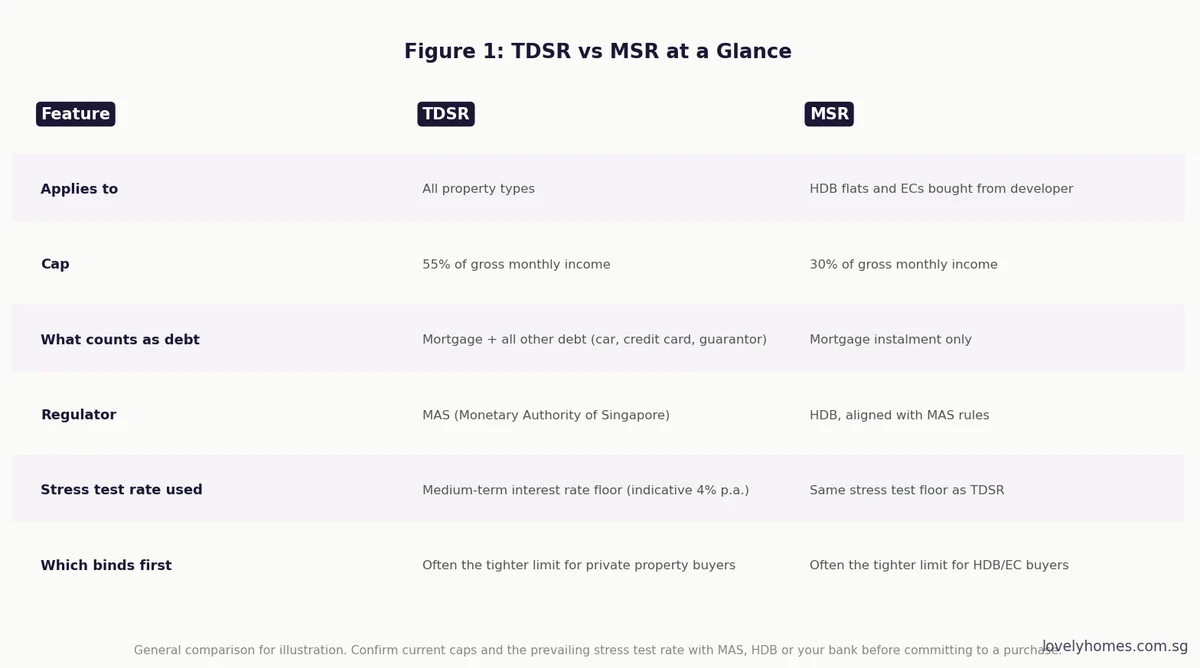
TDSR vs MSR comparison Singapore mortgage servicing ratio 2026
Figure 1: TDSR and MSR side by side: who they apply to, the caps, and what counts as debt.

TDSR in Detail: The 55% Ceiling That Applies to Every Property Loan

TDSR looks at the whole picture of your finances, not just the loan you’re applying for. The formula is straightforward in concept: add up all your monthly debt obligations (the proposed new mortgage instalment, any existing home loan, car loan, renovation loan, personal loan, education loan, and the minimum payment due on every credit card you hold) and divide that total by your gross monthly income. The result cannot exceed 55%. If it does, the bank cannot approve the loan at that quantum; you would need to either apply for a smaller loan, pay down existing debt first, or bring in a co-borrower whose income can be added to the calculation.

Crucially, TDSR is not limited to property-related debt. A large car loan, a chunk of outstanding credit card balances, or a sizeable personal loan for a wedding can all quietly eat into your TDSR headroom well before you ever start comparing condo units, which is why mortgage brokers routinely advise clearing high-interest short-term debt in the months before a home loan application.

MSR in Detail: The Tighter 30% Rule for HDB and EC Buyers

MSR is narrower in scope but stricter in effect. It applies only to HDB flats (whether new BTO, resale, or SBF) and Executive Condominiums bought directly from a developer, and it looks only at the mortgage instalment for that specific property: not your car loan, not your credit cards, not any other debt. The cap is 30% of gross monthly income. For most HDB and EC buyers, MSR bites before TDSR does, since 30% is a materially tighter ceiling than 55%; a buyer with no other debt at all can still be constrained purely by MSR.

Both ratios must be satisfied at the same time for an HDB or EC purchase financed with a bank loan: the mortgage instalment alone must stay under 30% of income (MSR), and the mortgage instalment plus every other debt obligation must stay under 55% of income (TDSR). HDB’s own concessionary loan, used by many first-time flat buyers, applies MSR using HDB’s own assessment framework, which is administered in step with the same underlying MAS policy intent even though the concessionary loan itself sits outside the bank lending system.

The Stress Test Rate: Why Your Loan Eligibility Isn’t Based on Your Actual Interest Rate

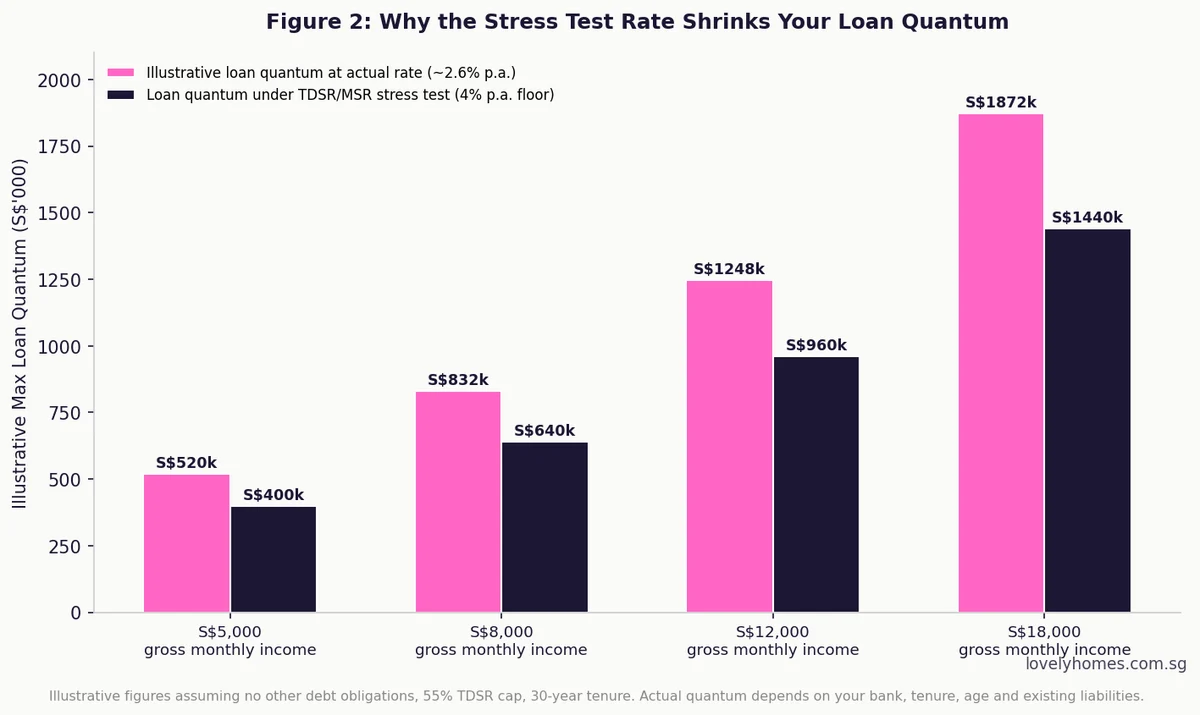
This is the detail that surprises the most first-time buyers. Banks are required by MAS to compute your TDSR and MSR using a stress test interest rate: a conservative, MAS-set floor rate, rather than the actual, usually lower, interest rate quoted on your home loan package. The stress test rate is commonly cited at a floor of 4% per annum (or the loan’s own reference rate plus a margin, whichever is higher), regardless of whether your actual mortgage package charges something closer to 2.5%–3.5%.

The logic is deliberately conservative: if interest rates were to rise materially over your loan’s 20–30 year tenure, MAS wants confidence that you could still service the mortgage at a meaningfully higher rate than today’s prevailing rate, without becoming financially distressed. The practical effect is that your maximum loan quantum is smaller than a simple calculation using your actual mortgage rate would suggest, sometimes substantially so, as illustrated below.
Stress test rate impact on maximum loan quantum TDSR MSR Singapore 2026
Figure 2: Illustrative maximum loan quantum at an actual mortgage rate versus the same household under the TDSR/MSR stress test floor.

What Counts as Income and Debt: The Details That Catch Buyers Out

Not all income is treated equally in a TDSR or MSR calculation, and this is where self-employed buyers, commission-based earners, and landlords most often find their expectations don’t match the bank’s numbers:

  • Fixed employment income (basic salary) is generally counted in full.
  • Variable income (bonuses, commissions, and income for the self-employed) is typically counted only after a haircut, commonly 30%, applied to a multi-year average rather than the most recent (and possibly best) year alone.
  • Rental income from other properties you own is likewise typically included only after a haircut, commonly around 30%, and usually requires evidence such as a signed tenancy agreement or recent rental transaction history.
  • Existing debt counted against you includes other mortgages, car loans, renovation loans, education loans, personal loans, and the minimum monthly payment on every credit card you hold, even if you pay your statement in full each month and carry no actual interest-bearing balance.
  • Guarantor obligations (if you’ve guaranteed someone else’s loan) can also be pulled into your own TDSR calculation, a detail many guarantors are unaware of until they apply for their own mortgage.

Worked Example: The Tans’ TDSR Headroom

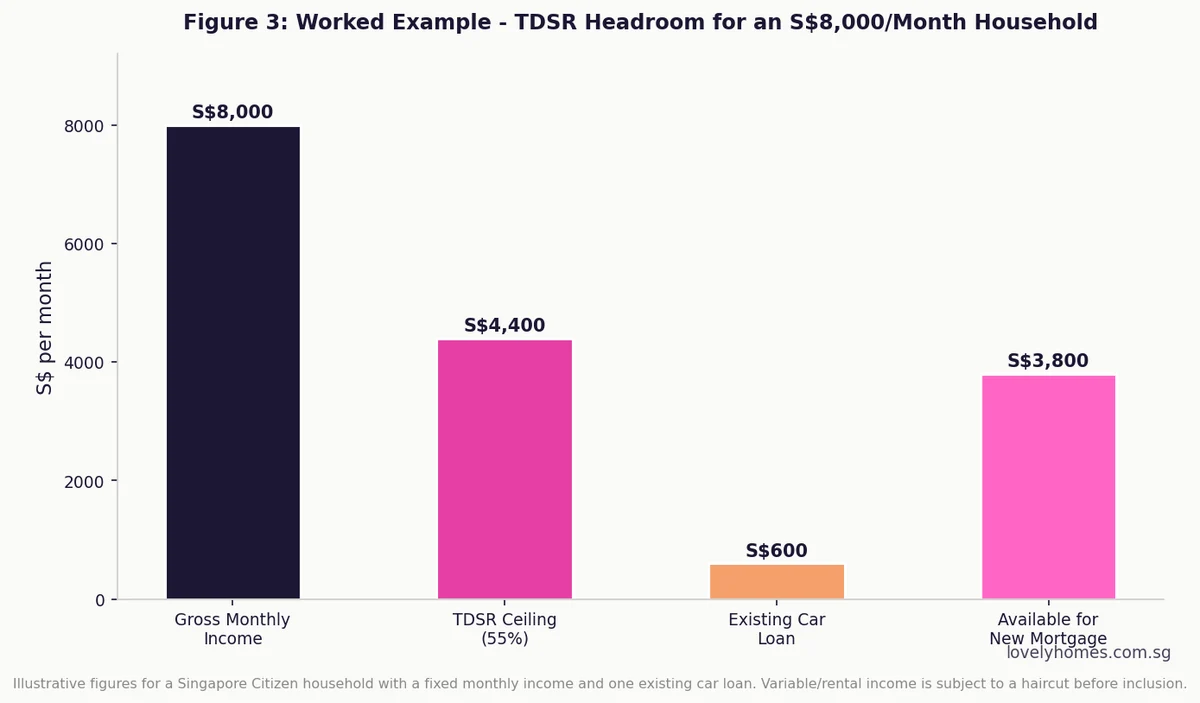
Profile: Mr and Mrs Tan have a combined gross monthly income of S$8,000. They currently service one existing car loan with a monthly instalment of S$600, and they hold no other outstanding debt.

Step 1: TDSR Ceiling. 55% of S$8,000 = S$4,400 is the maximum total monthly debt obligation the Tans can carry across everything, mortgage included.

Step 2: Deduct Existing Debt. S$4,400 − S$600 (car loan) = S$3,800 available for a new mortgage instalment.

Step 3: Translate Into a Loan Quantum. at the MAS stress test floor of 4% per annum over a 30-year tenure, roughly S$3,800 of monthly instalment headroom supports an indicative loan quantum in the region of S$790,000–S$800,000, notably lower than a calculation using the couple’s actual, lower contracted mortgage rate would suggest.

Step 4: If Buying an HDB Resale Flat Instead. MSR would also need to be checked. At 30% of S$8,000 = S$2,400 maximum mortgage instalment, MSR would be the binding constraint rather than TDSR, since S$2,400 is lower than the S$3,800 TDSR headroom calculated above, meaning the Tans’ loan quantum for an HDB purchase would be capped by MSR, not TDSR.
Worked example TDSR headroom calculation Singapore household mortgage 2026
Figure 3: Worked example: how existing debt reduces TDSR headroom for a new mortgage.

Summary: TDSR and MSR Facts at a Glance

Question Short Answer
What is the TDSR cap? 55% of gross monthly income, all property types.
What is the MSR cap? 30% of gross monthly income, HDB flats and ECs only.
Which rate is used to test eligibility? An MAS stress test floor (commonly cited at 4% p.a.), not your actual rate.
Who regulates TDSR/MSR? The Monetary Authority of Singapore (MAS), applied by HDB for HDB loans.
Does variable income count in full? No, typically only after a haircut (commonly around 30%).
Which limit binds for HDB/EC buyers? Usually MSR (30%), since it’s tighter than TDSR (55%).

Why This Matters: Who Gets Caught Out

TDSR and MSR are most likely to bind unexpectedly for a specific set of buyers: self-employed individuals and commission-based earners, whose variable-income haircut can shrink their apparent income considerably relative to what actually lands in their bank account; guarantors, who may not realise a loan they’ve guaranteed for a family member is quietly counted against their own future borrowing capacity; upgraders who haven’t yet sold their existing home and are trying to qualify for a new mortgage while still servicing the old one; and buyers relying heavily on rental income from an investment property, which is haircut and often requires documentary proof most first-time landlords haven’t yet assembled. For all these groups, getting an informal affordability check from a mortgage broker or bank before making an offer, rather than after, avoids the disappointment of a signed Option to Purchase that a bank later can’t finance at the assumed quantum.

What Might Come Next

The following is informed speculation, not confirmed policy. The TDSR/MSR framework, and the stress test rate in particular, is periodically reviewed by MAS in response to prevailing interest rate conditions and household debt trends, as seen when the stress test floor was last adjusted upward. Should mortgage rates fall meaningfully and household borrowing appetite pick up again, some industry commentary suggests MAS could revisit the stress test floor to keep effective borrowing capacity in check without necessarily changing the headline 55%/30% caps themselves. No such change has been announced as at this writing, and the caps and stress test rate discussed in this guide should always be verified against MAS’s current published rules before making financing decisions.

Frequently Asked Questions

Do TDSR and MSR apply to me if I’m paying cash, with no bank loan?

No. TDSR and MSR are lending safeguards that apply only when you’re taking a housing loan from a bank (or, for MSR-equivalent purposes, an HDB concessionary loan). A fully cash purchase with no loan is not subject to either ratio.

Can I use my parents’ or children’s income to boost my TDSR?

Some banks allow a family member to be added as a co-borrower or guarantor, which can bring their income into the calculation, subject to the bank’s own credit assessment and MAS rules on income-weighted average age for loan tenure. This is a case-by-case discussion best had directly with your mortgage banker or broker.

Why is my maximum loan quantum lower than a simple online calculator suggested?

Most simple calculators use your actual, contracted mortgage rate. Banks are required to test your eligibility using the higher stress test rate, which produces a smaller maximum loan quantum than a calculation based on your real interest rate.

Does refinancing my existing mortgage get tested against TDSR/MSR again?

Refinancing an existing property loan without increasing the loan quantum is generally not re-tested against TDSR/MSR in the same way as a new purchase loan, though banks retain discretion and individual policies can vary; always confirm directly with your bank.

If I clear my car loan, will my loan quantum increase immediately?

Once the car loan is fully settled and no longer appears in your credit record, it should no longer count against your TDSR, freeing up that portion of your income for mortgage servicing. Processing time for the update to reflect in a bank’s assessment can vary, so it’s worth allowing a short buffer before your loan application.

Is MSR checked for HDB flats bought entirely with a bank loan, not an HDB loan?

Yes. MSR applies to HDB flats and ECs regardless of whether the financing comes from a bank loan or an HDB concessionary loan; both are subject to the 30% mortgage servicing ceiling, alongside TDSR where applicable.

Do private condo purchases get checked against MSR too?

No. MSR applies only to HDB flats and Executive Condominiums bought from a developer. Private condominium and landed property purchases are assessed against TDSR only, not MSR.

Disclaimer: This article is intended for general informational purposes only and does not constitute financial advice. TDSR and MSR caps, the applicable stress test interest rate, and income haircut percentages are set by the Monetary Authority of Singapore and are subject to change. Always confirm the current framework with the Monetary Authority of Singapore (MAS), the Housing & Development Board (HDB), or your bank/mortgage broker before making any home financing decision.
×

Click anywhere outside to close

Singapore Property Investment Strategy 2026: Rental Yields, Capital Gains and Net Returns

Singapore Property Investment Strategy 2026: Rental Yields, Capital Gains and Net Returns

Quick Answer: Singapore Property Investment Strategy 2026

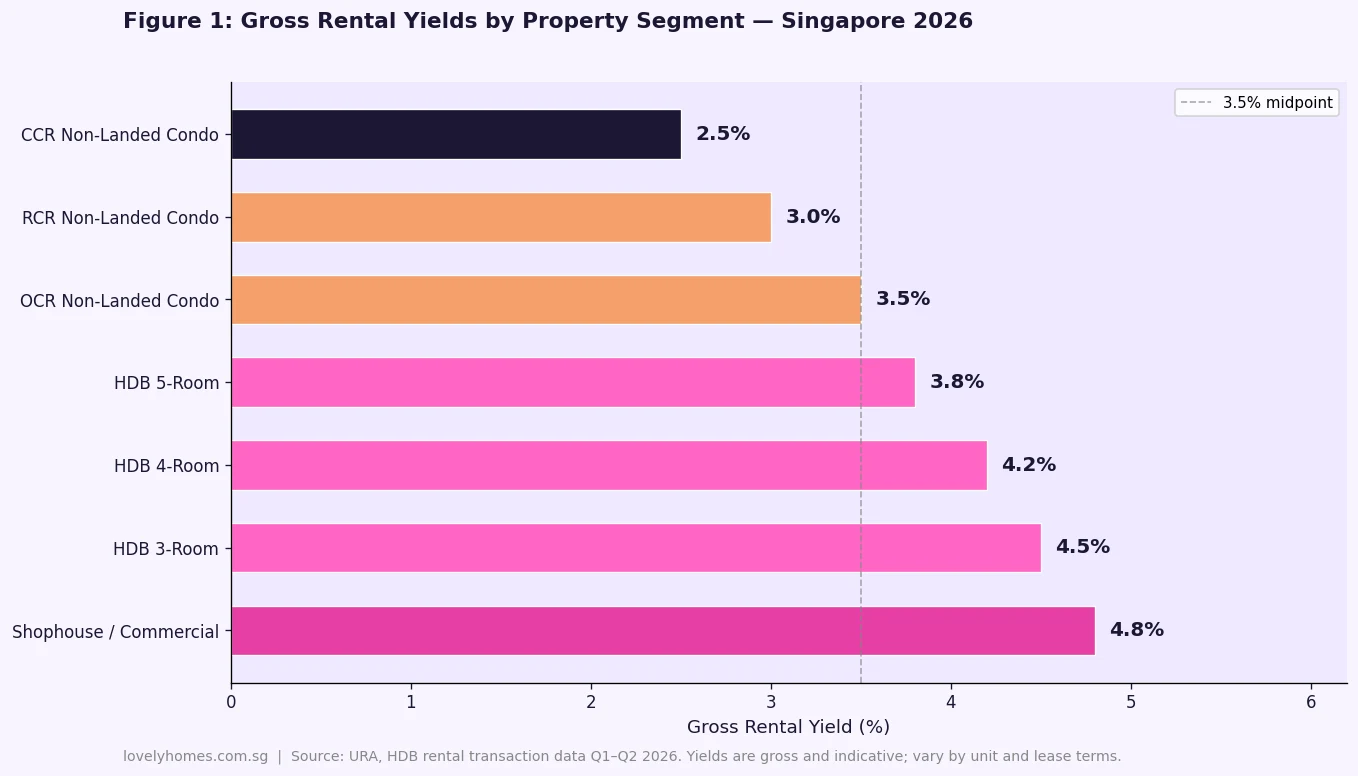
  • Singapore property gross rental yields range from 2.5% (CCR condos) to 4.8% (shophouse/commercial) — HDB flats offer the highest residential yields in 2026.
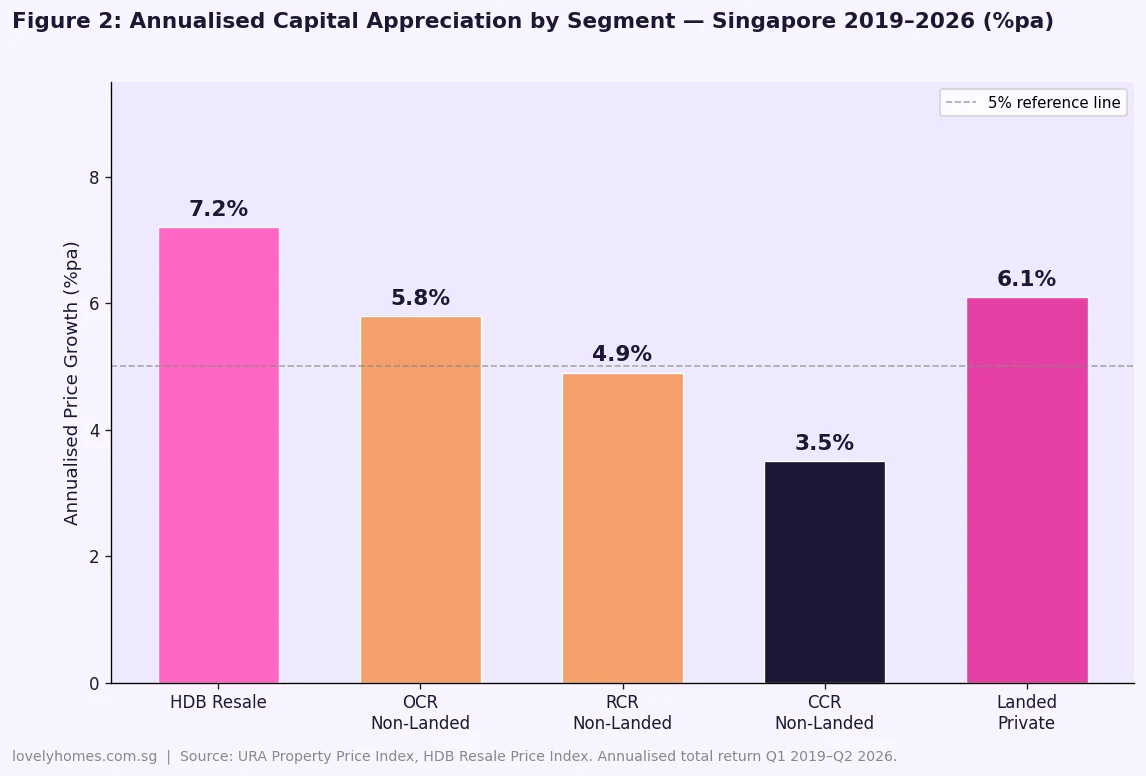
  • Capital appreciation since 2019 has been strongest in HDB resale (7.2% pa) and landed (6.1% pa), well ahead of CCR condominiums (3.5% pa).
  • The biggest drag on investor returns is ABSD: Singapore Citizens buying a 2nd property pay 20% — S$360,000 on a S$1.8M purchase — payable in cash only, not CPF.
  • After ABSD amortised over 10 years plus all operating costs, an OCR condo investor nets roughly S$44,000/yr total return — only if the property appreciates at ~4% pa.
  • Singapore Citizens on a first property (0% ABSD) and PRs on a first property (5% ABSD) enjoy meaningfully better net returns — estimated at 4.7% and 4.3% pa respectively.
  • S-REITs offer property exposure without ABSD or illiquidity, distributing 5.5–6.5% annually in 2026.
  • Record GLS supply (9,320 Confirmed-List units for 2026) could soften OCR/RCR prices by 2027 — monitor before committing at today’s entry prices.

Why Singapore Property Remains a Core Investment

Singapore’s property market has delivered consistent long-term returns since the Republic’s founding. Land is finite — the city-state covers just 720 square kilometres — yet it anchors a population approaching six million, a global financial hub, and one of the world’s busiest ports. This structural scarcity underpins values across all residential and commercial segments, and has historically cushioned the market against the deeper corrections seen in comparably-sized cities elsewhere in Asia.

The country’s legal and institutional framework adds a second pillar of confidence. Clear Torrens-system land titles, an independent judiciary, and the absence of capital controls make Singapore one of the few markets where property ownership has proved reliably secure across multiple economic cycles. Foreign institutional capital continues to flow into commercial and luxury-residential segments even at the 65% ABSD rate introduced in April 2023 — a telling signal of long-term conviction despite the punitive entry cost.

For Singapore Citizens and Permanent Residents, however, the investment case has shifted materially since the April 2023 cooling measures. A Singapore Citizen buying a second residential property now pays a 20% Additional Buyer’s Stamp Duty (ABSD), charged on the purchase price and payable entirely in cash within 14 days of exercising the Option to Purchase (OTP). On a S$1.8 million OCR condominium — modest by 2026 standards — that is S$360,000 in upfront tax. The critical question every investor must answer is: do the returns justify this cost?

Gross Rental Yields by Segment

Gross rental yield — annual rent divided by purchase price — is the simplest measure of a property’s income productivity before expenses. It varies significantly across Singapore’s property segments, reflecting both the absolute price level of each asset class and the depth and quality of tenant demand.

Gross rental yields by property segment Singapore 2026 horizontal bar chart
Figure 1: Gross rental yields by property segment, Singapore 2026. Shophouses lead at 4.8%; CCR non-landed condos trail at 2.5%. Source: URA, HDB rental transaction data Q1–Q2 2026. Yields are gross and indicative; they vary materially by unit, location, and lease terms.

HDB flats achieve the highest gross yields among residential assets — typically 3.8%–4.5% depending on flat type — because their purchase prices are substantially lower than private condominiums, while rents in mature estates are broadly competitive. A 4-room flat in Toa Payoh, Queenstown, or Bishan renting at S$2,500–S$3,000 per month on a resale price of S$600,000–S$750,000 generates a 4.0%–4.8% gross yield. The caveat is that HDB rental requires HDB approval, and subletting rules — including approved tenant nationalities and minimum lease terms — are more restrictive than private property.

OCR non-landed condominiums sit at approximately 3.5% gross. A 2-bedroom unit in the Tampines, Jurong, or Punggol corridors renting for S$3,200–S$4,000 per month against a purchase price of S$1.1M–S$1.4M falls comfortably in this range. RCR condominiums yield around 3.0%, reflecting higher per-square-foot prices and a somewhat more transient tenant pool. CCR condominiums trail at 2.5%, as their elevated pricing limits the universe of tenants who can afford market-rate rents in the core central region.

Shophouses and commercial units lead all segments at approximately 4.8%, but they come with critical caveats: minimum purchase prices of S$3M–S$15M, limited liquidity, specialist buyer pools, and very different stamp duty treatment — residential ABSD does not apply to commercial purchases, which materially skews headline yield comparisons.

Capital Appreciation by Segment: 2019–2026

Rental income rarely explains why Singaporeans commit such large sums to direct property ownership. The real prize — historically — has been capital appreciation. The chart below shows annualised price growth across segments from Q1 2019 to Q2 2026 flash, covering the post-COVID boom and the subsequent cooling-measure moderation.

Annualised capital appreciation Singapore property segments 2019 to 2026 bar chart
Figure 2: Annualised capital appreciation by segment, Singapore 2019–2026. HDB resale leads at 7.2% pa; CCR non-landed trails at 3.5% pa. Source: URA Property Price Index, HDB Resale Price Index Q1 2019–Q2 2026 flash estimate.

The HDB resale segment’s 7.2% annualised gain is the most striking figure in the landscape. This reflects a chronic undersupply of resale flats in mature estates, persistent demand from first-time buyers who did not win a BTO ballot and are paying market price, and the government grant structure that pulls purchasing power from a wide income band into the same finite pool of homes.

Landed property at 6.1% pa reflects equally constrained supply — Singapore’s landed housing stock is constitutionally protected in most districts, and titles cannot be subdivided below minimum plot sizes. OCR non-landed private property at 5.8% has been propelled by the HDB upgrader pipeline: Singapore Citizens who have served their Minimum Occupation Period and graduated to private ownership. That demographic funnel, fed by BTO completions from 2018–2022 and the elevated HDB resale market of 2021–2024, has proved remarkably durable.

CCR’s more modest 3.5% pa gain reflects both the segment’s higher price base and the disproportionate impact of the 65% foreign ABSD — raised from 30% in April 2023 — on CCR demand, which had historically skewed towards foreign investors and expatriate purchasers.

The ABSD Impact: Quantifying the Investor’s Hurdle

For Singapore Citizens already owning property, the 20% ABSD on a second residential purchase is the dominant variable in any investment analysis. It is not merely an upfront cost: it is a 20% return hurdle the investment must clear before any real profit begins to accumulate.

Buyer Profile ABSD Rate ABSD on S$1.8M Est. Net Yield Cap. Gain (4% pa) Total Return pa
SC — 1st property (owner-occupier buying only) 0% S$0 +0.7% +4.0% ~4.7%
PR — 1st property 5% S$90,000 +0.3% +4.0% ~4.3%
SC — 2nd property 20% S$360,000 -1.3% +4.0% ~2.7%
PR — 2nd property 25% S$450,000 -1.6% +4.0% ~2.4%
SC — 3rd property 30% S$540,000 -2.5% +4.0% ~1.5%
Foreigner 65% S$1,170,000 Deeply negative +4.0% ~2.0%*

*Foreigner total return assumes 10yr hold and 4% pa capital appreciation; ABSD amortised at S$117K/yr. Estimates only; not financial advice. ABSD rates effective 27 April 2023 per IRAS.

Net Annual Return: The Full Breakdown

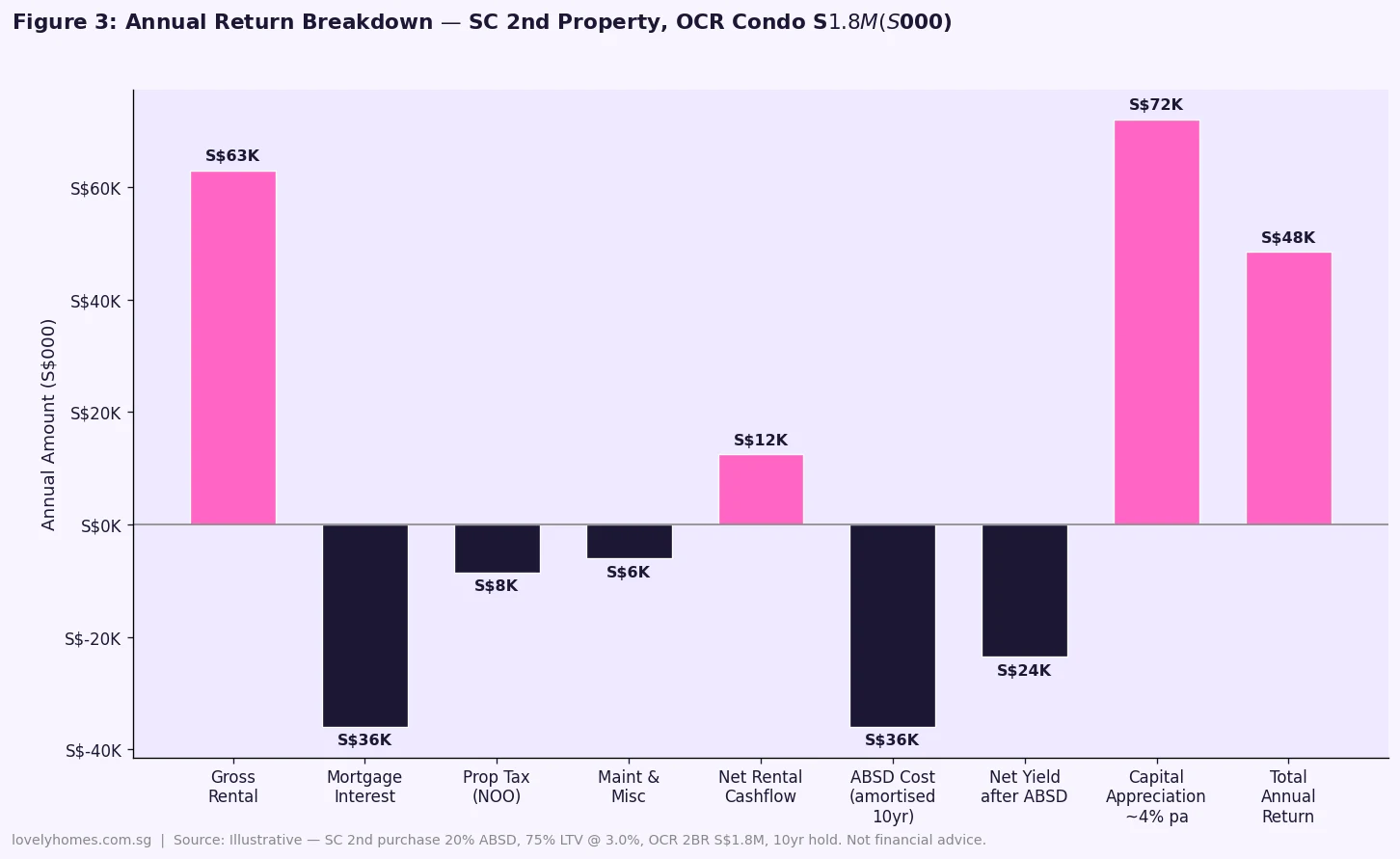
The chart below deconstructs every component of annual return for a Singapore Citizen buying a second property — a 2-bedroom OCR condominium at S$1,800,000 — showing precisely where income is earned and where costs erode it.

Net annual return breakdown Singapore OCR condo investment S$1.8 million 2026 waterfall chart
Figure 3: Annual return breakdown — SC 2nd property, OCR condo S$1.8M, 10-year hold, 75% LTV @ 3.0% pa. Pink bars = inflows; navy bars = costs. Source: LovelyHomes analysis based on URA market data. Illustrative only; not financial advice.

Gross rent at 3.5% yields S$63,000 per year. Mortgage interest on a S$1.35 million loan at 3.0% costs S$40,500. Non-owner-occupied property tax on an annual value of approximately S$63,000 costs around S$8,500. Maintenance fees and miscellaneous outgoings run another S$6,000 per year. That leaves a net rental cashflow of S$8,000 — barely 0.5% of the purchase price — before ABSD is factored in.

Amortised over a 10-year hold, the S$360,000 ABSD costs S$36,000 per year in opportunity cost. Subtracted from the S$8,000 net rental cashflow, the investor is running at S$28,000 negative annually from operations. Capital appreciation at 4% per annum on S$1.8M generates approximately S$72,000 per year in theoretical gain — rescuing the total return to roughly S$44,000 per year, or about 2.5% on purchase price. For comparison, the 10-year SGS bond yield in mid-2026 stood at approximately 3.0%, and S-REITs were distributing 5.5%–6.5% per annum. The risk-adjusted case for a second-property investment in Singapore demands real conviction in the capital-appreciation story.

Investment Strategies for 2026

Four broad strategies align with different investor profiles and risk appetites in the current environment.

Buy-to-let for income: Best suited to HDB flats (SC first purchase, mature estates near MRT) or OCR condominiums (first-time private buyer). Mature-estate HDB flats in Queenstown, Toa Payoh, and Bishan generate 4.0%–4.5% gross yields with low vacancy risk. Private condos in high-demand OCR rental catchments — near international schools, tech corridors, or major employment hubs — support consistent 3.3%–3.8% gross yields.

Capital-gain strategy via HDB-to-private upgrade: SC couples who sell their HDB flat and buy a private condominium as their primary residence pay zero ABSD on the private purchase and face no LTV penalty from an existing loan. This is structurally the most efficient entry into private property appreciation, and has driven OCR capital gains for over two decades.

En bloc positioning: Buying into an older, low-plot-ratio freehold property in a redevelopment-ready location — Greater Southern Waterfront fringe, Orchard/Newton corridor, or established OCR growth nodes — can deliver outsized capital gains if a collective sale proceeds. The trade-off is timeline uncertainty of 12–24 months and the 80% or 90% consent threshold. See our En Bloc Sale Guide 2026 for the full process and legal framework.

S-REITs — indirect exposure without ABSD: Singapore-listed REITs provide diversified property exposure across industrial, retail, logistics, and hospitality sectors, currently yielding 5.5%–6.5% annually. They are listed on SGX, liquid, and accessible from one lot. For income-focused investors who cannot justify the ABSD cost of direct second-property ownership, a portfolio of S-REITs is a compelling alternative — though it sacrifices the leverage and direct asset-selection advantages of physical property.

Financing: TDSR, LTV, and the Second-Property Rules

The Monetary Authority of Singapore (MAS) enforces the Total Debt Servicing Ratio (TDSR) across all property-linked loans. Monthly debt obligations — the new mortgage plus all existing commitments — must not exceed 55% of verified gross monthly income. For second-property investors, the binding constraint is often TDSR rather than ABSD alone.

Loan-to-Value rules compound this. With no outstanding loan, the bank LTV is 75% (meaning 25% downpayment, of which minimum 5% must be cash). With one outstanding loan — a common scenario for SC investors still servicing an HDB mortgage — the LTV on the new private loan drops to 45%, requiring a 55% downpayment. On a S$1.8M property, that is S$990,000 in equity required before ABSD, BSD, or legal fees are counted.

Note that ABSD cannot be paid with CPF. Only cash funds may be used. BSD may be paid from CPF Ordinary Account. These rules constrain the investable universe to buyers with substantial liquid savings beyond their CPF holdings.

What Might Come Next

The record GLS Confirmed List of 9,320 units for 2026 — the largest in the programme’s modern history — will translate into completions primarily in 2028–2030. Rental yields may compress modestly in 2027 as this wave of new supply enters the leasing market, particularly in the OCR and RCR segments where GLS activity is heaviest. Short-term investors entering at today’s prices face this headwind.

Interest rates are trending lower. The US Federal Reserve is expected to cut two to three times in 2026, pulling SORA from approximately 3.6% toward 2.8% by year-end. Lower financing costs improve net yields and could re-activate demand across all private segments. The full Q2 2026 URA private residential statistics, expected on 24 July 2026, will provide the most comprehensive data signal of whether the flash +0.5% figure holds across all sub-segments.

There is no credible expectation that ABSD rates will be reduced in the near term. MND has consistently signalled that housing affordability remains a priority concern, and any ABSD reduction risks reigniting the demand surge the 2023 measures were designed to prevent.

Frequently Asked Questions

Can I use CPF Ordinary Account funds to pay ABSD?

No. ABSD must be paid entirely in cash within 14 days of exercising the Option to Purchase. CPF Ordinary Account funds may be used for BSD, downpayments, and monthly mortgage instalments, but not for ABSD. This is a material liquidity constraint — buyers must hold sufficient cash above and beyond their CPF balances before committing to a second-property purchase.

Is there any ABSD remission for investors selling an existing property?

The ABSD remission for SC married couples allows a full ABSD refund on a second property if the first is sold within six months of the new property’s purchase date (completed property) or TOP (new launch). This is designed for the buy-before-sell upgrade path, not for investors who intend to retain both properties. There is no investor-specific ABSD waiver as at July 2026. Married SC/PR couples may apply for ABSD remission at the SC rate if the SC spouse is the sole or joint purchaser.

How does the TDSR apply to investment properties?

The TDSR applies equally to investment and owner-occupied residential properties. All monthly loan obligations must not exceed 55% of verified gross monthly income. Rental income from the investment property may be counted at a 70% haircut if you have evidence of existing rental receipts, but prospective rent from a newly purchased property is generally excluded. The TDSR is enforced by the MAS and applies to all financial institutions regulated in Singapore.

Is rental income from Singapore property taxable?

Yes. Net rental income is taxable as part of your assessable income under the Income Tax Act administered by IRAS. Net rental income is gross rent less allowable deductions: mortgage interest, agent commissions, property maintenance, fire insurance, property tax, and statutory depreciation on furniture and fittings (at 25% of monthly rent). Singapore residents pay progressive rates from 0% to 24%; non-residents pay a flat 24%. Rental income must be declared in your annual IRAS tax return by 15 April each year. Full guidance is available at iras.gov.sg.

Can foreigners buy investment property in Singapore?

Foreigners may purchase non-landed private residential property (condominiums and apartments). However, the 65% ABSD rate makes this prohibitively expensive for most investment theses — on a S$2M condominium, ABSD alone is S$1.3M. Foreigners cannot purchase HDB flats and require SLA written approval for landed property. Commercial property (shophouses, office, retail, industrial) is exempt from residential ABSD and remains fully open to foreign ownership, which is why shophouses continue to attract significant foreign institutional capital.

Are S-REITs a better investment than direct property?

S-REITs offer higher current yields (5.5%–6.5% in 2026), full liquidity (SGX-listed), no ABSD, and no minimum investment beyond one lot. The trade-off is that you do not select individual properties, you bear equity market volatility and interest-rate sensitivity, and capital appreciation is driven by unit-price movements rather than specific deals. For income-focused investors who cannot justify the ABSD cost of direct second-property ownership, a diversified S-REIT portfolio typically produces better risk-adjusted returns than a single leveraged property — though it sacrifices the leverage and bespoke asset-selection advantages of direct ownership.

Should I buy now or wait for the GLS supply to affect prices?

The record 9,320-unit GLS Confirmed List for 2026 translates into completions primarily in 2028–2030 — not an immediate price shock. Rental markets may soften from 2027 as supply arrives, particularly OCR/RCR. Short-term investors (3–5 year horizon) face elevated risk of entry-price headwinds from this supply wave. Long-term investors (8–10+ years) have historically found most Singapore entry points acceptable, as prices have recovered from every supply-driven moderation since 2013. Monitor the full Q2 2026 URA statistics (24 July 2026) and the October 2026 GLS announcement before committing.

Worked Example: SC Upgrader Buys OCR Investment Condo

Mr Tan, SC, 45, earns S$18,000 per month. He and his wife own a fully paid-up HDB flat in Bishan. He wishes to purchase an OCR 2-bedroom condominium in Tampines at S$1,800,000 as a 10-year investment.

Upfront costs: BSD S$56,600 (CPF OA) • ABSD 20% S$360,000 (cash only) • 25% downpayment: S$90,000 cash + S$360,000 CPF • Bank loan 75% LTV S$1,350,000 @ 3.0% 30 years = S$5,691/mth • TDSR 31.6% ✓ • Legal fees S$5,500. Total outlay: approximately S$455,500 cash + S$416,600 CPF.

Annual returns: Gross rent 3.5% = S$63,000 • Less mortgage interest (3.0% × S$1.35M) = S$40,500 • Less NOO property tax = S$7,560 • Less maintenance S$450/mth = S$5,400 • Less insurance and misc = S$1,200. Net rental cashflow: S$8,340/yr (0.5%). Less ABSD amortised over 10 years = S$36,000. Net yield after ABSD: −S$27,660/yr. Assumed capital appreciation 4% pa = S$72,000/yr. Estimated total annual return: S$44,340 (~2.5% pa on purchase price).

At a 10-year exit (no SSD having held more than three years), assuming 4% pa compound growth, the property is worth approximately S$2.66M — a S$860,000 gross capital gain. Less total ABSD (S$360,000), less selling costs (~S$36,000), less cumulative negative operating cashflow (approximately S$276,000 over 10 years): net 10-year return roughly S$188,000 on S$455,500 cash outlay. That is approximately 41% cumulative or 3.5% CAGR on cash invested. Compelling only if the 4% capital appreciation assumption holds across the entire decade.

Related Articles

Disclaimer: This article is for general information only and does not constitute financial, investment, or legal advice. Property investment involves risk, including possible loss of capital. Yield and appreciation figures are illustrative estimates based on historical and current market data; future performance may differ materially. ABSD rates, BSD schedules, and financing rules are correct as at 11 July 2026 but are subject to change by the relevant Singapore authorities. Readers should consult a licensed financial adviser or mortgage broker and conduct independent due diligence before making any investment decision. For official ABSD/BSD rates, refer to IRAS at iras.gov.sg. For market transaction data and GLS information, refer to URA at ura.gov.sg.

×
Enlarged view
Click anywhere to close

Translate »